A civil engineer turned writer, the girl of 22 set off the journey to freelance content creating since 2019. The impact she could make in people's lives acted as the fuel and the journey still continues in high spirits. This young thrashing blood offers 100% conversion guaranteed contents to your business. Throw brickbats or bouquets and of course, your writing requirements to anaswara.r.s.cet@gmail.com
Reinforced cement concrete is a topic you will need to familiarise at some point, if you are into civil engineering field, agree? Well, if you were surfing on the internet for some fresh knowledge and stumbled on to here, then also welcome! Let’s learn.
What is reinforced cement concrete?
Reinforced cement concrete (RCC), a composite material has been accepted worldwide as a construction material, bridges, retaining walls, docks and harbour, airfield pavements, flyovers,multi-storey building,complexes and simple houses etc.,
Okay. now what is the importance of RCC?
Concrete is good in resisting compression but is very weak in resisting tension. Hence reinforcement is provided in the concrete wherever tensile stress is expected. The best reinforcement is steel since the tensile strength of steel is quite high and the bond between steel and concrete is good. As the elastic modulus of steel is high, for the same extension the force resisted by steel is high compared to concrete.
However in tensile zone, hair cracks in concrete are unavoidable. Reinforcements are usually in the form of mild steel or ribbed steel bars of 6 mm to 32 mm diameter. A cage of reinforcements is prepared as per the design requirements, kept in a formwork and then green concrete is poured. After the concrete hardens, the formwork is removed. The composite material of steel and concrete now called R.C.C. acts as a structural member and can resist tensile as well as compressive stresses very well.
Moving onto more technicalities, let’s sneak into the properties of RCC.
Properties of reinforced cement concrete
The properties of a good RCC are,
It should be capable of resisting expected tensile, compressive, bending and shear forces.
It should not show excessive deflection and spoil serviceability requirement.
There should be proper cover to the reinforcement, so that the corrossion is prevented.
The hair cracks developed should be within the permissible limit.
It is a good fire resistant material.
When it is fresh, it can be moulded to any desired shape and size.
Durability is very good.
R.C.C. structure can be designed to take any load.
Ingredients of RCC
1. Cement
We have seen all the details of cement in previous blogs.
These are the inert or chemically inactive materials which form the bulk of cement concrete. These aggregates are bound together by means of cement.
They can be classified into two. The selection of aggregate is based on the purpose and its maximum size.
a) Fine aggregates
The material which is passed through BIS test sieve no. 480 is called a fine aggregate. River sand is an example.
b) Course aggregates
The material which is retained on BIS test sieve no. 480 is termed as a coarse aggregate. Broken stone is and example.
3. Steel
Steel is used for reinforcement in the form of round bars of mild steel. Diameter of the steel bars used is between 6 mm to 40 mm.
4. Water
Nobody wants a description of what water is, right? Instead, let’s talk about why its significant. Water is an important ingredient because its amount determines the mixing of other ingredients in concrete.
5. Admixtures
Admixtures are ingredients other than above that are added in concrete to give it certain improved qualities or for changing different physical properties in its fresh and hardened stages. The addition of an admixture may improve the concrete with respect to its strength, hardness, workability, water-resisting power, etc.
Uses of reinforced cement concrete
It is a widely used building material. Some of its important uses are,
R.C.C. is used as a structural element, the common structural elements in a building where R.C.C. is used are
(a) footings (b) columns
(c) beams and lintels (d) chajjas, roofs, slabs and
(e)stairs
2. R.C.C. is used for the construction of storage structures like
(a) Water tanks (b) Dams
(c) Bins (d) Silos and bunkers.
3. It is used for the construction of big structures like
(a) Bridges (b) Retaining walls
(c) Docks and harbours (d) Under water structures.
4. It is used for precasting
(a) Railway sleepers (b) Electric poles
5. R.C.C. is used for constructing tall structures like,
(a) Multistorey buildings (b) Chimneys
(c) Towers
6. It is used for paving,
(a) Roads (b) Airports
7. R.C.C. is used in building atomic plants to prevent danger of radiation. For this purpose R.C.C. walls built are 1.5 m to 2.0 m thick.
Cool. You have known enough to design RCC. Whom are we waiting for?
Design of reinforced cement concrete
Design of reinforced cement concrete
A structural member made by two or more different components constructing together is called as composite structure. A reinforced concrete structure belongs to this category.
Methods 1- Working stress method
In this method, behavior of the structure is assumed to act as linearly elastic body under the action of service loads.
Assumptions of working Stress Method
1. At any cross section,plane sections before bending remains plane after bending.
2. All tensile stresses are taken up by reinforcement and none by concrete,except otherwise specially permitted.
3. stress-strain relationship of steel and concrete under working load is a straight line.
4. The modular ratio m has the value 280/3 stress (cbc) is permissible compressive stress due to bending in concrete
Keeping the assumptions in mind, let me break down the procedure of working stress method below.
Steps of working stress method
a) The stresses in an element is obtained from the working loads and compared with permissible stresses.
b) The method follows linear stress-strain behaviour of both the materials.
c) Modular ratio can be used to determine allowable stresses,
d) Ultimate load carrying capacity cannot be predicted accurately.
e) The main drawback of this method is uneconomical.
The figure shows the grade of concrete and proportions of ingredients proposed by working stress method
Grade of concrete and proportions
Advantages of working stress method
Its a simple method
The design results give a large section. Therefore, deflection and cracking is less.
The structure designed using the method gives larger serviceability
Disadvantages of working stress method
This method doesn’t show the real strength of structue. And doesn’t give real factor of safety under failure of structure.
Because of creep, the stress- strain relationship of concrete doesn’t have definite modulous of elasticity
Method- 2 Limit state method
It is the method of designing structures based on statistical concept of safety and the associated statistical probability of failure.
The structures designed should satisfy the dual criteria which are safety and serviceability.
a). Safety
It can be defined as an acceptable degree of security against complete collapse. Or, the failure the concrete structure can occur by various modes such as compression, tension, flexure, torsion, shear.
b). Serviceability
The intended structure shouldn’t deteriorate to such an extend that if fails to fullfils the function for which its built. In concrete structure, the state can be reached due to excessive deflection, cracking, vibration, corrosion of reinforcement etc.
The steps in limit state of design
a) The stresses are obtained from design loads and compared with design strength.
b) In this method,it follows linear strain relationship but not linear stress relationship.
c) The ultimate stresses of materials itself are used as allowable stresses.
d) It shall also statisfy the serviceability requirements,such as limitations on deflection and cracking
Reinforced cement concrete books
The important books for clearing all your doubts regarding RCC are,
B.C. Punmia, Limit state design of reinforced concrete, 2007
S.S. Bhavikatti, Advance R.C.C. design, 2006
Murari Lal Gambhir, Design of reinforced concrete structures, 2008
You may note that other important authors are Unnikrishnan Pillai & Devdas Menon, V.L.Shah & S.R.Karve ( Local publication in Pune), P. Dayaratnam, R.Ramamutham and N. Krishnaraju.
Also you can refer NPTEL lectures and notes which are available in internet.
Bachelor of Engineering subjects and Bachelor of Technology (B.Tech). Are they same? No, but yes. There are similarities and differences in both. The outcome of course is more or less the same, but the subjects are different. Lets look at the difference before we dive in to the BE civil engineering subjects.
Both are two different ofessional degree courses, but you get to be a civil engineer.
The universities which offer the courses are different
The subjects of both degrees are not the same. Though both contain topics that impart knowledge in civil engineering.
The course duration is same which is four years.
There is no much difference between career opportunities. All the jobs and exams offered to a BE graduate considers BE graduates and vice versa.
Now, moving on to the subjects,
BE Civil Engineering Subjects-Semester – 1
COMMUNICATIVE ENGLISH
Objectives
• To develop the basic reading and writing skills of first year engineering and technology students.
• To help learners develop their listening skills, which will, enable them listen to lectures and comprehend them by asking questions; seeking clarifications.
• To help learners develop their speaking skills and speak fluently in real contexts.
• To help learners develop vocabulary of a general kind by developing their reading skills
Outcomes
At the end of the course, learners will be able to:
• Read articles of a general kind in magazines and newspapers.
• Participate effectively in informal conversations; introduce themselves and their friends and express opinions in English.
• Comprehend conversations and short talks delivered in English
• Write short essays of a general kind and personal letters and emails in English.
BE civil Engineering Subjects – Text books
1. Richards, C. Jack. Interchange Students’ Book-2 New Delhi: CUP, 2015.
2. Bailey, Stephen. Academic Writing: A practical guide for students. New York: Rutledge,2011
ENGINEERING MATHEMATICS– I
Objectives
• The goal of this course is to achieve conceptual understanding and to retain the best traditions of traditional calculus. The syllabus is designed to provide the basic tools of calculus mainly for the purpose of modelling the engineering problems mathematically and obtaining solutions.
Outcomes
After completing this course, students should demonstrate competency in the following skills:
• Use both the limit definition and rules of differentiation to differentiate functions.
• Apply differentiation to solve maxima and minima problems.
• Evaluate integrals both by using Riemann sums and by using the Fundamental Theorem of Calculus.
• Apply integration to compute multiple integrals, area, volume, integrals in polar coordinates, in addition to change of order and change of variables.
• Evaluate integrals using techniques of integration, such as substitution, partial fractions and integration by parts.
• Determine convergence/divergence of improper integrals and evaluate convergent improper integrals.
• Apply various techniques in solving differential equations.
2. Anton, H, Bivens, I and Davis, S, “Calculus”, Wiley, 10th Edition, 2016.
ENGINEERING PHYSICS
Objectives
• To enhance the fundamental knowledge in Physics and its applications relevant to various streams of Engineering and Technology.
Outcomes
Upon completion of this course,
• The students will gain knowledge on the basics of properties of matter and its applications,
• The students will acquire knowledge on the concepts of waves and optical devices and their applications in fibre optics,
• The students will have adequate knowledge on the concepts of thermal properties of materials and their applications in expansion joints and heat exchangers,
• The students will get knowledge on advanced physics concepts of quantum theory and its applications in tunneling microscopes, and
• The students will understand the basics of crystals, their structures and different crystal growth techniques.
BE civil Engineering Subjects – Text books
1. Bhattacharya, D.K. & Poonam, T. “Engineering Physics”. Oxford University Press, 2015.
2. Halliday, D., Resnick, R. & Walker, J. “Principles of Physics”. Wiley, 2015.
ENGINEERING CHEMISTRY
Objectives
• To make the students conversant with boiler feed water requirements, related problems and water treatment techniques
• To develop an understanding of the basic concepts of phase rule and its applications to single and two component systems and appreciate the purpose and significance of alloys.
• Preparation, properties and applications of engineering materials.
• Types of fuels, calorific value calculations, manufacture of solid, liquid and gaseous fuels.
• Principles and generation of energy in batteries, nuclear reactors, solar cells, wind mills and fuel cells.
Outcomes
• The knowledge gained on engineering materials, fuels, energy sources and water treatment techniques will facilitate better understanding of engineering processes and applications for further learning.
BE civil Engineering Subjects – Text books
1. S. S. Dara and S. S. Umare, “A Textbook of Engineering Chemistry”, S. Chand & Company LTD, New Delhi, 2015 2. P. C. Jain and Monika Jain, “Engineering Chemistry” Dhanpat Rai Publishing Company (P) LTD, New Delhi, 2015
2. Friedrich Emich, “Engineering Chemistry”, Scientific International PVT, LTD, New Delhi, 2014.
PROBLEM SOLVING AND PYTHON PROGRAMMING
Objectives
• To know the basics of algorithmic problem solving
• To read and write simple Python programs.
• To develop Python programs with conditionals and loops.
• To define Python functions and call them.
• To use Python data structures –- lists, tuples, dictionaries.
• To do input/output with files in Python.
Outcomes
• Develop algorithmic solutions to simple computational problems
• Read, write, execute by hand simple Python programs.
• Structure simple Python programs for solving problems.
• Decompose a Python program into functions.
• Represent compound data using Python lists, tuples, dictionaries.
• Read and write data from/to files in Python Programs.
BE civil Engineering Subjects – Text books
1. Allen B. Downey, “Think Python: How to Think Like a Computer Scientist’’, 2nd edition, Updated for Python 3, Shroff/O’Reilly Publishers, 2016 (http://greenteapress.com/wp/thinkpython/)
2. Charles Dierbach, “Introduction to Computer Science using Python: A Computational
ENGINEERING GRAPHICS
Objectives
• To develop in students, graphic skills for communication of concepts, ideas and design of engineering products.
• To expose them to existing national standards related to technical drawings.
Outcomes
On successful completion of this course, the student will be able to
• Familiarize with the fundamentals and standards of Engineering graphics
• Perform freehand sketching of basic geometrical constructions and multiple views of objects.
• Project orthographic projections of lines and plane surfaces.
• Draw projections and solids and development of surfaces.
• Visualize and to project isometric and perspective sections of simple solids.
BE civil Engineering Subjects – Text books
1. Natrajan K.V., “A text book of Engineering Graphics”, Dhanalakshmi Publishers, Chennai, 2009.
2. Basant Agarwal and Agarwal C.M., “Engineering Drawing”, Tata McGraw Hill Publishing Company Limited, New Delhi, 2008.
PROBLEM SOLVING AND PYTHON PROGRAMMING LABORATORY
Objectives
• To write, test, and debug simple Python programs.
• To implement Python programs with conditionals and loops.
• Use functions for structuring Python programs.
• Represent compound data using Python lists, tuples, dictionaries.
• Read and write data from/to files in Python.
Outcomes
Upon completion of the course, students will be able to
• Write, test, and debug simple Python programs.
• Implement Python programs with conditionals and loops.
• Develop Python programs step-wise by defining functions and calling them.
• Use Python lists, tuples, dictionaries for representing compound data.
• Read and write data from/to files in Python.
PHYSICS AND CHEMISTRY LABORATORY
Objectives
• To introduce different experiments to test basic understanding of physics concepts applied in optics, thermal physics, properties of matter and liquids.
Outcomes
Upon completion of the course, the students will be able to
• Apply principles of elasticity, optics and thermal properties for engineering applications.
CHEMISTRY LABORATORY
Objectives
• To make the student to acquire practical skills in the determination of water quality parameters through volumetric and instrumental analysis.
• To acquaint the students with the determination of molecular weight of a polymer by viscometery.
Outcomes
• The students will be outfitted with hands-on knowledge in the quantitative chemical analysis of water quality related parameters.
BE civil Engineering Subjects – Text books
1. Vogel’s Textbook of Quantitative Chemical Analysis (8TH edition, 2014)
BE Civil Engineering Subjects-Semester – 2
TECHNICAL ENGLISH
Objectives
The Course prepares second semester engineering and Technology students to:
• Develop strategies and skills to enhance their ability to read and comprehend engineering and technology texts.
• Foster their ability to write convincing job applications and effective reports.
• Develop their speaking skills to make technical presentations , participate in group discussions.
• Strengthen their listening skill which will help them comprehend lectures and talks in their areas
Outcomes
At the end of the course learners will be able to:
• Read technical texts and write area- specific texts effortlessly.
• Listen and comprehend lectures and talks in their area of specialisation successfully.
• Speak appropriately and effectively in varied formal and informal contexts.
• Write reports and winning job applications.
BE civil Engineering Subjects – Text books
1. Board of editors. Fluency in English A Course book for Engineering and Technology. Orient Blackswan, Hyderabad: 2016
2. Booth-L. Diana, Project Work, Oxford University Press, Oxford: 2014.
ENGINEERING MATHEMATICS
Objectives
• This course is designed to cover topics such as Matrix Algebra, Vector Calculus, Complex Analysis and Laplace Transform. Matrix Algebra is one of the powerful tools to handle practical problems arising in the field of engineering.
Outcomes
After successfully completing the course, the student will have a good understanding of the following topics and their applications:
• Eigenvalues and eigenvectors, diagonalization of a matrix, Symmetric matrices, Positive definite matrices and similar matrices.
• Gradient, divergence and curl of a vector point function and related identities.
• Evaluation of line, surface and volume integrals using Gauss, Stokes and Green’s theorems and their verification.
• Analytic functions, conformal mapping and complex integration.
• Laplace transform and inverse transform of simple functions, properties, various related theorems and application to differential equations with constant coefficients.
2. Bali N., Goyal M. and Watkins C., “Advanced Engineering Mathematics”, Firewall Media (An imprint of Lakshmi Publications Pvt., Ltd.,), New Delhi, 7th Edition, 2009.
PHYSICS FOR CIVIL ENGINEERING
Objectives
• To introduce the principles of thermal, acoustics, optics and new materials for civil engineering applications.
Outcomes
Upon completion of this course, the students will,
• Have knowledge on the thermal performance of buildings,
• Acquire knowledge on the acoustic properties of buildings,
• Get knowledge on various lighting designs for buildings,
• Gain knowledge on the properties and performance of engineering materials, and
• Understand the hazards of buildings.
BE civil Engineering Subjects – Text books
1. Alexander, D. “Natural disaster”, Springer (1993).
2. Gaur R.K. and Gupta S.L., Engineering Physics. Dhanpat Rai publishers, 2012.
BASIC ELECTRICAL AND ELECTRONICS ENGINEERING
Objectives
• To explain the basic theorems used in Electrical circuits and the different components and function of electrical machines.
• To explain the fundamentals of semiconductor and applications.
• To explain the principles of digital electronics • To impart knowledge of communication.
Outcomes
• Ability to identify the electrical components and explain the characteristics of electrical machines.
• Ability to identify electronics components and understand the characteristics
BE civil Engineering Subjects – Text books
1. D P Kothari and I.J Nagarath, ”Electrical Machines “Basic Electrical and Electronics Engineering”, McGraw Hill Education(India) Private Limited, Third Reprint ,2016
2. A.E. Fitzgerald, David E Higginbotham and Arvin Grabel, “Basic Electrical Engineering”, McGraw Hill Education(India) Private Limited, 2009
ENVIRONMENTAL SCIENCE AND ENGINEERING
Objectives
• To study the nature and facts about environment.
• To finding and implementing scientific, technological, economic and political solutions to environmental problems.
• To study the interrelationship between living organism and environment.
• To appreciate the importance of environment by assessing its impact on the human world; envision the surrounding environment, its functions and its value.
• To study the dynamic processes and understand the features of the earth s interior and surface.
• To study the integrated themes and biodiversity, natural resources, pollution control, and waste management.
Outcomes
• Environmental Pollution or problems cannot be solved by mere laws. Public participation is an important aspect which serves the environmental Protection. One will obtain knowledge on the following after completing the course.
• Public awareness of environmental is at infant stage.
• Ignorance and incomplete knowledge has lead to misconceptions
• Development and improvement in std. of living has lead to serious environmental disasters
BE civil Engineering Subjects – Text books
1. Benny Joseph, ‘Environmental Science and Engineering’, Tata McGraw-Hill, New Delhi, 2006.
2. Dharmendra S. Sengar, ‘Environmental law’, Prentice hall of India Pvt Ltd, New Delhi, 2007.
ENGINEERING MECHANICS
Objectives
• To develop capacity to predict the effect of force and motion in the course of carrying out the design functions of engineering.
Textbooks that be referred
Beer, F.P and Johnston Jr. E.R., “Vector Mechanics for Engineers (In SI Units): Statics and Dynamics”, 8th Edition, Tata McGraw-Hill Publishing company, New Delhi (2004).
2. Bhavikatti, S.S and Rajashekarappa, K.G., “Engineering Mechanics”, New Age International (P) Limited Publishers, 1998.
ENGINEERING PRACTICES LABORATORY
Objectives
• To provide exposure to the students with hands on experience on various basic engineering practices in Civil, Mechanical, Electrical and Electronics Engineering.
Outcomes
On successful completion of this course, the student will be able to
• Fabricate carpentry components and pipe connections including plumbing works.
• Use welding equipments to join the structures.
• Carry out the basic machining operations
• Make the models using sheet metal works
• Illustrate on centrifugal pump, Air conditioner, operations of smithy, foundary and fittings
• Carry out basic home electrical works and appliances
• Measure the electrical quantities
• Elaborate on the components, gates, soldering practices.
• To introduce the students to draft the plan, elevation and sectional views of buildings in accordance with development and control rules satisfying orientation and functional requirements as per National Building Code.
Outcomes
• The students will be able to draft the plan, elevation and sectional views of the buildings, industrial structures, and framed buildings using computer softwares.
BE civil Engineering Subjects – Text books
1. Sikka V.B., A Course in Civil Engineering Drawing, 4th Edition, S.K.Kataria and Sons, 2015.
2. Chuck Eastman, Paul Teicholz, Rafael Sacks, Kathleen Liston, BIM Handbook:A Guide to building information modeling for Owners, Managers, Designers, Engineers, and Contractors, John Wiley and Sons. Inc.,2011.
BE Civil Engineering Subjects-Semester – 3
TRANSFORMS AND PARTIAL DIFFERENTIAL EQUATIONS
Objectives
• To introduce the basic concepts of PDE for solving standard partial differential equations.
• To introduce Fourier series analysis which is central to many applications in engineering apart from its use in solving boundary value problems.
• To acquaint the student with Fourier series techniques in solving heat flow problems used in various situations.
• To acquaint the student with Fourier transform techniques used in wide variety of situations.
• To introduce the effective mathematical tools for the solutions of partial differential equations that model several physical processes and to develop Z transform techniques for discrete time systems.
Outcomes
• Understand how to solve the given standard partial differential equations.
• Solve differential equations using Fourier series analysis which plays a vital role in engineering applications.
• Appreciate the physical significance of Fourier series techniques in solving one and two dimensional heat flow problems and one dimensional wave equations.
• Understand the mathematical principles on transforms and partial differential equations would provide them the ability to formulate and solve some of the physical problems of engineering.
• Use the effective mathematical tools for the solutions of partial differential equations by using Z transform techniques for discrete time systems.
2. Andrews, L.C and Shivamoggi, B, “Integral Transforms for Engineers” SPIE Press, 1999.
STRENGTH OF MATERIALS I
Objectives
• To learn the fundamental concepts of Stress, Strain and deformation of solids.
• To know the mechanism of load transfer in beams, the induced stress resultants and deformations.
• To understand the effect of torsion on shafts and springs.
• To analyze plane and space trusses
Outcomes
Students will be able to
• Understand the concepts of stress and strain, principal stresses and principal planes.
• Determine Shear force and bending moment in beams and understand concept of theory of simple bending.
• Calculate the deflection of beams by different methods and selection of method for determining slope or deflection.
• Apply basic equation of torsion in design of circular shafts and helical springs, .
• Analyze the pin jointed plane and space trusses
BE civil Engineering Subjects – Text books
1. Rajput.R.K. “Strength of Materials”, S.Chand and Co, New Delhi, 2015.
2. Timoshenko.S.B. and Gere.J.M, “Mechanics of Materials”, Van Nos Reinbhold, New Delhi 1999.
FLUID MECHANICS
Objectives
• To understand the basic properties of the fluid, fluid kinematics, fluid dynamics and to analyze and appreciate the complexities involved in solving the fluid flow problems.
Outcomes
At the end of the course students will be able to
• Get a basic knowledge of fluids in static, kinematic and dynamic equilibrium.
• Understand and solve the problems related to equation of motion.
• Gain knowledge about dimensional and model analysis.
• Learn types of flow and losses of flow in pipes.
• Understand and solve the boundary layer problems.
BE civil Engineering Subjects – Text books
1. Modi P.N and Seth “Hydraulics and Fluid Mechanics including Hydraulic Machines”, Standard Book House New Delhi, 2009.
2. Streeter, V.L., and Wylie, E.B., “Fluid Mechanics”, McGraw Hill, 2000.
• To introduce students to various materials commonly used in civil engineering construction and their properties.
Outcomes
On completion of this course the students will be able to
• Compare the properties of most common and advanced building materials.
• Understand the typical and potential applications of lime, cement and aggregates
• know the production of concrete and also the method of placing and making of concrete elements.
• Understand the applications of timbers and other materials
• Understand the importance of modern material for construction.
BE civil Engineering Subjects – Text books
1.Varghese.P.C, “Building Materials”, PHI Learning Pvt. Ltd, New Delhi, 2015.
2. Jagadish.K.S, “Alternative Building Materials Technology”, New Age International, 2007.
ENGINEERING GEOLOGY
Objectives
• At the end of this course the students will be able to understand the importance of geological knowledge such as earth, earthquake, volcanism and to apply this knowledge in projects such as dams, tunnels, bridges, roads, airport and harbor.
Outcomes
The students completing this course
• Will be able to understand the importance of geological knowledge such as earth, earthquake, volcanism and the action of various geological agencies.
• Will get basics knowledge on properties of minerals.
• Gain knowledge about types of rocks, their distribution and uses.
• Will understand the methods of study on geological structure.
• Will understand the application of geological investigation in projects such as dams, tunnels, bridges, roads, airport and harbor
BE civil Engineering Subjects – Text books
1. Varghese, P.C., Engineering Geology for Civil Engineering Prentice Hall of India Learning Private Limited, New Delhi, 2012.
2. Blyth F.G.H. and de Freitas M.H., Geology for Engineers, Edward Arnold, London, 2010.
CONSTRUCTION MATERIALS LABORATORY
Objectives
• To facilitate the understanding of the behavior of construction materials.
Outcomes
• The students will have the required knowledge in the area of testing of construction materials and components of construction elements experimentally.
BE civil Engineering Subjects – Text books
1. Construction Materials Laboratory Manual, Anna University, Chennai-600 025.
SURVEYING LABORATORY
Objectives
• At the end of the course the student will posses knowledge about Survey field techniques
Outcomes
• Students completing this course would have acquired practical knowledge on handling basic survey instruments including Theodolite, Tacheometry, Total Station and GPS and have adequate knowledge to carryout Triangulation and Astronomical surveying including general field marking for various engineering projects and Location of site etc.
INTERPERSONAL SKILLS/LISTENING AND SPEAKING
Objectives
The Course will enable learners to:
• Equip students with the English language skills required for the successful undertaking of academic studies with primary emphasis on academic speaking and listening skills.
• Provide guidance and practice in basic general and classroom conversation and to engage in specific academic speaking activities.
• Improve general and academic listening skills
• Make effective presentations.
Outcomes
At the end of the course Learners will be able to:
• Listen and respond appropriately.
• Participate in group discussions
• Make effective presentations
• Participate confidently and appropriately in conversations both formal and informal
BE civil Engineering Subjects – Text books
1. Brooks, Margret. Skills for Success. Listening and Speaking. Level 4 Oxford University Press, Oxford: 2011.
2. Bhatnagar, Nitin and MamtaBhatnagar. Communicative English for Engineers and Professionals. Pearson: New Delhi, 2010.
BE Civil Engineering Subjects-Semester – 4
NUMERICAL METHODS
Objectives
• To introduce the basic concepts of solving algebraic and transcendental equations.
• To introduce the numerical techniques of interpolation in various intervals in real life situations.
• To acquaint the student with understanding of numerical techniques of differentiation and integration which plays an important role in engineering and technology disciplines.
• To acquaint the knowledge of various techniques and methods of solving ordinary differential equations.
• To understand the knowledge of various techniques and methods of solving various types of partial differential equations.
Outcomes
• Understand the basic concepts and techniques of solving algebraic and transcendental equations.
• Appreciate the numerical techniques of interpolation and error approximations in various intervals in real life situations.
• Apply the numerical techniques of differentiation and integration for engineering problems.
• Understand the knowledge of various techniques and methods for solving first and second order ordinary differential equations.
• Solve the partial and ordinary differential equations with initial and boundary conditions by using certain techniques with engineering applications.
2. Brian Bradie, “A Friendly Introduction to Numerical Analysis”, Pearson Education, Asia, New Delhi, 2007.
CONSTRUCTION TECHNIQUES AND PRACTICES Objectives
• The main objective of this course is to make the student aware of the various construction techniques, practices and equipment needed for different types of construction activities.
Outcomes
• To know the different construction techniques and structural systems
• Understand various techniques and practices on masonry construction, flooring, and roofing.
• Plan the requirements for substructure construction.
• Know the methods and techniques involved in the construction of various types of super structures
• Select, maintain and operate hand and power tools and equipment used in the building construction sites.
BE civil Engineering Subjects – Text books
1. eurifoy, R.L., Ledbetter, W.B. and Schexnayder, C., “Construction Planning, Equipment and Methods”, 5th Edition, McGraw Hill, Singapore, 1995.
2. Jha J and Sinha S.K., “Construction and Foundation Engineering”, Khanna Publishers,
STRENGTH OF MATERIALS II
Objectives
• To know the method of finding slope and deflection of beams and trusses using energy theorems and to know the concept of analysing indeterminate beam
• To estimate the load carrying capacity of columns, stresses due to unsymmetrical bending and various theories for failure of material.
Outcomes
Students will be able to,
• Determine the strain energy and compute the deflection of determinate beams, frames and trusses using energy principles.
• Analyze propped cantilever, fixed beams and continuous beams using theorem of three moment equation for external loadings and support settlements.
• Find the load carrying capacity of columns and stresses induced in columns and cylinders
• Determine principal stresses and planes for an element in three dimensional state of stress and study various theories of failure
• Determine the stresses due to Unsymmetrical bending of beams, locate the shear center, and find the stresses in curved beams.
BE civil Engineering Subjects – Text books
1. Rajput R.K. “Strength of Materials (Mechanics of Solids)”, S.Chand & company Ltd., New Delhi, 2015.
• To introduce the students to various hydraulic engineering problems like open channel flows and hydraulic machines. At the completion of the course, the student should be able to relate the theory and practice of problems in hydraulic engineering.
Outcomes
• Apply their knowledge of fluid mechanics in addressing problems in open channels.
• Able to identify a effective section for flow in different cross sections.
• To solve problems in uniform, gradually and rapidly varied flows in steady state conditions
• Understand the principles, working and application of turbines.
• Understand the principles, working and application of pumps
BE civil Engineering Subjects – Text books
Subramanya.K ,”Flow in open channels”, Tata McGraw Hill, New Delhi, 2000.
2. Ven Te Chow, “Open Channel Hydraulics”, McGraw Hill, New York, 2009.
CONCRETE TECHNOLOGY
Objectives
• To impart knowledge to the students on the properties of materials for concrete by suitable tests, mix design for concrete and special concretes.
Outcomes
Students will be able to understand,
• The various requirements of cement, aggregates and water for making concrete
• The effect of admixtures on properties of concrete
• The concept and procedure of mix design as per IS method
• The properties of concrete at fresh and hardened state
• The importance and application of special concretes.
BE civil Engineering Subjects – Text books
1. Gupta.B.L., Amit Gupta, “Concrete Technology”, Jain Book Agency, 2010.
• To impart knowledge to classify the soil based on index properties and to assess their engineering properties based on the classification. To familiarize the students about the fundamental concepts of compaction, flow through soil, stress transformation, stress distribution, consolidation and shear strength of soils.
Outcomes
Students will be able to
• Classify the soil and assess the engineering properties, based on index properties.
• Understand the stress concepts in soils
• Understand and identify the settlement in soils.
• Determine the shear strength of soil
• Analyze both finite and infinite slopes.
BE civil Engineering Subjects – Text books
1. Murthy, V.N.S., “Text book of Soil Mechanics and Foundation Engineering”, CBS Publishers Distribution Ltd., New Delhi. 2014
2. McCarthy, D.F., “Essentials of Soil Mechanics and Foundations: Basic Geotechnics”. Prentice-Hall, 2006.
STRENGTH OF MATERIALS LABORATORY
Objectives
• To expose the students to the testing of different materials under the action of various forces and determination of their characteristics experimentally.
Outcomes
• The students will have the required knowledge in the area of testing of materials and components of structural elements experimentally.
BE civil Engineering Subjects – Text books
1. Strength of Materials Laboratory Manual, Anna University, Chennai – 600 025.
2. IS1786-2008 (Fourth Revision, Reaffirmed 2013), ‘High strength deformed bars and wires for concrete reinforcement – Specification’, 2008.
HYDRAULIC ENGINEERING LABORATORY
Objectives
• Students should be able to verify the principles studied in theory by performing the experiments in lab.
Outcomes
• The students will be able to measure flow in pipes and determine frictional losses.
• The students will be able to develop characteristics of pumps and turbines.
BE civil Engineering Subjects – Text books
1. Sarbjit Singh.”Experiments in Fluid Mechanics”, Prentice Hall of India Pvt. Ltd, Learning Private Limited, Delhi, 2009.
2. “Hydraulic Laboratory Manual”, Centre for Water Resources, Anna University, 2004.
ADVANCED READING AND WRITING
Objectives
• Strengthen the reading skills of students of engineering.
• Enhance their writing skills with specific reference to technical writing.
• Develop students’ critical thinking skills.
• Provide more opportunities to develop their project and proposal writing skills.
Outcomes
At the end of the course Learners will be able to:
• Write different types of essays.
• Write winning job applications.
• Read and evaluate texts critically.
• Display critical thinking in various professional contexts.
BE civil Engineering Subjects – Text books
1. Gramer F. Margot and Colin S. Ward Reading and Writing (Level 3) Oxford University Press: Oxford, 2011
2. Davis, Jason and Rhonda LIss.Effective Academic Writing (Level 3) Oxford University Press: Oxford, 2006
BE Civil Engineering Subjects-Semester – 5
DESIGN OF REINFORCED CEMENT CONCRETE ELEMENTS
Objectives
• To introduce the different types of philosophies related to design of basic structural elements such as slab, beam, column and footing which form part of any structural system with reference to Indian standard code of practice.
Outcomes
Students will be able to,
• Understand the various design methodologies for the design of RC elements.
• Know the analysis and design of flanged beams by limit state method and sign of beams for shear, bond and torsion.
• Design the various types of slabs and staircase by limit state method.
• Design columns for axial, uniaxial and biaxial eccentric loadings. • Design of footing by limit state method.
BE civil Engineering Subjects – Text books
1. Varghese, P.C., “Limit State Design of Reinforced Concrete”, Prentice Hall of India, Pvt. Ltd., New Delhi, 2002.
2. Jain, A.K., “Limit State Design of RC Structures”, Nemchand Publications, Roorkee, 1998
STRUCTURAL ANALYSIS I
Objectives
• To introduce the students to basic theory and concepts of classical methods of structural analysis
Outcomes
Students will be able to,
• Analyze continuous beams, pin-jointed indeterminate plane frames and rigid plane frames by strain energy method
• Analyse the continuous beams and rigid frames by slope defection method.
• Understand the concept of moment distribution and analysis of continuous beams and rigid frames with and without sway.
• Analyse the indeterminate pin jointed plane frames continuous beams and rigid frames using matrix flexibility method.
• Understand the concept of matrix stiffness method and analysis of continuous beams, pin jointed trusses and rigid plane frames.
BE civil Engineering Subjects – Text books
1. Bhavikatti, S.S,Structural Analysis,Vol.1,& 2, Vikas Publishing House Pvt.Ltd.,NewDelhi-4, 2014.
2. Punmia. B.C, Ashok Kumar Jain & Arun Kumar Jain, Theory of structures, Laxmi Publications, New Delhi, 2004.
WATER SUPPLY ENGINEERING
Objectives
• To equip the students with the principles and design of water treatment units and distribution system.
Outcomes
The students completing the course will have,
• An insight into the structure of drinking water supply systems, including water transport, treatment, and distribution
• The knowledge in various unit operations and processes in water treatment
• An ability to design the various functional units in water treatment
• An understanding of water quality criteria and standards, and their relation to public health
• Tthe ability to design and evaluate water supply project alternatives on basis of chosen criteria.
BE civil Engineering Subjects – Text books
1. Garg, S.K. Environmental Engineering, Vol.IKhanna Publishers, New Delhi, 2010.
2. Manual on Water Supply and Treatment, CPHEEO, Ministry of Urban Development, Government of India, New Delhi, 1999.
FOUNDATION ENGINEERING
Objectives
• To impart knowledge to plan and execute a detail site investigation programme, to select geotechnical design parameters and type of foundations. Also to familiarize the students for the geotechnical design of different type of foundations and retaining walls.
Outcomes
Students will be able to,
• Understand the site investigation, methods and sampling.
• Get knowledge on bearing capacity and testing methods.
• Design shallow footings.
• Determine the load carrying capacity, settlement of Pile foundation
• Determine the earth pressure on retaining walls and analysis for stability.
BE civil Engineering Subjects – Text books
1. Murthy, V.N.S., “Text book of Soil Mechanics and Foundation Engineering”, CBS Publishers Distribution Ltd., New Delhi. 2014.
2. Braja M Das, “Principles of Foundation Engineering” (Eigth edition), Cengage Learning 2014.
SOIL MECHANICS LABORATORY
Objectives
• To develop skills to test the soils for their index and engineering properties and to characterise the soil based on their properties.
Outcomes
• Students are able to conduct tests to determine both the index and engineering properties of soils and to characterize the soil based on their properties.
BE civil Engineering Subjects – Text books
1. “Soil Engineering Laboratory Instruction Manual” published by Engineering College Cooperative Society, Anna University, Chennai, 2010.
2. Lambe T.W., “Soil Testing for Engineers”, John Wiley and Sons, New York, 1951. Digitized 2008.
WATER AND WASTE WATER ANALYSIS
Objectives
• To analyse the physical, chemical and biological characteristics of water and wastewater
• To quantify the dosage requirement for coagulation process
• To study the growth of micro-organism and its quantification
• To quantify the sludge
Outcomes
On the completion of the course, the students will be able to:
• Quantify the pollutant concentration in water and wastewater
• Suggest the type of treatment required and amount of dosage required for the treatment
• Examine the conditions for the growth of micro-organisms
SURVEY CAMP
The objective of the survey camp is to enable the students to get practical training in the field work. Groups of not more than six members in a group will carry out each exercise in survey camp. At the end of the camp, each student shall have mapped and contoured the area. The camp record shall include all original field observations, calculations and plots.
DESIGN OF STEEL STRUCTURAL ELEMENTS
Objectives
• To introduce the students to limit state design of structural steel members subjected to compressive, tensile and bending loads, including connections. Design of structural systems such as roof trusses, gantry girders as per provisions of current code (IS 800 – 2007) of practice for working stress and Limit state Method.
Outcomes
Students will be able to,
• Understand the concepts of various design philosophies
• Design common bolted and welded connections for steel structures
• Design tension members and understand the effect of shear lag.
• Understand the design concept of axially loaded columns and column base connections.
• Understand specific problems related to the design of laterally restrained and unrestrained steel beams.
BE civil Engineering Subjects – Text books
1. Subramanian.N, “Design of Steel Structures”, Oxford University Press, New Delhi, 2013.
2. Narayanan.R.et.al. “Teaching Resource on Structural Steel Design”, INSDAG, Ministry of Steel Publications, 2002
BE Civil Engineering Subjects-Semester – 6
STRUCTURAL ANALYSIS II
Objectives
• To learn the method of drawing influence lines and its uses in various applications like beams and plane trusses.
• To analyse the arches, suspension bridges and space trusses.
• Also to learn Plastic analysis of beams and rigid frames.
Outcomes
Students will be able to,
• Draw influence lines for statically determinate structures and calculate critical stress resultants.
• Understand Muller Breslau principle and draw the influence lines for statically indeterminate beams.
• Analyse of three hinged, two hinged and fixed arches.
• Analyse the suspension bridges with stiffening girders
• Understand the concept of Plastic analysis and the method of analyzing beams and rigid frames.
• The student is exposed to different phases in irrigation practices and Planning and management of irrigation. Further, they will be imparted required knowledge on Irrigation storage and distribution canal system and Irrigation management.
Outcomes
Students will be able to,
• Have knowledge and skills on crop water requirements.
• Understand the methods and management of irrigation.
• Gain knowledge on types of impounding structures
• Understand methods of irrigation including canal irrigation.
• Get knowledge on water management on optimization of water use.
BE civil Engineering Subjects – Text books
1. Dilip Kumar Majumdar, “Irrigation Water Management”, Prentice-Hall of India, New Delhi, 2008.
2. Duggal, K.N. and Soni, J.P., “Elements of Water Resources Engineering”, New Age International Publishers, 2005
HIGHWAY ENGINEERING
Objectives
• To give an overview about the highway engineering with respect to, planning, design, construction and maintenance of highways as per IRC standards, specifications and methods.
Outcomes
Students will be able to,
• Get knowledge on planning and aligning of highway.
• Geometric design of highways
• Design flexible and rigid pavements.
• Gain knowledge on Highway construction materials, properties, testing methods
• Understand the concept of pavement management system, evaluation of distress and maintenance of pavements.
BE civil Engineering Subjects – Text books
1. Khanna.S. K., Justo.C.E.G and Veeraragavan A. “Highway Engineering”, Nemchand Publishers, 2014.
2. Indian Road Congress (IRC), Guidelines for the Design of Flexible Pavements, ( Third Revision), IRC: 37-2012
WASTEWATER ENGINEERING
Objectives
• The objectives of this course is to help students develop the ability to apply basic understanding of physical, chemical, and biological phenomena for successful design, operation and maintenance of sewage treatment plants.
Outcomes
The students completing the course will have,
• An ability to estimate sewage generation and design sewer system including sewage pumping stations
• The required understanding on the characteristics and composition of sewage, selfpurification of streams
• An ability to perform basic design of the unit operations and processes that are used in sewage treatment
• Understand the standard methods for disposal of sewage.
• Gain knowledge on sludge treatment and disposal.
BE civil Engineering Subjects – Text books
1. Garg, S.K., Environmental Engineering Vol. II, Khanna Publishers, New Delhi, 2015.
2. Manual on Sewerage and Sewage Treatment Systems Part A,B and C, CPHEEO, Ministry of Urban Development, Government of India, New Delhi, 2013.
HIGHWAY ENGINEERING
Objectives
• To learn the principles and procedures of testing of highway materials
Outcomes
• Student knows the techniques to characterize various pavement materials through relevant tests.
BE civil Engineering Subjects – Text books
1. Highway Materials and Pavement Testing, Nem Chand and Bros., Roorkee, Revised Fifth Edition, 2009
2. Methods for testing tar and bituminous materials, IS 1201–1978 to IS 1220– 1978, Bureau of Indian Standards
IRRIGATION AND ENVIRONMENTAL ENGINEERING DRAWING
Objectives
• At the end of the semester, the student shall conceive, design and draw the irrigation and environmental engineering structures in detail showing the plan, elevation and Sections.
Outcomes
• The students after completing this course will be able to design and draw various units of Municipal water treatment plants and sewage treatment plants.
BE civil Engineering Subjects – Text books
1. Satya Narayana Murthy Challa, “Water Resources Engineering: Principles and Practice”, New Age International Publishers, New Delhi, 2002.
1. Mohanakrishnan. A, “A few Novel and Interesting Innovative Irrigation Structures: Conceived, Designed and Executed in the Plan Projects in Tamil Nadu”, Publ. No. 44 and Water Resources Development & Management Publ.No.43, IMTI Thuvakudy, Trichy, 2011.
PROFESSIONAL COMMUNICATION
Objectives
The couse aims to,
• Enhance the Employability and Career Skills of students
• Orient the students towards grooming as a professional
• Make them Employable Graduates
• Develop their confidence and help them attend interviews successfully.
Outcomes
At the end of the course Learners will be able to,
• Make effective presentations
• Participate confidently in Group Discussions.
• Attend job interviews and be successful in them.
• Develop adequate Soft Skills required for the workplace
BE civil Engineering Subjects – Text books
1. Butterfield, Jeff Soft Skills for Everyone. Cengage Learning: New Delhi, 2015
2. Interact English Lab Manual for Undergraduate Students,. OrientBalckSwan: Hyderabad,
BE Civil Engineering Subjects-Semester – 7
ESTIMATION, COSTING AND VALUATION ENGINEERING
Objectives
• The students will acquire knowledge in estimation, tender practices, contract procedures, and valuation and will be able to prepare estimates, call for tenders and execute works.
Outcomes
The student will be able to,
• Estimate the quantities for buildings,
• Rate Analysis for all Building works, canals, and Roads and Cost Estimate.
• Understand types of specifications, principles for report preparation, tender notices types.
• Gain knowledge on types of contracts
• Evaluate valuation for building and land.
BE civil Engineering Subjects – Text books
1. B.N Dutta ‘Estimating and Costing in Civil Engineering’, UBS Publishers & Distributors (P) Ltd, 2010.
RAILWAYS, AIRPORTS, DOCKS AND HARBOUR ENGINEERING
Objectives
• To introduce the students about Railways planning, design, construction and maintenance and planning design principles of airport and harbour
Outcomes
Students who successfully complete this course will be able to,
• Understand the methods of route alignment and design elements in Railway Planning and Constructions.
• Understand the Construction techniques and Maintenance of Track laying and Railway stations.
• Gain an insight on the planning and site selection of Airport Planning and design.
• Analyze and design the elements for orientation of runways and passenger facility systems.
• Understand the various features in Harbours and Ports, their construction, coastal protection works and coastal Regulations to be adopted.
BE civil Engineering Subjects – Text books
1. Subramanian K.P., Highways, Railways, Airport and Harbour Engineering, V Scitech Publications (India), Chennai, 2010
2. Venkatramaiah. C., Transportation Engineering-Vol.2 Railways, Airports, Docks and Harbours, Bridges and Tunnels.,Universities Press (India) Private Limited, Hyderabad, 2015.
STRUCTURAL DESIGN AND DRAWING
Objectives
• This course aims at providing students with a solid background on the principles of structural engineering design. Students will be acquire the knowledge of liquid retaining structures, bridges components, retaining wall and industrial structures.
Outcomes
At the end of the course the student will be able to,
• Design and draw reinforced concrete Cantilever and Counterfort Retaining Walls
• Design and draw flat slab as per code provisions
• Design and draw reinforced concrete and steel bridges
• Design and draw reinforced concrete and steel water tanks
• Design and detail the various steel trusses and cantry girders
BE civil Engineering Subjects – Text books
1. Krishnaraju N, Structural Design and Drawing, Universities Press, 2009.
2. Krishnamurthy D,Structural Design and Drawing VolI,IIandIII,CBS Publishers, 2010. 2. Shah V L and Veena Gore,Limit State Design of Steel Structures
CREATIVE AND INNOVATIVE PROJECT
Objectives
• To use the knowledge acquired in Civil Engineering to do a mini project, which allows the students to come up with designs, fabrication or algorithms and programs expressing their ideas in a novel way
BE Civil Engineering Subjects-Semester – 8
Subjects in semester 8 are professional electives and final year project.
Lastly, I just want to tell you that the subjects may vary with universities, but same at the core.
There are differences in the civil engineering subjects depending on the universities. But you will have to learn the following civil engineering subjects without any option. Because they decide your knowledge in the realm after you walk out of your college as a civil engineer.
So, let’s jump right on to it.
List of civil engineering subjects
Here, I’m going to list out the core subjects in civil engineering.
Surveying
Structural analysis
Construction technology
Geotechnical engineering
Design of concrete structures
Design of steel structures
Design of hydraulic structures
Transportation engineering
Water resource engineering
Environmental engineering
Quantity surveying and valuation
So, you got the civil engineering subjects list. Now, I am going to explain the importance of the subjects and textbooks you can refer to master at each of them. Civil engineering jobs and career growth after completion of professional course depends on the specialisation in any of the subjects.
1. Surveying
TOTAL STATION
Skills acquired
The subject gives you a deep understanding of how you have to carry out the surveying on field. Also, the principles and the theory behind surveying is explicitly drawn.
Applications
You should thrive to get good marks in the subject if your future plan is to be in the construction industry.
Textbooks that can be referred
Basak, Surveying and levelling
i. Dr. B. C. Punmia, Ashok Kumar Jain, Dr Arun Kuma Jain,Dr. Arun Kumar Jain., Surveying, Laxmi publications
ii. Arora K.R, Surveying, Standard book house
The next subject is related to structural engineering.
2. Structural analysis
Skills acquired
The behavior of different building materials on the structure is analysed with the help of various methods.
Applications
The subject is very important while constructing any structure in the field because the material is chosen based on the total load acting on a structure and matching its behavior with that.
Text books that can be referred
i. Aslam Kassimali., Structural analysis, Cenage Learning
ii. Hibbler., Structural analysis , Pearson Education
3. Construction technology
Skills acquired
A comprehensive study of different building materials and fundamental techniques of construction
Applications
This is a theory subject that will be useful for securing marks for several exams related to civil engineering. And, favorite portion of every interviewers.
Text books that can be referred
i. Rangwala S C., Engineering Materials, Charotar Publishers
ii. Arora and Bindra, Building construction, Dhanpath Rai and Sons
4. Geotechnical engineering
Skills acquired
You get to learn about the fundamentals of soil mechanics principles. Also, it provides knowledge about the properties and testing of soils.
Applications
Understanding the characteristics of soil is essential to decide on the type of foundation and building materials when you work on the field.
Text books that can be referred
i. Arora K. R., Geotechnical Engineering, Standard Publishers, 2006.
ii. Das B. M., Principles of Geotechnical Engineering, Cengage India Pvt. Ltd., 2010
5. Design of concrete structures
Skills acquired
The subject imparts knowledge of the behavior of reinforced concrete structural elements in various conditions. Also, it enables you to design essential elements such as beams, columns, slabs, staircases and footings under several loads.
Applications
This is an important portion for competitive exams such as UPSC, Gate. And its inevitable for everyone looking forward to work in construction sector.
ii. Pillai S.U 7 Menon D- Reinforced Concrete Design, Tata McGraw Hill Publishing Co., 2005
6. Water resource engineering
WATER RESOURCE ENGINEERING
Skills acquired
This subject gives a thorough knowledge of the scientific methods for computing irrigation water requirements. And fundamental knowledge on reservoir engineering and river engineering
Applications
This is an important subject for people who plan to work as site engineers at water authority, irrigation department and related realms.
Text books that can be referred
i. Arora, K.R., “Irrigation, Water Power and Water Resource Engineering”, Standard Publishers Distributors, New Delhi, 2009
ii. Garg S.K, Irrigation Engineering and Hydraulic Structures Khanna Publishers New Delhi 2006
7. Design of hydraulic structures
Skills acquired
The subject imparts knowledge regarding the design of various minor irrigation structures and conveys causes of failure, design criteria and stability analysis of different types of dams.
Applications
From the skills acquired, you might have got an idea of where this is beneficial. It’s important for people who plan to work in water resource related departments.
Text books that can be referred
i. Garg S.K, Irrigation Engineering and Hydraulic Structures, Khanna Publishers, 2006
ii. Modi. P.N., Irrigation Water Resources and Water Power Engineering, Standard Book House, 2009
8. Transportation engineering
Skills acquired
The subject envisages to enable the students to have a strong analytical and practical knowledge of geometric design of highways, pavements, efficient management of transportation facilities.
Applications
This is sort of an introduction for students who are interested to pursue research in transportation engineering. The subject can tell you whether you have a liking for this branch of engineering.
Text books that can be referred
i. Kadiyali, L. R., Principles of Highway Engineering, Khanna Publishers, 2001
ii. Khanna, S.K.& Justo E.G., Highway Engineering, Nem Chand & Bros., 2000
9. Design of steel structures
Skills acquired
It introduces the design of structural components subjected to various conditions of loading using steel and timber.
Applications
Important for UPSC exams and those who wish to pursue a career in the construction sector.
Text books that can be referred
i. P. Dayaratnam., Design of Steel Structures, Wheeler Publishing, 2003
ii. Subramanian N, Design of steel structures, Oxford University Press, 2011
10. Environmental engineering
Skills acquired
The subject tells the significance of water resources and the factors affecting the quality and quantity of water. Also, it throws light into the various types of treatment techniques adopted for a public water supply system.
Applications
You will get to know if you like to pursue your higher studies in environmental engineering after learning the subject.
Stone is a naturally available building material that has been used for construction from the early age of civilization.
Types of stones
The classification of stones are as follows.
a. Geological
i) Igneous Rocks: These rocks are formed by cooling and solidifying of the rock masses from their molten magmatic condition of the material of the earth.Eg: Trap and basalt
ii) Sedimentary Rocks: Due to weathering action of water Eg: Sand stones, lime stones
iii) Metamorphic Rocks: Previously formed igneous and sedimentary rocks under go changes due to metamorphic action of pressure and internal heat Eg: quartzite, marble
b. Physical
i) Stratified rocks Sand stones, lime stones
ii) Unstratified rocks Granite, trap, marble
c. Chemical
i) Silicious rocks: The main content of these rocks is silica. Examples are granite, trap, sand stones etc.
ii) Argillaceous rocks: The main constituent of these rocks is clay. Eg. Slates and laterites.
iii) Calcareous rocks: The main constituent of these rocks is calcium carbonate. Eg. Limestone
Had any idea there existed such varieties of stones?
Cool!
Now let me list out the important properties of stone that make you choose it for your building.
Properties of stone
Structure
Texture:
Density
Appearance
Strength
Hardness
Percentage wear
Porosity and Absorption
Weathering
Toughness
Resistance to Fire
Ease in Dressing
Seasoning
Before thinking about considering stone for your next building, have a close look at the following tests on stones.
Tests on Stones
(i) crushing strength test
(ii) water absorption test
(iii) abrasion test
(iv) impact test
(v) acid test
So, tests are done. Now, let me tell you, where all you can use this building material.
Uses of Stones
(i) Stone masonry is used for the construction of foundations, walls, columns and arches.
(ii) Stones are used for flooring.
(iii) Stone slabs are used as damp proof courses, lintels and even as roofing materials.
(iv) Stones with good appearance are used for the face works of buildings. Polished marbles and granite are commonly used for face works.
(v) Stones are used for paving of roads, footpaths and open spaces round the buildings.
(vi) Stones are also used in the constructions of piers and abutments of bridges, dams and retaining walls.
(vii) Crushed stones with graved are used to provide base course for roads. When mixed with tar they form finishing coat.
Wah! Lots of possible applications, right?
Moving on to the next building material, it’s none other than the lovely bricks.
Advertisements
2. Brick- Introducing second building material
Brick, the next in the category of building materials is obtained by molding good clay into a block, which is dried and then burnt.
Now, bricks being one among the inevitable materials in the building and construction sector, let’s know it deeper.
Types of Bricks
Major types of bricks are,
(i) Building Bricks
These bricks are used for the construction of walls.
(ii) Paving Bricks
These are vitrified bricks and are used as pavers.
(iv) Special Bricks
These bricks are different from the commonly used building bricks with respect to their shape and the purpose for which they are made.
Figure shows example of special bricks
Some of such bricks are listed below:
(a) Specially Shaped Bricks
Bricks of special shapes are manufactured to meet the requirements of different situations.
(b) Facing Bricks
These bricks are used in the outer face of masonry. Once these bricks are provided, plastering is not required. The standard size of these bricks are 190 × 90 × 90 mm or 190 × 90 × 40 mm.
(c) Perforated Building Bricks
These bricks are manufactured with area of perforation of 30 to 45 per cent. The area of each perforation should not exceed 500 mm2. The perforation should be uniformly distributed over the surface. They are manufactured in the size 190 × 190 × 90 mm and 290 × 90 × 90 mm.
(d) Burn’t Clay Hollow Bricks:
Bricks are used for the construction of partition walls. They provide good thermal insulation to buildings. They are manufactured in the sizes 190 × 190 × 90 mm, 290 × 90 × 90 mm and 290 × 140 × 90 mm. The thickness of any shell should not be less than 11 mm and that of any web not less than 8 mm. WEBS 8 mm minimum thick Fig. 1.4. Hollow bricks
(e) Sewer Bricks
These bricks are used for the construction of sewage lines. They are manufactured from surface clay, fire clay shale or with the combination of these. They are manufactured in the sizes 190 × 90 × 90 mm and 190 × 90 × 40 mm. The average strength of these bricks should be a minimum of 17.5 N/mm2 . The water absorption should not be more than 10 per cent.
( f ) Acid Resistant Bricks
These bricks are used for floorings likely to be subjected to acid attacks, lining of chambers in chemical plants, lining of sewers carrying industrial wastes etc. They are made of clay or shale of suitable composition with low lime and iron content, flint or sand and vitrified at high temperature in a ceramic kiln.
Expanding the little information, let’s see the properties of bricks.
Properties of Bricks
(i) Colour
Colour should be uniform and bright.
(ii) Shape
Bricks should have plane faces. They should have sharp and true right angled corners.
(iii) Size
Bricks should be of standard sizes as prescribed by codes.
(iv) Texture
They should possess fine, dense and uniform texture. They should not possess fissures, cavities, loose grit and unburnt lime.
(v) Soundness
When struck with hammer or with another brick, it should produce metallic sound.
(vi) Hardness
Finger scratching should not produce any impression on the brick.
(vii) Strength
Crushing strength of brick should not be less than 3.5 N/mm2. A field test for strength is that when dropped from a height of 0.9 m to 1.0 mm on a hard ground, the brick should not break into pieces.
(viii) Water Absorption
After immercing the brick in water for 24 hours, water absorption should not be more than 20 per cent by weight. For class-I works this limit is 15 per cent.
(ix) Efflorescence
Bricks should not show white patches when soaked in water for 24 hours and then allowed to dry in shade. White patches are due to the presence of sulphate of calcium, magnesium and potassium. They keep the masonry permanently in damp and wet conditions.
(x) Thermal Conductivity
Bricks should have low thermal conductivity, so that buildings built with them are cool in summer and warm in winter.
So, like you tested the stones to know whether its suitable for the work you intended, why not sneak into the tests on bricks?
Tests on Bricks
(i) Crushing strength
(ii) Absorption
(iii) Shape and size and
(iv) Efflorescence
Going on, let’s see the main uses of bricks below.
Uses of Bricks
(i) As building blocks.
(ii) For lining of ovens, furnaces and chimneys.
(iii) For protecting steel columns from fire.
(iv) As aggregates in providing water proofing to R.C.C. roofs.
(v) For pavers for footpaths and cycle tracks.
(vi) For lining sewer lines.
How was your time with bricks?
Alright. We are good to meet the last one now.
3. Lime- Introducing third building material
It is one of the oldest binding materials used in building construction. When it is mixed with sand it provides lime mortar and when mixed with sand and coarse aggregate, it forms lime concrete.
The major types of lime are,
Fat lime
Hydraulic lime
Poor lime
And important tests on limestones are,
Tests on Limestones
(i) Physical tests
(ii) Heat test
(iii) Chemical test
(iv) Ball test
Last, but not the least,
Uses of lime are,
(i) For white washing.
(ii) For making mortar for masonry works and plastering.
(iii) To produce lime sand bricks.
(iv) For soil stabilization.
(v) As a refractory material for lining open hearth furnaces.
Constructing a building is a very collaborative and intricate task where a lot of talented and expertised brains are involved, right? The first step is the building plan. In this blog, let’s look into how the design of building plan can be done in the best way by touching on all important aspects one by one. Hope you remembers the basics we learnt in the blog on basic of civil engineering.
Design requirements of a building plan
We are heading on to how to design a building plan by satisfying important requirements in the structural design.
1. Strength and Stability
Building should be capable of transferring the expected loads in its life period safely to the ground. Design of various structural components like slabs, beams, walls, columns and footing should ensure safety. None of the structural components should buckle, overturn and collapse.
2. Dimensional Stability
All structural components should be so designed that deflections do not exceed the permissible values specified in the codes.
3. Resistance to Dampness
Great care should be taken in planning and in the construction of the building to avoid dampness since it affects the lifespan of the building.
4. Resistance to Fire
Regarding achieving resistance to fire, the basic requirements laid down in the codes are:
(a) the structure should not ignite easily.
(b) building orientation should be such that spread of fire is slow.
(c) In case of fire, there should be means of easy access to vacate building quickly.
5. Heat Insulation
A building should be so oriented and designed that it insulates interior from heat.
6. Sound Insulation
Buildings should be planned against outdoor and indoor noises.
7. Protection from Termite
Buildings should be protected from termites.
8. Durability
Each and every component of the building should be durable.
9. Security against Burglary
This is the basic need the owner of the building expects.
10. Lighting and Ventilation
For healthy and happy living natural light and ventilation are required. Diffused light and good cross ventilation should be available inside the building.
11. Comforts and Conveniences
Various units in the building should be properly grouped and integrated keeping in mind the comfort and convenience of the user
12. Economy
Economy without sacrificing comfort, convenience and durability is another basic requirement of the building.
Okay. In nutshell, you should be incorporating major concepts of a green building.
So, the requirements in the design of building floor plan are taken care of. What’s the next important?
Yeah, the principles.
Principles of structural design of a building plan
There are 4 important principles. This principles reflect the features of a vastu home.
1. Building plan design for suitable orientation
Orientation means setting out the plan of the building with respect to north-south and east-west directions to provide an opportunity to user to enjoy sun-shine and breeze when required. And to avoid the same whenever not required.
2. Designing building plan for energy efficiency
If the orientation of the building is fulfilled, requirement of electric energy comes down.
(a) Light
Light should not be glaring but it should be uniformly distributed. Providing windows and ventilators of appropriate size at suitable positions contribute a lot for natural lighting.
(b) Ventilation
Natural ventilation can be achieved by selecting and positioning of doors, windows and ventilators at suitable places. Always cross ventilations should be planned suitably.
(c) Heat Insulation
Thicker exterior walls provide insulation against heat. Proper ventilation also helps in achieving heat insulation. Sunshades provided to doors, windows, and ventilators help in achieving heat insulation. In factories and assembly halls height should be more to reduce the temperature inside the building
3. Structural design of building plan for suitable utility
Principles of the design plan of your structure for suitable utility are:
1. Roominess
It refers to suitable proportioning of length, width and height of rooms in the
building to get maximum benefit from the minimum dimensions.
2. Furniture Requirements
In planning residential, office, laboratory, hospital buildings, positions of required furniture should be drawn and then room dimensions, positions of doors, windows, wardsities etc. planned. Availability of circulation area should be checked.
3. Grouping
Grouping means disposition of various rooms in the building for the convenience of users and their utility. In residential buildings grouping is to achieve comfort, privacy and efficiency while in the case of other buildings it is to achieve economic service.
4. Circulation
Circulation means the space to be provided for movement from room to room or floor to floor.
4. Building design plan for meeting other requirements
This principle includes the following major points.
1. Sanitary Convenience
Sanitary conveniences include provision of bathrooms, lavatories, urinals etc. These facilities should be located giving free access to all users. In these blocks, suitable slopes should be given to the floors to drain out water easily.
4. Flexibility
This aspect of planning means a room designed for a specific purpose should be possible to use for other purposes, if necessary such as a study room may be planned for using as a guest room.
5. Privacy
Planning should take care of privacy of one room from other room in a building as well as some parts of a building from neighbouring buildings and from streets. It is ensured by proper grouping of rooms and by suitably providing doors, windows and ventilators
6. Resistance to Fire
It may be noted that concrete and masonry (stone or brick) have better resistance to fire while steel and wood have lesser resistance. Hence reduce use of steel in kitchen and bathrooms with electric heaters.
7. Sound Insulation
Noise pollution can be reduced by suitable planning of the building.
8. Security against Burglary
By providing thicker walls, using stronger doors and windows in outer walls, security against burgling is improved. Providing grills to windows and additional shutters to doors are some of the methods of improving security. Alarms fitted in walls, roofs also improve security of the buildings.
9. Economy
Economy without sacrificing comfort, conveniences and durability is another basic principle of planning a building.
10. Provision for Future Expansion
Building should be planned making suitable provision for future expansion.
So, we have seen all the important aspects of design of a building plan. Did you feel that they are in perfect agreement with concepts of vastu as I said?Anyway, where is an example for the design of residential building?
Relax. Here we go.
The figure shows a simple building plan of a one story building at a scale of 1: 100
Wrapping up, hope you had a good time reading this!
How can you be the best civil engineer? Do you think it’s by mugging up a whole lot of textbooks and mastering the complex concepts, equations, etc.? Well, I agree. But, you can’t spread it out without grasping the basic of civil engineering in depth. Am I making sense?
Then, we are going to start off from the edge of the wave here.
1. General introduction to civil engineering
Did you know that civil engineering is the oldest engineering discipline? Yup. Civil Engineers plan, design, construct and operate the facilities essential to modern life which are bridges, highways, water treatment plant, etc. So, basically they are the problem solvers, right?
This branch of engineering is like a vast sea. Let me introduce you to its main disciples.
2. Fundamental disciples of civil engineering
Building Construction
Advanced Building Construction
Building Planning and Management
Environmental Engineering or Water Supply and Sanitary Engineering
Geotechnical Engineering (Soil Mechanics)
Surveying and Levelling
Structural Engineering
Transportation Engineering
Town Planning
Water Resource Engineering
3. Basic of building planning in civil engineering
Building planning is the process of making the set of drawing paying attention to each detail. We will see the basic features of a building now.
Basic elements of a building
The figure below says it all.
1. Foundation
It is the lowermost part of the building. The building activity starts with digging the ground for foundation and then building it.
2. Plinth
The plinth is the portion of the wall between the ground level and the ground floor level.
3. Walls and columns
The function of walls and columns is to transfer the load of the structure vertically downwards to transfer it to foundation.
4. Sills, lintels and chejjas
A window frame should not be directly placed over masonry. It is placed over 50 mm to 75 mm thick plain concrete course provided over the masonry. This course is called as sill.
Lintels are the R.C.C. or stone beams provided over the door and window openings to transfer the load transversely so as to see that door or window frame is not stressed unduly.
Chejja is the projection given outside the wall to protect doors and windows from the rain.
5. Doors and windows
The function of a door is to give access to different rooms in the building and to deny the access whenever necessary. Windows are provided to get light and ventilation in the building.
6. Floors
They give working/useful area for the occupants.
7. Roofs
Roof is the top most portion of the building which provide top cover to the building
8. Steps, stairs and lifts
Steps give convenient access from ground level to ground floor level.
9. Finishing work
Bottom portion of slab (ceiling), walls and top of floor need smooth finishing with plaster.
10. Building services
Water supply, sanitation and drainage works, electric supply work, and construction of cupboards and showcases constitute major building services.
You have seen each of the elements of a building. And now let’s explore some technical details.
4. Basic of surveying in civil engineering
Surveying is the art of making measurements of objects on, above or beneath the ground to show their relative positions on paper. The relative position required is either horizontal, or vertical, or both.
Fundamental uses of surveying
Fundamental uses of surveying are,
(i) Plans prepared to record property lines of private, public and government lands help in avoiding unnecessary controversies.
(ii) Maps prepared for marking boundaries of countries, states, districts etc., avoid disputes.
(iii) Locality plans help in identifying location of houses and offices in the area.
(iv) Road maps help travellers and tourist.
(v) Topographic maps showing natural features like rivers, streams, hills, forests help in planning irrigation projects and flood control measures.
(vi) For planning and estimating project works like roads, bridges, railways, airports, water supply and waste water disposal surveying is required.
5. Basic of building materials
Stones, bricks, cement, lime and timber are the traditional materials used for civil engineering constructions for several centuries.
1. Stone
Stone is available in the form of rocks, which is cut to the required size and shape and used as a building block. It has been used to construct small residential buildings to large palaces and temples all over the world
2. Brick
Brick is obtained by moulding good clay into a block, which is dried and then burnt. This is the oldest building block to replace stone. Manufacture of brick started with hand moulding, sun drying and burning in clamps.
3. Lime
It is an important binding material used in building construction. Lime has been used as the material of construction from ancient time. When it is mixed with sand it provides lime mortar and when mixed with sand and coarse aggregate, it forms lime concrete.
Cement is a commonly used binding material in the construction. The cement manufacturing is done by burning a mixture of calcareous (calcium) and argillaceous (clay) material at a very high temperature and then grinding the clinker so produced to a fine powder. The Properties of cement makes it a good fit most of the time.
5. Timber
Timber refers to wood used for construction works. It was used as building material even by primitive man.
That’s it.
Feel free to comment if anything more you would like to know.






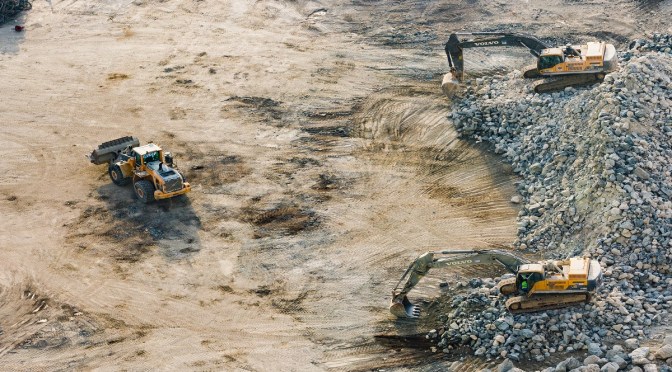

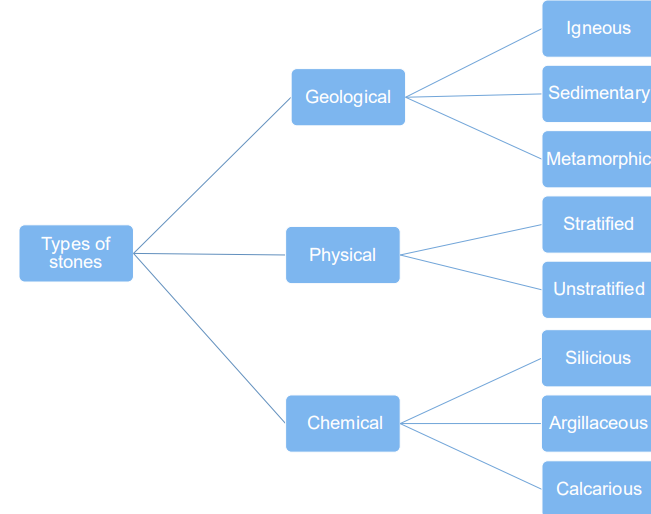

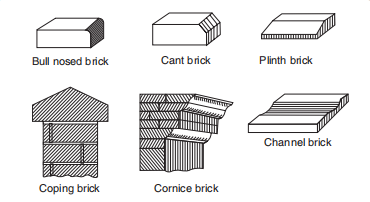


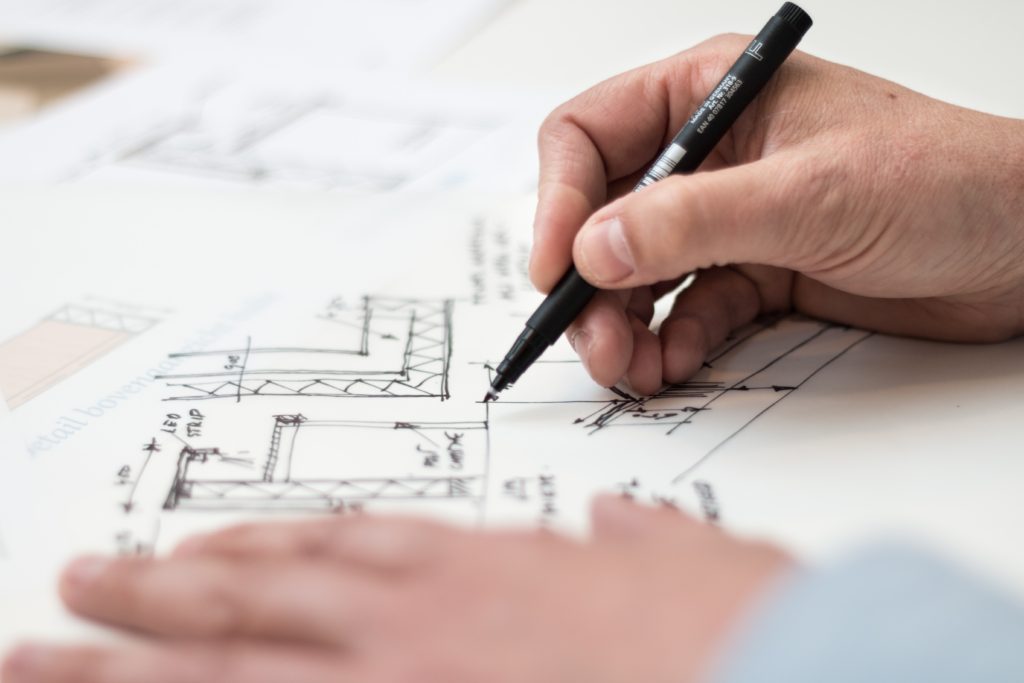




 vin civilworld