All posts by Anaswara

A civil engineer turned writer, the girl of 22 set off the journey to freelance content creating since 2019. The impact she could make in people's lives acted as the fuel and the journey still continues in high spirits. This young thrashing blood offers 100% conversion guaranteed contents to your business. Throw brickbats or bouquets and of course, your writing requirements to anaswara.r.s.cet@gmail.com

Concept of Green Building- 4 comprehensive concepts easy read!

Concept of green building is a buzz word at present, right? Because it has been a now or never situation to save nature. Therefore, you will come to understand the concept of green building and complete details in the blog.

Why concept of green building is important?

i. Protect occupant health

ii. Optimal environmental and economic performance

iii. Reduce overall impact to the environment

iv. Quality indoor spaces

v. Improve employee productivity

vi. Use energy, water and other resources more efficiently

vii. Increased market value of the building

Now that you have the answer to the big y, shall we move on to the main elements to incorporate the concept of green building in your home?

Let’s dig in systematically and find out what exactly each concept of green building implies.

a.)First Concept of green building- Powerful sites

  1. Site selection

A canvas is as important as the drawing brush. So is a site of construction in concept of green building. The following points are to be considered diligently.

  • Set preliminary environmental performance targets

A well revised plan is the ablest key. The plan should take into account the inevitable like water, energy, materials, waste, the mode of construction, indoor environmental quality, and economic performance.

  • Select appropriate land

We have two options in handy during a hunt for a building. Either we can renovate existing structures or select a land. If you are going for later, make sure that is a short walk from public transit, pedestrian and bicycle routes, exists in an already-urbanized area, is walking distance from amenities, is already serviced by the requisite urban infrastructure (roads, utilities, etc.), is a brownfields site and remediate it, allows infill development and allows mixed-use development. And the important point to be noted is that the land shouldn’t come under any restricted zones such as farmlands, the natural habitat of wildlife, wetlands, waterways.

2. Site design

This is a vital facet of the concept of green building and opens up wide possibilities to embed creativity of a civil engineer for the purpose. It includes,

A. Protect or enhance site’s ecological integrity and biodiversity

The color green itself highlights the importance of this aspect. The construction should be such that it preserves the site’s natural areas, re-establishes damaged native ecosystems and makes connections between the natural ecology of the site and natural systems both within and beyond the site.

B. Reduce or eliminate disturbance to water system

You can celebrate your life with the natural water conservation methods by making them into attractive landscape elements. Also increase site infiltration where soil conditions allow by maintaining the natural pervious landscape or designing a pervious landscape. Use pervious surfaces for as much as possible of the surfaces that are usually paved where soil conditions permit. capturing rainwater for site or building use is also a simple act to contribute to this.


C. Reduce urban heat islands

Maximize green space through the clever designing techniques including native gardens, trellises, roof gardens, green walls etc. and provide shade on impervious surfaces where high-albedo materials cannot be used.

D. Design infrastructure to support alternative transportation

In between the continuous run to balance work and life, there is no way you can compromise on this aspect. Location of the building should be such that it has access to public transit, bike routes, and pedestrian routes. And the feature should encourage walking, bicycling and battery operated vehicles, by designing attractive, safe pedestrian and cycling infrastructure.

3. Building orientation& configuration

The orientation of the building and the configuration of each element is significant to make a strong connection with nature. Use existing and proposed trees & plantings to reduce heating, cooling, and lighting loads and utilize the site resources to reduce building loads and enhance indoor environmental quality. Finally, orient the building to optimize prevailing winds and solar opportunities.

b.) Second concept of Green building- Wizardry in construction

Figure shows an engineer explaining concepts for the crew

After setting up the site, the next concept of green building is obviously construction. Here, we have the opportunity to take out the technical skills to weave the green blanket for our building.

i. Design stage

  • Choose environmental friendly materials

Try to use recycled and efficient materials, Use locally harvested or manufactured materials and materials that cause very less damage to nature as much as possible. You can find more elaborate details in A JOURNEY TO ECO- FRIENDLY MATERIALS

  • Design for reuse

Design a structure that allows for changes in use over time.Select building systems that can be deconstructed at the end of the building’s useful life.This is where the importance of a good design team arises.

  • Design envelope

Design envelope to reduce heating, cooling, lighting, and ventilation loads. Also it should incorporate all possibilities that make it energy efficient and allows for maximum natural light without glare and pollution and maximum wind intake. Remember to consider individual control for all the features because that is a determining factor of the comfort of the residents.

  • Reduce or prevent the use of potable water to treat human waste

Installation of water-efficient toilet fixtures and alternative wastewater technologies like constructed wetlands and monitoring the usage with something like water meters is very efficient to make sure that we protect each drop of water and ourselves.

  • Reducing impact of environment

While ozon depletion is growing on a daily bases, let’s do our bit to reduce it.Use HVAC systems, refrigerants and fire-suppressant equipment that do not contain CFCs, HCFCs or Halons.

ii. Building stage

  • Prevent erosion during construction

The prevention of erosion is important because properly done, it will also prevent the accompanying air pollution, and sedimentation of streams and storm sewers. Different strategies like maintaining or providing vegetated ground cover and controlling erosion with mulch or grass can be done.

  • Minimize the disposal of construction waste

A formal waste management plan can be adopted for minimizing the construction waste envisaging reuse, recycle or salvage the waste for later reuses.

c.) Third Concept of green building -Showering aura through energy & water efficiency

This is the highlight of the concept of green building. First, let’s close the deal with energy efficiency.

Thanks to technology and the human quest for innovation, new techniques and strategies are emerging every day. Smart home technology is one of the blessings in which interesting products like highly programmable thermostats reduce your heating and cooling bills and saves the environment by reducing energy production. Furthermore, your heating, ventilation, and air conditioning (HVAC) system works more efficiently, meaning less wear-and-tear on the system and longer life.

Another remarkable trend is energy star windows that reduce heating and cooling costs and thereby rise in home values. To boost the windows’ insulating effect, you can draw blinds in both summer and winter. Also, seal all air leaks in the house with caulk or weather stripping and clean and change furnace filters frequently. Having all the new lessons taken, don’t forget your roots. Aid renewable energy as much as possible.

So, you have set up your home for better energy treatment.

Now let’s see the practices for methodical water management.

Use rainwater collected for suitable domestic purposes and Install tank less water heaters, which heat up water at the source that avoids having to run the tap to bring hot water from a remote water heater. See more details about rainwater harvesting at RAINWATER HARVESTING; EVERYTHING YOU NEED TO KNOW. Consider fixtures and appliances that conserve water such as low flow faucet aerators. And home automation can help you too in monitoring, measuring, and controlling water usage. Another thing worth doing is systematic wastewater management. Wastewater can be recycled using recharging pits and used for landscape watering. Moving onto another concept of green building,

d.) Fourth Concept of green building- Rating tools to standardize

Congrats! You have the whole concept of green building ready to receive you now. Next you need to know how to market it with verification. Here is the significance of rating tools. These tools can even help you gain incentives for clients. Building rating and certification systems are in a state of change and evolution and continue to be refined to reflect new standards and goals. So it is essential to investigate the most current versions of these programs to gain an understanding of particular requirements that must be met in order to achieve the best results.

There are a number of green building rating tools that exist but are not administered by a World Green Building Council. Let’s look at some of the tools which are administered by them.

1. BREEAM or Building Research Establishment Environmental Assessment Method started in the UK where it is now a voluntary initiative in the private sector and compulsory in the public sector. Points are awarded in line with sustainable approaches to energy and water use, internal environment, pollution, transport, materials, waste, ecology, management processes and the life-cycle of buildings.

 2. LEED or Leadership in Energy and Environmental Design started in the US and is now popular worldwide as well as in North America. It covers new, existing, commercial and residential property and is concerned with energy, atmosphere, water efficiency, materials, resources and indoor environmental quality.

3. HQE (High Quality Standard) is a French initiative. Not as widely adopted as LEED or BREEAM, HQE is still committed to common aims including reducing energy and water use, minimal environmental impact on surroundings, a healthy internal environment and the full life-cycle of a building. It covers new and existing buildings from commercial properties to multi-family housing.

4. DGNB (German Sustainable Building Council) focuses on around 50 criteria ranging from environmental, economic, technological and work process aspects to sociocultural and functional dimensions. “A holistic approach is taken” meaning the system assesses the entire lifecycle of the building. Buildings are awarded DGNB certificates in bronze, silver or gold. In addition, there is the option of simple precertification in the planning phase.

5. WELL focus on “advancing health and well-being in buildings” through issues such as thermal and acoustic comfort and good air quality.

Drop a message in the comment section to reach out to us for Green Building Consultancy Services. Let’s make the bond for a lifetime of prosperity by sharing the joy with green.

A BUILDING AT ZERO COST!!

The past decade has been a witness to a lot of path breaking ideas and tremendous technological advancements. But a building at zero cost??

The people crazy enough to think they can change the world are the ones who do”. So at one point hopefully mankind would do that. For now, let’s dive into the key aspects that are nearly ideal for a low cost building.

1.INTAKE OF NATURAL LIGHT

Natural light has a lot of proven benefits over productivity and well being of people who reside/ work there. It has  a positive effect on you life too.

Positioning of windows and doors, mirrors that can reflect light to maximum space can contribute greatly for maximizing natural light to indoor areas.  A light intake medium to be available on the roof top also contributes for this. 

The real success in constructing a building is in its utility. 

Open plan living which are popular recently is very much close to the feature. The columns or structural walls will need to be carefully placed to ensure they have minimal impact on the flow of spaces/views. Also the passages inside the building should be an optimized design considering the position of doors that utilizes the floor space cleverly.

2. CHERRY- PICK THE STRUCTURAL COMPONENTS

A home is an emotion…

The windows that give you view to the outer world from your cozy personal space, the doors that welcome you to your universe of comfort and boundless freedom, the walls and corners of the house who have been with you in your thick and thin…

These different structural components where the housing material plays a significant role are one the quintessential factors that contribute to the cost of erection of a building. A proper care towards the different elements will help us save a lion’s share of the amount spent for the construction. These are,

i. Foundation

Foundations need to be as per available local materials and soil.

ii. Super structure

a.) Flooring material

b.) Walls

Environmental degradation in the top soil used for brick walls, the environmental pollution and enormous cost while making the bricks compel us to consider another alternatives for bricks Brick walls. GFRG Panels and AAC Blocks are best fits for this that highlight the significance of low cost construction materials.

GFRG Panels

Glass fibre reinforced gypsum(GFRG) panels have emerged as a recent trend in low cost buildings. It has the potential to reduce the cost of construction of a building by 30 percent.

The lucky charm of the low cost material is that it doesn’t require cement plastering of the walls and there by a considerable amount of money can be saved. Well, this not all. There are some amazing qualities of the material that can pull you towards it.

Find it here: GFRG panels – Glass fiber reinforced gypsum, an innovation of enormous potential…

AAC blocks

Autoclaved aerated concrete blocks (AAC) is one of the best low cost building materials suitable for producing concrete masonry unit like blocks. The whole building can be built and no plastering is required in internal and external areas.

AAC Blocks have a clear upper hand over bricks  thanks to its characteristics. They are easy to transport and handle leading to less labour charges. They eliminate the need for applying costly fire proof material and ensures fast construction owing to its physical characteristics.  And less wastage reduces the extra expenses for removal of debris in the construction site.

How can you not be biased towards this cutipie?

EXTRA BOUT: AAC blocks have an overall saving of 30% on the total construction cost.

c.) Roof:  

When Khaled Hussein said “One could not count the moons that shimmer on her roofs…” he might not have thought that it could have a meaning from civil engineering point of view. When we have filler in concrete that is capable of reducing the amount of cement in concrete without loss of strength, there is no doubt that it will catch our attention and mental presence.

Polyurethane Foam Infill (PUF) is a commercially attractive filler material which is reusable or disposable mold systems.

GRFG Panels can also be use and affordable and cost effective alternative for roofing system

GREEN WALLS

Another category which we shall miss at no cost is green walls. A green wall is comprised of plants grown in supported vertical systems that are generally attached to an internal or external wall. They  illustrate the back to nature concept with several healing benefits that can vent you from the hustle and bustle of urbanization.

3. INCORPORATING TECHNIQUES OF VASTU

There is a prevailing myth pertaining to Vastu that it is a blind belief. But there is also a sound claim that draws a fair line of pragmatic concepts that rely on logical reasoning that talk about techniques to save money. For example Vastu advocates the position  of  kitchen  windows in the  eastern  direction which  helps to trap  sunlight  rays that  can disinfect kitchen.

4. SHIFT IN THE PERSPECTIVE

“I’m so happy that I could build my home at low cost”- When was the last time you heard this from someone?

Very rare, I tell you. That’s because cheap buildings are never stylized. Because of the persuasion of some people who involve in between an engineer and the client, a low cost buildings is always looked down upon. Think over it the next time you hear the boasting of an expensive building.

5. LAURIE BAKER CONCEPTS

Figure shows Laurie Baker and the building designed by him

How is it possible to close the chapter  without reaching it through the wizard of the realm?

Laurie Baker made a variety of practical suggestions, including the use of rat trap bonding for brick walls, providing wall bends that increased strength and offered ready-made shelves, thin concrete roofs and even basic precautions, such as moving the dug up to the built-up area rather than out of it.

Now that we have taken a wonderful journey through all the possible factors for a low cost building, you may also think about other aspects like installing solar panels for energy efficiency. Remember a penny saved is a penny earned.

Money has its value when used for the right purpose. Low cost for a building can imply an empty belly filled. So liberate yourself from living in others thoughts and construct an independent mind as a perfect start.

Advertisements

COVID- 19 and the fate of CONSTRUCTION SECTOR!!

When the little kiddo was caged out from her mother’s care to explore the widened garden in the lobby of the home, she yelled in the curious voice “mummy, see the Corona flower, it even got kids with it!”
“That’s football flower baby!”

While all of us are living with the humming and chanting of the notorious COVID-19, it’s high time we spoke about its impact on the lifeline of the world, Construction and civil engineering.

Let’s look at the important aspects to reboot ourselves to face the situation gracefully.

  1. Economic uncertainty

Being the second largest provider of blue and white collar jobs, construction sector is the industry that has the worst impact from COVID- 19, after agriculture. According to the COVID- 19 impact and Implementation survey 2020 of ASCE, as of May 26, half of the responding organizations have experienced corona virus related delays in receiving materials from suppliers owing to the disruption in the global supply chains. It’s alarming to note that two large airlines, Delta and United, announced plans to reduce capital investment by $2 billion each as a result of the pandemic’s economic impact.

These shed light into the fact that companies are revising their plans about their capital investment and they are focusing on implementing cost cutting measures into the form of layoffs, increase in working hours which is about a tiresome 12 hours a day and pay cuts.

In the light of the gruesome provisions, government has issued a number of notices and instructions to companies in India not to deduct workers ‘ wages or to refrain from lay-offs or withdrawals during the lock-down period. But we know how unsure when the lock down extension is uncertain.

So how are you going to tackle these?

If a tiny virus that can’t even be seen by eyes can transform the entire universe in its working, then our brains should be given a chance to prove its part. By doing the calculations with investment reduction and changing the business plan and strategies accordingly, we can be robustly prepared to confront that.

Pro-tip:  You should also bear in mind the scope of the business insurance policies and if you deserve it, you should get yourself to claim it!

  1.  Managing remote work force

This aspect could be a phoenix to rise from all that hinders you from visiting the construction site.  But remember we have comprehensive software tools and technical support systems. Let the building site be anywhere in the world. You can use 360 cameras to digitally capture site conditions. This effectively creates a street view of your construction site. All that is required is a mechanism to carry out the survey, so all stakeholders will have access to the site tour staying at home itself. Also, the advent of robotics which offers wide possibilities in  3D printing a building, brick laying and masonry,can even change the fate of the sector. They’re all an asset to the future. Only that, thanks to Corona, it all happened in the blink of an eye.


   3.  Overall management of safety requirements / regulation

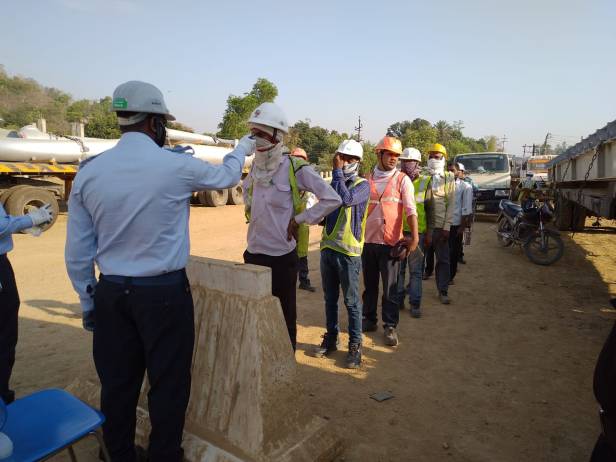
Employee safety is of paramount importance no matter the company’s business status. They should be provided with mandatory safety equipment in good time and should be treated gently to make them comfortable amid the prevailing pandemic. Major government instructions must be strictly applied to construction sites and offices which include:

1. Keeping a safe distance between workers

2. Mandatory hand washing for at least 20 seconds before work begins, after workers remove gloves, before and after the use of shared items such as tools, before and after any restroom breaks, and after shifts end.

3.Temperature checks when the workers arrive on site and when they leave for home

4. Limiting crossover of subcontractors

  1.  Customers going out of business

The sustaining epidemic conditions can change the mind of your customer anytime. So you better keep in touch with them through the virtual communications and strengthen the bond by testifying other customer’s success with your service.

  1.  Employee morale

It’s not at all worth a big bet that employee morale is directly connected to their productivity. Construction economists say construction loses 975,000 Jobs in April, Because of COVID-19 Impacts. The results of the April 9 survey of ASCE showed a similar statistics. One-quarter of the organizations have furloughed/ laid off/ terminated employees since March 1, 2020. These statistics tell us that boss to the caregiver is a must-have shift in this intense time. There’s no better feeling than that when you feel your job is secure.

6.  Troubles in contract period

The reports say that two-thirds of the responding organizations have experienced cancellation or delay of contracts. One out of seven organizations are facing potential contract penalties due to project delays. It implies that you should be well versed in our law to keep your client in peace.

The extra bout: Section 55 of the Indian Contract Act, 1872 (‘Contract Act’) provides for the effect of failure to meet the specified timeline. However, the intention of the parties must be examined, not the letter of the clause.

7. Expectations from government

Though government has taken required measures, it needs to think innovatively to save the sector that has been growing tremendously and contributing considerably to the economy. Even if banks have given moratorium options, they are still adding interest for the months we are not paying. Banks can avoid charging interest for these months when we are not able to pay EMIs. Also, some exemptions in GST will be a great relief. There shall be measures to mitigate impact on micro, small and medium enterprises (MSME) workforce, defer utility and social security payments, enhance access to credit and specific measures for self-employed. There is no better time to usher the commitment and care of the government to the people of the country.

8.  Work from home challenges

Every difficulty is an opportunity. The pandemic era is an opportunity to improve digital infrastructure, communication skills, automation and mechanized construction methods that can potentially replace manual intensive labour by machinery. Moving away from the difficulties, you’d better make it a rocking platform to improve all these things about your company.

9. Work- life balance

Suddenly, when your home desk says hi and your office desk misses you, it’s not easy to work normally and then move on to your personal life all of a sudden. A thick line is always to be drawn. A dedicated workspace and schedule can make a perfect balance.

IN NUTSHELL:

  • Being the second largest provider of blue and white collar jobs, construction sector is the industry that has the worst impact from COVID- 19, after agriculture.
  • Companies are revising their plans about their capital investment and they are focusing on implementing cost cutting measures into the form of layoffs, increase in working hours which is about a tiresome 12 hours a day and pay cuts.
  • The pandemic era is an opportunity to improve digital infrastructure, communication skills, automation and mechanized construction techniques.
  • By embedding navel technologies like 360 cameras, robotic assistance for brick laying , masonry and virtual communication systems, the challenges can be confronted gracefully.
  • Boss to the caregiver is a must-have shift in this intense time. There’s no better feeling than that when you feel your job is secure. Also employee safety is of paramount importance no matter the company’s business status. 
  • One out of seven organizations are facing potential contract penalties due to project delays. But section 55 of the Indian Contract Act clearly states the relaxations during unpredictable situations.
  • There shall be measures to mitigate impact on micro, small and medium enterprises workforce, defer utility and social security payments, enhance access to credit and specific measures for self-employed. Some exemptions in GST will be a great relief.

Bonus: Which the following do you find an advantage of COVID- 19, that helped the growth of your company/your work life?

1. It led digital transformation of your company

2. It helped you show gratitude and care to your employees

3. It helped you to explore the world of productivity

Let me know your thoughts in the comments.