
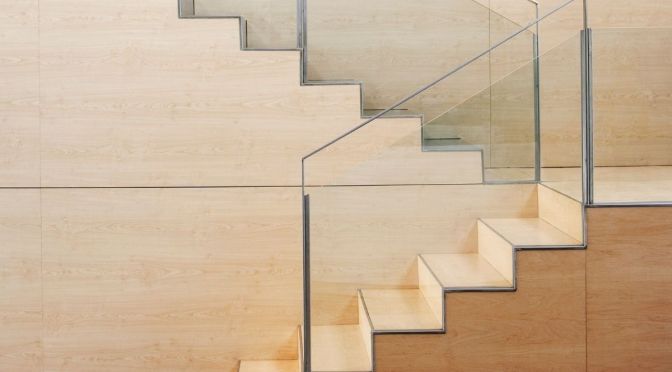
A dog-legged staircase is the simplest, common, space-saving, and economical staircase type used in commercial, industrial and residential buildings. A dog-legged staircase consists of two flights running in opposite directions and parallel to each other. They are separated categorically by a landing when the flights change direction.
A dog legged staircase is a space-efficient design consisting of two straight flights of stairs connected by a 180-degree turn. This layout allows the staircase to make a sharp turn without needing extra space for landings. Dog leg stairs are commonly used in residential and commercial buildings where space-saving is crucial. The dog legged stair design minimizes footprint while maintaining functionality and aesthetics. They offer a compact solution for multi-story structures, making them ideal for homes, offices, and small commercial spaces. The dog leg staircase is popular for its simple, practical, and versatile design.
This article is about the features of Dog legged staircase and its design, advantages, disadvantages, and applications.
- What is a staircase?
- What is a Dog legged staircase ?
- Major components of a Dog legged staircase
- Advantages of Dog legged staircase
- Disadvantages of Dog legged Staircase
- Features of a good staircase
- Types of Dog Legged Staircases
- Design of Dog legged Staircase
- Input details
What is a staircase?
A stair is a structure with a series of steps. It provides a simple and easy way to ascend and descend between levels or floors. The room or enclosure of the building, that occupies the stairs are known as a staircase. In certain designs like dog leg stairs, the staircase has two straight flights. These flights are connected by a 180-degree turn. This design saves space efficiently.
Also read : What is prefabrication in construction?
What is a Dog legged staircase ?
A dog legged staircase is a versatile and efficient stair design. It features two straight flights connected at a 180-degree turn. This configuration allows the stairs to change direction. It minimizes the need for extra landing space. This feature makes them ideal for compact areas. The flights can vary in length based on the total height and desired riser height, providing flexibility in design.
This type of staircase is commonly found in both residential and commercial settings, as it maximizes functionality without compromising aesthetics. The dog leg stairs are especially advantageous in multi-story buildings where space is a premium. They enhance the overall design while ensuring safe vertical movement between levels.
The term “dog leg” derives from the shape of the staircase when viewed in elevation, resembling a dog’s leg. This design not only offers practicality but also adds a unique architectural element to a space. The dog legged stair design is simple and effective. It provides a good solution for navigating different levels in a building. It combines economy, safety, and style.

Major components of a Dog legged staircase
A dog legged staircase consists of several important components that allow it to function effectively and fit within compact spaces. These parts work together to create a strong, functional structure for vertical movement. Here are the key components found in dog leg stairs.Let us go through the major components of a Dog legged Staircase
- Treads
- Risers
- Landing
- Balustrade
- Stringers
- Newel Post
- Handrail
- Flight
Thread
Horizontal portion where the foot rests while ascending and descending. The size and material of treads affect comfort and safety.
Rise
Risers are vertical portion between two threads.They ensure each step is of uniform height for smooth movement.
Step
Each step constitutes a tread and a riser and individual steps form a stair.
Landing
Landing is an intermediate space between a series of steps (Flights) . This spaces serves primarily as a resting place and enables a smooth direction change.
Newel post
The vertical post at the starting and end of a stair
Baluster
Balusters are Vertical members fixed along the flight for supporting hand rails
Handrail
An inclined rail provided at an optimum height which can support while ascending and descending.
Advantages of Dog legged staircase
From the design point of view the main advantages are as follows
- To allow an arrangement that occupies a shorter, though wider, floor area than a straight flight, and so is more compact. Even though the landings consume total floor space, there is no large single dimension.
- The upper floor is not directly visible from the bottom of the stairs, thereby providing more privacy.
- The space below landings serves the purpose of storage.
- The design and layout is very simple.
- Landings offer a comfortable resting space for commuters.
- They requires less area and limited space when compared with other stairs like straight staircase .
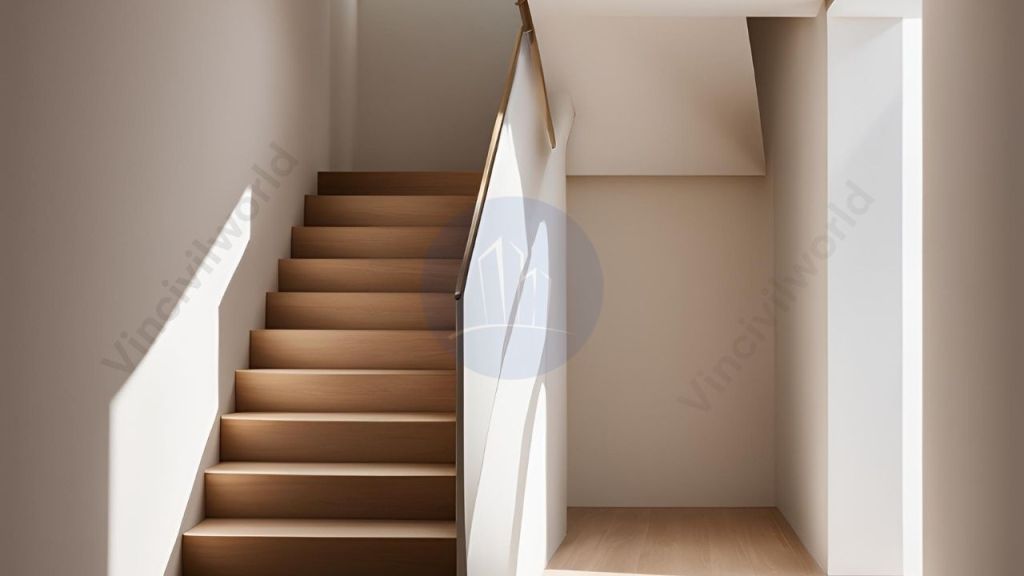
Disadvantages of Dog legged Staircase
- The construction of these stairs are not easy
- The handrails need very careful planning.
Features of a good staircase
- Staircase location selection has to ensure sufficient light and ventilation and easy access from all the rooms.
- A single flight should have a minimum of three risers and a maximum of 16 risers.
- Stair angles (Pitch) should be anywhere between 25 degrees to 40 degrees. Landings have to be provided categorically to manage the pitch.
- The landing width should not be less than the width of the stair flight.
- The riser height should be uniform for all flights between landings and floors. This uniformity helps maintain a rhythm while ascending and descending.
Types of Dog Legged Staircases
- Dog-legged staircase with enclosed space beneath – Landing area closed and used for storage or services
- Dog-legged staircase with open well space – A small gap or well left between the two flights
- Dog-legged staircase with half-space landing – Landing placed midway to change direction by 180°
- Dog-legged staircase with quarter-space landing – Used when a slight direction change is required
- Dog-legged reinforced concrete staircase – RCC structure for strength and durability
- Dog-legged wooden staircase – Used in residential interiors for better aesthetics
Design of Dog legged Staircase
How to design a staircase ?
Maximum size of riser is 190 mm for residential building and 150 mm for other buildings
Maximum size of thread is 250 mm for residential building and 300 mm for other buildings
In this example we are considering floor to floor height as 3 mtr
Height of Floor = 3 mtr (Floor to Floor)
Step 1
How to find the Number of Risers
Maximum height of Riser is 190 mm : Assume 175 mm as riser height
Total number of risers = 3000/175 = 17.14 risers say 17
Riser height assuming 17 risers = 3000/17 = 176.47 mm
Thread = Riser – 1 = 17-1 = 16 nos
Input details
Riser = 17 nos ( 17.47 mm)
Thread =16 nos (250 mm)
For first landing will take 9 Riser and 8 thread
For design details of dog legged staircase and layout please watch the video.
 vin civilworld