All posts by Jefy Jean A

Hello, I am Jefy Jean A, a freelance content writer, and blogger. I am pursuing my M.Tech from IIT ISM, Dhanbad. I can create authentic and well-researched content that would drive visitors to your website and turn them into your customers. Right now I focus on technical blogs and SEO optimised articles. I would be more than happy to venture into other genres like health and fitness, travel, lifestyle, home decor, food recipes, etc. as I believe in exploring new arenas and opportunities. If I am not researching or writing an article I would be in the kitchen trying out all the recipes that catch my eyes on YouTube. If you are in search of some insightful and irresistible content mail me your writing requirements to jefy98aj@gmail.com.

What are E-wastes? | Classification and Recycling

E-waste management addresses the growing challenge of handling discarded electronic devices in a safe and sustainable manner. To understand this issue, it is important to know what is e-waste and how rapid technological advancement increases electronic waste generation. Identifying the types of e-waste helps in sorting and handling different electronic components effectively. Proper e-waste classification supports safe handling, treatment, and compliance with environmental regulations. An efficient e-waste recycling process ensures recovery of valuable materials while reducing environmental pollution. Moreover, electronic waste recycling plays a vital role in conserving natural resources and minimizing health risks. Effective e-waste management promotes environmental protection, resource efficiency, and sustainable development in modern societies.

India ranked third in the world in terms of E-waste production last year, behind China (10.1 million tonnes) and the United States (3.2 million tonnes) (6.9 million tonnes). Consumers waste 44 million tonnes of electronics per year, according to a 2019 United Nations study titled “A New Circular Vision for Electronics, Time for a Global Reboot,” and just 20% of that is recycled sustainably. According to the Global E-Waste Monitor 2020, customers discarded 53.6 million tonnes of electronics in 2019, an increase of 20% over the previous five years.

Shocking right? Can you imagine tonnes and tonnes of E-waste piling up? Think of the damage it would do to our mother nature. But what if I say there’s an alternative? Yes, you heard me right. I am talking about recycling or management of the Electronic-waste.

In this blog, I will walk you through Electronic-waste management , different types and its recycling process.

  1. What is e-waste ?
    1. Types or classifications of e-waste
  2. Significance Electronic waste management and recycling
  3. E-waste recycling process
    1. Shredding, Separation, and Material Recovery in E-waste Recycling
  4. Benefits of Recycling
  5. Key Takeaways
  6. Conclusion

What is e-waste ?

E-waste, or electronic waste, refers to discarded electrical and electronic equipment that is no longer usable, repairable, or required. Common examples include computers, mobile phones, televisions, household appliances, and office electronics. As technology evolves rapidly, the generation of electronic-waste continues to increase worldwide. Improper disposal of e-waste can release harmful substances such as lead, mercury, and cadmium into the environment, posing serious risks to human health and ecosystems. Proper handling and recycling of e-waste allow the recovery of valuable materials like metals and plastics while reducing environmental pollution. Understanding what e-waste is helps promote responsible disposal practices and supports sustainable waste management solutions.

A large pile of discarded electronic devices, including old computers, monitors, keyboards, and tangled cables, in a warehouse setting.
A large pile of discarded electronic devices, highlighting the growing issue of e-waste.

Types or classifications of e-waste

Types of e-waste are classified based on the nature, size, and function of electronic equipment. Proper classification helps in safe handling, efficient recycling, and environmentally responsible e-waste management practices.

The European Directive on Waste Electrical and Electronic Equipment divides waste into ten categories: 

  1. Small household appliances
  2. IT equipment (including monitors)
  3. Consumer electronics (including TVs)
  4.  Lamps 
  5. Luminaires
  6. Toys
  7. Tools
  8. Medical devices
  9. Monitoring and Control Instruments,
  10. Automatic dispensers

Let me brief about the importance of recycling E-waste.

A cluttered pile of various electronic circuit boards and components scattered around, featuring an assortment of colors and types, with a keyboard and wires visible in the background.
A close-up view of various electronic waste components, illustrating the complexity and volume of e-waste generated in modern society.

Significance Electronic waste management and recycling

E-waste management is essential in addressing environmental challenges. It also helps with health challenges caused by the rapid growth of discarded electronic devices. Effective electronic waste recycling helps recover valuable materials, reduces pollution, and supports sustainable development by ensuring safe handling and proper disposal of electronic waste.
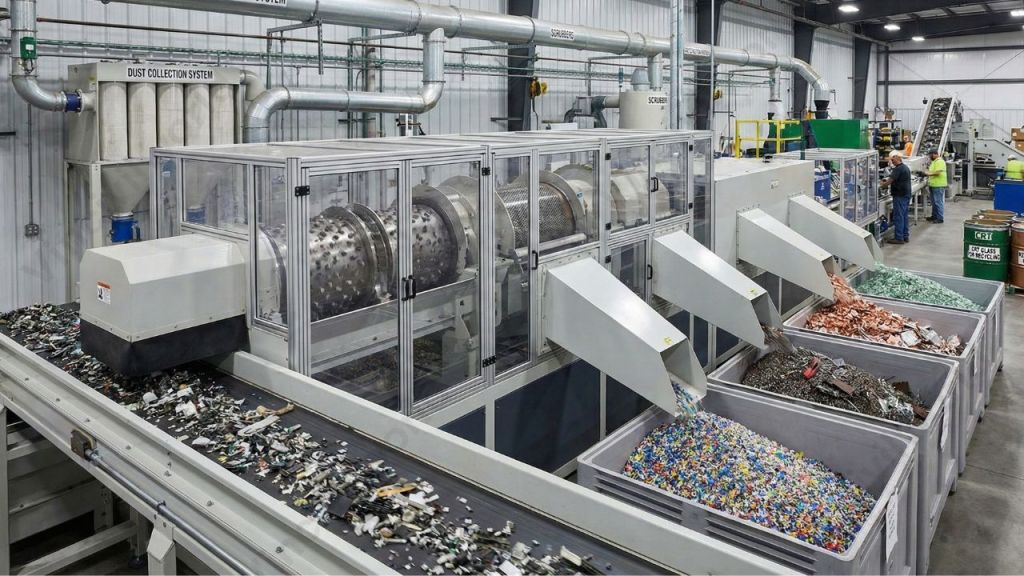
An industrial recycling facility featuring a conveyor belt with mixed waste, sorting machines, and bins for various types of recyclable materials.
An advanced e-waste recycling facility showcasing the shredding and separation process for efficient electronic waste management.

E-waste management is incomplete without recycling. Let’s see the reasons.

  • The aim of extracting metals and plastic from electronic waste is to use them in the manufacture of new electronics.
  •  Recycled metals are two to ten times more energy-efficient than metals smelted from raw ore.
  •  It’s used in tablets, smartphones, and electric car batteries.
  • According to the most recent estimates, the global value of e-waste is about $62.5 billion per year, which is more than the GDP of most countries.  It’s also worth three times what all of the world’s silver mines produce.
  • It can significantly minimise the release of radioactive materials into the atmosphere.
  • Helps to prevent the depletion of natural resources if properly implemented.
  • Reduces exposing workers to toxic and carcinogenic substances like mercury, lead, and cadmium.

E-waste recycling process

E-waste management depends on a well-structured recycling process that ensures safe handling, efficient material recovery, and environmentally responsible disposal of electronic waste. A step-by-step recycling approach reduces pollution, protects human health, and supports sustainable resource utilization.

Recycling printed circuit boards from electronic waste is one of the most difficult tasks. Gold, silver, platinum, and other precious metals, as well as base metals like copper, iron, and aluminium, are used on the circuit boards. 

Some of the ways of processing e-waste includes:

  • Melting circuit boards
  • burning cable sheathing to retrieve copper wire
  •  open-pit acid leaching 

Mechanical shredding and separation is the traditional process, but the recycling efficiency is poor. Cryogenic decomposition is an alternative method for recycling printed circuit board.
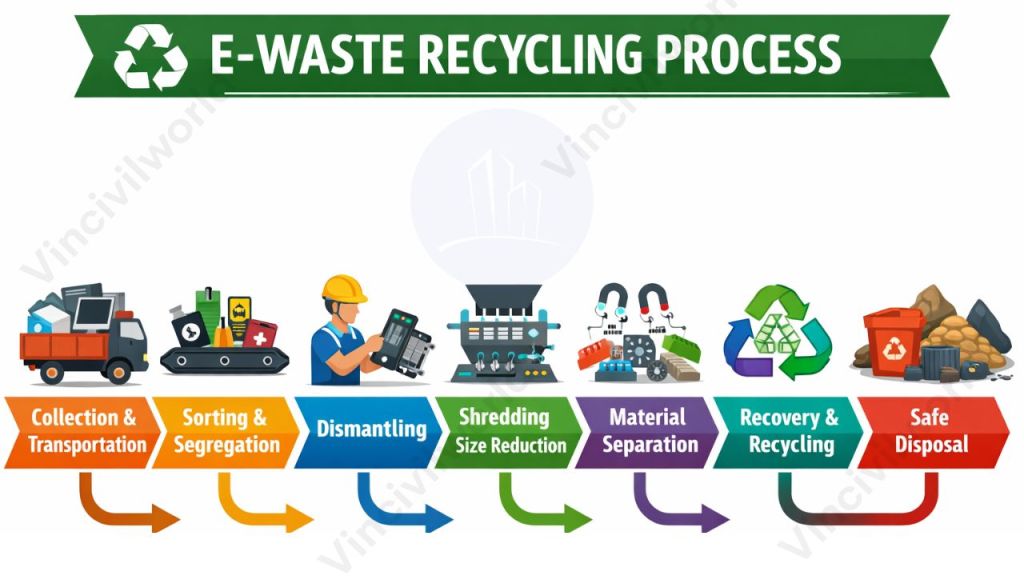
Infographic illustrating the e-waste recycling process, including steps such as collection, sorting, dismantling, shredding, material separation, recovery, recycling, and safe disposal.
Illustration of the E-waste recycling process, highlighting key steps like collection, sorting, dismantling, shredding, material separation, recovery, and safe disposal.

Shredding, Separation, and Material Recovery in E-waste Recycling

  • After dismantling, the material for shredding is conveyed into a crude mechanical separator, where size reduction begins. This stage plays a critical role in effective e-waste management by preparing materials for accurate separation.
  • The system uses screening and granulating machines to separate the constituent metal and plastic fractions. Once separated, these fractions are directed toward appropriate recovery streams and are sold to smelters or plastic recyclers for further processing.
  • This type of recycling equipment is fully enclosed and fitted with a dust collection system to prevent airborne contamination. Additionally, scrubbers and window-based capture systems collect a portion of the pollutants generated during shredding and granulation.
  • Following this, glass, plastic, and ferrous and non-ferrous metals are isolated using magnets, eddy current separators, and Trommel screens. These materials undergo further refinement at smelters.
  • CRT glass is recycled into products such as car batteries, ammunition, and lead wheel weights, or sold to foundries for use as a fluxing agent in raw lead ore production. Valuable metals including copper, gold, palladium, silver, and tin are recovered and sold to smelters for reuse.
  • To protect the atmosphere, hazardous smoke and gases are detected, contained, and treated. Through these techniques, all useful device construction materials are safely reclaimed, ensuring environmentally responsible and efficient e-waste management.
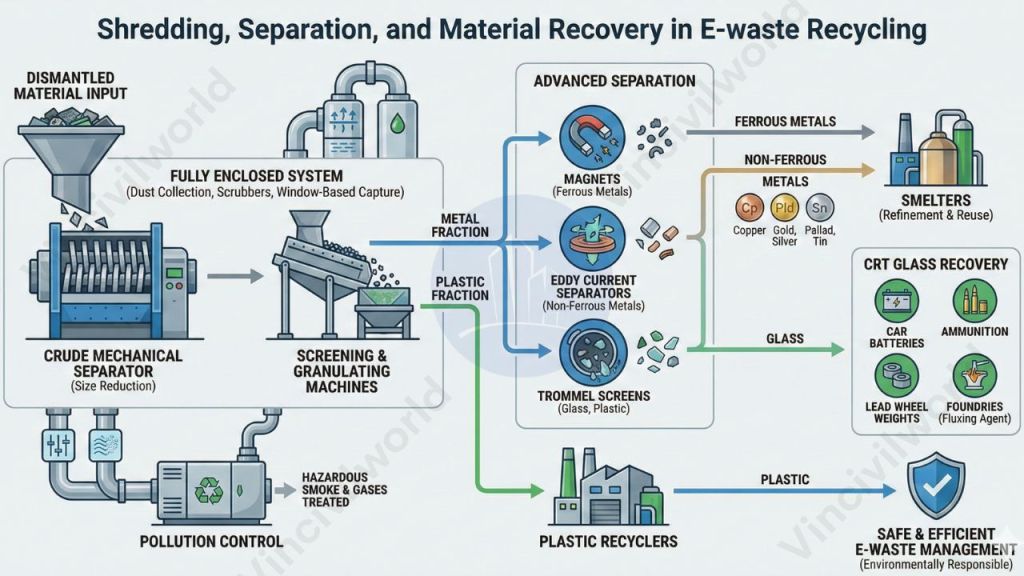
Infographic illustrating the process of shredding, separation, and material recovery in e-waste recycling, including stages like dismantled material input, crude mechanical separation, advanced separation for metals and plastics, and pollution control measures.
Diagram illustrating the shredding, separation, and material recovery processes in e-waste recycling.

Also read : Air pollution – effects and causes

Benefits of Recycling

  • The most successful solution to the growing e-waste issue is to recycle raw materials from end-of-life electronics. 
  • Recycling preserves our natural resources. 
  • Dismantling and reuse options prevent air and water contamination induced by hazardous disposal.
  • Furthermore, recycling decreases the amount of greenhouse gas emissions generated by new product production. 

Key Takeaways

  • E-waste management addresses the safe handling and disposal of discarded electronic devices.
  • Rapid technological advancement has significantly increased global electronic waste generation.
  • India ranks among the top e-waste–producing countries, highlighting the urgency of proper management.
  • Understanding what is e-waste helps promote responsible disposal and recycling practices.
  • Proper types and classification of e-waste support efficient collection and treatment.
  • Recycling enables recovery of valuable metals such as gold, copper, and silver.
  • Effective electronic waste recycling reduces environmental pollution and health risks.
  • Advanced recycling processes improve material recovery efficiency.
  • E-waste recycling conserves natural resources and saves energy.
  • Sustainable e-waste management supports environmental protection and circular economy goals.

Conclusion

E-waste management has become a critical environmental priority due to the rapid growth of discarded electronic devices worldwide. Understanding what e-waste is, along with its classification and recycling methods, helps address the environmental and health challenges associated with improper disposal. Efficient electronic waste recycling recovers valuable materials, reduces pollution, and minimizes the release of toxic substances into air, soil, and water. In countries like India, where e-waste generation is rising sharply, strong regulations and public awareness play a vital role in effective implementation. By adopting structured recycling processes and responsible consumption habits, societies can conserve resources, reduce energy use, and promote sustainable development.

Proper e-waste management is essential for protecting ecosystems and ensuring a cleaner, healthier future. Considering the huge volume of E-waste generated everyday recycling them is the need of the hour. India has formulated and notified its strategy to tackle e-waste through the e-waste (Management) Rules, 2016. Recycling reduces pollution, saves energy and conserves resources.

That’s it about E-waste. Hope you found it useful.

Understanding Green Roof Systems for Sustainable Buildings

Green roof systems are innovative building solutions that integrate vegetation layers over rooftops to improve environmental and building performance. These systems are widely adopted in sustainable construction. They vary based on design, depth, and usage. It is important to understand the types of green roofs available today. In modern construction, green roofs in buildings help reduce heat gain, manage stormwater, and enhance urban biodiversity. From a design perspective, proper green roof construction ensures structural safety, drainage efficiency, and long-term durability. The key features of green roofs include waterproofing layers, insulation, growing media, and plant selection. When implemented correctly, the green roof advantages extend to energy savings. They also improve air quality and reduce the urban heat island effect. Additionally, they enhance aesthetic value, making them an effective solution for sustainable and resilient buildings.

Green roofs or Eco roofs have become the latest design trend in almost all buildings. A green roof, also known as a living roof, is a building’s roof that is covered in vegetation and a growing medium. This is because of its wide variety of benefits ranging from energy conservation to carbon sequestration.

In this blog, I will show you the full details about green roof systems, their types, components, merits and demerits. By the end of this article, you would be planning to install a green roof in your home or office. Ready for the journey through green roofs?

  1. What are Green Roof systems in Buildings ?
  2. Different Types of Green Roofs
    1. Types of Green Roofs
    2. Features of Blue-Green Roofs
    3. Features of Semi-Extensive Green Roofs
  3. Green Roof System Construction Components
    1. Waterproofed roof deck
    2. Root barrier 
    3. Membranes for Waterproof Drainage 
    4. Filter Layer 
    5. Growing Substrate
  4. Green Roof Advantages
  5. Green Roof Disadvantages
  6. Key Takeaways
  7. Conclusion

What are Green Roof systems in Buildings ?

Green roof systems in buildings are sustainable roofing solutions where vegetation is installed over a layered roof structure. These systems typically include waterproofing, drainage, insulation, growing media, and selected plants. Green roof systems help reduce heat gain, manage stormwater runoff, and improve thermal performance of buildings. They also enhance air quality, reduce noise pollution, and support urban biodiversity. Commonly used in residential, commercial, and institutional buildings, green roof systems contribute to energy efficiency and environmental sustainability. By lowering indoor temperatures and protecting roof membranes, green roofs increase roof lifespan while promoting eco-friendly and climate-resilient building design.Additional layers, such as a root barrier, drainage, and irrigation systems, can be used. Green roofs with rooftop ponds are another form of green roof that is used to treat grey water.

A lush green rooftop lawn overlooking a calm sea with distant mountains and a few boats in the water.
A vibrant green roof provides an eco-friendly touch to modern buildings, overlooking a serene view of the sea.

Different Types of Green Roofs

Different types of green roofs are classified based on vegetation depth, structural load, and maintenance needs. Understanding these types helps designers choose the right system for performance, cost, and sustainability in buildings.

Aerial view of a lush green rooftop garden featuring various plants, a small pond, and a wooden walkway among vibrant foliage.
A diverse green roof featuring vegetation and a water feature, exemplifying the benefits of urban biodiversity and stormwater management.

Types of Green Roofs

  • Blue-Green Roofs
  • Extensive Green Roofs
  • Intensive Green Roofs
  • Semi-Intensive Green Roofs
  • Biodiverse (Brown) Roofs

Also Read : Green walls – Types and advantages

Blue-Green Roofs

Blue-Green Roofs combine green roof vegetation with integrated water storage systems to manage stormwater effectively. These roofs temporarily store rainwater, release it slowly, and support plant growth, reducing flooding risk and improving urban climate resilience.

Features of Blue-Green Roofs

  • Integrated rainwater storage layer
  • Controlled water release system
  • Vegetation adapted to wet conditions
  • Improved stormwater management
  • Reduced urban flooding and runoff

Extensive Green roofs 

  • Extensive green roofs are a common choice among homeowners.
  • They are light, low-maintenance, and do not need additional watering unless there is a prolonged drought.
  • Designers can use them on flat roofs of both existing and new roof decks.
  • Extensive green roofs typically feature an attractive vegetation layer about 80–150 mm thick, consisting of grass, moss, sedum, or small flowering plants.

Intensive Green Roofs

  • Intensive green roofs support larger plants, typically 8–12 inches tall, including bushes, small trees, and a wider variety of vegetation. They are commonly known as roof gardens.
  • To sustain this much thicker vegetation layer, they need a layer of rising medium/soil.
  • They’re more popular in larger commercial ventures, such as parks and gardens.
  • Intensive roofs require a much deeper substrate, which increases structural load and irrigation needs.
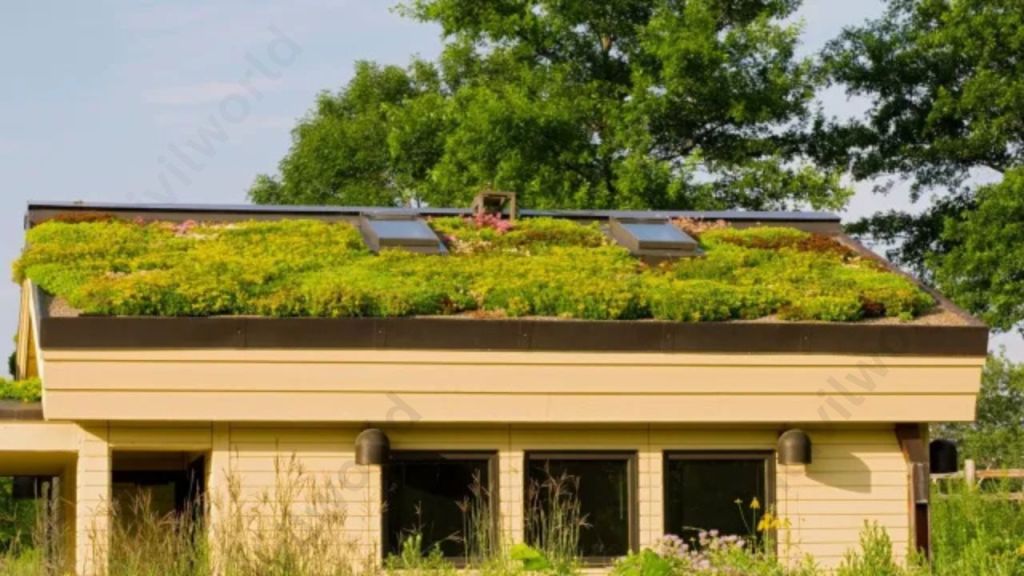
A modern house featuring a green roof with vegetation and solar panels, surrounded by trees and tall grass.
An example of a green roof system featuring a variety of vegetation, designed to enhance building sustainability and urban biodiversity.

Semi-extensive Green roofs

Semi-extensive green roofs are hybrid systems that combine features of extensive and intensive roofs. They offer moderate vegetation depth and improved aesthetics. These roofs also have balanced maintenance requirements for residential and commercial buildings.

Features of Semi-Extensive Green Roofs

  • Moderate irrigation and maintenance needs
  • Moderate substrate depth
  • Supports grasses, herbs, and small shrubs
  • Medium structural load requirement
  • Better insulation than extensive roofs
  • Let me show you the components of a green roof.

Green Roof System Construction Components

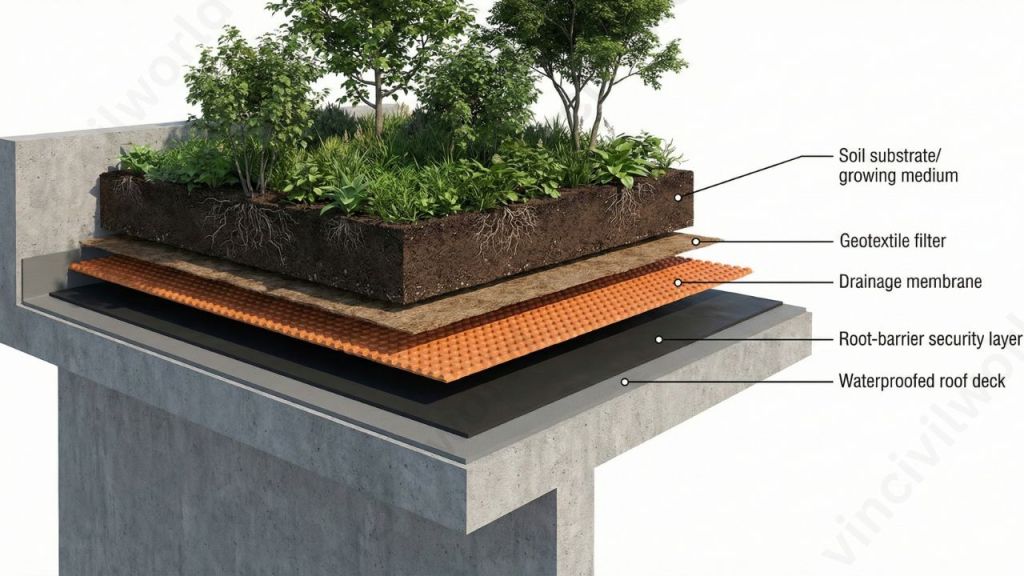
You must install a green roof system for a green roof to develop and prosper. A green roof system is made up of many layers, which are as follows:

  • Waterproofed roof deck 
  • Root-barrier security
  • Membrane for Drainage
  • Geotextile filter / filter layer
  • Substrate / growing medium for green roofs
  • Plants and trees
Cross-section diagram of a green roof system showing layers: soil substrate/growing medium, geotextile filter, drainage membrane, root-barrier security layer, and waterproofed roof deck.
An illustration of a green roof system, showcasing the layered components including soil substrate, drainage membrane, root barrier, and waterproofed roof deck.

Let’s take a look at each one separately:

Waterproofed roof deck

Your roof deck may already have a waterproofing layer since waterproofing is an important part of the structure’s protection. If not a bitumen membrane or coating, asphalt on a shed, or any kind of liquid waterproofing may be used.

Also Read : Types of water proofing – 5 methods explained

Root barrier 

  • To avoid any roots from causing damage to the structure, a root barrier should be installed above the primary waterproofing layer. 
  • There are typically thin polyethylene plastic membranes. 
  • They are spread over the waterproofing layer and taped together.
  • Root barriers are imperative in intensive roofs due to the potential for more woody and robust roots.

Membranes for Waterproof Drainage 

  • Rain and stormwater are dealt with by the drainage layer of a green roof system.
  • It allows water to safely flow away from the roof into guttering and downpipes.
  • It protects the structure as well as the plants from saturation and root damage by coping with excess water.
  • The stud profile on these green roof drainage membranes helps to ensure proper drainage.

Filter Layer 

The filter layer on a green roof prevents dirt, other substrates, and debris from clogging the drainage membrane’s cavities.

Growing Substrate

The substrate should be light, helps with drainage but is still absorbent enough to maintain enough water to sustain your plants’ growth. The commonly used substrates are: 

  • Bricks
  •  Aggregates 
  • Compost 
  • Medium clay soils 
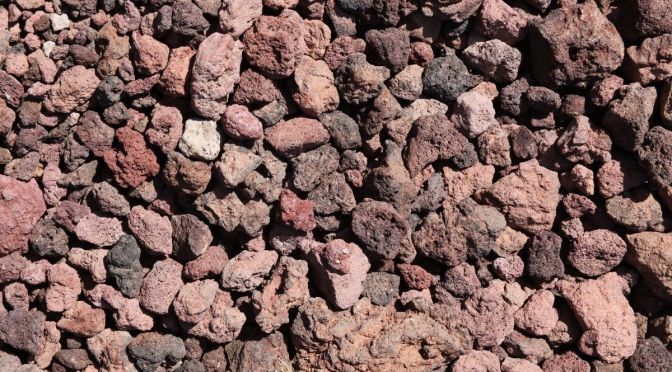
  • Volcanic rocks such as lava and pumice 

All of them offers the advantage of being all-natural and environmentally friendly.

Green Roof Advantages

  • Green roofing has a longer life since a green coating protects it from UV radiation, snow, and ice.
  • The roofing will last two to three times longer than a conventional roof because it will not be exposed to extreme high and low temperatures.
  •  It will be comfortable and cool inside during the summer and comfortably warm during the winter.
  • Energy costs will be reduced as a result of the lower HVAC energy demands.
  • The green roof  especially the substratum absorbs both impact and environmental noise, such as rain and hail.
  • Some of the invisible pollution and particles are filtered out of the air by plants.
  •  The pollution level in the air above gardens and parks is up to 80% lower than in the rest of the city.
  • The vegetation layer, the substratum, and the irrigation layer filter and absorb 30 to 50 percent of rainwater, resulting in far less water in the sewage system.
  • Green roofs help to increase the city’s fauna, such as butterflies, pollinating insects, and birds, among other things.
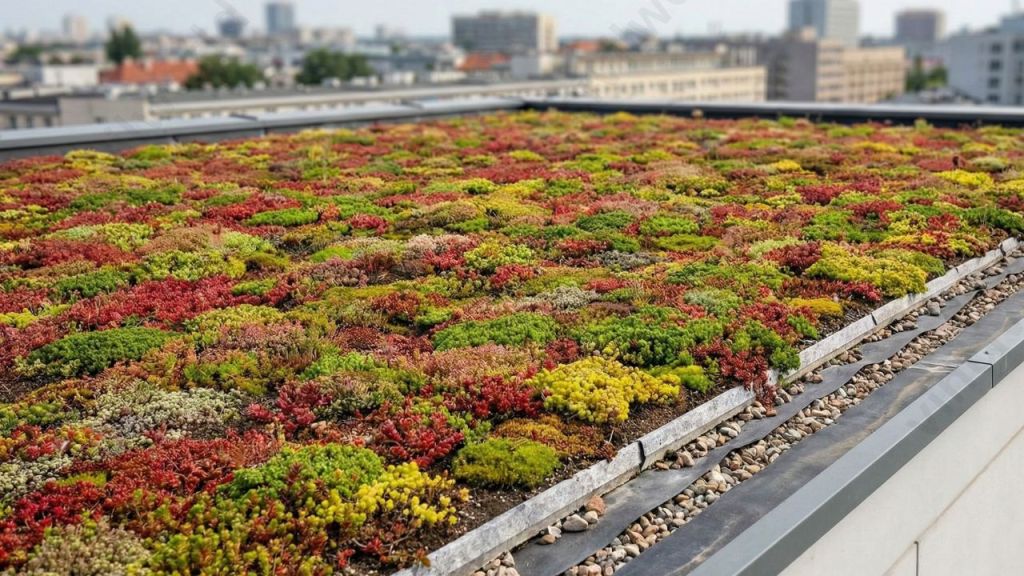
A vibrant green and red succulent roof garden filled with various low-growing plants covering a flat rooftop, with a city skyline visible in the background.
A vibrant green roof showcasing diverse vegetation, enhancing urban aesthetics and sustainability.

Green Roof Disadvantages

There are only a few drawbacks, with installation cost being the most significant. A green roof costs more to build than a conventional flat roof because builders must reinforce the underlying structure to handle the additional load.

That’s it about green roofs. Hope this blog motivated you to set up a green roof in your building. Let’s go green. Let’s adopt green roofs.

Key Takeaways

  • Green roof systems integrate vegetation layers over rooftops to improve environmental and building performance.
  • They play a major role in sustainable and climate-resilient construction.
  • Understanding the types of green roofs helps in selecting suitable systems based on load, maintenance, and usage.
  • Green roofs in buildings reduce heat gain, improve thermal comfort, and lower energy consumption.
  • Proper green roof construction ensures effective waterproofing, drainage, and long-term durability.
  • Key features of green roofs include insulation layers, drainage membranes, growing media, and plant systems.
  • Green roofs support stormwater management and urban biodiversity.
  • Noise reduction and air quality improvement are added benefits.
  • Structural assessment is essential before installation.
  • Overall, green roofs enhance sustainability and building lifespan.

Conclusion

Green roof systems offer an effective solution for creating sustainable, energy-efficient, and environmentally responsible buildings. By understanding the types of green roofs, designers and homeowners can choose systems that suit structural capacity, maintenance needs, and functional goals. The adoption of green roofs in buildings helps reduce heat gain, manage stormwater, and enhance urban biodiversity. Proper green roof construction is essential to ensure waterproofing, drainage efficiency, and long-term performance. The key features of green roofs include insulation layers, drainage membranes, and growing substrates. These elements contribute to improved thermal comfort and durability. With multiple green roof advantages, including energy savings, noise reduction, and extended roof lifespan, green roofs represent a practical and future-ready solution for sustainable building design.

Understanding Thermal Bridging: Causes and Solutions

Thermal Bridging in Buildings occurs when heat transfers through parts of a structure. This happens where insulation is reduced or interrupted. In construction practice, thermal bridges often happen at junctions, edges, and penetrations. High thermal conductivity materials allow heat to escape in these areas. Understanding the types of thermal bridging helps designers identify repeating, geometric, and point bridges within building envelopes. The causes of thermal bridging often include poor design detailing, structural elements passing through insulation, and improper installation practices. Over time, the effects of thermal bridging lead to heat loss, higher energy consumption, surface condensation, and mould growth. Additionally, thermal bridging insulation issues reduce overall thermal performance and occupant comfort. Addressing these aspects early improves energy efficiency, durability, and sustainability in modern building design.

Thermal bridging can have a major impact on a dwelling’s overall thermal efficiency, even in very well-insulated homes. According to recent studies, thermal bridging has been found to be responsible for up to 30% of a home’s heat loss.

In this blog, I will show you what exactly is thermal bridging, its consequences, causes, types and strategies to reduce them. Let’s get started.

  1. What is a thermal bridges in Buildings and Construction ?
  2. Effects of Thermal Bridging
  3. Thermal Bridging Causes
  4. Types of Thermal Bridging
    1. There are several types of thermal bridges, which can be further classified as follows:
  5. Why should we avoid thermal bridging?
    1. Decreased Insulation Effectiveness
    2. Increased expenditure of energy
    3. Greater risks of Condensation, mould, and rot 
  6. Strategies to reduce Thermal Bridging
  7. Key Takeaways
  8. Conclusion

What is a thermal bridges in Buildings and Construction ?

A thermal bridge is a part of an object that has a higher thermal conductivity than the surrounding areas. This allows heat to flow through it with the least amount of resistance. The object’s thermal resistance is reduced as a result of thermal bridges. It is also known as a cold bridge, heat bridge, or thermal bypass.

Thermal Bridging occurs when heat flows away easily through a part of the construction. This part has much less thermal resistance compared to its surroundings. This leads to uneven heating in a building.

Thermal bridges in buildings and construction are areas within a structure where heat flows more easily. This happens due to breaks or weaknesses in insulation. These bridges usually occur at junctions between walls, floors, roofs, balconies, and around openings such as windows and doors. When materials with high thermal conductivity pass through insulated layers, they create paths for heat loss during winter. They also lead to heat gain in summer. As a result, thermal bridges reduce energy efficiency. They increase heating and cooling demand. They may also cause surface condensation and mould growth. Identifying and minimizing thermal bridges in buildings and construction is essential for improving thermal performance, occupant comfort, and long-term building durability.

Also read : ALC Panels – Aerated Light Weight Concrete panels- Overview

Effects of Thermal Bridging

Effects of thermal bridging significantly influence the energy performance and durability of buildings. Thermal bridging occurs when heat transfers through areas with reduced insulation, creating unwanted heat loss or heat gain. In buildings and construction, these weak points lower thermal efficiency and negatively affect indoor comfort. Understanding the effects of thermal bridging helps engineers and designers improve insulation detailing, reduce energy consumption, and enhance building performance.

  • Thermal bridging in buildings will increase the amount of energy needed to heat and cool a room. 
  • Results in condensation of moisture inside the building envelope
  • Cause thermal discomfort. 
  • Causes additional heat losses in colder climates and require more energy to mitigation
  • Increased heat loss in winter and heat gain in summer
  • Higher energy consumption and utility costs
  • Reduced overall thermal performance of the building envelope
  • Formation of cold spots on internal surfaces
  • Risk of surface condensation
  • Growth of mould and mildew
  • Discomfort for occupants due to temperature variations
  • Degradation of building materials over time
  • Reduced lifespan of insulation systems
  • Failure to meet energy efficiency standards and regulations

Thermal Bridging Causes

Thermal bridging causes arise mainly from design and construction gaps where insulation is interrupted. This interruption allows heat to pass through structural elements and junctions. As a result, energy efficiency in buildings is reduced.

  • The points where the wall and the floor come together
  • Wall-to-roof junctions
  • Pipe and cable access holes in the building envelope
  • Window and door reveals
  •  Steel wall links in masonry work, (e.g. cavity walls)

Types of Thermal Bridging

Types of thermal bridging describe the different ways heat flows through building elements where insulation is reduced or interrupted. Identifying these types helps designers control heat loss, improve energy efficiency, and prevent moisture-related problems in buildings and construction.

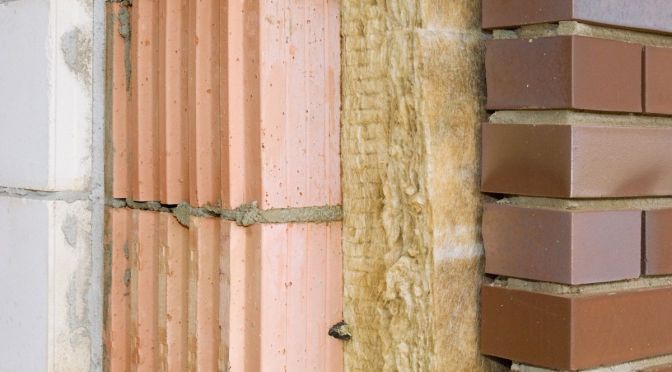
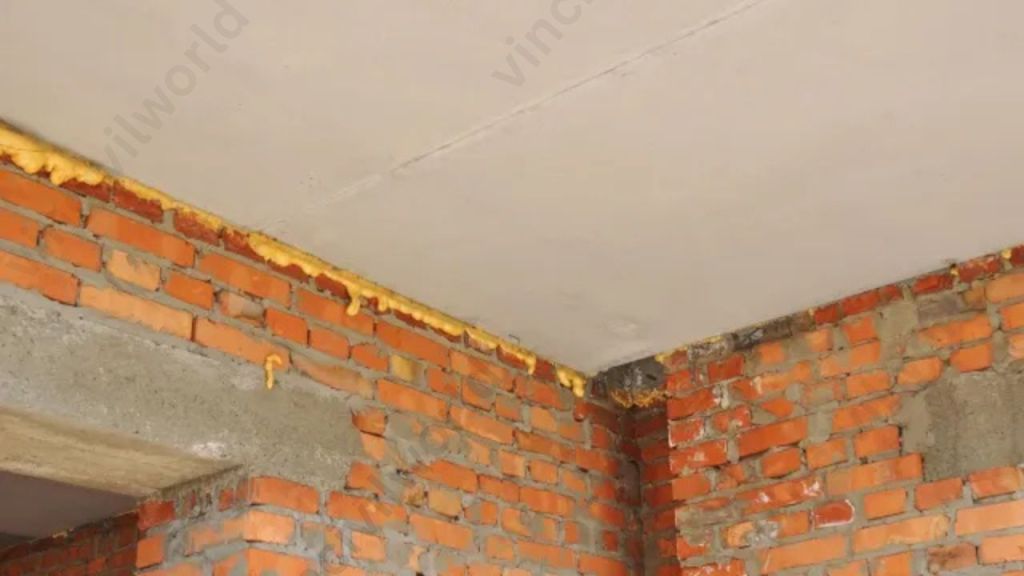
Interior corner of a room featuring exposed red brick walls and a foam sealant applied along the ceiling joint.
Close-up of a wall junction showcasing potential thermal bridging, highlighted by the insulation gaps and exposed brickwork.

There are several types of thermal bridges, which can be further classified as follows:

  • Geometric thermal bridging
  • Material thermal bridging
  • Structural thermal bridging
  • Repeating thermal bridging
  • Point thermal bridging

Geometrical Thermal Bridges 

Geometrical thermal bridges are induced by the building’s geometry, as the name implies. They are more likely to occur with complex building forms. So it’s best to keep the overall design as simple as possible to avoid them. The examples include:

  • Corners of exterior walls
  •  Wall-to-floor junctions 
  • Wall-to-roof junctions 
  • Junctions between adjacent walls

Material Thermal Bridging

Material thermal bridging occurs when building materials with high thermal conductivity pass through or replace insulation layers. Materials such as steel, concrete, and aluminum allow heat to transfer more easily than insulating materials. As a result, heat escapes in winter and enters the building during summer, reducing energy efficiency. Material thermal bridging commonly occurs in wall studs, beams, columns, and fasteners. Identifying and minimizing material thermal bridging is essential to improve insulation performance, reduce energy loss, and enhance indoor comfort in buildings and construction.

Structural Thermal Bridging

Structural thermal bridging occurs when structural elements penetrate the building envelope and interrupt continuous insulation. Elements such as balconies, floor slabs, columns, and cantilevered beams create direct heat flow paths. These structural connections significantly increase heat loss and may cause surface condensation and thermal discomfort. Structural thermal bridging is common in reinforced concrete and steel structures. Proper detailing, thermal breaks, and improved design strategies help reduce structural thermal bridging and improve overall thermal performance in buildings.

Repeating Thermal Bridges 

Repeating thermal bridges follow a trend. And it is “repeated” over a large area of the building’s thermal envelope. The examples include:

  • Steel wall ties used in masonry cavity wall construction
  • Ceiling joists used in cold pitched roofs when insulating at the ceiling level
  • Split created by timber framing when insulation occurs between the studs  
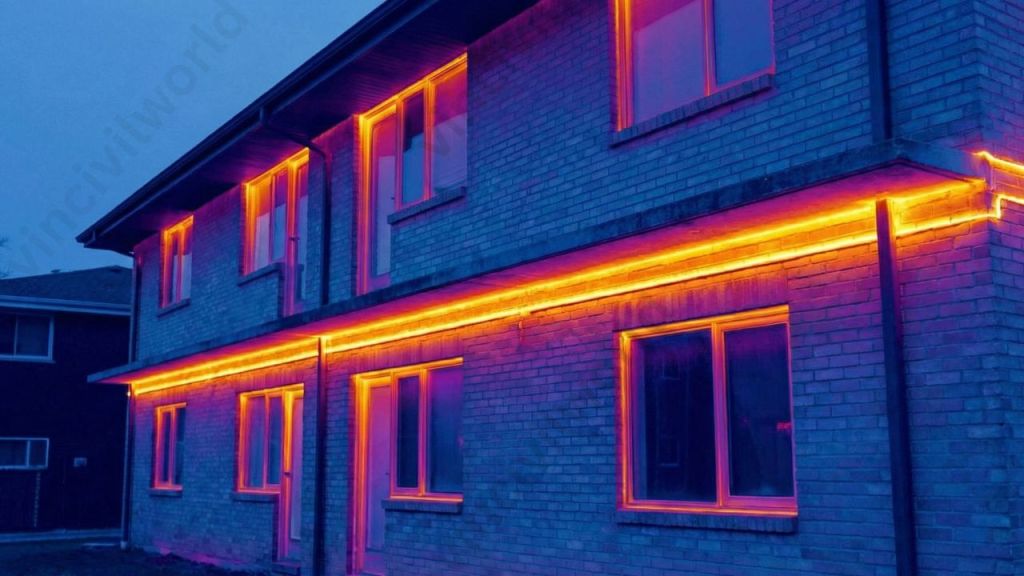
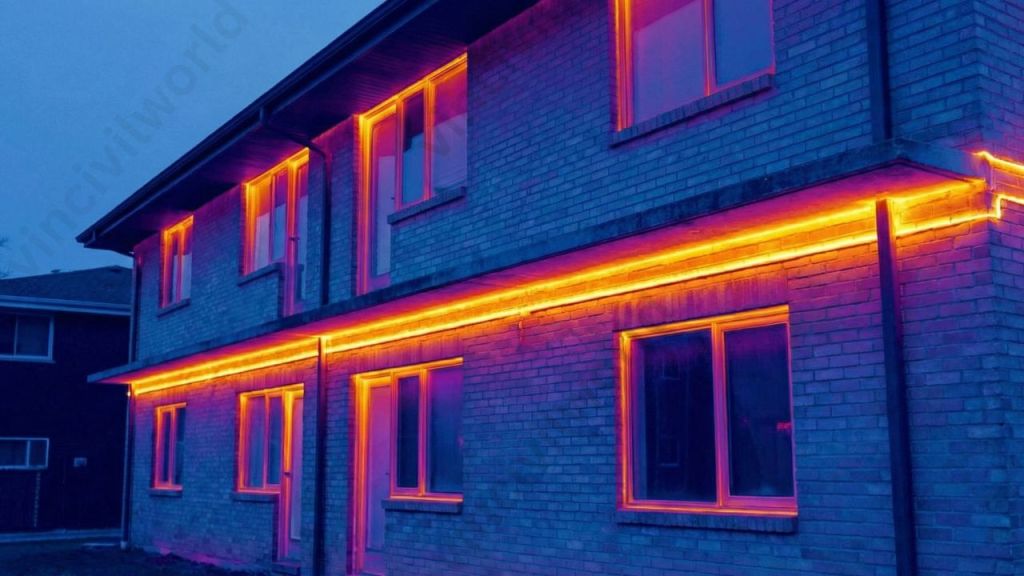
A two-story house illuminated with vibrant orange and purple LED lights along the edges, set against a twilight sky.
Thermal imaging of a building highlighting areas of heat loss, illustrating the effects of thermal bridging.

Repeating thermal bridges are normal and predictable. But still, they result in significant heat loss. Because of that, we should consider thermal bridging when calculating the U-value and during planning, design, and construction.

Point thermal bridging

Point thermal bridging occurs at localized points where small but highly conductive elements penetrate the insulation layer. Common examples include metal fasteners, anchors, screws, and fixing brackets used in building construction. Although each point bridge is small, their combined effect can lead to noticeable heat loss and reduced thermal performance. Point thermal bridging may also cause cold spots on interior surfaces, increasing the risk of condensation. Minimizing point thermal bridging through proper detailing and low-conductivity fixings improves energy efficiency and overall building performance.

Non Repeating Thermal Bridges 

  • Thermal bridges appear periodically. And, they are located where the building’s thermal insulation has a split in it.
  •  Non-repeating thermal bridges can form where materials with different thermal conductivity come together to form the envelope. 
  • Examples include reveals around windows and doors, loft hatches, and other openings in the building’s thermal envelope.
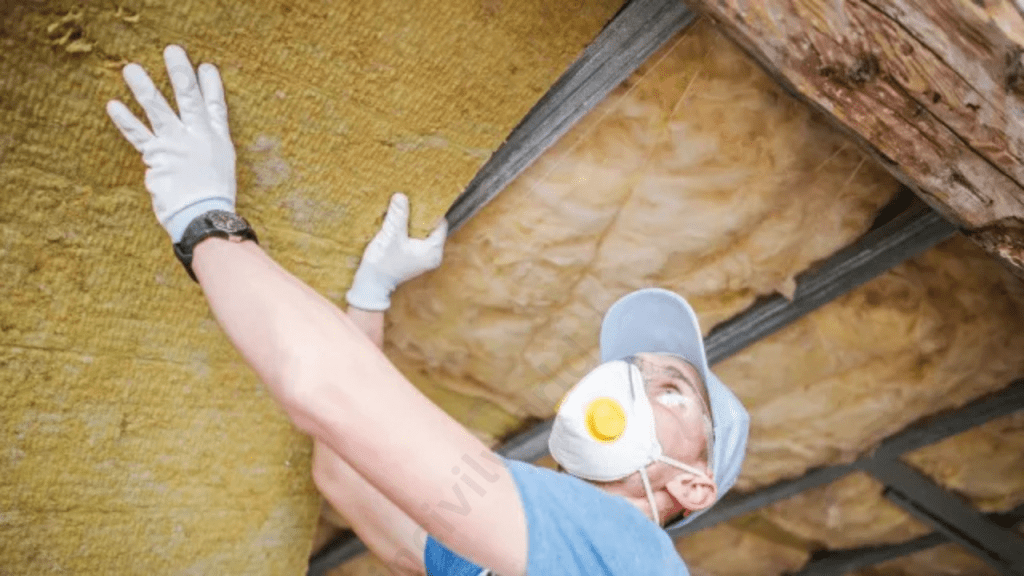
A person wearing gloves and a mask is installing insulation in a ceiling. The individual is reaching up to adjust the material, which appears to be yellow insulation. The environment indicates a home improvement or construction setting.
A worker installing insulation material to improve building energy efficiency and minimize thermal bridging.

Why should we avoid thermal bridging?

Let me give you a set of reasons that would prompt you to avoid thermal bridges during construction of a building.

Decreased Insulation Effectiveness

  • Buildings that are airtight and have high levels of insulation may be more vulnerable to thermal bridges. 
  • When high levels of air tightness and insulation are present, thermal bridges can account for up to 30% of heat loss. 
  • During the warmer months of the year, thermal bridges can actually cause an increase in heat gain. This can contribute to overheating of the indoor room.

Increased expenditure of energy

The amount of heat lost depends on the intensity and frequency of thermal bridges. it’s best to design and construct buildings with no thermal bridges. If you don’t, you’ll end up spending more money to maintain a constant and comfortable indoor air temperature. This will undermine the intention of installing energy efficiency measures in the first place. 

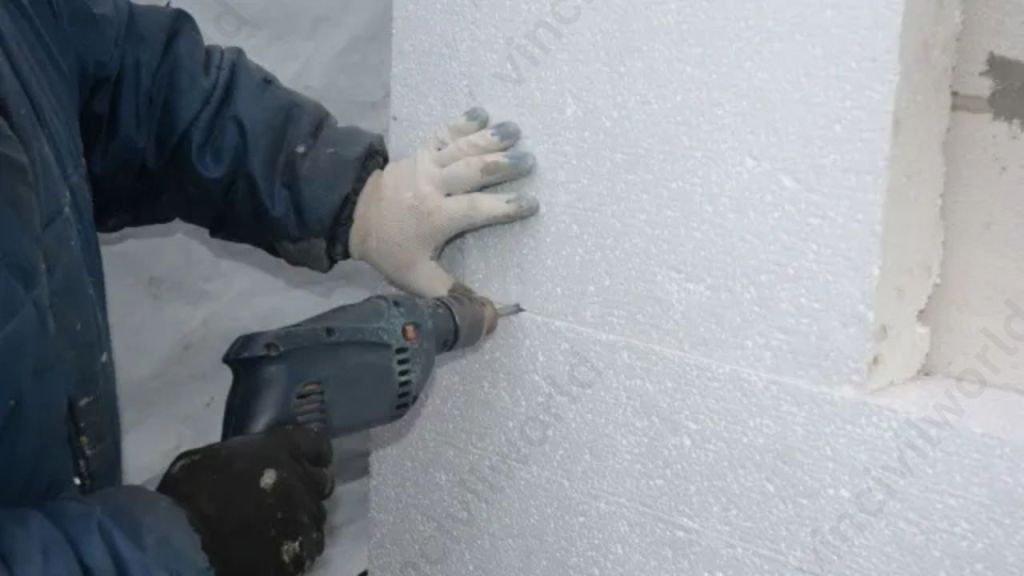
A worker installing insulation material using a power drill, emphasizing the importance of proper thermal bridging techniques in construction.

Greater risks of Condensation, mould, and rot 

  • Thermal bridges can cause interstitial condensation within walls and other building elements.
  •  Since it cannot be seen from the inside or outside of the house, interstitial condensation can be extremely hazardous. 
  • As the interior temperature falls below the dew point, moisture in the warm air condenses into water droplets.
  • Mold growth is one of the most common side effects of condensation. 
  • Invisible mold can develop out of reach, resulting in poor indoor air quality and negative health effects for building occupants.
A two-story brick house illuminated with vibrant orange and purple neon lights along the edges of the windows and roof, set against a twilight sky.
Infrared image showing thermal bridging in a building, highlighting heat loss areas around windows and walls.

Strategies to reduce Thermal Bridging

Depending on the source, site, and form of construction, there are many methods that have been proven to minimise or eliminate thermal bridging. The aim of these approaches is:

  1. Either create a thermal break where a building component would otherwise stretch from outside to inside.
  2. Or, minimise the amount of building components that span from outside to inside.

 These are some of the strategies:

  • Using a continuous thermal insulation layer, such as rigid foam board insulation in the thermal envelope.
  • Lapping of insulation where direct continuity is not feasible.
  • Usage of Wall assemblies with double and staggered walls.
  • Using Insulating Concrete Forms (ICFs) and Structural Insulated Panels (SIPs).
  • Reduce the framing factor by removing unnecessary framing members.
  • Increased insulation depth by using raised heel trusses at wall-to-roof junctions.
  • Installation of high-quality insulation with no voids or compressed insulation.
  • Adding a gas filler and a low-emissivity coating to double or triple-pane windows.
  • Installing windows with thermally broken low conductivity frames.

Keep this strategies in mind so that they can help you construct a building with zero thermal bridges. Hope you found them useful. Let’s know in the comments.
Key Takeaways

  • Thermal bridging in buildings occurs where insulation is reduced or interrupted, allowing heat to flow easily.
  • It can account for up to 30% of total heat loss, even in well-insulated structures.
  • Thermal bridges commonly form at junctions, edges, penetrations, and structural connections.
  • Major effects of thermal bridging include increased energy consumption, condensation, mould growth, and occupant discomfort.
  • Thermal bridging causes often relate to poor design detailing, material choices, and construction practices.
  • The main types of thermal bridging include geometric, material, structural, repeating, and point thermal bridges.
  • Repeating and point thermal bridges may appear minor individually but cause significant cumulative heat loss.
  • Proper identification during design is critical.
  • Continuous insulation and thermal breaks reduce risks.
  • Accurate detailing improves energy efficiency and building durability.

Conclusion

Thermal bridging is a critical factor that directly affects the energy efficiency, comfort, and durability of buildings. Thermal bridges in buildings and construction allow uncontrolled heat flow due to insulation gaps, material conductivity, and poor detailing. Understanding the types of thermal bridging, along with the causes of thermal bridging, enables designers and engineers to address weak points in the building envelope. The effects of thermal bridging, such as heat loss, condensation, mould growth, and increased energy costs, highlight the importance of proper planning and execution. By adopting effective strategies like continuous insulation, thermal breaks, and improved construction detailing, thermal bridging insulation issues can be significantly reduced. Addressing thermal bridging early ensures sustainable, energy-efficient, and comfortable buildings that meet modern performance standards.

Lightweight Aggregate: Manufacturing, Properties and Types

Lightweight aggregate plays a vital role in modern construction by reducing structural dead load while maintaining strength and durability. Widely used in lightweight aggregate concrete, it improves thermal insulation, seismic performance, and material efficiency. Understanding the types of lightweight aggregate—both natural and artificial lightweight aggregate—helps engineers select suitable materials for specific applications. Equally important is the lightweight aggregate manufacturing process, which influences density, strength, and absorption characteristics. The properties of lightweight aggregate, such as low unit weight, porosity, and adequate compressive strength, make it ideal for structural, geotechnical, and precast works. This article explains how manufacturers produce lightweight aggregates, highlights their key properties, and describes the different types available, providing a clear technical foundation for effective design and construction decisions.

Lightweight aggregate is a widely used construction material owing to its versatile properties. In this blog, I will walk you through what is a lightweight aggregate, its properties, applications and manufacturing process.

  1. What is a lightweight aggregate?
  2. Features of Lightweight Aggregates
  3. Lightweight Aggregate Desired Characteristics
  4. Types of Lightweight Aggregates
  5. Lightweight Aggregates Manufacturing Process
    1. Extraction or quarrying 
    2. Sizing 
    3. Reaction
    4. Cooling
  6. Lightweight Aggregate Applications
  7. Key takeaways
  8. Conclusion

What is a lightweight aggregate?

Lightweight aggregate is a coarse aggregate used to make lightweight concrete for structural as well as non-structural applications.

  • The Compressive design strength of normal concrete for cast-in-situ, precast and prestressed concrete ranges between 20 N/mm2 to 35 N/mm2. On the other hand, the minimum compressive design strength of concrete which uses lightweight aggregate will be around 17-18 N/mm2.
  • Normal concrete has a density between 2300 and 2500 kg/m3. However, when it comes to LWC the density ranges between 500 kg/m3 to 1800 kg/m3 depending on the type of aggregate used.
  • Lightweight concrete with densities lower than 17 N/mm2 falls under the category of LWC. And, those with densities above 17 N/mm2 are referred to as structural lightweight concrete (SLWC).
  • LWC can also be designed for the minimum compressive strength as normal concrete by varying the proportions of mineral admixtures used.
  • SLWC is used for structural applications. They can be used along with reinforcement steel just like normal concrete.
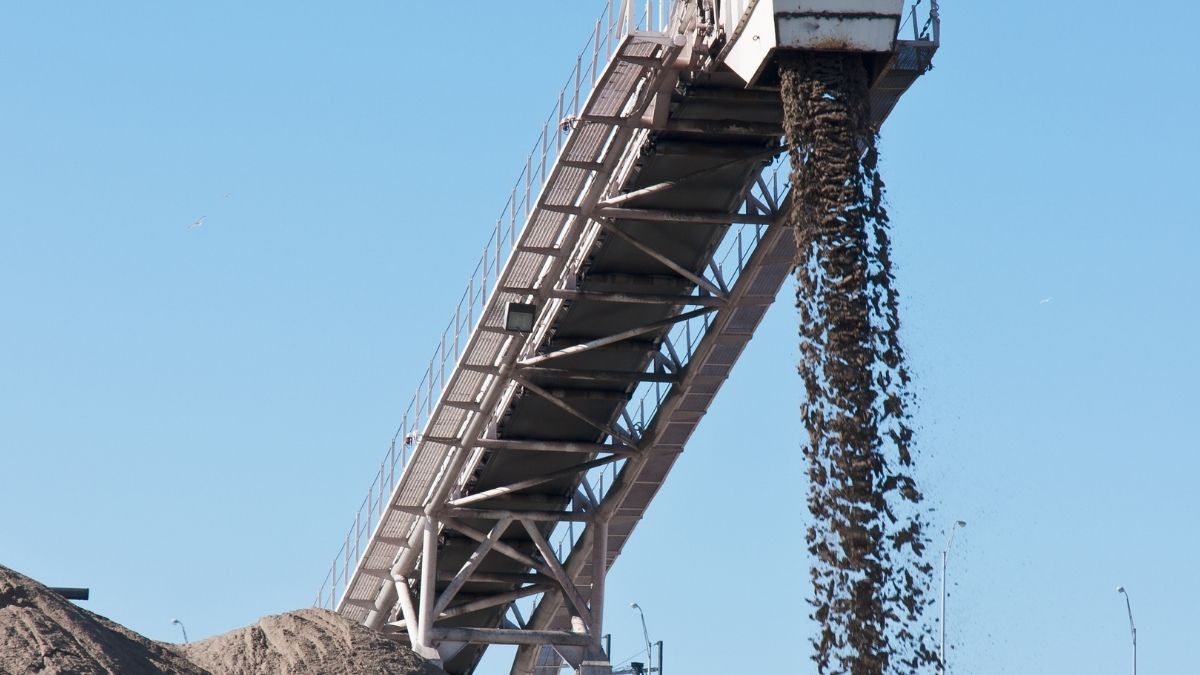
A conveyor belt discharging material, possibly sand or gravel, from a height onto a pile beneath against a clear blue sky.
A machine dispensing lightweight aggregate during the manufacturing process for construction materials.

Features of Lightweight Aggregates

  • The lightweight aggregate used in concrete may have any form, including cubical, rounded, angular, and other shapes. Its workability is directly influenced by its form and texture.
  • These aggregates are known for absorbing little water and maintaining their low density. 
  • A high saturation level makes it an attractive option.
  • LWA can reduce the dead loads on the structure and make it more economical.
  • Has relatively low thermal conductivity and is preferred for roof insulations.
  • Helps in consuming industrial wastes like blast furnace slag, fly ash, clinkers etc.
  • Possess good acoustic properties.

In the next section we will see what are the desired characteristics of a lightweight aggregate.

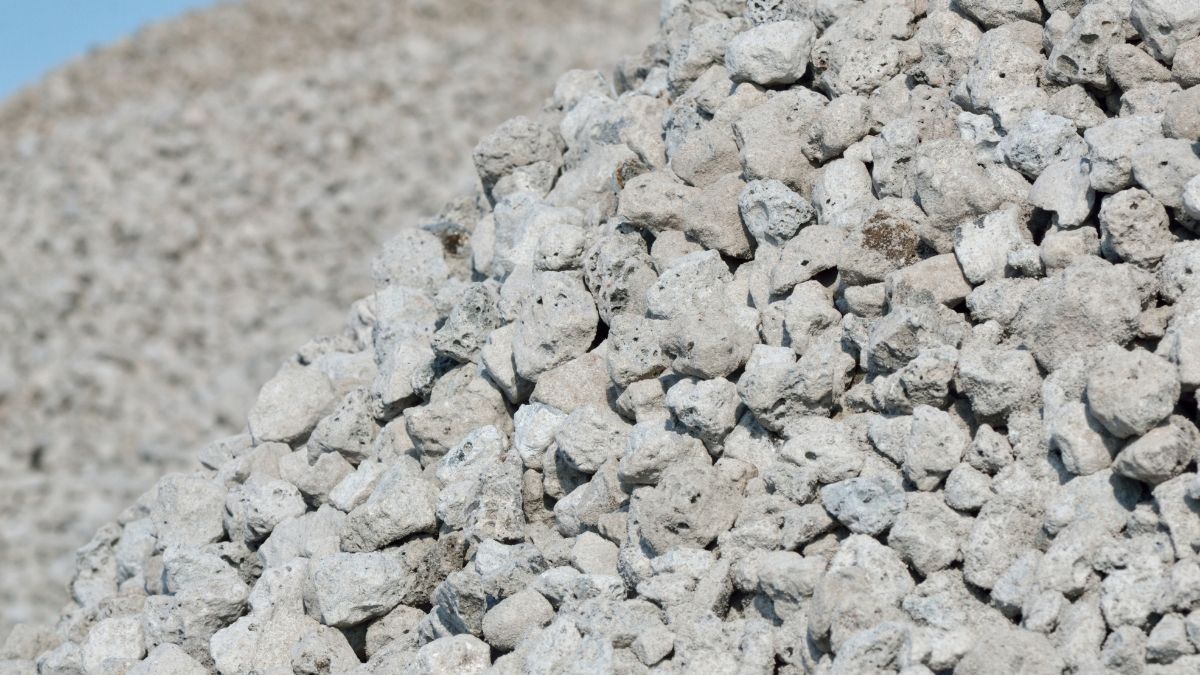
Close-up of a pile of grey, textured gravel or crushed stone.
Close-up view of lightweight aggregate, essential for reducing structural dead load in modern construction.

Also read : Pervious Concrete- All Factors Affecting, Limitations & Methodology Explained

Lightweight Aggregate Desired Characteristics

  • The properties and composition should be consistent.
  • To ensure worthwhile structural savings, the aggregate should have a low specific weight, in compliance with the required ASTM requirements. 
  • The aggregate should have a low number of large external voids. And a high number of smaller well-distributed voids within the particles. 
  • Individual aggregate particles should be able to withstand handling and mixing. 
  • The particles should have a good bond with the cement and should not react chemically with it. 
  • The aggregate should be rated appropriately for the intended use, according to the relevant ASTM specification 

Types of Lightweight Aggregates

Lightweight Aggregates can be divided into three types by their sources:

A chart illustrating the classification of lightweight aggregates, divided into natural aggregates from volcanic origin, such as pumice, scoria, and diatomite, and processed/artificial aggregates like expanded clay/shale, perlite, exfoliated vermiculite, and sintered fly ash. Key properties include low bulk density, high porosity, and good thermal insulation.
A visual classification of lightweight aggregates, showcasing natural aggregates like pumice and scoria alongside processed aggregates such as expanded clay, perlite, and sintered fly ash, emphasizing their low bulk density and high porosity.

(1)Industrial waste lightweight aggregate – This is processed by industrial wastes, such as fly as, ceramisite, expanded slag ball, cinder and light sand, etc.

(2)Natural aggregate – This is made from natural porous stone, such as pumice, volcanic cinder, and light sand, etc.

(3) Artificial lightweight aggregate – This is manufactured from local materials, such as clay ceramisite, and expanded perlite, etc.

Also read ALC Panel – Autoclaved lightweight Concrete Panel

Lightweight Aggregates Manufacturing Process

The majority of lightweight aggregate is made from clay, shale, or slate. However, furnace slag, natural pumice, vermiculite, and perlite can all be substituted. 

The raw material (excluding pumice) is extended to about twice its original volume to create lightweight aggregate. The expanded material has properties that are similar to natural aggregate. As a result, it produces a lighter concrete product.

Let me show you the detailed procedure.

Extraction or quarrying 

Cone crushers, jaw crushers, hammer mills, and pug mills are used to crush the material, which is then screened for quality.

Sizing 

The material that passes through the screens is returned to the crushers, and the material that passes through the screens is recycled.

It is then moved to hoppers.

Reaction

  • The material is fed from the hoppers into a rotary kiln. 
  • It is heated to about 1200°C (2200°F) using coal, coke, natural gas, or fuel oil. 
  • When the raw materials are heated, carbonaceous compounds in the material liquefy, forming gas bubbles that expand the material.
  • In addition, VOCs (volatile organic compounds) are released during the process.
  • The enlarged product emerges from the kiln.

Cooling

  • The product clinker is conveyed into the clinker cooler, where it is cooled by air and shaped into a porous material. 
  • The lightweight aggregate is screened for scale, crushed if necessary, and stockpiled after cooling. 
  • Rotary kilns are used by the vast majority of plants (roughly 90%). However, travelling grates are also used to heat the raw material. 

Lightweight Aggregate Applications

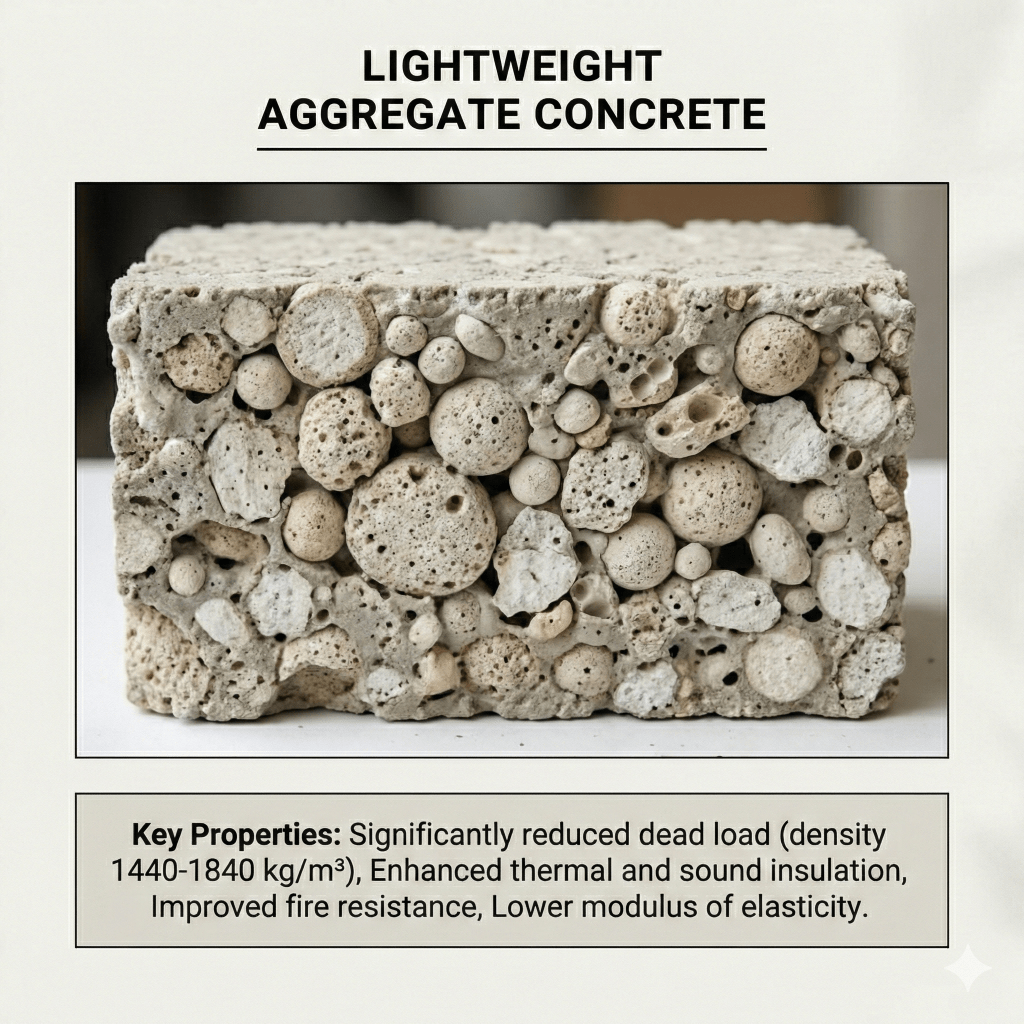
Close-up of a block of lightweight aggregate concrete displaying various aggregate particles, featuring a caption highlighting its key properties such as reduced dead load, improved insulation, and fire resistance.
Lightweight aggregate concrete block showcasing its unique porous structure and key properties: reduced dead load, enhanced insulation, and improved fire resistance.
  1. Screeds and thickening are made with lightweight aggregates. When the floor or roofs need thickening or smoothing, it can be used to easily achieve it.
  2. Can be applied to screeds and walls where the wood would be nailed together.
  3. Casting structural steel in lightweight aggregate concrete can protect it from fire and corrosion. Also, it can be used to cover architectural needs.
  4. Can be used on roofs as a heat insulation material.
  5. Used as insulation for water pipes.
  6. Used to construct partition walls and panel walls in frame structures.

That’s it about lightweight aggregates. Hope you found this article insightful. Let us know in the comments.

Key takeaways

  • Lightweight aggregates reduce structural dead load without compromising essential strength.
  • Manufacturing methods strongly influence density, strength, and absorption properties.
  • Natural, industrial by-product, and artificial types offer flexibility in material selection.
  • These aggregates improve workability and enable efficient construction practices.
  • They support structural, insulation, fire protection, and architectural applications.
  • Proper processing ensures consistent quality and performance.
  • LWA contribute to durable, economical, and sustainable construction solutions.

Conclusion

In conclusion, lightweight aggregates offer an efficient solution for modern construction by balancing strength, weight reduction, and performance. Their role in lightweight aggregate concrete has become increasingly important for structural and non-structural applications alike. Understanding the types of lightweight aggregate, including natural and artificial allows engineers to select materials suited to specific design needs. The lightweight aggregate manufacturing process directly affects quality, durability, and consistency, making process control essential. In addition, the properties of lightweight aggregate, such as low density, thermal insulation, and adequate strength, contribute to improved structural efficiency and sustainability. When selected and applied correctly, these materials support safe design, cost-effective construction, and long-term performance across a wide range of engine

Types of Spillways for Dams

Types of Spillway are essential structures provided in dams to safely pass excess floodwater and maintain reservoir levels. Every dam requires a suitable spillway system to prevent overtopping and structural damage. Different spillway types are used based on site conditions, discharge capacity, and dam design. In practice, spillways in dams guide surplus water away from the dam body while controlling flow energy. Each spillway in dam serves a specific purpose, whether for normal operation or emergency conditions. The spillway of dam may be gated or ungated, straight or curved, depending on hydraulic requirements. Engineers classify dam spillway types to ensure safety, efficiency, and long-term performance. This article explains the different types of spillway, their arrangement, major spillway components, and important spillway features that influence operation and durability.

Let’s start from the definition.

  1. What is a spillway ?
  2. Spillways of Dams – Role and Importance
    1. Importance of Spillways for Dams
  3. Components of a Spillway
    1. Control Structure
    2. Conveyance Channel
    3. Terminal Structure
  4. Dam spillway types – Classifications
    1. Types of Spillways
    2. Drop Spillway
    3. Ogee type Spillway
    4. Chute Spillway
    5. Side-channel
    6. Shaft Spillway
    7. Siphon Spillway
    8. Conduit Spillway
    9. Labyrinth Spillway
  5. Conclusion

What is a spillway ?

A spillway is a hydraulic structure provided in a dam to safely release excess water from a reservoir to the downstream side. It prevents overtopping of the dam during floods and heavy inflows. The spillway in a dam controls water levels and protects the dam body from erosion and structural failure. By guiding surplus water through a designed channel, a dam spillway reduces pressure on the embankment or concrete structure. Different spillway types handle varying discharge conditions and flow rates. Proper spillway design ensures safe flood passage, energy dissipation, and long-term stability of dams and reservoirs.

Spillways of Dams – Role and Importance

Spillways of dams are vital hydraulic structures that ensure the safe and efficient operation of reservoirs. A spillway allows excess water stored in a dam to pass safely to the downstream side. This process happens in a controlled manner, especially during floods or heavy inflows. It acts as a safety valve when the reservoir reaches its maximum capacity. This prevents water from overtopping the dam. It also avoids structural damage or failure.

Aerial view of a circular shaft spillway structure surrounded by water, designed for controlled water discharge from a reservoir.
Aerial view of a shaft spillway, designed to efficiently manage excess water from a reservoir.

Importance of Spillways for Dams

The following are the importance of spillways of Dams

  • Improve the long-term safety, stability, and durability of dams
  • Prevent overtopping of the dam during floods and heavy inflows
  • Safely discharge excess reservoir water to the downstream side
  • Control floods and reduce downstream flood risks
  • Regulate and maintain safe reservoir water levels
  • Provide emergency water release during extreme conditions
  • Reduce hydrostatic pressure on the dam body and foundations
  • Protect embankments and structural components from erosion
  • Dissipate flow energy and minimize downstream scouring
  • Safeguard appurtenant structures such as gates and outlets

Let’s go on a trip to see the different types of spillway.

Components of a Spillway

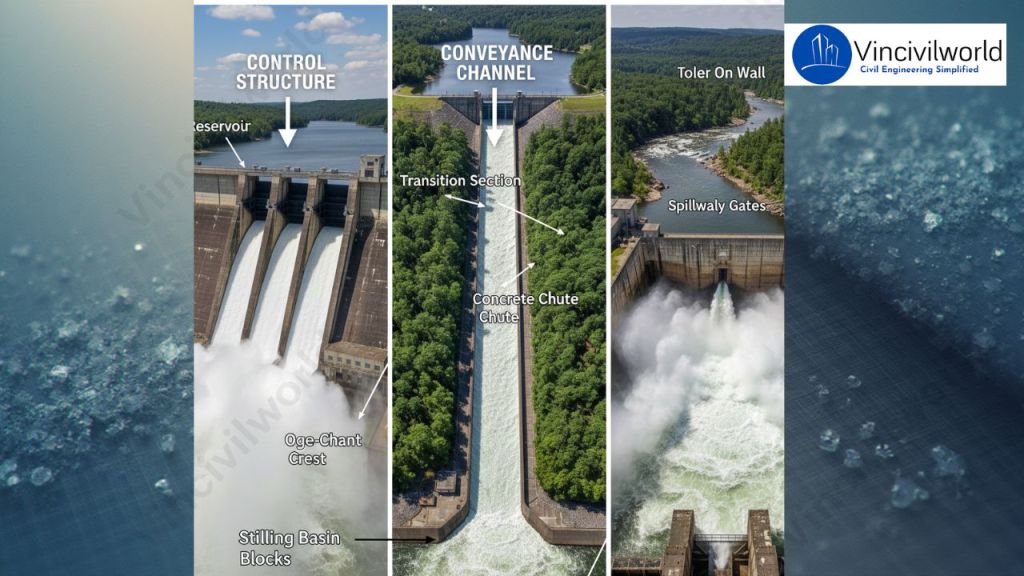
Depending on the suitability of the site and other conditions, various types of spillways may be given. A spillway consists of three main components that work together to safely discharge excess water from a reservoir. Each component of spillway has a distinct function and hydraulic role.

Diagram illustrating the components of a spillway, including the Control Structure, Conveyance Channel, and Spillway Gates, with labels for key features such as Ogee-Chant Crest and Transition Section.
Diagram illustrating the major components of a spillway system, including the control structure, conveyance channel, and spillway gates, essential for managing excess water in dams.

Control Structure

The control structure is the upstream part of the spillway that regulates the release of water from the reservoir. It allows water to pass only when the reservoir level exceeds a predetermined safe level. This structure controls discharge capacity and prevents uncontrolled outflow during normal operating conditions.

Conveyance Channel

The conveyance channel carries water from the control structure to the downstream side of the dam. It follows open-channel flow principles and may be located on the dam body or along a natural slope near the dam. Its main role is to guide water safely without causing erosion.

Terminal Structure

The terminal structure dissipates the high kinetic energy of flowing water before it enters the downstream river. As a result, the flow rate at the downstream end of the spillway is extremely high. It causes damage to the dam, spillway, and other nearby structures. As a result, engineers dissipate the high flow energy before returning the water to the downstream river. They provide terminal structures at the downstream end of the discharge channel to reduce this excess energy.

The first two can be combined in some cases. Now we have seen the main parts of a spillway. Time to learn about the different categories.

Dam spillway types – Classifications

Dam spillway types are classified based on hydraulic design, site conditions, and discharge requirements. This classification ensures they can safely pass floodwater. It also protects dam structures from overtopping and failure.

Types of Spillways

  • Drop Spillway
  • Ogee Spillway
  • Chute Spillway
  • Side-Channel Spillway
  • Shaft Spillway
  • Siphon Spillway
  • Conduit Spillway
  • Culvert Spillway

Let’s discuss each of its features in detail.

Drop Spillway

A drop spillway is a type of weir structure where water flows through the weir opening and then drops onto a level apron or a stilling basin before finally entering the downstream channel. This arrangement helps manage excess water safely while controlling flow energy.

Diagram illustrating a drop spillway, featuring labeled components including inlet channel, crest, headwall, apron, toe wall, wingwall, and outlet canal.
Diagram illustrating a drop spillway design, showcasing key components such as the inlet channel, crest, headwalls, apron, and outlet canal, essential for efficient water management in dams.
  • The overflowing water descends freely and almost vertically on the downstream side of the hydraulic structure.
  • This type of spillway is well suited for low dams and weirs.
  • Engineers shape the spillway crest with a nose to prevent the water jet from directly striking the downstream foundation of the structure.
  • On the downstream side, engineers provide a horizontal impervious apron to safeguard the structure against scouring caused by high-velocity flow.
  • Engineers construct a basin is usually constructed on the downstream side to form a small artificial pool, commonly referred to as a water cushion.
  • The primary purpose of this water cushion is to dissipate the energy of the falling water and reduce erosion.

Ogee type Spillway

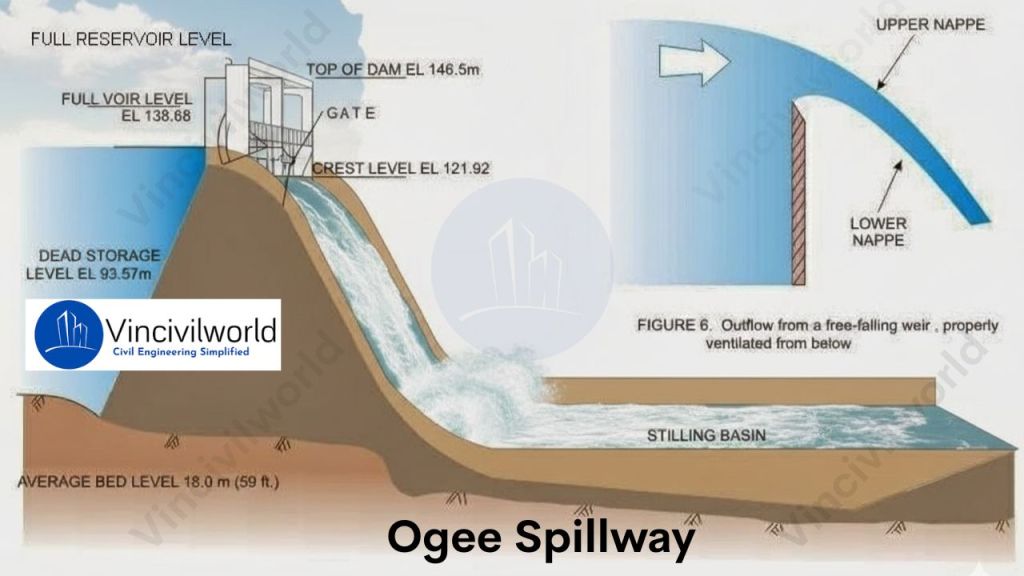
An ogee type spillway is an overflow spillway with an S-shaped crest profile, hydraulically designed to efficiently pass floodwater while maintaining controlled pressure conditions over the crest.

Diagram illustrating an ogee spillway, showing water flow from a reservoir over an S-shaped crest into a stilling basin.
Diagram illustrating an Ogee Spillway design, showcasing water flow mechanics and reservoir levels.
  • This is an overflow spillway with a controlled weir and a profile that is ogee-shaped (S-shaped).
  • It’s designed to track the lower surface of a horizontal jet that emerges from a sharp-crested weir.
  • At the design head, the pressure at the ogee crest remains atmospheric.
  • At a lower head, the pressure on the ogee crest becomes positive.
  • This results in the backwater effect which decreases the discharge.
  • At a higher head, the pressure on the crest becomes negative, resulting in the backwater effect, which increases the discharge

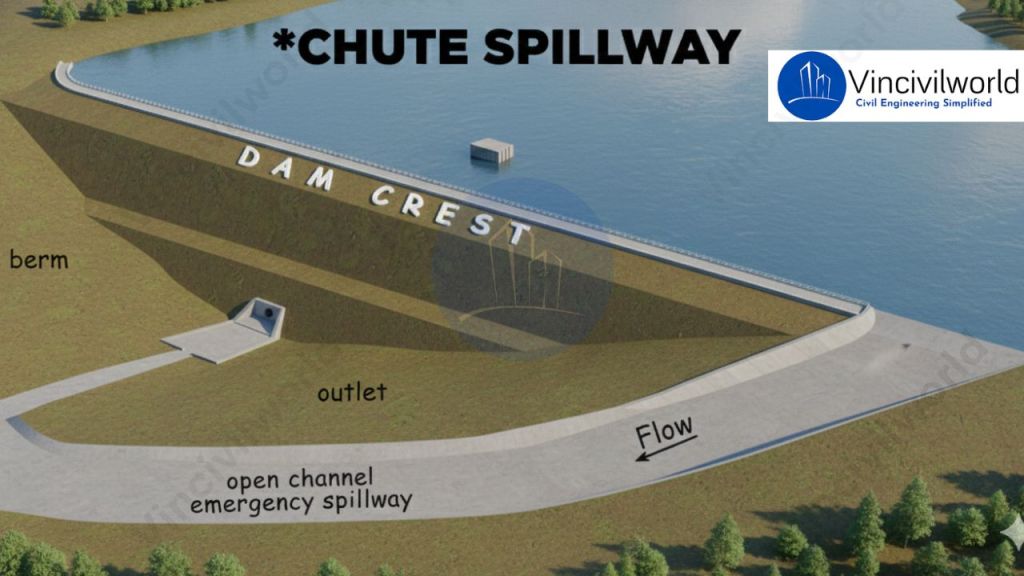
Chute Spillway

The chute spillway is an open channel-like structure with a fitting inlet and outlet built on the steep slope of the gully face.

Illustration of a chute spillway at a dam, showing the dam crest, outlet, and open channel emergency spillway with water flow direction indicated.
A Chute Spillway, designed as an open channel emergency spillway, regulates water flow from the dam crest while protecting valley walls from erosion.
  • Also called Trough Spillway. 
  • The aim of the Chute Spillway is to protect the valley walls from damage that could put the dams in danger. 
  • It is made up of a reinforced concrete slab that is a steeply sloping open channel.
  •  The spillway is not always of the same width.
  •  It is normally narrowed for the economy and then widened at the end to reduce the discharging velocity. 

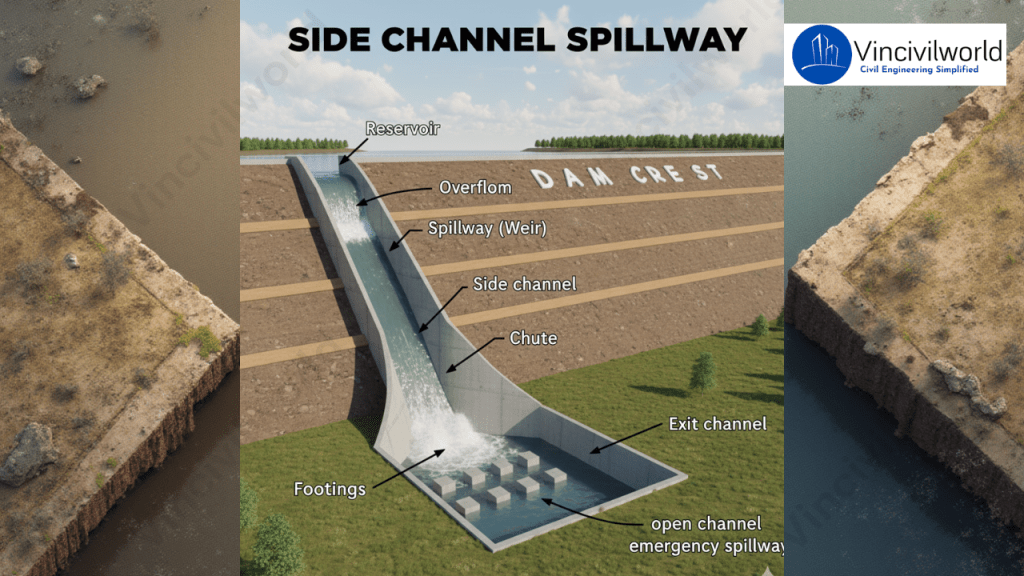
Side-channel

A side channel spillway has a control weir that runs alongside and roughly parallel to the spillway discharge channel’s upper half.

Diagram illustrating a side channel spillway, showing a reservoir, overflow weir, spillway channel, chute, exit channel, and footings.
Side-channel spillway design illustrating reservoir management and water flow diversion.
  • Unlike a chute spillway, the water spilling from the crest is turned 90 degrees and flows parallel to the crest of a side-channel spillway.
  • When flanks of adequate width are not accessible, side-channel spillways are preferred over chute spillways, typically to prevent heavy cutting.
  • The angle of turn of the water flow after passing through the weir crest can be held between 0 and 90 degrees. The spillway discharge falls into a shallow trough after flowing over the weir crest.

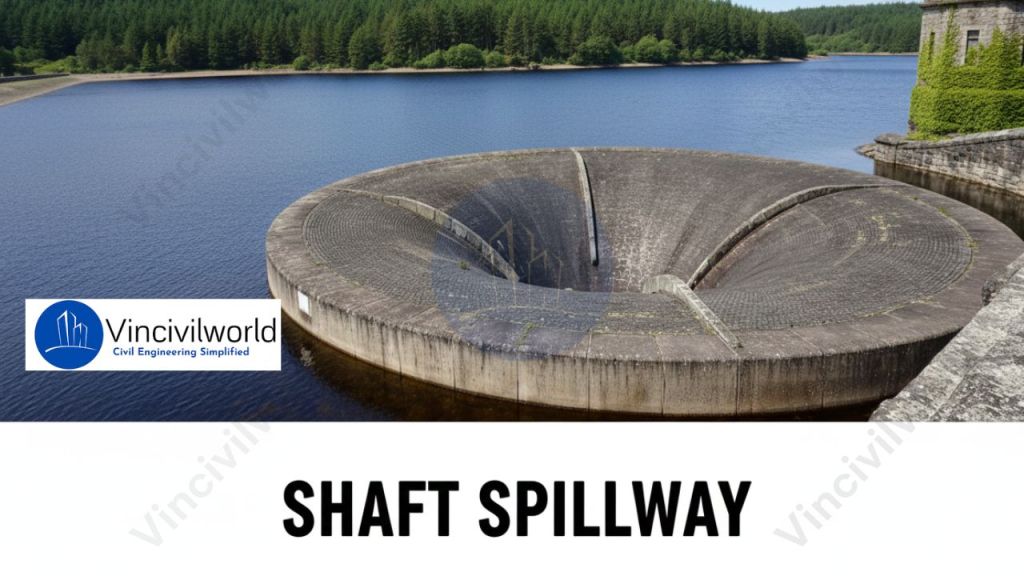
Shaft Spillway

A shaft spillway featuring a large, circular opening that descends vertically into a reservoir, surrounded by a forested landscape.
A shaft spillway design illustrating its vertical shaft and horizontal conduit for managing reservoir water flow.
  • The water from the reservoir enters a vertical shaft in the shaft spillway, which transports the water into a horizontal tube. 
  • A Shaft Spillway is made up of a horizontal crest and a vertical shaft, with the top surface at the spillway’s crest level and the lower end attached to a vertical shaft. 
  • The vertical shaft’s other end is attached to a horizontal conduit or tunnel that runs through or around the dam and transports the water to the river below. 
  • When the conditions aren’t conducive to an overflow or a chute spillway, a shaft spillway is used.

Siphon Spillway

A dam featuring multiple spillway structures with green hoods, situated against a backdrop of green hills and a river in the foreground.
Siphon spillway structure demonstrating effective hydraulic engineering for flood management.
  • The theory of siphonic action governs the operation of a siphon spillway.
  • A siphon spillway consists of two siphon pipes.
  • Engineers place one pipe upstream in contact with the reservoir, while the other pipe discharges water on the downstream side.
  • They provide an airtight RCC cover, known as the hood, over an ogee-shaped concrete body wall to form the siphon duct.
  • The top of the body wall forms the spillway crest, and engineers maintain it at the reservoir’s Full Reservoir Level (F.R.L.).

Conduit Spillway

  • Made up of a closed conduit that transports floodwaters to a downstream channel. 
  • A vertical or inclined shaft, a horizontal tube, or a conduit built in an open cut and then covered are all examples of closed conduits. 
  • It is built in the abutment or underneath the dam. 
  • Dam sites in narrow canyons with steep abutments would benefit from such a spillway.

Labyrinth Spillway

  • A labyrinth spillway is one in which the weir wall is built in a zigzag pattern to maximise the effective length of the weir crest in comparison to the channel width. 
  • This improvement in effective length increases the weir’s discharge capacity, allowing for more water flow at small heads to be easily transported downstream.
Aerial view of a labyrinth spillway showcasing zigzag-shaped weir walls, facilitating efficient floodwater discharge into the downstream while maintaining reservoir levels.
A labyrinth spillway showcasing the zigzag pattern designed to maximize discharge capacity and manage water flow effectively.

That’s it about spillway and their types. Hope you found it insightful. Next time you visit a dam site, make sure that you are able to identify the type of spillway present there. If you get confused don’t forget to check out our detailed articles on dams.

Key Takeaways

  • Types of Spillway are crucial for safely managing excess water in dams and protecting against flooding and structural damage.
  • Different spillway types include Drop, Ogee, Chute, Side-Channel, Shaft, Siphon, Conduit, and Labyrinth, each serving unique hydraulic functions.
  • The components of a spillway consist of the Control Structure, Conveyance Channel, and Terminal Structure, working together to manage water flow.
  • Proper spillway design enhances the safety and longevity of dams by controlling flow energy and maintaining reservoir levels.
  • Understanding the various types of spillway aids in identifying their specific applications and importance in dam engineering.

Conclusion

Types of Spillway play a decisive role in ensuring dam safety and effective flood management. Understanding various spillway types helps engineers design reliable systems that safely pass excess water and protect structures. Properly designed spillways in dams regulate reservoir levels and prevent overtopping during extreme inflow conditions. Every spillway in dam consists of essential spillway components that work together to control flow and dissipate energy. The spillway of dam may differ in layout and function, but its objective remains safe water discharge. Clear spillway classification allows engineers to compare performance and select suitable dam spillway types for specific site conditions. Knowledge of the different types of spillway and their spillway features improves hydraulic efficiency, structural safety, and long-term durability. Overall, spillways are indispensable elements of modern dam engineering and flood control systems.

Activated Sludge Process – Stages and Process Control

The activated sludge process is a widely used and highly effective method in wastewater treatment, employing aerobic microorganisms to remove organic pollutants efficiently. This guide covers the activated sludge process definition, stages, and diagram, while explaining its role in secondary wastewater treatment for producing high-quality effluent. You will understand how aeration tanks, wastewater treatment microorganisms, mixed liquor suspended solids (MLSS), and return activated sludge (RAS) work together to maintain stable and efficient system performance. The activated sludge process in wastewater treatment relies on proper aeration, controlled sludge recycling, and effective process monitoring. Due to its reliability, adaptability, and high treatment efficiency, activated sludge wastewater treatment remains the preferred choice for many municipal and industrial wastewater treatment plants, ensuring consistent performance and environmental compliance.

Activated Sludge Process is a globally used wastewater treatment technique. In the previous blogs, I had shown you the various secondary wastewater treatment techniques. In this blog, we will dig deep into this widely used technique of activated sludge process, its configuration, process control and aeration methods.

Activated sludge Process – Definition

The activated sludge process is a type of wastewater treatment that uses aeration. It involves a biological floc made up of bacteria and protozoa to clean sewage or industrial waste waters. This process is biological and has various applications. It includes oxidising carbonaceous biological matter. Additionally, it deals with nitrogenous waste in the biological matter, mostly ammonium and nitrogen.

Before starting make sure that you take a quick glance through the blog, Wastewater Treatment- Stages and Process full details for better understanding

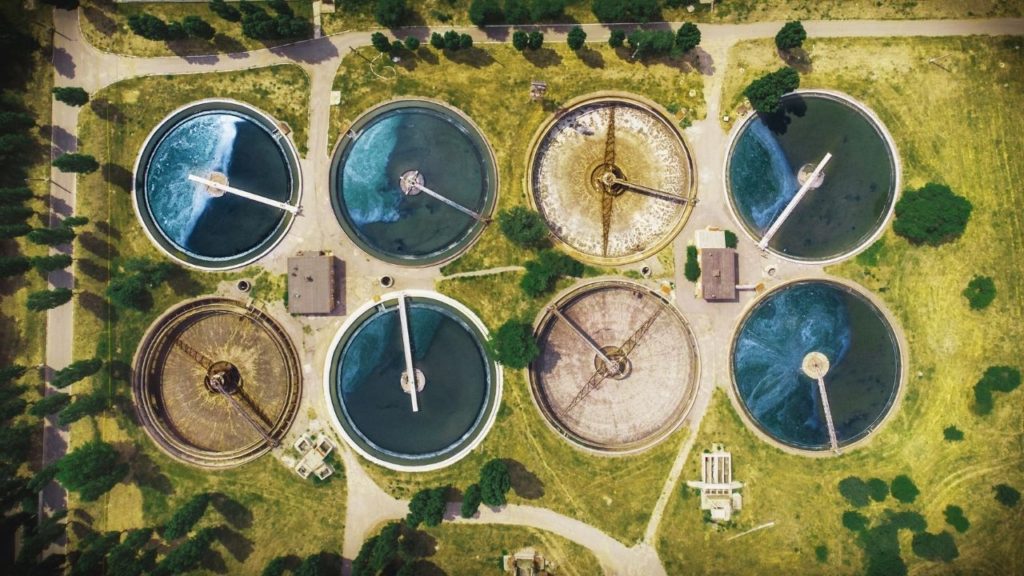
Aerial view of multiple circular wastewater treatment tanks with varying water clarity, surrounded by greenery.
Aerial view of multiple aeration tanks used in the activated sludge process for wastewater treatment.

The activated sludge process employs aerobic microorganisms that can digest organic substances in sewage. Also, they have the ability to cluster together via flocculation. The flocculated particles settle out as sludge. As a result, the liquid coming out is relatively free of suspended solids and organic matter.

Activated Sludge Process – Stages, Configuration, and Diagram

The activated sludge process is a widely used secondary wastewater treatment method. It removes carbonaceous organic pollution through aerobic biological activity. The configuration of an activated sludge wastewater treatment system consists of interconnected units that operate together to ensure efficient treatment.

Aeration Tank

The aeration tank is the heart of the activated sludge process in wastewater treatment. Primary treated sewage is mixed with microorganisms, forming mixed liquor suspended solids (MLSS). Air or oxygen is supplied using diffusers or mechanical aerators to support aerobic microbes. These microorganisms consume organic matter and convert it into stable end products.

Secondary Settling Tank (Secondary Clarifier)

The mixed liquor flows into the secondary settling tank, where biological flocs settle by gravity. Clarified effluent overflows for further treatment or discharge. Settled sludge collects at the bottom.

Sludge Recycling System

A portion of the settled sludge is returned as Return Activated Sludge (RAS) to maintain microbial concentration in the aeration tank. Excess sludge is removed as Waste Activated Sludge (WAS) to control sludge age and system stability.

Advanced control systems regulate aeration, sludge recycling, and flow rates, ensuring stable and efficient secondary wastewater treatment performance.

Now, how about looking deep into what happens inside an activated sludge process?

Diagram illustrating the activated sludge process, featuring an aeration tank, mixed liquor, secondary clarifier, return activated sludge (RAS), and waste activated sludge (WAS).
Diagram illustrating the activated sludge process, featuring the aeration tank, secondary clarifier, mixed liquor, return activated sludge (RAS), and waste activated sludge (WAS) pathways.

Activated Sludge Process Steps

The activated sludge process operates through a series of well-defined stages that enable effective secondary wastewater treatment. Each stage supports biological activity, sludge separation, and recycling to achieve high organic pollutant removal and regulatory compliance.

  • After primary treatment, wastewater enters into an aeration tank. A portion of sludge from the secondary settling tank also enters.
  • Organic matter comes into close contact with sludge from the secondary settling tank. Sludge is densely populated with microorganisms that are actively growing.
  • Diffusers or surface aerators inject air in the form of bubbles into the sewage-sludge mixture.
  • Microorganisms break down organic matter into stable chemicals like NO3, SO4, and CO2 while also producing new bacterial cells.
  • The effluent along with the actively growing microbial population passes to the secondary settling tank.
  • The secondary settling tank separates the aeration tank’s effluent, which contains flocculent microbial matter into supernatant and sludge. The treated supernatant undergoes further treatment before discharge.
  • This sludge from the settled waste returns to the aeration system’s inlet to re-seed the new wastewater reaching the tank. Return activated sludge (R.A.S.) is the fraction of the floc that returns to aeration tank.
  • The remaining sludge goes to sludge digesters for further treatment and safe disposal.

“Mixed liquor” refers to the combination of the liquid and microorganisms in the aeration tank. The suspended solids are called “Mixed Liquor Suspended Solids” (MLSS).

In the next section, we will find out the basic process control parameters in an activated sludge process.

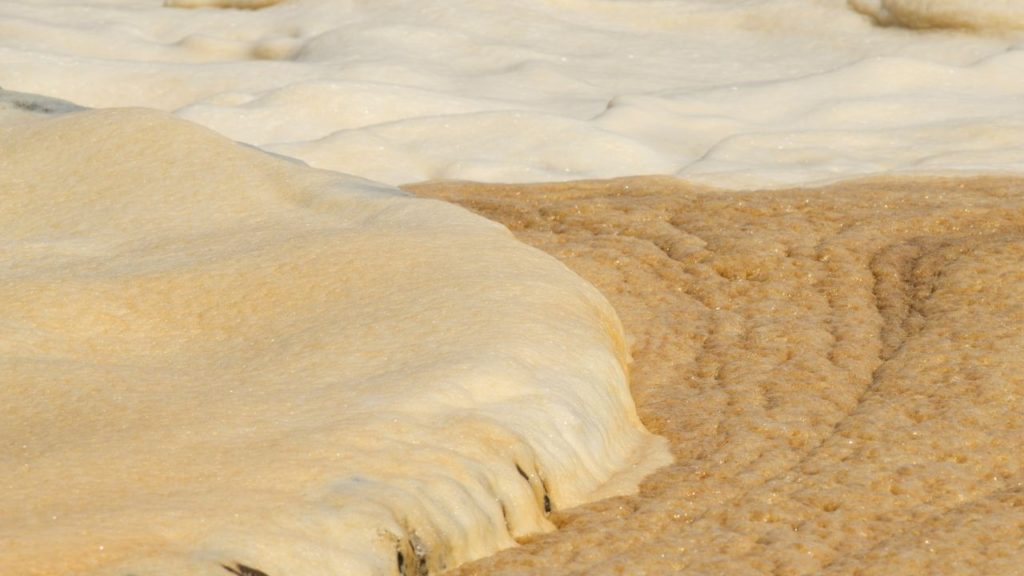
Close-up of foam and sediment in a wastewater treatment process, illustrating the activated sludge process used for organic pollutant removal.
Foamy surface of wastewater during the activated sludge process, illustrating the aeration and microbial activity involved in organic matter treatment.

Process Control in Activated Sludge Process

The general process control method monitors the following variables:

  • Sludge Volume Index (SVI)
  • Mean Cell Residence Time (MCRT)
  • Food to Microorganism Ratio (F/M)
  • Dissolved oxygen (DO)
  • Biochemical oxygen demand (BOD)
  • Chemical oxygen demand (COD)

Let me explain these parameters in detail.

Sludge Volume Index

Sludge Volume Index measures the volume of settled sludge in milliliters. This volume is occupied by 1g of dry sludge solids after 30 minutes of settling in a 1000 milliliter graduated cylinder. It gives a measure of the settling ability of the sludge. SVI ranges from 40 to 100 for a good sludge which settles down easily. Bulking Sludge is a biomass consisting of filamentous organisms with very poor settling characteristics. For a bulking sludge, SVI value can exceed 200. Sufficient pH control, adequate aeration and addition of hydrogen peroxide to the aeration tank prevents bulking.

Mean Cell Residence Time

Mean Cell Residence Time is the ratio of total mass (lbs) of mixed liquor suspended solids in the aerator and clarifier to the mass flow rate (lbs/day) of mixed liquor suspended solids leaving as final effluent.

Food to Microorganism Ratio

The Food to Microorganism Ratio indicates how much organic matter is fed to the microorganisms each day. It is relative to the mass of microorganisms under aeration. In other words, it is the ratio of the amount of BOD fed to the aerator (lbs/day). It is compared with the amount (lbs) of Mixed Liquor Volatile Suspended Solids (MLVSS) under aeration. 

Main Control Parameters

The mean cell residence time and F/M Ratio are the main control parameters used industrially. Both are directly related to the effluent quality. However, it is tedious to control the plant on the basis of the F/M ratio since it necessitates a lot of laboratory work to find the BOD and MLSS in the system. Therefore, the mean cell residence time is the best choice for controlling an activated sludge system.

Now you got an idea about the entire process and its important parameters. Next, we move on to the various aeration methods.

Aeration Methods in Activated Sludge Process

The decomposition of organic waste requires a very high concentration of oxygen at the initial stages of contact between microorganisms and the organic matter. The conventional systems usually maintain a plug flow hydraulic regime and keeps aeration and a mixing at an uniform rate along the entire tank. As a result, the oxygen concentration drops rapidly in the inlet and this can harm the microbes.

At the outlet, there is a surplus of oxygen which is not necessary and leads to economical losses. In order to match the oxygen supply and demand along the entire journey of wastewater from inlet to outlet, the mode of aeration needs some modifications. Let’s have a look at the different aeration methods in an activated sludge process.

Diffused Aeration

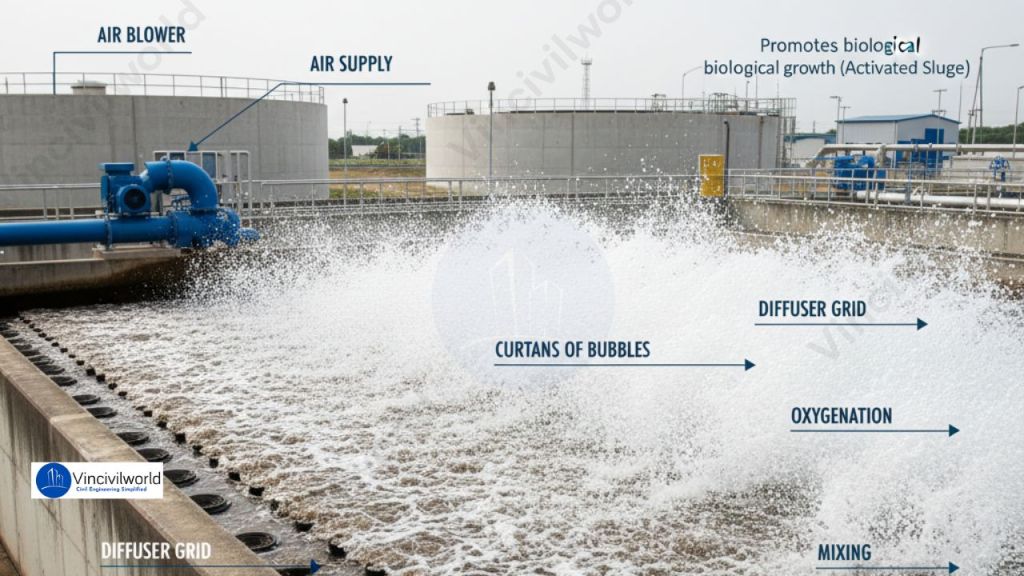
Sewage liquor is pumped into large tanks with floor-mounted diffuser grid aeration devices. Passing air creates a curtain of bubbles that oxygenates the liquor while also mixing it. An air blower usually creates the air. Oxygen replaces air for unusually strong and difficult to treat sewage.

Aeration tank in activated sludge process featuring air supply and diffuser grid for oxygenation, promoting biological growth with visible bubbles.
Diffused aeration system in activated sludge process, promoting oxygenation and biological growth.

Tapered Aeration

The organic waste needs more oxygen at the inlet. As it degrades progressively its oxygen demand decreases. Tapered aeration works on this principle. Aeration is intense at the inlet and decreases progressively along the length of the aeration tank. As this method involves the more efficient use of air, it results in savings in the pumping costs too.

Step Aeration

This method aims to equalize the oxygen supply and its demand. It introduces fresh feed at several points in the aeration tank, while keeping the rate of oxygen supply constant. This ensures a more even oxygen distribution over the entire tank and throughout the aeration stage. Baffles divide the aeration tank into several channels with each channel representing one step of the process.

Complete Mix Activated Sludge Process

In complete mix process, the aeration tank receives a mixture of fresh feed and recycled sludge at several locations within the tank. This ensures a constant supply and demand of oxygen along the length of the tank.

Contact Stabilisation

The microbial mass comes in contact with wastewater for short durations of time, approximately 0.5 to 1 hour in the biosorption unit. An anaerobic digestion unit stabilizes the resulting sludge after a retention period of about 2-3 hours. In the digestion unit, microbes consume the organic wastes removed in the biosorption unit. Since we stabilize the return sludge with higher solid concentrations, this reduces the volume of the aeration tank.

Pure Oxygen Activated Sludge Process

This type of activated sludge process supplies pure oxygen instead of air. It recirculates this oxygen into well mixed and converted chambers. Conventional processes utilize only 5-10% of oxygen. In contrast, the pure oxygen activated sludge process ensures about 90% utilization of oxygen. Further, it results in higher bacterial activity, lower sludge volume and sludge with better settling characteristics.

That’s it about activated sludge process. Let us know in the comments if you wish to know more.

Key Takeaways

  • The activated sludge process effectively treats wastewater using aerobic microorganisms to remove organic pollutants.
  • Key stages include aeration tanks, secondary settling tanks, and sludge recycling to maintain treatment efficiency.
  • Proper aeration and control parameters like SVI and F/M Ratio are essential for optimal performance.
  • Various aeration methods, such as diffused and tapered aeration, improve oxygen supply and microbial activity.
  • This process provides a reliable solution for secondary wastewater treatment, ensuring cleaner effluent.

Conclusion

The activated sludge process is a proven method for secondary wastewater treatment. It is highly efficient and used worldwide. This process removes organic pollutants from sewage and industrial wastewater. This process promotes aerobic microbial activity in aeration tanks. It achieves effective BOD reduction, suspended solids removal, and stable effluent quality. Proper control of operational parameters, such as dissolved oxygen, MLSS, and sludge age, ensures consistent system performance. It also prevents common issues like sludge bulking. With multiple activated sludge process configurations and aeration methods, the system can adapt to varying wastewater loads and treatment requirements. Due to its flexibility, reliability, and high treatment efficiency, the activated sludge process remains a cornerstone of modern biological wastewater treatment systems and sustainable water management.