All posts by Vinod Gopinath

Compressive strength test of concrete | Cube test for Concrete

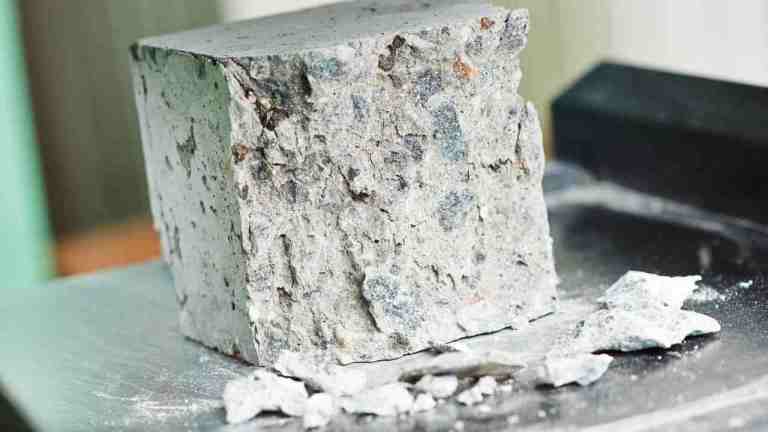
Compressive strength of concrete is the ability of the concrete to withstand loads without cracking or deformation. Compressive Strength of concrete is defined as the Characteristic strength of 150 mm size concrete cubes @28 days.  Marginal variations in water to cement ratio, ingredient proportioning, increase in a slump, etc impacts the desired concrete strength which in turn affects the strength and stability of structures.

Quality tests are to be conducted on concrete at various stages starting from the production stage to the hardened stage, and on structures. Quality tests play an important role in ensuring the quality of a particular construction. This article covers the types of tests conducted on concrete at various stages.

Quality tests on concrete

Quality tests are done on different stages as listed below,

  • Production stage quality tests ( On fresh concrete before placing)
  • Hardened stage quality tests ( hardened concrete specimens)
  • On structures ( tests done on the structures )

Quality tests on Fresh concrete

Quality tests on hardened concrete

Non destructive tests on concrete

  • Rebound hammer
  • Penetration resistance test
  • Ultrasonic pulse velocity test

This article is about compressive strength test of concrete, its significance and procedure.

Compressive strength test of concrete – significance

As a construction material, concrete should be able to withstand heavy loads. The concrete material beneath compression tends to reduce its size. Concrete gains its strength over time. The compressive strength depends on cement strength, water-cement ratio, concrete quality etc. The test gives an idea of the overall strength and above-mentioned factors. Through conducting this test, one can easily judge the concrete strength and quality of concrete produced. We can calculate the compressive strength from the failure load and the cross-sectional area of the specimen.

Compressive strength test of concrete

Concrete compressive strength for general construction varies from 15 MPa (2200 psi) to 30 MPa (4400 psi) and more than that in case of commercial, industrial structures and special structures.

The compressive strength helps in determining

  • Quality control
  • Acceptance of concrete
  • Evaluation of curing
  • For determining the in-place concrete strength.
  • Age of concrete, etc.

Formula for compressive strength

Compressive strength formula for any material is the load applied at the point of failure to the cross-section area of the face of the concrete specimen (cube or cylinder) on which load was applied.

Compressive Strength = Load / Cross-sectional Area

Relevant IS code

IS: 516-1959

Apparatus used

  • Compression testing machine or Universal testing machine
  • Cube or cylinder specimen
  • Weighing machine
  • Vibrating machine
  • Trowel
Compression test - Apparatus

Compressive strength test of concrete

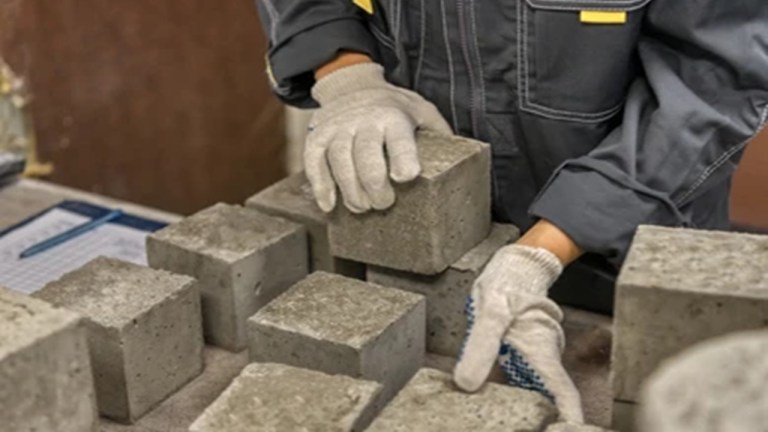
The specimen for this test can be cubic or cylindrical. The dimension of the specimens is as follows.

  • Cube = 150mm x 150mm x 150mm
  • Cylinder = 150mm diameter, 300mm height

The mould is made up of cast iron or steel. Cubical moulds are preferred for most works.

Compression testing of cubes – Procedure

Mixing of materials.

  • The first step is to prepare the test specimen by mixing the ingredients.
  • Mix the cement, coarse aggregate and fine aggregate in dry condition uniformly.
  • Mixing of the materials is by using batch mixer or by hand mixing.
  • Ingredients shall be bought to room temperature, before commencing the test.

Preparation of Test specimen

  • Clean the cube mould and apply the lubricant inside the mould.
  • Make at least three specimens from each batch.
  • After mixing the concrete, fill the specimen in the mould in three-layer at 50 mm thickness. 
  • After that stroke 35 times and compact the concrete using a vibrating machine. 
  • Then remove the excess concrete using a trowel. 
  • After that mark the date, grade of concrete etc and immerse the specimen in freshwater.
  • Then store the specimen at a temperature of 27-degree Celsius for 24 hours.

Procedure for testing

  • The specimens should be tested using the compression testing machine at 3, 7 and 28 days. 
  •  Before starting the test take the specimen from water and remove the mould.
  • The test should be conducted in the wet condition of the specimen.
  • Record the weight and dimension.
  • Then place the specimen in the testing machine. 
  • Gradually apply load on the specimen at a rate of 140 kg/ cm2 per minutes.
  • Note down the load at which the specimen breaks.
Compressive strength test of concrete

Calculation for Compressive strength test of concrete

The compressive strength of the concrete = Load at which the concrete breaks / Cross-sectional area of the specimen.

The compressive strength is expressed in N/mm2. The cube specimen is tested at 7, 14 & 28 days.

Calculation of compressive strength

Size of cube = 15cm x 15cm x 15cm

Area of specimen = 225 cm2

Expected maximum load = fck x area x f.s

Calculation shall be repeated for 7, and 28 days.

Results shall be furnished as average compressive strength of cube = …………… N/mm2 (7 days and 28 days)

Conclusion

The compressive strength of concrete cube gives and idea about the characteristics of concrete. With this single test we can judge the concrete quality and hence preferred for major construction works.

Stones || Quality tests on stones ||Types and procedures

Stones are the form of rocks from the earth’s crust. They find their application in the construction of residential and public buildings, dams, harbours, face-work of structures, road metal, and railway ballast. Besides, stones have good strength and durability.

Quality tests on stones are crucial for construction projects. Testing stone ensures that it meets the necessary standards for strength and durability. There are various tests for stones that assess different properties. These tests for stones include crushing strength, water absorption, and abrasion resistance. By performing these tests, engineers can decide the suitability of the stone for specific uses. Properly testing stone helps prevent structural failures and ensures long-lasting constructions. In this blog, we will explore the different types of stones and the procedures for each quality test. This information is essential for anyone involved in construction and material choice.

  1. Types of Stones Used in Construction
  2. Acid test
  3. Attrition test on stones
  4. Crushing test on stones
  5. Stone Crystalline test
  6. Freezing and Thawing Test
  7. Hardness Test
  8. Impact test
  9. Water absorption test
  10. Microscopic tests on stones
  11. Smiths tests

Types of Stones Used in Construction

Granite is a hard, durable stone, ideal for high-stress applications. Tests on stones, like crushing strength tests, highlight its robustness. Limestone is versatile but porous, requiring water absorption tests. Marble is prized for aesthetics, with abrasion resistance tests ensuring durability. Sandstone, used in paving and walls, needs strength and porosity tests. Slate, known for durability, is tested for impact resistance and is used in roofing and flooring. Proper testing stone ensures suitability for construction.

Qualities of Good Stone

We consider good-quality stones for the construction of important engineering structures. The next are the prime requirements of good-quality stones.

Also read : 9 lab tests for flexible pavements

  • The heavy stones have less porosity and high compactness. Thus the specific gravity of stones should be high.
  • Uniform and appealing colour stones are employed for decorative works.
  • Should have a homogeneous composition and should have less water absorption.
  • It should have the ability to get good polish.
  • Moreover, it should be free from iron oxides and calcium carbonate to resist fire.
  • The dense compaction of rocks can withstand the consequences of external agencies.
  • A good stone must be free from quarry sap.
Stones : Quality tests

Test on stones

Testing stone is essential to make sure durability and strength in construction. These tests for stones assess various properties. Proper tests on stones prevent structural issues.To conclude the strength, durability and other engineering properties of the stone, the following tests are performed. 

  • Acid test
  • Attrition test
  • Crushing test
  • Crystalline test
  • Freezing and thawing test
  • Hardness Test
  • Impact test
  • Water absorption test
  • Microscopic Test
  • Smith’s Test

Acid test

The acid test is a crucial procedure in testing stone for quality. Tests on stones help to determine the durability and suitability. Proper tests for stones ensure reliable construction materials.The acid tests determine the presence of calcium carbonate in rocks. The test method is as follows,

  • Take some 50 to 100g specimen randomly.
  • Then place them in the solution of sulphuric acid and hydrochloric acid having 1% strength for about one week.
  • Frequently mix the solution and immerse the specimen fully.
  • Subsequently, observe the specimen. 
  • Specimen with high lime content causes efflorescence due to the presence of an acid solution.
Quality tests on stones -Acid test

Attrition test on stones

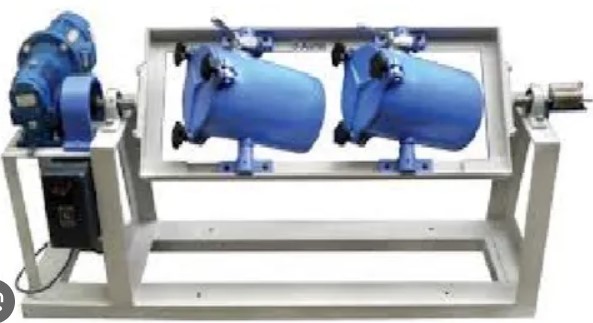
The attrition test indicates the rate of wear of the stone under the sudden impact of loads. Another name of the attrition test is the abrasion test. The apparatus for the attrition test is Devel’s testing machine.

  • Take some sample specimen and break them into small pieces having 60mm size.
  • Now take 50N of stones and place them in the cylinder of the testing machine. 
  • Then close the cylinder and rotate them for 5 hours at a rate of 30 rpm. 
  • After 5 hours, take the samples outside and sieve them through a 1.5 mm mesh.
  • Weigh the amount of material retained in the sieve and calculate the percentage of wear using the following formula.

Percentage of wear = ( Loss in weight / Initial weight ) x 100

Thus, we get the percentage of wear.

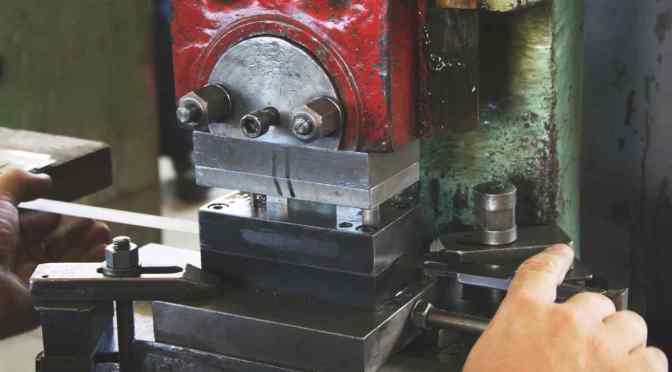
Attrition test on stones

Crushing test on stones

The crushing test gives the strength of the stones. These tests are performed for stones to be used at the bottom of heavy structures.

  • For this test, cut the stone specimens into 40mm x40mmx 40mm and dress the sides.
  • Minimum of three specimens are needed for this test.
  • Before starting, place the specimen in water for 72 hours.
  • Then cover the load-bearing surface of the specimen with a plywood layer.
  • Now place the specimen in the testing machine.
  • Simultaneously, apply load axially at a rate of 13.7 N/mm2 per minute.
  • Note down the load at which the stone breaks. Calculate the strength using the following formula.

Crushing strength = Maximum load at which stone breaks / Loaded area 

However even weak stone possess high compression strength. For example, the crushing strength of stone for ordinary building works should not exceed 1N/mm^2. 

Stone Crystalline test

This test defines the weathering nature of stones. To conduct this test we need at least 4 cubes with 40mm size. The crystallisation of Calcium sulphate causes eroding of stones

  • To start with first, immerse the samples in a solution of sodium sulphate at normal room temperature.
  • After that dry them at 100 degree Celsius and repeat these steps 5 times.
  • Then note down their difference in weight in the percentage of the original weight.
  • The difference in weight shows the weathering quality of the stones. 

Freezing and Thawing Test

As stones in the construction work are exposed to sunlight, wind, rain etc. This test is necessary to carefully study the behaviour of stone. The test procedure is as follows.

  • Take the specimen and immerse it in water for 24 hours.
  • Then place it in a freezing mixture at 12 degree Celsius for 24 hours.
  • Frequently repeat the above two steps and observe the stone quality. 

Besides, perform this test only in the shade to prevent the consequences of rain, sunlight, etc.

Hardness Test

The hardness of the stone is its ability to resist scratch or rebound.

  • For this test, we use a penknife. This can not make a scratch on pard stones like granite.
  • Moh’s scale value determines the hardness of the specimen.
  • For example, Moh’s scale value is 1. Since it is easily scratchable.
  • Likewise for Quartz, Moh’s scale value is 7. Since it cannot be scratched with a knife.

Impact test

The impact test determines the toughness of the stone. The impact testing machine is the apparatus used for this test. The test procedure is as follows.

  • Take a specimen in a cylindrical shape with 25mm diameter and 25mm height. 
  • Then place it on the cast iron anvil of the machine
  • After that, allow a steel hammer of 20N to fall vertically over the specimen
  • The first blow height is at 1cm. For the second blow height, it is 2cm and so on. 
  • Gradually increase the height of the blow. Finally, note down the height at which the specimen breaks. 
  • The height at which the specimen breaks is the toughness index.

Water absorption test

Through this test, we can determine the porosity as well as moisture content. The water absorption test is as follows

  • Prepare a stone sample and record its weight asW1
  • Then immerse the cube in distilled water for 24 hours. 
  • After that wipe the water with a damp piece of cloth. Again weigh the sample as W2.
  • Now suspend the cube freely in water and record its weight as W3.
  • Subsequently, place the cube in boiling water for five hours. Again weigh the cube and record its weight as W4.
  • From the above data, we can also calculate the percentage absorption of water and saturation coefficient using the formula.

Percentage absorption by weight after 24 hours = (W2- W1)/ W * 100

Percentage absorption by volume after 24 hours = (W2 – W1)/( W2 – W1) * 100

Saturation coefficient = Water absorption / Total porosity = (W2- W1) – ( W4- W1)

Microscopic tests on stones

This test helps to study the geology of the stone. The sample is placed for microscopic examination to analyse the below properties.

  • Mineral components
  • Texture and nature of stones
  • Presence of malicious substance
  • Determining defects and pores
  • Size calculation, etc.

Smiths tests

Smith’s test calculates indicates the presence of earth matter in stones. 

  • In this test firstly, break the specimen into small pieces.
  • Then take a test tube with clear water and place these pieces in it.
  • Vigorously shake the test tube. The muddy colour of the water shows the presence of earthy matter.

Key Takeaways

Quality tests on stones are essential for ensuring their suitability in construction projects. Testing stone involves various tests, including crushing strength, water absorption, and abrasion resistance. Each test stone procedure is designed to assess specific properties, such as strength, durability, and weather resistance. Granite, limestone, marble, sandstone, and slate are commonly used stones that undergo these tests for stones. Procedures like the acid test, attrition test, and freezing and thawing test help determine the stone’s durability and resistance to environmental factors. Proper tests on stones prevent structural issues and ensure long-lasting constructions. Understanding these tests for stones is crucial for anyone involved in construction and material selection.

Conclusion

In conclusion, performing quality tests on stones is a fundamental step in construction to ensure the materials’ strength and durability. Testing stone through various procedures, such as crushing strength, water absorption, and impact tests, provides critical information about the stone’s properties. These tests for stones help in selecting the right material for different construction purposes, ensuring safety and longevity. Types of stones like granite, limestone, marble, sandstone, and slate each require specific testing methods. Therefore, incorporating these tests on stones into the construction process is vital for achieving reliable and robust structures. Properly testing stone materials guarantees their performance and enhances the overall quality of construction projects.

Compaction factor test – Workability of concrete-Test procedure

Compaction factor test is a practical and reliable method used to assess the workability of concrete, especially when the mix is stiff and does not show clear results in a slump test. The compaction factor test for workability of concrete evaluates how easily concrete flows under gravity. It also assesses how it compacts by comparing partially compacted concrete with fully compacted concrete. In the workability of concrete compaction factor test, engineers gain a more accurate understanding of concrete consistency for low to medium workability mixes. Following the compaction factor test procedure helps achieve consistent results during laboratory testing. The compaction factor test of concrete is commonly applied in mix design and quality control and remains one of the dependable tests for workability of concrete used in practice. Compaction factor test is a lab test and is generally conducted on concrete samples having very low workability.

This article explains the compaction factor test, covering its principle, procedure, significance, advantages, limitations, and role in accurately evaluating the workability of concrete.

  1. Significance of Quality tests on concrete
  2. Production stage quality tests on fresh concrete
  3. Significance of compaction factor test
  4. Compaction factor test for workability of concrete
    1. Compaction Factor Test – Relevant codes
    2. Apparatus used
    3. Compaction factor test procedure
  5. Key Takeaways
  6. Conclusion

Significance of Quality tests on concrete

Quality tests on concrete are essential for ensuring strength, durability, and performance in construction. These tests help engineers assess the workability of fresh concrete and the quality of hardened concrete. Common quality tests on concrete include checks during the production stage (on fresh concrete before placing), tests on hardened concrete specimens, and evaluations performed directly on finished structures. Including tests like the flow table test for concrete ensures reliable results and consistent quality throughout a project.

A construction worker wearing a hard hat and safety vest examines concrete samples on a workbench, including a concrete compression testing machine and molds.
A civil engineer in a safety helmet and reflective vest analyzing concrete test specimens in a lab, showcasing the importance of quality control in concrete workability tests.

Following are the stages of quality tests

  • Production stage quality tests ( On fresh concrete before placing)
  • Hardened stage quality tests ( hardened concrete specimens)
  • On structures ( tests done on the structures )

Production stage quality tests on fresh concrete

Production stage quality tests on fresh concrete are crucial for ensuring the right workability and consistency before placement. These tests help engineers select the best mix for construction and maintain quality control. Key tests include the slump test, compaction factor test, Vee-Bee test, Kelly ball test, and the flow table test for concrete.

This article focuses on the Compaction factor test, explaining its procedure, importance, and how it compares with other workability tests like the slump test and other tests

Significance of compaction factor test

The compaction factor test is significant because it accurately measures the workability of concrete. This is especially true for stiff and low-slump mixes. This test provides more precise results than the slump test. It supports effective mix design. It also ensures consistent concrete quality through reliable laboratory-based workability assessment.

Compaction factor test for workability of concrete

The compaction factor test is used to determine the workability of concrete. Workability refers to the ease and uniformity with which freshly mixed concrete can be mixed, placed, compacted, and finished. Workability also represents the internal effort required to achieve full compaction. The compaction factor test of concrete was developed by the Road Research Laboratory, UK. It provides more precise and accurate results than the slump test. This test is especially suitable for stiff concrete mixes that do not slump and require vibration for compaction. The compaction factor test measures the degree of compaction under controlled conditions. It offers a reliable method for assessing concrete consistency in laboratory and quality control applications.

Also read : Bitumen – 9 lab tests on bitumen for flexible pavements.

Also read : Timber – Five important quality tests

Compaction Factor Test – Relevant codes

  • IS 1199 (Part 2): 2018Methods of Sampling and Analysis of Concrete – Workability
  • BS 1881 (Part 103)Testing Concrete – Method for Determination of Compaction Factor
  • ASTM C1170 / C1170MWorkability of Fresh Concrete by Compaction Factor Method (Reference use)
  • DIN 1048Testing Methods for Fresh Concrete

These codes provide standardized procedures for conducting the Compaction Factor Test and ensure reliable evaluation of concrete workability.

The Compaction Factor Test method followed in IS 1199 (Part 2) is fundamentally the same as those in British standards. It is also similar to other international standards. All codes measure workability by comparing partially compacted concrete with fully compacted concrete.

  • Principle: Same across all standards
  • Apparatus: Same (two hoppers + cylinder)
  • Calculation: Same compaction factor ratio
  • Differences: Minor variations in dimensions, tolerances, and wording

Apparatus used

A female laboratory technician in a white lab coat and protective goggles is pouring a substance from a can into a blue funnel system, while a male colleague works in the background in a modern laboratory setting.
Laboratory setup for conducting the compaction factor test on concrete, demonstrating the apparatus used to measure workability.
  • Compacting factor apparatus
  • Cylindrical mould 
  • Hand scoop 
  • Trowel
  • Weighing machine
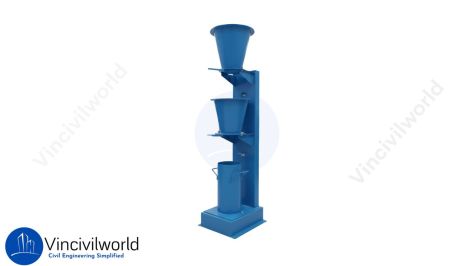
A blue civil engineering apparatus featuring two hoppers and a collecting bucket, designed for material testing.
Apparatus used for the Compaction Factor Test, designed to accurately measure concrete workability.

The figure shows the dimension of the hopper and the mould. The inside area of the hopper should be smooth. The apparatus is made of bronze or cast brass. At the lower ends of the hopper, there is a trap door with a 3mm thickness. A rigid frame attaches the hoppers and cylinder. After the completion of mixing, the test is conducted at a constant time interval. 

Compaction factor test procedure

  • Place the sample in the upper hopper of the apparatus using a hand scoop.
  • Fill the hopper with its brim level and open the trap door.
  • Then allow the concrete to fall into the lower hopper.
  • Immediately after the concrete rests, uncover the cylinder and open the lower trap door.
  • Cut off the excess amount of concrete above the cylinder using the trowel.
  • Then weigh the concrete in the cylinder nearest to 10g. This is the weight of partially compacted concrete.
  • Refill the cylinder with the same sample in the layers and the layer is heavily rammed or vibrated for full compaction.
  • Then weigh the fully compacted concrete and the weight of the empty cylinder.
  • Finally, Compute the compaction factor using the formula.

The compaction factor is the ratio of partially compacted concrete to fully compacted concrete.

Compaction factor = (W1 – W) / (W2 – W)

The compaction factor value varies from 0.7 to 0.95.

Key Takeaways

  • The Compaction Factor Test is used to evaluate the workability of concrete, especially stiff mixes.
  • It is more sensitive and accurate than the slump test for low-workability concrete.
  • The compaction factor test for workability of concrete measures ease of compaction under gravity.
  • It is best suited for laboratory-controlled conditions.
  • The workability of concrete compaction factor test helps compare different mix designs.
  • The test uses two hoppers and a cylindrical mould.
  • Following the compaction factor test procedure ensures consistent results.
  • The compaction factor test of concrete minimizes subjective judgment.
  • It supports quality control and mix optimization.
  • It is one of the reliable tests for workability of concrete.

Conclusion

The Compaction Factor Test remains an important method for assessing the workability of concrete. This is particularly true for mixes that show little or no slump. By measuring the ratio of partially compacted to fully compacted concrete, the compaction factor test for workability of concrete provides a clear and quantitative indication of consistency. When engineers follow the standard compaction factor test procedure, the results help in evaluating mix performance and maintaining uniform quality. The workability of concrete compaction factor test is especially useful in laboratory testing and mix design studies. As one of the established tests for workability of concrete, the compaction factor test of concrete continues to support accurate quality control and better construction outcomes.

Shape tests on Coarse Aggregates- Flakiness index test and Elongation Index Tests.

Shape test on coarse aggregates constitutes flakiness Index and elongation index tests. The particle size and shape of aggregate is one of the major factors affecting the quality of the concrete.

Shape test on Coarse Aggregates

  • Flakiness index test
  • Elongation index test

Must read : Aggregate crushing test- Strength of aggregate

Must read : Bitumen – 9 lab tests on bitumen for flexible pavements.

Shape test on coarse aggregate – Flakiness index test

The particle shape of aggregates is determined by the percentages of flaky and elongated particles contained in it. for concrete and construction of bituminous works the presence of flaky and elongated particles are not suitable and cause failures and breaking during heavy loads.

The Flakiness index of aggregates is the percentage by weight of particles whose least dimension (thickness) is less than three- fifths (0.6times) of their mean dimension. This test is not applicable to sizes smaller than 6.3mm

The Elongation index of an aggregate is the percentage by weight of particles whose greatest dimension (length) is greater than nine-fifths (1.8times) their mean dimension. This test is not applicable for sizes smaller than 6.3mm.

Flake materials may cause voids in concrete and has to be kept under limit to ensure the quality of the concrete.

Relevant IS codes: 

  • IS:2386(PartI)-1963

Apparatus used

  • Weighing machine
  • Metal gauge
  • IS sieve

Test procedure

First we have to find the flakiness index.

Dimensions of thickness and length gauges
  • For finding the flakiness index, we have to test at least 200 pieces of any fraction and weigh them.
  • Then sieve the sample through IS sieves according to the table below.
  • After that to determine the flakiness index separate the aggregate retained in the sieve.
  • Then pass each aggregate through the corresponding slot in the thickness gauge.
  • Finally, we calculate the flakiness index.
  • The flakiness index is the total weight of material passing through the gauge to the total weight of the sample. It is expressed in terms of percentage. Weigh the flaky material passing the gauge to an accuracy of at least 0.1 per cent of the test sample.
  • The formula for flakiness index is

F.I = (Weight of aggregate passing through the slot of the thickness gauge / Total weight of the sample) * 100

Thickness gauge
Thickness gauge

Must read : Los Angeles abrasion test on aggregates

Shape test on Coarse Aggregates- Elongation index test

The presence of elongated particles in the aggregate is undesirable for construction. Also, this shape test is made in coarse aggregate. The elongation shape test is not applicable for aggregates with a smaller size than 6.3 mm.

Relevant IS codes: 

  • IS:2386(PartI)-1963

Apparatus used

  • Weighing machine
  • Metal gauge
  • IS sieve

Test procedure

  • For finding the flakiness index, we have to test at least 200 pieces of any fraction.
  • Then sieve the sample through IS sieves according to the table below.
  • After that pass, each fraction through the gauge individually.
  • Now using a weighing machine, weigh the total amount of fraction retained.
  • Finally, we calculate the elongation index.
  • The elongation index of an aggregate is the weight of the particle whose greatest dimension is greater than 1.8 times its mean dimension.
  • The formula for elongation index is 
Shape test on aggregates

E.I = Weight of the aggregate retained on length gauge / Total weight of aggregate x 100

Conclusion

The shape tests give only a rough idea of the relative shapes of aggregates. Flaky and elongated particles should be avoided in pavement construction, particularly in surface course.

Timber – 5 Important Quality Tests and Procedures.

Timber is wood suitable for construction purposes. In order to find the quality and sustainability of the Timbers, Various Quality tests are performed.

They are natural polymeric material that nearly does not age. Moreover, the structure of the wood ensures efficient strength and load capacity.
Wood can be split into two classes. They are natural and man-made. Hence some examples of man-made timber are plywood, fibreboard, impregnated wood, etc.

PROPERTIES OF GOOD QUALITY TIMBER

The timber should posses the following qualities.

  • It should have a good uniform dark colour.
  • Timber should be free from defects such as shakes, flaws, dead knots, etc.
  • It should possess regular annual rings.
  • The freshly carved surface of the wood should have a sweet smell.
  • Moreover, It should have a heavyweight.
  • The cellular tissue and fibres should be compact and hard.
  • A good timber should be durable and possess elasticity. 
  • It should be resistant to fungus, insect, etc.
  • Also, timbers with compact texture have good resistance to fire. 
  • It should be inert from mechanical, chemical and physical agencies.
  • A good quality wood should hold loads from structures.
qualities of good timber

Also Read : Bitumen – 9 lab tests on bitumen on flexible pavement

Also Read : Bricks – 8 Reliable tests to ensure quality.

TEST ON TIMBER

In order to find the quality and sustainability of the Timbers, Various Quality tests are performed. In this article, we have listed a few test procedures.

  • Moisture content test
  • Tensile strength test
  • Compressive strength test
  • Shear strength test
  • Bending test

MOISTURE CONTENT TEST OF TIMBER

This test determines the moisture content in wood. However, wood contains a small amount of moisture content. A weighing machine and a drying oven are important apparatus for the water absorption test. 

moisture content test of timber

Relevant IS codes:

IS I 2380 ( Part VI ) – 1977

Test procedure

  • Initially, Take the specimen with a size of 5cm x 5cm x 2.4cm.
  • Then using a weighing machine weigh the specimen. Mark it as W1.
  • After that oven-dry the timber at a temperature of 103-degree celsius. 
  • Later, take out the specimen when becomes dry.
  • Again weigh and mark the weight of the dry specimen as W2.
  • Finally, calculate the percentage of moisture content by

% of moisture content = Weight of moisture in sample/ Dry weight of sample = (W1 – W2)/ W2

TENSILE STRENGTH TEST OF TIMBER

The tensile strength test defines the strength and ability to withstand breaking. Also, we can determine the load-carrying capacity of the wood.

Relevant IS codes:

IS I 2380 ( Part VI ) – 1977

Test procedure

Tensile test on timber
  • Firstly, take a specimen with 5cm x 5cm and 20cm in length.
  • Then place the specimen on the base plate of the instrument. 
  • After that apply load either parallel or perpendicular to the grains. 
  • Mark the load at which the wood breaks.
  • Finally, calculate the tensile strength of the wood.

Tensile strength = Maximum load applied / Cross sectional area

COMPRESSIVE STRENGTH TEST

The compressive strength test defines the crushing strength of the timber. Furthermore, this test determines the load which the wood can support over a period.

Relevant IS codes:

IS I 2380 ( Part VI ) – 1977

Test procedure

Compressive test
Compressive test
  • Initially, take a specimen with a size of 5cm x 5cm x 20cm. 
  • Then place the specimen in the compressive testing machine.
  • Following this, apply load parallel to the grains.
  • The specimen should be free from defects. Gradually increase the load.
  • Then note down the load at which the timber breaks. 
  • Lastly, calculate the compressive strength from the below formula.

Compressive strength = Load at which the specimen breaks/ Total area of the specimen

SHEAR STRENGTH TEST

The shear strength is important when timber is used as slabs. The load should be applied parallel to the grains. 

Relevant IS codes:

IS I 2380 ( Part VI ) – 1977

Test procedure

Shear test apparatus
  • The size of the specimen for shear strength is 5cm x 5cm x6.25 cm. 
  • Then cut the corner of the specimen.
  • Thus it produces failure on 5cm x 5cm surface.
  • However, this failure occurs tangentially or radially. 

BENDING STRENGTH TEST

The Bending strength test is necessary when we use timber as a beam. Through this test, we can find the modulus of rupture and modulus of elasticity.

Relevant IS codes:

IS I 2380 ( Part VI ) – 1977

Test procedure

Bending test on timber
  • For this, take a specimen of 5cm x 5cm x 7.5 cm in size
  • The specimen should be free from defects and deterioration.
  • Then drop a hammer with specific weight from a certain height.
  • Thus we get the impact bending.
  • Lastly using the load and deflection, calculate bending strength.

Also Read : Los Angeles abrasion test on aggregates

What is Prefabrication in construction? Advantages and Disadvantages

Prefabricated construction, or “prefab,” is a method of construction that  uses components made off-site in a factory, which are then transported put together on-site to create a structure. Prefabrication is an amazing technology that helps to reduce time and have many more benefits.Construction has always been about the speed and efficiency that can be ensured with the materials and techniques of construction.

In this blog, we will find out all the details about the same.

Let’s start from the definition.

What is prefabrication?

Prefabricated construction, or “prefab,” is a method of construction that uses components made off-site in a factory, which are then transported put together on-site to create a structure.

With different advantages to offer, there are a few different common types of prefab. You may want to consider incorporating any of these solutions, depending on your particular building project.

So, that’s the basic details. We will discuss about the benefits in next section.

Other related posts from vincivilworld

Benefits of prefabrication

Prefabrication setup

1. Mitigating the labour shortage:

  • It is already difficult for contractors to find labour, but construction still needs to take place.
  • It decreases labour productivity much more as on-site building continues piecemeal.
  • Therefore, prefabrication helps businesses speed up timelines, make the most of their on-site labour, improve efficiency, and succeed in the marketplace.

2. Cost-effectiveness:

  • It also costs less to transport partial assemblies from a factory than to move pre-production resources to each site.
  • Plus, as labour efficiency increases, personnel-related costs decline.

3. Time savings:

  • Time is the essence of the rainy season, and prefabrication will help you manage tighter timelines.

4. Quality control:

  • Factory tools can provide added quality assurance as opposed to repetitive construction on-site.
  • In addition, consistent factory indoor environments remove much of the weather effects on manufacturing, while streamlined manufacturing and production improve job site safety on the whole.

5. Lower environmental impact:

  • Accelerated offsite production of parts results in reduced emissions and work disruption.
  • This preserves wetlands or protected areas nearby and minimises local flora and fauna disturbance.
  • The controlled, dry environment of modular construction saves water consumption and allows scrap and other materials to be recycled.
  • Plus, fossil fuel consumption plummets with less on-site traffic and streamlined transportation.

6. Better safety and security:

  • By reducing a construction site’s timeframe, you simultaneously decrease the amount of time that the site is vulnerable to vandalism or robbery.

7. Flexibility:

  • It is easy to disassemble and move modular construction to various sites.
  • This greatly decreases the demand for raw materials, minimises the resources spent and overall reduces time.
  • Modular construction also allows for versatility in the structure’s design, allowing for an infinite number of possibilities.
  • Since prefabricated building units can be used in various spaces, their neutral aesthetics can be combined with almost any form of construction.

8. Reduced Site Disruption:

  • There is much fewer truck traffic, machinery and material suppliers around the final construction site as several parts of a building are completed in the factory.
  • The disturbance of conventional workplaces suffering from noise, emissions, waste and other common irritants is therefore minimal.
  • This structured design approach offers a much more productive productivity environment and removes unwanted disruptions and interruptions typical of construction sites.

Time to know the challenges of prefabrication.

Challenges of Prefab Construction

Construction site of prefabricated building
  • The joints to be given should be well-built enough to convey all sorts of stresses, connecting the core structure and the components.
  • The strength and solidity of the whole building totally depend on the strength of the joint.
  • Therefore, rather than component-based analysis, it is important to have detailed studies on the whole system.
  • One of the key challenges in embracing prefabrication technology in construction requiring accuracy and precision is the need for skilled labour on-site and the lack of on-site automation.
  • Skill development and native automation are also mandatory for prefabricated systems to be installed.
  • It is likely to get damaged during the erection or transport of heavy machinery units, so the arrangement of the units must be performed precisely and this process in a congested area becomes sloppy.
  • Labour maintenance is another concern because prefabricated construction requires skilled labour as it differs from in-situ construction, which requires machine-oriented expertise both on-site and in the production process.

Now, let me show you the advantages of prefabrication

Advantages of Prefabrication

  • Prefabrication technology has several advantages, such as energy efficiency revision, minimal waste and inspection, efficient construction, work speed, protection, sustainability and quality.
  • As self-supporting ready-made components are used, the need for formwork, shuttering and scaffolding is substantially lowered.
  • Building time is thereby decreased, resulting in lower labour costs.
  • Reduced the quantity of waste materials relative to building on site.
  • Reduction in construction time to allow an earlier return of the invested principal.
  • Construction guarantees precise compliance with building codes and excellent quality assurance.
  • Along with quality control and factory sealing, high-energy performance.
  • It is possible to place prefabrication sites where skilled labour is more readily accessible and the costs of labour, electricity, materials, space and overhead are reduced.
  • Prefabrication permits building throughout the year, regardless of the weather (related to excessive cold, heat, rain, snow, etc.).
  • Material waste from the building is less.
  • Regardless of climatic conditions.
  • Security and worker comfort levels are higher in the off-site building.

Last, but not the least the disadvantages should be known.

Disadvantages/Limitations of prefabrication

Material assembly for prefab construction

The subsequent constraints are known to have restricted design choices, decreased reselling value, high initial expenditure, non-suitability for foundation and precast unit transport.

There are even more drawbacks. They are the following:

  • Leakage occurs in joints in prefabricated parts.
  • For huge prefabricated parts, transportation costs can be high.
  • To ensure affordability through prefabrication, increased production volume is required.
  • Initial costs for construction are higher.
  • The initial production of designs is time-consuming.
  • Large prefabricated parts require heavy-duty cranes and measurement of precision from handling to position on site.
  • Local employment can be lost, as skilled labour is needed.
  • Modular building design and construction requires high levels of cooperation between project parties, particularly architects, structural engineers and manufacturers.
  • These buildings usually depreciate more rapidly than standard site-built housing due to their shorter economic existence.

Hope the time you spent for the article was worth it. Let me know if you have any doubts in comments.

Happy learning!