All posts by Vinod Gopinath

Blockboard vs Plywood – Which one do you choose?

Blockboard vs plywood, Most people get confused with these terms because of the similarity in looks, and both products are popularly used in interior works, home decor, and furniture works. In reality, both these materials are different types of engineered wood and possess entirely different properties, and are used for specific interior applications.

Blockboard, with its core of softwood strips sandwiched between veneers, is known for its strength and durability. In contrast, plywood features multiple layers of thin veneer glued together, providing flexibility and stability. As you weigh plywood vs block board, consider how each material meets your needs for load-bearing, cost, and aesthetics. Blockboard plywood is often preferred for heavy-duty applications, while plywood and blockboard both offer versatility for different uses. This blog explains and clarifies the differences and properties of ply board/block-board and can make the right choice.

  1. What is plywood?
  2. What is Plyboard or blockboard?
  3. Blockboard vs Plywood- A comparison
    1. Manufacturing process – Blockboard vs Plywood
    2. Ease of handling – Plywood vs Blockboard
    3. Strength and durability
    4. Water and moisture resistant properties
    5. Physical properties
    6. Screw holding capacity
    7. Flexibility in Applications: Blockboard vs Plywood
    8. Applications: Blockboard vs Plywood
    9. Sizes available
    10. Service Life: Blockboard vs Plywood
    11. Economy
    12. Sound insulation properties
  4. Key Takeaways
  5. Conclusion

What is plywood?

Plywood is an engineered wood panel manufactured by joining sliced wood veneers 2-4 mm thick in a cross-layered pattern and pressed under high temperature to form sheets.Unlike blockboard, plywood is flexible and resistant to warping. This makes it ideal for a wide range of applications, from furniture to construction. When comparing blockboard vs plywood, plywood’s adaptability and ease of use stand out.

Must Read : Plywood Types – MR Resistant ,BWR & BWP or Marine ply

Must Read : WPC board vs plywood – Which is best?

What is Plyboard or blockboard?

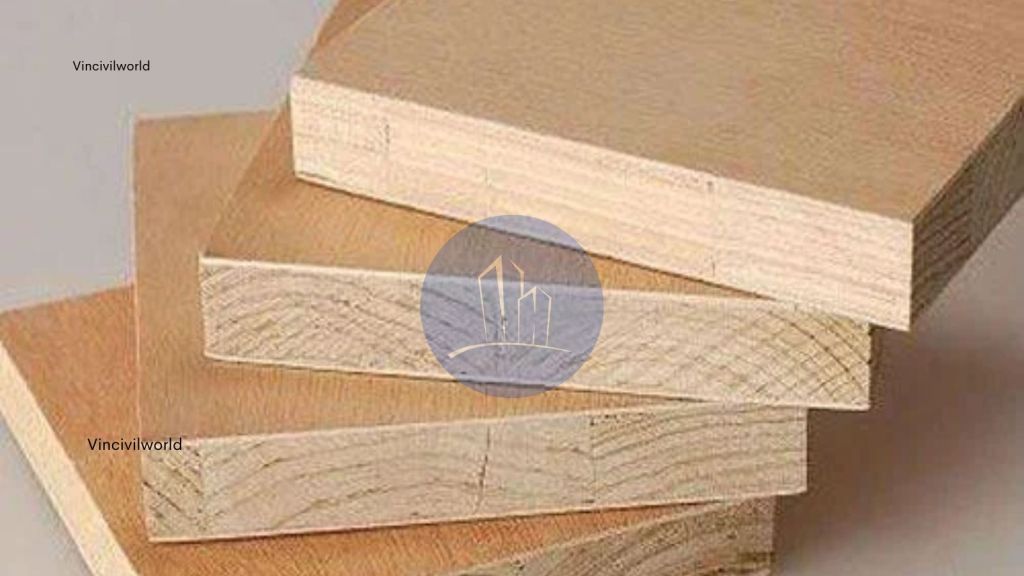
Plyboard or blockboard is an engineered wood panel made of a core comprising of softwood wooden strips or blocks placed edge to edges sandwiched between two wood veneer layers. This construction gives it strength and durability, making it ideal for heavy-duty applications like furniture and doors. These veneer layers are glued and pressed under high pressure and temperature to form a plyboard/blockboard. Compared to plywood, blockboard is thicker and provides better load-bearing capacity. When considering blockboard vs plywood, blockboard excels in situations requiring robust support and rigidity.

Also read : WPC Boards – Advantages, Disadvantages and uses

Blockboard vs Plywood- A comparison

Let us have a comparison between the properties , types and uses of Plyboard and plywood/blockboard. This comparison highlights key differences to help you choose the best material for your project.

  • Composition and Manufacturing process
  • Ease of handling
  • Strength and durability
  • Water and moisture resistant properties
  • Physical properties
  • Screw Holding capacity
  • Flexibility in applications
  • Sound insulation properties
  • Sizes available
  • Economy
  • Service life

Manufacturing process – Blockboard vs Plywood

Blockboard/PlyboardPlywood
Small wooden strips are placed
edge to edge sandwiched between sliced wooden veneers.
Plywood is made in an odd number of veneer layers starting from 3 layers
more depending on the thickness of the plywood.
Block boards are made in either
3 layers or 5 layers. It is like a
wooden frame filled with small
wooden strips and covered by
wooden veneers on the faces.
The veneers are arranged in a cross layered pattern.

Blockboard vs plywood involves different core materials and manufacturing methods. Blockboard has a core of softwood strips with outer veneers, while plywood features alternating layers of veneer. Each method affects the material’s strength, flexibility, and final use.
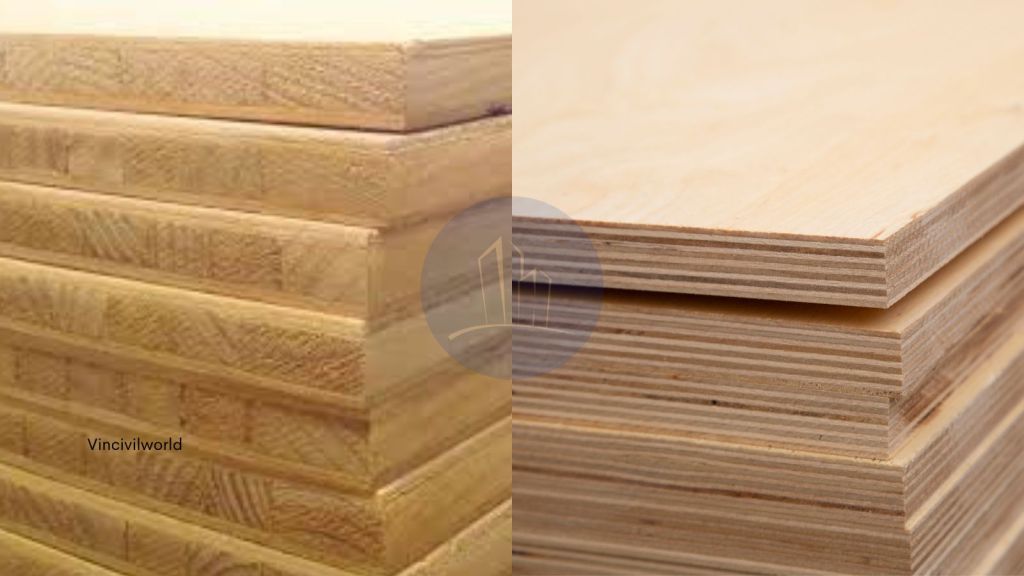
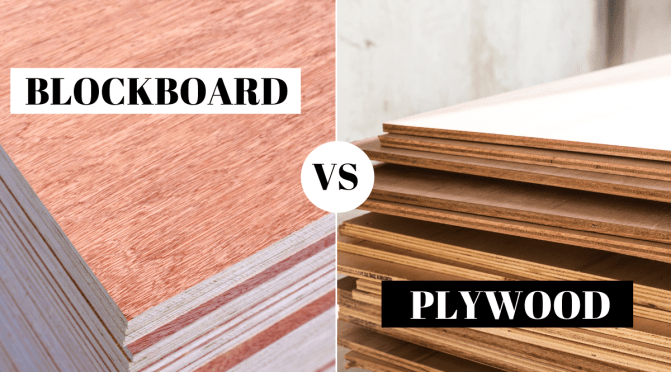
Blockboard vs Plywood

Ease of handling – Plywood vs Blockboard

Blockboard/plyboardPlywood
Blockboard mostly uses softwood core and hence blockboard is lighter than plywood.Plywood grades use dense hardwood and the layers are pressed to form plywood.
Due to their lightweight nature, they are easy to transport and handle.plywood is solid and heavier than Blockboard.

Blockboard uses softwood for its core, making it lighter compared to plywood, which uses dense hardwood veneers. Consequently, blockboard is easier to handle and move, while plywood’s weight can make it more challenging to work with.

Strength and durability

Plyboard/BlockboardPlywood
Mostly uses softwood in the core. Softwoods are soft and have low strength and hence blockboards have moderate strength.Mostly uses hardwood veneers arranged in a uniform cross-layered pattern. Plywood is much stronger than blockboard.
Plyboard is strong compared to particleboard and MDF but is less durable as compared to plywood.Low-density plywood can even take moderate loads. They are strong and durable when compared with blockboards/plyboards.
Blockboard looks plain from the outside, but minor gaps are inside the core.Plywood layers are uniform in both directions and no gaps will be there.

Blockboard provides robust strength due to its core of softwood strips, making it suitable for heavy-duty applications. However, it can be affected by moisture. Plywood, with its layered veneer construction, offers consistent strength and high durability, making it resistant to environmental changes and suitable for diverse uses.

Water and moisture resistant properties

Plyboard/BlockboardPlywood
Blockboards retains moisture and more prone to water and moisture damages.Plywood grades like BWR (Exterior Grade)and Marine ply are less suspectable to water and moisture.
They can be made waterproof by using BWP Grade (Boiling Water Proof) resin for bonding the strips.Plywood grades like BWR (303 grade) and Marine ply (710 grade) are superior to block boards in terms of moisture and water-resistant properties.

Physical properties

Plyboard/BlockboardPlywood
Bending and sagging
Plyboard is more stiffer than plywood
and do not bend when used as
long pieces. Block board is preferred over plywood when used as lengthy
panels and furniture.
Long pieces of plywood may sags from the centre. Plywood is
less stiffer than blockboard.
Warping and Cracking
It has good dimensional stability and so is highly resistant to warping and crackingIt is resistant to warping and cracking.
Splitting on edges
Plyboard does not split on edges while cuttingPlywood split on edges while cutting.
Block board is comparatively easy to cut.Plywood splinter on edges and is very difficult to cut.

Blockboard vs plywood differs in density, thickness, and other physical properties. Blockboard, with its softwood core, is typically thicker and less flexible but provides a smooth surface. Plywood, made from layered veneers, is denser, more flexible, and offers better dimensional stability.

Screw holding capacity

Plyboard/BlockboardPlywood
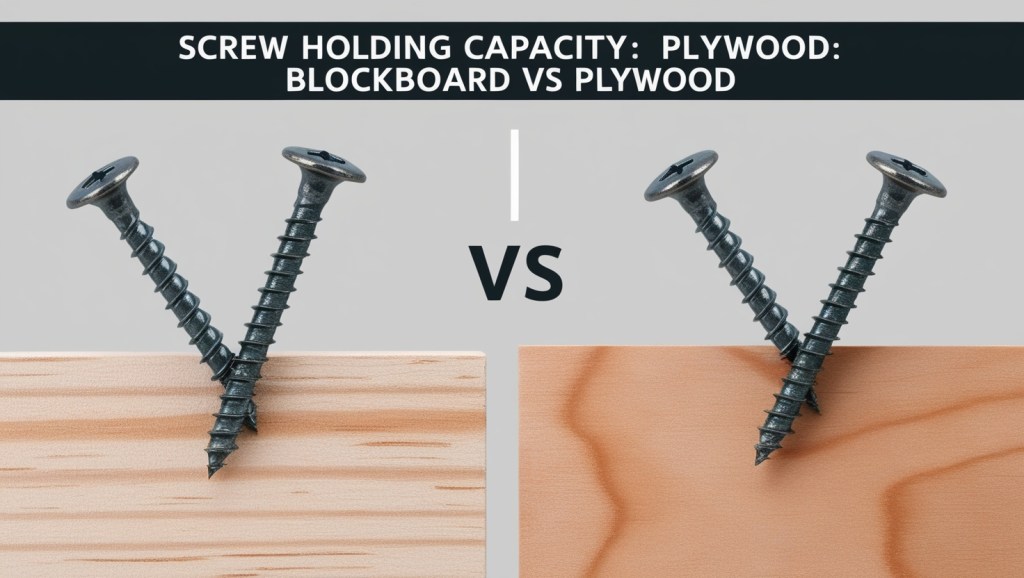
Blockboards have very good screw holding capacity, than particle board and MDF. They can hold nails very well and thus are used for making custom made furniture. Also they are used as core in flush doors, where screw holding capacity is essential.Got excellent screw holding capacity due to the cross layered arrangement of veneers. The hinges do not come out easily.
Some times the screws tend to go between
the gaps of the wood pieces. Skilled carpenters
can identify and manage the problem

In the blockboard vs plywood comparison, plywood typically offers better screw holding capacity. The layered veneer structure of plywood provides more grip, making it suitable for applications where secure fastening is essential. Blockboard, with its softer core, may have screws loosen over time and is less reliable for high-stress fastening.
Screw holding capacity - Blockboard vs plywood
Screw holding capacity- Plywood vs Blockboard

Flexibility in Applications: Blockboard vs Plywood

AspectBlockboardPlywood
Application VersatilityLess versatile; best suited for applications requiring solid and stable support, such as heavy-duty furniture and doors.Highly versatile; used in a wide range of applications including cabinetry, wall panels, and structural components.
CustomizabilityLimited in terms of bending or shaping; typically used in flat applications.More flexible; can be easily cut, bent, and shaped for various designs and structures.
Use CasesIdeal for applications requiring strength and stability but less flexibility.Ideal for both structural and decorative purposes due to its adaptability and ease of modification.

Plywood is more flexible in applications due to its ability to be shaped and customized easily. In contrast, blockboard is less adaptable, making it suitable primarily for stable, heavy-duty applications.

Applications: Blockboard vs Plywood

AspectBlockboardPlywood
Typical UsesCommonly used for heavy-duty furniture, long bookshelves, benches, doors, partitions, and panels where solid support is needed.Widely used in cabinetry, wall paneling, flooring, structural components, and various DIY projects due to its versatility.
Suitability for Interior DesignSuitable for high-end furniture and cabinetry where a smooth finish and robustness are required.Ideal for a broad range of interior design projects, including furniture, shelving, and decorative panels.
Structural UsesBest for applications requiring solid core strength but less flexibility in design.Common in structural applications like roof sheathing, subflooring, and wall sheathing due to its strength and flexibility.

Blockboard is ideal for applications needing solid support, such as heavy-duty furniture and doors. Plywood, being versatile and flexible, is used in a wide range of applications from cabinetry and wall paneling to structural components.

Sizes available

Plywood

  • The most commonly manufactured plywood size is 8 x 4 ft. (2449 x 1219 mm)
  • It is available in various thicknesses ranging from 3 mm to 25 mm.

Blockboard

  • The most commonly manufactured and sold block board size in India is 8 x 4 ft. (2449 x 1219 mm).
  • Available thickness are 16mm,19mm,25mm

Service Life: Blockboard vs Plywood

AspectBlockboardPlywood
DurabilityGenerally durable but may have a shorter service life if exposed to moisture without proper sealing.Highly durable with a longer service life, resistant to environmental changes and moisture when properly treated.Always use BWR and Marine ply for water prone areas.
MaintenanceRequires regular maintenance and sealing to extend service life, particularly in humid conditions.Low maintenance; retains durability with minimal upkeep and resists moisture and environmental factors effectively.
LongevitySuitable for applications where moderate longevity is acceptable but may degrade faster under adverse conditions.Ideal for long-term use; maintains performance and appearance over extended periods.

Plywood generally has a longer service life compared to blockboard. While blockboard is durable, it may require more maintenance and protection from moisture to ensure longevity. Plywood, on the other hand, offers extended durability and requires less maintenance, making it suitable for long-term applications.Blockboard should be kept away from water and moisture. They got a better life and durability compared to MDF and particle boards. Blockboards are available in BWR and BWP varieties. They can resist moisture better.
Plywood vs Blockboard
Plywood

Economy

Blockboard is comparatively cheaper than plywood.

Sound insulation properties

Block boards are poor conductor of sound, heat and electricity and offer good sound and thermal insulation properties.Hence are used in partitions etc.

Key Takeaways

  • Blockboard: Lighter than plywood, ideal for heavy-duty applications requiring solid support and stability.
  • Plywood: More versatile and flexible, suitable for a wide range of applications including structural and decorative uses.
  • Strength & Durability: Plywood is generally stronger and more durable, especially in moisture-prone areas.
  • Screw Holding Capacity: Plywood offers better screw holding due to its dense veneer layers.
  • Service Life: Plywood has a longer service life with lower maintenance needs, while blockboard requires more care, especially in humid conditions.
  • Economy: Blockboard is usually cheaper, making it a budget-friendly option for certain applications.

Conclusion

When choosing between blockboard and plywood, it is essential to consider the specific requirements of your project. Blockboard is an excellent choice for heavy-duty furniture, doors, and long shelves, offering solid support at a lower cost. However, it requires careful handling in moisture-prone areas to ensure durability. Plywood, with its superior strength, flexibility, and moisture resistance, is the preferred material for a broad range of applications, from structural elements to decorative finishes. Its longer service life and lower maintenance needs make it a reliable choice for both residential and commercial projects. Ultimately, your selection should align with your project’s demands, budget, and expected longevity.

Must Read : Plywood vs Natural wood – which is best?

Shotcrete – A total overview||Shotcrete vs Gunite

Shotcrete is a method of placing concrete where concrete/mortar is sprayed at high velocity to an overhead or vertical surface. Concrete is conventionally placed on the ground or to the formwork and compacted using appropriate vibration methods.

What is shotcrete? 

Shotcrete is a wet or dry mix of mortar/concrete sprayed to a vertical or overhead surface with high velocity. The mortar/concrete mix is conveyed through a hose and sprayed with a nozzle with high velocity. The force imparted by this application process consolidates the concrete/mortar resulting in an excellent bonding with almost all substrates. Shotcrete is also called sprayed concrete. The pressure will be maintained to around 20-30 N/cm2.

When mentioning about shotcrete another term which is commonly used is gunite or guniting.

Shotcrete process
Shotcrete process

What is gunite or guniting ?

Guniting and shotcrete are more or less the same. The difference between shotcrete and gunite is basically in the method of spraying and mixing ingredients.

Shotcrete spraying is accomplished through either of the following process.

a) Dry mix process

b) Wet mix process

The dry mix process is called gunite or guniting

In Gunite / dry mix process the dry materials are premixed and placed in a hopper. With the help of compressed air, the dry materials are driven to the nozzle. Water gets mixed with the ingredients from a separate source just before going out of the nozzle. The mixed material hit the surface to be applied at a super high velocity through the nozzle.

In the wet-mix process/Shotcrete, the ingredients are premixed with water like conventional concrete and placed in a hopper. Just like the dry-mix process, the wet-mix process uses compressed air to shoot the concrete through a hose. This is also called sprayed concrete were fully mixed concrete or mortar is sprayed through a nozzle.

Shotcrete of walls
Shotcrete of walls

Both these process are used depending on the area of application and site conditions.

Shotcrete vs Gunite – A comparison

Both of these methods have there pros and cons. The uses are distinguished depending on the area of application and nature of the job.

GUNITESHOTCRETE
In the gunite process, we can stop and start the job after some interval, and still, the material will stick on to the old surface due to the high velocity at which the material is applied.Shotcrete material is premixed and to be consumed within a specified time or else the material strength and qualities will be affected.
The applicators get much more work time since the cement mixing is done at the site. With gunite, you can stop and start the application without creating any cold joints. They got super high strength accompanied by low shrinkage.The joints formed in shotcrete due to any stoppage of work leads to a cold joint and the next layer applied after a certain period behaves as a different layer. A cold joint may develop and cracks may happen.
A super-skilled operator is required for gunite. The total quality, consistency, and strength of the gunite depend on the skill of the operator. And the ratio of water, cement sand mix. The nozzle operator controls the application, adjusting water levels as needed to get the right mix consistency.Highly skilled workers are not needed for a shotcrete application. The crew doesn’t have to be as skilled because the concrete comes already mixed and no need for any mixing or proportioning at the site. It’s easier to add specialised admixtures to the concrete
The high water content will ruin the mix and less water content will clog the hose and nozzle. Therefore care should be taken to maintain optimum water content.You don’t need to add water as it comes premixed with water. Sometimes water is added to improve the consistency of the mix in transit mixtures at site. This reduces the strength of the mix and cause shrinkage cracks.
Guniting gives a strong and uniform surfaceShotcrete gives a strong and consistent surface
Gunite produces a lot of oversprays called Rebound wastage. These rebound wastage are not to be reused and generate huge wastes. Disposing and housekeeping the area requires extra manpower.Wastage is less compared to Gunite in case of shotcrete.
Guniting is less expensive than shotcrete. Large-sized aggregates are not used in concrete, and mostly it will a cement-sand mix.Shot Crete is more expensive than gunite and uses aggregate up to 20 mm or as per design mix recommendations.
Completion time is slow compared to shotcreteThe shotcrete process is faster than gunite and got higher production rates.
Gunite is easier to clean up than shotcrete.
The hose is lighter and easier to use
Because you add water at the nozzle, the concrete is very fresh when you spray it.
If the hose gets clogged, it can be tough to clear which could be dangerous for the crew and property

The bottom line is that both gunite and shotcrete have their advantages and disadvantages. The truth is both will produce a high-quality, watertight, durable surface if you do the processes correctly. A super-skilled operator for doing the works improves the quality of the process.

Advantages of shotcrete

Shotcrete-sprayed concrete is increasingly becoming popular because of its extremely economical and flexible application process.

  • Shotcrete has got several advantages when compared to conventional concrete. For swimming pools, water retaining structures shotcrete is an ideal choice. They are easier to spray and admixtures can also be included to enhance mix qualities.
  • Shotcrete is durable and it imparts more strength to structures.
  • The process of application of shotcrete makes the concrete dense and less porous than conventional concrete.
  • They help in reducing shrinkage cracks, cold joints and produce an even, nonporous and durable concrete.
  • They help in reducing the construction time and reduce valuable time and money incurred as formwork costs and makes the work far more easier.
  • Shotcrete/gunite can save money in terms of shuttering, labour costs and can shorten the project delivery schedule.
  • Cold joints and areas where shuttering possibility is minimum can also be done using shotcrete methods.
  • It is possible to create any shape using shotcrete which is not possible using conventional concrete.
Gunite work
Gunite work

Application of Shotcrete/guniting

Shotcrete is extensively used in a wide range of applications due to there ease and flexibility in placing and capability of producing a dense and non porous concrete surface. They are used for..

  • Shotcrete is used for the construction of thin, lightly reinforced sections such as curtain walls.
  • Used for shell or folded plate roofs.
  • Used for underground structures and tunnels, lining works. For pre-stressed tanks, swimming pools, water retaining structures for treatment plants, etc.
  • Shotcrete/gunite is used for repairing deteriorated concrete and retrofitting works.
  • Used for structural steel encasing works.
  • Shotcrete is used for the formation of canal lining, reservoirs, and repairing of linings.
  • They are best suited for applications in underground structures, basement waterproofing works, water retaining structures, deep excavation slope protection, etc.

Disadvantages of Shotcrete/Gunite

  1. The success of shot crete depends on the skill of the operator.
  2. Shotcrete cost is higher than conventional concrete.
  3. Chances of concrete loosing its quality due to delay in spraying or pouring water to increase workability.
  4. Getting a perfect bond with some surfaces is very difficult.

Share this:

Crib retaining walls, Bin retaining walls & Gabion Walls

Retaining walls are rigid walls used for supporting soil laterally so that it can be retained at different levels on the two sides. The soil got a natural angle of repose and when it exceeds the range a retaining wall structure has to be provided.

They are vertical or near vertical structures constructed to hold soil between two terrains when the slope exceeds the natural one. The slope can be vertical or steep or much above the range of angle of repose.

Also read : Retaining walls – All Types, Materials, features and uses

In this article we are mentioning about some special type of retaining walls

Gravity retaining walls are made of stone, bricks, concrete or any other heavy material.  Gravity walls are made with or without mortar They are designed to counter the earth pressure by their self weight. Following are the special types of gravity retaining walls.

a) Crib retaining wall

b) Bin retaining wall

c) Gabion retaining wall

Crib Retaining walls

Crib retaining wall or crib lock retaining wall is one of the oldest types of retaining wall. They consist of cribs or cells made of timber, concrete, and plastic/fibres. The cribs or interlock areas are filled with free-draining materials or earth back-fill, eliminating the hydro-static pressure and enabling a free escape of water.

Most common materials used for crib wall construction is 

  • Timber crib retaining walls
  • Precast crib retaining walls

Timber crib retaining walls

Timber crib walls use timber to form the cells of the crib. The cells are filled with free-draining stone materials for maintaining the mass of the wall. Water drainage can happen freely through the cribs. The timber sections are interlocked to make the walls.
They can also be planted with trees to create a natural appearance. These types of walls are ok up to a height of 5-6 mtrs and mostly used for landscape walls etc.

Timber crib retaining walls

Precast concrete crib retaining walls

This system consists of a precast concrete header and stretcher units. They are erected to form precast crib retaining walls.
Precast concrete cribs are the cheapest form of earth-retaining systems and are used for landscaping structures, plant terraces, and other works with heights around 10- 20 mtr with proper professional design.
They do not require any skilled labour to do the erection. Trees or shrubs are planted to give natural and excellent looks. Crib walls are erected for small curves and are considered a very flexible material.

Precast Concrete Crib retaining walls

Bin retaining walls

Steel bin walls are made from corrugated steel sheets and are usually bolted together and then filled with crushed rock or other free-draining material. They are mostly used for bank erosion protection, holding encroaching slopes, breakwaters, etc. They can resist unforeseen ground movements that may cause failure to other types of retaining walls.

Gabion Retaining walls

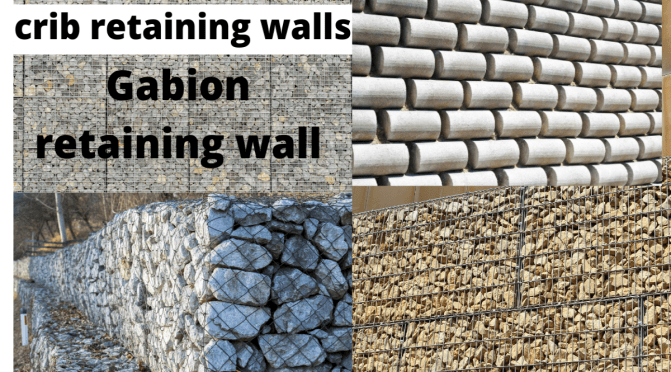
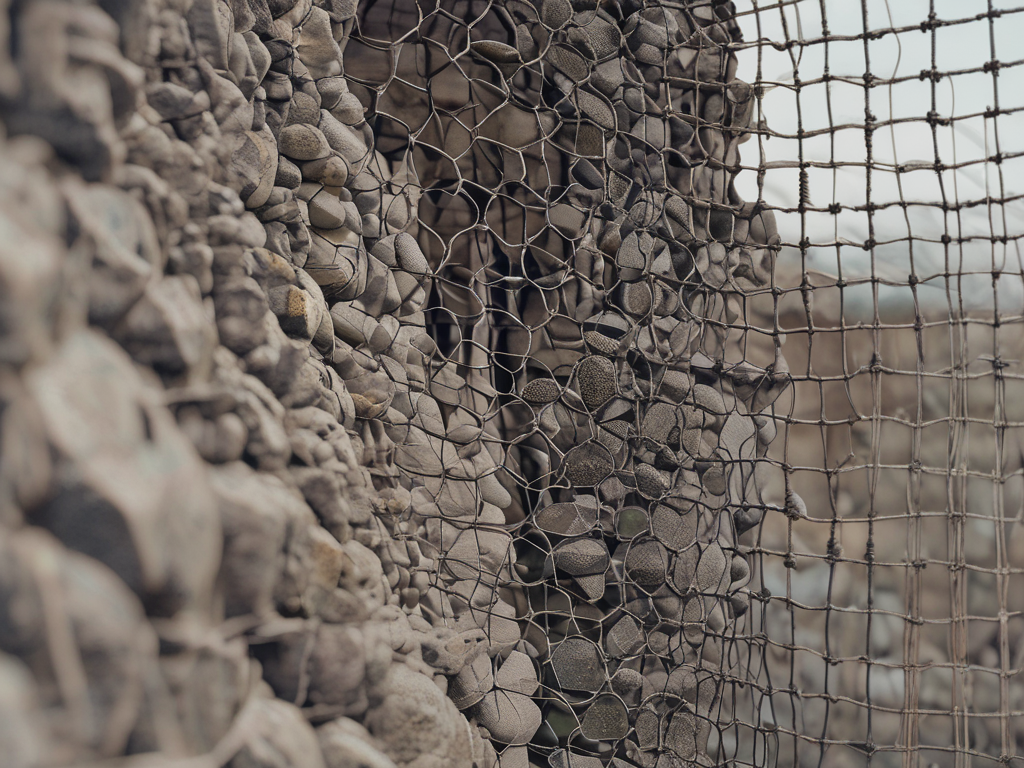
Gabion retaining wall systems are one of the oldest forms of gravity wall. Gabion walls are manufactured by factory fabricating a galvanised hexagonal wire mesh of varying diameters into box cages. These box cages are site filled with locally available stones and fully closed and laid in a pattern as per design. They are used in areas where the foundation conditions are not favourable for adopting any other retaining structures. The concept of a gabion wall is to increase the shear capacity of rock by providing the box cages. They can accommodate substantial ground movements without failures. Gabion boxes are free-draining structures that can reduce hydro-static pressure drastically.

Gabion Retaining walls

The main advantage of these types of systems is that they do not need an exclusive foundation structure. Gabion walls are installed directly over the surface in specified patterns according to design requirements.
The mesh is PVC protected or coated with special coatings to protect from rusting in areas subjected to continuous water flow.
These walls provided a Good visual appeal of the product and the satisfying rock finish look.
Gabion walls are erected mainly for soil stabilisation behind the wall. They can also act as a cover wall. The gabion boxes are stacked in layers with a proper design. They are a very economical alternative for concrete retaining walls and rock anchors for soil stabilisation works and slope protection works.

Also read : MSE retaining walls or Mechanically stabilised Earth walls

Types of Retaining walls – All types,materials,features and uses.

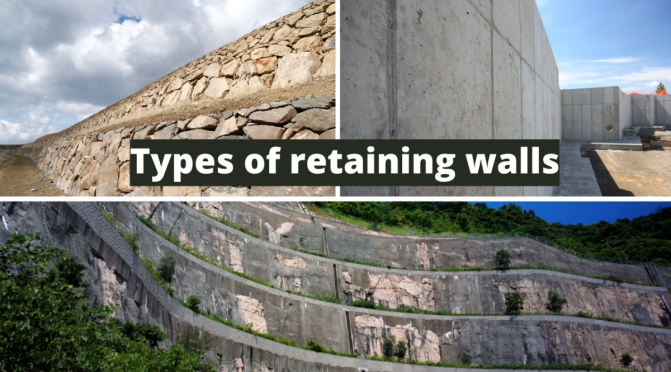
Retaining walls are rigid structures used for supporting soil laterally and retained at different levels on the two sides. These structures are vertical or near-vertical. They are constructed to hold soil between two terrains when the slope exceeds the natural angle of repose. The slope can be vertical or steep or much above the range of angle of repose. Understanding retaining wall types is crucial for selecting the right wall based on soil conditions, load requirements, and project design.

Key retaining wall types include gravity retaining walls. These rely on weight for stability. Buttress retaining walls provide extra support. Elements like retaining wall heel and toe enhance stability, making these walls effective and durable solutions.

This article is about the types of retaining walls, materials used and features.

  1. What is a retaining wall?
  2. Design criteria of retaining wall
  3. Retaining wall types
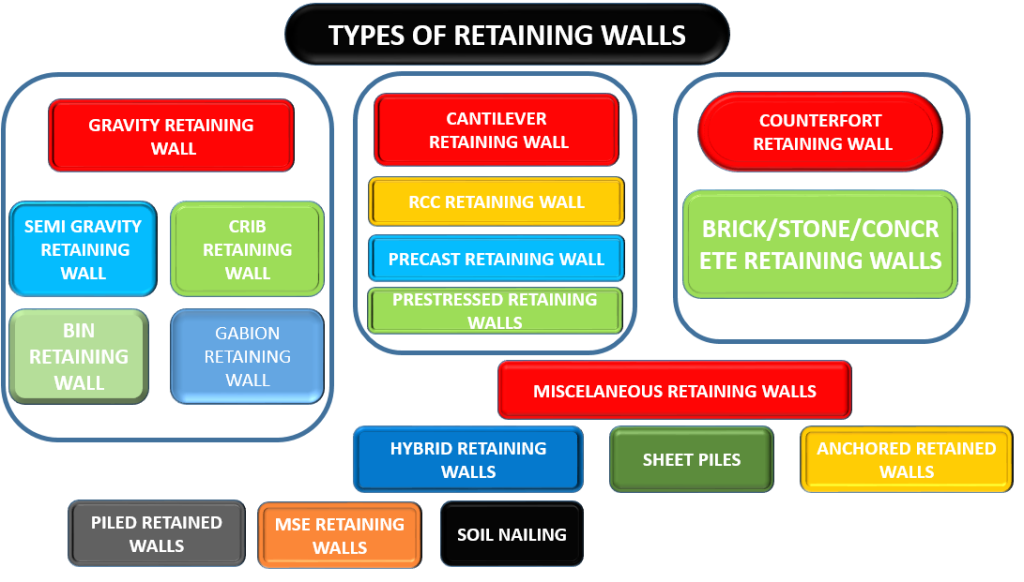
    1. Gravity Retaining walls
    2. Cantilever retaining walls
      1. The loads induced on various components
    3. Counter-fort retaining walls
    4. Buttressed retaining walls
    5. Sheet piled retaining walls
    6. Piled retaining walls
    7. Anchored retaining walls

What is a retaining wall?

Retaining walls are critical engineering structures designed to stabilize and support terrain by restraining soil mass at different elevations. These versatile architectural elements are essential in landscape design, civil engineering, and construction projects. They prevent erosion, manage slope stability, create usable spaces on uneven terrain. Retaining walls provide critical structural support in areas with significant elevation changes.

Engineers and landscape architects utilize various types of retaining walls, each with unique characteristics and applications. The selection depends on factors such as soil conditions and load requirements. Other considerations include site topography, budget constraints, aesthetic considerations, and project design. These factors ensure long-term durability and safety. Common retaining wall types include gravity walls, cantilever walls, and anchored walls, each using distinct methods to provide stability.

Design criteria of retaining wall

The main criteria behind the design of the retaining wall are to counter the downward slope movement of back filled soil by gravity. The lateral pressure developed behind the wall depends on the angle of internal friction & cohesive strength of retained materials. The lateral pressure can also be liquid (hydro-static pressure), and pressure from any type of back-fill material like sand, granular material, fly ash, etc. A proper drainage system is to be provided to reduce the hydro-static pressure.

Retaining wall types

There are several types of retaining wall depends on the nature and type of soil and situations they are to be used.

  • Gravity retaining wall
  • Cantilever retaining walls
  • Counter-fort retaining wall
  • Buttressed retaining wall
  • Sheet pile retaining wall
  • Bored pile retaining wall
  • Anchored retaining wall

There are a lot of innovative and alternated methods used for retaining walls

Retaining wall Types

Gravity Retaining walls

Gravity retaining walls are executed with stone, bricks, concrete, or any other heavy material. They are done with or without mortar and are designed to counter back-fill soil pressure by their self-weight.
Dry retaining walls do not require rigid footing. However, they must be designed to counter sliding. They also need to address overturning and bearing loads acting on the structure.
These types of retaining walls are mainly adopted in landscape areas and also in locations with height is around 2-3 meters.

Gravity retaining wall

Gravity retaining walls are used for larger heights using composite gravity walls. Composite gravity walls include precast crib walls or timber walls filled with granular materials, Gabion walls, Geowalls, etc.
The gravity wall when provided with a small amount of reinforcement is known as semi gravity retaining wall. The load transfer mechanism remains the same as that of gravity retaining walls.

Gabion wall

Cantilever retaining walls

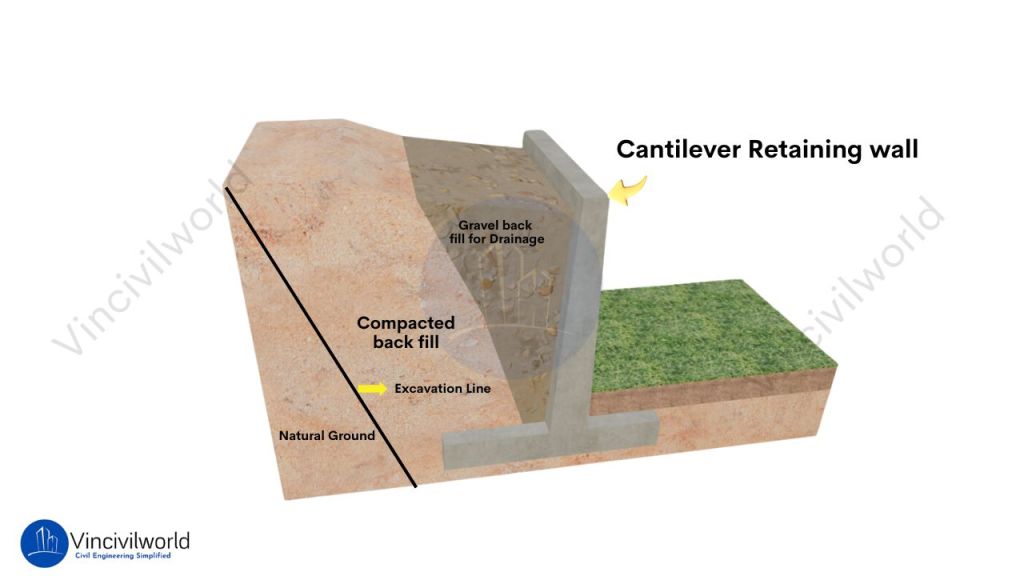
Cantilever retaining walls are the most common retaining wall type. They are reinforced concrete structures wherein the lateral earth pressure is countered by the cumulative action of total structural members.
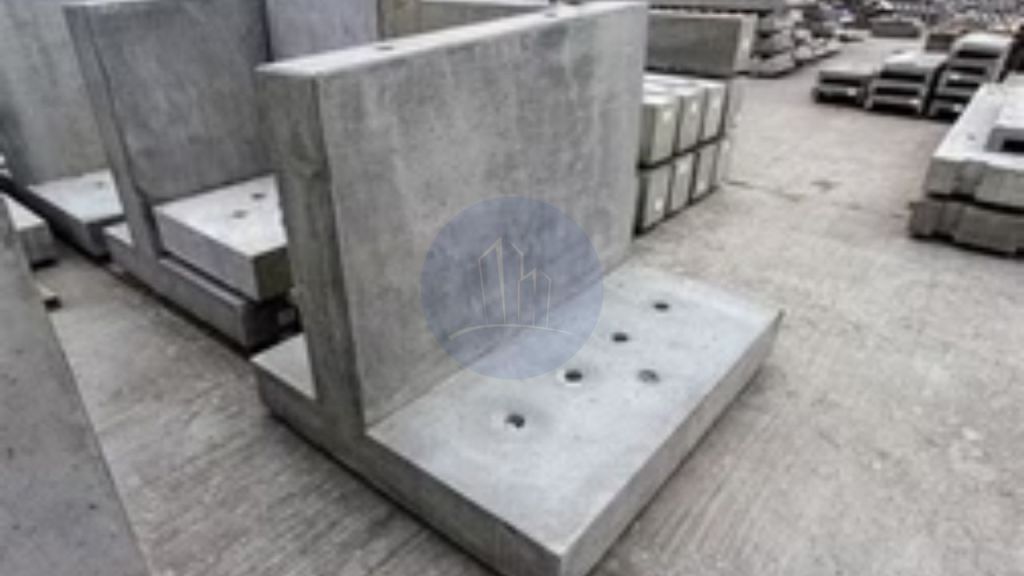
Cantilever retaining walls consist of a stem, a base slab which is divided into toe slab and heel slab as shown in the figure.

Cantilever retaining walls


The vertical stem wall is extended to the back fill side or heel side and is called a heel slab and the slab on the other side is a toe slab as shown in the figure.
The stem wall, toe slab, and heel slab act as cantilevers fixed injunction and spanning to other ends. The back filling of soil over the heel slabs imposes additional stability against lateral pressure and stabilises the wall against overturning and sliding.

The loads induced on various components

a) Heal slab and toe slab = Upward soil pressure from the bottom and tends to bend upward. Rebar is placed in a tension zone.
b) stem= Lateral earth pressure tends to bend in the opposite direction of back-fill.
These types of walls are economical and can be used for heights around 5-7 mtr. They are much lighter than gravity walls and require comparatively small foundations. These types of walls can be constructed as to cast in situ and precast and prestressed concrete depending on the site requirements.

Prestressed retaining wall & Retaining wall

Counter-fort retaining walls

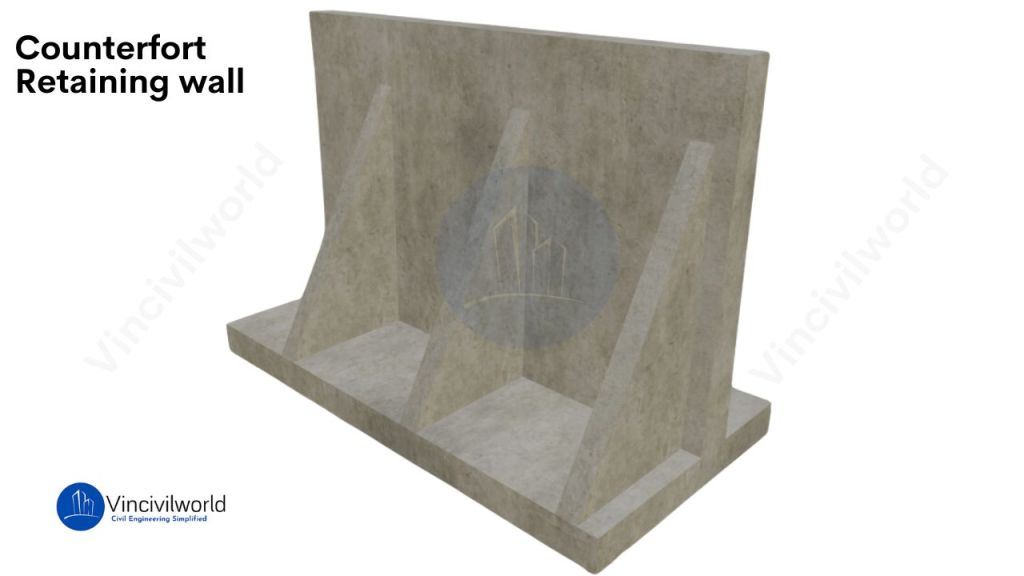
Counter-fort retaining wall is a cantilever retaining wall used when the height is around 7 mtr or more. For economising the structure, vertical bracing called counter-forts are provided on the back fill side. These counter-forts connect the heel slab and stem as shown in the figure. The stem and heel slabs between counter-fort act as continuous slabs and negotiate the high bending movements. The counter-forts function as tension stiffness and reduce the bending and shear stresses. These types of retaining walls are used for heights ranging from around 8-12 mtr.

Counter-fort Retaining walls

Buttressed retaining walls

Buttress retaining walls have the vertical bracing located on the front side of the retaining wall in place of the back-fill side like that of counter-fort retaining walls. The structural action of the stem remains the same as the counter-fort walls.

Sheet piled retaining walls

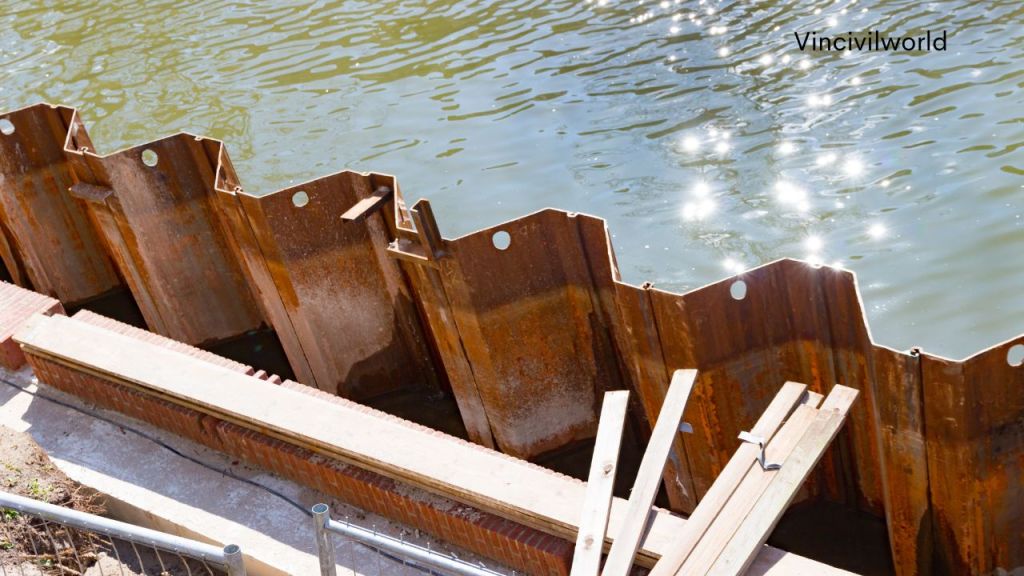
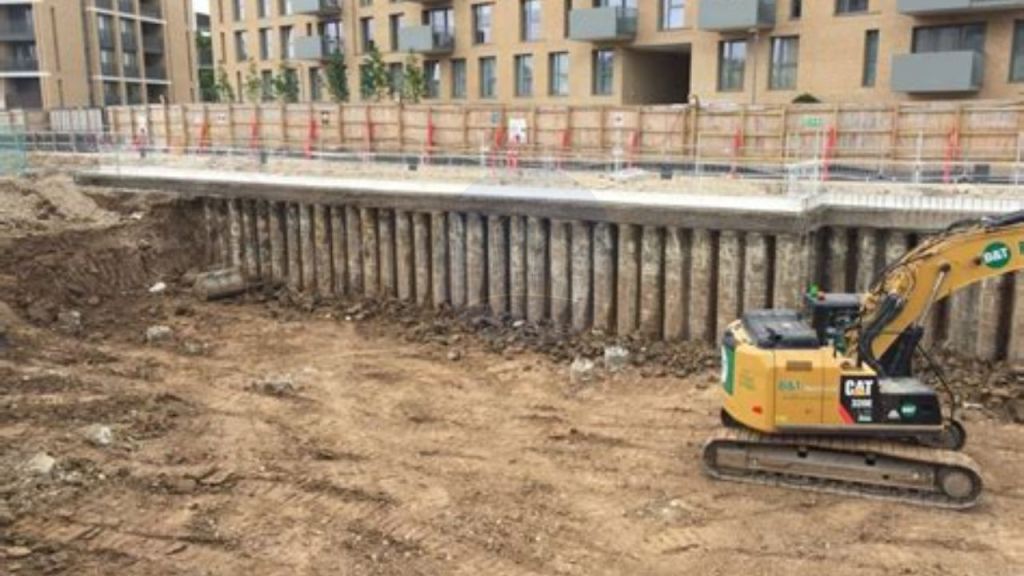
Sheet pile walls are erected using steel sheets into a slope to be protected or for excavations up to a required depth. Sheet pile retaining wall economical till a height of 6m and cannot negotiate huge loads. Sheet pile acts as a temporary wall that is driven into the excavation area for protecting the area from collapsing. They provide high resistance to driving stresses. They can also be reused and are considered the most economical retaining solutions. They can be bolted and driven easily and do not deform on driving. The problem with sheet piles is the noise it creates while driving.

Sheet pile

Piled retaining walls

These types of retaining walls consist of a sequence of bored piles. The bored piled retaining walls are often accompanied by erection earth anchors, shot-creating the pile gaps, and provision of additional supports depending on the site conditions and designs. Bored pile retaining walls are used in areas where sheet pile tends to create a lot of noise and disturbs the areas.
These types of piles are used for temporary and permanent works. They can hold huge lateral pressure and are used for holding earth for high depth excavations without disturbing the nearby structures. Bored pile retaining walls are classified into contiguous pile walls, tangent pile walls & secant pile walls according to the sequence of piling works.

Piled retaining wall

Anchored retaining walls

Anchored retaining walls, also known as tie-back systems, are essential structural components used in construction. They are mostly used to stabilize earth and as support structures. Anchored Retaining walls deliver lateral support to walls. They prevent soil from shifting or eroding. These walls are commonly used in applications like deep excavations, embankments, and hillside retention etc.

4 Types of Pavement |Difference between Flexible and Rigid Pavement

Types of pavements play a crucial role in road construction. They determine the performance, durability, and maintenance requirements of highways and streets. There are four primary pavement types: flexible pavements, rigid pavements, composite pavements, and semi-rigid pavements. Each of these serves specific purposes depending on the load-bearing capacity, climatic conditions, and construction needs. It is essential to understand the difference between flexible and rigid pavements. These two major categories vary in material composition, load distribution, and overall performance. Flexible and rigid pavements offer distinct advantages. Flexible pavements are more adaptable to underlying soil conditions. Rigid pavements, made of concrete, provide higher structural strength.

This article covers the four types of pavements and the difference between flexible and rigid pavements

Before we begin, let’s look into what a pavement is.

  1. What is pavement?
  2. Types of Pavements
  3. Flexible pavement
    1. Examples of flexible pavements
    2. Advantages of flexible pavement
    3. Disadvantages of flexible pavements
  4. Rigid pavement
    1. Advantages of rigid pavement
    2. Disadvantages of rigid pavement
  5. Comparison between flexible and rigid pavements
  6. Semi rigid/ composite pavements
  7. Interlocking Concrete Block Pavement (ICBP)

What is pavement?

The pavement is a hard surface that’s built with concrete or asphalt, like a road or a driveway.

Pavement refers to the hard, durable surface layer of roads, walkways, and other transportation paths. These surfaces are designed to withstand the wear and load of traffic. It provides a smooth, stable platform for vehicles and pedestrians, while ensuring safety and comfort. Pavements are engineered for strength, weather resistance, and longevity, typically made from materials like asphalt or concrete. Properly constructed pavements reduce road maintenance and improve traffic efficiency, contributing significantly to infrastructure durability and performance.

Types of Pavements

Pavements are essential for providing a stable and smooth surface for roads and infrastructure. The main types of pavements differ in their structural composition and load-bearing capacities. The top four types of pavements include flexible pavements, rigid pavements, composite pavements, and semi-rigid pavements. Each type serves specific purposes depending on traffic load, climatic conditions, and construction requirements.Based on the structural behavior, road pavements are classified as

  • Flexible pavement
  • Rigid pavement
  • Semi-rigid pavements
  • Composite pavements
  • Interlocking cement concrete block pavement (ICBP)

Without any due, let’s jump onto the first type of pavement.

Flexible pavement

Flexible pavement - Type of pavement
Flexible type of pavement

Flexible pavement is the pavement which possess negligible flexural strength. And,

  • The flexible pavement layer can exhibit non-recoverable deformations of the lower layer. It may also show recoverable deformations. These deformations include the subgrade on the upper layers and possibly affect the pavement surface.
  • The vertical compressive stress is maximum on the pavement surface directly under the wheel load and is equal to the contact pressure under the wheel
  • The lower layers of pavement have to withstand lesser magnitudes of stresses. There is no direct wearing action due to traffic loads. They also do not experience weathering action due to environmental factors. Therefore inferior materials with lower cost can be used in the lower layers.
  • In flexible pavement layers, the top layer has to be the strongest. This layer must sustain the highest compressive stresses. It also endures wear and tear due to moving traffic and varying weather factors.

Examples of flexible pavements

  1. Asphalt Pavements – Commonly used for highways, streets, and driveways.
  2. Bituminous Surface Treatment (BST) – Used for lower-traffic roads and rural areas.
  3. Gravel Roads with Asphalt Coating – Often found in rural areas or less populated regions.
  4. Full-Depth Asphalt Pavements – Used in areas with high traffic and heavy loads.
  5. Cold Mix Asphalt – Used in maintenance and patching.

Each of these examples offers flexibility, enabling them to adjust to changes in the subgrade beneath.

Also read: Electronic Toll Collection-4 subsystems of ETC Full details

Next, let’s peep into advantages and disadvantages of flexible pavements.

Advantages of flexible pavement

Flexible pavement is a common choice in road construction. It is designed to distribute loads over a wide area. This allows for movement and adaptation to underlying conditions. This adaptability makes flexible pavements particularly beneficial in various applications.

Types of Road pavements - Flexible pavement
Types of Road pavements – Flexible pavement
  • Initial cost can be reduced by constructing thin bituminous surface layer
  • Standard design load in terms of CSA (Cumulative Standard Axles)
  • Functional deterioration
  • Strengthening by overlay
  • High salvage value
  • Can be open to traffic after 24 hours

Disadvantages of flexible pavements

  • Deterioration under stagnant water
  • Periodic maintenance
  • Patching of pot holes is expensive
  • Thickness is very high
  • Night visibility is very low

That’s it about flexible pavement. Let’s move onto the next type of pavement.

Also read: Classification of roads- 5 types of roads full details

Rigid pavement

Rigid pavements are those which possess noteworthy flexural strength of flexural strength or flexural rigidity.

See more details below.

  • Rigid pavements are generally made of Portland cement concrete hence known as ‘cc pavement’
  • Construction of rigid pavement using high quality plane cement concrete known as ‘pavement quality concrete (PQC)
  • The CC pavement made of PQC are generally expected to sustain up to 45kg/cm2 of flexural stresses
  • In rigid pavements, the stresses are not transferred from grain to grain to the lower layers as in the case of flexible pavement layers.
  • Slab action is capable of  transmitting the wheel load cases through a much wide area below pavement slab

Having the details in back pack, ready to know the advantages and disadvantages of rigid pavements?

Advantages of rigid pavement

  • No deterioration under stagnant water
  • Thickness is less
  • Service life 30 years
  • Life cycle cost is very less
  • Night visibility is high

Disadvantages of rigid pavement

  • Axle load study is required
  • Design should be for 30 years
  • Possible to restore the pavements under crack
  • Surface may become smooth or slippery
  • Long period of 28 days is required to open traffic

Let’s conclude the section with a comparison.

Comparison between flexible and rigid pavements

Flexible pavementRigid pavement
Bitumen is mostly used for construction Otherwise called concrete pavements
Bitumen becomes soft due to low temperature and bleeds leading to failure of pavementHave longer life and is practically maintenance- free
When water enters the pavement during raining, resulting in potholes Can withstand extreme weather conditions
Due to low temperature in winter season, bitumen becomes brittle leading to cracking of pavementInitial cost higher comparatively, but economical in long term
Comparison between flexible and rigid pavements

Now, you know about flexible and rigid pavement. Time to meet some not-so-famous type of pavement.

Also read: Gauges in railway- All Details About Broad, Metre and Narrow Gauges

Semi rigid/ composite pavements

Semi-rigid pavements are an intermediate state between the Flexible and the Rigid pavement. The flexural strength of the pavement is less than a concrete slab. Nevertheless, it finds support by the lateral distribution of loads through the pavement depth as in flexible pavement.

When the intermediate class of semi-rigid materials like soil cement, lean cement concrete are used in the sub-base or base course of layers of pavements, they are called semi-rigid pavement.

Pavement consisting of both flexible pavement layers and one or more semi rigid pavement layers are called composite pavements.

The last member is ICBP or Interlocking concrete block pavement.

Interlocking Concrete Block Pavement (ICBP)

interlocking concrete block pavement
Interlocking Concrete Block Pavement (ICBP)

Interlocking Concrete Block Pavement (ICBP) has been extensively used in a number of countries for quite sometime as a specialized problem-solving technique for providing pavement in areas where conventional types of construction are less durable due to many operational and environmental constraints

That was the trip through the types of pavement. Have any doubts regarding this? Just drop it in comments.

See you there. Happy learning!

WPC Board vs Plywood – Which is best?

WPC Board vs Plywood– Which is best ? When you decide to do the interiors of your home or office a lot of materials come to your mind. But choosing the right material is the primary concern and need. Of all the interior materials available in the market Plywood and WPC or Wood plastic composite are the most preferred and commonly used. Which one do you choose?

Both are excellent building materials in terms of durability, strength, and workability and are available in different grades to cater to any requirement, budget, and application areas.

wpc boards used as kitchen cabinets
WPC BOARD – KITCHEN INTERIOR

What is WPC boards?

WPC boards are made from grounded sawdust thoroughly mixed and heated with thermoplastic resins mixed with additives for imparting superior qualities. Sawdust from fibre fillers like pulp, peanut hulls, byproducts of the textile industry, bamboo, etc. are mixed with virgin or waste/recycled plastic derived from polyethylene, polyvinyl chloride, polypropylene, etc. Nowadays polyethylene-based plastics are commonly used. The proportion of sawdust is around 15%, virgin/recycled plastic constitutes 75%, and the remaining will be different additives. WPC board is a hybrid product that got the qualities of wood and easiness and water-resistant properties of plastic. These ingredients are mixed to a thick consistency and are moulded or extruded to form WPC boards.

WPC BOARD - SWIMMING POOL DECK
WPC BOARD – SWIMMING POOL DECK

Must Read : WPC Boards – Advantages, Disadvantages and Uses.

What is plywood?

Plywood is a manufactured wood panel/ engineered wood made from thin sliced natural wood called veneers in the core as well as the face. These core veneers are glued in layers one on top of the other with adjacent layers having their wood grains rotated up to 90 degrees to one another. The cross layering of adjacent layers imparts structural strength and stability to plywood. These veneers are bonded together with glue and pressed under high pressure and heated to form plywood. Plywood is a versatile, flexible, and highly workable building material widely used in manufacturing furniture, cabinets, shelves, and wardrobes, etc. They are also used for woodwork for ships and boats and for shuttering works in the construction sector. These are the commonly used categories of plywood based on application sectors.

WPC BOARD VS PLYWOOD - LAMINATE OVER PLYWOOD INTERIORS
LAMINATE OVER PLYWOOD

Also read : Plywood Types – MR resistant, BWR and BWP/Marine ply

WPC board vs Plywood – A comparison

Plywood is available in three different grades. They are MR grade/ commercial ply as per IS 303, Exterior grade /BWR grade as per IS 303 and Marine ply/BWP grade as per IS 710 grade. Marine ply is the most superior grade of plywood. For comparison, we are taking marine ply and Wood plastic composite (WPC).
Marine plywood and WPC boards got similar characteristics – They are moisture-resistant, termite-resistant, suitable for outdoor applications, and extensively used for external and works exposed to water and moisture such as kitchens and bathrooms and external furniture, facades, etc.

Advertisements

WPC board vs Plywood – Ingredients and manufacturing

PlywoodWPC Board
Plywood is made of sliced wood layers (veneers) and is placed in a cross-layered pattern. The veneer layers are glued together using synthetic resins like Urea Formaldehyde or Phenol formaldehyde, pressed with high pressure, and heated
to form plywood.
Manufactured from a mixture of sawdust/wood fibre and waste/ recycled plastics. The materials are mixed with pigments and additives and moulded our extruded to for WPC boards.

Moisture resistant and termite resistant qualities

PlywoodWPC board
Marine-grade ply wood surface is
very hard and delivers superior
water-resistant qualities.
They are made from tropical
hardwood veneers and jointed using
water-resistant adhesive. Marine ply
is further treated with preservatives
and protective finishes to enhance
water and termite resistant qualities.
WPC is a Mixture of sawdust
and plastics. They are a hundred
percent water-resistant
and
termite-proof material.

Because of these qualities, both these materials can be used for wet areas, external furniture, facades, kitchen cabinets, bathroom interiors, etc. But plywood of grades other than Marine got less water and moisture resistant than WPC boards.

Advertisements

Fire resistant and heat resistance

PlywoodWPC board
Plywood burns with flame and is
more suspectable to heat.
WPC does not burn with flames due to the presence of plastic material and special additives. WPC is a polymer-based material and does not catch fire.

Plywood can be made fire resistant by protecting with fire-retardant additives. Fire and heat resistant qualities are much better in the case of WPC boards.

Screw holding capacity

Due to the cross-layered arrangement of veneers, plywood possesses extremely good screw holding capacities. It may not come out from hinges easily.

Screw holding capacity of WPC depends on the density of the materials. For a competitive screw holding capacity, WPC boards should possess a density of 600kg/cm3.

Screw holding capacity of plywood is comparatively better than WPC boards.

PLYWOOD MANUFACTURING

Durability

The durability of plywood depends on the grade which is being used and the area of application. Plywood is durable but has to be maintained properly. Some plywood grades may split or splinter in course of time.

WPC is an extremely durable material and is long-lasting.

WPC always comes with a lifetime guarantee from major manufactures whereas plywood quality determines durability and life. Because of the presence of a lot of plywood manufacturers, the qualities may be compromised. BWR grade- IS 303 GRADE plywood is sold to the customer in place of Marine ply in most of the cases. Ensure that the materials to be purchased from the reputed manufacturer with proper test certificates.

WPC is extruded or moulded to form sheets and hence are a homogeneous material whereas plywood is made by layers that are glued and may fail.

Workability

Plywood can be easily bent without affecting its strength. But planning and molding are not possible like Wood and WPC due to cross-layered arrangement.

WPC got the combined properties of plastic and wood and hence are more flexible than plywood and can be thermoformed to any shape. They can also be moulded, planned, and grooved, exactly like wood.

Plywood cannot be used in the raw form. Plywood has to be covered with laminate or veneer to match the colour scheme. Plywood got a good surface enabling the gluing of veneers and laminates. They can also be painted with PU and textures. Laminated plywood are also available for various uses.
The veneers and laminates may peel off on continuous exposure to sunlight and water.

In the case of WPC boards, the colours are generated through the addition of pigments in the manufacturing process and do not fade easily on exposure to sunlight. WPC does not need any laminate, veneer, paints, and polish.

Veneers and laminates are fixed on WPC with proper roughening of the surface and treatment with special adhesives and double side adhesive tapes. They can even be painted with PU paint and texture paint after the application of plastic primer. The bonding properties of WPC with laminates, veneers, and paint are not strong when compared with plywood.

Eco friendly qualities

Plywood veneers are from cutting trees and are not environmentally friendly. The manufacturing of plywood will result in deforestation.

WPC is made from wood waste, sawdust, recycled plastics, etc and consumes industrial wastes and converts it into usable materials. WPC manufacturing does not generate any wastage nor any trees are cut in this process and is an environmental friendly material.

WPC board vs plywood – Cost

Good quality WPC boards are costlier than marine plywood. But the additional costs incurred for veneer, laminates etc can be eliminated.

Conclusion

WPC is a long-lasting, eco-friendly, durable, and extremely high water and moisture resistant product than plywood. But the looks cannot match exactly as wood and they do not have the choice of application of beautiful laminates and veneers. Still, WPC stands out as a better option than plywood in wet areas even though it costs high. Plywood on the other hand is durable and can match wood finishes and colours through veneers and laminates which is not possible in WPC.

Processing…
Success! You're on the list.