Category Archives: CONCRETE

Concrete Mixing || Mixing concrete – Objectives and types

Concrete mixing is a critical step in ensuring strong, durable, and workable concrete for construction projects. This process involves blending cement, aggregates, water, and admixtures to achieve a uniform mixture. Understanding different concrete mixing methods is essential to achieving desired strength and performance. In this blog, we’ll explore the objectives of concrete mixing, various concrete mixing techniques, and compare manual vs. machine mixing to help you choose the right method for your needs. Whether you’re working on small residential jobs or large-scale infrastructure, knowing the types of concrete mixing and their advantages can improve quality and efficiency. Dive into the best practices and discover how to mix concrete properly for reliable, long-lasting results in all construction settings.

To begin with, let’s try to understand the objectives of mixing concrete and concrete mixing types

  1. Objectives of Concrete Mixing
  2. Concrete Mixing Types
    1. Hand Mixing of concrete
      1. Process – Hand Mixing of concrete
    2. Machine Mixing of Concrete
      1. Concrete Mixing Machine
      2. Machine Mixing Process
    3. Ready Mix Concrete
    4. Mixing Ratios
  3. Conclusion

Objectives of Concrete Mixing

How many of you have wondered why we mix concrete? Read on to find the answers.

  • To manufacture high-quality fresh concrete, proper mixing of materials is critical. 
  • The surface of all aggregate particles is coated with cement paste during the mixing phase.
  • For the desired workability and performance of concrete in both the fresh and hardened states.
  • To avoid segregation and bleeding.

In the next section, we will learn the types of concrete mixing

Related posts from vincivilworld

Concrete Mixing Types

There are three methods to produce efficient and high-quality concrete.

  • Hand Mixing – Mixing concrete manually without a mixer machine.
  • Machine Mixing – Mixing using a mixer machine.
  • Ready Mix Concrete – Mixing is done in an automatic or semi-automatic batch plant.

Let’s dig deeper into each of them.

Hand Mixing of concrete

  • Method of manually mixing the concrete materials without the use of a mixer machine. 
  • Hand mixing is done only for small jobs where the concrete demand is low and quality control is not critical. 
  • Uniformity of mixing is difficult to achieve by hand mixing. It necessitates extra caution and effort. 
  • In the case of hand mixing, 10% more cement should be applied to the nominal mix concrete proportion.
Hand Mixing of concrete

Process – Hand Mixing of concrete

  • Hand mixing is done on a flat iron sheet plate base that is hard, clean, and non-porous.
  • On the platform, a measured amount of sand is placed.
  • Then the cement is poured over the sand.
  • In a dry state, the sand and cement are thoroughly combined with shovels several times until the mixture achieves an even colour.
  • The coarse aggregates are then spread out on top of the above mixture and thoroughly mixed. 
  • The whole mixture is properly mixed by twisting it from centre to side, back to centre, and then to the sides several times.
  • After that, depression is rendered in the mixed materials’ nucleus.
  • 75 per cent of the necessary amount of water is then poured into the depression and mixed with shovels.
  • Finally, the remaining water is applied, and the mixing process is repeated until the concrete has a uniform colour and consistency. 

The total time for concrete mixing does not exceed 3 minutes.

Let’s move on to the next method ie mechanised concrete mixing.

Machine Mixing of Concrete

  • The method of combining concrete materials with a concrete mixer system is known as machine mixing. 
  • It meets the demands of fast mixing times, optimal consistency, and homogeneous concrete efficiency. 
  • Since it ensures uniform homogeneity, machine mixing of concrete is best suited for large projects requiring large quantities. 

Concrete Mixing Machine

It is also known as a concrete mixer is a machine that mixes cement, aggregate (such as sand or gravel), and water in a uniform manner to shape concrete. A rotating drum is used to combine the components in a traditional concrete mixer. Concrete mixers powered by gasoline, diesel, or electricity are now widely available. The mixer machine is mostly used for mixing ingredients by volume. They are also used for mixing ingredients by weight by providing weigh batcher.

Concrete Mixer Machine

Machine Mixing Process

  • Wet the inner surfaces of the concrete mixer drum first.
  • The coarse aggregates are added first, followed by sand, and finally cement, in the mixer.
  • In a mixing machine, combine the products in a dry state. In most cases, 1.5 to 3 minutes should suffice.
  • While the machine is running, slowly add the appropriate amount of water after the dry materials have been thoroughly mixed. 
  • Don’t use any extra water.
  • Concrete must be mixed in the drum for at least two minutes after adding water.

We have seen the details of machine mixing. How about getting an idea about ready-mix concrete?

Ready Mix Concrete

  • Ready Mix Concrete (RMC) is a specialised material in which the cement, aggregates, and other materials are weighed and batched at a central location, then mixed either in a central mixer or in truck mixers. Then it is shipped to construction sites.
  • The consistency of the resulting concrete is much superior to that of site-mixed concrete.
  • Useful on congested sites or in road construction where space for a mixing plant or aggregate storage is limited or nonexistent. 
  • Quality control of concrete is simple in this process.

So far, I have showed you the types of concrete mixing and its procedures. Now its time to throw some light on concrete mixing ratios.

Concrete Batching Plant

Mixing Ratios

The proportions of concrete components such as cement, sand, aggregates, and water are known as concrete mix ratios. The method of building and mix designs are used to determine these ratios. In comparison to other mixing processes, the water/cement ratio in RMC can be easily managed.

Conclusion

To summarise,

  • Hand blending of concrete is the cheapest method.
  • It is only recommended for very limited projects requiring a small amount of concrete since consistent concrete consistency is difficult to achieve with this method. 
  • It ensures proper material mixing.
  • When compared to site mixing (both hand and machine mixing), RMC takes less time and produces a higher quality product.
  • It’s also very handy when you need a large amount of concrete per day.

Methods of concrete curing – Top 3 curing methods explained

The concrete curing methods depend on the nature of the structure, site conditions, and ingredient parameters. In this article, we will go through some common curing methods adopted in constructions sites. For getting a better understanding of the topic, refer to our earlier article Curing of concrete – Process and significance.

Methods of concrete curing

Curing is the process that helps in maintaining moisture to allow fresh concrete to attain its desired strength in a planned manner through a hydration reaction. If the water evaporates quickly, the requisite amount of water will not be available for the hydration process. The curing of concrete helps to retain the concrete moisture until the hydration process is complete and concrete attains the requisite strength.

The curing method and time primarily depend on structure type, site conditions, and ingredient parameters. Some of the curing concepts adopted in constructions sites are as follows.

  • Maintaining a water layer of water over the concrete surfaces (water curing)
  • Reducing the loss of water from concrete
  • Accelerating the initial strength gain

Let us go through these three basic concepts and curing methods adopted for each of these criteria.

Also Read : Non destructive tests ( NDT } on hardened concrete

Maintaining water over the concrete surfaces -Methods of concrete curing

Maintaining water over concrete surfaces or water curing is the most popular and conventional method of concrete curing. The methods of curing depends on the type of structure basically. Let us go through the water curing methods adopted in construction sites .

  • Ponding
  • Spraying and fogging
  • Saturated or wet coverings
  • Immersion curing

Ponding

Ponding is the method of wetting the concrete surface by creating a temporary containment area around the concrete. 

The ponding method is one of the very well-known and widely adopted concrete curing methods. This method is possible only on horizontal or flat structures and is best suited for curing concrete slabs. 

Small bunds of clay or lean cement sand are placed over the concrete surface. Water is filled in the bunds, refilled, and maintained as and when the level goes down.

This method is very efficient but requires a huge amount of water. The ponding method of curing is not preferred for large areas and areas where water is scarce.

Spraying and fogging method of curing

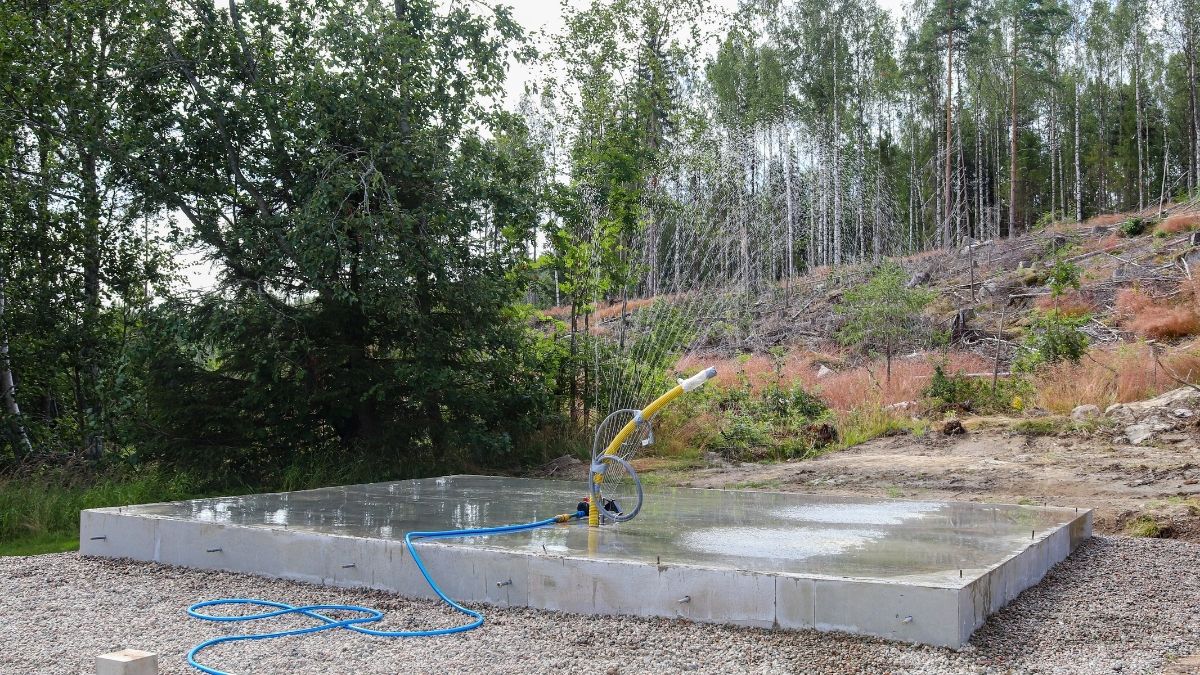
Spraying and fogging are conventional water curing methods for horizontal and vertical concrete surfaces. These methods are very effective and efficient in supplying additional moisture during hot weather. The spraying and fogging methods help in reducing the temperature of the concrete.

Spraying is a manual method of simply spraying water over the concrete surface. Even though the spraying method is effective, it tends to waste a lot of water.

curing by water spraying

Fogging is applicable for areas where the temperature is above freezing point and with low humidity. This process raises the humidity higher than curing concrete by spraying a fine mist of water regularly across the concrete surface. Fogging, or fog spraying is effective in reducing the chances of plastic shrinkage cracking in mixes.

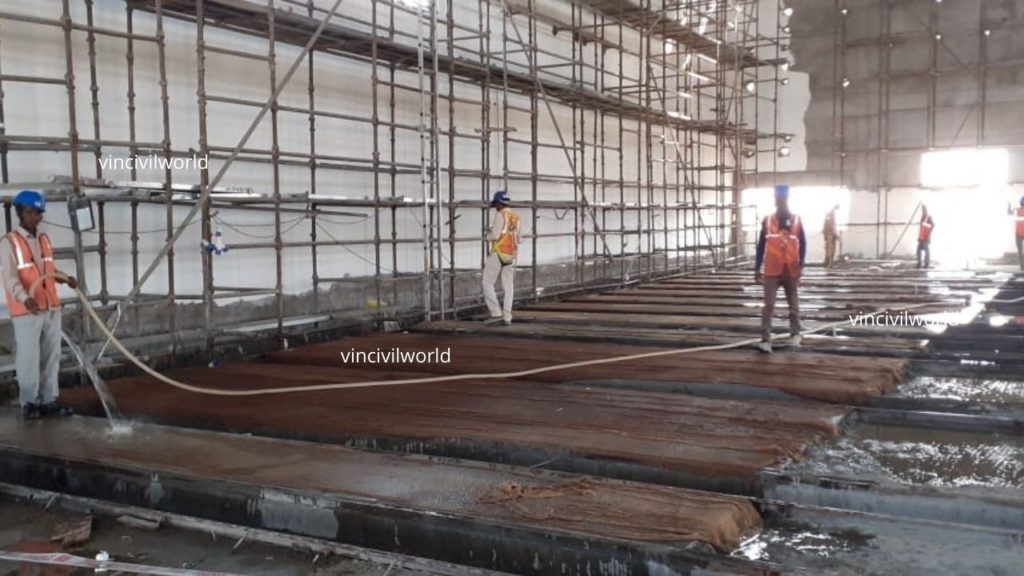
Saturated or wet coverings

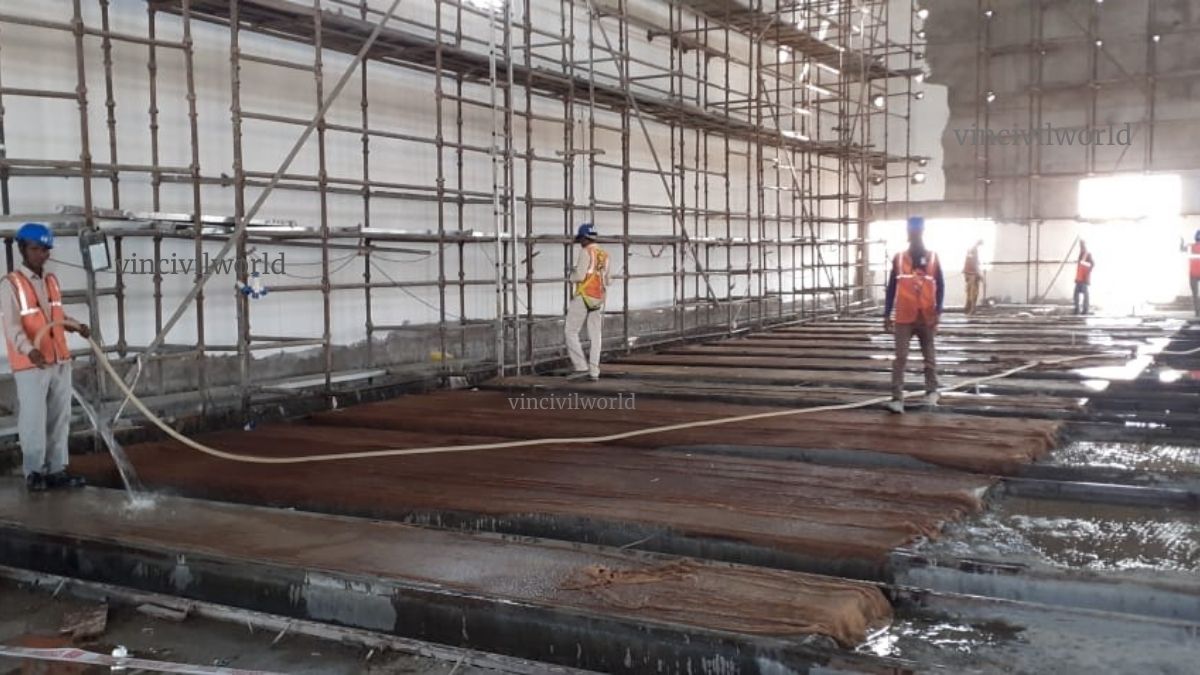
In this method of curing, saturated or wet coverings are placed over the hardened concrete. The wet covering material includes hessian cloths, cotton mats,moisture-retaining fabrics, etc. Vertical and inclined structures like columns, beams, sloped roofs, etc are cured in this method.

Curing by wetting -methods of concrete curing
Curing by wetting

Immersion curing

Immersion method of curing is for curing concrete specimens.

Reducing Water loss from concrete- Methods of concrete curing

This concept of curing is by reducing the moisture loss from the concrete surface by wrapping it with an impermeable membrane or plastic sheets. This method is the most practical and efficient way to cure concrete nowadays and is a much-needed option for areas where there is water scarcity. The common methods are..

  • Membrane curing
  • Covering concrete with impervious sheets or plastic sheets

Membrane curing

The application of curing compounds is through spraying or painting directly on the concrete surface. The compound dries and forms an impermeable membrane that retards or reduces the moisture loss from the concrete. The membrane curing method is a flexible and easy method of curing.

membrane curing-methods of concrete curing
membrane curing /curing compound

Curing compounds are applied once the concrete is hardened, but still having water content on it. The application has to be done before the water evaporates fully from the concrete. The membrane curing may not produce desired results, if applied after the water evaporates. Ensure uniform thickness and coverage during the application process.
Curing compounds are available in acrylic-based and water-based forms.
The curing compound should comply with ASTM C3094 or ASTM C13155.
Always go through the manufacture specification before application of curing compounds.

Covering with plastic sheets

In this method, Impervious paper and plastic sheets is applied on thoroughly wetted concrete. The concrete surface should be hard enough to take the possible damages while placing the sheets.

Accelerating strength gain method – Methods of concrete curing

Accelerating strength gain using heat or additional moisture is done to speed up the early hardening of concrete and mortars by subjecting them to steam and humidity. Following are the methods adopted in this method of curing.

Steam curing for concrete

The steam curing method uses water vapor or steam for curing the concrete elements. This method of curing is for cold weather conditions where the concrete needs accelerated early strength gain and additional heat for hydration. Prestressing and precast factories use the steam curing method for early strength gain of components. The early strength gain can enable rapid removal and reuse of forms. 
The steam curing is done in two ways

  • live (or low pressure) steam at atmospheric pressure
  • high-pressure steam curing in autoclaves.

Steam curing at atmospheric pressure

Steam curing allows increased production due to rapid repetition and reuse of molds/forms in precast yards.

The steam temperature should be kept at around 140 degrees Fahrenheit or less for live steam at atmospheric pressure until the desired concrete strength is achieved.

By maintaining an optimum temperature, a 28 days strength of normal water cured concrete can be achieved in 3 days using the steam curing method.

High-pressure steam

High-pressure steam curing is carried out in a closed chamber at high temperature and high pressure. This process is also known as “Autoclaving”. Temperature should be maintained between 325°to 375°F and pressures should be around 80 to 170 psi. This method is used for manufacturing precast components, cellular concrete products, such as cellular blocks, precast panels, autoclaved aerated concrete (AAC) blocks, etc.

The main advantage of a high-pressure steam curing system is the capability of attaining 28 days of strength of normally cured concrete in 24 hours.

High-pressure steam cured concrete got less creep and shrinkage and better sulfate resistance. There will not be any efflorescence and moisture content after curing.

Heating coils

Heating coils are usually used as embedded elements near the surface of concrete elements. Their purpose is to protect concrete from freezing during cold weather concreting.

Conclusion

The type of curing to be suggested depend upon the structure, type, nature of the structure and climatic conditions. Curing is the most important activity to be done on concrete to maintain its design strength, durability,serviceability and life span.

Splitting tensile strength test of concrete – Test procedure

The splitting tensile strength test is performed on hardened concrete to determine its tensile strength. Marginal variations in water to cement ratio, ingredient proportioning, increase in a slump, etc impacts the desired concrete strength. This in turn affects the strength and stability of structures. There are several tests to determine the strength of concrete.

Quality tests are to be conducted on concrete at various stages starting from the production stage to the hardened stage, and on structures. Quality tests play an important role in ensuring the construction quality. This article covers splitting tensile strength test for deriving the strength of concrete

Quality tests on concrete

The Quality tests are done on different stages like production stage, hardened stage and Non destructive tests.

Quality tests on Fresh concrete

Quality tests on hardened concrete

  • Compressive strength
  • Tensile strength – Split tensile strength
  • Flexural strength test
  • Water absorption test

Non destructive tests on concrete

In this article we deal with the Splitting tensile strength test of concrete.

Splitting tensile strength test – Significance

Since concrete is brittle, it is weak in tension and can cause cracks. So it is essential to conduct the tensile strength test of concrete. A method of determining the tensile strength of concrete using a cylinder which splits across the vertical diameter. It is an indirect method of testing tensile strength of concrete. At least three samples should be tested and an average value is calculated. The main objectives of this test are as follows

  • For determining the tensile strength of concrete.
  • To provide the information on the use of sand and aggregate.
  • To determine the uniform stress distribution.
  • For studying the behaviour of concrete.

Relevant code

  • IS 5816: 1999
  • ASTM C496
splitting tensile stress

Apparatus used

  • Testing machine
  • Plate or Supplementary Bearing bar
  • Bearing strips
  • Cylinder specimen
  • Tamping rod

The testing machine should apply continuous load without shocks. So for this test, two bearing strips with 3.2 mm thick and 25 mm wide are used. The dimension of the cylindrical specimen is 150 mm in diameter and 300 mm in height. 

Splitting tensile strength

Test procedure of Splitting tensile strength test

  • The first step is to prepare the concrete mix for making the cylindrical specimen.
  • Grease the inside surface of the mould and Pour the mix into the mould as layers.
  • Compact each layer using a tamping rod. Tap each layer 30 times. 
  • Uniformly stroke the concrete mix and remove the excess concrete.
  •  Then immerse the casted specimen in water for 24 hours at 27-degree celsius.
  • After that remove the specimen from the mould and immerse it in freshwater.
  • The splitting tensile strength of concrete should be conducted at 7, 28 days of curing.
  • Before starting the test, take the specimen from the immersed water and wipe the water. 
  • Then note the dimension and weight of the specimen. 
  • Place plywood strip above and below the specimen 
  • After that place the specimen on the testing machine. 
  • Then gradually apply load at a rate of 0.7 to 1.4 MPa/min (1.2 to 2.4 MPa/min based on IS 5816 1999).
  • Record the load at which the specimen breaks. 

Calculation – Splitting tensile strength test

Splitting tensile strength of concrete, T= 2P/ Ω LD

The unit of tensile strength is N/mm. The splitting test is easy to perform and we can get uniform results. It is a simple, reliable and convenient method to determine the strength of concrete.

Compressive strength test of concrete | Cube test for Concrete

Compressive strength of concrete is the ability of the concrete to withstand loads without cracking or deformation. Compressive Strength of concrete is defined as the Characteristic strength of 150 mm size concrete cubes @28 days.  Marginal variations in water to cement ratio, ingredient proportioning, increase in a slump, etc impacts the desired concrete strength which in turn affects the strength and stability of structures.

Quality tests are to be conducted on concrete at various stages starting from the production stage to the hardened stage, and on structures. Quality tests play an important role in ensuring the quality of a particular construction. This article covers the types of tests conducted on concrete at various stages.

Quality tests on concrete

Quality tests are done on different stages as listed below,

  • Production stage quality tests ( On fresh concrete before placing)
  • Hardened stage quality tests ( hardened concrete specimens)
  • On structures ( tests done on the structures )

Quality tests on Fresh concrete

Quality tests on hardened concrete

Non destructive tests on concrete

  • Rebound hammer
  • Penetration resistance test
  • Ultrasonic pulse velocity test

This article is about compressive strength test of concrete, its significance and procedure.

Compressive strength test of concrete – significance

As a construction material, concrete should be able to withstand heavy loads. The concrete material beneath compression tends to reduce its size. Concrete gains its strength over time. The compressive strength depends on cement strength, water-cement ratio, concrete quality etc. The test gives an idea of the overall strength and above-mentioned factors. Through conducting this test, one can easily judge the concrete strength and quality of concrete produced. We can calculate the compressive strength from the failure load and the cross-sectional area of the specimen.

Compressive strength test of concrete

Concrete compressive strength for general construction varies from 15 MPa (2200 psi) to 30 MPa (4400 psi) and more than that in case of commercial, industrial structures and special structures.

The compressive strength helps in determining

  • Quality control
  • Acceptance of concrete
  • Evaluation of curing
  • For determining the in-place concrete strength.
  • Age of concrete, etc.

Formula for compressive strength

Compressive strength formula for any material is the load applied at the point of failure to the cross-section area of the face of the concrete specimen (cube or cylinder) on which load was applied.

Compressive Strength = Load / Cross-sectional Area

Relevant IS code

IS: 516-1959

Apparatus used

  • Compression testing machine or Universal testing machine
  • Cube or cylinder specimen
  • Weighing machine
  • Vibrating machine
  • Trowel
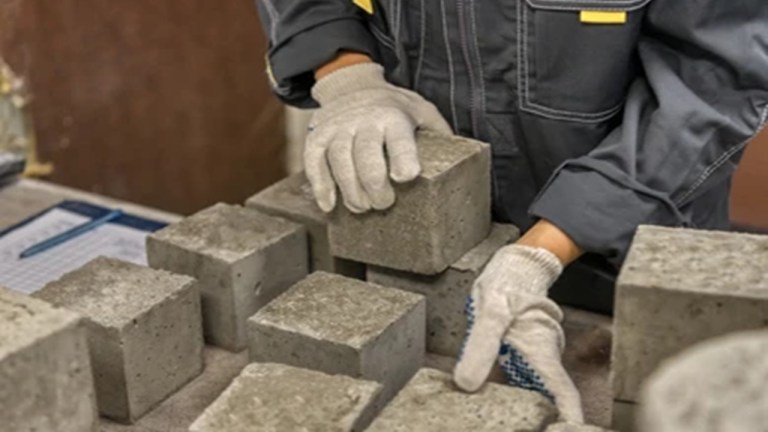
Compression test - Apparatus

Compressive strength test of concrete

The specimen for this test can be cubic or cylindrical. The dimension of the specimens is as follows.

  • Cube = 150mm x 150mm x 150mm
  • Cylinder = 150mm diameter, 300mm height

The mould is made up of cast iron or steel. Cubical moulds are preferred for most works.

Compression testing of cubes – Procedure

Mixing of materials.

  • The first step is to prepare the test specimen by mixing the ingredients.
  • Mix the cement, coarse aggregate and fine aggregate in dry condition uniformly.
  • Mixing of the materials is by using batch mixer or by hand mixing.
  • Ingredients shall be bought to room temperature, before commencing the test.

Preparation of Test specimen

  • Clean the cube mould and apply the lubricant inside the mould.
  • Make at least three specimens from each batch.
  • After mixing the concrete, fill the specimen in the mould in three-layer at 50 mm thickness. 
  • After that stroke 35 times and compact the concrete using a vibrating machine. 
  • Then remove the excess concrete using a trowel. 
  • After that mark the date, grade of concrete etc and immerse the specimen in freshwater.
  • Then store the specimen at a temperature of 27-degree Celsius for 24 hours.

Procedure for testing

  • The specimens should be tested using the compression testing machine at 3, 7 and 28 days. 
  •  Before starting the test take the specimen from water and remove the mould.
  • The test should be conducted in the wet condition of the specimen.
  • Record the weight and dimension.
  • Then place the specimen in the testing machine. 
  • Gradually apply load on the specimen at a rate of 140 kg/ cm2 per minutes.
  • Note down the load at which the specimen breaks.
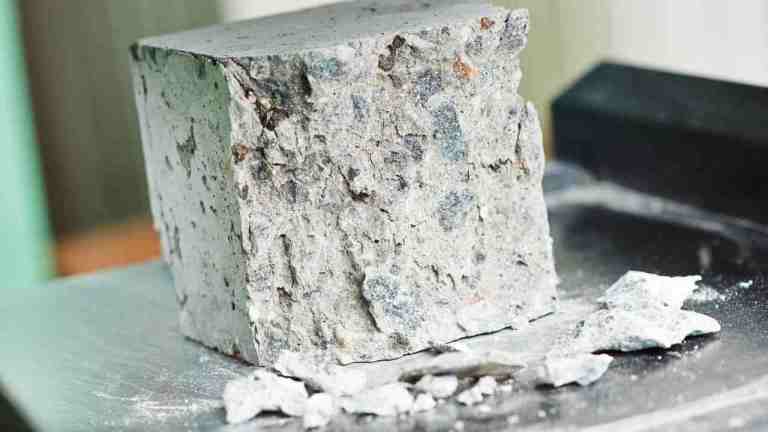
Compressive strength test of concrete

Calculation for Compressive strength test of concrete

The compressive strength of the concrete = Load at which the concrete breaks / Cross-sectional area of the specimen.

The compressive strength is expressed in N/mm2. The cube specimen is tested at 7, 14 & 28 days.

Calculation of compressive strength

Size of cube = 15cm x 15cm x 15cm

Area of specimen = 225 cm2

Expected maximum load = fck x area x f.s

Calculation shall be repeated for 7, and 28 days.

Results shall be furnished as average compressive strength of cube = …………… N/mm2 (7 days and 28 days)

Conclusion

The compressive strength of concrete cube gives and idea about the characteristics of concrete. With this single test we can judge the concrete quality and hence preferred for major construction works.

Stones || Quality tests on stones ||Types and procedures

Stones are the form of rocks from the earth’s crust. They find their application in the construction of residential and public buildings, dams, harbours, face-work of structures, road metal, and railway ballast. Besides, stones have good strength and durability.

Quality tests on stones are crucial for construction projects. Testing stone ensures that it meets the necessary standards for strength and durability. There are various tests for stones that assess different properties. These tests for stones include crushing strength, water absorption, and abrasion resistance. By performing these tests, engineers can decide the suitability of the stone for specific uses. Properly testing stone helps prevent structural failures and ensures long-lasting constructions. In this blog, we will explore the different types of stones and the procedures for each quality test. This information is essential for anyone involved in construction and material choice.

  1. Types of Stones Used in Construction
  2. Acid test
  3. Attrition test on stones
  4. Crushing test on stones
  5. Stone Crystalline test
  6. Freezing and Thawing Test
  7. Hardness Test
  8. Impact test
  9. Water absorption test
  10. Microscopic tests on stones
  11. Smiths tests

Types of Stones Used in Construction

Granite is a hard, durable stone, ideal for high-stress applications. Tests on stones, like crushing strength tests, highlight its robustness. Limestone is versatile but porous, requiring water absorption tests. Marble is prized for aesthetics, with abrasion resistance tests ensuring durability. Sandstone, used in paving and walls, needs strength and porosity tests. Slate, known for durability, is tested for impact resistance and is used in roofing and flooring. Proper testing stone ensures suitability for construction.

Qualities of Good Stone

We consider good-quality stones for the construction of important engineering structures. The next are the prime requirements of good-quality stones.

Also read : 9 lab tests for flexible pavements

  • The heavy stones have less porosity and high compactness. Thus the specific gravity of stones should be high.
  • Uniform and appealing colour stones are employed for decorative works.
  • Should have a homogeneous composition and should have less water absorption.
  • It should have the ability to get good polish.
  • Moreover, it should be free from iron oxides and calcium carbonate to resist fire.
  • The dense compaction of rocks can withstand the consequences of external agencies.
  • A good stone must be free from quarry sap.
Stones : Quality tests

Test on stones

Testing stone is essential to make sure durability and strength in construction. These tests for stones assess various properties. Proper tests on stones prevent structural issues.To conclude the strength, durability and other engineering properties of the stone, the following tests are performed. 

  • Acid test
  • Attrition test
  • Crushing test
  • Crystalline test
  • Freezing and thawing test
  • Hardness Test
  • Impact test
  • Water absorption test
  • Microscopic Test
  • Smith’s Test

Acid test

The acid test is a crucial procedure in testing stone for quality. Tests on stones help to determine the durability and suitability. Proper tests for stones ensure reliable construction materials.The acid tests determine the presence of calcium carbonate in rocks. The test method is as follows,

  • Take some 50 to 100g specimen randomly.
  • Then place them in the solution of sulphuric acid and hydrochloric acid having 1% strength for about one week.
  • Frequently mix the solution and immerse the specimen fully.
  • Subsequently, observe the specimen. 
  • Specimen with high lime content causes efflorescence due to the presence of an acid solution.
Quality tests on stones -Acid test

Attrition test on stones

The attrition test indicates the rate of wear of the stone under the sudden impact of loads. Another name of the attrition test is the abrasion test. The apparatus for the attrition test is Devel’s testing machine.

  • Take some sample specimen and break them into small pieces having 60mm size.
  • Now take 50N of stones and place them in the cylinder of the testing machine. 
  • Then close the cylinder and rotate them for 5 hours at a rate of 30 rpm. 
  • After 5 hours, take the samples outside and sieve them through a 1.5 mm mesh.
  • Weigh the amount of material retained in the sieve and calculate the percentage of wear using the following formula.

Percentage of wear = ( Loss in weight / Initial weight ) x 100

Thus, we get the percentage of wear.

Attrition test on stones

Crushing test on stones

The crushing test gives the strength of the stones. These tests are performed for stones to be used at the bottom of heavy structures.

  • For this test, cut the stone specimens into 40mm x40mmx 40mm and dress the sides.
  • Minimum of three specimens are needed for this test.
  • Before starting, place the specimen in water for 72 hours.
  • Then cover the load-bearing surface of the specimen with a plywood layer.
  • Now place the specimen in the testing machine.
  • Simultaneously, apply load axially at a rate of 13.7 N/mm2 per minute.
  • Note down the load at which the stone breaks. Calculate the strength using the following formula.

Crushing strength = Maximum load at which stone breaks / Loaded area 

However even weak stone possess high compression strength. For example, the crushing strength of stone for ordinary building works should not exceed 1N/mm^2. 

Stone Crystalline test

This test defines the weathering nature of stones. To conduct this test we need at least 4 cubes with 40mm size. The crystallisation of Calcium sulphate causes eroding of stones

  • To start with first, immerse the samples in a solution of sodium sulphate at normal room temperature.
  • After that dry them at 100 degree Celsius and repeat these steps 5 times.
  • Then note down their difference in weight in the percentage of the original weight.
  • The difference in weight shows the weathering quality of the stones. 

Freezing and Thawing Test

As stones in the construction work are exposed to sunlight, wind, rain etc. This test is necessary to carefully study the behaviour of stone. The test procedure is as follows.

  • Take the specimen and immerse it in water for 24 hours.
  • Then place it in a freezing mixture at 12 degree Celsius for 24 hours.
  • Frequently repeat the above two steps and observe the stone quality. 

Besides, perform this test only in the shade to prevent the consequences of rain, sunlight, etc.

Hardness Test

The hardness of the stone is its ability to resist scratch or rebound.

  • For this test, we use a penknife. This can not make a scratch on pard stones like granite.
  • Moh’s scale value determines the hardness of the specimen.
  • For example, Moh’s scale value is 1. Since it is easily scratchable.
  • Likewise for Quartz, Moh’s scale value is 7. Since it cannot be scratched with a knife.

Impact test

The impact test determines the toughness of the stone. The impact testing machine is the apparatus used for this test. The test procedure is as follows.

  • Take a specimen in a cylindrical shape with 25mm diameter and 25mm height. 
  • Then place it on the cast iron anvil of the machine
  • After that, allow a steel hammer of 20N to fall vertically over the specimen
  • The first blow height is at 1cm. For the second blow height, it is 2cm and so on. 
  • Gradually increase the height of the blow. Finally, note down the height at which the specimen breaks. 
  • The height at which the specimen breaks is the toughness index.

Water absorption test

Through this test, we can determine the porosity as well as moisture content. The water absorption test is as follows

  • Prepare a stone sample and record its weight asW1
  • Then immerse the cube in distilled water for 24 hours. 
  • After that wipe the water with a damp piece of cloth. Again weigh the sample as W2.
  • Now suspend the cube freely in water and record its weight as W3.
  • Subsequently, place the cube in boiling water for five hours. Again weigh the cube and record its weight as W4.
  • From the above data, we can also calculate the percentage absorption of water and saturation coefficient using the formula.

Percentage absorption by weight after 24 hours = (W2- W1)/ W * 100

Percentage absorption by volume after 24 hours = (W2 – W1)/( W2 – W1) * 100

Saturation coefficient = Water absorption / Total porosity = (W2- W1) – ( W4- W1)

Microscopic tests on stones

This test helps to study the geology of the stone. The sample is placed for microscopic examination to analyse the below properties.

  • Mineral components
  • Texture and nature of stones
  • Presence of malicious substance
  • Determining defects and pores
  • Size calculation, etc.

Smiths tests

Smith’s test calculates indicates the presence of earth matter in stones. 

  • In this test firstly, break the specimen into small pieces.
  • Then take a test tube with clear water and place these pieces in it.
  • Vigorously shake the test tube. The muddy colour of the water shows the presence of earthy matter.

Key Takeaways

Quality tests on stones are essential for ensuring their suitability in construction projects. Testing stone involves various tests, including crushing strength, water absorption, and abrasion resistance. Each test stone procedure is designed to assess specific properties, such as strength, durability, and weather resistance. Granite, limestone, marble, sandstone, and slate are commonly used stones that undergo these tests for stones. Procedures like the acid test, attrition test, and freezing and thawing test help determine the stone’s durability and resistance to environmental factors. Proper tests on stones prevent structural issues and ensure long-lasting constructions. Understanding these tests for stones is crucial for anyone involved in construction and material selection.

Conclusion

In conclusion, performing quality tests on stones is a fundamental step in construction to ensure the materials’ strength and durability. Testing stone through various procedures, such as crushing strength, water absorption, and impact tests, provides critical information about the stone’s properties. These tests for stones help in selecting the right material for different construction purposes, ensuring safety and longevity. Types of stones like granite, limestone, marble, sandstone, and slate each require specific testing methods. Therefore, incorporating these tests on stones into the construction process is vital for achieving reliable and robust structures. Properly testing stone materials guarantees their performance and enhances the overall quality of construction projects.

Kelly Ball Test – Workability of Concrete

Kelly ball test is a simple test also known as a ball penetration test. This test determines the workability of fresh concrete. It is an alternative to the slump cone test and is an effortless field test of concrete.

Concrete is designed for a particular strength. The total structural stability is dependent on good quality concrete. Therefore quality control is one of the most important aspects to be taken into account during the production of concrete. Marginal variations in water to cement ratio, ingredient proportioning, increase in a slump, etc impacts the desired concrete strength which in turn affects the strength and stability of structures.

Quality tests on concrete

Quality tests performed on concrete are

  • Production stage quality tests ( On fresh concrete before placing)
  • Hardened stage quality tests ( hardened concrete specimens)
  • On structures ( tests done on the structures )

Also read : Bitumen tests – 9 lab tests for bitumen

Production stage quality tests on fresh concrete

This article covers the kelly ball test ,apparatus details, procedure, merits and demerits etc.

Kelly Ball test apparatus

Standard Guidelines

ASTM C360 – 92

Kelly ball test Apparatus

The kelly ball apparatus for measuring the workability of concrete consist of..

  • Meta hemisphere (Ball)
  • Graduated scale
  • Frame
  • Handle

The workability of concrete is decided by the depth of the penetration of metal hemisphere (ball) which will descend under its own weight into the fresh concrete. The Metal hemisphere or ball has 152 mm diameter and 13.6 kg weight. J. W. Kelly (Professor, University of California) had devised the plan of the Kelly ball test apparatus. Hence, later on it also came to be known as a ball penetration test. On the top of the apparatus, there is a handle. The graduated scale measures the penetration reading. 

Kelly ball test apparatus

Test Procedure

  • Firstly, Pour the fresh concrete into the wide container. 
  • The concrete depth should be a minimum of 20 cm.
  • Then level and place the apparatus on the surface of the concrete in the container.
  • Now slowly release the handle of the apparatus and allow it to penetrate the concrete. 
  • Then observe and note down the penetration value on the graduated scale.
  • Repeat the procedure at least three times and record the values.
  • Finally, calculate the average values of the penetration to determine the workability of concrete. 

Results

The workability of the concrete is the average value of the readings from the penetration.

Advantages – Kelly ball test

Some advantages of this test are

  • Compared to other workability tests kelly ball test is very fast
  • Precise and Accurate results

Disadvantages of Kelly Ball Test

The disadvantages of this test include

  • This test requires a large amount of fresh concrete.
  • The result should not be precise if the size of the aggregate is large.
  • The concrete should be levelled before starting the test.