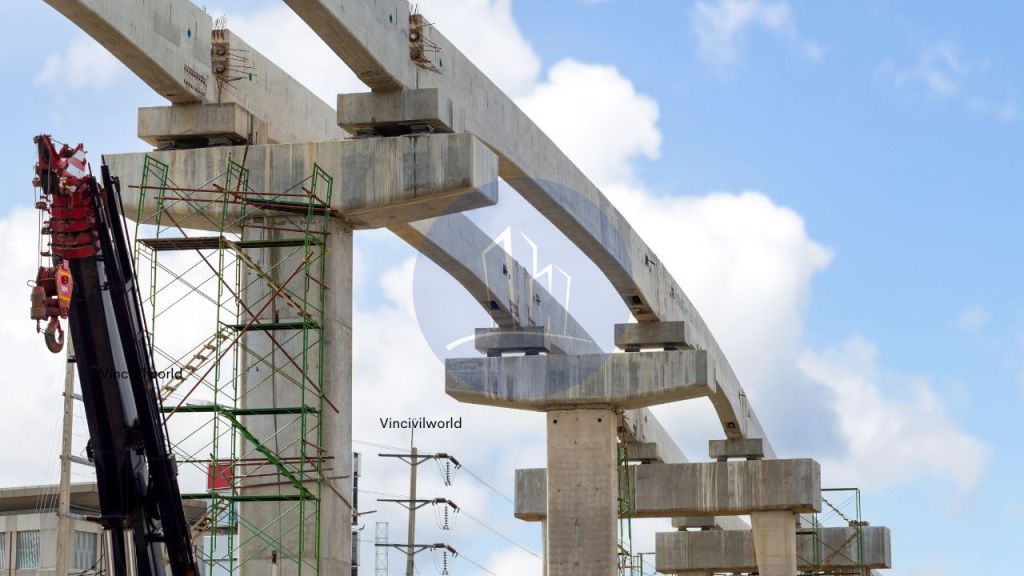
Category Archives: bridges

Cable Stayed Bridge – Types, key features and construction

A cable stayed bridge is a modern engineering marvel known for its strength, efficiency, and aesthetic appeal. It uses one or more towers to support the bridge deck through a series of cables, which transfer the load directly to the foundation. Unlike suspension bridges, the cables in a cable stayed bridge connect directly from the deck to the towers in a straight line. This design provides greater rigidity, making it ideal for long spans and challenging terrain.

Cable stayed bridges are widely used for highway crossings, urban connections, and river spans due to their cost-effectiveness and adaptability. The distinctive arrangement of cable-stayed bridge cables creates visually striking structures that enhance the skyline. Some famous cable-stayed bridge examples include the Millau Viaduct in France and the Russky Bridge in Russia. With their efficient load distribution and elegant design, cable-stayed bridges continue to shape modern infrastructure globally.

In this article, we will explore the key components, types, and advantages of a cable-stayed bridge. We’ll also explain how cable stayed bridge cables function, discuss various construction techniques, and highlight notable cable-stayed bridge examples. By the end, you’ll understand why this design is widely used in modern infrastructure projects.

  1. What is a Cable-Stayed Bridge?
  2. How Does a Cable-Stayed Bridge Work?
  3. Key Components of a Cable-Stayed Bridge
    1. Towers/Pylons
      1. Types of Towers (Pylons)
    2. Stay Cables
      1. Types of Stay Cables
    3. Deck Structure
      1. Types of Deck Structures
    4. Anchorages
      1. Types of Anchorages
  4. Types of Cable-Stayed Bridges
    1. Based on the Arrangement of Pylons
      1. Multiple-Tower
      2. Single-Tower
      3. Double Pylons
    2. Based on the shape of Pylons
    3. Based on Cable Arrangements
      1. Radial Pattern
      2. Harp/parallel Pattern
      3. Fan Pattern
  5. Advantages of Cable-Stayed Bridges
    1. Fast Construction
    2. Cost-Effective Construction
    3. Efficient Load Distribution
    4. Versatile Design
    5. Aesthetic Appeal
  6. Challenges and Limitations of Cable-Stayed Bridges
    1. Complex Construction Techniques
    2. Maintenance Requirements
    3. Wind and Seismic Vulnerability
    4. Accumulation of snow
    5. High Initial Costs
  7. Construction Techniques for Cable-Stayed Bridges
  8. Comparison Between Cable-Stayed and Suspension Bridges
  9. Famous Examples of Cable-Stayed Bridges Around the World
  10. Applications of Cable-Stayed Bridges in Modern Infrastructure
  11. The Future of Cable-Stayed Bridges
  12. Key takeaways
  13. Conclusion

What is a Cable-Stayed Bridge?

A cable-stayed bridge is a type of bridge where the deck is directly supported by cables connected to one or more towers/ pylons . The towers bear the load, and the cables transfer the weight to the foundation, creating a balanced and efficient structure. Unlike suspension bridges, where cables run horizontally between towers, cable-stayed bridge cables are attached directly from the deck to the tower in a straight or fan-like arrangement. This design provides superior stiffness and requires less material, making it cost-effective and suitable for long spans.

Cable stayed Bridges

Cable-stayed bridges are common in modern infrastructure due to their strength and aesthetic appeal. In India, the Bandra-Worli Sea Link serves as a well-known example of this type of bridge. It showcases the country’s advancements in bridge engineering. Other famous cable-stayed bridge examples include the Sutong Bridge in China and the Øresund Bridge connecting Denmark and Sweden. These bridges exemplify their efficiency in various applications.

How Does a Cable-Stayed Bridge Work?

A cable-stayed bridge works by using a combination of towers (pylons) and stay cables to support the bridge deck. The towers, which are vertical structures, act as the primary load-bearing elements. Stay cables run directly from the towers to the deck in either fan, harp, or radial patterns. These patterns distribute the weight of the bridge and its traffic evenly.
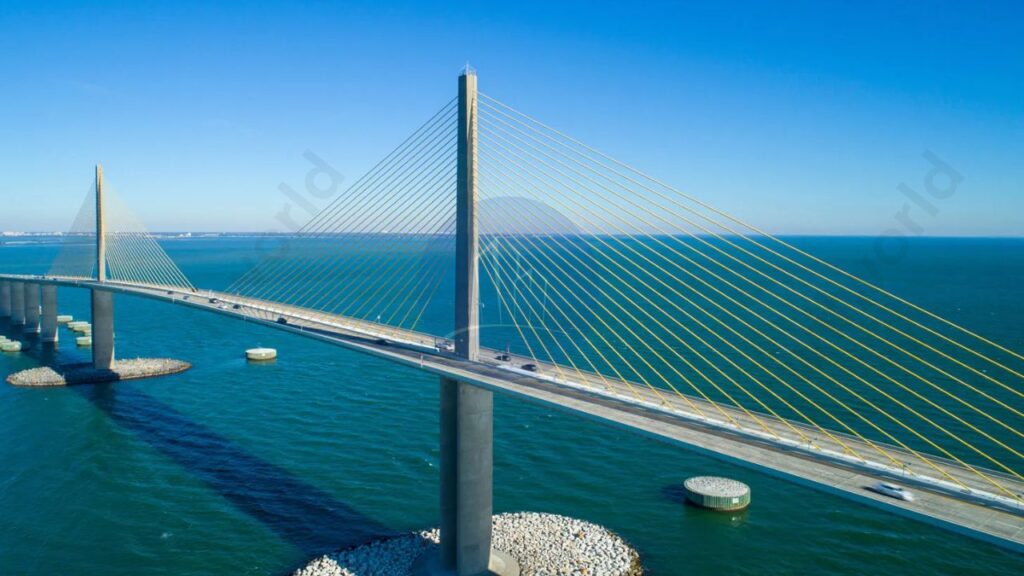
How does a cable bridge work?

The cables are tensioned to hold up the deck. They transfer the weight from the deck to the towers. The towers then channel the load down to the foundation. This design allows the bridge to span long distances without the need for additional piers. This makes it efficient and cost-effective for crossing large bodies of water or valleys. The tension in the cables and the compression in the towers create a balanced system. It allows the cable-stayed bridge to remain stable under heavy loads. This includes traffic, wind, and environmental stresses.

Key Components of a Cable-Stayed Bridge

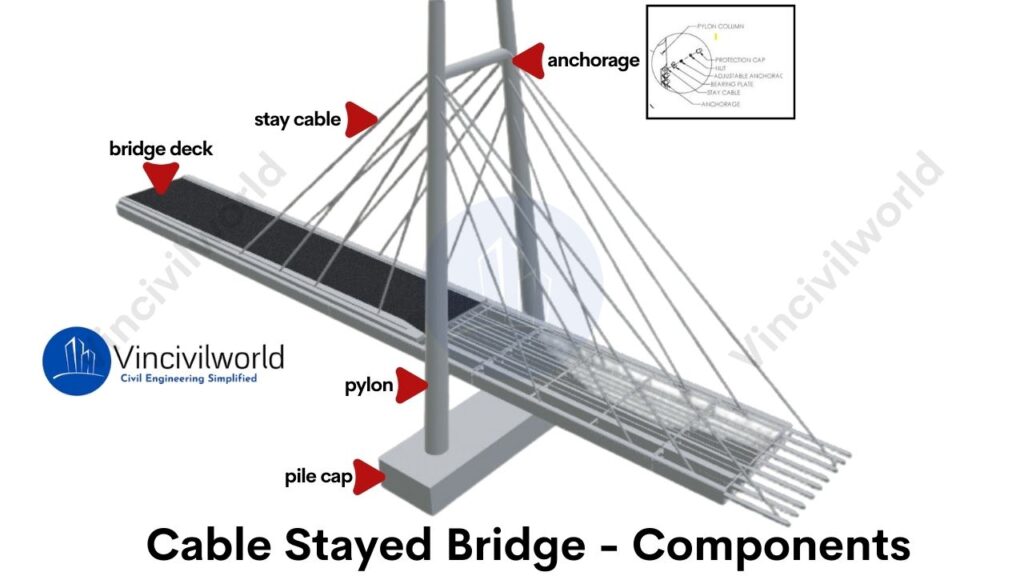
A cable-stayed bridge consists of several essential components that work together to create a stable and efficient structure. Each part plays a crucial role in supporting the deck and transferring the load through the cable-stayed bridge cables. Below are the key components:

  • Towers/Pylons
  • Stay Cables
  • Deck Structure
  • Anchorages
Components of a Cable stayed Bridge

Towers/Pylons

Towers, also known as pylons, are the vertical structures that support the cable-stayed bridge cables. They carry the majority of the load by transferring it to the foundations. Towers are usually made of concrete or steel, depending on the bridge design. A well-known example is the Bandra-Worli Sea Link in India, where towering pylons define its unique structure.

Types of Towers (Pylons)

Cable-stayed bridge towers come in various shapes based on design needs and aesthetics. Common types include A-shaped, H-shaped, and single-column towers. A-shaped towers, like those seen in the Bandra-Worli Sea Link in India, provide stability for long spans. H-shaped towers offer simplicity and strength, while single-column towers are ideal for minimalist designs. These towers bear the load of the thereby ensuring the structure’s integrity.

Stay Cables

Stay cables are the cables that directly connect the deck to the towers. These cables carry the weight of the bridge deck and the traffic. In cable-stayed bridges, the cables are arranged in different patterns, like fan or harp styles. These cables allow for flexibility and strength, ensuring the stability of the bridge.

These cables are typically made of high-strength steel strands or parallel wire strands for durability. Stay cables are encased in plastic sheaths to protect against corrosion. They are then grouted with special materials. This process further increases their lifespan and resistance to environmental damage.

Types of Stay Cables

Stay cables are arranged in different patterns, depending on the bridge design. The main types include fan-shaped, harp-shaped, and radial. In fan-shaped designs, the cables spread out from a single point at the top of the tower. In harp-shaped designs, the cables run parallel, creating a clean, sleek appearance. Radial patterns are used for smaller spans, with cable-stayed bridge cables directly supporting the deck.

Deck Structure

The deck structure forms the road or walkway of the cable-stayed bridge. It is supported by the stay cables and often consists of steel or reinforced concrete. The deck must distribute the load evenly across the bridge. In many cable-stayed bridges in India, the deck is designed to handle heavy vehicular traffic. It can also withstand environmental conditions.

Types of Deck Structures

Decks in cable-stayed bridges can be constructed using steel, concrete, or composite materials. Concrete decks are heavy but offer high durability, while steel decks are lighter, making them suitable for longer spans. Composite decks, combining steel and concrete, offer the best of both worlds, balancing weight and strength. The deck structure must efficiently transfer loads to the stay cables and towers.

Decks in cable-stayed bridges can be constructed using steel, concrete, or composite materials. Concrete decks are heavy but offer high durability, while steel decks are lighter, making them suitable for longer spans. Composite decks, combining steel and concrete, offer the best of both worlds, balancing weight and strength. The deck structure must efficiently transfer loads to the stay cables and towers.

Anchorages

Anchorages are crucial in securing the stay cables to the deck and the towers. They ensure that the load is evenly transferred and that the cables remain in tension. Proper anchorage design is vital to prevent movement in the cables, ensuring the bridge’s durability and long-term stability.
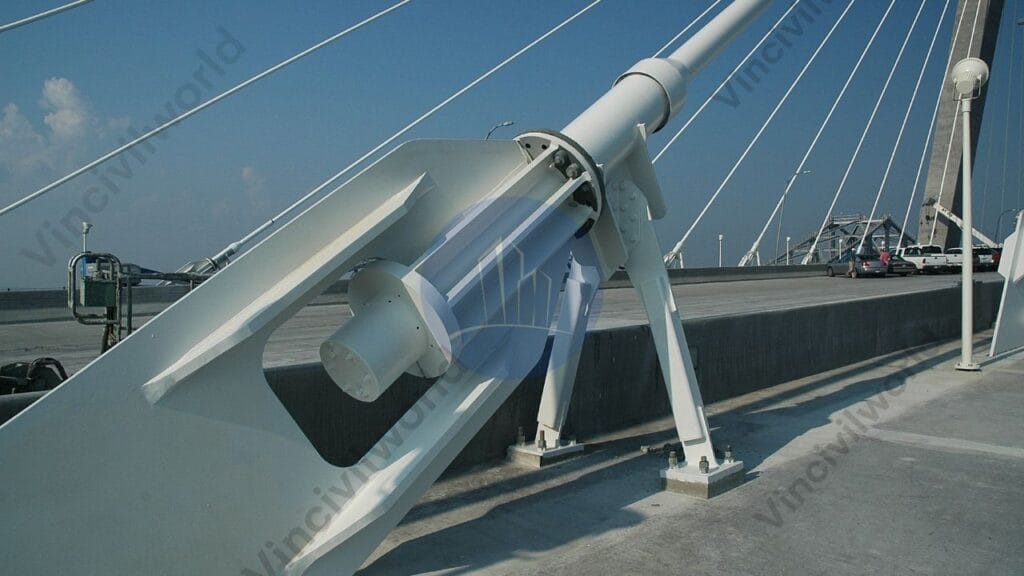
Anchorages

Types of Anchorages

Anchorages are essential for securing the stay cables to the deck and towers. The two main types are external and internal anchorages. Inspecting and maintaining external anchorages is simpler due to their visibility, while embedding internal anchorages within the deck or tower offers added protection. Both types ensure the cable-stayed bridge maintains its tension and stability under varying loads.

Types of Cable-Stayed Bridges

Cable stayed bridges are classified based on the following basis

  • Based on the Arrangement of Pylons
  • Based on the shape of Pylons
  • Based on Cable Arrangements

Based on the Arrangement of Pylons

Cable-stayed bridges can be classified by the arrangement of pylons (towers) used to support the deck. The most common types include single-pylon bridges. They have a central tower supporting cables that radiate outward. There are also double pylon bridges and multiple-pylon bridges, which feature two or more pylons placed along the bridge deck. Another variation is asymmetric pylon bridges. The pylons are of different heights or placed off-center. This accommodates specific design needs or terrain constraints.

Multiple-Tower

Multiple-tower cable-stayed bridges use two or more pylons to support longer spans. Engineers often use this type of bridge for large river crossings. These areas require extensive span coverage. Multiple towers distribute the load across a larger area.
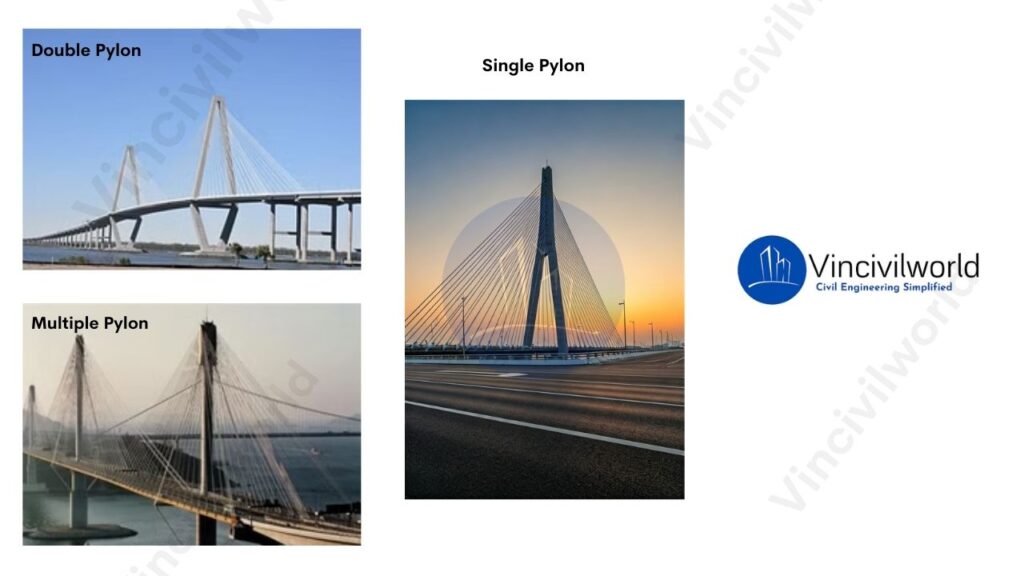
Types of Pylons

Single-Tower

Single-tower cable-stayed bridges feature a single pylon or tower that supports the entire bridge structure. Consequently, narrow waterways or urban environments with limited space are ideal for these bridges. In addition, they provide a sleek and minimalist design.

Double Pylons

Based on the shape of Pylons

  • H-Shaped Pylons: These pylons feature two vertical legs. A horizontal beam connects them at the top. This design offers high stability and evenly distributes forces.
  • A-Shaped Pylons: The pylons are tapered at the top. They resemble the letter “A,” which gives a more streamlined appearance. This design efficiently channels forces down the legs.
  • Diamond-Shaped Pylons: These pylons are wider at the base and converge near the top, forming a diamond shape. They offer a unique aesthetic and strong structural support.
  • Y-Shaped Pylons: These pylons resemble the letter “Y.” They have a single leg splitting into two arms at the top. This design offers both flexibility and strength.
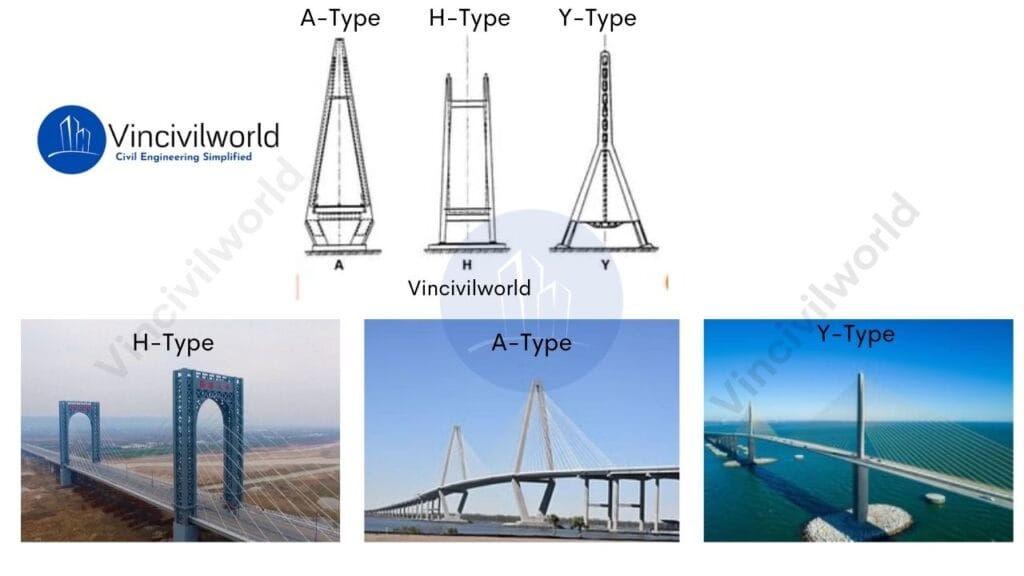
Shape of Pylons

Each shape provides distinct structural advantages. The choice depends on the specific needs of the bridge design, aesthetics, and load distribution requirements.

Based on Cable Arrangements

Cable arrangements in cable-stayed bridges generally follow three main patterns:

  • Radial (fan): Cables radiate from the top of the pylon to various points along the deck, creating a fan-like pattern.
  • Parallel (harp): Cables are attached at regular intervals along the pylon and deck, forming a parallel arrangement.
  • Semi-fan: A hybrid design where cables partially fan out but with more uniform spacing, balancing aesthetics and structural efficiency.

Radial Pattern

The cables radiate outward from the pylon to the deck, forming a fan-like shape. This arrangement offers efficient load distribution.

Harp/parallel Pattern

The cables are arranged in a parallel pattern, resembling the strings of a harp. This configuration is commonly used for bridges with a central pylon

Fan Pattern

In a fan pattern, stay cables converge at the top of the tower, spreading out to the deck in a fan-like arrangement. Engineers commonly use this design for cable-stayed bridges with shorter spans, offering both strength and visual distinction.

Advantages of Cable-Stayed Bridges

Cable-stayed bridges offer numerous benefits due to their efficient design and versatility. Moreover, they are ideal for long spans and challenging terrains, as they provide both structural stability and aesthetic appeal. Below are the key advantages:

Fast Construction

The modular construction process of cable-stayed bridges allows for quicker building, reducing disruptions to surrounding areas and environments.

Cost-Effective Construction

Cable-stayed bridges use fewer materials. They require less maintenance compared to suspension bridges. This results in lower construction costs and long-term maintenance costs.

Efficient Load Distribution

Stay cables directly transfer the deck’s load to the towers. This reduces the need for multiple support piers. It simplifies construction and allows for longer spans.

Versatile Design

Cable-stayed bridges offer flexibility in design. They adapt to different structural and architectural needs through various cable arrangements. These arrangements include fan, harp, or radial patterns.
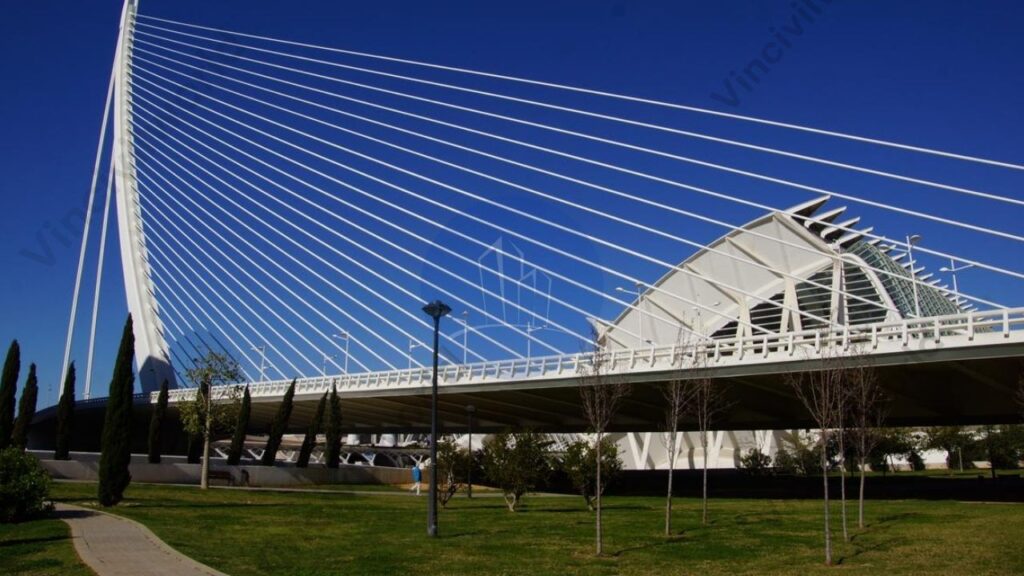
Cable stayed bridge

Aesthetic Appeal

The visible arrangement of cable-stayed bridge cables creates a striking, modern look. It enhances the visual landscape of urban or natural settings.

Challenges and Limitations of Cable-Stayed Bridges

While cable-stayed bridges offer many advantages, they also come with certain challenges that impact their design, construction, and long-term performance.

Complex Construction Techniques

Building cable-stayed bridges requires specialized engineering knowledge and equipment. The tensioning of cables, alignment of towers, and precision needed for the cable-stayed bridge cables require high-level expertise. This expertise can increase the complexity and cost of construction.

Maintenance Requirements

Although durable, cable-stayed bridges require regular inspections and maintenance, particularly for the stay cables. Environmental factors like corrosion and wind-induced vibrations can affect cable performance. These issues lead to increased maintenance efforts. This ensures the long-term stability of the structure.

Wind and Seismic Vulnerability

They are sensitive to strong winds and seismic activity. The flexibility of the cables can lead to vibrations or oscillations. If not managed through proper dampening systems, these vibrations may compromise the structure’s stability during severe weather or earthquakes.

Accumulation of snow

The cable-stayed bridges will accumulate ice due to environmental conditions. This ice will cause great harm to the traffic safety below the bridges.

High Initial Costs

These structures are generally cost-effective in the long run. However, they can incur high initial construction costs. This is due to the specialized materials and engineering that they require. The use of advanced materials for stay cables and pylons adds to the upfront expense of the project.

Construction Techniques for Cable-Stayed Bridges

Cable-stayed bridges require precise construction techniques to ensure structural integrity and stability. The process begins with the construction of the towers, which are the main vertical supports. These towers must be strong enough to handle the immense forces transmitted by the cables. Once the towers are in place, deck sections are incrementally installed, typically using a cantilever method. This involves placing deck segments starting from the towers and progressing outward in both directions to maintain balance.

The construction team anchors the cables to the deck and tower, supporting the deck as the build progresses. They continuously adjust the cable tension to ensure the deck stays level. High-strength steel cables are essential. They transfer the load from the deck to the towers. This reduces bending moments in the deck structure.
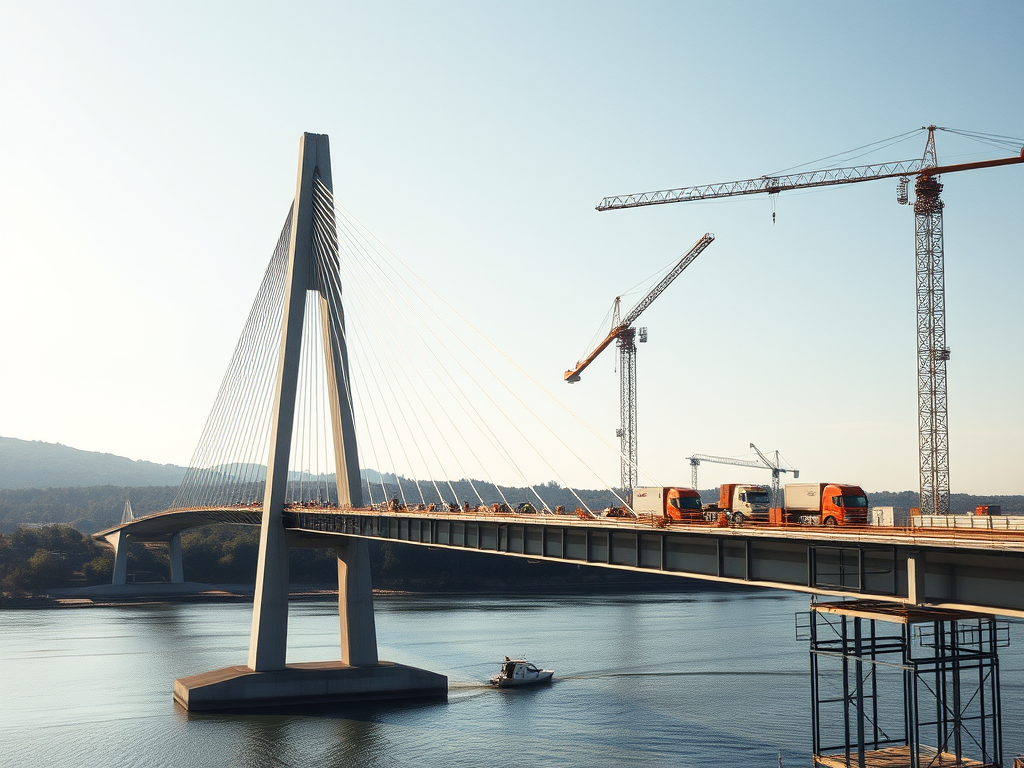
Cable stayed bridge under construction

The construction process also requires careful consideration of material properties and cable tension forces, with adjustments often calculated using advanced methods like finite element analysis. Designers must give the bridge deck high torsional rigidity to resist twisting forces caused by uneven loads, ensuring long-term durability. Regular monitoring and adjustments during the construction phases are critical to maintaining the bridge’s alignment and stability

Comparison Between Cable-Stayed and Suspension Bridges

FeatureCable-Stayed BridgesSuspension Bridges
Structural DesignCables directly connect the deck to the towers.Cables run from towers to anchorages, supporting the deck via smaller vertical cables.
Main CablesFewer, shorter cables, anchored directly to the towers.Long, continuous cables running over towers, anchored at both ends.
Cable ArrangementRadial or fan-shaped pattern from towers to deck.Vertical hangers suspend the deck from main cables.
Tower HeightTowers are shorter compared to suspension bridges.Taller towers are required to support the long, continuous main cables.
Span LengthBest suited for medium spans (typically 200 to 1,000 meters).Suitable for long spans (over 1,000 meters).
Construction MethodFaster to build as deck sections and cables are installed incrementally.Requires extensive anchoring and time-consuming construction, especially for long spans.
Deck SupportCables directly support the deck, providing greater stiffness.The deck is supported by vertical hangers, allowing for more flexibility.
Torsional StiffnessHigher torsional stiffness, making it less prone to twisting under loads.Lower torsional stiffness, making it more flexible and vulnerable to twisting.
CostGenerally more economical for medium spans.Higher construction costs, particularly for long spans.
MaintenanceLower maintenance costs due to fewer cables and less complex structure.Higher maintenance costs due to more extensive cable systems and anchorages.
AestheticsModern, sleek appearance with visible cables fanning from the towers.Iconic and graceful with sweeping main cables and vertical hangers.
ExamplesMillau Viaduct (France), Vasco da Gama Bridge (Portugal)Golden Gate Bridge (USA), Akashi Kaikyō Bridge (Japan)

This comparison highlights the key differences in design, function, and applications between cable-stayed and suspension bridges​

Famous Examples of Cable-Stayed Bridges Around the World

Here’s a list of famous cable stayed bridges around the world:

  1. Millau Viaduct (France) – One of the tallest bridges globally, known for its elegance and engineering.
  2. Vasco da Gama Bridge (Portugal) – The longest bridge in Europe, spanning 12.3 km over the Tagus River.
  3. Sunshine Skyway Bridge (USA) – An iconic cable-stayed bridge in Florida, noted for its striking design.
  4. Sutong Bridge (China) – Famous for its long span, once the longest cable-stayed span in the world.
  5. Russky Bridge (Russia) – Holds the record for the longest cable-stayed span, connecting Russky Island to mainland Russia.

These bridges exemplify cutting-edge engineering and aesthetic appeal.

Cable stayed bridge

Applications of Cable-Stayed Bridges in Modern Infrastructure

Here’s a list of applications in modern infrastructure:

  1. Highway Crossings: They efficiently connect major roadways, facilitating smoother traffic flow.
  2. Railway Bridges: Ideal for spanning railway lines, minimizing disruptions to train services.
  3. Urban Infrastructure: Often used in city planning to enhance connectivity between districts.
  4. Waterway Crossings: They provide essential links over rivers and lakes, supporting commercial and recreational navigation.
  5. Pedestrian and Bicycle Paths: Some designs incorporate dedicated lanes for non-motorized traffic, promoting eco-friendly transport.
  6. Iconic Landmarks: Their aesthetic appeal makes them popular for constructing visually striking landmarks.

These applications demonstrate the versatility and effectiveness in various infrastructure projects​

The Future of Cable-Stayed Bridges

The future of cable-stayed bridges is promising, driven by advancements in materials and engineering techniques. Innovations such as high-strength steel and fiber-reinforced polymers will enhance durability and reduce maintenance costs. Additionally, the integration of smart technologies, like sensors for real-time monitoring, will improve safety and efficiency. As cities continue to expand, cable-stayed bridges will meet infrastructure demands and maintain aesthetic appeal. This makes them increasingly relevant in modern urban planning​.

Key takeaways

Here are the key takeaways

  • Efficient Load Distribution: They distribute loads effectively through towers and stay cables.
  • Aesthetic Appeal: Their unique design contributes to the visual beauty of infrastructure.
  • Long Spans: Capable of spanning long distances without multiple piers.
  • Cost-Effective Construction: Typically cheaper and quicker to construct compared to other bridge types.
  • Key Components:
    • Towers: Support the bridge deck.
    • Stay Cables: Connect the towers to the deck.
    • Deck Structures: The surface of the bridge.
    • Anchorages: Secure the cables.
  • Configuration Variations: Includes fan, harp, and radial patterns to meet different design requirements.
  • Advantages: Faster construction and lower maintenance costs.
  • Challenges: Sensitivity to wind and seismic activity.
  • Notable Examples: Includes the Millau Viaduct and the Bandra-Worli Sea Link, illustrating their significance in modern infrastructure.

Conclusion

Cable-stayed bridges are remarkable engineering achievements characterized by their efficient load distribution and aesthetic appeal. They use towers to support the bridge deck. A system of stay cables allows for long spans without multiple piers. This design not only enhances structural rigidity but also offers cost-effective construction. Key components include towers, stay cables, deck structures, and anchorages. They come in various configurations such as fan, harp, and radial patterns to suit different needs. Cable-stayed bridges offer advantages like faster construction and lower maintenance costs. However, they also face challenges related to sensitivity to wind and seismic activity. Notable examples include the Millau Viaduct and the Bandra-Worli Sea Link, showcasing their significance in modern infrastructure.



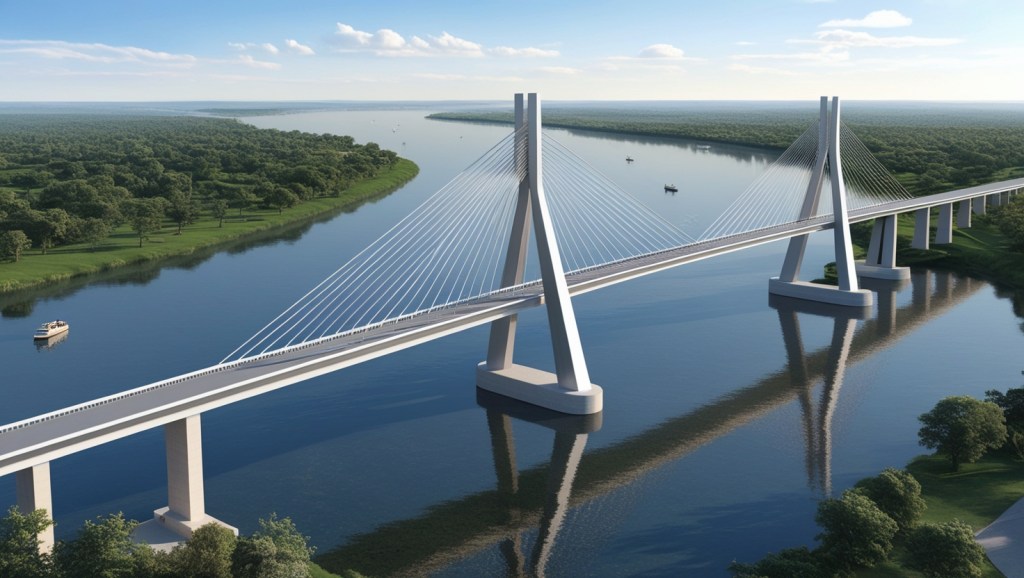
Flyovers and bridges : Features and difference

Flyovers and bridges are essential transportation structures that enable the seamless movement of vehicles and pedestrians. While both serve similar purposes, flyovers navigate intersections efficiently as elevated roads, while bridges connect points over bodies of water or valleys. Their distinct features make them vital components of modern infrastructure. This article is about the features and advantages of Flyovers and bridges and the difference between flyovers and bridges.

  1. What is a flyover?
  2. What are the benefits of flyovers?
  3. Types of flyovers
    1. Classification of flyovers based on Formation
    2. Classification of flyovers based on Materials
  4. What are bridges?
  5. Difference between Flyovers and Bridges
    1. Purpose of bridges and Flyovers
    2. Design of flyovers and bridges
    3. Location of flyovers and bridges
    4. Traffic Flow of flyovers and bridges
    5. Integration
    6. Environmental Factors
    7. Length and Span
  6. Key take aways
  7. Conclusion

What is a flyover?

A flyover, also referred to as an overpass or an elevated roadway, is a transportation infrastructure that provides a dedicated elevated route for vehicles to traverse over obstacles such as intersections, congested areas, or other roads.”Designers create flyovers to enhance traffic flow, reduce congestion, and improve overall transportation efficiency.”

Constructors typically build flyovers above ground level, enabling vehicles to bypass busy intersections or intersections with heavy pedestrian traffic. Generally, by separating the flow of vehicles from crossroads and pedestrian crossings, flyovers minimize traffic conflicts and ensure uninterrupted movement. This in turn results in smoother traffic flow, reduced delays, and improved safety.

The construction of flyovers requires careful planning and engineering. Generally, builders often use reinforced concrete or steel girders to construct flyovers, providing structural support for vehicles and the ability to bear substantial loads. The design includes ramps or access points to enable smooth vehicle entry and exit onto the flyover, ensuring seamless integration with the current road network.

What are the benefits of flyovers?

The benefits of flyovers include:

  1. Improved traffic flow: Basically, Flyovers separate the flow of vehicles, reducing congestion and ensuring smoother traffic movement.
  2. Reduced travel time: By bypassing intersections or congested areas, flyovers enable faster and more efficient travel, saving time for commuters.
  3. Enhanced safety: Flyovers minimize the risk of accidents by eliminating conflict points between vehicles and pedestrians or conflicting traffic streams.
  4. Increased capacity: Flyovers can increase the capacity of road networks by providing additional lanes or routes for vehicles.
  5. Better fuel efficiency: Reduced congestion and smoother traffic flow on flyovers contribute to improved fuel efficiency and reduced emissions.
  6. Enhanced connectivity: Flyovers connect different parts of a road network, improving accessibility and connectivity between areas.
  7. Improved urban aesthetics: Well-designed flyovers with landscaping, architectural features, and decorative elements can enhance the visual appeal of urban landscapes.
  8. Economic benefits: Efficient traffic flow facilitated by flyovers can boost economic productivity by reducing transportation costs and improving logistics.
  9. Minimized environmental impact: Generally, flyovers can help reduce air pollution and noise pollution by minimizing congestion and idling time at intersections.
  10. Improved emergency response: Flyovers provide unimpeded routes for emergency vehicles, enabling quicker response times during emergencies or disasters.

Types of flyovers

Flyovers are classified based on the following factors

a) Classification based on the formation

b) Classification based on materials

Classification of flyovers based on Formation

  1. Straight Flyovers: Follow a straight-line trajectory, providing a direct route over obstacles.
  2. Curved Flyovers: Incorporate curves or bends in their design, accommodating specific road alignments or geographical constraints.
  3. T-Junction Flyovers: Connect perpendicular roads at a T-junction, allowing for uninterrupted traffic flow in multiple directions.
  4. Cloverleaf Flyovers: Form a circular or cloverleaf-shaped interchange, facilitating smooth merging and diverging movements between roads.
  5. Diamond Flyovers: Feature a diamond-shaped interchange, allowing for efficient access and exits from multiple directions.
  6. Multi-Level Flyovers: Comprise multiple layers or levels, providing complex interchanges with ramps and access points for different roads.
  7. U-Turn Flyovers: Enable U-turns or reverse movements, allowing vehicles to change direction without disrupting traffic flow.

Classification of flyovers based on Materials

  1. Prestressed Concrete Flyovers: Constructed using precast prestressed concrete segments that provide strength and durability.
  2. Steel Flyovers: Built using steel girders, offering flexibility in design and allowing for longer spans.
  3. Reinforced Concrete Flyovers: Constructed using reinforced concrete beams or slabs, offering a balance between cost, strength, and ease of construction.
  4. Composite Flyovers: Combination of steel and concrete elements, leveraging the advantages of both materials for optimal structural performance.
  5. Cable-Stayed Flyovers: Supported by cables attached to tall towers, offering an elegant and efficient structural solution for longer spans.
  6. Box Girder Flyovers: Consists of hollow box-shaped beams, providing strength, rigidity, and resistance against bending and torsion forces.
  7. Extradosed Flyovers: Hybrid of cable-stayed and prestressed concrete flyovers featuring shorter towers and fewer cables while maintaining structural integrity.

What are bridges?

Engineers design bridges to connect two points over a body of water, a valley, or any physical obstacle. They typically comprise abutments, piers, and a deck or roadway for transportation. The construction of bridges involves using diverse materials like concrete, steel, or wood, which depend on factors such as span length and the required load capacity. However, They serve as crucial transportation links, facilitating the passage of vehicles, pedestrians, and sometimes, even trains. Bridges provide essential connectivity, improve accessibility, promote trade, and enable social and economic development by overcoming natural barriers and creating efficient transportation routes.

Bridge

Difference between Flyovers and Bridges

Bridges and flyovers both elevate traffic, but they have different purposes. Bridges cross over obstacles like rivers or valleys and come in various designs, such as suspension or arch. Flyovers are overpasses built to let traffic pass over other roads or intersections, commonly found in cities to ease traffic flow. While bridges connect different areas, flyovers improve road efficiency within urban settings. Let us get into the details of the difference between flyovers and bridges.

Here are the key differences between flyovers and bridges

Purpose of bridges and Flyovers

BridgesFlyover
Bridges are primarily built to connect two points over a body of water, a valley, or any physical obstacle.Flyovers are constructed to navigate intersections, congested areas, or other roads efficiently, providing an elevated route for vehicles.
Purpose

Design of flyovers and bridges

BridgeFlyover
Bridges are typically designed with piers or support that span across the obstacle, supporting a deck or roadway.Flyovers are designed as elevated roadways, often supported by columns or piers, allowing vehicles to bypass intersections or congested areas.
Design

Location of flyovers and bridges

BridgeFlyover
Bridges are commonly found over bodies of water, such as rivers, lakes, or seas, or in areas with significant topographical variations like valleys or canyons.Flyovers are usually constructed in urban areas with heavy traffic, where they can provide efficient bypasses for intersections or congested road segments.
Location

Traffic Flow of flyovers and bridges

BridgeFlyover
Bridges accommodate two-way traffic, allowing vehicles to travel in both directions.Flyovers typically facilitate one-way traffic flow, with separate lanes or ramps for entering and exiting.
Traffic flow

Integration

Bridge Flyover
Bridges are integrated into the existing road network, connecting two points and providing a continuous route.Flyovers are designed to integrate with existing roads, providing seamless connectivity by allowing vehicles to enter and exit at designated access points.
Integration

Environmental Factors

Bridge Flyover
Bridges often need to consider factors like water flow, tidal forces, or seismic activity, depending on their location.Flyovers focus on addressing traffic congestion and improving transportation efficiency, with less consideration for natural elements.
Environmental factors

Length and Span

Bridge Flyover
Bridges can vary in length and span depending on the distance they need to cover, ranging from short spans to long suspension or cable-stayed bridges.Flyovers are generally shorter in length compared to bridges, spanning a specific area such as an intersection or congested road segment.
Length and span

Understanding these distinctions can help in determining the appropriate infrastructure solution based on the specific transportation needs and challenges of a given location.

Key take aways

Flyovers and bridges are crucial infrastructure elements with distinct purposes. Flyovers are designed to alleviate urban traffic congestion by providing elevated routes over intersections and other congested areas, ensuring smoother traffic flow and enhanced safety. They are typically constructed using reinforced concrete or steel girders and are commonly found in urban areas.

Bridges, on the other hand, connect two points over natural obstacles such as bodies of water or valleys. They are essential for providing transportation links that facilitate trade and economic development. Bridges are built using a variety of materials including concrete, steel, and wood, and must consider environmental factors like water flow and seismic activity.

Both flyovers and bridges integrate with existing road networks but serve different roles in enhancing transportation efficiency and connectivity. Flyovers are generally shorter and focus on urban traffic, while bridges can span longer distances and connect regions separated by natural barriers. Understanding these distinctions helps in planning and implementing effective transportation solutions.

Conclusion

Flyovers and bridges are integral to modern infrastructure, each serving distinct purposes. Flyovers, or overpasses, enhance urban traffic flow by providing elevated routes over intersections and congested areas, thereby reducing delays and improving safety. Bridges, on the other hand, connect two points over physical obstacles like water bodies and valleys, facilitating transportation and promoting economic development. Both structures require careful planning and engineering, utilizing materials such as concrete and steel to ensure durability and efficiency. Their unique features and applications make them crucial in addressing the specific transportation needs and challenges of different environments.

Types of Bridges – Top 7 Bridge Design Types and Principles

Types of Bridges in civil engineering can range from modest constructions to massive, eye-catching pieces of art – and everything in between. A bridge serves its sole purpose as long as it transports us across a gap. The required passage may be for a road, train, pedestrians, canal, or pipeline. A river, a road, a railway, or a valley may be crossed. Types of bridges are an important classification in civil engineering. In today’s blog, we are going to learn about different types of bridges in detail.

Types of bridges and Bridges design types in civil Engineering

The types of bridges are broadly classified as follows on the basis of form and type of superstructure

  • Arch Bridge
  • Beam bridge
  • Cantilever bridge
  • Suspension bridge
  • Cable-Stayed Bridge
  • Tied-Arch Bridge
  • Truss Bridge

Let’s dig deeper into each of the types now.

Arch Bridge – Types of Bridges

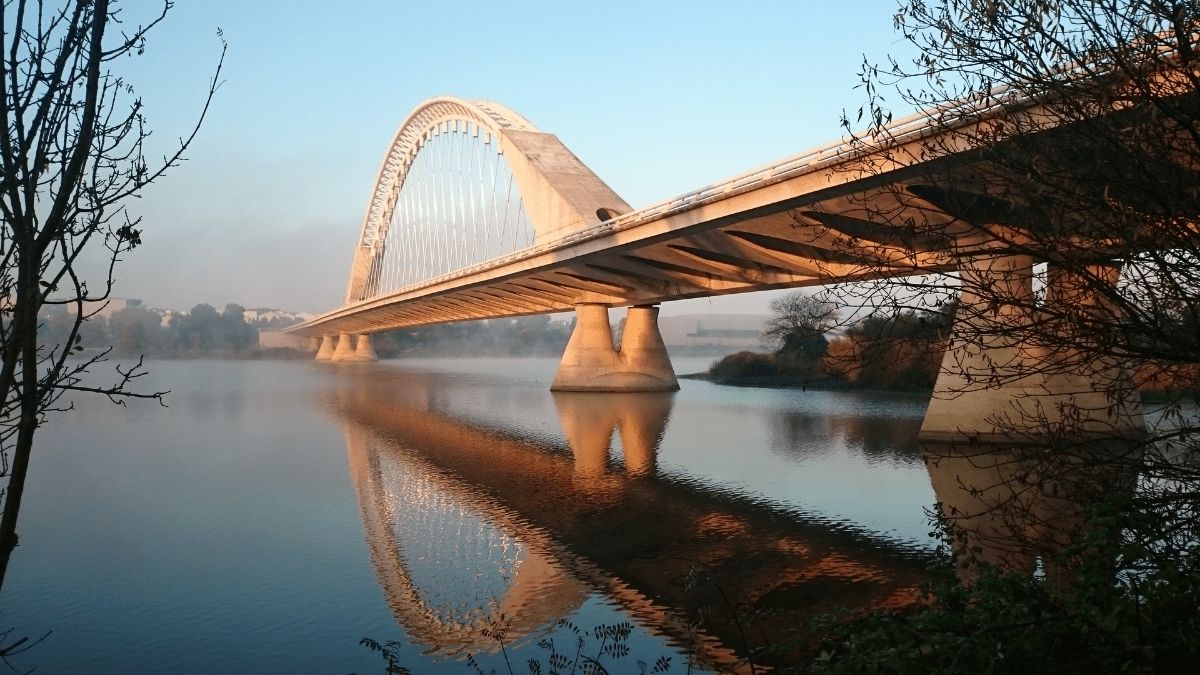
Arch Bridge
Arch Bridge
  • A dead load of a bridge is the weight of the bridge itself, plus the weight of whatever it is carrying (the live load). The forces of load and gravity, which would otherwise send a bridge sliding downhill, are used to hold an arch bridge aloft instead. 
  • An arch bridge works by channelling gravity’s downward force into the structure’s centre — toward a central stone known as the keystone — rather than straight down.
  • Compression is the principle that allows the arch below to support the surface, or deck, above it.
  • Temperature changes can destabilise fixed arch bridges, hence the arch design is occasionally changed with hinges at each base and even the span’s centre.
  • This allows longer arch bridges to adjust to material expansion and contraction when temperatures fluctuate.

Also read: Bridge components explained – Types and functions.

Beam Bridge – Types of bridges

The beam bridge was the first form of bridge ever created due to its simplicity. It is still the most cost-effective to construct. All you need is a crossbeam that spans the gap and is supported at each end by an abutment. A girder bridge is a form of beam bridge that uses steel girders for reinforcement. 

beam bridge
beam bridge
  • Gravity presents a greater issue when creating a bridge since, unlike a building, the majority of the space beneath it is empty.
  • To resist gravity and bear the full load, a beam bridge might be supported merely by two abutments, one at each end.
  • But there’s a catch with beam bridges: the longer a bridge is and the more people, cars, and other objects it carries, the heavier the entire weight becomes.
  • The more abutments on a beam bridge are spaced apart, the less stable the structure becomes. 
  • You may make a long, stable bridge by putting supports in the middle, known as piers or stanchions, and connecting sections between them.
  • The Yolo Causeway in Sacramento, California, is 3.2 miles long, and the Lake Pontchartrain Causeway in Louisiana is 24 miles long.
  • The force of compression drives the weight inward onto piers in the middle of the bridge in beam bridges.
  • Simultaneously, the tension pulling or stretching force pulls the load outward toward the bridge’s abutments on both ends.

Also read: Highway Engineering- Definition, Importance and Construction Details

Cantilever Bridges Types

Cantilever construction is used on some bridges.

  • This design uses a vertically anchored pillar to support a horizontal deck that extends out from one or both sides across the span.
  • Both the above and below are frequently used to support the load.
  • A good example of cantilever construction is a diving board or platform.
cantilever bridge
cantilever bridge

Suspension Bridge Types

Suspension bridges are exactly what they sound like: they’re supported by vertical pillars or pylons that are linked by suspension cables.

Suspension bridge
Suspension bridge
  • Smaller, vertical suspenders are attached to these main cables and use tension to hold the bridge deck up.
  • Tension is the main force that sustains these types of bridges.
  • Despite the fact that the original suspension bridges were composed of simple ropes supporting wooden planks, the suspension technique now allows for vast spans across wide canals.
  • However, because these bridges are only attached to the ground in a few locations, they might shake when heavy traffic passes beneath them.
  • Vibrations can be caused by wind or movement across a bridge.
  • When these reach a specific frequency, resonance occurs, which is the same mechanism that causes the glass to shatter when a trained vocalist hits a high enough note.
  • Bridge crossings can be disrupted and collapsed if vibrations are strong enough. 
  • Torsion, a twisting force commonly generated by external variables such as wind, can also impact these bridges, causing unsafe movement.
  • Travelers can be thrown off a bridge if the surface twists significantly while they are on it.
  • While torsion causes tension in a vertical plane, shear causes stress in a horizontal plane.
  • It occurs when opposing environmental pressures act on a single, fixed component of a bridge, causing it to break like a stick between two hands.

Also read: Cofferdams – Types & Construction methods

Cable-Stayed Bridge

  • A suspension bridge with a cable-stayed bridge connects the crossbeam or bridge deck directly to pillars or towers.
  • There is no main cable, only a slew of vertical suspenders attached to the tower’s summit.
  • Tension is used by these suspenders to keep the bridge deck solid and in place.
Cable Stayed Bridge
Cable Stayed Bridge

Tied-Arch Bridge

  • The qualities of an arch bridge and a suspension bridge are combined in a tied-arch bridge.
  • It supports an arched structure with horizontal force from both sides, similar to a normal arch bridge.
  • Instead of supporting the building from below, the arch rises over the road, with vertical ties descending to provide additional decking support. 
  • Because they resemble a bow from the side, these are sometimes known as bowstring bridges.
  • This bow supports the weight and keeps the bridge stable by combining the tension of its vertical cables with the compression of the arch.
Tied arch bridge
Tied arch bridge

Also read: Golden Gate Bridge: Design and 2 Main Issues

Truss Bridge

  • The load on a truss bridge is distributed across a succession of tiny sections that are joined together.
  • Bridge trusses are typically formed by structural beams for smaller bridges or box girders for bigger bridges, and are joined in a sequence of triangles by welded or riveted joints. 
  • The bridge is held up by tension from vertical steel or timber supports, while compression from diagonal truss supports adds stability by directing the weight toward the centre, similar to an arch.
Truss bridge
Truss bridge

That’s it about the main types of bridges. Each of these has advantages and disadvantages. We need to decide on the type of bridge based on the requirements.

Let me know in the comments if you need any further information.

Happy learning!

Component of a bridge|Bridge components-Types, functions

Component of a bridge/ bridge components plays a very important role in maintaining the stability and functional requirements of the bridge structure. Each bridge component has its functions. The bridge component types and functions vary as per the site conditions, design requirements, and functional requirements. This article is about a total overview of the components of bridge/bridge components.

A bridge is a structure built over physical obstacles such as water bodies like rivers, lakes, canals, etc, and valleys, roads, etc with minimal obstructing to the area below. During ancient times bridges are made by falling of trees, providing stepping stones, and by tying a rope from the trees. Bridges are the most important components of a highway, railway, and urban roads. Brides play an important role in the socio-economic, politics, culture, defence, etc of a region and a country.

  1. Component of a bridge / Bridge components
    1. Bridge components – Substructure
      1. Bridge components – Abutments
        1. Types of Abutments
      2. Wing walls and return walls
      3. Piers
      4. Foundation
    2. Component of a bridge – Super structure or decking components
      1. Bridge bearings
      2. Decking components
  2. Key Takeaways
  3. Conclusion
  4. Latest posts

Also read : Components of a road – Elements and their function

Also read : Components of a railway track – Types and functions

Component of a bridge / Bridge components

The components of the bridges are divided broadly into .

Components of Bridge

a) Sub- structure

c) Super structure or decking component

Components of a bridge below the bearing constitute substructure and components above the bearings constitute superstructure or decking components.

You tube video – Components of a Bridge

VIDEO SHOWING BRIDGE COMPONENTS/COMPONENT OF A BRIDGE

Bridge components – Substructure

The main function of the substructure is to support the superstructure components and transfer the loads to safe strata. The major substructure components of a bridge are as follows.

a) Abutments

b) Wing walls and return walls

c) Piers

d) Pier cap

e) Foundation

Bridge components – Abutments

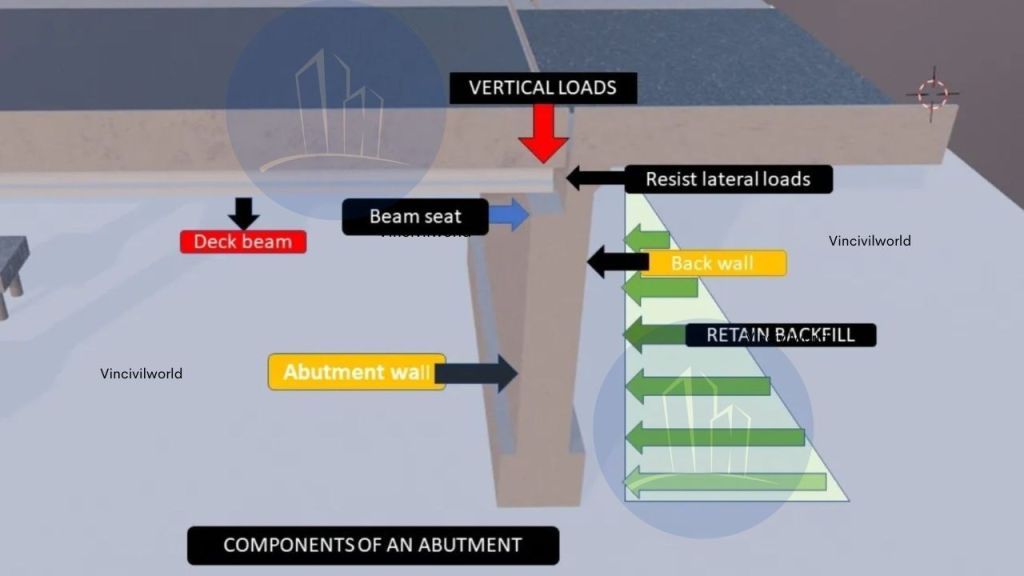
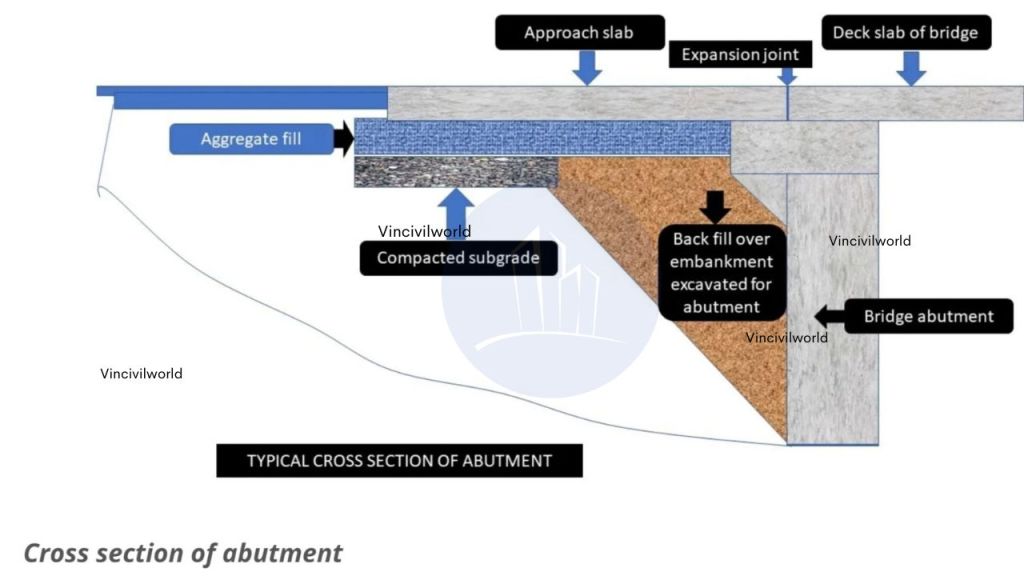
Abutments functions as vertical supports to the superstructure components at the bridge end. They are the endpoints of a bridge and acts as an approach for the roadway. Abutments retain the roadway backfill and base materials and act as lateral support to the embankments approach. Because of these properties, the abutments are designed as retaining structures.

A single span bridges got two abutments which serves as a vertical support and lateral support. Abutments also resist lateral movement of earth fill of the road approaches.

Components of abutments
components of abutment

Abutment are of various types depending on the design requirements and load considerations.

Cross section of Abutment
Cross section of abutment
Types of Abutments
  • Closed Abutment
  • Stub or Perched Abutment 
  • Pedestal or Spill-through Abutment
  • Integral End Bents
  • Mechanically Stabilized Abutment

Wing walls and return walls

Wing walls are located near to the abutments as an extension of abutments or as independent structures. They act as a retaining wall to resist the earth in the approach areas. Wing walls may be placed right-angled to the approach way or splayed as shown in the figure.

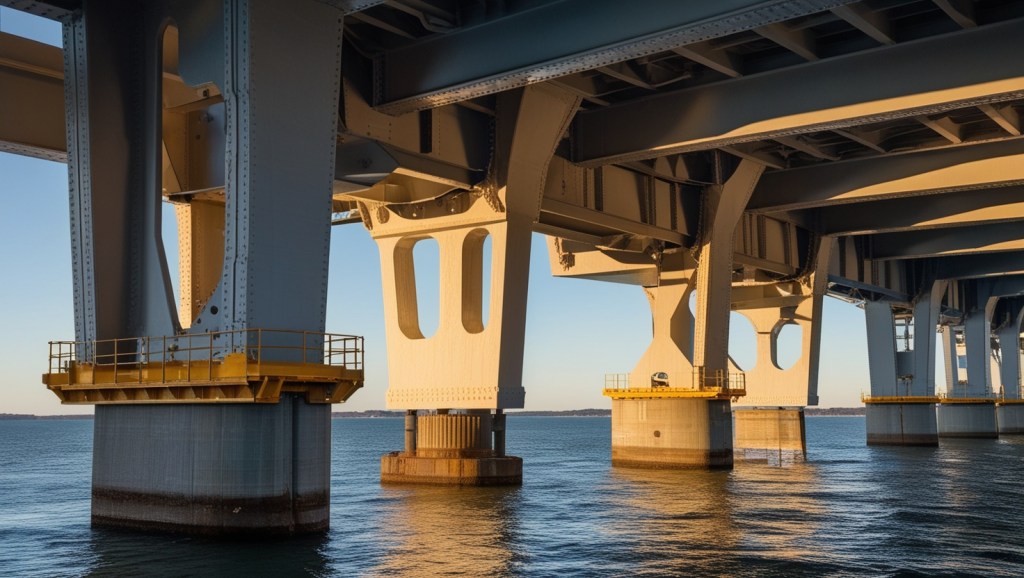
Piers

Piers are intermediate vertical supports provided between bridge spans. The main function of a pier is to transfer the loads coming on the superstructure to the foundations. Pier got pier caps to provide sufficient bearing areas for the transfer of superstructure loads.

Piers are basically compression members and are designed for vertical loads but in high seismic areas they are designed for lateral loads also.

Bridge pier
Piers

Foundation

Foundations are constructed to transfer loads coming on the superstructure and substructure to a larger area and hard strata. The foundations may be an open foundation or pile foundation or some other foundation type depends upon nature or soil strata and design considerations. The foundation has to be provided at sufficient depth to ensure protection and chances of failure against the scouring and undermining process.

Also read : Foundation types – Shallow and deep foundations

Also read : Pile foundations – Types and advantages

Component of a bridge – Super structure or decking components

The superstructure constitutes deck slabs, deck beams/girders, trusses, cables, arches, handrails, parapet, etc. The superstructure components depend on the type of bridge-like concrete, composite, steel, etc. The following are the basic superstructure components.

a) Bearings

b) Bridge deck

Bridge Superstructure Components
SUPERSTRUCTURE COMPONENTS

Bridge bearings

Bridge bearings are components of the bridge that provides a resting surface between the bridge pier and the bridge deck. The main function of the bearing is to control movements and reduces the stresses involved.

A bridge bearing carries the loads or movement in both vertical and horizontal directions from the bridge superstructure and transfers those loads to the bridge pier and abutments. The loads can be live load and dead load in vertical directions, or wind load, earthquake load, etc., in horizontal directions.

Bridge bearings
Bridge bearing

Decking components

Decking is the surface over which the traffic like road or rail passes. The decks are supported on beams, girders (prestressed or post-tensioned ) viaducts, prefabricated segments, steel girders or hanged through cables. The whole decking components are supported by pier which transfer the loads to reliable soil strata.

The deck beams shall be conventional rectangular type or of I – GIRDERS (Concrete or steel)

Deck support beams
Types of Deck support beams

The surface of the deck may be of the concrete or bituminous for movement of traffic.

There are a lot of miscellaneous components like strip seal expansion joints which separates the deck spans, Hand rails are provided on the deck side as a barrier and protection.

Key Takeaways

  1. Bridge Importance: Bridges connect regions over obstacles like water bodies and valleys.
  2. Component Categories: Divided into substructures and superstructures.
  3. Substructure Components: Includes abutments, wing walls, piers, pier caps, and foundations.
  4. Abutments: Serve as vertical and lateral support, retaining roadway backfill and providing bridge endpoints.
  5. Wing Walls: Act as retaining walls near abutments, resisting earth in approach areas.
  6. Piers: Provide intermediate vertical support between spans, transferring loads to foundations.
  7. Foundations: Ensure stability against scouring and undermining, transferring loads to the ground.
  8. Superstructure Components: Comprise deck slabs, beams, trusses, cables, arches, handrails, and parapets.
  9. Bridge Bearings: Control movements and reduce stresses, transferring loads to piers and abutments.
  10. Decking: Forms the surface for traffic, supported by beams and girders, ensuring efficient load distribution.
  11. Miscellaneous Components: Include expansion joints and handrails for protection and separation of deck spans.

Conclusion

Understanding bridge components is crucial for maintaining stability and functionality. The substructure, including abutments, piers, and foundations, supports and distributes loads to the ground, while the superstructure, comprising decking, beams, and bearings, facilitates traffic flow and load transfer. Abutments provide vertical and lateral support, retaining backfill and serving as endpoints. Piers act as intermediate supports, and foundations ensure stability against environmental factors. The superstructure supports traffic with decks and beams, transferring loads through bearings to the substructure. These components work together to create safe, efficient, and durable bridges, highlighting the importance of comprehensive design and construction in bridge engineering.

Latest posts