Category Archives: TRANSPORTATION ENGINEERING

Intelligent transportation system – Components of Intelligent transportation system

Intelligent transportation system is a hot topic among all civil engineering subjects that has gained popularity and many countries are successfully implementing it. With the rapidly exploding population, ITS has even become a mandatory technique in all countries. Here, we are going to read through the main components of the intelligent transportation system. We will swim through the benefits of intelligent transportation system in the middle, then to uses and challenges of ITS.

  1. What is intelligent transportation system?
  2. Components of intelligent transportation system
  3. Benefits of intelligent transportation system
  4. Uses and challenges of intelligent transportation system
    1. 1. Use of cameras equipped with automatic number plate recognition(ANPR)
      1. Advantages
      2. Challenges
    2. 2. Speed violation recording cameras
      1.  Advantage
      2. Challenges
    3. 3. Cameras for recording violations of passing through red-lights at intersections
      1. Advantages
      2. Challenges
    4. 4. Equipping the transportation system with GPS
      1. Advantages
      2. Challenges
    5. 5. Use of intelligent routing systems for public transportation passengers
      1. Advantages
    6. 6.  Modern informative systems for offenders
      1. Advantages
      2. Challenges

What is intelligent transportation system?

What is Intelligent Transport System is the first step to dive in the topic. They are advanced applications which, aim to provide innovative services relating to different modes of transport and traffic management and enable various users to be better informed and make safer, more coordinated, and ‘smarter’ use of transport networks. In ITS the information and communication technologies are applied in the field of road transport, including infrastructure, vehicles and users, and in traffic management and mobility management, as well as for interfaces with other modes of transport.

Another answer to the question of what is Intelligent transportation system (ITS) is that, it is the application of sensing, analysis, control and communications technologies to ground transportation in order to improve safety, mobility and efficiency. ITS includes a wide range of applications that process and share information to ease congestion, improve traffic management, minimize environmental impact and increase the benefits of transportation to commercial users and the public in general.

Now, let me walk you through the main components of intelligent transportation system.

Related posts from vincivilworld
Components of intelligent transportation system

Components of intelligent transportation systems

The main components of intelligent transportation system are,

1. Accurate tracking system
GPS enabled vehicles along with smartphone apps will help citizens to track buses and other vehicles.

2. Electronic timetables
Schedules of bus service should be updated in standard format which can be easily read by people and utilised by softwares.

3. Smart model to predict time of arrival
Transportation studies like that be conducted in IIT Madras, funded by Ministry of Urban Development. should be encouraged to obtain a robust algorithm to predict the arrival time of buses, which is what a citizen needs.

4. Standardisation by regulating authority

This is very important among all the components of intelligent transportation system. An authority should be set up which can standardise various components of the public transport and encourage the use of better and smart IT services in transport sector

5.Smart commuting

Latest information on traffic jams, accidents and ways for navigation

6. Mobile technology

App based technology, incentives for young technical entrepreneurs

7. Smart traffic control

Dynamic controls of traffic signals instead of current static control, automated system.

8. Scalability

The ITS should be easily applicable to 2nd tier cities so that problem of congestion doesn’t arise in the first place

9. Improved and better BRT system enacted with public participation

10. Installing CCTVs on traffic routes and in buses.

11. Creation of flyover and overbridges to eliminate need of traffic lights

12. Electronic payment of fare

13 Traveller’s advisory system like the use of advisory radio, SMS services, internet etc

14. Highway Management Systems: Use ramp metering techniques to measure and regulate by knowing the traffic entering or leaving the highway

15. Emergency Management Systems: To manage any unforeseen emergencies

16. Railroad Crossing: Gives signals about approaching rail junctions

17 Wireless communication System

18. Safe driving Support System

This includes,

a) Right turn collision prevention system

b) vehicle detection system
c) Pedestrian detection system

d) voice guidance

e) display warning

18. Electronic toll payment System

19. Computational technologie

20. Inductive loop detection and sensing technology

21.Freeway management.

Cool! Now how are these components of the intelligent transportation system benefiting transportation? Let’s see below.

Benefits of intelligent transportation system
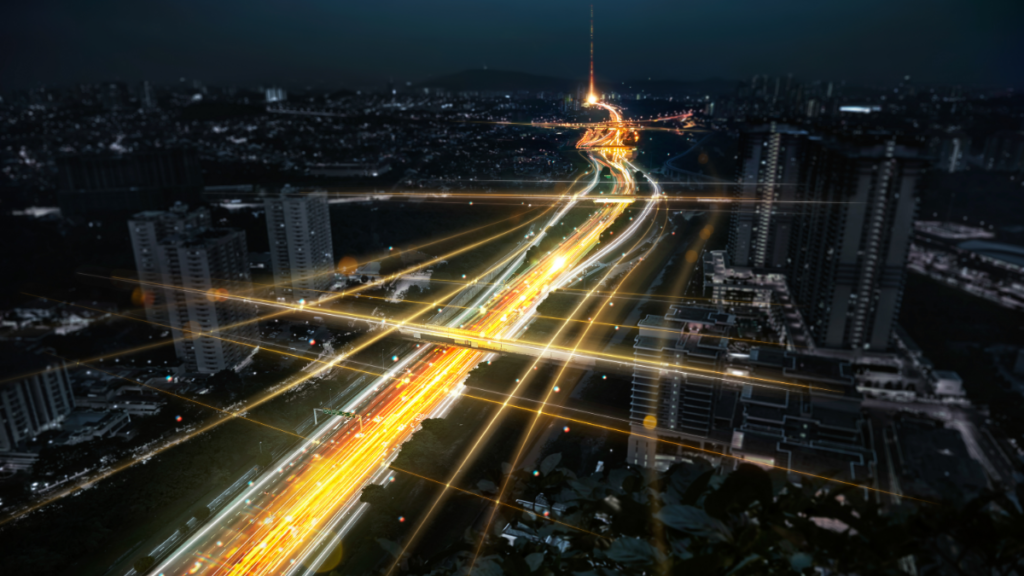
traffic at night - Components of intelligent transportation systems

The main benefits of intelligent transportation are as follows.

  • Develop (and subsequently renew), a secure and effective revenue collection system – this has formed the backbone of the ITS
  • Develop enhanced operations management capabilities to provide reliable services and deal with disruptions
  • Provide communications for staff security
  • Provide improved passenger information
  • Obtain data for planning, resource optimisation and performance monitoring
  • To assist the achievement of the quantity and quality of the service required in the service contract with the province of Florence

• To generate the trip logs, analysis and reporting required by the province of Florence under the service contract

• To manage the daily operations, on both normal and disrupted state

• To manage the driver vehicle handovers and shift-changes

• To provide the platform for real-time and other information to passengers

• To provide the platform for e-ticketing

• To identify vehicle faults and assist rapid response

• To support demand responsive transport and other non-standard mobility services

• To generate and manage data for post-event analysis, including running time analysis, scheduling, resource optimization, and incident investigation

So, I walked you through the important benefits of intelligent transportation system.

Its time to see the results now.

Uses and challenges of intelligent transportation system

Components of intelligent transportation systems

1. Use of cameras equipped with automatic number plate recognition(ANPR)

Equip the intersections with traffic light crossing violations recording system and video surveillance cameras monitoring traffic flow

Advantages

Cameras are capable of fining any number of offending vehicles simultaneously

Challenges

  • Drivers cover the number plate of their cars daily in order to not to be fined
  • Some drivers who repeatedly pass specific passages try to destroy or damage the cameras and their equipment.

2. Speed violation recording cameras

Fixed cameras equipped with radar technology are assembled to identify and record speed violations

 Advantage

Assured of getting fined through being caught on camera, drivers rarely attempt to drive over the speed limit

Challenges

  • After identifying the locations where the cameras are installed, drivers may attempt to increase their speed in the distances between cameras, and this may cause many disturbances in traffic flow.
  • Due to the weakness of technology, identifying motorcycles is not possible in this system

3. Cameras for recording violations of passing through red-lights at intersections

Cameras are assembled at intersections  to record the red light running violations.

Advantages

A decrease in this kind of violation will have a direct effect in reducing car crashes and capital loss.

Challenges

  • In many intersections, due to the low quality of crosswalks and zebra crossings, it is really hard to determine a threshold running from which enables the driver to be known as an offender
  • As in many intersections, turning left or right is not legally forbidden, it is really a hard job to distinguish the vehicles doing so from the violators.

4. Equipping the transportation system with GPS

Position of the buses and the approximate arrival time of buses to stations can be calculated those who are speeding or using unauthorized routes can be identified

Advantages

  • Reduction of dangerous high speed of buses
  • Decreasing of delay time of journey

Challenges

  • Some drivers try to deactivate the GPS before attempting violation. They cover the GPS with aluminum foil to make it disconnected from the center.
  • Due to the need for a GPRS platform for sending the information to the center, using this system in Tehran is very expensive.
  • Due to the low average educational level of drivers and users of public transportation services, the relevant systematic training for using this system will be needed.

5. Use of intelligent routing systems for public transportation passengers

Passenger can receive information about the journey duration and the best manner of navigation after determining the origin and destination and also specifying the desired transportation mode such as metro, taxi, bus or walking

Advantages

 Decrease in delay of journeys and an increase in productivity.

6.  Modern informative systems for offenders

All fine notifications and notices for a technical test will be informed to the offenders via SMS

Advantages

  • Deliver the fine notifications to the offenders, omitting the process of printing and stuffing envelopes with fine notification
  •  Informing all offenders of their violations in an online manner, and creating a cohesive database of the offenders.

Challenges

  • As the telecommunications system and necessary infrastructure have not been completely developed, some problems in sending the SMS to offenders have been occasionally observed.
  •  Informative limitations such as length of words in SMS.

That’s it about ITS.

Continue learning!

MUST READ: Basic of civil engineering; Simple and in-depth guide

Bitumen Softening Point Test – Ring and ball method

The bitumen softening Point Test is done to determine the consistency of bitumen. Bitumen is a viscoelastic material, which means it behaves like both a liquid and a solid state. It does not have a specific melting point. As the temperature increases, the bitumen becomes softer and the viscosity of the bitumen decreases. One of the common parameters for classifying bitumen is the softening point of the bitumen. This property shows at what temperature the bitumen softens. 

Bitumen Softening Point Test

Bitumen softening point is measured in different ways such as:

  • Ring and Ball Method (R&B)
  • Krämer-Sarnow Method (KS)
  • Mettler Softening Point Method
  • Capillary Method
  • Flow Point Method
  • Drop Point Method

The ring and Ball method is the most frequently used to determine the softening point of bitumen.

Bitumen roads
Bitumen roads

Why Is The Bitumen Softening Point Important?

To pave the roads and aeroplane runways, it is necessary to use a type of bitumen that has a specific degree of softness. Choosing a suitable bitumen with a good softening point depends on the weather condition and traffic loads.

For example, if the average temperature in a region is high during a year, bitumen with a    higher softening point should be used to make asphalt pavement. If during the year, the number of vehicles crossing this road is high and they put a  lot of pressure on the road surface, more bitumen should be used in the asphalt. This work increases the strength of the asphalt.

Related posts – Bitumen

International Standard Methods of softening point test

The softening point  test  of  bitumen  is  in  the  accordance   with  the following standards:

  • ASTM D36
  • ASTM E28-67/E28-99
  • ASTM D6493 – 11
  • IS 1205
  • EN 1427
  • IP 58
  • ISO 4625
  • JIS K 6863

The most common standard method for determining the softening point of bitumen is ASTM D36, which we will discuss further. You can see the steps of the Ring and ball method through the Video produced by the Infinity Galaxy team.

Softening point test of bitumen – Ring and ball method (Video)

YouTube video
Youtube video

Softening Point Test Procedure

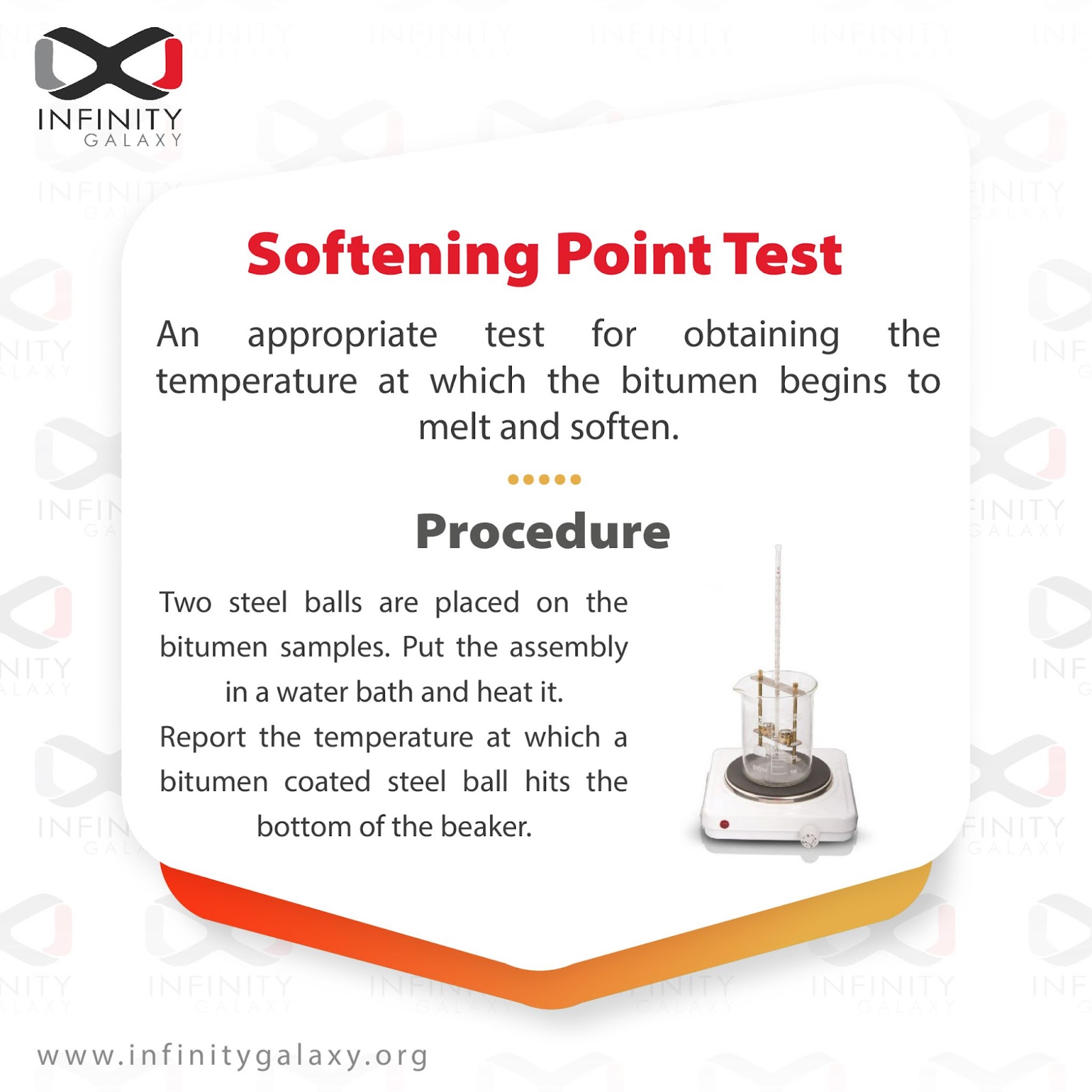
The ring and ball method is widely used to determine the softening point of bitumen. In  the  infographic  below, you  can  see  a  summary  of  the  bitumen softening point test:

Softening point test procedure

The required equipment to do the bitumen softening point test are:

  • Two steel balls
  • Two brass rings
  • Beaker
  • Thermometer
  • Heater
  • Knife
  • A glass surface 
  • Bitumen
  • The bases holding the rings

Bitumen Softening Point Test Steps:

  • In the first step, it is necessary to prepare the test sample. Heat the bitumen to a   temperature between  75  and 100 °C. Stir the bitumen well until it becomes completely liquid and free of air and water bubbles. Heat the rings to the approximate temperature of the bitumen. Prepare a mixture of glycerin and dextrin in equal proportions.
  • Cover the surface of the metal or glass plate with it. Pour the heated bitumen into the rings to fill them. After cooling in the air, it is necessary to draw the extra bitumen with a heated knife at an angle of 45 degrees on the surface of the rings. So far you have understood how to prepare the sample.  In the following, we will explain the process of conducting this test.
  • Place the rings filled with bitumen on the bases and place them in a water bath with a temperature of 5 °C for 15 minutes. Cool the steel balls to a temperature of 5 °C. Put them in the beaker and fill them with distilled water up to about 50 mm above the rings. Now place the steel ball in the centre of the ring and tangent to the bitumen and heat it until the temperature rises 5±0.5 °C/min.

Ring and ball method – Results

  • As the temperature increases, the bituminous material softens and the balls sink through the rings. Continue heating until the balls on the bitumen reach the surface of the metal blade under the rings and note the temperature when each of the balls contacts the bottom of the plate. Consider the average of the two temperatures obtained as the bitumen softening point.
  • An important point in this experiment is the process of heating the beaker and its contents, i.e. bitumen.   Since this test is very sensitive to heat, it is necessary to use the same heating rate throughout the test. It should be noted that if the bitumen is blown and hard, glycerin liquid is used instead of water.

Types of Bridges – Top 7 Bridge Design Types and Principles

Types of Bridges in civil engineering can range from modest constructions to massive, eye-catching pieces of art – and everything in between. A bridge serves its sole purpose as long as it transports us across a gap. The required passage may be for a road, train, pedestrians, canal, or pipeline. A river, a road, a railway, or a valley may be crossed. Types of bridges are an important classification in civil engineering. In today’s blog, we are going to learn about different types of bridges in detail.

Types of bridges and Bridges design types in civil Engineering

The types of bridges are broadly classified as follows on the basis of form and type of superstructure

  • Arch Bridge
  • Beam bridge
  • Cantilever bridge
  • Suspension bridge
  • Cable-Stayed Bridge
  • Tied-Arch Bridge
  • Truss Bridge

Let’s dig deeper into each of the types now.

Arch Bridge – Types of Bridges

Arch Bridge
Arch Bridge
  • A dead load of a bridge is the weight of the bridge itself, plus the weight of whatever it is carrying (the live load). The forces of load and gravity, which would otherwise send a bridge sliding downhill, are used to hold an arch bridge aloft instead. 
  • An arch bridge works by channelling gravity’s downward force into the structure’s centre — toward a central stone known as the keystone — rather than straight down.
  • Compression is the principle that allows the arch below to support the surface, or deck, above it.
  • Temperature changes can destabilise fixed arch bridges, hence the arch design is occasionally changed with hinges at each base and even the span’s centre.
  • This allows longer arch bridges to adjust to material expansion and contraction when temperatures fluctuate.

Also read: Bridge components explained – Types and functions.

Beam Bridge – Types of bridges

The beam bridge was the first form of bridge ever created due to its simplicity. It is still the most cost-effective to construct. All you need is a crossbeam that spans the gap and is supported at each end by an abutment. A girder bridge is a form of beam bridge that uses steel girders for reinforcement. 

beam bridge
beam bridge
  • Gravity presents a greater issue when creating a bridge since, unlike a building, the majority of the space beneath it is empty.
  • To resist gravity and bear the full load, a beam bridge might be supported merely by two abutments, one at each end.
  • But there’s a catch with beam bridges: the longer a bridge is and the more people, cars, and other objects it carries, the heavier the entire weight becomes.
  • The more abutments on a beam bridge are spaced apart, the less stable the structure becomes. 
  • You may make a long, stable bridge by putting supports in the middle, known as piers or stanchions, and connecting sections between them.
  • The Yolo Causeway in Sacramento, California, is 3.2 miles long, and the Lake Pontchartrain Causeway in Louisiana is 24 miles long.
  • The force of compression drives the weight inward onto piers in the middle of the bridge in beam bridges.
  • Simultaneously, the tension pulling or stretching force pulls the load outward toward the bridge’s abutments on both ends.

Also read: Highway Engineering- Definition, Importance and Construction Details

Cantilever Bridges Types

Cantilever construction is used on some bridges.

  • This design uses a vertically anchored pillar to support a horizontal deck that extends out from one or both sides across the span.
  • Both the above and below are frequently used to support the load.
  • A good example of cantilever construction is a diving board or platform.
cantilever bridge
cantilever bridge

Suspension Bridge Types

Suspension bridges are exactly what they sound like: they’re supported by vertical pillars or pylons that are linked by suspension cables.

Suspension bridge
Suspension bridge
  • Smaller, vertical suspenders are attached to these main cables and use tension to hold the bridge deck up.
  • Tension is the main force that sustains these types of bridges.
  • Despite the fact that the original suspension bridges were composed of simple ropes supporting wooden planks, the suspension technique now allows for vast spans across wide canals.
  • However, because these bridges are only attached to the ground in a few locations, they might shake when heavy traffic passes beneath them.
  • Vibrations can be caused by wind or movement across a bridge.
  • When these reach a specific frequency, resonance occurs, which is the same mechanism that causes the glass to shatter when a trained vocalist hits a high enough note.
  • Bridge crossings can be disrupted and collapsed if vibrations are strong enough. 
  • Torsion, a twisting force commonly generated by external variables such as wind, can also impact these bridges, causing unsafe movement.
  • Travelers can be thrown off a bridge if the surface twists significantly while they are on it.
  • While torsion causes tension in a vertical plane, shear causes stress in a horizontal plane.
  • It occurs when opposing environmental pressures act on a single, fixed component of a bridge, causing it to break like a stick between two hands.

Also read: Cofferdams – Types & Construction methods

Cable-Stayed Bridge

  • A suspension bridge with a cable-stayed bridge connects the crossbeam or bridge deck directly to pillars or towers.
  • There is no main cable, only a slew of vertical suspenders attached to the tower’s summit.
  • Tension is used by these suspenders to keep the bridge deck solid and in place.
Cable Stayed Bridge
Cable Stayed Bridge

Tied-Arch Bridge

  • The qualities of an arch bridge and a suspension bridge are combined in a tied-arch bridge.
  • It supports an arched structure with horizontal force from both sides, similar to a normal arch bridge.
  • Instead of supporting the building from below, the arch rises over the road, with vertical ties descending to provide additional decking support. 
  • Because they resemble a bow from the side, these are sometimes known as bowstring bridges.
  • This bow supports the weight and keeps the bridge stable by combining the tension of its vertical cables with the compression of the arch.
Tied arch bridge
Tied arch bridge

Also read: Golden Gate Bridge: Design and 2 Main Issues

Truss Bridge

  • The load on a truss bridge is distributed across a succession of tiny sections that are joined together.
  • Bridge trusses are typically formed by structural beams for smaller bridges or box girders for bigger bridges, and are joined in a sequence of triangles by welded or riveted joints. 
  • The bridge is held up by tension from vertical steel or timber supports, while compression from diagonal truss supports adds stability by directing the weight toward the centre, similar to an arch.
Truss bridge
Truss bridge

That’s it about the main types of bridges. Each of these has advantages and disadvantages. We need to decide on the type of bridge based on the requirements.

Let me know in the comments if you need any further information.

Happy learning!

Smart roads- 6 Smart road technologies Full Guide

We’ve all learned about connected vehicles, self-driving cars, GPS mapping, applications for route optimization and ride-hailing services. Smart roads and other smart road technologies are relevant to the advancement of the transportation sector of a country. We are going to dig deep into this in the upcoming sections.

Let’s start from scratch.

What are Smart Roads?

To make driving safer, more effective, and greener, in line with government goals, smart roads use Internet of Things (IoT) devices.

With software infrastructure such as AI and big data, smart roads integrate physical infrastructures such as sensors and solar panels.

Smart road technologies are embedded in roads and can enhance visibility, generate electricity, communicate with connected and autonomous vehicles, track road conditions, and more.

Here are a few examples:

  • IoT connectivity: Cities can connect roads to IoT devices and collect data about traffic and weather. Health, traffic control, and energy efficiency can be enhanced by this form of connectivity.
  • Traffic management networks: For safety enhancement and congestion reduction. To provide warning signs for unsafe situations, the network uses speed cameras and sends automatic traffic diversion signals that control traffic.
  • Traffic lights optimization: Systems that use data from closed-circuit television (CCTV) cameras or smart vehicles to optimise traffic signals and jam or bottleneck alerts for commuters.

Let me show you main smart road technologies in the next section.

Smart road technologies in detail

Let’s meet each of the smart road technologies in this section.

1. Solar powered roadways

Smart roads example
Smart roads example
  • Inside hexagonal panels made of tempered glass, which are used to pave paths, photovoltaic cells are integrated.

  • These panels include LEDs, microprocessors, heating devices for snow-melting and electric vehicle inductive charging capabilities while driving. Glass is renewable and can be engineered to be stronger than steel, even when driving at high speeds and to allow cars to stop safely.
  • Although this concept has gained widespread acceptance, as it remains costly, scalability is a problem.

2. Glow in the dark roads

  • A photo-luminescent powder that absorbs and stores daylight uses glowing markers painted on existing roadway surfaces.
  • For 8 hours after dark, the 500m long strips shine.
  • This technology is still in the testing process, and the glow is not yet reliable, but it may be more cost-effective than conventional technologies for road lighting.

3. Interactive lights for smart roads

  • As cars approach, road lights triggered by motion sensors illuminate a specific section of the road.
  • Once the vehicle leaves, the lights fade. Interactive lights, ideal for roads with less traffic, provide night visibility when required and minimise energy wastage when there are no vehicles.
  • The wind created by passing vehicles to power lights is used in one design built in Holland.

4. Electric priority lane for charging electric vehicles

Smart roads at high traffic areas
  • Magnetic fields that charge electric vehicles while driving are created by embedded cables.
  • In the engine, a receiver coil picks up electromagnetic oscillations from a road-embedded transmitter coil and converts them to AC, which can then power the car.
  • For static cars, inductive charging technology already exists, but potential wireless technology could charge batteries when in motion, providing electric vehicles that drive longer journeys with distance-range solutions.

5. Weather detection

  • Weather conditions that affect road safety are identified by networks of AI-integrated sensors.
  • Today’s Road Weather Information Systems (RWIS) are limited in use because they gather data only from a small number of weather stations.
  • In order to capture atmospheric and weather data and automatically upload it to the cloud, a bigger future network might use automated weather stations.
  • To illustrate invisible roadway conditions like black ice, complex temperature-sensitive paint could be used.

6. Traffic detection

  • Traffic detection implies information that helps travellers schedule their journeys.
  • Highway-lining sensors track traffic flow and weight load, warn traffic jam drivers, and automatically inform authorities of incidents.
  • Wear and tear are identified by fibre-optic cables embedded in the lane, and contact between vehicles and roads will enhance traffic management. Rapid flow technologies, for example, use artificial intelligence (AI) to control traffic lights that respond to each other and to automobiles.
  • In order to maximise flow during peak journey times, conventional systems have been pre-programmed and emerging technologies are able to process and optimise flows in real-time.

In the next section, let us find out the importance of smart roads.

Importance of Smart Roads

Smart highways
Smart highways
  • The importance of smart roads is recognised by many governments and transport authorities.
  • It can, however, be expensive and complicated to build smart city infrastructure on a large scale.
  • Starting with low-investment, narrow-scale initiatives that can provide initial value, leaders can break down smart road projects into stages, setting the stage for high-investment and large-scale efforts.
  • Cars were possible in the early days of motor-powered mobility, but no suitable road networks existed; the first private cars were barely more powerful than horse-driven waggons.
  • The authorities have increasingly agreed that only a substantial investment in road infrastructure would allow the population to benefit from modern transport technologies.
  • Similarly, the importance of smart roads as an important forum for mobility innovation is beginning to be understood by today’s governments and urban transport authorities.
  • Smart roads will power smarter vehicles, motivate drivers, and provide unparalleled visibility and control of the living fabric of motor-based traffic for governments.

We have reached at the end of the section. Let’s conclude smart roads now.

Conclusion

  • Although countries such as Dubai have announced plans to develop and incorporate existing smart technology into their traffic networks, China is one of the first, if not the first, to announce plans to create a planned 161-kilometer-long smart road in its eastern province of Zhejiang, incorporating safety features to enable sensor-tracked autonomous driving, an Internet of Vehicles system and solar p pp.
  • The growth of autonomous vehicles in the world has also given rise to the concept of smart highways, encompassing all kinds of technology to build a safer and more effective driving environment, such as sensors, solar panels and software.

That’s it about smart roads. Let us know in comments if you have any doubts.

Hyperloop Technology; Working & Social Impact Complete Details

Hyperloop technology has been in mainstream headlines ever since Elon_Musk announced its construction. Today, we are going to discuss in detail about all the aspect of a hyperloop.

The working of hyperloop, its pros and cons, technical details, will be explained in each of the following sections.

Let’s start from the definition.

What is Hyperloop technology?

Hyperloop technology is a new method of ground transport currently being built by a number of businesses. It will see passengers moving in floating pods at over 700 miles an hour, speeding either above or below ground along inside massive low-pressure tubes.

The next question is why is it a buzz word.

Hyperloop Technology

What makes Hyperloop different?

  • Between Hyperloop and conventional rail, there are two major differences. Firstly, to minimise friction, the pods carrying passengers fly through tubes or tunnels from which much of the air has been extracted.
  • This should allow up to 750 miles per hour for the pods to fly.
  • Secondly, the pods are designed to float on air skis rather than using wheels like a train or vehicle, using the same basic concept as an air hockey table, or using magnetic levitation to minimise friction.

Also read: Components of a Road – Elements and their Functions.

Next, let me show you the benefits.

What are the benefits of Hyperloop technology?

  • Hyperloop may be cheaper and quicker than train or car travel, and cheaper and less polluting than air travel, proponents claim.
  • They say that construction is both faster and cheaper than conventional high-speed rail.
  • Therefore, Hyperloop may be used to take the burden off gridlocked highways, making it easier to fly between cities and, as a result, potentially unlocking major economic benefits.

Time to look at the working of the hyperloop tube.

How does a Hyperloop tube work?

  • As envisioned by Musk, the basic concept of Hyperloop is that the passenger pods or capsules fly through a tunnel, either above or below ground.
  • Much, but not all of the air is extracted from the tubes by pumps to minimise friction.
  • One of the greatest uses of energy in high speed transport is to conquer air resistance.
  • To travel through less dense air, airliners ascend to high altitudes; Hyperloop encloses the capsules in a reduced-pressure tube to produce a similar effect at ground level, essentially allowing the trains to travel at aeroplane speeds while still on the ground.
  • The pressure of the air inside the Hyperloop tube in Musk’s model is around one-sixth of the atmospheric pressure on Mars (a noteworthy contrast as Mars is another of Musk’s interests).
  • This would mean an operating pressure of 100 pascals, which would decrease the drag force of the air by 1,000 times compared to the conditions at sea level and would be equal to flying above 150,000 feet.

Also read: 5 Types of road construction Complete Guide

Next, we will see the working of hyperloop capsules.

How do Hyperloop capsules work?

  • In Musk’s model, the Hyperloop capsules float above the surface of the tube on a set of 28 air-bearing skis, close to the way the puck floats just above the table in an air hockey game.
  • One major difference is that the air cushion is created by the pod, not the track, in order to keep the tube as easy and cheap as possible.
  • In order to hold the passenger pods above the tracks, most Hyperloop models use magnetic levitation rather than air skis.
  • From an external linear electric motor, the pod would get its initial velocity, which would accelerate it to ‘high subsonic velocity’ and then give it a boost every 70 miles or so; in between, the pod would coast along in close vacuum.
  • Each capsule could hold 28 passengers plus some luggage (other variants are designed to carry up to 40 passengers); another variant of the capsule could carry freight and vehicles. Pods quit every two minutes (or every 30 seconds at peak usage).

Also read: Electric Vehicles- 5 Types & Advantages Full Guide

We will move on to the benefits of hyperloop to society.

The potential benefits to society

  • Study figures show that by using a hyperloop or 83 minutes by national rail, the journey from London to Birmingham will take nine minutes-a cumulative saving of 74 minutes.
  • Other distances include 22 minutes to Newcastle from London (saving 149 minutes), 29 minutes to Edinburgh from London (saving 231 minutes) and just 31 minutes to Glasgow from London (saving 238 minutes).
  • Shorter trips to the capital would open up opportunities for employment and have a beneficial effect on tourism and sustainability.
  • Entry to education will also be increased by Hyperloop.
  • Choosing one that is right for you but is not too far from home is a challenge that many faces when choosing their prospective university, with universities spread across the world.
  • However, there is no longer a limit to choosing universities close to home with city-to-city connections via hyperloop, which dramatically reduces travel time.
  • Aside from cutting travel time, hyperloop would help to solve the housing crisis.
  • Because of financial uncertainty, the cost of living in locations like London and San Francisco is driving the poorest people out.
  • Therefore, people would be more likely to live outside of the city by making travelling to locations across the world cheaper.
  • Travelling cheaply from Edinburgh to London, for example, will encourage more people to live in Edinburgh, which has a considerably lower cost of living than London and a large stock of available homes.
  • Similarly, houses in Los Angeles are about 66% cheaper than in San Francisco, with just 30 minutes of travel time between the two.
  • The Hyperloop is not only intended for the transport of passengers, but also for the transport of goods.
  • This would increase delivery time, prevent package damage and reduce the number of delivery vehicles, resulting in lower emissions.
  • So what’s driving this new big form of transportation? The easy answer to that is electricity and solar power.
  • From an external linear electric motor, the pods would get their speed, and the tube would have solar panels mounted on top that would produce more electricity.
  • Therefore, to power the hyperloop to its peak speeds, only a small amount of electricity is required, making this one of the most environmentally friendly modes of transport alongside the electric car.

That’s it about hyperloop technology. Do you think it’s going to revolutionise the transportation sector? Let me know your doubts in comments.

Happy learning!

Component of a bridge|Bridge components-Types, functions

Component of a bridge/ bridge components plays a very important role in maintaining the stability and functional requirements of the bridge structure. Each bridge component has its functions. The bridge component types and functions vary as per the site conditions, design requirements, and functional requirements. This article is about a total overview of the components of bridge/bridge components.

A bridge is a structure built over physical obstacles such as water bodies like rivers, lakes, canals, etc, and valleys, roads, etc with minimal obstructing to the area below. During ancient times bridges are made by falling of trees, providing stepping stones, and by tying a rope from the trees. Bridges are the most important components of a highway, railway, and urban roads. Brides play an important role in the socio-economic, politics, culture, defence, etc of a region and a country.

  1. Component of a bridge / Bridge components
    1. Bridge components – Substructure
      1. Bridge components – Abutments
        1. Types of Abutments
      2. Wing walls and return walls
      3. Piers
      4. Foundation
    2. Component of a bridge – Super structure or decking components
      1. Bridge bearings
      2. Decking components
  2. Key Takeaways
  3. Conclusion
  4. Latest posts

Also read : Components of a road – Elements and their function

Also read : Components of a railway track – Types and functions

Component of a bridge / Bridge components

The components of the bridges are divided broadly into .

Diagram illustrating the components of a bridge, highlighting substructure and superstructure elements.
Illustration depicting the components of a bridge, highlighting substructure and superstructure elements.

a) Sub- structure

c) Super structure or decking component

Components of a bridge below the bearing constitute substructure and components above the bearings constitute superstructure or decking components.

You tube video – Components of a Bridge

VIDEO SHOWING BRIDGE COMPONENTS/COMPONENT OF A BRIDGE

Bridge components – Substructure

The main function of the substructure is to support the superstructure components and transfer the loads to safe strata. The major substructure components of a bridge are as follows.

a) Abutments

b) Wing walls and return walls

c) Piers

d) Pier cap

e) Foundation

Bridge components – Abutments

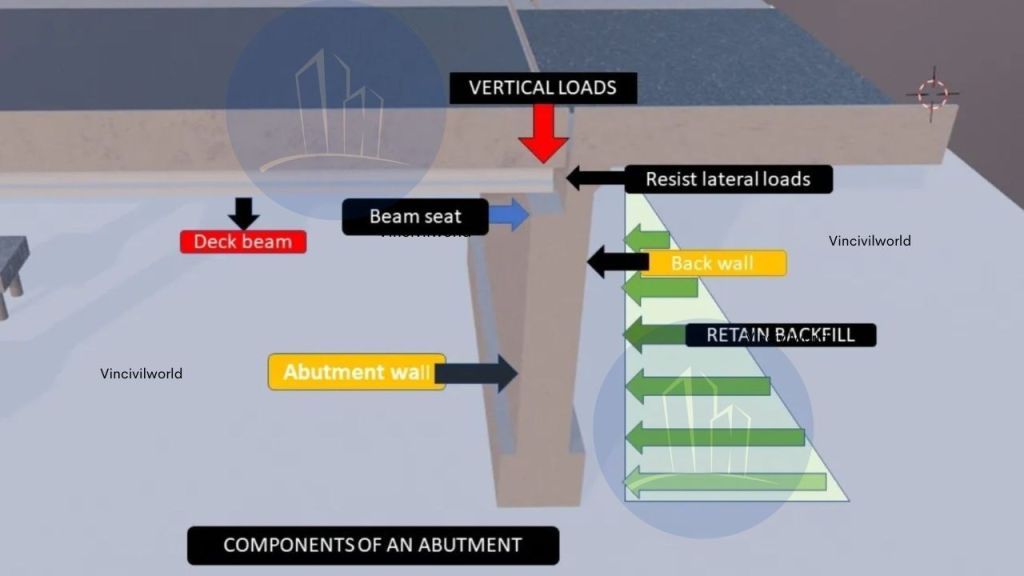
Abutments functions as vertical supports to the superstructure components at the bridge end. They are the endpoints of a bridge and acts as an approach for the roadway. Abutments retain the roadway backfill and base materials and act as lateral support to the embankments approach. Because of these properties, the abutments are designed as retaining structures.

A single span bridges got two abutments which serves as a vertical support and lateral support. Abutments also resist lateral movement of earth fill of the road approaches.

Illustration of abutment components showing vertical loads, deck beam, beam seat, and back wall for retaining backfill.
Illustration of the components of an abutment, highlighting its role in supporting deck beams and resisting lateral loads.
components of abutment

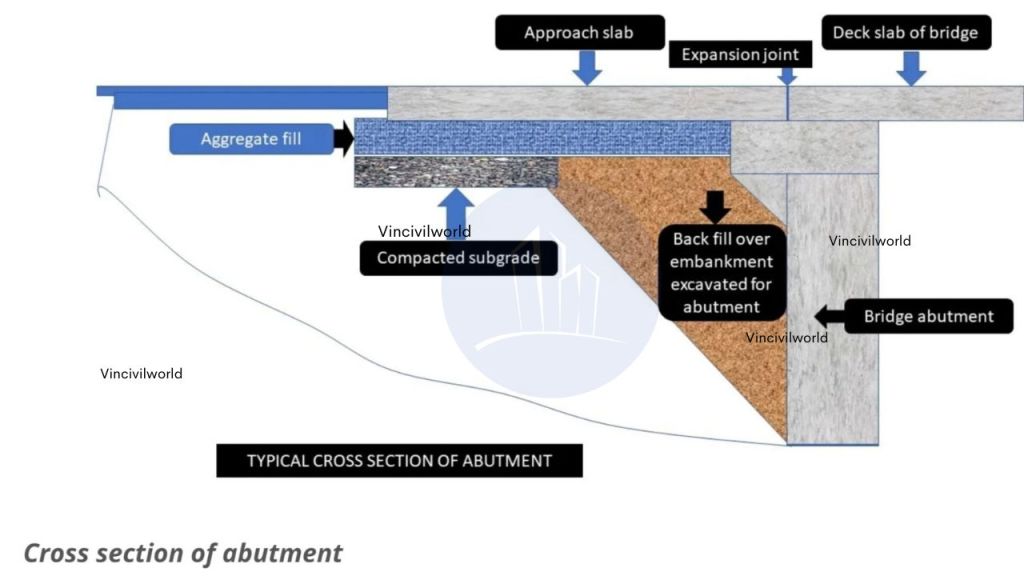
Abutment are of various types depending on the design requirements and load considerations.

Cross section diagram of a bridge abutment showing components like aggregate fill, compacted subgrade, back fill, approach slab, expansion joint, and deck slab.
Cross section illustration of a bridge abutment showing its structural components and layering.
Cross section of abutment
Types of Abutments
  • Closed Abutment
  • Stub or Perched Abutment 
  • Pedestal or Spill-through Abutment
  • Integral End Bents
  • Mechanically Stabilized Abutment

Wing walls and return walls

Wing walls are located near to the abutments as an extension of abutments or as independent structures. They act as a retaining wall to resist the earth in the approach areas. Wing walls may be placed right-angled to the approach way or splayed as shown in the figure.

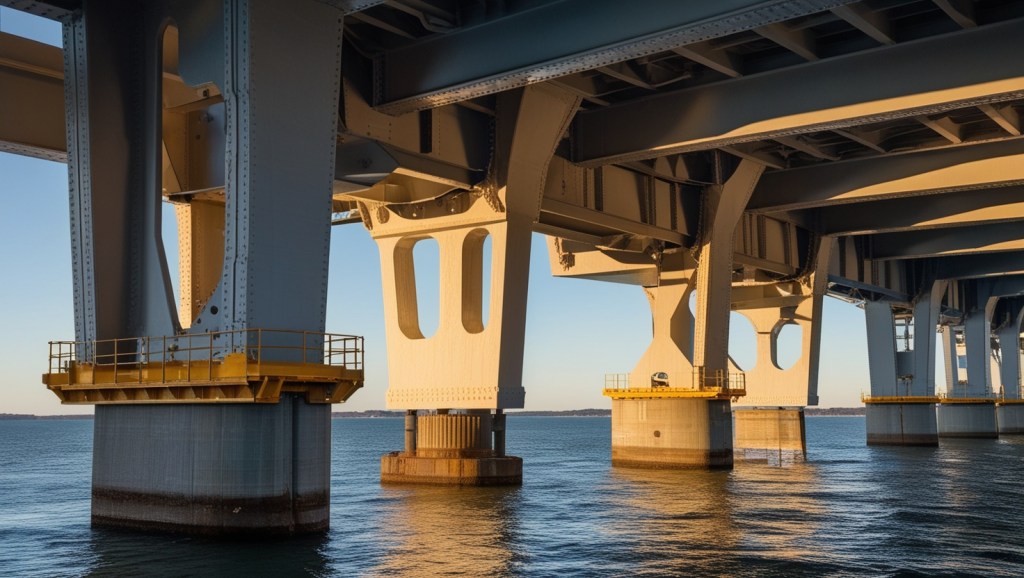
Piers

Piers are intermediate vertical supports provided between bridge spans. The main function of a pier is to transfer the loads coming on the superstructure to the foundations. Pier got pier caps to provide sufficient bearing areas for the transfer of superstructure loads.

Piers are basically compression members and are designed for vertical loads but in high seismic areas they are designed for lateral loads also.

Underneath view of a bridge showing its structural components, including piers and beams, over a water body.
View of bridge piers supporting the superstructure above water, showcasing essential components of bridge stability.
Piers

Foundation

Foundations are constructed to transfer loads coming on the superstructure and substructure to a larger area and hard strata. The foundations may be an open foundation or pile foundation or some other foundation type depends upon nature or soil strata and design considerations. The foundation has to be provided at sufficient depth to ensure protection and chances of failure against the scouring and undermining process.

Also read : Foundation types – Shallow and deep foundations

Also read : Pile foundations – Types and advantages

Component of a bridge – Super structure or decking components

The superstructure constitutes deck slabs, deck beams/girders, trusses, cables, arches, handrails, parapet, etc. The superstructure components depend on the type of bridge-like concrete, composite, steel, etc. The following are the basic superstructure components.

a) Bearings

b) Bridge deck

Diagram illustrating the components of a bridge superstructure, including deck slab, deck beam, bridge bearings, and parapet.
Diagram illustrating the superstructure components of a bridge, including deck slab, deck beam, bridge bearings, and parapet.
SUPERSTRUCTURE COMPONENTS

Bridge bearings

Bridge bearings are components of the bridge that provides a resting surface between the bridge pier and the bridge deck. The main function of the bearing is to control movements and reduces the stresses involved.

A bridge bearing carries the loads or movement in both vertical and horizontal directions from the bridge superstructure and transfers those loads to the bridge pier and abutments. The loads can be live load and dead load in vertical directions, or wind load, earthquake load, etc., in horizontal directions.

Close-up view of a bridge bearing system, showing the connection between the bridge deck and the support structure below.
Close-up view of a bridge bearing, showcasing its structural connection between the bridge deck and pier.
Bridge bearing

Decking components

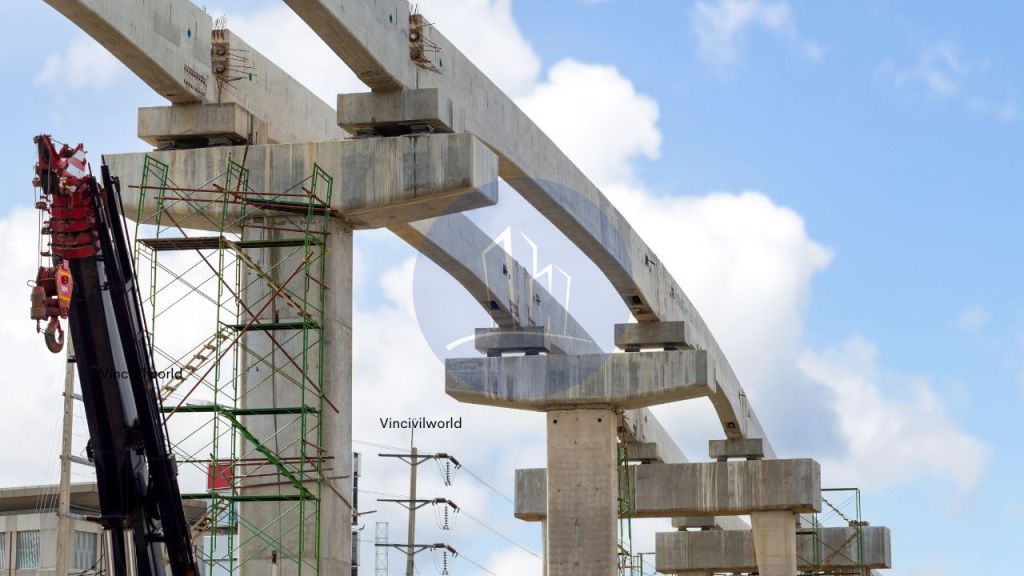
Decking is the surface over which the traffic like road or rail passes. The decks are supported on beams, girders (prestressed or post-tensioned ) viaducts, prefabricated segments, steel girders or hanged through cables. The whole decking components are supported by pier which transfer the loads to reliable soil strata.

The deck beams shall be conventional rectangular type or of I – GIRDERS (Concrete or steel)

Construction of a bridge showing concrete beams supported by scaffolding and equipment.
Construction of a bridge superstructure featuring concrete beams supported by piers.
Types of Deck support beams

The surface of the deck may be of the concrete or bituminous for movement of traffic.

There are a lot of miscellaneous components like strip seal expansion joints which separates the deck spans, Hand rails are provided on the deck side as a barrier and protection.

Key Takeaways

  1. Bridge Importance: Bridges connect regions over obstacles like water bodies and valleys.
  2. Component Categories: Divided into substructures and superstructures.
  3. Substructure Components: Includes abutments, wing walls, piers, pier caps, and foundations.
  4. Abutments: Serve as vertical and lateral support, retaining roadway backfill and providing bridge endpoints.
  5. Wing Walls: Act as retaining walls near abutments, resisting earth in approach areas.
  6. Piers: Provide intermediate vertical support between spans, transferring loads to foundations.
  7. Foundations: Ensure stability against scouring and undermining, transferring loads to the ground.
  8. Superstructure Components: Comprise deck slabs, beams, trusses, cables, arches, handrails, and parapets.
  9. Bridge Bearings: Control movements and reduce stresses, transferring loads to piers and abutments.
  10. Decking: Forms the surface for traffic, supported by beams and girders, ensuring efficient load distribution.
  11. Miscellaneous Components: Include expansion joints and handrails for protection and separation of deck spans.

Conclusion

Understanding bridge components is crucial for maintaining stability and functionality. The substructure, including abutments, piers, and foundations, supports and distributes loads to the ground, while the superstructure, comprising decking, beams, and bearings, facilitates traffic flow and load transfer. Abutments provide vertical and lateral support, retaining backfill and serving as endpoints. Piers act as intermediate supports, and foundations ensure stability against environmental factors. The superstructure supports traffic with decks and beams, transferring loads through bearings to the substructure. These components work together to create safe, efficient, and durable bridges, highlighting the importance of comprehensive design and construction in bridge engineering.

Latest posts