Constructed Wetlands for Wastewater Treatment

Constructed wetlands are wastewater treatment systems that utilise natural processes such as plants, soil, and organisms to treat wastewater, greywater, or stormwater runoff from municipal or industrial sources. In this blog, let’s go for a trip exploring the different types of constructed wetlands and their mechanism.

Let’s get started by understanding the basics of a constructed wetland.

  1. What are constructed wetlands?
  2. Constructed Wetlands Components
  3. Pollutants Removal In Constructed Wetlands
    1. Nitrogen Removal
    2. Phosphorus Removal
  4. Constructed Wetlands Types
    1. Subsurface Flow Wetlands
      1. Horizontal Flow Constructed Wetlands
      2. Vertical Flow Constructed Wetlands
    2. Surface Flow Wetlands
  5. Floating treatment wetlands
  6. Conclusion

What are constructed wetlands?

Constructed wetlands are manmade wetlands that find applications in land reclamation after mining and compensating for natural areas lost to development. They operate as a biofilter and remove a variety of pollutants from the water such as organic substances, fertilisers, pathogens, and heavy metals. It can also eradicate pathogens (bacteria, viruses, protozoa, and helminths) to a certain extent.

Constructed Wetlands Components

There are three main components in constructed wetlands:

  • An impermeable layer of Clay
  • A Substrate layer of gravel
  • Ground Vegetation Zone

The impermeable layer, which is often comprised of clay, inhibits pollutants from filtering into the lower aquifers. It is the bottom-most layer.

Above the impermeable layer lies the substrate layer. that nourishes and protects the root zone. The water passes through this layer and into the root zone. Bioremediation and denitrification take place in this layer with the help of bacteria present in the roots. The ground vegetative layer rests above the substrate layer.

Constructed wet lands

In a wetland, vegetation offers a substrate (roots, stems, and leaves) for microbes to proliferate as they decompose organic matter. This microbial colony or the periphyton accomplishes around 90% of pollution removal and waste decomposition. When the plants degrade, they provide a carbon source for the microorganisms and eliminate roughly 7% to 10% of contaminants.

Also read : Secondary Treatment for Wastewater – Methods and Process

Pollutants Removal In Constructed Wetlands

  • As wastewater flows through the wetland medium and the plant rhizomes, it undergoes treatment through various physical, chemical and biological processes.
  • The oxygen which comes out of the rhizomes, roots, and rootlets, forms a thin layer surrounding each root hair.
  • This creates aerobic conditions for the aerobes to act. Along with the aerobic bacteria, anaerobic bacteria also acts on the wastewater.
  • Microbial nitrification and subsequent denitrification releases nitrogen gas. In the root-bed media, phosphorus coprecipitates with iron, aluminium, and calcium compounds.
  • Filtration and adsorption by biofilms on the gravel or sand media reduces the harmful bacteria and viruses.

Nitrogen Removal

Ammonia present in the wastewater converts to ammonium ions. The aerobic bacterium Nitrosomonas sp. oxidizes these ammonium ions to nitrite. Nitrite converts to nitrate by the action of the the bacterium Nitrobacter sp. Finally, nitrate reduces to relatively harmless nitrogen gas under anaerobic conditions. It then enters the atmosphere.

Phosphorus Removal

Phosphorus removal and storage occurs within the constructed wetland itself since the phosphorus cycle is closed and there is no release of it into the atmosphere. A wetland system sequesters phosphorus by:

  1. Incorporating phosphorus into living biomass and thereby becoming a part of the organic matter present in living beings.
  2. Precipitation of phosphorus as insoluble phosphates with ferric iron, calcium, and aluminium compounds found in wetland soil.

Constructed Wetlands Types

The following are the three primary types of built wetlands:

  • Subsurface flow constructed wetland
  • Surface flow constructed wetland
  • Floating treatment wetland

Let’s have a closer look at each one of them.

Subsurface Flow Wetlands

There is no water surfacing in subsurface flow constructed wetlands because wastewater flows through the roots of the plants which lies below the gravel. As a result, these types of constructed wetlands offer the following advantages:

  • The system is more efficient
  • Attract fewer mosquitoes and flies.
  • Emit less stink.
  • Less susceptible to cold temperatures.
  • Water purification takes up lesser space.

There are two types of subsurface flow constructed wetlands: Horizontal flow and vertical flow constructed wetlands

Horizontal Flow Constructed Wetlands

The effluent in the horizontal flow built wetland moves horizontally and parallel to the surface. Absence of surface water, preventing mosquito breeding. Subsurface flow wetlands can treat a variety of different wastewaters, such as household wastewater, agricultural, paper mill wastewater, mining runoff, tannery or meat processing wastes, stormwater.

Vertical Flow Constructed Wetlands

A vertical flow constructed wetland is a planted filter bed with a bottom drain. A mechanical dosing system pours or doses wastewater onto the surface from above. Water runs down vertically through the substrate layer to the basin’s bottom, where it is collected in a drainage pipe. In comparison to horizontal flow constructed wetlands, vertical flow constructed wetlands are more efficient and use less space.

Also read : Activated Sludge Process – Stages and Process Control

Surface Flow Wetlands

Surface flow wetlands resemble wastewater treatment ponds in appearance such as “waste stabilisation ponds”. They find applications in tertiary treatment, wastewater treatment plant effluent polishing and stormwater runoff treatment

Along with natural decay, predation by higher species, pathogens die by UV radiation due to the exposure of water to direct sunlight, . The soil layer beneath the water is anaerobic, but the roots of the plants produce oxygen, allowing complex biological and chemical interactions to take place.

A wide range of soil types, including bay mud and various silty clays, can support surface flow wetlands.Plants like Water Hyacinth (Eichhornia crassipes) and Pontederia spp. are employed.

Constructed Wetlands
  • Surface flow constructed wetlands, on the other hand, may increase mosquito breeding.
  • They also produce a lot of algae, which degrades the effluent quality.
  • In comparison to subsurface flow built wetlands, they require a larger area to cleanse water.
  • They have a stronger odour and lesser performance in the winter.

Floating treatment wetlands

The floating treatment wetlands (FTWs) are artificial wetlands that replicate natural ones. Floating rafts support hydroponically grown plants in FTWs. The rafts float on the surface of a wet pond and they improve water quality by filtering, consuming, or breaking down contaminants (such as nutrients, silt, and metals) in the water.

Shall we wrap up?

Conclusion

Due to the self-sustaining nature of the constructed wetlands they have a significantly lower lifetime costs compared to the conventional treatment systems. Hence they provide an economical and nature-friendly option for wastewater treatment.

So, how was the trip? Let us know in the comments.

Chemical Oxygen Demand and Total Organic Carbon Analysis

Chemical Oxygen Demand (COD) and Total Organic Carbon (TOC) are widely used analysis methods in water treatment plants, petrochemicals and drinking water treatment. In this blog, let me walk you through the analysis of Chemical Oxygen Demand, Total Organic Carbon and its applications.

Let’s get started with Chemical Oxygen Demand.

  1. What is Chemical Oxygen Demand?
  2. Why COD and TOC are important
  3. Significance of COD/TOC Ratio
  4. Chemical Oxygen Demand Determination
    1. Procedure for Chemical Oxygen Demand
    2. Chemical Oxygen Demand Testing Advantages
    3. Chemical Oxygen Demand Testing Limitations
  5. Total Organic Carbon (TOC)
  6. What does TOC Analyse?
    1. Oxidation Methods
    2. TOC Applications

What is Chemical Oxygen Demand?

Chemical Oxygen Demand is the amount of oxygen required to oxidise all the biodegradable and non-biodegradable organic matter. It evaluates all chemically oxidizable components present in a given wastewater sample. It can be directly linked to the effluent’s actual oxygen requirement on releasing into the environment. Total Organic Carbon testing, in addition to Chemical Oxygen Demand, provides us with a better understanding of a waste stream’s true organic load.

Why COD and TOC are important

COD (Chemical Oxygen Demand) and TOC (Total Organic Carbon) analysis play a vital role in keeping our waterways safe and healthy. By measuring the levels of organic pollution in water and wastewater, these tests help us monitor water quality, evaluate the efficiency of treatment processes, and ensure that we’re meeting environmental regulations. Ultimately, they safeguard our well-being and the delicate balance of aquatic ecosystems.

Significance of COD/TOC Ratio

  • The COD/TOC ratio is a useful tool for assessing the biotreatability of wastewater treatment.
  • At a given point in the wastewater treatment process, the ratio of COD to TOC provides insight into the nature of organic wastewater constituents present.
  • A high COD/TOC ratio indicates easily oxidisable organic molecules like alcohols.
  • Ratios in the range of 0.8 or higher indicate wastes with a high biochemical treatment potential.
  • Lower ratios indicate that the wastes are not amenable to biochemical treatment.
  • The amount of oxygen required as measured by the COD value may change during wastewater treatment, but the carbon concentration as measured by the TOC value does not.
  • As the COD/TOC ratio of wastewater decreases during treatment, it means that the organic compounds are undergoing oxidation and the treatment plant is functioning smoothly.

Also read : Wastewater Treatment- Stages and Process full details

Chemical Oxygen Demand Determination

The COD determination is similar to the BOD determination in the fact that both methods use titration. The basic principle of the COD test is that a strong oxidizing agent can fully oxidize almost all organic compounds to carbon dioxide under acidic conditions.

The best choice would be potassium dichromate which is a strong oxidizing agent under acidic conditions. The addition of sulfuric acid creates acidic conditions for titration. Usually, we use a 0.25 N solution of potassium dichromate for COD determination. However, for samples of COD below 50 mg/L, we use a lower concentration of potassium dichromate.

During the oxidation of the organic substances found in the water sample, potassium dichromate undergoes reduction and forms Cr3+. After the completion of the oxidation reaction, the amount of Cr3+ gives an indirect measure of the organic contents in the water sample.

Procedure for Chemical Oxygen Demand

  • Pipette out 50 ml of the wastewater sample into a flat bottom Erlenmeyer flask.
  • Gently add HgSO4 and 5 mL of sulfuric acid. Swirl the flask continuously until all the mercuric sulfate has dissolved.
  • Now, add 25.0 mL of 0.25N potassium dichromate.
  • Carefully add 70 mL of previously prepared sulfuric acid-silver sulfate solution and gently swirl until the solution is thoroughly mixed.
  • Add glass beads to the refluxing mixture to prevent bumping.
  • Heat the mixture under total reflux conditions for 2 hours.
  • Cool down the mixture to room temperature and titrate it with standard ferrous ammonium sulfate along with 10 drops of ferroin indicator.
  • The end-point of titration is a sharp colour change from blue-green to reddish-brown.
  • Run a blank, with 50 mL of distilled water in place of the sample along with all reagents and subsequent treatment.

COD in mg/l = [(A-B)*M*8000]/sample volume in ml

A = Volume (ml) of Ferrous Ammonium Sulphate used for blank.

B = Volume (ml) of Ferrous Ammonium Sulphate used for sample

M = Molarity of Ferrous Ammponium Sulphate

8000 = milliequivalent weight of oxygen * 1000 ml/L

The COD test doesn’t differentiate between biodegradable and non-biodegradable organic materials. It gives a measure of total oxidisable organic materials in the sample. Therefore, we get higher values of COD than BOD for the same sample. Dichromate oxidises the chlorides and nitrites present in the sample. They create an inorganic COD and generates error in the COD determination.

Chemical Oxygen Demand Analysis

Chemical Oxygen Demand Testing Advantages

  • COD is ideal for checking treatment plant performance and water quality regularly.
  • In comparison to the 5-day BOD test, COD testing is more accurate and has a shorter analysis period (2-hour digesting time).
  • Toxic elements in the sample do not affect the COD oxidant.
  • Changes in COD between influent and effluent may be correlated with BOD content and can be used to augment BOD data.

Chemical Oxygen Demand Testing Limitations

  • The COD technique does not completely oxidise some organic molecules.
  • Chloride ions might cause interference in COD measurements.

Now you got a clear idea about COD determination. Let’s move on to Total Organic Carbon Analysis.

Total Organic Carbon (TOC)

Total Organic Carbon refers to the total amount of organic carbon (including elemental carbon) bound to dissolved or suspended organic substances in water. It is a non-specific indicator of water quality or cleanliness of pharmaceutical manufacturing equipment.

What does TOC Analyse?

The basic principle behind the Total Organic Carbon test is the oxidation of the carbon in the organic matter to carbon dioxide. After that, a non-dispersive infrared analyzer measures the amount of CO2. The amount of CO2 evolved gives a measure of the carbon content in the sample. Further stoichiometric calculations based on the method employed gives the amount of TOC.

TOC analysis measures the following:

  • Total carbon (TC)
  • Inorganic carbon (IC)
  • Total organic carbon (TOC)
  • Purgeable organic carbon (POC)
  • Nonpurgeable organic carbon (NPOC)

TOC analysis measures Total Carbon and Inorganic Carbon. Then we subtract the Inorganic Carbon (IC) from Total Carbon (TC) to find the Total Organic Carbon. This is the TC-IC method.

TOC Analysis
TOC Analysis

According to the TC-TIC method, TOC = TC -T IC

TIC-NPOC method employs acidification of the sample to evolve carbon dioxide. It gives the measure of inorganic carbon (IC) and then oxidation of sample and measurement of the remaining non-purgeable organic carbon (NPOC).

Oxidation Methods

We have a variety of oxidation and detection methods to find out the TOC. Let me show a few of them:

  • High-temperature combustion at 1,200 °C in an oxygen-rich atmosphere. The CO2 passes through scrubber tubes to remove interferences. After that, non-dispersive infrared absorption (NDIR) gives the amount of CO2.
  • High-temperature catalytic oxidation at 680 °C in an oxygen-rich environment inside tubes filled with a platinum catalyst and then NDIR.
  • Thermochemical oxidation in the presence of heat and a chemical oxidizer, usually a persulphate.
  • Photochemical oxidation in the presence of UV and a chemical oxidizer like persulphate.
  • Photo-oxidation by ultra-violet (UV) light alone or with a catalyst. In a UV-irradiated chamber, combine sample with persulfate to convert organics to carbon dioxide. The UV oxidation method offers the most reliable, low maintenance method of determining TOC in ultra-pure waters.

Accurate detection and quantification are very crucial to get accurate results in TOC analysis. The most commonly used methods include conductivity and non-dispersive infrared (NDIR).

TOC Applications

  • In oil exploration, the initial chemical study on a prospective petroleum source rock is TOC.
  • TOC helps in detecting pollutants in drinking water, cooling water, semiconductor production water, and pharmaceutical-grade water.
  • It finds applications in controlling the release of organic chemicals into the environment at a production facility.
  • Furthermore, a low TOC can demonstrate the absence of potentially dangerous organic compounds in pharmaceutical manufacturing water.
  • Because of the byproducts, TOC is also of importance in the field of drinking water treatment.

That’s it about the analysis of Chemical Oxygen Demand and Total Organic Carbon. Hope you found it informative. Let us know your queries in the comments section.

Structural Steel Fabrication – Stages and Applications

Structural steel fabrication is a process that involves bending, cutting, and shaping steel components. It also includes assembling these components to create industrial and residential structures. Structural steel fabrication has a very high strength-to-weight ratio. Because of this versatility and flexibility, engineers use structural steel fabrication extensively in various industrial, residential and commercial projects.

Structural steel fabrication involves the process of transforming raw steel into usable components for construction projects. Structural steelwork fabricators follow a series of stages to ensure precision, from design to installation. The fabricated steel structures are used in various applications, including bridges, buildings, and industrial facilities. The fabrication of steel structures requires attention to detail and quality control to meet the highest standards. This work plays a crucial role in the development of durable, reliable infrastructure.

In this blog, let me walk you through the Advantages, Processes and applications of structural steel fabrication works. Here we go.

  1. Structural steel fabrication – Stages and procedures
    1. Ideation and shop drawings/fabrication drawings
    2. Material preparation for structural fabrication
      1. Material selection and inspection
      2. Cutting, bending and drilling of steel
    3. Welding of structural steel
    4. Engraving and assembly
    5. Conveying for erection
  2. Inspection and Quality Control
  3. Advantages of structural steel fabrication
  4. Applications of structural steel
  5. Conclusion

Structural steel fabrication – Stages and procedures

Structural steel fabrication involves multiple stages and requires highly skilled manpower. The training of manpower is essential for transforming raw materials into precise engineering structures. In the following sections, I will show you the processes involved in structural steel fabrication works and the involvement in crafting the structures.

Structural steel fabrication work involves the detailed process of transforming raw steel into components for building structures. Skilled structural steelwork fabricators perform various stages to create fabricated steel structures.

  • Creating Shop drawings /fabrication drawings
  • Material preparation for structural fabrication
  • Cutting, bending and drilling of steel
  • Welding of structural steel
  • Engraving and assembly

    Each stage is crucial to the successful completion of structural steelwork fabrication projects.

    Ideation and shop drawings/fabrication drawings

    In the first stage of structural steel fabrication works the major processes involve ideating, blueprinting, and creating shop drawings. During this phase, the team conceptualizes the design and prepares detailed plans and drawings. We use software to create blueprint drawings, taking into account requirements, code compliance, and specifications. Blueprints and shop drawings ensure the design is proper. They provide accurate information like dimensions, connections, and other specifications required for fabricating the structure.

    Accurate and precise ideation, blueprints, and shop drawings are crucial. They greatly influence the quality of any structural fabrication work. They are also critical for its speed.

    structural steel fabrication
    structural steel fabrication work
    structural steel fabrication work

    Material preparation for structural fabrication

    Material preparation for structural steel fabrication work involves selecting steel components. It also involves cutting and preparing them. This ensures precision and quality in fabricating steel structures by skilled fabricators. The preparation of raw steel for structural fabrication involves the following stages:

    a) Material selection and inspection

    b) Cutting, bending, drilling

    Material selection and inspection

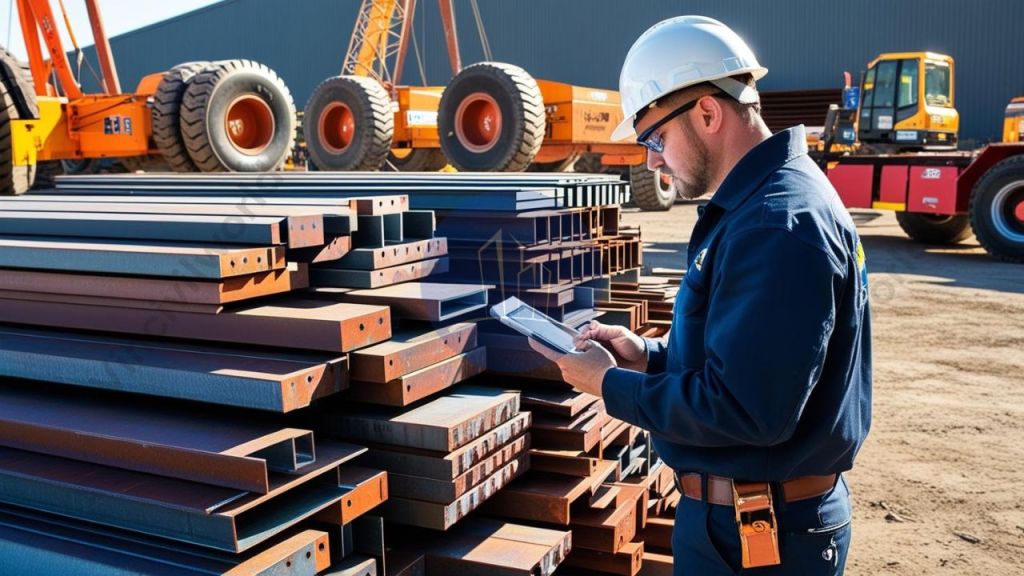
    We perform the material selection on the basis of project requirements and specifications. This step typically includes selecting the appropriate grade of material. It involves conducting requisite raw material quality checks before using it for work.

    Material Inspection for Structural Steel Fabrication works
    Material Inspection for Structural Steel Fabrication works

    Cutting, bending and drilling of steel

    The cutting stage encompasses the precise cutting of raw material into accurate sizes as per the shop drawings. Mostly, cutting is done with the help of various techniques. This includes sawing, which involves using a saw blade. Shearing uses specialized machinery to make straight cuts. Advanced techniques include plasma cutting, laser cutting, or water jets. Generally, these processes take place in a fabrication shop/factory. However, the shearing process is limited to small and miscellaneous structural members.

    During the bending stage, the structural steel undergoes deformation to the required shape and angles. We mainly employ rolling machines or press breaks in this process. Generally, there are five common methods of bending structural steel. This includes rolling, incremental bending, hot bending, rotary-draw bending, and induction bending. Fabrication of curved or angled structures requires bending.

    Drilling of structural steel for fabrication work
    Drilling of structural steel for fabrication work
    Drilling of structural steel for fabrication work

    Drilling of structural steel provides precise holes in structural members. This is generally done with the help of drill presses or specialized drilling machines. Drilling is basically done for bolted components.

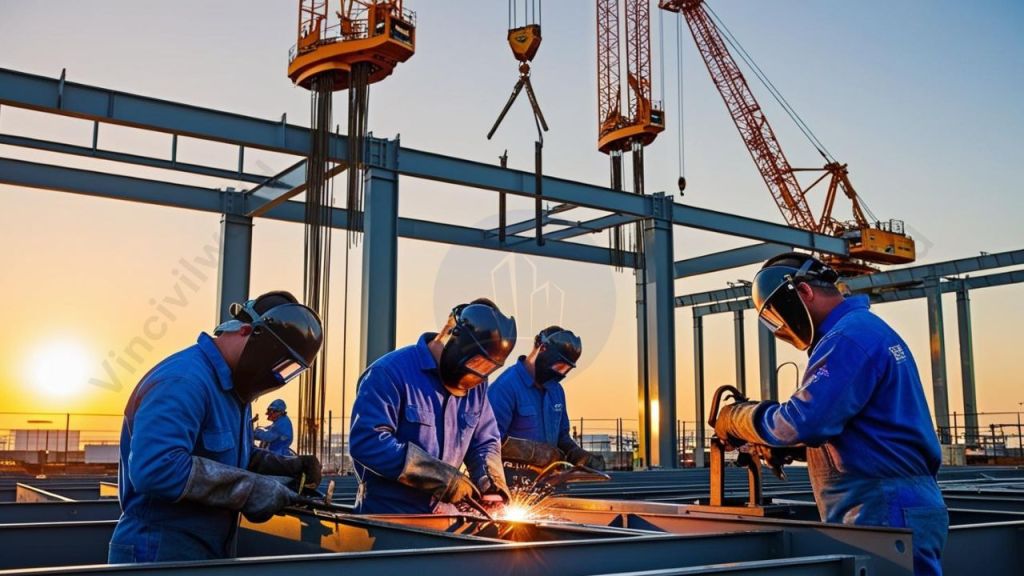
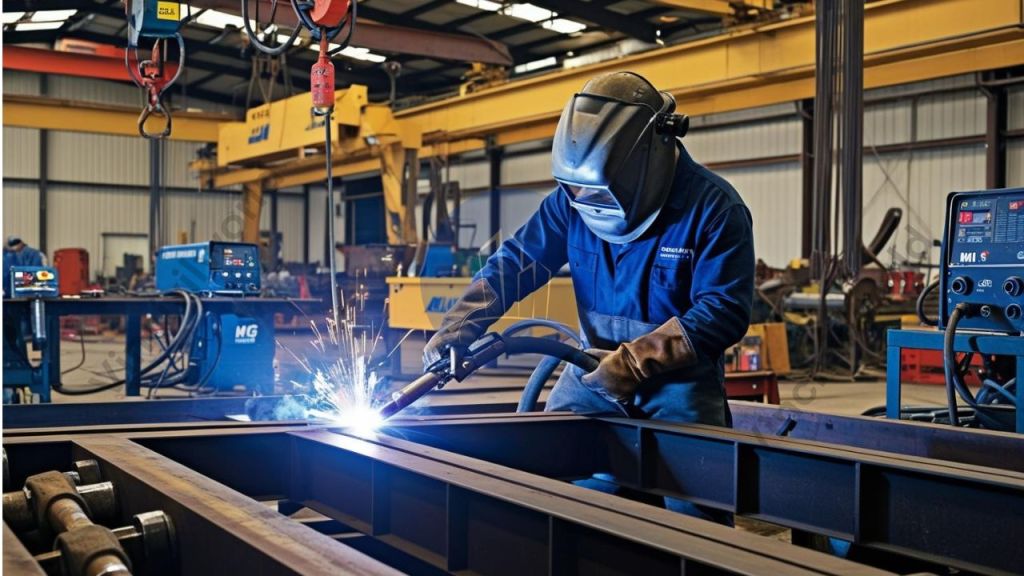
    Welding of structural steel

    Welding involves creating a variety of welds to join structural steel components. The process uses heat and pressure to produce continuous joints. Mostly, the welding process follows different stages:

    The welding process starts with cleaning the surface and ensuring that any dirt and other impurities are not there. The next process is the fit where we assemble and align the steel sections as per shop drawings. Basically, this ensures an accurate fit-up for welding. On completion of the fit-up, we start the structural welding process.

    Welding of structural steel
    Welding of Structural Steel for fabrication works
    Welding of Structural Steel for fabrication works

    Structural welding is done in any of the two methods. The heat from an electric arc, laser, or other welding methods is applied to melt the steel edges, forming a molten pool. Filler Material such as welding wire or rod, is added to the molten pool to strengthen the weld. The molten pool cools, solidifies, and forms a continuous bond between the steel components.

    Common types of welding used in structural steel fabrication include:

    Engraving and assembly

    Engraving in structural steel fabrication involves etching or inscribing markings, identification codes, or specific details onto the steel components. Specialized engraving tools or laser engraving machines perform this step.

    Assembly is the final stage. In this stage, we combine the fabricated steel components to create the completed structure. This is often done through welding, bolting, or riveting. These steps ensure proper identification, alignment, and secure connections, contributing to the structural integrity and functionality of the steel assembly.

    Conveying for erection

    The fabricated members are conveyed to the area of erection where these members are erected and aligned according to the drawings.

    Inspection and Quality Control

    Inspection and quality control ensure that each component meets industry standards for strength, precision, and durability. Specialists check weld integrity, measurements, and alignment to confirm that the steel structure is sound and compliant. This stage involves using non-destructive testing (NDT) techniques. Techniques like ultrasonic or radiographic testing detect flaws within the metal without causing damage. Rigorous quality checks help avoid structural failures, supporting structural steel fabrication work of the highest standard.

    Advantages of structural steel fabrication

    Structural steel fabrication offers a wide variety of advantages,

    1. High Strength and Durability: Structural steel possesses excellent strength-to-weight ratio and durability, providing long-lasting and resilient structures.
    2. Design Flexibility: Steel fabrication allows for versatile and customizable designs, accommodating complex architectural and engineering requirements.
    3. Fast Construction: Prefabrication of Steel components enables efficient and speedy on-site assembly, reducing construction time and costs.
    4. Structural Integrity: Steel’s inherent properties ensure structural integrity, capable of withstanding heavy loads, seismic forces, and extreme weather conditions.
    5. Sustainability: Steel is recyclable and reusable, reducing environmental impact and promoting sustainability in construction projects.
    6. Cost-Effective: Steel fabrication offers cost efficiencies due to faster construction, reduced labor requirements, and minimized maintenance needs.
    7. Precision and Quality: Since steel fabrication takes place under controlled conditions, it ensures high precision, quality, and dimensional accuracy.
    8. Fire Resistance: Steel is non-combustible and can withstand high temperatures, enhancing fire resistance and safety.
    9. Adaptability: Generally, steel structures give the option for easy modification, expansion, or retrofitting to accommodate future changes or renovations.
    10. Aesthetic Appeal: Steel’s sleek and modern appearance provides architectural versatility and visually appealing structures.

    These advantages contribute to structural steel fabrication’s widespread use and popularity in various construction projects.

    Applications of structural steel

    Structural fabricated construction mainly has the following applications

    • High-rise buildings
    • Industrial Buildings
    • Residential Buildings
    • Parking Garages and multilevel parking
    • Bridges

    Shall we wrap up?

    Conclusion

    In this blog, we saw the advantages, processes and applications of structural steel fabrication works. I hope you found it insightful. In case of any queries, please feel free to ask in the comments.

    Happy Learning.


    Fiber Reinforced Concrete (FRC) – Types and Advantages

    Fiber-reinforced concrete (FRC), an advanced form of Reinforced Cement Concrete is finding wide applications these days. Fiber-reinforced concrete (FRC) is a versatile and durable composite material consisting of a cementitious matrix with uniformly dispersed fibers. The addition of discontinuous, discrete fibers to cement, mortar or concrete mixes can enhance the concrete properties. Ever thought why do we add different kinds of fibres to the Reinforced Cement Concrete and what are the different types of fibres that we add? Stay with me till the end of this blog and we will find answers to all these questions.

    Before proceeding further, make sure you check out our blog, Reinforced Cement Concrete (RCC)|Definition|Advantages to have your concepts clear.

    First, let’s have a look at the basics of fiber-reinforced concrete and its applications.

    What is Fiber-reinforced concrete?

    Fiber-reinforced concrete (FRC) is a versatile and durable composite material consisting of a cementitious matrix with uniformly dispersed fibers. The addition of discontinuous, discrete fibers to cement, mortar or concrete mixes can enhance the concrete properties. These fibers act as reinforcement throughout the concrete matrix, and control cracking due to plastic shrinkage and drying shrinkage. Fiber-reinforced concrete reduces the permeability of concrete and reduces water bleeding.

    Fiber reinforced concrete finds extensive applications in various infrastructure works, industrial flooring works and other construction works that demand enhanced durability and crack control. FRC improves the flexural and impact resistance and hence we prefer it for structures subjected to dynamic or heavy loads.

    Now, let’s discuss the reason behind the addition of fibres to the reinforced concrete.

    Principle of Fiber-reinforced concrete

    Fibre-reinforced concrete uses discrete fibres to improve its mechanical properties, making it stronger, more durable, and resistant to cracking. Fiber is a small piece of circular or flat reinforcing material possessing certain characteristics and properties. These fibers are of steel, glass, synthetic polymer fibers and natural fibers like jute or hemp.

    Fibers are available in various sizes ranges from a few millimeters to a few centimetres. They are uniformly distributed throughout the concrete matrix. The features of Fiber reinforced concrete depends on the character and percentage, diameter and length of fibers and water-cement ratios. Typically fiber reinforced concrete is used in shotcrete but can also be used in normal concrete.

    The addition of fibres to concrete controls the shrinkage cracking, lower permeability, and reduce water bleeding. Some fibers enhance impact, abrasion, and shatter resistance. However, they do not increase flexural strength or replace structural steel reinforcement.

    We measure the amount of fiber as a percentage of total volume (Vf) and typically ranges from 0.1 to 3%. Aspect ratio (l/d) affects strength and toughness, but long fibers can hinder workability. Recent research shows limited impact resistance improvement, with microfibers performing better than longer fibers.

    Types of Fiber-reinforced concrete

    The type of fiber-reinforced concrete depends on the nature of the structure and applications. Let us have a look at the most common types of fibre reinforced concretes commonly used in construction.

    • Steel Fiber Reinforced Concrete
    • Polypropylene Fiber Reinforced (PFR) Concrete
    • GFRC Glass Fiber Reinforced Concrete
    • Asbestos Fibers
    • Polyester fiber
    • Carbon Fibers
    • Macro synthetic fibers
    • Organic Fibers
    • Cellulose fibers
    • Micro-synthetic fibers
    • Synthetic Fiber Reinforced Concrete (SFRC)Natural Fiber Reinforced Concrete (NFRC)Carbon Fiber Reinforced Concrete (CFRC)Basalt Fiber Reinforced Concrete (BFRC)Nylon Fiber Reinforced Concrete (NyFRC)Polyvinyl Alcohol Fiber Reinforced Concrete (PVAFRC)High-Performance Fiber Reinforced Concrete (HPFRC)

    Steel fiber-reinforced concrete

    SFRC is a composite material that includes a certain amount of steel fibers in the concrete mix. These fibres can change the properties of concrete and thereby enhance the performance of concrete. The typical diameter lies in the range of 0.25 to 0.75mm. Steel fibers having a rectangular c/s are produced by silting the sheets about 0.25mm thick.

    Steel fibre reinforced Concrete

    SFRC offers numerous advantages, including improved tensile strength, crack resistance, impact resistance, and durability. The steel fibers act as reinforcement, effectively bridging cracks and enhancing the concrete’s structural integrity. The steel fiber types are as per ASTM A.820 Type I: cold-drawn wire, Type II; cut sheet, Type III: melt-extracted, Type IV: mill cut and Type V: modified cold-drawn wire.

    SFRC finds applications in industrial floors, pavements, tunnels, and precast elements, where increased toughness and load-bearing capacity are required. It is also widely used in applications prone to dynamic loading, such as blast-resistant structures and earthquake-resistant buildings.

    Glass fiber-reinforced concrete

    Glass Fiber Reinforced Concrete (GFRC) is a composite material incorporating fine glass fibers into the concrete mix. These fibers, typically around 3-12 mm in length, enhance the concrete’s strength, durability, and flexibility. GFRC is commonly used in architectural applications, such as cladding, facades, and decorative elements, due to its lightweight nature and ability to create intricate designs.

    Glass fiber reinforced concrete

    You can get the full details about glass fiber-reinforced concrete here. Glass Fiber Reinforced Concrete – GFRC Ingredients and Uses

    Polypropylene Fiber Reinforced Concrete (PFRC)

    Polypropylene Fiber Reinforced Concrete (PFRC) is a composite material that combines polypropylene fibers with concrete. One of the cheapest & abundantly available synthetic fiber/ polymer is polypropylene. They are resistant to most chemicals and only the cementitious matrix will deteriorate first. These discrete fibers, typically ranging from 6 to 30 mm in length uniformly dispersed in concrete will control cracking due to plastic and drying shrinkage.

    We usually use these fibers in concrete to control cracking due to plastic shrinkage and drying shrinkage. The fibers act as reinforcement and reduce the permeability of concrete and thus reducing the bleeding of water and improving crack resistance, impact resistance, and durability. Polypropylene fibers being hydrophobic can be easily mixed as they do not need lengthy contact during mixing and only need to be evenly distressed in the mix.

    Polyester fiber reinforced concrete

    Polyester fiber-reinforced concrete is a composite material that incorporates polyester fibers into the concrete mix. These fibers, typically short and discrete, improve the concrete’s toughness, crack resistance, and impact resistance. Polyester fibers due to the high tensile strength and resistance to alkalis make them suitable for various construction applications that demand enhanced durability.

    Carbon fibers

    Carbon fiber reinforced concrete (CFRC) is a composite material that combines concrete with carbon fibers about 5-10 microns in diameter having carbon atoms. The carbon fibers, known for their exceptional tensile strength and stiffness, low weight, high chemical resistance, high-temperature tolerance and low thermal expansion impart their qualities to the concrete.

    We manufacture carbon fibers by baking plastic resins. They have high strength-to-weight ratio. Carbon fibers form the most recent and probably the most spectacular addition to the range of fiber available for commercial use. Since they are more vulnerable to damage than even glass fiber, we generally treat them with resin coating.

    Macro synthetic fibers

    Macro synthetic fibers are synthetic fibers used as reinforcement in concrete. These fibers, typically longer and thicker than traditional fibers, are manufactured from a blend of polymers. These fibers are developed for shot create or sprayed concrete. But they find extensive applications in floor slabs for enhancing the concrete’s toughness, crack resistance, and impact resistance.

    They offer improved durability and control of plastic shrinkage cracking. This makes them suitable for various construction applications in marine and coastal structures which require enhanced performance and reduced maintenance.

    Advantages of fibre-reinforced concrete

    1. Enhanced Durability: FRC increases the impact, fatigue, and abrasion resistance of concrete structures while minimising cracking. It increases the tensile strength and durability of the concrete.
    2. Crack prevention: The use of fibres reduces the spread and enlargement of cracks by controlling plastic and drying shrinkage cracking.
    3. Permeability Reduction: Fibres make concrete less permeable, which reduces water bleeding and improves resistance to moisture infiltration.It reduces the air voids and water voids and the inherent porosity of gel.
    4. Improved Impact Resistance: Certain types of fibres enhance the impact resistance of concrete, making it more resilient against sudden loads and external forces.
    5. Increased Toughness: The bridging action of the fibres, which absorbs energy and prevents abrupt failure, gives FRC an improved level of toughness.
    6. Design Flexibility: Using fibres in concrete allows for design flexibility, enabling the creation of complicated shapes and architectural freedom.
    7. Simplicity: Using fibre reinforcement instead of or less frequently than standard steel reinforcement simplifies construction operations.
    8. Better Workability: Fibres can make concrete mixes more workable and cohesive, making placement and compaction easier.
    9. Corrosion Resistance: In some circumstances, fibre reinforcement can reduce the likelihood that concrete buildings will corrode.
    10. Sustainable: Fibre-reinforced concrete is a sustainable solution since it can increase the longevity of structures and lessen the reliance on non-renewable resources.
    11. Creep Resistance: Fibres such as graphite and glass have excellent resistance to creep, while the same is not true for most resins. Therefore, the orientation and volume of fibres have a significant influence on the creep performance of rebars/tendons.

    Shall we wrap up?

    Conclusion

    In this blog, we saw the properties, uses, types and advantages of fiber-reinforced concrete. If you have any queries please feel free to ask in the comments.

    Terrazzo Flooring – Types, applications and Advantages

    Terrazzo flooring is a stunning and durable option for residential and commercial spaces. It combines marble, quartz, granite, or glass chips with a cement or epoxy binder to create a unique and elegant surface. Terrazzo floors offer endless design possibilities, with various colours, patterns, and finishes available. With its timeless appeal, durability, and low maintenance, terrazzo flooring is a popular choice for those seeking a beautiful, long-lasting solution.

    Terrazzo flooring incorporates a mix of materials such as marble, quartz, granite, or glass chips, creating a visually striking and versatile floor. Its popularity stems from its exceptional durability, easy maintenance, and ability to be customized to suit any aesthetic, making it a preferred choice for architects and designers.

    1. Terrazzo flooring – Types and ingredients
      1. Epoxy Terrazzo Flooring
        1. Advantages and applications of Epoxy terrazzo flooring
      2. Traditional terrazzo or cementitious Terrazzo Flooring
    2. Advantages of Epoxy Terrazzo Flooring over Cementitious Terrazzo Floor
    3. Advantages of Terrazzo Flooring
    4. Conclusion

    Terrazzo flooring – Types and ingredients

    Terrazzo flooring comes in various types, each offering unique characteristics and aesthetic appeal. From traditional and Venetian to epoxy and rustic, here are some common terrazzo flooring types to explore.

    1. Traditional Terrazzo: This type uses a cement binder mixed with marble, quartz, or other aggregates. They provide a classic and timeless look.
    2. Epoxy Terrazzo: Instead of cement, epoxy resin is used as the binder. Epoxy terrazzo offers greater design flexibility, durability, and a smoother finish.
    3. Venetian Terrazzo: Originating from Italy, Venetian Terrazzo features a polished finish and intricate patterns. These patterns are created by embedding various colourful marble chips in a cement binder.
    4. Rustic Terrazzo: This type showcases a more textured and natural appearance. They often incorporate larger aggregate chips for a rustic, earthy aesthetic.
    5. Aggregate Terrazzo: It consists of a single type of aggregate, such as recycled glass or marble chips, mixed with a binder, resulting in a uniform and minimalist design.
    6. Monolithic Terrazzo: This refers to terrazzo that is poured on-site without any precast or separate installation. It offers seamless, continuous flooring with endless design possibilities.

    These are just a few examples, as terrazzo flooring can be customized to meet specific design preferences. This allows for an extensive range of variations and combinations.

    Epoxy Terrazzo Flooring

    Epoxy terrazzo flooring is a popular choice known for its durability, versatility, and seamless finish. It utilizes an epoxy resin binder mixed with aggregates like marble, quartz, or glass chips, creating a highly customizable surface. Epoxy terrazzo is resistant to stains, chemicals, and moisture, making it ideal for high-traffic areas and contemporary design schemes.

    terrazzo floor
    terrazzo floor

    Advantages and applications of Epoxy terrazzo flooring

    Epoxy terrazzo floor offers several advantages and finds wide applications in various settings. Its seamless finish eliminates grout lines, making maintenance easier and preventing dirt and bacteria build-up. It is highly durable, resistant to stains, chemicals, and impact. Epoxy terrazzo’s versatility allows for limitless design possibilities, including intricate patterns and vibrant colours. It is commonly used in commercial spaces like airports, hospitals, schools, and retail stores. They are also used in residential projects, due to its aesthetic appeal and long-lasting performance.

    Traditional terrazzo or cementitious Terrazzo Flooring

    Cementitious terrazzo flooring comes in various types, each offering unique characteristics. Common types include Venetian terrazzo, which features intricate patterns and colourful marble chips; rustic terrazzo, known for its textured and natural appearance; and aggregate terrazzo, using a single type of aggregate like recycled glass or marble chips for a minimalist design. These variations allow for a wide range of aesthetic options to suit different preferences.

    Monolithic terrazzo refers to terrazzo flooring that is poured on-site without separate installation or precast elements. It provides a seamless and continuous surface, allowing for unlimited design possibilities and a visually cohesive look.

    Advantages of Epoxy Terrazzo Flooring over Cementitious Terrazzo Floor

    Here is a comparison between epoxy terrazzo flooring and cementitious terrazzo flooring:

    1. Durability: Epoxy terrazzo has superior chemical and stain resistance, making it more resistant to wear and tear compared to cementitious terrazzo.
    2. Design Versatility: Epoxy terrazzo offers a wider range of design possibilities, including vibrant colours, intricate patterns, and decorative effects, whereas cementitious terrazzo has more limited options.
    3. Seamless Finish: Epoxy terrazzo provides a seamless finish without grout lines, making it easier to clean and maintain compared to cementitious terrazzo.
    4. Installation Time: Epoxy terrazzo has a faster installation process, as it requires less curing time compared to cementitious terrazzo.
    5. Cost: Epoxy terrazzo tends to be more cost-effective than cementitious terrazzo, depending on the complexity of the design and project size.

    It’s important to consider specific project requirements and design preferences when choosing between epoxy terrazzo and cementitious terrazzo flooring.

    Terrazzo floor

    Advantages of Terrazzo Flooring


    Terrazzo floor offers several advantages over other popular flooring choices:

    1. Durability: Terrazzo is highly durable and long-lasting, surpassing materials like laminate, vinyl, or carpet.
    2. Design Options: Terrazzo provides endless design possibilities with customizable colours, patterns, and aggregates, unlike the limited options of hardwood or tile.
    3. Low Maintenance: Terrazzo requires minimal maintenance, with easy cleaning and resistance to stains and scratches, unlike carpet or natural stone.
    4. Sustainability: Terrazzo is eco-friendly, often using recycled materials and reducing waste, making it a greener choice compared to some floor options.
    5. Versatility: Terrazzo can be used both indoors and outdoors, accommodating various spaces, while materials like carpet or hardwood may have limited outdoor usage.
    6. Allergen Reduction: Unlike carpet, terrazzo does not trap allergens and is hypoallergenic, promoting a healthier indoor environment.
    7. Longevity: Terrazzo has a long lifespan, exceeding the durability of materials like laminate or vinyl, offering a cost-effective solution over time.

    Terrazzo’s unique blend of durability, aesthetic appeal, low maintenance, and sustainability make it stand out among popular flooring choices.

    Terrazzo floor

    Conclusion

    Terrazzo flooring is a versatile, durable, and visually striking option for both residential and commercial spaces. With its timeless appeal and low maintenance, terrazzo floor offers a long-lasting and elegant solution for any design aesthetic.

    Flyovers and bridges : Features and difference

    Flyovers and bridges are essential transportation structures that enable the seamless movement of vehicles and pedestrians. While both serve similar purposes, flyovers navigate intersections efficiently as elevated roads, while bridges connect points over bodies of water or valleys. Their distinct features make them vital components of modern infrastructure. This article is about the features and advantages of Flyovers and bridges and the difference between flyovers and bridges.

    1. What is a flyover?
    2. What are the benefits of flyovers?
    3. Types of flyovers
      1. Classification of flyovers based on Formation
      2. Classification of flyovers based on Materials
    4. What are bridges?
    5. Difference between Flyovers and Bridges
      1. Purpose of bridges and Flyovers
      2. Design of flyovers and bridges
      3. Location of flyovers and bridges
      4. Traffic Flow of flyovers and bridges
      5. Integration
      6. Environmental Factors
      7. Length and Span
    6. Key take aways
    7. Conclusion

    What is a flyover?

    A flyover, also referred to as an overpass or an elevated roadway, is a transportation infrastructure that provides a dedicated elevated route for vehicles to traverse over obstacles such as intersections, congested areas, or other roads.”Designers create flyovers to enhance traffic flow, reduce congestion, and improve overall transportation efficiency.”

    Constructors typically build flyovers above ground level, enabling vehicles to bypass busy intersections or intersections with heavy pedestrian traffic. Generally, by separating the flow of vehicles from crossroads and pedestrian crossings, flyovers minimize traffic conflicts and ensure uninterrupted movement. This in turn results in smoother traffic flow, reduced delays, and improved safety.

    The construction of flyovers requires careful planning and engineering. Generally, builders often use reinforced concrete or steel girders to construct flyovers, providing structural support for vehicles and the ability to bear substantial loads. The design includes ramps or access points to enable smooth vehicle entry and exit onto the flyover, ensuring seamless integration with the current road network.

    What are the benefits of flyovers?

    The benefits of flyovers include:

    1. Improved traffic flow: Basically, Flyovers separate the flow of vehicles, reducing congestion and ensuring smoother traffic movement.
    2. Reduced travel time: By bypassing intersections or congested areas, flyovers enable faster and more efficient travel, saving time for commuters.
    3. Enhanced safety: Flyovers minimize the risk of accidents by eliminating conflict points between vehicles and pedestrians or conflicting traffic streams.
    4. Increased capacity: Flyovers can increase the capacity of road networks by providing additional lanes or routes for vehicles.
    5. Better fuel efficiency: Reduced congestion and smoother traffic flow on flyovers contribute to improved fuel efficiency and reduced emissions.
    6. Enhanced connectivity: Flyovers connect different parts of a road network, improving accessibility and connectivity between areas.
    7. Improved urban aesthetics: Well-designed flyovers with landscaping, architectural features, and decorative elements can enhance the visual appeal of urban landscapes.
    8. Economic benefits: Efficient traffic flow facilitated by flyovers can boost economic productivity by reducing transportation costs and improving logistics.
    9. Minimized environmental impact: Generally, flyovers can help reduce air pollution and noise pollution by minimizing congestion and idling time at intersections.
    10. Improved emergency response: Flyovers provide unimpeded routes for emergency vehicles, enabling quicker response times during emergencies or disasters.

    Types of flyovers

    Flyovers are classified based on the following factors

    a) Classification based on the formation

    b) Classification based on materials

    Classification of flyovers based on Formation

    1. Straight Flyovers: Follow a straight-line trajectory, providing a direct route over obstacles.
    2. Curved Flyovers: Incorporate curves or bends in their design, accommodating specific road alignments or geographical constraints.
    3. T-Junction Flyovers: Connect perpendicular roads at a T-junction, allowing for uninterrupted traffic flow in multiple directions.
    4. Cloverleaf Flyovers: Form a circular or cloverleaf-shaped interchange, facilitating smooth merging and diverging movements between roads.
    5. Diamond Flyovers: Feature a diamond-shaped interchange, allowing for efficient access and exits from multiple directions.
    6. Multi-Level Flyovers: Comprise multiple layers or levels, providing complex interchanges with ramps and access points for different roads.
    7. U-Turn Flyovers: Enable U-turns or reverse movements, allowing vehicles to change direction without disrupting traffic flow.

    Classification of flyovers based on Materials

    1. Prestressed Concrete Flyovers: Constructed using precast prestressed concrete segments that provide strength and durability.
    2. Steel Flyovers: Built using steel girders, offering flexibility in design and allowing for longer spans.
    3. Reinforced Concrete Flyovers: Constructed using reinforced concrete beams or slabs, offering a balance between cost, strength, and ease of construction.
    4. Composite Flyovers: Combination of steel and concrete elements, leveraging the advantages of both materials for optimal structural performance.
    5. Cable-Stayed Flyovers: Supported by cables attached to tall towers, offering an elegant and efficient structural solution for longer spans.
    6. Box Girder Flyovers: Consists of hollow box-shaped beams, providing strength, rigidity, and resistance against bending and torsion forces.
    7. Extradosed Flyovers: Hybrid of cable-stayed and prestressed concrete flyovers featuring shorter towers and fewer cables while maintaining structural integrity.

    What are bridges?

    Engineers design bridges to connect two points over a body of water, a valley, or any physical obstacle. They typically comprise abutments, piers, and a deck or roadway for transportation. The construction of bridges involves using diverse materials like concrete, steel, or wood, which depend on factors such as span length and the required load capacity. However, They serve as crucial transportation links, facilitating the passage of vehicles, pedestrians, and sometimes, even trains. Bridges provide essential connectivity, improve accessibility, promote trade, and enable social and economic development by overcoming natural barriers and creating efficient transportation routes.

    Bridge

    Difference between Flyovers and Bridges

    Bridges and flyovers both elevate traffic, but they have different purposes. Bridges cross over obstacles like rivers or valleys and come in various designs, such as suspension or arch. Flyovers are overpasses built to let traffic pass over other roads or intersections, commonly found in cities to ease traffic flow. While bridges connect different areas, flyovers improve road efficiency within urban settings. Let us get into the details of the difference between flyovers and bridges.

    Here are the key differences between flyovers and bridges

    Purpose of bridges and Flyovers

    BridgesFlyover
    Bridges are primarily built to connect two points over a body of water, a valley, or any physical obstacle.Flyovers are constructed to navigate intersections, congested areas, or other roads efficiently, providing an elevated route for vehicles.
    Purpose

    Design of flyovers and bridges

    BridgeFlyover
    Bridges are typically designed with piers or support that span across the obstacle, supporting a deck or roadway.Flyovers are designed as elevated roadways, often supported by columns or piers, allowing vehicles to bypass intersections or congested areas.
    Design

    Location of flyovers and bridges

    BridgeFlyover
    Bridges are commonly found over bodies of water, such as rivers, lakes, or seas, or in areas with significant topographical variations like valleys or canyons.Flyovers are usually constructed in urban areas with heavy traffic, where they can provide efficient bypasses for intersections or congested road segments.
    Location

    Traffic Flow of flyovers and bridges

    BridgeFlyover
    Bridges accommodate two-way traffic, allowing vehicles to travel in both directions.Flyovers typically facilitate one-way traffic flow, with separate lanes or ramps for entering and exiting.
    Traffic flow

    Integration

    Bridge Flyover
    Bridges are integrated into the existing road network, connecting two points and providing a continuous route.Flyovers are designed to integrate with existing roads, providing seamless connectivity by allowing vehicles to enter and exit at designated access points.
    Integration

    Environmental Factors

    Bridge Flyover
    Bridges often need to consider factors like water flow, tidal forces, or seismic activity, depending on their location.Flyovers focus on addressing traffic congestion and improving transportation efficiency, with less consideration for natural elements.
    Environmental factors

    Length and Span

    Bridge Flyover
    Bridges can vary in length and span depending on the distance they need to cover, ranging from short spans to long suspension or cable-stayed bridges.Flyovers are generally shorter in length compared to bridges, spanning a specific area such as an intersection or congested road segment.
    Length and span

    Understanding these distinctions can help in determining the appropriate infrastructure solution based on the specific transportation needs and challenges of a given location.

    Key take aways

    Flyovers and bridges are crucial infrastructure elements with distinct purposes. Flyovers are designed to alleviate urban traffic congestion by providing elevated routes over intersections and other congested areas, ensuring smoother traffic flow and enhanced safety. They are typically constructed using reinforced concrete or steel girders and are commonly found in urban areas.

    Bridges, on the other hand, connect two points over natural obstacles such as bodies of water or valleys. They are essential for providing transportation links that facilitate trade and economic development. Bridges are built using a variety of materials including concrete, steel, and wood, and must consider environmental factors like water flow and seismic activity.

    Both flyovers and bridges integrate with existing road networks but serve different roles in enhancing transportation efficiency and connectivity. Flyovers are generally shorter and focus on urban traffic, while bridges can span longer distances and connect regions separated by natural barriers. Understanding these distinctions helps in planning and implementing effective transportation solutions.

    Conclusion

    Flyovers and bridges are integral to modern infrastructure, each serving distinct purposes. Flyovers, or overpasses, enhance urban traffic flow by providing elevated routes over intersections and congested areas, thereby reducing delays and improving safety. Bridges, on the other hand, connect two points over physical obstacles like water bodies and valleys, facilitating transportation and promoting economic development. Both structures require careful planning and engineering, utilizing materials such as concrete and steel to ensure durability and efficiency. Their unique features and applications make them crucial in addressing the specific transportation needs and challenges of different environments.

    Updates in civil engineering, architecture finishes, building construction, Environmental Engineering