
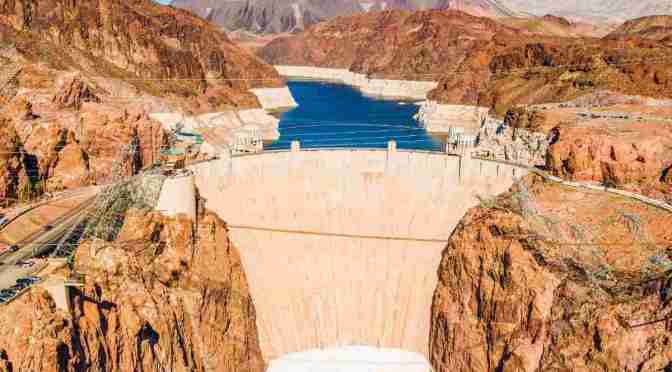
Components of dams have specific functions in managing their primary responsibility of water management. Dams are structures built across water bodies to control water flow and levels. Furthermore, dams are also required for a wide range of projects, including small irrigation and water supply schemes as well as larger hydropower and disaster management schemes. Dams’ primary responsibility of managing water is managed by each component in a specific way. The components of the dam and their functions are discussed in this article.
The upstream side of a dam is the area where the water is collected. The water level is high on the upstream side. The downstream is the section of the barriers with low water levels.

Advantages of Dams
The dams provide a range of environmental, economic and social benefits. One of the most important benefits of dams is water storage. The stored water is used for drinking, cleaning, bathing, gardening, irrigation purposes, and industrial purposes.
Dams may be constructed to meet the following functions
- Water storage: Dams are one of the major sources of water for domestic uses. These include cooking, cleaning, bathing, washing, and drinking water. They are also used for gardening, agricultural uses, and industrial purposes. The water is supplied through the canal or with the help of a pipe system from the dam.
- Irrigation – The water from the dams is diverted through canals. It is directed to fields where the water level is low. This process is used for irrigation purposes.
- Hydroelectric power – The water stored in the dam is passed through turbines for hydroelectric power generation.
- Flood prevention – The water level of rivers, streams, etc is maintained by constructing dams across it. This prevents the loss and damage from unexpected floods.
- Recreation – The water stored in the dam is used for fishing, boating, and other recreational activities.
- Debris control – The dam also provides the retention of hazardous material and protects the environment.
Related articles of Dams by Vincivilworld
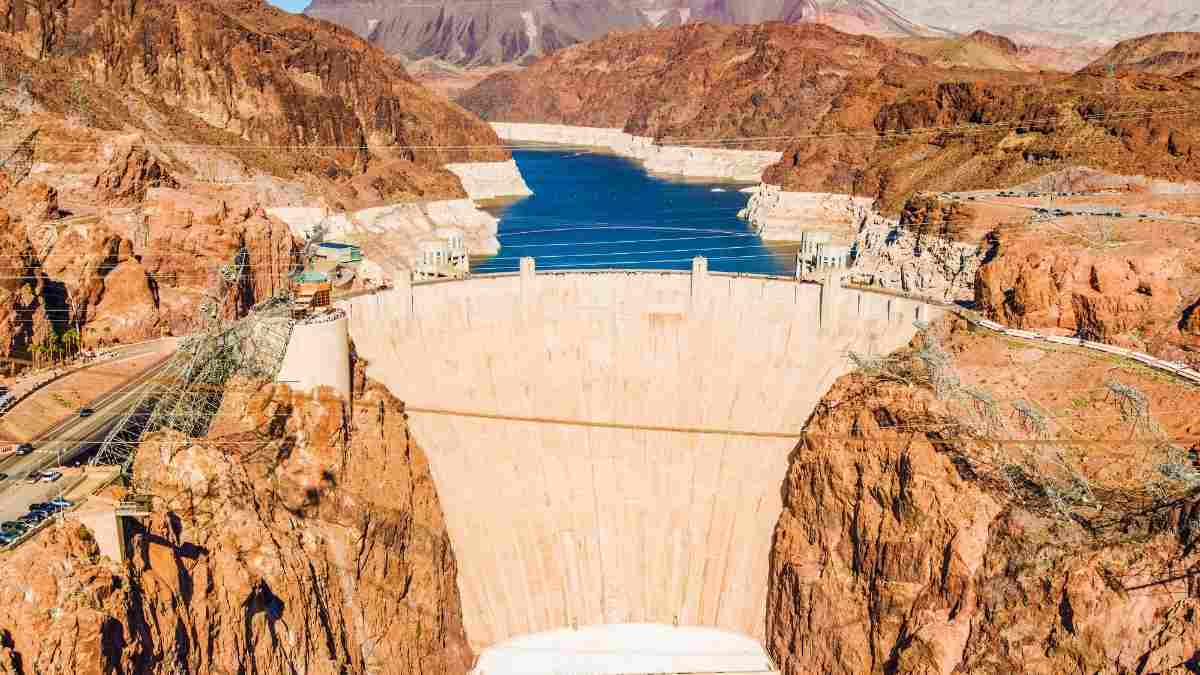
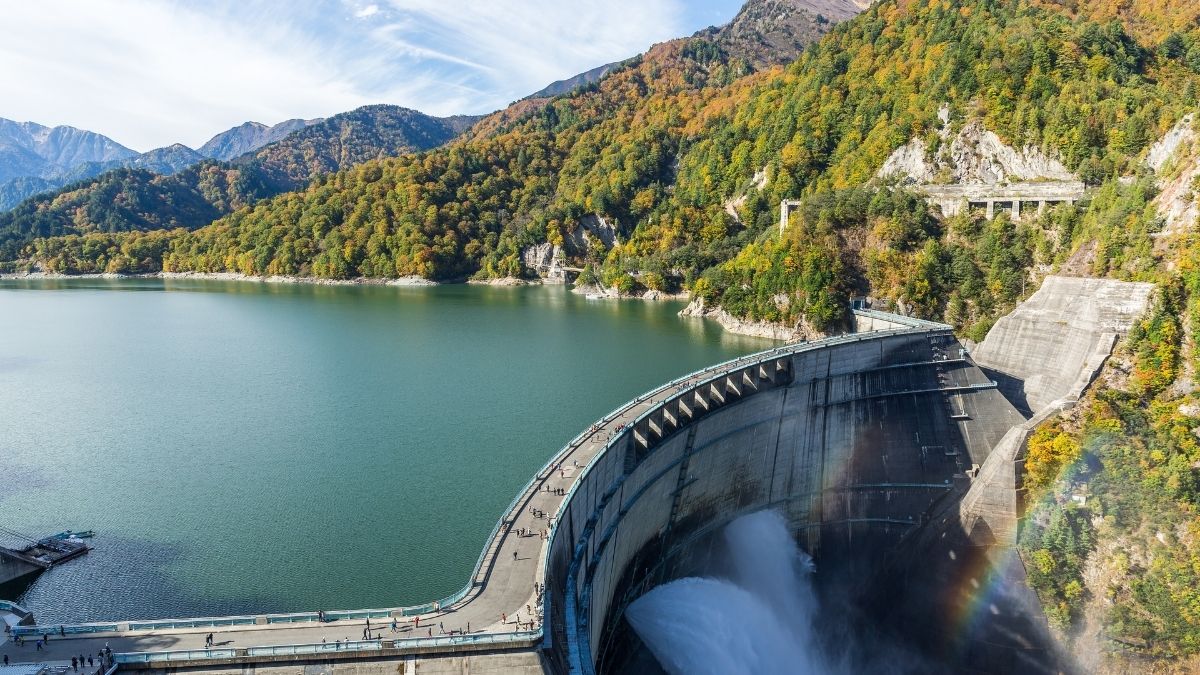
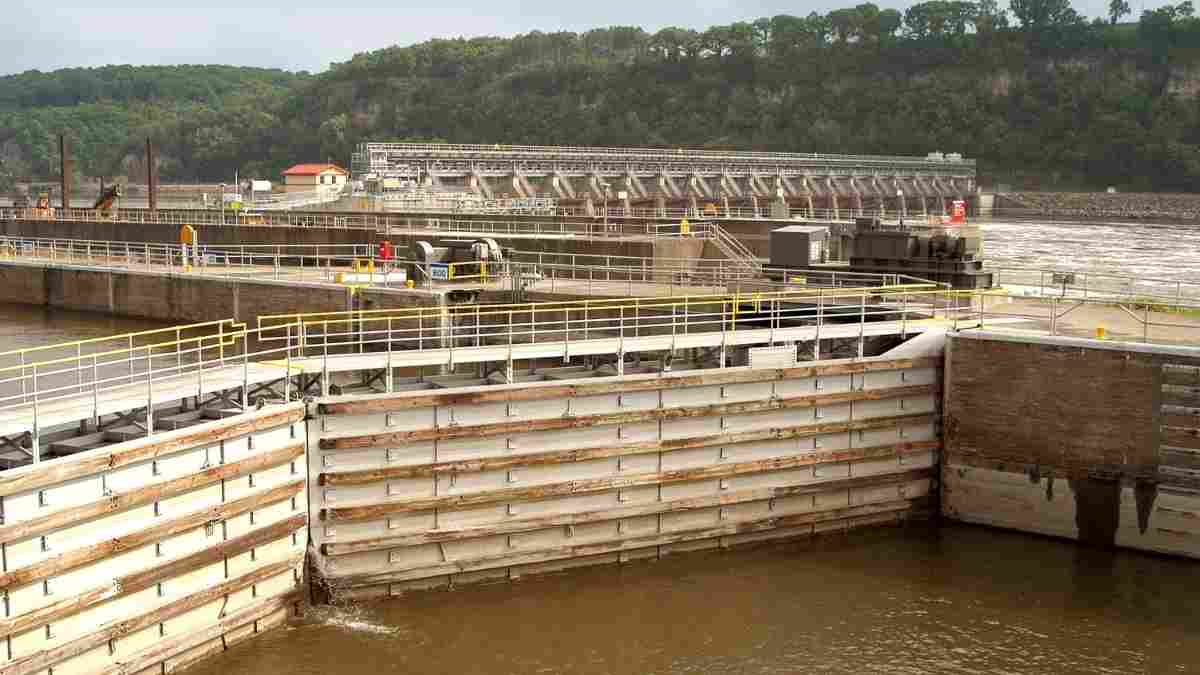

Components of Dams
The components of dams play an important role in maintaining the primary responsibility of water management. The parts of the dams are broadly classified as follows.
- Water-retaining structure
- Water-releasing structure
- Water conveying structure
Components of Dam – Youtube video
Water-retaining structure – Components of Dam
The water-retaining structure is the dam’s walled structure that resists water while allowing a controlled amount to flow downstream. The side of the barrier where water is collected is known as the upstream side. Where the water flows is known as the downstream side. Generally, the following component of dams makes up the dam’s water-retention section
- Heel
- Toe
- Abutment
- Crest
- Cutoff
- Parapet wall

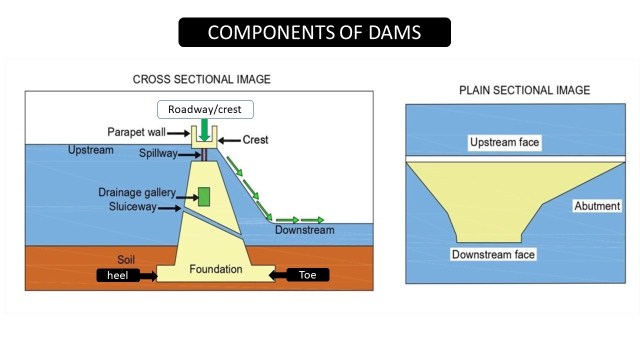
Heel
The part of the dams meeting with the groundwater or upstream side is called the heel. (Ref fig.)
Toe
The portion of the dams meeting with the groundwater or downstream side is called the Toe.(Ref fig)
Abutment
Abutments support the lateral pressure. These are the sides of the valley. These are concrete or masonry structures.
Crest/Roadway of Dams
The section of the dams used as a roadway or walkway is the crest. It is the upper area of the dam.
Cut off
The cut-off is an impervious barrier constructed beneath the earthen dams. The main function is to reduce the loss of stored water in the reservoir by preventing seepage.

Parapet wall
The parapet wall is seen below the crest near the roadway. This assists in the dam investigation and safety barriers.
Water-releasing structure: Components of dams
Mainly, the components of dams that allow water to flow downstream are known as the water-releasing structure. These dam components are technically known as the dam’s spillways. The spillway’s mechanism allows for controlled water volume. A spillway contains the following components.
- Galleries
- Spillways
- Diversion tunnel
- Sluice way
- Free board
Galleries
These are hollow openings passing through the dam as shown in fig. The main purpose of providing a drainage gallery is to collect seepage water from the foundation and body of the dam and drain it out. The seepage water received by foundation galleries is drained away under gravity. The galleries are broadly divided into …
- Grouting gallery
- Inspection Gallery
- Drainage gallery
- Valve gallery
- Transformer Gallery

Spillway
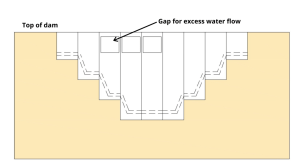
The role of the spillway is to convey excess water and prevent damage. The water passes from upstream to downstream. The spillway helps in the emergency discharge of water.
They are two varieties
- Controlled spillway
- Uncontrolled spillway
In a controlled spillway the flood flow is regulated by the gate.
Also Read : Spillway types and features – A comprehensive guide
Diversion tunnel
The purpose of the diversion canal is to redirect the water. Diversion tunnels are constructed during the construction stage of dams.
A diversion tunnel may also be constructed to divert floodwater. It can redirect water from mountainous regions to low-lying areas experiencing a water shortage supply.
Sluice way
The role of the sluiceway is to remove the silt accumulated.
Free board
The interval between the dam heads to the maximum water level on the upstream side.
Water conveying structure – Components of dams
Water-conveying structure mainly conduit and conveys the water from reservoirs through, around, or under an embankment dam
Conduit
These are closed pipe structures. Conduits act as a passage for the water supply. Bottom discharge conduits are pipes. They cross the body of the dam from the upstream to the downstream sides. This enables water flow.
Examples of some major dams
Bhakra Dam ( Gravity dam )
The Bhakra Dam is an Indian gravity dam built across the river Sutlej in Himachal Pradesh. This dam is constructed in 1963. The height of the dam is 226 meters. The length of the dam is 518 meters.
Gobind Sagar is a reservoir of this dam. The Bhakra Dam is composed of alternating layers of light red clays and sandstone.
This dam has four spillways. It helps in irrigation, hydroelectric power generation and recreation. The major source of irrigation water supply in Haryana, Punjab and Rajasthan is this dam.
Idukki dam ( Arch dam )
Idukki dam is an arch dam constructed across the Periyar river in Kerala. It is 554 feet high. One of the biggest arch dams in Asia. The dam provides hydroelectricity, irrigation and tourist destinations. It is built between Kuravan and Kurathi hills.

Nagarjuna Sagar Dam (Masonry Dam)
Nagarjuna Sagar Dam is a stone masonry dam completed in 1967. The dam is a symbol of modern architecture. The purpose of this project was to generate hydroelectricity. It has a 26-crest gate.
The Hirakud Dam (Earthern dam)
The Hirakud dam is located in Orissa state over the river Mahanadi near Sambalpur. The length of the dam is 4800 meters and 59 meters high. It is the oldest multipurpose dam completed in 1957.
The Hirakud Dam is the 4800-meter long and 59 meters high. The gross storage capacity of the dam is 1841 million cum.
KARIBA DAM (Double curvature arch dam)
Kariba Dam is a double curvature arch dam constructed in 1960. It has been built over the Zambezi river. The crest length is 620m and 128m high. The dam provides an example of improving the quality of rocks.
Key Takeaways
- Primary Functions: Dams manage water for various uses, including storage, irrigation, hydroelectric power, flood prevention, recreation, and debris control.
- Components: The main components include water-retaining structures such as the heel, toe, abutment, crest, cutoff, and parapet wall. Water-releasing structures include galleries, spillways, diversion tunnels, sluice ways, and freeboard. Water-conveying structures are conduits.
- Types of Dams: Dams vary by construction and purpose. Examples include gravity dams, arch dams, masonry dams, earthen dams, and double curvature arch dams.
- Examples: Major dams include Bhakra Dam, Idukki Dam, Nagarjuna Sagar Dam, Hirakud Dam, and Kariba Dam.
- Environmental and Economic Benefits: Dams provide essential benefits like water supply, power generation, flood control, and recreational opportunities.
Conclusion
Dams are crucial infrastructure for effective water management and offer significant environmental, economic, and social benefits. We can appreciate the role of dams by understanding their various components and functions. They are important for water storage, irrigation, hydroelectric power, and flood prevention. Each component plays a vital part in the dam’s functionality. From the water-retaining to the water-releasing and conveying structures, they ensure efficiency. Examples like Bhakra Dam, Idukki Dam, and Kariba Dam demonstrate the diverse applications and benefits of these impressive engineering feats. Effective dam management is essential for sustainable development and environmental protection.
 vin civilworld