
Types of rails are mainly divided into three. Double headed rails, bull headed rails and flat footed rails. You will come to know all the important details of each of them with figures in the blog.
In this blog, we’ll explore the various types of rails, offering a detailed look at their unique characteristics and applications. We’ll define rails and delve into the specific types of rail sections. The rail types includes bull headed rails, double headed rails, and flat bottom rails etc. Each rail type will be examined for its design. Their uses and advantages will also be discussed. This will provide you with a comprehensive understanding of these essential components in rail systems.
Let’s start from scratch. What are rails?
What are Rails?
Rails are an important component of railway tracks. They are high carbon rolled steel sections. These sections are laid end-to-end in two parallel lines over sleepers. This provides a continuous and levelled surface for trains to move. It also helps in carrying axle loads of the rolling stock.
Rails are essential components in railway systems, providing the track on which trains run. They come in various types of rails, including bull headed rails, double headed rails, and flat bottom rails. Each type serves a specific function, influencing stability and safety. Understanding the types of rail sections helps in selecting the right rails for efficient and reliable rail operations.
Let’s deep into the types of rails.
Main Types of Rails
Types of rails are crucial in rail infrastructure, each designed for specific needs and conditions. Understanding types of rail sections helps in selecting the appropriate rail for various applications. There are mainly 4 types of rails. In this blog, we will explore these 4 key types of rails:
- Double Headed Rails
- Bull Headed Rails
- Flat Bottom Rails
- Vignole Rails
Each section will include a detailed figure for clarity.
Double headed rails
Double headed rails indicate the early stage of development. It essentially consists of three parts, such as upper table, web and lower table. Both the upper and lower tables were identical. They were introduced with the hope of doubling the life of rails.
When the upper table is worn out, the rails can be placed upside down. They can be reversed on the chair. This way, the lower table can be brought into use.
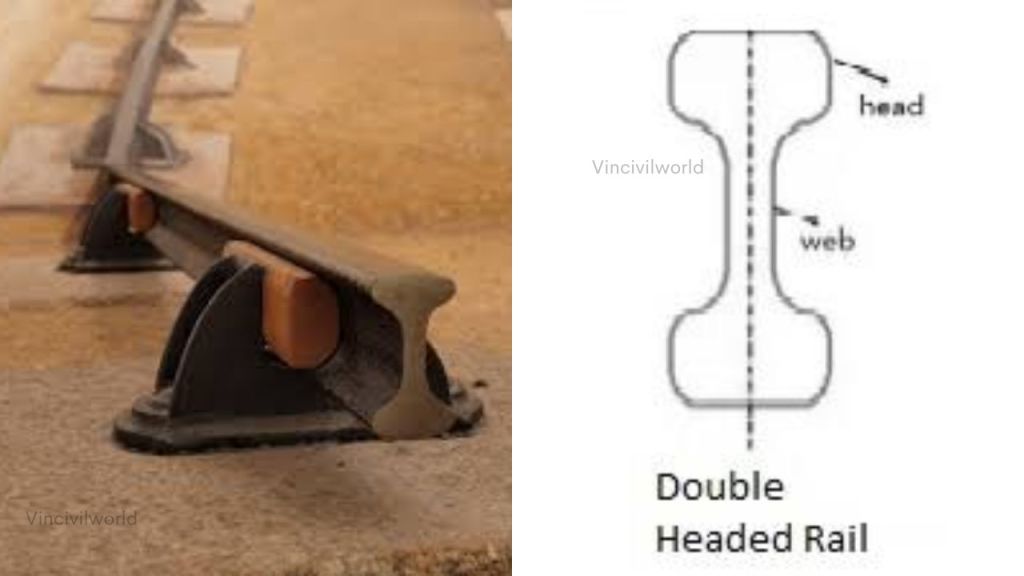
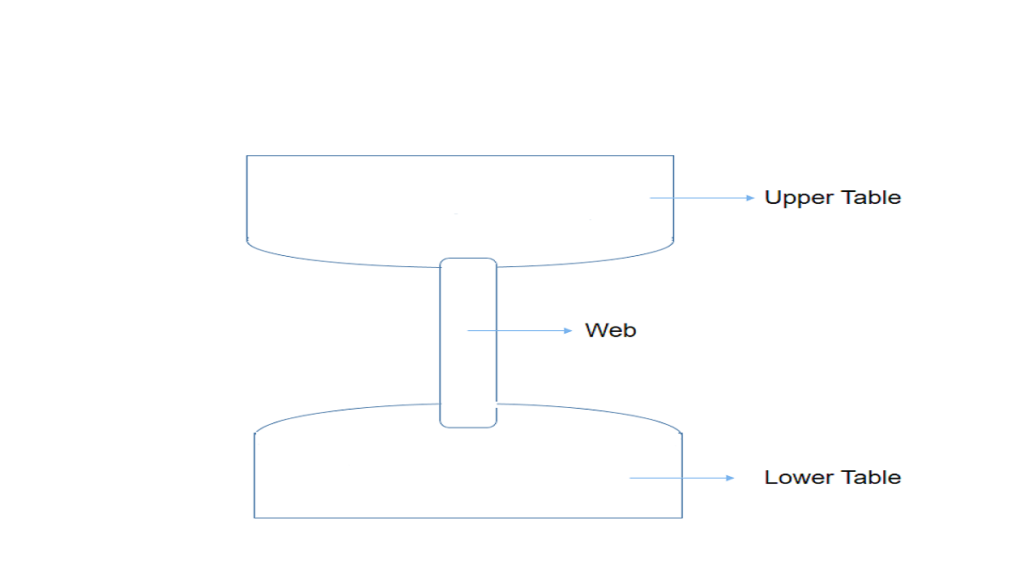
But this idea soon turned out to be wrong. The continuous contact of the lower table with the chair made the surface of the lower table rough. Hence, the smooth running of the train was impossible.
Therefore, this type of rail is practically out of use. Nowadays, these rails vary in lengths from 20- 24.
The rail sections, whose foot and head are of same dimensions, are called double headed rails. In the beginning, these rails were widely used in the railway track.
The idea behind using these rails was that when the head had worn out due to rubbing action of wheels, the rails could be inverted. The rails could then be reused. But by experience, it was found that their foot could not be used as running surface because it also got corrugated under the impact of wheel loads.
Its time to meet the second type of rails which are bull headed rails.
Bull headed rails

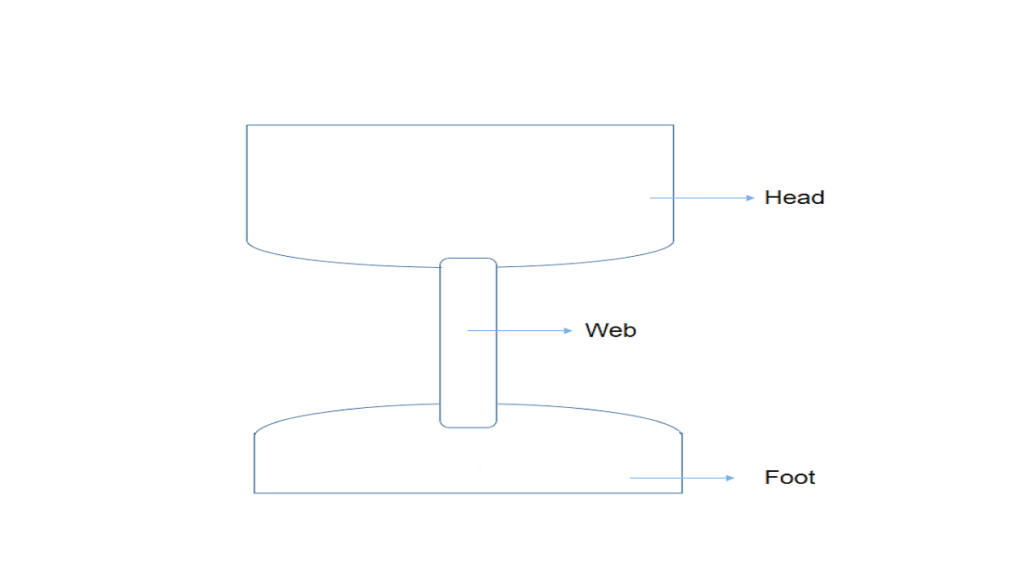
The rail section whose head dimensions are more than that of their foot are called bull headed rails. In this type of rail the head is made little thicker and stronger than the lower part by adding more metal to it. These rails also require chairs for holding them in position.
Bull headed rails are especially used for making points and crossings. This type of rail also consists of three parts, such as the head, the web and the foot. These rails were made of steel.
The head is of larger size than foot and the foot is designed only to hold up properly the wooden keys with which rails are secured. Thus, the foot is designed only to furnish necessary strength and stiffness to rails.
Two cast iron chairs are required per each sleeper when these rails are adopted. Their weight ranges from 85lb to 95lb and their length is up to 60ft.
That’s it about bull headed rails. Let’s move on to the third member in the list of types of rails, which are flat footed rails.
Flat footed rails

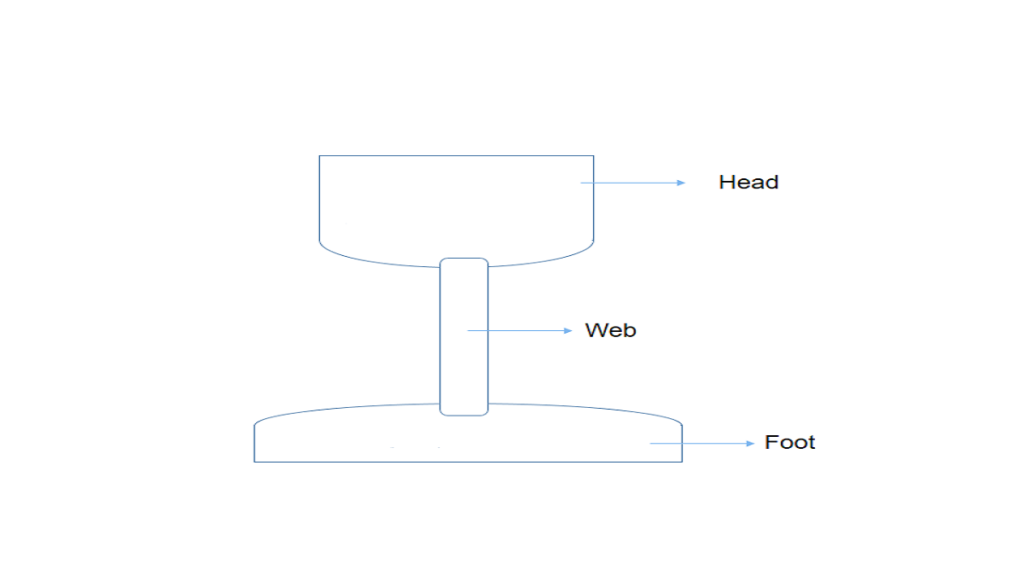
The rail sections having their foot rolled to flat are called flat footed rails. This type of rail was invented by Charles Vignola in 1836.
It was initially thought that the flat footed rails could be fixed directly to wooden sleepers. This would eliminate chairs and keys required for the BH rails. But later on, it was observed that heavy train loads caused the foot of the rail to sink into the sleepers. The heavy train loads also made the spikes loose.
Flat footed rails consist of three parts, such as head web and foot. The foot is spread out to form a base. This form of rail has become so popular. About 90% of railway tracks in the world are laid with this form of rails.
Flat footed rails have the following advantages.
Advantages of flat footed rails
- They do not need any chair and can be directly spiked or keyed to the sleepers. Thus they are economical.
- They are much stiffer both vertically and laterally. The lateral stiffness is important for curves.
- They are less liable to develop kinks and maintain a more regular top surface than bull headed rails.
- They are cheaper than bull headed rails
- The loads from wheels of trains are distributed over large number of sleepers and hence larger area which results in greater track stability, longer life of rails and sleepers, reduced maintenance, costs, rail failure and few interruptions to traffic
Industrial Railway Rails
Industrial railway rails are specially designed rails used in industrial environments such as factories, mines, and ports. These rails are heavier and more robust than conventional railway rails to withstand high axle loads, frequent stopping and starting, and harsh conditions. Typically, they conform to standards like the AREMA Class 1 and can weigh between 112 to 141 pounds per yard. Industrial rails provide durability, strength, and resistance to wear, ensuring reliability for transporting heavy goods and equipment within industrial premises.

Crane Rails
Crane rails are specialized rails designed to support the movement of overhead cranes and gantry cranes in industrial facilities. They have a wider head and base to provide stability and distribute heavy crane loads evenly. Crane rails are typically more rigid and wear-resistant than standard rails, often stocked in weights like 60 kg/m or higher. They ensure smooth crane operation, safety, and longevity under continuous heavy loading and lateral stresses encountered in crane tracks.
The Most Used Rail Profiles Worldwide Presently
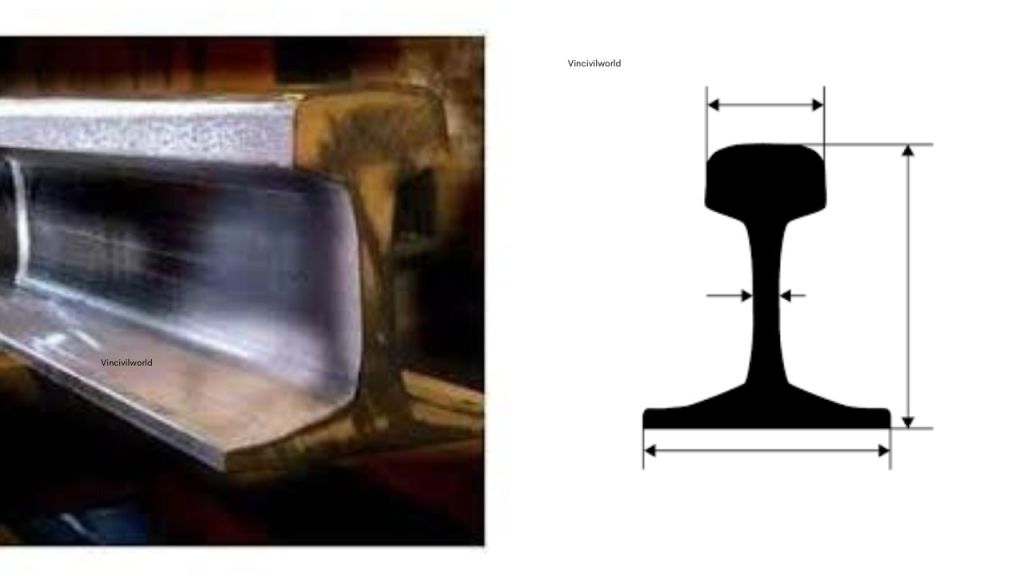
In contemporary railway engineering, the flat footed rail profile is very prevalent. It is also known as the Vignole rail. It is the most widely used rail profile globally. This profile has a flat, wide foot. It can be spiked directly to sleepers. This design eliminates the need for additional support such as chairs. Flat footed rails are favored for their structural efficiency. They are known for durability and ease of installation. This makes them ideal for standard and heavy-duty railway tracks.
Common modern flat footed rail profiles include the internationally standardized UIC60 (60 kg/m), prevalent on mainline railways worldwide, and the 115RE profile (approximately 56.9 kg/m), widely used in North America. Regional variations such as DIN rails in Europe and other heavy or light profiles also follow the flat bottom design. These flat footed/Vignole rails offer superior load distribution, enhanced stability, and cost advantages over traditional bull headed rails, leading to their dominant use in global rail infrastructure.
Key Takeaways
Understanding the various types of rail is essential for optimizing railway infrastructure. Types of rail sections include double-headed rails, bull-headed rails, and flat-footed rails. Double-headed rails have symmetrical upper and lower tables. They aimed to extend rail life. However, they are now rarely used due to maintenance issues. Bull-headed rails feature a thicker head for strength and are commonly used in points and crossings. Flat-footed rails, introduced by Charles Vignole, are widely adopted in modern railways due to their ease of installation and cost-efficiency. Each of these types of rail sections serves specific needs, influencing track stability and performance.
Conclusion
In conclusion, the selection of rail types profoundly affects railway system efficiency. Types of rail sections, such as double-headed rails, bull-headed rails, and flat-footed rails, each have distinct characteristics and applications. Double-headed rails are largely obsolete, while bull-headed rails remain useful for specific rail components. Flat-footed rails, with their practical advantages, dominate modern rail systems. A comprehensive understanding of the types of rail and their properties is crucial. This is essential for effective rail system design and maintenance. It ensures optimal performance and longevity.
Was the article helpful? Let me know your thoughts in the comments.
Happy learning!
MUST READ: Applications of Intelligent transportation system- everything you want to know
 vin civilworld