
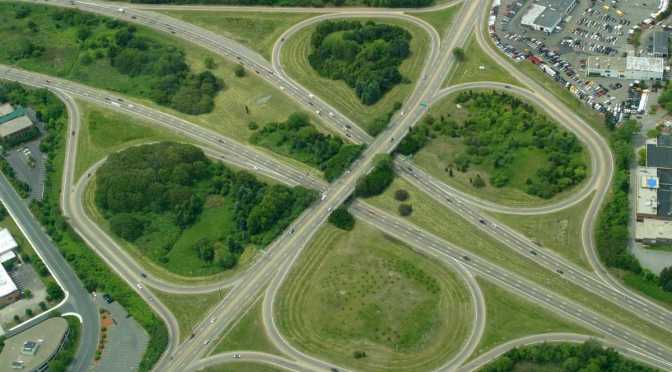
The cloverleaf interchange is one of the attractive innovations in civil engineering. A cloverleaf interchange is a two-level interchange at which left turns are done by ramp roads (reverse directions in left-driving regions). It is not only aesthetically pleasing but also provides several advantages to the transportation system.
The cloverleaf interchange is a vital road design. It allows traffic to flow freely between highways without the need for signals or stops. Commonly used in the past, the clover leaf highway design features looping ramps to guide vehicles between roads. Despite its benefits, it also creates issues like traffic weaving and large land use. In modern traffic management, the cloverleaf interchange is still functional but faces challenges due to increased traffic volumes.
In the upcoming sections, we will discuss examples of clover leaf highways around the world. We will talk about the problems with these interchanges. We will also explore alternatives to the traditional clover leaf flyover design for more efficient road management.
Let’s start from scratch.
- What is cloverleaf interchange ?
- Design and Purpose of a Cloverleaf Interchange
- Examples of cloverleaf interchange in India and around world
- Cloverleaf interchanges – Main problems and challenges
- Solutions to Cloverleaf Interchange Problems
- Upgrades for cloverleaf interchanges
- Traffic signals in leu of cloverleaf interchange
- Future of Cloverleaf Interchanges
- Key Takeaways
What is cloverleaf interchange ?
- A cloverleaf interchange is a two-level interchange at which left turns are done by ramp roads (reverse directions in left-driving regions).
- Vehicles first proceed to go left (in right-hand traffic) as one lane crosses over or below the other. Then, exit right onto a one-way three-fourth loop ramp (270 °) and merge onto the intersecting road.
- The purpose of a cloverleaf is to allow two highways to cross. This removes the need for any traffic to be stopped by red lights. Only the left and right turns need to stop.
- Traffic weaving is the limiting factor in a cloverleaf interchange’s ability.

In the next section, let me take you through some examples of clover leaf in India.
Design and Purpose of a Cloverleaf Interchange
The cloverleaf interchange is a unique road design that allows traffic to flow seamlessly between intersecting highways. Its design minimizes the need for traffic signals and improves overall traffic efficiency.
What is a Cloverleaf Interchange ?
A cloverleaf interchange is a type of road junction where two highways intersect, allowing traffic to transition without stopping. This design features looping ramps that resemble a clover leaf, helping vehicles smoothly merge between lanes. It’s often used for high-traffic areas, providing a continuous flow on clover leaf highways.
Structure and Layout of a Cloverleaf highway.
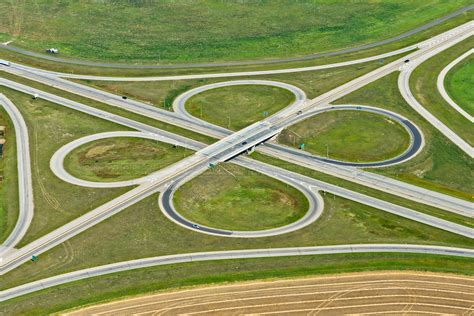
The cloverleaf interchange consists of four looped ramps that create the characteristic clover-leaf shape. Each loop directs vehicles from one clover leaf highway to another, avoiding sharp turns and minimizing conflict points. This layout requires large land areas and is typically used in wide-open spaces or highway intersections.
How Traffic Flows in a Cloverleaf Interchange
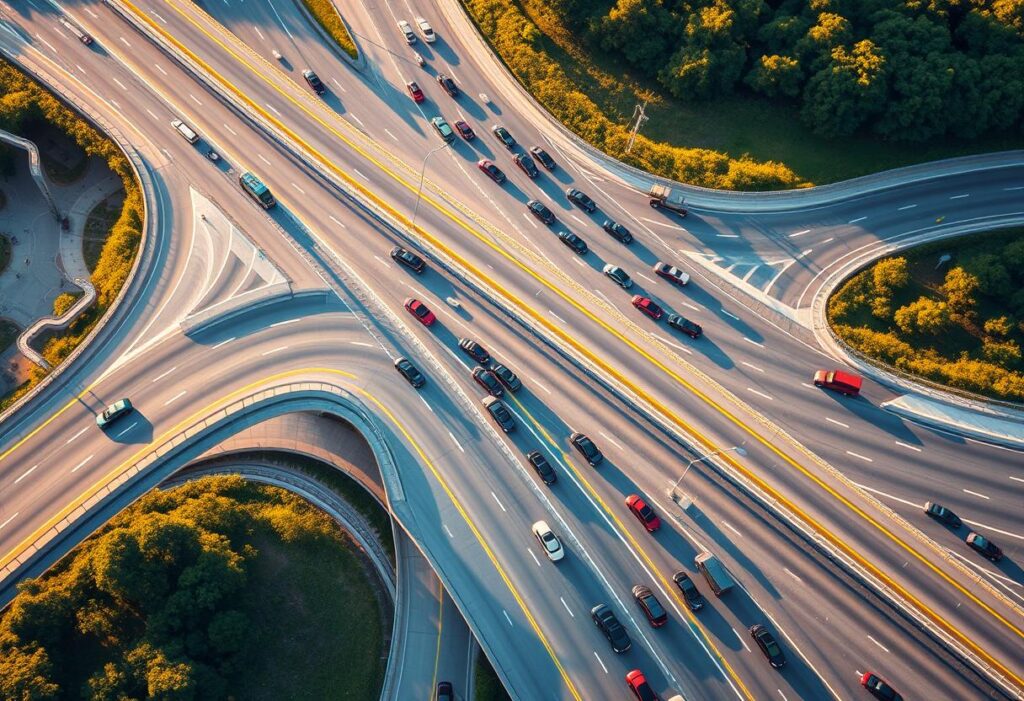
In a cloverleaf flyover, traffic flows through looping ramps, allowing vehicles to exit and enter clover leaf highways without stopping. The loops guide cars in a continuous circular path to merge onto connecting highways. While efficient for moderate traffic, issues like weaving occur as vehicles enter and exit the loops.
Advantages of the Cloverleaf Flyover Design
The cloverleaf interchange allows for uninterrupted traffic flow, reducing congestion and eliminating the need for traffic lights. It’s particularly effective for clover leaf highways, where high-speed traffic requires seamless movement. Additionally, the design is easy to implement and was historically favored for reducing collisions in clover leaf flyover systems.
Related trending posts from vincivilworld


Examples of cloverleaf interchange in India and around world
Cloverleaf Interchanges Worldwide
- North America
- New Jersey Turnpike, USA
- Gardiner Expressway and Highway 427, Canada
- Europe
- A1 and A4 Intersection, Germany
- M8 and M9, Scotland
- Asia
- Outer Ring Road, India
- Tokyo Expressway Cloverleaf, Japan
- Other Regions
- Australia and South American Examples
Cloverleaf interchanges in India
- Kathipara Cloverleaf, Chennai
- Maduravoyal Cloverleaf, Chennai
- Koyambedu Cloverleaf, Chennai
- Badarpur Cloverleaf, Delhi
- Yamuna Cloverleaf-Noida
- Mukarba Chowk Cloverleaf, Delhi
- BMIC Cloverleaf, Karnataka
Also read: Road pavement structure-Components and functions
So, you got an idea about clover leaf roads. Let me quickly walk you through the major challenges and problems associated with this.
Cloverleaf interchanges – Main problems and challenges
The cloverleaf interchange offers a continuous flow of traffic. However, it comes with several drawbacks. These drawbacks impact its efficiency and safety. Understanding these common problems is crucial for improving modern road networks.
Traffic Weaving Issues
The cloverleaf interchange creates traffic weaving as vehicles merge and diverge on the looping ramps. This weaving can lead to congestion and increased accident risk, particularly on high-speed clover leaf highways. Vehicles navigating these loops often cross multiple lanes, complicating traffic flow and safety.
- The biggest downside of the cloverleaf’s classic configuration is at the end of a loop. Vehicles converge on the highway immediately before other vehicles exit to go around another loop. This causes a dispute known as weaving.
- Weaving restricts the number of traffic-turning lanes.
- Since then, the majority of road authorities have adopted new interchange designs. These designs include less-curved exit ramps which do not lead to weaving.
- These interchanges include diamond, parclo, and single-point urban interchanges (SPUI). They are used when connecting at the crossroads to an arterial road in non-free-flowing traffic. The stack or clover and stack hybrids are used when connecting in free-flowing traffic to another freeway. They are also used when connecting to a busy arterial where signals are not yet needed.
Space Consumption and Land Use
A significant issue with the cloverleaf interchange is its large footprint. The extensive looping ramps require considerable land, making it challenging to fit into densely populated areas. This high space consumption affects land use, making clover leaf highways less feasible in urban settings.
Safety Concerns and Collision Rates
Safety is a major concern with the cloverleaf interchange. The design’s complex loop system increases the likelihood of collisions due to merging and diverging traffic. The clover leaf highway layout can result in high accident rates. This is particularly true in busy intersections. It is also an issue in poorly maintained clover leaf flyover areas.
Limited Capacity for Modern Traffic Volumes
Modern traffic volumes often exceed the capacity of the cloverleaf interchange. The design, while effective for earlier traffic levels, struggles with today’s high traffic flows, leading to congestion. Clover leaf highways may become bottlenecks, causing delays and inefficiencies as demand grows.
Solutions to Cloverleaf Interchange Problems
Addressing the issues associated with the cloverleaf interchange requires innovative solutions to enhance traffic flow and safety. By redesigning and upgrading these interchanges, we can improve their efficiency and adaptability to modern traffic demands.
Redesigning for Traffic Volume
To manage increased traffic volumes, redesigning the cloverleaf interchange can optimize its capacity. Incorporating additional lanes or reconfiguring loops can reduce congestion and improve flow on clover leaf highways. Such redesigns address the high traffic demands and mitigate the problems associated with outdated clover leaf flyover designs.
Implementing Traffic Control Signals
Adding traffic control signals at critical points within a cloverleaf interchange can help manage vehicle flow more effectively. Signals can regulate entry and exit ramps on clover leaf highways, reducing weaving and improving overall safety. This solution helps control high traffic volumes and enhances operational efficiency.

Expanding or Converting Cloverleafs to Stack Interchanges
Expanding or converting cloverleaf interchanges to stack interchanges offers a modern alternative. Stack interchanges provide multiple levels of roadway, eliminating the need for looping ramps. This conversion can significantly increase capacity. It can also reduce congestion on clover leaf highways. These advantages make it a practical solution for high-traffic areas.
Upgrades for cloverleaf interchanges
- For new interchanges, not only are these ideas valid, but they also hold when existing cloverleaf interchanges are upgraded.
- The exchange between US 13 and US 58 was originally a cloverleaf in Norfolk, Virginia. It has since been turned into a SPUI.
- In addition, several cloverleaf interchanges are being upgraded to parclos on California freeways, such as U.S. 101. In Hampton, Virginia, a cloverleaf interchange was partly unwound into a partial stack interchange between Interstate 64 and Mercury Boulevard.
- As part of a major highway improvement project, the highway is being upgraded to Interstate standards. Four cloverleaf interchanges along I-64/US 40 in St. Louis, Missouri, were substituted with SPUIs between 2008 and 2009.
- Adding a collector/distributor route next to the highway is a compromise. This does not prevent weaving. However, it takes weaving off the main lanes of the freeway. An example of this is the Sheboygan, Wisconsin, State Highway 23/Interstate 43 interchange. The exit/entrance roads on and off Highway 23 are two lanes. They are on the north and southbound sides of the road next to the main I-43 freeway.
Traffic signals in leu of cloverleaf interchange
- Several cloverleaf interchanges on the non-freeway route have been removed by installing traffic signals.
- This is also done sometimes at the intersection of two freeways. This particularly happens when one freeway ends at an interchange with another.
- An example of this is at the intersection between Interstate 5 and Washington State Route 512 in Lakewood, Washington. A noticeable ramp stub reveals that one of the four leaves has been cut. This change has removed weaving on I-5.
- The traffic signal will be replaced by a two-lane flyover in the future, again completing the freeway-to-freeway interchange.
- Cloverleaf exchanges often appear to consume much more land than any other form of exchange. The only exceptions are stack interchanges.
- Numerous cloverleaf intersections exist in the Lower Mainland of British Columbia, Canada. Traffic merges from the clover directly into the collector/distributor lane.
- This allows the slowly moving driver to merge around the loop ramp. The rapidly moving driver leaves the collector/distributor lane without the ability to accelerate. This helps balance the oncoming driver’s flow.
- This merging velocity gap can be as high as 65 km/h (approx. 43 mph).
- In the United Kingdom, owing to these performance concerns, the cloverleaf interchange was not introduced in significant numbers. Originally, there were three, one in Redditch and two in Livingston.
- In Ontario, most cloverleaf interchanges have been phased out, but with similar traffic patterns, some near variants remain.
- However, the key difference is that single bidirectional carriageways share the adjacent on and off-ramps.
- Examples include the intersection in Belleville, Ontario, between Highway 62 and Highway 401. Another example is the interchange in Toronto between Lawrence Avenue and Don Valley Parkway.
Future of Cloverleaf Interchanges
The future of cloverleaf interchanges lies in integrating advanced technologies and sustainable practices. As traffic demands evolve, innovative solutions will enhance the functionality and environmental impact of these iconic highway designs.
Smart Traffic Systems and Automation
Implementing smart traffic systems and automation can revolutionize the cloverleaf interchange. Advanced sensors and traffic management software will optimize traffic flow on clover leaf highways, reducing congestion and improving safety. Automation can streamline vehicle movements through clover leaf flyovers, adapting to real-time traffic conditions and minimizing delays.

Sustainability and New Approaches to Highway Design
The future of clover leaf highways includes adopting sustainable practices and new design approaches. Incorporating green infrastructure, such as noise barriers and energy-efficient lighting, can mitigate environmental impacts. Innovative designs will focus on reducing land use. They will also integrate eco-friendly materials in the cloverleaf interchange. This aligns with modern sustainability goals.
Integrating Multi-Modal Transportation
To enhance the cloverleaf interchange, integrating multi-modal transportation options is crucial. Adding provisions for public transit, cycling paths, and pedestrian walkways will improve overall connectivity. This approach will make clover leaf highways more versatile and accessible. It will accommodate various transportation modes. It will also reduce reliance on single-occupancy vehicles.
Key Takeaways
- Design and Purpose: The cloverleaf interchange facilitates smooth traffic flow between highways with minimal stops. It uses looping ramps to transition between roads.
- Common Problems: Issues include traffic weaving, large land use, safety concerns, and limited capacity for modern traffic volumes.
- Solutions: Redesigns, traffic control signals, and conversions to stack interchanges can address these challenges.
- Future Trends: Incorporation of smart traffic systems, sustainability practices, and multi-modal transportation options are key to enhancing cloverleaf interchanges.
Conclusion
Cloverleaf interchanges have played a significant role in traffic management by facilitating seamless highway transitions. Despite their benefits, challenges such as traffic weaving, extensive land use, and modern capacity limits need addressing. Future advancements, including smart technologies and sustainable practices, promise to enhance the efficiency and environmental impact of these interchanges. By embracing innovative solutions, we can optimize cloverleaf designs to better meet contemporary traffic demands and improve road network functionality.
So, how was the trip through the clover leaf interchange? Let me know in comments, if you have any queries.
 vin civilworld