
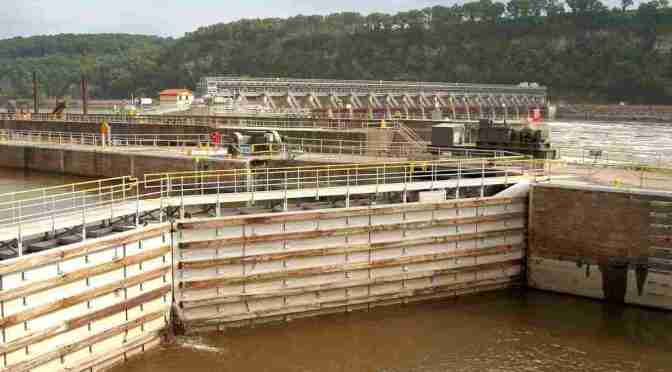
Cofferdams are temporary enclosures constructed in water bodies like lakes and rivers. They provide a dry working environment throughout the construction period. Cofferdams are temporary dykes that are built across a body of water. They allow the water to be pumped outside, ensuring a clean and dry construction site.
There are several types of cofferdams. These include sheet pile, rock-fill, and cellular types. Each is suited to different site conditions and project needs. The choice among cofferdam types depends on factors like water depth and soil conditions. Cofferdam construction often involves driving materials like sheet piles into the ground. This creates a watertight barrier. It ensures stability during foundation or underwater projects.
This article discusses the significance and definition of Cofferdam and construction methods of Cofferdams. It also explores the different types of cofferdams preferred in construction works.
Significance of cofferdams
Construction in water is the most challenging task in civil engineering. A safe and dry working environment is necessary to preserve the project’s safety and construction quality. However, various strategies are used to construct structures in the water and maintain the area’s dryness. One of the most popular and widely utilized ways is the use of cofferdam.
Related posts from vincivilworld


What is a Cofferdam?
Cofferdams are innovative structures that play a crucial role in underwater construction projects. These watertight barriers temporarily hold back water, enabling construction teams to work on submerged foundations safely and efficiently. The primary function of cofferdam construction is to create a dry workspace. This is done by pumping out the water inside once the structure is in place. This is essential for projects such as bridge construction, underwater excavation, and marine infrastructure development.
There are various types of cofferdams, each tailored to the specific requirements of the construction site. Cofferdams range from simple sheet pile designs to more intricate cellular designs. These cofferdam types are engineered to withstand the pressure of surrounding water. Proper cofferdam construction ensures a stable work environment, allowing for efficient operations even in challenging conditions. Understanding the different types of cofferdams is vital for selecting the right solution for each project. Let us dive deep into the Types of Cofferdams and their applications.
Types of cofferdams
Depending on the design requirements, water depth, soil conditions, type of material used, etc., coffer dams are classified into many types.
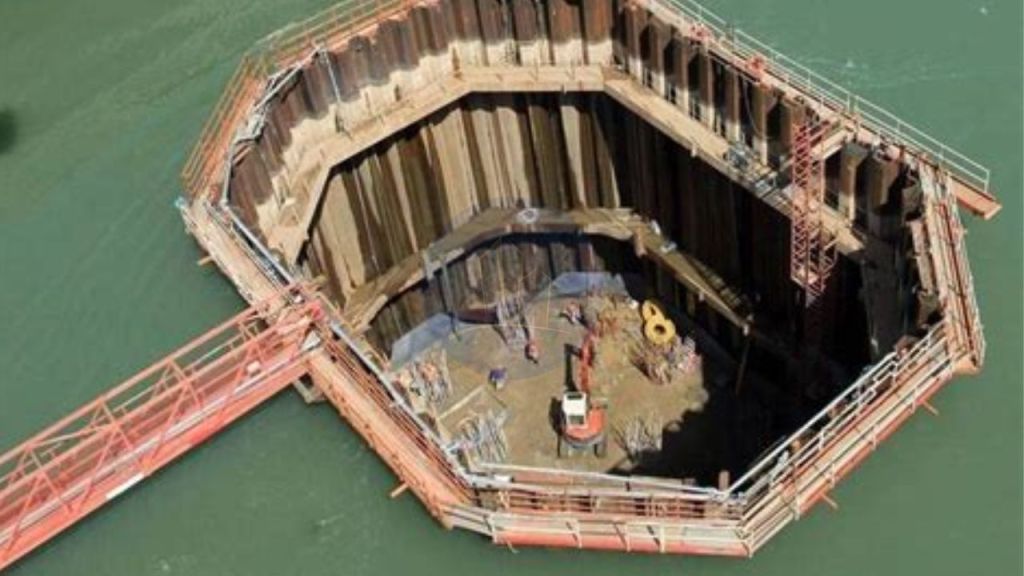
- Earth cofferdam
- Rock fill cofferdam
- Single sheet pile cofferdam
- Double-wall sheet piling cofferdam
- Braced cofferdam
- Cellular cofferdam
Earthen cofferdam
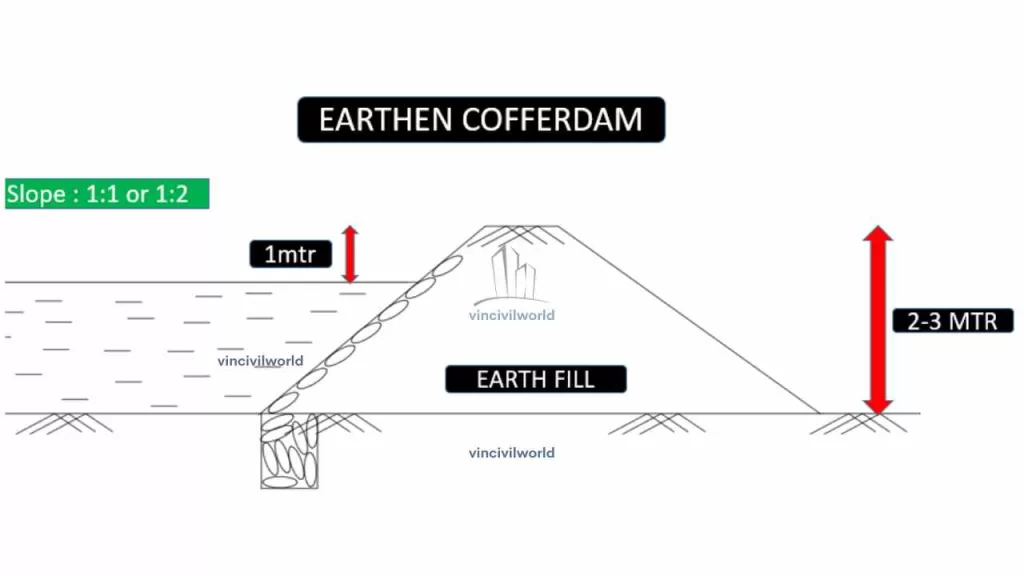
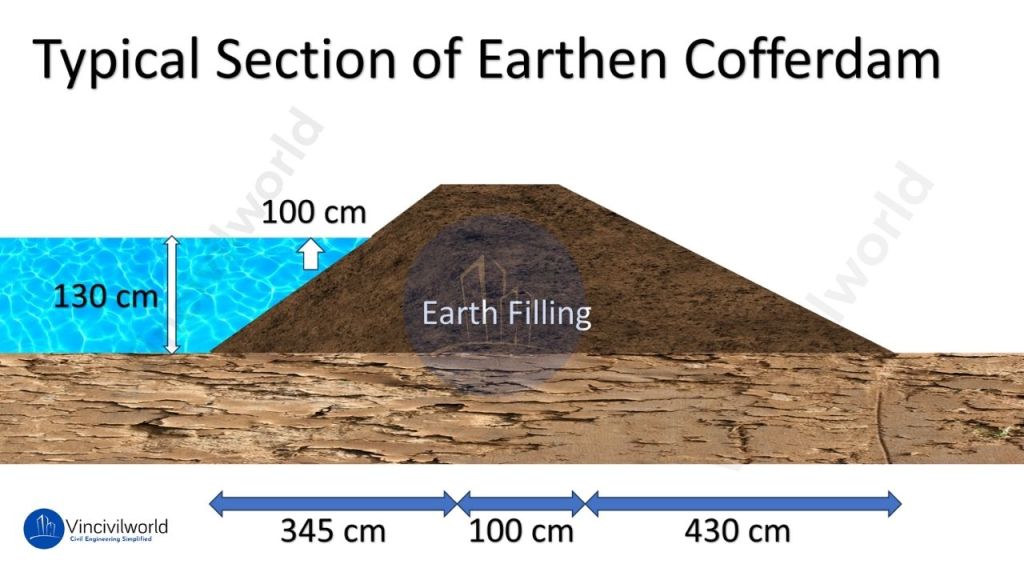
Earthen cofferdam is the most common and simplest type of cofferdam. They are appropriate for locations with minimal water depth and water current. Sand, soil, clay, and boulders that are readily available locally are used to construct earthen cofferdam. The earthen cofferdam must be at least one meter above the maximum water level.
When an area of excavation is quite extensive, earthen cofferdam is used and require a sizable base area. To withstand water pressure and seepage, impervious clay core or sheet piles are driven in the centre. In order to prevent scouring and possible dam failures, the upstream side is stone-pitched. These technologies do not, however, completely provide waterproof zones. Generally, to remove the water, pumps and waterproofing systems must be installed.
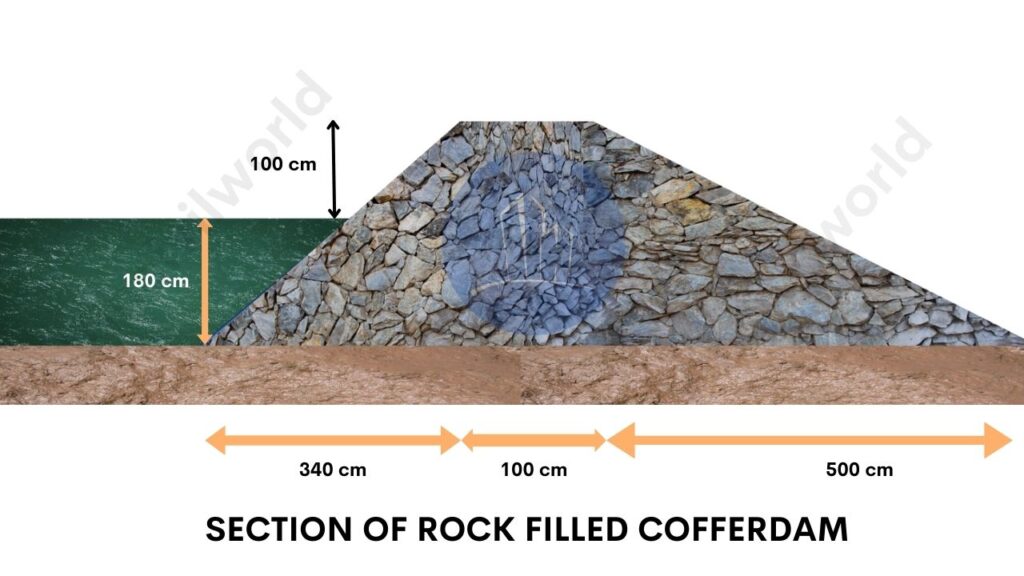
Rock-fill cofferdams
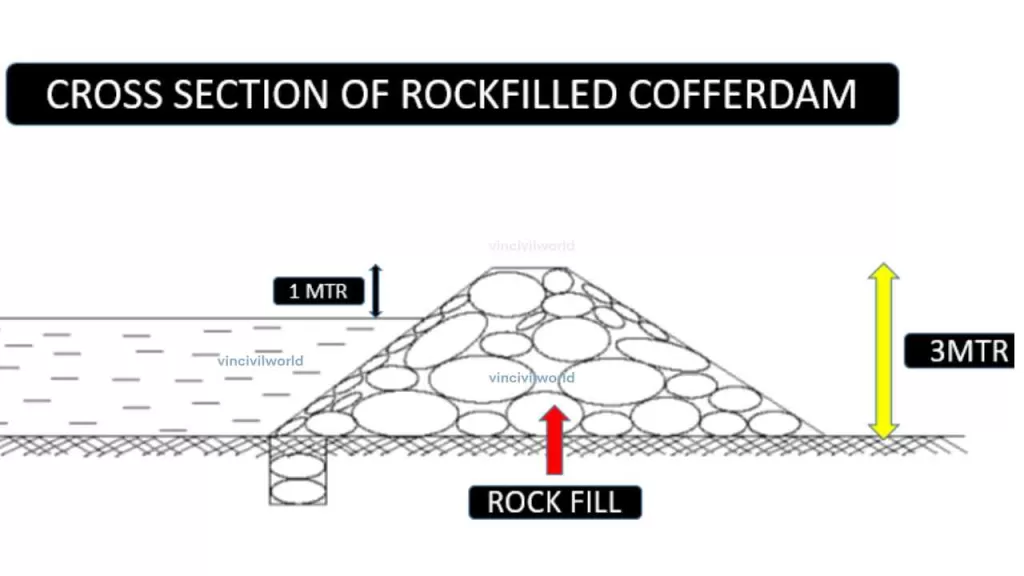
When compared to earthen cofferdams, rockfill cofferdams are superior. The choice of rockfill dams is influenced by the cost and availability of rocks in the area. Generally, the rockfill dam’s maximum height should be limited to under 10 feet. The rockfill area is pervious and will be lined with an impervious clay layer to prevent seepage and dam failure.
Single walled cofferdams
When the depth of the water is less than 6 meters, single-walled cofferdams are preferred. This is especially true when the area of work is localized, such as on a bridge pier. Single-walled coffer dams are primarily built by driving timber sheets into the exterior as guide piles. Then, steel sheets are driven into the inside as a support layer. In situations where the water is deep, guide piles may be steel sections.
After driving the guide piles, workers bolt wales or runners made of wood logs to them. This is done at appropriate vertical intervals. Wales position the inside sheets from the wooden planks. This is done at a specific distance as shown in the figure. Mostly, these wales are fastened to the sheets using bolts from both sides.
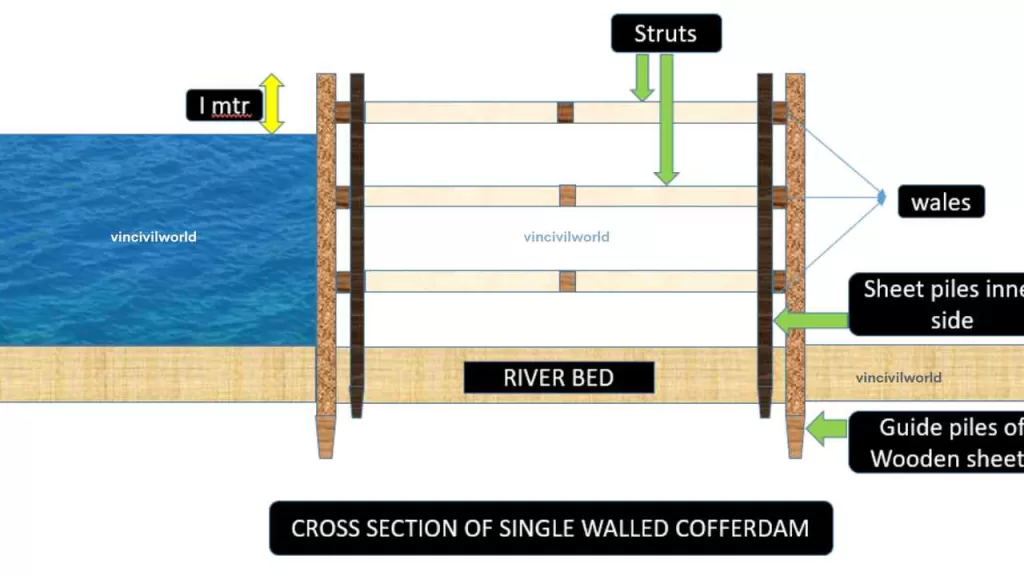
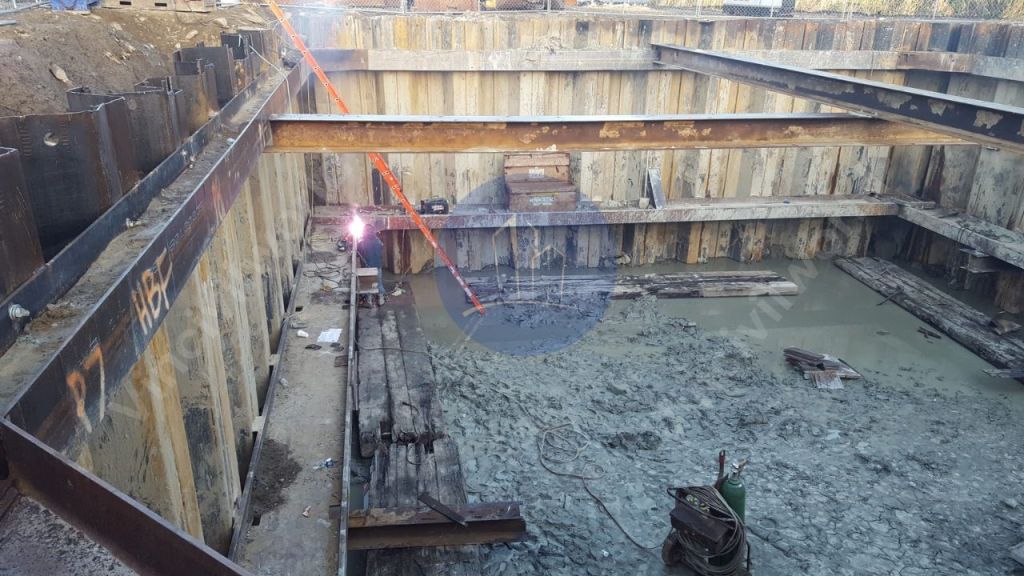
The inside sheet piles have strong bracing. Sandbags are positioned on both sides of the walls to increase stability even more. For clay, the penetration depth should be approximately 1 meter, 0.5-0.75 meters for sand, and 0.25-0.5 meters for gravel, etc. Construction can begin when the interior water has been pumped out.
Also Read : Reservoirs vs Dams – Reservoir – types and functions
Double walled cofferdams
Double-walled cofferdams are preferred when the construction area is large. They are also preferred when the water depth is higher than 6 metres. Single-walled cofferdams appear to be uneconomical in these conditions. Double-walled cofferdams Consist of two straight, parallel vertical walls of sheet piling coupled together, with the space between them filled with soil. If the height is greater than 3 mtr, double wall sheet piles must be strutted as illustrated in the figure.
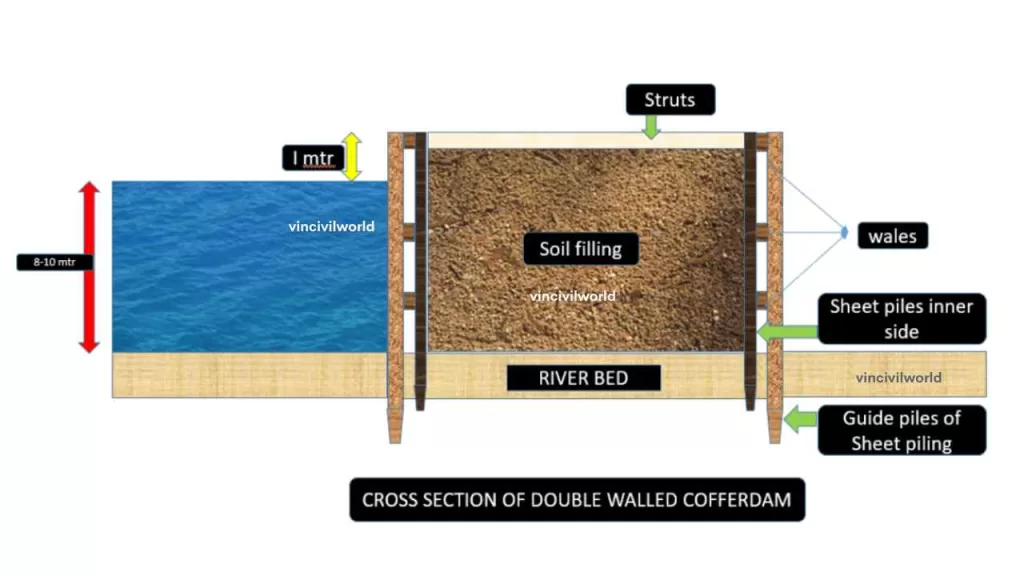
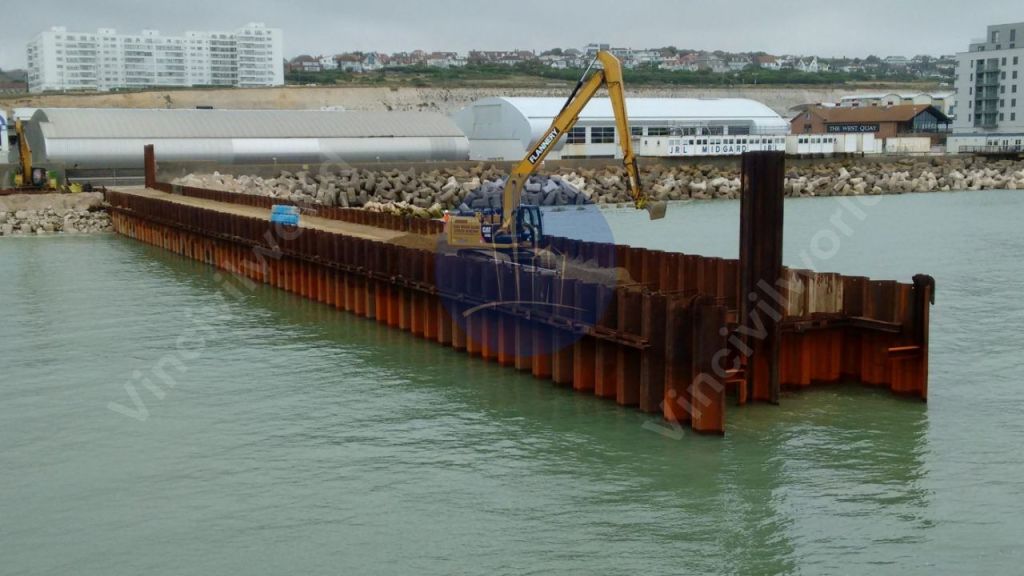
The filling materials must be carefully chosen to give stability to the cofferdam. The coefficient of friction must be taken into account. The sheet piles are driven into the bed in the upstream area. They are inserted to a good depth to avoid leaking from the ground below.
Braced Cofferdams
A braced cofferdam offers a solution when driving piles into the bed underwater is difficult. Engineers drive two piles into the bed and laterally support them using wooden cribs, which are installed in alternating courses. These cribs create pockets that are filled with stones and earth to stabilize the structure.
The cofferdam framework, typically made from logs, is constructed on land and then floated to the worksite for assembly. Workers dredge out loose material above the impervious bed and submerge the cribs to match the bedrock’s contours. After dewatering the pit, they pour concrete to form the foundation. Once the concrete cures above the waterline, the cofferdam is removed, leaving a stable base for ongoing construction activities. This method effectively provides a dry work area, showcasing the advantages of braced cofferdams.
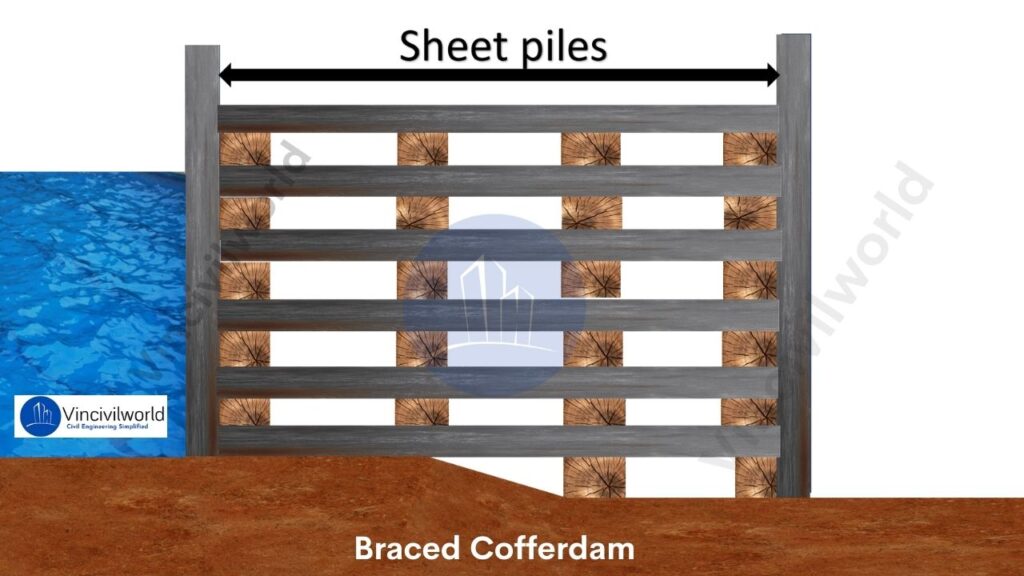
A braced cofferdam serves as a temporary enclosure. It enables construction in shallow water or earth by using vertical or horizontal sheeting. This sheeting is supported by internal struts. This design effectively keeps water out, creating a dry environment essential for projects like bridge construction or aquatic maintenance. Braced cofferdams are versatile, supporting shallow trench excavations and providing bracing for multi-level basements. They are often chosen for bridge piers and abutments because they are cost-effective. This is especially true when compared to cellular cofferdams and caissons in depths up to 40 ft. However, constructing them in extensive, deep excavations can be challenging, necessitating alternative excavation methods.
Cellular Cofferdam
A cellular cofferdam is a temporary structure. It is used to dewater large areas. This is particularly useful in deep water construction projects such as dams or bridge piers. It consists of interconnected steel sheet piles. These form either circular type cellular cofferdams or diaphragm cells. The cells are filled with materials like sand, gravel, or clay. These cofferdams are ideal when large surface areas need to be enclosed and when the water depth is considerable.
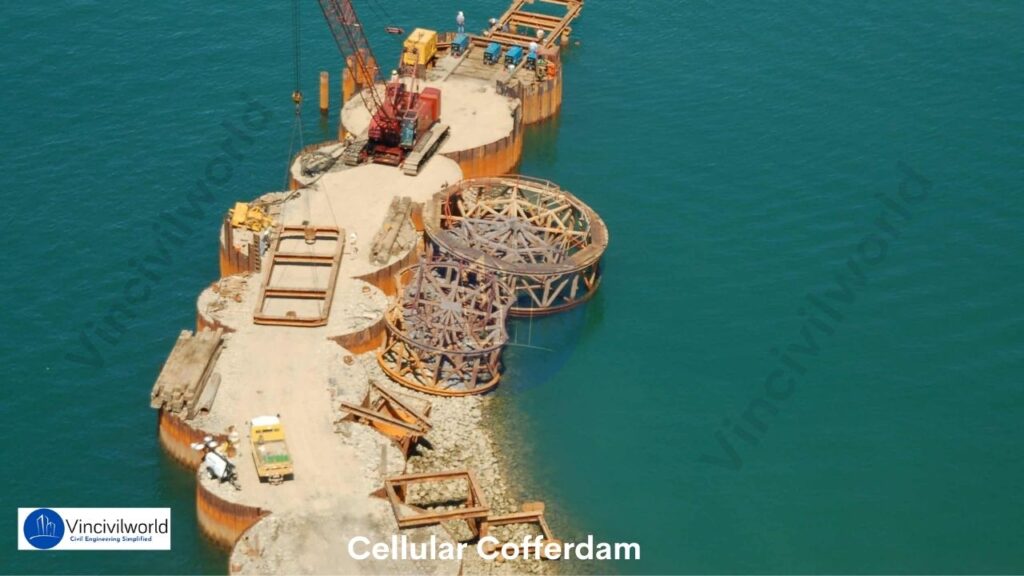
This category of cofferdams includes two main types. Engineers design circular type cellular cofferdams with round cells. Diaphragm cellular cofferdams use straight diaphragms connected by arcs of sheet piles. This construction provides stability due to the weight of the fill material and the interlocked design. Cofferdam construction of this type is robust and cost-effective in terms of material use.
The selection of cofferdam types depends on the specific project requirements. These include water depth and the size of the area to be enclosed. Engineers typically use cellular cofferdams in deep water environments because of their stability. They also resist high water pressures.
Key Takeaways
- Cofferdams are essential temporary structures used in underwater construction to create a dry environment for submerged projects.
- Various types of cofferdams—including earthen, rock-fill, single-walled, double-walled, braced, and cellular—are used based on water depth, flow conditions, and project requirements.
- Materials such as steel sheet piles, fill materials, and concrete are chosen based on the project’s complexity. They are also selected considering water pressure and soil conditions.
- Cofferdams are widely applied in bridge construction. They are also used in dam building and marine infrastructure projects. This makes them indispensable for safe and efficient underwater construction.
Conclusion
Cofferdams provide a reliable solution for underwater construction projects by creating a controlled, dry work area. Their versatility in design—from earthen to cellular types—ensures they meet the specific demands of different environments. Choosing the right type of cofferdam is crucial. Selecting the appropriate materials guarantees stability and safety during construction. This enables successful completion of projects in challenging aquatic settings.
 vin civilworld