Tag Archives: Concrete mix design

Consistency test on cement – Significance and Procedure

The standard consistency test of cement is a crucial procedure for determining the precise quantity of water needed to create a workable paste, which is essential for subsequent laboratory tests. This test utilizes a Vicat apparatus to find the water content that allows the plunger to penetrate the paste to a specified depth, thus defining the normal consistency of cement. Establishing this value is a necessary step before conducting other important tests like setting time, soundness, and compressive strength, all of which rely on a correct water–cement ratio.

Understanding the significance of the consistency test helps one appreciate its influence on key concrete properties such as workability, strength development, and durability. By providing a clear explanation of the test’s procedure—from trial mixes to the final penetration reading—this article serves as a valuable guide for students, site engineers, and quality controllers. It aims to assist them in performing reliable laboratory work, ultimately ensuring high-quality cement performance in structures.

  1. Significance of cement tests
    1. Field tests of cement
    2. Laboratory tests
  2. Significance of Consistency test on Cement
  3. Relevant IS code for consistency test on cement
  4. Apparatus used for consistency test on cement
  5. Procedure of consistency test for cement (As per IS 4031 Part 4)
  6. Calculation
  7. Consistency of cement test procedure – Standards comparison
  8. Precaution
  9. Conclusion

Significance of cement tests

Cement is a key construction material used in buildings, bridges, and infrastructure. It forms concrete and mortar, and it directly influences the strength, durability, and performance of structures.

Cement is a key construction material, so its quality must be checked before use. Cement tests generally fall into two types: laboratory tests and field tests. Field tests are simple, quick checks that do not require special equipment or expertise. They help to judge whether cement can be accepted for work.

Field tests of cement

  • Checking manufacturing date
  • Visual lump check
  • Feel test (smoothness)
  • Heat test
  • Colour check
  • Water float test
  • Setting test

These tests provide approximate but useful quality indications.

A laboratory technician wearing safety goggles and gloves mixes cement paste in a large bowl, with a Vicat apparatus and various testing equipment visible in the background.
A technician performing the standard consistency test of cement using a Vicat apparatus in a laboratory setting.

Laboratory tests

Laboratory tests provide detailed and accurate assessment of cement quality under controlled conditions , essential before use in structural works. Common lab tests for cement include:

  • Standard consistency test of cement
  • Initial and final setting time test
  • Soundness test (e.g., Le Chatelier method)
  • Fineness test (e.g., sieve or Blaine method)
  • Strength test (e.g., compressive strength of cement mortar)
  • Heat of hydration test (for some cements)
  • Chemical composition / chemical analysis

This article is about standard consistency test of cement.

Significance of Consistency test on Cement

The strength and durability of concrete depend greatly on the quality of cement and its correct water content. To achieve proper strength, the cement mortar must have standard consistency, which is determined in the consistency test of cement. In this test, standard consistency occurs when the Vicat plunger penetrates to a depth of 5–7 mm from the mould’s bottom. This penetration confirms the cement’s readiness. It is determined through trial and error to find the exact amount of water required to prepare a workable cement paste. Knowing the normal consistency of cement is crucial. It is needed before performing other laboratory tests, such as compressive strength, setting time, and soundness tests. Water directly influences hydration. Cement composition, fineness, and water–cement ratio affect consistency. Excess water weakens hardened cement, while too little water slows hydration and reduces strength. Therefore, determining consistency ensures reliable concrete performance and quality control.

Relevant IS code for consistency test on cement

  • IS 4031 (Part 4):1988 – Standard consistency test (India)
  • ASTM C187 – Amount of water required for normal consistency (USA)
  • BS EN 196-3:2016 – Standard consistence, setting times & soundness (UK/Europe)

Apparatus used for consistency test on cement

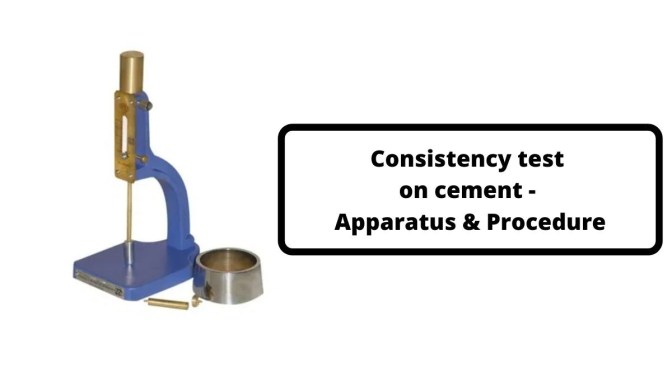
The Vicat apparatus is used to determine the consistency of cement. It consists of a plunger, a movable rod weighing 300 g, graduated scale, non-porous plate, split mould and Vicat mould. The diameter of the plunger is 10mm and the length is 50mm. The graduate scale measures the depth of penetration. The Vicat mould is a cone frustum with 80 mm diameter. The test should be conducted at a standard temperature of 27 C. The humidity should be 65%. A stop clock is used to measure the time from the addition of water to the drying of cement. As per IS code, the time of gauging is not less than 3 minutes, nor more than 5 min.

Procedure of consistency test for cement (As per IS 4031 Part 4)

Follow these steps when performing the consistency test under IS code:

  • Use a clean Vicat apparatus (as per specification) with 10 mm-diameter plunger and standard mould resting on a non-porous base plate.
  • Weigh a required quantity of cement and a proportionate amount of potable or distilled water.
  • Begin gauging (mixing): mix cement and water thoroughly, and complete gauging within 3 to 5 minutes from addition of water. Ensure gauging is completed before any sign of setting occurs.
  • Fill the Vicat mould with the fresh cement paste, rest mould on non-porous plate. Level the surface — remove excess paste, smooth the top. A light shake may be used to expel air bubbles.
  • Lower the plunger gently so it just touches the paste surface, then release it to descent under its own weight (no external load).
  • Observe the depth of penetration on the graded scale. If plunger stops such that it’s 5–7 mm above the bottom of mould — that paste has “standard consistency.”
  • If the penetration depth is not within that range, discard paste; prepare a new paste with adjusted water content (increase or decrease water) and repeat until standard consistency is reached.
  • Document the percentage water (by weight of cement) that achieved standard consistency — this becomes the “water for normal consistency” or “standard consistency water proportion.”
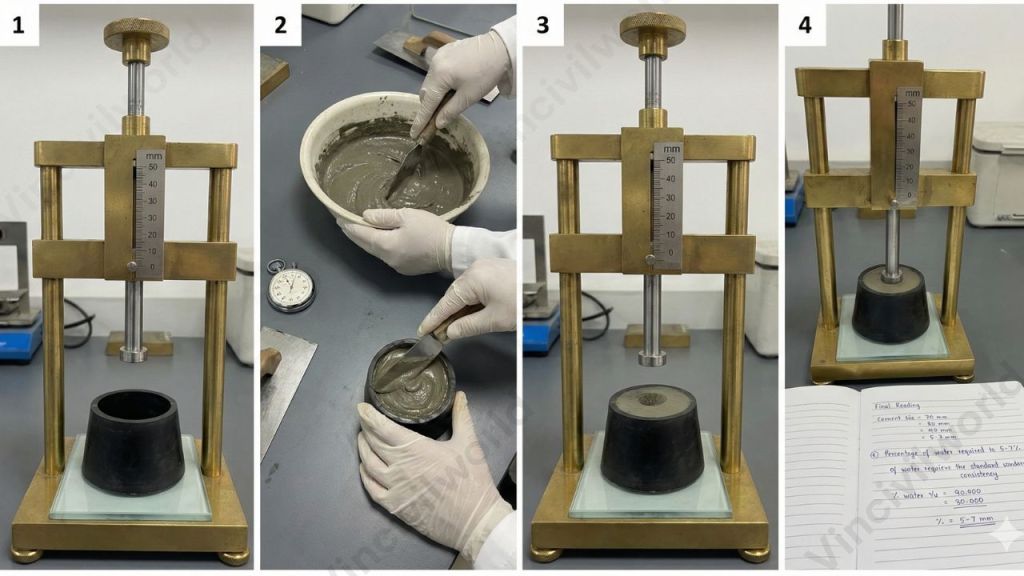
Vicats apparatus setup for the standard consistency test of cement, showing the plunger mechanism.
Vicat apparatus used for measuring standard consistency of cement during laboratory testing.

Calculation

The standard consistency is expressed in terms of the percentage of the quantity of added water to the weight of cement. The consistency of cement ranges from 26% to 33%.

Standard consistency = ( Quantity of water added / Weight of cement) x 100

Consistency of cement test procedure – Standards comparison

StandardApparatus / PrincipleConsistency Criterion / Penetration DepthNotes / Use for Further Tests
IS 4031 (Part 4)Vicat apparatus (10 mm dia. plunger, standard mould)Plunger penetrates so that it stops 5–7 mm from the bottom of mould (i.e. ~33–35 mm from top) for standard / normal consistency (Basis for subsequent cement tests (setting time, soundness, strength) under Indian Code
ASTM C187Vicat-type penetration instrument / similar test method to determine water for “normal consistency” Penetration per ASTM calibration (aims to find water percent giving normal consistency) Used internationally / in labs following ASTM procedures; result used for further cement/concrete tests
BS EN 196‑3 (European / British standard)Vicat apparatus for consistency and setting-time / soundness tests Defines “standard consistence” via penetration depth per EN criteria; used before setting time & soundness tests Common in European labs; ensures standard baseline for cement tests under EN / BS norms

Precaution

We should take certain precautions before starting the test so that to obtain accurate results.

  • Clean the Vicat mould properly and grease the inside surface
  • Take immense care while attaching the plunger. Make sure it is vertical.
  • Place the apparatus on a levelled surface.
  • Maintain the standard temperature and humidity throughout the test.

Key Takeaways

  • The consistency test of cement measures the required water for a workable paste, using the Vicat apparatus.
  • This test is crucial for determining key properties like setting time, soundness, and compressive strength of cement.
  • Standard consistency is reached when the plunger penetrates 5–7 mm from the bottom of the mould, ensuring proper hydration.
  • Laboratory tests provide accurate assessments of cement quality, while field tests offer quick checks.
  • Precautions are vital for accurate test results, including cleaning the apparatus and maintaining proper temperature and humidity.

Conclusion

In conclusion, the consistency test of cement is essential for maintaining quality and performance in concrete works. By determining the standard consistency of cement, engineers identify the exact water needed to create a uniform and workable paste. This value is crucial for reliable results in other major laboratory tests such as compressive strength, setting time, and soundness. The significance of standard consistency test of cement lies in ensuring proper hydration, which directly influences the strength, durability, and service life of structures. Using the Vicat apparatus, the test provides accurate and repeatable outcomes for both laboratories and field quality control. When the water–cement ratio is correctly maintained, concrete becomes safer, stronger, and more durable, supporting high-standard construction practices.

Compaction factor test – Workability of concrete-Test procedure

Compaction factor test is a practical and reliable method used to assess the workability of concrete, especially when the mix is stiff and does not show clear results in a slump test. The compaction factor test for workability of concrete evaluates how easily concrete flows under gravity. It also assesses how it compacts by comparing partially compacted concrete with fully compacted concrete. In the workability of concrete compaction factor test, engineers gain a more accurate understanding of concrete consistency for low to medium workability mixes. Following the compaction factor test procedure helps achieve consistent results during laboratory testing. The compaction factor test of concrete is commonly applied in mix design and quality control and remains one of the dependable tests for workability of concrete used in practice. Compaction factor test is a lab test and is generally conducted on concrete samples having very low workability.

This article explains the compaction factor test, covering its principle, procedure, significance, advantages, limitations, and role in accurately evaluating the workability of concrete.

  1. Significance of Quality tests on concrete
  2. Production stage quality tests on fresh concrete
  3. Significance of compaction factor test
  4. Compaction factor test for workability of concrete
    1. Compaction Factor Test – Relevant codes
    2. Apparatus used
    3. Compaction factor test procedure
  5. Key Takeaways
  6. Conclusion

Significance of Quality tests on concrete

Quality tests on concrete are essential for ensuring strength, durability, and performance in construction. These tests help engineers assess the workability of fresh concrete and the quality of hardened concrete. Common quality tests on concrete include checks during the production stage (on fresh concrete before placing), tests on hardened concrete specimens, and evaluations performed directly on finished structures. Including tests like the flow table test for concrete ensures reliable results and consistent quality throughout a project.

A construction worker wearing a hard hat and safety vest examines concrete samples on a workbench, including a concrete compression testing machine and molds.
A civil engineer in a safety helmet and reflective vest analyzing concrete test specimens in a lab, showcasing the importance of quality control in concrete workability tests.

Following are the stages of quality tests

  • Production stage quality tests ( On fresh concrete before placing)
  • Hardened stage quality tests ( hardened concrete specimens)
  • On structures ( tests done on the structures )

Production stage quality tests on fresh concrete

Production stage quality tests on fresh concrete are crucial for ensuring the right workability and consistency before placement. These tests help engineers select the best mix for construction and maintain quality control. Key tests include the slump test, compaction factor test, Vee-Bee test, Kelly ball test, and the flow table test for concrete.

This article focuses on the Compaction factor test, explaining its procedure, importance, and how it compares with other workability tests like the slump test and other tests

Significance of compaction factor test

The compaction factor test is significant because it accurately measures the workability of concrete. This is especially true for stiff and low-slump mixes. This test provides more precise results than the slump test. It supports effective mix design. It also ensures consistent concrete quality through reliable laboratory-based workability assessment.

Compaction factor test for workability of concrete

The compaction factor test is used to determine the workability of concrete. Workability refers to the ease and uniformity with which freshly mixed concrete can be mixed, placed, compacted, and finished. Workability also represents the internal effort required to achieve full compaction. The compaction factor test of concrete was developed by the Road Research Laboratory, UK. It provides more precise and accurate results than the slump test. This test is especially suitable for stiff concrete mixes that do not slump and require vibration for compaction. The compaction factor test measures the degree of compaction under controlled conditions. It offers a reliable method for assessing concrete consistency in laboratory and quality control applications.

Also read : Bitumen – 9 lab tests on bitumen for flexible pavements.

Also read : Timber – Five important quality tests

Compaction Factor Test – Relevant codes

  • IS 1199 (Part 2): 2018Methods of Sampling and Analysis of Concrete – Workability
  • BS 1881 (Part 103)Testing Concrete – Method for Determination of Compaction Factor
  • ASTM C1170 / C1170MWorkability of Fresh Concrete by Compaction Factor Method (Reference use)
  • DIN 1048Testing Methods for Fresh Concrete

These codes provide standardized procedures for conducting the Compaction Factor Test and ensure reliable evaluation of concrete workability.

The Compaction Factor Test method followed in IS 1199 (Part 2) is fundamentally the same as those in British standards. It is also similar to other international standards. All codes measure workability by comparing partially compacted concrete with fully compacted concrete.

  • Principle: Same across all standards
  • Apparatus: Same (two hoppers + cylinder)
  • Calculation: Same compaction factor ratio
  • Differences: Minor variations in dimensions, tolerances, and wording

Apparatus used

A female laboratory technician in a white lab coat and protective goggles is pouring a substance from a can into a blue funnel system, while a male colleague works in the background in a modern laboratory setting.
Laboratory setup for conducting the compaction factor test on concrete, demonstrating the apparatus used to measure workability.
  • Compacting factor apparatus
  • Cylindrical mould 
  • Hand scoop 
  • Trowel
  • Weighing machine
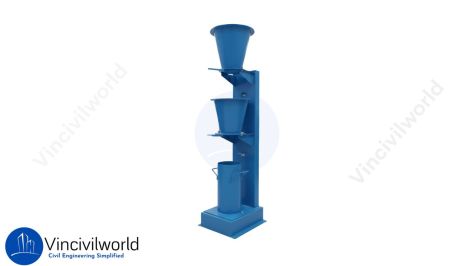
A blue civil engineering apparatus featuring two hoppers and a collecting bucket, designed for material testing.
Apparatus used for the Compaction Factor Test, designed to accurately measure concrete workability.

The figure shows the dimension of the hopper and the mould. The inside area of the hopper should be smooth. The apparatus is made of bronze or cast brass. At the lower ends of the hopper, there is a trap door with a 3mm thickness. A rigid frame attaches the hoppers and cylinder. After the completion of mixing, the test is conducted at a constant time interval. 

Compaction factor test procedure

  • Place the sample in the upper hopper of the apparatus using a hand scoop.
  • Fill the hopper with its brim level and open the trap door.
  • Then allow the concrete to fall into the lower hopper.
  • Immediately after the concrete rests, uncover the cylinder and open the lower trap door.
  • Cut off the excess amount of concrete above the cylinder using the trowel.
  • Then weigh the concrete in the cylinder nearest to 10g. This is the weight of partially compacted concrete.
  • Refill the cylinder with the same sample in the layers and the layer is heavily rammed or vibrated for full compaction.
  • Then weigh the fully compacted concrete and the weight of the empty cylinder.
  • Finally, Compute the compaction factor using the formula.

The compaction factor is the ratio of partially compacted concrete to fully compacted concrete.

Compaction factor = (W1 – W) / (W2 – W)

The compaction factor value varies from 0.7 to 0.95.

Key Takeaways

  • The Compaction Factor Test is used to evaluate the workability of concrete, especially stiff mixes.
  • It is more sensitive and accurate than the slump test for low-workability concrete.
  • The compaction factor test for workability of concrete measures ease of compaction under gravity.
  • It is best suited for laboratory-controlled conditions.
  • The workability of concrete compaction factor test helps compare different mix designs.
  • The test uses two hoppers and a cylindrical mould.
  • Following the compaction factor test procedure ensures consistent results.
  • The compaction factor test of concrete minimizes subjective judgment.
  • It supports quality control and mix optimization.
  • It is one of the reliable tests for workability of concrete.

Conclusion

The Compaction Factor Test remains an important method for assessing the workability of concrete. This is particularly true for mixes that show little or no slump. By measuring the ratio of partially compacted to fully compacted concrete, the compaction factor test for workability of concrete provides a clear and quantitative indication of consistency. When engineers follow the standard compaction factor test procedure, the results help in evaluating mix performance and maintaining uniform quality. The workability of concrete compaction factor test is especially useful in laboratory testing and mix design studies. As one of the established tests for workability of concrete, the compaction factor test of concrete continues to support accurate quality control and better construction outcomes.