Tag Archives: concrete workability

Kelly Ball Test – Workability of Concrete

Kelly Ball Test is a simple and reliable method used to assess the workability of concrete directly at construction sites. Among the various tests for workability of concrete, this method stands out for its speed. It is also easy to execute on fresh concrete surfaces. The Kelly Ball Test concrete assessment works by measuring penetration depth. This makes it a practical Kelly Ball penetration test for large pours and ready-mix applications. To ensure accurate results, you must follow the standard Kelly Ball Test procedure. This procedure correlates penetration values with concrete consistency. The Kelly Ball Test is simple. It is also suitable for the field. Therefore, it continues to be an effective tool for monitoring concrete quality during placement.

  1. Significance of Quality tests on concrete
  2. Production stage quality tests on fresh concrete
  3. What is Kelly ball test ?
    1. Standard Guidelines
      1. Codes and Standards
    2. Kelly ball test Apparatus as per ASTM C360/C360 M 92
    3. Test Procedure
    4. Results
  4. Advantages – Kelly ball test
  5. Disadvantages of Kelly Ball Test
  6. Key Takeaways
  7. Conclusion

Significance of Quality tests on concrete

Quality tests on concrete are essential for ensuring strength, durability, and performance in construction. These tests help engineers assess the workability of fresh concrete and the quality of hardened concrete. Common quality tests on concrete include checks during the production stage (on fresh concrete before placing), tests on hardened concrete specimens, and evaluations performed directly on finished structures. Including tests like the flow table test for concrete ensures reliable results and consistent quality throughout a project.

Quality tests performed on concrete are classified into

Also read : Bitumen tests – 9 lab tests for bitumen

Production stage quality tests on fresh concrete

This article covers the kelly ball test ,apparatus details, procedure, merits and demerits etc.

A Kelly ball test apparatus placed on a construction site, with blurred machinery and materials in the background.
The Kelly Ball Test apparatus used for assessing the workability of concrete at construction sites.

What is Kelly ball test ?

This simple field method assesses the workability of freshly mixed concrete. In the test, a standard steel ball penetrates the concrete under its own weight, and the penetration depth indicates concrete consistency. Engineers mainly use this test at construction sites to make quick decisions during concrete placement. The Kelly Ball Test helps verify whether the concrete is too stiff or too workable for proper compaction and finishing. Its significance lies in its speed, ease of use, and ability to provide a direct indication of concrete workability without complex equipment.

Standard Guidelines

Standard codes for the Kelly Ball penetration test provide guidance on equipment, testing procedure, and result interpretation. This ensures reliable assessment of concrete workability, especially during on-site quality control.

Codes and Standards

ASTM C360 / C360M 92– Standard Test Method for Ball Penetration in Freshly Mixed Concrete
Issued by ASTM International.
Note: This standard has been withdrawn but is still referenced in technical literature.

AASHTO T 183 – Ball Penetration Test
Issued by AASHTO.
Note: This standard is discontinued and mainly used for historical reference.

Indian Standards (IS Codes)
There is no specific IS code . Workability testing in India is generally covered under IS 1199, issued by Bureau of Indian Standards

Kelly ball test Apparatus as per ASTM C360/C360 M 92

The kelly ball apparatus for measuring the workability of concrete consist of..

  • Meta hemisphere (Ball)
  • Graduated scale
  • Frame
  • Handle

The workability of concrete is decided by the depth of the penetration of metal hemisphere (ball) which will descend under its own weight into the fresh concrete. The Metal hemisphere or ball has 152 mm diameter and 13.6 kg weight. J. W. Kelly (Professor, University of California) had devised the plan of the Kelly ball test afessor, University of California) had devised the plan of the Kelly ball test apparatus. Hence, later on it also came to be known as a ball penetration test. On the top of the apparatus, there is a handle. The graduated scale measures the penetration reading. 
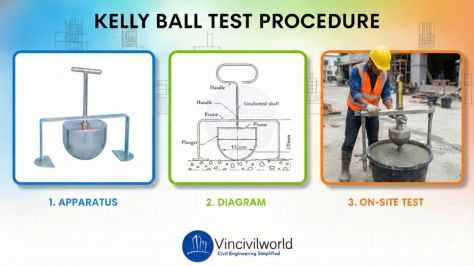
A three-part image illustrating the Kelly Ball Test procedure. The left panel shows the apparatus used for the test, the middle panel features a diagram explaining the components, and the right panel displays a person conducting the on-site test with concrete.
Visual representation of the Kelly Ball Test procedure, showcasing the apparatus, diagram, and on-site testing process for assessing concrete workability.

Test Procedure

  • Place freshly mixed concrete on a level, rigid surface immediately after mixing.
  • Ensure the concrete surface is smooth and free from vibration.
  • Clean the Kelly ball and check that it moves freely along the guide rod.
  • Position the apparatus so the steel ball just touches the concrete surface.
  • Release the ball gently without applying any force.
  • Allow the ball to penetrate under its own weight.
  • Wait until the penetration stabilizes.
  • Read and record the depth of penetration from the graduated scale.
  • Repeat the test at different locations on the concrete surface.
  • Take the average penetration value as the final result.
  • Note: Greater penetration indicates higher workability, while lower penetration indicates stiffer concrete.

Results

The workability of the concrete is the average value of the readings from the penetration.

Advantages – Kelly ball test

Some advantages of this test are

  • Compared to other workability tests kelly ball test is very fast
  • Precise and Accurate results

Disadvantages of Kelly Ball Test

The disadvantages of this test include

  • This test requires a large amount of fresh concrete.
  • The result should not be precise if the size of the aggregate is large.
  • The concrete should be levelled before starting the test.

Key Takeaways

  • This is a simple field method for assessing fresh concrete consistency.
  • It directly measures penetration depth, reflecting the workability of concrete.
  • The test is faster and less operator-dependent than many laboratory methods.
  • Kelly Ball Test concrete assessment is suitable for large pours and flat surfaces.
  • The Kelly Ball penetration test works under the self-weight of the steel ball.
  • Proper surface preparation is essential for reliable results.
  • The procedure must be followed carefully to avoid errors.
  • It is mainly used as a supplementary field check.
  • Results help engineers make quick placement decisions.
  • It complements other tests for workability of concrete used in quality control.

Conclusion

The Kelly Ball Test remains a practical and efficient method for evaluating the workability of concrete under site conditions. By measuring penetration depth, the Kelly Ball penetration test provides a direct indication of concrete consistency during placement. Although not as widely standardized as slump testing, Kelly Ball Test concrete assessment is valuable for large slabs and mass concreting works. When carried out correctly using the recommended Kelly Ball Test procedure, it helps engineers maintain uniform quality and avoid placement issues. Among various tests for workability of concrete, the Kelly Ball Test stands out for its simplicity, speed, and field applicability. Used alongside standard methods, it supports better decision-making and effective on-site concrete quality control.

Compaction factor test – Workability of concrete-Test procedure

Compaction factor test is a practical and reliable method used to assess the workability of concrete, especially when the mix is stiff and does not show clear results in a slump test. The compaction factor test for workability of concrete evaluates how easily concrete flows under gravity. It also assesses how it compacts by comparing partially compacted concrete with fully compacted concrete. In the workability of concrete compaction factor test, engineers gain a more accurate understanding of concrete consistency for low to medium workability mixes. Following the compaction factor test procedure helps achieve consistent results during laboratory testing. The compaction factor test of concrete is commonly applied in mix design and quality control and remains one of the dependable tests for workability of concrete used in practice. Compaction factor test is a lab test and is generally conducted on concrete samples having very low workability.

This article explains the compaction factor test, covering its principle, procedure, significance, advantages, limitations, and role in accurately evaluating the workability of concrete.

  1. Significance of Quality tests on concrete
  2. Production stage quality tests on fresh concrete
  3. Significance of compaction factor test
  4. Compaction factor test for workability of concrete
    1. Compaction Factor Test – Relevant codes
    2. Apparatus used
    3. Compaction factor test procedure
  5. Key Takeaways
  6. Conclusion

Significance of Quality tests on concrete

Quality tests on concrete are essential for ensuring strength, durability, and performance in construction. These tests help engineers assess the workability of fresh concrete and the quality of hardened concrete. Common quality tests on concrete include checks during the production stage (on fresh concrete before placing), tests on hardened concrete specimens, and evaluations performed directly on finished structures. Including tests like the flow table test for concrete ensures reliable results and consistent quality throughout a project.

A construction worker wearing a hard hat and safety vest examines concrete samples on a workbench, including a concrete compression testing machine and molds.
A civil engineer in a safety helmet and reflective vest analyzing concrete test specimens in a lab, showcasing the importance of quality control in concrete workability tests.

Following are the stages of quality tests

  • Production stage quality tests ( On fresh concrete before placing)
  • Hardened stage quality tests ( hardened concrete specimens)
  • On structures ( tests done on the structures )

Production stage quality tests on fresh concrete

Production stage quality tests on fresh concrete are crucial for ensuring the right workability and consistency before placement. These tests help engineers select the best mix for construction and maintain quality control. Key tests include the slump test, compaction factor test, Vee-Bee test, Kelly ball test, and the flow table test for concrete.

This article focuses on the Compaction factor test, explaining its procedure, importance, and how it compares with other workability tests like the slump test and other tests

Significance of compaction factor test

The compaction factor test is significant because it accurately measures the workability of concrete. This is especially true for stiff and low-slump mixes. This test provides more precise results than the slump test. It supports effective mix design. It also ensures consistent concrete quality through reliable laboratory-based workability assessment.

Compaction factor test for workability of concrete

The compaction factor test is used to determine the workability of concrete. Workability refers to the ease and uniformity with which freshly mixed concrete can be mixed, placed, compacted, and finished. Workability also represents the internal effort required to achieve full compaction. The compaction factor test of concrete was developed by the Road Research Laboratory, UK. It provides more precise and accurate results than the slump test. This test is especially suitable for stiff concrete mixes that do not slump and require vibration for compaction. The compaction factor test measures the degree of compaction under controlled conditions. It offers a reliable method for assessing concrete consistency in laboratory and quality control applications.

Also read : Bitumen – 9 lab tests on bitumen for flexible pavements.

Also read : Timber – Five important quality tests

Compaction Factor Test – Relevant codes

  • IS 1199 (Part 2): 2018Methods of Sampling and Analysis of Concrete – Workability
  • BS 1881 (Part 103)Testing Concrete – Method for Determination of Compaction Factor
  • ASTM C1170 / C1170MWorkability of Fresh Concrete by Compaction Factor Method (Reference use)
  • DIN 1048Testing Methods for Fresh Concrete

These codes provide standardized procedures for conducting the Compaction Factor Test and ensure reliable evaluation of concrete workability.

The Compaction Factor Test method followed in IS 1199 (Part 2) is fundamentally the same as those in British standards. It is also similar to other international standards. All codes measure workability by comparing partially compacted concrete with fully compacted concrete.

  • Principle: Same across all standards
  • Apparatus: Same (two hoppers + cylinder)
  • Calculation: Same compaction factor ratio
  • Differences: Minor variations in dimensions, tolerances, and wording

Apparatus used

A female laboratory technician in a white lab coat and protective goggles is pouring a substance from a can into a blue funnel system, while a male colleague works in the background in a modern laboratory setting.
Laboratory setup for conducting the compaction factor test on concrete, demonstrating the apparatus used to measure workability.
  • Compacting factor apparatus
  • Cylindrical mould 
  • Hand scoop 
  • Trowel
  • Weighing machine
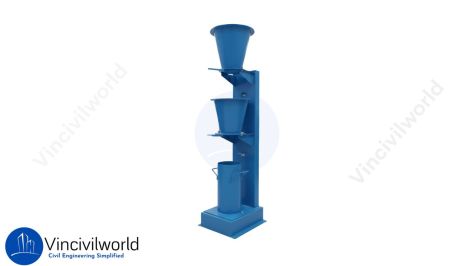
A blue civil engineering apparatus featuring two hoppers and a collecting bucket, designed for material testing.
Apparatus used for the Compaction Factor Test, designed to accurately measure concrete workability.

The figure shows the dimension of the hopper and the mould. The inside area of the hopper should be smooth. The apparatus is made of bronze or cast brass. At the lower ends of the hopper, there is a trap door with a 3mm thickness. A rigid frame attaches the hoppers and cylinder. After the completion of mixing, the test is conducted at a constant time interval. 

Compaction factor test procedure

  • Place the sample in the upper hopper of the apparatus using a hand scoop.
  • Fill the hopper with its brim level and open the trap door.
  • Then allow the concrete to fall into the lower hopper.
  • Immediately after the concrete rests, uncover the cylinder and open the lower trap door.
  • Cut off the excess amount of concrete above the cylinder using the trowel.
  • Then weigh the concrete in the cylinder nearest to 10g. This is the weight of partially compacted concrete.
  • Refill the cylinder with the same sample in the layers and the layer is heavily rammed or vibrated for full compaction.
  • Then weigh the fully compacted concrete and the weight of the empty cylinder.
  • Finally, Compute the compaction factor using the formula.

The compaction factor is the ratio of partially compacted concrete to fully compacted concrete.

Compaction factor = (W1 – W) / (W2 – W)

The compaction factor value varies from 0.7 to 0.95.

Key Takeaways

  • The Compaction Factor Test is used to evaluate the workability of concrete, especially stiff mixes.
  • It is more sensitive and accurate than the slump test for low-workability concrete.
  • The compaction factor test for workability of concrete measures ease of compaction under gravity.
  • It is best suited for laboratory-controlled conditions.
  • The workability of concrete compaction factor test helps compare different mix designs.
  • The test uses two hoppers and a cylindrical mould.
  • Following the compaction factor test procedure ensures consistent results.
  • The compaction factor test of concrete minimizes subjective judgment.
  • It supports quality control and mix optimization.
  • It is one of the reliable tests for workability of concrete.

Conclusion

The Compaction Factor Test remains an important method for assessing the workability of concrete. This is particularly true for mixes that show little or no slump. By measuring the ratio of partially compacted to fully compacted concrete, the compaction factor test for workability of concrete provides a clear and quantitative indication of consistency. When engineers follow the standard compaction factor test procedure, the results help in evaluating mix performance and maintaining uniform quality. The workability of concrete compaction factor test is especially useful in laboratory testing and mix design studies. As one of the established tests for workability of concrete, the compaction factor test of concrete continues to support accurate quality control and better construction outcomes.