

Two basic principle of surveying serves as the cornerstones upon which all other surveying methods are developed. Surveying is the process of determining the relative position of various points on the earth’s surface by measuring the distance between them and creating a map to any reasonable scale. The principle of surveying forms the foundation for accurate land measurement and mapping. Engineers and surveyors apply the first survey principle and second survey principle to ensure precise data collection. A system of reliable control points, established with high precision, anchors the entire survey framework and serves as fixed references for all measurements. Moreover, understanding surveying principles helps professionals establish reliable surveying control points, which are essential for consistent measurements.
Consequently, following these fundamental principles of surveying enables effective planning and execution of surveying projects. By mastering these concepts, surveyors can achieve high accuracy and efficiency in their work, ultimately contributing to successful construction and infrastructure development. Therefore, the principle of surveying and its related key concepts remain critical for the integrity of all surveying activities. In the blog Basic of civil engineering; a Simple and in-depth guide, we saw the fundamentals of surveying. Here, we will look at the fundamental principle of surveying using diagrams to make it easier to understand. So, why follow the surveying principle? Is it unavoidable? Let’s see what happens.
So, why follow the surveying principle? Is it unavoidable? Let’s see what happens.
- What is the principle of surveying?
- The fundamental principle of surveying
- The first principle of surveying
- The second principle of surveying
- Key Takeaways
- Conclusion
What is the principle of surveying?
To understand the importance of the principle of surveying, we should first know the purpose of carrying out surveying. Generally, it is to make measurements of objects on, above, or beneath the ground to show their relative positions on paper. The relative position required is either horizontal, vertical, or both. Or, similarly surveying is used for the measurement of objects in their horizontal positions.

The principle of surveying comprises two main principles are the strategies to get very accurate results. Basically, successful surveying can’t be carried out without obeying the basic principle of surveying. So, let’s sneak into the details of each of the principles that fetch you accurate results in surveying.
Related articles relating to surveying





The fundamental principle of surveying
The main principle of surveying is categorized into
- First Principle of Surveying
- Second Principle of Surveying
The first principle of surveying
The first principle of surveying is to work from whole to part.
To understand this, we should first know what a control point is.
What are control points?
A control point is a point on the ground or any permanent structure whose horizontal and vertical location is known.
Having this in mind, let’s dive deep into the details of the principle.
In surveying large areas, a system of control points is identified and they are located with high precision. Then secondary control points are located using lesser precise methods. Accordingly, the details of the localized areas are measured and plotted concerning the secondary control points. This is called working from whole to part.
Importance of the first principle of surveying
- Helps to localize errors to particular points rather than distributing them across the area.
- Prevents the accumulation of errors, which can become unacceptable over large areas.
- Creates a reliable and accurate control framework before surveying smaller, detailed areas.
- Ensures accurate measurements for mapping and construction projects.
- Allows secondary control points to be located with less precision while maintaining overall integrity.
- Helps contain and adjust inevitable errors within the control framework.
- Facilitates efficient surveying by starting from primary control points with high precision and adding subsidiary detail surveys.
- Maintains the integrity and precision of surveying data for infrastructure development.
- Reduces risk of error magnification during survey.
- Supports clear organization of survey work, making it manageable and structured.
- These points summarize why the first principle of surveying is critical for achieving quality, reliable, and error-controlled survey outcomes.
Moving on,
The second principle of surveying
Hope you got a clear idea about working from whole to part. Similarly, let us see what the second principle of surveying means.
The second principle of surveying states that new points (stations) must be located by at least two measurements either linear or angular from fixed control points. This redundancy ensures accuracy by verifying positions and minimizing errors. Surveyors use multiple reference points to precisely fix new stations, maintaining reliable mapping and error control throughout the survey process. This principle complements the first principle and is essential for accurate surveying and construction.
Taking extra care in fixing new control points

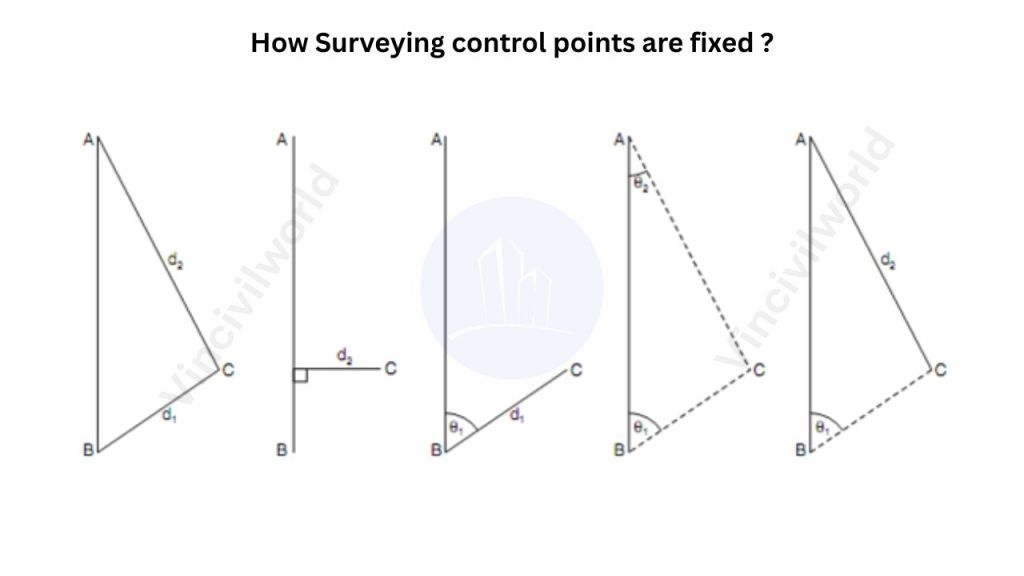
The figure shows the various methods of fixing point C concerning already fixed points A and B by measuring sides, angles, or setting perpendiculars. For fixing new control points (stations) with respect to already fixed points at least two independent processes should be followed.
If A and B are already located control points and concerning the new control point C is to be located, apart from the minimum measurements required as shown in the above figure, one more measurement should be taken.
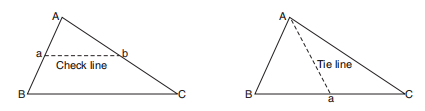
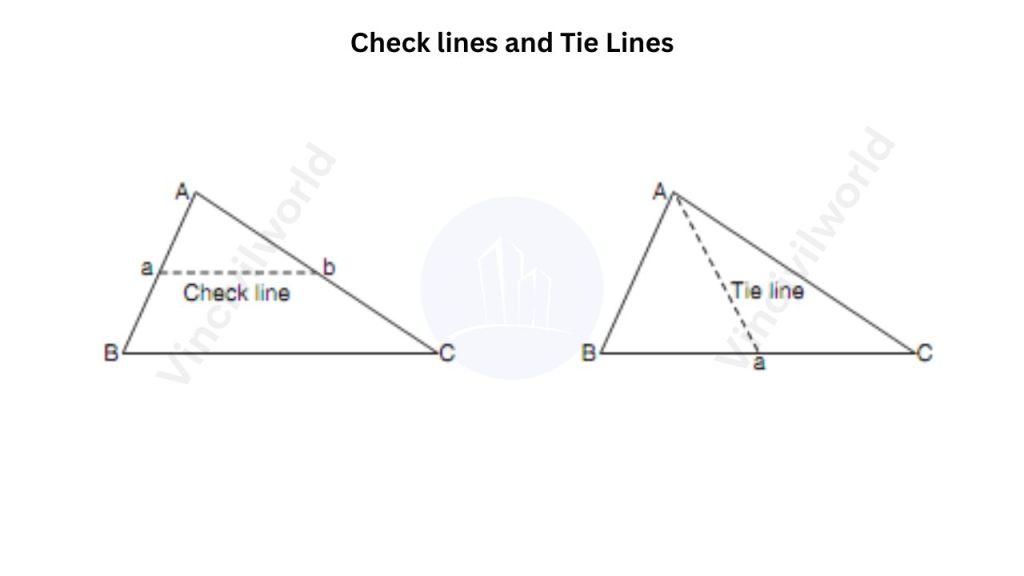
Measuring the lengths of check lines and tie lines will also serve this purpose as shown in the figure below.
So,
what is a check line?
A check line otherwise called a proof line is a line joining the apex of a triangle to some fixed points on any two sides of a triangle. A check line in surveying is the line joining the apex of a triangle to fixed points on its base, used to verify the accuracy of the survey measurements. It ensures correctness by comparing field measurements with plotted lengths, helping detect and control errors. Also called a proof line, it may be run independently to confirm the main survey lines’ precision and sometimes assists in locating interior details.
How check lines are used to check the accuracy of the framework?
The length of checking as measured on the ground should be equal to the length on the plan.Check lines are used to verify the accuracy of a surveying framework by measuring the length on the ground and ensuring it matches the corresponding length on the plan, thereby detecting errors and confirming precision.
Okay. We are done with the check lines. What about tie lines?
What are tie lines?
A tie line joints two fixed points on the main survey lines.
How do tie lines help to embed the principles of surveying?
Tie lines generally, help to check the accuracy of surveying and to locate interior details. The position of each tie line should be close to some features, such as paths, buildings, etc.

Tie lines, on the other hand, run from the main survey lines. They locate interior or nearby details and avoid long offsets. They connect fixed points (tie stations) and help accurately position details away from main lines, enhancing the survey’s completeness and reducing measurement errors.
So, be happy that you are now savvy in the topic of surveying.
Key Takeaways
- The two basic principles of surveying form the foundation of all surveying methods.
- Surveying measures relative positions on the Earth’s surface by accurately determining distances and creating maps to scale.
- The principle of surveying is essential for precise land measurement, mapping, and infrastructure development.
- Engineers use the first principle of surveying to work from the whole to the part, establishing reliable primary control points with high precision.
- The second principle of surveying requires locating new points by at least two measurements (linear or angular) from fixed control points to minimize errors.
- Control points serve as fixed references, anchoring the survey framework to ensure accuracy and error control.
- Check lines verify survey accuracy by comparing ground and plan lengths, while tie lines help locate interior details and maintain survey completeness.
- Adhering to these principles ensures efficient, error-controlled, and reliable surveying critical for successful projects.
Conclusion
The principles of surveying are indispensable for achieving accuracy and precision in all surveying tasks within civil engineering. By systematically applying the first principle ,working from broad, reliable control points to detailed measurements and the second principle, using multiple references for new points, surveyors establish a robust control framework that localizes and minimizes errors. Control points anchor this system, ensuring consistent and dependable measurements throughout the survey. Tools like check lines and tie lines further embed these practices by validating measurement accuracy and capturing detailed site information. Mastering these principles fosters efficient planning, mapping, and execution of surveying projects, ultimately supporting high standards in construction and infrastructure development. Thus, surveying principles remain critical for the integrity and success of any surveying activity
Happy learning!
 vin civilworld