Tag Archives: green building design

Understanding Green Roof Systems for Sustainable Buildings

Green roof systems are innovative building solutions that integrate vegetation layers over rooftops to improve environmental and building performance. These systems are widely adopted in sustainable construction. They vary based on design, depth, and usage. It is important to understand the types of green roofs available today. In modern construction, green roofs in buildings help reduce heat gain, manage stormwater, and enhance urban biodiversity. From a design perspective, proper green roof construction ensures structural safety, drainage efficiency, and long-term durability. The key features of green roofs include waterproofing layers, insulation, growing media, and plant selection. When implemented correctly, the green roof advantages extend to energy savings. They also improve air quality and reduce the urban heat island effect. Additionally, they enhance aesthetic value, making them an effective solution for sustainable and resilient buildings.

Green roofs or Eco roofs have become the latest design trend in almost all buildings. A green roof, also known as a living roof, is a building’s roof that is covered in vegetation and a growing medium. This is because of its wide variety of benefits ranging from energy conservation to carbon sequestration.

In this blog, I will show you the full details about green roof systems, their types, components, merits and demerits. By the end of this article, you would be planning to install a green roof in your home or office. Ready for the journey through green roofs?

  1. What are Green Roof systems in Buildings ?
  2. Different Types of Green Roofs
    1. Types of Green Roofs
    2. Features of Blue-Green Roofs
    3. Features of Semi-Extensive Green Roofs
  3. Green Roof System Construction Components
    1. Waterproofed roof deck
    2. Root barrier 
    3. Membranes for Waterproof Drainage 
    4. Filter Layer 
    5. Growing Substrate
  4. Green Roof Advantages
  5. Green Roof Disadvantages
  6. Key Takeaways
  7. Conclusion

What are Green Roof systems in Buildings ?

Green roof systems in buildings are sustainable roofing solutions where vegetation is installed over a layered roof structure. These systems typically include waterproofing, drainage, insulation, growing media, and selected plants. Green roof systems help reduce heat gain, manage stormwater runoff, and improve thermal performance of buildings. They also enhance air quality, reduce noise pollution, and support urban biodiversity. Commonly used in residential, commercial, and institutional buildings, green roof systems contribute to energy efficiency and environmental sustainability. By lowering indoor temperatures and protecting roof membranes, green roofs increase roof lifespan while promoting eco-friendly and climate-resilient building design.Additional layers, such as a root barrier, drainage, and irrigation systems, can be used. Green roofs with rooftop ponds are another form of green roof that is used to treat grey water.
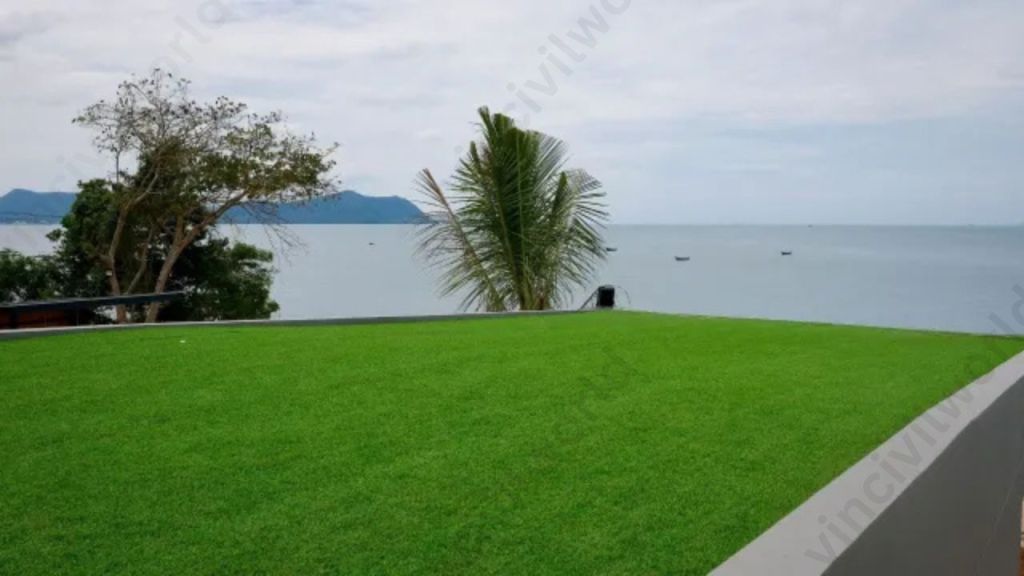
A lush green rooftop lawn overlooking a calm sea with distant mountains and a few boats in the water.
A vibrant green roof provides an eco-friendly touch to modern buildings, overlooking a serene view of the sea.

Different Types of Green Roofs

Different types of green roofs are classified based on vegetation depth, structural load, and maintenance needs. Understanding these types helps designers choose the right system for performance, cost, and sustainability in buildings.
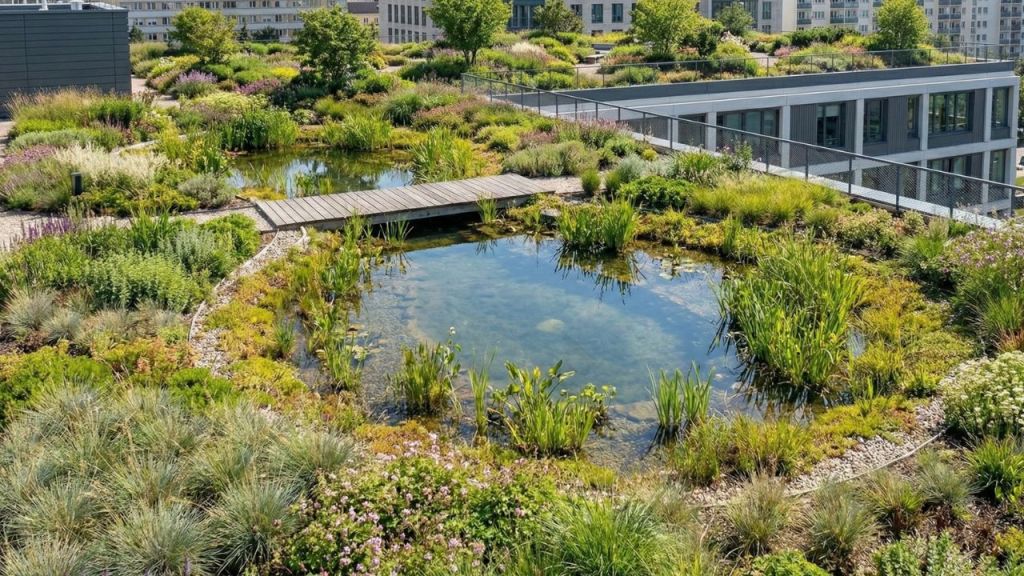
Aerial view of a lush green rooftop garden featuring various plants, a small pond, and a wooden walkway among vibrant foliage.
A diverse green roof featuring vegetation and a water feature, exemplifying the benefits of urban biodiversity and stormwater management.

Types of Green Roofs

  • Blue-Green Roofs
  • Extensive Green Roofs
  • Intensive Green Roofs
  • Semi-Intensive Green Roofs
  • Biodiverse (Brown) Roofs

Also Read : Green walls – Types and advantages

Blue-Green Roofs

Blue-Green Roofs combine green roof vegetation with integrated water storage systems to manage stormwater effectively. These roofs temporarily store rainwater, release it slowly, and support plant growth, reducing flooding risk and improving urban climate resilience.

Features of Blue-Green Roofs

  • Integrated rainwater storage layer
  • Controlled water release system
  • Vegetation adapted to wet conditions
  • Improved stormwater management
  • Reduced urban flooding and runoff

Extensive Green roofs 

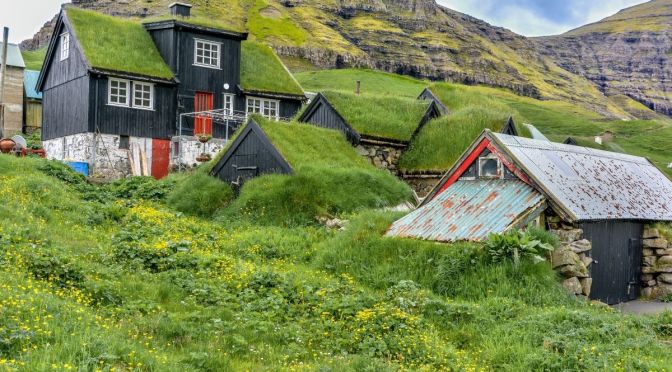
  • Extensive green roofs are a common choice among homeowners.
  • They are light, low-maintenance, and do not need additional watering unless there is a prolonged drought.
  • Designers can use them on flat roofs of both existing and new roof decks.
  • Extensive green roofs typically feature an attractive vegetation layer about 80–150 mm thick, consisting of grass, moss, sedum, or small flowering plants.

Intensive Green Roofs

  • Intensive green roofs support larger plants, typically 8–12 inches tall, including bushes, small trees, and a wider variety of vegetation. They are commonly known as roof gardens.
  • To sustain this much thicker vegetation layer, they need a layer of rising medium/soil.
  • They’re more popular in larger commercial ventures, such as parks and gardens.
  • Intensive roofs require a much deeper substrate, which increases structural load and irrigation needs.
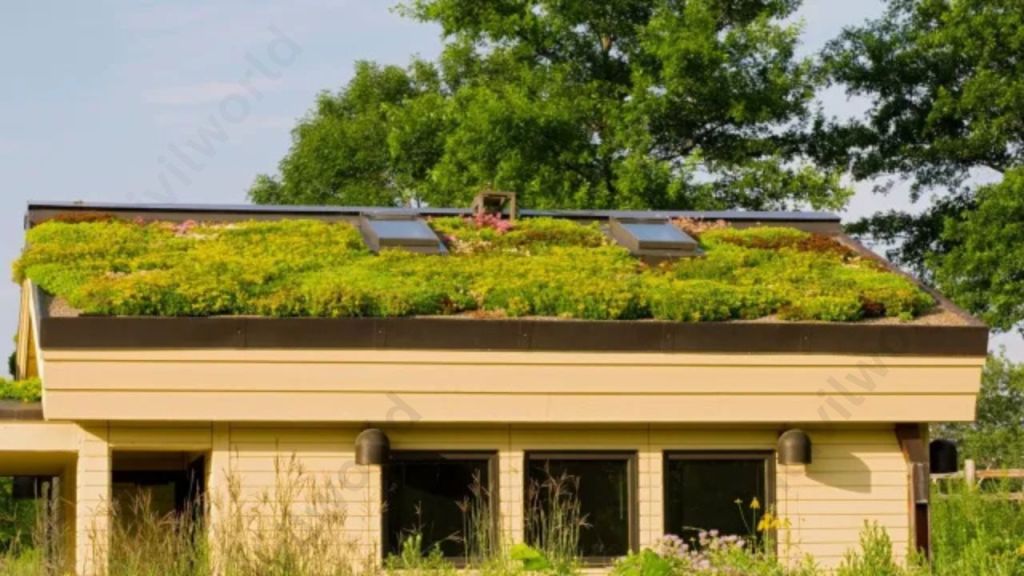
A modern house featuring a green roof with vegetation and solar panels, surrounded by trees and tall grass.
An example of a green roof system featuring a variety of vegetation, designed to enhance building sustainability and urban biodiversity.

Semi-extensive Green roofs

Semi-extensive green roofs are hybrid systems that combine features of extensive and intensive roofs. They offer moderate vegetation depth and improved aesthetics. These roofs also have balanced maintenance requirements for residential and commercial buildings.

Features of Semi-Extensive Green Roofs

  • Moderate irrigation and maintenance needs
  • Moderate substrate depth
  • Supports grasses, herbs, and small shrubs
  • Medium structural load requirement
  • Better insulation than extensive roofs
  • Let me show you the components of a green roof.

Green Roof System Construction Components

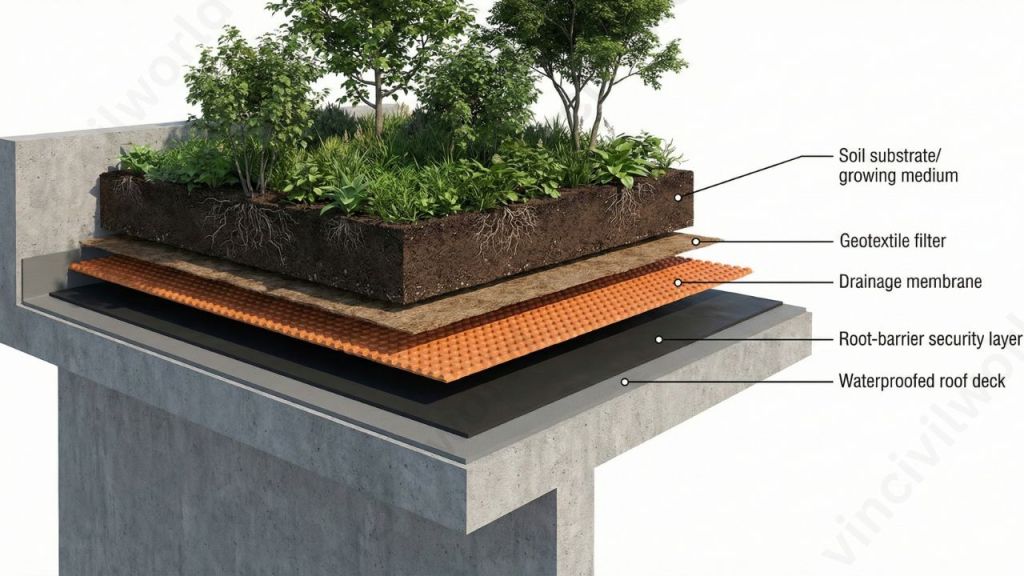
You must install a green roof system for a green roof to develop and prosper. A green roof system is made up of many layers, which are as follows:

  • Waterproofed roof deck 
  • Root-barrier security
  • Membrane for Drainage
  • Geotextile filter / filter layer
  • Substrate / growing medium for green roofs
  • Plants and trees
Cross-section diagram of a green roof system showing layers: soil substrate/growing medium, geotextile filter, drainage membrane, root-barrier security layer, and waterproofed roof deck.
An illustration of a green roof system, showcasing the layered components including soil substrate, drainage membrane, root barrier, and waterproofed roof deck.

Let’s take a look at each one separately:

Waterproofed roof deck

Your roof deck may already have a waterproofing layer since waterproofing is an important part of the structure’s protection. If not a bitumen membrane or coating, asphalt on a shed, or any kind of liquid waterproofing may be used.

Also Read : Types of water proofing – 5 methods explained

Root barrier 

  • To avoid any roots from causing damage to the structure, a root barrier should be installed above the primary waterproofing layer. 
  • There are typically thin polyethylene plastic membranes. 
  • They are spread over the waterproofing layer and taped together.
  • Root barriers are imperative in intensive roofs due to the potential for more woody and robust roots.

Membranes for Waterproof Drainage 

  • Rain and stormwater are dealt with by the drainage layer of a green roof system.
  • It allows water to safely flow away from the roof into guttering and downpipes.
  • It protects the structure as well as the plants from saturation and root damage by coping with excess water.
  • The stud profile on these green roof drainage membranes helps to ensure proper drainage.

Filter Layer 

The filter layer on a green roof prevents dirt, other substrates, and debris from clogging the drainage membrane’s cavities.

Growing Substrate

The substrate should be light, helps with drainage but is still absorbent enough to maintain enough water to sustain your plants’ growth. The commonly used substrates are: 

  • Bricks
  •  Aggregates 
  • Compost 
  • Medium clay soils 
  • Volcanic rocks such as lava and pumice 

All of them offers the advantage of being all-natural and environmentally friendly.

Green Roof Advantages

  • Green roofing has a longer life since a green coating protects it from UV radiation, snow, and ice.
  • The roofing will last two to three times longer than a conventional roof because it will not be exposed to extreme high and low temperatures.
  •  It will be comfortable and cool inside during the summer and comfortably warm during the winter.
  • Energy costs will be reduced as a result of the lower HVAC energy demands.
  • The green roof  especially the substratum absorbs both impact and environmental noise, such as rain and hail.
  • Some of the invisible pollution and particles are filtered out of the air by plants.
  •  The pollution level in the air above gardens and parks is up to 80% lower than in the rest of the city.
  • The vegetation layer, the substratum, and the irrigation layer filter and absorb 30 to 50 percent of rainwater, resulting in far less water in the sewage system.
  • Green roofs help to increase the city’s fauna, such as butterflies, pollinating insects, and birds, among other things.
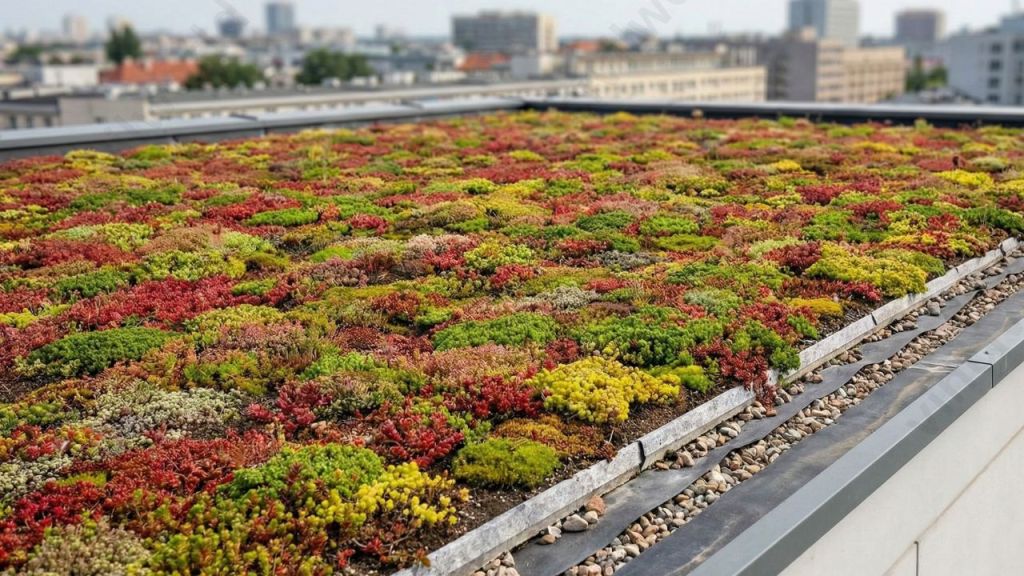
A vibrant green and red succulent roof garden filled with various low-growing plants covering a flat rooftop, with a city skyline visible in the background.
A vibrant green roof showcasing diverse vegetation, enhancing urban aesthetics and sustainability.

Green Roof Disadvantages

There are only a few drawbacks, with installation cost being the most significant. A green roof costs more to build than a conventional flat roof because builders must reinforce the underlying structure to handle the additional load.

That’s it about green roofs. Hope this blog motivated you to set up a green roof in your building. Let’s go green. Let’s adopt green roofs.

Key Takeaways

  • Green roof systems integrate vegetation layers over rooftops to improve environmental and building performance.
  • They play a major role in sustainable and climate-resilient construction.
  • Understanding the types of green roofs helps in selecting suitable systems based on load, maintenance, and usage.
  • Green roofs in buildings reduce heat gain, improve thermal comfort, and lower energy consumption.
  • Proper green roof construction ensures effective waterproofing, drainage, and long-term durability.
  • Key features of green roofs include insulation layers, drainage membranes, growing media, and plant systems.
  • Green roofs support stormwater management and urban biodiversity.
  • Noise reduction and air quality improvement are added benefits.
  • Structural assessment is essential before installation.
  • Overall, green roofs enhance sustainability and building lifespan.

Conclusion

Green roof systems offer an effective solution for creating sustainable, energy-efficient, and environmentally responsible buildings. By understanding the types of green roofs, designers and homeowners can choose systems that suit structural capacity, maintenance needs, and functional goals. The adoption of green roofs in buildings helps reduce heat gain, manage stormwater, and enhance urban biodiversity. Proper green roof construction is essential to ensure waterproofing, drainage efficiency, and long-term performance. The key features of green roofs include insulation layers, drainage membranes, and growing substrates. These elements contribute to improved thermal comfort and durability. With multiple green roof advantages, including energy savings, noise reduction, and extended roof lifespan, green roofs represent a practical and future-ready solution for sustainable building design.
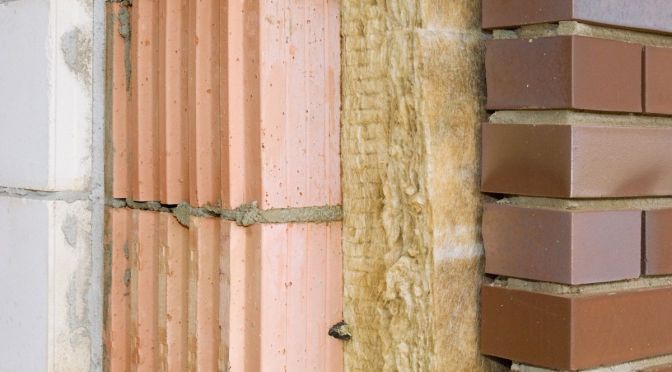
Understanding Thermal Bridging: Causes and Solutions

Thermal Bridging in Buildings occurs when heat transfers through parts of a structure. This happens where insulation is reduced or interrupted. In construction practice, thermal bridges often happen at junctions, edges, and penetrations. High thermal conductivity materials allow heat to escape in these areas. Understanding the types of thermal bridging helps designers identify repeating, geometric, and point bridges within building envelopes. The causes of thermal bridging often include poor design detailing, structural elements passing through insulation, and improper installation practices. Over time, the effects of thermal bridging lead to heat loss, higher energy consumption, surface condensation, and mould growth. Additionally, thermal bridging insulation issues reduce overall thermal performance and occupant comfort. Addressing these aspects early improves energy efficiency, durability, and sustainability in modern building design.

Thermal bridging can have a major impact on a dwelling’s overall thermal efficiency, even in very well-insulated homes. According to recent studies, thermal bridging has been found to be responsible for up to 30% of a home’s heat loss.

In this blog, I will show you what exactly is thermal bridging, its consequences, causes, types and strategies to reduce them. Let’s get started.

  1. What is a thermal bridges in Buildings and Construction ?
  2. Effects of Thermal Bridging
  3. Thermal Bridging Causes
  4. Types of Thermal Bridging
    1. There are several types of thermal bridges, which can be further classified as follows:
  5. Why should we avoid thermal bridging?
    1. Decreased Insulation Effectiveness
    2. Increased expenditure of energy
    3. Greater risks of Condensation, mould, and rot 
  6. Strategies to reduce Thermal Bridging
  7. Key Takeaways
  8. Conclusion

What is a thermal bridges in Buildings and Construction ?

A thermal bridge is a part of an object that has a higher thermal conductivity than the surrounding areas. This allows heat to flow through it with the least amount of resistance. The object’s thermal resistance is reduced as a result of thermal bridges. It is also known as a cold bridge, heat bridge, or thermal bypass.

Thermal Bridging occurs when heat flows away easily through a part of the construction. This part has much less thermal resistance compared to its surroundings. This leads to uneven heating in a building.

Thermal bridges in buildings and construction are areas within a structure where heat flows more easily. This happens due to breaks or weaknesses in insulation. These bridges usually occur at junctions between walls, floors, roofs, balconies, and around openings such as windows and doors. When materials with high thermal conductivity pass through insulated layers, they create paths for heat loss during winter. They also lead to heat gain in summer. As a result, thermal bridges reduce energy efficiency. They increase heating and cooling demand. They may also cause surface condensation and mould growth. Identifying and minimizing thermal bridges in buildings and construction is essential for improving thermal performance, occupant comfort, and long-term building durability.

Also read : ALC Panels – Aerated Light Weight Concrete panels- Overview

Effects of Thermal Bridging

Effects of thermal bridging significantly influence the energy performance and durability of buildings. Thermal bridging occurs when heat transfers through areas with reduced insulation, creating unwanted heat loss or heat gain. In buildings and construction, these weak points lower thermal efficiency and negatively affect indoor comfort. Understanding the effects of thermal bridging helps engineers and designers improve insulation detailing, reduce energy consumption, and enhance building performance.

  • Thermal bridging in buildings will increase the amount of energy needed to heat and cool a room. 
  • Results in condensation of moisture inside the building envelope
  • Cause thermal discomfort. 
  • Causes additional heat losses in colder climates and require more energy to mitigation
  • Increased heat loss in winter and heat gain in summer
  • Higher energy consumption and utility costs
  • Reduced overall thermal performance of the building envelope
  • Formation of cold spots on internal surfaces
  • Risk of surface condensation
  • Growth of mould and mildew
  • Discomfort for occupants due to temperature variations
  • Degradation of building materials over time
  • Reduced lifespan of insulation systems
  • Failure to meet energy efficiency standards and regulations

Thermal Bridging Causes

Thermal bridging causes arise mainly from design and construction gaps where insulation is interrupted. This interruption allows heat to pass through structural elements and junctions. As a result, energy efficiency in buildings is reduced.

  • The points where the wall and the floor come together
  • Wall-to-roof junctions
  • Pipe and cable access holes in the building envelope
  • Window and door reveals
  •  Steel wall links in masonry work, (e.g. cavity walls)

Types of Thermal Bridging

Types of thermal bridging describe the different ways heat flows through building elements where insulation is reduced or interrupted. Identifying these types helps designers control heat loss, improve energy efficiency, and prevent moisture-related problems in buildings and construction.

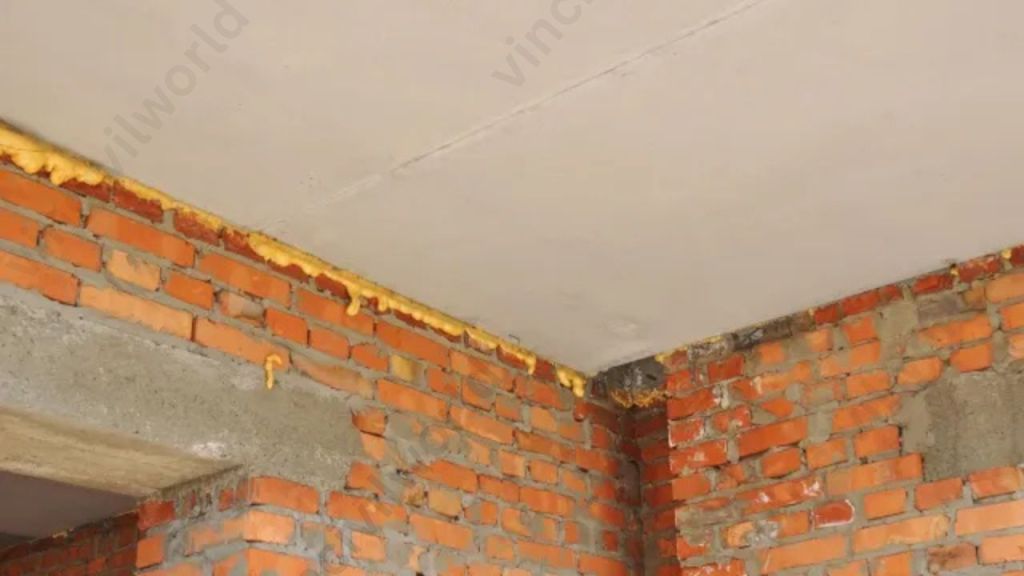
Interior corner of a room featuring exposed red brick walls and a foam sealant applied along the ceiling joint.
Close-up of a wall junction showcasing potential thermal bridging, highlighted by the insulation gaps and exposed brickwork.

There are several types of thermal bridges, which can be further classified as follows:

  • Geometric thermal bridging
  • Material thermal bridging
  • Structural thermal bridging
  • Repeating thermal bridging
  • Point thermal bridging

Geometrical Thermal Bridges 

Geometrical thermal bridges are induced by the building’s geometry, as the name implies. They are more likely to occur with complex building forms. So it’s best to keep the overall design as simple as possible to avoid them. The examples include:

  • Corners of exterior walls
  •  Wall-to-floor junctions 
  • Wall-to-roof junctions 
  • Junctions between adjacent walls

Material Thermal Bridging

Material thermal bridging occurs when building materials with high thermal conductivity pass through or replace insulation layers. Materials such as steel, concrete, and aluminum allow heat to transfer more easily than insulating materials. As a result, heat escapes in winter and enters the building during summer, reducing energy efficiency. Material thermal bridging commonly occurs in wall studs, beams, columns, and fasteners. Identifying and minimizing material thermal bridging is essential to improve insulation performance, reduce energy loss, and enhance indoor comfort in buildings and construction.

Structural Thermal Bridging

Structural thermal bridging occurs when structural elements penetrate the building envelope and interrupt continuous insulation. Elements such as balconies, floor slabs, columns, and cantilevered beams create direct heat flow paths. These structural connections significantly increase heat loss and may cause surface condensation and thermal discomfort. Structural thermal bridging is common in reinforced concrete and steel structures. Proper detailing, thermal breaks, and improved design strategies help reduce structural thermal bridging and improve overall thermal performance in buildings.

Repeating Thermal Bridges 

Repeating thermal bridges follow a trend. And it is “repeated” over a large area of the building’s thermal envelope. The examples include:

  • Steel wall ties used in masonry cavity wall construction
  • Ceiling joists used in cold pitched roofs when insulating at the ceiling level
  • Split created by timber framing when insulation occurs between the studs  
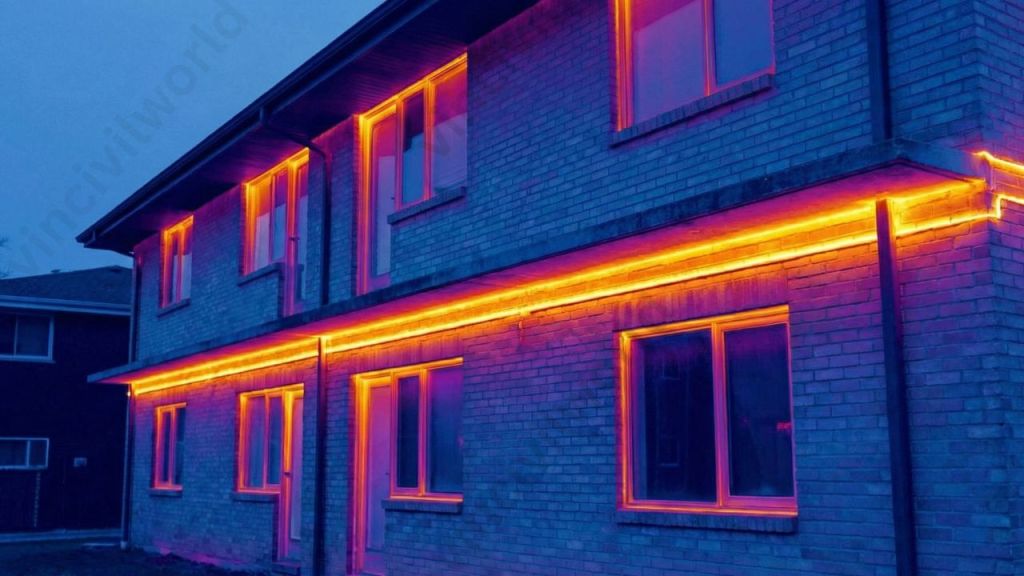
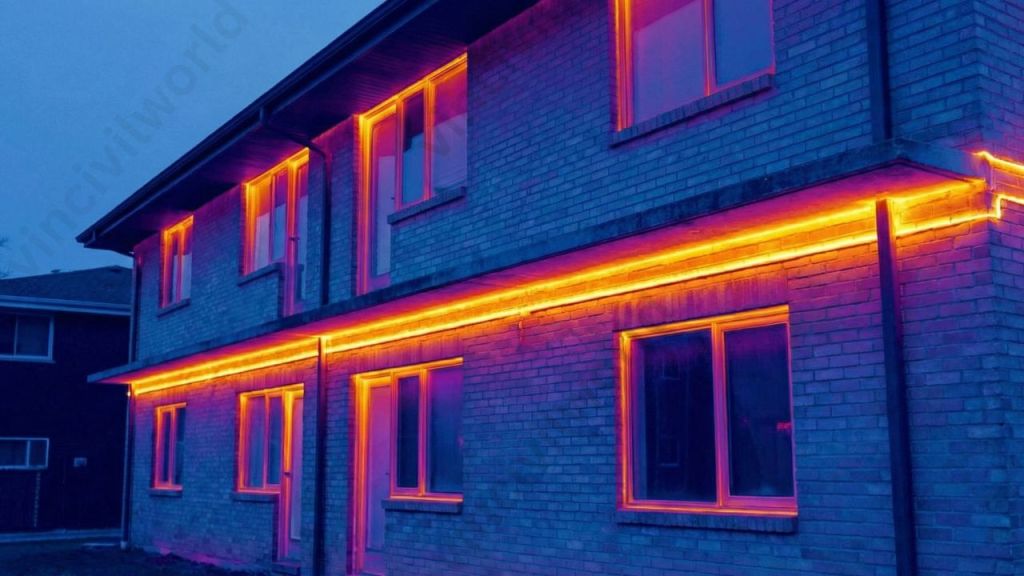
A two-story house illuminated with vibrant orange and purple LED lights along the edges, set against a twilight sky.
Thermal imaging of a building highlighting areas of heat loss, illustrating the effects of thermal bridging.

Repeating thermal bridges are normal and predictable. But still, they result in significant heat loss. Because of that, we should consider thermal bridging when calculating the U-value and during planning, design, and construction.

Point thermal bridging

Point thermal bridging occurs at localized points where small but highly conductive elements penetrate the insulation layer. Common examples include metal fasteners, anchors, screws, and fixing brackets used in building construction. Although each point bridge is small, their combined effect can lead to noticeable heat loss and reduced thermal performance. Point thermal bridging may also cause cold spots on interior surfaces, increasing the risk of condensation. Minimizing point thermal bridging through proper detailing and low-conductivity fixings improves energy efficiency and overall building performance.

Non Repeating Thermal Bridges 

  • Thermal bridges appear periodically. And, they are located where the building’s thermal insulation has a split in it.
  •  Non-repeating thermal bridges can form where materials with different thermal conductivity come together to form the envelope. 
  • Examples include reveals around windows and doors, loft hatches, and other openings in the building’s thermal envelope.
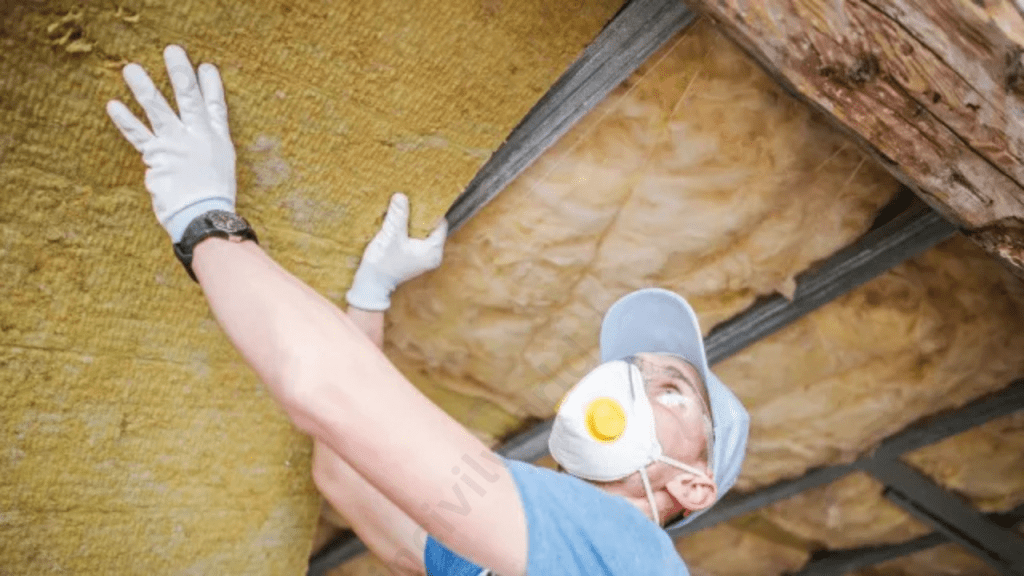
A person wearing gloves and a mask is installing insulation in a ceiling. The individual is reaching up to adjust the material, which appears to be yellow insulation. The environment indicates a home improvement or construction setting.
A worker installing insulation material to improve building energy efficiency and minimize thermal bridging.

Why should we avoid thermal bridging?

Let me give you a set of reasons that would prompt you to avoid thermal bridges during construction of a building.

Decreased Insulation Effectiveness

  • Buildings that are airtight and have high levels of insulation may be more vulnerable to thermal bridges. 
  • When high levels of air tightness and insulation are present, thermal bridges can account for up to 30% of heat loss. 
  • During the warmer months of the year, thermal bridges can actually cause an increase in heat gain. This can contribute to overheating of the indoor room.

Increased expenditure of energy

The amount of heat lost depends on the intensity and frequency of thermal bridges. it’s best to design and construct buildings with no thermal bridges. If you don’t, you’ll end up spending more money to maintain a constant and comfortable indoor air temperature. This will undermine the intention of installing energy efficiency measures in the first place. 

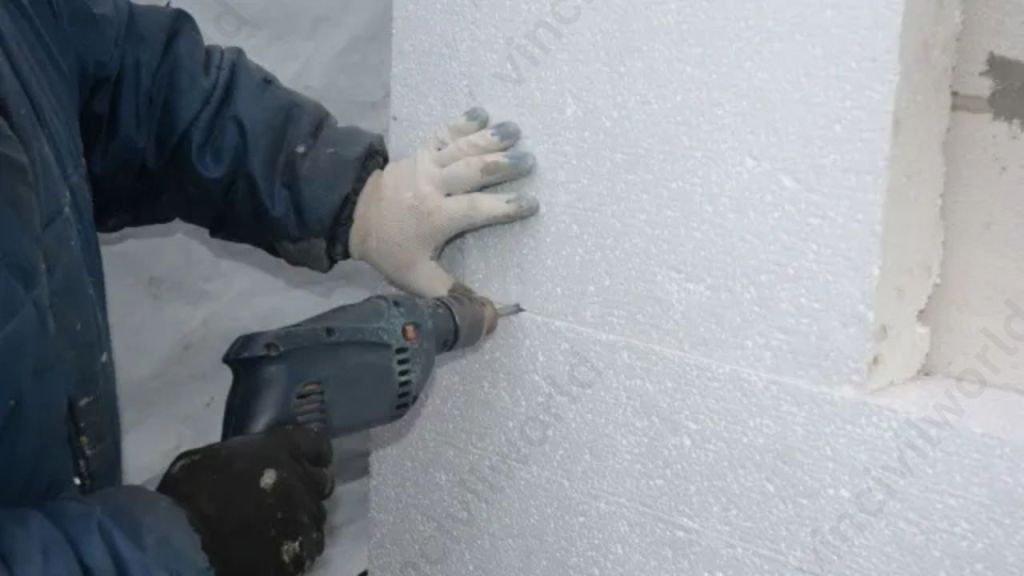
A worker installing insulation material using a power drill, emphasizing the importance of proper thermal bridging techniques in construction.

Greater risks of Condensation, mould, and rot 

  • Thermal bridges can cause interstitial condensation within walls and other building elements.
  •  Since it cannot be seen from the inside or outside of the house, interstitial condensation can be extremely hazardous. 
  • As the interior temperature falls below the dew point, moisture in the warm air condenses into water droplets.
  • Mold growth is one of the most common side effects of condensation. 
  • Invisible mold can develop out of reach, resulting in poor indoor air quality and negative health effects for building occupants.
A two-story brick house illuminated with vibrant orange and purple neon lights along the edges of the windows and roof, set against a twilight sky.
Infrared image showing thermal bridging in a building, highlighting heat loss areas around windows and walls.

Strategies to reduce Thermal Bridging

Depending on the source, site, and form of construction, there are many methods that have been proven to minimise or eliminate thermal bridging. The aim of these approaches is:

  1. Either create a thermal break where a building component would otherwise stretch from outside to inside.
  2. Or, minimise the amount of building components that span from outside to inside.

 These are some of the strategies:

  • Using a continuous thermal insulation layer, such as rigid foam board insulation in the thermal envelope.
  • Lapping of insulation where direct continuity is not feasible.
  • Usage of Wall assemblies with double and staggered walls.
  • Using Insulating Concrete Forms (ICFs) and Structural Insulated Panels (SIPs).
  • Reduce the framing factor by removing unnecessary framing members.
  • Increased insulation depth by using raised heel trusses at wall-to-roof junctions.
  • Installation of high-quality insulation with no voids or compressed insulation.
  • Adding a gas filler and a low-emissivity coating to double or triple-pane windows.
  • Installing windows with thermally broken low conductivity frames.

Keep this strategies in mind so that they can help you construct a building with zero thermal bridges. Hope you found them useful. Let’s know in the comments.

Key Takeaways

  • Thermal bridging in buildings occurs where insulation is reduced or interrupted, allowing heat to flow easily.
  • It can account for up to 30% of total heat loss, even in well-insulated structures.
  • Thermal bridges commonly form at junctions, edges, penetrations, and structural connections.
  • Major effects of thermal bridging include increased energy consumption, condensation, mould growth, and occupant discomfort.
  • Thermal bridging causes often relate to poor design detailing, material choices, and construction practices.
  • The main types of thermal bridging include geometric, material, structural, repeating, and point thermal bridges.
  • Repeating and point thermal bridges may appear minor individually but cause significant cumulative heat loss.
  • Proper identification during design is critical.
  • Continuous insulation and thermal breaks reduce risks.
  • Accurate detailing improves energy efficiency and building durability.

Conclusion

Thermal bridging is a critical factor that directly affects the energy efficiency, comfort, and durability of buildings. Thermal bridges in buildings and construction allow uncontrolled heat flow due to insulation gaps, material conductivity, and poor detailing. Understanding the types of thermal bridging, along with the causes of thermal bridging, enables designers and engineers to address weak points in the building envelope. The effects of thermal bridging, such as heat loss, condensation, mould growth, and increased energy costs, highlight the importance of proper planning and execution. By adopting effective strategies like continuous insulation, thermal breaks, and improved construction detailing, thermal bridging insulation issues can be significantly reduced. Addressing thermal bridging early ensures sustainable, energy-efficient, and comfortable buildings that meet modern performance standards.