Tag Archives: irrigation infrastructure

Types of Irrigation- Flow and Lift Irrigation Full Details

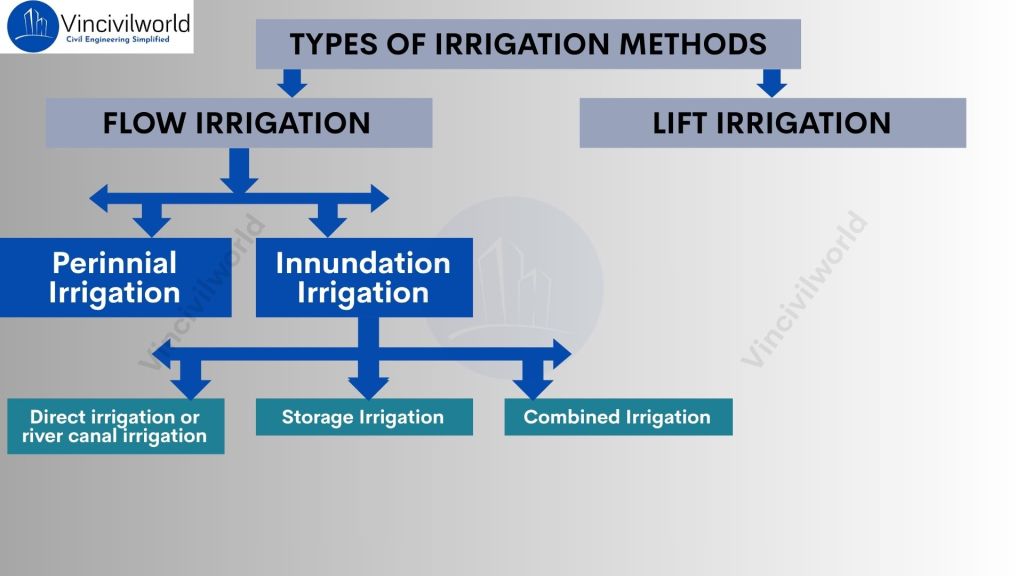
Types of irrigation are mainly divided into two- Lift irrigation and flow irrigation. Flow irrigation is further divided into perennial and inundation irrigation. Inundation irrigation is again subdivided into three. They are direct irrigation, storage irrigation and combined System. We are going to meet the huge family in the blog.

Irrigation is crucial for sustainable agriculture, ensuring crops receive water even when rainfall is uncertain. Two predominant systems are widely implemented today: flow irrigation and lift irrigation. In flow irrigation, water naturally moves from rivers or canals to fields by gravity. This includes inundation irrigation and perennial irrigation methods. These methods make it cost-effective and widely accessible. On the other hand, lift irrigation uses pumps or other means to raise water from lower sources. It offers solutions in areas where gravity canals can’t reach. Understanding the difference between lift irrigation and flow irrigation, the mechanics behind a flow irrigation system. This article covers all aspects, helping farmers and professionals choose the right irrigation strategy for their fields.

  1. Types of Irrigation methods
  2. Flow irrigation- Major among types of irrigation
    1. Perennial irrigation system
    2. Inundation irrigation
    3. Direct irrigation or river canal irrigation
    4. Storage irrigation
    5. Combined System
  3. Lift irrigation- second among types of irrigation
  4. Choice between types of irrigation
  5. Difference between Lift irrigation and Flow irrigation
  6. Key takeaways
  7. Conclusion 

Types of Irrigation methods

Irrigation is crucial for ensuring crops receive adequate water when rainfall is lacking. Various irrigation methods have been developed to deliver water efficiently to fields. Each method is designed to suit different landscapes. These methods also consider diverse water sources and agricultural requirements.

Irrigation is mainly two types.

  • Flow irrigation
  • Lift irrigation

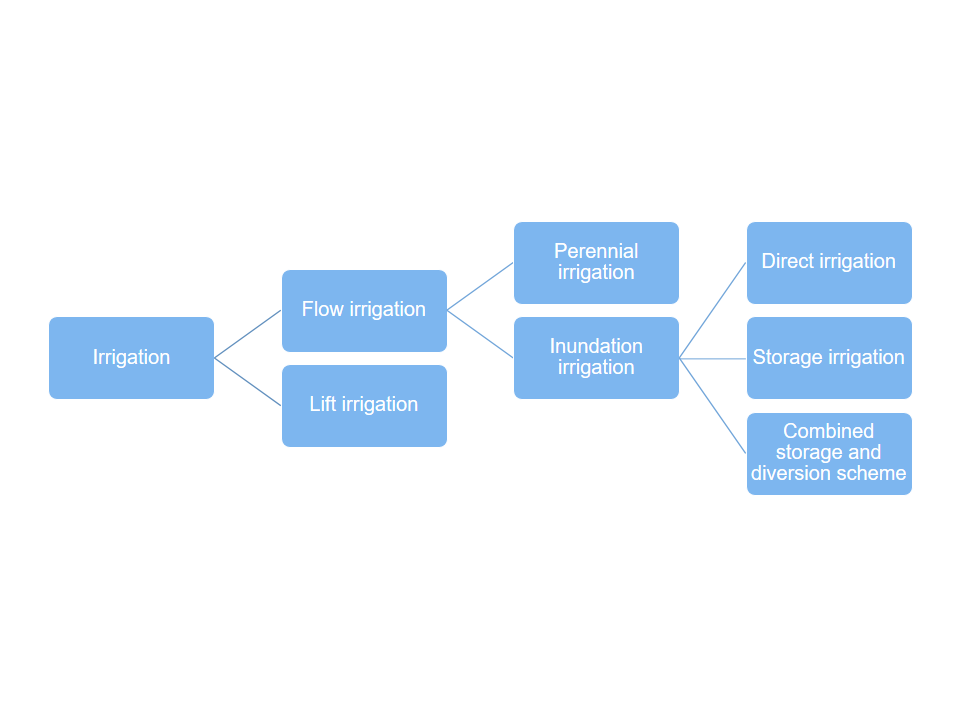
The figure below is a schematic diagram showing the types of irrigation.
Types of irrigation
Types of irrigation
A schematic diagram illustrating the two main types of irrigation methods: Flow Irrigation and Lift Irrigation, with Flow Irrigation further divided into Perennial and Inundation Irrigation, and Inundation Irrigation further subdivided into Direct Irrigation, Storage Irrigation, and Combined Irrigation.
Schematic diagram illustrating the different types of irrigation methods: Flow Irrigation and Lift Irrigation.

Let’s get into each of them in detail.

Flow irrigation- Major among types of irrigation

Flow irrigation is that type of irrigation in which the supply of irrigation water available is at such a level that it is conveyed on to the land by the gravity flow. The Flow irrigation is an irrigation method where water supply is conveyed to agricultural fields by gravity flow from sources like rivers or canals, without external energy. It includes perennial irrigation and inundation irrigation, making it cost-effective and widely used. Understanding flow irrigation systems and its difference with lift irrigation is crucial for efficient water management.

  • Perennial irrigation system
  • Inundation or flood irrigation system

So, what are these? Relax. We will take one at a time and learn.

Perennial irrigation system

In perennial irrigation system, the water required for irrigation is supplied in accordance with the crop requirements throughout the crop storage. Weirs or barrages are required to store the excess water during floods and release it to the crops as and when it is required.

The perennial irrigation system supplies water continuously throughout the crop’s growth period, matching irrigation to crop needs. It uses storage structures like dams, barrages, or weirs to store excess water during floods and releases it as required. This system ensures reliable water availability year-round; consequently, it promotes steady crop growth and higher yields. Moreover, it is particularly suitable for areas with consistent water sources.

Inundation irrigation

Inundation irrigation is carried out by deep flooding and thorough saturation of the land to be cultivated which is then drained off prior to the planting of the crop.

The Inundation irrigation is a traditional method. Floodwater from a river overflow during the rainy season is diverted to agricultural land through a canal. This process occurs without any regulating structure. The canal’s bed level is fixed so water flows only when the river level exceeds it, and irrigation stops when the water level falls. Because there is no head regulator, over-irrigation may damage crops. It relies solely on gravity and natural flooding events for water supply.

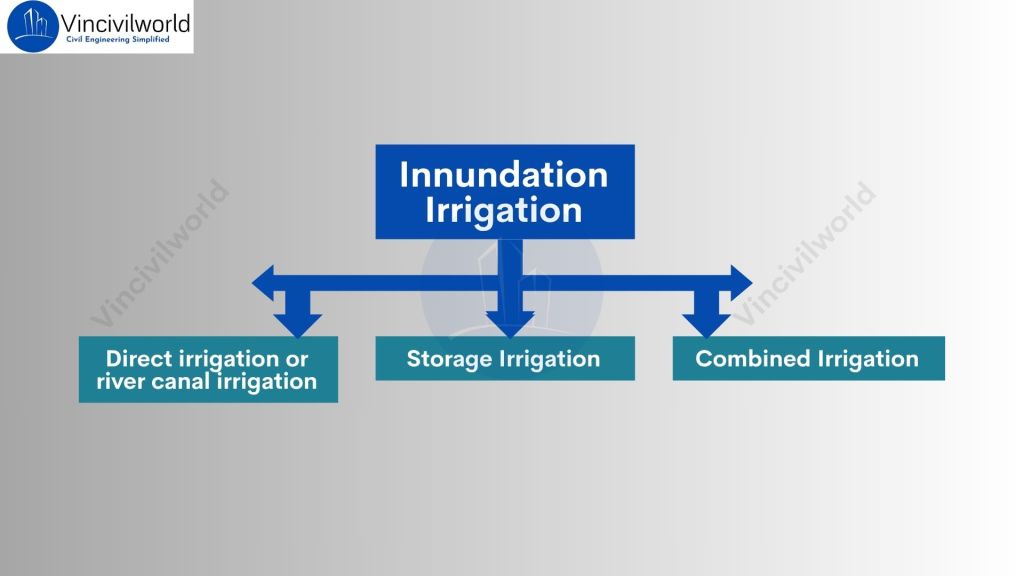
Depending upon the source from which the water is drawn, inundation irrigation can be further subdivided into 3 types.

  • Direct irrigation or river canal irrigation
  • Storage irrigation
  • Combined System
Schematic diagram showing types of inundation irrigation: direct irrigation, storage irrigation, and combined irrigation.
Schematic diagram illustrating the types of inundation irrigation: Direct irrigation, Storage irrigation, and Combined irrigation.

Now, what? Let’s peep into each of them to make friends with them.

Direct irrigation or river canal irrigation
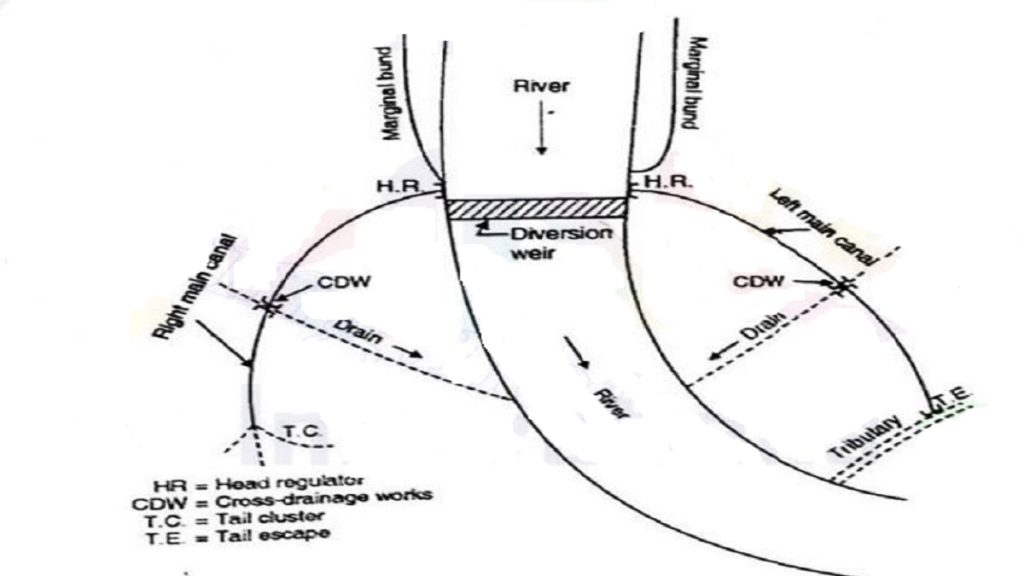
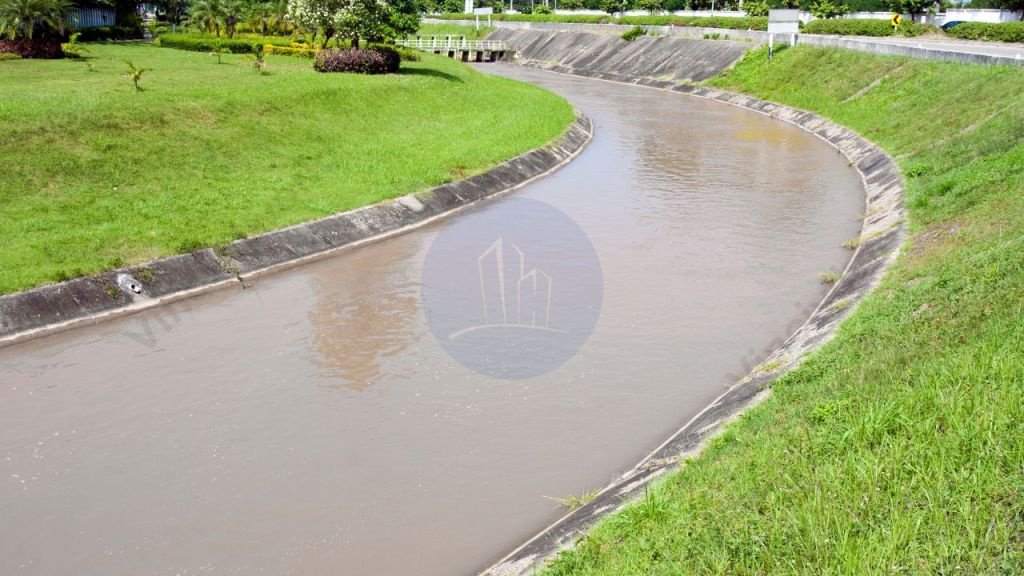
figure shows direct irrigation
Direct irrigation
A curved canal filled with water, bordered by green grass and plants, illustrating a flow irrigation system.
A canal used for direct irrigation, showcasing how water is supplied to agricultural fields using gravity flow.

We are going to jump right into the details of direct irrigation now.

  • In this direct irrigation system, water is directly diverted to the canal without attempting to store the water. For such a system, a low diversion weir or diversion barrage is constructed across the river.
  • This raises the water level in the river and thus diverts the water to the canal taking off upstream of the weir, as shown in figure.
  • Generally, a direct irrigation scheme is of a smaller magnitude, since there are no rigid controls over the supplies. One or two main canals may take off directly from the river.
  • Cross- drainage works are constructed wherever natural drains or distributary streams cross the canals. In a bigger scheme, there may be branch canal taking off from the main canal

Learnt about direct irrigation, right? Let’s move on to storage irrigation next.

Storage irrigation
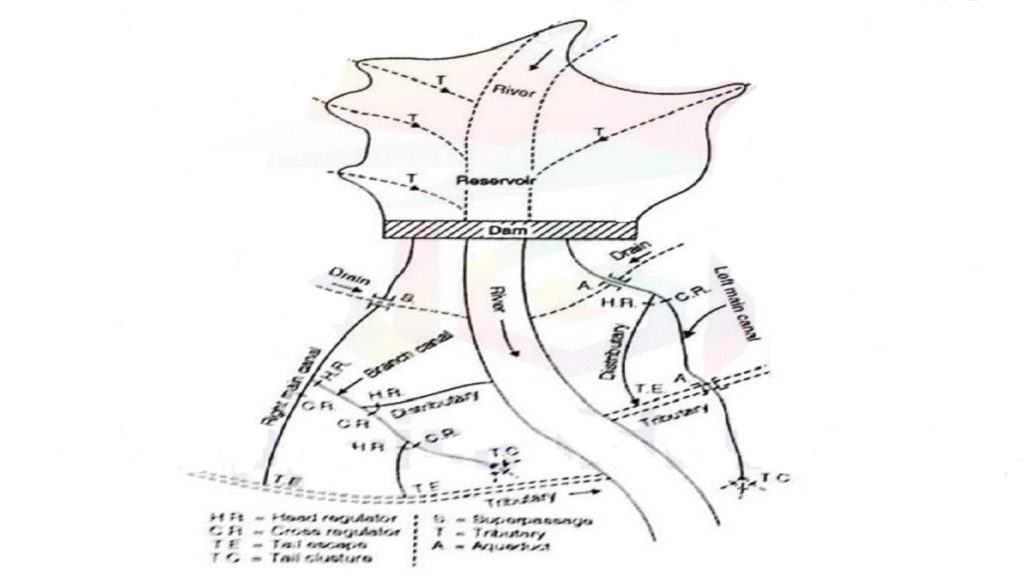
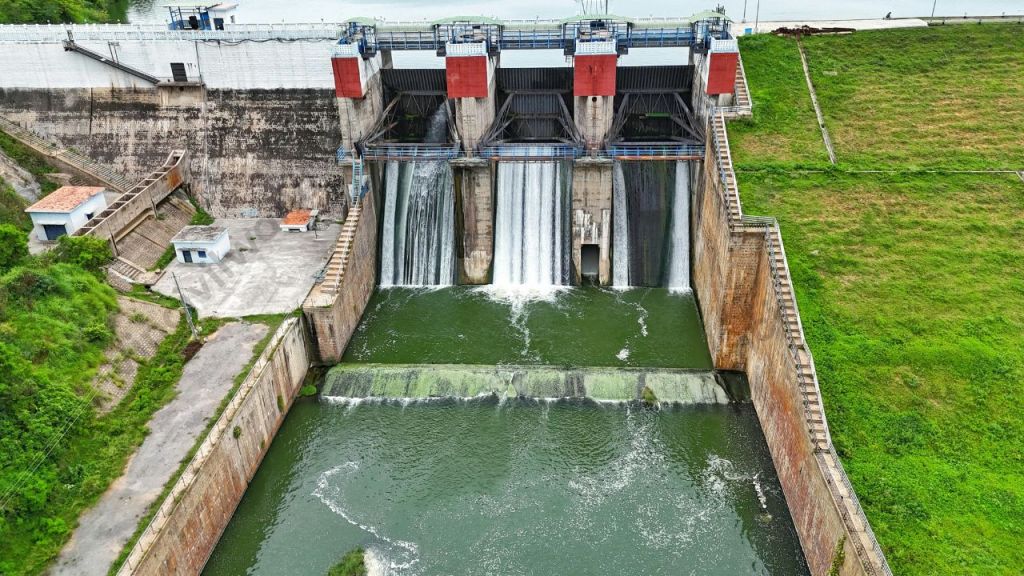
figure shows storage irrigation
Storage Irrigation
An aerial view of a dam structure with water flowing through gates, surrounded by green land.
Aerial view of a dam illustrating the concept of storage irrigation, with water being retained for agricultural use.

What are we waiting for? See the basic knowledge about storage irrigation now.

  • In storage irrigation system, a solid barrier, such as a dam or a storage Weir is constructed across the river and water is stored in the reservoir or lake so formed.
  • Depending upon the water requirements of crops, or the hydroelectric power generation, and upon the flow of water in the basin at the site construction, the elevation storage curve for the reservoir is known.
  • The height of the dam is then decided from this curve, corresponding to the storage- volume required.
  • Storage irrigation scheme is comparatively of a bigger magnitude, and involves much more expenditure than a direct irrigation scheme.
  • One or two main canals take off from the reservoir. Due to the formation reservoir, some land property may be submerged to the upstream of the dam.
  • A network of canal system convey water to the agricultural fields, through various regulatory works.
  • Cross-drainage works such as aqueducts, syphon aqueducts, super passages and canal syphons are constructed wherever natural drains cross the canals

Time to meet the last member in flow irrigation system. Who’s that? Of course, combined system.

MUST READ: Concept of Green Building- 4 comprehensive concepts easy read!

Combined System
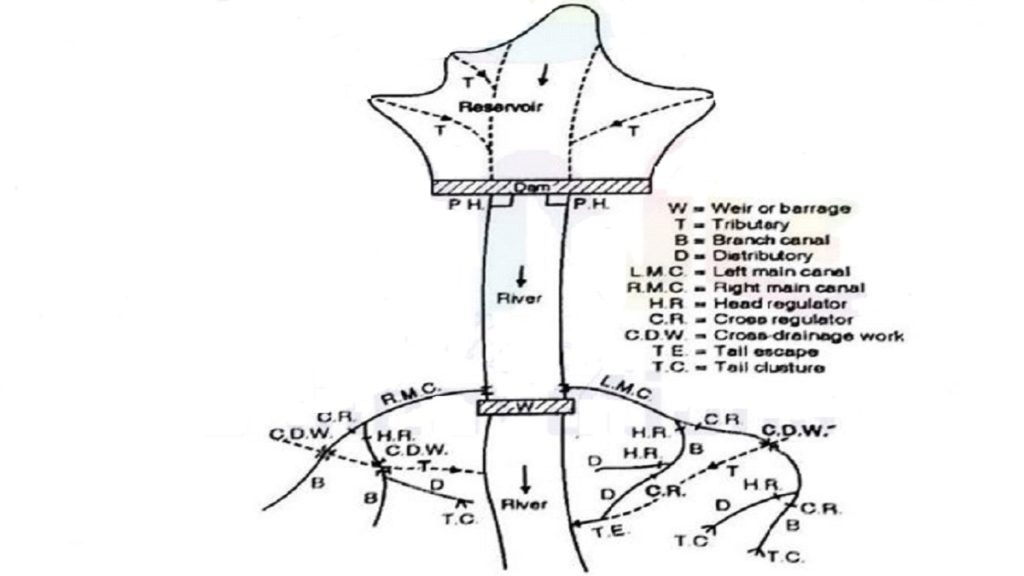
figure shows combined irrigation
Combined System

We have seen that in the storage irrigation system, water is stored in the reservoir, since the river is not perennial, while in the direct irrigation system, the river is perennial and hence the water is diverted from the river to the canal.
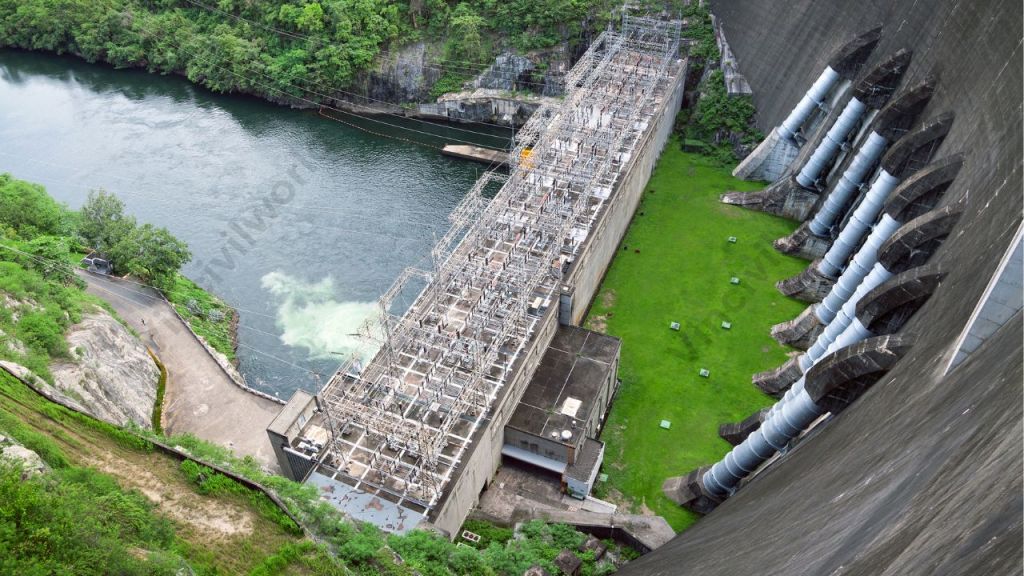
Aerial view of a dam and power generation facility, showcasing the water reservoir, power lines, and surrounding greenery.
Aerial view of a dam showcasing the reservoir, power generation facilities, and the surrounding landscape.

Sometimes, a combined scheme is adopted in which the water is first stored in the reservoir formed at the upstream side of the dam, and this water is used for water power generation.

The discharge from the power house is fed back into the river, to the downstream side of the dam. Thus, sufficient quantity of flow is again available in the river.

At a suitable location in the downstream, a pick up weir is constructed. This weir diverts the water from the river to the canal.

How can we leave the second main among the types of irrigation alone? Shake your hands with lift irrigation now.

Lift irrigation- second among types of irrigation

Lift irrigation is practiced when the water- supply is at too low a level to run by gravitation on to the land.

In this irrigation method, water is mechanically lifted from a lower-level source. It can be a river, well, or canal. The water is then moved to higher elevation fields using pumps or other lifting devices. Unlike gravity-fed systems, pumps carry the water first to a main delivery chamber. This chamber is at the highest point of the command area. From there, water is distributed by gravity through pipelines or canals to agricultural lands. The system is designed around topography, often dividing fields into blocks for fair water allocation. Lift irrigation is energy-intensive. It requires careful planning for distribution. However, it enables irrigation in areas lacking natural gravity flow. It expands cultivable zones and improves water access.

In such a circumstances water is lifted by mechanical means. Irrigation from wells is an example of lift irrigation, in which sub- soil water is lifted up to the surface and is then conveyed to the agricultural fields.

Now that you know all types of irrigation, how do you choose the right one for your requirement?

Choice between types of irrigation

Direct irrigation scheme is adopted in the circumstances where the river is perennial and has a normal flow throughout the irrigation season, never less at any time than the requirements of the field.

On the contrary, storage irrigation system is adopted when the river flow is either not perennial, or where flow is insufficient during certain parts of the crop season for irrigation requirements.

In a multistage river valley development, a combined storage- cum diversion scheme is more useful.

Difference between Lift irrigation and Flow irrigation

AspectFlow IrrigationLift Irrigation
Water MovementWater flows by natural gravity from higher to lower levels.Water is mechanically lifted from lower to higher elevations.
Energy RequirementMinimal; uses gravity, no pumps needed.High; requires pumps and energy (electric, diesel, solar).
Terrain SuitabilitySuitable for sloping or river command areas.Suitable for flat or elevated lands without gravity flow.
Infrastructure CostHigh initial costs due to hydraulic structures (dams, canals).Lower initial cost; no large hydraulic structures needed.
Operational CostRelatively low maintenance and energy costs.Higher energy and maintenance costs due to pumping.
Water LossesHigher losses from seepage and evaporation in open canals.Lower losses due to closed pipelines after lifting.
Water ControlLess precise; depends on natural flow and canal design.More precise; water delivery controlled via pumps/valves.
ComplexitySimple and economical system.More complex, needs technical operation and monitoring.
ExamplesPerennial and inundation irrigation.Pumping from wells, rivers, or canals to irrigate highlands.

This table highlights the core differences in mechanics, cost, terrain applicability, and water management between the two. Lift irrigation offers flexibility for challenging terrains. However, it incurs higher energy and operational costs. Flow irrigation relies on natural gravity. It is typically simpler but limited by topography.

Key takeaways

  • Irrigation is vital for sustainable agriculture, ensuring crops receive sufficient water regardless of rainfall variability.
  • Irrigation types mainly divide into Flow Irrigation and Lift Irrigation.
  • Flow irrigation uses natural gravity flow from sources like rivers or canals. It encompasses perennial irrigation (continuous supply) and inundation irrigation (seasonal flooding).
  • Inundation irrigation subdivides into direct irrigation, storage irrigation, and combined systems, depending on water source and storage method.
  • Lift irrigation mechanically raises water using pumps to higher elevation fields, then distributes it by gravity, enabling irrigation on otherwise unreachable terrain.
  • Flow irrigation is cost-effective, energy-efficient, and suited for sloping lands with reliable water sources.
  • Lift irrigation offers flexibility on flat or elevated land but requires energy and technical management.
  • Understanding the difference between lift irrigation and flow irrigation helps farmers choose the best system based on topography, water availability, and cost.

Conclusion 

Irrigation systems are essential tools for stabilizing agricultural production and managing water resources efficiently. Flow irrigation, relying on gravity-fed water movement, remains the predominant method due to its low energy requirements and suitability for perennial and seasonal water availability. Its subdivision into perennial and inundation irrigation allows adaptation to various water flow conditions. In contrast, lift irrigation addresses challenges in flat or elevated terrains where gravity flow is impossible, mechanically lifting water to irrigate diverse lands. While lift irrigation demands higher operational costs and technical expertise, it significantly expands cultivable areas. Choosing the appropriate irrigation system depends on landscape, water source reliability, infrastructure capacity, and crop requirements. Understanding these distinctions empowers farmers and water managers to optimize irrigation efficiency, conserve water, and sustain agricultural productivity under changing climatic and geographic conditions.

MUST READ: Innovative Water Conservation Methods Unlocked.

So, loved the article on types of irrigation? Let me know if i missed out anything in the comments.


Aqueduct || Cross Drainage Works || Types and functions

Aqueduct is a cross drainage structure constructed to channel water from the rivers or stream to the distribution points. But modern engineering aqueduct is a cross drainage system that constitutes pipes, ditches, canals, tunnels, and supporting structures. These are constructed or laid to convey water from a source to the main distribution points. Aqueducts/cross drainage systems play and important role in maintaining the strategic flow between drainage water with canal water.

Cross drainage works is a modern day aqueduct. It is constructed to intercept a drain crossing or canal crossing. This prevents the water from mixing between these sources.

  1. Significance of Aqueducts and Cross drainage works
  2. Cross drainage system/Aqueduct – Need
  3. Aqueduct /Drainage type selection
  4. Types of Cross drainage works
    1. Type 1 – irrigation canal passes over the drainage
      1. Aqueduct
        1. Advantages of Aqueduct
      2. Syphon Aqueduct
    2. Type-2- Drainage passes over the irrigation canal
      1. Super Passage
      2. Canal Syphon
    3. Type 3 – Drainage and canal intersection each other of the same level
      1. Level Crossing
      2. Inlet and Outlets or Canal Inlet
  5. Key Takeaways
  6. Conclusion

Significance of Aqueducts and Cross drainage works

Aqueducts and cross drainage works play vital roles in managing water flow and maintaining infrastructure integrity. An aqueduct was historically used to transport water across valleys and uneven terrain. It has evolved into essential modern structures. These include syphon aqueducts designed to overcome challenging topography. Cross drainage works, including culverts, bridges, and siphons, ensure efficient water management by directing flow under roads and other obstacles. This blog will explore the various types of aqueducts. It will also discuss cross drainage systems and their functions. Additionally, it will highlight their significance in infrastructure development. We’ll delve into syphon aqueducts and their unique role in hydraulic engineering, highlighting their applications.

Cross drainage system/Aqueduct – Need

The cross drainage system is an expensive structure and has to be avoided. But there may be situations when the following conditions are encountered and the cross drainage is to be provided.

  • The cross drainage design can minimise the discharge velocity at the intersection point.
  • The ideal condition of aligning the canal without intersecting the drainage is not possible. The increase in the length makes construction difficult. 
  • A canal is set between head work and the main watershed. The water supply is not intervened by providing cross drainage work.
A historic stone aqueduct featuring multiple arches, set against a backdrop of a cityscape with modern buildings and hills in the distance.
View of an ancient aqueduct showcasing its iconic arches and structure, illustrating its importance in water management.

Must Read : Components of a Dam – 12 components explained

Must Read : Methods of Irrigation – 3 methods fully explained

Aqueduct /Drainage type selection

The primary factors for drainage works are relative bed levels, water levels, canal and drainage discharge. However, the choice of drainage types can be summarised based on

  • Alignment of the canal
  • Discharge from canal and drainage 
  • Capacity of Foundation 
  • Economic condition
  • Canal head loss
  • The water level of canal and drainage

Must Read : Controlled Flooding – 6 types – Free Flooding – Basin Flooding

Types of Cross drainage works

Cross drainage works are essential in water management. They ensure that irrigation canals and drainage channels can intersect without disrupting their functions. These structures prevent flooding, erosion, and waterlogging, maintaining the efficiency of both irrigation and drainage systems. Cross drainage works are broadly classified into three types. The classification is based on how the canal and drainage interact at the crossing point. Each type is designed to handle specific hydraulic challenges, ensuring smooth water flow across different terrains.

The cross drainage works are broadly classified into three types as shown below

a )Type 1 – irrigation canal passes over the drainage

  • Aqueduct
  • Syphon aqueduct

b) Type 2 – Drainage passes over the irrigation canal

  • Super passage
  • Canal syphon

c) Type 3 – Drainage and canal intersection each other of the same level

  • Level crossing
  • Inlet and Outlet

Type 1 – irrigation canal passes over the drainage

The structures coming in this category are

  • Aqueduct
  • Siphon Aqueduct

Aqueduct

An aqueduct is a cross drainage work. It is used when the bed level of the canal is above the drainage bed level. This is shown in the figure. The canal water flows from upstream to downstream freely under gravity. The canal trough is rested on a series of piers.

An aqueduct is a structure that carries an irrigation canal over a drainage channel. It is a key component in cross drainage works, ensuring the canal water flows uninterrupted above the drainage. This design prevents the drainage water from mixing with the canal, avoiding contamination and erosion. Aqueducts are vital in areas with uneven terrain, where traditional water management methods fail. They efficiently transport water across valleys and other obstacles. Aqueducts are among the primary types of cross drainage works. This category includes syphon aqueducts, which use enclosed channels to manage higher hydraulic pressures.

Diagram illustrating an aqueduct, featuring an inspection road, RCC rectangular trough, and both Full Supply Level (FSL) and High Flood Level (HFL) indicators.
Diagram illustrating an aqueduct with key features including inspection road, RCC rectangular trough, and water levels marked as Full Supply Level (FSL) and High Flood Level (HFL).

The canal water level is known as full supply level or FSL. Drainage water level is referred to as High Flood Level or HFL. This level is below the canal bed level.

The shape of the canal is a rectangular trough or trapezoidal trough. It is similar to a bridge, railway, or roadway. 

Advantages of Aqueduct
  • They are utilized for irrigational purposes and water supply.
  • It is held over piers, made of stone or reinforced concrete.
  • The freeboard of 0.5 m is implemented.
  • The section of the trough is determined by FSL and the height of the section is determined by HFL. 
  • An inspection road is given on the sides of the trough. 

Syphon Aqueduct

A syphon aqueduct is a type of cross drainage work. The irrigation canal flows over a drainage channel through an enclosed conduit. This design uses siphonic action to maintain water flow, even across steep gradients. In the syphon aqueduct, the canal bed level is below the full supply level. The water flows from upstream to downstream through aqueduct barrels following siphonic action. A sloping apron is provided on both sides to depress the canal level.

The enclosed structure prevents water contamination and erosion, making it ideal for challenging terrains. Unlike open aqueducts, syphon aqueducts handle higher hydraulic pressures effectively. They ensure uninterrupted canal water flow while safely directing drainage beneath. Syphon aqueducts are a crucial part of cross drainage works. They provide a reliable solution in areas where traditional aqueducts not suffice.

In a syphon aqueduct, canal water is carried above the drainage. The high flood level (HFL) of drainage is above the canal trough. The drainage water flows under syphonic action and there is no presence of atmospheric pressure in the natural drain.

Syphonic aqueducts are more often constructed and better preferred than simple Aqueduct, though costlier.

Diagram illustrating a syphon aqueduct, featuring labeled components like inspection road, FSL (full supply level), HFL (high flood level), cut-off wall, and concrete floor, alongside water flow directions.
Diagram illustrating the structure of a syphon aqueduct, showcasing the relationship between canal water flow and drainage levels.
  • The section of the trough is determined by the canal water level.
  • Cut off walls are provided at both ends. 
  • The sloping apron is built by using stone or cement concrete. 
  • The bottom of the siphon aqueduct is impervious.
  • The atmospheric pressure is not taken into account. 
  • They are more prefered than an aqueduct.
  • They are expensive.

Type-2- Drainage passes over the irrigation canal

  • Super passage
  • Canal Siphon

Super Passage

The super passage is type of cross drainage work and a hydraulic structure where drainage passes over the irrigation canal. They contradict the aqueduct. The water from the drainage flows through the troughs under gravity and atmospheric pressure. 

This design allows the canal to pass beneath the drainage without interference. The structure prevents the canal from flooding and ensures effective water management. Unlike an aqueduct, the super passage prioritizes the drainage flow, allowing it to cross over the canal. It is essential in areas where drainage water must remain separate from canal water.

Diagram illustrating a super passage structure showing the banks of a canal, the full supply level (FSL), and the high flood level (HFL) with stream flow indicated.
Diagram illustrating a super passage, showing how drainage passes over an irrigation canal.

The drainage trough is constructed at the road level. These are preferred when drain discharge is less compared to canal discharge. An inspection road cannot be constructed on the sides of the trough. Thus they are not available for an open investigation.

A separate bridge is equipped for the roadway. Also, a ramp is given at the doorway. It is supported by piers. 

  • To avoid scouring, boulder pitching is given at the bed and banking. 
  • The section of the drainage is concluded by the high flood level.
  • For safety, a freeboard of 1.5 m is given.
  • The concrete foundation is provided, But the depth of the foundation is determined by the availability of soil. 

Canal Syphon

Canal syphon is implemented when the drainage passes over the canal. The canal water flows under syphonic action and no atmospheric pressure is considered. Since the canal water is under drainage, the exclusion of sediments and silts is impossible. 

Diagram illustrating a canal syphon, showing water flow through the structure with banks of the canal marked, indicating Full Supply Level (FSL) and High Flood Level (HFL).
Diagram illustrating the Canal Syphon, showing the relationship between the canal’s Full Supply Level (FSL) and the High Flood Level (HFL) of the drainage, emphasizing water flow direction.

The inspection road cannot be provided, a separate bridge is constructed for the roadway. 

  • The selection of trough is designed based on the HFL.
  • A ramp is provided for the exit. 
  • The sloping apron is seen with stone or concrete pitching. 
  • They have a high head loss. 
  • These are opposite of syphon aqueduct.

Type 3 – Drainage and canal intersection each other of the same level

  • Level Crossing
  • Inlet and outlet

Level Crossing

Level crossing is recommended when the canal level and drainage level are the same. The quality and discharge of both canal and drainage water should also be equivalent. A barrier is provided at the upstream level. A regulator is provided at the downstream side.

The components of level crossing are 

  • Crest wall
  • Drainage regulator
  • Canal regulator

The top wall of the crest is equivalent to the FSL of the canal. The crest is provided on the upstream side. 

Diagram illustrating an aqueduct system, highlighting the relationships between a drainage channel and an irrigation canal, including features like bank pitching, bed pitching, and weir wall.
Diagram illustrating the components of a level crossing in a cross drainage system, including weir walls and bank pitching.

The drainage regulator is given at the downstream side. They regulate the flow of water by an adjustable shutter. 

The Canal regulator is also kept on downstream at the crossing point. This regulator is used at the peak water supply. Thus the drainage water can be stopped behind.

In peak supply time of canal water parallel to drainage, both the regulators are opened. This clears the drainage water from that of the canal for a certain time interval. 

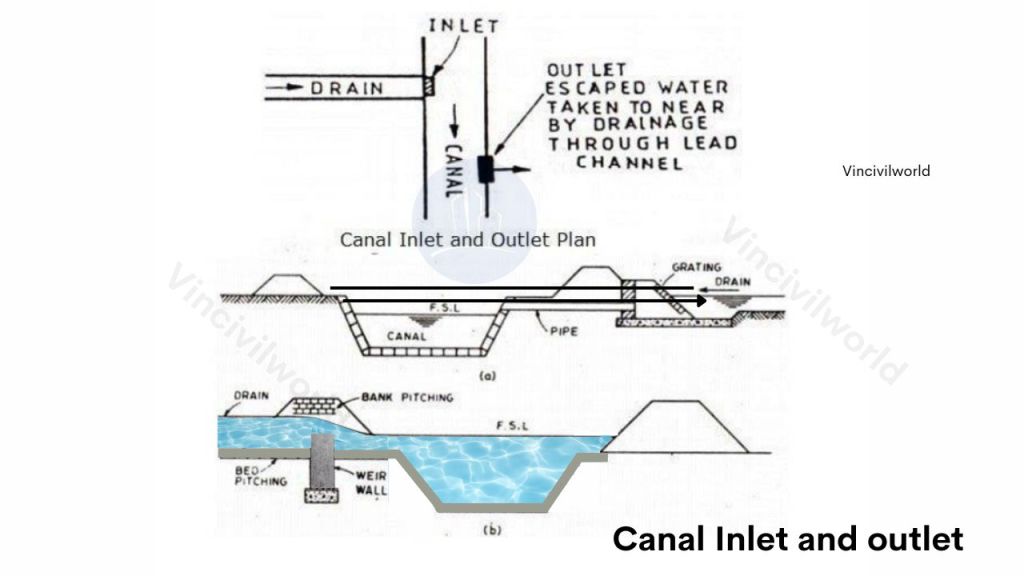
Inlet and Outlets or Canal Inlet

These are provided where the channel and drainage are small. Inlet and Outlet are simple openings. The inlet allows the flow of the water. While the outlet allows the water drain. 

The drainage mixed with canal travels through the canal for certain length as shown in the fig. After that the drainage solids are sucked through and outlet provided to create suction pressure disposing to the watershed nearby.

Diagram illustrating the design of a canal inlet and outlet system, showing water flow direction and structural components.
Diagram illustrating the canal inlet and outlet system, highlighting the flow and management of water between the canal and drainage.

Stone pitching is provided at the bed and banks of the drainage. The maintenance cost of the inlet and outlet system is high. But the construction cost is low. The main disadvantage of this system is that they also cause soil erosion and water pollution. 

Key Takeaways

  • Cross Drainage Works: Crucial for managing the intersection of irrigation canals and drainage channels without disrupting their functions.
  • Aqueducts: Carry irrigation canals over drainage channels, preventing water mixing and ensuring stable flow, especially in uneven terrains.
  • Syphon Aqueducts: Handle higher hydraulic pressures, using enclosed conduits to maintain water flow across challenging topographies.
  • Design Considerations: Cross drainage work selection is based on factors like alignment, discharge levels, foundation capacity, and economic conditions.
  • Preventing Erosion and Flooding: These structures mitigate the risks of flooding, erosion, and waterlogging, contributing to efficient water management systems.

Conclusion

Cross drainage works, particularly aqueducts and syphon aqueducts, play a crucial role in modern water management. These structures are designed to maintain the integrity of irrigation and drainage systems, ensuring uninterrupted water flow across different terrains. Aqueducts, by carrying canals over drainage channels, prevent contamination and erosion. Syphon aqueducts, handling higher pressures, offer advanced solutions for challenging landscapes. These systems are indispensable for maintaining efficient and sustainable water management, safeguarding both agricultural productivity and infrastructure longevity.