

The prestressing in Prestressed concrete is done by inducing predetermined compressive stresses to concrete by tensioning the steel, before subjecting it to service loads. In prestressed Concrete the stress developed during the service stage is countered by the already induced compressive stresses. Prestressing is a combination of the high-strength compressive properties of concrete with the high tensile strength of steel. This article is about prestressing in prestressed concrete, different methods of prestressing, and how prestressing works.
Prestressing in prestressed concrete is a critical technique that enhances the strength and durability of structures. The concrete is reinforced against tensile forces by carefully applying pre-determined compressive stresses. This is done through methods like post-tensioning. This approach ensures that prestressed concrete elements maintain their structural integrity over time. This article will cover the fundamentals of prestressing, including key methods and their applications in construction.
- Prestressing in Prestressed concrete
- Significance of Prestressed Concrete
- Prestressed Concrete
- SOME STRUCTURES USING PRESTRESSED CONCRETE
- Prestressed Concrete – How it works
- Principle of Prestressed Concrete
- Method of Prestressed Concrete
- Comparison between Post- tensioning and pre-tensioning process
- What are tendons?
- Key Takeaways
- Conclusion
Prestressing in Prestressed concrete
Concrete got excellent properties, making them the most preferred material for structural members, but has its weakness too. Let us consider two cases where a concrete beam is subjected to loads.
- CASE 1 ( PLAIN CEMENT CONCRETE BEAM ON LOADS)
- CASE 2 (REINFORCEMENT CEMENT CONCRETE ON LOADS)
Plain Cement Concrete Beam on Loads
Let us consider a Plain Cement Concrete (PCC) beam subjected to loads as shown in Fig. The beam bends and cracks are developed in the tensile zone. This confirms that the concrete is very weak in tension and strong in compression.

Reinforced Cement Concrete beam on loads
Consider a reinforced Cement Concrete beam subjected to loads as shown in fig. In this case, the beam will not bend or cracks. This is due to the presence of reinforcement steel in the tensile zone. The reinforcement steel takes care of the tensile loads and prevents the member from cracking.

In this case, the RCC beam with steel behaves as a composite member. Concrete’s poor tensile strength and ductility are countered by the reinforcement steel having high tensile strength and ductility.
Significance of Prestressed Concrete
Even though concrete owes the property of good compressive strength, it has the following disadvantages.
Prestressed concrete, achieved through techniques like post-tensioning and pre-tensioning ways, are crucial for enhancing structural performance. By inducing compressive stresses, it counters tensile forces, reducing cracking and increasing load-bearing capacity. This approach allows for longer spans. It also allows for thinner sections and greater durability in construction. This makes it ideal for bridges, high-rise buildings, and other demanding applications.
- Tensile strength is weak
- Brittle
- Non ductile
A good designer anticipates the areas of failure and designs the structure to overcome them. The design developed through this method is optimised.
The Design is based on Design criteria ( Goal of the design). Each design should satisfy the design criteria of ultimate strength and Serviceability.
Let us go through the details of Ultimate strength and Serviceability
Ultimate strength
In this design Criteria, the structures are designed on ultimate strength and will not collapse even in the worst condition. For example, if the proposed structure for a bridge can handle a load of traffic without a collapse. Then it satisfies the Design criteria of ultimate strength.
Serviceability
The structures are to be checked for serviceability conditions like stability analysis, deflection checks, etc. In the service stage if the structure tends to deflect on moments, then the serviceability criteria is not satisfied.
Let us analysis the impact of service loads on RCC structure like a bridge.
Deflection of steel structures
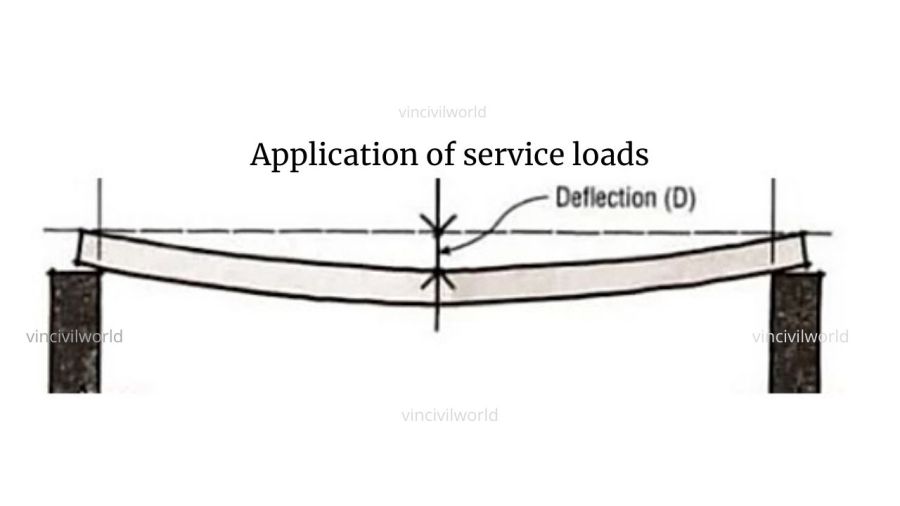
The figure presents what happens when an RCC structure is subjected to service loads. The moments cause the structure to deflect. The ductile reinforcement elongates to negotiate the loads. However concrete with poor tensile strength fails on tensile loads and develops cracks.
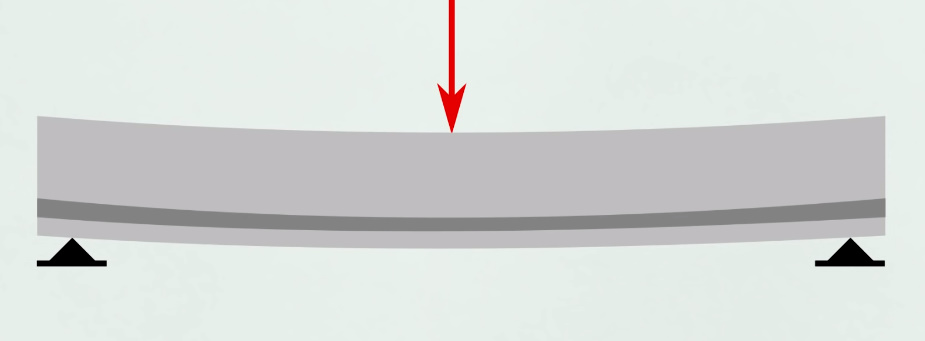

The cracks absorb moisture and gradually rust the reinforcement steel. This leads to spalling of concrete and initiates an ultimate collapse of the structure.
Prestressed concrete is introduced to minimise deflection cracks, for increasing the strength of members. Prestressing gives the designers, the flexibility of optimising the design while negotiating large spans.
Prestressed Concrete
Prestressing is a method of inducing Compressive stress into a structural member. This is done by tensioning the steel before subjecting it to service loads.
This process, known as prestressing, enhances the concrete’s ability to withstand tensile forces, reducing cracking and improving load-bearing capacity. Prestressed concrete combines high-strength steel reinforcement with concrete’s compressive strength. This combination enables the construction of structures with longer spans. It also allows for thinner sections and increased durability.
Prestressing is adopted for structures like bridges,large spanned auditoriums, silos, reservoirs, pile foundations, prefabricated elements etc.

SOME STRUCTURES USING PRESTRESSED CONCRETE

Prestressed Concrete – How it works
The figure below explains how an RCC member subjected to loads deflects and gets cracked

Principle of Prestressed Concrete
In prestressed concrete, the steel/tendons are stretched along the axis before pouring concrete as shown in fig.
The tendons are released once the concrete reaches the desired strength. On detaching, the tendons induce compressive stresses in the structural member.
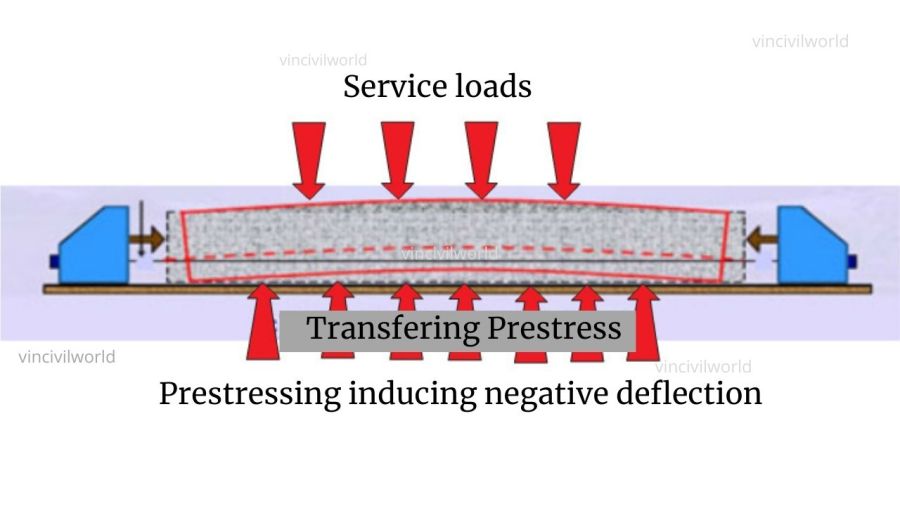
The compressive stress is induced in the structural member on releasing the tensioned steel. It counterbalances the compression that arises due to loads applied in the service stage. In prestressed concrete, tensioning of steel initiates negative deflections in the member. These defections balance the compressive stress due to service loads and prevent the concrete from cracking.

Prestressing method provides the designers with the much-needed flexibility in designing large spanned structures. Whereas deriving economical and optimised designs in RCC seems difficult.
Method of Prestressed Concrete
Prestressing is done in two methods
- Pre-tensioning Method
- Post – tensioning Method
Pre tensioning Method
In Pre tensioning method, the tendons are stretched before pouring the concrete. Once the concrete attains the desired strength the tendons are released. After releasing the tendon the structure is subjected to service loads.
The High-strength steel tendons are placed between two abutments/buttress. The tendons are stretched around 70% of their ultimate strength or as per design requirements. Concrete is poured with Tendons kept stretched. The tendons are released once the concrete attains its desired strength. On release, the steel tries to regain its original length due to its high ductility. During this process, the tensile stress in steel is converted to compressive stress in concrete. This conversion initiates a negative deflection. These compressive stresses induced in the structural member counters the compressive stress in the service stage.

The post-tensioning method is for precast girders of bridge spans, metro lines, and flyovers. It is also used for railway sleepers, piles, and prefabricated elements. These elements are subjected to heavy loads. The structures are prestressed in the prestressing yards, conveyed, and lifted for erection at the site.
The post-tensioned structures have size limitations. They have to be carried from the fabrication yard to the site. They are then erected at the site.
Post-Tensioning Method
In the post-tensioning method tendons are tensioned, once the concrete attains design strength. For this purpose, ducts or profiles are strategically placed within the concrete during casting.
Once the concrete hardens and attains design strength, the tendons are inserted through the already placed ducts or profiles. The tendons are tensioned using jacks as per design requirements. On completion of post-tensioning works, the structure is released for service loads.

In bonded type post-tensioning, the tendons are grouted with special grouts after tensioning. In unbounded type, tendon grouting is not necessary.
Post-tensioning is done at the site and not in the fabrication yard like a pre-tensioning system. The post-tensioning method is used in viaducts, segmental construction of large bridge spans, large slabs, reservoirs, big silos of cement plants, coal washeries, etc
Comparison between Post- tensioning and pre-tensioning process
| Aspect | Post-Tensioning | Pre-Tensioning |
|---|---|---|
| Definition | Prestressing method where steel cables are tensioned after concrete has set. | Prestressing method where steel cables are tensioned before concrete is poured. |
| Application | Commonly used in large-scale projects like bridges and high-rise buildings. | Typically used in precast concrete elements like beams and slabs. |
| Process | Cables are placed in ducts, which are then tensioned after the concrete cures. | Cables are tensioned before the concrete is cast around them. |
| Construction Time | Longer, as tensioning occurs after curing. | Shorter, as tensioning is completed before casting. |
| Flexibility | Allows for adjustments in cable tension during construction. | Less flexibility, as tensioning is fixed before casting. |
| Maintenance | Easier to inspect and maintain the tensioned cables. | More challenging to inspect as cables are embedded in the concrete. |
| Cost | Higher due to the need for additional equipment and labor. | Typically lower due to simpler setup and fewer materials. |
This comparison highlights the key differences between post-tensioning and pre-tensioning in prestressed concrete applications.
What are tendons?
Tendons consist of single wires, multi-wire strands, or threaded bars. These are most commonly made from high-tensile steels, carbon fiber, or aramid fiber.
Tendons are high-strength steel cables or rods used in prestressing concrete to enhance its structural performance. In prestressed concrete, tendons are either pre-tensioned before the concrete is poured or post-tensioned after curing. During post-tensioning, tendons are threaded through ducts. They are then tensioned to apply compressive stresses to the concrete. This process improves its load-bearing capacity and reduces cracking.
Key Takeaways
- Prestressing Methods: Two primary methods, pre-tensioning and post-tensioning, enhance concrete’s performance. Pre-tensioning involves tensioning tendons before pouring concrete, while post-tensioning occurs after the concrete has cured.
- Benefits: Prestressed concrete combines high-strength steel with concrete’s compressive strength, leading to longer spans, thinner sections, and greater durability.
- Applications: These ways are crucial in structures requiring high load-bearing capacity and durability. Examples include bridges, high-rise buildings, and large spans.
- Tendons: Tendons are made of high-tensile steel or other materials. They are central to prestressing. The tendons provide the necessary compressive stresses to counteract tensile forces.
Conclusion
Prestressing in concrete is vital for optimizing structural performance by introducing compressive stresses to counteract tensile forces. Both pre-tensioning and post-tensioning methods effectively enhance the concrete’s strength and durability. Pre-tensioning is used before casting, while post-tensioning is applied after curing. These techniques are instrumental in building efficient, long-lasting structures like bridges and high-rise buildings. Understanding and implementing these methods ensure the structural integrity and longevity of prestressed concrete elements in various demanding applications.
 vin civilworld