

Kelly Ball Test is a simple and reliable method used to assess the workability of concrete directly at construction sites. Among the various tests for workability of concrete, this method stands out for its speed. It is also easy to execute on fresh concrete surfaces. The Kelly Ball Test concrete assessment works by measuring penetration depth. This makes it a practical Kelly Ball penetration test for large pours and ready-mix applications. To ensure accurate results, you must follow the standard Kelly Ball Test procedure. This procedure correlates penetration values with concrete consistency. The Kelly Ball Test is simple. It is also suitable for the field. Therefore, it continues to be an effective tool for monitoring concrete quality during placement.
- Significance of Quality tests on concrete
- Production stage quality tests on fresh concrete
- What is Kelly ball test ?
- Advantages – Kelly ball test
- Disadvantages of Kelly Ball Test
- Key Takeaways
- Conclusion
Significance of Quality tests on concrete
Quality tests on concrete are essential for ensuring strength, durability, and performance in construction. These tests help engineers assess the workability of fresh concrete and the quality of hardened concrete. Common quality tests on concrete include checks during the production stage (on fresh concrete before placing), tests on hardened concrete specimens, and evaluations performed directly on finished structures. Including tests like the flow table test for concrete ensures reliable results and consistent quality throughout a project.
Quality tests performed on concrete are classified into
- Non Destructive tests On structures ( tests done on the structures ) tests on concrete
- Production stage quality tests ( On fresh concrete before placing)
- Hardened stage quality tests ( hardened concrete specimens)
Also read : Bitumen tests – 9 lab tests for bitumen
Production stage quality tests on fresh concrete
This article covers the kelly ball test ,apparatus details, procedure, merits and demerits etc.

What is Kelly ball test ?
This simple field method assesses the workability of freshly mixed concrete. In the test, a standard steel ball penetrates the concrete under its own weight, and the penetration depth indicates concrete consistency. Engineers mainly use this test at construction sites to make quick decisions during concrete placement. The Kelly Ball Test helps verify whether the concrete is too stiff or too workable for proper compaction and finishing. Its significance lies in its speed, ease of use, and ability to provide a direct indication of concrete workability without complex equipment.
Standard Guidelines
Standard codes for the Kelly Ball penetration test provide guidance on equipment, testing procedure, and result interpretation. This ensures reliable assessment of concrete workability, especially during on-site quality control.
Codes and Standards
ASTM C360 / C360M 92– Standard Test Method for Ball Penetration in Freshly Mixed Concrete
Issued by ASTM International.
Note: This standard has been withdrawn but is still referenced in technical literature.
AASHTO T 183 – Ball Penetration Test
Issued by AASHTO.
Note: This standard is discontinued and mainly used for historical reference.
Indian Standards (IS Codes)
There is no specific IS code . Workability testing in India is generally covered under IS 1199, issued by Bureau of Indian Standards
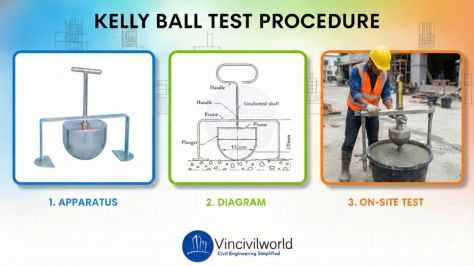
Kelly ball test Apparatus as per ASTM C360/C360 M 92
The kelly ball apparatus for measuring the workability of concrete consist of..
- Meta hemisphere (Ball)
- Graduated scale
- Frame
- Handle
The workability of concrete is decided by the depth of the penetration of metal hemisphere (ball) which will descend under its own weight into the fresh concrete. The Metal hemisphere or ball has 152 mm diameter and 13.6 kg weight. J. W. Kelly (Professor, University of California) had devised the plan of the Kelly ball test afessor, University of California) had devised the plan of the Kelly ball test apparatus. Hence, later on it also came to be known as a ball penetration test. On the top of the apparatus, there is a handle. The graduated scale measures the penetration reading.
Test Procedure
- Place freshly mixed concrete on a level, rigid surface immediately after mixing.
- Ensure the concrete surface is smooth and free from vibration.
- Clean the Kelly ball and check that it moves freely along the guide rod.
- Position the apparatus so the steel ball just touches the concrete surface.
- Release the ball gently without applying any force.
- Allow the ball to penetrate under its own weight.
- Wait until the penetration stabilizes.
- Read and record the depth of penetration from the graduated scale.
- Repeat the test at different locations on the concrete surface.
- Take the average penetration value as the final result.
- Note: Greater penetration indicates higher workability, while lower penetration indicates stiffer concrete.
Results
The workability of the concrete is the average value of the readings from the penetration.
Advantages – Kelly ball test
Some advantages of this test are
- Compared to other workability tests kelly ball test is very fast
- Precise and Accurate results
Disadvantages of Kelly Ball Test
The disadvantages of this test include
- This test requires a large amount of fresh concrete.
- The result should not be precise if the size of the aggregate is large.
- The concrete should be levelled before starting the test.
Key Takeaways
- This is a simple field method for assessing fresh concrete consistency.
- It directly measures penetration depth, reflecting the workability of concrete.
- The test is faster and less operator-dependent than many laboratory methods.
- Kelly Ball Test concrete assessment is suitable for large pours and flat surfaces.
- The Kelly Ball penetration test works under the self-weight of the steel ball.
- Proper surface preparation is essential for reliable results.
- The procedure must be followed carefully to avoid errors.
- It is mainly used as a supplementary field check.
- Results help engineers make quick placement decisions.
- It complements other tests for workability of concrete used in quality control.
Conclusion
The Kelly Ball Test remains a practical and efficient method for evaluating the workability of concrete under site conditions. By measuring penetration depth, the Kelly Ball penetration test provides a direct indication of concrete consistency during placement. Although not as widely standardized as slump testing, Kelly Ball Test concrete assessment is valuable for large slabs and mass concreting works. When carried out correctly using the recommended Kelly Ball Test procedure, it helps engineers maintain uniform quality and avoid placement issues. Among various tests for workability of concrete, the Kelly Ball Test stands out for its simplicity, speed, and field applicability. Used alongside standard methods, it supports better decision-making and effective on-site concrete quality control.
 vin civilworld