
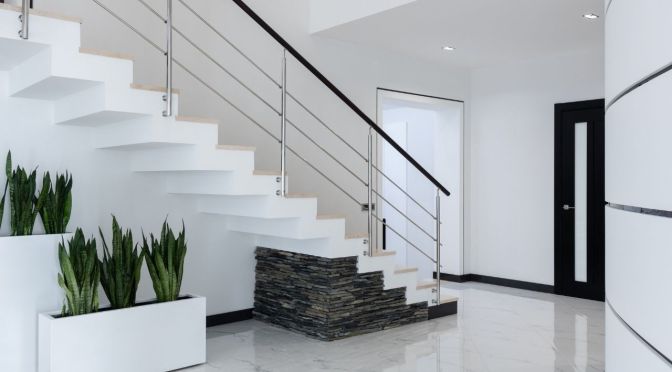
Staircase components are essential parts that work together to create a functional and safe staircase. The stair function is to provide a stable and accessible means of moving between levels.This is achieved through various key staircase components. Treads, the horizontal surfaces, provide a step for the foot, while risers are the vertical elements that define the step height. Stringers serve as the structural supports that hold the treads and risers in place. Handrails offer safety and stability for users, while landings provide resting spaces or changes in direction. Each of these components of a staircase contributes to both the staircase function and the overall design, ensuring comfort, safety, and efficiency.
The components of the staircase must fulfill specific functional requirements. . A staircase is one of the most important structural elements of a building. The primary function of a staircase is to facilitate movement from one floor to another. Staircases can be straight or curved and made of reinforced concrete, steel, wood, stones, and other materials. Staircases enhance the aesthetic appearance of the building in addition to providing access between floors.
It is necessary to understand the various components of the staircase as well as its functions when detailing it. This article discusses the components of a staircase and their functions
Components of Staircase
The staircase is made of several components and each component is associated with specific functional requirements. Following are the components of a staircase.
- Tread
- Rise
- Steps
- Curtail step
- Nosing
- Flight
- Landing
- Going
- Winders
- Railing
- Baluster
- Run
- Soffit
- Stringer
- Waist


Related posts from vincivilworld
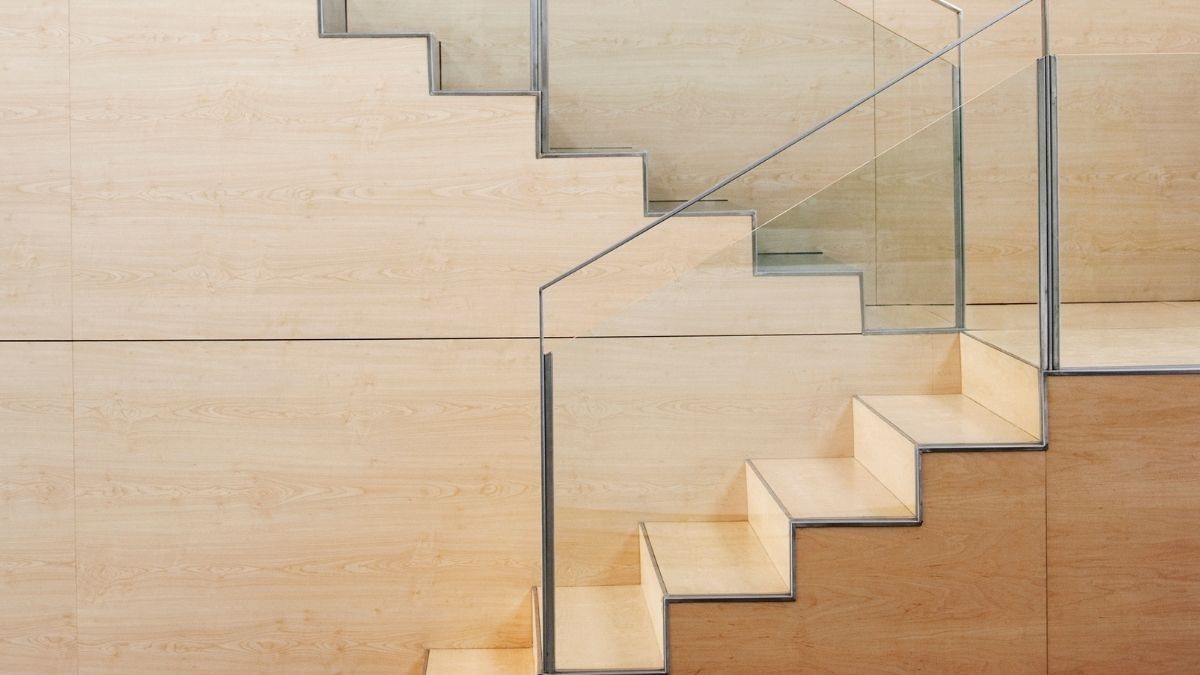



Tread – Horizontal Components of the staircase step
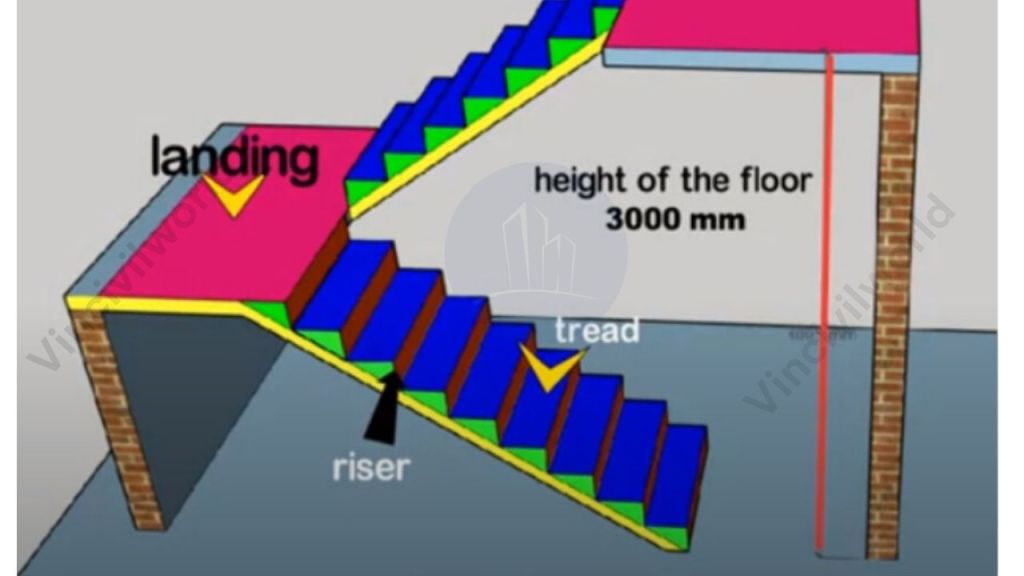
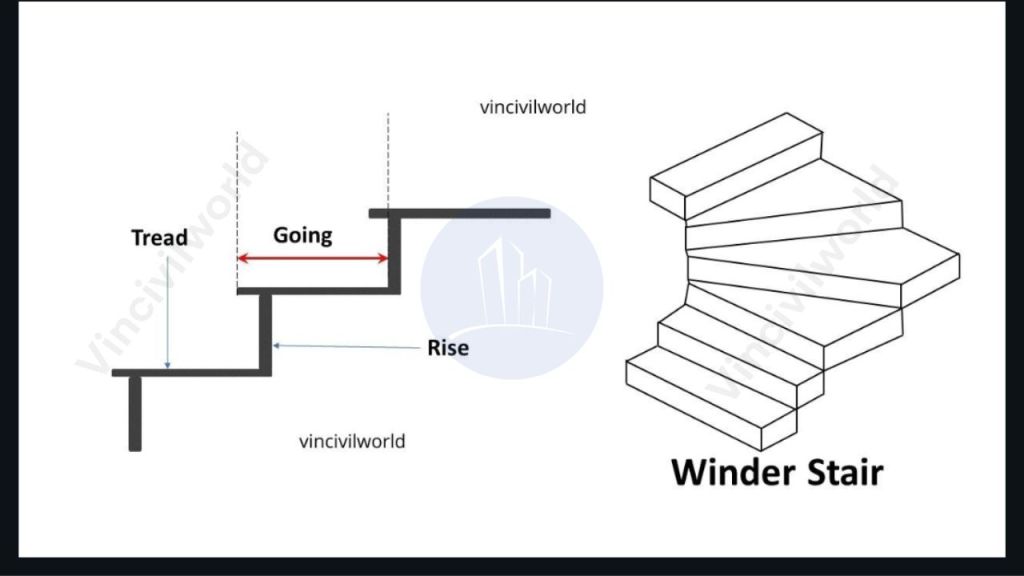
A tread is a major horizontal component of the staircase where we put our feet. The depth of tread is the distance between the staircase’s inner and outer edges. The tread width is the distance along the width of the steps. Generally, the tread of the staircase should be 270 mm in residential buildings and 300 mm in public buildings.
Rise – Vertical components of the staircase step
A rise in a staircase is the vertical component of the staircase step. It serves as a support for the treads. The vertical distance between successive treads is referred to as the rise. Generally, the riser should be 150 mm for public buildings and 190 mm for residential buildings.
Step – Combination of vertical and horizontal components of the staircase
Steps are the combination of treads and risers. Similarly, a pair of risers and tread makes a step. Basically, it is the functional unit of a staircase.
Curtail step
The curtail step is the first step in the staircase. The width of the curtail step can be more than the normal steps. The curtail step is another major components of the staircase which acts as a base for the staircase.
Nosing
The edge of a stair tread that projects out horizontally is known as the nosing. In general, nosing has a rounded edge. However, the length of the nosing should not exceed 1.5″. Basically, nosing enhances the appearance of the staircase. The line of nosing is the imaginary line that connects the nosing. This line runs parallel to the stairwell’s incline.
Flight
Flight is a component of the staircase that consists of a series of steps. Basically, it is the total steps between the two landings. Generally, flights consist of 8 to 10 steps.
Landing – Crucial components of the staircase
Landing is the horizontal space between two flights. It acts as a space to change the direction of the staircase. Generally, the minimum height of the landing should be 7 feet. The width of a landing is the distance between one end to the other end, which is normally equal to the width of the step.

Going
Going is the distance measured from the nosing of successive treads. It is the horizontal distance between the consecutive risers.
Winders
Winders are tapering steps. That is one end of the step is narrower than the other. Likewise, It is a type of step which helps in changing the direction of the staircase. Basically, it acts as a landing. However, Spiral staircases consist of a series of winders.

Railing
The railing is a components of staircase which is used for holding hands. Generally, it is inclined and parallel to the slope of the staircase. Similarly, they act as protective bars. Generally, they are made using timber.
Baluster
The baluster is the vertical component of the handrail. Basically, balusters act as a support for the railing.
Run
The total length of the series of flights including the length of landing is the run of a staircase
Soffit
The bottom part of the staircase component is the soffit. Basically, this place is suitable as a storage area.
Stringer
The components in the staircase which support the risers and treads are the stringer. There are two types of stringers,
- Cut or type stringers
- Closed or Housed type stringers
They are parallel to the slope of the staircase.
Waist
The staircase is rest on a thick RCC slab. This RCC slab is known as the waist slab. It is perpendicular to the soffit of the staircase.
Conclusion:
In summary, the components of a staircase—such as treads, risers, stringers, handrails, and landings—work together. They ensure functionality, safety, and design coherence. Each element plays a critical role in providing a stable and accessible means of movement between floors. It also enhances the overall aesthetic appeal of the building. Understanding these components is crucial for designing staircases. It is also vital for constructing staircases. These components ensure that staircases meet safety standards. They also suit the specific needs of the building. By considering the design and function of each component, designers can create staircases that are practical. They can also enhance the architectural beauty of a space.
 vin civilworld