Tag Archives: workability

Vee Bee Consistometer test – Workability of concrete

Vee Bee Consistometer Test is a reliable laboratory method used to evaluate the workability of concrete, especially for stiff and low-workability mixes where slump test results are not accurate. The Vee Bee Consistometer test for workability of concrete measures the time required for concrete to remould under vibration, providing a clear indication of consistency. In the workability of concrete Vee Bee test, vibration energy replaces gravity-based flow, making it suitable for dry mixes. Understanding the Vee Bee test procedure helps engineers achieve consistent and repeatable results. The Vee Bee Consistency test of concrete is widely used in laboratories and quality control setups and is considered one of the most dependable tests for workability of concrete for controlled assessment of stiff concrete mixes.

This article explains the Vee Bee Consistometer test, its principle, procedure, applications, and importance in accurately assessing the workability of stiff concrete mixes.

Significance of Quality tests on concrete

Quality tests on concrete are essential for ensuring strength, durability, and performance in construction. These tests help engineers assess the workability of fresh concrete and the quality of hardened concrete. Common quality tests on concrete include checks during the production stage (on fresh concrete before placing), tests on hardened concrete specimens, and evaluations performed directly on finished structures. Including tests like the flow table test for concrete ensures reliable results and consistent quality throughout a project.

A construction worker in a safety vest and hard hat examines concrete samples next to a compression testing machine in a lab setting.
A civil engineer in a safety helmet and reflective vest analyzing concrete test specimens in a lab, showcasing the importance of quality control in concrete workability tests.

Quality tests performed on concrete are classified into

  • Production stage quality tests ( On fresh concrete before placing)
  • Hardened stage quality tests ( hardened concrete specimens)
  • Non Destructive tests On structures ( tests done on the structures )

Also read : Aggregate Crushing test – Strength of aggregate

Also read : 9 lab tests of Bitumen for flexible pavements

Production stage quality tests on fresh concrete

Production stage quality tests on fresh concrete are crucial for ensuring the right workability and consistency before placement. These tests help engineers select the best mix for construction and maintain quality control. Key tests include the slump test, compaction factor test, Vee-Bee test, Kelly ball test, and the flow table test for concrete.

This article focuses on the Vee Bee Consistometer test, explaining its procedure, importance, and how it compares with other workability tests like the slump test and compaction factor test.

Vee Bee Consistometer test for workability of concrete

The Vee Bee Consistometer Test is a laboratory test used to determine the workability of concrete, particularly stiff and low-workability mixes. It measures the time required for fresh concrete to remould from a conical shape into a cylindrical shape under controlled vibration. This time, known as the Vee Bee time, indicates concrete consistency. Unlike the slump test, the Vee Bee Consistometer test for workability of concrete is suitable for dry mixes that do not flow easily. Commonly used in quality control, this test helps engineers compare mix designs and ensure uniform concrete performance.
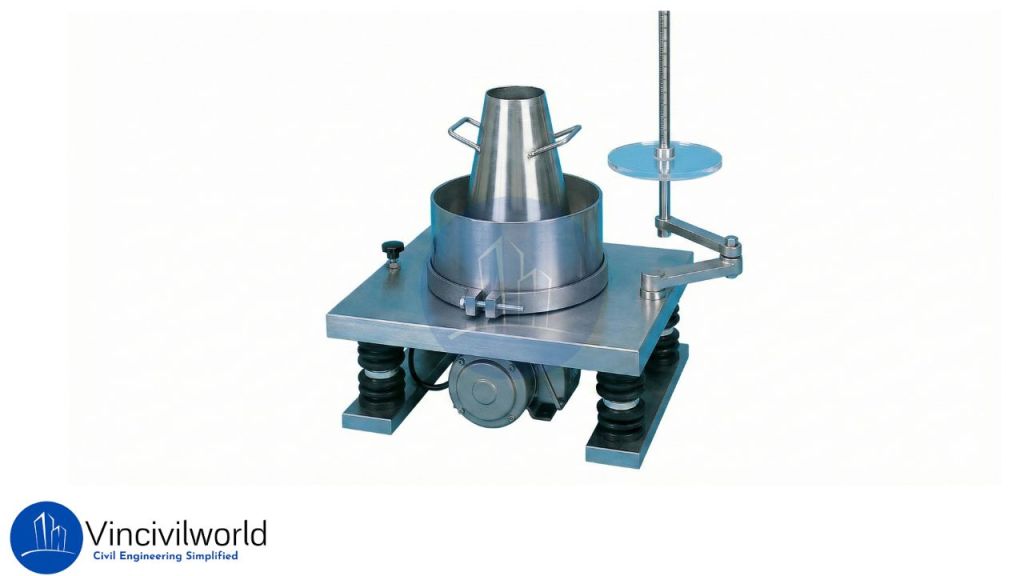
A steel laboratory apparatus used for material testing, featuring a cone-shaped container and a mechanical device for precise measurements.
Vee Bee Consistometer apparatus used for evaluating the workability of concrete in laboratory settings.

Relevant Codes and Standards for Vee Bee Consistometer Test

  • IS 1199 (Part 2): 2018Methods of Sampling and Analysis of Concrete – Workability
    Issued by Bureau of Indian Standards.
    This standard covers the Vee Bee Consistometer test, along with slump and compaction factor tests.
  • BS EN 12350-3Testing Fresh Concrete – Vebe Test
    Issued by British Standards Institution.
    Widely used in the UK and Europe for stiff concrete workability assessment.
  • DIN 1048 (Part 1)Testing Concrete – Fresh Concrete Tests
    Issued by DIN.
    Includes the Vebe test for consistency measurement.

Note: These standards ensure uniform testing procedures, repeatable results, and reliable evaluation of low-workability concrete mixes.Relevant IS code

Apparatus used for Vee Bee Consistometer

A blue industrial machine with a funnel and a black container at the center, designed for processing materials.
Vee Bee Consistometer apparatus used to assess the workability of concrete.

The Vee – Bee Consistometer includes of 

  • A vibrator table resting upon elastic supports
  • A metal pot
  • A sheet metal cone, open at both ends
  • A standard iron rod

The dimension of the vibrating table is 380 mm in length, 260 mm in width and height of 305 mm. Also, supporting the table there is a rubber shock absorber. Under the table, there is a vibrator that vibrates electrically.  The dimension of the metal slump cone is 300mm height, 200 mm top diameter and 100 mm bottom diameter. 
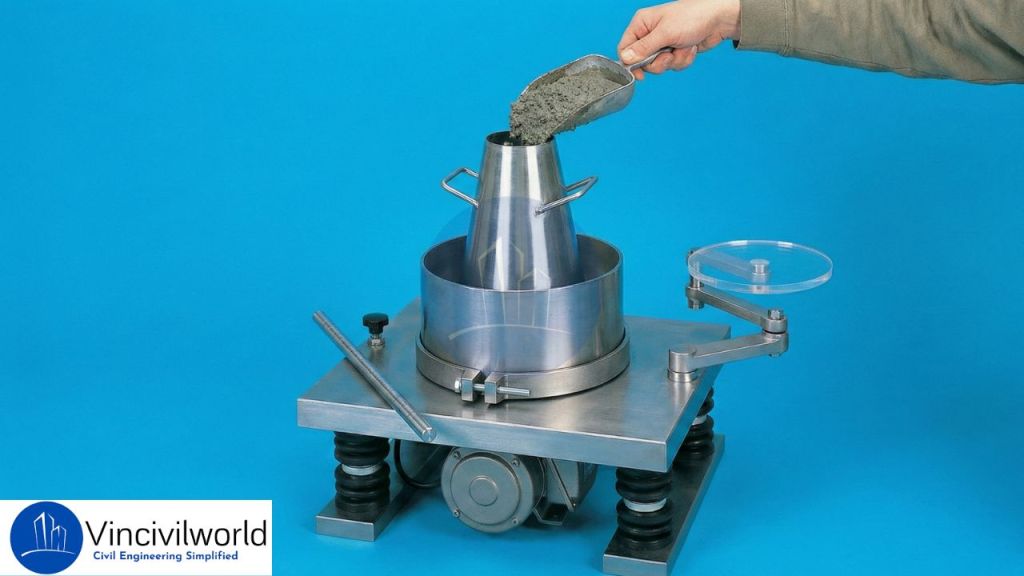
A person pouring a scoop of material into a metallic measuring cone on a balance scale, with a blue background.
The Vee Bee Consistometer, essential for evaluating the workability of concrete, particularly in stiff and low-workability mixes.

Test procedure

  • Initially fill the slump cone with four layers of concrete. Each layer should have a height of one – fourth of the cone. 
  • After that tamp each layer 25 times using a standard tamping rod and strike uniformly.
  • Then after placing the final layer, remove the excess concrete on the top of the concrete.
  • Move and place the swivel arm attached to the glass disc on the top of the cone.
  • Now remove the cylindrical cone gradually in the vertical direction and note down the slump.
  • Then switch on the electrical vibrator and allow the concrete to spread. 
  • The time taken by the concrete to spread uniformly is noted using the stop clock.
  • This time is expressed in vee bee seconds.

The time for the concrete to remould is the Vee-Bee seconds. The Vee Bee consistometer is an indirect measure of concrete workability. This method is suitable for concrete whose slump value cannot be determined. ie, for dry mixes. We can get direct result through this method.

Also Read : Soundness test on aggregate

Key Takeaways

  1. The Vee Bee Consistometer Test is designed to assess the workability of stiff concrete mixes.
  2. It measures the time required for concrete to remould under vibration.
  3. Longer Vee Bee time indicates lower workability of concrete.
  4. The test provides more reliable results than slump test for dry mixes.
  5. It is commonly used in laboratory-controlled environments.
  6. The method helps compare different concrete mix designs.
  7. Proper vibration is essential for accurate results.
  8. The test minimizes subjective judgment during workability assessment.
  9. It is standardized under Indian and international codes.
  10. The test is an important part of quality control procedures.
  11. It complements other tests for workability of concrete.
  12. It ensures consistency during concrete production.

Conclusion

The Vee Bee Consistometer Test plays a crucial role in evaluating the workability of concrete, especially for mixes with low water content. By measuring the remoulding time under vibration, the test provides a clear and quantitative indication of concrete consistency. Unlike the slump test, it performs well for stiff mixes where flow is minimal. When conducted according to standard procedures, the test helps engineers maintain uniformity in concrete production and placement. It also supports effective quality control by enabling comparison of different mix proportions. As one of the reliable laboratory-based tests for workability of concrete, the Vee Bee Consistometer Test remains essential for achieving durable and well-performing concrete structures.

Flow Table Test: Key Method for Concrete Workability

Flow table test of concrete is a common method to measure the workability of fresh concrete. It is especially useful for mixes that are too fluid for the slump test. This test helps check how easily concrete flows, which is important for quality construction. In the flow table test for concrete, a flow table apparatus spreads the concrete, and the flow diameter is measured. Compared to the slump test, the flow table test procedure for concrete works better with high workability and self-compacting mixes. Knowing the difference between flow table test vs slump test helps engineers choose the right method. By following standards like ASTM C124 or EN 12350-5 and IS1199, the flow table test apparatus for concrete gives reliable results. This makes it a key test for concrete workability in construction projects.

In this article, we will explain the purpose and importance of the flow table test for concrete, especially in measuring workability and consistency for high-fluidity mixes like Self compacting Concrete (SCC) . You will learn about the standard codes (including IS 1199:1959, IS 5512:1983, ASTM C124, and EN 12350-5), the apparatus required, and the step-by-step procedure for conducting the test. We will also discuss the advantages, limitations, and practical applications of the flow table test in civil engineering projects. By the end, you’ll understand when and why to use the flow table test for concrete, and how it helps ensure quality and performance in construction

  1. Significance of Quality tests on concrete
  2. Production stage quality tests on fresh concrete
  3. Flow table test for Concrete
  4. Standards for flow table test of concrete
    1. Flow table test of concrete as per IS 1199 (Part 6): 2018
      1. Flow table test apparatus Used as per IS 1199
    2. Flow table Test procedure
    3. Calculation for Flow table test
  5. Key Takeaways
  6. Conclusion

Significance of Quality tests on concrete

Quality tests on concrete are essential for ensuring strength, durability, and performance in construction. These tests help engineers assess the workability of fresh concrete and the quality of hardened concrete. Common quality tests on concrete include checks during the production stage (on fresh concrete before placing), tests on hardened concrete specimens, and evaluations performed directly on finished structures. Including tests like the flow table test for concrete ensures reliable results and consistent quality throughout a project.

A laboratory setting for concrete testing, featuring a man in a safety vest and hard hat, observing a concrete compression testing machine alongside molds and tools.
A construction engineer analyzing concrete samples in a laboratory, highlighting the importance of quality tests for concrete workability.

Quality tests performed on concrete are classified into

  • Production stage quality tests ( On fresh concrete before placing)
  • Hardened stage quality tests ( hardened concrete specimens)
  • Non Destructive tests On structures ( tests done on the structures )

Also read : Bitumen tests – 9 lab tests for bitumen

Production stage quality tests on fresh concrete

Production stage quality tests on fresh concrete are crucial for ensuring the right workability and consistency before placement. These tests help engineers select the best mix for construction and maintain quality control. Key tests include the slump test, compaction factor test, Vee-Bee test, Kelly ball test, and the flow table test for concrete.

This article focuses on the flow test of concrete, explaining its procedure, importance, and how it compares with other workability tests like the slump test and compaction factor test.

Flow table test for Concrete

The flow table test for concrete is a simple laboratory method used to measure the workability and flowability of fresh concrete, especially for highly workable mixes where the slump test is not suitable. In this test, the workability of concrete is determined by observing how much the concrete spreads on a flow table after being jolted. This spreading, or flow, directly indicates the concrete’s consistency and fluidity, which are essential for quality control in construction.

The flow table test is particularly useful for high or very high workability concrete that would otherwise collapse in a standard slump test. It provides insights into the consistency and cohesiveness of the mix, helping engineers ensure that the concrete can be easily placed and compacted without segregation. This method is best suited for concrete with a nominal maximum aggregate size less than 38 mm.

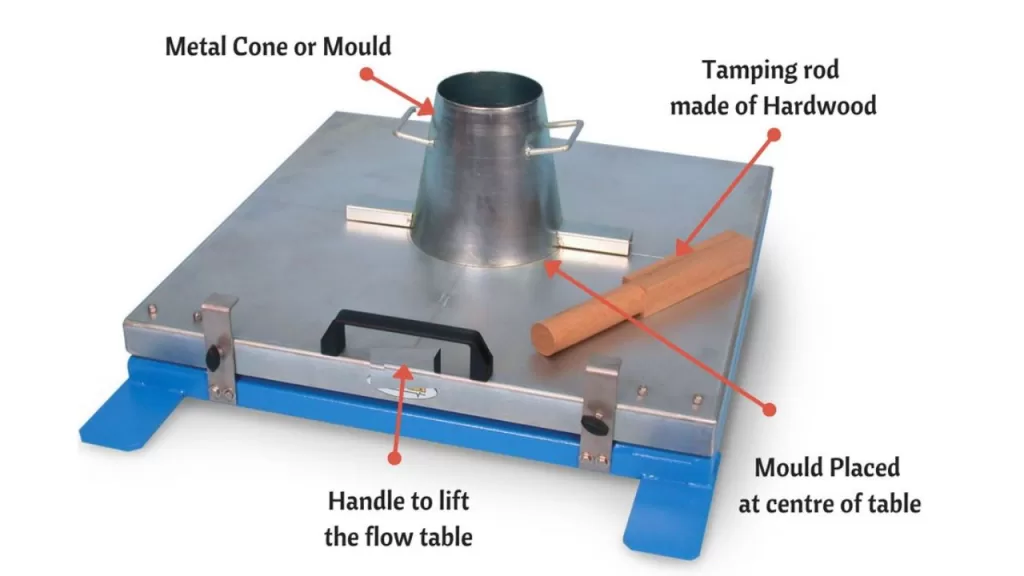
Flow table apparatus for conducting the flow table test on concrete, featuring a metal cone mold, tamping rod, and handle for easy lifting.
Flow table test apparatus showcasing the metal cone mold, tamping rod, and handling features, essential for measuring the workability of concrete.

Standards for flow table test of concrete

  • IS 1199 (Part 6): 2018
  • ASTM C 124 – 39 (Re-approved 1966)
  • BS 1881 :105: 1984

Flow table test of concrete as per IS 1199 (Part 6): 2018

The flow table test as per IS 1199 (Part 6): 2018 is a standardized method to determine the workability and flowability of fresh concrete, especially for self-compacting concrete. It measures the spread of concrete after the flow table is repeatedly dropped, indicating the concrete’s consistency and ability to flow without segregation.

Flow table test apparatus Used as per IS 1199

The following apparatus are used to perform the flow table test:

  • Flow table
  • Mould
  • Scale
  • Hand scoop
  • Trowel
  • Tamping rod

Flow Table: A metal table with a flat surface and a hinged base, dropped to measure the concrete’s spread, indicating its workability.

Scale: A measuring device used to accurately measure the diameter of the concrete spread on the flow table, ensuring precise results.

Hand Scoop: A tool used to transfer concrete into the mold, ensuring an even and consistent sample for testing.

Trowel: A flat, metal tool used for smoothing and leveling the concrete surface within the mold, ensuring uniformity.

Flow table test apparatus for measuring concrete workability, featuring a metal cone, tamping rod, and a handle for lifting.
Flow table test apparatus for measuring the workability of fresh concrete, featuring a metal cone mould and tamping rod.

Tamping Rod: A rod used to compact the concrete inside the mold, removing air pockets and ensuring consistency in the sample.

Mould: A metal conical mold used to shape the concrete sample before spreading, essential for standardized measurements in the flow test. The shape of the mould for the flow table test is a cone frustum. The base diameter of the mould is 25 cm and the upper diameter is 17 cm. It has a height of 12 cm. A handle is also present on the sides of the mould. 

Flow table Test procedure

  • Before starting the test, wet and clean the tabletop and the mould from gritty materials.
  • Keep the mould firmly at the centre of the table. 
  • Now fill two-layer, each layer should be one half of the volume of the mould.
  • Tamp each layer 25 times using a tamping rod uniformly. 
  • After tamping the top layer, struck off the excess concrete using the trowel.
  • Also, clean the area of the table outside the mould. 
  • Then remove the mould immediately by steady upward pull. 
  • Raise the table and drop at 12.5 mm, 15 times in 15 seconds. 
  • Measure the diameter of the concrete spread about its 6 direction and compute its mean value. 

Calculation for Flow table test

The percentage increase in the average diameter of the spreading concrete over the base diameter of the mould is called the flow of concrete.

Flow% = (Spread diameter in cm – 25) / 25 * 100

The value of flow test varies from 0 to 150%.

According to ‘A.M. Neville, honorary member of the American Concrete Institute’, this flow table test is appropriate for concrete mixes having a flow of 340 to 600 mm.

Key Takeaways

The flow table test is an essential method for assessing the workability and flowability of fresh concrete, especially for high-fluidity and self-compacting mixes where the slump test is inadequate. By following standards like IS 1199 (Part 6): 2018, this test provides reliable, repeatable results crucial for quality control in construction projects. The apparatus is simple, and the procedure is straightforward, making it widely accessible in laboratories. The test helps engineers ensure the mix can be easily placed and compacted without segregation. This directly impacts the durability and performance of the finished structure. Understanding the differences between the flow table and slump tests is important. It helps in selecting the appropriate method for each concrete type. This ensures optimal construction quality.

Conclusion

In conclusion, the flow table test, as outlined in IS 1199 (Part 6): 2018, is a vital tool for evaluating the workability of fresh concrete, particularly for mixes with high workability or self-compacting properties. Its ability to measure the spread of concrete after jolting provides valuable insights into the mix’s consistency and cohesiveness. This ensures that the concrete will perform well during placement and compaction, reducing the risk of defects and enhancing structural integrity. By integrating the flow table test into routine quality control, engineers and builders can achieve better consistency, durability, and performance in concrete structures, ultimately contributing to safer and longer-lasting construction projects.