All posts by Vinod Gopinath

Ultrasonic pulse velocity test || UPV Test – Types and Methodology

Ultrasonic Pulse Velocity (UPV) testing is a reliable, non-destructive method for assessing concrete quality and durability. An ultrasonic pulse is transmitted through the concrete in this method. The velocity is measured to detect variations in density and strength. UPV testing is very useful for identifying cracks, voids, and other flaws in concrete structures. It helps assess structural integrity without damaging the material. This technique is commonly known as UPV tests. It is also referred to as UPV tests on concrete. Specialized UPV testers are used to deliver accurate, quick results. Industries favor UPV testing for its efficiency, cost-effectiveness, and precision in evaluating concrete conditions.

This article discusses the UPV test. It is one of the most well-liked and most reliable non-destructive tests carried out on concrete structures.

  1. Significance of Ultrasonic Pulse Velocity Test (UPV test)
  2. Ultra sonic Pulse Velocity test (UPV Test)
  3. Relevant IS code for Ultrasonic Pulse Velocity Test (UPV Test)
  4. Ultrasonic Pulse Velocity tester
  5. Principles of Ultrasonic Pulse Velocity test
  6. Objective of UPV tests
  7. Factors affecting Ultrasonic pulse velocity test
  8. Methodology of Ultrasonic Pulse velocity tests
    1. Direct method
    2. Indirect method
  9. Result interpretation of UPV testing
  10. Conclusion

Significance of Ultrasonic Pulse Velocity Test (UPV test)

The ultrasonic pulse velocity test, or UPV test, is an example of a non-destructive concrete test. Generally, hardened concrete is subjected to non-destructive testing (NDT) and destructive tests (DT). Concrete is the world’s oldest and most significant construction material. Therefore, concrete testing is crucial for assessing the stability, strength, durability, and condition of structures.

Non-destructive testing of concrete is a way of analysing concrete structures without causing damage. This aids in ensuring the structural quality and condition. The strength of the concrete is also influenced by various characteristics. This includes hardness, density, curing circumstances, ingredient quality, workability and water-to-cement ratio, etc.

Also read : Bitumen tests – 9 tests for flexible pavements

Ultra sonic Pulse Velocity test (UPV Test)

The most efficient and fast method of testing concrete is through ultrasonic pulse velocity tests, or UPV tests. The quality of concrete is assessed using the results of UPV tests, which evaluate the period of travel of ultrasonic pulse waves. A 50–55 kHz range must be maintained for the ultrasonic pulse wave’s frequency. The pulses are generated by the UPV tester’s pulse generator and are allowed to travel through the concrete. By monitoring the traversing distance and the duration, the pulse velocity can be determined. Higher velocity indicates that the density and elastic modulus of the concrete are higher.

Cracks and defects in the structure are detected using UPV tests. Significant variations in pulse velocity values are indicative of broken and degraded concrete. The concrete’s density and wave velocity are related. Therefore, this test has a tremendous potential for evaluating the quality of concrete.

Relevant IS code for Ultrasonic Pulse Velocity Test (UPV Test)

IS-13311 (Part 1):1992 (Reaffirmed- May 2013) “Non-Destructive Testing of Concrete- Methods of Test (Ultrasonic Pulse Velocity)”

Related posts from vincivilworld

Ultrasonic Pulse Velocity tester

The UPV tester is the name of the type of equipment used to measure ultrasonic pulse velocity. The following accessories are included in ultrasonic pulse velocity tester.

  • Electrical Pulse generator
  • Pair of Transducers (probes)
  • Amplifier
  • Electronic timing device
Ultrasonic Pulse Velocity Tester
ultrasonic pulse velocity tester

Principles of Ultrasonic Pulse Velocity test

The electrical pulse generator generates pulses that are sent through the UPV tester’s transducer. Through the concrete surfaces, the pulse generates many reflections. Using the formula shown below, the pulse velocity is calculated.

Pulse velocity, V = L/T

where L is the traverse distance, T is the time for the receiver to receive the pulse

The geometry of the material is unrelated to the UPV test. Better concrete strength is associated with higher velocity and vice versa. One of the dynamic tests for concrete is the ultrasonic pulse velocity test.

Objective of UPV tests

The main objectives of the ultrasonic pulse velocity test or UPV tests are

  • To learn the homogeneity of the concrete.
  • Determines the presence of cracks, voids and imperfections. 
  • To calculate the elastic modulus of concrete. 
  • Finds the quality of concrete relative to the standard requirements. 
  • To determine the age of concrete. 

Factors affecting Ultrasonic pulse velocity test

The UPV test detects cracks and assists in structure development. However, a number of factors influence how pulse velocity is measured. As a result, compressive strength cannot generally be approximated from the pulse velocity. The following are the elements that impact the UPV test.

  • Presence of reinforcement
  • Water content
  • Mix proportion
  • Temperature of concrete
  • Concrete age
  • Stress level of concrete

Methodology of Ultrasonic Pulse velocity tests

Piezoelectric and magneto strictive types of transducers are suitable for use with the UPV test. Additionally, its frequency range should be between 20 and 150 kHz. The electronic timing device monitors time with an accuracy of 0.1 microseconds.

The transducer transmits the waves that travel through the concrete surface. The receiver transducer detects the electric signals that are generated once the pulse waves are transformed to them. The traversal length will be displayed as ( L). The electronic timing device calculates how long it takes for signals to arrive. Time is shown as (T).


The Electronic timing device measures the receiving time of the signals. The time is denoted as (T).

Pulse velocity (v) = L/T

There are three common methods for doing UPV tests. They are direct method and indirect method.

  • Direct Method of UPV Testing
  • Indirect Method of UPV Testing
Methodology of UPV test

Direct method

The maximum energy is transmitted at right angles to the face of the transmitter. As a result, to achieve the greatest results, the receiving transducer must be placed on the side of the transmitting transducer. This is referred to as the direct approach or cross probing.

Ultrasonic pulse velocity test
Ultrasonic Pulse velocity test -Types

Indirect method

In some circumstances, the opposite side of the structure may be inaccessible. The receiving and transmitting transducers are installed on the same face of the concrete members in this scenario. This is known as the indirect method or surface probing. This approach is less effective than the direct approach. The test findings are mostly influenced by the surface concrete, which has different properties from the structural components’ core concrete.

Result interpretation of UPV testing

The density and elastic modulus of concrete are correlated with the ultrasonic pulse velocity. This in turn depends on the components, mixing processes, placement techniques, concrete compaction and curing, casting temperature, etc.

The main causes of internal cracks and pockets in concrete are lack of compaction and concrete segregation. Lower pulse velocity values are a result of these concrete defects. However, the laboratory tests might have confirmed a well-designed concrete.

The range of pulse velocity in the direct method is as shown below.

  1. Above 4.5 Excellent
  2. 3.5 to 4.5 Good
  3. 3.0 to 3.5 Medium
  4. Below 3.0 Doubtful

Conclusion

The final assessment of compressive strength from UPV is not the sole criterion used to determine concrete strength. The strength is confirmed by comparing it to a compressive strength estimate derived from the same ingredient mix and conditions. The results of the UPV test and site tests conducted using similar ingredients may be correlated. When compared to actual UPV intensities, the numbers may change by about 20%.


Aluminium Composite Panel || ACP sheets design

Aluminium composite panel, also known as an ACP sheet, is a modern panelling material used for building exteriors (facades), interiors, kitchen cabinets, and signage applications.

Aluminium composite panels are flat panels having a non-aluminium core sandwiched between two thin coil-coated aluminium sheets. Aluminium Composite Panel is the most durable and flexible decorative surface material available, with enhanced performance attributes. This article discusses the production process, ACP sheet types, advantages, and applications.

  1. What is an Aluminium Composite panel or ACP sheets ?
  2. Types of Aluminium Composite Panels (ACP)
    1. Non fire rated Aluminium Composite Panel (ACP)
  3. Fire rated Aluminium Composite Panels
  4. Advantages of Aluminium Composite Panels
    1. Light weight
    2. Flexible
    3. Availability and colour choices
    4. Environmental friendly
    5. Dimensional stability
    6. Smooth and elegant
    7. Cost
    8. Weather resistant and Durable
  5. Applications of Aluminium Composite Panels
    1. External and internal architectural cladding/partitions
    2. Internal partitions
    3. Signage
    4. Interior work
  6. Conclusion

What is an Aluminium Composite panel or ACP sheets ?

Aluminum composite panels are made up of two thin layers of aluminium sheets sandwiched by a polymer core. ACP sheet’s polymer core is made of Low-Density Polyethylene (LDPE) or Polyurethane. These polymer cores are made of components that are flammable and not fire-resistant. Because aluminium has a low melting point, the Aluminium composite panel is more flammable when the combustible polymer core is present. The presence of a combustible polymer core limits the use of Aluminium composite panel in fire-prone areas.

To improve fire resistance, polymer cores should be specially treated or over 90% (Non-Combustible Mineral Fiber FR core) sandwiched between two layers of aluminium skins should be used. To preserve the ACP sheets, polyvinylidene fluoride (PVDF), fluoropolymer resin (FEVE), polyester coating, and other materials are applied. The typical thicknesses of aluminium composite panel are 2 mm, 3 mm, 4 mm, and 6 mm.

Aluminium Composite Panels
Aluminium Composite Panels – Façade

Types of Aluminium Composite Panels (ACP)

Depending on the usage and fire rating standards ACP sheets are classified into two categories

  • Non fire rated grade
  • Fire rated grade

Non fire rated Aluminium Composite Panel (ACP)

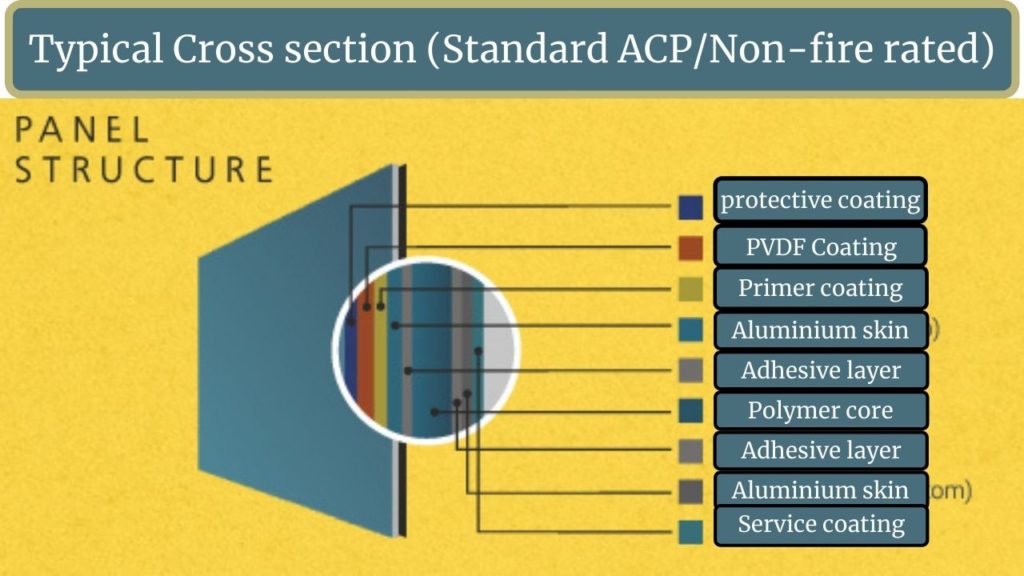
Two thin layers of aluminium sheets plus a sandwiched polymer core make up aluminium composite panels. Aluminium Composite Panel’s polymer core is made of polyurethane or low-density polyethylene (LDPE). These Aluminium Composite Panels are not fire-rated since they are flammable and could catch fire. The use of these sheets is restricted based on the fire rating. The image below depicts a typical cross-section of an ACP sheet that is not fire-rated.

Non Fire rated or Standard Aluminium Composite Panel - Typical section
Non Fire rated or Standard Aluminium Composite Panel – Typical section

Fire rated Aluminium Composite Panels

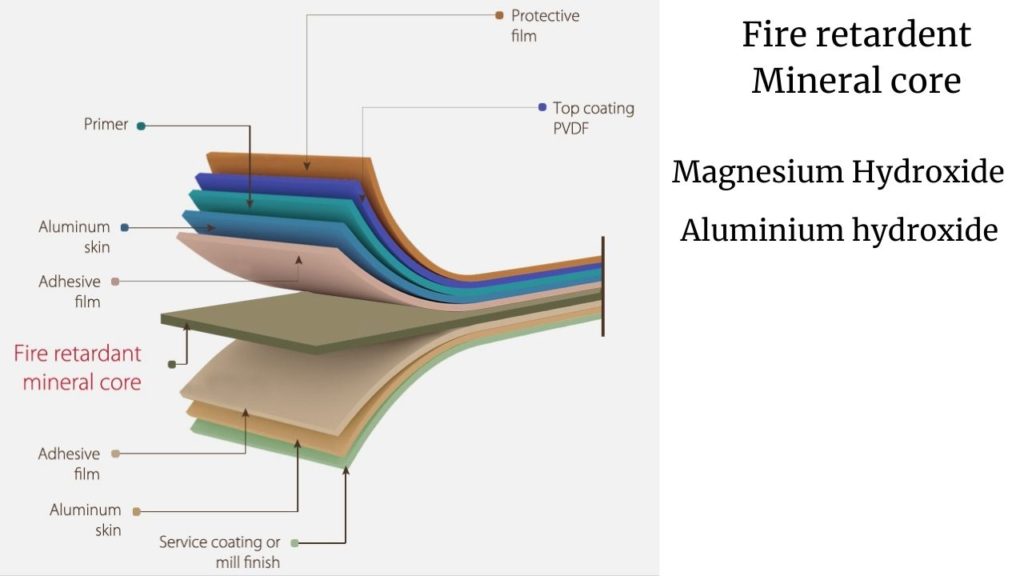
Depending on the core composition, fire-rated Aluminium Composite panel can withstand fire for up to 2 hours. The core materials are the fundamental distinction between ACP sheets that are fire-rated and those that are standard. While the fire-rated ACP has a specially formulated fire-resistant mineral core, the standard ACP uses LDPE/HDPE as its core material. Fire resistant mineral core uses Magnesium hydroxide as core for enhanced fire retardant qualities. As the name suggests, Fire Grade Aluminium Composite Panels have the unique capability to withstand extreme temperatures. The highest grade ACP is fire retardant ACP (A2 GRADE), which contains over 90% inorganic material content.

Aluminium Composite Panel - Fire retardant grade
Aluminium Composite Panel – Fire retardant grade (Credits – Alstrong )

Related posts from vincivilworld

Advantages of Aluminium Composite Panels

Aluminium Composite Panels are widely used nowadays because of their countless unique properties. Let’s highlight a few of its unique features that set it apart from other panelling materials.

Light weight

When compared to other building materials like steel, Aluminium Composite Panel is lightweight. This significantly reduces the design loads on the structure with big spans and vast areas involved. Lifting and erecting ACP sheets is simple. This, in turn, minimises labour and construction costs while maintaining the schedule.

Flexible

The ACP sheet is flexible and very simple to use. The installation process is quick and simple, and the fixing framework construction is uncomplicated.

Availability and colour choices

This composite panel has exceptional flexibility because to the vast range of finishes it supports. Aluminium composite board can be textured, solid, mirror, or wood type to meet any architectural concept. The colour and feel of real stone and wood are effectively replicated on aluminium.

Environmental friendly

ACP is an environmentally friendly material that is composed of 85% recycled aluminium. ACP’s cover sheets and core material are both recyclable.

Dimensional stability

Aluminium composite panels got high dimensional stability and the material can remain stable for a long period without changing the dimensions.

Smooth and elegant

The exteriors of buildings can have a pleasant and attractive appearance because to the smooth, elegant ACP surface.

Cost

ACP sheet is the most economical panelling option when compared with other panelling materials. The cost depends on the core materials. The fire grade materials are costlier than standard non fire rated ACP.

Weather resistant and Durable

ACP panels are UV resistant and chemical resistant. They are unbreakable stain-resistant, weather-resistant, termite resistant, moisture resistant, and anti-fungal.

Applications of Aluminium Composite Panels

ACP sheet is mainly used for a wide range of applications due to its extraordinary qualities. Major uses of the ACP sheet are as follows.

  • External and internal architectural cladding 
  • Internal partition
  • False ceilings
  • Signage
  • Machine coverings
  • Container construction

External and internal architectural cladding/partitions

For exterior cladding/façade applications, ACP sheets are used, thanks to their versatile qualities like UV resistance, fire resistance, and durability. ACP sheets come in a wide range of colours to match any architectural style. ACP sheet is the material of choice for facades and partitions because of its lightweight characteristics, simple fixing procedures, and quick construction.

Internal partitions

Aluminium Composite Panels in combination with aluminium, UPVC etc are used for office cabins and internal partitions. Partitions can be done with minimal space wastage.

Signage

ACP is used to render a wide variety of flexible exterior signs, as signage and hoardings are being used for exterior applications and must survive changes in temperature or weather

Interior work

ACP sheets are used for interior applications such as wall coverings, false ceilings, cupboards, portable kitchen cabinets, tabletops, column covers, and more.

Conclusion

ACP sheets are Green and environmentally friendly, easy to clean, and can shorten the construction period. ACP panels are resistant to corrosion, prevents acid and alkali, and other types of corrosion. Due to these versatile properties, ACP sheets are one of the popular choices in the construction sector.

Formwork in construction – Top 5 Formwork types

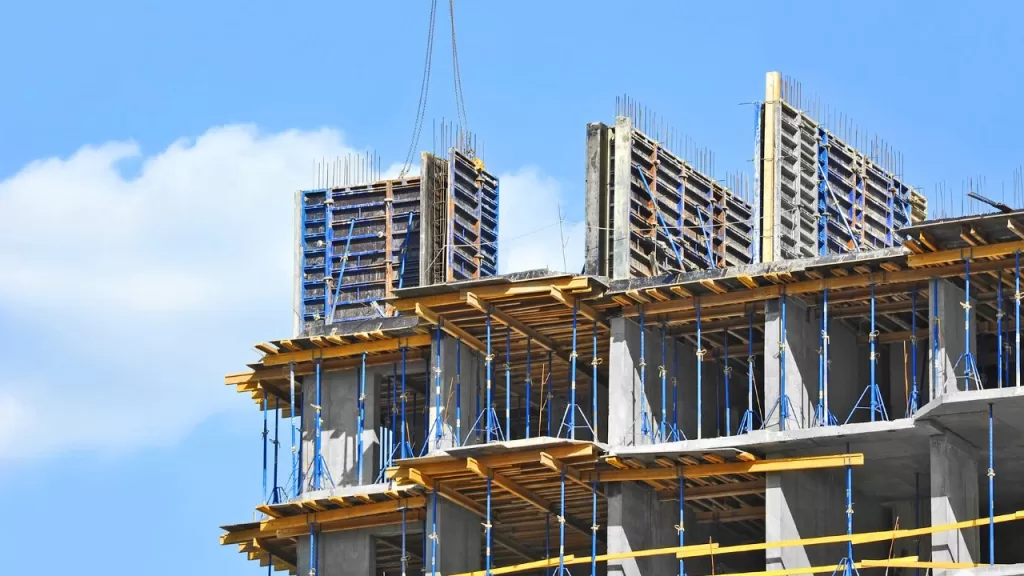
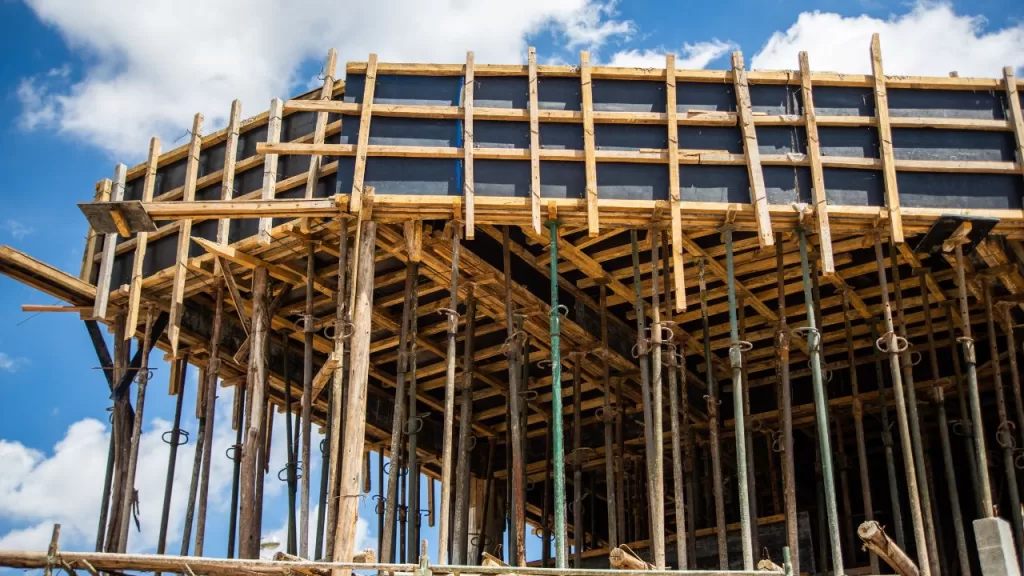
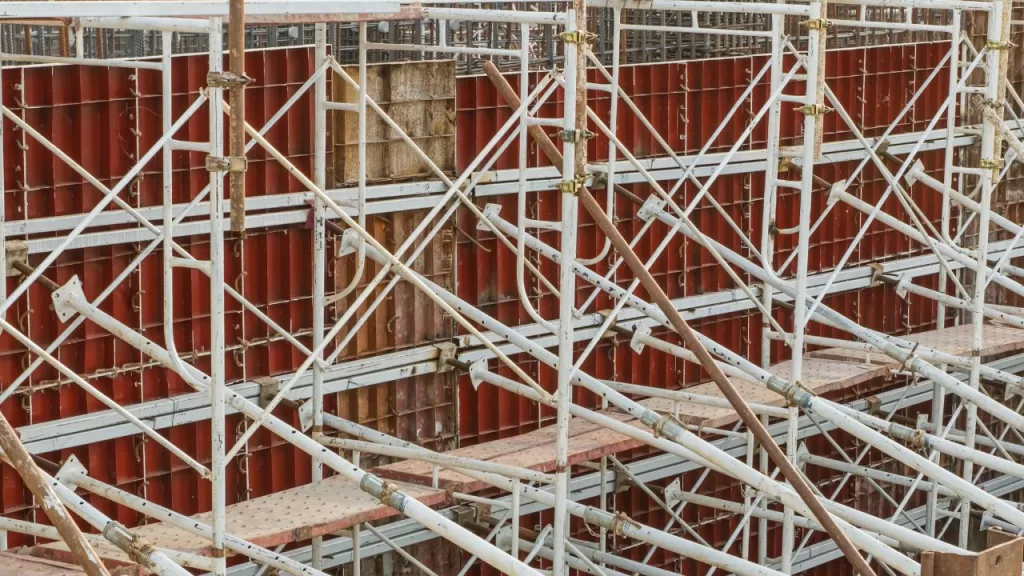
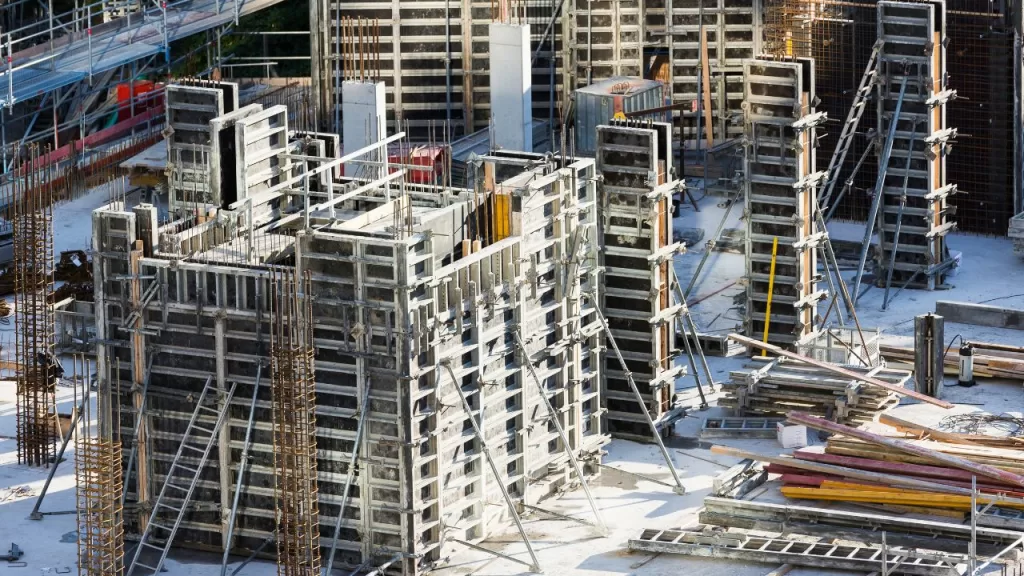
Formwork in construction refers to a mould used to shape concrete into structural shapes (beams, columns, slabs, shells) for buildings and other structures. Concrete is one of the most popular building materials due to its exceptional properties and advantages. However, in order to create construction components, concrete must be poured into a specific mould. In order to achieve the desired shape precisely, concrete is occasionally poured into formwork, a type of temporary mould. Formwork types in construction can also be categorised based on the type of structural member they are used in, such as slab formwork for use in slabs, beam formwork for use in beams and columns, and so forth. The formwork and any accompanying falsework must be sturdy enough to support the weight of the wet concrete without experiencing significant distortion.

Timber formwork is the most prevalent type of formwork used for minor buildings. This article explores the various forms of formwork used in construction as well as their characteristics.

  1. Significance of formwork in construction
  2. Quality of good formwork in construction
    1. Easy removal
    2. Economy
    3. Rigidity and strength
    4. Less Leakage
    5. Supports
  3. De-shuttering Period as per IS 456 – 2000 for formwork in construction
  4. Advantages of formwork in construction
  5. Types of formwork in construction
    1. Timber formwork in construction
    2. Plywood formwork
    3. Metal formwork
      1. Advantages of metal/steel formwork
    4. Aluminium formwork
      1. Advantages of Aluminium Formwork:
      2. Disadvantages of Aluminium Formwork
    5. Plastic formwork

Significance of formwork in construction

Formwork is frequently used in a range of shapes and sizes in buildingroadsbridgestunnels, corridor linings, hydroelectric power dams, agriculture headwork, sewage pipeline works, and other applications based on our design materials in the form of PCC and RCC. Falsework is the term for the structures that are needed for formwork in order to prevent movement during construction procedures. Formwork in construction requires a qualified crew and appropriate supervision to ensure high quality. Poor accuracy and expertise during the creation of the formwork lead to subpar work, which wastes time and money.

Form work in construction
Formwork

25 to 30 per cent of the total price of concrete construction is made up of the cost of the formwork. For bridges, this cost proportion could be higher. However, depending on the complexity of the structure, this may exceed 60%.
Similar trending posts from vincivilworld

Quality of good formwork in construction

Although there are numerous formwork materials, the following are general performance characteristics to satisfy the objectives of concrete construction is as follows.
  • Easy removal
  • Economy
  • Rigidity and strength
  • Less leakage
  • Supports

Easy removal

The design of the formwork should be such that it may be quickly removed with minimal pounding, resulting in less damage to the concrete.

Economy

Formwork serves no purpose in ensuring the stability of completed concrete. So, keeping safety in mind, its cost might be reduced. The formwork should be constructed with reasonably priced, lightweight, readily available materials that are both recyclable and reusable.

Rigidity and strength

Good formwork should be capable to withstand any form of live or dead load. Formwork must be properly aligned to the target line, and levels must have a plane and solid surface. When exposed to weather, the formwork’s material shouldn’t swell or warp. When choosing the formwork, take into account the temperature of the pour as well as the type of concrete being used because both affect the pressure that is applied. Furthermore, the formwork must be sturdy enough to bear the weight of both wet and dry concrete.

Less Leakage

Joints must not leak at any point.

Supports

Formwork needs falsework, which consists of stabilisers and poles, in order to stop moving while construction is being done. Formwork needs to be supported by sturdy, rigid, and rigid supports.

De-shuttering Period as per IS 456 – 2000 for formwork in construction

Let us have a look into the de-shuttering period of various structural components as per IS 456-2000

Sr. No.Type of FormworkMinimum Period Before Striking Formwork
1.Vertical formwork to columns, walls, beams16-24 hours
2.Slab ( props left under )3 days
3.Beam soffits ( props left under )7 days
4.Props for Slab
(a).Spanning up to 4.5m7days
(b).Spanning over 4.5m14days
5.Props to Beam and Arches
(a).Spanning up to 6m14days
(b).Spanning over 6m21days

De-shuttering period as per IS 456

Advantages of formwork in construction

Formwork is unquestionably necessary for all construction projects; its fundamental benefit is that no other technique can take its place.

  • Concrete structures can be swiftly and affordably built by using formwork.
  • A formwork provides suitable access and working platforms throughout the whole construction process, thereby, enhancing worker scaffold safety.
  • Formwork helps to reduce project timelines and costs by shortening the floor-to-floor building cycle time, which implies that more projects can meet their budgetary requirements. This, in turn, enables construction managers to provide precise on-time shuttering and de-shuttering of formwork resources, which improves project effectiveness and resource utilisation.
  • Formwork assists in creating a smooth concrete finish surface.

Types of formwork in construction

The following are the major types of formworks commonly used in construction.

Timber formwork in construction

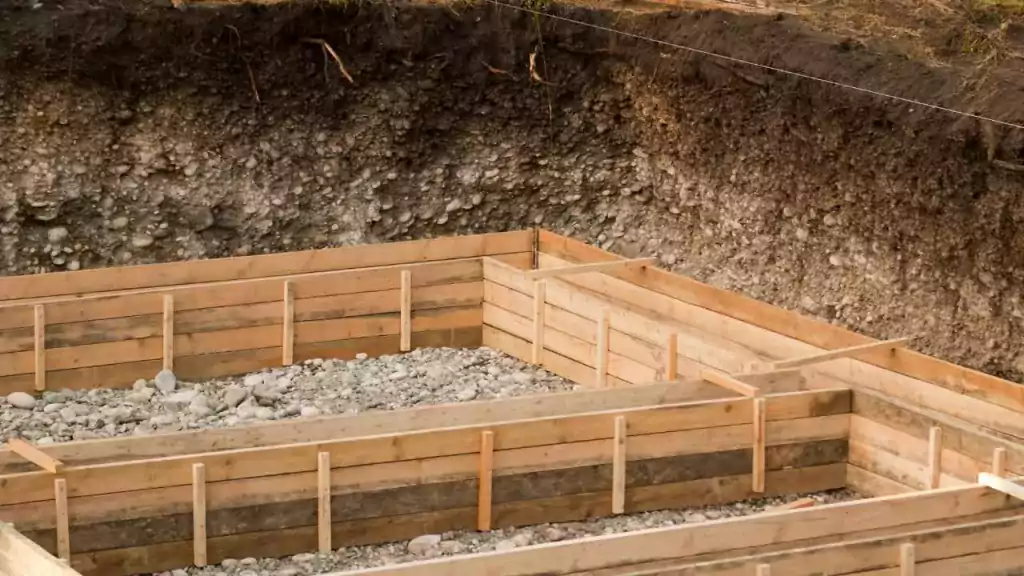
One of the first types of formwork utilised in the construction industry was timber formwork. Basically, timber formwork is the most versatile form, is built on-site, and has numerous advantages. In comparison to metallic formwork, they are incredibly lightweight and easy to install and remove. Timber formwork is versatile and can be built to any shape, size, or height. However, for minor projects where the use of local wood is permitted, these kinds of formworks are cost-effective. Prior to usage, the lumber must, however, undergo a thorough inspection to make sure it is termite-free. Timber formwork also has two disadvantages that should be considered: it has a short lifespan and takes a long time on large projects. Timber formwork is frequently recommended when labour costs are low or when flexible formwork is required for complex concrete components.

Timber formwork
Timber formwork in construction

The timber formwork should be well-seasoned, small in size, easy to nail without breaking, and free of slack knots. During shuttering, every face of timber that will make contact with the exposed concrete work must be even and smooth.

Plywood formwork

Generally, for plywood shuttering, sheets of waterproof, boiling-level plywood that are suited for shuttering are commonly used. These plywood sheets are attached to wooden frames to form the desired-size panels. Typically, plywood formwork is used in the sheathing, decking, and form-lining applications. Hence, Plywood formwork is the modern-day alternative to wooden formwork in construction. To support the concrete work, this formwork incorporates plywood. Plywood formwork results in a smooth concrete surface, which eliminates the need for concrete refinishing. Accordingly, with the use of large-size panels, a wider area can be covered. Basically, for jobs like fixing and disassembling, this might result in labour savings. The number of reuses is higher as compared to wooden shuttering. The number of reuses might be approximated to be between 10 and 15 times.

Plywood formwork
Plywood formwork in construction

Many of the same characteristics of timber formwork, such as strength, durability, and lightweight, also apply to plywood formwork. The ability of plywood shuttering to withstand moderate weather conditions is one of its key benefits. The surface of plywood seems to be sturdy, and it is robust enough to support the weight of concrete.

Metal formwork

Steel shuttering is composed of panels with thin steel plates that are connected at the edges by small steel angles. Suitable clamps or bolts and nuts can be used to secure the panel units together, Likewise, this type of formwork is used in the majority of bridge construction projects. Because of their long lifespan and adaptability, steel hardware and formwork are becoming more popular. Despite its potential cost, steel shuttering is beneficial for a wide range of applications and constructions. Basically, steel shuttering gives the concrete surface an extremely flat and smooth finish. It is ideally suited for circular or curved structures such as tanks, columns, chimneys, sewers, tunnels, and retaining walls.

Metal formwork
metal formwork

Advantages of metal/steel formwork

  • It gives the surface of the member a highly smooth and levelled finish.
  • Steel shuttering has a long lifespan and is effective and strong.
  • The honeycombing effect is reduced and it is waterproof.
  • It can be used more than 100 times.
  • The concrete surface does not collect moisture through the steel shuttering. Likewise, it is simple to assemble and de-shuttering.

Aluminium formwork

Aluminium shuttering resembles steel shuttering. The main difference is that aluminium has a lower density than steel, which makes formwork lighter. There are a few things to consider before using aluminium in a construction project. Compared to steel, aluminium is less strong. Aluminium shuttering is cost-efficient when deployed in several construction projects engineered for repeated use. The major disadvantage is that once the shuttering is constructed, it cannot be changed.

Aluminium shuttering

Advantages of Aluminium Formwork:

  • A smoother, cleaner surface finish is produced.
  • Generally, Up to 250 re-uses were intended for aluminium formwork.
  • It’s also cost-effective if numerous symmetrical structures need to be constructed.

Disadvantages of Aluminium Formwork

  • The initial cost is higher since aluminium formwork is now more expensive. Such formwork is cost-effective when used in symmetrical building designs.
  • Setting up initially takes some time.
  • Professional services are necessary in order to align and maintain this kind of formwork.
  • In order to prevent future leaks, the formwork holes made by wall ties should be correctly blocked.

Plastic formwork

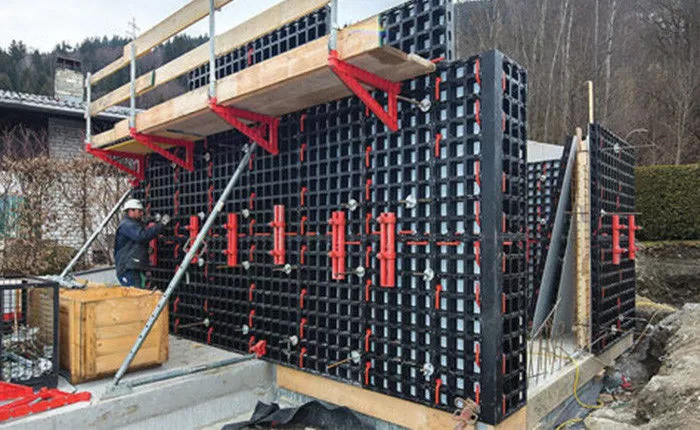
Interlocking panels or modular systems, which are both light and strong, are used to construct plastic shutters. Generally, small, repeatable initiatives like low-cost housing complexes are where it works best.

Plastic formwork
Picture courtesy: Newstrail.com

Basically, plastic formwork is appropriate for plain concrete structures. Due to its lightweight and water-cleanability, plastic shuttering is ideal for large segments and multiple reuses. Its primary drawback is that it is less flexible than timber because many of its components are prefabricated. However, large housing projects and structures with similar shapes are increasingly using these shuttering techniques.


UltraTech Cement commissions 1.9 mtpa cement capacity in Pali – Rajasthan

On Tuesday, the Aditya Birla Group company announced that the 1.9 mtpa greenfield clinker-backed grinding capacity at Pali Cement Works in Rajasthan had been put into operation.

According to the corporation, this is a part of the first phase of capacity increase that was announced in December 2020.

With 5 different plant locations, the firm and its subsidiary can now produce 16.25 mtpa of cement in Rajasthan.

The total capacity of UltraTech Cement for the production of cement in India is currently 121.35 mtpa. Outside of China, UltraTech Cement is the third-largest cement manufacturer in the world, with a combined Grey Cement capacity of 121.25 MTPA.

Despite a rise in net sales of 15.78% to Rs 13,596, the cement manufacturer’s consolidated net profit fell 42.47% to Rs 756 crore.

Concrete Mixing || Mixing concrete – Objectives and types

Concrete mixing is a critical step in ensuring strong, durable, and workable concrete for construction projects. This process involves blending cement, aggregates, water, and admixtures to achieve a uniform mixture. Understanding different concrete mixing methods is essential to achieving desired strength and performance. In this blog, we’ll explore the objectives of concrete mixing, various concrete mixing techniques, and compare manual vs. machine mixing to help you choose the right method for your needs. Whether you’re working on small residential jobs or large-scale infrastructure, knowing the types of concrete mixing and their advantages can improve quality and efficiency. Dive into the best practices and discover how to mix concrete properly for reliable, long-lasting results in all construction settings.

To begin with, let’s try to understand the objectives of mixing concrete and concrete mixing types

  1. Objectives of Concrete Mixing
  2. Concrete Mixing Types
    1. Hand Mixing of concrete
      1. Process – Hand Mixing of concrete
    2. Machine Mixing of Concrete
      1. Concrete Mixing Machine
      2. Machine Mixing Process
    3. Ready Mix Concrete
    4. Mixing Ratios
  3. Conclusion

Objectives of Concrete Mixing

How many of you have wondered why we mix concrete? Read on to find the answers.

  • To manufacture high-quality fresh concrete, proper mixing of materials is critical. 
  • The surface of all aggregate particles is coated with cement paste during the mixing phase.
  • For the desired workability and performance of concrete in both the fresh and hardened states.
  • To avoid segregation and bleeding.

In the next section, we will learn the types of concrete mixing

Related posts from vincivilworld

Concrete Mixing Types

There are three methods to produce efficient and high-quality concrete.

  • Hand Mixing – Mixing concrete manually without a mixer machine.
  • Machine Mixing – Mixing using a mixer machine.
  • Ready Mix Concrete – Mixing is done in an automatic or semi-automatic batch plant.

Let’s dig deeper into each of them.

Hand Mixing of concrete

  • Method of manually mixing the concrete materials without the use of a mixer machine. 
  • Hand mixing is done only for small jobs where the concrete demand is low and quality control is not critical. 
  • Uniformity of mixing is difficult to achieve by hand mixing. It necessitates extra caution and effort. 
  • In the case of hand mixing, 10% more cement should be applied to the nominal mix concrete proportion.
Hand Mixing of concrete

Process – Hand Mixing of concrete

  • Hand mixing is done on a flat iron sheet plate base that is hard, clean, and non-porous.
  • On the platform, a measured amount of sand is placed.
  • Then the cement is poured over the sand.
  • In a dry state, the sand and cement are thoroughly combined with shovels several times until the mixture achieves an even colour.
  • The coarse aggregates are then spread out on top of the above mixture and thoroughly mixed. 
  • The whole mixture is properly mixed by twisting it from centre to side, back to centre, and then to the sides several times.
  • After that, depression is rendered in the mixed materials’ nucleus.
  • 75 per cent of the necessary amount of water is then poured into the depression and mixed with shovels.
  • Finally, the remaining water is applied, and the mixing process is repeated until the concrete has a uniform colour and consistency. 

The total time for concrete mixing does not exceed 3 minutes.

Let’s move on to the next method ie mechanised concrete mixing.

Machine Mixing of Concrete

  • The method of combining concrete materials with a concrete mixer system is known as machine mixing. 
  • It meets the demands of fast mixing times, optimal consistency, and homogeneous concrete efficiency. 
  • Since it ensures uniform homogeneity, machine mixing of concrete is best suited for large projects requiring large quantities. 

Concrete Mixing Machine

It is also known as a concrete mixer is a machine that mixes cement, aggregate (such as sand or gravel), and water in a uniform manner to shape concrete. A rotating drum is used to combine the components in a traditional concrete mixer. Concrete mixers powered by gasoline, diesel, or electricity are now widely available. The mixer machine is mostly used for mixing ingredients by volume. They are also used for mixing ingredients by weight by providing weigh batcher.

Concrete Mixer Machine

Machine Mixing Process

  • Wet the inner surfaces of the concrete mixer drum first.
  • The coarse aggregates are added first, followed by sand, and finally cement, in the mixer.
  • In a mixing machine, combine the products in a dry state. In most cases, 1.5 to 3 minutes should suffice.
  • While the machine is running, slowly add the appropriate amount of water after the dry materials have been thoroughly mixed. 
  • Don’t use any extra water.
  • Concrete must be mixed in the drum for at least two minutes after adding water.

We have seen the details of machine mixing. How about getting an idea about ready-mix concrete?

Ready Mix Concrete

  • Ready Mix Concrete (RMC) is a specialised material in which the cement, aggregates, and other materials are weighed and batched at a central location, then mixed either in a central mixer or in truck mixers. Then it is shipped to construction sites.
  • The consistency of the resulting concrete is much superior to that of site-mixed concrete.
  • Useful on congested sites or in road construction where space for a mixing plant or aggregate storage is limited or nonexistent. 
  • Quality control of concrete is simple in this process.

So far, I have showed you the types of concrete mixing and its procedures. Now its time to throw some light on concrete mixing ratios.

Concrete Batching Plant

Mixing Ratios

The proportions of concrete components such as cement, sand, aggregates, and water are known as concrete mix ratios. The method of building and mix designs are used to determine these ratios. In comparison to other mixing processes, the water/cement ratio in RMC can be easily managed.

Conclusion

To summarise,

  • Hand blending of concrete is the cheapest method.
  • It is only recommended for very limited projects requiring a small amount of concrete since consistent concrete consistency is difficult to achieve with this method. 
  • It ensures proper material mixing.
  • When compared to site mixing (both hand and machine mixing), RMC takes less time and produces a higher quality product.
  • It’s also very handy when you need a large amount of concrete per day.

Test of cement on site – Field tests of Cement

Test of cement on site or field tests of cement is one of the most crucial things to be performed to assure the quality of the construction. Every structure is made up of hundreds of different building materials, such as sand, cement, aggregates, bricks, tiles, marble, and so on. However, the quality of the building materials is crucial for producing a high-quality structure and should be regularly evaluated at various phases of construction. Cement is the most important material used in construction and is responsible for the overall strength of the structure. In order to guarantee excellence in building, cement quality must be properly.

This article is about the various test of cement on-site or field tests of cement to ensure quality.

  1. Test of cement on site – Significance
  2. How to check cement quality?
  3. Test of cement on site / Field tests of cement
    1. Checking the manufacturing date of cement
    2. Visual checking for Lumps for the test of cement on site.
    3. Feel test of cement on site
    4. Heat of cement
    5. Colour
    6. Water float test
    7. Setting test
    8. Conclusion

Test of cement on site – Significance

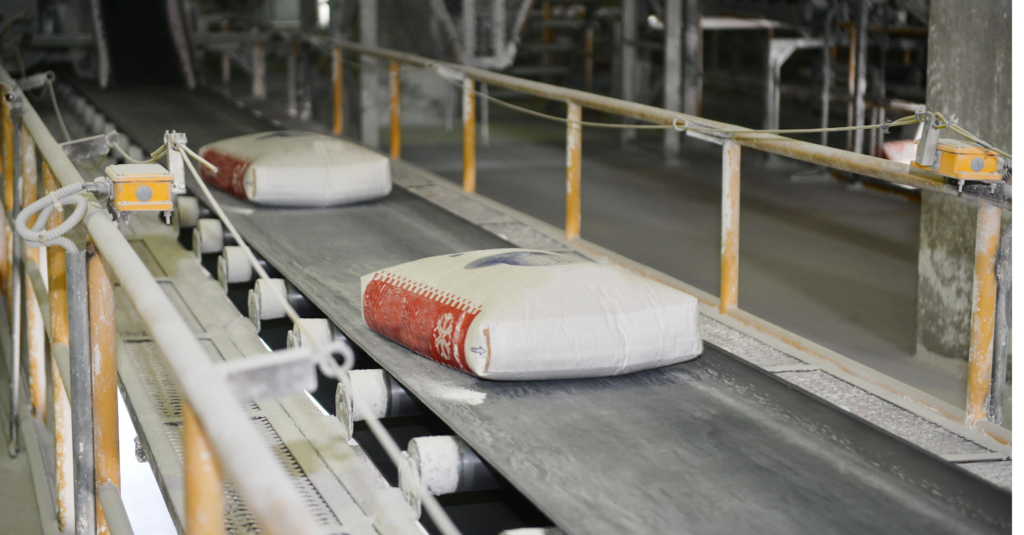
Cement plants are generally found in isolated areas near limestone mines. Generally, clinker is produced by cement companies at a centralised clinkerization plant. Clinkers are either ground at the clinkerization facility or transported to strategically placed grinding units for grinding and cement bag packing. The manufactured and packed cement is transported and delivered to the prescribed destinations by road or rail. Even with the finest protection, the cement still has the potential of absorbing moisture while being transported. After absorbing moisture, the cement tends to harden, deteriorating its quality. Because of these unforeseen concerns, cement must be tested for quality before being used in construction. Basically, cement testing is carried out in accredited laboratories.

How to check cement quality?

The characteristics of cement are often determined by laboratory tests. Lab tests need time, specialised equipment, and expertise to evaluate and interpret the data. All of the cement’s qualities might not be able to be tested on-site. To address this issue, cement tests are divided into two types.

  • Field Tests of Cement

This article is about the field tests of cement.

test of cement on site
FIELD TEST OF CEMENT

Related posts from vincivilworld

Test of cement on site / Field tests of cement

Some simple field tests can be used to confirm the quality of cement. Generally, these tests do not require the use of costly equipment or professional skills, and the results are obtained quickly. We can determine whether to accept or reject the cement by doing these quick tests, analysing the findings, and drawing conclusions about its quality. These are preliminary evaluations, and the cement’s quality is confirmed by factors such as how smooth it feels to the touch and its colour etc.

  • Checking the manufacturing date of cement
  • Visual checking for lumps
  • Feel test of cement
  • The heat of cement test
  • Colour test of cement
  • Water float tests
  • Setting tests
Test of cement on site
Field tests of cement

Checking the manufacturing date of cement

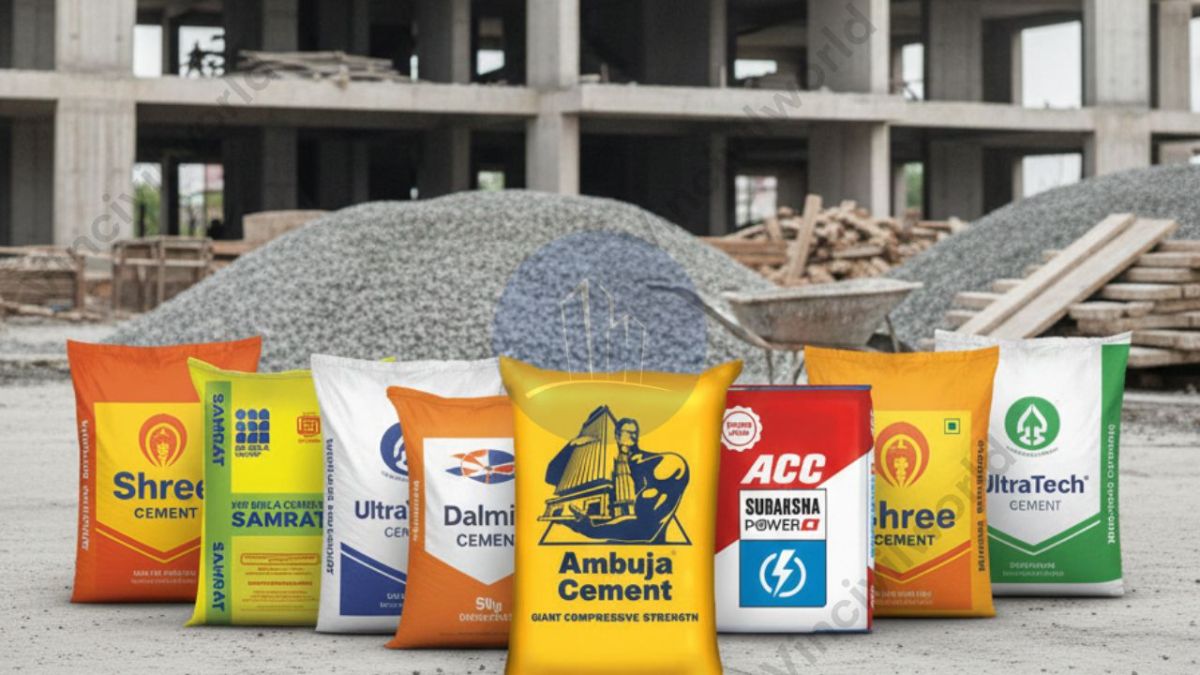
When stored under perfect conditions, the cement must be utilised within 90 days of manufacture. The manufacturing date and batch number are imprinted on each cement bag. By verifying the manufacturing date, we can get a good indication of how old the cement is and decide whether to use it. In addition, every batch of cement is accompanied by a Manufacturers Test Certificate, which can be requested and examined to verify the dates of manufacture.

Visual checking for Lumps for the test of cement on site.

Cement can be inspected for visible lumps. To establish the potential existence of lumps, you can press the cement bag’s corners. This test determines if the cement has hardened or not.

Feel test of cement on site

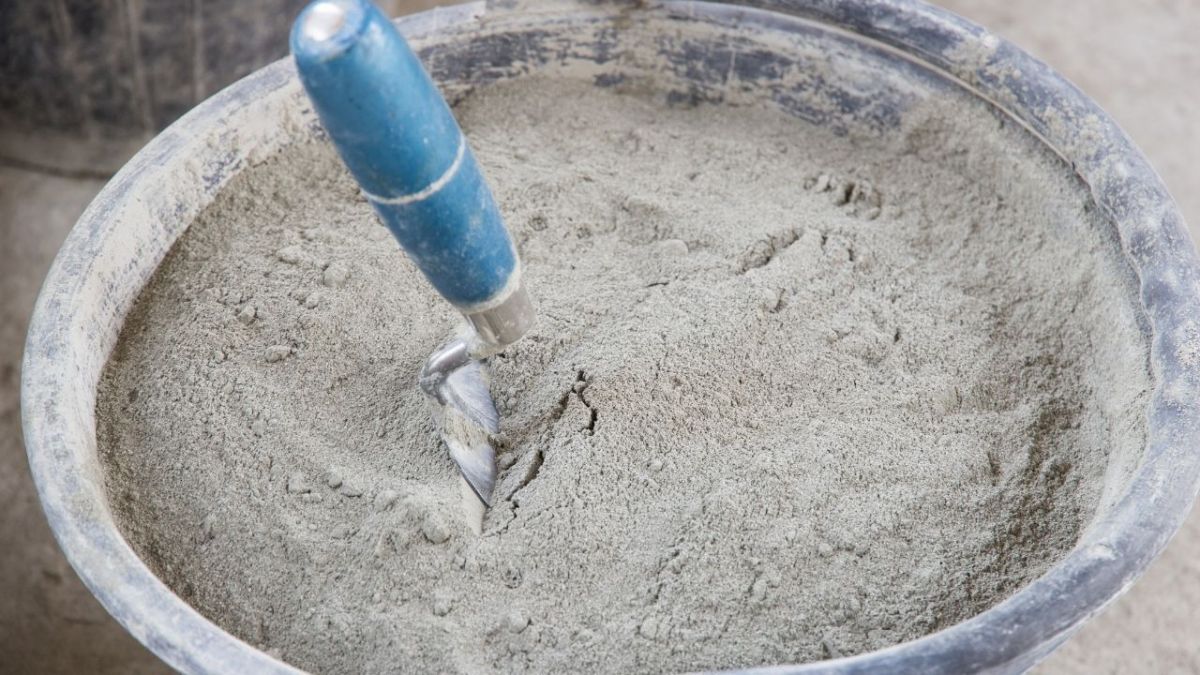
Feel a pinch of cement between the figures. Cement has to feel smooth and not grainy. By this test, we can rule out the presence of any adulterated material like sand mixed with cement.

Heat of cement

Put your hand inside a bag of cement that is open. If the cement is of good quality and has not yet begun to hydrate, the hand feels cool.

Colour

Cement is usually greenish-grey in colour. We can verify and confirm the colour of the cement on-site. However, the type and source of the ingredients can affect the colour of the cement.

Water float test

This test is performed to find out whether there are impurities in cement. A cement hand is thrown into a bucket of water. The cement floats for a while before settling down if it is good cement free of impurities or other foreign objects. Impurities in the water can cause the cement to settle instantly.

Setting test

A thick paste of cement is applied to a glass piece and slowly immersed in water for 24 hours. The cement piece won’t break or alter shape while it sets and maintains its original shape. This cement is regarded as excellent.

Conclusion

We have the opportunity to contact cement manufacturers through their customer services if we have any questions about the product’s quality and they will be happy to help. It is possible to confirm field observations with laboratory tests. Cement quality should never be compromised during construction. Because the most crucial component that affects the durability and quality of a structure is cement.

ALSO READ : WHAT ARE THE PROPERTIES OF CEMENT?

Advertisements