Category Archives: Building materials

Best Cement of India || Top Cement Companies in India -2025

Best cement brands in India is a question that comes up frequently among homeowners, builders, and civil engineers planning durable construction projects. With rapid infrastructure growth and rising quality expectations, choosing the right cement has become more important than ever. Several factors influence this decision, including strength, consistency, durability, and performance under Indian site conditions. Today, many top cement companies in India offer a wide range of products designed for residential, commercial, and infrastructure works. Understanding best cement quality in India helps buyers make informed choices rather than relying only on brand names. People often ask which cement is best in India and look for reliable comparisons among the best cement brands in India. This article answers that question clearly by examining leading cement companies and their performance in 2025.

Which are the best cement companies in India? Which is the best cement in India? This is the common question every individual should be asking while deciding to go for home construction.

Cement is the most significant and widely used construction material which forms an integral part of any structure. Cement is the major ingredient of concrete and mortar and the structural stability and life of a structure or building depends on the cement quality.

  1. Significance of cement in construction sector
  2. Which is the best cement brand for your House/Structure?
  3. What is the difference between best cement company and best cement?
  4. Top cement brands in India in terms of Market share
  5. 1.UltraTech – Best cement companies in India
  6. 2.Ambuja Cement – Best cement companies in India
  7. Ambuja Cements (Adani Group) – UPDATED
  8. 3.ACC Cements – Best cement companies in India
  9. ACC Cement – UPDATED
  10. 4.Shree cements – Best cement companies in India
  11. Shree Cement – UPDATED
  12. Dalmia cement
  13. Birla Corporation
  14. India Cements
  15. Ramco cements
  16. Conclusion

Significance of cement in construction sector

In large industrial, commercial, and residential projects, contract documents specify the best cement brand in India. They also clearly specify the cement type and list approved vendors. However, for individual home construction, decisions often rely on the engineer or contractor. Even so, homeowners should understand the best cement quality in India. They should also know the available cement types. It is essential for homeowners to identify which cement is best in India for their needs. Basic knowledge of leading brands is important. Understanding applications helps ensure durability, safety, and long-term performance. This is crucial when choosing from the best cement brands in India for residential construction.

Which is the best cement brand for your House/Structure?

After China, India is the second-largest cement producer globally. Production is expected to rise to around 453 million tonnes in FY25. It will expand further in FY26 due to strong infrastructure and housing demand. India’s installed cement production capacity is approximately 668–690 million tonnes per annum, with major clusters in South, North, and West India. The sector continues to grow, with planned capacity additions of 150–170 million tonnes by FY28. More than 200 large cement plants operate nationwide, and producers are investing heavily in expansion, sustainability, and efficiency. This article highlights the top 8 best cement companies in India based on production capacity, quality, and market presence in 2025.

What is the difference between best cement company and best cement?

The difference between the best cement company and the best cement often creates confusion. In reality, all reputed cement companies manufacture cement in accordance with prescribed Indian standards. Therefore, there is no absolute “best cement” or “best brand.” What mainly distinguishes the best cement companies in India is their production capacity, quality consistency, marketing strength, and wide distribution network. Regional availability plays a key role in cement selection, as a well-distributed brand ensures fresh supply and reliable performance. For most users, the choice of cement depends on local availability, application requirements, and budget rather than brand name alone. Therefore, this article lists leading cement companies based on market share and widespread availability across different regions of India.

Top cement brands in India in terms of Market share

As per India Brand Equity Foundation (IFBL) Ultratech stand at first position in terms of market share and Market cap.

Market share
Best cement quality in india
Best cement of India - Data with respect to market cap and Market share
Best cement of India – Data with respect to market cap and Market share

Let us go through the details of top cement companies in india in terms of market capitalization and market share

1.UltraTech – Best cement companies in India

Ultra Tech is the largest manufacturer of grey cement, white cement, and Ready mix concrete in India. It is the flagship cement company of the Aditya Birla Group. Established in 1983, UltraTech Cement boasts 23 integrated plants. It also operates 1 clinkerisation unit. Additionally, it runs 26 grinding units and 7 bulk terminals. The company manages 1 white cement plant, 2 Wall Care putty plants, and over 100 RMC plants. Ultratech is the third-largest company in the world (Excluding china) and has business operations in UAE, Bahrain, Sri Lanka, and India. Ultra Tech has a consolidated capacity of 116.8 million tonnes per annum (MT PA) of grey cement.

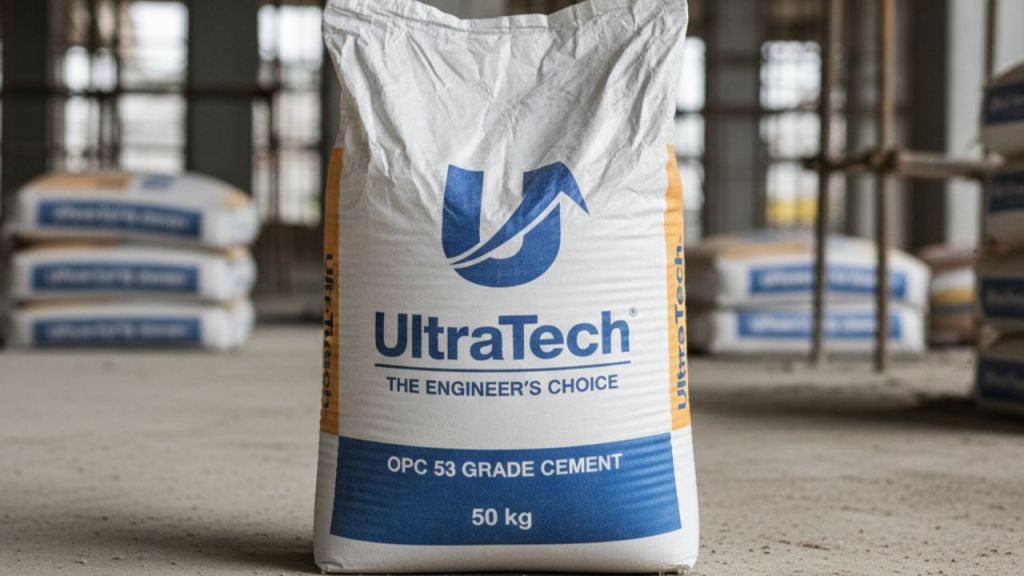
A bag of UltraTech cement labeled 'OPC 53 GRADE CEMENT' weighing 50 kg, placed in a construction setting with other bags in the background.
UltraTech 53 Grade Cement bag, known for its high strength and widely used in construction projects.
  • Establishment: 1987 ✅
  • Headquarter: Mumbai ✅
  • Market share: ≈ 26–28%
  • Market Cap (Rs Cr.): ₹3.1–3.3 lakh crore (≈ 30–32%)
  • Production capacity: ≈ 183–185 MTPA

Ultratech production line includes Ordinary Portland Cement, Portland Blast Furnace Slag Cement, Portland Pozzolana Cement, etc. They are also leading producers of White Cement, Ready Mix Concrete, building products, etc.

2.Ambuja Cement – Best cement companies in India

Ambuja cement formerly known as (Gujrat Ambuja Cement Limited ) is the second-largest cement company in India in terms of the Market share. It was founded in 1983 and has their headquarter in Mumbai. Ambuja Cement got five integrated cement manufacturing plants and eight cement grinding units spanning across the country with a production capacity of 29.65 million tonnes per Annum (MT PA).

All Ambuja Cement plants are ISO 14001 certified. It is also plastic negative, by burning as much as over 75,000 tonnes of plastic waste in its kilns, equivalent to 2.5 times of total plastic used. The company also generated 7.1% of its power needs from renewable resources.

Ambuja Cement is known for its high strength, high performance Ordinary Portland Cement (OPC) and Pozzolana Portland Cement (PPC) and was the first to introduce 53-grade cement in the market.

Yellow cement bag with Ambuja Cement branding, surrounded by construction materials.
Ambuja Cement bag showcasing its strong branding and significance in the Indian construction sector.

Ambuja Cements (Adani Group) – UPDATED

(Include Ambuja + ACC + acquired assets context)

  • Establishment: 1983 ✅
  • Headquarter: Mumbai ✅
  • Market share: ≈ 10–11% (standalone Ambuja)
  • Market Cap (Rs Cr.): ₹1.2–1.4 lakh crore
  • Production capacity: ≈ 75–80 MTPA
  • 📌 Note: Along with ACC, Adani Cement cluster controls ≈ 14–15% of India’s cement market.

In 2005, Ambuja Cements (as the company was known then) joined the reputed Holcim Group of Switzerland. Another premier Indian cement company, ACC Limited, also became part of this group. Later, in 2015, Holcim Limited and Lafarge SA came together in a merger of equals to form LafargeHolcim – the new world leader in building materials.

3.ACC Cements – Best cement companies in India

It is formerly known as an Associate Cement Company is one of the oldest and leading manufacturers of cement and ready mix concrete. ACC Cement was established in the year 1936 with headquarter in Mumbai and having 17 cement manufacturing units, over 90 ready mix concrete plants etc.

ACC Cement – UPDATED

  • Establishment: 1936 ✅
  • Headquarter: Mumbai ✅
  • Market share: ≈ 4–5%
  • Market Cap (Rs Cr.): ₹40,000–45,000 crore
  • Production capacity: ≈ 36–38 MTPA
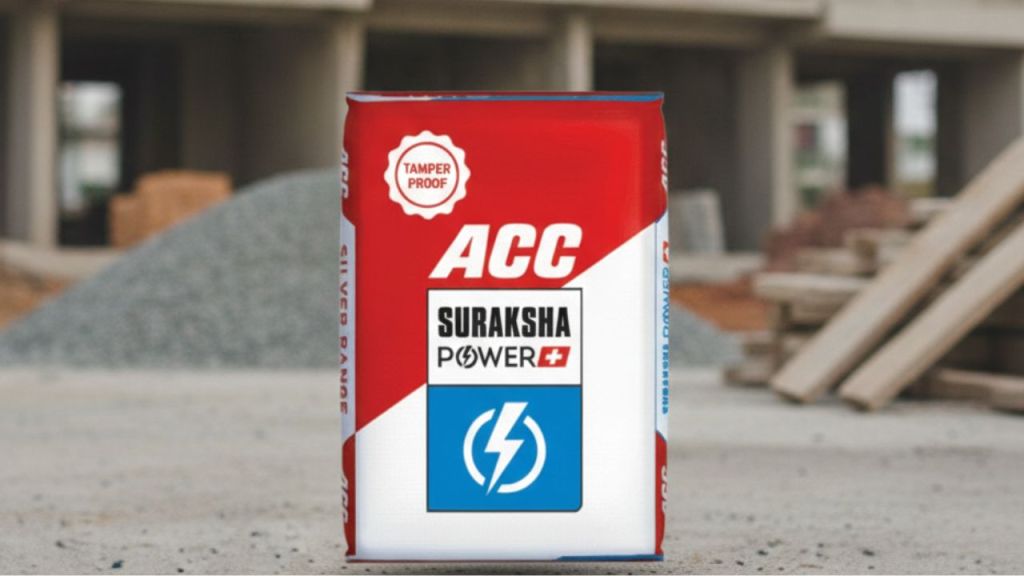
A bag of ACC Suraksha Power cement displayed at a construction site, with building materials like gravel and wooden beams in the background.
ACC Suraksha Power: Premium quality cement for robust construction.

In 2005, ACC became part of the Holcim Group of Switzerland. Subsequently, in 2015, Holcim and Lafarge came together in a merger to form LafargeHolcim – the global leader in building materials and solutions.

4.Shree cements – Best cement companies in India

SCL is one of the fast growing cement companies in India. Shree Cement was Incorporated in 1979 by renowned Bangur family based out of Kolkata and first cement plant was established in the year 1985.

SCL is one of India’s Top five cement producers and among the fastest growing cement companies with an installed capacity of 45 Million Tonnes Per Annum in India and 50-55 MPTA including overseas.

Shree Cement – UPDATED

  • Establishment: 1979 ✅
  • Headquarter: Kolkata ✅
  • Market share: ≈ 6–7%
  • Market Cap (Rs Cr.): ₹95,000–1,05,000 crore
  • Production capacity: ≈ 50–55 MTPA (India + overseas)
An assortment of cement bags displayed in a construction environment. The bags include Shree Cement, Bangur Magna, Solid Concrete, Roofon Plus, Powermax, and Rockstrong.
An array of Bangur cement products showcasing Shree Cement and various concrete options, highlighting quality for construction projects.

SCPL is known for delivery of good quality products at an affordable price range.

Dalmia cement

They are one of India’s pioneering homegrown cement companies established in 1939 having headquarter in Delhi. Dalmia Cement (Bharat) Ltd, which is a 100% subsidiary of Dalmia Bharat Ltd.

The company has a production capacity of 30.75 MP TA and operates thirteen cement plants and grinding units which are spread across nine states. Dalmia Cement is the only company with at least one plant in each of the four key eastern states of West Bengal, Bihar, Jharkhand, and Odisha.

A bag of Dalmia cement labeled 'RCF Expert' displayed on a construction site with bags in the background.
Dalmia Cement bag showcasing the brand’s commitment to quality construction materials.
  • Establishment: 1939 ✅
  • Headquarter: Delhi ✅
  • Market share: ≈ 5–6%
  • Market Cap (Rs Cr.): ₹35,000–40,000 crore
  • Production capacity: ≈ 44–46 MTPA

Dalmia is the largest manufacturer of slag cement and is a leader in super-speciality cement for oil wells, railway sleepers, and airstrips. These brands are available as Portland Pozzolana Cement, Portland Slag Cement, Composite Cement, and Ordinary Portland Cement in select markets

Birla Corporation

Birla Corporation is a flagship company of MP Birla group and got 10 cement plants at various locations and having a production capacity of 15.5 MT PA. Incorporated as Birla Jute Manufacturing Company Limited in 1919 Birla corporation is engaged in the manufacture of cement. They manufacture varieties of cement like Ordinary Portland Cement (OPC), 43 & 53 grades, Portland Pozzolana Cement (PPC), fly ash-based PPC, Low Alkali Portland Cement, Portland Slag Cement (PSC), Low Heat Cement and Sulfates Resistant Cement.

A bag of MP Birla Cement 'Samrat' displayed on a construction site, with gravel piles and wooden planks in the background.
A bag of MP Birla Cement ‘Samrat’ prominently displayed at a construction site, showcasing its sustainable branding.
  • Establishment: 1946 ✅
  • Headquarter: Chennai ✅
  • Market share: ≈ 2–3%
  • Market Cap (Rs Cr.): ₹7,000–8,000 crore
  • Production capacity: ≈ 14–15 MTPA

The company acquired 100% shares of Reliance Cement Company Private Limited for a value 4800 crores. The total capacity including acquisition stands at 15.5 MT PA.

India Cements

India cements Ltd was founded in the year 1946 by Shri S N N Sankaralinga Iyer and Sri T S Narayanaswami. From a two plant company having a capacity of just 1.3 million tonnes in 1989, India Cements has robustly grown in the last two decades to a total capacity of 15.5 million tonnes per annum. India Cements has now 8 integrated cement plants in Tamil Nadu, Telangana, Andhra Pradesh and Rajasthan and two grinding units, one each in Tamil Nadu and Maharashtra.

  • Establishment: 1946
  • Headquarter: Chennai
  • Market share : 5%
  • Market Cap (Rs Cr.) Rs. 6047Cr. (1.22%)
  • Production capacity : 15.5 MTPA

Ramco cements

Ramco Cements Limited is the flagship company of the Ramco Group, a well-known business group of South India. having their head quarters in Chennai. It is eight in the list of top 10 cement company in India

Various types of Ramco cement bags displayed on a blue background.
Various types of Ramco Cement products showcased against a vibrant blue background, highlighting their diverse offerings in the Indian cement market.

The main product of the company is Portland cement, manufactured in eight state-of-the-art production facilities that include Integrated Cement plants and Grinding units with a current total production capacity of 16.45 MTPA. The company is the fifth largest cement producer in the country. 

  • Establishment: 1946 ✅
  • Headquarter: Chennai ✅
  • Market share: ≈ 3–4%
  • Market Cap (Rs Cr.): ₹25,000–28,000 crore
  • Production capacity: ≈ 23–25 MTPA

Key Takeaways

  • Choosing the best cement brands in India is crucial for durable construction projects due to factors like strength and performance.
  • The article highlights leading cement companies based on market share and production capacity as of 2025.
  • UltraTech and Ambuja Cement rank among the top cement companies in India, with significant market shares and production capacities.
  • The difference between best cement companies and the best cement often lies in production capacity and local availability.
  • Homeowners should prioritize readily available brands with good marketing networks for their construction needs.

Conclusion

All cement companies manufacture their products in compliance with Indian Standards (IS) and relevant international standards, ensuring consistent quality and performance. Therefore, there is no single answer to which cement is best in India, as most leading brands meet the required technical specifications. While selecting the best cement brand in India, availability in the local market, logistics, and budget play a major role. The top cement companies in India listed in this article stand out mainly due to their large manufacturing capacity, strong distribution network, and wide regional presence. However, many other best cement brands in India also offer excellent strength, durability, and reliability. Builders and homeowners can confidently choose any standard-compliant cement that is easily available nearby, as best cement quality in India is maintained across reputed manufacturers.

Consistency test on cement – Significance and Procedure

The standard consistency test of cement is a crucial procedure for determining the precise quantity of water needed to create a workable paste, which is essential for subsequent laboratory tests. This test utilizes a Vicat apparatus to find the water content that allows the plunger to penetrate the paste to a specified depth, thus defining the normal consistency of cement. Establishing this value is a necessary step before conducting other important tests like setting time, soundness, and compressive strength, all of which rely on a correct water–cement ratio.

Understanding the significance of the consistency test helps one appreciate its influence on key concrete properties such as workability, strength development, and durability. By providing a clear explanation of the test’s procedure—from trial mixes to the final penetration reading—this article serves as a valuable guide for students, site engineers, and quality controllers. It aims to assist them in performing reliable laboratory work, ultimately ensuring high-quality cement performance in structures.

  1. Significance of cement tests
    1. Field tests of cement
    2. Laboratory tests
  2. Significance of Consistency test on Cement
  3. Relevant IS code for consistency test on cement
  4. Apparatus used for consistency test on cement
  5. Procedure of consistency test for cement (As per IS 4031 Part 4)
  6. Calculation
  7. Consistency of cement test procedure – Standards comparison
  8. Precaution
  9. Conclusion

Significance of cement tests

Cement is a key construction material used in buildings, bridges, and infrastructure. It forms concrete and mortar, and it directly influences the strength, durability, and performance of structures.

Cement is a key construction material, so its quality must be checked before use. Cement tests generally fall into two types: laboratory tests and field tests. Field tests are simple, quick checks that do not require special equipment or expertise. They help to judge whether cement can be accepted for work.

Field tests of cement

  • Checking manufacturing date
  • Visual lump check
  • Feel test (smoothness)
  • Heat test
  • Colour check
  • Water float test
  • Setting test

These tests provide approximate but useful quality indications.

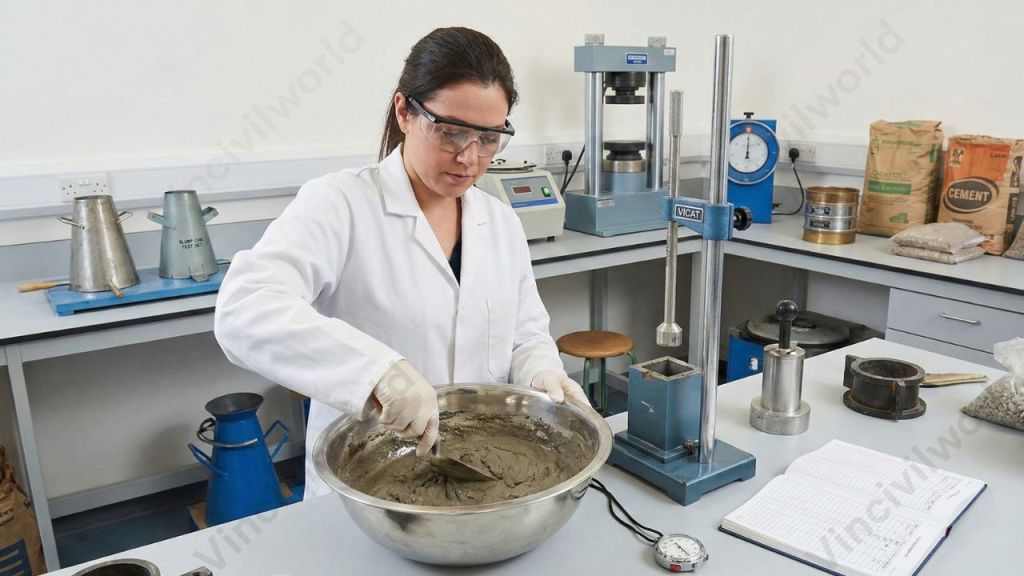
A laboratory technician wearing safety goggles and gloves mixes cement paste in a large bowl, with a Vicat apparatus and various testing equipment visible in the background.
A technician performing the standard consistency test of cement using a Vicat apparatus in a laboratory setting.

Laboratory tests

Laboratory tests provide detailed and accurate assessment of cement quality under controlled conditions , essential before use in structural works. Common lab tests for cement include:

  • Standard consistency test of cement
  • Initial and final setting time test
  • Soundness test (e.g., Le Chatelier method)
  • Fineness test (e.g., sieve or Blaine method)
  • Strength test (e.g., compressive strength of cement mortar)
  • Heat of hydration test (for some cements)
  • Chemical composition / chemical analysis

This article is about standard consistency test of cement.

Significance of Consistency test on Cement

The strength and durability of concrete depend greatly on the quality of cement and its correct water content. To achieve proper strength, the cement mortar must have standard consistency, which is determined in the consistency test of cement. In this test, standard consistency occurs when the Vicat plunger penetrates to a depth of 5–7 mm from the mould’s bottom. This penetration confirms the cement’s readiness. It is determined through trial and error to find the exact amount of water required to prepare a workable cement paste. Knowing the normal consistency of cement is crucial. It is needed before performing other laboratory tests, such as compressive strength, setting time, and soundness tests. Water directly influences hydration. Cement composition, fineness, and water–cement ratio affect consistency. Excess water weakens hardened cement, while too little water slows hydration and reduces strength. Therefore, determining consistency ensures reliable concrete performance and quality control.

Relevant IS code for consistency test on cement

  • IS 4031 (Part 4):1988 – Standard consistency test (India)
  • ASTM C187 – Amount of water required for normal consistency (USA)
  • BS EN 196-3:2016 – Standard consistence, setting times & soundness (UK/Europe)

Apparatus used for consistency test on cement

The Vicat apparatus is used to determine the consistency of cement. It consists of a plunger, a movable rod weighing 300 g, graduated scale, non-porous plate, split mould and Vicat mould. The diameter of the plunger is 10mm and the length is 50mm. The graduate scale measures the depth of penetration. The Vicat mould is a cone frustum with 80 mm diameter. The test should be conducted at a standard temperature of 27 C. The humidity should be 65%. A stop clock is used to measure the time from the addition of water to the drying of cement. As per IS code, the time of gauging is not less than 3 minutes, nor more than 5 min.

Procedure of consistency test for cement (As per IS 4031 Part 4)

Follow these steps when performing the consistency test under IS code:

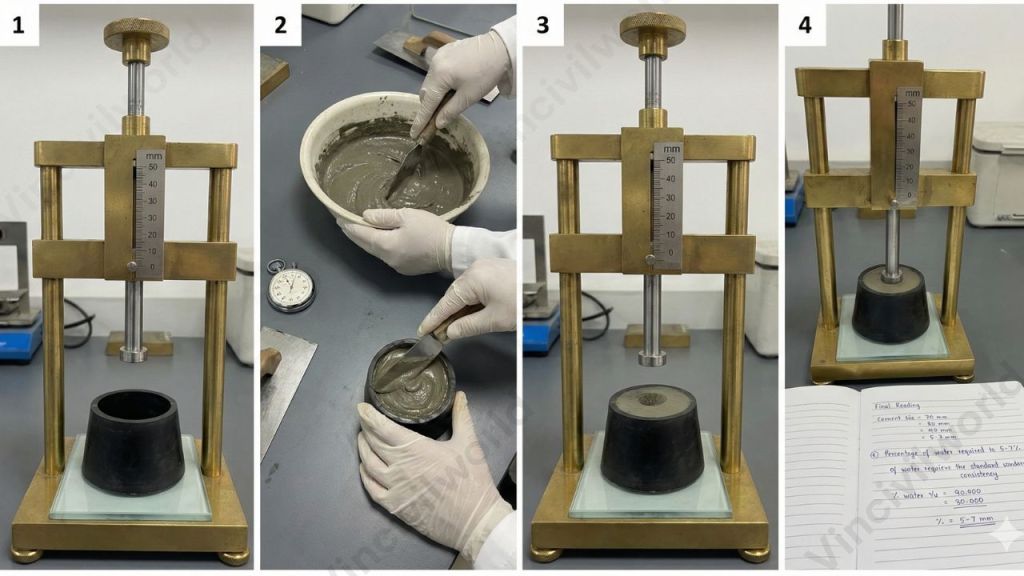
  • Use a clean Vicat apparatus (as per specification) with 10 mm-diameter plunger and standard mould resting on a non-porous base plate.
  • Weigh a required quantity of cement and a proportionate amount of potable or distilled water.
  • Begin gauging (mixing): mix cement and water thoroughly, and complete gauging within 3 to 5 minutes from addition of water. Ensure gauging is completed before any sign of setting occurs.
  • Fill the Vicat mould with the fresh cement paste, rest mould on non-porous plate. Level the surface — remove excess paste, smooth the top. A light shake may be used to expel air bubbles.
  • Lower the plunger gently so it just touches the paste surface, then release it to descent under its own weight (no external load).
  • Observe the depth of penetration on the graded scale. If plunger stops such that it’s 5–7 mm above the bottom of mould — that paste has “standard consistency.”
  • If the penetration depth is not within that range, discard paste; prepare a new paste with adjusted water content (increase or decrease water) and repeat until standard consistency is reached.
  • Document the percentage water (by weight of cement) that achieved standard consistency — this becomes the “water for normal consistency” or “standard consistency water proportion.”
Vicats apparatus setup for the standard consistency test of cement, showing the plunger mechanism.
Vicat apparatus used for measuring standard consistency of cement during laboratory testing.

Calculation

The standard consistency is expressed in terms of the percentage of the quantity of added water to the weight of cement. The consistency of cement ranges from 26% to 33%.

Standard consistency = ( Quantity of water added / Weight of cement) x 100

Consistency of cement test procedure – Standards comparison

StandardApparatus / PrincipleConsistency Criterion / Penetration DepthNotes / Use for Further Tests
IS 4031 (Part 4)Vicat apparatus (10 mm dia. plunger, standard mould)Plunger penetrates so that it stops 5–7 mm from the bottom of mould (i.e. ~33–35 mm from top) for standard / normal consistency (Basis for subsequent cement tests (setting time, soundness, strength) under Indian Code
ASTM C187Vicat-type penetration instrument / similar test method to determine water for “normal consistency” Penetration per ASTM calibration (aims to find water percent giving normal consistency) Used internationally / in labs following ASTM procedures; result used for further cement/concrete tests
BS EN 196‑3 (European / British standard)Vicat apparatus for consistency and setting-time / soundness tests Defines “standard consistence” via penetration depth per EN criteria; used before setting time & soundness tests Common in European labs; ensures standard baseline for cement tests under EN / BS norms

Precaution

We should take certain precautions before starting the test so that to obtain accurate results.

  • Clean the Vicat mould properly and grease the inside surface
  • Take immense care while attaching the plunger. Make sure it is vertical.
  • Place the apparatus on a levelled surface.
  • Maintain the standard temperature and humidity throughout the test.

Key Takeaways

  • The consistency test of cement measures the required water for a workable paste, using the Vicat apparatus.
  • This test is crucial for determining key properties like setting time, soundness, and compressive strength of cement.
  • Standard consistency is reached when the plunger penetrates 5–7 mm from the bottom of the mould, ensuring proper hydration.
  • Laboratory tests provide accurate assessments of cement quality, while field tests offer quick checks.
  • Precautions are vital for accurate test results, including cleaning the apparatus and maintaining proper temperature and humidity.

Conclusion

In conclusion, the consistency test of cement is essential for maintaining quality and performance in concrete works. By determining the standard consistency of cement, engineers identify the exact water needed to create a uniform and workable paste. This value is crucial for reliable results in other major laboratory tests such as compressive strength, setting time, and soundness. The significance of standard consistency test of cement lies in ensuring proper hydration, which directly influences the strength, durability, and service life of structures. Using the Vicat apparatus, the test provides accurate and repeatable outcomes for both laboratories and field quality control. When the water–cement ratio is correctly maintained, concrete becomes safer, stronger, and more durable, supporting high-standard construction practices.

Heat of hydration test of Cement – Process and Procedure

The Heat of Hydration of Cement plays a major role in determining concrete temperature, early strength, and long-term stability. The heat of hydration is the heat liberated from the reaction between cement and water. When water combines with cement compounds, it triggers the Cement Hydration Process, releasing heat that varies across different Hydration Stages of Cement. These stages influence setting behaviour, strength formation, and temperature rise in both normal and mass concrete. Understanding the Factors Affecting Heat of Hydration is crucial. Factors such as cement composition, fineness, water-cement ratio, and environmental conditions help engineers control excessive heat generation. This control helps avoid thermal cracking. In large pours like dams and raft foundations, Low Heat Cement Applications become essential to manage temperature gradients and ensure structural durability. By studying these principles, professionals can produce safer, stronger, and long-lasting concrete structures.

This article covers the Heat of Hydration of Cement and the Cement Hydration Process. It also details the Hydration Stages of Cement. Additionally, it discusses Factors Affecting Heat of Hydration and Low Heat Cement Applications.

  1. Tests on Cement (Field Tests and Lab Tests)
    1. Field tests on Cement
    2. Laboratory tests for Cement
  2. What is heat of hydration?
  3. Hydration stages of cement
    1. Initial Reaction
    2. Dormant / Induction Period
    3. Acceleration Period
    4. Deceleration Stage
    5. Steady-State of cement Hydration process
  4. Relevant Codes for measuring Heat of hydration
    1. Indian Standards (IS)
    2. ASTM Standards (USA)
    3. European Standards (EN)
  5. Heat of Hydration test as per IS 11209
    1. Procedure for heat of hydration test
  6. Heat of hydration as per ASTM
    1. Apparatus Required
    2. Test Procedure (ASTM C1702)
    3. Calculation
  7. Factors Affecting Heat of Hydration
  8. Conclusion

Tests on Cement (Field Tests and Lab Tests)

Tests on cement play a vital role in ensuring its quality, consistency, and suitability for construction. Field tests offer quick assessments of basic properties like colour, smoothness, and physical behaviour, helping engineers make immediate decisions on-site. Laboratory tests, conducted under controlled conditions, provide accurate information about cement’s strength, setting characteristics, durability, and chemical performance. Together, field tests and lab tests ensure that only high-quality cement is used in concrete production.

Field tests on Cement

Simple field tests quickly indicate cement quality without advanced equipment. By checking colour, smoothness, and basic behaviour, we can immediately judge whether the cement should be accepted or rejected.

  • Checking manufacturing date
  • Visual checking of lumps
  • Feel test
  • Heat of cement
  • colour
  • Water float test
  • Setting test

These basic tests give an approximate characteristic of cement. These are easy and quick but not accurate, however help in concluding the acceptance of cement for works. For more details about field tests you can go through our earlier article 

Laboratory tests for Cement

The laboratory tests define the physical and chemical properties of cement. So it is not possible to check all the cement properties at the site. Laboratory tests on concrete offer accurate evaluations of strength, durability, and physical properties. These tests help engineers verify performance and ensure quality. They also predict the long-term behaviour of structural concrete. The main laboratory tests conducted on cement is as follows.

  • Fineness Test
  • Compressive Strength Test
  • Consistency Test on cement
  • Setting time
  • Soundness Test
  • Tensile strength Test
  • Heat of hydration

Lab tests require time. But it provides accurate results.

What is heat of hydration?

Cement contains several key chemical compounds that govern its setting and hardening behaviour. These major compounds—Alite (C3S), Belite (C2S), Celite (C3A), and Felite (C4AF)—are collectively known as the Bogue compounds, formed during the clinkering stage of cement production. Although these compounds remain inactive in dry form, they react vigorously when water is added, initiating the hydration process. Hydration is an exothermic chemical reaction, meaning it releases a considerable amount of heat as the compounds dissolve and form new binding products.

Illustration depicting cement particles in the mix before hydration, showing no water present.
Stages of cement hydration: 1) Cement particles before hydration; 2) Formation of hydration products; 3) Complete filling of the mix with hydration products.

Typically, cement hydration liberates about 89–90 cal/g of heat within the first seven days and 90–100 cal/g by 28 days. The physical properties and overall performance of cement depend greatly on the rate and completeness of this hydration reaction; inadequate hydration can lead to reduced strength and long-term structural deterioration. The key chemical compounds responsible for hydration include the primary Bogue constituents listed below.

  • Tricalcium silicate, C3S
  • Dicalcium silicate, C2S
  • Tricalcium aluminate, C3A
  • Tetracalcium aluminoferrite, C4AF
  • Gypsum, CSH2

This heat is highly important in concrete engineering because it influences setting time, early-age strength, and temperature rise in both thin and massive concrete elements. Properly understanding the Factors Affecting Heat of Hydration helps engineers prevent thermal cracking and select suitable Low Heat Cement Applications for large pours, dams, and raft foundation

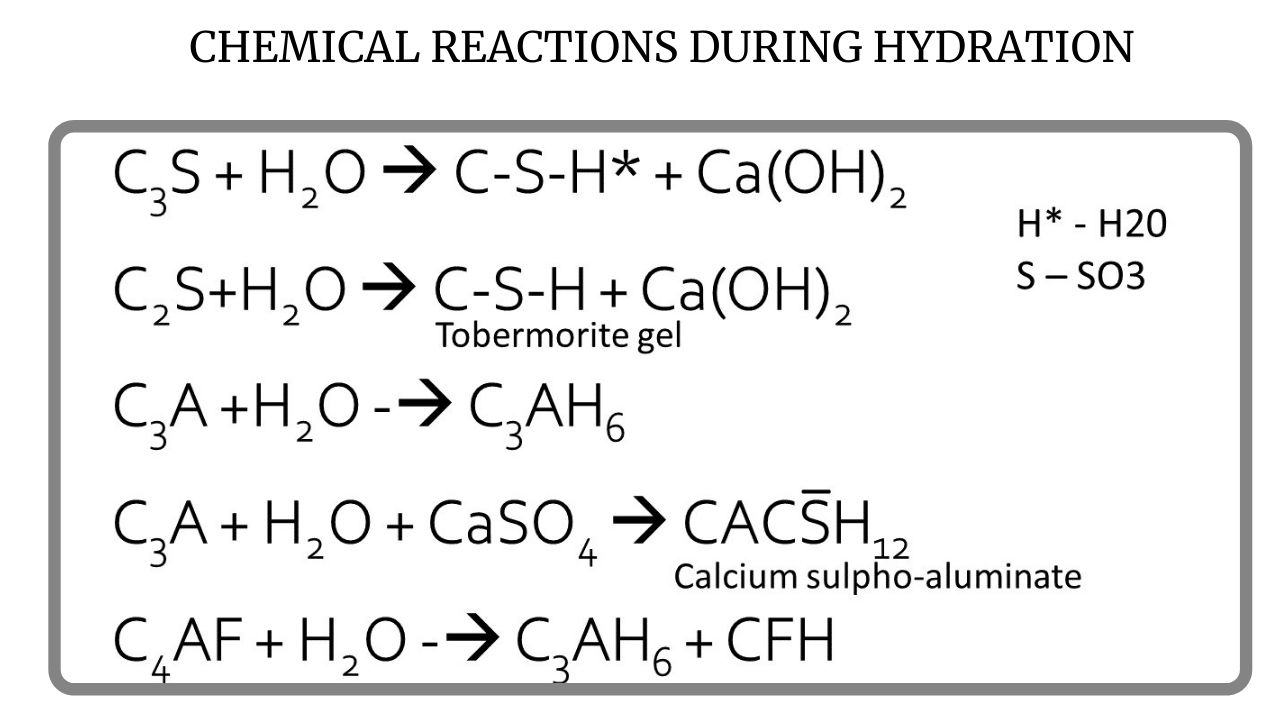
Diagram illustrating chemical reactions during the hydration of cement, showing the formation of various compounds such as C-S-H, Tobermorite gel, and Calcium sulpho-aluminate.
Chemical reactions involved in the hydration process of cement, detailing the formation of key compounds.

Hydration stages of cement

The hydration stages of cement detail the progression of chemical reactions after adding water. This process influences heat release, setting behaviour, and the long-term strength development of concrete.

Initial Reaction

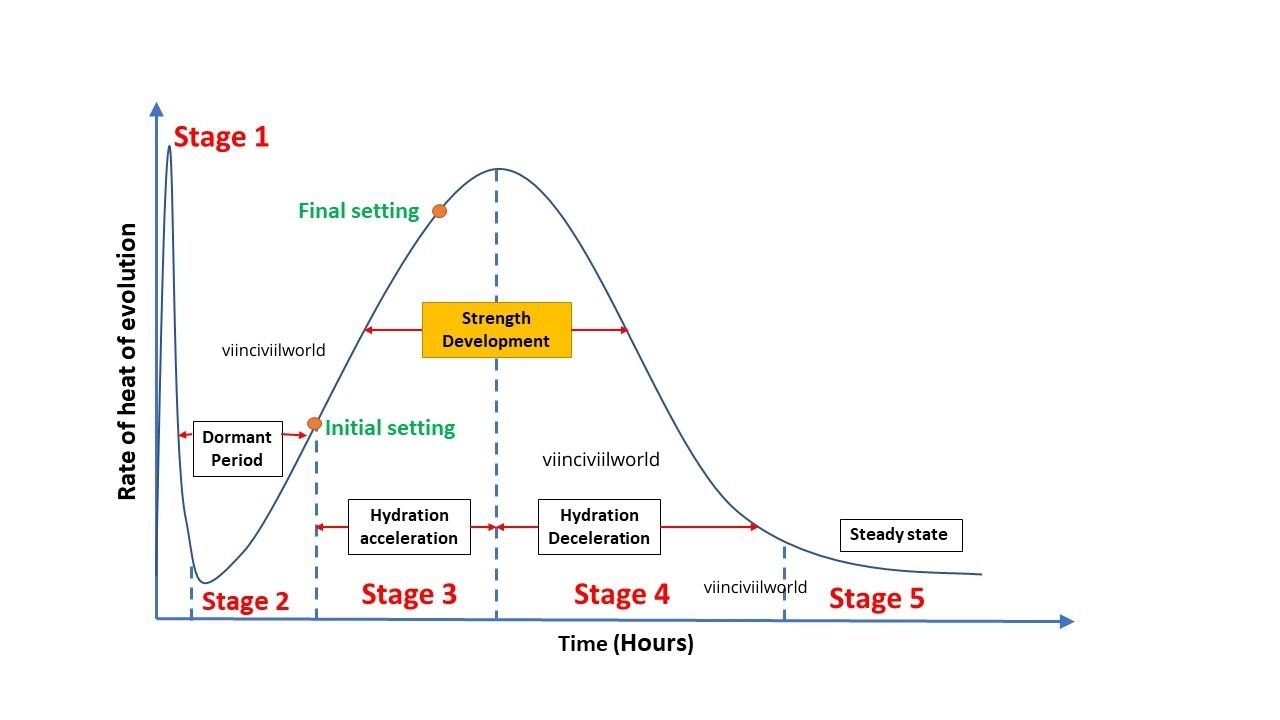
The hydration process begins instantly when water meets cement. During this stage, a rapid chemical reaction occurs on the surface of the cement particles. It is intense and releases a sudden burst of heat. This reaction is short-lived but crucial, as it triggers the formation of early hydration products and initiates the overall setting process.

Graph illustrating the stages of heat evolution during the cement hydration process, including initial reaction, dormant period, acceleration, deceleration, and steady state.
Graph illustrating the stages of heat evolution during the cement hydration process, showcasing initial reaction, dormant period, acceleration, deceleration, and steady-state.

Dormant / Induction Period

After the initial reaction, the hydration activity slows down significantly and enters the dormant or induction period. This phase typically lasts 2 to 5 hours, during which the concrete remains workable and can be transported, placed, and compacted. Although the reaction rate is low, hydration continues slowly around the nuclei of the cement grains.

Acceleration Period

The acceleration stage marks a sharp increase in hydration activity. During this phase, major binding compounds such as Tobermorite gel (C-S-H gel), calcium hydroxide, and other minor products form rapidly. These substances begin depositing around the outer surface of partially hydrated cement grains, contributing to strength development.

Deceleration Stage

As the hydration layer thickens, the reaction rate begins to decrease, marking the deceleration stage. The reduced speed occurs because the growing C-S-H gel creates a barrier that slows further water penetration into the cement particles. Strength continues to develop but at a slower pace.

Steady-State of cement Hydration process

In the final stage, hydration proceeds very slowly over days, months, and even years. The reaction gradually stops once the cement particles are fully hydrated. By this time, Tobermorite gel occupies nearly 50–60% of the volume of the hydrated cement, making it the dominant contributor to long-term strength and durability.

Relevant Codes for measuring Heat of hydration

Indian Standards (IS)

  • IS 11209 – Method for Determining Heat of Hydration of Hydraulic Cement
  • IS 269 – Specification for Ordinary Portland Cement (includes heat categories)

ASTM Standards (USA)

  • ASTM C1702 – Heat of Hydration of Hydraulic Cement (Isothermal Calorimetry)
  • ASTM C1753 – Evaluating Heat of Hydration in Adiabatic Conditions
  • ASTM C150 – Standard Specification for Portland Cement (heat limits)

European Standards (EN)

  • EN 196-9 – Heat of Hydration by Isothermal Conduction Calorimetry
  • EN 197-1 – European Cement Specification (heat classes)

Heat of Hydration test as per IS 11209

The heat of hydration test is conducted at a standard room temperature of 27 degrees celsius. The apparatus for this test is

  1. Calorimeter
  2. Mortar and pestle 
  3. Glass/Plastic vials
  4. Stopwatch or timer
  5. Sieve
  6. Muffle furnace
  7. Weighing balance
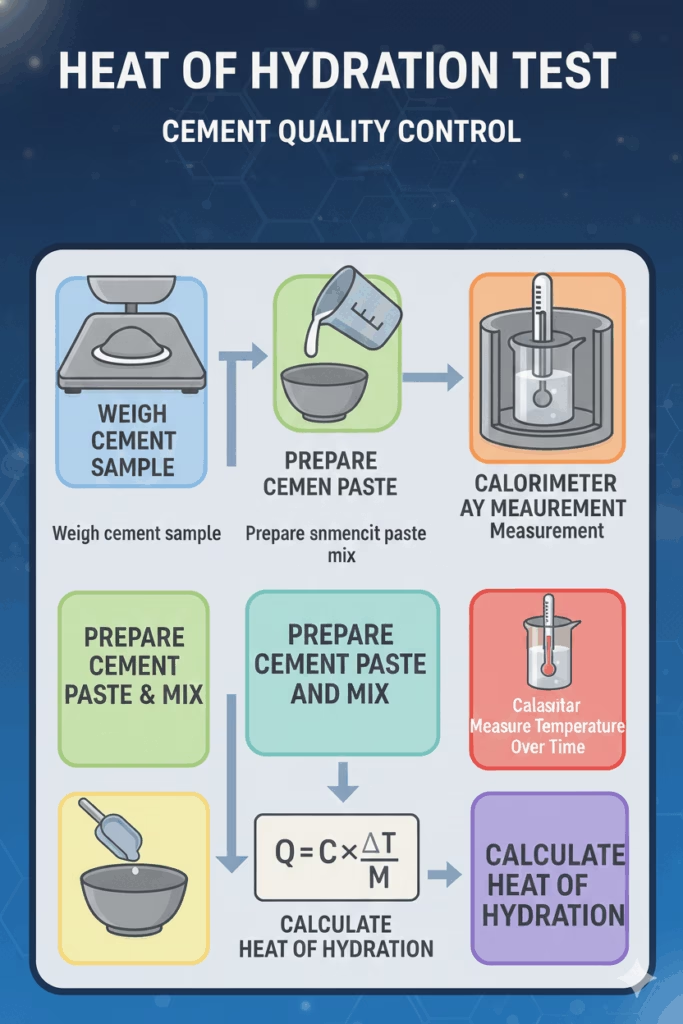
Heat of Hydration test of cement

Heat of hydration test

The calorimeter determines the heat of the paste. Glass vial has a dimension of 80×20 mm. Muffle furnace maintains the temperature. Before performing the test, the calorimeter temperature is to be made uniform. The heat of hydration should be determined at the 7th and 28 days.

Procedure for heat of hydration test

  • To find the heat of hydration, firstly we have to measure the heat released from the unhydrated cement using a calorimeter.
  • Then we have to measure the heat of hydration from hydrated cement
  • For that take 60 grams of cement and add 24 ml of water. 
  • Then fill this mixture in three glasses and seal them with wax to avoid the entry of air. 
  • The standard temperature should be 27 degrees celsius. 
  • Then measure the heat of the solution using a calorimeter. 
Heat of hydration test procedure

Heat of hydration = Heat released from hydrated cement – Heat released from unhydrated cement

For low heat cement, The heat of hydration for 7 days should not be greater than 66 cal/g and for 28 days should not be greater than 75 cal/gm. 

Heat of hydration as per ASTM

ASTM methods measure the Heat of Hydration using precise isothermal calorimetry, providing accurate data on cement’s heat release, hydration behaviour, and performance in concrete.

Apparatus Required

  • Isothermal calorimeter (high-precision)
  • Sample ampoules or containers
  • Precision weighing balance
  • Thermometric sensors
  • Mixing tools
  • Temperature-controlled environment
  • Distilled water
  • Data acquisition system or software

Test Procedure (ASTM C1702)

  1. Weigh the required mass of cement sample accurately.
  2. Place the sample in the calorimeter ampoule.
  3. Add the specified quantity of water.
  4. Seal the ampoule to prevent moisture exchange.
  5. Insert ampoule into the isothermal calorimeter.
  6. Start data logging for heat flow measurement.
  7. Monitor heat release continuously for the required duration.
  8. Save heat-time curve data for interpretation.

Calculation

Total Heat of Hydration (J/g) = Integral of heat-flow curve ÷ Mass of cement
(Software usually calculates the cumulative heat automatically.)

Factors Affecting Heat of Hydration

Controlling the Heat of Hydration on site involves lowering concrete temperature and slowing early reactions. Cooling techniques like chilled water, ice, or cooled aggregates reduce initial heat. Proper material selection, including low-heat cement and mineral admixtures, also helps. Optimized mix design strategies lower cement content. Adjusting construction timing to cooler hours and applying effective curing practices further minimise temperature rise and thermal cracking.

Key Takeaways

  • The Heat of hydration of cement significantly affects concrete temperature, strength, and stability through the Cement hydration process.
  • Cement undergoes five hydration stages, each influencing heat release and strength development in concrete.
  • Field tests provide quick assessments of cement quality, while laboratory tests offer detailed evaluations of its properties.
  • Controlling the heat of hydration involves cooling techniques, proper material selection, and optimised mix design strategies.
  • The heat of hydration test is crucial for assessing cement’s performance and ensuring long-lasting, reliable structures.

Conclusion

Understanding the Heat of Hydration of Cement is essential for ensuring concrete quality, durability, and temperature control in construction. By analysing the Cement Hydration Process and the key Hydration Stages of Cement, engineers can accurately predict heat generation and early-age behaviour. This knowledge also helps identify the major Factors Affecting Heat of Hydration, enabling better decisions in material selection, mix design, and site practices. In mass concrete works, choosing suitable Low Heat Cement Applications prevents thermal cracking and enhances long-term performance. Ultimately, proper evaluation of hydration heat supports safer, stronger, and more reliable structures, making it a critical aspect of modern concrete engineering and quality control.

Soundness test on Aggregate | Sample selection and procedure


Soundness test of aggregates is a crucial evaluation that determines an aggregate’s ability to withstand weathering effects. These weathering effects include wetting, drying, freezing, and thawing. This test is vital in assessing the durability and longevity of aggregates used in construction. Soundness test determines the disintegration of aggregates due to weathering. This includes freezing, thawing, marine condition etc. Yet, the weak and porous aggregate shows a change in weight during this soundness test.

Understanding the soundness of aggregate test is essential for ensuring the performance and reliability of materials in various infrastructure projects.Aggregates are the significant factor that contributes adequate strength to concrete. Hence, it is important to obtain the right quality aggregate for construction. This article examines both IS 2386 Part 5 and ASTM methods. It aims to highlight why maintaining aggregate quality is important in construction applications.

We will explore the soundness test on aggregate in this article. We will focus on the methodologies outlined in IS 2386 Part 5 and American Society for Testing and Materials (ASTM) standards.

  1. Tests on Aggregate
  2. Purpose of soundness test for aggregate
    1. Durability Assessment
    2. Expansion and Contraction
    3. Preventing Structure Failure
    4. Construction Material Selection
  3. Soundness test for aggregates (IS-2386-PART-5)- Testing method
  4. Relevant IS code
  5. Sample selection for fine and coarse aggregates
  6. Apparatus for Soundness test
  7. Reagents used
  8. Test procedure of soundness test
  9. Soundness test on Aggregate as per ASTM C88
    1. Key Takeaways
    2. Conclusion

Tests on Aggregate

For ensuring the quality of aggregates the following tests are conducted.

This article is about the soundness test on aggregate. We will focus on the methodologies in IS 2386 Part 5. We will also follow relevant American Society for Testing and Materials (ASTM) standards.

Purpose of soundness test for aggregate

This section explores the importance of the soundness test on aggregate.

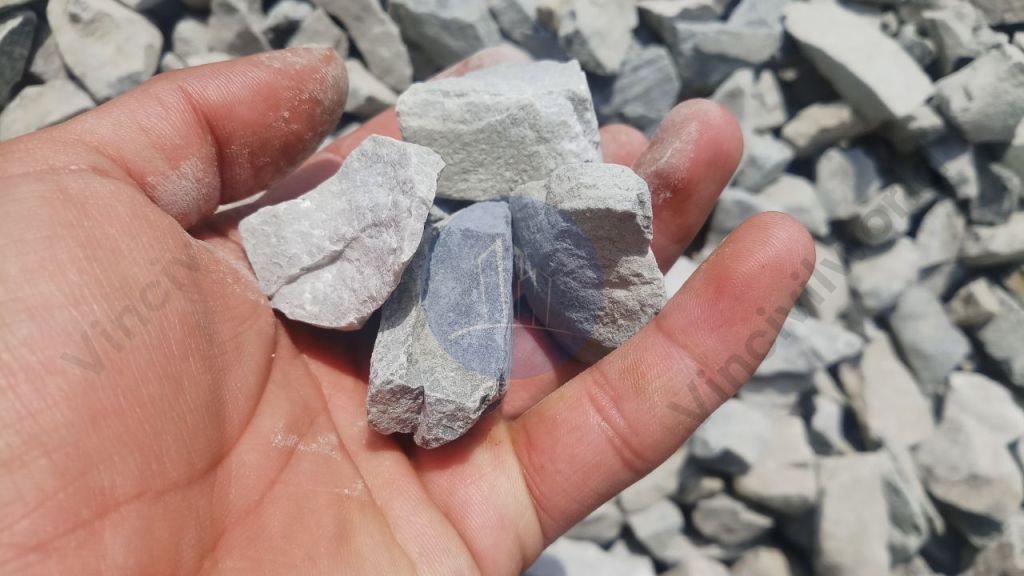
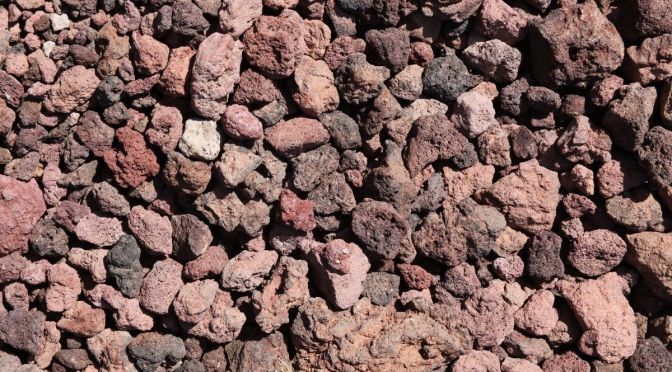
A hand holding several pieces of aggregate, showing different shapes and sizes, against a background of loose aggregates.
A hand holding various aggregates used for soundness testing in construction.

Durability Assessment

The soundness test on aggregate evaluates its resistance to deterioration due to freezing and thawing cycles. It also assesses its resistance to repeated wetting and drying. This test ensures the aggregate’s longevity in construction applications.

Expansion and Contraction

Moisture absorption and freezing lead to expansion and contraction of aggregates. This can weaken structures, emphasizing the need for the aggregate soundness test to identify potential vulnerabilities.

Preventing Structure Failure

The soundness of aggregate test is essential for confirming that aggregates can withstand environmental stresses. This capability prevents structural failure. It ensures long-term stability and durability in construction projects.

Construction Material Selection

Results from the IS 2386 Part 5 soundness test guide engineers and contractors. They help in choosing appropriate aggregates for specific construction applications. This promotes effective material selection and enhances overall project quality.

Soundness test for aggregates (IS-2386-PART-5)- Testing method

In the soundness test on aggregate, samples are immersed in sodium sulfate or magnesium sulfate solutions multiple times. Salt deposits form within the aggregate’s pores due to this repetitive process. These deposits cause internal pressure that can weaken and break the aggregates. After a specified number of cycles of dipping and drying, workers sieve the aggregates. This process assesses the percentage of material loss. This procedure, outlined in IS 2386 Part 5, is crucial for conducting a successful aggregate soundness test. It ensures the durability and longevity of aggregates in construction applications.

Soundness test of aggregate
A laboratory setting where a person in a lab coat and blue gloves is conducting a soundness test on aggregates, using measuring equipment and samples.
A laboratory technician preparing samples for the soundness test of aggregates, ensuring quality control in construction materials.

Relevant IS code

  • IS: 2386 Part V
  • ASTM C88

Sample selection for fine and coarse aggregates

  • The fine aggregate passing through the 10 mm IS sieve should be held as a sample for this test.
  • Then sieve the sample again through 10mm, 4.75 mm, 2.36 mm, 1.18 mm, 600 microns, 300 microns.
  • However, the sample should be decided in such a way that, it will not yield below 100g of given sizes. 
  • For coarse aggregate, sample remove aggregates finer than 4.75 mm. 
  • Then dry the sample and again sieve through 80mm, 63mm, 40mm, 20mm, 10mm IS sieves.
  • Choose the sample in such a way that, it will not yield below the given amount for the given sizes.
  • Weigh the samples separately and store them in different containers.

Apparatus for Soundness test

  • IS Sieves (80 mm, 63 mm, 40 mm, 31.5 mm, 25 mm, 20 mm, 16 mm, 12.5 mm, 10 mm, 8.0 mm, 4.75 mm, 4.0 mm, 2.36 mm, 1.18 mm, 600 micron, 300 micron, 150 micron)
  • Container
  • Weighing machine
  • Drying oven (105 to 110 degree)
Laboratory setup with metal sieves arranged on a table, showcasing equipment used for the soundness test of aggregates.
Apparatus used for conducting the soundness test on aggregates, crucial for assessing their durability in construction.

Reagents used

  • Sodium sulphate solution
  • Magnesium sulphate solution

Test procedure of soundness test

  • After the selection of aggregate samples, wash them thoroughly on a 300 micron IS sieve.
  • Then dry them at 105 to 110-degree celsius in drying oven.
  • After that immerse the sample in a solution of sodium sulphate or magnesium sulphate for 16 to 18 hours. 
  • Cover the container for reducing evaporation and accidental addition of extraneous substances. 
  • The temperature of the solution should be 27 degree Celsius. 
  • After 18 hours, take out the sample and dry them at 105 to 110-degree celsius. 
  • Allow them to cool to room temperature and repeat this process.
  • After the final cycle, wash the sample and dry them again at 105 to 100-degree celsius.
  • Weigh them and sieve them through the same sieve we used before the test.
  • The percentage of finer sieve after the test and before the test is determined.
  • The percentage loss of weight indicates the soundness of aggregate.

Soundness test on Aggregate as per ASTM C88

The soundness test on aggregate using ASTM C88 assesses how well aggregates resist weathering. It subjects them to alternate cycles of immersion in a sulfate solution and drying. This test simulates natural conditions where aggregates are exposed to wetting, drying, freezing, and thawing, helping determine their durability. The procedure involves immersing aggregate samples in either sodium sulfate or magnesium sulfate solutions for 16 to 18 hours. After soaking, the aggregates are dried at 105°C to 110°C, then cooled to room temperature. This cycle is repeated a set number of times, typically five, to simulate environmental conditions.

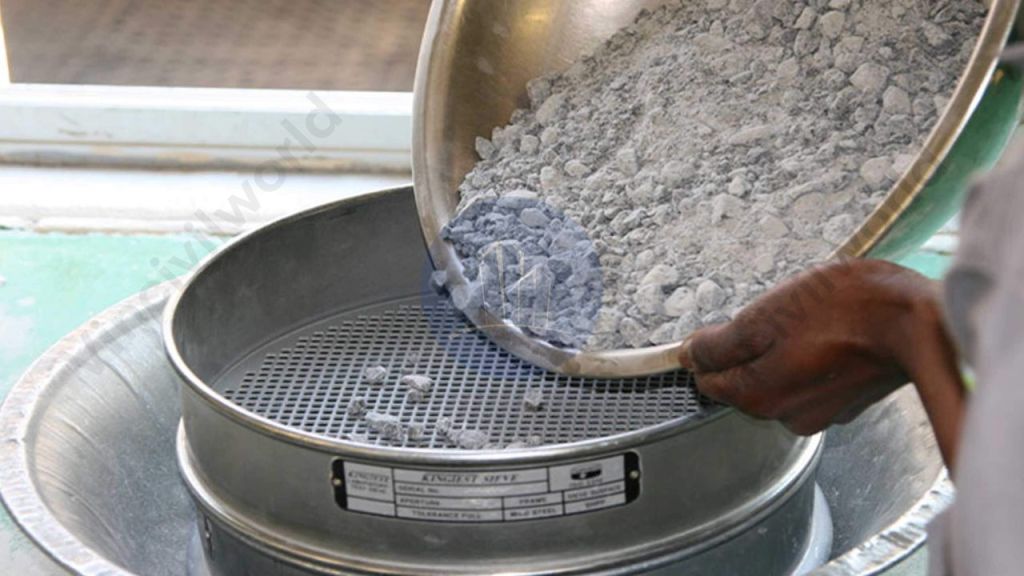
A person pouring aggregate material into a sieve for testing, illustrating the soundness test process for assessing the quality of aggregates used in construction.
Sifting aggregate samples during the soundness test, a crucial step for assessing durability and resistance to weathering effects.

After the cycles, the samples are sieved, and the percentage loss in mass is calculated to assess the aggregate’s soundness. The higher the loss in mass, the less durable the aggregate. The aggregate soundness test per ASTM C88 helps engineers select durable aggregates. These aggregates are reliable for use in construction projects under harsh environmental conditions.

Key Takeaways

  1. Soundness test on aggregate evaluates the durability of aggregates. It assesses their resistance to weathering effects like wetting, drying, freezing, and thawing.
  2. IS 2386 Part 5 outlines the standard procedure for performing this test, ensuring accuracy and consistency.
  3. Aggregate soundness test involves repeated cycles of soaking in sodium or magnesium sulfate solutions. These cycles assess the percentage of material loss.
  4. Fine and coarse aggregate samples are sieved, immersed, and dried under controlled conditions. These steps help determine the soundness of aggregate test results.
  5. The test ensures proper material selection, preventing structural failure due to environmental stress.

Conclusion

The soundness test on aggregate is essential. It evaluates an aggregate’s ability to withstand weathering effects. This test also helps maintain an aggregate’s structural integrity. This test is defined in IS 2386 Part 5 and ASTM C88 standards. It involves submerging aggregate samples in sodium sulfate or magnesium sulfate solutions. These solutions simulate real-world conditions such as freezing, thawing, and drying. The test identifies aggregates that may deteriorate by measuring the percentage loss of material. This is done after a specified number of cycles. Soundness testing is vital. It ensures only durable aggregates are used in construction projects. This enhances the longevity and reliability of infrastructure.

Soundness test on Cement – Procedure and Calculation

The soundness of the cement is the ability to resist volume changes after hardening. The soundness test on cement is significant because,using unsound cement leads to cracks and hamper the structural quality. A sound cement is one of the key materials used in construction. Therefore it is essential to determine its quality before using it in construction. 

Ensuring the quality of cement is essential for the strength and durability of construction projects. The soundness test of cement checks if the cement will maintain its volume after setting, preventing it from expanding and cracking. This test finds any excess lime or magnesia that could cause issues.

In this blog, we will dive deep into the soundness test of cement, covering its procedure, calculation, and importance in making sure construction materials are reliable. You will learn all about the Soundness Test for Cement and why it’s essential for ensuring cement quality. We’ll cover the cement soundness test ways, the step-by-step procedure, and how to interpret the results. By understanding the soundness of cement test, you’ll gain insights into how it impacts construction durability. Whether you’re a professional or a learner, this guide will simplify the soundness test of cement for you.

  1. Types of Tests on Cement
  2. Field tests on Cement
  3. Laboratory tests for Cement
  4. What is Soundness test of cement ?
  5. Why is the Soundness of Cement Test Necessary?
  6. Relevant IS code for soundness test of cement
  7. Standard Methods for Soundness Test for cement
  8. Procedure for Soundness Test of Cement
    1. Apparatus required for Le chatelier’s Method
    2. Procedure for soundness test on Cement
    3. Calculation
  9. Interpreting the Results of the Soundness Test for Cement
    1. What Do the Results of the Soundness of Cement Test Indicate
    2. Acceptable Limits and Standards for Cement Soundness
  10. Importance of Soundness Test in Quality Control
  11. Key Takeaways
  12. Conclusion

Types of Tests on Cement

Cement is one of the oldest and most used binding materials and an integral ingredient used in the construction sector. The quality, serviceability, and stability of a structure are directly related to the quality of cement used in it. Hence it is necessary to analyse the quality of cement before using it for works. The tests for determining cement quality are split into two major categories.

Field tests on Cement

The quality of cement is determined using some simple field tests. These tests do not require any sophisticated types of equipment and professional skills and get the results very quickly. By conducting these simple tests and analyzing the results we will get an idea about the cement quality and can at once decide on accepting or rejecting it.

Following are the common field tests conducted to ensure the quality of cement

These are first look tests and the quality of cement is ensured by its smoothness to touch, the colour of cement, etc.

  • Checking manufacturing date
  • Visual checking of lumps
  • Feel test
  • Heat of cement
  • colour
  • Water float test
  • Setting test

These basic tests give an approximate characteristic of cement. These are easy and quick but not accurate, however help in concluding the acceptance of cement for works.

Laboratory tests for Cement

The laboratory tests defines the physical and chemical properties of cement. It is not possible to check all the cement properties at the site. The main laboratory tests conducted on cement is as follows.

Infographic illustrating various laboratory tests for cement, including Fineness Test, Compressive Strength Test, Consistency Test, Setting Mold, Vicat Test, Soundness Test, and Tensile Strength Test, with labeled apparatus and descriptions.
Illustration of laboratory tests for cement, highlighting key methods such as soundness, compressive strength, and consistency tests essential for ensuring cement quality.

Lab tests require time. But it provides accurate results. In this article, we are going to describe the Soundness test on cement.

What is Soundness test of cement ?

The soundness of the cement is the ability to resist volume changes after hardening. The Soundness Test for Cement evaluates how well cement maintains its volume over time, ensuring it does not expand or shrink excessively after setting. The cement soundness test is significant because usage of unsound cement leads to cracks and hamper the structural quality.

The chemical composition of cement consists of lime. About 60 to 70% of cement is lime. The main function of lime is to help cement in the setting process. A good quality cement do not change its volume after hardening.

Following are the reasons for the unsoundness of cement.

  • If the cement has an excess amount of lime, expansion or contraction in volume occurs after setting.
  • Another reason for unsoundness is the inadequate burning of cement. This leads to cracks, disintegration and a decrease in durability.
  • Improper grinding and mixing of raw materials during the manufacturing process of cement.
  • Due to the high proportion of magnesium content or sulphate content.

Therefore Soundness test is performed to determine whether the cement shows volume changes or not.

Why is the Soundness of Cement Test Necessary?

The Soundness Test for Cement evaluates how well cement maintains its volume over time, ensuring it does not expand or shrink excessively after setting. By performing the soundness of cement test, we can identify any potential issues that might lead to deformation or cracking. The soundness test of cement helps prevent problems in the final structure, ensuring long-term quality and performance. Conducting this test allows engineers to ensure that the cement used meets the necessary standards and maintains its integrity throughout its service life, contributing to overall construction reliability.

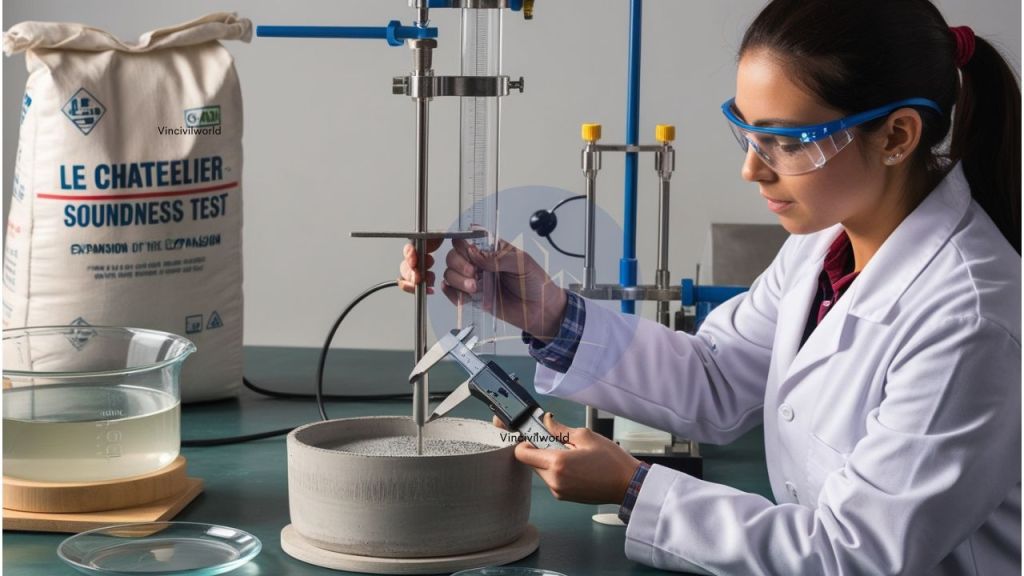
A laboratory technician conducts a soundness test on cement using the Le Chatelier apparatus, with a focus on measuring expansion. In the background, a bag labeled 'LE CHATELIER SOUNDNESS TEST' and various lab equipment are visible.
Conducting the Soundness Test for Cement using the Le Chatelier method to evaluate cement’s stability and volume consistency.

Relevant IS code for soundness test of cement

  • IS 4031 (Part 3)-1988
  • ASTM C 151-09
  • BS EN 196-3: 2005

Standard Methods for Soundness Test for cement

Standard methods for the Soundness Test for Cement include the Le Chatelier Method and the Autoclave Test. The Le Chatelier Method measures expansion using a special apparatus with a cement sample and a reference gauge. The Autoclave Test involves curing the cement in a high-pressure steam environment to evaluate its expansion. Both methods help determine if the cement meets required standards for stability and durability. In this article we will emphasis on Le Chatelier Method for Soundness test for cement

Procedure for Soundness Test of Cement

To perform the Soundness Test of Cement, mix cement with water to create a paste and mold it into a specific shape. Using the Le Chatelier Method, measure the expansion of the molded sample with the Le Chatelier apparatus. This method evaluates the cement’s stability by checking for excessive expansion. Accurate measurement ensures that the cement maintains its integrity and does not cause structural issues.

Apparatus required for Le chatelier’s Method

Soundness of cement is calculated by using Le-chatelier’s apparatus.

  • Le-Chatelier mould
  • Balance
  • Water bath
  • Vernier Calliper
  • Pan and trowel

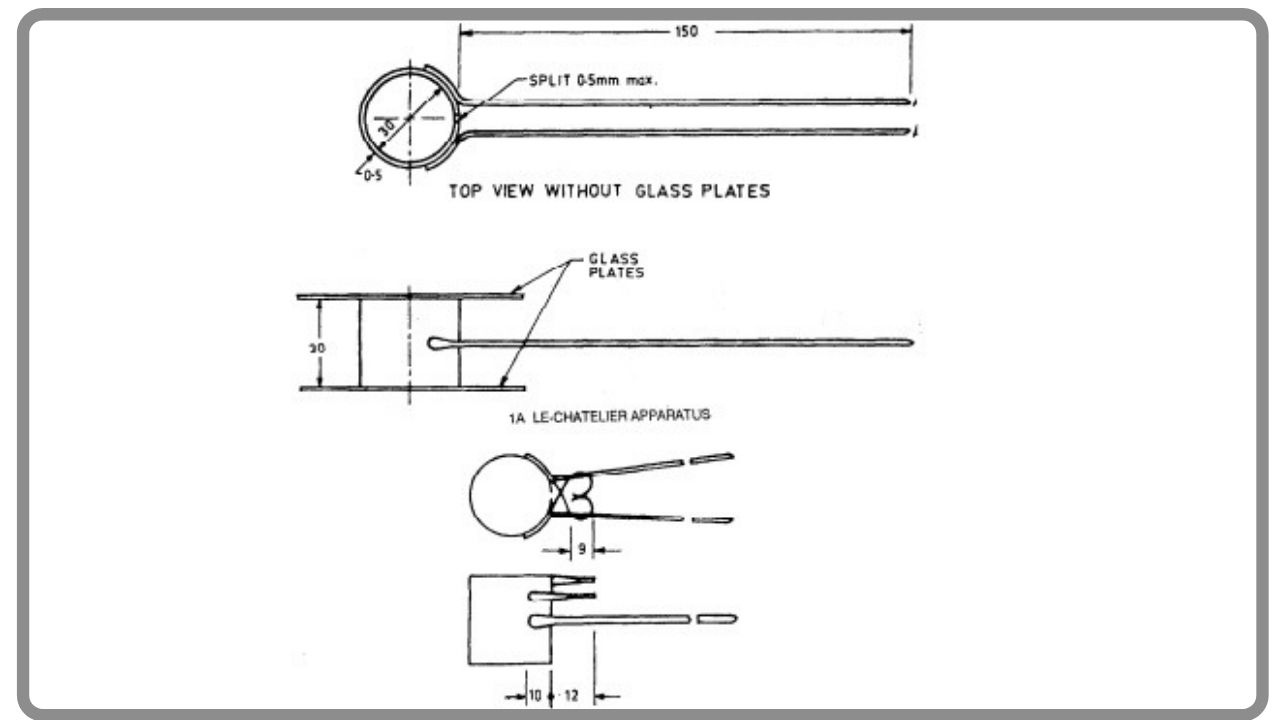
Le-chatelier mould is made using brass. It consists of a spring-tensioned split cylinder and an indicating long arm in its either side. The internal diameter and height of the cylinder are 30mm and 30mm. The size of glass plates is 50mm x 50 mm. For each test, we need three such moulds. The test should be performed at a temperature of 27 ± 2°C and relative humidity of 50 to 80 per cent as per IS code.

Diagram illustrating the Le Chatelier apparatus used for soundness testing of cement, showing dimensions and components such as split cylinder and glass plates.
Diagram illustrating the Le Chatelier apparatus used for the soundness test of cement.

Procedure for soundness test on Cement

Before Performing the test, calculate the standard consistency of cement to find out the water required to obtain the normal consistency(P).

  • Take about 100 gm of cement and add 0.78-times the water needed to make cement paste with normal consistency.
  • Then grease the glass plate and the Le-chatelier mould to avoid the sticking of cement on its surface.
  •  Fill the cement paste and strike out the excess cement using a trowel.
  • Cover the mould with another glass plate and place a weight above the glass plate.
  • Then immerse the whole assembly inside the water bath for 24 hours. 
  • After 24 hours, take out the mould from water and measure the distance between the indicators.
  • Note this measurement as L1. After that place, the assembly in the water bath 
  • Boil the water for 25 to 30 minutes and leave them for 3 hours.
  • After that, allow them to cool till it reaches the room temperature.
  • Now take out the assembly and measure the distance between the indicators and mark them as L2. 

Calculation

Volume expansion of cement = L1 – L2

L1 is the distance between the indicators after immersing in water for 24 hours

L2 is the distance between the indicators after immersing in water at boiling temperature for 3 hours

This value differs for different types of cement. The expansion of volume for Ordinary portland cement, portland pozzolanic cement, low heat cement and rapid hardening cement should not exceed 10mm. For high alumina cement, super sulphate cement, the volume expansion should not exceed 5mm. Because it contains excess lime or magnesium which is not suitable for construction.

Interpreting the Results of the Soundness Test for Cement

Interpreting results from the Soundness Test for Cement involves assessing whether the cement maintains its volume. The test results indicate if the cement will remain stable and avoid excessive expansion.

What Do the Results of the Soundness of Cement Test Indicate

The results of the soundness of cement test show whether the cement expands or contracts after setting. If expansion is within acceptable limits, the cement will remain stable and prevent structural issues.

Acceptable Limits and Standards for Cement Soundness

Cement soundness test results must meet specific standards, such as those outlined in ASTM C150. Typically, acceptable limits are defined to ensure that expansion remains minimal, ensuring cement’s long-term stability and performance.

Importance of Soundness Test in Quality Control

The Soundness Test for Cement is crucial in the cement industry for maintaining quality control. It ensures that cement will not expand excessively after setting, preventing structural issues such as cracks. By assessing the soundness of cement, manufacturers can guarantee that their products meet industry standards and provide long-lasting stability. This test directly affects construction quality, as stable cement ensures reliable and durable structures.

Key Takeaways

  • The Soundness Test for Cement evaluates the cement’s ability to maintain volume post-hardening.
  • Le Chatelier Method is a common method used for this test, assessing expansion.
  • Unsound cement can lead to structural issues such as cracks.
  • The test helps identify excess lime, magnesia, or improper manufacturing that may cause expansion.
  • ASTM C150 and IS 4031 set standards for acceptable limits in cement soundness.
  • Accurate results are crucial for ensuring cement’s stability and long-term durability in construction.

Conclusion

The Soundness Test for Cement is vital for ensuring the quality and reliability of cement used in construction. By measuring the cement’s ability to resist volume changes, this test helps prevent potential issues like cracks and structural failure. The Le Chatelier Method provides a reliable way to evaluate cement stability, ensuring that it meets industry standards. Conducting this test is essential for achieving durable and high-quality construction, making it a key part of quality control in the cement industry.

Tests on bitumen – 9 lab tests for flexible pavements.

Tests on bitumen are essential for ensuring the quality and durability of flexible pavements and other civil engineering structures. Bitumen is a viscous, binding material used in construction. Various lab tests confirm its properties. This article delves into the comprehensive set of tests on bitumen that civil engineers and researchers perform to ensure the material’s suitability. We will explore key assessments. These include the softening point test, the penetration test, the ductility test, and the viscosity test on bitumen, among others. Understanding these bitumen tests is crucial for guaranteeing high-quality construction and prolonging the life of road surfaces.

Bitumen is a binding material extensively used in the construction of flexible pavements, damp-proofing of the basement, floors, waterproofing of roofs, corrosion protection of reinforcement structures, etc. The bitumen is viscous black or brown mixture of hydrocarbons obtained as a byproduct on refining crude petroleum.Bitumen is responsible for imparting quality and durability for flexible pavements and is necessary to confirm its quality before applications. This article is about the various lab tests and procedures performed on bitumen for ensuring the quality.

Properties of bitumen

The properties of bitumen are fundamental to its use in construction, determining its quality and performance. To ensure a durable material, these characteristics are confirmed through rigorous testing.

Construction workers paving a road using heavy machinery during sunset.
Workers are laying asphalt for a road construction project. This work highlights the practical application of bitumen in civil engineering.

Key Properties of Bitumen

  • Consistency: Bitumen must maintain its physical state across a wide temperature range. It should stay firm in heat. It should also avoid brittleness in cold.
  • Viscosity: Its resistance to flow is crucial for proper mixing with aggregates and effective compaction during the paving process.
  • Adhesiveness: The material must possess strong binding properties. It should create a lasting bond with aggregates. This ensures the structural integrity of the pavement.
  • Durability: Bitumen should be resistant to aging and weathering to retain its properties and prolong the lifespan of the finished structure.

Tests on bitumen

To ensure the quality and durability of bitumen for construction, technicians perform a series of standardized laboratory tests on bitumen. These tests evaluate its key properties and characteristics.

  • Softening point test
  • Flash and fire point test
  • Solubility test
  • Viscosity test
  • Distillation test
  • Water content test
  • Ductility test
  • Penetration test
  • Specific gravity test

Softening Point Test on bitumen

Softening point test indicates the point at which bitumen attains a particular degree of softening under standard test conditions. The test helps in determining the consistency of bitumen and done using ring and ball test apparatus.

Ring and ball test apparatus include a brass ring, steel ball, water bath, and thermometer as shown in the figure.

Apparatus for conducting the softening point test on bitumen, featuring a temperature-controlled water bath and brass ring setup.
Viscometer apparatus used for conducting viscosity tests on bitumen, assessing its resistance to flow.

Test procedure

  • Firstly, heat the sample at a temperature of around 75 to 100-degree wherein the bitumen transforms to a liquid state.
  • The brass ring is heated before placing inside the mercury-coated metal plate. Glycerine is applied over the ring to prevent sticking.
  • Then fill the brass ring with molten bitumen and cool it for 30 minutes. Trim the excess material using a knife.
  • After filling assemble the apparatus and place the balls over the top of the specimen sample.
  • Then fill the apparatus with boiled distilled water. However, the height of filling should be 50mm above the topmost surface of the ring.
  • After that heat the water bath at a rate of 5-degree Celsius per minute.
  • On heating, the bitumen softens and the ball slowly sinks and touches the bottom plate.
  • Finally, note down the temperature at which the specimen touches the lower plate and this temperature is the softening point of the bitumen specimen.

Normally the softening temperature varies from 35 degrees to 70 degree Celsius. 

Flash and fire point test

Flash-point test refers to the temperature at which the specimen becomes volatile and catches fire under test conditions. The apparatus for the flash and fire point test is Pensky – Morten’s closed cup apparatus.

Cleveland open cup flash point tester used for measuring the flash point of bitumen in laboratory tests.
Cleveland Open Cup Flash Point Tester used for determining the flash and fire points of bitumen.

Procedure

  • Initially , fill the bitumen sample up to the filling mark and close the apparatus.
  • Then, fix the thermometer in a proper position as shown in the figure.
  • Heat the specimen at a rate of 5-degree Celsius per minute.
  • Then, constantly keep stirring the specimen and apply the test flames at regular intervals.
  • The temperature at which the flame produces a light flash inside the cup is the flash point.
  • On further heating, the bitumen specimen inflames and catches fire and this temperature is the fire point.
A laboratory setup showing fire erupting from a Pensky-Marten closed cup apparatus used for the flash and fire point test on bitumen.
Illustration of the flash and fire point test being conducted on bitumen, showcasing the moment it ignites under test conditions.

Solubility Test

The solubility test determines the purity of bitumen. Lot of impurities like carbon, salts, etc gets entrapped in bitumen and hamper the quality . Hence this test is necessary for calculating the impurity percentage.

Laboratory setup for conducting bitumen tests, featuring a filter flask, stopper, filter tube, and rubber tubing.
Apparatus for the solubility test of bitumen, featuring essential components like rubber tubing, filter tube, stopper, and filter flasks.
  • Firstly, dissolve the sample in carbon disulfide.
  • Then filter the solution using a porosity filter.
  • Finally, calculate the percentage of impurity from the residue left.

Penetration test on bitumen

The penetration test measures the hardness or softness of the bitumen. A penetrometer is an apparatus used for computing penetration tests which consist of a needle that weighs 100 gms. Similarly, penetration readings are measured in terms of mm/10.

Procedure

  • Firstly, heat the specimen into pouring consistency and immerse the specimen in the water bath. However, make sure the temperature is around 25-degree Celsius.
  • After half an hour, take-out the specimen and place it below the apparatus.
  • Meanwhile, adjust and set the dial to zero reading and allow the needle to fall on the specimen.
  • Immediately, measure the penetration depth.
  • Then repeat this process a minimum of three times and note down the values. The average values

The penetration value ranges from 20 to 225. Low penetration values represent good quality bitumen.

Viscosity test on bitumen

The viscosity of bitumen is the measure of the resistance of the fluid to flow. The unit of viscosity is seconds. Too High or low viscosity impacts the compaction, penetration, lubrication, and coating capacity over aggregates. A viscometer apparatus is for finding the viscosity.

A laboratory apparatus for conducting viscosity tests on bitumen, featuring a large, cylindrical container with a heating element and a control unit beside it.
Viscometer used for measuring the viscosity of bitumen in laboratory tests.

Procedure

  • Prepare the specimen under standard temperature. 
  • Further, Level the cup with the help of the bubble level.
  • Then heat the water bath at a constant temperature.
  • Next, clean the receiver and pour the specimen up to 20ml.
  • Allow the bitumen to pass through the orifice. Open the valve.
  • Start the stopwatch and note down the time at which it reaches 25ml.
  • Then repeat the test three times and calculate the mean value of viscosity.

Distillation test or loss of heating test

The distillation test determines the quantity and nature of volatile elements in bitumen. Through this test, volatile and non-volatile components are separated.

A laboratory technician in a white coat conducting an experiment with a bitumen testing apparatus on a lab bench.
A technician conducting the distillation test on bitumen in a laboratory, essential for analyzing its quality and properties.
  • Initially, take 200 grams of bitumen and Note down the weight of the sample.
  • Next, continuously heat the sample at 360-degree Celsius for 15 minutes.
  • After that, carefully distil the sample in a 500ml distillation flask.
  • Measure the residue left. This is the actual quantity of bitumen.

Water content test on bitumen

In a good quality bitumen, the water content should be minimum. Because excess water content produces foam when heated above the melting point.

  • Initially,the bitumen sample is weighed using a weighing machine.
  • Next step is to immerse the sample in pure petroleum which is free from water.
  • After immersing, immediately start heating the specimen and distill the water.
  • Then condense the distillate and collect the condensed water at the bottom.
  • Record the weight of residue
A blue laboratory apparatus used for conducting distillation tests, featuring a heating element and glassware for measuring and separating volatile elements in bitumen.
Apparatus for the water content test on bitumen, used to determine the amount of water in the sample to ensure quality in construction.

The water content is the weight of condensed water to the weight of the sample. However, for good quality bitumen water content should not exceed 0.2 percent by weight.

Ductility test on bitumen

The ductility is the ability to undergo deformation or elongation under load. Ductility is measured as the distance in centimeters to which a standard specimen of bitumen will elongate without breaking. The ductility value ranges from 5 to 100 cm. However, the minimum ductility value should be 73 mm as per BIS.

Diagram illustrating the ductility test on bitumen, showing the initial stage, end stage, and rupture point of the material.
Illustration of the ductility test on bitumen, showing the initial and end stages of the specimen’s elongation.
  • Initially, heat the specimen into pouring consistency.
  • Then, allow them to cool for 30 minutes and remove the excess specimen using a knife.
  • After that, take the sample specimen in the form of a standard briquette.
  • Continue to keep the specimen assembly in a water bath for 90 minutes, however maintaining the temperature to 27- degrees Celsius.
  • After hooking the clips in the ductility machine, start applying the load and allow them to stretch.
  • Finally, record the reading on the scale at which the bitumen breaks.

Specific gravity test on bitumen

Specific gravity is the ratio of the weight/mass of the bitumen specimen with equal mass of water at 27-degree Celsius. Normally the specific gravity of bitumen ranges between 0.97 to 1.02. The apparatus to determine specific gravity is a pycnometer.

The formula for specific gravity is 

Specific gravity = (W3-W1)/[(W3-W1)-(W4-W3)]

Where, W1 – Weight of empty pycnometer

W2 – Weight of pycnometer with distilled water

W3 – Weight of pycnometer with half-filled bitumen

W4 – Weight of pycnometer with half-filled bitumen and distilled water

Illustration depicting the specific gravity computation of bituminous material, featuring three flasks labeled A, B, and C, with a formula for calculating specific gravity.
Illustration of specific gravity computation for bituminous materials, detailing the relationships among three distinct samples.

The test procedure is as follows.

  • Firstly, clean and dry the pycnometer. Make sure it contains no water.
  • Then weigh the empty pycnometer and mark it as W1.
  • Then ,empty the apparatus and again fill it with fresh distilled water.
  • Similarly, weigh the pycnometer and record it as W2.
  • Again empty and fill half of the apparatus with melted bitumen. Avoid the inclusion of air in the sample.
  • Then allow the sample bottle to stand for 30 minutes. Similarly weigh the sample and mark it as W3.
  • Now fill the rest with distilled water. Again, weigh the specimen. This is W4.
  • Finally, determine the specific gravity using the formula.

Key Takeaways from Bitumen Tests

  • Quality Control is Key: Standardized laboratory tests on bitumen are essential for quality control in civil engineering. They ensure that the material used in flexible pavements and other structures meets specific performance criteria, which is critical for long-term durability.
  • Properties and Performance: Tests directly evaluate key properties of bitumen. These include its consistency, like softening point and penetration. They also assess resistance to flow, such as viscosity, and check purity, like solubility. These characteristics dictate how bitumen will behave during mixing, paving, and over its service life.
  • Critical Assessments: Each test provides a unique insight. The softening point determines temperature stability, while the penetration test measures its hardness. The ductility test assesses its ability to stretch without breaking. This is a vital property for resisting cracking. The solubility test ensures it’s free from harmful impurities.
  • Safety and Suitability: Tests like the flash and fire point are crucial for safety during handling and processing. The specific gravity test is used to accurately classify the bitumen. It also determines its correct proportion in asphalt mixes. Together, these tests guarantee the material’s suitability for construction.

Conclusion

The comprehensive suite of tests on bitumen is a fundamental practice in civil engineering. It serves as the backbone for ensuring the quality and durability of flexible pavements. It also supports other essential structures. Each assessment—from the softening point and penetration tests that characterize its physical state to the ductility and viscosity tests that measure its performance under stress—provides critical data points. This rigorous laboratory testing regimen is not merely about meeting standards. It guarantees that bitumen can withstand environmental extremes. It ensures bitumen can handle heavy traffic loads and the inevitable effects of aging. By confirming the material’s consistency, adhesiveness, and purity before it is ever used in a project, civil engineers can significantly prolong the lifespan of road surfaces and infrastructural assets, thereby building safer and more sustainable public works. Ultimately, these tests are indispensable for effective quality assurance in modern construction.