Category Archives: civil engineering

PCC Concrete – Plain Cement Concrete – PCC in Construction

PCC concrete of Plain Cement Concrete (PCC) is without reinforcement steel. Plain cement concrete (PCC) is high in compression and very low in tension. Plain cement concrete is commonly used over the ground to keep footing reinforcement from coming into direct contact with the soil. The design mixes commonly used for Plain Cement Concrete (PCC) are 1:4:8, 1:3:5, 1:2:4, M7.5, M10 etc. PCC can also be used for grade slabs (floors) and concrete roads where the only load is compressive.

Concrete is a mixture of cement, sand, and aggregate (preferably broken stone) mixed with water in specific proportions. When poured into moulds or shuttered, the mixture consolidates over time to form a uniform mass known as concrete.

  1. What is PCC Concrete or Plain cement Concrete in construction?
  2. Properties of Plain Cement Concrete or PCC concrete
  3. Ingredients of Plain Cement Concrete or PCC Concrete
  4. Production of Plain Cement Concrete (PCC) in Construction
  5. Types of concrete in construction
  6. How to Decide On A Concrete Type
    1. Material Availability
    2. Strength Required
    3. Construction methodology to be adopted
    4. Type of structure
    5. Area of application
    6. Climate and pouring conditions
  7. Placing of Plain Cement Concrete (PCC)
    1. Level marking and dressing for PCC concrete
    2. Surface Preparation and shuttering
    3. Placing and Finishing of PCC Concrete
  8. Precautions while doing Plain Cement Concrete (PCC)

What is PCC Concrete or Plain cement Concrete in construction?

Concrete without reinforcement steel is called Plain Cement Concrete (PCC). Generally, design mixes commonly used for PCC are 1:4:8 , 1:3:5, 1:2:4, M7.5, M10 etc. Plain cement concrete is high in compression and very low in tension.

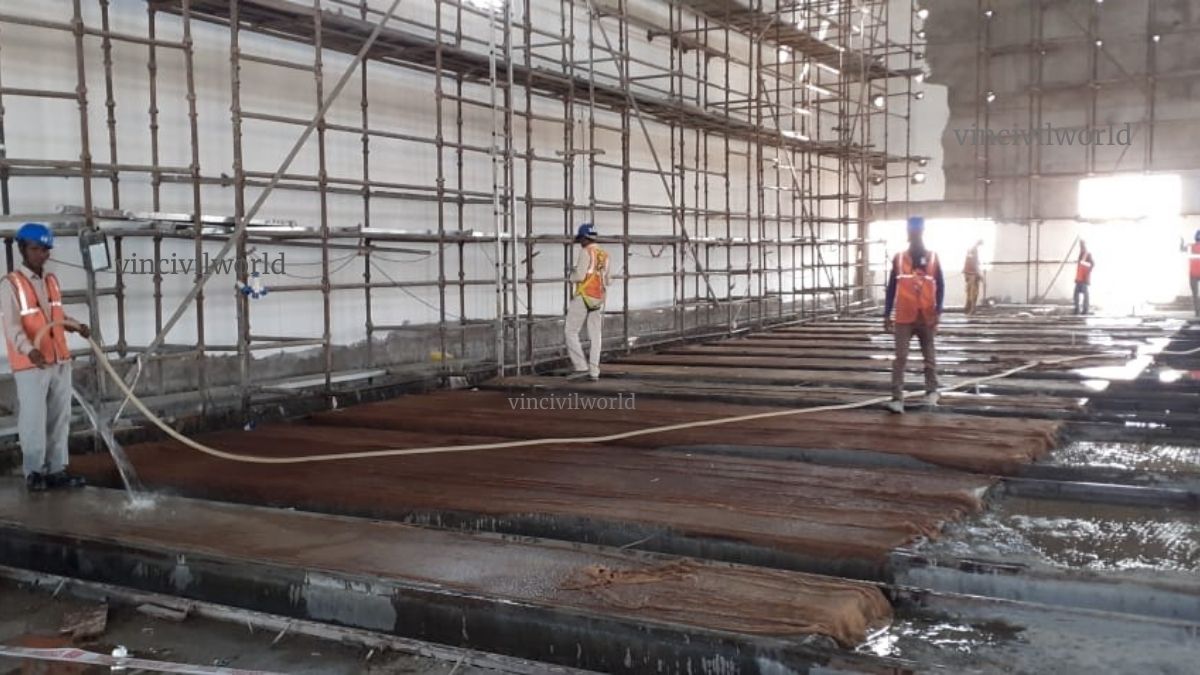
Plain cement concrete laying

Properties of Plain Cement Concrete or PCC concrete

Plain cement Concrete (PCC) has compressive strengths ranging from 200 kg/cm2 to 500 kg/cm2. Likewise, tensile strength of PCC ranges from 50 kg/cm2 to 100 kg/cm2, and density ranges from 2200 kg to 2500 kg, depending on the grade of concrete and aggregates used.

Ingredients of Plain Cement Concrete or PCC Concrete

Basically, PCC is made from cement, coarse aggregate, and fine aggregate. Ordinary Portland cement is used as the binding material. Accordingly, as coarse aggregate, broken or crushed stone or brickbats must be used. However, fine aggregate must consist of coarse sand. Finally, these ingredients are combined in the appropriate proportions with potable water to make PCC.

Production of Plain Cement Concrete (PCC) in Construction

PCC can be manufactured in batching plants, mixer machines, or manually mixing. Generally, the thickness of PCC can range from 50 mm to 300 mm or more, depending on the design parameters.

Types of concrete in construction

The following are the main types of concrete used in construction

Plain cement concrete (PCC)
Plain cement concrete (PCC )

How to Decide On A Concrete Type

The type of concrete to be used on a particular work is decided based on following conditions.

Material Availability

Normally, the raw material (aggregate, sand, cement etc) availability decides the type of concrete to be used.
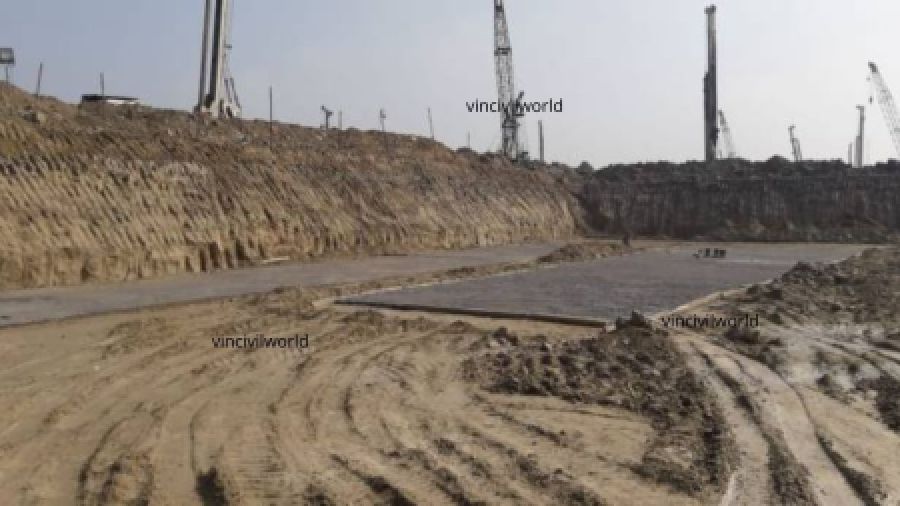
Plain cement concrete


Strength Required

The concrete requires different strengths for different structures. However, the strength required for the particular structure decides the type of concrete to be used.

Construction methodology to be adopted

The construction technique to be adopted for a structure decides the type of concrete. Example Pre-stressed concrete etc.

Type of structure

Most of times the type of the structure decides the type of concrete to be used.

SELF COMPACTED CONCRETE (SCC) is preferred in structures where normal pouring is restricted due to rebar congestion or access restricted pouring area. SCC, when pumped from a single point, can fill every part of the structure. 

Area of application

The type of concrete shall be decided by the area where it has to be used. In some structures, the reinforcement is so dense that concrete may not pass through it. Mostly, In those cases, specially designed concrete with small-size aggregates or Self compacted concrete (SCC) may be used.

Climate and pouring conditions

The areas where there is extreme weather conditions like heavy rain , extreme cold, extreme hot specially designed quick setting concrete will be used.

Placing of Plain Cement Concrete (PCC)

The following steps are followed while placing Plain Cement Concrete (PCC)

Level marking and dressing for PCC concrete

After completing the excavation, the bottom level of the PCC shall be marked on the ground using a level machine. The centre line from the survey pillars shall be transferred to the ground where PCC has to be done. The surface shall be dressed manually to remove the loose soil the surface level to receive PCC.

Surface Preperation and shuttering

The surface shall be neatly dressed and supports has to be placed around using wooden battens. Accordingly, the battens used have to be the same size as PCC preferably. The battens shall be properly supported using proper supports (scrap steel can be used). The dressed surface shall be sprinkled with water to avoid absorption of concrete water by the soil.

Dressing for Plain Cement Concrete

Placing and Finishing of PCC Concrete

Concrete must be poured from one end to the other. For levelling purposes, level pillars at 2 metre intervals must be provided. The concrete must be levelled and rammed in accordance with the level pillars and end supports. The slump for PCC should be approximately 75 mm. Concrete must be poured within 30-45 minutes.

Precautions while doing Plain Cement Concrete (PCC)

  • When excavating, take care to only excavate to the required levels. However, avoid over-excavation. Backfilling with loose earth is not recommended if the excavation depth exceeds the required depth. In that case, we can place the PCC at the required level by doing a plum concrete. Backfilling with soil and compaction with plate compactors/walk-behind rollers/or Vibro rollers, depending on the situation, is required.
  • Before beginning excavation, the PCC level must be transferred to different locations. Before fine dressing with lime powder, the centerline and PCC dimensions must be marked on the ground to avoid reworks.
  • The surface on which PCC is to be laid shall be sprinkled with water.
  • Anti Termite chemical or LDPE sheets may sometimes be used before doing PCC. A confirmation has to be taken before doing the PCC from the clients/customers.
  • The free-falling height of concrete shall be restricted to 1.5 meters due to segregation issues.

Prefabricated and modular houses – 10 Amazing designs. | Advantages and Disadvantages

Prefabricated and modular houses, as found in New City Paradise, are like putting together a puzzle. But best of all is that from one or more pieces, it is you who decides the final image. The future of housing design will probably be increasingly closer to the modality of prefabricated and modular houses.

And the reasons are simple and appeal to our old friend: common sense.

  1. Significance of Prefabricated and Modular Houses
  2. Disadvantages of Prefabricated and Modular Houses
  3. 10 Very Good Designs of Prefabricated and Modular Houses
    1. #1. CPH Shelter House
    2. #two. Modular Ecological Houses
    3. #3. The Smart Shelter
    4. #4. The Unseen House
    5. #5. House M2
    6. #6. The Big Box
    7. #7. Prefabricated House C6
    8. #8. Modular House in Container
    9. #9. The Arch House
    10. #10. Prefabricated Single Family Home

Significance of Prefabricated and Modular Houses

There are many advantages to this constructive modality:

  • Construction times are greatly reduced
  • The house (in its entirety or parts) is built in a workshop and not on the land
  • Less environmental impact due to: waste of materials, water contamination, less noise, and less energy consumption
  • There is greater control of the energy and bioclimatic behaviour of the house
  • Construction labour costs are reduced
  • The fieldwork is much less compared to the traditional way of building a house
  • It is very easy to expand the house since being modules; it is only enough to “add” one or more to the house
  • There are fewer construction labour conflicts because the entire construction process is done in the factory, in a scheduled and standardized manner

Disadvantages of Prefabricated and Modular Houses

And like everything in this life, prefabricated and modular houses also have their disadvantages:

  • In many cases, you must choose between pre-established designs
  • Costs are increased in the quality of the materials used. (Which is also an advantage regarding the quality that the house will have)
  • In matters of legislation, it is worth reviewing when you buy models of prefabricated and modular houses outside the country where you live
  • Local weather conditions should also guide you when choosing the prefabricated and modular home option. Not all houses will be designed according to the climate of the place where you live
  • The costs of moving the house to the land must be considered

In conclusion, and weighing both the advantages and disadvantages of the prefabricated and modular home design modality, it seems to me that there are more advantages than disadvantages.

So it is worth considering this alternative when building your house.

And to give you an idea of ​​the versatility offered by the prefabricated and modular home modality, here is a selection of 10 good designs that I have compiled for you.

I hope you enjoy them and tell me if it is easy for you or not to choose the one you like the most.

10 Very Good Designs of Prefabricated and Modular Houses

#1. CPH Shelter House

Prefabricated and Modular Houses
Prefabricated and Modular Houses – A very good design. A mobile, flexible and sustainable house. Built by the Danish firm CPH Shelter

A very good design. A mobile, flexible and sustainable house. Built by the Danish firm CPH Shelter

Building based on containers has many advantages:

  • Its construction is fast, flexible and modular
  • In most soils, very simple and inexpensive foundations are required
  • The assembly of the house on the ground takes very little time
  • They are very easy to move from one place to another

Being houses built in a modular way, they can easily be transformed into larger houses and adapted to the needs of each family.

This house is a passive design; that is, it makes the most of the use of clean energy, also taking care of the materials used, coatings and paints.

It has large windows and includes a kitchen, bathroom, living room, and bedroom, plus plenty of storage space.

#two. Modular Ecological Houses

Modular Ecological Houses
A house generates more energy than it consumes

The main idea of ​​this house is to maximize passive design strategies and the creation of spaces that flow through the house.

The walls are mobile so that the spaces grow as needed, making the rooms larger or smaller depending on the activity.

All this facing north and the winter garden, not only a place to air-condition the house but also to grow vegetables, to rest, relax, etc.

This design has been developed by the Australian company ArchiBlox.

#3. The Smart Shelter

Prefabricated and Modular Houses - The Smart Shelter
A 96m2 house was built in 10 months

The construction has been defined as a place to share leisure time enjoying the landscape.

The S-SE orientation maximizes thermal comfort in winter, and the sun protection ensures enjoyment in the summer season.

A very good design where simplicity and functionality prevail.

This project was designed and built by the Spanish company NOEM. 

NOEM’s motto reads:

«Design, modern, ecological and prefabricated wooden houses. High energy efficiency custom projects equipped with the most advanced eco-technology and designed under passive house standards.”

Your work is worth knowing!

#4. The Unseen House

Prefabricated Modular Houses - The Unseen House
The Unseen House

Casa Invisible is a flexible housing unit consisting of a prefabricated wooden structure designed for turnkey execution at any designated site

Maximum flexibility and spatial quality are the critical elements in its development concept.

This provides custom design options for the housing units as well as flexible pricing options.

The total dimensions are 14.50 x 3.50 meters, which facilitates transport by truck.

The key factors in this proposal are its uncomplicated assembly, its attractive price, and the free choice of location.

This design was developed by the Austrian firm DMAA. 

#5. House M2

Prefabricated Modular Houses - House M2
Prefabricated Modular Houses – House M2

The house has 2 bedrooms and 1 and a half bathrooms. It has a total area of ​​115 m2

The living/dining rooms and bedrooms are connected by a fibreglass “suspended bridge”.

Method Homes is one of North America’s most prestigious manufactured home companies.

They are specialists in modular houses, built in an artisanal way by authentic professionals, with excellent value for money.

Its quality and precision are unquestionable.

#6. The Big Box

Prefabricated and modular houses - The big box
A house with 2 bedrooms and a total area of ​​73m2

Clad in wood both outside and inside the house, which gives it a rustic and very modern design at the same time.

An outside terrace helps to “extend” the house outside.

The Bert & May Group (London) are specialists in modular manufacturing of houses with a very modern aesthetic.

The construction of this “ecological mobile home” takes only 14 weeks, and it can be assembled in a single day. Incredible!!!

Enjoy this Very Good Design!!!

#7. Prefabricated House C6

Prefabricated House - C 6

This design is part of the C6 series of model homes designed by the LivingHomes staff in collaboration with Make It Right, a non-profit organization founded by Brad Pitt and architect William McDonough.

The C6 series is the lowest cost design.

They combine clean and modern design, have floor plans adaptable to each client, improved finishes and artefacts, and many warehouses for storage.

The new C6 model is larger than the original C6 and features a streamlined roof and exterior.

#8. Modular House in Container

Modular house in container
Modular House in Container

This design is the smallest of the modular houses built by the company Nova Deko, in Australia

They use a 40-foot container and come up with good space-saving solutions that make the house compact and large at the same time.

Thanks to mechanisms such as folding doors and fitted wardrobes, the house offers a living space that does not feel claustrophobic.

There is a lot of efficiency in this design. Less is more!!!

#9. The Arch House

A prefabricated house, small and simple, but at the same time self-sufficient and intelligent

It can have a surface between 37 and 46m 2, depending on the model.

Solar panels make it energy self-sufficient. It also has good thermal insulation.

The house has the basic amenities of a house and the “California codes of modular construction”.

The design was made by the company Shelter Dynamics. 

#10. Prefabricated Single Family Home

Prefabricated single family Home
Prefabricated single-family Home

This house was designed by the Berlin-based studio  Brandt + Simon Architekten.

A design that seeks (and succeeds) to integrate with the landscape through a pixelated facade

The façade combines sustainable technologies with traditional cladding and hides a light timber frame construction.

In addition, a series of green building strategies are incorporated: layers of recycled paper are used for insulation, while solar panels support the heating system.

The internal structure allows a flexible organization of the rooms.

The kitchen and dining room are open to the terrace, while the ground floor spaces overlook a small part of the garden

I hope that this visual walk through these 10 Prefabricated and Modular Houses has inspired you.

I think it is worth considering this option when evaluating different modalities to build the house of your dreams.

But above all, I would like you to know that there are always alternatives.

There are always options when what guides you is the dream of building your own house.

And do not forget that whatever method you choose to build your house, try to have a good design and quality.

A good design will make your home a beautiful, welcoming place, a place where you can be happy with the people you love. For more home ideas, please visit New City Official Site.

Types of foundations in civil engineering

Types of foundations – This article focuses on different types of foundations used in civil engineering. The foundation is the most crucial component of any structure/building because it transfers the total loads of the structure and its components to a competent ground surface. There are two types of foundations. ie: Shallow foundations and deep foundations

Types of Foundations – Related Posts

  1. Types of foundations – How to decide?
  2. Deciding the size and types of foundations
  3. Safe bearing capacity
  4. Types of foundations
  5. Shallow foundations
  6. Types of foundations – Shallow foundations
    1. Spread footing or isolated footing
    2. Simple spread footing
    3. Sloped spread footing
    4. Stepped spread footing
    5. Strip footing
    6. Combined footing
    7. Strap footing
    8. Types of foundations – Raft foundation /Mat foundation
  7. Types of foundations – Deep foundations
    1. Pile foundations
    2. Basement foundations
    3. Caissons foundation
    4. Hollow box foundations or Buoyancy foundations
    5. Drilled shaft foundation
  8. Conclusion

Types of foundations – How to decide?

The foundation is the most essential element of a structure. A well-designed foundation is critical to protecting a structure from dead loads, live loads, and external forces acting on the structure. The foundation is the final part of the structure to make contact with the ground. The foundation bed is the area where the foundation meets the ground. Before we get into the different types of foundations, let’s converse about substructure and superstructure. Each structure is subdivided into Superstructure &  Substructure Substructure refers to components of a structure that are below ground level, while superstructure refers to components that are above ground level. The foundation belongs to the substructure category and is responsible for transferring loads from superstructure components to the ground.

Deciding the size and types of foundations

The type of foundation is determined by the soil’s bearing capacity and the purpose of the structure. Geotechnical engineering is a branch of civil engineering that analyses the physical and chemical properties of soil in order to provide input to designers on soil properties and proposed foundation types and sizes.

Safe bearing capacity

A soil’s bearing capacity is its ability to support a structure without settlement or failure. The bearing capacity of soil must be calculated at various locations to ensure the structure’s safety. To determine the safe bearing capacity of the soil, the ultimate bearing capacity should be divided by a factor. The maximum load per unit area that soil can withstand without settlement and failure is defined as safe bearing capacity. Field tests or soil investigations are often used to determine the safe bearing capacity of the soil.

Types of foundations

Foundations are broadly classified into

For more details about shallow and deep foundations please follow this article

Types of foundations – Shallow foundations

Shallow foundations transfer the load to the soil laterally. It’s also known as stripped foundations. A shallow foundation has a depth that is less than its width. Shallow foundations are used when the load acting on a structure is reasonable and there is a competent soil layer capable of negotiating the loads available at a shallow or shorter depth. A shallow foundation is laid on the ground’s surface. A shallow foundation’s depth can range from 1 meter to 3.5 meters, and sometimes even more.

Shallow foundations can be of various types, depending on the site conditions and design requirements.

Spread footing or isolated footing

The spread footing is one of the most common types of shallow foundations. They are also known as isolated footings or individual footings. Spread footings are further classified based on their shape into simple spread footing, sloped spread footing, and stepped spread footing.

  • Simple spread footing
  • Sloped spread footing
  • Stepped spread footing

Simple spread footing

A simple spread footing is made up of a base footing and a single column on top of it. This foundation is used for structures with reasonable/moderate loads and bearing capacities.  

Simple Spread Footing
Simple spread footing

Sloped spread footing

Footings in this type of foundation are sloped, as shown in the figure. The footing is supported by a single column and has a trapezoidal cross-section.

Sloped Spread Footing

Stepped spread footing

When the loads are heavy, steps are provided in the footings, as shown in the figure.

Stepped Spread Footing

Strip footing

Strip footings are also known as wall footings. They are used to provide load-bearing brick/stone/RCC walls over the footings. Strip footings run continuously along a building’s wall. These footings are also used when the column spacing is very close and the footings overlap.

Strip Footing
Types of foundation – Strip footing

Combined footing

A combined footing is made up of two or more columns laid over a single footing. These footings are used when the distance between two individual footings is very small and they overlap. A combined footing is also provided in areas where further excavation is not possible due to boundary flushing. Rectangular combined footings and trapezoidal combined footings are the two types of combined footings.

  • Rectangular combined footings
Rectangular Combined Footing
Foundation type-Rectangular Combined Footing
  • Trapezoidal combined footings
Trapezoidal Combined Footings
Trapezoidal Combined Footing

Strap footing

Strap footings, also known as cantilever footings, are made up of two individual footings connected by a beam strap. The beam strap is designed as a rigid structure. These types of foundations are less expensive than combined footings.

Strap Footing
Strap Footing

Types of foundations – Raft foundation /Mat foundation

Raft foundations are the most common foundation types used in construction. It is a continuous slab that rests on the soil and covers the entire area of the proposed structure. Raft foundations are categorized based on their intended use. Numerous factors, such as bearing capacity, loads, site conditions, and so on, influence the type of raft foundation. A raft foundation/mat foundation is a solid slab which spans the entire structure area and is placed at a predetermined depth. Raft foundations are comprised entirely of columns and shear walls which transfer the structure’s load to the ground. These foundations are generally used when the soil’s bearing capacity is low and individual footings struggle to negotiate the loads. The raft foundation aids in the transfer of the entire load of the structure to a larger area.

Raft Foundation
Raft Foundation

For more information on a raft foundation, please see our blog

Raft foundations – Types and Advantages.

Types of foundations – Deep foundations

The foundations having a depth more than a width are called deep foundations. When the subsoil strata lack the safe bearing capacity to handle the loads induced by the structure, deep foundations are proposed. In such a case, the foundations’ founding level is moved to a deeper area with the required bearing capacity. The structure’s loads are transferred vertically into the ground.

Many applications adopt deep foundations. They are considered the safest option for transferring heavy loads on soil strata with low bearing capacities. The following are examples of common Deep foundations in use.

  • Basement foundations
  • Caissons Foundation
  • Hollow Box Foundation or Buoyancy foundations
  • Drilled shaft foundations
  • Pile foundations

Pile foundations

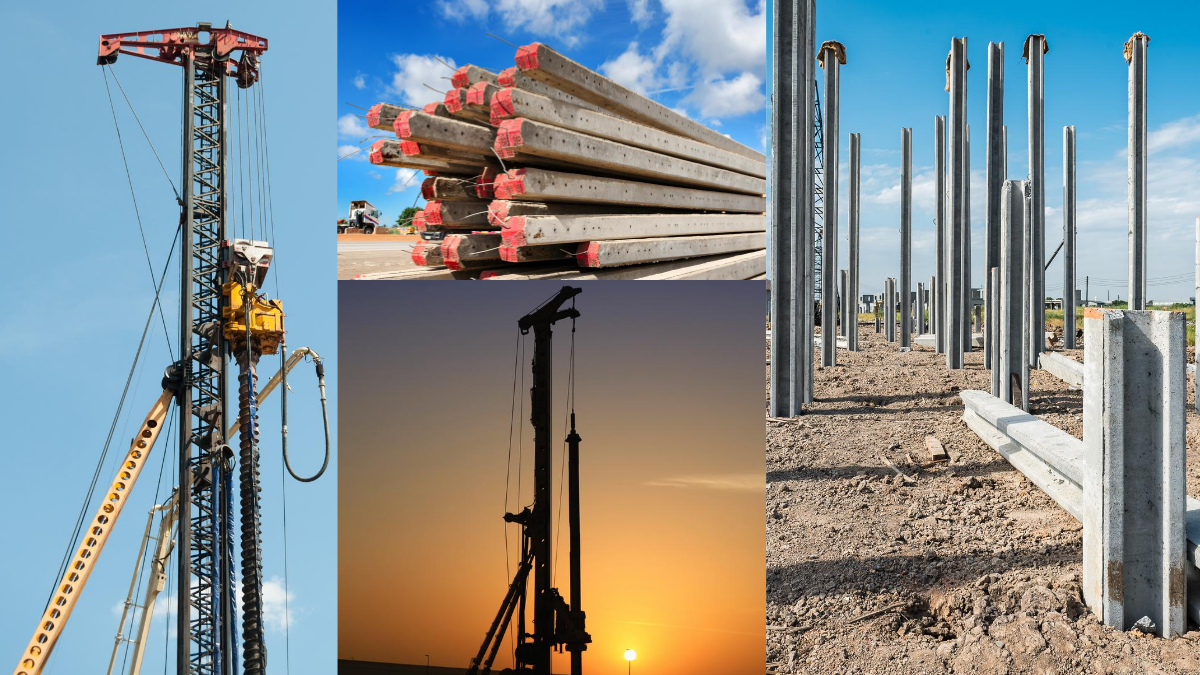
Pile foundations are long, slender members made of concrete, steel, or any other material which are used to transfer loads from a structure when the subsoil lacks bearing capacity. The pile foundations transfer the load vertically through the less dense top layer to a denser soil/rock layer which can negotiate the loads without failure.

For more details read our article: Pile foundations – Types and advantages

Basement foundations

Basement foundations are substructure foundations designed to account for parking areas, underground tanks, electrical systems, and storage spaces beneath a building below ground level. They are commonly used in high-rise residential and commercial structures. Basement foundations are designed to address the functional needs of parking and storage.

Caissons foundation

A caisson foundation is a water-retaining structure that serves as a working space for pier foundation operations. They are box-like constructions built of wood, steel, concrete, and other materials. Caisson Foundation is sunk by excavating the earth within the foundation. Caissons are prefabricated above ground or water level and sunk to the founding level as a single unit. They are built to facilitate excavation and related operations for dock structure foundations, bridges, jetties, piers, foreshore protection, and so on. These structures are eventually incorporated into the main structural components.

Hollow box foundations or Buoyancy foundations

The concept behind a hollow box foundation is to create a structure that has little or no impact on the original soil stress before commencing excavation. Overburden is removed as required by the design, and superstructure loads are transferred to the ground. These foundations are referred to as buoyancy foundations because they follow the principle of a ship floating in the water, where the displaced water balances the ship’s weight.

Drilled shaft foundation

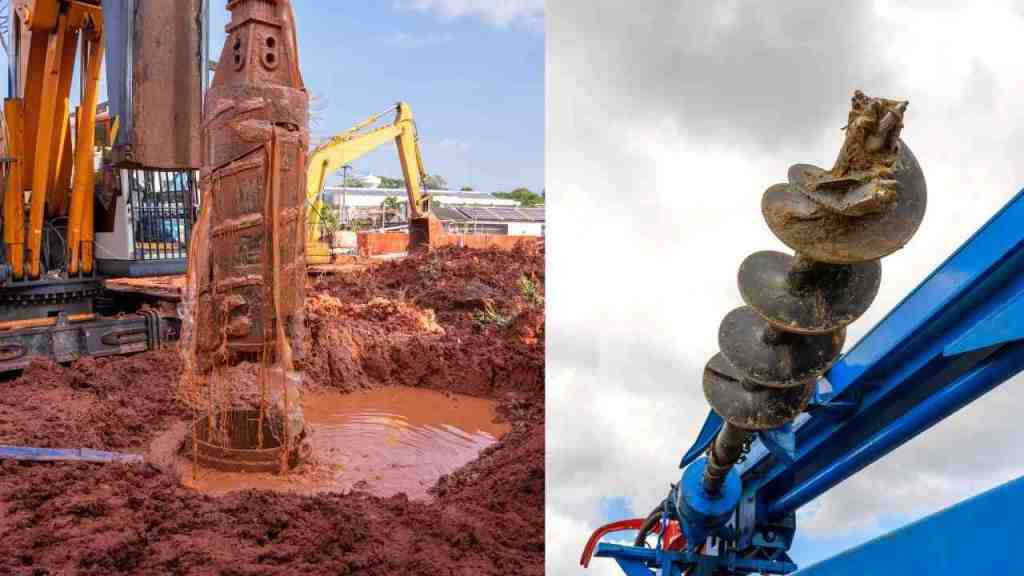
The drilled shaft is a versatile foundation system that is widely used nowadays. These foundations are also referred to as drilled piers, drilled caissons, bored piles, and so on. The main idea is to excavate a cylindrical shaft and then cast it after adding the necessary reinforcements. Drilled holes should be between 1-3 meters in diameter and up to 100 meters deep. Shafts can be drilled to depths of 100 meters and diameters varying from 1 to 3 meters. However, greater depth and diameter are now conceivable. These foundations can partially replace driven piles in the same way that a single drilled shaft can replace a group of piles.

Drilled shaft foundations

Conclusion

Shallow foundations are very easy to construct and do not require highly skilled manpower and professional supervision. These foundations can even be built with the assistance of semi-skilled workers. A shallow foundation is very economical when compared with a deep foundation. Shallow foundations are end-bearing type foundations that transfer loads to the end of the foundation. Shallow foundations are considered the most preferred option when the safe bearing capacity of the soil is reasonable and the structural loads are within the permissible limits.

Classification of Surveying – A complete overview

Classification of Surveying is a fundamental topic in civil engineering. This is because almost every project begins with measuring and mapping the ground. Surveying determines the relative position of points on the earth. It also measures directions, distances, elevations, and areas. These measurements are used to prepare layouts at a chosen scale. In practice, surveyors apply different Types of Surveying and Land Surveying Methods through reconnaissance, measurement, marking and plan preparation. These Surveying Techniques in Civil Engineering demand high precision and good mathematical skills to analyse field data accurately. By understanding Methods of Surveying Classification, including the difference between Plane vs Geodetic Surveying, engineers can select the most suitable approach for each site and structure. In this article, we explore how surveying is classified and where each type is typically used.

  1. Classification of surveying
  2. Primary classification of surveying
    1. Plane surveying
    2. Geodetic surveying
  3. Classification of surveying based on field nature
    1. Land surveying
      1. Topographical surveying
      2. Cadastral surveying
      3. City surveying 
    2. Hydro-graphic surveying
    3. Astronomical surveying
  4. Classification of surveying based on purpose
    1. Engineering survey
    2. Military survey
    3. Mining surveying
    4. Geological survey
    5. Archaeological survey
  5. Classification of surveying based on instruments
    1. Chain surveying
    2. Theodolite surveying
    3. Traverse survey
    4. Triangulation survey
    5. Tacheometric survey
    6. Plane table survey
    7. Photogrammetric survey

Classification of surveying

Surveying is divided into different types to ensure accurate measurement methods are selected for specific project requirements and field conditions.

  • Primary classification of surveying
  • Classification of surveying based on field nature
  • Classification of surveying based on purpose
  • Based on Instruments classification of surveying

Also Read : Principle of surveying – First and second principle

The details of every classification basis is explained in detail in this article

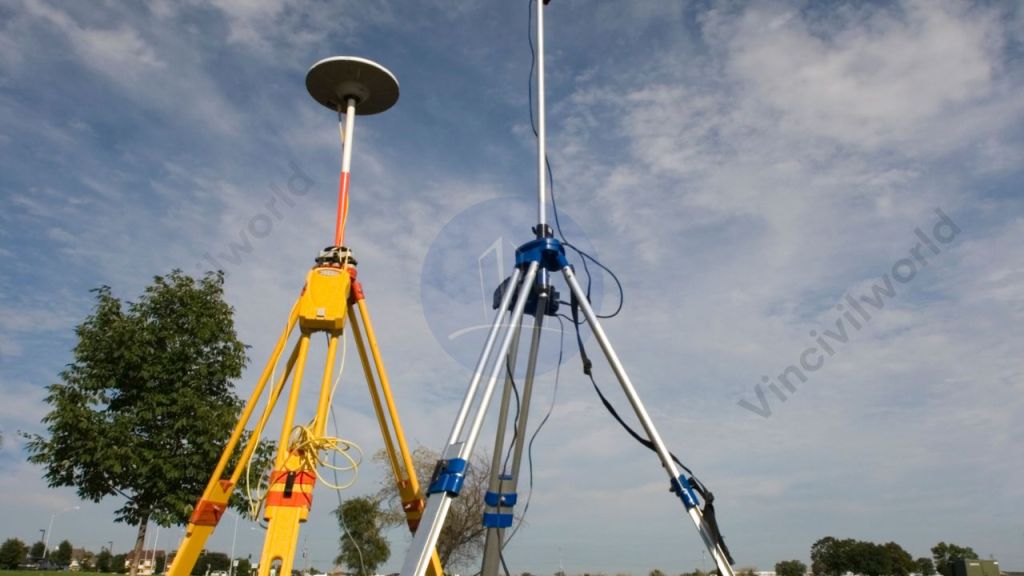
Classification of surveying - Total Station
Classification of Surveying – Total Station

Primary classification of surveying

The primary classification is based on the earth’s surface. We know earth is an oblate spheroid. So while surveying we must consider the earth as either plane or as curved. Primarily we can divide surveying into two types and are as follows.

Plane surveying

For plane table surveying the earth’s surface is considered as a plane. Therefore we should neglect the corrections due to earth curvature. The line which connects these points is a straight line. The triangles made by joining these lines are Plane triangles. This type of surveying is useful for limited areas. ie less than 200 sq.m.

Geodetic surveying

In Geodetic surveying, the earth’s surface is considered as a curve. So the line which connects these points are curves and the triangles made joining these lines are Spherical triangles. Geodetic surveying is used for large areas of more than 200 sq.m.

Classification of surveying based on field nature

Land surveying

Land surveying is the art of establishing or re-establishing corners, lines, boundaries, and monuments of property or land. This is based upon recorded documents, historical evidence, and present standards of practice. It helps in preparation of topographical maps, planning, and estimation of project works, locating boundary lines, etc. Land surveying is classified into three types.

  • Topographical surveying
  • Cadastral Surveying
  • City surveying

Topographical surveying

The main application of a topographical survey is the drafting of maps. Topographical surveys include surveying natural and artificial features such as rivers, hills, roads, canals, etc. It consists of horizontal, vertical, and angular measurements. The scale range is 1: 25000 to 1: 1000000.

Cadastral surveying

The main use of this surveying is in the documentation process while transferring ownership from one person to another. It helps in defining the boundaries and land area calculations. It also called Public land survey.

City surveying 

City surveying provides information for the construction of water supplies, sewage lines etc.

Hydro-graphic surveying

Hydro-graphic surveying deals with the surveying of water bodies. They help in offshore construction activities. Hydro-graphic surveying is also known as Marine surveying. It helps in determining the mean sea level calculation, water depth calculation, dredging analysis, etc.

Astronomical surveying

This type of surveying observes the heavenly bodies such as the sun, moon, and stars. It helps locate the absolute location and lines on the surface of the earth. It also determines the azimuth, latitude, longitude, and time.

Astronomical Surveying

Classification of surveying based on purpose

Engineering survey

This type of surveying helps to analyse the field data for engineering works. These include the construction of roads, railways, and sewage pipelines.

Military survey

This type of surveying helps the military services like the army, navy etc to determine the location of strategic importance. Through this surveying, we can provide maps of broader areas. Since it uses advanced technologies like remote sensing, GIS and GPS, we get precise field details.

Mining surveying

A mining survey determines the location of points in the underground for mine planning.

Geological survey

Gological survey helps in the study of earth composition. It helps to determine the arrangement of different strata on the earth.

Archaeological survey

This type of survey gives the details about old antiquity, forts etc to understand the archaeological sites.

Classification of surveying based on instruments

Chain surveying

Chain surveying is the simplest form of surveying. The principle of chain surveying is triangulation. In this surveying method, we only measure linear measurements. Also, it is suitable for small areas. The areas are divided into triangles and the sides of the triangles are measured. The chain surveying uses instruments such as chains, arrows, pegs, ranging rods, etc.

Theodolite surveying

Theodolite is a surveying instrument that measures horizontal and vertical angles. It is one of the precise methods of surveying. This type of surveying helps to find the level difference, setting out, prolonging survey lines, etc of the area.

Theodolite survey - Classification of Surveying
Theodolite Survey

Also Read : Total station – Principles and fundamentals

Traverse survey

Traverse surveying is a type of surveying in which we connect the survey lines to form a framework. The length can be measured either using the directly or indirectly method. So for the direct method of measurement, we use tapes. For the indirect method, we use Electronic Distance measurement. Some important traversing methods are Chain traversing, Chain and compass traversing, Tape traversing and plane table traversing.

Triangulation survey

In triangulation surveying, we trace series of triangles formed by joining the survey points. The distance and relative points are calculated by the trigonometric relations between the length and angles of the triangle. It is preferable for hills and undulating areas. 

Tacheometric survey

Taacheometric surveying is angular surveying in which horizontal and vertical distance are calculated from the angular measurements. It is a convenient surveying method. Tacheometric surveying uses transit theodolite with a stadia diaphragm for taking measurements. This method is preferable when a direct method of surveying is not possible. 

Plane table survey

Plane table surveying is one of the fastest methods of surveying. It is a graphical method in which we can do field observation and plot simultaneously. Mostly preferable in magnetic areas where compass surveying is not possible. Also, we can check errors and mistakes using check lines. The instruments for plane table surveying are plane table, alidade, plumbing fork, plumb bob, spirit level, compass, etc. 

Photogrammetric survey

It is a surveying type that uses photographs for making measurements. We can prepare maps, 3d diagrams from these photographs. These are mostly to study the wide life and to make virtual models of historical structures. Photogrammetric surveys cover a large area for surveying and they are less time-consuming. 

Environmental Impact Assessment (EIA) – Process and Benefits

Environmental Impact Assessment (EIA) is an indispensable part of any proposed project be it governmental or non-governmental. Environmental Impact Assessment is the method of assessing the possible environmental consequences of a proposed project or development.In this blog I will show you what is EIA, its procedure, benefits and shortcomings.

Read on to know more details.

What is Environmental Impact Assessment?

Environmental Impact Assessment is the method of assessing the possible environmental consequences of a proposed project or development. It takes into account both the positive and negative socioeconomic, cultural, and human-health consequences of the process. It is a mechanism used by the United Nations Environment Programme (UNEP) to determine the environmental, social, and economic impacts of a project before making a decision. The Environment Protection Act of 1986, which includes various provisions on EIA methodology and mechanism, provides legal backing for environmental impact assessments in India.

Environmental Impact Assessment (EIA)

Goals of Environmental Impact Assessment

Following are the goals of an EIA process:

  • Forecast environmental impacts early in the project planning and design process 
  • Identify ways to mitigate negative effects 
  • Tailor projects to suit the local community 
  • Present the predictions and options to decision-makers. 

Also readSustainable Cities -Features Full Guide

History of Environmental Impact Assessment in India

Environmental Impact Assessment has been practised in India for over 20 years. It began in 1976-77. In September 2006, the Ministry of Environment, Forests, and Climate Change (MoEFCC) announced new EIA legislation. The following projects require environmental clearance under the notification:

  • Mining
  • Thermal power plants, 
  • River valleys, 
  • Infrastructure (roads, highways, ports, harbours, and airports) 
  • Factories, including very small electroplating or foundry units

Also read : What is e-waste?

EIA Process

The steps outlined below are part of the EIA method. The EIA mechanism, is cyclical, with interactions between the various phases.

Screening: 

The project plan is scrutinised for its size, location, and form of construction, as well as whether it requires legislative approval.

Scoping: 

The project’s possible effects, impact zones, mitigation options, and monitoring requirements.

Collection of baseline data: 

Baseline data refers to the state of the environment in the study region.

Impact Prediction: 

Positive and negative, reversible and irreversible, transient and permanent effects must all be forecast. This requires the evaluation agency to provide a thorough understanding of the project.

Mitigation measures and the EIA report: 

The EIA report should provide actions and steps for avoiding, mitigating, or transferring the impacts, as well as the extent of compensation for likely environmental harm or loss.

Public Hearing: 

After the EIA report is completed, the public and environmental organisations residing near the project site will be advised and consulted.

Decision Making: 

The Impact Assessment Authority, in consultation with experts, consults the project manager and a consultant to make a final decision, holding EIA and EMP in mind (Environment Management Plan).

Monitoring and implementation of EMP: 

The various phases of implementation of the project are monitored.

Alternatives Evaluation and Environmental Impact Assessment Report:

Alternatives should be defined for each project, and environmental attributes should be compared. Both the project site and the process technology should be seen as alternatives.

Following the evaluation of alternatives, a mitigation plan for the chosen choice should be created, which should be supported by an Environmental Management Plan (EMP) to direct the supporter toward environmental improvements.

Risk Assessment: 

Inventory analysis and hazard likelihood and index are also used in EIA procedures.

Ever thought why all the projects must undergo the lengthy procedures of EIA? I have the answer for you. 

Environmental Impact Assessment (EIA)

Benefits of Environmental Impact Assessment

Ever thought why all the projects must undergo the lengthy procedures of EIA? I have the answer for you. 

  • Connects the environment and development for environmentally friendly and sustainable growth.
  • A cost-effective way to mitigate or reduce the negative effects of infrastructure projects.
  • Allows decision-makers to assess the impact of construction activities on the ecosystem well before the project is implemented.
  • Encourages the adaptation of mitigation techniques in the growth plan EIA ensures that the development strategy is environmentally sustainable and operates within the ecosystem’s capacity for assimilation and regeneration.

Earthquake Engineering- A Comprehensive Guide

Earthquake Engineering though not a mainstream engineering branch, is a widely researched topic now. Though all of us wouldn’t have experienced an earthquake most of us must have seen news and videos about the tremendous loss it causes. Looks scary, right? That’s exactly what makes Earthquake Engineering a subject of immense possibilities and research.

In this blog let me walk you through what is Earthquake Engineering and the relevant topics in Earthquake Engineering.

What is Earthquake Engineering?

Earthquake engineering is a branch of civil engineering that considers the impacts of earthquakes while designing and analysing engineering structures. The ultimate aim is to make such structures more earthquake resistant. 

In a major earthquake, an earthquake (or seismic) engineer attempts to construct structures that will not be affected by slight shaking and will prevent significant damage or failure. Earthquake engineering is a scientific area concerned with reducing seismic risk to appropriate socioeconomic levels to protect society, the natural environment, and the built environment from earthquakes.

Also See : Prefabrication in construction – Advantages – Disadvantages

Also See : Cellular light weight concrete -Manufacturing process – Properties

Earthquake Engineering Objectives

The main objectives of earthquake engineering include:

  • Anticipate the effects of powerful earthquakes on urban areas and civil infrastructure.
  • Design, construct and maintain structures so that they function as expected and per building codes when exposed to earthquakes.

Isn’t it amazing that a properly designed structure need not be extremely strong or costly? Instead, it just has to be carefully designed to withstand seismic forces while sustaining a minimum amount of damage. In this blog, I will show you how exactly this can be done.

Earthquake Engineering Relevant Topics

Let me give you a brief description of earthquake engineering’s relevant topics.

  • Seismic Performance in Earthquake Engineering
  • Seismic Vibration Control in Earthquake Engineering

Earthquake Engineering- Seismic Performance

The ability of a structure to maintain its key functions, such as protection and serviceability, during and after an earthquake exposure is referred to as earthquake or seismic performance. If a structure does not threaten the lives and well-being of those in or around it by partially or fully collapsing, it is considered secure.

Earthquake Engineering- Seismic Vibration Control

The term “seismic vibration control” in Earthquake Engineering refers to a range of technological methods for reducing seismic vibrations in both building and non-building structures. There are three types of seismic vibration control devices: passive, active, and hybrid.

  • Passive control devices have no feedback capability between them, structural elements and the ground
  • Active control devices incorporate real-time recording instrumentation on the ground coupled with earthquake input processing equipment and actuators inside the structure.
  • Hybrid control devices combine the functionality of active and passive control systems.

Due to reflections, as ground seismic waves reach up and begin to penetrate a building’s foundation, their energy flow density drops dramatically: usually by up to 90%. The residual portions of the incident waves after a major earthquake, on the other hand, also have significant destructive potential.

There are a variety of ways to monitor seismic waves once they reach a superstructure to mitigate their damaging effects and increase the building’s seismic efficiency, for example:

  • Dissipating wave energy within a superstructure using properly designed dampers.
  • To spread wave energy over a wider frequency range.
  • By absorbing the resonant portions of the entire wave frequencies band with mass dampers.
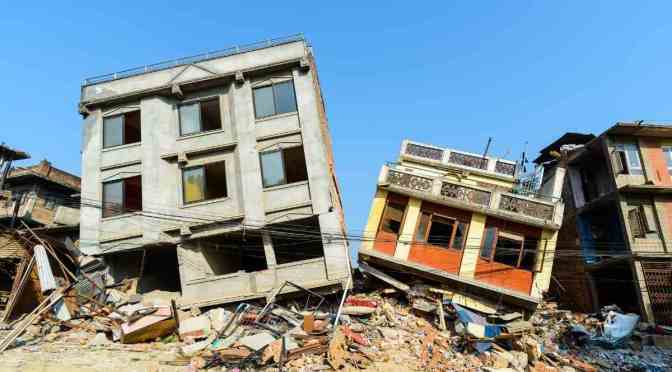
Earthquake Engineering
Losses due to Earthquake

Let’s see how to apply these principles in the construction field.

Earthquake Resistant Construction

Earthquake resistant construction refers to the use of seismic design to ensure that buildings and non-built structures withstand earthquakes to the best of their abilities and in accordance with relevant building codes.

Detailing of the members and their relations should be as straightforward as possible to achieve good workmanship. Earthquake design, like any other form of construction, entails the construction, retrofitting, or assembling of infrastructure using the materials available.

  • Adobe Structures
  • Timber frame structures
  • Light frame structures
  • Reinforced Masonry Structures
  • Reinforced concrete structures

Adobe Structures

  • About a third of the world’s population lives or works in Adobe structures.
  • Adobe mud bricks are one of the most popular and oldest building materials.
  • Adobe is widely used in some of the world’s most vulnerable areas, including the Indian subcontinent, and other parts of Asia.

The following are important factors to consider when improving the seismic efficiency of adobe construction:

  • Construction quality.
  • Box-like and compact layout.
  • Seismic reassurance.

Timber frame structures

  • Timber framing has been used in many parts of the world for thousands of years.
  • The use of timber framing in buildings provides the building’s full skeletal framing, which has structural advantages because the timber frame if properly designed, lends itself to better seismic survivability.
Timber framed structure

Light Frame Structures

  • Rigid plywood shear walls and wood structural panel diaphragms provide seismic resistance to light-frame structures.
  • For all engineered wood structures, special provisions for seismic load-resisting systems include consideration of diaphragm ratios, horizontal and vertical diaphragm shears, and connector/fastener values.
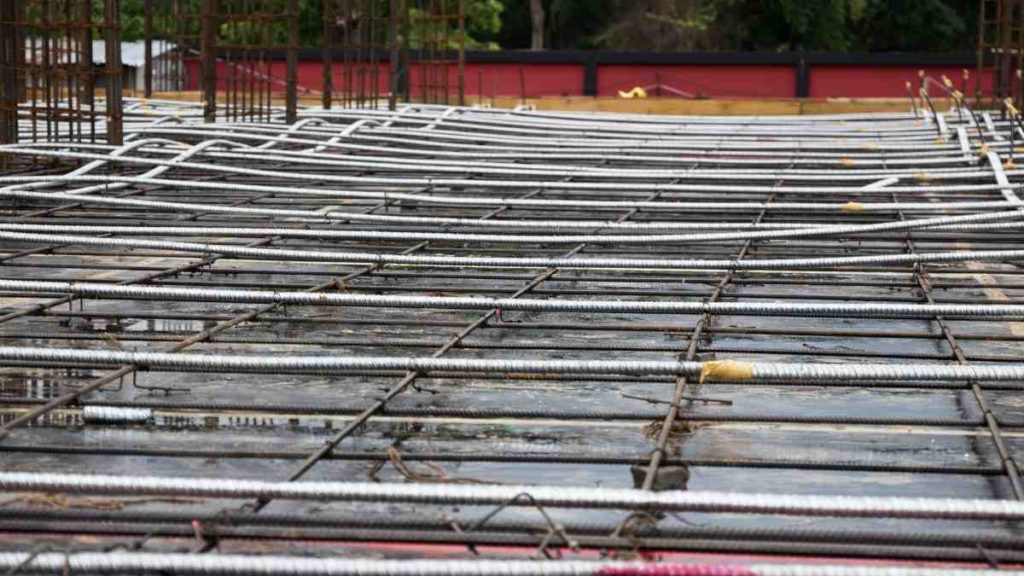
  • Collectors, or drag struts, are often used to distribute shear along a diaphragm length.

Reinforced masonry structures

  • Reinforced masonry is a building method in which steel reinforcement is inserted in masonry mortar joints or put in holes and then filled with concrete or grout.
  • This can be achieved using a variety of methods and techniques in which the reinforced hollow unit masonry is the most common form.
  • The shear strength of the wall must be greater than the flexural strength to achieve ductile action in masonry.
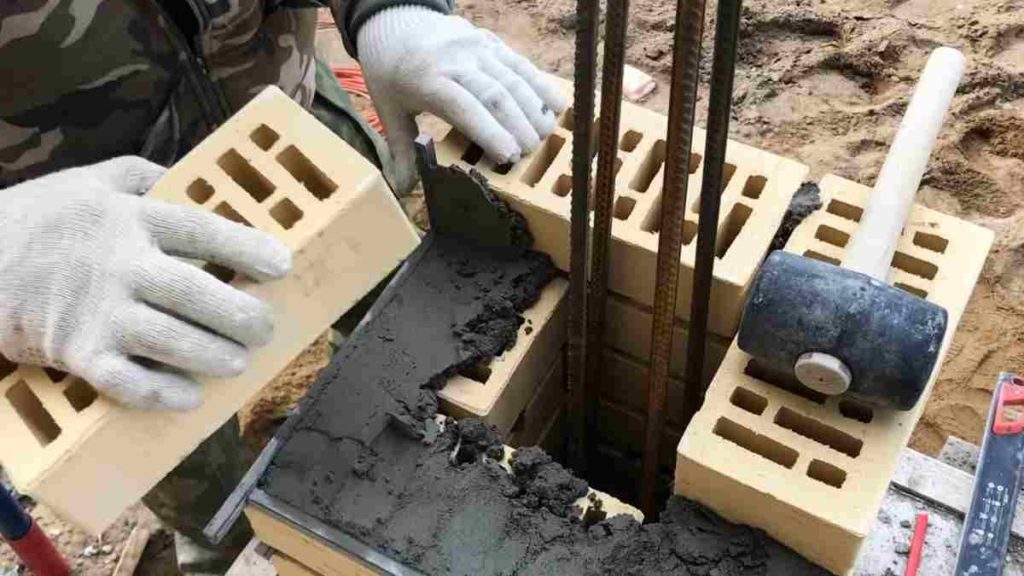
Reinforced Masonry structures

Reinforced concrete structures

Steel reinforcement bars (rebars) or fibres are inserted into reinforced concrete to strengthen a brittle composite. It can be used to make beams, columns, floors, and bridges, among other things.

Prestressed concrete is a form of reinforced concrete that is used to overcome the natural weakness of concrete in strain. It can be used for beams, floors, and bridges with longer spans than ordinary reinforced concrete allows. 

Post Tension - slabs
Post Tension – slabs

Prestressing tendons are used to apply a clamping load to the concrete compression member, resulting in compressive stress that compensates for the tensile stress that would otherwise be applied by a bending load. A typical reinforced concrete frame should have ductile joints to avoid catastrophic failure in response to earth-shaking.

Now you have seen the basic aspects of Earthquake Engineering. How do you feel about it? Let’s know in comments.