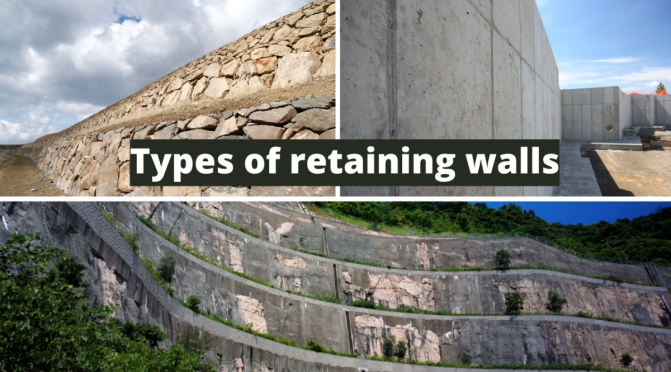
Category Archives: geotechnical

Types of Retaining walls – All types,materials,features and uses.

Retaining walls are rigid structures used for supporting soil laterally and retained at different levels on the two sides. These structures are vertical or near-vertical. They are constructed to hold soil between two terrains when the slope exceeds the natural angle of repose. The slope can be vertical or steep or much above the range of angle of repose. Understanding retaining wall types is crucial for selecting the right wall based on soil conditions, load requirements, and project design.

Key retaining wall types include gravity retaining walls. These rely on weight for stability. Buttress retaining walls provide extra support. Elements like retaining wall heel and toe enhance stability, making these walls effective and durable solutions.

This article is about the types of retaining walls, materials used and features.

  1. What is a retaining wall?
  2. Design criteria of retaining wall
  3. Retaining wall types
    1. Gravity Retaining walls
    2. Cantilever retaining walls
      1. The loads induced on various components
    3. Counter-fort retaining walls
    4. Buttressed retaining walls
    5. Sheet piled retaining walls
    6. Piled retaining walls
    7. Anchored retaining walls

What is a retaining wall?

Retaining walls are critical engineering structures designed to stabilize and support terrain by restraining soil mass at different elevations. These versatile architectural elements are essential in landscape design, civil engineering, and construction projects. They prevent erosion, manage slope stability, create usable spaces on uneven terrain. Retaining walls provide critical structural support in areas with significant elevation changes.

Engineers and landscape architects utilize various types of retaining walls, each with unique characteristics and applications. The selection depends on factors such as soil conditions and load requirements. Other considerations include site topography, budget constraints, aesthetic considerations, and project design. These factors ensure long-term durability and safety. Common retaining wall types include gravity walls, cantilever walls, and anchored walls, each using distinct methods to provide stability.

Design criteria of retaining wall

The main criteria behind the design of the retaining wall are to counter the downward slope movement of back filled soil by gravity. The lateral pressure developed behind the wall depends on the angle of internal friction & cohesive strength of retained materials. The lateral pressure can also be liquid (hydro-static pressure), and pressure from any type of back-fill material like sand, granular material, fly ash, etc. A proper drainage system is to be provided to reduce the hydro-static pressure.

Retaining wall types

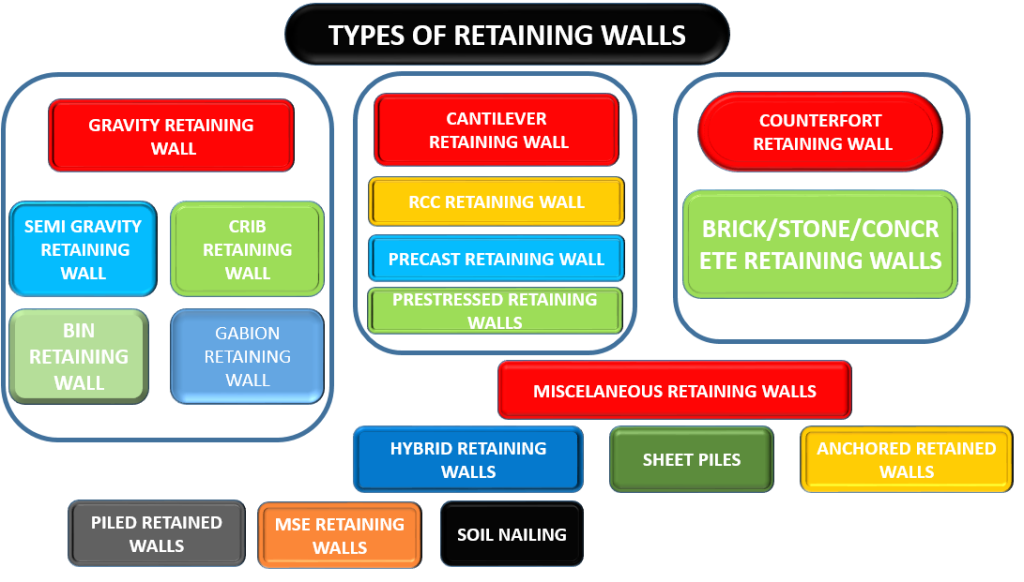
There are several types of retaining wall depends on the nature and type of soil and situations they are to be used.

  • Gravity retaining wall
  • Cantilever retaining walls
  • Counter-fort retaining wall
  • Buttressed retaining wall
  • Sheet pile retaining wall
  • Bored pile retaining wall
  • Anchored retaining wall

There are a lot of innovative and alternated methods used for retaining walls
Retaining wall Types

Gravity Retaining walls

Gravity retaining walls are executed with stone, bricks, concrete, or any other heavy material. They are done with or without mortar and are designed to counter back-fill soil pressure by their self-weight.
Dry retaining walls do not require rigid footing. However, they must be designed to counter sliding. They also need to address overturning and bearing loads acting on the structure.
These types of retaining walls are mainly adopted in landscape areas and also in locations with height is around 2-3 meters.

Gravity retaining wall

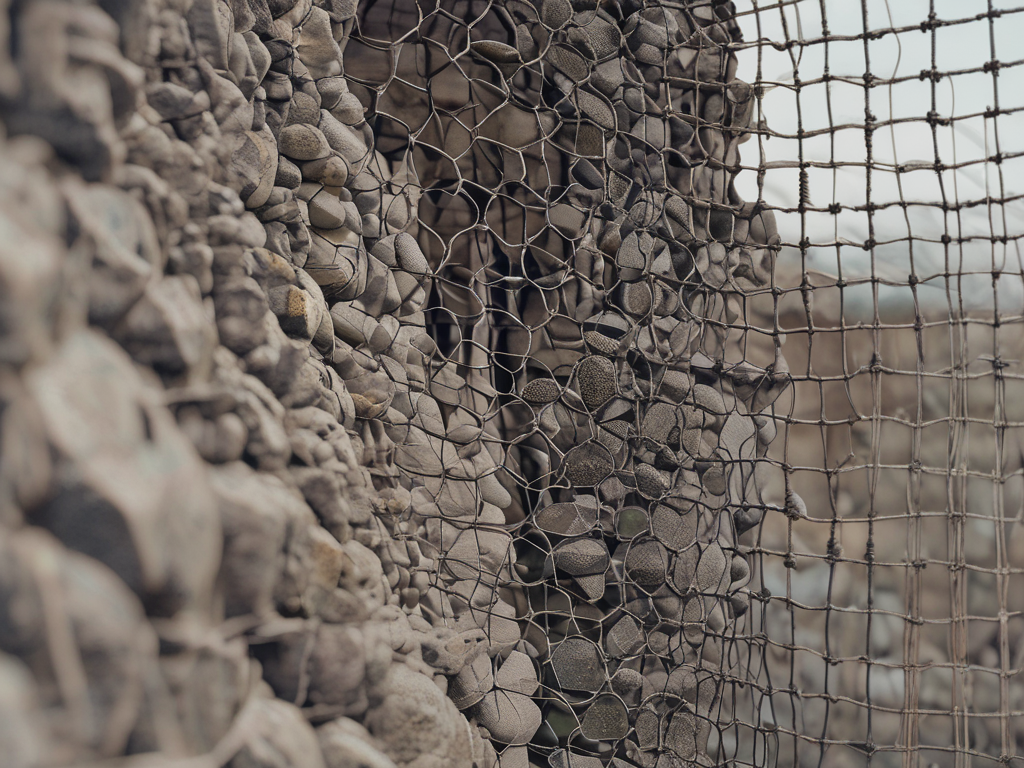
Gravity retaining walls are used for larger heights using composite gravity walls. Composite gravity walls include precast crib walls or timber walls filled with granular materials, Gabion walls, Geowalls, etc.
The gravity wall when provided with a small amount of reinforcement is known as semi gravity retaining wall. The load transfer mechanism remains the same as that of gravity retaining walls.
Gabion wall

Cantilever retaining walls

Cantilever retaining walls are the most common retaining wall type. They are reinforced concrete structures wherein the lateral earth pressure is countered by the cumulative action of total structural members.
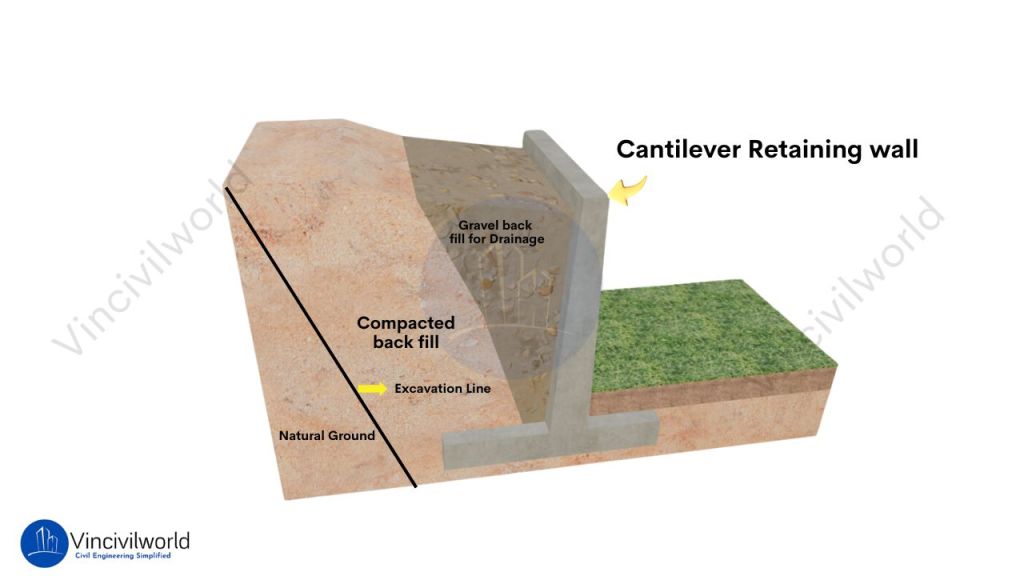
Cantilever retaining walls consist of a stem, a base slab which is divided into toe slab and heel slab as shown in the figure.

Cantilever retaining walls


The vertical stem wall is extended to the back fill side or heel side and is called a heel slab and the slab on the other side is a toe slab as shown in the figure.
The stem wall, toe slab, and heel slab act as cantilevers fixed injunction and spanning to other ends. The back filling of soil over the heel slabs imposes additional stability against lateral pressure and stabilises the wall against overturning and sliding.

The loads induced on various components

a) Heal slab and toe slab = Upward soil pressure from the bottom and tends to bend upward. Rebar is placed in a tension zone.
b) stem= Lateral earth pressure tends to bend in the opposite direction of back-fill.
These types of walls are economical and can be used for heights around 5-7 mtr. They are much lighter than gravity walls and require comparatively small foundations. These types of walls can be constructed as to cast in situ and precast and prestressed concrete depending on the site requirements.

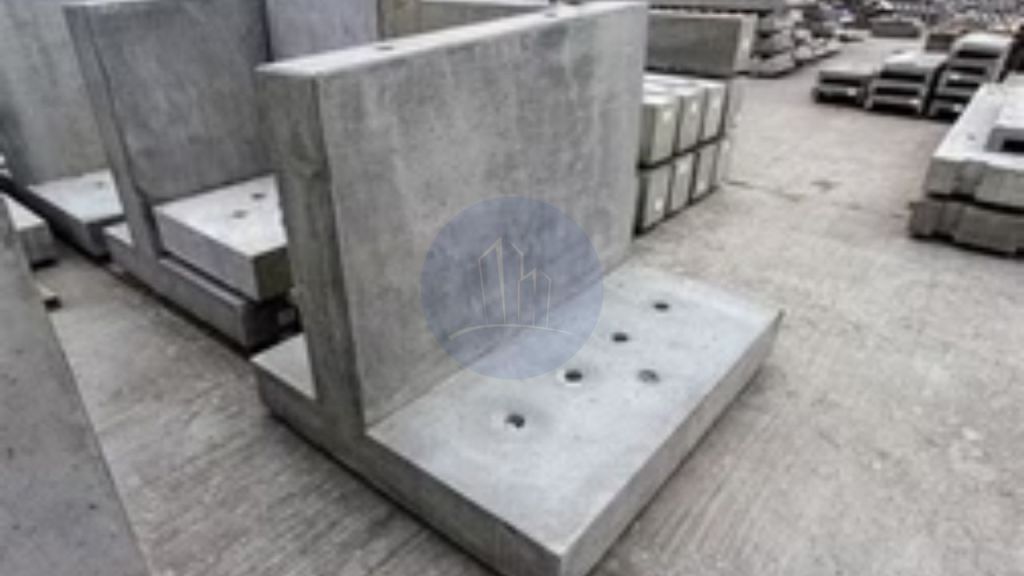
Prestressed retaining wall & Retaining wall

Counter-fort retaining walls

Counter-fort retaining wall is a cantilever retaining wall used when the height is around 7 mtr or more. For economising the structure, vertical bracing called counter-forts are provided on the back fill side. These counter-forts connect the heel slab and stem as shown in the figure. The stem and heel slabs between counter-fort act as continuous slabs and negotiate the high bending movements. The counter-forts function as tension stiffness and reduce the bending and shear stresses. These types of retaining walls are used for heights ranging from around 8-12 mtr.

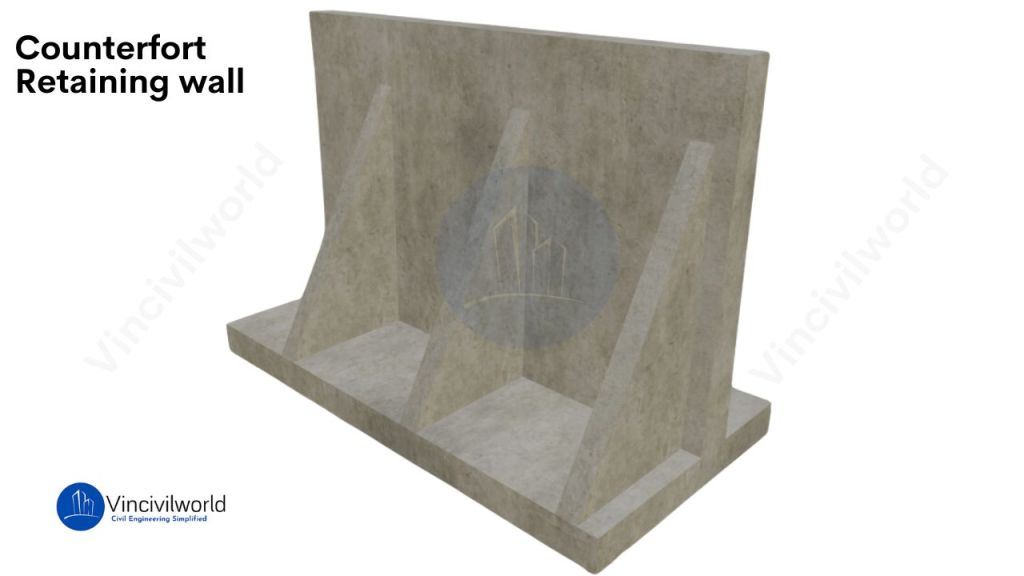
Counter-fort Retaining walls

Buttressed retaining walls

Buttress retaining walls have the vertical bracing located on the front side of the retaining wall in place of the back-fill side like that of counter-fort retaining walls. The structural action of the stem remains the same as the counter-fort walls.

Sheet piled retaining walls

Sheet pile walls are erected using steel sheets into a slope to be protected or for excavations up to a required depth. Sheet pile retaining wall economical till a height of 6m and cannot negotiate huge loads. Sheet pile acts as a temporary wall that is driven into the excavation area for protecting the area from collapsing. They provide high resistance to driving stresses. They can also be reused and are considered the most economical retaining solutions. They can be bolted and driven easily and do not deform on driving. The problem with sheet piles is the noise it creates while driving.
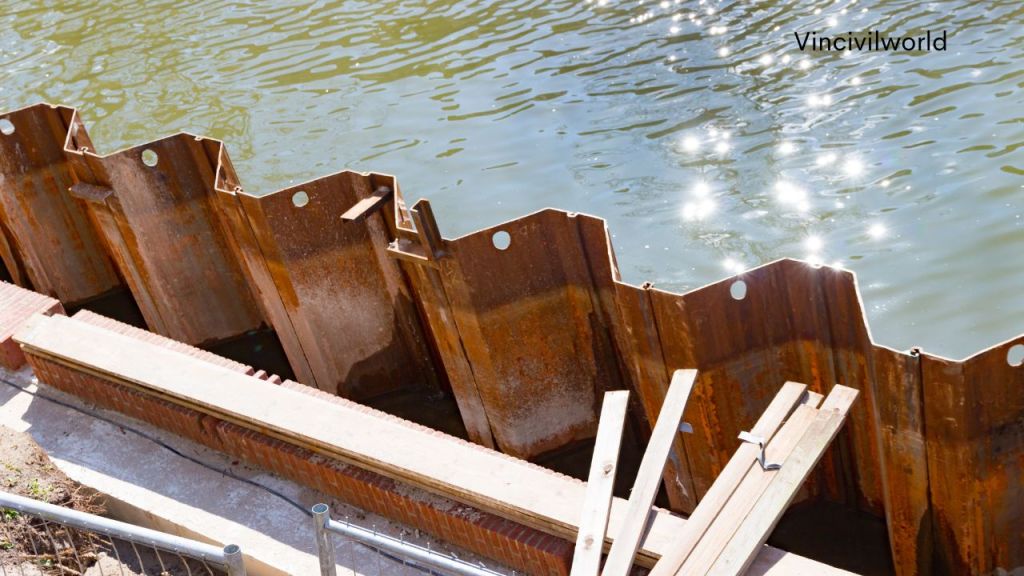
Sheet pile

Piled retaining walls

These types of retaining walls consist of a sequence of bored piles. The bored piled retaining walls are often accompanied by erection earth anchors, shot-creating the pile gaps, and provision of additional supports depending on the site conditions and designs. Bored pile retaining walls are used in areas where sheet pile tends to create a lot of noise and disturbs the areas.
These types of piles are used for temporary and permanent works. They can hold huge lateral pressure and are used for holding earth for high depth excavations without disturbing the nearby structures. Bored pile retaining walls are classified into contiguous pile walls, tangent pile walls & secant pile walls according to the sequence of piling works.
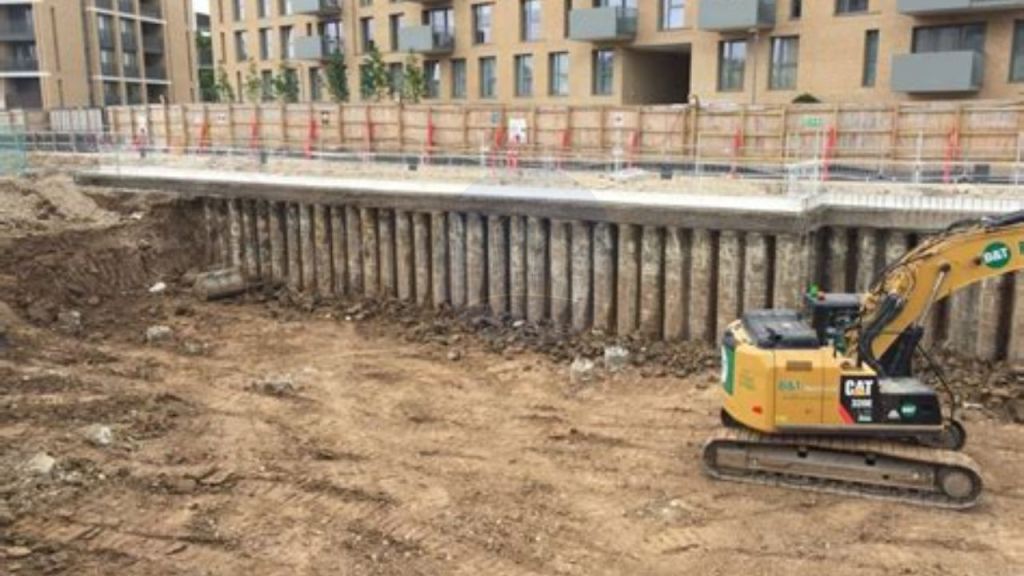
Piled retaining wall

Anchored retaining walls

Anchored retaining walls, also known as tie-back systems, are essential structural components used in construction. They are mostly used to stabilize earth and as support structures. Anchored Retaining walls deliver lateral support to walls. They prevent soil from shifting or eroding. These walls are commonly used in applications like deep excavations, embankments, and hillside retention etc.
Types of deep foundation – A detailed overview.

Types of Deep Foundation – Foundations are broadly classified into shallow foundations and deep foundations. This article is a total overview of Deep Foundations and types of Deep Foundations.

What is a deep foundation?

The foundations having the depth more than the width are called deep foundations. Deep foundations are proposed when the sub soil strata lacks the safe bearing capacity to handle the loads induced by the structure. In such a case the founding level of the foundations are moved to a deeper area with required bearing capacity. The loads on the structure are transferred vertically into the ground.

Deep Foundations

Deep foundations are preferred when the subsurface bearing capacity of the soil is not competent to withstand the proposed loads coming on the structure. In that case, the loads are transferred to a designated design depth or rock/hard strata. The strata is at a deeper location below the ground level capable of negotiating the loads without failure.

Typical section of Deep Foundation

Types of Deep Foundation

Deep foundations are adopted for many applications. They are preferred as the safest option for transferring heavy loads on soil strata with less bearing capacities. Common types of Deep foundation in use are as follows.

  • Basement foundations
  • Caissons Foundation
  • Hollow Box Foundation or Buoyancy foundations
  • Drilled shaft foundations
  • Pile foundations

Types of deep foundation – Basement foundations

Basement foundations are substructure foundations designed to account for parking areas, underground tanks, Electrical systems, and storage spaces beneath a building below ground level. They are mostly adopted in high rise residential buildings and commercial buildings. Basement foundations cater to the functional requirements of parking and storage.

Also Read : Types of Foundations- Shallow and deep foundations

Also Read : Types of shallow Foundations – Advantages & Suitability

Caissons foundation

Caisson foundation is a water-retaining structure that serves as a working space to work on the foundations of piers. They are box-type structures made of timber, steel, concrete, etc. Caisson Foundation is sunken by excavating the earth within the foundation. Caissons are prefabricated above the ground level or water level and are sunk to the founding level as one single unit. They are constructed to facilitate excavation and related works for foundations of the dock structure, bridges, jetty, piers, foreshore protection, etc. These structures later form an integral part of the main structural components.

Hollow box foundation or Buoyancy foundations

The concept of a hollow box foundation is to design a structure with minimal or no impact on the original stress of soil before commencing excavation. Required overburden as per the design is removed and superstructure loads are transferred to the ground. These types of foundations are known as Buoyancy foundations because they adopted the principle of a ship floating in the water, where the displaced water equals the weight of the ship.

Drilled shaft foundation

The drilled shaft is a versatile foundation system used extensively nowadays. These foundations are also known as a drilled pier, drilled caisson, bored pile, etc. The basic concept is excavating a cylindrical shaft and casting after putting necessary reinforcements. Diameters ranging from 1-3 mtr and depths up to 100 mtrs are preferred for drilled Shafts can be drilled from diameter ranging from 1 to 3 mtr and a depth of 100 mtrs normally. But higher depth and diameter are also possible nowadays. These types of foundations can replace driven piles to some extent where a single drilled shaft can replace a group of pile.

Pile foundations

Pile foundations are long slender members, which can be concrete, steel or any other material used for transferring the loads of a structure when the subsoil lacks the bearing capacity . The pile foundations transfer the load vertically through the less denser top layer to a high denser soil/rock layer which can negotiate the loads without failure.

Must Read : Pile foundations Classification,Types and Advantages

Typical Cross Section of Pile foundation
pile foundations

Video showing different types of shallow foundations

Types of shallow foundations – Advantages & Suitability

Types of shallow foundations – Foundations are broadly classified into shallow foundations and deep foundations. This article is a total overview of shallow foundations and the types of Shallow foundations.

What is a shallow foundation ?

Shallow foundations transfer the load laterally to the soil. It is also called stripped foundations. The depth of a shallow foundation is less than its width. Shallow foundations are adopted when the load acting on a structure is reasonable and has a competent soil layer capable of negotiating the loads available at a shallow depth or shorter depth.

A shallow foundation is placed on the surface of the ground. The depth of a shallow foundation can range anywhere between 1 meter to 3.5 meters and sometimes more. The width of the shallow foundation is greater than the depth.

  1. What is a shallow foundation ?
  2. Types of shallow foundations
    1. Shallow foundation – Spread footing or isolated footing
      1. Simple spread footing
      2. Sloped spread footing
      3. Stepped spread footing
    2. Types of shallow foundations- Strip footing
    3. Types of shallow foundations – Combined footing
    4. Strap footings
    5. Mat or Raft foundations
  3. Types of shallow foundations – Suitability

Types of shallow foundations

There are different types of shallow foundations adopted as per site conditions and design requirements.

Shallow foundation – Spread footing or isolated footing

The spread footing is one of the most commonly used types of shallow foundations. They are also called isolated footing or individual footings. Spread footings are further classified into simple spread footing, sloped spread footing, and stepped spread footing based on the shape of the footing.

  • Simple spread footing
  • Sloped spread footing
  • Stepped spread footing

Simple spread footing

This is a common type of spread footing. Simple spread footing consists of a base footing with a single column over it. This type of foundation is used for structures with reasonable loads and bearing capacities.

Types of Shallow Foundations-Simple Spread Footing
Types of shallow Foundations -Isolated or spread Footings.

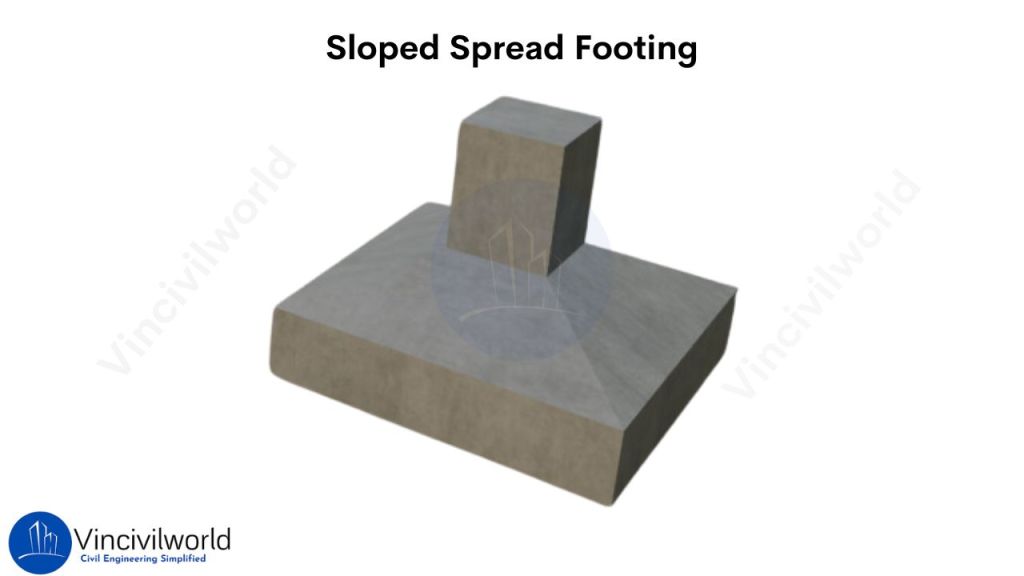
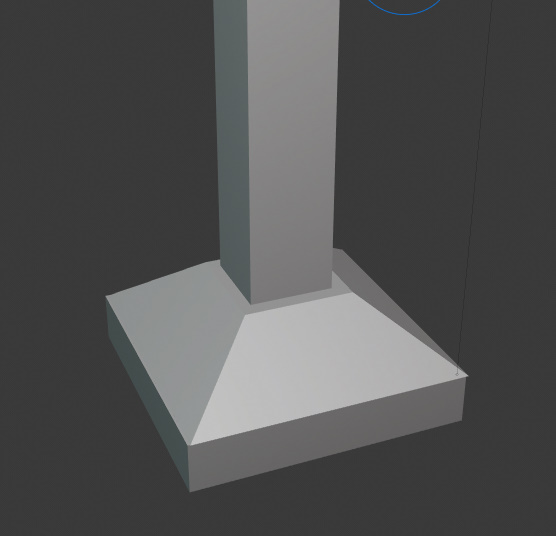
Sloped spread footing

In this type of foundation the footing is sloped as shown in the figure. The footing carries a single column. The cross section of these types of footings are trapezoidal.

Types of Shallow Foundations-Sloped Spread Footing
Sloped Spread Footing

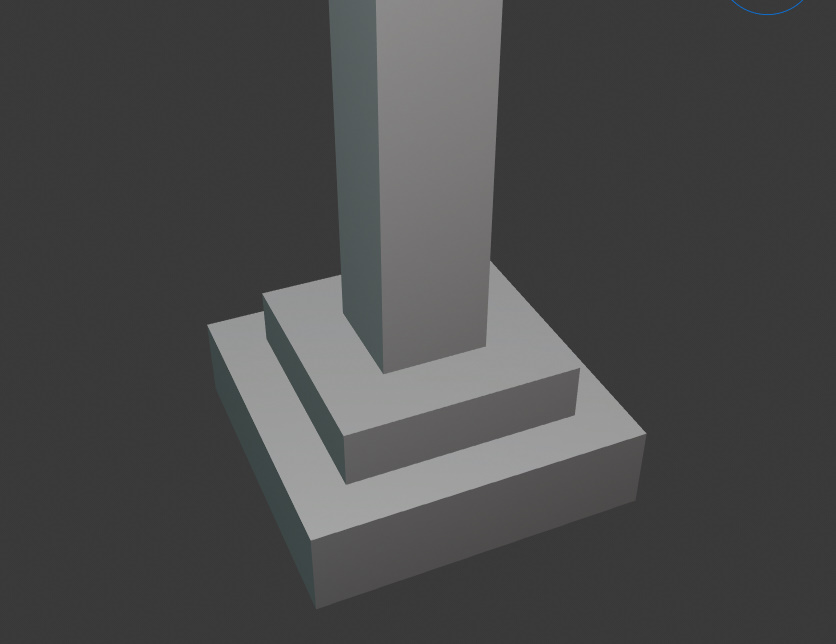
Stepped spread footing

When the loads are high steps are provided in the footings as shown in the figure.

Types of Shallow Foundations-Stepped Spread Footing
Stepped Spread Footing

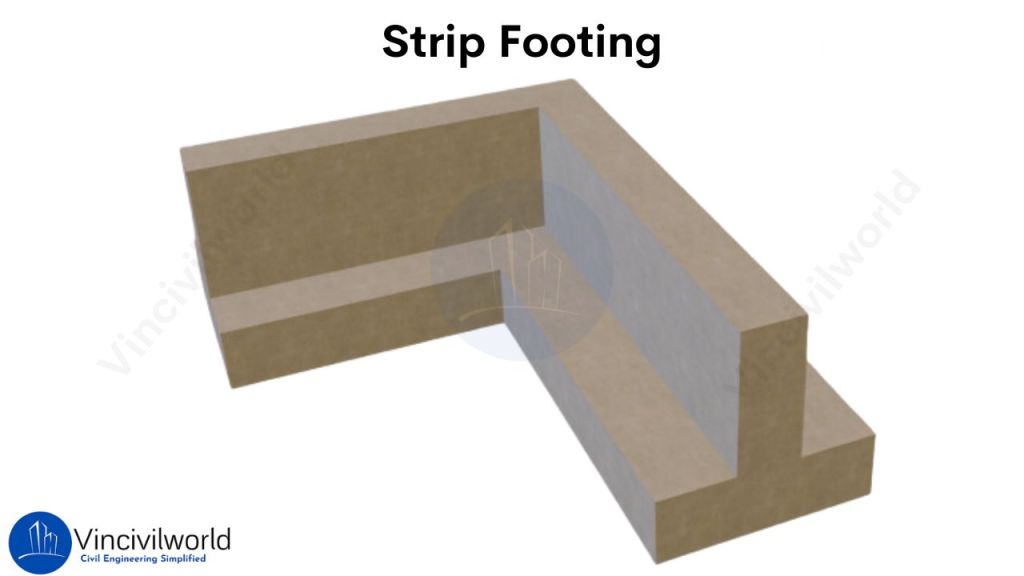
Types of shallow foundations- Strip footing

Strip footings are also called wall footings. They are used for providing load-bearing brick/stone/RCC walls over the footings. Strip footings run continuously throughout the wall area of a building. These types of footings are also used when the spacing between the columns is very less and the footings overlap each other.

Types of Shallow Foundations-Strip Footing
Strip Footing
Types of Shallow foundation : Strip Footing

Types of shallow foundations – Combined footing

Combined footing consists of two or more columns over a single footing. These types of footings are adopted when the distance between the two individual footings are very less and overlap each other. A combined footing is also provided in areas where further excavation is not possible due to any flushing with the boundary. A combined footing is classified as rectangular combined footings and trapezoidal combined footings.

Trapezoidal Combined Footing
Rectangular Combined Footing

Strap footings

Strap footings are also called cantilever footings consisting of two individual footings connected through a beam strap. The beam strap is designed as a rigid structure. These types of foundations are economical than combined footings.

Strap Footings
Strap Footings
Shallow foundation types : Strap Footing

Mat or Raft foundations

Raft foundation – One of the most commonly used types of foundation in construction is a continuous slab resting on the soil and covering the total area of the proposed structure. There are different types of raft foundations based on their applications. The selection of the type of raft foundation depends on a lot of factors like bearing capacity, loads, site conditions, etc.

Raft Foundation
Raft Foundation
Raft Foundation

Raft foundation/Mat foundation is a solid slab placed at a designed depth spreading over the entire area of the structure. Raft foundations consist of columns and shear walls for transferring loads coming on the structure to the ground. These types of foundations are mainly used when the bearing capacity of the soil is low and becomes difficult for individual footings to negotiate the loads. The raft foundation helps to transfer the entire load of the structure to a larger area.

Also read : RAFT FOUNDATION – TYPES & ADVANTAGES

Also read : PILE FOUNDATIONS – TYPES & ADVANTAGES

Types of shallow foundations – Suitability

Shallow foundations are very easy to construct and do not require highly skilled manpower and professional supervision. These foundations can even be done with the help of medium-skilled workers. A shallow foundation is very economical when compared with a deep foundation. Shallow foundations are end bearing type foundations that transfer loads to the end of the foundation.

Shallow foundations are considered as the most preferred option when the safe bearing capacity of the soil is reasonable and the structural loads are within the permissible limits.

VIDEO – SHALLOW FOUNDATIONS – DIFFERENT TYPES & ADVANTAGES

Balancing Raft or Floating Raft Foundation

<p value="Balancing rafts or floating rafts are used when the bearing capacity of the soil is very low. This <a rel="noreferrer noopener" href="https://vincivilworld.com/2020/05/25/foundation-types-shallow-and-deep-foundations/&quot; target="_blank">foundationBalancing rafts or floating rafts are used when the bearing capacity of the soil is very low. This foundation protects against soil settlements and works on the principle that the total weight of the soil and water excavated for the foundation equals to the total load of the proposed structure. They are called zero settlement structures and are used for high rise towers with multiple basements. This type of foundation is preferred only when the soil is very compressive and soft and even friction piles are not able to support the loads.

Also Read : Types Of Raft Foundations

Also Read : Pile Foundations – Types and Advantages

How Floating Raft Works?

Balancing Raft /Floating Raft Methodology

The basic concept of a floating raft is countering the weight of excavated soil and water with the total load of the structure resting over it. ie. The same weight of excavated materials is replaced by a structure with the same weight. Because of these balancing floating rafts are also known as balancing raft foundations or compensated foundation. The vertical pressure at the foundation depth remains same before and after excavation.

Advertisements

Concerns of Floating Raft/Balancing Raft

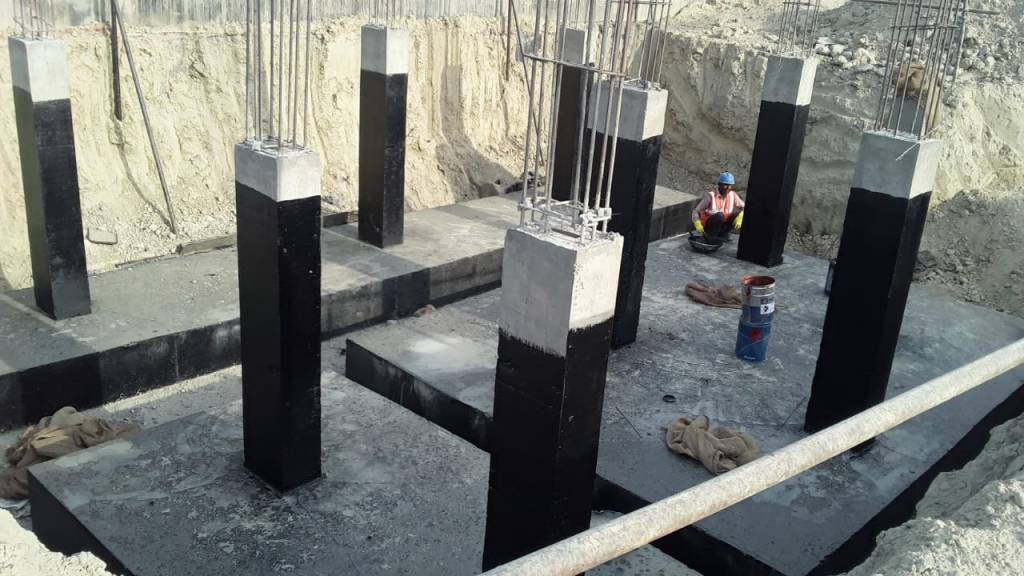
Execution of a floating foundation demands massive earthwork excavation in high water table areas. Open dewatering may not be sufficient to control a large amount of water flowing in the excavated areas. Wellpoint dewatering systems have to be run simultaneously with the excavation to lower the water table.

Excavation of floating foundations can trigger soil collapse and soil scoring from the bottom of existing foundations. Sheet piles have to be erected to protect the building against any possible damage during excavation.

Materials required for temporary retaining walls like sandbags, PCC blocks, etc has to be organised and mobilised before starting excavation. Temporary retaining walls have to be constructed in tandem with excavation works.

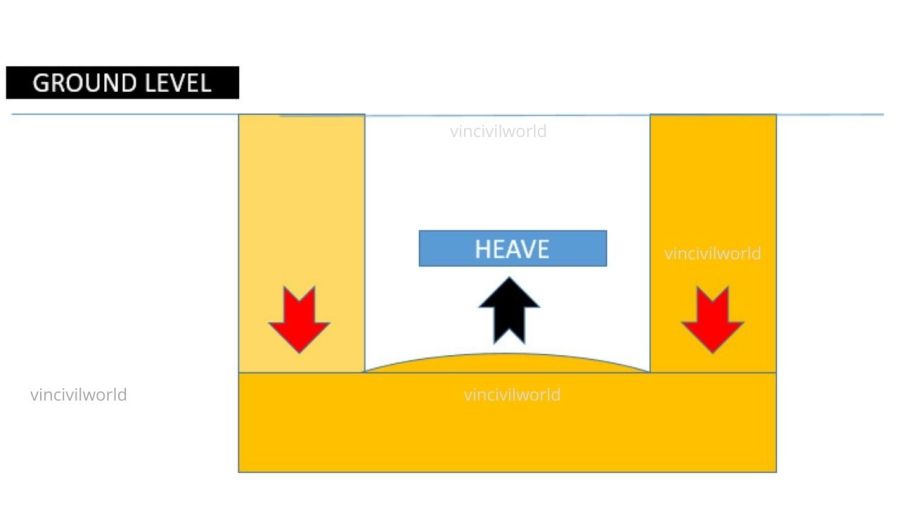
Heave formation in Floating Raft Foundation

Heave formation can always happen while doing deep excavations because of the weight of soil on both sides of the excavation pit. Heaves formations cannot be avoided in any case but have to be controlled or else it may initiate foundation settlements. Heave formation can be minimised by further lowering the water table to a depth below the founding level of the structure. Installation of friction piles or micro piles on partially completed excavation surfaces can also control heave formation to an extent. Concrete bands are provided at the bottom level to control heave formation.

Balancing raft foundations are adopted for high rise buildings with multiple basements. Execution of these foundations requires highly skilled professionals and micro-level supervision supported by an experienced and skilled workforce. All safety precautions have to be done to protect the nearby structures from any damage.

VIDEO : RAFT FOUNDATION – TYPES AND ADVANTAGES

Advertisements

Foundation types- shallow and deep foundation

Foundation is the most significant part of any structure/building which transfers the total loads of the structure and its components to a competent surface on the ground. Foundations are broadly classified into two types. ie. Shallow and Deep Foundations.

Foundation is the last part of the structure which touches the ground. The area of contact with the ground is called the foundation bed.

Every structure is divided into:

a) Sub structure

b) Super structure

Components of a structure that are coming below the ground level are called substructure, and above ground level is called superstructure. Foundations are coming in the substructure category. Foundations are responsible for transferring loads of superstructure components to the ground.

HOW TO FIX TYPE AND SIZE OF FOUNDATIONS?

The selection of foundations depends on the bearing capacity of the soil and the purpose of the structure. Geotechnical engineering is a field of Civil Engineering, which analyses the physical and chemical properties of soil and furnish designers with the inputs on the soil properties and proposed types of foundations. The Safe bearing capacity of the soil determines the foundation type and dimensions.

SAFE BEARING CAPACITY OF SOIL

Bearing capacity is the capacity of soil to support a structure without settlement or failure. To keep the structure safe, the bearing capacity has to be calculated at different locations. The ultimate bearing capacity has to be divided by a factor to derive the safe bearing capacity of the soil. Safe bearing capacity is defined as the maximum load per unit area soil can withstand without settlement and failure. The safe bearing capacity is determined by conducting field tests or soil investigations.

QUALITIES OF A WELL DESIGNED FOUNDATION

SHALLOW FOUNDATION
SHALLOW FOUNDATION

A well-designed foundation is supposed to possess the following qualities.

a) Have to distribute the total load on the structure to a larger area.

b)Have to counter unequal settlement in case of any displacement.

c) Has to prevent the structure from lateral moments.

d) Foundations are responsible for the total stability of structures.

DIFFERENT TYPES OF FOUNDATIONS

Foundations are classified into

a) Shallow Foundation

b) Deep Foundation

SHALLOW FOUNDATION

Advertisements
SHALLOW FOUNDATION
SHALLOW FOUNDATION

Shallow foundations transfer the load laterally to the soil. It is also called stripped foundations. The depth of a shallow foundation is less than its width.

Characteristics of shallow foundations

Shallow foundations are adopted when the load acting on a structure is reasonable and has a competent soil layer capable of negotiating the loads available at a shallow depth or shorter depth.

Shallow foundations are placed on the surface of the ground. The depth of a shallow foundation can range from 1 meter to 3.5 meters and sometimes more.

The width of the shallow foundation is greater than the depth. Shallow foundations are very easy to construct and do not require highly skilled manpower and professional supervision. These foundations can even be done with the help of medium-skilled workers. A shallow foundation is very economical when compared with a deep foundation. Shallow foundations are end bearing type foundations that transfer loads to the end of the foundation.

Shallow foundations are considered as the most preferred option when the safe bearing capacity of the soil is reasonable and the structural loads are within the permissible limits.

DEEP FOUNDATION

DEEP FOUNDATION
DEEP FOUNDATION

Characteristics of deep foundation

The width of the deep foundation is less than the depth. The depth can even go up to 60 meters or more depending on the design, loads, and availability of capable strata.

Deep foundations require technical expertise, sophisticated equipment, and highly skilled manpower for interpreting and executing works.

The deep foundations are costly due to their way of execution involving the infusion of quality materials, skilled labor, professional engineering support, and equipment

Deep foundations do not rely only on end bearing for transferring the loads. The skin friction developed between the foundation surface and the soil surrounding it may also be considered in the design stage.

The deep foundations can resist uplift pressure much more than shallow foundations and hence the chances of failure are less compared to shallow foundations.

SHALLOW FOUNDATION VS DEEP FOUNDATION