Today, we are going to talk about one of the interesting innovations, smart building. With the advancement of technology, civil engineering has seen mouthful innovations in the past decade.
We will find out everything you need to know about smart buildings.
Let’s start from the definition.
What is a smart building?
Smart buildings view
A smart building is any structure that uses automated processes, including heating, ventilation, air conditioning, lighting, safety and other systems, to automatically control the building’s operations.
In order to gather data and handle it according to the functions and services of a company, smart buildings use sensors, actuators and microchips.
This infrastructure helps owners, operators and facility managers increase the efficiency and performance of facilities, decreasing energy usage, maximising the use of space and mitigating the impact of buildings on the climate.
In the next section, I will walk you through the process of building smart buildings.
The creation of a smart building
Making a smart house, or making a building smart, starts by connecting sensors and control systems to core systems such as lighting, power metres, water metres, pumps, heating, fire alarms and chiller plants.
Also elevators, access systems and shading may become a part of the system at a more advanced level.
There is no single collection of norms that makes up what a smart building is, but convergence is what they all have in common.
Many new buildings have “smart” technology and are connected to a smart power grid and are sensitive.
To operate in smart buildings, you don’t even need to move offices or create a new building.
In order for property owners to take advantage of the power available in older buildings, building automation systems such as those from Honeywell or Johnson Controls exist.
Next, we will find out the benefits of smart buildings.
Let’s come to the main features section.
The main features of smart buildings
Highly automated building
Systems are connected
The most fundamental characteristic is the connection of the core systems within it.
So, all connected are water metres, pumps, fire alarms, electricity, lighting etc.
This is what makes “smart” a building-the capacity of the systems inside it to communicate with each other.
2. The use of sensors
Use of sensors can help make various activities easier and effective.
There are different types of sensors available to be used according to the purpose
3. Automation
The systems that have been placed in place collect and interpret information, and this is done continuously and in real-time, basically.
This continuous monitoring makes it possible to make automatic changes that can control conditions in an entire building.
4. Data
These type of buildings create a large amount of useful data about their own usage, which is something that is obviously not done by standard buildings.
Improve decision-making throughout the organization.
You have seen the different aspects of a smart building. It indeed is an innovation worth incorporating in your life. Let me know if you have any doubts in comments.
Hyperloop technology has been in mainstream headlines ever since Elon_Musk announced its construction. Today, we are going to discuss in detail about all the aspect of a hyperloop.
The working of hyperloop, its pros and cons, technical details, will be explained in each of the following sections.
Let’s start from the definition.
What is Hyperloop technology?
Hyperloop technology is a new method of ground transport currently being built by a number of businesses. It will see passengers moving in floating pods at over 700 miles an hour, speeding either above or below ground along inside massive low-pressure tubes.
The next question is why is it a buzz word.
Hyperloop Technology
What makes Hyperloop different?
Between Hyperloop and conventional rail, there are two major differences. Firstly, to minimise friction, the pods carrying passengers fly through tubes or tunnels from which much of the air has been extracted.
This should allow up to 750 miles per hour for the pods to fly.
Secondly, the pods are designed to float on air skis rather than using wheels like a train or vehicle, using the same basic concept as an air hockey table, or using magnetic levitation to minimise friction.
Hyperloop may be cheaper and quicker than train or car travel, and cheaper and less polluting than air travel, proponents claim.
They say that construction is both faster and cheaper than conventional high-speed rail.
Therefore, Hyperloop may be used to take the burden off gridlocked highways, making it easier to fly between cities and, as a result, potentially unlocking major economic benefits.
Time to look at the working of the hyperloop tube.
How does a Hyperloop tube work?
As envisioned by Musk, the basic concept of Hyperloop is that the passenger pods or capsules fly through a tunnel, either above or below ground.
Much, but not all of the air is extracted from the tubes by pumps to minimise friction.
One of the greatest uses of energy in high speed transport is to conquer air resistance.
To travel through less dense air, airliners ascend to high altitudes; Hyperloop encloses the capsules in a reduced-pressure tube to produce a similar effect at ground level, essentially allowing the trains to travel at aeroplane speeds while still on the ground.
The pressure of the air inside the Hyperloop tube in Musk’s model is around one-sixth of the atmospheric pressure on Mars (a noteworthy contrast as Mars is another of Musk’s interests).
This would mean an operating pressure of 100 pascals, which would decrease the drag force of the air by 1,000 times compared to the conditions at sea level and would be equal to flying above 150,000 feet.
Next, we will see the working of hyperloop capsules.
How do Hyperloop capsules work?
In Musk’s model, the Hyperloop capsules float above the surface of the tube on a set of 28 air-bearing skis, close to the way the puck floats just above the table in an air hockey game.
One major difference is that the air cushion is created by the pod, not the track, in order to keep the tube as easy and cheap as possible.
In order to hold the passenger pods above the tracks, most Hyperloop models use magnetic levitation rather than air skis.
From an external linear electric motor, the pod would get its initial velocity, which would accelerate it to ‘high subsonic velocity’ and then give it a boost every 70 miles or so; in between, the pod would coast along in close vacuum.
Each capsule could hold 28 passengers plus some luggage (other variants are designed to carry up to 40 passengers); another variant of the capsule could carry freight and vehicles. Pods quit every two minutes (or every 30 seconds at peak usage).
We will move on to the benefits of hyperloop to society.
The potential benefits to society
Study figures show that by using a hyperloop or 83 minutes by national rail, the journey from London to Birmingham will take nine minutes-a cumulative saving of 74 minutes.
Other distances include 22 minutes to Newcastle from London (saving 149 minutes), 29 minutes to Edinburgh from London (saving 231 minutes) and just 31 minutes to Glasgow from London (saving 238 minutes).
Shorter trips to the capital would open up opportunities for employment and have a beneficial effect on tourism and sustainability.
Entry to education will also be increased by Hyperloop.
Choosing one that is right for you but is not too far from home is a challenge that many faces when choosing their prospective university, with universities spread across the world.
However, there is no longer a limit to choosing universities close to home with city-to-city connections via hyperloop, which dramatically reduces travel time.
Aside from cutting travel time, hyperloop would help to solve the housing crisis.
Because of financial uncertainty, the cost of living in locations like London and San Francisco is driving the poorest people out.
Therefore, people would be more likely to live outside of the city by making travelling to locations across the world cheaper.
Travelling cheaply from Edinburgh to London, for example, will encourage more people to live in Edinburgh, which has a considerably lower cost of living than London and a large stock of available homes.
Similarly, houses in Los Angeles are about 66% cheaper than in San Francisco, with just 30 minutes of travel time between the two.
The Hyperloop is not only intended for the transport of passengers, but also for the transport of goods.
This would increase delivery time, prevent package damage and reduce the number of delivery vehicles, resulting in lower emissions.
So what’s driving this new big form of transportation? The easy answer to that is electricity and solar power.
From an external linear electric motor, the pods would get their speed, and the tube would have solar panels mounted on top that would produce more electricity.
Therefore, to power the hyperloop to its peak speeds, only a small amount of electricity is required, making this one of the most environmentally friendly modes of transport alongside the electric car.
That’s it about hyperloop technology. Do you think it’s going to revolutionise the transportation sector? Let me know your doubts in comments.
Types of road construction are significant to understand the category of roads and their characteristics. In this blog, we will find out the details of 5 types in detail.
5 Types of road construction
In this section, the important types of road construction is broken down in detail.
Whitetopping is the coating of a layer of Portland cement concrete on the existing asphalt pavement.
Depending on the thickness of the concrete sheet and if the layer is bonded to the asphalt substrate, whitetopping is divided into different types.
The main objective of an overlay is either to restore the existing pavement or to improve the load-carrying capacity, or both.
In achieving this goal, in addition to rectifying other defects such as loss of texture, overlays often restore the ride-ability of existing pavements that have experienced rutting and deformation.
Asphalt is considered to be much less robust and powerful than most other alternatives and is therefore not the best for the setting.
Polymeric fibres are now used because they are cost-effective and have no chance of corrosion.
Polymeric fibres are either polyester or polypropylene that are normally used.
FRC material technology, including highways, local streets, intersections, parking lots, bus pads, sidewalks, driveways, bridge decks, pavement overlays, manufacturing floors, airfield pavement overlays, and patches, is used for a large number of pavement applications.
FRC may be used for new construction as well as for maintenance (patching), rehabilitation (overlays), and reconstruction.
The use of FRC for bonded concrete overlays on asphalt or composite pavements has seen substantial growth in the past few years for minor pavement rehabilitation.
The thickness of an asphalt bonded concrete overlay (BCOA) varies from 3 to 6 in., and the thinner installations were the majority of FRC overlays of this kind.
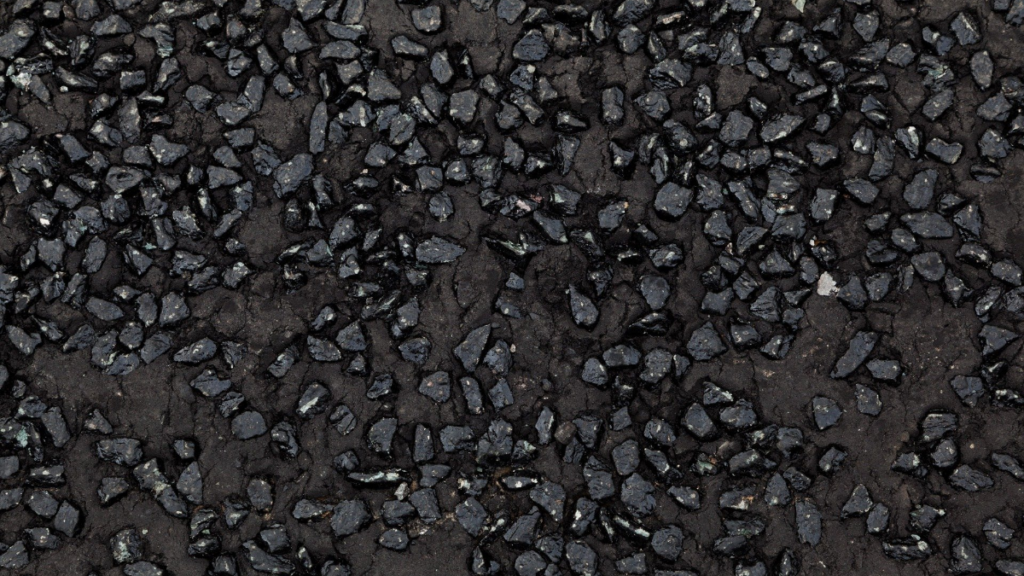
Bituminous surface treatment (BST) or chip seal is primarily used as a sealing coat to rejuvenate asphalt concrete pavement, but also on low-traffic highways.
It typically consists of aggregate spread over an asphalt emulsion sprayed-on or asphalt cement cut-back.
By rolling it, usually with a rubber-tired roller, the aggregate is then deposited in the asphalt.
“A broad range of regional words, like “chip seal,” “tar and chip,” “oil and stone,” “seal coat,” “sprayed seal,” or “surface dressing,” or simply “bitumen,” define this form of surface.
These are laid down using specialised and proprietary equipment.
In urban areas where the roughness and lack of stone associated with chip seals are deemed inappropriate.
Composite pavement road
Concrete road
In composite pavements, portland cement concrete sublayer is mixed with asphalt.
Usually, they are used to rehabilitate existing roadways. To restore a smooth wearing surface, asphalt overlays are sometimes laid over distressed concrete.
For reflective crack management, geosynthetics can be used.
A heavyweight is dropped on the concrete with breakage and seat and crack and seat processes to cause cracking, then a heavy roller is used to seat the resulting parts into the subbase.
The machinery used to crack the concrete pavement and the scale of the resulting fragments is the key difference between the two methods.
The hypothesis is that regular small cracks disperse thermal stress over a wider area than uncommon large joints, minimising the strain on the asphalt pavement overlying it.
Rubblization is a more complete fracturing of the old, worn-out concrete that essentially turns the old pavement into a new asphalt road aggregate base.
Gravel road
Two distinct uses of road surfacing have been used to add gravel, or “metalling.”
Second, the highway path would have been dug down several feet and French drains may or may not have been installed, depending on local conditions.
Large stones were then positioned and compacted, accompanied by successive layers of smaller stones until the road surface consisted of small stones that had been compacted into a rough, durable surface.
“Road metal” later became the name of stone chippings combined with tar to form the tarmac material for the road surface.
The decision on whether or not to pave a gravel road also depends on the amount of traffic.
Maintenance costs for gravel roads have been found to sometimes exceed maintenance costs for paved or surface-treated roads if the traffic level reaches 200 vehicles a day.
I hope you found the article insightful. Let me know in comments if you have any doubts.
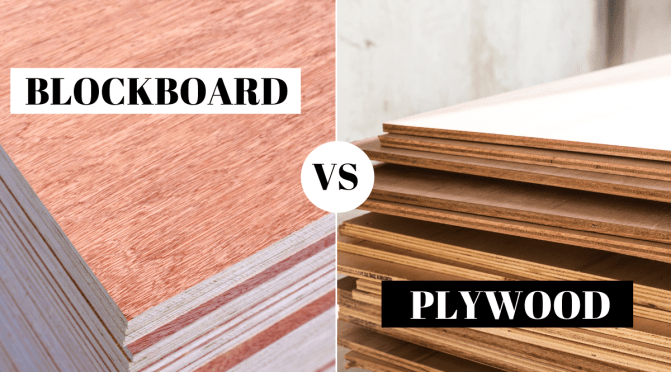
Blockboard vs plywood, Most people get confused with these terms because of the similarity in looks, and both products are popularly used in interior works, home decor, and furniture works. In reality, both these materials are different types of engineered wood and possess entirely different properties, and are used for specific interior applications.
Blockboard, with its core of softwood strips sandwiched between veneers, is known for its strength and durability. In contrast, plywood features multiple layers of thin veneer glued together, providing flexibility and stability. As you weigh plywood vs block board, consider how each material meets your needs for load-bearing, cost, and aesthetics. Blockboard plywood is often preferred for heavy-duty applications, while plywood and blockboard both offer versatility for different uses. This blog explains and clarifies the differences and properties of ply board/block-board and can make the right choice.
Plywood is an engineered wood panel manufactured by joining sliced wood veneers 2-4 mm thick in a cross-layered pattern and pressed under high temperature to form sheets.Unlike blockboard, plywood is flexible and resistant to warping. This makes it ideal for a wide range of applications, from furniture to construction. When comparing blockboard vs plywood, plywood’s adaptability and ease of use stand out.
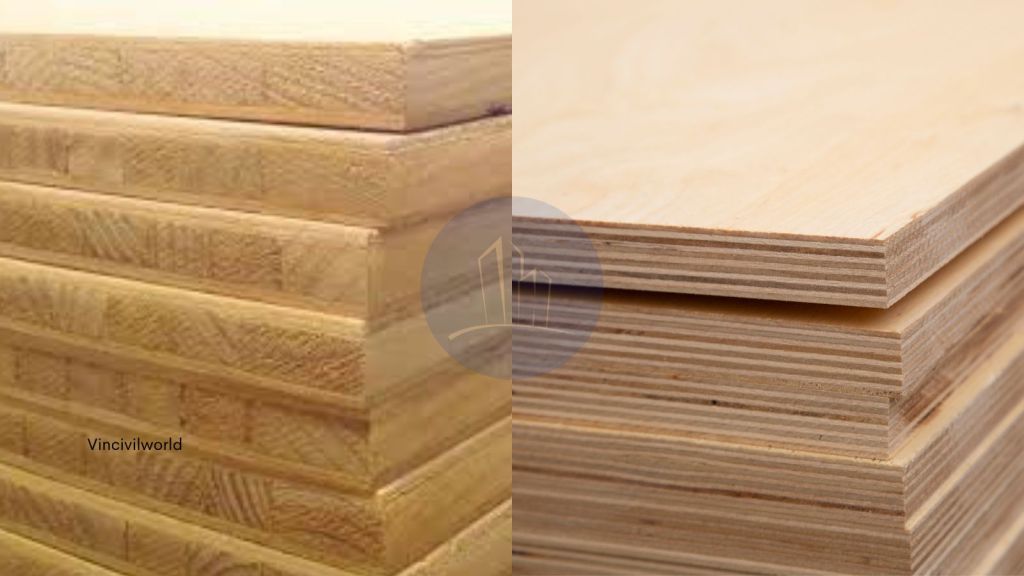
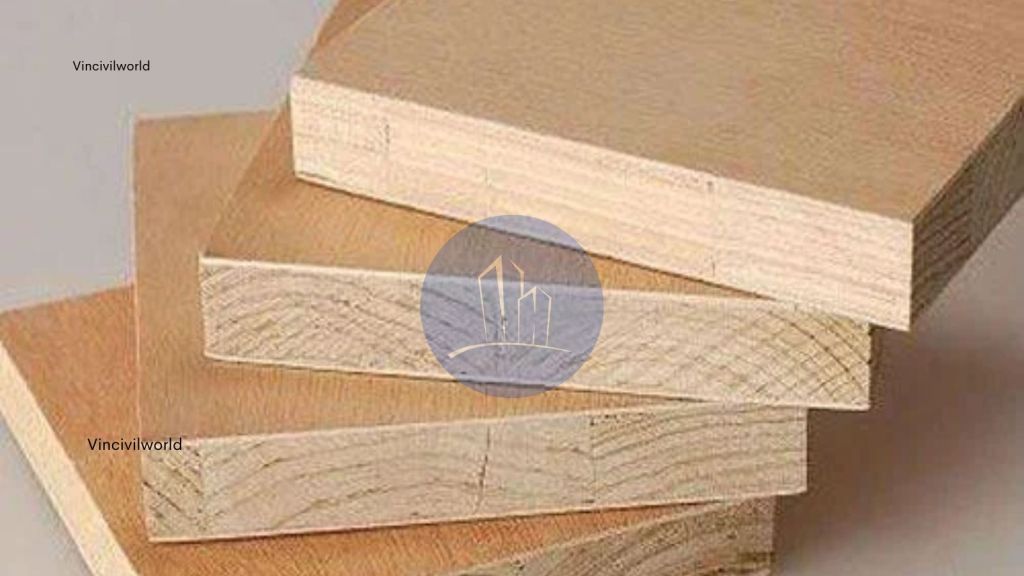
Plyboard or blockboard is an engineered wood panel made of a core comprising of softwood wooden strips or blocks placed edge to edges sandwiched between two wood veneer layers. This construction gives it strength and durability, making it ideal for heavy-duty applications like furniture and doors. These veneer layers are glued and pressed under high pressure and temperature to form a plyboard/blockboard. Compared to plywood, blockboard is thicker and provides better load-bearing capacity. When considering blockboard vs plywood, blockboard excels in situations requiring robust support and rigidity.
Let us have a comparison between the properties , types and uses of Plyboard and plywood/blockboard. This comparison highlights key differences to help you choose the best material for your project.
Composition and Manufacturing process
Ease of handling
Strength and durability
Water and moisture resistant properties
Physical properties
Screw Holding capacity
Flexibility in applications
Sound insulation properties
Sizes available
Economy
Service life
Manufacturing process – Blockboard vs Plywood
Blockboard/Plyboard
Plywood
Small wooden strips are placed edge to edge sandwiched between sliced wooden veneers.
Plywood is made in an odd number of veneer layers starting from 3 layers more depending on the thickness of the plywood.
Block boards are made in either 3 layers or 5 layers. It is like a wooden frame filled with small wooden strips and covered by wooden veneers on the faces.
The veneers are arranged in a cross layered pattern.
Blockboard vs plywood involves different core materials and manufacturing methods. Blockboard has a core of softwood strips with outer veneers, while plywood features alternating layers of veneer. Each method affects the material’s strength, flexibility, and final use.
Ease of handling – Plywood vs Blockboard
Blockboard/plyboard
Plywood
Blockboard mostly uses softwood core and hence blockboard is lighter than plywood.
Plywood grades use dense hardwood and the layers are pressed to form plywood.
Due to their lightweight nature, they are easy to transport and handle.
plywood is solid and heavier than Blockboard.
Blockboard uses softwood for its core, making it lighter compared to plywood, which uses dense hardwood veneers. Consequently, blockboard is easier to handle and move, while plywood’s weight can make it more challenging to work with.
Strength and durability
Plyboard/Blockboard
Plywood
Mostly uses softwood in the core. Softwoods are soft and have low strength and hence blockboards have moderate strength.
Mostly uses hardwood veneers arranged in a uniform cross-layered pattern. Plywood is much stronger than blockboard.
Plyboard is strong compared to particleboard and MDF but is less durable as compared to plywood.
Low-density plywood can even take moderate loads. They are strong and durable when compared with blockboards/plyboards.
Blockboard looks plain from the outside, but minor gaps are inside the core.
Plywood layers are uniform in both directions and no gaps will be there.
Blockboard provides robust strength due to its core of softwood strips, making it suitable for heavy-duty applications. However, it can be affected by moisture. Plywood, with its layered veneer construction, offers consistent strength and high durability, making it resistant to environmental changes and suitable for diverse uses.
Water and moisture resistant properties
Plyboard/Blockboard
Plywood
Blockboards retains moisture and more prone to water and moisture damages.
Plywood grades like BWR (Exterior Grade)and Marine ply are less suspectable to water and moisture.
They can be made waterproof by using BWP Grade (Boiling Water Proof) resin for bonding the strips.
Plywood grades like BWR (303 grade) and Marine ply (710 grade) are superior to block boards in terms of moisture and water-resistant properties.
Physical properties
Plyboard/Blockboard
Plywood
Bending and sagging
Plyboard is more stiffer than plywood and do not bend when used as long pieces. Block board is preferred over plywood when used as lengthy panels and furniture.
Long pieces of plywood may sags from the centre. Plywood is less stiffer than blockboard.
Warping and Cracking
It has good dimensional stability and so is highly resistant to warping and cracking
It is resistant to warping and cracking.
Splitting on edges
Plyboard does not split on edges while cutting
Plywood split on edges while cutting.
Block board is comparatively easy to cut.
Plywood splinter on edges and is very difficult to cut.
Blockboard vs plywood differs in density, thickness, and other physical properties. Blockboard, with its softwood core, is typically thicker and less flexible but provides a smooth surface. Plywood, made from layered veneers, is denser, more flexible, and offers better dimensional stability.
Screw holding capacity
Plyboard/Blockboard
Plywood
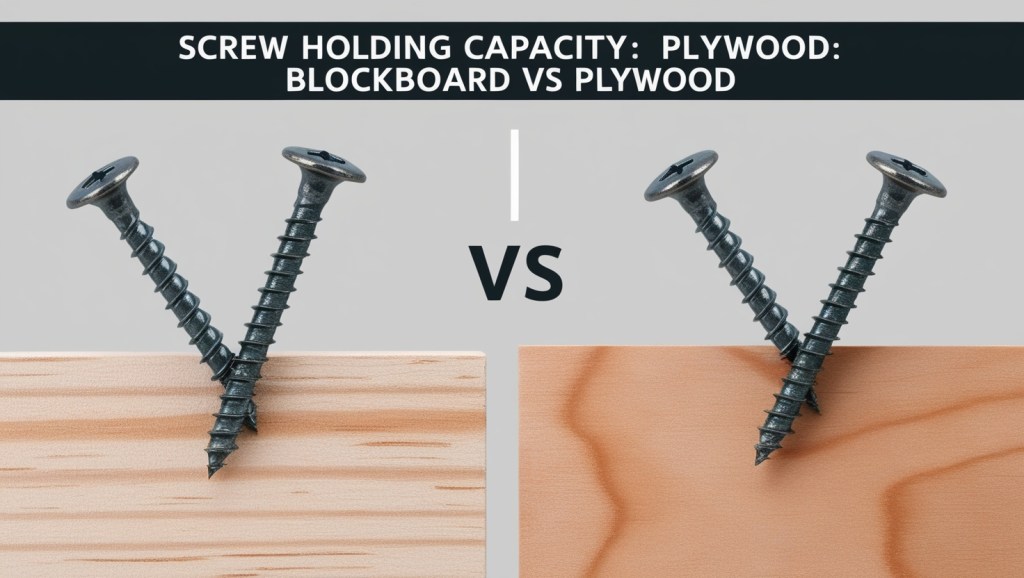
Blockboards have very good screw holding capacity, than particle board and MDF. They can hold nails very well and thus are used for making custom made furniture. Also they are used as core in flush doors, where screw holding capacity is essential.
Got excellent screw holding capacity due to the cross layered arrangement of veneers. The hinges do not come out easily.
Some times the screws tend to go between the gaps of the wood pieces. Skilled carpenters can identify and manage the problem
In the blockboard vs plywood comparison, plywood typically offers better screw holding capacity. The layered veneer structure of plywood provides more grip, making it suitable for applications where secure fastening is essential. Blockboard, with its softer core, may have screws loosen over time and is less reliable for high-stress fastening.
Flexibility in Applications: Blockboard vs Plywood
Aspect
Blockboard
Plywood
Application Versatility
Less versatile; best suited for applications requiring solid and stable support, such as heavy-duty furniture and doors.
Highly versatile; used in a wide range of applications including cabinetry, wall panels, and structural components.
Customizability
Limited in terms of bending or shaping; typically used in flat applications.
More flexible; can be easily cut, bent, and shaped for various designs and structures.
Use Cases
Ideal for applications requiring strength and stability but less flexibility.
Ideal for both structural and decorative purposes due to its adaptability and ease of modification.
Plywood is more flexible in applications due to its ability to be shaped and customized easily. In contrast, blockboard is less adaptable, making it suitable primarily for stable, heavy-duty applications.
Applications: Blockboard vs Plywood
Aspect
Blockboard
Plywood
Typical Uses
Commonly used for heavy-duty furniture, long bookshelves, benches, doors, partitions, and panels where solid support is needed.
Widely used in cabinetry, wall paneling, flooring, structural components, and various DIY projects due to its versatility.
Suitability for Interior Design
Suitable for high-end furniture and cabinetry where a smooth finish and robustness are required.
Ideal for a broad range of interior design projects, including furniture, shelving, and decorative panels.
Structural Uses
Best for applications requiring solid core strength but less flexibility in design.
Common in structural applications like roof sheathing, subflooring, and wall sheathing due to its strength and flexibility.
Blockboard is ideal for applications needing solid support, such as heavy-duty furniture and doors. Plywood, being versatile and flexible, is used in a wide range of applications from cabinetry and wall paneling to structural components.
Sizes available
Plywood
The most commonly manufactured plywood size is 8 x 4 ft. (2449 x 1219 mm)
It is available in various thicknesses ranging from 3 mm to 25 mm.
Blockboard
The most commonly manufactured and sold block board size in India is 8 x 4 ft. (2449 x 1219 mm).
Available thickness are 16mm,19mm,25mm
Service Life: Blockboard vs Plywood
Aspect
Blockboard
Plywood
Durability
Generally durable but may have a shorter service life if exposed to moisture without proper sealing.
Highly durable with a longer service life, resistant to environmental changes and moisture when properly treated.Always use BWR and Marine ply for water prone areas.
Maintenance
Requires regular maintenance and sealing to extend service life, particularly in humid conditions.
Low maintenance; retains durability with minimal upkeep and resists moisture and environmental factors effectively.
Longevity
Suitable for applications where moderate longevity is acceptable but may degrade faster under adverse conditions.
Ideal for long-term use; maintains performance and appearance over extended periods.
Plywood generally has a longer service life compared to blockboard. While blockboard is durable, it may require more maintenance and protection from moisture to ensure longevity. Plywood, on the other hand, offers extended durability and requires less maintenance, making it suitable for long-term applications.Blockboard should be kept away from water and moisture. They got a better life and durability compared to MDF and particle boards. Blockboards are available in BWR and BWP varieties. They can resist moisture better.
Economy
Blockboard is comparatively cheaper than plywood.
Sound insulation properties
Block boards are poor conductor of sound, heat and electricity and offer good sound and thermal insulation properties.Hence are used in partitions etc.
Key Takeaways
Blockboard: Lighter than plywood, ideal for heavy-duty applications requiring solid support and stability.
Plywood: More versatile and flexible, suitable for a wide range of applications including structural and decorative uses.
Strength & Durability: Plywood is generally stronger and more durable, especially in moisture-prone areas.
Screw Holding Capacity: Plywood offers better screw holding due to its dense veneer layers.
Service Life: Plywood has a longer service life with lower maintenance needs, while blockboard requires more care, especially in humid conditions.
Economy: Blockboard is usually cheaper, making it a budget-friendly option for certain applications.
Conclusion
When choosing between blockboard and plywood, it is essential to consider the specific requirements of your project. Blockboard is an excellent choice for heavy-duty furniture, doors, and long shelves, offering solid support at a lower cost. However, it requires careful handling in moisture-prone areas to ensure durability. Plywood, with its superior strength, flexibility, and moisture resistance, is the preferred material for a broad range of applications, from structural elements to decorative finishes. Its longer service life and lower maintenance needs make it a reliable choice for both residential and commercial projects. Ultimately, your selection should align with your project’s demands, budget, and expected longevity.
The ecological footprint is gaining significance in the era of advancements. The unsustainable developments and rapid technological developments in the infrastructure says its high time we give significance to the concept.
In the blog, we will find out all the basic details about the EF. The methodology, applications and implementation examples are also included.
Let’s begin with the definition of ecological footprint (EF).
What’s an ecological footprint?
Ecological footprint is a metric to quantify human demand for natural resources.
Or, the amount of nature it takes to sustain people or an economy, promoted by the Global Footprint Network. It controls this demand through a method of ecological accounting.
The measure of land and water to produce goods and dispose of waste humans generate
The 3 types of lands are cropland, grazing land and fisheries.
The methodology of EF is given in the next section.
Methodology of ecological footprint
Tracks biologically productive area and water to meet demands
Demands: space for food growing, timber regeneration, fibre production, absorption of CO2 emission
consumption=Imports-exports from national production
Biocapacity-biologically productive are available to produce resources and absorb waste
Ecological reserve-footprint> biocapacity
Ecological deficit-footprint<biocapacity
85% of population ecological deficit
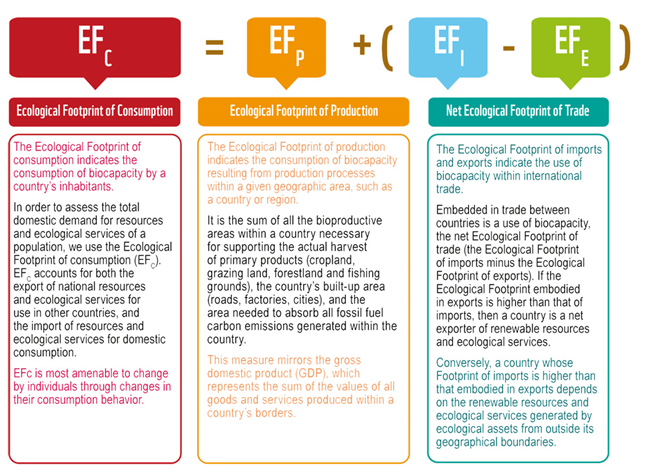
The figure below shows the EF of production and ecological footprint of trade- the two factors that contributes to the ecological footprint of consumption.
Ecological footprint of consumption (SOURCE:GLOBAL FOOTPRINT NETWORK)
It’s time to have a look at the various factors that impact EF.
Impacts on EF
The section deals with the parameters that influence the ecological footprint.
A. Natural resources
Negative
Therefore excessive use controlled
Mining industry- advanced energy efficient technology
Reforestation,control fishing
B. Human capital
Negative
Locational advantage huge FDI
Education rate high hence human capital high
Tutorials ,public messages
C. Energy consumption and economic growth
Positively related
Stimulates use of fossil fuels
New technologies revolutionalize the energy sector to reduce emission
Govt should subsidize investments
Hydrogen fuel cell resolves storage issue
Policies-reforestation soil management, solar panels, organic farming
In the next section, we will find out the applications of ecological footprint.
Ecological footprint helps in measuring and assessing the impact of human activities.
Therefore take necessary actions which include rainwater harvesting, soil management practices, use of public transportation system, use of renewable resources, organic farming etc.
Strive towards a world where waste becomes energy, wastewater turned into bioplastics and heat and where electricity becomes green.
Reactive powder concrete is an ultra-high strength and highly ductile composite material with advanced mechanical properties, hence has high durability. In this blog, I will walk you through the components, properties, advantages and limitations of RPC.
Let’s start from the definition.
What is reactive powder concrete?
Reactive Powder Concrete (RPC) is a type of Ultra High Performance Concrete (UHPC). The main constituents are cement, sand, silica fume, steel fiber and quartz powder with minimal water to binder ratio, without coarse aggregate.
Next, let me show you the development of RPC that presents different steps of formation.
Development of RPC
In RPC, water- binder ratio is very low, CA is absent- reduce the heterogeneity of concrete mix and optimize microstructure. Precise gradation of particles yields compact, well-arranged and high strength hydrates of maximum density.
Development of RPC is based on the following principles.
Elimination of CA- Homogeneity enhanced
Utilization of pozzolanic properties of silica fume
Granular mixture optimization- to enhance the compacted density
Optimal usage of superplasticizer- improves workability, reduce w/c
Apply pressure (before and during setting)- improves compaction
Post set heat treatment- to enhance microstructure
Addition of small-sized steel fibres- improves ductility
Let’s move on to the components of reactive powder concrete now.
Components of RPC
COMPONENT
SELECTION PARAMETER
FUNCTION
PARTICLE SIZE
Sand
Good hardness, readily available and low cost
Gives strength
150-600 µm
Cement
C3S: 60% C2S: 22% C3A: 3.8% C4AF: 7.4%
Binding material for production of primary hydrates
1-100 µm
Quartz powder
Fineness
Max reactivity during heat-treating
5-25µm
Silica fume
Very less quantity of impurities
Filling the voids, enhance rheology, production of secondary hydrates
0.1-1µm
Steel fibers
Good aspect ratio, straight in shape
Improve ductility
Length 13-25 mm Dia. 0.15-0.2 mm
Super plasticizer
Less retarding characteristics
Reduce w/c
Poly acrylate based
Components of RPC
Here comes the properties of RPC in the next section.
Properties of RPC
RPC possess better strength (compressive and flexural) and lower permeability compared to HPC
Fracture toughness is higher for RPC- higher ductility
Ultra-dense microstructure- waterproofing and durability characteristics
Higher corrosion resistance- can be used in chemically aggressive environments
Workability of RPC mixtures (with and without fibres) measured by mortar flow table test- (120-140 mm)
Workability of HPC mixtures (with and without fibres) measured by slump test- (120-150 mm)
Density of fresh RPC and HPC mixtures- 2500-2650 kg/m3
Compressive Strength of RPC and HPC- linked to durability, found that compressive strength of RPC is suitable for nuclear waste containment
How about the factors affecting the strength of RPC?














 vin civilworld