Infrared Thermography in Civil Engineering: Applications & Pros and Cons Simplified

Heard about infrared thermography? We are going to deal with the topic in today’s blog.

I will walk you through the principle behind the technology, the classification based on its working, applications and the advantages and disadvantages.

What is Infrared thermography?

Infrared thermography uses thermographic cameras to detect radiation in the long-infrared range of the electromagnetic spectrum and generate images of that radiation, called thermograms.

The figure below shows the procedure of IRT.
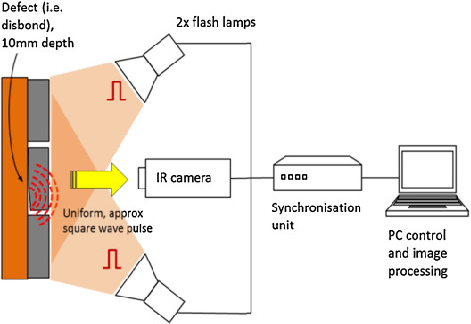
Schematic Representation of IRT
Source: Vollmer et al. (2010)

The principle behind infrared thermography is that the heat flow through the body is  affected by the  presence of internal anomalies. The main heat transfer mechanisms are conduction and radiation.

Now, let’s peep into the classification of infrared thermography.

Classification of infrared thermography

There are two types of classification based on different parameters.

1. Based source Of heating

  • Passive Thermography- Passive thermography explicitly tests the surface temperature for measurement, as the interest area would have irregular hot-spot as compared with the surroundings
  • Active Thermography- In active thermography, to detect inhomogeneities and cavities, heat is directed into a test piece. When a test object is heated or cooled, surface temperature variations are caused by local differences in the thermal conductivity and heat power of the test sample.

2. Based on method of heating

  •  Pulse Thermography-  Infrared pulse thermography is a non-contact, non-intrusive NDE process commonly used for aircraft structure inspection. To unleash a thermal wave into the material for the detection of defects within the material, the technique employs a burst of high-intensity thermal excitation.
  • Lock-in Thermography- Lock-in thermography is a method that uses a laboratory power supply and reed relays to automatically and repeatedly power a device at regular intervals while the device’s temperature response is integrated and measured over time.

In the next section, I will show you the advantages and disadvantages of infrared thermography.

Advantages of infrared thermography
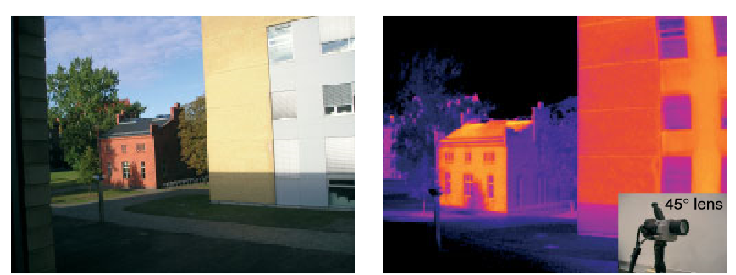
Digital and Infrared image of a building
[Source: Vollmer et al. (2010)]

The main advantages of IRT are as follows.

  • Early detection of defects
  •  No hazard 
  •  Quick
  •  No time constraints

Disadvantages

The disadvantages of IRT are,

  • High Equipment Cost
  • Dependency on the environment conditions
  • Dependency on the surface conditions
  • Difficult to measure the depth of a flow

That’s it about the pros and cons. Let’s move on to the last section that talks about the interesting applications of infrared thermography in civil engineering.

Applications of infrared thermography

1. Bridge deck assessment

Bridge deck deterioration is an issue to be addressed with seriousness. Delamination and disintegration of concrete lead to this. Inadequacy of Traditional methods like sounding, chloride, corrosion potential gives way to IRT to be considered as the better alternative.

2. Testing for fibre reinforced plastic wrapped columns

  • Subsurface debonds form between the fabric and the underlying member
  • This affects the strength and ductility of the member
  • IRT in rehabilitation work and periodic monitoring
  • External Heat source is used
  • Detection of  subsurface debonds
  • Repair using resin or replacement

3. Thermal Measurement And Control Of HMA Pavement Construction

The figure below shows the continuous thermal measurement system.
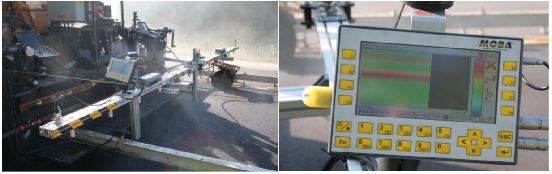
Continuous Thermal Measurement System
Continuous Thermal Measurement System:
(a) Sensing Bar mounted to Paver (b) Display Screen
[Source: LeClair et al. (2015)]
  • IRT can be used for real-time measurements of the surface temperature of the installed asphalt mat
  • Map thermal contour on the surface of a material
  • Identify temperature anomalies in cold areas

4. Energy Efficiency Assessment in Buildings

  • It is used to identify and minimize the source of unnecessary heat flows.
  • It makes use of the actual and expected 3D spatio-thermal models using EPAR
  • The technique optimizes R-values using retrofit
  • It helps to achieve optimal thermal comfort for occupants
  • It also improves energy efficiency in buildings

5. Building Moisture Inspection

  • In this application, IRT is utilized as a diagnostic tool to evaluate moisture
  • It uses Moisture detector as a supporting device
  • IRT identifies critical areas that were not detected visually
  • Structural plans of the building should be checked

With that, we come to the end of this piece of information. Let’s wrap with the conclusion.

Conclusion

  • Infrared thermography is a fast, clean and safe technology
  • IRT is dependent on the sensor and the surrounding environment
  • The defect can only be detected if it possesses enough thermal resistance
  • IRT has wide applications in the realm of NDA as well as Civil engineering

So, how was the trip through infrared thermography for civil engineering? Was your time worth investing here with me?

If so, let me know your thoughts in the comment section.

Enjoy learning!
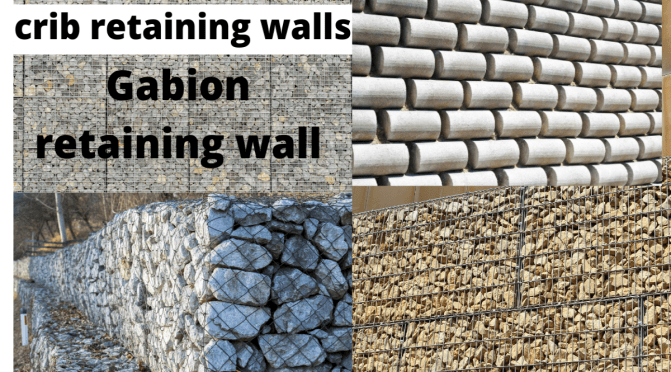
Crib retaining walls, Bin retaining walls & Gabion Walls

Retaining walls are rigid walls used for supporting soil laterally so that it can be retained at different levels on the two sides. The soil got a natural angle of repose and when it exceeds the range a retaining wall structure has to be provided.

They are vertical or near vertical structures constructed to hold soil between two terrains when the slope exceeds the natural one. The slope can be vertical or steep or much above the range of angle of repose.

Also read : Retaining walls – All Types, Materials, features and uses

In this article we are mentioning about some special type of retaining walls

Gravity retaining walls are made of stone, bricks, concrete or any other heavy material.  Gravity walls are made with or without mortar They are designed to counter the earth pressure by their self weight. Following are the special types of gravity retaining walls.

a) Crib retaining wall

b) Bin retaining wall

c) Gabion retaining wall

Crib Retaining walls

Crib retaining wall or crib lock retaining wall is one of the oldest types of retaining wall. They consist of cribs or cells made of timber, concrete, and plastic/fibres. The cribs or interlock areas are filled with free-draining materials or earth back-fill, eliminating the hydro-static pressure and enabling a free escape of water.

Most common materials used for crib wall construction is 

  • Timber crib retaining walls
  • Precast crib retaining walls

Timber crib retaining walls

Timber crib walls use timber to form the cells of the crib. The cells are filled with free-draining stone materials for maintaining the mass of the wall. Water drainage can happen freely through the cribs. The timber sections are interlocked to make the walls.
They can also be planted with trees to create a natural appearance. These types of walls are ok up to a height of 5-6 mtrs and mostly used for landscape walls etc.

Timber crib retaining walls

Precast concrete crib retaining walls

This system consists of a precast concrete header and stretcher units. They are erected to form precast crib retaining walls.
Precast concrete cribs are the cheapest form of earth-retaining systems and are used for landscaping structures, plant terraces, and other works with heights around 10- 20 mtr with proper professional design.
They do not require any skilled labour to do the erection. Trees or shrubs are planted to give natural and excellent looks. Crib walls are erected for small curves and are considered a very flexible material.

Precast Concrete Crib retaining walls

Bin retaining walls

Steel bin walls are made from corrugated steel sheets and are usually bolted together and then filled with crushed rock or other free-draining material. They are mostly used for bank erosion protection, holding encroaching slopes, breakwaters, etc. They can resist unforeseen ground movements that may cause failure to other types of retaining walls.

Gabion Retaining walls

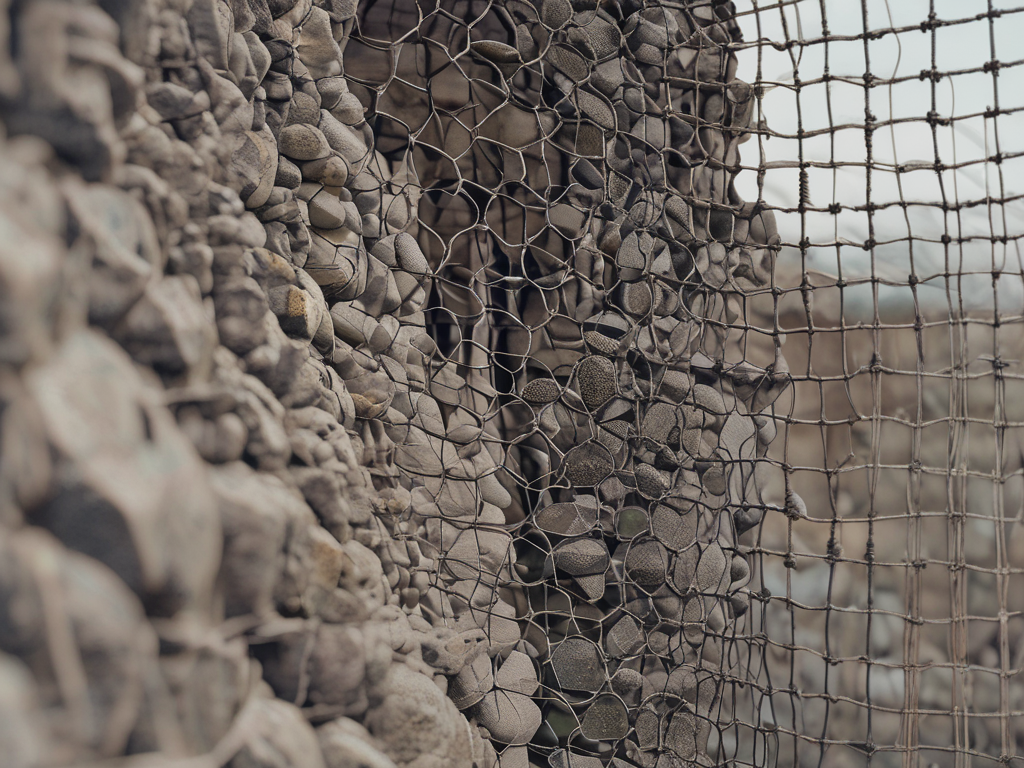
Gabion retaining wall systems are one of the oldest forms of gravity wall. Gabion walls are manufactured by factory fabricating a galvanised hexagonal wire mesh of varying diameters into box cages. These box cages are site filled with locally available stones and fully closed and laid in a pattern as per design. They are used in areas where the foundation conditions are not favourable for adopting any other retaining structures. The concept of a gabion wall is to increase the shear capacity of rock by providing the box cages. They can accommodate substantial ground movements without failures. Gabion boxes are free-draining structures that can reduce hydro-static pressure drastically.

Gabion Retaining walls

The main advantage of these types of systems is that they do not need an exclusive foundation structure. Gabion walls are installed directly over the surface in specified patterns according to design requirements.
The mesh is PVC protected or coated with special coatings to protect from rusting in areas subjected to continuous water flow.
These walls provided a Good visual appeal of the product and the satisfying rock finish look.
Gabion walls are erected mainly for soil stabilisation behind the wall. They can also act as a cover wall. The gabion boxes are stacked in layers with a proper design. They are a very economical alternative for concrete retaining walls and rock anchors for soil stabilisation works and slope protection works.

Also read : MSE retaining walls or Mechanically stabilised Earth walls

Self Healing Concrete ||Bacterial Concrete -Preparation and Advantages

Self healing concrete is a mind-blowing innovation in civil engineering. It can potentially contribute to ensure a longer lifespan of a structure. In this article, we will find out the details about bacterial concrete. A bacterial concrete is most effective in this category.

Let’s start from scratch.

What is self healing concrete?

The type of concrete that uses the process of self-filling up of cracks by the help of bacterial reaction in the concrete, after hardening is known as Self-healing concrete.

Why self healing concrete is important?

  • Unrepaired cracks lead to a reduction in the service life of the structure. Therefore, it is worth giving attention to.
  • Epoxy resins and other synthetic mixtures are alternatives. (But they are not good for human health)
  • Self healing concrete does not require human intervention

Let’s dive in deep now.

Bacterial Concrete

Concrete which is made by adding bacteria that precipitate calcite is called bacterial concrete.

  • It is microbiologically induced calcite precipitation.
  • Bacterial concrete heals cracks around 0.5 mm thickness.
  • It has improved Compressive & flexure strength than ordinary concrete.
  • Bacterial concrete is well suited for Small & Medium-Sized building
  • It is used on a limited scale & not commercially wide-spread.

We learnt the general details. Let’s be a bit technical now?

Bacteria Used in the self healing concrete

Bacteria used in bacterial concrete
Source : alchetron.com
  • “Bacillus pasteurii ”  is a common soil bacterium which is used in bacterial concrete.
  • Precipitates impermeable calcite layer over the surface of concrete.
  • Acid producing bacteria
  • Remains dormant & be viable for over 200 years under dry conditions

In the next section, let me quickly walk you through the mechanism of the self healing concrete.

Mechanism of Bacterial Concrete

  • Bacillus pasteurii is used along with Calcium Lactate. 
  • Both are added in the wet concrete when the mixing is done.
  • Water seeps in the cracks (or exposure to moisture)
  • Spores of the bacteria germinate & feeds on calcium lactate ,consuming oxygen.
  • The soluble calcium lactate is converted to insoluble limestone.
  • limestone starts to harden, filling the crack automatically
  • The advantage is that oxygen consumed helps in the prevention of corrosion of steel.

That’s it. Now, we will move on to the chemical process in bacterial concrete.

Chemical process of this self healing concrete

The steps in the process are as follows.

  • Water comes in contact with the unhydrated calcium.
  • Calcium hydroxide is produced by the help of bacteria, it acts as a catalyst.
  • This calcium hydroxide reacts with CO2 to form limestone and water.
  • This extra water molecule keeps the reaction going.
  • The limestone then hardens and seals the cracks.

Figure below shows the self healing concrete.

Source: sciencedirect.com

What about us study about the preparation of bacterial concrete now?

Preparation of Bacterial Concrete

There are mainly two methods.

  • By Direct application
  • By Encapsulation

Without delay, let’s meet each of them.

Direct Application

  • Bacterial spores and calcium lactate is added directly when mixing of concrete is done.
  • This doesn’t change the most properties of concrete.
  • When water comes in contact with this bacteria
  • They germinate & feeds on calcium lactate and produces limestone.

Encapsulation Method

  • The bacteria and its food (calcium lactate), are placed inside treated clay pellets.
  • Concrete is prepared.
  • Clay pellets break when crack occurs.
  • Bacteria germinate and eat down the calcium lactate & produce limestone.

Time to chill. Sit back and enjoy the advantages and disadvantages of what we have made through the process.

Advantages of bacterial concrete

  • Increase in compressive and flexural strength compared to normal concrete.
  • Self-repairing
  • Reduction in permeability of concrete
  • Resistance towards freeze-thaw attacks.
  • Low maintenance
  • Improves the durability of steel reinforcements.
  • Bacillus bacteria are harmless to human life.

Disadvantages of bacterial concrete

  • High Cost
  • Growth of bacteria is not suitable in some environment.
  • The clay pellets comprise 20% of the volume of the concrete. This may become a shear zone.
  • Design of mix concrete with bacteria  is not available in any IS code

We have reached the shore. Let’s wind this up with the conclusion.

Conclusion

  • Self healing concrete appears to be much more efficient
  • It has more advantages than disadvantages.
  • So far, Bacterial Concrete is the best approach in the field of self healing concrete

Hope the article served its purpose to quench your thirst to know about self healing concrete. Share your thoughts on this in comments.

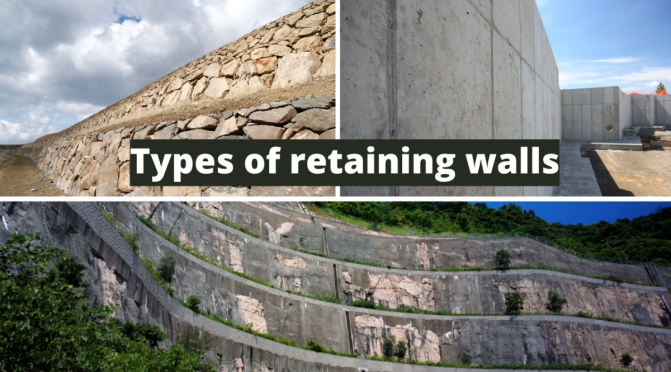
Types of Retaining walls – All types,materials,features and uses.

Retaining walls are rigid structures used for supporting soil laterally and retained at different levels on the two sides. These structures are vertical or near-vertical. They are constructed to hold soil between two terrains when the slope exceeds the natural angle of repose. The slope can be vertical or steep or much above the range of angle of repose. Understanding retaining wall types is crucial for selecting the right wall based on soil conditions, load requirements, and project design.

Key retaining wall types include gravity retaining walls. These rely on weight for stability. Buttress retaining walls provide extra support. Elements like retaining wall heel and toe enhance stability, making these walls effective and durable solutions.

This article is about the types of retaining walls, materials used and features.

  1. What is a retaining wall?
  2. Design criteria of retaining wall
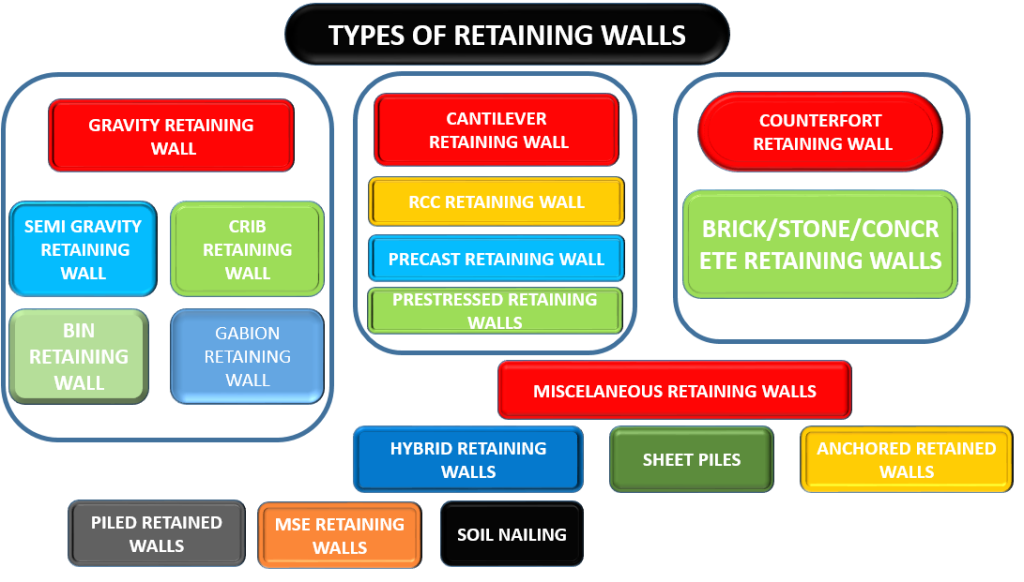
  3. Retaining wall types
    1. Gravity Retaining walls
    2. Cantilever retaining walls
      1. The loads induced on various components
    3. Counter-fort retaining walls
    4. Buttressed retaining walls
    5. Sheet piled retaining walls
    6. Piled retaining walls
    7. Anchored retaining walls

What is a retaining wall?

Retaining walls are critical engineering structures designed to stabilize and support terrain by restraining soil mass at different elevations. These versatile architectural elements are essential in landscape design, civil engineering, and construction projects. They prevent erosion, manage slope stability, create usable spaces on uneven terrain. Retaining walls provide critical structural support in areas with significant elevation changes.

Engineers and landscape architects utilize various types of retaining walls, each with unique characteristics and applications. The selection depends on factors such as soil conditions and load requirements. Other considerations include site topography, budget constraints, aesthetic considerations, and project design. These factors ensure long-term durability and safety. Common retaining wall types include gravity walls, cantilever walls, and anchored walls, each using distinct methods to provide stability.

Design criteria of retaining wall

The main criteria behind the design of the retaining wall are to counter the downward slope movement of back filled soil by gravity. The lateral pressure developed behind the wall depends on the angle of internal friction & cohesive strength of retained materials. The lateral pressure can also be liquid (hydro-static pressure), and pressure from any type of back-fill material like sand, granular material, fly ash, etc. A proper drainage system is to be provided to reduce the hydro-static pressure.

Retaining wall types

There are several types of retaining wall depends on the nature and type of soil and situations they are to be used.

  • Gravity retaining wall
  • Cantilever retaining walls
  • Counter-fort retaining wall
  • Buttressed retaining wall
  • Sheet pile retaining wall
  • Bored pile retaining wall
  • Anchored retaining wall

There are a lot of innovative and alternated methods used for retaining walls

Retaining wall Types

Gravity Retaining walls

Gravity retaining walls are executed with stone, bricks, concrete, or any other heavy material. They are done with or without mortar and are designed to counter back-fill soil pressure by their self-weight.
Dry retaining walls do not require rigid footing. However, they must be designed to counter sliding. They also need to address overturning and bearing loads acting on the structure.
These types of retaining walls are mainly adopted in landscape areas and also in locations with height is around 2-3 meters.

Gravity retaining wall

Gravity retaining walls are used for larger heights using composite gravity walls. Composite gravity walls include precast crib walls or timber walls filled with granular materials, Gabion walls, Geowalls, etc.
The gravity wall when provided with a small amount of reinforcement is known as semi gravity retaining wall. The load transfer mechanism remains the same as that of gravity retaining walls.

Gabion wall

Cantilever retaining walls

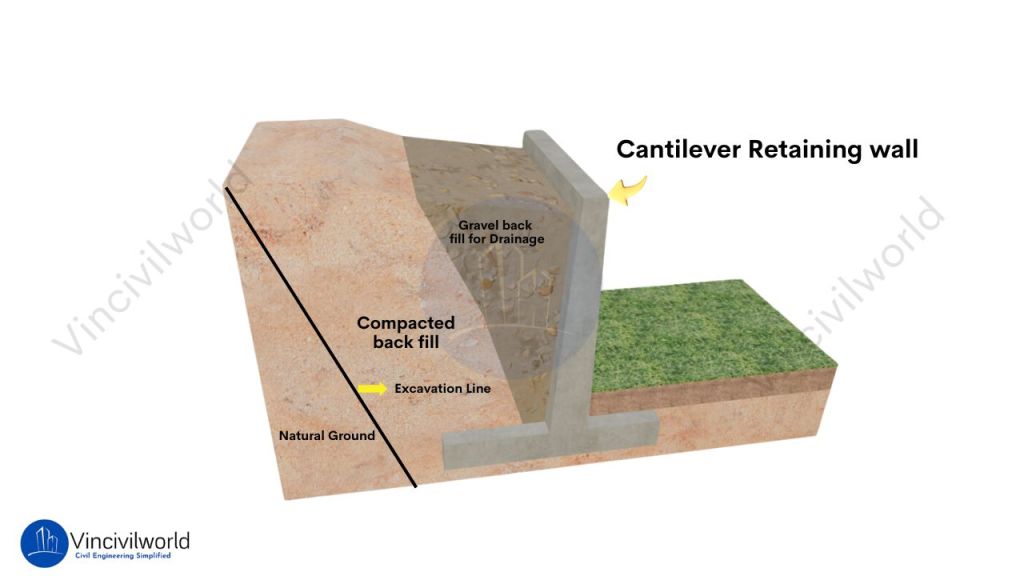
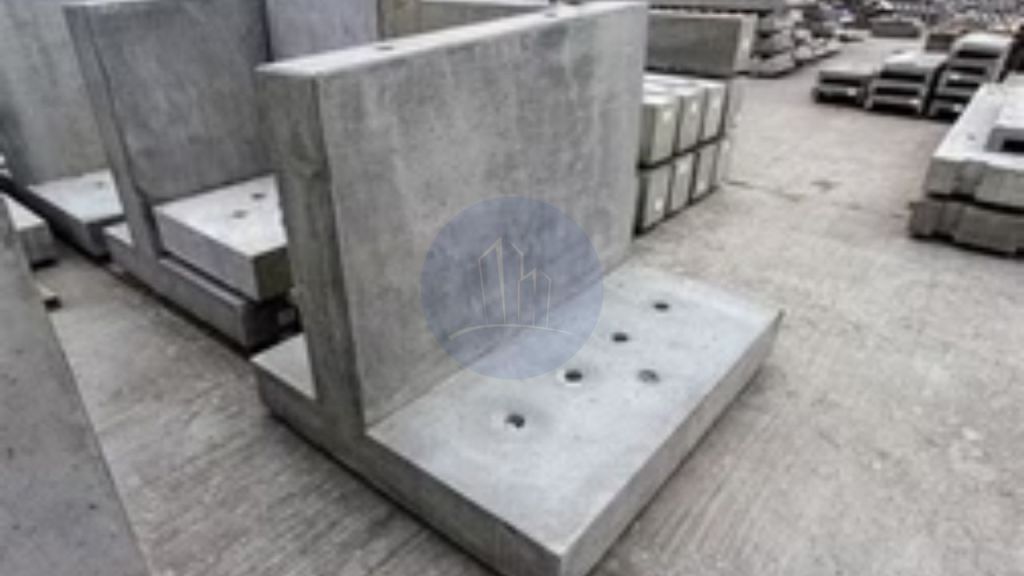
Cantilever retaining walls are the most common retaining wall type. They are reinforced concrete structures wherein the lateral earth pressure is countered by the cumulative action of total structural members.
Cantilever retaining walls consist of a stem, a base slab which is divided into toe slab and heel slab as shown in the figure.

Cantilever retaining walls


The vertical stem wall is extended to the back fill side or heel side and is called a heel slab and the slab on the other side is a toe slab as shown in the figure.
The stem wall, toe slab, and heel slab act as cantilevers fixed injunction and spanning to other ends. The back filling of soil over the heel slabs imposes additional stability against lateral pressure and stabilises the wall against overturning and sliding.

The loads induced on various components

a) Heal slab and toe slab = Upward soil pressure from the bottom and tends to bend upward. Rebar is placed in a tension zone.
b) stem= Lateral earth pressure tends to bend in the opposite direction of back-fill.
These types of walls are economical and can be used for heights around 5-7 mtr. They are much lighter than gravity walls and require comparatively small foundations. These types of walls can be constructed as to cast in situ and precast and prestressed concrete depending on the site requirements.

Prestressed retaining wall & Retaining wall

Counter-fort retaining walls

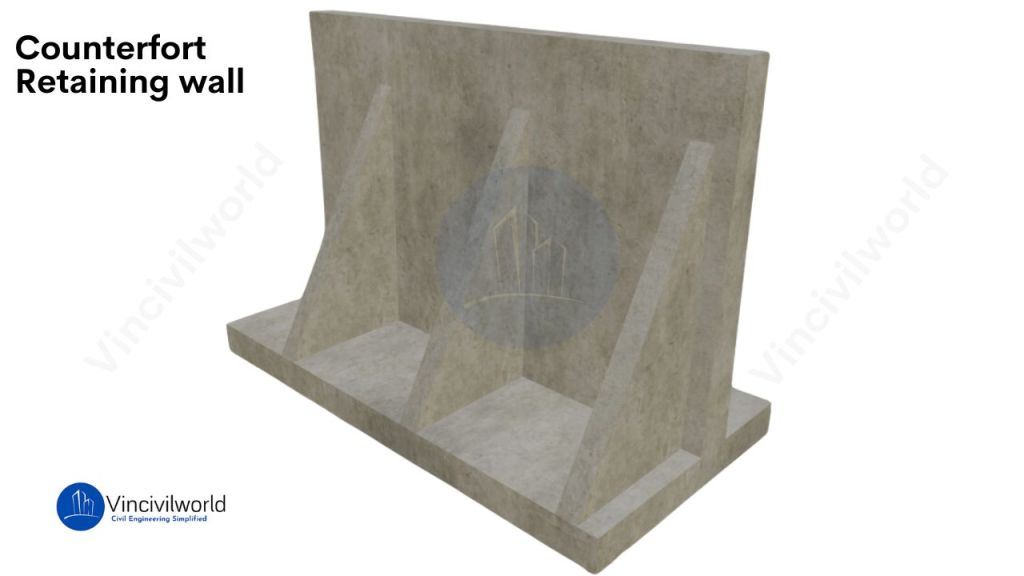
Counter-fort retaining wall is a cantilever retaining wall used when the height is around 7 mtr or more. For economising the structure, vertical bracing called counter-forts are provided on the back fill side. These counter-forts connect the heel slab and stem as shown in the figure. The stem and heel slabs between counter-fort act as continuous slabs and negotiate the high bending movements. The counter-forts function as tension stiffness and reduce the bending and shear stresses. These types of retaining walls are used for heights ranging from around 8-12 mtr.

Counter-fort Retaining walls

Buttressed retaining walls

Buttress retaining walls have the vertical bracing located on the front side of the retaining wall in place of the back-fill side like that of counter-fort retaining walls. The structural action of the stem remains the same as the counter-fort walls.

Sheet piled retaining walls

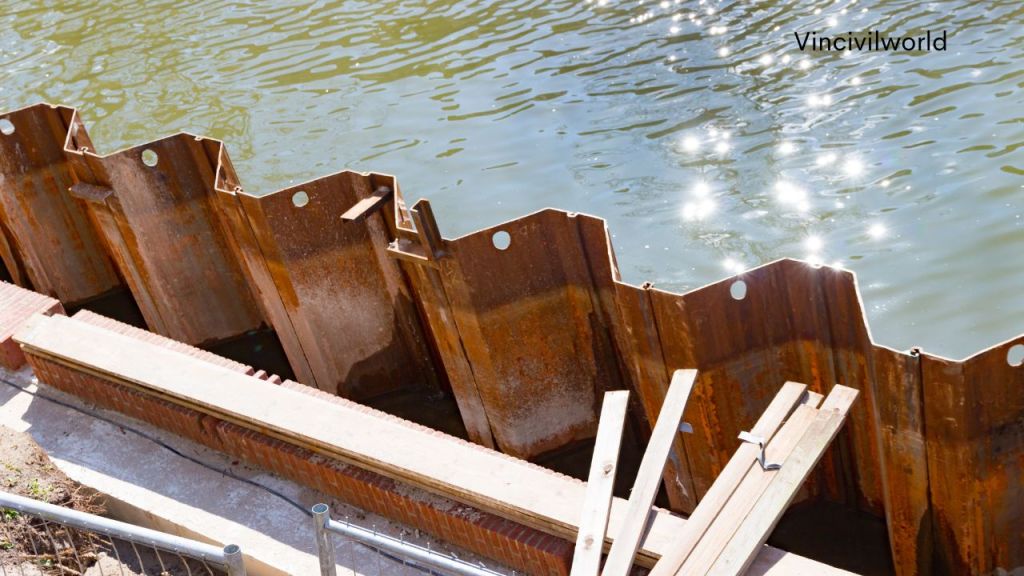
Sheet pile walls are erected using steel sheets into a slope to be protected or for excavations up to a required depth. Sheet pile retaining wall economical till a height of 6m and cannot negotiate huge loads. Sheet pile acts as a temporary wall that is driven into the excavation area for protecting the area from collapsing. They provide high resistance to driving stresses. They can also be reused and are considered the most economical retaining solutions. They can be bolted and driven easily and do not deform on driving. The problem with sheet piles is the noise it creates while driving.

Sheet pile

Piled retaining walls

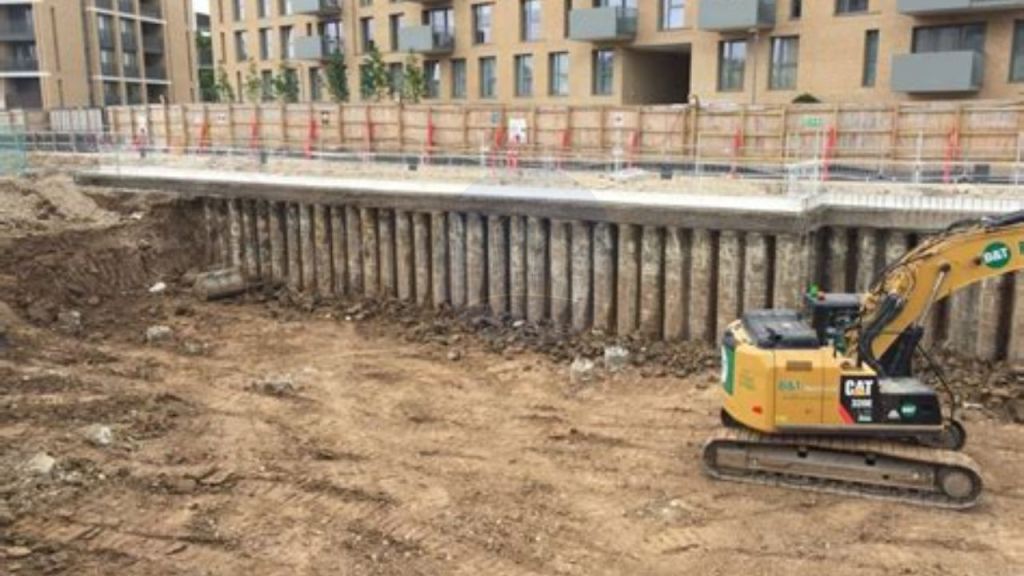
These types of retaining walls consist of a sequence of bored piles. The bored piled retaining walls are often accompanied by erection earth anchors, shot-creating the pile gaps, and provision of additional supports depending on the site conditions and designs. Bored pile retaining walls are used in areas where sheet pile tends to create a lot of noise and disturbs the areas.
These types of piles are used for temporary and permanent works. They can hold huge lateral pressure and are used for holding earth for high depth excavations without disturbing the nearby structures. Bored pile retaining walls are classified into contiguous pile walls, tangent pile walls & secant pile walls according to the sequence of piling works.

Piled retaining wall

Anchored retaining walls

Anchored retaining walls, also known as tie-back systems, are essential structural components used in construction. They are mostly used to stabilize earth and as support structures. Anchored Retaining walls deliver lateral support to walls. They prevent soil from shifting or eroding. These walls are commonly used in applications like deep excavations, embankments, and hillside retention etc.

3 d Printing buildings |Concrete Printing & Contour Crafting Methods Full Guide

3 d Printing buildings are one of the greatest advancements of technology. The rapidity and accuracy with which the work can be completed is the attraction. We will find out all the details about the important methods of 3 d printing which are concrete printing and contour crafting.

What is 3 D Printing?

The 3D printing process builds a three-dimensional object from a computer-aided design (CAD) model, by successively adding material layer by layer.

Unlike conventional machining, casting and forging processes, where material is removed from a stock item or poured into a mold and shaped by means of dies, presses and hammers.

Time to ask the question. Why is it a big deal?

Why 3 D Printing for construction?

  • To avoid construction formwork which accounts for 40% of the total budget for concrete
  • It allows for flexibility and freedom of architectural design
  • To reduce construction and facilities management costs
  • To build a future of sustainable construction

Now, let’s move on to the next section which introduces the 2 printing methods.

3 d printing buildings methods

There are mainly 2 methods for 3 d printing buildings.

  1. Contour crafting
  2. Concrete printing

Let’s dive in deep into each of them.

Contour crafting for 3 d printing buildings

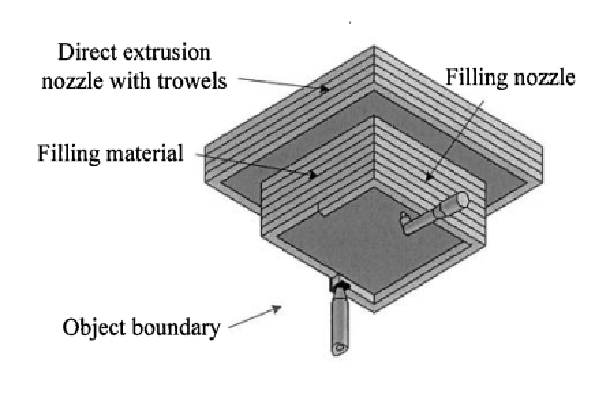
Contour crafting- Schematic of CC extrusion and filling process
  • Contour crafting is based on an extrusion and filling process
  • The extrusion process forms the smooth object surface by constraining the extruded flow in the vertical and horizontal directions by the use of trowels.
  • The orientation of the side-trowel is dynamically changed for better surface fit for each decomposed layer.
  • The side-trowel allows thicker material deposition while maintaining the high surface finish.
  • Thicker material deposition cuts down manufacturing time, which is essential for building large-scale parts using the material additive process.
  • Maximum deposition layer thickness is limited by the trowel height.
  • As the extrusion nozzle moves according to the predefined material deposition path of each layer, the rims (smooth outer and the top surface of outside edges) are first created.
  • The towelled outer surface of each layer determines the surface finish quality of the object.
  • The smooth top surface of each layer is also important for building a strong bond with the next layer above.
  • Once the boundaries of each layer are created, the filling process begins and material is poured or injected to fill the internal volume.

Now, let’s find out the details of concrete printing.

Concrete printing for 3 d printing buildings

Concrete printing
Concrete printing
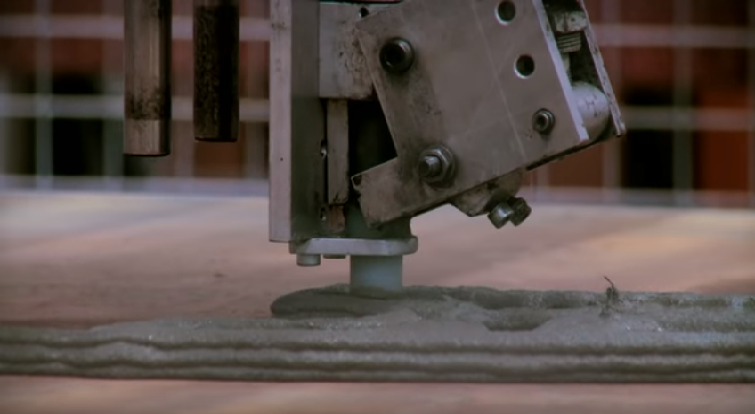
  • Concrete printing is similar to contour crafting in the ejection phase of concrete
  • It is able to achieve better 3D printing, because of its resolution of deposition
  •  Concrete printing provides larger freedom printing internally and externally.
  • The method not only enables the production of both high compressive compressive_strength and_tensile_strength concrete mixture, 110 MPa and 10 MPa respectively but improves the overall workability, extrusion and onsite construction methods.

Next, let me show you the advantages of 3 d printing in construction industry.

Advantages of 3 d printing in the construction sector

  • Cost Efficiency
  • Labour efficiency
  • Time and costs savings
  • Environmental/ economic aspects
  • Any complex design can be built

Now, let me quickly show you some examples of 3 d printing buildings.

Implementation examples of 3d printing for construction

  1. Dubai Future Foundation (DFF)
DFF Building Dubai
Dubai Future Foundation (DFF) Building in Dubai

     2. Reinforced concrete printed bridge at Gemert

     3. Yin gChuang, the Chinese company

Conclusion

  • Using this technology is cost, time and quality efficient, through analyzing many theoretical and practical examples of 3D printed structures.
  • According to the literature survey that was conducted, using 3D printing can save up to 80% of manufacturing costs and 40% in materials costs.
  • For future work and application, the detailed economic analysis must be conducted to show the reduction potential of 3D printing, and its impact on the full-scale economy of the country, by applying any of the methods previously mentioned companies use in their work.

Real experiments must be conducted to prove the material, labor and energy reduction. And, you will amaze at the beauty of 3d printing building.

Photo credits: https://www.spentys.com/

Don’t forget to share your views on the innovation in comments.

Happy learning!

Cracks in a Building |3 Types of Cracks in Building Walls Full Guide

Cracks in a building affect the building’s artistic look and it destroys the wall integrity, affects the safety of the structure and even reduces the durability of the structure.

In this blog, I will show you the important types of cracks in building and example of these cracks to understand them better.

Cracks occur when stress in the components increases beyond its strength.

Stress in the building components could be caused by externally applied forces like,

  • Dead load
  • Live load
  • Wind load
  • Seismic loads
  • Foundation settlement

It could be induced by internally due to temperature variations, moisture changes and chemical actions.

Let’s find out the types of cracks in building now.

Types of cracks in a building

Cracks are classified into three types

  • Structural cracks
  • Non-structural cracks
  • Cracks based on width

Structural cracks

Structural cracks arise due to different reasons such as incorrect design and overloading of the structural components. Structural cracks are a threat to the stability of the building and are difficult to correct.

This type of cracks can’t be corrected. But needs special retrofitting techniques to prevent the structure from collapsing. We will discuss more that in another blog.

For now, see the cracks in different structural members below.

BEAMSCOLUMNSSLABS
Flexural CracksHorizontal CracksFlexure Cracks
Shear CracksDiagonal CracksShrinkage Cracks
Torsional cracksCorrosion cracksCorrosion cracks
Corrosion cracks
Combination of above cracks
Cracks in a building at different structural members

Next let’s know about the structural cracks on beams and columns. An example is always good to understand a concept better.

Cracks on beams and columns

Cracks on beams and columns
  • Cracks in beams and columns occur when a material is strained under stress.
  • When two materials of varying elastic properties is joined together under the effect of force, then different shear stresses in these materials create cracks at the junction.
  • Dead and live loads are the main reasons for elastic deformation in any structural components of a building

Preventive Measures

  • To prevent this, you can build slip joints under the support of concrete slab on walls
  • Slip joints are mounted in the brickwork and concrete junctions to allow low friction movement between different materials due to expansion and contraction. And, thereby, prevent the bricks or mortar from cracking.
  • Provide horizontal movement joints between the top of the brick panel and reinforced cement concrete- beam/slab

Now, we will find out the details on non- structural cracks.

Non-structural cracks in a building (hair cracks)

Non-structural cracks are formed because of internal forces in the structure.

Materials due to moisture variation, temperature changes and suitable remedial measures can be carefully handled to put a curb on the crack. Cracks differ in width largely.

There, she is. The last member. Let’s meet last member in types of cracks in a building.

Cracks based on width

Depending upon the crack width, the cracks can be further divided as,

  • Thin Crack -less than 1 mm in width
  • Medium Crack -1 to 2 mm in width.
  • Wide Crack -more than 2 mm in width.

That’s it about the types of cracks in building.

We have sailed through the important aspects of cracks in building. We missed out the causes of cracks which will be explained in a blog in future.

Stay tuned!

Updates in civil engineering, architecture finishes, building construction, Environmental Engineering