Controlled Flooding- 6 Types| Free Flooding| Basin Flooding

Types of flooding is an important topic in irrigation engineering, but they are usually classified based on the irrigation method rather than flooding itself. It’s mainly divided into three. Surface irrigation where water flows directly over the soil including basin flooding, furrow and border techniques.In subsurface irrigation water is delivered below the soil surface via tubes, minimizing evaporation. In case of sprinkler irrigation pipes and sprinklers are used to distribute water like rainfall.

In this blog, we will delve deep into the different types of controlled flooding in irrigation, exploring methods such as Free flooding, basin flooding, flooding by contour laterals, zigzag method of flooding, border strip flooding and check flooding are the 6 types of controlled flooding which is a subcategory of surface irrigation.

We will examine how these techniques manage water efficiently, their advantages, and their impact on agriculture and the environment.

What is Controlled Flooding Method of Irrigation

In controlled flooding, water is spread or flooded on a rather smooth flat land, without much control or prior preparation. This method is generally used in the inundation irrigation system in which water is forced to spread over vast tracts during the season of high streamflow.

It is a wasteful use of water and is practised largely where irrigation water is abundant and inexpensive.

Controlled flooding techniques in irrigation, including the flooding method of irrigation, optimize water use and minimize damage. Unlike traditional flooding irrigation, which can lead to inefficient water use, controlled flooding carefully manages water levels to enhance efficiency. Techniques such as free flooding, where water spreads broadly, and wild flooding, which lacks control, are contrasted with more precise methods like the check basin method. The check basin method uses barriers to contain and direct water, reducing runoff and erosion. Controlled flooding not only improves water distribution but also conserves resources and enhances crop yields. By managing water flow more effectively, these techniques address the challenges of traditional flooding, ensuring better agricultural outcomes and environmental sustainability.

Types of Controlled Flooding Irrigation


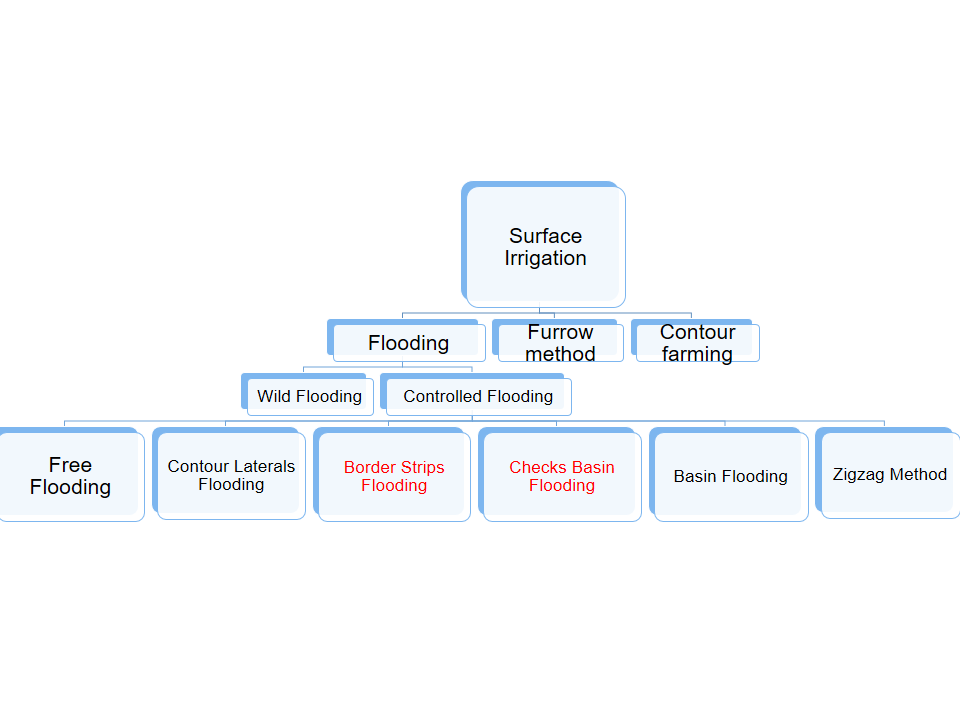
Controlled flooding irrigation includes several methods to manage water levels efficiently. These techniques aim to improve water distribution and reduce waste. let’s peep into the hierarchy of methods of controlled irrigation.

  • Free Flooding irrigation/wild flooding irrigation
  • Contour Lateral Flooding
  • Border Strips Flooding irrigation
  • Checks basin Flooding
  • Basin Flooding
  • Zigzag Method of Flooding

Free flooding or flooding from field channels
Free Flooding

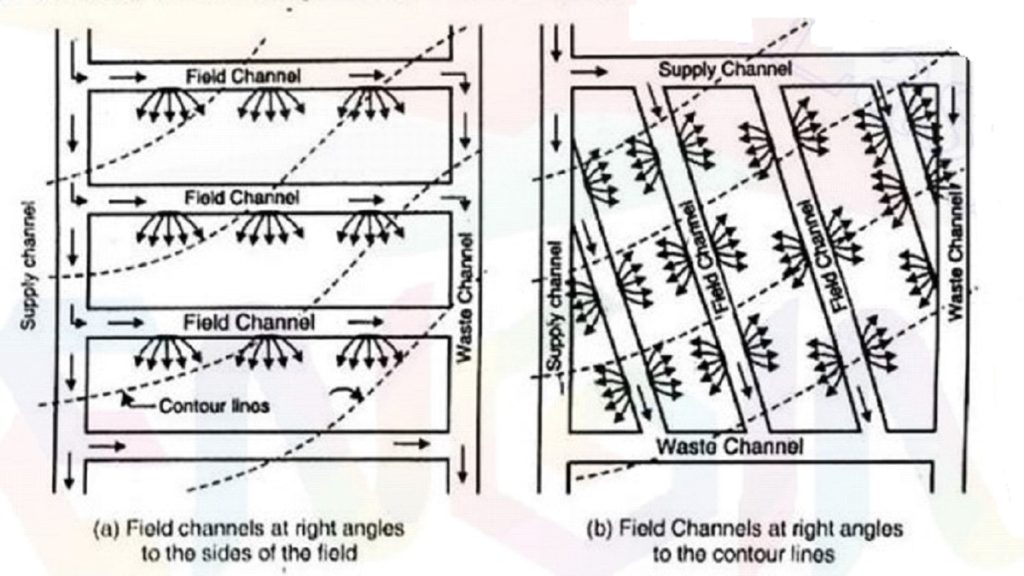
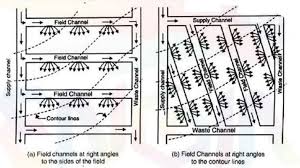
Free flooding method consists of dividing the entire land to be irrigated into small strips by a number of field channels known as laterals.

  • These laterals may be either at right angles to the sides of the field, or at right angles to the contour lines as shown in figures.
  • When the laterals are aligned at right angles to the sides of the lateral, irrigation is possible only to one side of the lateral. However, when the laterals are aligned at right angles to the contours, irrigation is done to both the sides of the lateral.
  • The field channels receive water from the supply channel and discharge excess water in the waste channel.
  • Water is applied to the strip of a land through feeding points provided at some interval along the laterals.
  • This method of water application can be used both for flat lands as well as for relatively steep lands. The alignment and spacing of the laterals depends upon the type of soil and topography of land.
  • If the slopes are steeper, the closer spacing of laterals is required. Similarly, closer spacing is required for relatively more permeable soils.
  • For flat land and for relatively less pervious soils, the spacing of the laterals may be increased. Normally the spacing of the laterals may vary from 10 to 50 metres.
  • However, the method is more suited for irrigation fields containing medium type soil and having slopes ranging from 1 in 100 to 1 in 300.

Let’s find out about the next method of controlled flooding.

Flooding by contour laterals

Flooding by Contour Laterals

This is a special case of free flooding in which the field channels or laterals are aligned approximately along the contour lines.

This method is applicable to steeper terrain.

The field is cut by a relatively dense network of small contour laterals, the spacing of which depends upon the prominent grade of field between two adjacent ditches or laterals, the uniformity of slope and the soil type.

I have explained the details of border strip flooding and checks basin flooding in previous blogs. So, let’s move on to the next member.

ALSO READ: Rainwater Harvesting Methods: Everything You Need To Know

Border Strips Flooding irrigation

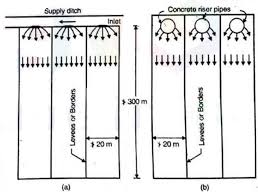
The border strip method, also known as border strip flooding irrigation, involves dividing a field into strips, typically 10 to 20 meters wide and 100 to 300 meters long, separated by low levees or borders. Water is directed from a supply ditch to the head of each strip, flowing down the slope in a controlled sheet, guided by the borders. The surface between the borders is kept level to ensure uniform coverage. Slopes vary from 0.2% to 0.8% along the strip, with cross slopes minimized to prevent uneven irrigation. This method is efficient for forage crops and requires minimal investment and labor. The length of each strip is adjusted based on soil type, infiltration rate, and irrigation stream size. For example, sandy soils typically use shorter strips, while clay soils may use longer ones.
Basin Flooding
Basin Flooding
Basin Flooding

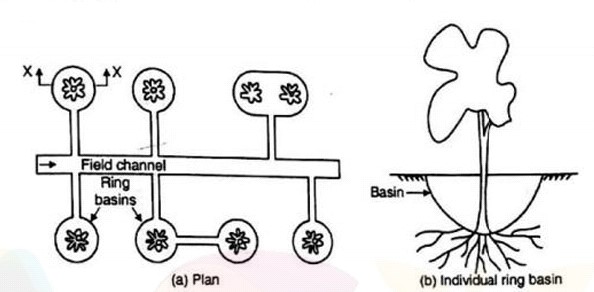
The ring basin flooding is a special form of check basin flooding adapted to orchards.

  • Ring basins are formed for each tree; in some cases, one ring basin may be formed for two or more trees.
  • Water is supplied to these basins through a supply ditch. In some cases, a number of ring basins are interconnected.
  • Portable pipes or large hoses may also be used in place of ditches.

Last, but not the least let me explain about final method of controlled flooding.

Zigzag method of controlled flooding

Zig Zag Method of Flooding

It is special method of flooding where water takes circuitous route before reaching the dead end of each plot.

  • The whole area is divided into a number of square or rectangular plots; each plot is then subdivided with the help of low bunds or levees.
  • This method is suitable for relatively level plots. It is, however, highly unsuitable for farming operations with modern farm machinery.

That’s it about the methods of controlled flooding.

MUST-READ: Concept of green building- 4 comprehensive concepts easy read!

I hope you got a fair idea about free flooding, basin flooding, flooding by contour laterals and zigzag method of flooding.

Happy learning!

Electronic toll collection- 4 subsystems full details

Electronic toll collection is one of the best advancements of Intelligent transportation system in transportation sector. We will see what is electronic toll collection in the next section. Later, I will walk you through four subsystems of ETC. They are automatic vehicle classification (AVC), violation enforcement system (VES), automatic vehicle identification (AVI) and transaction processing, which includes a back office and customer service center. The advantages, cost and disadvantages of ETC will also be discussed.

Moving onto the definition,

What is Electronic Toll Collection?

Electronic toll collection is a wireless system to automatically collect the usage fee or toll charged to vehicles using toll roads, HOV lanes, toll_bridges, and toll_tunnels.

Typical methods for collecting tolls are,

  • Manual collection
  • Automatic toll collection via coin machines
  • Electronic toll collection (ETC)

Manual toll collection is the simplest form of toll collection, in which a collector operating from a booth collects the toll.

Automatic coin machines allow collection of several methods of payments such as coins, tokens, smart cards, and credit cards without the need for a collector.

ETC is the most complex and latest method for collecting tolls. Although it has been in use for more than 20 years, ETC continues to evolve. ETC lanes improve the speed and efficiency of traffic flow and save drivers’ time.

An ETC system is capable of electronically charging a toll to an established customer account.

The system can determine whether a passing car is registered, automatically charging those vehicles, and alert the local highway patrol about users that are not registered. The ETC method allows vehicles to pass through a toll facility without requiring any action or stopping by the driver.

Now let’s see the advantages of electronic toll collection system.

Advantages of Electronic Toll Collection System

Systematic vehicle parking- an application of ITS like electronic toll collection
  • Typical ETC systems can improve the traffic flow through the toll area. Manual toll collection lanes handle about 350 vehicles per hour and automatic coin machine lanes handle about 500 vehicles in the same time period.
  • An ETC lane can process 1,200 vehicles per hour when the lane is located in a traditional plaza configuration with island structures on each side of the lane and up to 1,800 vehicles per hour in all-electronic tolling (AET) configurations.
  • An AET lane offers over five times the flow rate of a manual lane and nearly four times the flow of an automatic coin machine lane.
  • Most ETC lanes are less expensive to build and operate than traditional toll collection methods.
  • Cost data averaged for five toll facilities in five states showed electronic toll collection systems provide cost savings of over $40,000 per lane for equipment costs, and $40,000 per lane in annual operating and maintenance costs compared with automatic coin machines, and $135,000 per lane in annual operating and maintenance costs compared with manual tollbooths.
  • ETC lane usage can decrease emissions in the area.
  • Practitioners have reported that the ETC system at three toll plazas in Baltimore, Maryland, with dedicated ETC lanes located in a traditional plaza configuration with island structures on each side of the lane resulted in a 40 to 63 percent reduction of hydrocarbon and carbon monoxide, and approximately 16 percent reduction of nitrogen oxide in the study area.

That’s it about the advantages. Its time to see the principles of electronic toll collection.

Don’t miss out Google position 1st post: Road margins- 6 types of road margins in highway

Principles of Electronic Toll Collection

Typical ETC systems are comprised of four subsystems

  • Automatic vehicle classification (AVC)
  • Violation enforcement system (VES)
  • Automatic vehicle identification (AVI)
  • Transaction processing, which includes a back office and customer service center.

Automatic Vehicle Classification

  •  Automatic Vehicle Classification (AVC) consist of sensors installed in the toll lanes to detect and classify the vehicles for proper tolling.
  • The AVC technique is most commonly performed using overhead equipment (laser or infrared detectors) or intelligent detector loops embedded in the pavement, but the detectors can also be placed on the roadside.
  • The sensors are capable of perceiving and classifying vehicles in the open road tolling or all electronic tolling environments.

Violation Enforcement System

  • The primary goal of Violation Enforcement System is to reduce the number of toll evaders with the assistance of multiple types of solutions.
  • These methods range from fairly basic (audible and/or visual alarms) to complex systems, such as automatic license plate recognition camera-based solutions.
  • Police enforcement and toll gates are other types of successful VES but can be costly and inefficient for high traffic volumes.
  • Camera-based VES captures images of each vehicle’s front and/or rear license plates, depending on the toll authority’s regulations.
  • The necessary equipment consists of a camera (or array of cameras), an illumination system, and a controller card or computer that interfaces with the lane controller and/or the back office.
  • A camera-based VES with plate recognition serves a dual purpose of enforcement and video tolling.

Automatic Vehicle Identification

  •  The Automatic Vehicle Identification systems properly identify each vehicle to charge the toll to a particular customer.
  • This ETC method is typically done with various AVI technologies such as a bar coded label affixed to the vehicle, proximity card, radio or infrared transponder, and automatic license plate recognition.
  • A majority of the AVI systems used involve radio frequency identity (RFID) and plate recognition technologies.
  • The RFID system uses an antenna to communicate with a transponder in each registered vehicle, while video tolling identifies the license plate and charges a customer or sends a bill to unregistered drivers with help from the Department of Motor Vehicle’s address database.

Transaction Processing with Back Office and Customer Service

  • The back office consists of the host and/or plaza system, customer service center, and violation processing center.
  • The main functions of the host and plaza systems are to aggregate transactional data from all the lanes, data summarization, report generation, download of files such as a toll rates, toll schedules, and transponder status list.
  • The customer service center is responsible for processing the AVI and video tolling transactions, matching transactions with account holders, debiting the correct toll amount, managing accounts, generating a valid tag list, and providing customer support to name a few.
  • The violation processing center’s main function is to process the images of the licenses plates, identify violators, and mail notices.

 We have seen all the positives till now. Any topic is incomplete without raising the negative side. I will tell you that now.

Also read: Gauges in railway- All Details About Broad, Metre and Narrow Gauges

Disadvantages of Electronic Toll Collection System

Charging a car- an application of ITS like electronic toll collection

Most of the technological issues have been overcome after two decades of successful ETC implementations. The current issues with implementing ETC systems are related to interoperability and technology selection.

  • There is a lack of interoperability with other states and with toll facilities at border crossings.
  • The need for interoperability between border crossings and toll roads will continue to increase as toll road are built near the border.
  • Technology selection directly impacts interoperability. If a toll agency selects a different RFID protocol then it might not be able to read customers from away agencies.
  • Cities and local toll authorities should work together to create a compatible system throughout the state.

And finally, we have reached at the practical aspect.

Cost of ETC

  • The cost of implementing an ETC system varies widely depending on the scope of the project, making it difficult to provide an exact cost.
  • The system size (number of lanes and collection points), shoulder coverage, gantry type, and type of technology all affect the project price.
  • The cost is also affected by whether the system is new, upgraded, or added onto.
  • The price range will change based on the level of customized software required for the business rules, the back office operation (outsource or in-house), the project location, and the necessary signage.
  • The cost per ETC lane in an AET or ORT environment ranges from $100,000 to $200,000 for the cost of the lane equipment and its installation, and assuming the project reuses existing back office software, gantry, and right of-way.

MUST READ: Bitumen for road- Grade and properties of bitumen

Hope the article benefited you. So, electronic toll collection is an amazing tool, right? Let me know that in the comments.

Enjoy learning!

Check flooding and Border strip methods of irrigation| Types of surface irrigation

Check flooding and border strip method are two types in surface irrigation, one of the major methods of irrigation. In the blog, we are going to learn everything about these two with figures.

Before we begin, let’s look at the classification of surface irrigation. Check flooding and border strip method are two that comes in the bottom. I will surely cover other main categories in another blog.

We saw the hierarchy of methods of surface irrigation. Let’s jump right into the first method which is border strip method.

Figure shows methods of irrigation

Border strip method in detail

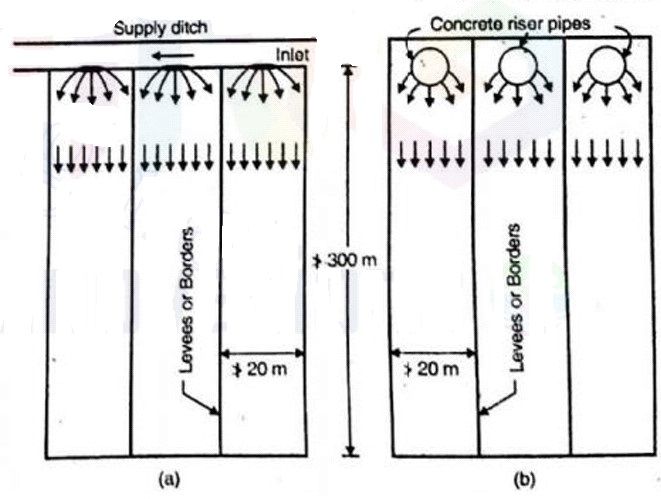
The diagram below shows border strip method.

Figure shows border strip method
Diagram showing border strip method

Border strip method is otherwise called border strip flooding method. The main points regarding this are,

In the border strip flooding method, the farm is divided into a series of strips 10 to 20 metres wide and 100 to 300 metres long.

These strips are separated by low levees or borders and run down the predominant or any other desired slope.

To irrigate, water is turned from the supply ditch onto the head of the border. Water advances confined and guided by two borders in a thin sheet towards the lower end of the strip.

The surface is essentially level between two borders so that the advancing sheet of water covers the entire width of the strip.

The lengthwise slope varies from 0.2 to 0.8 %. The border strip should be level cross wise.

Cross slopes within border strips cause water to concentrate along the lower side of the strip causing uneven irrigation.

This method is especially suited to forage crops,its advantage being that for a relatively low investment a system can be developed which can afford the highest irrigation efficiency and lowest labour requirements.

With highly mechanised farming, large area can be irrigated within a short time by border strip method. The length of border strip depends upon how quickly it can be wetted over its entire length. This depends upon,

  • Infiltration rate of the soil
  • Longitudinal slope of the land
  • Size of irrigation stream available

The following lengths are suggested for moderate condition

Type of soil of border stripLength
Sandy soil or sandy loam   60- 90m
Medium silt loam90-150
Clay loam or clay soil  150- 300
Length of border strip with type of soil

The first 6 to 12m length of the strip should be made level to ensure uniform spreading of water. Water is diverted to the border strips from the following

Warth or concrete ditches

These run at a flat longitudinal grade. The water is discharged into the strips via border gates, aluminum syphons or plastic piping

Underground concrete pipes through risers

In this method, water is let into the strips by concrete risers

That’s it about border strip method. Let me walk you through check flooding now.

Also read: Concept of Green Building- 4 comprehensive concepts easy read!

Check flooding

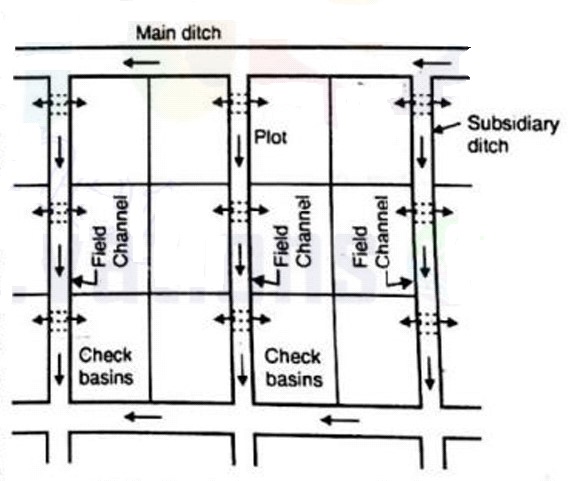
The diagram given below shows check flooding.

Figure shows check flooding
Check flooding

The method is also known as irrigation by plots since the entire area is divided into several plots obtained by subdividing the entire area by levees

Moving on to the main details,

  • Check flooding is similar to free flooding except that the water is controlled by surrounding the check area with low, flat levees surrounding each check while in free flooding no such levees are provided and the strips are divided by field channels.
  • Each plot is practically level. The size of levee depends upon the depth of water to be applies as well as the stability of the soil when it is wet.
  • Water is conveyed to the land by a system of supply channels a swell as laterals.
  • Usually, there is one field channel for every two rows of plots. Water is admitted to these plots at the higher end and the supply is cutoff as soon as the lower part of the plot has received the sufficient depth of water.
  • Oblong plots are preferred to the square plots. The size of the plots depends on the porosity of the soil.
  • In a levelled ground, the plots are generally rectangular, but if the ground has same initial slope, the checks or levees may follow contours.
  • Contour checks are prepared by constructing ridges along contours at vertical intervals of 6 to 12 cm and connecting them with cross ridges at intervals.
  • Very little crop land is perfectly level, and the water does not stand at a uniform depth over the entire check. This results in uneven distribution of water within the plot.
  • Low area will receive too much water and high gets too little. 
  • The size of check basins is dependent on the infiltration rate. It may vary from 1m2 for growing vegetables and other intensive irrigation to 1- 2 hectares for growing rice under wet land conditions.
  • However, the more common size varies from 0.03 to 0.06 hectares for medium soils. The size of stream should be sufficient to cover the entire basin in a relatively small portion of time required

So, that was the main details on check flooding.

Also read: Innovative Water Conservation Methods Unlocked.

What are your thoughts on border strip method and check flooding? Let me know that in the comments.

WPC Board vs Plywood – Which is best?

WPC Board vs Plywood– Which is best ? When you decide to do the interiors of your home or office a lot of materials come to your mind. But choosing the right material is the primary concern and need. Of all the interior materials available in the market Plywood and WPC or Wood plastic composite are the most preferred and commonly used. Which one do you choose?

Both are excellent building materials in terms of durability, strength, and workability and are available in different grades to cater to any requirement, budget, and application areas.

wpc boards used as kitchen cabinets
WPC BOARD – KITCHEN INTERIOR

What is WPC boards?

WPC boards are made from grounded sawdust thoroughly mixed and heated with thermoplastic resins mixed with additives for imparting superior qualities. Sawdust from fibre fillers like pulp, peanut hulls, byproducts of the textile industry, bamboo, etc. are mixed with virgin or waste/recycled plastic derived from polyethylene, polyvinyl chloride, polypropylene, etc. Nowadays polyethylene-based plastics are commonly used. The proportion of sawdust is around 15%, virgin/recycled plastic constitutes 75%, and the remaining will be different additives. WPC board is a hybrid product that got the qualities of wood and easiness and water-resistant properties of plastic. These ingredients are mixed to a thick consistency and are moulded or extruded to form WPC boards.

WPC BOARD - SWIMMING POOL DECK
WPC BOARD – SWIMMING POOL DECK

Must Read : WPC Boards – Advantages, Disadvantages and Uses.

What is plywood?

Plywood is a manufactured wood panel/ engineered wood made from thin sliced natural wood called veneers in the core as well as the face. These core veneers are glued in layers one on top of the other with adjacent layers having their wood grains rotated up to 90 degrees to one another. The cross layering of adjacent layers imparts structural strength and stability to plywood. These veneers are bonded together with glue and pressed under high pressure and heated to form plywood. Plywood is a versatile, flexible, and highly workable building material widely used in manufacturing furniture, cabinets, shelves, and wardrobes, etc. They are also used for woodwork for ships and boats and for shuttering works in the construction sector. These are the commonly used categories of plywood based on application sectors.

WPC BOARD VS PLYWOOD - LAMINATE OVER PLYWOOD INTERIORS
LAMINATE OVER PLYWOOD

Also read : Plywood Types – MR resistant, BWR and BWP/Marine ply

WPC board vs Plywood – A comparison

Plywood is available in three different grades. They are MR grade/ commercial ply as per IS 303, Exterior grade /BWR grade as per IS 303 and Marine ply/BWP grade as per IS 710 grade. Marine ply is the most superior grade of plywood. For comparison, we are taking marine ply and Wood plastic composite (WPC).
Marine plywood and WPC boards got similar characteristics – They are moisture-resistant, termite-resistant, suitable for outdoor applications, and extensively used for external and works exposed to water and moisture such as kitchens and bathrooms and external furniture, facades, etc.

Advertisements

WPC board vs Plywood – Ingredients and manufacturing

PlywoodWPC Board
Plywood is made of sliced wood layers (veneers) and is placed in a cross-layered pattern. The veneer layers are glued together using synthetic resins like Urea Formaldehyde or Phenol formaldehyde, pressed with high pressure, and heated
to form plywood.
Manufactured from a mixture of sawdust/wood fibre and waste/ recycled plastics. The materials are mixed with pigments and additives and moulded our extruded to for WPC boards.

Moisture resistant and termite resistant qualities

PlywoodWPC board
Marine-grade ply wood surface is
very hard and delivers superior
water-resistant qualities.
They are made from tropical
hardwood veneers and jointed using
water-resistant adhesive. Marine ply
is further treated with preservatives
and protective finishes to enhance
water and termite resistant qualities.
WPC is a Mixture of sawdust
and plastics. They are a hundred
percent water-resistant
and
termite-proof material.

Because of these qualities, both these materials can be used for wet areas, external furniture, facades, kitchen cabinets, bathroom interiors, etc. But plywood of grades other than Marine got less water and moisture resistant than WPC boards.

Advertisements

Fire resistant and heat resistance

PlywoodWPC board
Plywood burns with flame and is
more suspectable to heat.
WPC does not burn with flames due to the presence of plastic material and special additives. WPC is a polymer-based material and does not catch fire.

Plywood can be made fire resistant by protecting with fire-retardant additives. Fire and heat resistant qualities are much better in the case of WPC boards.

Screw holding capacity

Due to the cross-layered arrangement of veneers, plywood possesses extremely good screw holding capacities. It may not come out from hinges easily.

Screw holding capacity of WPC depends on the density of the materials. For a competitive screw holding capacity, WPC boards should possess a density of 600kg/cm3.

Screw holding capacity of plywood is comparatively better than WPC boards.

PLYWOOD MANUFACTURING

Durability

The durability of plywood depends on the grade which is being used and the area of application. Plywood is durable but has to be maintained properly. Some plywood grades may split or splinter in course of time.

WPC is an extremely durable material and is long-lasting.

WPC always comes with a lifetime guarantee from major manufactures whereas plywood quality determines durability and life. Because of the presence of a lot of plywood manufacturers, the qualities may be compromised. BWR grade- IS 303 GRADE plywood is sold to the customer in place of Marine ply in most of the cases. Ensure that the materials to be purchased from the reputed manufacturer with proper test certificates.

WPC is extruded or moulded to form sheets and hence are a homogeneous material whereas plywood is made by layers that are glued and may fail.

Workability

Plywood can be easily bent without affecting its strength. But planning and molding are not possible like Wood and WPC due to cross-layered arrangement.

WPC got the combined properties of plastic and wood and hence are more flexible than plywood and can be thermoformed to any shape. They can also be moulded, planned, and grooved, exactly like wood.

Plywood cannot be used in the raw form. Plywood has to be covered with laminate or veneer to match the colour scheme. Plywood got a good surface enabling the gluing of veneers and laminates. They can also be painted with PU and textures. Laminated plywood are also available for various uses.
The veneers and laminates may peel off on continuous exposure to sunlight and water.

In the case of WPC boards, the colours are generated through the addition of pigments in the manufacturing process and do not fade easily on exposure to sunlight. WPC does not need any laminate, veneer, paints, and polish.

Veneers and laminates are fixed on WPC with proper roughening of the surface and treatment with special adhesives and double side adhesive tapes. They can even be painted with PU paint and texture paint after the application of plastic primer. The bonding properties of WPC with laminates, veneers, and paint are not strong when compared with plywood.

Eco friendly qualities

Plywood veneers are from cutting trees and are not environmentally friendly. The manufacturing of plywood will result in deforestation.

WPC is made from wood waste, sawdust, recycled plastics, etc and consumes industrial wastes and converts it into usable materials. WPC manufacturing does not generate any wastage nor any trees are cut in this process and is an environmental friendly material.

WPC board vs plywood – Cost

Good quality WPC boards are costlier than marine plywood. But the additional costs incurred for veneer, laminates etc can be eliminated.

Conclusion

WPC is a long-lasting, eco-friendly, durable, and extremely high water and moisture resistant product than plywood. But the looks cannot match exactly as wood and they do not have the choice of application of beautiful laminates and veneers. Still, WPC stands out as a better option than plywood in wet areas even though it costs high. Plywood on the other hand is durable and can match wood finishes and colours through veneers and laminates which is not possible in WPC.

Processing…
Success! You're on the list.

Methods of Irrigation- 3 Methods Full Guide

Methods of irrigation is an important portion in hydraulics. There are mainly three methods- surface irrigation, subsurface irrigation and sprinkler irrigation. Subsurface irrigation is again divided into natural sub-irrigation and artificial sub-irrigation.

Before selecting a particular method, the irrigation engineer must evaluate all the factors, and choose that method which is best suited to the local conditions.

Basic requirements for adaptation of irrigation methods

  • The method should be such that uniform water distribution with as small as 6cm water depth applications can be made for light irrigation
  • At the same time, it should afford a heavy uniform application of 15 to 20 cm water depth.
  • It should allow the use of large concentrated water flows for reduction of conveyance losses, and labour cost.
  • It should be suitable for use with economical conveyance structure.
  • It should be such that mechanized farming is facilitated

Good irrigation method results in increased yield and conservation of resources with soil productivity maintained and water utilised economically. Over irrigation results in soil erosion, leached fertilizers, drainage troubles and salt accumulation.

Basic methods of Irrigation

Water may be applied to the crops by through three basic methods of irrigation.

  • Surface irrigation method
  • Subsurface irrigation method
  • Sprinkler irrigation method

Let’s dive into through each of them now.

Also read: Concept of Green Building- 4 comprehensive concepts easy read!

Surface irrigation method- Largest among methods of irrigation

Surface irrigation is a method of irrigation where water is applied and distributed over the soil surface due to gravity. It is the most common form of irrigation throughout the world and has been practised in many areas.

Surface irrigation is also known as flood irrigation, which means that water distribution is uncontrolled. So, it will be inefficient. Some of the irrigation practices grouped under this name involve a large degree of management. Surface irrigation is mainly of three types.

  1. Flooding method
  2. Furrow method
  3. Contour farming
Surface Irrigation classification

We shall discuss about each of the subdivisions in another blog. Now, come with me to shake hands with subsurface irrigation.

Subsurface irrigation method

The sub surface irrigation method consists of  supplying water firectly to the root zone of the crop. The favourable conditions for the sub surfacr irrigation practice are

  1. Impervious sub soil at reasonable depth (2 to 3m) or existence of high water table
  2. Permeable soil such as loam or sandy loam in the root zone of the soil
  3. Uniform topographic conditions
  4. Moderate slopes
  5. Good quality irrigation water

If all these favourable conditions are fulfilled and if proper precautions are taken to prevent alkali accumulation or excess water logging, the method results in exonomical use of water, high crop yield and low labour cost in preparing the irrigation plots.

Subsurface irrigation may be of two classes

  1. Naural sub irrigation
  2. Artificial sub irrigation
Sub surface Irrigation classification

Also read: LEED certification India- a comprehensive guide

Next, let’s know more details about these methods of irrigation shown in the diagram.

1. Natural sub irrigation

In natural sub irrigation, water is supplied to the root zone of the plants by controlling the level of local water table, such a high level of water table in the area may be available due to water seeping from earthen canals, drains, rivers, etc.

The main points in natural sub irrigation are,

  • In order to ensure the requisite supply of water to the root zone, its is essential to maintain the desired water level by artificial means.
  • For this purpose, water is supplied to a series of ditches half to one metre deep and 25 to 50cm wide having vertical sides.
  • These ditches are spaced from 15 to 100m apart depending upon the Permeability_of_sub soil and topography of land.
  • The depth of ditches may vary from 0.3 to 0.5m These channels have relatively flat slopes.
  • Water flows at a slow rate and seeps into the ground to maintain the water table at a height such that water from the capiliary fringe is available to the vrops.
  • Proper drainage of excess water is permitted, either naturally or with the other drainage works to prevent water logging of the fields.
  • Sometimes the upward capiliary water flow from shallow water table may produce saline and alkali conditions and may make the land less productive.
  • Under such circumstances, the subsurface irrigation method has to be discontinued and irrigation has to be resorted by sprinkling method.

Next member is artificial sub irrigation method. What are we waiting for? Let me give you more details on that.

2. Artificial sub irrigation

The artificial sub irrigation method consists of supplying water diretly to the root zone of crops through a network of buried perforated pipes. Water is made to pass under pressure, through these underground perforated pipes.

This method is suitable only for those soils formations which have high horizontal permeability to permit free lateral movement though the root zone of the crops and low vertical permeability so that deep percolation losses are minimised.

The pipe are buried 0.3 to 0.4m deep, so that cultivation operations are not hindered, an are spaced  0.4 to 0.5m horizontally, for uniform distribution of water.

Also read: Vastu for home plan- all design tips backed by logic

Its time to meet the last member, sprinkler irrigation.

Sprinkler irrigation

figure shows sprinkler irrigation
Sprinkler Irrigation

The sprinkler irrigation method consists of applying the water in the form of a spray, somewhat as in ordinary rain, as is done in the garden lawn sprinkling.

The greatest advantage of sprinkler irrigation is its adaptabilities to use under conditions where surface irrigatin methods are not efficient. The method is more useful where,

  1. The land cannot be prepared for surface methods
  2. Slopes are excessive
  3. Topography is irregular
  4. Soil is erosive
  5. Soil is excessively permeable or impermeable
  6. Depth of soil is hallow over gravel or sand

In this system, the cost of land preparations and permanent water delivery system of channels or conduits is less. However, there is large initaial investment in the purchace of the pumping and sprinkling equipment.

Sprinkler system can be classified under 3 heads.

  1. Permanent system
  2. Semi-permanent system
  3. Portable system
Sprinkler Irrigation Classification

Earlier, stationary overhead perforated pipe installations were used. However, with the introduction of lightweight steel pipes and quick couplers, a portable sprinkler system was developed.

In the permanent system, pipes are permanently buried in such a way that they do not interfere with tillage operations.

In the semi-permanent system, the main lines are buried while the laterals are portable. A portable system has both portable mains lines and laterals. These systems are designed to be moved from around the farm from field to field.

A pump usually lifts the water from the source, pushes it through the distribution system and through the sprinkler nozzle on the sprinkler heads mounted on rising pipes attached to the laterals. Turbine and horizontal centrifugal pumps are used.

So, that’s it about methods of irrigation. Was that helpful to the knowledge seeker in you?

Plywood vs Natural wood – A comparison

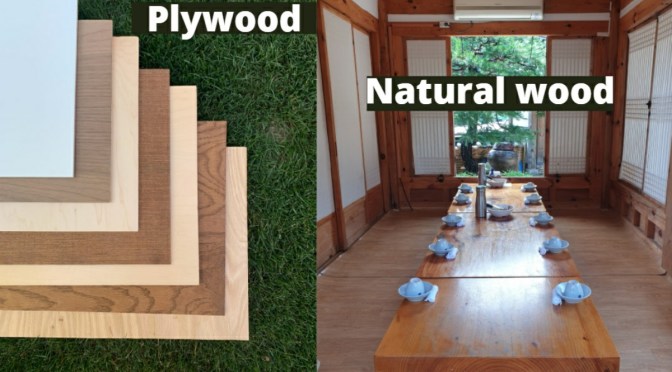
Plywood vs natural wood – Which one you prefer. The vast  Engineered wood category includes mass timbercomposite woodman-made wood, or manufactured board, which can be a wood derivative or manufactured by binding or fixing the strands, particles, fibres, or veneers together with adhesives or other fixation methods. The most widely accepted engineered wood available in the market is Natural wood and its alternatives like Plywood, MDF, HDF, etc. But plywood is always considered as the most preferred wood alternative. Why plywood is preferred? This article is about a comparison of properties of Natural wood and plywood.

Also read : Plywood Types – MR resistant, BWR and BWP/Marine ply

Plywood vs Natural wood

Plywood and natural wood are the most commonly used materials for interior works, furniture, kitchen cabinets, decks, facades, ceilings, etc. Both these products possess excellent strength and are flexible, affordable, and workable. Plywood is the most extensively used wood substitute because of its flexibility, strength, and excellent screw holding capacities.

Natural wood

Solid wood is the natural wood and is obtained from trees. The trees are felled and cut in sawmills as per the required size and fabricated as per requirements. Amongst the most popular solid woods are teak wood, oak wood, cherry, maple, mahogany, and Indian rosewood, etc.

Plywood

Plywood is a manufactured wood panel made from thin natural wood called veneers sliced from hardwood or softwood. These core veneers are glued in layers one on top of the other with adjacent layers having their wood grains rotated up to 90 degrees to one another. The cross layering of adjacent layers imparts structural strength and stability to plywood. These veneers are bonded together with glue and pressed under high pressure and heated to form plywood.

plywood interiors
Plywood interiors

Plywood vs natural wood – Strength

PlywoodNatural wood
Cross veneer layers are responsible
or the strength and stiffness both long and across grains. Plywood bends on loads when placed horizontally.
Solid wood is 20 times stronger along the grains. They are much stiffer than plywood. Wood do not
bend on loads.
Veneer layers are glued together and hence ply layers may debond due to low glue shear strength.Solid wood is a homogeneous and dense material and much stronger than plywood.
The quality depends on the type of wood used and the number of ply layers. Plywood made of gurjan wood is extremely strong.Some solid wood like teak etc posses high density and with proper maintenance can last hundreds of years.

Solid wood is much stronger than any other engineered wood and no alternative can match it.

Shrinkage

PlywoodNatural wood
Plywood does not shrink due to the
cross-layered arrangement of veneers.
Timber shrinks across the grains

Appearance and aesthetic looks

PlywoodNatural wood
Plywood is not a decorative
material. For wooden looks, they
have to be faced with decorative veneers.
Designers always prefer
the beauty of wood over any
other material.
The natural grains gives a classy
and elegant look that never can
be matched with any other material.
Plywood finishes are
provided through coatings,
PU paints laminates and veneers.
Wood finishes are through planing
and polishing Some wood varieties
like teak wood got unique grains
and maintain classy looks for years.

Durability

PlywoodNatural wood
The plywood grades determine
the durability. MR resistant grade
is good for interior works, BWR
grade is good for external
works,kitchen cabinets,
bathrooms interiors, etc
whereas marine ply is durable
and highly water-resistant.
Natural wood is everlasting if
protected and maintained properly. The durability depends on the type
of wood. Hardwood like teak
wood is extremely strong
and dense and requires minimal maintenance,
whereas softwood like pine needs
frequent maintenance
Plywood can last for years if maintained
properly and protected using laminate
veneers or paints
Plywood cannot match the durability of wood.

Plywood vs Natural wood – Costs

Good quality solid wood is very costly when compared to plywood. The usage of wood is getting restricted due to acts against deforestation and
environmental issues. The scarcity of wood and high costs sidelined natural wood as a non-affordable option. On the other hand, plywood is cheap and got plenty of varieties to manage your budget and requirements and is easily available.

Kitchen cabinet

Sheet material applications

Plywood has an extra hand over wood in the case of sheet material applications like wardrobes, partitions, and cabinets.
The maximum size of wood panels depends on the size of the tree. Wood has to be joined for sheet material applications whereas plywood is available in large sheet sizes and can be easily cut and used. Plywood can reduce the joints and give a seamless look. Wood has to be jointed and tends to crack along the joints.

Flexibility and workability

Ply wood can be bend easily where as it is very difficult to bend solid wood.It is very strong and the thinner cuts are easy to work with.Plywood never splits on edges while nailing and posses good screw holding capacity whereas timber used to split on edges on nailing. Ply wood can be easily cut into any shapes and sizes. Plywood are easy to paint or polish. The plywood surface is smooth and any kind of veneer or laminate can be pasted with the help of adhesives. This flexibility makes plywood one of the most versatile material.

Wood, on the other hand, can be planed whereas plywood cannot be planed The edges of the plywood looks rough and has to be covered or coated to look good. Wood possesses excellent screw holding capacity.

Maximum usage of materials

The plywood manufacturing process achieves complete utilisation of the log than timber which is available in logs and the utilisation is only 50-70%. No sawdust results from either rotary cutting or slicing (the two most popular methods of cutting veneer).

Environmental concerns

Natural wood is obtained by felling trees. This leads to deforestation and degradation of environment.

Uses of Natural wood and plywood

Solid wood is commonly used to make the wooden framed structures as well as in flooring. It is also used in the manufacturing of highly durable furniture items for indoor and outdoor use. In the homes and buildings, it is also used for the doors, and window frames. It is also used in ships, aircraft, millwork, ladders, boxes, crates and much more.

Conclusion

Wood is the best material in terms of strength and durability. But high costs, less design options, high labour charges etc is the main disadvantage. Plywood is readily available,can match any customer requirement, cheap and affordable. Plywood is better in terms of flexibility, workability and costs.

Updates in civil engineering, architecture finishes, building construction, Environmental Engineering