Tag Archives: cement properties

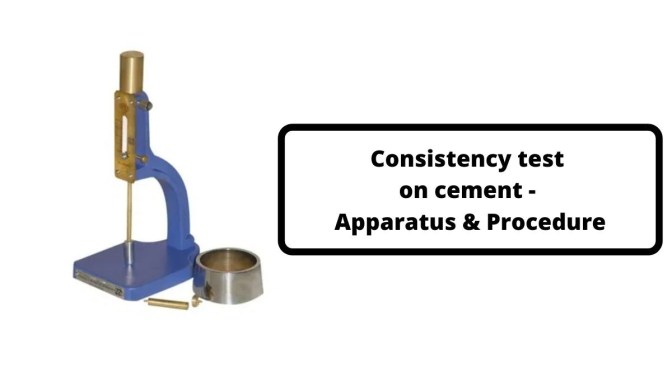
Consistency test on cement – Significance and Procedure

The standard consistency test of cement is a crucial procedure for determining the precise quantity of water needed to create a workable paste, which is essential for subsequent laboratory tests. This test utilizes a Vicat apparatus to find the water content that allows the plunger to penetrate the paste to a specified depth, thus defining the normal consistency of cement. Establishing this value is a necessary step before conducting other important tests like setting time, soundness, and compressive strength, all of which rely on a correct water–cement ratio.

Understanding the significance of the consistency test helps one appreciate its influence on key concrete properties such as workability, strength development, and durability. By providing a clear explanation of the test’s procedure—from trial mixes to the final penetration reading—this article serves as a valuable guide for students, site engineers, and quality controllers. It aims to assist them in performing reliable laboratory work, ultimately ensuring high-quality cement performance in structures.

  1. Significance of cement tests
    1. Field tests of cement
    2. Laboratory tests
  2. Significance of Consistency test on Cement
  3. Relevant IS code for consistency test on cement
  4. Apparatus used for consistency test on cement
  5. Procedure of consistency test for cement (As per IS 4031 Part 4)
  6. Calculation
  7. Consistency of cement test procedure – Standards comparison
  8. Precaution
  9. Conclusion

Significance of cement tests

Cement is a key construction material used in buildings, bridges, and infrastructure. It forms concrete and mortar, and it directly influences the strength, durability, and performance of structures.

Cement is a key construction material, so its quality must be checked before use. Cement tests generally fall into two types: laboratory tests and field tests. Field tests are simple, quick checks that do not require special equipment or expertise. They help to judge whether cement can be accepted for work.

Field tests of cement

  • Checking manufacturing date
  • Visual lump check
  • Feel test (smoothness)
  • Heat test
  • Colour check
  • Water float test
  • Setting test

These tests provide approximate but useful quality indications.

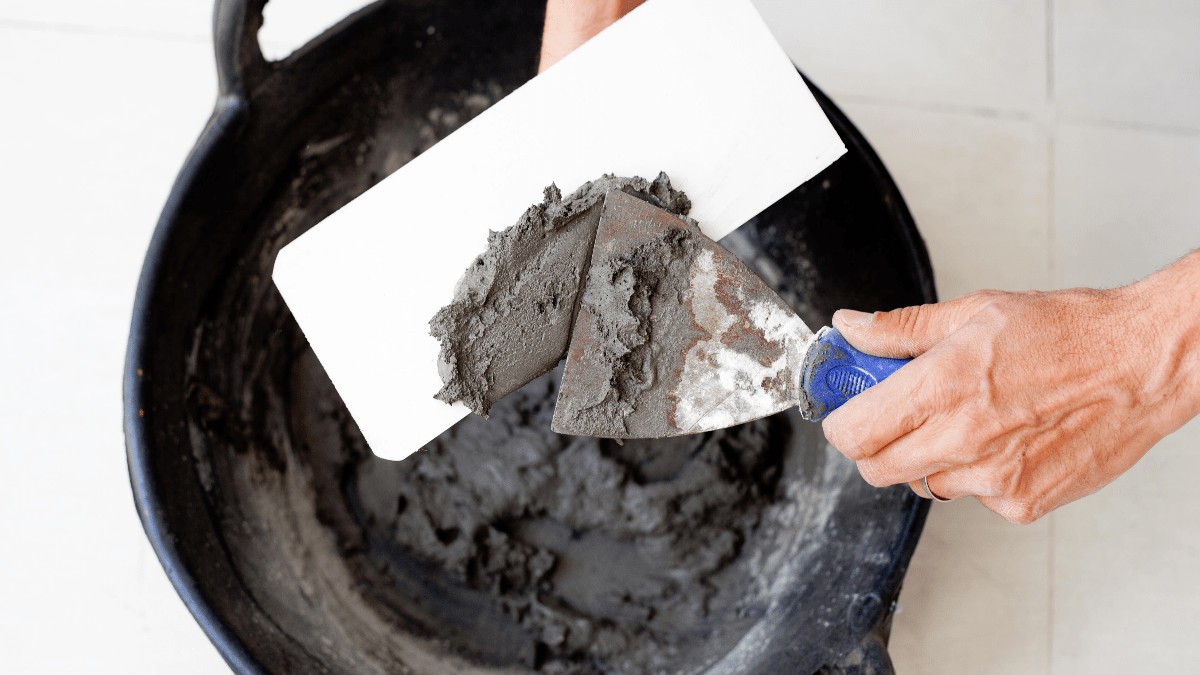
A laboratory technician wearing safety goggles and gloves mixes cement paste in a large bowl, with a Vicat apparatus and various testing equipment visible in the background.
A technician performing the standard consistency test of cement using a Vicat apparatus in a laboratory setting.

Laboratory tests

Laboratory tests provide detailed and accurate assessment of cement quality under controlled conditions , essential before use in structural works. Common lab tests for cement include:

  • Standard consistency test of cement
  • Initial and final setting time test
  • Soundness test (e.g., Le Chatelier method)
  • Fineness test (e.g., sieve or Blaine method)
  • Strength test (e.g., compressive strength of cement mortar)
  • Heat of hydration test (for some cements)
  • Chemical composition / chemical analysis

This article is about standard consistency test of cement.

Significance of Consistency test on Cement

The strength and durability of concrete depend greatly on the quality of cement and its correct water content. To achieve proper strength, the cement mortar must have standard consistency, which is determined in the consistency test of cement. In this test, standard consistency occurs when the Vicat plunger penetrates to a depth of 5–7 mm from the mould’s bottom. This penetration confirms the cement’s readiness. It is determined through trial and error to find the exact amount of water required to prepare a workable cement paste. Knowing the normal consistency of cement is crucial. It is needed before performing other laboratory tests, such as compressive strength, setting time, and soundness tests. Water directly influences hydration. Cement composition, fineness, and water–cement ratio affect consistency. Excess water weakens hardened cement, while too little water slows hydration and reduces strength. Therefore, determining consistency ensures reliable concrete performance and quality control.

Relevant IS code for consistency test on cement

  • IS 4031 (Part 4):1988 – Standard consistency test (India)
  • ASTM C187 – Amount of water required for normal consistency (USA)
  • BS EN 196-3:2016 – Standard consistence, setting times & soundness (UK/Europe)

Apparatus used for consistency test on cement

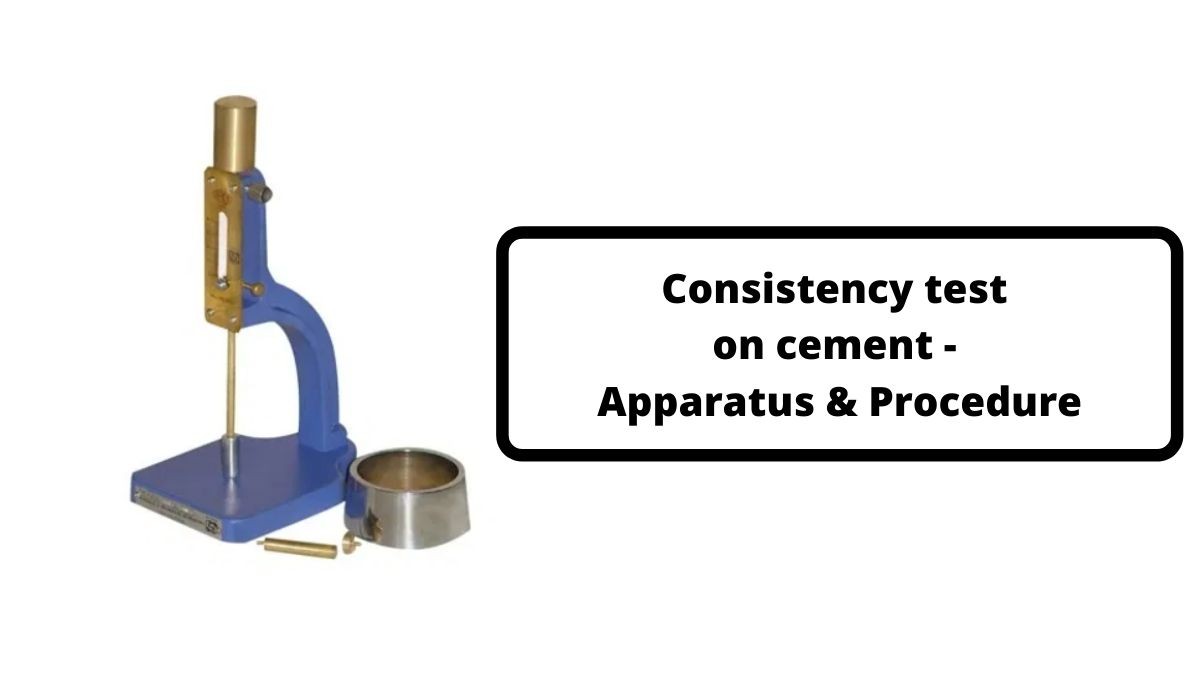
The Vicat apparatus is used to determine the consistency of cement. It consists of a plunger, a movable rod weighing 300 g, graduated scale, non-porous plate, split mould and Vicat mould. The diameter of the plunger is 10mm and the length is 50mm. The graduate scale measures the depth of penetration. The Vicat mould is a cone frustum with 80 mm diameter. The test should be conducted at a standard temperature of 27 C. The humidity should be 65%. A stop clock is used to measure the time from the addition of water to the drying of cement. As per IS code, the time of gauging is not less than 3 minutes, nor more than 5 min.

Procedure of consistency test for cement (As per IS 4031 Part 4)

Follow these steps when performing the consistency test under IS code:

  • Use a clean Vicat apparatus (as per specification) with 10 mm-diameter plunger and standard mould resting on a non-porous base plate.
  • Weigh a required quantity of cement and a proportionate amount of potable or distilled water.
  • Begin gauging (mixing): mix cement and water thoroughly, and complete gauging within 3 to 5 minutes from addition of water. Ensure gauging is completed before any sign of setting occurs.
  • Fill the Vicat mould with the fresh cement paste, rest mould on non-porous plate. Level the surface — remove excess paste, smooth the top. A light shake may be used to expel air bubbles.
  • Lower the plunger gently so it just touches the paste surface, then release it to descent under its own weight (no external load).
  • Observe the depth of penetration on the graded scale. If plunger stops such that it’s 5–7 mm above the bottom of mould — that paste has “standard consistency.”
  • If the penetration depth is not within that range, discard paste; prepare a new paste with adjusted water content (increase or decrease water) and repeat until standard consistency is reached.
  • Document the percentage water (by weight of cement) that achieved standard consistency — this becomes the “water for normal consistency” or “standard consistency water proportion.”
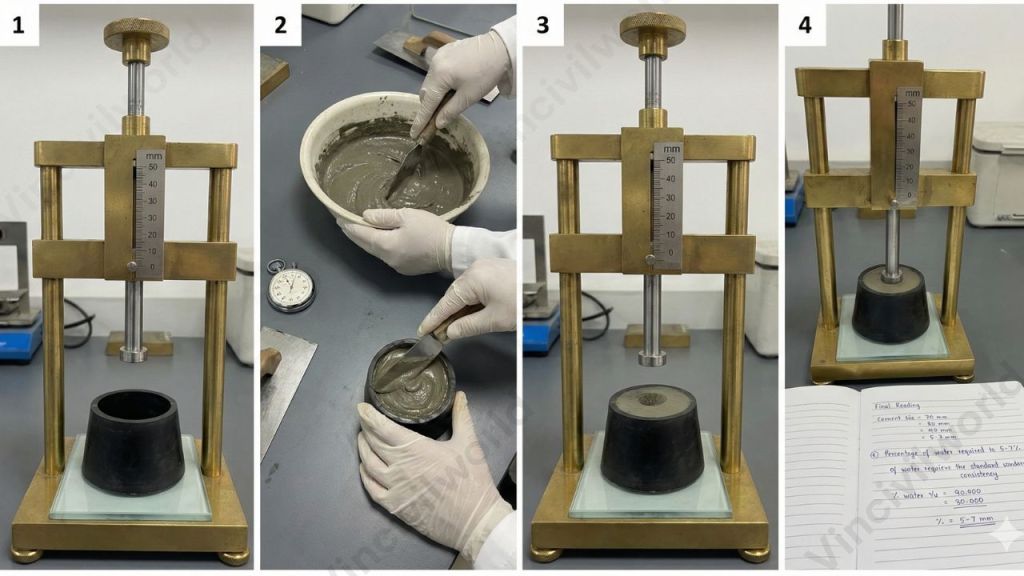
Vicats apparatus setup for the standard consistency test of cement, showing the plunger mechanism.
Vicat apparatus used for measuring standard consistency of cement during laboratory testing.

Calculation

The standard consistency is expressed in terms of the percentage of the quantity of added water to the weight of cement. The consistency of cement ranges from 26% to 33%.

Standard consistency = ( Quantity of water added / Weight of cement) x 100

Consistency of cement test procedure – Standards comparison

StandardApparatus / PrincipleConsistency Criterion / Penetration DepthNotes / Use for Further Tests
IS 4031 (Part 4)Vicat apparatus (10 mm dia. plunger, standard mould)Plunger penetrates so that it stops 5–7 mm from the bottom of mould (i.e. ~33–35 mm from top) for standard / normal consistency (Basis for subsequent cement tests (setting time, soundness, strength) under Indian Code
ASTM C187Vicat-type penetration instrument / similar test method to determine water for “normal consistency” Penetration per ASTM calibration (aims to find water percent giving normal consistency) Used internationally / in labs following ASTM procedures; result used for further cement/concrete tests
BS EN 196‑3 (European / British standard)Vicat apparatus for consistency and setting-time / soundness tests Defines “standard consistence” via penetration depth per EN criteria; used before setting time & soundness tests Common in European labs; ensures standard baseline for cement tests under EN / BS norms

Precaution

We should take certain precautions before starting the test so that to obtain accurate results.

  • Clean the Vicat mould properly and grease the inside surface
  • Take immense care while attaching the plunger. Make sure it is vertical.
  • Place the apparatus on a levelled surface.
  • Maintain the standard temperature and humidity throughout the test.

Key Takeaways

  • The consistency test of cement measures the required water for a workable paste, using the Vicat apparatus.
  • This test is crucial for determining key properties like setting time, soundness, and compressive strength of cement.
  • Standard consistency is reached when the plunger penetrates 5–7 mm from the bottom of the mould, ensuring proper hydration.
  • Laboratory tests provide accurate assessments of cement quality, while field tests offer quick checks.
  • Precautions are vital for accurate test results, including cleaning the apparatus and maintaining proper temperature and humidity.

Conclusion

In conclusion, the consistency test of cement is essential for maintaining quality and performance in concrete works. By determining the standard consistency of cement, engineers identify the exact water needed to create a uniform and workable paste. This value is crucial for reliable results in other major laboratory tests such as compressive strength, setting time, and soundness. The significance of standard consistency test of cement lies in ensuring proper hydration, which directly influences the strength, durability, and service life of structures. Using the Vicat apparatus, the test provides accurate and repeatable outcomes for both laboratories and field quality control. When the water–cement ratio is correctly maintained, concrete becomes safer, stronger, and more durable, supporting high-standard construction practices.


Key Physical Properties of Cement Explained

Physical properties of cement determine its performance, durability, and suitability for construction. These properties—such as fineness, setting time, soundness, strength, and consistency—play a vital role in every stage of a project, from mixing to final strength development. Engineers and builders closely evaluate these characteristics to ensure the cement meets specific standards and performs reliably under different conditions. Understanding physical properties helps in selecting the right type of cement for various applications, optimizing workability, and predicting the longevity of concrete structures. In this article, we delve into the key physical properties of cement, explore their significance in construction, and highlight the essential tests used to assess cement quality for safe and lasting building solution.

The physical properties of cement have a significant impact on a structure’s serviceability, strength, and durability. The most important and highly recognized structural material used in construction is cement. All types of construction, from large skyscrapers, bridges, and tunnels to modest residential structures, use cement. It stands out as a crucial component of industrial buildings such as power plants, refineries, steel plants, cement mills, bridges, and other infrastructure.

  1. Why are the physical properties of cement important?
  2. Physical Properties of Cement
    1. The fineness of cement – Physical properties of cement
    2. The soundness of cement – Physical Properties of Cement
      1. Causes of Unsoundness of cement
    3. Consistency of cement
    4. Strength of cement
    5. Setting time of cement
    6. Hydration of cement
  3. Key Takeaways
  4. Conclusion

Why are the physical properties of cement important?

Cement, when mixed with sand and aggregates, forms concrete, and when combined with sand alone, it results in mortar. The serviceability, strength, and durability of any structure rely significantly on the quality of cement used in both concrete and mortar. The various physical properties of cement such as setting time, strength, fineness, and soundness are crucial determinants of construction performance. These properties are directly influenced by the cement manufacturing process, which includes the precise proportioning of ingredients, thorough grinding, packaging, and proper storage of cement. Maintaining high standards throughout manufacturing ensures the cement possesses optimum properties that contribute to long-lasting, reliable, and safe concrete and mortar in construction projects.

The cement properties are classified into PHYSICAL PROPERTIES and CHEMICAL PROPERTIES

Physical Properties of Cement

The physical properties of cement are critical in ensuring cement quality. Let us explore the physical properties of cement in depth. Physical properties distinguish different cement blends used in construction. Some critical parameters influence cement quality. Good cement has the following physical properties and is based on the following factors.

Physical properties of cement
  • Fineness of Cement
  • Soundness of cement
  • Consistency of cement
  • Strength of cement
  • Setting time of Cement
  • Hydration reaction of cement

The fineness of cement – Physical properties of cement

The Fineness of cement is the measure of the particles of cement or the specific surface area of cement. The hydration rate of cement is directly related to its fineness. The higher the fineness of cement higher the specific surface area available per unit volume of cement. ie More area is available for cement and water action (hydration). This increases the rate of hydration and early gaining of strength in concrete. Bleeding can also be reduced by an increase in the fineness of the cement. But this in turn leads to dry shrinkage which can be managed by using more water.

Fineness can be determined by using a sieve analysis test, air permeability test or a sedimentation method.

The soundness of cement – Physical Properties of Cement

Soundness refers to the ability of hardened cement paste not to shrink or expand and retains its volume. If there is any change in volume, cracks may develop and the cement can be distinguished as unsound cement. Unsound cement can affect the durability and life of the structure. Soundness can also be defined as the volume stability of cement.

The cement manufacturing quality also has a very serious impact on cement quality. Inadequate heating can leave excess lime in cement. Even though cement plants have full-fledged quality labs to check the ingredients in detail, still cement has to be checked for its soundness before being used for any structure. Le Chatelier apparatus is used to test the soundness of cement.

Physical properties of cement : Soundness

Causes of Unsoundness of cement

The soundness of cement is affected by the presence of excess lime and magnesia. The excess lime hydrates very slowly to form slaked lime and will affect the properties of cement. The hydration difference between free lime (CaO) and slaked lime can change the volume of concrete on hardening and these changes make cement unsound.

Excess magnesia also reacts with water and affects the hydration process making cement unsound.

Gypsum is added to control the setting time of cement. Excess gypsum can react with Tricalcium aluminate to form calcium sulphoaluminate which can expand the concrete while hardening. The addition of gypsum has to be done with utmost care or else can make the cement unsound.

Consistency of cement

The consistency of cement is the ability of cement-water paste to flow under normal conditions. The optimum water-cement ratio has to be maintained in dry mixes to make it workable. Consistency of cement is the measure of the optimum water-cement ratio of a cement paste which can allow a Vicat apparatus plunger to penetrate a depth of 5-7 mm measured from the bottom of the mould. In that case, we can consider the paste is at normal consistency. The optimum water percentage for normal consistency ranges from 26% – 33%. The standard consistency test is conducted using a Vicat apparatus.

Consistency of cement

Strength of cement

Cement is the material responsible for imparting strength to mortar and concrete. The cement hydrates react with water and induce strength in concrete. The strength of cement has to be checked before it can be used for work. The strength can be affected by a lot of factors like water-to-cement ratio, ingredient proportioning, curing conditions, age, etc. The cement has to be checked for compressive, tensile, and flexural strength. The strengths are measured as grades in the cement bags

The strength is determined by checking the compressive strength of the cement.

Setting time of cement

The setting time of cement starts when water is added to the cement. It continues to the point where the cement reacts with water and the paste hardens. This period covers the time from production to hardening. It involves activities like mixing, conveying, placing, and hardening. The setting time depends on a lot of factors. These include the fineness of cement, water-cement ratio, chemical content, and the presence of admixtures. The setting time needs to be adjusted according to the structural requirements. It must ensure that the initial settling time is not too low. Additionally, the final setting time should not be too high.

The initial setting time is when the mix starts to stiffen and attains its plasticity. The initial setting time is 30 minutes for cement.

Setting time of cement

The final setting time is when the cement hardens to a point where it can take loads. The final setting time is 10 hours.

Hydration of cement

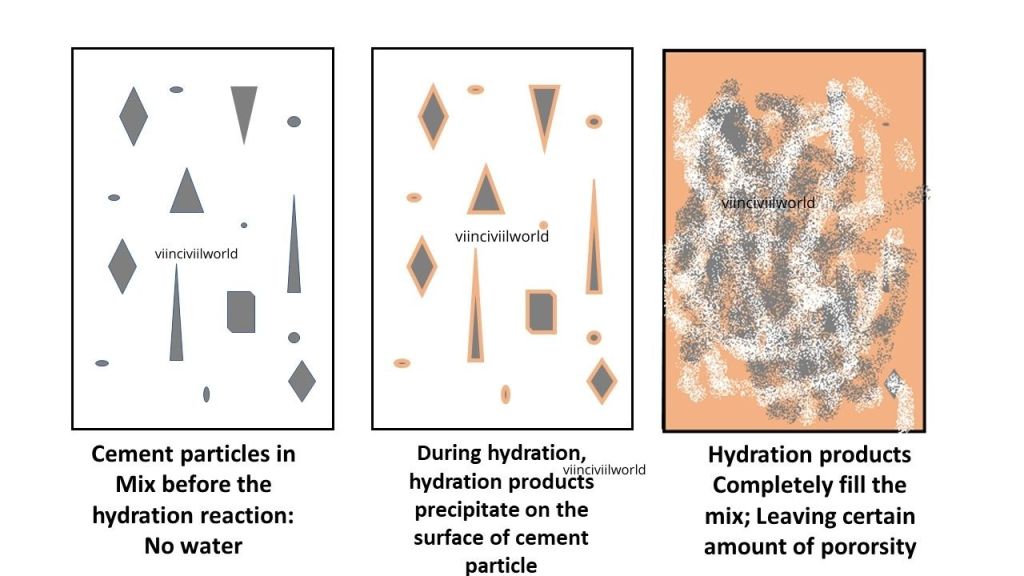
For using cement in any construction work, it is necessary to mix cement with water. On mixing water with the cement, a chemical reaction happens between water and cement leading to heat generation. This process of heat generation is known as the heat of hydration. It is very critical in mass concrete work and works done in hot and humid conditions.

When water is added to cement, a chemical reaction takes place between cement and water and is called hydration. Hydration generates heat, which can control the quality of the cement and helps in maintaining curing temperature in cold conditions. When used in mass concrete, heat generation tends to be very high. This can cause undesired stresses in the structure. The heat of hydration is influenced mostly by the presence of C3S and C3A in cement. It is also affected by the water-cement ratio, fineness, and curing temperature. The heat of hydration of Portland cement is calculated by finding the difference between the dry cement and the partially hydrated cement.

Heat of hydration process

Key Takeaways

  • Physical properties of cement—such as fineness, setting time, soundness, consistency, and strength—directly impact concrete’s performancedurability, and workability.
  • Fineness of cement controls the rate of hydration, early strength gain, and bleeding in concrete.
  • Soundness of cement ensures volume stability, preventing cracks and structural failures.
  • Consistency of cement relates to optimum water-cement ratio for good workability and determines appropriate mixing.
  • Cement strength (compressive, tensile, flexural) must be checked before use, as it’s fundamental for structural integrity.
  • Setting time of cement guides work timing; initial setting should not be too short, nor final setting too long, to meet construction requirements.
  • Heat of hydration (from the hydration process) is critical in mass concrete and is affected by cement composition and curing conditions.
  • Regular testing like sieve analysis, Le Chatelier apparatus, and Vicat apparatus is essential for quality control.
  • Understanding these properties helps in selecting the right cement type, optimizing construction processes, and predicting concrete longevity.

Conclusion

To achieve durable, strong, and reliable concrete structures, engineers, architects, and builders need to understand the key physical properties of cement. Properties such as fineness, soundness, and consistency are crucial. Strength, setting time, and the heat of hydration also play a vital role at every stage of construction, from mixing to final curing. Proper testing—using methods like sieve analysis, Le Chatelier, and Vicat apparatus—ensures cement meets required quality standards, which directly influences structural performance and safety. By carefully analyzing and controlling these key physical parameters, professionals can prevent common issues such as cracking, shrinkage, and poor durability. Ultimately, selecting the right type of cement based on its physical characteristics optimizes workability, enhances longevity, and assures a superior building solution for any project.