Kelly Ball Test is a simple and reliable method used to assess the workability of concrete directly at construction sites. Among the various tests for workability of concrete, this method stands out for its speed. It is also easy to execute on fresh concrete surfaces. The Kelly Ball Test concrete assessment works by measuring penetration depth. This makes it a practical Kelly Ball penetration test for large pours and ready-mix applications. To ensure accurate results, you must follow the standard Kelly Ball Test procedure. This procedure correlates penetration values with concrete consistency. The Kelly Ball Test is simple. It is also suitable for the field. Therefore, it continues to be an effective tool for monitoring concrete quality during placement.
Quality tests on concrete are essential for ensuring strength, durability, and performance in construction. These tests help engineers assess the workability of fresh concrete and the quality of hardened concrete. Common quality tests on concrete include checks during the production stage (on fresh concrete before placing), tests on hardened concrete specimens, and evaluations performed directly on finished structures. Including tests like the flow table test for concrete ensures reliable results and consistent quality throughout a project.
Quality tests performed on concrete are classified into
This article covers the kelly ball test ,apparatus details, procedure, merits and demerits etc.
The Kelly Ball Test apparatus used for assessing the workability of concrete at construction sites.
What is Kelly ball test ?
This simple field method assesses the workability of freshly mixed concrete. In the test, a standard steel ball penetrates the concrete under its own weight, and the penetration depth indicates concrete consistency. Engineers mainly use this test at construction sites to make quick decisions during concrete placement. The Kelly Ball Test helps verify whether the concrete is too stiff or too workable for proper compaction and finishing. Its significance lies in its speed, ease of use, and ability to provide a direct indication of concrete workability without complex equipment.
Standard Guidelines
Standard codes for the Kelly Ball penetration test provide guidance on equipment, testing procedure, and result interpretation. This ensures reliable assessment of concrete workability, especially during on-site quality control.
Codes and Standards
ASTM C360 / C360M 92– Standard Test Method for Ball Penetration in Freshly Mixed Concrete Issued by ASTM International. Note: This standard has been withdrawn but is still referenced in technical literature.
AASHTO T 183 – Ball Penetration Test Issued by AASHTO. Note: This standard is discontinued and mainly used for historical reference.
Indian Standards (IS Codes) There is no specific IS code . Workability testing in India is generally covered under IS 1199, issued by Bureau of Indian Standards
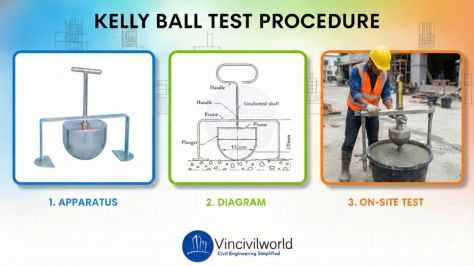
Kelly ball test Apparatus as per ASTM C360/C360 M 92
The kelly ball apparatus for measuring the workability of concrete consist of..
Meta hemisphere (Ball)
Graduated scale
Frame
Handle
The workability of concrete is decided by the depth of the penetration of metal hemisphere (ball) which will descend under its own weight into the fresh concrete. The Metal hemisphere or ball has 152 mm diameter and 13.6 kg weight. J. W. Kelly (Professor, University of California) had devised the plan of the Kelly ball test afessor, University of California) had devised the plan of the Kelly ball test apparatus. Hence, later on it also came to be known as a ball penetration test. On the top of the apparatus, there is a handle. The graduated scale measures the penetration reading.
Visual representation of the Kelly Ball Test procedure, showcasing the apparatus, diagram, and on-site testing process for assessing concrete workability.
Test Procedure
Place freshly mixed concrete on a level, rigid surface immediately after mixing.
Ensure the concrete surface is smooth and free from vibration.
Clean the Kelly ball and check that it moves freely along the guide rod.
Position the apparatus so the steel ball just touches the concrete surface.
Release the ball gently without applying any force.
Allow the ball to penetrate under its own weight.
Wait until the penetration stabilizes.
Read and record the depth of penetration from the graduated scale.
Repeat the test at different locations on the concrete surface.
Take the average penetration value as the final result.
The workability of the concrete is the average value of the readings from the penetration.
Advantages – Kelly ball test
Some advantages of this test are
Compared to other workability tests kelly ball test is very fast
Precise and Accurate results
Disadvantages of Kelly Ball Test
The disadvantages of this test include
This test requires a large amount of fresh concrete.
The result should not be precise if the size of the aggregate is large.
The concrete should be levelled before starting the test.
Key Takeaways
This is a simple field method for assessing fresh concrete consistency.
It directly measures penetration depth, reflecting the workability of concrete.
The test is faster and less operator-dependent than many laboratory methods.
Kelly Ball Test concrete assessment is suitable for large pours and flat surfaces.
The Kelly Ball penetration test works under the self-weight of the steel ball.
Proper surface preparation is essential for reliable results.
The procedure must be followed carefully to avoid errors.
It is mainly used as a supplementary field check.
Results help engineers make quick placement decisions.
It complements other tests for workability of concrete used in quality control.
Conclusion
The Kelly Ball Test remains a practical and efficient method for evaluating the workability of concrete under site conditions. By measuring penetration depth, the Kelly Ball penetration test provides a direct indication of concrete consistency during placement. Although not as widely standardized as slump testing, Kelly Ball Test concrete assessment is valuable for large slabs and mass concreting works. When carried out correctly using the recommended Kelly Ball Test procedure, it helps engineers maintain uniform quality and avoid placement issues. Among various tests for workability of concrete, the Kelly Ball Test stands out for its simplicity, speed, and field applicability. Used alongside standard methods, it supports better decision-making and effective on-site concrete quality control.
ebound Hammer Test for Concrete is one of the most widely used non-destructive tests to evaluate in-place concrete strength. Also known as the Schmidt Hammer Test, it helps engineers quickly assess concrete surface hardness without damaging the structure. This test measures the rebound number when a spring-controlled hammer impacts the concrete surface, providing valuable insight into its compressive strength. The Rebound Hammer Test procedure is simple, fast, and highly suitable for quality control at construction sites. It is commonly used in buildings, bridges, and existing structures where core extraction is difficult or not recommended. Along with evaluating strength, the method helps identify weaker concrete zones and ensures uniformity. Due to its practical benefits, many professionals prefer this technique while comparing concrete hardness test methods. Understanding the advantages of Rebound Hammer Test ensures accurate decision-making in structural assessment and maintenance.
Rebound hammer test is one of the most popular and simple non-destructive concrete tests. The Non-destructive test is the process of detection of defects in concrete without its destruction. The determination of concrete quality is necessary for both fresh concrete and hardened concrete. The rebound hammer test is the common test for determining quality for existing structures.
Rebound/Schmidt hammer test definition and significance
The Rebound Hammer Test for Concrete is a widely used non-destructive test for concrete strength. It evaluates surface hardness and provides an estimate of compressive strength. This is done without damaging the structure. In this Schmidt Hammer Test, a spring-controlled hammer impacts the concrete surface, and the rebound value indicates the concrete’s hardness. This concrete hardness test method is quick, simple, and ideal for assessing uniformity and quality in existing structures. The rebound hammer test procedure helps identify weak zones, monitor deterioration, and ensure proper maintenance. The advantages of rebound hammer test make it essential for preliminary and on-site concrete assessment.
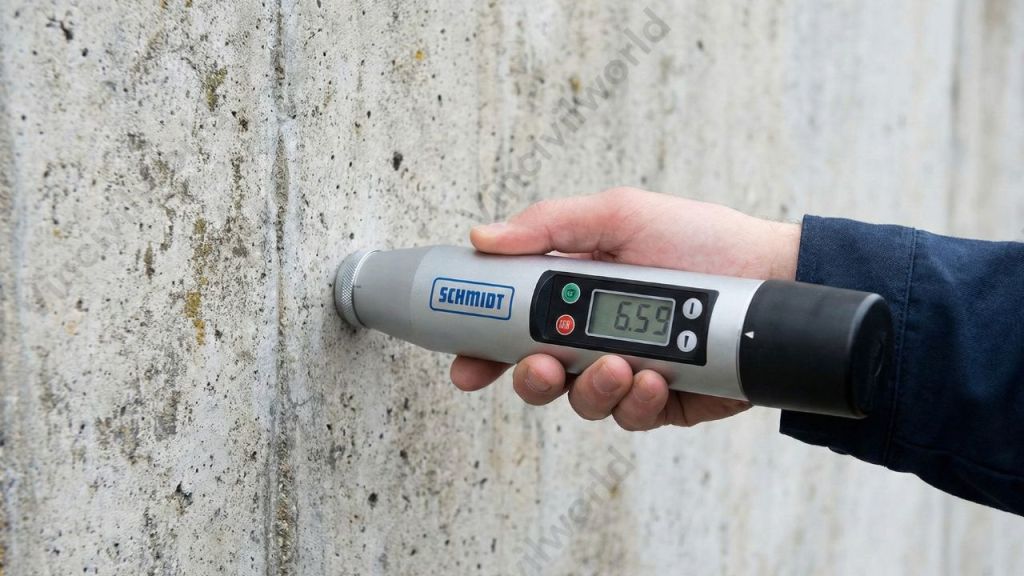
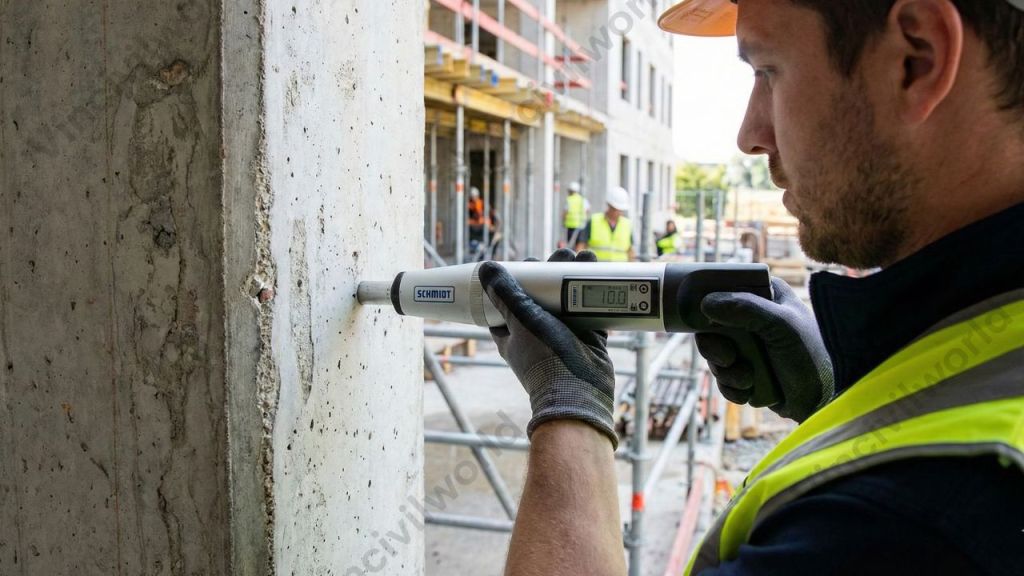
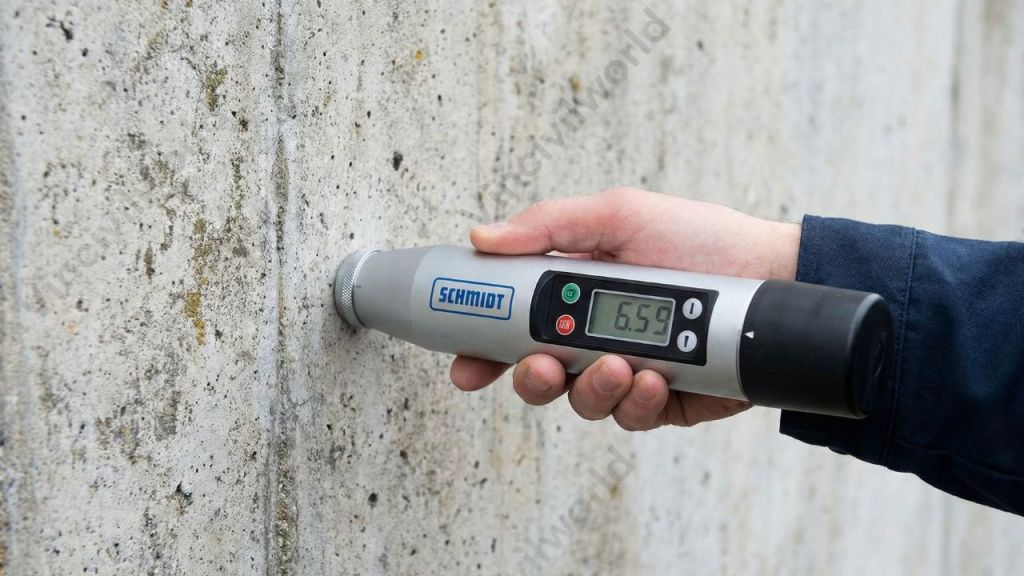
A Schmidt hammer being used to perform a Rebound Hammer Test on concrete, measuring surface hardness to estimate compressive strength.
Significance
Estimates in-place compressive strength of concrete
Checks surface hardness and material uniformity
Identifies weak zones or deteriorated areas
Helps compare different structural members
Quick, cost-effective, and non-destructive field evaluation
Relevant Codes
Country / Region
Standard Code
Title / Description
India 🇮🇳
IS 13311 (Part 2): 1992
Non-destructive testing of concrete – Rebound Hammer
USA 🇺🇸
ASTM C805 / C805M
Standard Test Method for Rebound Number of Hardened Concrete
Europe 🇪🇺
EN 12504-2: 2021
Testing concrete in structures – Part 2: Non-destructive testing – Rebound Hammer
International 🌍
BS 1881: Part 202: 1986
Testing Concrete – Recommendations for Rebound Hammer Test
International 🌍
ACI 228.1R
In-place Methods to Estimate Concrete Strength (includes rebound hammer guidance)
Objectives of Rebound hammer test
The main objectives of the Rebound hammer test include
This determines the compressive strength of the concrete in terms of the rebound index.
Also finds the uniformity of concrete.
evaluates the concrete quality with standard requirements.
Rebound hammer test procedure – Standard method
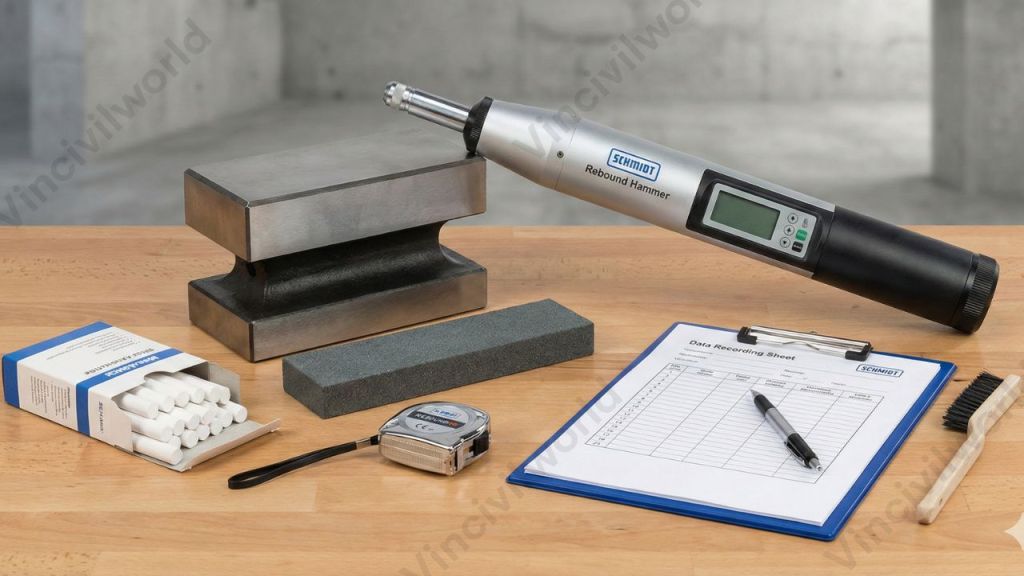
The Schmidt Rebound Hammer, an essential tool for assessing concrete strength through non-destructive testing, displayed alongside testing materials.
The Rebound Hammer Test for Concrete is a widely used non-destructive test for concrete strength. It measures the surface hardness of hardened concrete to quickly estimate compressive strength using a Schmidt hammer. This test is simple, cost-effective, and provides immediate results on-site. It is an essential method in quality control to check concrete uniformity, detect weak zones, and evaluate structures without causing damage. While the rebound hammer test procedure ensures quick assessment, results must be correlated with laboratory-tested samples for accuracy.
Procedure – Step-by-Step
Select the test area – Smooth, clean, and free from loose particles or surface defects.
Hold the rebound hammer firmly and position it perpendicular to the test surface.
Press the plunger against the concrete until the hammer triggers a rebound.
Record the rebound number displayed on the scale.
Perform at least 10 readings on one point and discard abnormal outliers.
Take the average rebound number for that test location.
Apply correction factors (surface condition, carbonation, direction of testing).
Use a correlation chart to estimate compressive strength of concrete.
The correlation between the concrete strength and the rebound hammer shown in a graph is called the rebound hammer graph.
According to IS 13311 (Part 2): 1992, the rebound hammer test requires specific calibration, correction factors, and surface conditions. These elements are necessary to ensure accurate results in Indian construction environments. IS also recommends correlating rebound numbers with compressive strength. The correlation should consider concrete grade, age, and surface hardness. This approach helps minimize interpretation errors.
Correlation between compressive strength of concrete and rebound index.
It is essential to calibrate the rebound hammer before testing. For this, we test a specimen of 150mm * 150mm * 150mm size using a compression testing machine (CTM). Fix the load rate at 7N/mm2, when the hammer result is 2.2 Nm. Test the vertical surface of the specimen using a rebound hammer. The results from the CMT and the rebound hammer should not have a major difference.
Result Calculation of Rebound Hammer tests
The Rebound Hammer Test for Concrete measures surface hardness and estimates compressive strength without damaging the structure. The rebound number directly reflects the elasticity of concrete—higher numbers indicate harder and stronger concrete. To calculate results accurately, we take several rebound readings on a smooth, clean surface, remove extreme values, and determine an average. This average rebound number is then compared with calibration charts. The charts are provided by the hammer manufacturer or relevant standards (IS 13311 Part 2:1992). This helps to determine the estimated compressive strength of concrete at the test location.
The rebound number assess the strength of the structure. As the rebound number increases, the strength also increases. This depends on the
Cement type
Aggregate type
Surface condition
Age of concrete
Moisture content, etc.
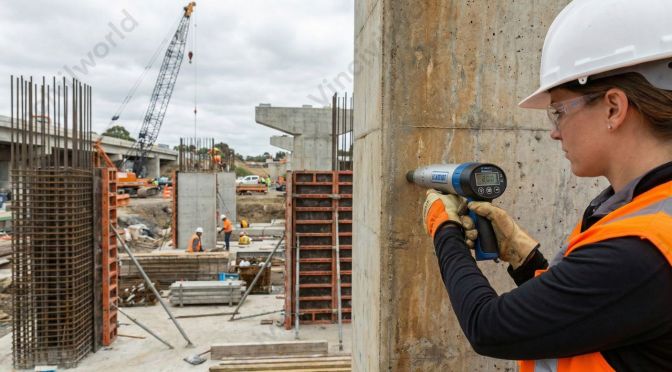
A construction professional using a Schmidt hammer to conduct a Rebound Hammer Test on concrete, assessing its surface hardness and strength.
The quality of concrete concerning the rebound concrete is as follows.
Thus the rebound number predicts the quality of concrete. The rebound hammer apparatus is very easy to use. Also, it determines the uniformity of the concrete surface. Thus it can be used for the rehabilitation of old monuments. It produces a convenient indication of compressive strength
Rebound Number Range
Estimated Concrete Quality
Interpretation Notes
≤ 20
Poor / Very Weak Concrete
Possible deterioration, low strength; further testing required
20 – 30
Fair / Medium Quality Concrete
Acceptable for non-structural sections; verify structural safety using core tests
30 – 40
Good Quality Concrete
Suitable for reinforced concrete structural elements
> 40
Very Good / Hard Concrete
High strength concrete; ensure carbonation effects are considered
Advantages of rebound hammer test
The Rebound Hammer Test is one of the simplest and fastest non destructive tests for concrete strength. It allows engineers to quickly assess the surface hardness and uniformity of concrete without damaging the structure.
Key Advantages of Rebound/Schmidt Hammer Test
Quick and easy testing with instant results
Completely non-destructive, keeping the structure intact
Portable and ideal for on-site assessment
Helps identify weak or deteriorated concrete areas
Cost-effective compared to laboratory strength tests
Useful for quality control and comparative analysis
Can be used on both old and new concrete structures
Requires only a single operator and minimal training
Helps decide if further detailed testing (e.g., core cutting or UPV) is needed
Provides data for concrete hardness evaluation and uniformity checks
Key Takeaways
The Rebound hammer test for concrete is a widely used non-destructive method to assess concrete strength and surface hardness.
It involves a spring-controlled hammer that impacts the concrete, measuring the rebound number to estimate compressive strength.
This test is quick, cost-effective, and essential for quality control, helping identify weak zones and ensuring uniformity in structures.
Professionals appreciate the test for its practical advantages, including its portability and immediate results on-site.
Applicable codes include IS 13311 (Part 2) in India and ASTM C805 in the USA, ensuring standard practices across regions.
Conclusion
The Rebound Hammer Test for concrete is a widely used non destructive test for concrete strength. It helps engineers quickly check surface hardness and uniformity without damaging the structure. As one of the simplest concrete hardness test methods, it supports quality control. It is also used for preliminary assessment and condition monitoring of existing buildings. Rebound values alone do not determine exact compressive strength. They provide valuable onsite insights when combined with other techniques such as UPV or core strength tests. By following the correct rebound hammer test procedure and calibration guidelines, engineers can improve reliability and decision-making. The Schmidt Hammer Test offers a fast, economical, and practical way to evaluate concrete. It enhances durability, safety, and maintenance planning in modern construction projects.
Non destructive testing of hardened concrete plays a vital role in assessing the condition of concrete structures. It evaluates performance without causing damage. Engineers use non destructive test for concrete structures to evaluate strength, durability, and uniformity while the structure remains fully functional. These NDT methods for concrete evaluation help detect cracks, voids, honeycombs, and other hidden defects that may affect long-term performance. Professionals can estimate compressive strength by using advanced hardened concrete testing techniques. They can identify deterioration and also monitor the health of aging infrastructure. Modern tools like rebound hammer and ultrasonic pulse velocity make concrete strength testing faster. They support the process without causing damage and are more cost-efficient. The key advantages of NDT in concrete testing include safety, accuracy, rapid inspections, and extended service life of structures. Overall, NDT ensures reliable decision-making for repairs, rehabilitation, and quality control in construction.
Non-destructive test (NDT) and destructive tests (DT) are the the tests done one hardened concrete. Concrete is the oldest and most important construction material in the world. Testing of the concrete plays and important role to know about the strength, durability and condition of the structure. This article is about the types of Destructive and non destructive tests done on concrete.
Concrete testing plays a vital role in determining the strength, durability, and performance of concrete structures. Engineers conduct different tests to verify that the concrete mix meets design requirements and performs safely throughout its service life. These types of concrete tests help assess important properties such as workability, compressive strength, density, and internal defects. The tests are categorized into destructive tests and non destructive tests, depending on whether the specimen is damaged during inspection. Both testing methods are essential for ensuring quality control, structural integrity, and long-term durability of concrete in construction projects. By using the right concrete testing techniques, engineers can make reliable decisions in design, repair, and maintenance works.
Concrete tests are classified into two types
Destructive tests (DT)
Non – Destructive tests (NDT)
Destructive Tests
Compressive Strength Test
Flexural Strength Test
Split Tensile Strength Test
Pull-out Test
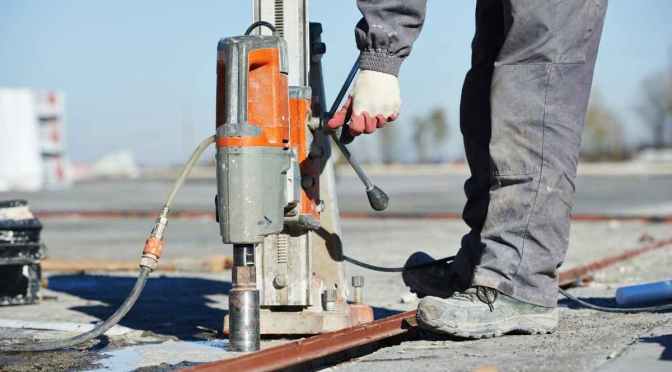
Core Cutting and Testing
Non Destructive Tests (NDT)
Impact Echo / Pulse Echo Test
Rebound Hammer Test
Ultrasonic Pulse Velocity (UPV) Test
Half-Cell Potential Method
Ground Penetrating Radar (GPR)
Cover Meter Survey
Schmidt Hammer Test
In this article we describes about the Non destructive testing techniques conducted on hardened concrete.
Non- Destructive testing techniques on hardened concrete
The standard method of non destructive testing of hardened concrete is carried out by testing concrete specimens. These specimens are cast simultaneously with structural concrete. These destructive tests on concrete can determine the compressive, flexural, and tensile strengths. The major disadvantage of these destructive concrete testing methods is the non availability of immediate results. Moreover, the properties of the concrete specimen differ from what it is in the actual structure. This difference is due to pouring conditions, curing factor, compaction and concrete density, etc. These tests come under the category of destructive tests (DT). Destructive testing of concrete destroys or changes the part. Even if it passes the test, the part is no longer fit for service.
Engineers conducting non-destructive testing on hardened concrete to assess its strength and durability.
Non Destructive Test (NDT) is for determining compressive strength and other properties of concrete from existing structures or buildings. NDT testing of concrete does not destroy the part. It does not change the part so that it is still fit for service if it passes the test. The non-destructive test determines the properties of concrete or structures without their destruction. Moreover, we can study its changes over time, The measurements are repeated many times and validate in detail, and gets immediate results. These NDT concrete testing methods help assess quality, strength, and durability in a quick and reliable way.
Objectives/advantages of Non destructive testing (NDT)
Non-destructive testing (NDT) helps evaluate hardened concrete structures without causing damage. It allows engineers to assess concrete strength and durability. They can also evaluate reinforcement condition, cracks, and internal defects. All of these are assessed while the structure remains fit for service. The advantages of NDT include quick results, safety, cost-effectiveness, and the ability to monitor structures throughout their life cycle. These advantages of NDT make it widely preferred for quality assurance and structural health monitoring.
Quality check of the existing structure.
For determining the homogeneity, internal and external characteristics of the concrete.
To detect the cracks and voids of the concrete structures.
Assess the quality of concrete with the standard requirement.
To study the ageing of concrete.
For finding the compressive strength of structures.
Evaluation of elastic modulus
Classification of Non-Destructive test
Hardened Concrete testing techniques/ Non Destructive testing are as follows
Windsor Probe Test
Rebound Hammer Test
Ultrasonic Pulse Velocity (UPV)
Half-Cell Potential Test
Covermeter / Rebar Locator Test
Impact Echo Test
Penetration Resistance Test / Windsor Probe Test
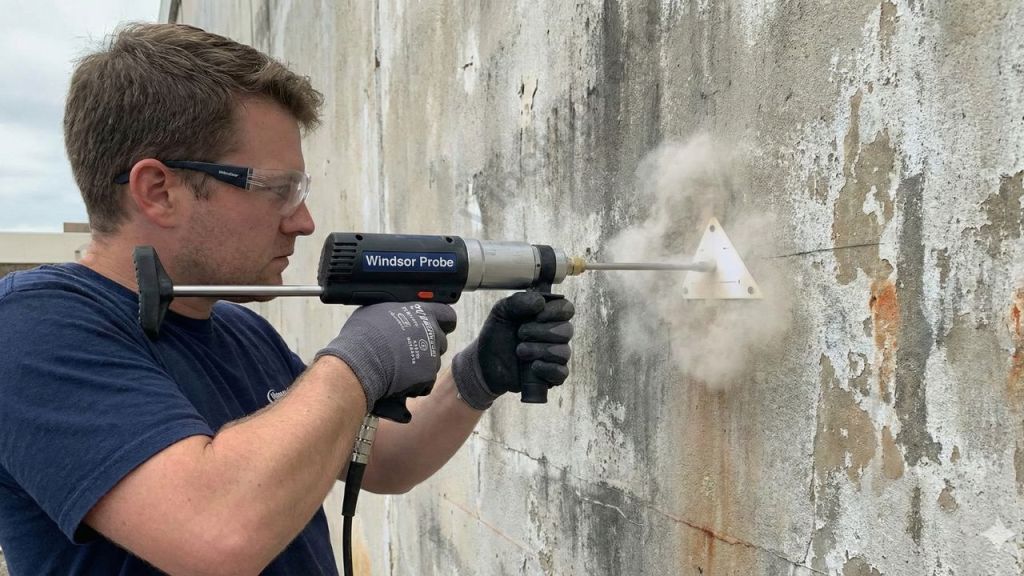
The penetration resistance test is an NDT that determines the relative strength of the concrete structures. The Windsor probe is the equipment for conducting this test. This equipment includes of powder-actuates driver or gun, probes, loaded cartridges and a gauge that measures the penetration.
The penetration depth indicates the compressive strength of the concrete. However, this depends on the aggregate type and size. This test evaluates the poor quality and deterioration of concrete
An engineer using a Windsor Probe for penetration resistance testing on hardened concrete.
The major disadvantage of this test is getting variable results. Several probes are often shot to achieve a solid average depth for arriving a final conclusion. So we cannot determine the exact strength. But it is a quick method to evaluate the quality and maturity of concrete. Care should be taken to calibrate the instrument before taking readings.
Rebound Hammer Test
The rebound hammer is also known as Schmidt’s Hammer test. It determines the strength of concrete based on the hardness of the concrete surface. It is a surface hardness tester. The equipment consists of a spring-controlled plunger, a hammer that weighs 1.8 kg, and a graduated scale. By pressing the hammer on the concrete surface, the graduate scale measures the rebound number. A low rebound number means the concrete has low compressive strength and stiffness.
A technician conducting the Rebound Hammer Test on concrete to assess compressive strength without causing damage.
An accuracy of 15 to 20% is possible through this test. It is a simple and quick method. Also, the result relies on the surface smoothness, water content, type and size of aggregate and carbonation of the surface.
Ultrasonic Pulse Velocity Test
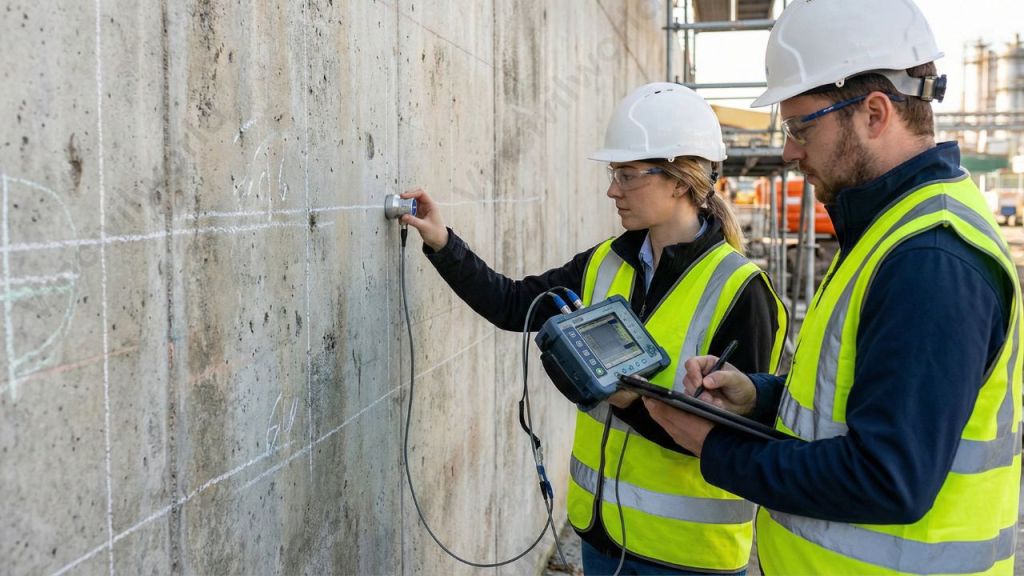
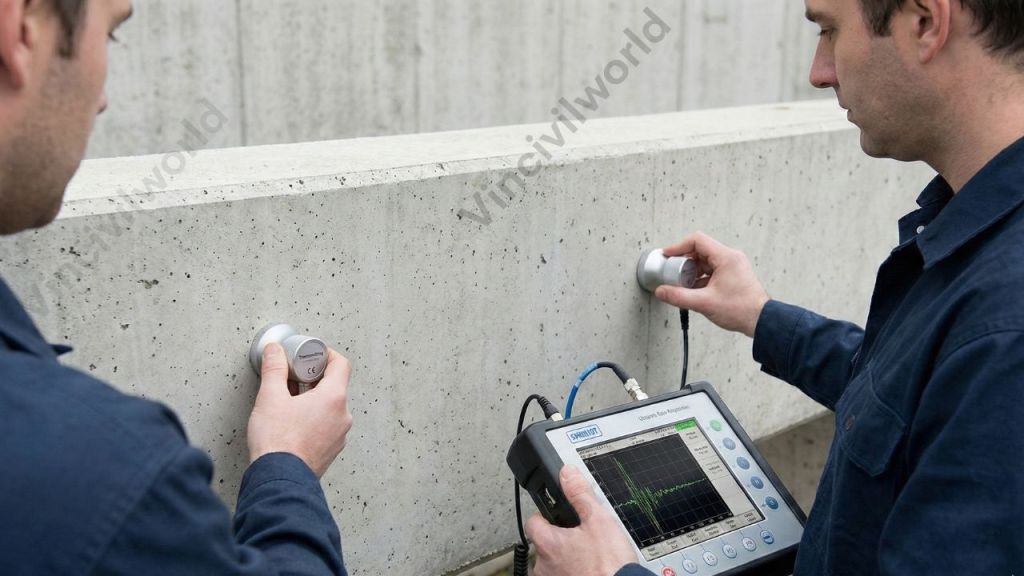
Ultrasonic pulse velocity test is another type of Non-destructive test. This test measures the time of travel of ultrasonic pulse waves for evaluating the concrete quality. The UPV test units consists of a pulse generator and pulse receiver. The frequency of the wave is 50-55 kHz. The pulse generator produces the pulses and is allowed to pass through the concrete. Then we calculate the velocity, by measuring the traversing distance and the time. Higher velocity means the concrete has a higher elastic modulus and density. It also determines the cracks and flaws in the structure. Large differences in pulse velocity values indicates a defective and deteriorated concrete.
Engineers conducting an Ultrasonic Pulse Velocity test on concrete to assess its quality and detect any hidden defects.
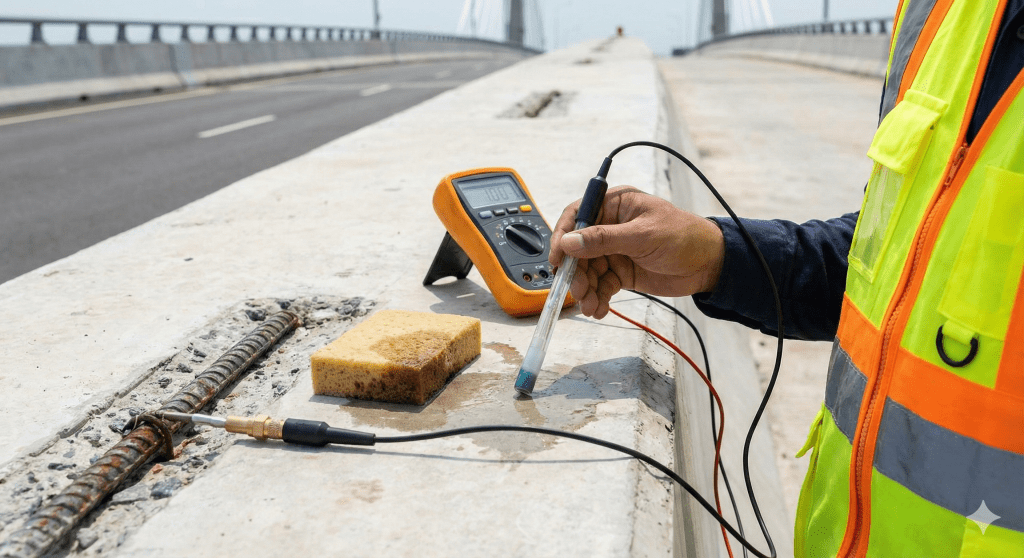
The Half-Cell Potential Test is a widely used non-destructive testing (NDT) method. It evaluates corrosion activity in steel reinforcement within hardened concrete. It measures the electrical potential difference between embedded rebars and a reference electrode. This reference electrode is typically a copper / copper sulfate (Cu/CuSO₄) cell. The test helps determine whether the reinforcement is actively corroding, passive, or at risk. An electrical connection directly connects to the rebar. Surface readings are recorded in a grid on moist concrete to ensure good conductivity. These readings are compared with standard probability charts provided in ASTM C876. The results allow engineers to locate corroded zones, plan preventive repairs, and avoid unnecessary concrete removal. Overall, it is a quick, reliable, and cost-effective tool for structural health assessment and durability maintenance of concrete structures.
An engineer conducting a non-destructive test on concrete using a specialized equipment to assess structural integrity.
Covermeter / Rebar Locator Test – Locating Reinforcement Without Damage
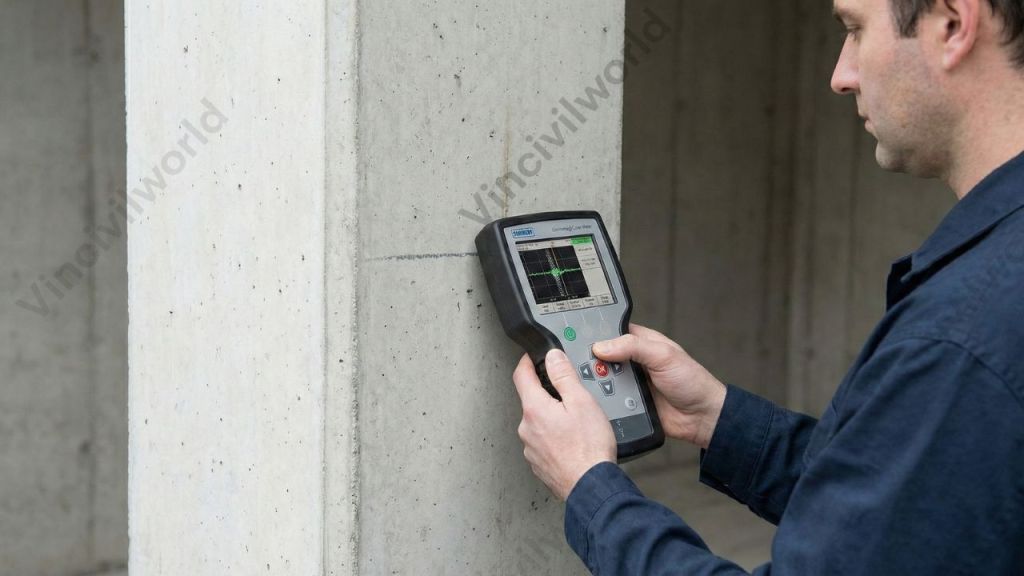
The Covermeter Test is also known as the Rebar Locator Test. It is a widely used non-destructive testing (NDT) method. This method is for detecting the position, depth, and spacing of steel reinforcement in hardened concrete. It works by measuring the magnetic field disturbance created by embedded steel when scanned with an electromagnetic probe. The test accurately determines the cover thickness. This is the distance from the concrete surface to the reinforcement. This measurement is critical for durability, fire safety, and code compliance. Modern Covermeter can also estimate bar diameter and identify congestion or missing rebars. This method adheres to standards such as BS 1881-204. It assists engineers in repair planning, drilling, and anchoring. It also helps in retrofitting without damaging the structure. Overall, the rebar locator test is fast, clean, and essential for structural assessment and quality control of reinforced concrete.
A technician performing a non-destructive test on a concrete structure using specialized equipment to assess its condition.
Impact Echo Test – Evaluating Internal Defects in Concrete
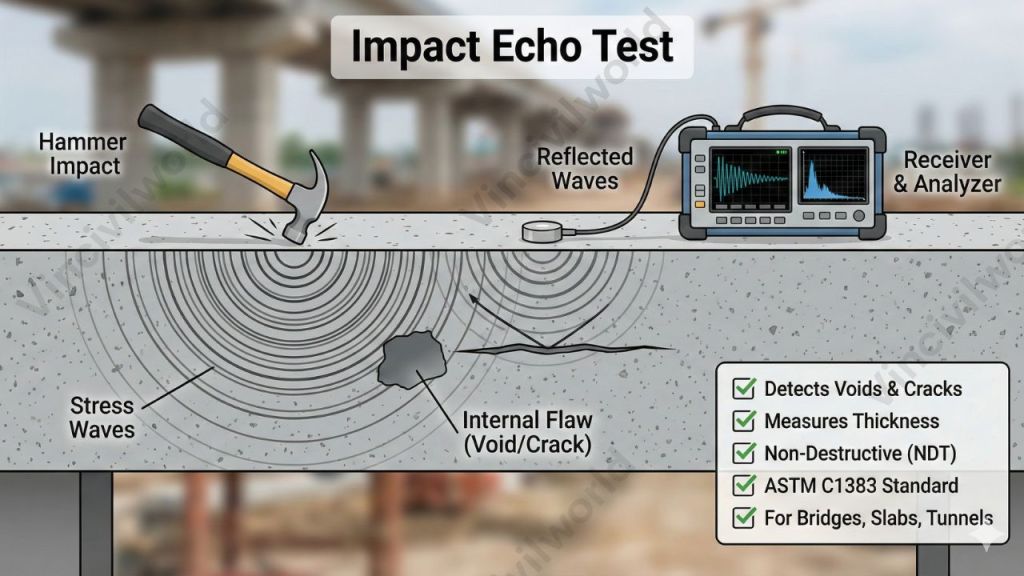
The Impact Echo Test is a reliable non-destructive testing (NDT) method. It is used to detect internal flaws such as voids, cracks, and delamination in hardened concrete. It also identifies thickness variations. It works by applying a short mechanical impact on the surface using a small hammer or impactor. This impact generates stress waves that travel through the concrete and reflect back from internal boundaries. A sensitive receiver records the returning signals and analyzes the wave frequencies to identify abnormalities. The method is guided by standards like ASTM C1383, making it suitable for bridges, slabs, tunnels, and precast elements. Engineers use this test to assess structural integrity, locate hidden defects, verify grouting, and ensure long-term durability—without drilling, cutting, or damaging the structure. Overall, the Impact Echo Test offers a fast and effective solution for concrete condition evaluation and maintenance planning.
Illustration of the Impact Echo Test used in non-destructive testing of concrete, showing hammer impact, stress waves, and internal flaw detection.
Key Takeaways
Non-destructive testing (NDT) evaluates hardened concrete’s strength and durability without causing damage, helping to detect hidden defects.
Engineers use both non-destructive and destructive tests to ensure quality control and structural integrity during concrete assessments.
Key advantages of NDT include quick results, safety, and cost-effectiveness, making it ideal for monitoring concrete structures over time.
Various NDT techniques include the Rebound Hammer Test, Ultrasonic Pulse Velocity Test, and Impact Echo Test.
These methods provide crucial insights into concrete quality, allowing for reliable repairs and maintenance planning.
Conclusion
Non Destructive testing of concrete plays a vital role in maintaining the long-term performance and safety of structures. NDT for hardened concrete enables engineers to assess strength, durability, reinforcement conditions, and internal defects without damaging the structure. With modern concrete NDT methods such as Rebound Hammer, Ultrasonic Pulse Velocity, and Covermeter testing, engineers receive quick data. Tests like Half-Cell Potential and Impact Echo provide reliable insights into structural integrity. One of the major advantages of NDT is the ability to monitor existing buildings. It helps identify deterioration early. Engineers can plan effective maintenance. By using advanced NDT techniques, the industry ensures cost efficiency, improved safety, and accurate decision-making throughout a structure’s life. Therefore, the advantages of NDT strongly support sustainable, safe, and high-quality construction management.
Compaction factor test is a practical and reliable method used to assess the workability of concrete, especially when the mix is stiff and does not show clear results in a slump test. The compaction factor test for workability of concrete evaluates how easily concrete flows under gravity. It also assesses how it compacts by comparing partially compacted concrete with fully compacted concrete. In the workability of concrete compaction factor test, engineers gain a more accurate understanding of concrete consistency for low to medium workability mixes. Following the compaction factor test procedure helps achieve consistent results during laboratory testing. The compaction factor test of concrete is commonly applied in mix design and quality control and remains one of the dependable tests for workability of concrete used in practice. Compaction factor test is a lab test and is generally conducted on concrete samples having very low workability.
This article explains the compaction factor test, covering its principle, procedure, significance, advantages, limitations, and role in accurately evaluating the workability of concrete.
Quality tests on concrete are essential for ensuring strength, durability, and performance in construction. These tests help engineers assess the workability of fresh concrete and the quality of hardened concrete. Common quality tests on concrete include checks during the production stage (on fresh concrete before placing), tests on hardened concrete specimens, and evaluations performed directly on finished structures. Including tests like the flow table test for concrete ensures reliable results and consistent quality throughout a project.
A civil engineer in a safety helmet and reflective vest analyzing concrete test specimens in a lab, showcasing the importance of quality control in concrete workability tests.
Following are the stages of quality tests
Production stage quality tests ( On fresh concrete before placing)
Production stage quality tests on fresh concrete are crucial for ensuring the right workability and consistency before placement. These tests help engineers select the best mix for construction and maintain quality control. Key tests include the slump test, compaction factor test, Vee-Bee test, Kelly ball test, and the flow table test for concrete.
This article focuses on the Compaction factor test, explaining its procedure, importance, and how it compares with other workability tests like the slump test and other tests
Significance of compaction factor test
The compaction factor test is significant because it accurately measures the workability of concrete. This is especially true for stiff and low-slump mixes. This test provides more precise results than the slump test. It supports effective mix design. It also ensures consistent concrete quality through reliable laboratory-based workability assessment.
Compaction factor test for workability of concrete
The compaction factor test is used to determine the workability of concrete. Workability refers to the ease and uniformity with which freshly mixed concrete can be mixed, placed, compacted, and finished. Workability also represents the internal effort required to achieve full compaction. The compaction factor test of concrete was developed by the Road Research Laboratory, UK. It provides more precise and accurate results than the slump test. This test is especially suitable for stiff concrete mixes that do not slump and require vibration for compaction. The compaction factor test measures the degree of compaction under controlled conditions. It offers a reliable method for assessing concrete consistency in laboratory and quality control applications.
IS 1199 (Part 2): 2018 – Methods of Sampling and Analysis of Concrete – Workability
BS 1881 (Part 103) – Testing Concrete – Method for Determination of Compaction Factor
ASTM C1170 / C1170M – Workability of Fresh Concrete by Compaction Factor Method(Reference use)
DIN 1048 – Testing Methods for Fresh Concrete
These codes provide standardized procedures for conducting the Compaction Factor Test and ensure reliable evaluation of concrete workability.
The Compaction Factor Test method followed in IS 1199 (Part 2) is fundamentally the same as those in British standards. It is also similar to other international standards. All codes measure workability by comparing partially compacted concrete with fully compacted concrete.
Principle: Same across all standards
Apparatus: Same (two hoppers + cylinder)
Calculation: Same compaction factor ratio
Differences: Minor variations in dimensions, tolerances, and wording
Apparatus used
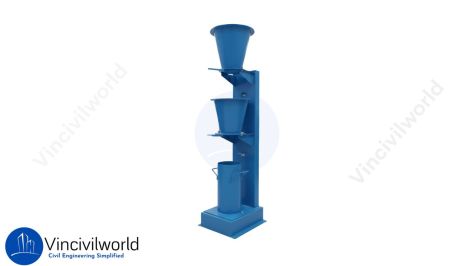
Laboratory setup for conducting the compaction factor test on concrete, demonstrating the apparatus used to measure workability.
Compacting factor apparatus
Cylindrical mould
Hand scoop
Trowel
Weighing machine
Apparatus used for the Compaction Factor Test, designed to accurately measure concrete workability.
The figure shows the dimension of the hopper and the mould. The inside area of the hopper should be smooth. The apparatus is made of bronze or cast brass. At the lower ends of the hopper, there is a trap door with a 3mm thickness. A rigid frame attaches the hoppers and cylinder. After the completion of mixing, the test is conducted at a constant time interval.
Compaction factor test procedure
Place the sample in the upper hopper of the apparatus using a hand scoop.
Fill the hopper with its brim level and open the trap door.
Then allow the concrete to fall into the lower hopper.
Immediately after the concrete rests, uncover the cylinder and open the lower trap door.
Cut off the excess amount of concrete above the cylinder using the trowel.
Then weigh the concrete in the cylinder nearest to 10g. This is the weight of partially compacted concrete.
Refill the cylinder with the same sample in the layers and the layer is heavily rammed or vibrated for full compaction.
Then weigh the fully compacted concrete and the weight of the empty cylinder.
Finally, Compute the compaction factor using the formula.
The compaction factor is the ratio of partially compacted concrete to fully compacted concrete.
Compaction factor = (W1 – W) / (W2 – W)
The compaction factor value varies from 0.7 to 0.95.
The Compaction Factor Test is used to evaluate the workability of concrete, especially stiff mixes.
It is more sensitive and accurate than the slump test for low-workability concrete.
The compaction factor test for workability of concrete measures ease of compaction under gravity.
It is best suited for laboratory-controlled conditions.
The workability of concrete compaction factor test helps compare different mix designs.
The test uses two hoppers and a cylindrical mould.
Following the compaction factor test procedure ensures consistent results.
The compaction factor test of concrete minimizes subjective judgment.
It supports quality control and mix optimization.
It is one of the reliable tests for workability of concrete.
Conclusion
The Compaction Factor Test remains an important method for assessing the workability of concrete. This is particularly true for mixes that show little or no slump. By measuring the ratio of partially compacted to fully compacted concrete, the compaction factor test for workability of concrete provides a clear and quantitative indication of consistency. When engineers follow the standard compaction factor test procedure, the results help in evaluating mix performance and maintaining uniform quality. The workability of concrete compaction factor test is especially useful in laboratory testing and mix design studies. As one of the established tests for workability of concrete, the compaction factor test of concrete continues to support accurate quality control and better construction outcomes.






 vin civilworld