Tag Archives: Road structure

Components of Road pavement structure – Parts of a road and functions

Components of a road or parts of a road plays an important part in ensuring the safety and service life of a road. Components of a road is designed to meet the design requirements, functional requirements etc. This article is about the components of road/parts of a road and its functions.

Understanding the road pavement structure is crucial for designing and maintaining effective roadways. Key road components include the carriageway or pavement, roadway or formation width, camber or cross slope, kerbs, medians, road margins, and the right of way (ROW). Each part serves a specific role within the overall road section. This blog will explore these components of the road. It will detail the role of each road section. The blog will explain how they contribute to the road’s durability and performance.

  1. Components of a Road
    1. Carriage way or pavement width
      1. Carriage width as per IRC
    2. Road way or formation width
    3. Camber or cross slope
    4. Kerbs
    5. Medians or traffic separators
    6. Right of way
    7. Road margins

Components of a Road

The road components are crucial for ensuring road durability and safety. Each part of the road, from the carriageway to the right of way (ROW), plays a specific role in the road section. Understanding these components and their functions helps in maintaining effective road performance. The main road sections are listed below.

  • Carriage way or pavement
  • Road way or formation width
  • Camber or cross slope
  • Kerbs
  • Medians
  • Road margins
  • Right of way ( ROW)
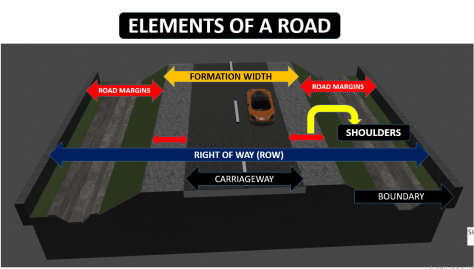
Diagram illustrating the components of a road, including carriageway, formation width, shoulders, right of way (ROW), and road margins, with labels highlighting each component.
Illustration of the key components of a road, including the carriageway, shoulders, road margins, and right of way.
COMPONENTS OF A ROAD

Video showing the components of a road

Video on components of a road

Also read : Alignment of road – Factors affecting – obligatory points

Also read : Classification of road – Full details

Carriage way or pavement width

The paved part or surface of the road for traffic movement without any restriction is called the carriageway. The width of the carriageway/ pavement width depends on the number of traffic lanes. The number of lines is decided based on the type of road, service importance, and traffic density.

The carriageway or pavement width is a critical road component that determines the space available for vehicle movement. It directly affects traffic flow, safety, and overall road performance. Properly designed pavement width ensures efficient use of road space and supports the road’s intended load-bearing capacity.

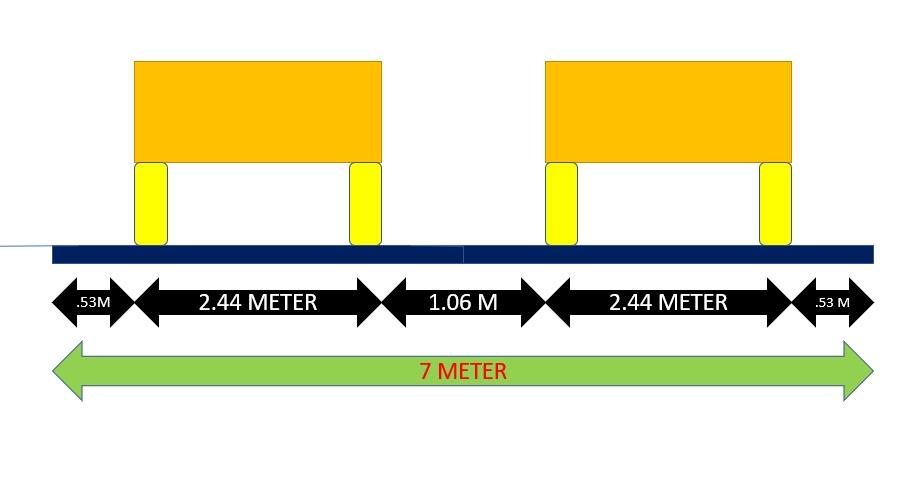
The carriageway is divided into a single carriageway and a dual carriageway as shown in the figure.
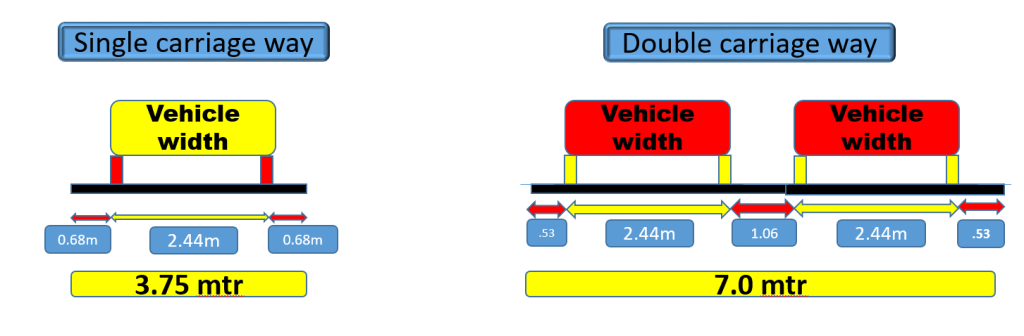
Illustration comparing the dimensions of a single carriageway and a double carriageway for road design, highlighting vehicle width and total road width measurements.
Illustration of single and double carriageway road designs, highlighting vehicle width and lane specifications.
SINGLE CARRIAGE WAY AND DUAL CARRIAGE WAY

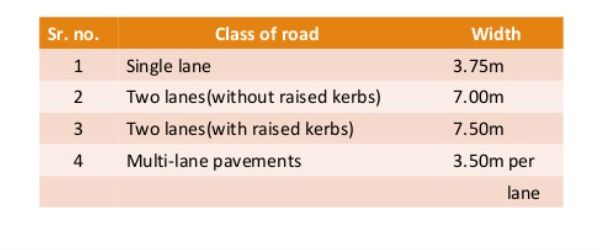
The maximum permissible width of a vehicle is 2.44 and the side clearance for single lane traffic is 0.68 m. The required minimum lane width is 3.75 m for a single lane road. For the dual carriageway, the pavement width is two times 3.75 mtr. ie: 7.5 mtr.

Each country has its own specification for carriage way widths.

Must read : Road pavement layers – Components and function

DUAL CARRIAGE WAY
Diagram illustrating the width dimensions of a dual carriageway, showing measurements for vehicle space and lane configuration.
Diagram illustrating the width specifications for dual carriageway design, detailing lane dimensions and spacing.

Carriage width as per IRC

CARRIAGE WIDTH
Table showing the class of road and their corresponding width specifications for single lanes and multi-lane pavements.
Table outlining the width specifications for various classes of roads, including single and multi-lane options.

Road way or formation width

Width of formation or roadway width is the sum of the widths of pavements or carriage way including separators and shoulders. This does not include the extra land in formation/cutting. (Ref : Diagram)

Camber or cross slope

Camber or cross slope provided to raise the middle of the road in the transverse direction to drain of water. Inadequate slopes result in flooding of water on the pavement which may deteriorate the surface in course of time. The too steep slope is undesirable for it will erode the surface.
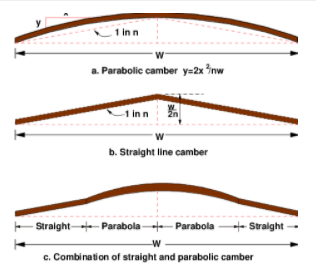
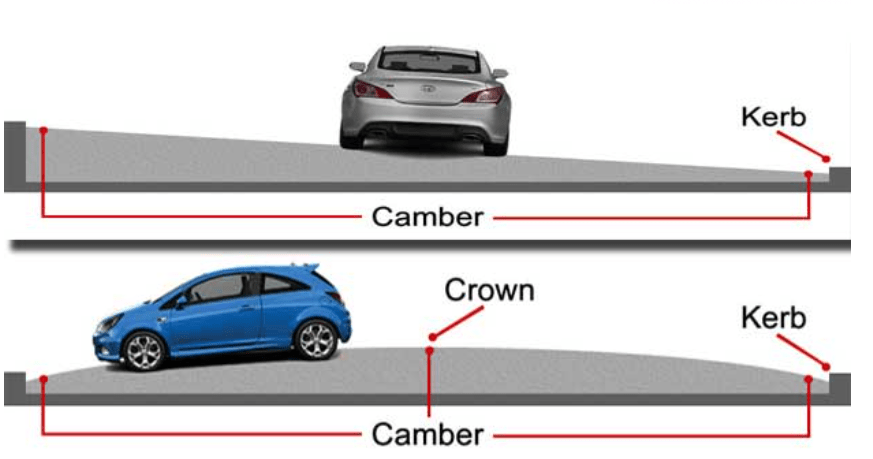
Illustration showing different types of camber in road design: parabolic camber, straight line camber, and a combination of straight and parabolic camber.
Illustration of different camber types used in road design, showcasing parabolic and straight line camber techniques essential for effective drainage.

Camber or cross slope serves as Surface protection especially for gravel and bituminous roads. They protect the sub grade by providing proper drainage. This also enables quick drying of pavement. This in turn protects the vehicles from slipping and thereby increases safety.

The value of camber depends on the type of material used for making it and rainfall density in that region.

Kerbs

Kerbs are dividing line between carriage way and shoulders, footpath or islands. The following are the different types of kerbs.

Low or mountable kerbs allows the vehicle to enter the shoulder area with little difficultly. Height of 10 cm above pavement level & Edge will have a slope allowing vehicle to step over easily.

Semi barrier type kerbs are used when the pedestrian traffic is high. Their height is 15 cm above the pavement edge. This type of kerb prevents encroachment of parking vehicles. In an acute emergency, it is possible to drive over this kerb with some difficulty.

Barrier type kerbs are designed to discourage vehicles from leaving the pavement. 
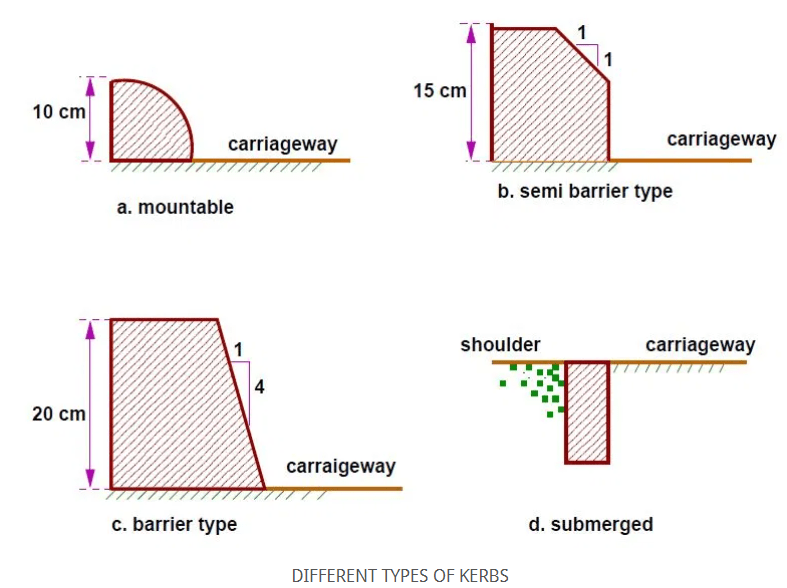
Diagram illustrating different types of kerbs used in roadway construction, including mountable, semi-barrier, barrier type, and submerged kerbs.
Illustration of different types of kerbs used in road construction, highlighting their dimensions and functions.

Submerged kerbs are used in rural roads as edges between the pavement edge and shoulders. 

Function of kerb

  • Drainage control
  • Demarking of walkways
  • Roadway demarking
  • Maintenance assistant
  • Assisting road side development.

Medians or traffic separators

ROAD SEPARATED WITH MEDIANS

They are physical or painted separation provided to separate two road ways. Mainly used to differentiate vehicles based on speed.

Right of way

Right of way or ROW is the land to be acquired for the road along its alignment. The right of way depends on the importance of the road, traffic an possibility of expansion in the future. They include the total elements of the road like carriageway, shoulders, drainage system, cuttings, and embankment slopes, etc.
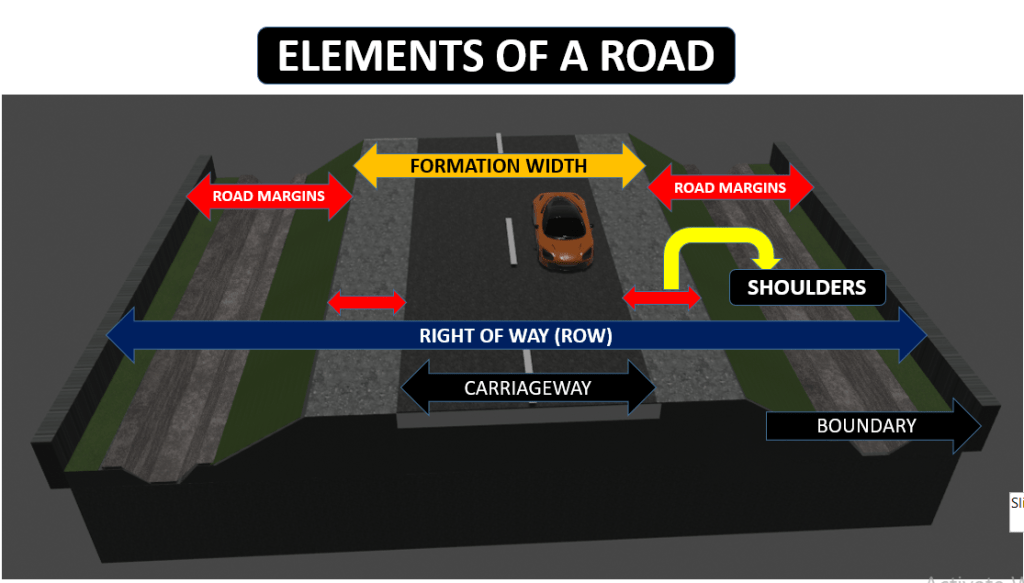
Diagram illustrating the components of a road, including formation width, road margins, right of way (ROW), carriageway, and shoulders.
Diagram illustrating the essential components of a road including carriageway, shoulders, road margins, formation width, and right of way.

Factors influencing the width of ROW

a) Width of formation

b) Embankment depth and cutting depth

c) Side slopes of embankment or cutting

d) Drainage system

e) site distance considerations

f) Future widening & Service roads.

Road margins

The portion of the road beyond the carriageway and on the roadway can be generally called road margin. Various elements that form the road margins are given below.

They include

  • shoulders
  • Parking lines
  • Bus bay
  • Service roads
  • Cycle track
  • Footpath
  • Guard rail

For more details about road margin : Must Read

Road margins- 6 types of road margins in highway

Road Pavement Layers – Components and Functions

Road pavement layers play a critical role in infrastructure development, significantly impacting a country’s economic growth. Constructing roads necessitates a careful assessment of traffic patterns, climate variations, and terrain characteristics. As a result, these layers must withstand abrasion, heavy loads, and diverse environmental conditions to ensure durability and prevent structural failures. Therefore, this article explores the essential components of road pavement layers, with a particular emphasis on flexible pavement structures.

  1. Road Pavement Layers and their functions
    1. Subgrade of a Road Pavement
      1. Functions of Subgrade
    2. Sub-base Course of a Road Pavement Layer
      1. Functions of Sub-base Course
    3. Base Course
      1. Functions of Base Course:
    4. Surface Course or Wearing Course
      1. Functions of Surface or Wearing Course:
  2. Key Takeaways on Road Pavement Layers
  3. Conclusion

Road Pavement Layers and their functions

A road pavement is a multi-layered structure designed to support and distribute traffic loads, provide a smooth driving surface, and withstand environmental stresses. Each layer has a specific function, working together to ensure durability, stability, and long-term performance of the roadway.

The layers of a road pavement structure include:

  1. Subgrade or roadbed
  2. Sub-base course
  3. Base course
  4. Surface course or wearing course
ROAD PAVEMENT STRUCTURE
Concrete road layers

Subgrade of a Road Pavement

The Subgrade, composed of compacted natural soil, forms the foundation for road Pavement layers. It serves as the finished or compacted surface where the formation supporting the pavement rests. Whether an embankment, cutting, or aligned with natural ground, its load-bearing strength is evaluated by the California Bearing Ratio (CBR) test. Locally sourced, robust, and cost-effective materials typically compose the Subgrade, crucial for structural integrity.

SUB GRADE PREPARATION FOR ROAD PAVEMENT LAYERS
SUB GRADE PREPARATION
Concrete road layers : Subgrade preparation

Functions of Subgrade

  • Serves as the foundation and provides uniform support to the road pavement layers.
  • Bears the entire load of the pavement along with the service load of traffic.

Sub-base Course of a Road Pavement Layer

The sub-base course is positioned between the subgrade and the base course within the framework of road pavement layers. It requires materials that meet strict criteria for size, strength, and flexibility. This layer is crucial when the subgrade quality is inadequate. It often needs additional materials like burnt clinkers, gravel, or slag to enhance its strength.

Functions of Sub-base Course

  • Enhancing the bearing capacity of the subgrade and improving the load distribution of the base course and wearing course.
  • The sub-base course also prevents the entry of finely graded subgrade soil into the base course layer.
  • Additionally, it prevents the capillary rise of water and facilitates the free drainage of water entering the pavement.
  • Moreover, the sub-base material must be free-draining, with suitable systems in place to collect and remove accumulated water.
  • It provides insulation to subgrades against frost. It also helps to raise the pavement height to align with the natural water table.
  • Lastly, it offers a solid stratum for subsequent construction activities.

Base Course

The base course is a pivotal element in road pavement layers. It comprises one or more layers of specified or select material. These layers have a designed thickness. It is positioned on the sub-base or directly on the subgrade in the absence of a sub-base layer. This crucial layer provides uniform and stable support for the binder and surface courses within the road pavement layers.

Additionally, responsible for transferring stresses from traffic impacts to the wearing course, the base course ensures structural integrity. To adhere to technical standards, high-quality crushed aggregates are typically utilized. If these aggregates do not meet requirements, they can be reinforced with Portland cement, lime, or asphalt. Moreover, for superior durability and performance in high-quality pavements, these aggregates undergo treatment with asphalt or Portland cement.

BASE COURSE OF ROAD LAYER
Concrete road construction - Base course
Concrete road construction – Base course

Functions of Base Course:

  • Acts as the foundation of the road pavement and safely transfers traffic load to the sub-base and subgrade.
  • Withstands high shearing stresses due to traffic impact.
  • Prevents undesirable entry of subgrade soil into the pavement when constructed directly over the subgrade.

Surface Course or Wearing Course

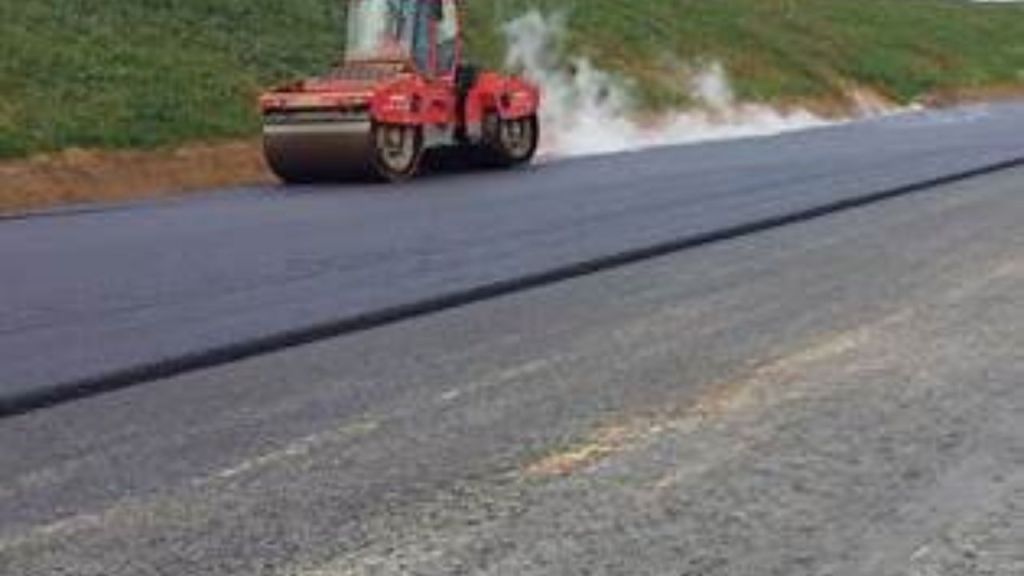
The surface course is also known as the wearing course. It is the topmost layer in road pavement layers. This layer is directly exposed to traffic. In flexible pavements, this layer typically consists of bituminous material. Rigid pavements utilize concrete. The concrete serves both as the base and wearing course. The primary role of the wearing course is to minimize water percolation. It also provides a durable, anti-skid surface. This surface resists abrasion caused by traffic.

Concrete road construction - Wearing Course
Concrete road construction – Wearing Course

Functions of Surface or Wearing Course:

  • Provides a smooth and uniform rigid surface.
  • Resists abrasive forces from traffic.
  • Prevents dust nuisance.
  • Acts as a structural component of the pavement.

Key Takeaways on Road Pavement Layers

  1. Components: Road pavement consists of four primary layers: subgrade, sub-base, base course, and surface course.
  2. Subgrade: Acts as the foundational layer, providing uniform support and load-bearing capacity.
  3. Sub-base Course: Enhances bearing capacity, improves load distribution, prevents soil migration, and facilitates drainage.
  4. Base Course: Transfers traffic loads to the subgrade, withstands shearing stresses, and prevents subgrade soil intrusion.
  5. Surface Course: The top layer exposed to traffic, designed for durability, skid resistance, and water percolation minimization.
  6. Durability: Each layer plays a critical role in the road’s structural integrity. It also impacts its longevity. This necessitates careful material selection and construction practices.
  7. Load Distribution: Proper design and construction ensure that the pavement can withstand traffic loads and environmental conditions effectively.

These insights emphasize the need to understand each layer’s role. This understanding is crucial for the overall pavement structure. It ensures effective road construction and maintenance.

Conclusion

In road construction, each layer of the pavement structure plays a vital role. These layers ensure both the durability and functionality of the road. Starting with the subgrade providing foundational support, the sub-base enhances load distribution and drainage. The base course offers structural strength. The surface course provides a smooth and durable riding surface. These layers work together seamlessly to create a resilient and long-lasting road.