All posts by Anaswara

A civil engineer turned writer, the girl of 22 set off the journey to freelance content creating since 2019. The impact she could make in people's lives acted as the fuel and the journey still continues in high spirits. This young thrashing blood offers 100% conversion guaranteed contents to your business. Throw brickbats or bouquets and of course, your writing requirements to anaswara.r.s.cet@gmail.com

Hyperloop Technology; Working & Social Impact Complete Details

Hyperloop technology has been in mainstream headlines ever since Elon_Musk announced its construction. Today, we are going to discuss in detail about all the aspect of a hyperloop.

The working of hyperloop, its pros and cons, technical details, will be explained in each of the following sections.

Let’s start from the definition.

What is Hyperloop technology?

Hyperloop technology is a new method of ground transport currently being built by a number of businesses. It will see passengers moving in floating pods at over 700 miles an hour, speeding either above or below ground along inside massive low-pressure tubes.

The next question is why is it a buzz word.

Hyperloop Technology

What makes Hyperloop different?

  • Between Hyperloop and conventional rail, there are two major differences. Firstly, to minimise friction, the pods carrying passengers fly through tubes or tunnels from which much of the air has been extracted.
  • This should allow up to 750 miles per hour for the pods to fly.
  • Secondly, the pods are designed to float on air skis rather than using wheels like a train or vehicle, using the same basic concept as an air hockey table, or using magnetic levitation to minimise friction.

Also read: Components of a Road – Elements and their Functions.

Next, let me show you the benefits.

What are the benefits of Hyperloop technology?

  • Hyperloop may be cheaper and quicker than train or car travel, and cheaper and less polluting than air travel, proponents claim.
  • They say that construction is both faster and cheaper than conventional high-speed rail.
  • Therefore, Hyperloop may be used to take the burden off gridlocked highways, making it easier to fly between cities and, as a result, potentially unlocking major economic benefits.

Time to look at the working of the hyperloop tube.

How does a Hyperloop tube work?

  • As envisioned by Musk, the basic concept of Hyperloop is that the passenger pods or capsules fly through a tunnel, either above or below ground.
  • Much, but not all of the air is extracted from the tubes by pumps to minimise friction.
  • One of the greatest uses of energy in high speed transport is to conquer air resistance.
  • To travel through less dense air, airliners ascend to high altitudes; Hyperloop encloses the capsules in a reduced-pressure tube to produce a similar effect at ground level, essentially allowing the trains to travel at aeroplane speeds while still on the ground.
  • The pressure of the air inside the Hyperloop tube in Musk’s model is around one-sixth of the atmospheric pressure on Mars (a noteworthy contrast as Mars is another of Musk’s interests).
  • This would mean an operating pressure of 100 pascals, which would decrease the drag force of the air by 1,000 times compared to the conditions at sea level and would be equal to flying above 150,000 feet.

Also read: 5 Types of road construction Complete Guide

Next, we will see the working of hyperloop capsules.

How do Hyperloop capsules work?

  • In Musk’s model, the Hyperloop capsules float above the surface of the tube on a set of 28 air-bearing skis, close to the way the puck floats just above the table in an air hockey game.
  • One major difference is that the air cushion is created by the pod, not the track, in order to keep the tube as easy and cheap as possible.
  • In order to hold the passenger pods above the tracks, most Hyperloop models use magnetic levitation rather than air skis.
  • From an external linear electric motor, the pod would get its initial velocity, which would accelerate it to ‘high subsonic velocity’ and then give it a boost every 70 miles or so; in between, the pod would coast along in close vacuum.
  • Each capsule could hold 28 passengers plus some luggage (other variants are designed to carry up to 40 passengers); another variant of the capsule could carry freight and vehicles. Pods quit every two minutes (or every 30 seconds at peak usage).

Also read: Electric Vehicles- 5 Types & Advantages Full Guide

We will move on to the benefits of hyperloop to society.

The potential benefits to society

  • Study figures show that by using a hyperloop or 83 minutes by national rail, the journey from London to Birmingham will take nine minutes-a cumulative saving of 74 minutes.
  • Other distances include 22 minutes to Newcastle from London (saving 149 minutes), 29 minutes to Edinburgh from London (saving 231 minutes) and just 31 minutes to Glasgow from London (saving 238 minutes).
  • Shorter trips to the capital would open up opportunities for employment and have a beneficial effect on tourism and sustainability.
  • Entry to education will also be increased by Hyperloop.
  • Choosing one that is right for you but is not too far from home is a challenge that many faces when choosing their prospective university, with universities spread across the world.
  • However, there is no longer a limit to choosing universities close to home with city-to-city connections via hyperloop, which dramatically reduces travel time.
  • Aside from cutting travel time, hyperloop would help to solve the housing crisis.
  • Because of financial uncertainty, the cost of living in locations like London and San Francisco is driving the poorest people out.
  • Therefore, people would be more likely to live outside of the city by making travelling to locations across the world cheaper.
  • Travelling cheaply from Edinburgh to London, for example, will encourage more people to live in Edinburgh, which has a considerably lower cost of living than London and a large stock of available homes.
  • Similarly, houses in Los Angeles are about 66% cheaper than in San Francisco, with just 30 minutes of travel time between the two.
  • The Hyperloop is not only intended for the transport of passengers, but also for the transport of goods.
  • This would increase delivery time, prevent package damage and reduce the number of delivery vehicles, resulting in lower emissions.
  • So what’s driving this new big form of transportation? The easy answer to that is electricity and solar power.
  • From an external linear electric motor, the pods would get their speed, and the tube would have solar panels mounted on top that would produce more electricity.
  • Therefore, to power the hyperloop to its peak speeds, only a small amount of electricity is required, making this one of the most environmentally friendly modes of transport alongside the electric car.

That’s it about hyperloop technology. Do you think it’s going to revolutionise the transportation sector? Let me know your doubts in comments.

Happy learning!

5 Types of road construction Complete Guide

Types of road construction are significant to understand the category of roads and their characteristics. In this blog, we will find out the details of 5 types in detail.

5 Types of road construction

In this section, the important types of road construction is broken down in detail.

Whitetopping roads

  • Whitetopping is the coating of a layer of Portland cement concrete on the existing asphalt pavement.
  • Depending on the thickness of the concrete sheet and if the layer is bonded to the asphalt substrate, whitetopping is divided into different types.
  • The main objective of an overlay is either to restore the existing pavement or to improve the load-carrying capacity, or both.
  • In achieving this goal, in addition to rectifying other defects such as loss of texture, overlays often restore the ride-ability of existing pavements that have experienced rutting and deformation.
  • Asphalt is considered to be much less robust and powerful than most other alternatives and is therefore not the best for the setting.

Polymer fiber reinforced concrete roads

Polymer Fiber Reinforced Concrete roads
  • Polymeric fibres are now used because they are cost-effective and have no chance of corrosion.
  • Polymeric fibres are either polyester or polypropylene that are normally used.
  • FRC material technology, including highways, local streets, intersections, parking lots, bus pads, sidewalks, driveways, bridge decks, pavement overlays, manufacturing floors, airfield pavement overlays, and patches, is used for a large number of pavement applications.
  • FRC may be used for new construction as well as for maintenance (patching), rehabilitation (overlays), and reconstruction.
  • The use of FRC for bonded concrete overlays on asphalt or composite pavements has seen substantial growth in the past few years for minor pavement rehabilitation.
  • The thickness of an asphalt bonded concrete overlay (BCOA) varies from 3 to 6 in., and the thinner installations were the majority of FRC overlays of this kind.

Bituminous roads

Bituminous roads
Bituminous roads
  • Bituminous surface treatment (BST) or chip seal is primarily used as a sealing coat to rejuvenate asphalt concrete pavement, but also on low-traffic highways.
  • It typically consists of aggregate spread over an asphalt emulsion sprayed-on or asphalt cement cut-back.
  • By rolling it, usually with a rubber-tired roller, the aggregate is then deposited in the asphalt.
  • “A broad range of regional words, like “chip seal,” “tar and chip,” “oil and stone,” “seal coat,” “sprayed seal,” or “surface dressing,” or simply “bitumen,” define this form of surface.
  • These are laid down using specialised and proprietary equipment.
  • In urban areas where the roughness and lack of stone associated with chip seals are deemed inappropriate.

Composite pavement road

concrete road
Concrete road
  •  In composite pavements, portland cement concrete sublayer is mixed with asphalt.  
  • Usually, they are used to rehabilitate existing roadways. To restore a smooth wearing surface, asphalt overlays are sometimes laid over distressed concrete.
  • For reflective crack management, geosynthetics can be used.
  • A heavyweight is dropped on the concrete with breakage and seat and crack and seat processes to cause cracking, then a heavy roller is used to seat the resulting parts into the subbase.
  • The machinery used to crack the concrete pavement and the scale of the resulting fragments is the key difference between the two methods.
  • The hypothesis is that regular small cracks disperse thermal stress over a wider area than uncommon large joints, minimising the strain on the asphalt pavement overlying it.
  • Rubblization is a more complete fracturing of the old, worn-out concrete that essentially turns the old pavement into a new asphalt road aggregate base.

Gravel road

  • Two distinct uses of road surfacing have been used to add gravel, or “metalling.”
  • Second, the highway path would have been dug down several feet and French drains may or may not have been installed, depending on local conditions.
  • Large stones were then positioned and compacted, accompanied by successive layers of smaller stones until the road surface consisted of small stones that had been compacted into a rough, durable surface.
  • “Road metal” later became the name of stone chippings combined with tar to form the tarmac material for the road surface.
  • The decision on whether or not to pave a gravel road also depends on the amount of traffic.
  • Maintenance costs for gravel roads have been found to sometimes exceed maintenance costs for paved or surface-treated roads if the traffic level reaches 200 vehicles a day.

I hope you found the article insightful. Let me know in comments if you have any doubts.

Happy learning!

Ecological footprint- Methodology, Impact and Examples Complete Guide

The ecological footprint is gaining significance in the era of advancements. The unsustainable developments and rapid technological developments in the infrastructure says its high time we give significance to the concept.

In the blog, we will find out all the basic details about the EF. The methodology, applications and implementation examples are also included.

Let’s begin with the definition of ecological footprint (EF).

What’s an ecological footprint?

  • Ecological footprint is a metric to quantify human demand for natural resources.
  • Or, the amount of nature it takes to sustain people or an economy, promoted by the Global Footprint Network. It controls this demand through a method of ecological accounting.
  • The measure of land and water to produce goods and dispose of waste humans generate
  • The 3 types of lands are cropland, grazing land and fisheries.
  • Helps in managing assets wisely
  • Helps in taking necessary action
  • Unit of EF is gha

Also read: Cellular Light Weight Concrete: Manufacturing Process & Properties Full Details

The methodology of EF is given in the next section.

Methodology of ecological footprint

  • Tracks biologically productive area and water to meet demands
  • Demands: space for food growing, timber regeneration, fibre production, absorption of CO2 emission
  • consumption=Imports-exports from national production
  • Biocapacity-biologically productive are available to produce resources and absorb waste
  • Ecological reserve-footprint> biocapacity
  • Ecological deficit-footprint<biocapacity
  • 85% of population ecological deficit

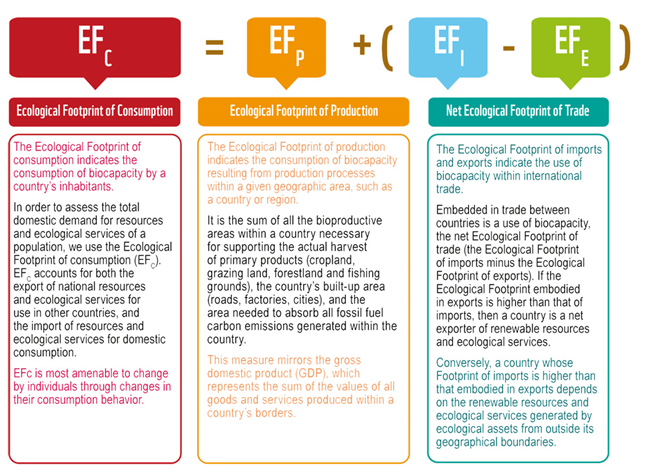
The figure below shows the EF of production and ecological footprint of trade- the two factors that contributes to the ecological footprint of consumption.

Ecological footprint of consumption
(SOURCE:GLOBAL FOOTPRINT NETWORK)

It’s time to have a look at the various factors that impact EF.

Impacts on EF

The section deals with the parameters that influence the ecological footprint.

A. Natural resources

  • Negative
  • Therefore excessive use controlled
  • Mining industry- advanced energy efficient technology
  • Reforestation,control fishing

B. Human capital

  • Negative
  • Locational advantage huge FDI
  • Education rate high hence human capital high
  • Tutorials ,public messages

C. Energy consumption and economic growth

  • Positively related
  • Stimulates use of fossil fuels
  • New technologies revolutionalize the energy sector to reduce emission
  • Govt should subsidize investments
  • Hydrogen fuel cell resolves storage issue
  • Policies-reforestation soil management, solar panels, organic farming

In the next section, we will find out the applications of ecological footprint.

Applications of ecological footprint

The main applications are as follows.

  • National review
  • Risk identification
  • Policy development
  • Footprint adoption
  • Monitoring
  • Communications

Also read: Types of Cracks in Building- 14 Causes& Prevention Full Details

Now that you know the basics of EF, let’s read through the implementation examples.

Examples of implementation

Places of less EF
Places having less EF

There are 4 implementation examples given below.

  1. United Arab Emirates
  • Largest per capita EF in 2006
  • Today exemplery model
  • Innovative awareness campaigns launched
  • Support from government
  • Energy efficient lighting regulation on oct 2013
  • Household sector main contributor(55%)

2. Philippines

  • Ecological deficit
  • Per capita biocapacity reduced 44%due to rapid population growth
  • In 2011 govt and global footprint network took an initiative to analyse country’s resources
  • Currently in the process of finalising national land use act –EF national indicator,protect area,careful use of resources

3. San Francisco

  • Overall EF 6% higher than avg Americans
  • Density and public transportation reduce EF
  • Increased consumption of city residents increase EF
  • Food and beverage consumption highest contributor

4. Calgary

  • The first city to develop EF reduction targets
  • If everyone same EF as Calgary resident,5 earths are required
  • Public rail transportation system powered 100% emission-free wind-generated energy
  • Greenhouse_gas emission 45% below 2005 levels
  • Already met 2020 reduction targets

Now, let’s wrap up.

Conclusions

  • Ecological footprint helps in measuring and assessing the impact of human activities.
  • Therefore take necessary actions which include rainwater harvesting, soil management practices, use of public transportation system, use of renewable resources, organic farming etc.
  • Strive towards a world where waste becomes energy, wastewater turned into bioplastics and heat and where electricity becomes green.

Also read: 3 d Printing buildings |Concrete Printing & Contour Crafting Methods Full Guide

So have you got all the important information regarding ecological footprint? Give a shoutout in the comments!

Happy learning

Reactive Powder Concrete- 6 Components and All Properties Explained

Reactive powder concrete is an ultra-high strength and highly ductile composite material with advanced mechanical properties, hence has high durability. In this blog, I will walk you through the components, properties, advantages and limitations of RPC.

Let’s start from the definition.

What is reactive powder concrete?

Reactive Powder Concrete (RPC) is a type of Ultra High Performance Concrete (UHPC). The main constituents are cement, sand, silica fume, steel fiber and quartz powder with minimal water to binder ratio, without coarse aggregate.

Next, let me show you the development of RPC that presents different steps of formation.

Development of RPC

In RPC, water- binder ratio is very low, CA is absent- reduce the heterogeneity of concrete mix and optimize microstructure. Precise gradation of particles yields compact, well-arranged and high strength hydrates of maximum density.

Development of RPC is based on the following principles.

  • Elimination of CA- Homogeneity enhanced
  • Utilization of pozzolanic properties of silica fume
  • Granular mixture optimization- to enhance the compacted density
  • Optimal usage of superplasticizer- improves workability, reduce w/c
  • Apply pressure (before and during setting)- improves compaction
  • Post set heat treatment- to enhance microstructure
  • Addition of small-sized steel fibres- improves ductility

Let’s move on to the components of reactive powder concrete now.

Components of RPC

  COMPONENT      SELECTION PARAMETER  FUNCTION  PARTICLE SIZE
SandGood hardness, readily available and low costGives strength150-600 µm
CementC3S: 60% C2S: 22% C3A: 3.8% C4AF: 7.4%Binding material for production of primary hydrates1-100 µm
Quartz powderFinenessMax reactivity during heat-treating5-25µm
Silica fumeVery less quantity of impuritiesFilling the voids,
enhance rheology,
production of secondary hydrates
0.1-1µm
Steel fibersGood aspect ratio, straight in shapeImprove ductilityLength 13-25 mm   Dia. 0.15-0.2 mm
Super plasticizerLess retarding characteristicsReduce w/cPoly acrylate based
Components of RPC

Here comes the properties of RPC in the next section.

Properties of RPC

  • RPC possess better strength (compressive and flexural) and lower permeability compared to HPC
  • Fracture toughness is higher for RPC- higher ductility
  • Ultra-dense microstructure- waterproofing and durability characteristics
  • Higher corrosion resistance- can be used in chemically aggressive environments
  • Workability of RPC mixtures (with and without fibres) measured by mortar flow table test- (120-140 mm)
  • Workability of HPC mixtures (with and without fibres) measured by slump test- (120-150 mm)
  • Density of fresh RPC and HPC mixtures- 2500-2650 kg/m3 
  • Compressive Strength of RPC and HPC- linked to durability, found that compressive strength of RPC is suitable for nuclear waste containment

How about the factors affecting the strength of RPC?

Also read: Self healing concrete|Bacterial concrete-Preparations& Advantages

Factors affecting strength of RPC

  1. Silica fume percentage- Compressive strength decreases as dosage increases, fluctuates in the range of 25-35% silica fume 

2. Quartz Powder- improves filler effect, 20% increase in compressive strength under accelerated curing condition

3. Curing Regime- compressive strength increased by 10% when subjected to hot water curing

4. Temperature- 

  • Compressive strength

– decreases at 100°C

– increases from temperatures 200-500°C 

– decreases at temperatures above 600°C

-increases as fibre content increases

-decreases as fibre content increases above 300°C

  • Tensile strength

– decreases below 200°C

 -increases from temperatures 200-300°C

 -decreases above 300°C

5. Pre-Setting pressure- Compressive strength of RPC increased by two times

Time to see the advantages of reactive powder concrete.

Advantages of reactive powder concrete

Reactive powder concrete
  • High ductility
  • Low porosity and permeability
  • Increased resistance to corrosion and chemical attack
  • Significant dead load reduction is possible
  • Eliminates the need for supplemental shear and auxiliary reinforcing steel
  • Improved seismic performance
  • Useful for containment of nuclear wastes- as there is minimum penetration of liquid/gas through RPC

We will find out the applications of reactive powder concrete now.

Also read: Reinforced cement concrete- Working stress and limit state method

Applications of RPC

  • Pre-stressed applications
  • Light weight structures- roof of stadiums, long span bridges, space structures, high pressure pipes, and blast resistance structures
  • Containment of nuclear wastes
  • Pre-cast structures 

Before we wrap up, let’s take a quick stroll through the limitations.

Limitations of reactive powder concrete

  • More expensive compared to conventional concrete
  • Technological and economical difficulties in applying pressure to mix and heat treatment in field
  • Since RPC technology is in its infancy, the long term are still not known
  • Fine sand becomes equivalent to CA of conventional concrete, hence acting as a weak link
  • Portland cement plays the role of fine aggregate and silica fume of the cement of conventional concrete

So, in nutshell,

Conclusions

  • RPC is a recent advancement in the field of construction
  • It has superior performance characteristics compared to HPC
  • Based on the principle of optimization of microstructure to produce hydrates of the highest strength and durability
  • Usage of superior materials has increased the cost of RPC considerably
  • Ambiguity in long term properties, technological difficulties
  • Intense research in this field guarantees that its limitations shall be resolved and it will be tapped to its full potential in the near future

That’s it about reactive powder concrete. Let me know your feedback on the article and any other topic suggestions in comments.

Happy learning!

Electric Vehicles- 5 Types & Advantages Full Guide

The world is moving towards an increased share of renewable energy in order to reduce greenhouse gases. The transport sector is the main source of greenhouse_gas. Electric vehicles can be used as an alternative source. Because they cause zero emissions and is extremely eco-friendly. There have already been many reports that show the positive impact of EVs.

We will find out the basic details of EVs along with its challenges and solutions.

Let’s get into the first section that explains the working of electric vehicles.

Electric vehicles working

Electric vehicle technology is as follows.

  • EVs are defined as vehicles that use an electric motor for propulsion.
  • Although EVs offer several advantages and can be used in different application, there are several challenges in the popular use of them.
  • The electricity used to run the motor could come either through transmission wires.
  • This is the same case with electric locomotives, metro trains, and trams or through a single or a series of connected batteries.
  • And so is the case in electric bikes and electric cars, or it could be generated onboard using a fuel cell.
  • Powered through a collector system by electricity from off-vehicle sources, or maybe self-contained with a battery, solar panels or an electric generator to convert fuel to electricity.

I will walk you through the advantages of electric vehicles in this section.

Electric vehicles advantages

  • Electric vehicles cause zero emissions and therefore eco-friendly.
  • EVs are as green as the energy sources used to charge them
  • Do not have any tail-pipe or evaporative emissions.
  •  Not limited to, road and rail vehicles, surface and underwater vessels, electric aircraft and electric spacecraft.

Time to look at the different types of EVs.

Electric vehicles types

There are mainly 5 types of EVs.

1. Mild hybrid electric vehicles

  • Contains a small electric motor that enables a start-stop system, facilitates regenerative offers acceleration assistance.
  • Achieve small reductions in emissions, between 10% to 15%  at relatively high costs.
  • It is viewed as an intermediate system.

2. Fully hybrid

  • The larger motor and battery pack that provides the vehicle with electric launching, acceleration assistance and electric driving at low speeds.
  • Achieve a maximum of 25% to 30% in greenhouse gas emission contribution.
  • The cost of hybrid components is expected to fall by 5% per year.

3. Plugin hybrid electric vehicles

  • A larger battery that can be recharged by connecting a plug to an electric power source or grid.
  • The ability to connect to the grid gives the PHEV a range of 30 to 60 kilometres of all its electric driving.
  • The carbon reduction potential of a PHEV is between 30% to 40%.

4. Range extenders

  • A small ICE that is used to recharge the battery to extend the driving range.
  • Carbon reduction potential of between 60%- 80% depending on the electricity source used to charge the battery.

5. Fully electric

  • All the needed propulsion energy is stored in a large battery that can be recharged by connecting it to the electricity grid.
  • 2 to 3 times more efficient than conventional ICEs.
  • Only as clean as the source of electricity that is used to recharge the battery, and when charged using renewable sources.
  • Reduce emissions by up to 80 %- 100%.

I will show you the challenges of EVs in this section.

Challenges of electric vehicles

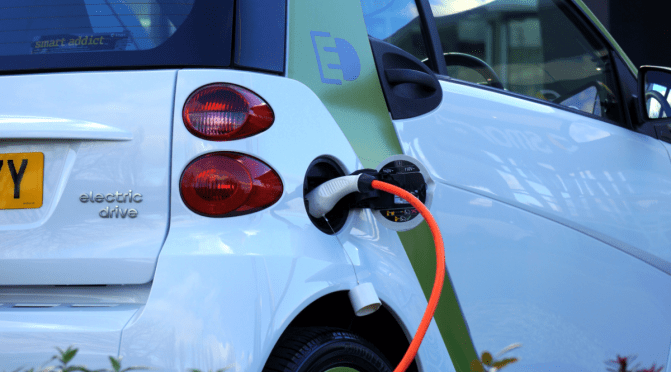
Tesla electric cars
Tesla electric cars

The major challenges has been categorized into the following types.

  1. Technical

Parameters which decide the designing and operation of EVs.

a) Light weight material

  • The main objective of EVs is to reduce the energy demand of the vehicle.
  • A large amount of the energy generated from the input will be utilized in driving the heavyweight of the vehicles.

b) Efficiencies of batteries

  • Battery system should be lightweight and its storage capacity should be more.
  • EV is based on increased battery capacity and efficiency.
  • Energy devices for EV system are Pb Acid,
  • Ni and Li-ion based batteries.

c) Driving range of EVs

  • Fully charged EVs are having approximate 5 times lesser driving range than that of a conventional diesel or petrol vehicles.

d) Charging Time

  • Older lead-acid batteries or valve-regulated lead-acid battery packs or the new Lithium-Ion packs will charge fully overnight.
  • Lead Acid batteries, 70% of the charging is done in the first 40% of charging time.
  • The rest is the “topping up” stage of the charging process.

e) Environmental Impacts

  • If electricity fed to EVs is generated by the fossil fuel the emission factor will be more
  • Disposal of the used battery
  • Pb can be very dangerous to dispose of it in open.

2. Infrastructure

a) Power infrastructure

  • Substantial increase in electricity production is required to offset the overloading of local transformer and grid.

b) Charging infrastructure

  • The requirement of sufficient charging stations
  • Also, fast charging devices should be used

c) Battery recycling

  • The disposal will cause environmental pollution
  • During designing a recycling process cost is the main factor.

3. Market

a) Vehicle servicing

  • Trained technicians are required for its servicing and maintenance
  • Costly compared to conventional vehicles
  • Due to less popularization of EV

b) High upfront cost

  • A high upfront cost of purchase along with battery replacement after a few years does seem like a heavy investment to an average Indian with decent income

c) Consumer perceptions

  • Change in consumer perception is required

d) Policy

  • Taxation of vehicles and components
  • Subsidies on fossil fuels
  • Electricity tariff policies

Also read: Road margins- 6 types of road margins in highway

We saw the challenges. Let’s solve them now.

Solutions to overcome the challenges

EV charging
EV charging
  1. Light weight materials such as glass, plastics, rubber, and special fibers are used in the production of a vehicle
  2. Aluminium and magnesium are used in the construction of body of vehicle to reduce the total weight.
  3. Natural fiber reinforced composites are also used in manufacturing
  4. Sodium ion, lithium sulphur batteries can be introduces for more capacity
  5. Super capacitors are also introduced which can be used to meet peak power demand condition and also for purpose of fast charging
  6. To reduce anxiety towards fuel
  7. Increase in charging stations
  8. Fast charging battery
  9. High density batteries etc.
  10. Solar power would provide cheap and reliable power system.
  11. Incentives will motivate the buyers to purchase EVs
  12. To make EVs affordable in India, domestic production of quality batteries has to be taken up.

Also read: Types of rails- 3 types full details with figures

Let’s wrap up.

Conclusions

  • The increase in the number of vehicles results in the increased emission of GHG.
  • Emission from the transportation sector is decreased: a great change in the carbon emission of our country.
  • EV – best alternative.
  • The complete economic comparison of fuels shows that electricity as a fuel is much cheaper than conventional vehicles

Are electric vehicles the future? Share your thoughts in the comments in the light of the article.

Cellular Light Weight Concrete: Manufacturing Process & Properties Full Details

Cellular Light Weight Concrete (CLC) is a lightweight concrete that is produced by mixing cement and fly ash slurry with pre-formed foam. CLC is also known by the names as foam concrete,  aircrete, foamcrete or reduced density concrete.

We will find out the main principles, constituent materials, manufacturing, properties, advantages and disadvantages of CLC in the blog.

Let’s start from the principles.

Cellular lightweight concrete technology

  • Cellular lightweight concrete is prepared by introducing air bubbles into the concrete using a foaming agent.
  • Amount of air-entrained determines the density of the material.
  • Use of coarse aggregates is eliminated in CLC.

We will see the constituent materials in the next sections.

Constituent materials

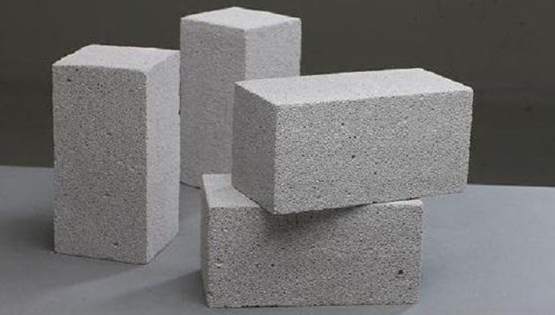
Cellular light weight concrete block
  1. Cement

Ordinary Portland Cement is used.

2. Water:

The water used in the manufacture of CLC Blocks is potable water.

3. Fly-Ash :

Class F Fly-ash conforming to IS 3812 (part-1) is used .

4. Sand :

Sand passing through 2.36 mm IS sieve is used.

5. Foaming Agent :

Hydrolyzed protein-based foaming agent or synthetic-based foaming agent is used. Protein-based foaming agents are prepared with raw material in presence of Ca(OH)2 and a small portion of NaHSO3.

Time to look into the classification of cellular light weight concrete.

Classification of cellular light weight concrete

The cellular light-weight concrete blocks confirms to the following grades :

  • Grade-A: These are used as load-bearing units and shall have a block density in the range of   1200 kg/m3 to 1800 kg/m3.
  • Grade-B: These are used as non-load bearing units and shall have a block density in the range of 800 kg/m3 to 1000 kg/m3.
  •  Grade-C: These are used for providing thermal insulation and shall have a block density in the range of 400 kg/m3 to 600 kg/m3.

How about the manufacturing process?

Cellular light weight concrete manufacturing process

CEMENT  (%)FLY ASH (%)SAND (%)
35650
35605
355510
355015
354520
354025
353530
Mix proportion of Cellular light weight concrete
  • Cement, sand and fly ash are dry mixed in proportion
  • The slurry is made by wet mixing with water.
  • Foaming agent about an amount of 1.5% of the total weight of cement, fly ash and sand is taken.
  • The foaming agent is diluted with water in the dilution ratio is 1:35.
  • The above solution is fed into the foam generator.
  • the foam is mixed thoroughly with the cement-based slurry.
  • After mixing is completed check that the wet density of the foamed concrete is close to what is required.
  • The slurry form of foamed cellular concrete is pumped into assembled moulds of blocks of dimensions 600mm x 250mm x 200mm.
  • The blocks are then cured and this curing is done by Water for 2 to 3 weeks.

We will find out the properties of fresh and hard cellular light weight concrete now.

Fresh CLC properties

  • Workability of foamed concrete is very high and have a slump value of 150mm to collapse
  • Reduces tendencies of segregation, bleeding and laitance
  • Reduced alkali-aggregate reaction
  • Freely flowing consistency and self-compacting property

Hardened cellular light weight concrete properties

  • Physical properties of the foam concrete are clearly related to the dry density (400 to 1400kg/m3)
  • Thermal conductivity of foam concrete ranges from 0.1W/m.K to 0.7 W/m.K
  • Better acoustical insulation
  • Good resistance against freezing and thawing
  • Reduced permeability

I will show you the comparison of various technical parameters of cellular light weight concrete in the next section.

Comparison of technical parameters of clc blocks and burnt clay bricks

1Dry Density (Kg/m3)  80090010001100
2Compressive Strength (N/mm2)  2.63.23.85.4
3Drying Shrinkage No Shrinkage    No Shrinkage    No Shrinkage     No Shrinkage  
4Thermal Conductivity (W/m.K)  0.320.340.360.37
5Water Absorption (%)  11.8711.5111.3710.96
Comparison of technical parameters of clc blocks and burnt clay bricks

Now comes the the mandatory section on advantages and disadvantages of cellular light weight concrete.

Advantages of CLC

  • reduces dead load of the building
  • easy to handle and hence reduce the cost of transportation
  • low thermal conductivity and good acoustical insulation
  • good resistance to freezing and thawing action
  • disposal of harmful industrial wastes like fly ash
  • better placeability
  • eco-friendly
  • lower water absorption
  • Fire resistant

Disadvantages of cellular lightweight concrete

  • Difficulty in finishing
  • Time of mixing longer
  • With the decrease in density, the compressive strength and flexural strength also decreases

Let’s wrap up with the conclusion.

Conclusions

  • 68% of our country’s electricity demand is fulfilled by coal-based thermal power plants and so the harmful fly ash produced can be used in CLC.
  • CLC blocks are environment friendly and thus we can reduce environmental pollution and global warming.
  • Technical properties of CLC are far more superior than conventional burnt clay bricks and so the use of burnt clay bricks can be replaced with CLC.

That’s it about cellular light weight concrete. Do you have any doubts? Did I miss out anything? Please help yourself to the comment box.

Happy learning!