Architectural finishes in a holistic sense can refer to a variety of textures, , colours and materials and refers to hard and soft permanently fixed finishes such as plaster or render and other surface coatings, such as paint. Architectural finishes can be in form of Vitrified tiles for flooring, ceramic tiles, False ceiling, textured paints, dry walls, facades, aluminium doors and windows, UPVC doors and windows, Epoxy painting, plastic emulsion, Plaster of Paries, natural stones like marble, granite etc
Empire state building remains one of the most distinctive and prominent buildings in the United States. And it is one of Modernist Art Deco design’s best examples.
I will walk you through the design and other aspects of the building. Let’s start from scratch.
What is Empire state building?
empire state building image
Empire State Building, a 102-story steel-framed skyscraper completed in New York City in 1931 and the world’s tallest building until 1971.
In Midtown Manhattan, on Fifth Avenue at 34th Street, is the Empire State Building.
Empire state building was the first to have more than 100 floors.
In the next section, we will find out the design of Empire state building.
Design
Empire state building night view
The Empire State Building, including its 203-foot (61.9 m) pinnacle, is 1,250 ft (381 m) high to its 102nd floor or 1,453 feet 8 9⁄16 inches (443.092 m) high.
The building has 86 available floors; 2.158 million square feet (200,500 m2) of commercial and office space are on the first through 85th floors, while the 86th floor features an observatory.
The remaining 16 floors are part of the Art Deco spire, which is capped on the 102nd floor by an observatory, which does not have any intermediate floor levels.
The 203 ft (61.9 m) pinnacle is at the top of the 86th storey, most of which is protected by broadcast antennas and surmounted by a lightning rod.
The building and its street floor interior are designated as New York City Landmarks Preservation Commission landmarks, and verified by the Estimate Board of New York City.
In 1986, it was designated as a National Historic Landmark.
It was first on the AIA’s List of Favourite Architecture for America in 2007.
I will show you the construction details in the next section.
Construction
Empire state building view
On January 12, 1930, a structural steel contract was awarded, with the construction of the site starting ten days later on January 22, until the old hotel was completely demolished.
Two twelve-hour shifts, consisting of 300 men each, continuously worked to dig the foundation of 55 feet (17 m).
To house the concrete footings that would protect the steelwork, small pier holes were drilled into the ground.
By early March, excavation was almost complete, and work on the building itself began on March 17, with the builders putting the first steel columns on the completed footings before completing the rest of the footings.
In anticipation of a revision to the city’s building code, the structural steel was pre-ordered and pre-fabricated to enable the structural steel of the Empire State Building to hold 18,000 pounds per square inch (120,000 kPa), up from 16,000 pounds per square inch (110,000 kPa), thereby reducing the amount of steel required for the building.
While the 18,000-psi rule had been safely enforced in other towns, until March 26, 1930, just before the construction was due to begin, Mayor Jimmy Walker did not sign the new codes into law.
The first steel structure was built on April 1, 1930.
Construction from there continued at a rapid pace; the builders erected fourteen floors within one stretch of 10 working days.
This was made possible by precisely organising the planning of the house, as well as by mass manufacturing common materials such as windows and spandrels.
On one occasion, when a supplier was unable to supply dark Hauteville marble in a timely manner, Starrett turned to the use of Rose Famosa marble from a German quarry that was purchased specifically to provide ample marble for the project.
By June 20, the supporting steel frame of the skyscraper had risen to the 26th floor, and half of the steel structure had been completed by July 27. Starrett Bros.
And Eken sought to build one floor a day to speed up construction, a target they almost achieved with their rate of 4 1⁄2 floors a week; prior to this, the fastest rate of construction for a building of similar height (as opposed to the general design, which had been from the roof down).
Some of the levels were still awaiting final approval, with many orders placed within an hour of finalising a design.
As steelwork was nearing completion on September 10, during a ceremony attended by thousands, Smith laid the cornerstone of the structure.
That’s it about Empire state building. Do you want to know anymore? Let me know in comments.
The Lotus Temple has received several architectural awards and has been published in various articles in newspapers and magazines. A 2001 article by CNN referred to it as the world’s most visited building.
Today, we are going to discuss about this amazing marvel.
What is Lotus temple?
Now you got an idea of why this civil engineering structure is significant. We are going to dive into the basics now.
Lotus Temple is located in Delhi, India in December 1986.
It has become a prominent attraction in the area, notable for its flowerlike shape.
The Lotus Temple, regardless of religion or any other qualification, is available to everyone.
The building consists of 27 free-standing marble-clad petals’ arranged to form nine sides in clusters of three, with nine doors opening into a central hall with a height of slightly more than 34 metres and a capacity of 2,500 people.
In the next section, let me show you the details on its architecture.
Architecture of Lotus Temple
Lotus temple image
This lotus-inspired building, surrounded by lush green landscaped gardens, spreads over 26 acres of land.
Made from white marble from Greece, it consists of 27 free-standing petals. As was suggested in the Bahai scripture, these petals are arranged in groups of three to give the structure a nine-sided circular shape.
There are nine entrances opening up to an immense central hall that is about 40 metres high.
The temple has a capacity of 1300 people for seating and can hold 2500 people at a time.
Within the Lotus Temple, there are no altars or pulpits, which is a common feature of all Bahai Houses of Worship.
The interiors are often devoid of statues, portraits, or images.
The nine pools of water situated around the petals are an eye-catching feature of the temple.
In a water body, they give the appearance of a half-bloomed lotus and when illuminated in the night, the whole structure looks magnificent.
This temple was designed by an Iranian-American architect, Fariborz Sahba, while Flint and Neill, a UK firm, carried out the structural design. The ECC Design Company of Larsen & Toubro Limited undertook the construction work for the temple and finished it at a cost of $10 million.
There are different types of buildings. We can classify them according to various criteria. With the advent of technology, new categories are included each day.
In this blog, we are going to dwell deep into modular building.
Let’s start form scratch.
What is modular building?
Buildings similar to modular buildings
Modular buildings are structures that are constructed in a factory setting before being transported for assembly on site.
Despite having been used as a method of construction for decades, this type of modular structure is increasingly being used for a wider range of construction projects, ranging from offices and hospitality builds to residential properties, and more.
So, you got an idea about modular building. Now, let’s get into the construction details.
Modular building construction
Modular buildings are manufactured in sections away from building sites before being delivered to the desired location where they are installed into a final building design.
60-90% of the work is completed in a factory-controlled environment, either as a complete structure or as modular subassemblies for a larger project.
This offsite construction allows the use of lean manufacturing techniques to create prefabricated modules.
These modular units can be placed end-to-end or stacked up to create different configurations.
The modular construction process is completed onsite using inter-module connections (or inter-connections) to tie the units together.
Permanent modular buildings, such as prefabricated homes, are built to standards that are equal or higher than traditional site-built properties, ensuring high levels of quality control.
Permanent modular construction (PMC) can be carried out with a variety of building materials, such as concrete, steel or wood, and can also include provision for adding windows, power supplies, water and sewage pipes, telecommunications, air conditioning and more.
Many of these additional features can be installed before being taken to the site, saving construction time later in the process.
These PMC structures are designed to remain in one location once built and can include as many storeys as allowed by building regulations.
The design phase is particularly important in the creation of modular buildings.
Design for Manufacture and Assembly (DfMA) practices need to be used to make sure the assembly tolerances are controlled and ensure any slack or misalignment can be taken up.
CAD systems, additive manufacture (3D printing) and manufacturing control systems are important for modular construction since the components cannot easily be realigned onsite.
Let me walk you through the benefits of such buildings.
Benefits of Modular Construction Compared to Traditional Construction
Construction delays due to adverse weather and other onsite issues are not an issue with factory manufacture, eliminating many potential delays to project completion dates
Factory conditions allow for a higher quality product with improved operating procedures and monitoring, while employees are able to work in a more comfortable environment. Construction can also more easily be extended 24/7 if required to complete a project
Material supplies are easier to control in a factory setting, reducing wastage and thereby cost, as well as lowering the environmental impact of a build.
Manufacture of the modules can begin before onsite preparations, such as foundations, are complete, speeding up the whole build process
Modular construction allows for different parts of the building to be built at the same time – further reducing the time taken to complete a project
Modular construction is highly suited to remote locations where onsite building could prove difficult or expensive.
Building away from these locations also means that staff can work in places where medical and sanitary provision is more readily available if required
Modular structures can be added to overtime or even be treated as a relocatable building which can also be readily refurbished to meet a new need
Because modular units need to meet regulations for travel and assembly, the final product can end up being more durable than a traditional build that didn’t have to be assessed part by part
Many modular units use Structural Insulated Panels which are light yet durable and provide improved thermal insulation as well as damp and cold resistance when compared to materials like timber.
The factory construction also removes the potential for high levels of moisture being trapped inside the construction, improving the quality of the product
Modular constructions have been shown to offer time savings of more than 50% when compared to traditional builds, with the inherent cost savings this provides
Now, I will show you the disadvantages of modular building.
Disadvantages of modular building
There are a few challenges associated with modular builds, including;
The transportation of finished modular building sections can require a lot of space
Manufacturing and transportation restrictions can limit the size of each modular unit, which can impact room sizes
Lack of knowledge about technology
Some amazing architectural designs might not be possible through the construction.
All the changes need to be made at the beginning itself. Otherwise, they will have adverse effects on the structure.
We have reached at the last section. Let’s have a quick stroll.
Applications
Modular buildings in a city
Where modular building used to be associated with temporary structures, improvements in quality, design and unit sizes mean that this type of construction continues to find new applications.
From offices to homes and even larger builds like sports halls, the uses of modular construction are constantly growing.
No longer associated with small, low cost structures, the modern wave of modular buildings are proving that they can be used for any number of applications while offering cost and time savings along with comparable levels of quality to traditional builds.
BIM is one of the trending civil engineering technological advancements. It has impacted the construction sector hugely and continue to make it better and better.
In this blog, we will find out all the details of BIM.
Let’s start from the definition.
What is BIM?
BIM is an acronym for Building Information Modeling.
It is a highly collaborative process that allows multiple stakeholders and AEC (architecture, engineering, construction) professionals to collaborate on the planning, design, and construction of a building within one 3D model.
It can also span into the operation and management of buildings using data that owners have access to.
This data allows owners and stakeholders to make decisions based on pertinent information derived from the model even after the building is constructed.
In the next section, I will walk you through different BIM objects.
BIM Objects
The steps in building drawing
BIM objects, the components that make up a BIM model, are intelligent, have geometry, and store data.
If any element is changed, BIM software updates the model to reflect that change.
This allows the model to remain consistent and coordinated throughout the entire process so that structural engineers, architects, MEP engineers, designers, project managers, and contractors can work in a more collaborative environment.
Time to know the future of BIM.
The Future of Building Information Modeling
Because of the clear benefits, it’s certain that BIM is here to stay.
It has defined goals and objectives that are clearly beneficial to all those who work their way through the levels.
Undoubtedly, the future of construction will be even more highly collaborative and digital.
As BIM becomes increasingly more sophisticated, 4D, 5D, and even 6D BIM will start to play a part in the process.
Furthermore, around the globe, there is an attempt to reduce waste in construction.
Much of this is attributed to supply chain inefficiencies, clashes, and reworking.
By working collaboratively in a BIM environment, all of this becomes much less likely, setting the stage for a better tomorrow
Now, let me show you how Building Information Modelling can help you.
How can BIM help you?
BIM brings together all of the information about every component of a building, in one place.
BIM makes it possible for anyone to access that information for any purpose, e.g. to integrate different aspects of the design more effectively.
In this way, the risk of mistakes or discrepancies is reduced, and abortive costs minimized.
BIM data can be used to illustrate the entire building life-cycle, from cradle to cradle, from inception and design to demolition and materials reuse. Spaces, systems, products and sequences can be shown in relative scale to each other and, in turn, relative to the entire project.
And by signalling conflict detection BIM prevents errors creeping in at the various stages of development/ construction
A building information model can be used for the following purposes:
• Visualization: 3D renderings can be easily generated in house with little additional effort.
• Fabrication/shop drawings: It is easy to generate shop drawings for various building systems. For example, the sheet metal ductwork shop drawings can be quickly produced once the model is complete.
• Code reviews: Fire departments and other officials may use these models for their review of building projects.
• Cost estimating: BIM software has built-in cost estimating features. Material quantities are automatically extracted and updated when any changes are made in the model.
• Construction sequencing: A building information model can be effectively used to coordinate material ordering, fabrication, and delivery schedules for all building components.
• Conflict, interference, and collision detection: Because building information models are created to scale in 3D space, all major systems can be instantly and automatically checked for interferences. For example, this process can verify that piping does not intersect with steel beams, ducts, or walls.
• Forensic analysis: A building information model can be easily adapted to graphically illustrate potential failures, leaks, evacuation plans, and so forth.
• Facilities management: Facilities management departments can use it for renovations, space planning, and maintenance operations.
In the next section, let’s see the benefits of building information modelling.
Benefits of BIM
Accurate geometrical representation of the parts of a building in an integrated data environment
Faster and more effective processes: Information is more easily shared and can be value-added and reused.
Better design: Building proposals can be rigorously analyzed, simulations performed quickly, and performance benchmarked, enabling improved and innovative solutions.
Controlled whole-life costs and environmental data: Environmental performance is more predictable, and lifecycle costs are better understood.
Better production quality: Documentation output is flexible and exploits automation.
Automated assembly: Digital product data can be exploited in downstream processes and used for manufacturing and assembly of structural systems.
Better customer service: Proposals are better understood through accurate visualization.
Lifecycle data: Requirements, design, construction, and operational information can be used in facilities management.
That’s it about BIM. You have seen the technical details as well as other aspects of the innovation.
So, do you think it’s going to change the future of civil engineering? Let me know in comments.
Today, we are going to talk about one of the interesting innovations, smart building. With the advancement of technology, civil engineering has seen mouthful innovations in the past decade.
We will find out everything you need to know about smart buildings.
Let’s start from the definition.
What is a smart building?
Smart buildings view
A smart building is any structure that uses automated processes, including heating, ventilation, air conditioning, lighting, safety and other systems, to automatically control the building’s operations.
In order to gather data and handle it according to the functions and services of a company, smart buildings use sensors, actuators and microchips.
This infrastructure helps owners, operators and facility managers increase the efficiency and performance of facilities, decreasing energy usage, maximising the use of space and mitigating the impact of buildings on the climate.
In the next section, I will walk you through the process of building smart buildings.
The creation of a smart building
Making a smart house, or making a building smart, starts by connecting sensors and control systems to core systems such as lighting, power metres, water metres, pumps, heating, fire alarms and chiller plants.
Also elevators, access systems and shading may become a part of the system at a more advanced level.
There is no single collection of norms that makes up what a smart building is, but convergence is what they all have in common.
Many new buildings have “smart” technology and are connected to a smart power grid and are sensitive.
To operate in smart buildings, you don’t even need to move offices or create a new building.
In order for property owners to take advantage of the power available in older buildings, building automation systems such as those from Honeywell or Johnson Controls exist.
Next, we will find out the benefits of smart buildings.
Let’s come to the main features section.
The main features of smart buildings
Highly automated building
Systems are connected
The most fundamental characteristic is the connection of the core systems within it.
So, all connected are water metres, pumps, fire alarms, electricity, lighting etc.
This is what makes “smart” a building-the capacity of the systems inside it to communicate with each other.
2. The use of sensors
Use of sensors can help make various activities easier and effective.
There are different types of sensors available to be used according to the purpose
3. Automation
The systems that have been placed in place collect and interpret information, and this is done continuously and in real-time, basically.
This continuous monitoring makes it possible to make automatic changes that can control conditions in an entire building.
4. Data
These type of buildings create a large amount of useful data about their own usage, which is something that is obviously not done by standard buildings.
Improve decision-making throughout the organization.
You have seen the different aspects of a smart building. It indeed is an innovation worth incorporating in your life. Let me know if you have any doubts in comments.
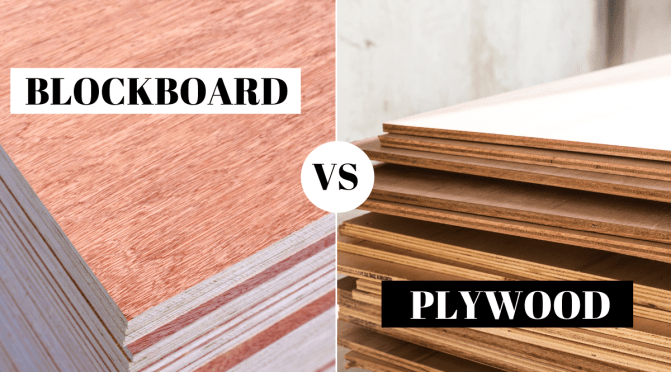
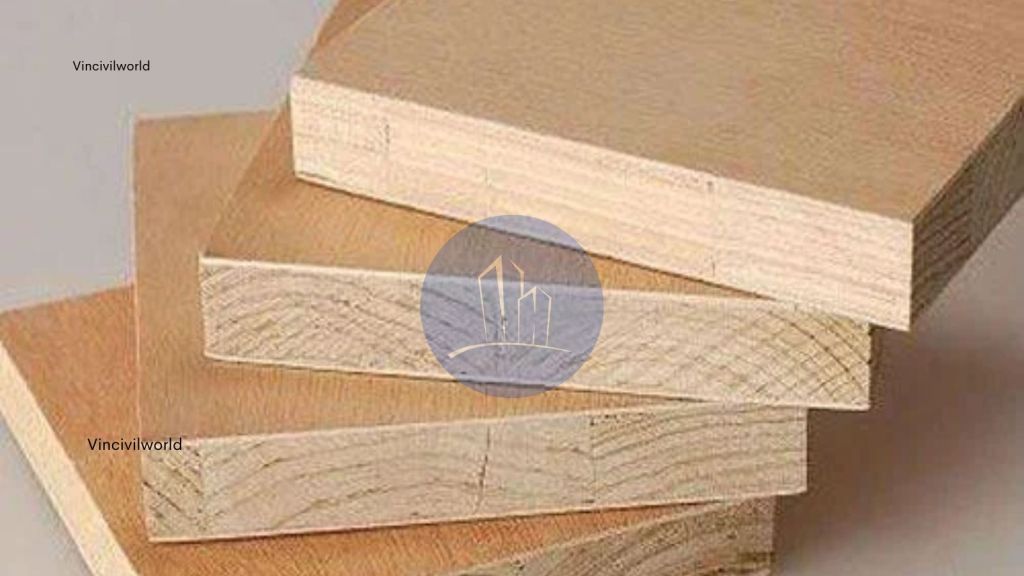
Blockboard vs plywood, Most people get confused with these terms because of the similarity in looks, and both products are popularly used in interior works, home decor, and furniture works. In reality, both these materials are different types of engineered wood and possess entirely different properties, and are used for specific interior applications.
Blockboard, with its core of softwood strips sandwiched between veneers, is known for its strength and durability. In contrast, plywood features multiple layers of thin veneer glued together, providing flexibility and stability. As you weigh plywood vs block board, consider how each material meets your needs for load-bearing, cost, and aesthetics. Blockboard plywood is often preferred for heavy-duty applications, while plywood and blockboard both offer versatility for different uses. This blog explains and clarifies the differences and properties of ply board/block-board and can make the right choice.
Plywood is an engineered wood panel manufactured by joining sliced wood veneers 2-4 mm thick in a cross-layered pattern and pressed under high temperature to form sheets.Unlike blockboard, plywood is flexible and resistant to warping. This makes it ideal for a wide range of applications, from furniture to construction. When comparing blockboard vs plywood, plywood’s adaptability and ease of use stand out.
Plyboard or blockboard is an engineered wood panel made of a core comprising of softwood wooden strips or blocks placed edge to edges sandwiched between two wood veneer layers. This construction gives it strength and durability, making it ideal for heavy-duty applications like furniture and doors. These veneer layers are glued and pressed under high pressure and temperature to form a plyboard/blockboard. Compared to plywood, blockboard is thicker and provides better load-bearing capacity. When considering blockboard vs plywood, blockboard excels in situations requiring robust support and rigidity.
Let us have a comparison between the properties , types and uses of Plyboard and plywood/blockboard. This comparison highlights key differences to help you choose the best material for your project.
Composition and Manufacturing process
Ease of handling
Strength and durability
Water and moisture resistant properties
Physical properties
Screw Holding capacity
Flexibility in applications
Sound insulation properties
Sizes available
Economy
Service life
Manufacturing process – Blockboard vs Plywood
Blockboard/Plyboard
Plywood
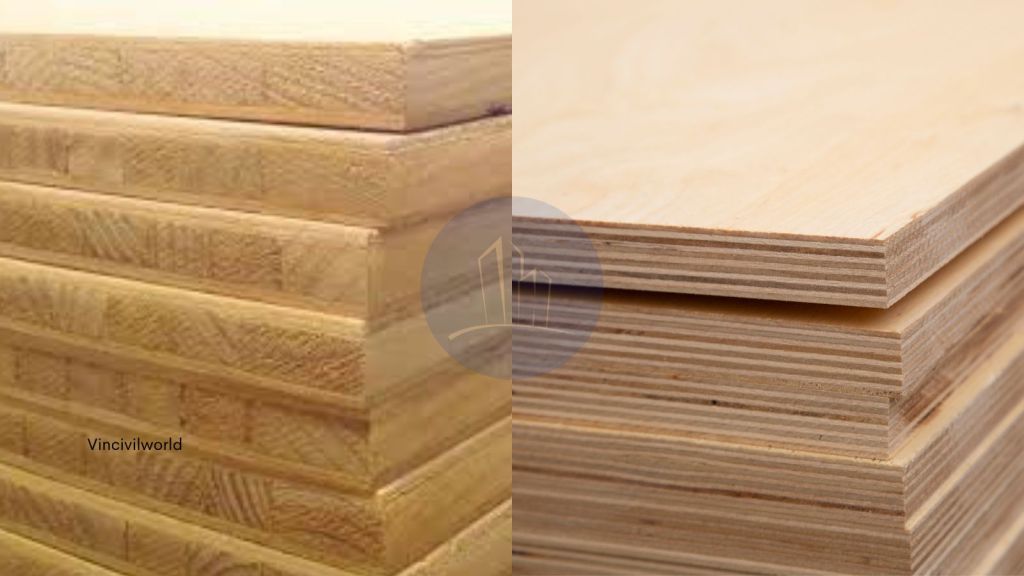
Small wooden strips are placed edge to edge sandwiched between sliced wooden veneers.
Plywood is made in an odd number of veneer layers starting from 3 layers more depending on the thickness of the plywood.
Block boards are made in either 3 layers or 5 layers. It is like a wooden frame filled with small wooden strips and covered by wooden veneers on the faces.
The veneers are arranged in a cross layered pattern.
Blockboard vs plywood involves different core materials and manufacturing methods. Blockboard has a core of softwood strips with outer veneers, while plywood features alternating layers of veneer. Each method affects the material’s strength, flexibility, and final use.
Ease of handling – Plywood vs Blockboard
Blockboard/plyboard
Plywood
Blockboard mostly uses softwood core and hence blockboard is lighter than plywood.
Plywood grades use dense hardwood and the layers are pressed to form plywood.
Due to their lightweight nature, they are easy to transport and handle.
plywood is solid and heavier than Blockboard.
Blockboard uses softwood for its core, making it lighter compared to plywood, which uses dense hardwood veneers. Consequently, blockboard is easier to handle and move, while plywood’s weight can make it more challenging to work with.
Strength and durability
Plyboard/Blockboard
Plywood
Mostly uses softwood in the core. Softwoods are soft and have low strength and hence blockboards have moderate strength.
Mostly uses hardwood veneers arranged in a uniform cross-layered pattern. Plywood is much stronger than blockboard.
Plyboard is strong compared to particleboard and MDF but is less durable as compared to plywood.
Low-density plywood can even take moderate loads. They are strong and durable when compared with blockboards/plyboards.
Blockboard looks plain from the outside, but minor gaps are inside the core.
Plywood layers are uniform in both directions and no gaps will be there.
Blockboard provides robust strength due to its core of softwood strips, making it suitable for heavy-duty applications. However, it can be affected by moisture. Plywood, with its layered veneer construction, offers consistent strength and high durability, making it resistant to environmental changes and suitable for diverse uses.
Water and moisture resistant properties
Plyboard/Blockboard
Plywood
Blockboards retains moisture and more prone to water and moisture damages.
Plywood grades like BWR (Exterior Grade)and Marine ply are less suspectable to water and moisture.
They can be made waterproof by using BWP Grade (Boiling Water Proof) resin for bonding the strips.
Plywood grades like BWR (303 grade) and Marine ply (710 grade) are superior to block boards in terms of moisture and water-resistant properties.
Physical properties
Plyboard/Blockboard
Plywood
Bending and sagging
Plyboard is more stiffer than plywood and do not bend when used as long pieces. Block board is preferred over plywood when used as lengthy panels and furniture.
Long pieces of plywood may sags from the centre. Plywood is less stiffer than blockboard.
Warping and Cracking
It has good dimensional stability and so is highly resistant to warping and cracking
It is resistant to warping and cracking.
Splitting on edges
Plyboard does not split on edges while cutting
Plywood split on edges while cutting.
Block board is comparatively easy to cut.
Plywood splinter on edges and is very difficult to cut.
Blockboard vs plywood differs in density, thickness, and other physical properties. Blockboard, with its softwood core, is typically thicker and less flexible but provides a smooth surface. Plywood, made from layered veneers, is denser, more flexible, and offers better dimensional stability.
Screw holding capacity
Plyboard/Blockboard
Plywood
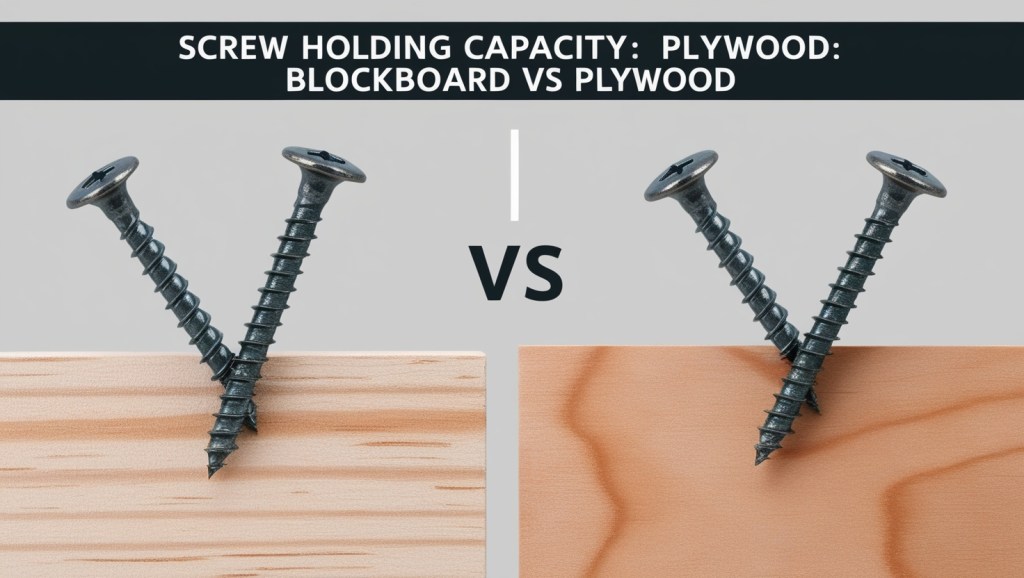
Blockboards have very good screw holding capacity, than particle board and MDF. They can hold nails very well and thus are used for making custom made furniture. Also they are used as core in flush doors, where screw holding capacity is essential.
Got excellent screw holding capacity due to the cross layered arrangement of veneers. The hinges do not come out easily.
Some times the screws tend to go between the gaps of the wood pieces. Skilled carpenters can identify and manage the problem
In the blockboard vs plywood comparison, plywood typically offers better screw holding capacity. The layered veneer structure of plywood provides more grip, making it suitable for applications where secure fastening is essential. Blockboard, with its softer core, may have screws loosen over time and is less reliable for high-stress fastening.
Flexibility in Applications: Blockboard vs Plywood
Aspect
Blockboard
Plywood
Application Versatility
Less versatile; best suited for applications requiring solid and stable support, such as heavy-duty furniture and doors.
Highly versatile; used in a wide range of applications including cabinetry, wall panels, and structural components.
Customizability
Limited in terms of bending or shaping; typically used in flat applications.
More flexible; can be easily cut, bent, and shaped for various designs and structures.
Use Cases
Ideal for applications requiring strength and stability but less flexibility.
Ideal for both structural and decorative purposes due to its adaptability and ease of modification.
Plywood is more flexible in applications due to its ability to be shaped and customized easily. In contrast, blockboard is less adaptable, making it suitable primarily for stable, heavy-duty applications.
Applications: Blockboard vs Plywood
Aspect
Blockboard
Plywood
Typical Uses
Commonly used for heavy-duty furniture, long bookshelves, benches, doors, partitions, and panels where solid support is needed.
Widely used in cabinetry, wall paneling, flooring, structural components, and various DIY projects due to its versatility.
Suitability for Interior Design
Suitable for high-end furniture and cabinetry where a smooth finish and robustness are required.
Ideal for a broad range of interior design projects, including furniture, shelving, and decorative panels.
Structural Uses
Best for applications requiring solid core strength but less flexibility in design.
Common in structural applications like roof sheathing, subflooring, and wall sheathing due to its strength and flexibility.
Blockboard is ideal for applications needing solid support, such as heavy-duty furniture and doors. Plywood, being versatile and flexible, is used in a wide range of applications from cabinetry and wall paneling to structural components.
Sizes available
Plywood
The most commonly manufactured plywood size is 8 x 4 ft. (2449 x 1219 mm)
It is available in various thicknesses ranging from 3 mm to 25 mm.
Blockboard
The most commonly manufactured and sold block board size in India is 8 x 4 ft. (2449 x 1219 mm).
Available thickness are 16mm,19mm,25mm
Service Life: Blockboard vs Plywood
Aspect
Blockboard
Plywood
Durability
Generally durable but may have a shorter service life if exposed to moisture without proper sealing.
Highly durable with a longer service life, resistant to environmental changes and moisture when properly treated.Always use BWR and Marine ply for water prone areas.
Maintenance
Requires regular maintenance and sealing to extend service life, particularly in humid conditions.
Low maintenance; retains durability with minimal upkeep and resists moisture and environmental factors effectively.
Longevity
Suitable for applications where moderate longevity is acceptable but may degrade faster under adverse conditions.
Ideal for long-term use; maintains performance and appearance over extended periods.
Plywood generally has a longer service life compared to blockboard. While blockboard is durable, it may require more maintenance and protection from moisture to ensure longevity. Plywood, on the other hand, offers extended durability and requires less maintenance, making it suitable for long-term applications.Blockboard should be kept away from water and moisture. They got a better life and durability compared to MDF and particle boards. Blockboards are available in BWR and BWP varieties. They can resist moisture better.
Economy
Blockboard is comparatively cheaper than plywood.
Sound insulation properties
Block boards are poor conductor of sound, heat and electricity and offer good sound and thermal insulation properties.Hence are used in partitions etc.
Key Takeaways
Blockboard: Lighter than plywood, ideal for heavy-duty applications requiring solid support and stability.
Plywood: More versatile and flexible, suitable for a wide range of applications including structural and decorative uses.
Strength & Durability: Plywood is generally stronger and more durable, especially in moisture-prone areas.
Screw Holding Capacity: Plywood offers better screw holding due to its dense veneer layers.
Service Life: Plywood has a longer service life with lower maintenance needs, while blockboard requires more care, especially in humid conditions.
Economy: Blockboard is usually cheaper, making it a budget-friendly option for certain applications.
Conclusion
When choosing between blockboard and plywood, it is essential to consider the specific requirements of your project. Blockboard is an excellent choice for heavy-duty furniture, doors, and long shelves, offering solid support at a lower cost. However, it requires careful handling in moisture-prone areas to ensure durability. Plywood, with its superior strength, flexibility, and moisture resistance, is the preferred material for a broad range of applications, from structural elements to decorative finishes. Its longer service life and lower maintenance needs make it a reliable choice for both residential and commercial projects. Ultimately, your selection should align with your project’s demands, budget, and expected longevity.





















 vin civilworld