Category Archives: BUILDING CONSTRUCTION

Building construction is a field that deals with all the engineering aspects of putting up buildings. The building should be capable of transferring the expected loads in its life period safely to the ground. Design of various structural components like slabs, beams, walls, columns and footing should ensure safety. None of the structural components should buckle, overturn and collapse. All structural components should be so designed that deflections do not exceed the permissible values specified in the codes.

“Carpet Area & Built Up Area: Myths Explained”

Carpet area, built-up area, plinth area, and super built-up area are crucial terms when buying a home, with each offering different insights into the true size and usable space within a property. Carpet area refers to the usable floor space inside a home, excluding the walls, while built-up area encompasses the carpet area along with the thickness of the walls and additional spaces like balconies. Understanding these terms is essential, especially for civil engineers who need to adeptly interpret floor plans. This article will delve into these different types of areas, providing clarity on the actual dimensions of a property, including the distinction between built-up area vs carpet area.

Real Estate Regulation and Development Act, 2016, (RERA)

The Real Estate Regulation and Development Act, 2016, (RERA) is an act established by the Indian parliament. However, the main objective of RERA is to give prompt information between the buyers and sellers. This increases transparency and reduces the chance of cheating.

There are three different ways to calculate the area of the property. 

  • In terms of the Carpet area
  • In terms of Built-up area
  • In terms of Super built-up area

While buying a property buyer should pay for the area which is usable. RERA provides safety of money, buyer protection and balanced agreement.

Types of areas in Building Construction

Before making home buying plans, we should familiarize ourselves with the following building construction practices and terminologies typically used in the industry.

  • Plot area
  • Built-up area or Plinth area
  • Carpet area
  • Setback area
  • Super built-up area

Before getting into these terms first we have to know what is RERA 

Plot area (Areas of building)

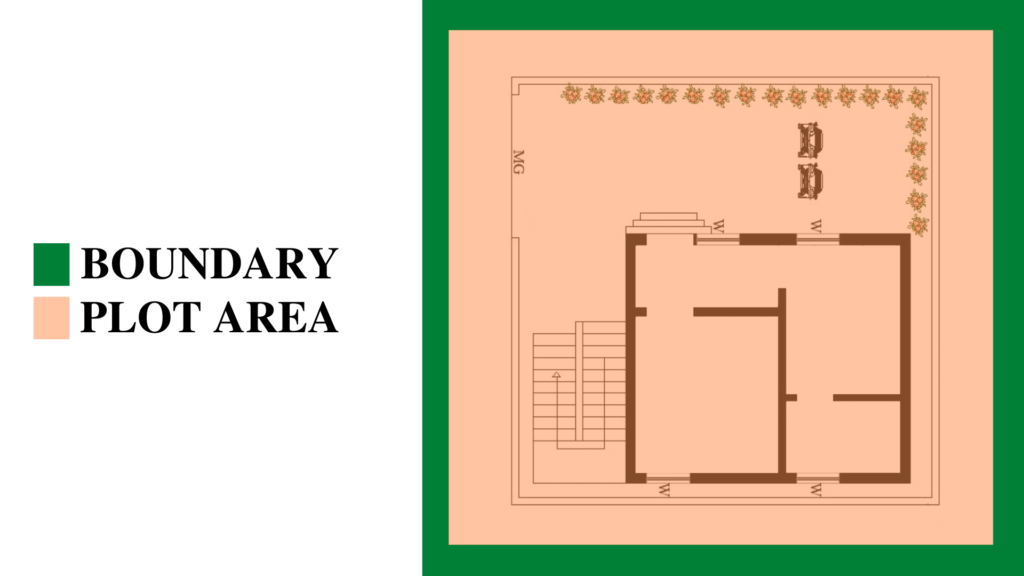
The plot area includes the complete area which you own. This area comes under the fencing.

Plot-area
Plot-area

Carpet area (Areas of building)

Real estate agents frequently use the term “carpet area,” which refers to the floor area of a building that can be covered with carpet. This area, also known as the net usable floor area, is crucial for determining the actual space available for use in a property.

Carpet-area
Carpet-area

Carpet Area = Total floor area – Area of internal/external walls

But as per RERA Carpet area = Total Floor area – Area of external walls

According to RERA flats should be sold on the basis of carpet area. The carpet area as per RERA is the area of usable spaces such as bedrooms, kitchen, bathroom, toilet etc. It also includes an area covered by internal partition walls. It excludes areas such as Balcony, utility areas, external walls area, open terrace area, lift, lobby, staircase etc. Generally, carpet area is 70% of its built-up area. 

Built up area

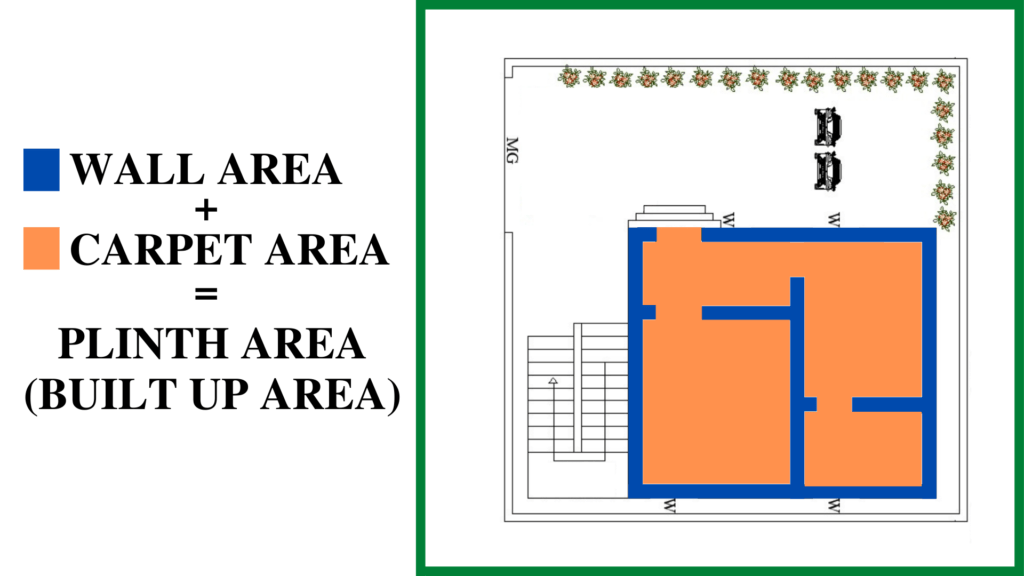
The plinth area is also known as the Built-up area. Basically, It is the total area of the building within the plot area. It is mostly 30% of the total plot area. 
Plinth-area
Plinth-area

Built-up Area = carpet area + Area of walls

It includes living room, bedrooms, utility, bathroom, wall thickness, kitchen, balcony closed staircases etc. and excludes open terrace area, lift, open staircase, swimming pool etc. It is 10 to 15 % more than the carpet area.

Built up area vs carpet area

Built-up area vs. carpet area are important terms in real estate that describe different aspects of a property’s space. Carpet area refers to the actual floor area inside the walls where you can place carpet or furniture. It includes rooms like bedrooms and kitchens but excludes areas like balconies and walls.

Built-up area, on the other hand, includes the carpet area plus the space taken up by walls and other building parts. This means it covers all enclosed spaces within the building, including walls, corridors, and partitions. Built-up area is typically larger than the carpet area by about 10% to 15% because it counts everything inside the building’s outer walls.

Knowing the difference between carpet area and built up area is important for homebuyers. Carpet area tells you exactly how much livable space you get, while built-up area gives you a broader view that includes all internal structures. This understanding helps buyers make informed decisions about the space they’re getting in a property.

Super built-up area

Super built-up area was used to measure the area of property before the RERA act came into existence. Because the super built-up area lowers the rate per square foot. Saleable area is another name of super built-up area.

Super built up area

Super Built-Up Area = Setback area+Built-up Area+20% of common area 

Super built-up area includes common areas like swimming pool, clubhouses, lobby, staircase, Lift, etc. and the built-up area of the flat. 

Set back area

Set back area is the space between the boundary and the building. It is the minimum open space necessary around the building. As per the municipal regulation a specific margin should be provided between building and road. 

Setback-area
Setback-area

Setback area = Built-up Area – Plot area

This provides sufficient ventilation, ease in vehicle movement and protection from other entities

Key Takeaways:

Understanding the differences between carpet area, built-up area, and other terms like super built-up area is crucial when buying a property. Carpet area specifically denotes the usable floor space inside the walls, while built-up area includes everything within those walls, including partitions and corridors. RERA guidelines emphasize selling flats based on carpet area, ensuring transparency and fair pricing. Super built-up area, now less common due to RERA, includes common areas like lobbies and lifts, affecting overall cost calculations. Setback area refers to the open space required around a building, ensuring adequate ventilation and safety margins.

Conclusion:

  • Carpet Area:
    • The space inside walls where you can put furniture.
    • It’s the actual usable living area.
  • Built-Up Area:
    • Includes carpet area plus walls, corridors, and partitions.
    • Shows the total enclosed space.
  • Budgeting Help:
    • Knowing these differences helps plan finances better.
    • Avoids confusion about what’s included.
  • Setback Area Compliance:
    • Ensures legal safety and ventilation around buildings.
    • Specifies required open space around a building.
  • Confident Property Decisions:
    • Understanding these terms guides smart property choices.
    • Aligns with fair standards like those set by RERA.
    • Ensures buyers get the best value for their investment.

What is a Plinth beam? Plinth beam height and size

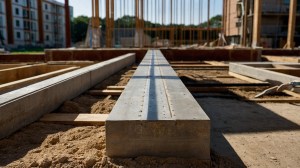
What is a plinth beam in construction? Plinth beams are horizontal structural elements that are built at the plinth level. It is the first beam built after the foundation has been completed. Furthermore, the plinth beam is an important component in a building because it serves as a foundation for brickwork as well as a moisture barrier, preventing moisture from entering the superstructure walls. The height of the plinth beam is typically 200mm to 450mm. It can be both reinforced and unreinforced.

The most important components of a building are the substructure and superstructure. The substructure is the part of the building that is below ground level, while the superstructure is the part of the building that is above ground level. The plinth level separates the substructure from the superstructure. The plinth beam follows the foundation’s construction. This article discusses what a plinth beam is, as well as plinth level, plinth beam size, and plinth beam height.

  1. What is a plinth?
  2. What is a plinth beam?
  3. Plinth beam in construction – Functions and advantages
  4. Size of plinth beam
  5. Plinth beam reinforcement
  6. Plinth beam construction

What is a plinth?

The plinth is the structural stratum that separates the superstructure and substructure of a building. All structures must have a ground floor that is 45 to 60 centimetres higher than the surrounding ground. This will prevent rainwater, dirt, and dust from entering the building. Because of this, the outer dimensions of a pedestal constructed first are slightly larger than those of the ground floor. That is referred to as the Plinth. A level or base known as a plinth is used to support superstructure walls, columns, and other structures. The plinth’s function is to distribute pressure and load evenly across a surface.

Related posts from vincivilworld

What is a plinth beam?

A plinth beam, as the name implies, is a beam at the plinth level. It is a particular kind of beam that is situated at the bottom of a framed structure. Because it holds the columns in place, it is also referred to as a Tie Beam. A horizontal structural component that joins the columns at the plinth level of the building is called a plinth beam. It is constructed above the top of the plinth level in load-bearing walls to aid in uniform load distribution and building settlement. Plinth beams reduce the length and slenderness ratio of a column. These beams are installed to prevent foundation cracks from spreading into the structure.

The plinth beam is located at 1.5 to 2 ft above Ground Level
Plinth Beam

Plinth beams are installed to stop cracks from the foundation from spreading into the wall above when the foundation settles. Plinth beams distribute the load of the wall evenly over the foundation.

Plinth beam in construction – Functions and advantages

Following are the functions and advantages of plinth beams

  • To prevent the development of cracks from the foundation to the walls
  • For distributing loads uniformly from columns to the foundations via superstructure.
  • Prevention of differential settlement
  • To prevent the entry of dampness in the structure. 
  • For avoiding the collapse of building due to earthquakes. It is crucial to provide plinth beams in earthquake-prone areas.
  • For providing support for walls
  • To reduce the effective length of columns. 
  • Prevention of column buckling
  • To withstand lateral forces. 
  • It saves buildings by preventing differential settlement which is caused by the partial failure of substructure or by the failure of soil on which buildings are constructed.
  • It provides uniformity to buildings at the plinth level.
  • The best application of a plinth beam is to withstand outside actions such as water, tree roots, and termites which could affect the life of the plinth.

Size of plinth beam

The plinth beams are designed in accordance with IS 132920-2016. According to the IS Code, the minimum width of the plinth beam cannot be less than 250mm. The depth should be not more than 1/4 of the clear span and not less than 200mm depth. In addition, the span to overall depth should be between 15 and 18. The concrete strength of the plinth beams shall not be less than 200Mpa.

Plinth Beam
Plinth beam

Plinth beam reinforcement

At the bottom of the beam, two bars with a minimum diameter of 12mm are recommended. Similarly, two bars with a minimum diameter of 10mm must be provided at the top of the plinth beams. A 25mm concrete cover should be used to protect reinforcement bars. The stirrup diameter should be at least 6mm, with a 15cm spacing.

Plinth beam construction

1) Determining the mark-up width First, the plinth level is marked. Plinth beams are usually half the width of the foundation. The skeleton is prepared after marking the width of the plinth. The beam reinforcement must then be completed prior to shuttering.

2) Formwork Installation The next step is to put up formwork. Steel, wood, or plastic must be used for formwork. By levelling the ground, you can fix the formwork properly.

3) Concrete pouring Before pouring concrete, make sure the shuttering is dry and all the joints are tight.

4) Pouring of the concrete

Before pouring concrete, ensure the shuttering is dry and all the joints are tight. Pour the concrete evenly. 

5) Curing of the Concrete

After the concrete is dried, It is cured for at least 7 to 14 days for attaining good strength and durability

5) Removal of Formwork

After curing Once the concrete is set, remove the formwork. 

A Comprehensive Guide To Construction Drawings For Your Building

The Construction drawings for a house are the most important document in home-building. It contains instructions on how to construct your new house or add-on, which contractors to hire, and how they should do their job.

A blueprint is an overview of the entire construction project photographed from above. It means that all of the construction drawings for your building will be contained within a single blueprint sheet, making it easy to follow along with what’s happening during various stages of construction. A blueprint sheet will have a lot of information.

Each scale drawing has a title, starting with the plan, the number, and name of the architect, scale measurements, and legal description of the property. You will also see different scale drawings.

Different Types Of Assembly Drawings

There are many types of assembly drawings. They include foundation, tanking and foundation cut-always, crawl space and slab information, parapet wall, and roof details. Foundation drawings are required for new construction, additions, and modifications to existing structures. It shows all the walls, floor supports, and footings used to support the house’s floors, structures, and external components.

1. Standard Assembly Drawings – 

These drawings are a set of drawings that show how to put the parts together. It establishes a basis for construction and design. The main elements are framing, sheets, lumber, blocking, and trim/molding materials.

Structural fabrication and erection

2. Outline Assembly Drawings –

A preliminary set of drawings establishes the general appearance of the work.

3. Detail Assembly Drawings – 

It provides more detail on construction details such as existing and proposed walls, ceilings, and other finishes.

4. Assembly Working Drawings – 

The drawings show the construction process and include foundation details of the framing, floors, cabinets, and stairs.

5. Tabular Drawings – 

It contains all the information needed to construct the project. They are usually kept in a text file or spreadsheet and give you information on the actual sizes, quantities, and room locations.

6. Diagram Drawings – 

Diagram drawings are simple drawings of a floor plan and elevation drawings that show how any given elements work to create the project’s design.

Also read: Areas of building | Built-up area | Carpet area | Super built-up area

Why Are Assembly Drawings Necessary?

All structural elements of the building must be drawn in detail, anticipating all expected loads on the structure. These details must also include all internal and external spaces within the new building, anticipate potential problems, and propose solutions.

Structural drawings are the blueprints of the construction sheets: they show all structure elements, including beams and columns, walls, and flooring. It is a series of symbols and lines that illustrate any load-bearing or non-load-bearing walls. Sustainable cities and constructions of the future require high-quality structural drawings.

What Are The Major Inclusions Of Assembly Drawings?

Building plans include a profile view of your house, including the side elevations or front and rear views. In addition, the plan sets out the orientation of your house, inside to outside. When reading a structural drawing, you need to understand that there are many different kinds of assemblies. However, there are three basic types of structurally significant assemblies: frame, floor, and roof.

  1. A-frame assembly comprises a top plate, bottom plate, and posts. The basic elements of an assembly are the post. These are angled beams that are attached to foundation walls, floors, or exterior walls.
  2. The landfills and roof beams are considered as frame assemblies. They include facets such as posts, beams, headers, and joists or wooden floorboards. The next assembly is a floor assembly. It is a structural system that supports the weight of all upper floors and roofs. 
  3. The roof assembly is the third major structural assembly. It consists of a top and bottom chord, common rafters, collar ties, or trusses.
Building construction drawing

The Importance Of Construction drawing In Designing A Building

  1. Scope of construction – 

Construction drawings are all about explaining and showing the finished product. The job is to document and view the construction process. That’s why structural engineers design the building, show their drawings, and then give their clients a set of construction drawings.

  1. Importance of construction drawing

The drawing is about the design and the assembly of everything working together for a living space, so you need to be able to tell more than one story. It deserves a lot of attention.

  1. Staff size – 

It is a big job, and they usually work with several people who help them draw the design and then give the construction drawings to the client.

  1. Provides information – 

It involves many people who have to provide a lot of information. This information should be precise and clear, as it is about planning for the future.

  1. Safety –

 It plays an important role in the design and construction process to ensure the safe construction of the building.

How To Produce A Construction Drawing 

There are many ways to make construction drawings. Today’s most common ways workers use photo plotting, CAD (Computer Assisted Drawing), and hand drafting. CAD is an advanced technology, and using it is quite easy. India CAD works enable you to make construction drawings with ease. You can create as many construction drawings as possible and share them with your clients. Many construction companies use it to execute their projects and make best-selling construction drawings for their clients. With CAD, you can create various drawings, from simple to complex. You can design and add any number of view layers and color them in any way you like.

Areas of building | Built-up area | Carpet area | Super built-up area

Reading the floor plan is an important skill that a civil engineer should possess. There are different types of areas in the floor plan of a building. In this article, we will see about the different types of areas.

Different types of areas in Building Construction

Before planning to purchase a home we should be familiar with the following areas adopted in building construction.

1. Plot area

2. Built-up area or Plinth area

3. Carpet area

4. Setback area

5. Super built-up area

Before getting into these terms first we have to know what is RERA 

Real Estate Regulation and Development Act, 2016, (RERA)

The Real Estate Regulation and Development Act, 2016, (RERA) is an act established by the Indian parliament. The main objective of RERA is to give prompt information between the buyers and sellers. This increases transparency and reduces the chance of cheating.

There are three different ways to calculate the area of the property. 

1. In terms of the Carpet area

2. In terms of Built-up area

3. In terms of Super built-up area

While buying a property buyer should pay for the area which is usable. RERA provides safety of money, buyer protection and balanced agreement.

Areas of building
AREAS OF BUILDING

Plot area (Areas of building)

The plot area includes the complete area which you own. This area comes under the fencing.

Plot-area
Plot-area

Carpet area (Areas of building)

Carpet area is a term which the real estate agent uses the most. It is the area of the building which can be covered by using carpet. It is also called a net usable floor area. 

Carpet Area = Total floor area – Area of internal/external walls

But as per RERA Carpet area = Total Floor area – Area of external walls

Carpet-area
Carpet-area

According to RERA flats should be sold on the basis of carpet area. The carpet area as per RERA is the area of usable spaces such as bedrooms, kitchen, bathroom, toilet etc. It also includes an area covered by internal partition walls. It excludes areas such as Balcony, utility areas, external walls area, open terrace area, lift, lobby, staircase etc. Mostly carpet area is 70% of its built-up area.

Plinth area

The plinth area is also known as the Built-up area. It is the total area of the building within the plot area. It is mostly 30% of the total plot area. 

Built-up Area = carpet area + Area of walls

Plinth-area
Plinth-area

It includes living room, bedrooms, utility, bathroom, wall thickness, kitchen, balcony closed staircases etc. and excludes open terrace area, lift, open staircase, swimming pool etc. It is 10 to 15 % more than the carpet area.

Super built-up area

Super built-up area was used to measure the area of property before the RERA act came into existence. Because the super built-up area lowers the rate per square foot. Saleable area is another name of super built-up area.

Super Built-Up Area = Setback area + Built-up Area+20% of common area 

Super built-up area includes common areas like swimming pool, clubhouses, lobby, staircase, Lift, etc. and the built-up area of the flat.

Set back area

Set back area is the space between the boundary and the building. It is the minimum open space necessary around the building. As per the municipal regulation a specific margin should be provided between building and road. 

Setback-area
Setback-area

Setback area = Built-up Area – Plot area

This provides sufficient ventilation, ease in vehicle movement and protection from other entities.

Monolith- The Technology, Merits and Demerits Full Guide

Monolith is a well-known concept in the world. The technology is used to construct high-rise buildings and skyscrapers. The monolithic structure can withstand high loads (up to 8 points) without being broken, which makes it a suitable candidate to be used in seismic zones.

Let’s look at what monolithic houses are, their benefits and drawbacks, and the construction process.

The Technology of Monolith building

Monolith
Monolith

The technology’s essence lies in pouring reinforced concrete sections of a monolithic house during erection. Since there is no load on this part of the wall, any sound (brick, block, sheet) or low-strength material (wood, PVC panel with insulation, glass) may be used to fill the gaps between slabs.

In this technology a few variants of the frame are used:

Steel rods of various diameters are used to make the reinforcement cage for a monolithic building. Many of the frame’s components are welded or bound together. However, since it takes more time and effort, the last bonding technique is rarely used.

Formwork construction

Circular or stay-in-place formwork is used for this housing. A framework structure is a large sound panel (panel formwork) or prefabricated pouring form (tunnel formwork) that prevents the concrete mixture from flowing and allows the shape to be saved during the setting time.

There are various types of formwork construction in use:

  • Horizontal
  • Vertical
  • Creeping
  • For rounded elements

In apartment buildings, monolithic houses with stay-in-place formwork are more popular. There are single-story monolithic cottages.

Concrete mixture and grouting

Concrete mixtures may be manufactured immediately on the building ground in a mixing batch or a special concrete goods plant, depending on the monolithic construction scale. In the second case, concrete is transferred to the moto mixer.

Works with setting concrete

The concrete is densified after it has been filled into a formwork. This phase is required to remove airlocks, which impede the mixture’s efficiency. The per vibrator or external vibrator is used to densify the concrete mixture. The smoothness of the surface of the walls and ceiling is influenced by the consistency of the densification of the concrete mixture, which in turn affects the fine finish budget.

Form stripping

After the concrete has reached the required strength, the formwork is removed and passed on to the next stage of grouting.

Merits and Demerits of Monolith Building

Monolith Building
Monolith Building

Monolithic houses have both benefits and drawbacks. Let’s make a distinction between them.

One of the prime benefits would be the speed of construction. Monolithic buildings, which are similar to brick houses in design, are constructed faster than the previous ones. Equality of design is also a compelling point.

The majority of houses are constructed in a specific pattern that is characterized by their constructional peculiarities. A monolithic building, on the other hand, has no bounds. Plans for such houses can be varied, multilevel, and have ceilings of varying heights, which is not typical of block or brick houses.

The complete absence of open joints in a monolithic house has a range of benefits, including:

  • Increase in sound isolation level
  • Thermal insulation improvement
  • Extension of house life
  • Increase in strength
  • Protection from cracking
  • Lowering of construction weight

You should pay attention to its disadvantages also Monolithic structures permit the easy propagation of sound and vibrations making soundproofing of the rooms a difficult task. Also, it demands a large amount of finishing work.