Category Archives: CONCRETE

Reinforced cement concrete is a topic you will need to familiarize at some point, if you are into civil engineering field. The category explicitly presents it. Reinforced cement concrete (RCC), a composite material has been accepted worldwide as a construction material, bridges, retaining walls, docks and harbour, airfield pavements, flyovers,multi-storey building,complexes and simple houses etc., Concrete is good in resisting compression but is very weak in resisting tension. Hence reinforcement is provided in the concrete wherever tensile stress is expected. The best reinforcement is steel since the tensile strength of steel is quite high and the bond between steel and concrete is good. As the elastic modulus of steel is high, for the same extension the force resisted by steel is high compared to concrete. However in tensile zone, hair cracks in concrete are unavoidable. Reinforcements are usually in the form of mild steel or ribbed steel bars of 6 mm to 32 mm diameter. A cage of reinforcements is prepared as per the design requirements, kept in a formwork and then green concrete is poured. After the concrete hardens, the formwork is removed. The composite material of steel and concrete now called R.C.C. acts as a structural member and can resist tensile as well as compressive stresses very well. Aggregates are the inert or chemically inactive materials which form the bulk of cement concrete. These aggregates are bound together by means of a cement. They can be classified into two. The selection of aggregate is based on the purpose and its maximum size.

Rebound hammer test on Concrete structures

ebound Hammer Test for Concrete is one of the most widely used non-destructive tests to evaluate in-place concrete strength. Also known as the Schmidt Hammer Test, it helps engineers quickly assess concrete surface hardness without damaging the structure. This test measures the rebound number when a spring-controlled hammer impacts the concrete surface, providing valuable insight into its compressive strength. The Rebound Hammer Test procedure is simple, fast, and highly suitable for quality control at construction sites. It is commonly used in buildings, bridges, and existing structures where core extraction is difficult or not recommended. Along with evaluating strength, the method helps identify weaker concrete zones and ensures uniformity. Due to its practical benefits, many professionals prefer this technique while comparing concrete hardness test methods. Understanding the advantages of Rebound Hammer Test ensures accurate decision-making in structural assessment and maintenance.

Rebound hammer test is one of the most popular and simple non-destructive concrete tests. The Non-destructive test is the process of detection of defects in concrete without its destruction. The determination of concrete quality is necessary for both fresh concrete and hardened concrete. The rebound hammer test is the common test for determining quality for existing structures.

  1. Rebound/Schmidt hammer test definition and significance
    1. Significance
    2. Relevant Codes 
  2. Objectives of Rebound hammer test
  3. Rebound hammer test procedure – Standard method
    1. Procedure – Step-by-Step
  4. Correlation between compressive strength of concrete and rebound index.
  5. Result Calculation of Rebound Hammer tests
  6. Concrete quality and rebound test values
  7. Advantages of rebound hammer test
  8. Conclusion

Rebound/Schmidt hammer test definition and significance

The Rebound Hammer Test for Concrete is a widely used non-destructive test for concrete strength. It evaluates surface hardness and provides an estimate of compressive strength. This is done without damaging the structure. In this Schmidt Hammer Test, a spring-controlled hammer impacts the concrete surface, and the rebound value indicates the concrete’s hardness. This concrete hardness test method is quick, simple, and ideal for assessing uniformity and quality in existing structures. The rebound hammer test procedure helps identify weak zones, monitor deterioration, and ensure proper maintenance. The advantages of rebound hammer test make it essential for preliminary and on-site concrete assessment.

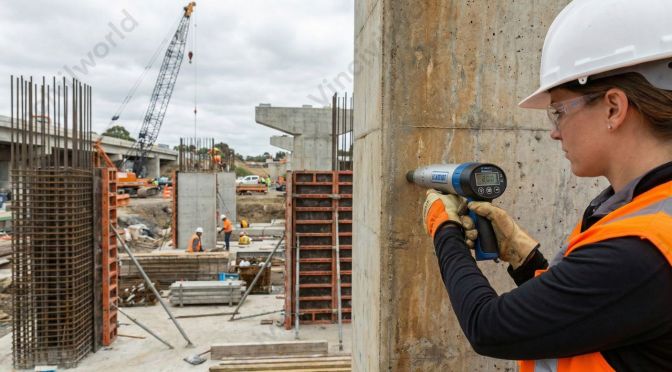
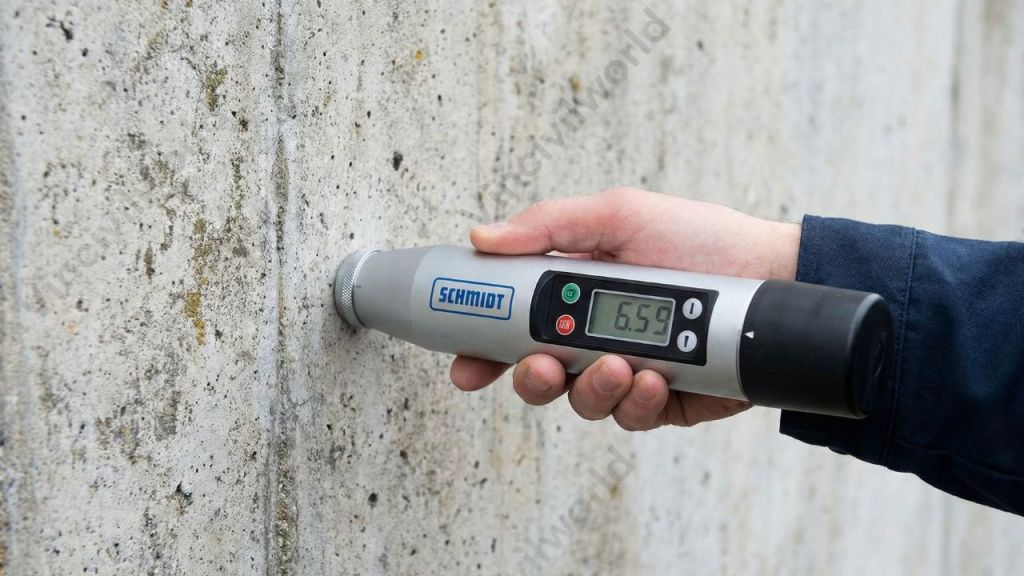
A person conducting a Schmidt Hammer Test on a concrete surface, showing the rebound measurement displayed on the device.
A Schmidt hammer being used to perform a Rebound Hammer Test on concrete, measuring surface hardness to estimate compressive strength.

Significance

  • Estimates in-place compressive strength of concrete
  • Checks surface hardness and material uniformity
  • Identifies weak zones or deteriorated areas
  • Helps compare different structural members
  • Quick, cost-effective, and non-destructive field evaluation

Relevant Codes 

Country / RegionStandard CodeTitle / Description
India 🇮🇳IS 13311 (Part 2): 1992Non-destructive testing of concrete – Rebound Hammer
USA 🇺🇸ASTM C805 / C805MStandard Test Method for Rebound Number of Hardened Concrete
Europe 🇪🇺EN 12504-2: 2021Testing concrete in structures – Part 2: Non-destructive testing – Rebound Hammer
International 🌍BS 1881: Part 202: 1986Testing Concrete – Recommendations for Rebound Hammer Test
International 🌍ACI 228.1RIn-place Methods to Estimate Concrete Strength (includes rebound hammer guidance)

Objectives of Rebound hammer test

The main objectives of the Rebound hammer test include

  • This determines the compressive strength of the concrete in terms of the rebound index.
  • Also finds the uniformity of concrete.
  • evaluates the concrete quality with standard requirements.

Rebound hammer test procedure – Standard method

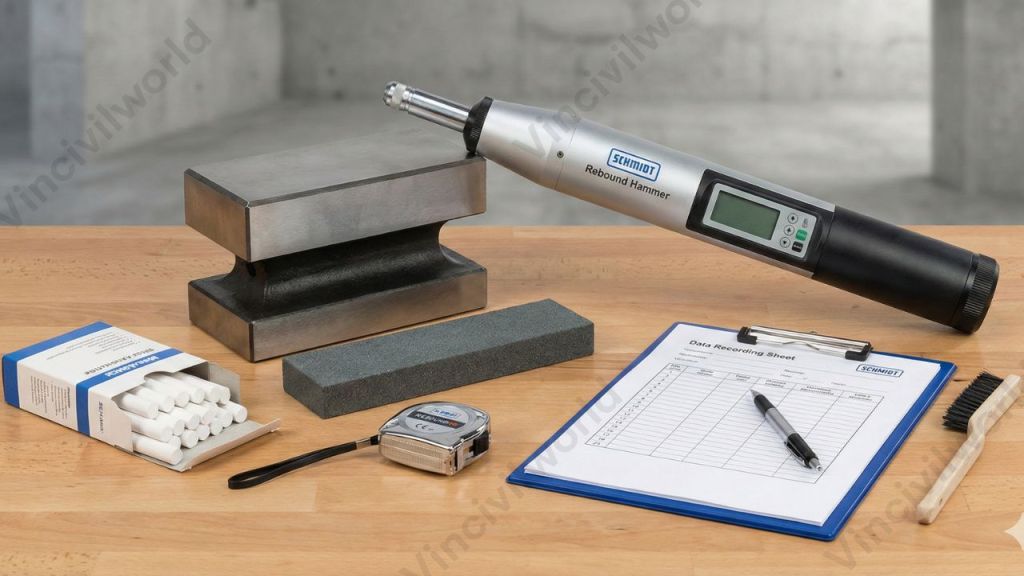
A Schmidt rebound hammer positioned near a concrete block, surrounded by a data recording sheet, measuring tape, and a set of reference materials for conducting the rebound hammer test for concrete strength.
The Schmidt Rebound Hammer, an essential tool for assessing concrete strength through non-destructive testing, displayed alongside testing materials.

The Rebound Hammer Test for Concrete is a widely used non-destructive test for concrete strength. It measures the surface hardness of hardened concrete to quickly estimate compressive strength using a Schmidt hammer. This test is simple, cost-effective, and provides immediate results on-site. It is an essential method in quality control to check concrete uniformity, detect weak zones, and evaluate structures without causing damage. While the rebound hammer test procedure ensures quick assessment, results must be correlated with laboratory-tested samples for accuracy.

Procedure – Step-by-Step

  • Select the test area – Smooth, clean, and free from loose particles or surface defects.
  • Hold the rebound hammer firmly and position it perpendicular to the test surface.
  • Press the plunger against the concrete until the hammer triggers a rebound.
  • Record the rebound number displayed on the scale.
  • Perform at least 10 readings on one point and discard abnormal outliers.
  • Take the average rebound number for that test location.
  • Apply correction factors (surface condition, carbonation, direction of testing).
  • Use a correlation chart to estimate compressive strength of concrete.

The correlation between the concrete strength and the rebound hammer shown in a graph is called the rebound hammer graph. 

According to IS 13311 (Part 2): 1992, the rebound hammer test requires specific calibration, correction factors, and surface conditions. These elements are necessary to ensure accurate results in Indian construction environments. IS also recommends correlating rebound numbers with compressive strength. The correlation should consider concrete grade, age, and surface hardness. This approach helps minimize interpretation errors.

Correlation between compressive strength of concrete and rebound index.

It is essential to calibrate the rebound hammer before testing. For this, we test a specimen of 150mm * 150mm * 150mm size using a compression testing machine (CTM). Fix the load rate at 7N/mm2, when the hammer result is 2.2 Nm. Test the vertical surface of the specimen using a rebound hammer. The results from the CMT and the rebound hammer should not have a major difference.

Result Calculation of Rebound Hammer tests

The Rebound Hammer Test for Concrete measures surface hardness and estimates compressive strength without damaging the structure. The rebound number directly reflects the elasticity of concrete—higher numbers indicate harder and stronger concrete. To calculate results accurately, we take several rebound readings on a smooth, clean surface, remove extreme values, and determine an average. This average rebound number is then compared with calibration charts. The charts are provided by the hammer manufacturer or relevant standards (IS 13311 Part 2:1992). This helps to determine the estimated compressive strength of concrete at the test location.

The rebound number assess the strength of the structure. As the rebound number increases, the strength also increases. This depends on the 

  • Cement type
  • Aggregate type
  • Surface condition
  • Age of concrete
  • Moisture content, etc.
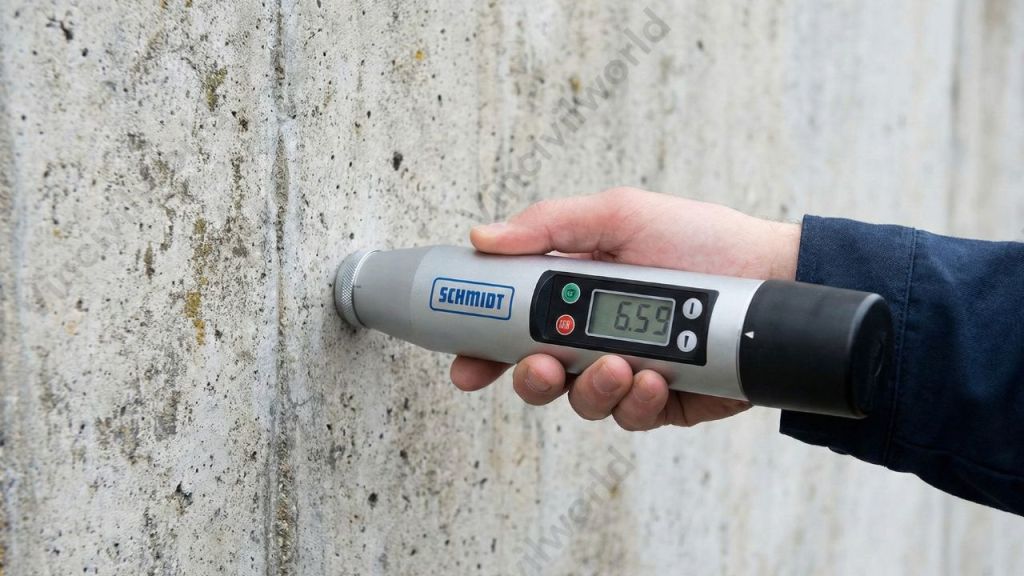
A construction worker using a Schmidt hammer to perform a rebound test on a concrete surface, displaying the rebound number on the device.
A construction professional using a Schmidt hammer to conduct a Rebound Hammer Test on concrete, assessing its surface hardness and strength.

The quality of concrete concerning the rebound concrete is as follows.

Concrete quality and rebound test values

Thus the rebound number predicts the quality of concrete. The rebound hammer apparatus is very easy to use. Also, it determines the uniformity of the concrete surface. Thus it can be used for the rehabilitation of old monuments. It produces a convenient indication of compressive strength

Rebound Number RangeEstimated Concrete QualityInterpretation Notes
≤ 20Poor / Very Weak ConcretePossible deterioration, low strength; further testing required
20 – 30Fair / Medium Quality ConcreteAcceptable for non-structural sections; verify structural safety using core tests
30 – 40Good Quality ConcreteSuitable for reinforced concrete structural elements
> 40Very Good / Hard ConcreteHigh strength concrete; ensure carbonation effects are considered

Advantages of rebound hammer test

The Rebound Hammer Test is one of the simplest and fastest non destructive tests for concrete strength. It allows engineers to quickly assess the surface hardness and uniformity of concrete without damaging the structure.

Key Advantages of Rebound/Schmidt Hammer Test

  • Quick and easy testing with instant results
  • Completely non-destructive, keeping the structure intact
  • Portable and ideal for on-site assessment
  • Helps identify weak or deteriorated concrete areas
  • Cost-effective compared to laboratory strength tests
  • Useful for quality control and comparative analysis
  • Can be used on both old and new concrete structures
  • Requires only a single operator and minimal training
  • Helps decide if further detailed testing (e.g., core cutting or UPV) is needed
  • Provides data for concrete hardness evaluation and uniformity checks

Key Takeaways

  • The Rebound hammer test for concrete is a widely used non-destructive method to assess concrete strength and surface hardness.
  • It involves a spring-controlled hammer that impacts the concrete, measuring the rebound number to estimate compressive strength.
  • This test is quick, cost-effective, and essential for quality control, helping identify weak zones and ensuring uniformity in structures.
  • Professionals appreciate the test for its practical advantages, including its portability and immediate results on-site.
  • Applicable codes include IS 13311 (Part 2) in India and ASTM C805 in the USA, ensuring standard practices across regions.

Conclusion

The Rebound Hammer Test for concrete is a widely used non destructive test for concrete strength. It helps engineers quickly check surface hardness and uniformity without damaging the structure. As one of the simplest concrete hardness test methods, it supports quality control. It is also used for preliminary assessment and condition monitoring of existing buildings. Rebound values alone do not determine exact compressive strength. They provide valuable onsite insights when combined with other techniques such as UPV or core strength tests. By following the correct rebound hammer test procedure and calibration guidelines, engineers can improve reliability and decision-making. The Schmidt Hammer Test offers a fast, economical, and practical way to evaluate concrete. It enhances durability, safety, and maintenance planning in modern construction projects.

Non Destructive test (NDT)- Hardened Concrete

Non destructive testing of hardened concrete plays a vital role in assessing the condition of concrete structures. It evaluates performance without causing damage. Engineers use non destructive test for concrete structures to evaluate strength, durability, and uniformity while the structure remains fully functional. These NDT methods for concrete evaluation help detect cracks, voids, honeycombs, and other hidden defects that may affect long-term performance. Professionals can estimate compressive strength by using advanced hardened concrete testing techniques. They can identify deterioration and also monitor the health of aging infrastructure. Modern tools like rebound hammer and ultrasonic pulse velocity make concrete strength testing faster. They support the process without causing damage and are more cost-efficient. The key advantages of NDT in concrete testing include safety, accuracy, rapid inspections, and extended service life of structures. Overall, NDT ensures reliable decision-making for repairs, rehabilitation, and quality control in construction.
Non-destructive test (NDT) and destructive tests (DT) are the the tests done one hardened concrete. Concrete is the oldest and most important construction material in the world. Testing of the concrete plays and important role to know about the strength, durability and condition of the structure. This article is about the types of Destructive and non destructive tests done on concrete.

  1. Types and significance of Concrete Tests
    1. Destructive Tests
    2. Non Destructive Tests (NDT)
  2. Non- Destructive testing techniques on hardened concrete
  3. Objectives/advantages of Non destructive testing (NDT)
  4. Classification of Non-Destructive test
    1. Penetration Resistance Test / Windsor Probe Test
    2. Rebound Hammer Test
    3. Ultrasonic Pulse Velocity Test
    4. Half-Cell Potential Test – Detecting Corrosion
    5. Covermeter / Rebar Locator Test – Locating Reinforcement Without Damage
    6. Impact Echo Test – Evaluating Internal Defects in Concrete
  5. Conclusion

Types and significance of Concrete Tests

Concrete testing plays a vital role in determining the strength, durability, and performance of concrete structures. Engineers conduct different tests to verify that the concrete mix meets design requirements and performs safely throughout its service life. These types of concrete tests help assess important properties such as workability, compressive strength, density, and internal defects. The tests are categorized into destructive tests and non destructive tests, depending on whether the specimen is damaged during inspection. Both testing methods are essential for ensuring quality control, structural integrity, and long-term durability of concrete in construction projects. By using the right concrete testing techniques, engineers can make reliable decisions in design, repair, and maintenance works.
Concrete tests are classified into two types

  • Destructive tests (DT)
  • Non – Destructive tests (NDT)

Destructive Tests

  • Compressive Strength Test
  • Flexural Strength Test
  • Split Tensile Strength Test
  • Pull-out Test
  • Core Cutting and Testing

Non Destructive Tests (NDT)

  • Impact Echo / Pulse Echo Test
  • Rebound Hammer Test
  • Ultrasonic Pulse Velocity (UPV) Test
  • Half-Cell Potential Method
  • Ground Penetrating Radar (GPR)
  • Cover Meter Survey
  • Schmidt Hammer Test

In this article we describes about the Non destructive testing techniques conducted on hardened concrete.

Non- Destructive testing techniques on hardened concrete

The standard method of non destructive testing of hardened concrete is carried out by testing concrete specimens. These specimens are cast simultaneously with structural concrete. These destructive tests on concrete can determine the compressive, flexural, and tensile strengths. The major disadvantage of these destructive concrete testing methods is the non availability of immediate results. Moreover, the properties of the concrete specimen differ from what it is in the actual structure. This difference is due to pouring conditions, curing factor, compaction and concrete density, etc. These tests come under the category of destructive tests (DT). Destructive testing of concrete destroys or changes the part. Even if it passes the test, the part is no longer fit for service.

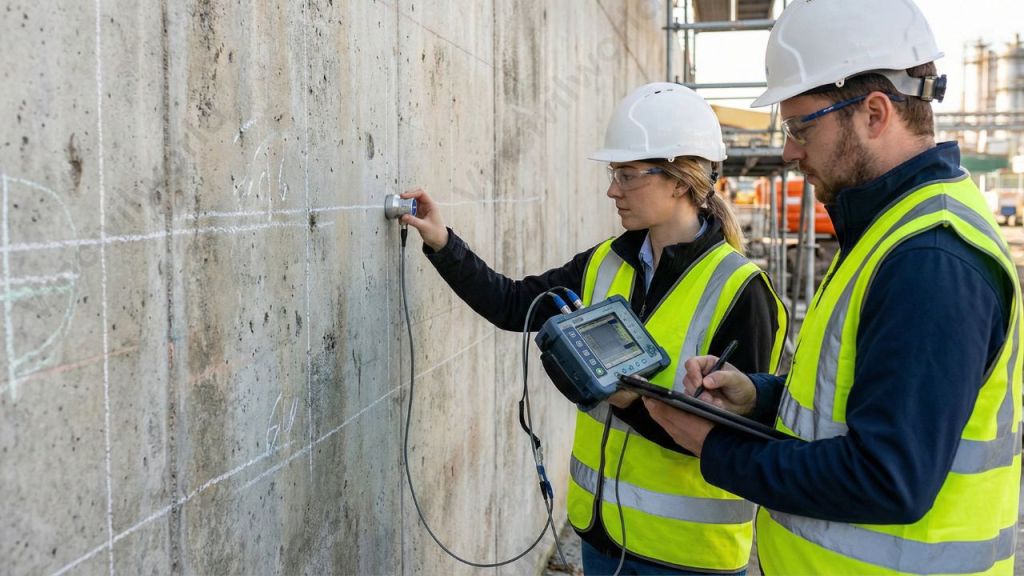
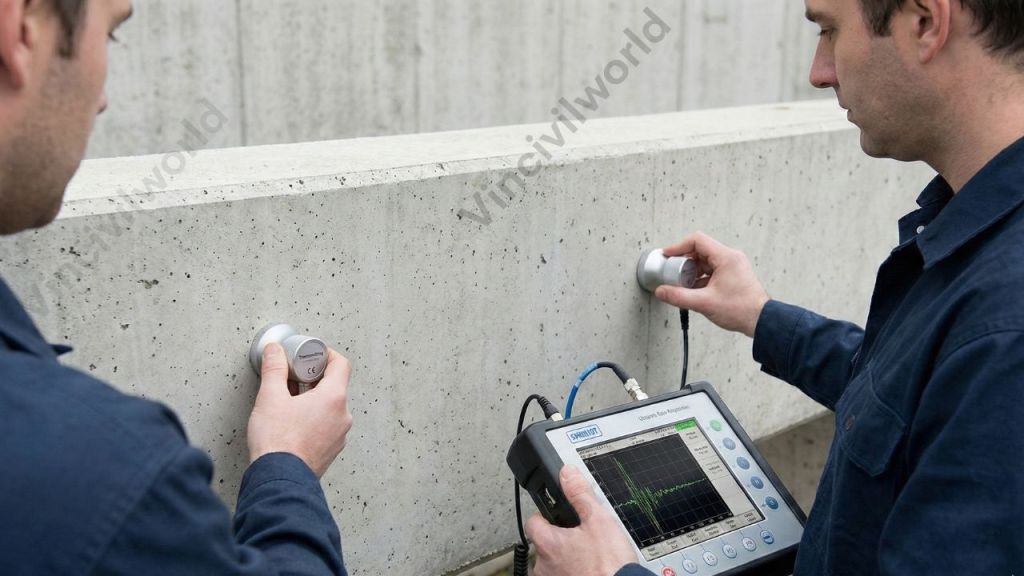
Two engineers conducting non-destructive testing on a concrete wall using specialized equipment.
Engineers conducting non-destructive testing on hardened concrete to assess its strength and durability.

Non Destructive Test (NDT) is for determining compressive strength and other properties of concrete from existing structures or buildings. NDT testing of concrete does not destroy the part. It does not change the part so that it is still fit for service if it passes the test. The non-destructive test determines the properties of concrete or structures without their destruction. Moreover, we can study its changes over time, The measurements are repeated many times and validate in detail, and gets immediate results. These NDT concrete testing methods help assess quality, strength, and durability in a quick and reliable way.

Objectives/advantages of Non destructive testing (NDT)

Non-destructive testing (NDT) helps evaluate hardened concrete structures without causing damage. It allows engineers to assess concrete strength and durability. They can also evaluate reinforcement condition, cracks, and internal defects. All of these are assessed while the structure remains fit for service. The advantages of NDT include quick results, safety, cost-effectiveness, and the ability to monitor structures throughout their life cycle. These advantages of NDT make it widely preferred for quality assurance and structural health monitoring.

  • Quality check of the existing structure.
  • For determining the homogeneity, internal and external characteristics of the concrete. 
  • To detect the cracks and voids of the concrete structures. 
  • Assess the quality of concrete with the standard requirement. 
  • To study the ageing of concrete. 
  • For finding the compressive strength of structures.
  • Evaluation of elastic modulus

Classification of Non-Destructive test

Hardened Concrete testing techniques/ Non Destructive testing are as follows

  • Windsor Probe Test
  • Rebound Hammer Test
  • Ultrasonic Pulse Velocity (UPV)
  • Half-Cell Potential Test
  • Covermeter / Rebar Locator Test
  • Impact Echo Test

Penetration Resistance Test / Windsor Probe Test

The penetration resistance test is an NDT that determines the relative strength of the concrete structures. The Windsor probe is the equipment for conducting this test. This equipment includes of powder-actuates driver or gun, probes, loaded cartridges and a gauge that measures the penetration.

The penetration depth indicates the compressive strength of the concrete. However, this depends on the aggregate type and size. This test evaluates the poor quality and deterioration of concrete

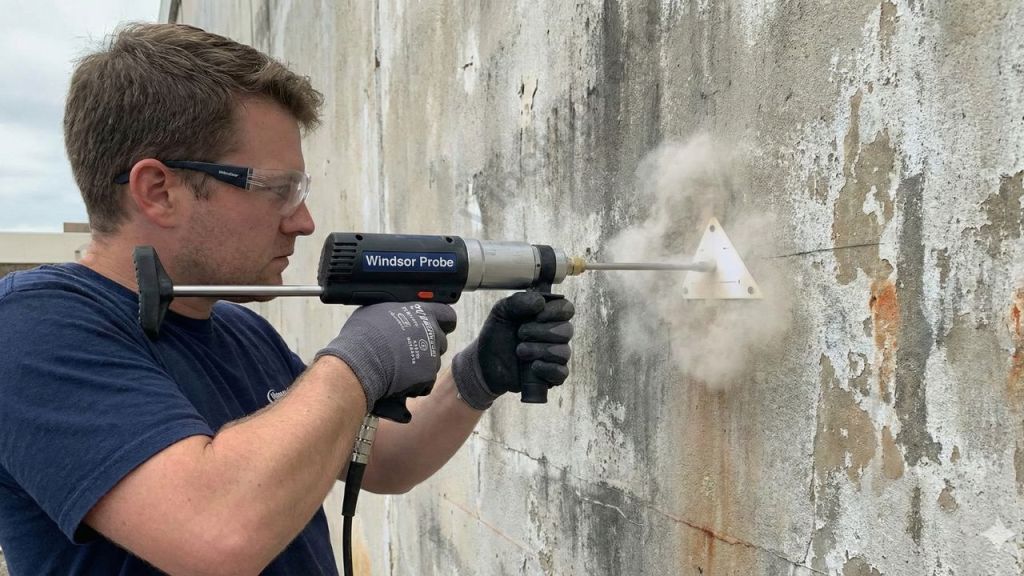
A professional using a Windsor Probe device to conduct non-destructive testing on a concrete wall, assessing its strength and quality without causing damage.
An engineer using a Windsor Probe for penetration resistance testing on hardened concrete.

The major disadvantage of this test is getting variable results. Several probes are often shot to achieve a solid average depth for arriving a final conclusion. So we cannot determine the exact strength. But it is a quick method to evaluate the quality and maturity of concrete. Care should be taken to calibrate the instrument before taking readings.

Rebound Hammer Test

The rebound hammer is also known as Schmidt’s Hammer test. It determines the strength of concrete based on the hardness of the concrete surface. It is a surface hardness tester. The equipment consists of a spring-controlled plunger, a hammer that weighs 1.8 kg, and a graduated scale. By pressing the hammer on the concrete surface, the graduate scale measures the rebound number. A low rebound number means the concrete has low compressive strength and stiffness.

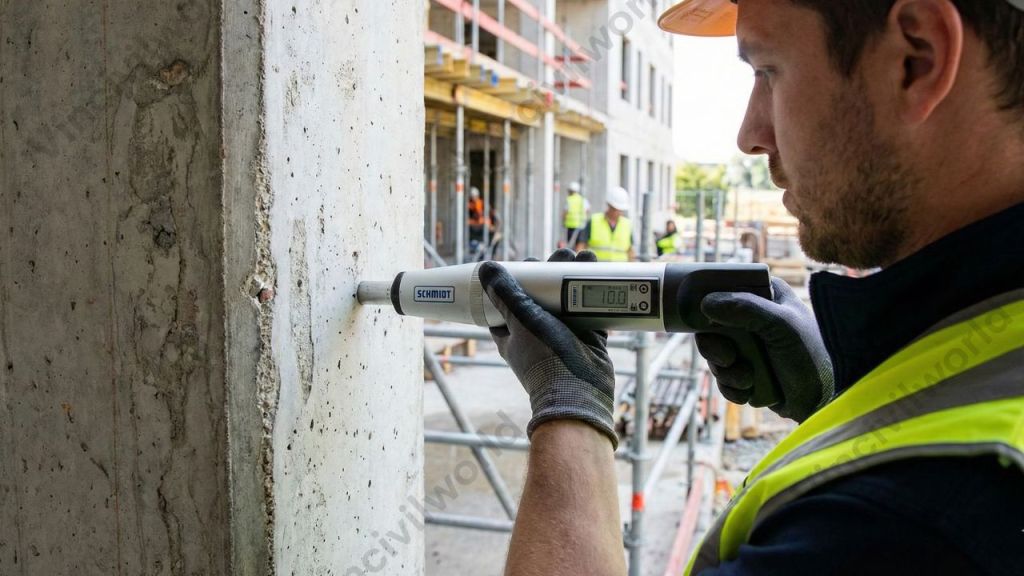
A person using a rebound hammer test device on a concrete wall to measure its surface hardness and estimate compressive strength.
A technician conducting the Rebound Hammer Test on concrete to assess compressive strength without causing damage.

An accuracy of 15 to 20% is possible through this test. It is a simple and quick method. Also, the result relies on the surface smoothness, water content, type and size of aggregate and carbonation of the surface.

Ultrasonic Pulse Velocity Test

Ultrasonic pulse velocity test is another type of Non-destructive test. This test measures the time of travel of ultrasonic pulse waves for evaluating the concrete quality. The UPV test units consists of a pulse generator and pulse receiver. The frequency of the wave is 50-55 kHz. The pulse generator produces the pulses and is allowed to pass through the concrete. Then we calculate the velocity, by measuring the traversing distance and the time. Higher velocity means the concrete has a higher elastic modulus and density. It also determines the cracks and flaws in the structure. Large differences in pulse velocity values indicates a defective and deteriorated concrete.

Two engineers conducting non-destructive testing on a concrete structure using specialized equipment.
Engineers conducting an Ultrasonic Pulse Velocity test on concrete to assess its quality and detect any hidden defects.

For more details : Ultrasonic pulse velocity test || UPV Test – Methods and procedure

Half-Cell Potential Test – Detecting Corrosion

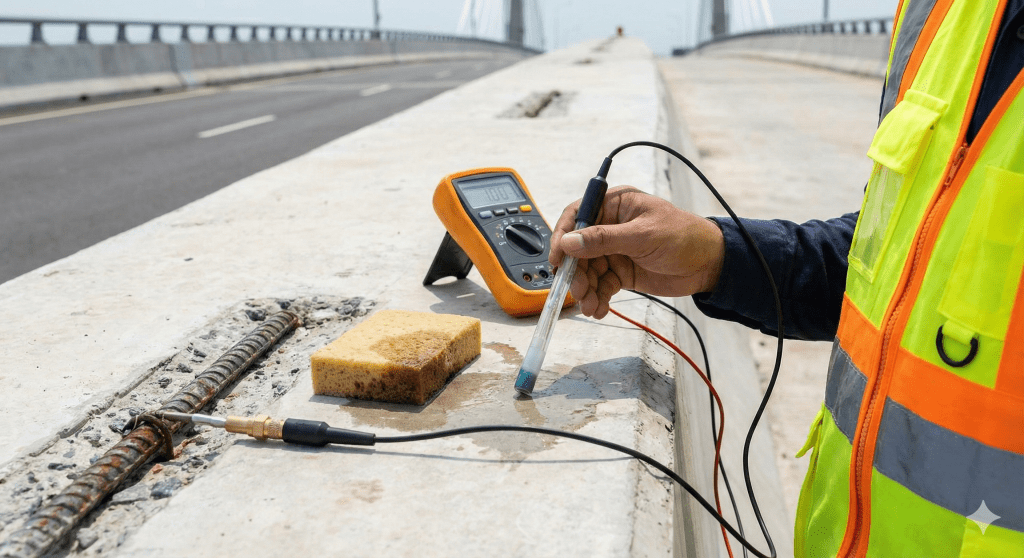
The Half-Cell Potential Test is a widely used non-destructive testing (NDT) method. It evaluates corrosion activity in steel reinforcement within hardened concrete. It measures the electrical potential difference between embedded rebars and a reference electrode. This reference electrode is typically a copper / copper sulfate (Cu/CuSO₄) cell. The test helps determine whether the reinforcement is actively corroding, passive, or at risk. An electrical connection directly connects to the rebar. Surface readings are recorded in a grid on moist concrete to ensure good conductivity. These readings are compared with standard probability charts provided in ASTM C876. The results allow engineers to locate corroded zones, plan preventive repairs, and avoid unnecessary concrete removal. Overall, it is a quick, reliable, and cost-effective tool for structural health assessment and durability maintenance of concrete structures.
A construction professional conducting non-destructive testing on a concrete structure using a measuring device, with a sponge for conductivity, to assess the integrity of the material.
An engineer conducting a non-destructive test on concrete using a specialized equipment to assess structural integrity.

Covermeter / Rebar Locator Test – Locating Reinforcement Without Damage

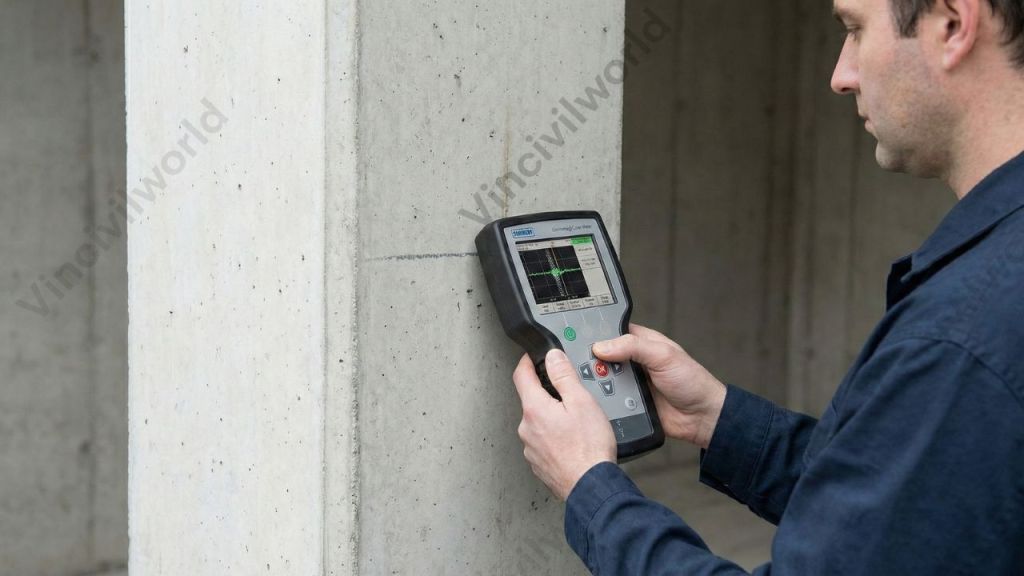
The Covermeter Test is also known as the Rebar Locator Test. It is a widely used non-destructive testing (NDT) method. This method is for detecting the position, depth, and spacing of steel reinforcement in hardened concrete. It works by measuring the magnetic field disturbance created by embedded steel when scanned with an electromagnetic probe. The test accurately determines the cover thickness. This is the distance from the concrete surface to the reinforcement. This measurement is critical for durability, fire safety, and code compliance. Modern Covermeter can also estimate bar diameter and identify congestion or missing rebars. This method adheres to standards such as BS 1881-204. It assists engineers in repair planning, drilling, and anchoring. It also helps in retrofitting without damaging the structure. Overall, the rebar locator test is fast, clean, and essential for structural assessment and quality control of reinforced concrete.

A technician using a handheld ultrasonic testing device on a concrete surface to assess the material's properties without causing damage.
A technician performing a non-destructive test on a concrete structure using specialized equipment to assess its condition.

Impact Echo Test – Evaluating Internal Defects in Concrete

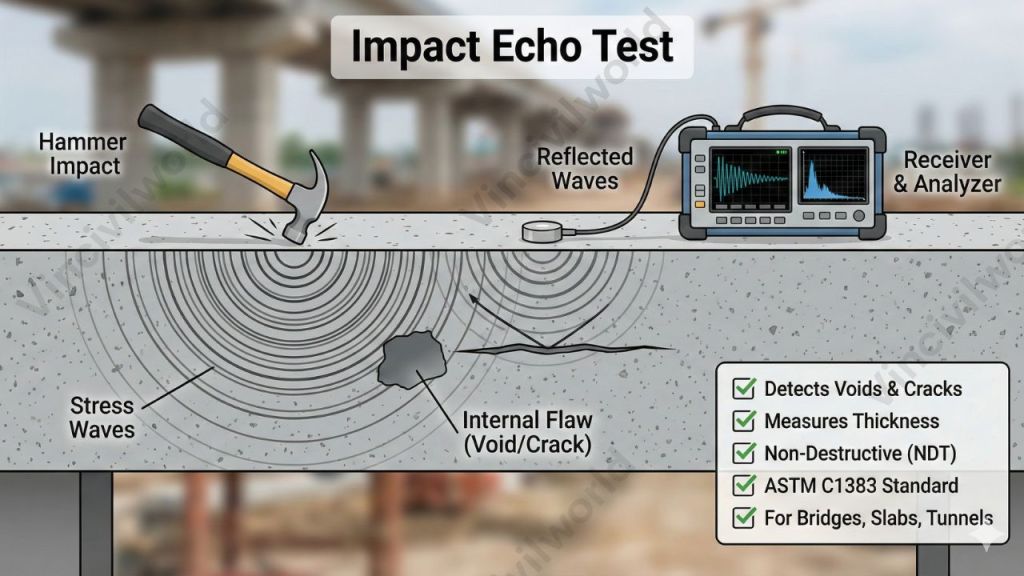
The Impact Echo Test is a reliable non-destructive testing (NDT) method. It is used to detect internal flaws such as voids, cracks, and delamination in hardened concrete. It also identifies thickness variations. It works by applying a short mechanical impact on the surface using a small hammer or impactor. This impact generates stress waves that travel through the concrete and reflect back from internal boundaries. A sensitive receiver records the returning signals and analyzes the wave frequencies to identify abnormalities. The method is guided by standards like ASTM C1383, making it suitable for bridges, slabs, tunnels, and precast elements. Engineers use this test to assess structural integrity, locate hidden defects, verify grouting, and ensure long-term durability—without drilling, cutting, or damaging the structure. Overall, the Impact Echo Test offers a fast and effective solution for concrete condition evaluation and maintenance planning.

Illustration of the Impact Echo Test showing a hammer impacting concrete, generating stress waves. The diagram includes labels for 'Hammer Impact', 'Stress Waves', and 'Internal Flaw (Void/Crack)', as well as a receiver/analyzer that detects reflected waves. The image highlights the test's ability to identify voids and cracks non-destructively, following ASTM C1383 standards.
Illustration of the Impact Echo Test used in non-destructive testing of concrete, showing hammer impact, stress waves, and internal flaw detection.

Key Takeaways

  • Non-destructive testing (NDT) evaluates hardened concrete’s strength and durability without causing damage, helping to detect hidden defects.
  • Engineers use both non-destructive and destructive tests to ensure quality control and structural integrity during concrete assessments.
  • Key advantages of NDT include quick results, safety, and cost-effectiveness, making it ideal for monitoring concrete structures over time.
  • Various NDT techniques include the Rebound Hammer Test, Ultrasonic Pulse Velocity Test, and Impact Echo Test.
  • These methods provide crucial insights into concrete quality, allowing for reliable repairs and maintenance planning.

Conclusion

Non Destructive testing of concrete plays a vital role in maintaining the long-term performance and safety of structures. NDT for hardened concrete enables engineers to assess strength, durability, reinforcement conditions, and internal defects without damaging the structure. With modern concrete NDT methods such as Rebound Hammer, Ultrasonic Pulse Velocity, and Covermeter testing, engineers receive quick data. Tests like Half-Cell Potential and Impact Echo provide reliable insights into structural integrity. One of the major advantages of NDT is the ability to monitor existing buildings. It helps identify deterioration early. Engineers can plan effective maintenance. By using advanced NDT techniques, the industry ensures cost efficiency, improved safety, and accurate decision-making throughout a structure’s life. Therefore, the advantages of NDT strongly support sustainable, safe, and high-quality construction management.

Concrete Pumps Types – Applications and advantages

Understanding the types of concrete pumps is essential for selecting the right equipment for modern construction. Each pump works differently and offers specific benefits depending on the site conditions and structural requirements. Engineers use concrete pump types in construction to increase productivity, reduce manual labor, and deliver concrete with accuracy. Truck-mounted concrete pumps handle large projects efficiently by pumping concrete over long distances and at greater heights using boom arms.

Meanwhile, stationary concrete pumps support continuous pumping operations in high-volume or high-rise structures. The advantages of concrete pumps include faster concrete placement, improved quality, and better safety for workers. By understanding various concrete pump applications, contractors can ensure the best performance when working on foundations, tunnels, bridges, and skyscrapers. This article explains all major concrete pump types and their impact on modern project success.

  1. Concrete pump types in construction
    1. Boom /Truck-mounted concrete pumps
      1. Features and Advantages
      2. Demerits / Limitations
    2. Line /Stationary concrete pump
      1. Features and Advantages
      2. Demerits / Limitations
    3. Trailer-Mounted Concrete Pump
    4. Specialized Concrete Pumps
  2. Concrete pump applications
  3. How to Choose a Concrete Pump ?
    1. Manufacturer of equipment
    2. Price and economic factors
    3. Selection Based on Work
  4. Concrete Pumps Advantages
  5. Disadvantages
  6. Conclusion

Concrete pump types in construction

Concrete pump types in construction help deliver concrete quickly and precisely to any required height or distance. These pumps improve productivity, safety, and quality on site while reducing manual labor. Engineers select the right pump depending on project scale, reinforcement congestion, accessibility, and structural height.

Types of Concrete Pumps

  • Truck-mounted concrete pump (Boom pump)
  • Stationary concrete pump (Line pump)
  • Trailer-mounted concrete pump
  • Specialized concrete pumps (Spider boom, Crawler pump, Underground pump)

Boom /Truck-mounted concrete pumps

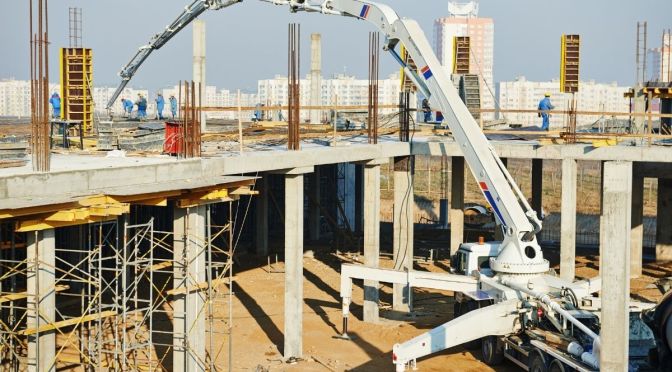
A truck-mounted concrete pump, commonly called a boom pump, delivers concrete quickly and accurately. It reaches over long distances or to high elevations. It boosts construction speed and reduces manual labor.

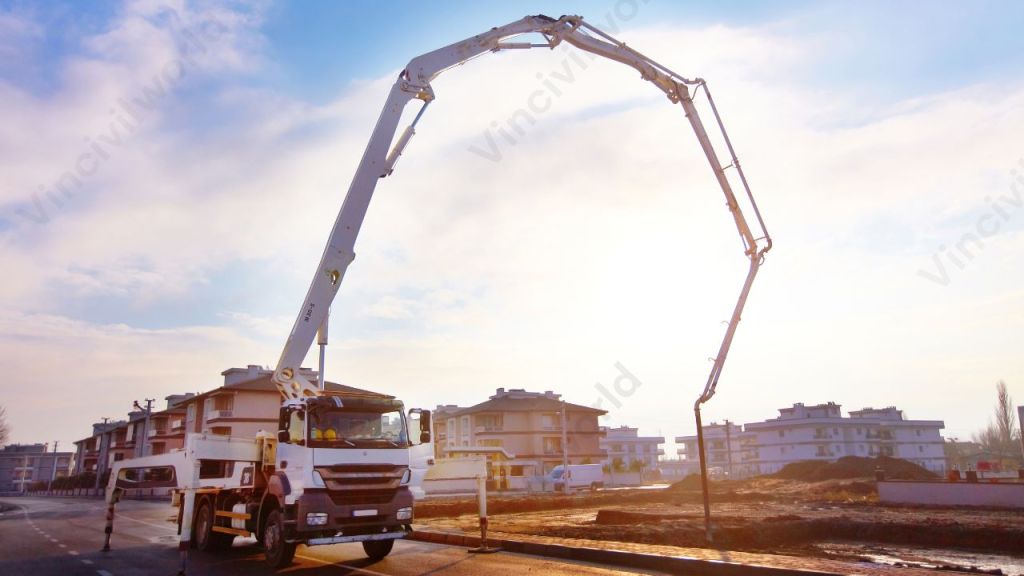
A truck-mounted concrete pump with a long boom is positioned on a construction site, delivering concrete from a mixer to the elevated framework of a building under construction, surrounded by workers and scaffolding.
A boom-mounted concrete pump efficiently delivering concrete at a construction site for a high-rise building.

Features and Advantages

  • Long hydraulic boom with multiple articulating sections — delivers concrete over tall buildings, deep foundation pits, or distant spots.
  • Mounted on a truck chassis — highly mobile and easy to reposition on site.
  • High pumping capacity — ideal for large-volume pours like high-rise, bridges, and large slabs.
  • Precise placement — reduces need for manual handling, improving safety and finish quality.
  • Saves time and labor — faster concrete pouring compared to manual or line-pump methods.

Demerits / Limitations

  • Requires good access and stable ground for truck setup — not ideal on narrow or unstable sites.
  • High rental or ownership cost and maintenance.
  • Boom reach limitations — very tall or complex geometry may need additional equipment or planning.
  • Setup and dismantling time — requires space and time to deploy the outriggers and boom.

Line /Stationary concrete pump

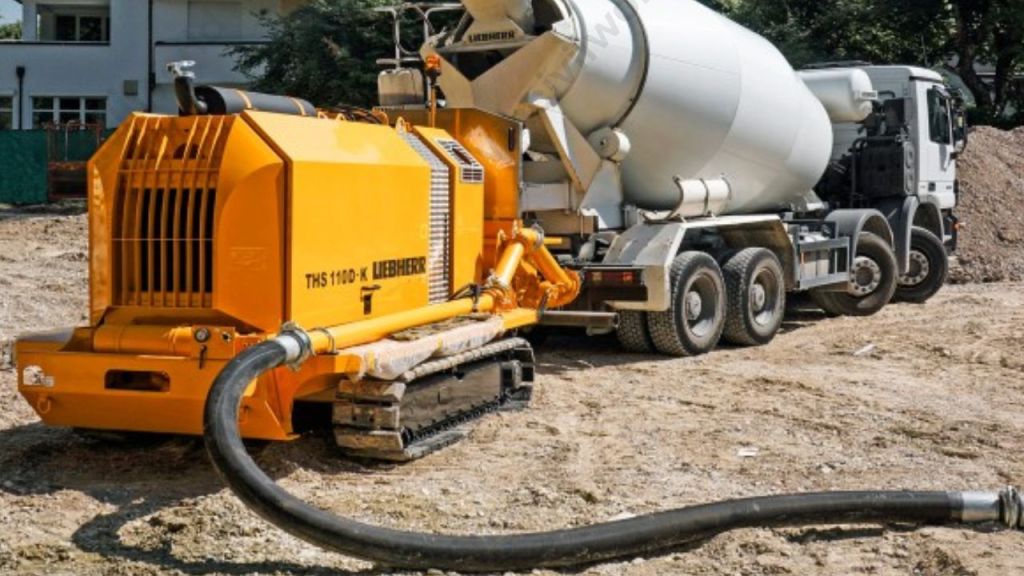
A stationary concrete pump is also called a line pump. It stays fixed on site. It delivers concrete through flexible hoses or pipelines. It suits small to mid-size pours and constrained work areas.

A stationary concrete pump connected to a cement mixer truck, with flexible hoses on the ground for concrete delivery at a construction site.
A stationary concrete pump efficiently delivering concrete via flexible hoses on a construction site, ideal for tight spaces.

Features and Advantages

  • Compact and easy to position — works well on tight or narrow sites where truck-mounted pumps can’t access.
  • Uses flexible hoses or pipelines — allows concrete placement in hard-to-reach corners, basements, or low-clearance zones.
  • Requires less setup space and simpler deployment — ideal for smaller pours or interior works.
  • Lower operational cost compared to large boom pumps — cost-effective for small slabs, staircases, or repair works.
  • Reduced noise and simpler handling — suitable for urban settings, residential sites, or renovation jobs.

Demerits / Limitations

  • Lower pumping capacity — not ideal for high-volume pours or high-rise projects.
  • Requires manual connection and repositioning of hoses for larger coverage — increases labor and time.
  • Less efficient over long distance or height — concrete flow may degrade if hoses are too long or steep.
  • Possible flow interruptions — need careful monitoring to avoid blockages or segregation.

Trailer-Mounted Concrete Pump

Trailer-mounted concrete pumps are compact units towed to the site and connected to pipelines or hoses for concrete delivery. They are ideal for small to medium-scale projects, interior works, and areas with limited access. These pumps offer flexibility, lower operating costs, and reliable performance for slabs, driveways, and repair works.

Specialized Concrete Pumps

Specialized concrete pumps like spider boom, crawler pump, and underground pump handle complex projects where standard pumps cannot operate. Spider booms fit inside tight spaces and deliver concrete overhead. Crawler pumps move on rough terrains, perfect for infrastructure projects. Underground pumps efficiently deliver concrete in tunnels, shafts, and mining projects.

Concrete pump applications

Concrete pumps improve placement speed and accuracy. This makes them ideal for projects requiring efficient delivery to high areas. They are also suited for distant or congested areas.

  • High-rise building construction
  • Bridge decks and flyovers
  • Foundations and retaining walls
  • Tunnels and underground structures
  • Residential slabs and floors
  • Large industrial projects
  • Dams and power plants
  • Pile foundations and diaphragm walls
  • Road pavements and airport runways
  • Precast concrete installations
  • Water tanks and reservoirs
  • Narrow or restricted access sites

How to Choose a Concrete Pump ?

The concrete pump is chosen based on the construction project’s specifications. The following criteria are used to determine a successful and appropriate concrete pump:

  • The Concrete Pump’s manufacturer
  • Concrete Pump’s Function
  • Construction Projects’ Schedule
  • Price and economic factors

Manufacturer of equipment

The following are important considerations to consider when choosing a successful concrete pump manufacturer:

  • Choose the best concrete pump manufacturer in the region. For this, consult local contractors and seek assistance from any recognised manufacturers.
  • A wide range of options are now available online. Check out the top-rated concrete pumps and the feedback they’ve received.
  • Under high pressure, the concrete pumping procedure is carried out. This long-term pressure must be able to withstand a strong concrete pump. 
  • If the concrete pump’s output is below average, building projects can break down and suffer losses.

Price and economic factors

The concrete pump chosen must be practical and work at the rate for which it was purchased. Avoid the risk of paying a high price for an underperforming concrete pump. Often choose a concrete pump based on its efficiency and cost. Compare the price and the results.

Selection Based on Work

When the concrete pump is chosen on the basis of work, two basic factors are considered:

  1. Volumetric Concrete Output
  2. The Pumping Pressure

The work determines the maximum volumetric concrete output required per hour for concrete construction. The pump’s pressure is specified based on this. This pressure is the criterion for choosing a concrete pump. 

The strength of the concrete pump’s driving unit is determined by the desired concrete output (Q) and the pumping pressure (P). Then the  hydraulic output (H) is given by:

H = Q x P 

The concrete pump described above can be chosen based on the various construction projects.

  • For the building of large road and highway projects, a boom or truck-mounted concrete pump is ideal.
  • A boom concrete pump is the best option for concrete pouring at various altitudes and where there is a small area for concrete pouring.
  • Boom concrete pumps can mount two or three robotic pump lines that function as a multi-purpose robotic arm, reducing the number of workers needed.
  • For the building of sidewalks or slabs, a line concrete pump or a stationary concrete pump is used. The stationary pump is used if only a small amount of concrete needs to be pumped.

Concrete Pumps Advantages

Concrete pumps improve productivity. They enhance safety and ensure high-quality placement. Pumps deliver concrete precisely where needed, even in difficult and congested construction areas. The advantages of concrete pumps are listed below.

  • Faster concrete placement
  • Reduced labor requirements
  • Precise and controlled pouring
  • Better quality and surface finish
  • Improved safety and reduced manual handling
  • Ability to reach high or distant locations
  • Efficient pumping in congested reinforcement zones
  • Less concrete wastage and cleanup
  • Continuous and consistent concrete flow
  • Works in areas inaccessible to trucks or cranes
A truck-mounted concrete pump with a long hydraulic boom extends over a construction site, demonstrating its use for delivering concrete to elevated areas.
A truck-mounted concrete pump in action, demonstrating its long hydraulic boom used for precise and efficient concrete placement at construction sites.

Disadvantages

The disadvantages of using concrete pumps in building projects are as follows:

  • The net cost would be higher.
  • Due to the huge initial cost, these pumps are not feasible for structures with minor concrete volume.

That’s it about concrete pumps. Let us know in comments if you found this insightful.

Key Takeaways

  • Concrete pumps convey concrete from a source to a casting location, using pistons to draw and discharge the material.
  • There are two main types of concrete pumps: Boom Concrete Pumps and Line Concrete Pumps, each with specific use cases.
  • Boom Concrete Pumps offer flexibility for high-rise construction, while Line Concrete Pumps are fixed and require more labour involvement.
  • Choosing the right concrete pump depends on factors like the project’s specifications, manufacturer, and economic considerations.
  • Concrete pumps provide advantages such as reduced labour reliance and adaptability, but they also come with higher initial costs.

Conclusion

Understanding the types of concrete pumps helps construction teams choose the most efficient equipment for each project. Different concrete pump types in construction provide unique advantages. Truck-mounted pumps and stationary pumps improve delivery based on height, distance, and site access. When used correctly, these pumps provide major advantages of concrete pumps, including faster placement, reduced labor, and better finishing quality. The right pump also ensures smooth and continuous flow. It works effectively through congested reinforcement during critical concrete pump applications. These include high-rise buildings, bridges, foundations, tunnels, and precast installation. By selecting the most suitable pump type, contractors can tailor their choices based on project requirements. This selection improves productivity. It enhances structural performance. Contractors achieve safe, reliable, and cost-effective results in modern construction.

Curing of Concrete – Concrete Curing Methods explained

Methods of Concrete curing plays a critical role in ensuring that fresh concrete gains its required strength and durability. After placement, concrete needs controlled moisture and temperature conditions to support the hydration reaction. Engineers follow different Methods of Concrete Curing depending on the site environment, structure type, and expected performance. Among the many Types of Concrete Curing, water curing remains the most common approach, especially for slabs, pavements, beams, and columns.

Practical Concrete Water Curing Techniques like ponding, spraying, and fogging help maintain continuous moisture in hot and dry regions. When water is limited, engineers prefer Membrane Curing of Concrete to reduce evaporation. In cold weather concreting and precast sites, they use Steam Curing Concrete to accelerate early strength. These On-Site Concrete Curing Methods ensure durable, crack-free structures that perform well throughout their service life.

This article explains water curing, membrane curing, and steam curing techniques used at construction sites. It also discusses their applications and benefits.

  1. Types of Concrete curing
    1. Maintaining water over the concrete surfaces -Concrete Water Curing Techniques
    2. Ponding
    3. Spraying and fogging method of curing
    4. Saturated or wet coverings
    5. Immersion curing
  2. Reducing Water loss from concrete- Methods of concrete curing
    1. Membrane Curing of Concrete
    2. Covering with plastic sheets
  3. Accelerating strength gain method of concrete curing
    1. Concrete Steam Curing
      1. Steam curing of concrete at atmospheric pressure
      2. High-pressure steam curing
    2. Heating coils
  4. Conclusion

Types of Concrete curing

Curing is the process that maintains moisture in fresh concrete. This allows it to attain its desired strength in a planned manner through a hydration reaction. If the water evaporates quickly, the requisite amount of water will not be available for the hydration process. The curing of concrete helps to retain the moisture. This retention continues until the hydration process is complete. This ensures the concrete attains the requisite strength.

The curing method and time primarily depend on structure type, site conditions, and ingredient parameters. Some of the Types of concrete curing methods adopted in constructions sites are as follows.

  • Maintaining a water layer over the concrete surfaces (water curing)
  • Reducing the loss of water from concrete
  • Accelerating the initial strength gain

Let us go through these three basic concepts and onsite concrete curing methods adopted for each of these criteria.

Maintaining water over the concrete surfaces -Concrete Water Curing Techniques

Maintaining water over concrete surfaces or water curing is the most popular and conventional method of concrete water curing techniques. The methods of curing depends on the type of structure basically. Let us go through the water curing techniques adopted in construction sites .

  • Ponding
  • Spraying and fogging
  • Saturated or wet coverings
  • Immersion curing

Ponding

Ponding is the method of wetting the concrete surface by creating a temporary containment area around the concrete. 

The ponding method is one of the very well-known and widely adopted concrete water curing technique. This method is possible only on horizontal or flat structures and is best suited for curing concrete slabs. 

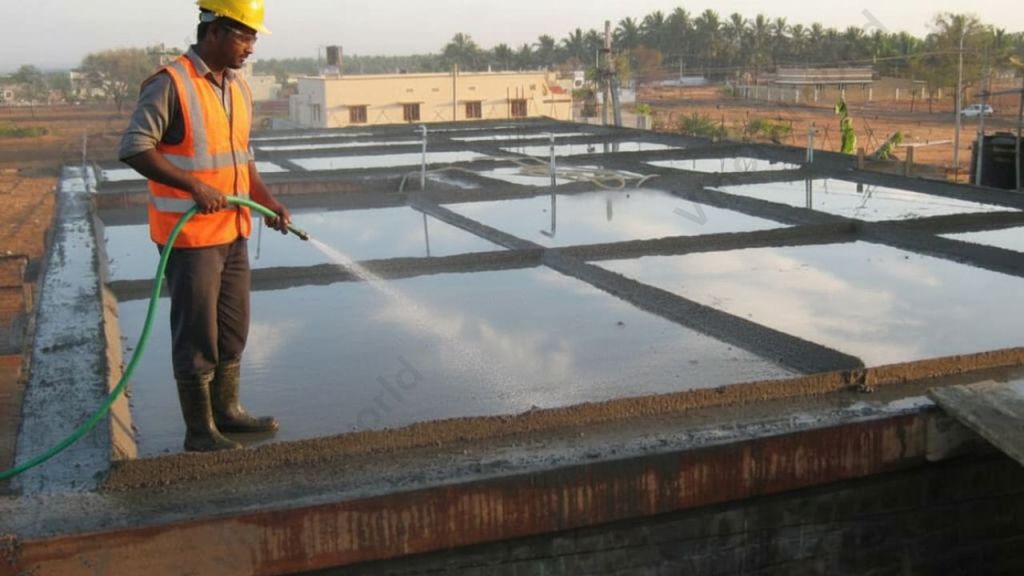
A construction worker applies water to a freshly poured concrete slab using a hose, surrounded by temporary containment for effective curing.
A construction worker performing water curing by spraying water on a freshly poured concrete slab to ensure proper hydration and strength.

Small bunds of clay or lean cement sand are placed over the concrete surface. Water is filled in the bunds, refilled, and maintained as and when the level goes down.

This method is very efficient but requires a huge amount of water. The ponding method of curing is not preferred for large areas and areas where water is scarce.

Spraying and fogging method of curing

Spraying and fogging are conventional water curing methods for horizontal and vertical concrete surfaces. These methods are very effective and efficient in supplying additional moisture during hot weather. The spraying and fogging methods help in reducing the temperature of the concrete.

Spraying is a manual method of simply spraying water over the concrete surface. Even though the spraying method is effective, it tends to waste a lot of water.

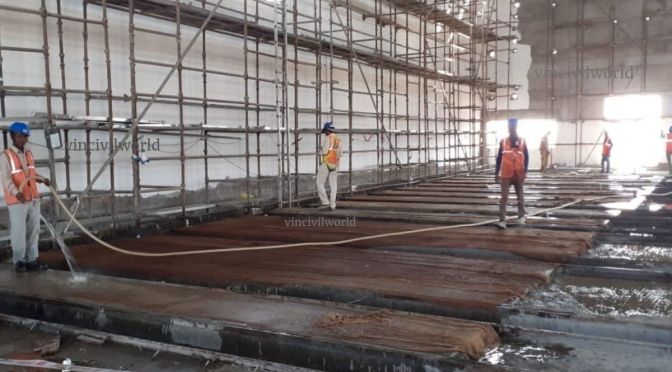
A construction worker using a spray nozzle to apply water onto freshly poured concrete at a construction site, with a building structure partially completed in the background.
A construction worker using a spraying technique to cure fresh concrete on a building site.

Fogging is applicable for areas where the temperature is above freezing point and with low humidity. This process raises the humidity higher than curing concrete by spraying a fine mist of water regularly across the concrete surface. Fogging, or fog spraying is effective in reducing the chances of plastic shrinkage cracking in mixes.

Saturated or wet coverings

In this method of curing, saturated or wet coverings are placed over the hardened concrete. The wet covering material includes hessian cloths, cotton mats, moisture-retaining fabrics, etc. Vertical and inclined structures like columns, beams, sloped roofs, etc are cured in this method.

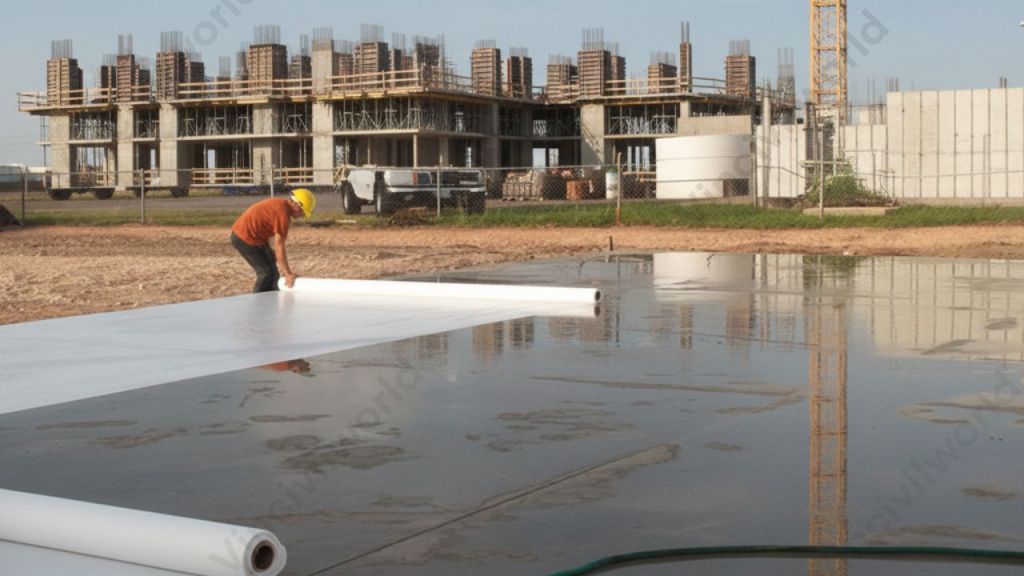
A construction worker unrolling a plastic sheet over a wet concrete surface to reduce evaporation, with a building under construction in the background.
Applying membrane curing to retain moisture on a concrete surface during construction.

Immersion curing

Immersion method of curing is for curing concrete specimens.

Reducing Water loss from concrete- Methods of concrete curing

This concept of curing involves reducing moisture loss from the concrete surface. It is done by wrapping the surface with an impermeable membrane or plastic sheets. This method is the most practical and efficient way to cure concrete nowadays. It is also a much-needed option for areas where there is water scarcity. The common methods are..

  • Membrane Curing of Concrete
  • Covering concrete with impervious sheets or plastic sheets

Membrane Curing of Concrete

The application of curing compounds is through spraying or painting directly on the concrete surface. The compound dries and forms an impermeable membrane that retards or reduces the moisture loss from the concrete. The membrane curing method is a flexible and easy method of curing.

A person using a spray nozzle to apply water on a concrete surface for curing.
A worker applying water to a concrete surface using a spray method for effective curing.

Engineers apply curing compounds once the concrete has hardened but still contains surface moisture. They complete the application before the water evaporates fully from the concrete. The membrane curing may not produce desired results, if applied after the water evaporates. Ensure uniform thickness and coverage during the application process.

Curing compounds are available in acrylic-based and water-based forms.
The curing compound should comply with ASTM C3094 or ASTM C13155. Always go through the manufacture specification before application of curing compounds.

Covering with plastic sheets

Engineers apply impervious paper and plastic sheets on thoroughly wetted concrete in this method. The concrete surface should be hard enough to take the possible damages while placing the sheets.

Concrete surface covered with plastic sheets for membrane curing to retain moisture and reduce evaporation.
Concrete surface covered with impermeable plastic sheets for membrane curing to minimize evaporation.

Accelerating strength gain method of concrete curing

Engineers accelerate strength gain by applying heat or additional moisture, speeding up the early hardening of concrete and mortars through controlled steam and humidity. The following curing methods use this technique.

Concrete Steam Curing

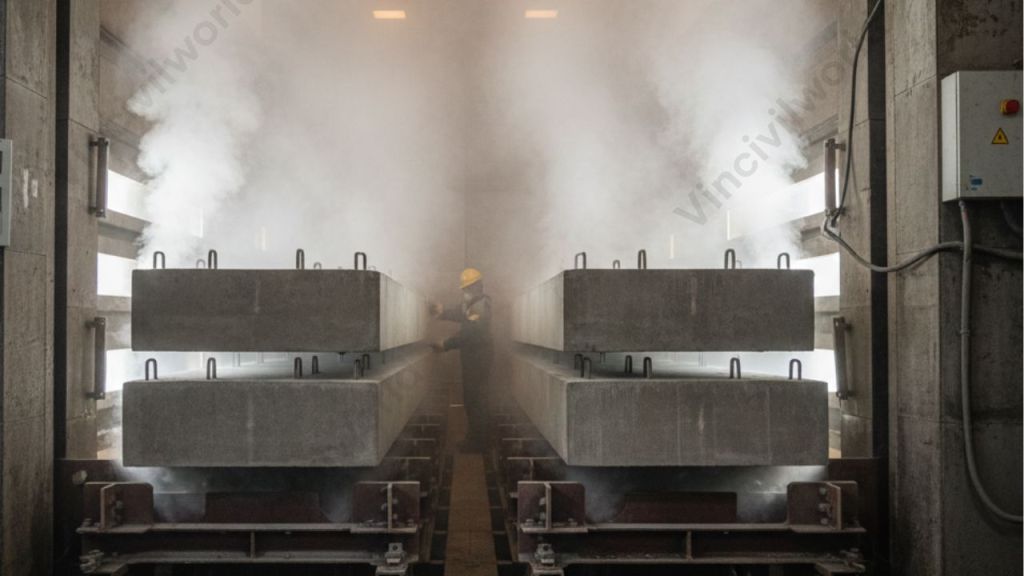
The steam curing method uses water vapor or steam for curing the concrete elements. This curing method is used in cold weather conditions. The concrete needs accelerated early strength gain. It also requires additional heat for hydration. Prestressing and precast factories use the steam curing method for early strength gain of components. The early strength gain can enable rapid removal and reuse of forms. 

The steam curing is done in two ways

  • live (or low pressure) steam at atmospheric pressure
  • high-pressure steam curing in autoclaves.

Steam curing of concrete at atmospheric pressure

Steam curing allows increased production due to rapid repetition and reuse of molds/forms in precast yards.

Concrete elements being cured with steam in a controlled environment, with visible steam rising around the concrete.
Steam curing of concrete elements in a controlled environment to accelerate early strength gain.

Engineers keep the steam temperature at around 140°F or lower for live steam at atmospheric pressure. This continues until the concrete reaches the desired strength. By maintaining an optimum temperature, they can achieve in just 3 days what normally takes 28 days with water-cured concrete. They use the steam curing method.

High-pressure steam curing

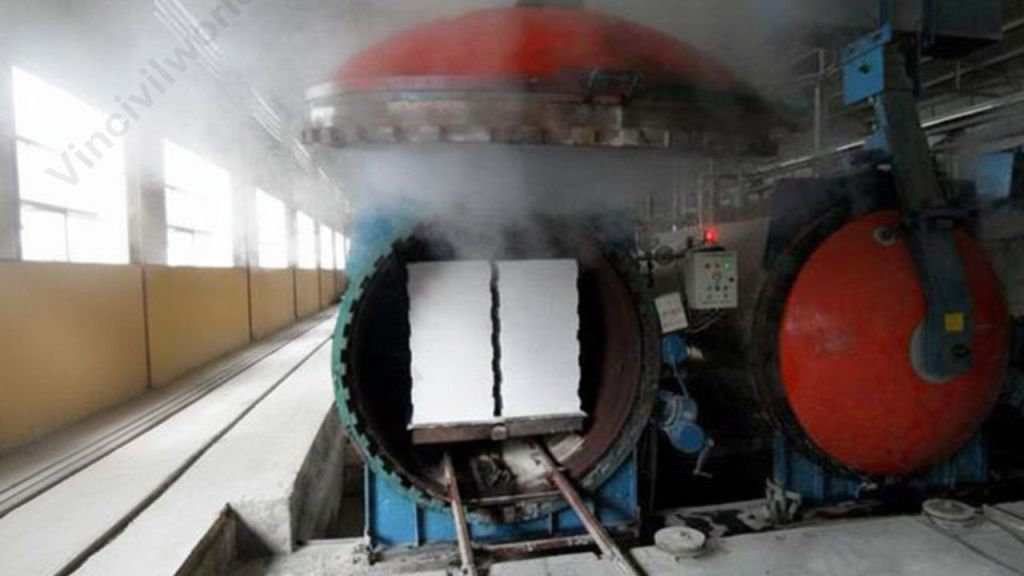
Engineers carry out high-pressure steam curing in a closed chamber at elevated temperature and pressure. They refer to this process as “Autoclaving.” They maintain temperatures between 325° and 375°F and pressures around 80 to 170 psi. Engineers use this method to manufacture precast components, cellular concrete products, and cellular blocks. They also produce precast panels and autoclaved aerated concrete (AAC) blocks.

A steam curing chamber used for concrete, showcasing steam release and a partially visible concrete element inside.
High-pressure steam curing setup, enhancing early strength gain in concrete.

The main advantage of a high-pressure steam curing system is the capability of attaining 28 days of strength of normally cured concrete in 24 hours.

High-pressure steam cured concrete got less creep and shrinkage and better sulfate resistance. There will not be any efflorescence and moisture content after curing.

Heating coils

Heating coils are usually used as embedded elements near the surface of concrete elements. Their purpose is to protect concrete from freezing during cold weather concreting.

Key Takeaways

  • Methods of concrete curing are essential for strength and durability, requiring controlled moisture and temperature.
  • Water curing is the most common method, employing techniques like ponding, spraying, and fogging.
  • Membrane curing is preferred in water-scarce areas, using impermeable sheets to minimize evaporation.
  • Steam curing accelerates early strength gain, particularly in cold weather, using live or high-pressure steam.
  • The choice of curing method depends on structure type, site conditions, and climatic factors.

Conclusion

Selecting the right Methods of Concrete Curing on site is essential to ensure concrete develops its intended strength and durability. Engineers choose different Types of Concrete Curing depending on weather conditions, structural exposure, and project requirements. Engineers use Concrete Water Curing Techniques such as ponding, spraying, and fogging to supply continuous moisture for most slabs and structural elements and prevent early drying. When water is limited or evaporation is high, they apply Membrane Curing of Concrete to retain internal moisture effectively. In colder climates or when faster formwork removal is needed, Steam Curing Concrete accelerates hydration and early strength gain. By applying the correct On-Site Concrete Curing Methods, construction teams can minimize thermal cracking, improve service life, and deliver high-quality structures that perform reliably throughout their lifespan.

Penetration Resistance Test – Significance and Procedure

enetration Resistance Test is an important method used to assess in-situ concrete strength without causing damage, making it a key part of modern evaluation practices. When engineers ask ,What is Penetration Resistance Test. They refer to a non-destructive technique. This method measures surface hardness by driving a probe into concrete. It correlates penetration depth with strength. This approach fits within Non-destructive test penetration resistance concrete applications, especially where core extraction is impractical.

In today’s construction environment, accuracy and structural reliability are essential. The significance of the Penetration Resistance Test in concrete continues to increase. Engineers often use it alongside the Windsor Probe Test concrete strength assessment system, which provides standardized and repeatable results. As part of evolving field assessments, the method aids in faster decision-making. It complements laboratory testing. The method remains practical, economical, and relevant in modern engineering practice.

This blog covers what the Penetration Resistance Test is, its significance, procedure, equipment, influencing factors, advantages, limitations, and practical applications for assessing concrete strength on site.

  1. What is Penetration Resistance Test?
  2. Significance of Penetration Resistance Test
    1. Destructive testing vs Non destructive testing
    2. Why Penetration test is Considered NDT ?
  3. Types of Non Destructive tests
  4. Penetration Resistance Test Procedure
    1. Relevant Codes
  5. Windsor Probe Penetration Resistance Test
  6. Apparatus – Windsor Probe Penetration resistance test
    1. Equipment List
  7. Test Procedure for Penetration Resistance Test
    1. Factors Affecting Penetration Resistance Test Results
    2. Advantages and Limitations of Penetration Resistance Test
    3. Applications of Penetration Resistance Test in Concrete Structures
  8. Conclusion

What is Penetration Resistance Test?

Engineers use the Penetration Resistance Test as a non-destructive method to estimate in-place compressive strength by measuring the penetration depth of a driven probe. The working concept is simple, the harder and stronger the concrete, the lower the penetration depth. A specially designed driver propels a hardened probe into the concrete surface. The depth of penetration is then measured. This reading is compared with calibrated charts. The comparison gives the estimated concrete strength. The test reacts directly to how resistant the surface is to penetration. This means it has a clear link to concrete surface hardness.

An engineer conducting a Penetration Resistance Test on a concrete wall using a gunpowder-actuated driver and probe.
An engineer conducting the Penetration Resistance Test on a concrete surface using a Windsor Probe to measure in-situ concrete strength.

The method is useful for testing concrete already in a structure. It works well on slabs, pavements, overlays, bridges, and repair areas and does not require removing samples. This method does not cause structural damage. It allows strength assessment safely and quickly on site.

Significance of Penetration Resistance Test

Engineers evaluate concrete strength using two main categories of tests:

  • Destructive Testing (DT)
  • Non-Destructive Testing (NDT).

Understanding the difference aids us in comprehending the widespread use of the Penetration Resistance Test. This test is commonly employed in modern concrete evaluation and field testing.

Destructive testing vs Non destructive testing

Destructive Testing involves casting concrete specimens at the same time as the structural concrete. Later, these specimens are tested for compressive, tensile, or flexural strength. These tests take time, and the results are not immediate. Also, the concrete specimen may not represent the real concrete in the structure because pouring conditions, curing method, compaction, and density can vary. DT also damages or destroys the sample, so it cannot be reused and does not allow repeated testing.
Non-Destructive Testing, however, measures concrete strength directly from existing structures without causing damage. NDT keeps the structure in service, allows results to be obtained immediately, and makes it possible to check strength development and deterioration over time. This makes NDT useful for bridges, slabs, pavements, repairs, and old structures.

Why Penetration test is Considered NDT ?

The Penetration Resistance Test qualifies as a non-destructive testing method. It measures surface hardness and in-situ strength. It does this by checking probe penetration depth without reducing the structural capacity. Engineers often use it with the Windsor Probe system. They rely on it to perform safe, simple, and reliable concrete assessment on site.

Types of Non Destructive tests

Penetration resistance test is a concrete non-destructive test. Nowadays Non-destructive test is conducted to determine the relative strength of the concrete. The non-destructive test is the method of evaluating the strength and durability of concrete without loading the specimen.

The main Non Destructive test are

  • Penetration Resistance Test
  • Rebound Hammer Test
  • Ultrasonic Pulse Velocity Test
  • Pullout Test and Pull-off Test
  • Concrete Core Testing or Compressive strength test

Penetration Resistance Test Procedure

The Penetration Resistance Test Procedure outlines how to assess in-situ concrete strength using a driven probe. It follows standard codes and defines equipment requirements. It provides systematic steps for accurate surface hardness evaluation.

Relevant Codes

  • ASTM C803 / C803M – Standard Test Method for Penetration Resistance of Hardened Concrete
  • ACI 228.1R – In-Place Methods to Estimate Concrete Strength
  • BS 1881 – Methods of Testing Concrete (NDT Guidance Reference)

Windsor Probe Penetration Resistance Test

The Windsor probe test is used to determine the following

  • To determine the concrete strength.
  • For evaluating the uniformity of concrete.
  • To identify deterioration in concrete. 
  • To evaluate the in-place strength.
  • For investigating the presence of cracks and flaws.

Apparatus – Windsor Probe Penetration resistance test

The equipment used for this test is called the Windsor Probe System. To begin with, it is designed to estimate in-situ concrete strength. In this method, it works by measuring the penetration depth of a hardened probe. Furthermore, the setup includes a gunpowder-actuated driver. This driver then propels the probe into the concrete surface with controlled energy.

The probe is a hardened alloy rod with a blunt conical nose. Different probes are chosen based on aggregate hardness. This ensures accurate readings and prevents corrosion. A depth gauge is used to measure the penetration length. The reading is then converted into estimated compressive strength using calibration charts.

Spacing rules must be followed during testing. There should be at least 100 mm between probes. The test point must also be 200 mm away from edges. These requirements prevent interference and ensure reliable results.

Equipment List

A collection of Penetration Resistance Test equipment, including a gunpowder-actuated driver, depth gauge, calibration chart, and various probes, arranged on a blue background.
A comprehensive equipment set for the Penetration Resistance Test, essential for assessing in-situ concrete strength.
  • Calibration chart
  • Gunpowder-actuated driver
  • Loaded cartridge
  • Hardened alloy probe
  • Depth gauge
  • Alignment and positioning guide
Penetration-resistance-test

Test Procedure for Penetration Resistance Test

  • Select the Test Area – Choose a clean, smooth concrete surface free from cracks, honeycombing, coatings, or loose material.
  • Check Edge Distance – Ensure the test point is at least 200 mm away from edges and corners to avoid weakened zones.
  • Confirm Probe Spacing – Maintain a minimum spacing of 100 mm and a maximum of 175 mm between test points to prevent overlapping influence.
  • Position the Guide Device – Place the alignment guide firmly against the surface to ensure the probe is driven perpendicular for accurate penetration.
  • Load the Cartridge – Insert the correct cartridge into the gunpowder-actuated driver according to manufacturer specifications and safety guidelines.
  • Insert the Probe – Place the hardened alloy probe into the driver barrel, ensuring proper seating.
  • Discharge the Driver – Trigger the device to drive the probe into the concrete with controlled force.
  • Measure Penetration Depth – Use the depth gauge to record penetration length precisely.
  • Repeat Readings – Take at least three penetrations in the same area and average the results.
  • Interpret Results – Compare the averaged penetration depth with the calibration chart to estimate in-situ concrete strength.

Correlate the depth of penetration with the compressive strength. If the depth of penetration is low, then the strength of concrete is high and vice versa. 

Factors Affecting Penetration Resistance Test Results

The Penetration Resistance Test results can vary due to several factors. Concrete hardness, moisture, and carbonation effects can all play a role. Incorrect probe angle or positioning also influences penetration depth and strength interpretation.

  • Material hardness
  • Moisture and carbonation
  • Test angle and positioning

Advantages and Limitations of Penetration Resistance Test

The Penetration Resistance Test offers advantages over the rebound hammer and UPV. It provides a more direct indication of concrete strength. This is related to surface hardness and penetration depth. It delivers quick on-site results and is useful for comparative evaluation. Engineers avoid using the test on weak or highly porous concrete. They also refrain from using it on lightweight or freshly cast concrete. Surfaces where aggregate hardness, carbonation, or nearby reinforcement can distort readings and reduce accuracy are also avoided.

Applications of Penetration Resistance Test in Concrete Structures

The Penetration Resistance Test is widely used for assessing concrete strength in bridges, pavements, slabs, and structural repair zones where sampling is difficult. It supports quality control checks, renovation planning, surface wear evaluation, and strength verification in existing structures. The test helps engineers identify weak spots, confirm uniformity, and monitor ageing concrete without damaging the member, making it practical for field investigation and ongoing structural performance assessment test has some limitations, this method is apt for the on-site estimation of concrete strength

Key Takeaways

  • The Penetration Resistance Test is a non-destructive method that evaluates in-situ concrete strength by measuring probe penetration depth.
  • This test is crucial in modern construction, as it provides immediate results without damaging structures, unlike destructive testing.
  • Engineers can use the Penetration Resistance Test alongside methods like the Windsor Probe Test to determine concrete strength accurately.
  • Factors such as material hardness and moisture can affect the test results, emphasising the need for careful procedure adherence.
  • Overall, the Penetration Resistance Test is practical for assessing concrete in various structures like bridges and slabs without extraction.

Conclusion

The Penetration Resistance Test is a valuable concrete strength test. It helps engineers assess in-situ strength without damaging structures. This makes it an essential part of non-destructive testing practices. Understanding what the Penetration Resistance Test is and how it relates to concrete surface hardness enables more accurate evaluation. This method is better compared to traditional destructive testing. Destructive testing requires specimens and delays results.

The Significance of Penetration Resistance Test in concrete is evident in bridges, pavements, and slabs. It is also crucial for overlays and repair assessment. Quick decisions are necessary in these areas. When performed according to the Penetration Resistance Test Procedure, the method supports reliability. It ensures quality control and aids in condition monitoring using the Windsor Probe. Despite influences like moisture, carbonation, and positioning, it remains a practical tool for field evaluation, structural performance checks, and long-term concrete assessment.

Segregation and bleeding in concrete – Types, Causes and remedies

Segregation is the separation of concrete ingredients from one another. Concrete is one of the most used construction materials. It consists of coarse aggregate, fine aggregate, cement and water. There are many reasons for the cause of segregation. This article is about segregation and bleeding and their types, causes and remedies.

Segregation and bleeding in concrete are common issues that affect its quality and durability. Segregation of concrete occurs when its components separate, leading to uneven distribution of materials. Bleeding in concrete happens when water rises to the surface, causing weak spots. Both segregation and bleeding of concrete can compromise the strength and finish of a structure. Understanding the causes and effects of segregation and bleeding in concrete is essential for ensuring high-quality construction. This blog will explore these problems, their causes, preventive measures, and solutions to maintain concrete integrity.

  1. What is Segregation in Concrete?
  2. What is segregation in concrete ?
    1. Causes of Segregation in Concrete
    2. Types of Segregation in concrete
  3. Effects of Segregation on Concrete
  4. Bleeding of Concrete
  5. What is bleeding in concrete?
    1. Causes of bleeding in concrete
    2. How to reduce bleeding in concrete?
  6. Methods for Detecting Segregation
  7. Methods for Identifying Bleeding
  8. Standard Testing Procedures
  9. Key Takeaway
  10. Conclusion

What is Segregation in Concrete?

Workability is an important property of concrete that reflects how easily we can place a particular concrete mix . Good concrete should be uniformly mixed and easily placeable without segregation or bleeding.

What is segregation in concrete ?

Segregation of concrete is the separation of ingredients in concrete. Since concrete is a non-homogeneous material, improper mixing is the main reason for the segregation. It occurs during transporting, handling and placing of concrete. Also, it affects the concrete properties. The strength of concrete decreases and leads to cracking. Therefore it should be properly mixed before use in construction. 

Segregation in concrete is the separation of its different components, leading to uneven distribution. This means that the coarse aggregates, fine aggregates, and cement paste do not stay uniformly mixed. As a result, heavier particles settle at the bottom, and lighter ones rise to the top. Segregation of concrete can lead to weak spots, reducing the overall strength and durability of the structure. Segregation and bleeding in concrete are common issues that affect its quality. Proper handling and mix design are crucial to prevent segregation and bleeding of concrete. We will describe the causes of segregation in concrete in the coming paragraph.

Close-up view of concrete with visible aggregates, showcasing uneven distribution of materials, indicating potential segregation.
Close-up view of concrete showing uneven distribution of aggregates, indicative of segregation.
segregation

Causes of Segregation in Concrete

A good quality concrete mix is prepared by considering factors like the size of aggregate, water-cement ratio, compaction, etc. They are many reasons for the causes of segregation in concrete. They are

Prevention of concrete segregation is very important as it adversely affects the properties of concrete. 

Types of Segregation in concrete

Segregation of Concrete occurs in three types such as

Separation of water and cement from other ingredients : Fine particles separate from the mix, often floating to the surface or forming distinct layers.

  1. Segregation of coarse aggregate : This occurs when heavy aggregates settle at the bottom, leaving a weak, paste-heavy layer at the top.
  2. Separation of water content : Excess water rises to the surface, leading to a watery top layer and a dry, aggregate-heavy bottom.

Segregation is hard to measure since there is no particular test for determining it. However, the Flow table test measures the segregation. Also, the slump test of concrete can give an idea about segregation. Coarse aggregate in concrete tends to settle down from other ingredients. Usually, It occurs when the concrete mix is dry. While segregation by separation of water content occurs due to an insufficient amount of fine aggregates or due to the use of an excess amount of water content.

Effects of Segregation on Concrete

Segregation in concrete negatively impacts its strength and durability. When aggregates settle unevenly, it creates weak zones prone to cracking. This uneven distribution leads to poor load-bearing capacity, reducing the structure’s overall stability. Segregation also causes surface defects, such as honeycombing and voids, which can affect the concrete’s appearance and longevity. Moreover, it increases the risk of permeability, making the concrete susceptible to water infiltration and chemical attacks, further compromising its integrity.

Related posts from vincivilworld

Bleeding of Concrete

Bleeding of concrete occurs when excess water rises to the surface during setting. This weakens the mix and can lead to cracks, affecting the quality of concrete. Let’s dive deep into these details in the coming section.

What is bleeding in concrete?

Segregation occurs when the principal ingredients in a concrete mix – in other words, gravel aggregate, cement, and water – separate prior to and during the curing process. Moreover, Segregation causes excessive amounts of water to rise to the surface. This process is know as bleeding. Bleeding is also similar to segregation in which the water in the concrete rises to the surface of the concrete. As a result, the concrete becomes porous and weak.

Bleeding in concrete is the upward movement of excess water to the surface during the setting process. This occurs when the heavier solid particles settle, displacing the lighter water. Concrete bleeding can weaken the surface layer, creating weak spots and leading to cracks. Bleeding affects its strength and its durability of concrete . Likewise, It breaks the bond between the concrete and steel reinforcement. Segregation and bleeding in concrete often occur together, compromising the quality.

However, a proper proportion of concrete ingredients and controlled vibration can reduce bleeding. Moreover, air entraining admixtures can also be used for reduce bleeding. Proper mix design, adequate water-cement ratio, and good compaction practices are essential to minimize segregation and bleeding of concrete. Understanding and preventing these issues is crucial for maintaining the integrity and longevity of concrete structures. We will describe the main causes and remedies in the next sections.
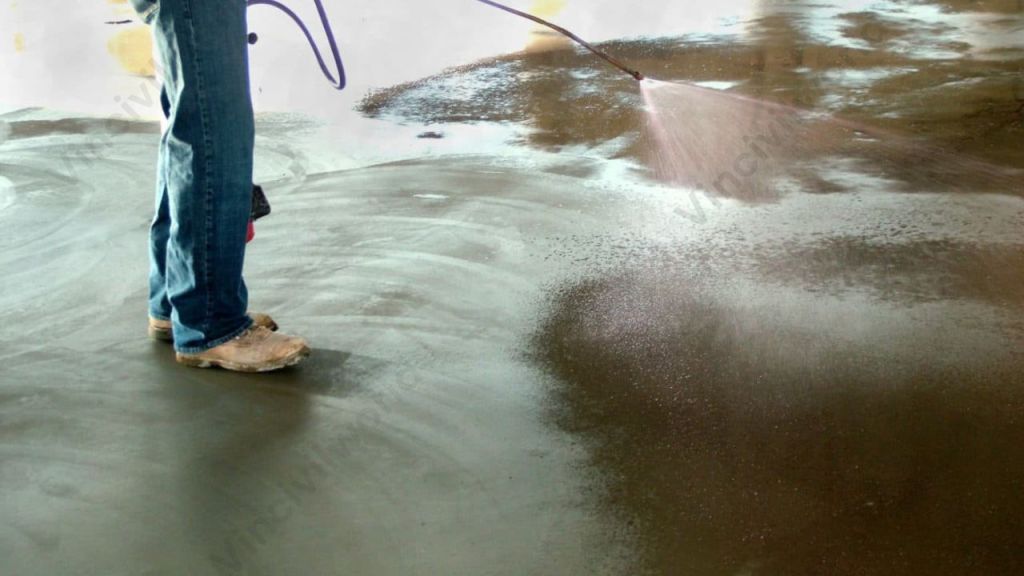
Surface of freshly poured concrete showing water accumulation due to bleeding.
Surface of freshly poured concrete exhibiting signs of bleeding, where excess water has risen to the top.
Bleeding of concrete

Causes of bleeding in concrete

The main causes of bleeding in concrete mix is as follows

  • Segregation is the main cause of bleeding in concrete
  • Improper Mix Design : Improper proportions of cement, sand and aggregate can lead to concrete bleeding
  • Inadequate Mixing : Poor mixing results in uneven distribution of materials,causing bleeding of concrete.
  • High water cement ratio causes bleeding.
  • Type of cement used and quantity of fine aggregate
  • High temperature causing rapid evaporation of water accelerates bleeding
  • Low cement content in the mix fails to bind water effectively leading to bleeding
  • Over vibration during compaction can cause water to rise to the surface, increasing bleeding.

Segregation and bleeding of concrete are interconnected issues that need careful handling and design to prevent.

How to reduce bleeding in concrete?

By adapting the following methods bleeding can be reduced

  • Minimum water cement ratio necessary for workability should be maintained to reduce bleeding in concrete.
  • A proper design mix : Ensure correct proportions of cement, sand, and aggregates to create a balanced mix that minimizes concrete bleeding.
  • Incorporate water-reducing admixtures or superplasticizers to maintain workability without adding extra water.
  • Adequate Mixing : Mix the concrete thoroughly to ensure even distribution of materials, reducing the chances of bleeding of concrete.
  • Control Temperature : Avoid high temperatures during mixing and curing to prevent rapid evaporation and bleeding.
  • Increase Fines Content: Use mineral admixtures like fly ash or silica fume, to improve the mix’s cohesiveness and reduce bleeding.
  • Proper compaction : Use appropriate vibration techniques to compact the concrete without causing excess water to rise.
  • Use air entrapping admixtures
  • Maintain fine aggregate ratio

By following these steps, you can effectively minimize segregation and bleeding in concrete, ensuring a stronger and more durable structure

Methods for Detecting Segregation

Detecting segregation involves visual inspection and sampling. Look for uneven distribution of aggregates and a water-rich layer on the surface. Concrete cores or test cylinders can reveal segregation by examining the uniformity of material distribution. Additionally, a slump test can indicate segregation if the mix shows excessive water separation.

Methods for Identifying Bleeding

Identifying bleeding involves observing the surface for excess water accumulation. This can be seen as a watery film forming on the surface during setting. A simple test involves tapping the surface to check for a thin, water-rich layer. Surface inspection and core samples can also reveal internal bleeding patterns.

Standard Testing Procedures

Standard testing procedures for segregation and bleeding include the slump test to assess workability and consistency, and the bleed water test to measure the amount of water rising to the surface. Additionally, laboratory analysis of concrete cores and cylinders can identify segregation and bleeding by examining the material distribution and surface conditions.

Key Takeaway

Segregation and bleeding in concrete are critical issues affecting construction quality. Segregation involves the separation of concrete ingredients, leading to weak spots and poor durability. Bleeding is the rise of excess water to the surface, weakening the concrete and causing cracks. Key causes include improper mix design, excessive water content, and poor compaction. Prevention measures involve optimizing mix design, controlling the water-cement ratio, and using appropriate admixtures. Regular testing and proper handling are essential to detect and address these problems.

Conclusion

Segregation and bleeding in concrete undermine structural integrity and durability. Addressing these issues involves understanding their causes, implementing preventive measures, and employing standard testing procedures. By maintaining proper mix proportions, controlling environmental factors, and ensuring adequate mixing and compaction, one can significantly reduce the risks associated with segregation and bleeding. Proper attention to these aspects ensures high-quality concrete, enhancing the longevity and performance of construction projects.