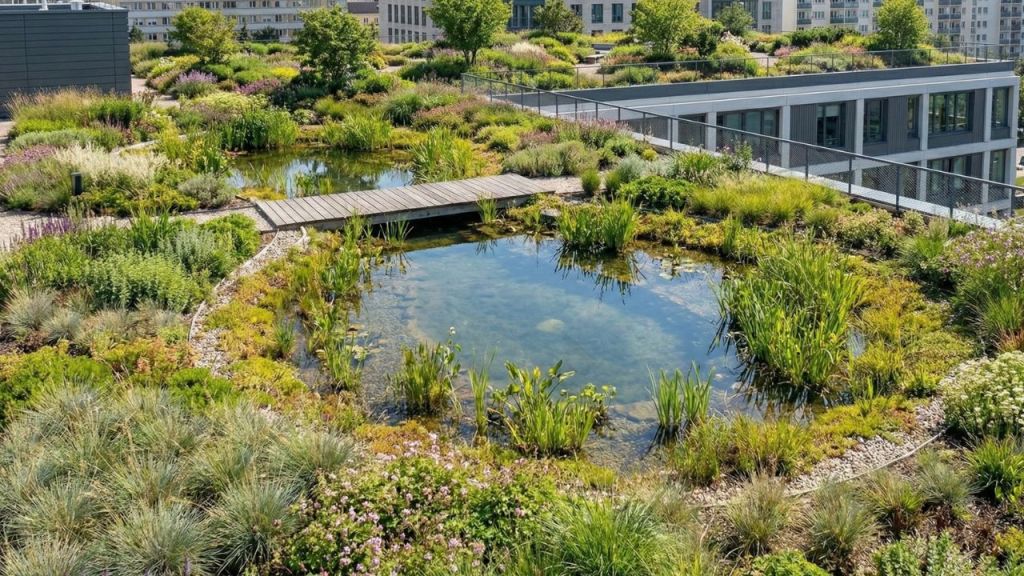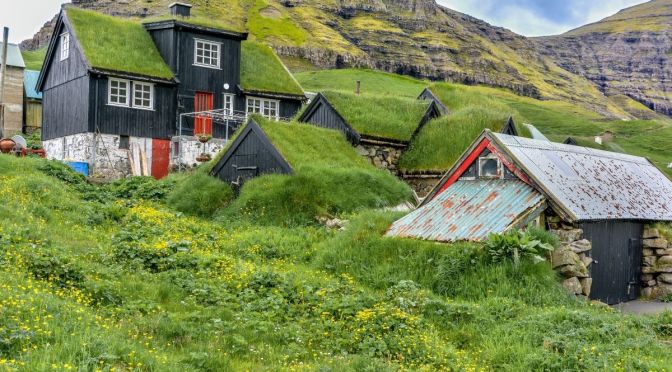
Green roofs or Eco roofs have become the latest design trend in almost all buildings. A green roof, also known as a living roof, is a building’s roof that is covered in vegetation and a growing medium. This is because of its wide variety of benefits ranging from energy conservation to carbon sequestration.
In this blog, I will show you the full details about green roofs, their types, components, merits and demerits. By the end of this article, you would be planning to install a green roof in your home or office. Ready for the journey through green roofs?
What are Green Roofs?
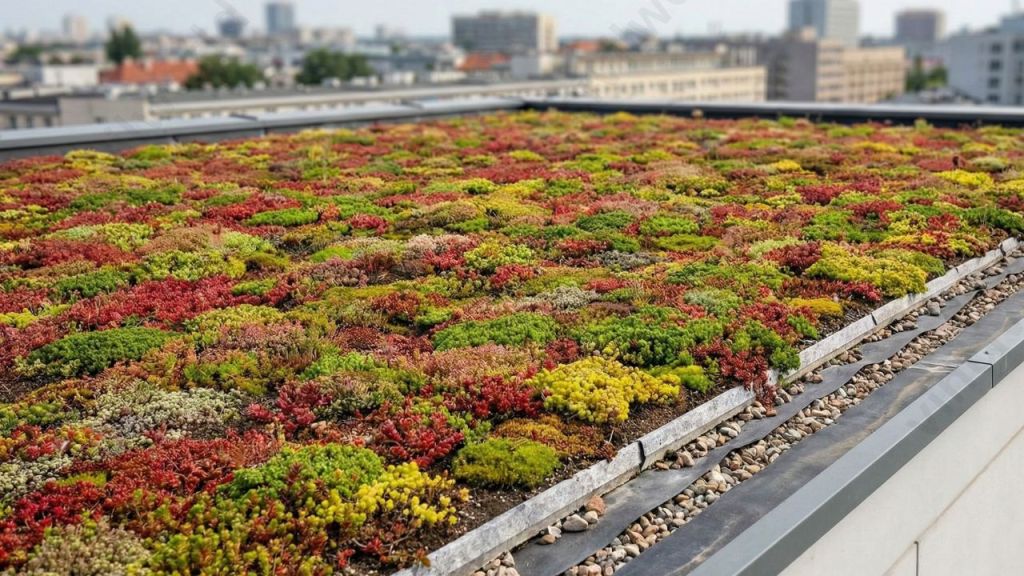
A green roof, also known as a living roof, is a building’s roof that is covered in vegetation and a growing medium. This is planted over a waterproofing membrane. Additional layers, such as a root barrier, drainage, and irrigation systems, can be used. Green roofs with rooftop ponds are another form of green roof that is used to treat grey water.
Different Types of Green Roofs
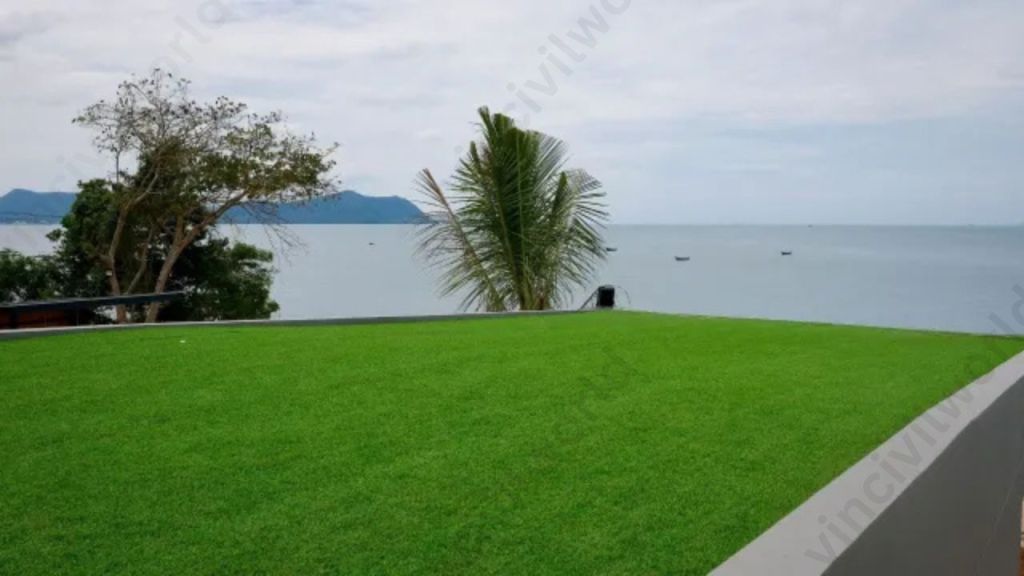
Green roofs are also known as living roofs, grass roofs, and sedum roofs, but all of these terms apply to the same thing. There are three types of green roofs to consider when it comes to your options. Let me walk you through the features of each one of them.
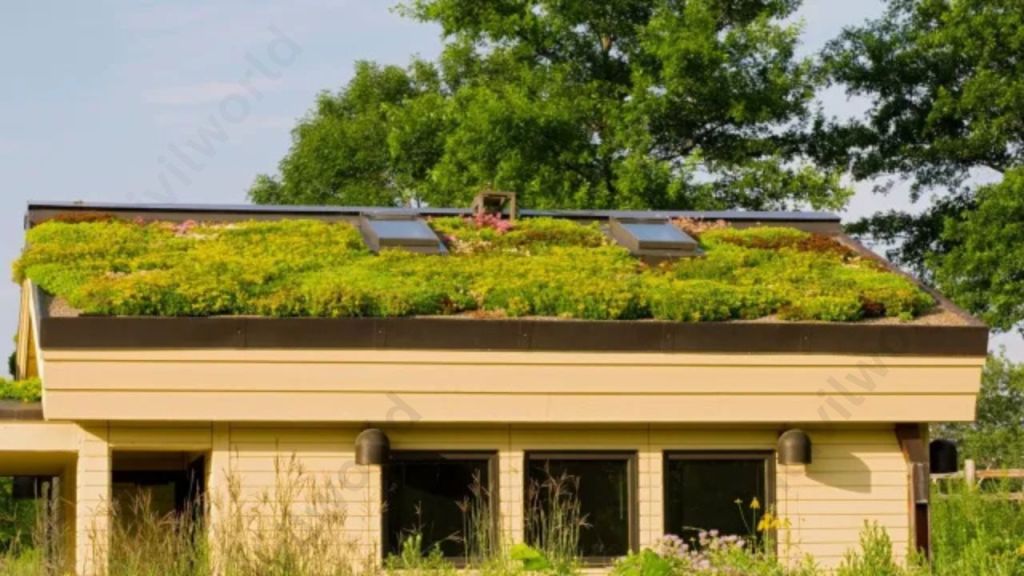
Extensive green roofs are a common choice among homeowners.
They are light, low-maintenance, and do not need additional watering unless there is a prolonged drought.
They can be used on flat roof of both current and new roof decks.
An attractive low layer of vegetation, about 80-150mm thick, such as grass, moss, sedum, or small flowers, is usually found on extensive green roofs.
Extensive Green Roof
Intensive Green Roofs
Intensive green roofs are designed to accommodate larger plants having a height of around 8-12 inches, such as bushes and small trees, as well as a broader range of plants.
They are often referred to as roof gardens.
To sustain this much thicker vegetation layer, they need a layer of rising medium/soil.
They’re more popular in larger commercial ventures, such as parks and gardens.
Intensive roofs necessitate a much deeper substrate to be set up, which means more weight to carry as well as irrigation requirements.
Green Roofs
Semi-extensive Green roofs
Semi-intensive roofs are combinations of both extensive and intensive green roofs. They can combine the environmental benefits of green top and functions as a roof garden.
Let me show you the components of a green roof.
Green Roof System Components
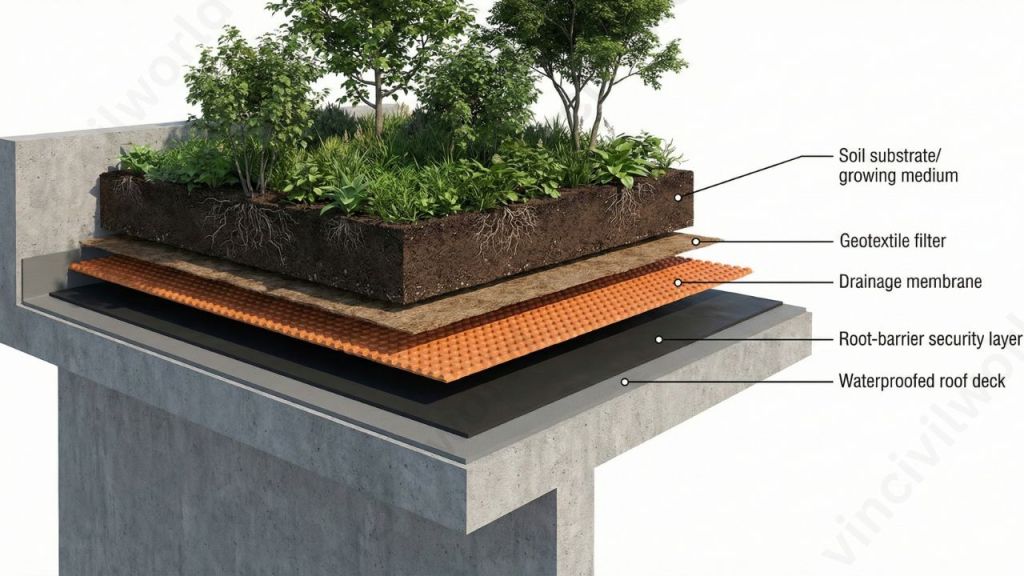
You must install a green roof system for a green roof to develop and prosper. A green roof system is made up of many layers, which are as follows:
Waterproofed roof deck
Root-barrier security
Membrane for Drainage
Geotextile filter / filter layer
Substrate / growing medium for green roofs
Plants and trees
Let’s take a look at each one separately:
Waterproofed roof deck
Your roof deck may already have a waterproofing layer since waterproofing is an important part of the structure’s protection. If not a bitumen membrane or coating, asphalt on a shed, or any kind of liquid waterproofing may be used.
To avoid any roots from causing damage to the structure, a root barrier should be installed above the primary waterproofing layer.
There are typically thin polyethylene plastic membranes.
They are spread over the waterproofing layer and taped together.
Root barriers are imperative in intensive roofs due to the potential for more woody and robust roots.
Membranes for Waterproof Drainage
Rain and stormwater are dealt with by the drainage layer of a green roof system.
It allows water to safely flow away from the roof into guttering and downpipes.
It protects the structure as well as the plants from saturation and root damage by coping with excess water.
The stud profile on these green roof drainage membranes helps to ensure proper drainage.
Filter Layer
The filter layer on a green roof is intended to keep dirt, other substrates, and debris from filling the drainage membrane’s cavities.
Growing Substrate
The substrate should be light, helps with drainage but is still absorbent enough to maintain enough water to sustain your plants’ growth. The commonly used substrates are:
Bricks
Aggregates
Compost
Medium clay soils
Volcanic rocks such as lava and pumice
All of them offers the advantage of being all-natural and environmentally friendly.
Green Roof Advantages
Green roofing has a longer life since a green coating protects it from UV radiation, snow, and ice.
The roofing will last two to three times longer than a conventional roof because it will not be exposed to extreme high and low temperatures.
It will be comfortable and cool inside during the summer and comfortably warm during the winter.
Energy costs will be reduced as a result of the lower HVAC energy demands.
The green roof especially the substratum absorbs both impact and environmental noise, such as rain and hail.
Some of the invisible pollution and particles are filtered out of the air by plants.
The pollution level in the air above gardens and parks is up to 80% lower than in the rest of the city.
The vegetation layer, the substratum, and the irrigation layer filter and absorb 30 to 50 percent of rainwater, resulting in far less water in the sewage system.
Green roofs help to increase the city’s fauna, such as butterflies, pollinating insects, and birds, among other things.
Green Roof Disadvantages
There are only a few drawbacks, the most significant of which is the installation cost. A green roof may cost more to build than a conventional flat roof since the underlying structure will need to be reinforced to handle the additional load.
That’s it about green roofs. Hope this blog motivated you to set up a green roof in your building. Let’s go green. Let’s adopt green roofs.
ALC Panel or Autoclaved Lightweight Aerated Concrete panel is composite material consists of cement, lime, and silica sand. These light weight panels use two-way welded steel mesh as reinforcement. Reinforcements are treated with anti-rust liquid. ALC panels are manufactured at high temperatures and are steam cured.
Lightweight panels are a versatile solution in modern construction, offering easy handling, reduced weight, and enhanced insulation. These lightweight panels provide superior strength-to-weight ratios, making them ideal for both structural and decorative applications. Additionally, they contribute to energy efficiency and sustainability, benefiting green building projects by lowering overall environmental impact.
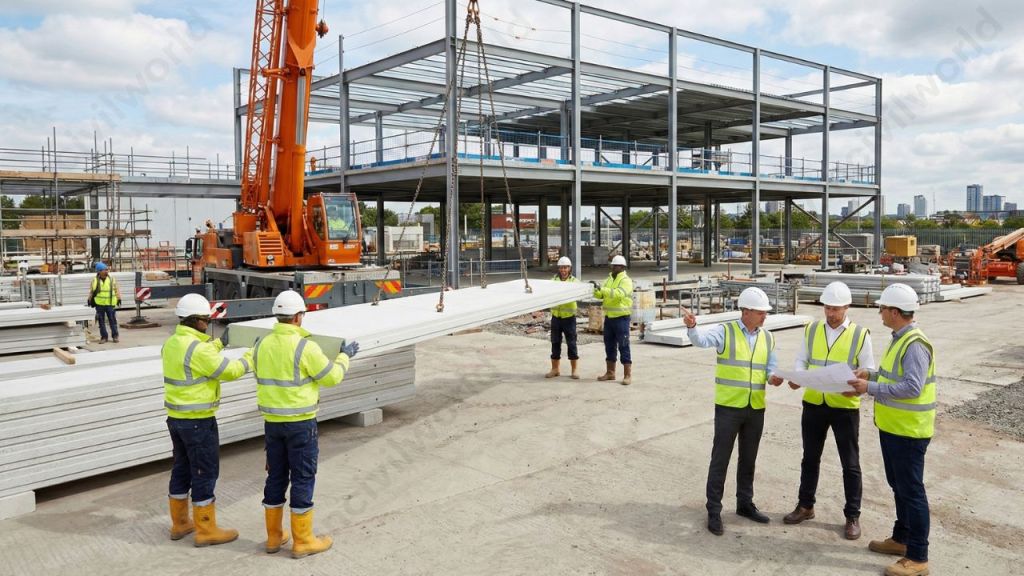
Autoclaved light weight Concrete panels are used for external and internal non-load bearing walls. They are also used for roofs and floors. These panels are suitable for commercial, industrial, and residential buildings.
AAC panels or Autoclaved Lightweight Concrete panels – Introduction
ALC panels, or Autoclaved Lightweight Concrete panels, are innovative construction materials known for their durability and insulation properties. These lightweight panels are made from autoclaved lightweight concrete, offering strength while being easier to handle. ALC panels are increasingly popular in modern construction for their efficiency and sustainability.
In this blog, we will explore everything you need to know about ALC panels. We’ll start by discussing what ALC panels are and how they are made. Then, we’ll delve into the benefits and key features of these lightweight panels, including their durability, insulation, and fire resistance. We’ll explore the various applications of ALC panels in modern construction. We will compare them to traditional concrete and other lightweight materials. Finally, we’ll cover the environmental advantages and cost-effectiveness and future trends of ALC panels. This will help you understand why they are becoming a preferred choice in the building industry.
Processing…
Success! You're on the list.
Whoops! There was an error and we couldn't process your subscription. Please reload the page and try again.
Significance of Autoclaved Light weight Concrete panel or ALC panel
ALC panels are next-generation, a versatile green building material that possesses superior technical and functional advantages. These advantages gave them an upper edge over conventional construction materials to become a favorite walling alternative. ALC panels are designed for non-load bearing walls, load-bearing walls, basement walls, partition walls, floor and roof slabs, etc. There is an extraordinary rise in construction expenses due to higher costs of construction materials and the non-availability of construction materials. ALC panels emerged as a superior and green alternative. They effectively address these issues. Additionally, they manage the construction schedules and deliveries.
ALC panels – Aerated Light weight concrete panels
ALC Panel – Aerated Light weight concrete panels
Technical parameters of ALC panel
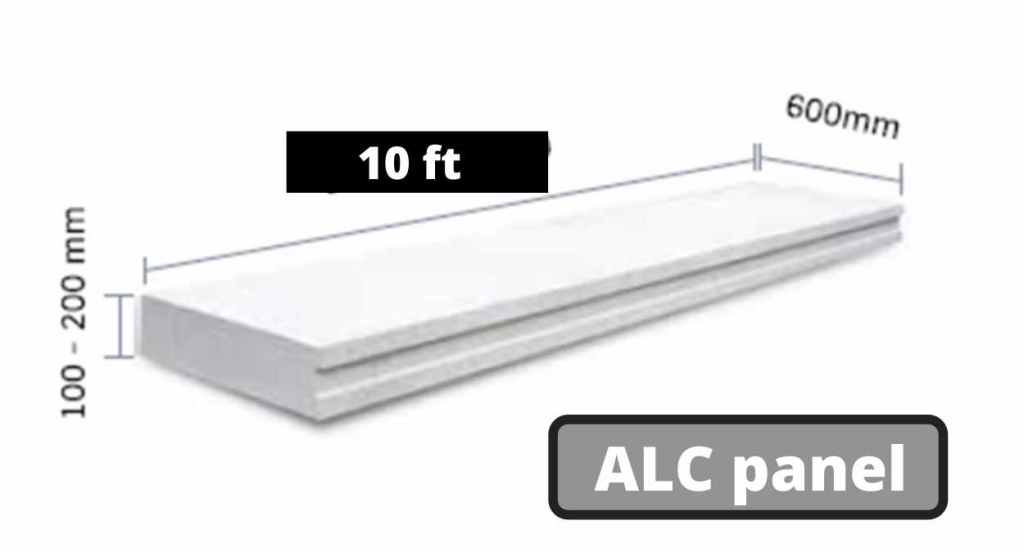
ALC panels are solid panel systems having insulation properties and are embedded with steel reinforcements. They are suited for load-bearing and non-load-bearing applications. Load-bearing applications are restricted to single-storied or low-rise buildings. The floor and roof panels are usually 10 ft long. They have a standard width of 2 ft with tongue and groove joints. ALC panels are designed in suitable thickness to cater to the loads acting on the components. The technical properties of ALC panels as follows.
ALC panels – Technical comparison
ALC Panel – Aerated Light weight concrete panels
Advantages of ALC panel
ALC panels are best suited to cater to the present-day challenges of energy efficiency. They provide better fire safety and thermal insulation than any other building material. Let us examine the features and benefits of ALC panels. These advantages make them superior and a preferred choice of wall paneling systems.
ALC panel got a unique cellular structure that constitutes around 75% to 80% air bubbles. These air bubbles are responsible for their low thermal conductivity. The ALC panels got a k value nine (9) times less than concrete and twice less than bricks. ALC panels got the highest thermal rating of R30 in the industry. The low thermal conductivity helps ALC panels in maintaining and retaining indoor temperatures. The indoors will be kept cool during summers and warm in winters. ALC panels can reduce substantial energy loads and thereby generates an energy bill savings of around 25%.
High fire resistance
ALC panels got a unique cellular structure. They provide a superior fire rating of around 4hr for a 100 mm thick panel. The melting point of ALC panels is over 1600 degrees Celsius. It is much higher than the typical building temperature of 650 degrees Celsius. ALC panels do not release smoke or toxic gas during a fire incident.
Acoustic insulation- ALC panel
ALC panels possess natural sound insulation properties. They can also reduce mechanical vibrations to an extend. Noise insulation of these panels ranges between 40-60Db depending on the thickness of the panels and surface treatments. They can function as sound absorption and a sound resistance material simultaneously, which is not possible with other building materials. A good STC rating of around 44 is ideal. This enables ALC panels to be used in areas designed to have high acoustic performance. Ideal for hotels, hospitals, commercials, and residential uses.
Water and moisture resistant
Consists of millions of microscopic cells that resist the capillary flow of water and strongly resists water and moisture.
Light weight product
ALC panels got a density of around 600-650 kg per m3. They are 4 times lighter than concrete and three times that of brick. These lightweight properties can reduce the self-weight. This reduction in self-weight in turn reduces the design loads on foundations. Usage of ALC panels can substantially economize the structure and ease the construction process. The overall saving in structural cost is around 15-20%.
Durability and strength
High pressure steam-curing autoclaving process gives ALC panels high strength to weight ratio even higher than M 150 concrete. ALC panels are used with reinforcements to meet load-bearing design requirements like bearing capacity, stiffness, shear resistance, deflection, etc.
ALC blocks are a preferred choice for all kinds of walls due to their high load-bearing strength. They are used for external and internal walls, load bearing and non-load-bearing walls, basements, and firewalls, etc. They can absorb strong impacts, while also being able to withstand harsh weather conditions without cracking. They have a designed life span of 50 to 80 years.
Environmental friendly
ALC panels are environment-friendly building products. From the raw material to the production process there is no emission of toxic wastes to the environment. The wastage is minimal and negligible and the entire material is reusable and recyclable. ALC blocks use Energy saving manufacturing process and are LEED-certifiedand belong to the green buildingcategory.
Earthquake resistant
Earthquake forces on a structure is proportional to its weight and ALC panels can considerably reduces the weight of the structure. ALC panels have high shear wall strength and capable of resisting lateral loads. ALC panels can withstand wind loads.
Installation process and speed
ALC panels are manufactured in precise sizes, hence the tolerance in length, height, and width are only +/- 2 mm. The tongue and groove fixing arrangements are fast and easy and uses only thin mortar joints and putty. These thin mortar joints and precise dimensions can eliminate possible cracks and enhances the construction speed. ALC walls are fully cured in 11 hours where as concrete takes 28 days, minimizing cracks due to shrinkage.
The panel erection is by dry masonry continuous operations and there are no height restrictions like conventional masonry works. Joints are sealed by special adhesives and no curing is required. After installation putty can be applied directly over the surface. The product can be cut and grooved using wood working tools much easier than wooden products. ALC panels can be cut easily, cored, ground, and installed fast and easy. Conduit joints and openings can be made easily in panels.
Conclusion
ALC blocks are a kind of porous plate with high performance. They can be a perfect, economic, and green alternative for conventional walling systems. They are easy and fast to install, durable and environmental friendly products. ALC panels got superior thermal conductivity, acoustic properties and fire resistant properties.
Wastewater treatment is an area where a lot of experts have carried out in-depth research. According to The United Nations World Water Development Report (WWDR), about 80% of wastewater is released into the water bodies without proper treatment on a global scale.
In the previous blog, I showed you some innovative ways to conserve water. Today we are going to dig deeper into the journey of wastewater through a wastewater treatment plant.
In the first section, let me introduce you to the wastewater treatment process.
Wastewater Treatment Process
The method of removing pollutants from wastewater or sewage and converting it into an effluent that can be added to the water cycle is known as wastewater treatment. In wastewater treatment plants, pollutants in wastewater are reduced to a degree that nature can accommodate.
Here’s a step-by-step guide to explain what happens at each point of the treatment process and how contaminants are neutralised or removed to help keep our rivers and streams safe.
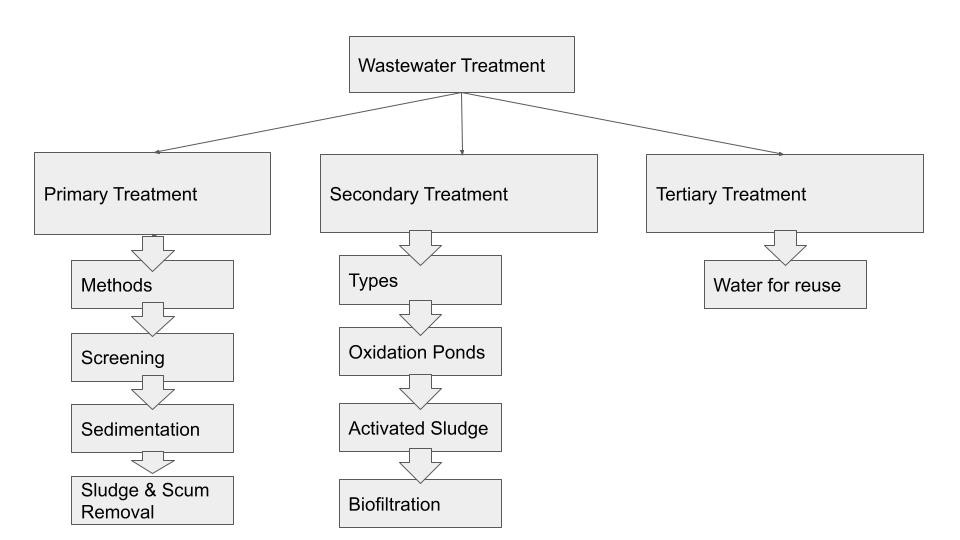
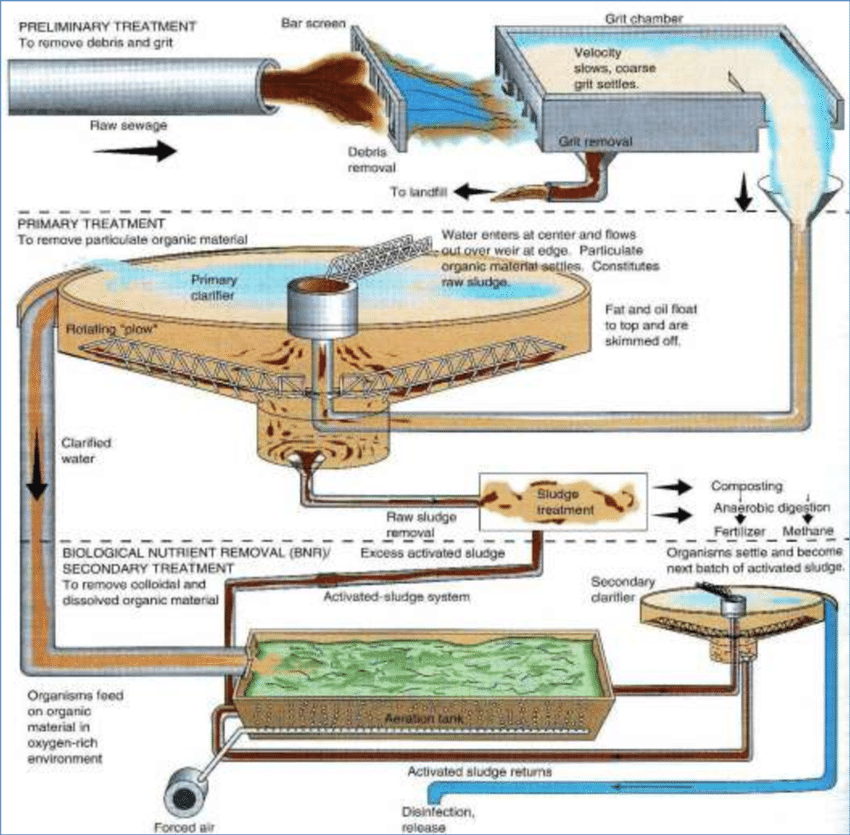
As shown in the diagram, the three main stages in the treatment of wastewater are:
Primary Treatment
Secondary Treatment
Tertiary Treatment
Let’s analyse what happens in each of the stages in detail.
Primary Treatment of Wastewater
Wastewater reaching a treatment plant through pipes first undergoes primary treatment irrespective of its source. About 60% of the suspended solids are removed from the wastewater during primary treatment along with aeration or stirring in the water to put oxygen back. It includes the following steps:
1. Screening
The majority of the floating materials are removed from the wastewater using screens of 10 mm openings and settling tanks.
The floating materials include stone, rocks, sticks and even dead animals. Solid materials make up about a third of the wastewater.
As a result, eliminating solid waste at the initial stage makes subsequent treatment procedures easier. Also, they may cause problems later in the treatment process if they are not removed.
Solid waste is collected and disposed of in landfills after the screening process.
2. Sedimentation
The sewage then flows through the grit trap or grit chamber which collects sand, cinders, and small stones at the bottom.
The wastewater is then directed to sedimentation ponds, settling tanks, or clarifiers after the settled grit have been removed.
Organic and inorganic matter, as well as suspended solids, are removed in this process.
The suspended particles begin to fall to the bottom and form a solid mass known as sludge.
3. Sludge Removal
In the sedimentation tanks, sludge (the organic solid component of the sewage) settles out of the wastewater.
Mechanical scrapers in the tank’s base continuously move accumulated sludge to a hopper, where it is pumped to sludge treatment facilities.
The thickening step removes some of the water before the sludge is processed in digesters.
4. Scum Removal
Lighter materials rise to the surface as sludge settles to the bottom of the sedimentation tanks.
Grease, oils, plastics, and soap are among the ‘scum.’
Scum is skimmed off the surface of the wastewater by slow-moving rakes.
Scum is thickened before being poured into the digesters with the sludge.
Around 90% of suspended solids, 55% of faecal coliforms, and 50% of biological oxygen demand are removed during the primary treatment process. The waste must be subjected to secondary treatment in order to be completely free of toxic substances. Let’s see how to do that.
Source: researchgate.net
Secondary Treatment of Wastewater
Secondary wastewater treatment is designed to significantly degrade the biological content of the waste by aerobic biological processes, and it operates at a deeper level than primary treatment.
During secondary wastewater treatment, about 85% of the organic matter in sewage is eliminated.
The method entails combining the wastewater with bacteria and oxygen at high pressures.
Bacteria digest organic matter with the aid of oxygen.
Secondary wastewater treatment reduces common biodegradable pollutants to acceptable levels, allowing for cleaner release into the nearby water bodies. It is done in one of three ways:
1. Biofiltration
Sand filters, contact filters, and trickling filters are used in biofiltration to ensure that any excess sediment is extracted from the wastewater.
A trickling filter consists of a bed of stones that is about 6 feet tall.
Sewage coming out of the sedimentation tank is permitted to pass through this stone sheet.
The bacteria congregate on these stones and begin to multiply and evolve until all of the organic matter in the sewage has been consumed.
Following the process, the clean water is piped out and directed to another sedimentation tank.
2. Oxidation Ponds
Oxidation ponds, also known as lagoons or stabilisation ponds, are large, shallow ponds that use the interaction of sunlight, bacteria, and algae to treat wastewater.
Algae use the sun’s energy, as well as carbon dioxide and inorganic compounds released by bacteria in the water, to grow.
During photosynthesis, algae release oxygen, which is needed by aerobic bacteria.
Mechanical aerators are often used to provide even more oxygen, reducing the size of the pond needed.
Dredging is needed to remove sludge deposits in the pond.
Filtration or a combination of chemical treatment and settling will kill any residual algae in the pond effluent.
The air and sludge are allowed to come into close contact with the bacteria during this process and then passed into the settling tank.
The sewage from the settling tank is first sent to an aeration tank, where bacteria are added to the air and sludge.
The entire setup is left alone for several hours, during which time the bacteria decompose the organic matter into toxic by-products.
The sludge, which has been activated by billions of bacteria, is returned to the aeration tank to handle fresh sewage.
The previously treated wastewater is pumped to the sedimentation tank, which filters out any bacteria.
We have seen the primary and secondary treatment of wastewater. Now it’s time to see what happens in the tertiary treatment of wastewater.
Tertiary Treatment of Wastewater
The aim of tertiary wastewater treatment is to improve the water’s quality to meet domestic and industrial standards, as well as to meet specific criteria for water discharge safety. It can be done by ion exchange, reverse osmosis, chemical precipitation, membrane filtration etc. In the case of municipally treated water, the tertiary treatment also includes the elimination of bacteria, ensuring that the water is safe to drink.
In some cases, quaternary treatment is also done. This stage deals with contamination levels of a few parts per million to billions of parts per billion, and it often includes oxidation or fine filtration.
Wastewater Treatment
Shall we wrap up?
Conclusion
Wastewater treatment refers to the purification of sewage from various sources and converting it into a reusable form. It involves mainly 3 stages namely primary, secondary and tertiary.
Primary treatment involves screening, sedimentation, sludge and scum removal. Secondary treatment deals with the removal of biological contaminants using oxidation ponds, trickling filters or activated sludge process. Finally, the Tertiary treatment converts water into a reusable form.
The management of wastewater is inextricably related to the availability of clean and adequate water sources. Far from being anything to discard or neglect, wastewater will play an important role in meeting the increasing water demand in rapidly expanding cities, improving energy production and industrial growth, and promoting sustainable agriculture.
Green Airport has been in the news for quite some time as more and more airports are going green. According to studies by ATAG, the global aviation industry produces 2% of all anthropogenic carbon dioxide emissions. When it comes to climate change, the aviation industry is under increasing pressure to clean up its act, but gas-guzzling planes aren’t the only culprits.
As airports grow, so does their carbon footprint and emissions. As new terminals, ground transportation vehicles, and facilities are built, the energy demand increases.
As a result, many airports around the world have incorporated greener elements into their designs and operations strategies, as well as pledged to support environmentally sustainable initiatives thereby transforming into green airports. Before we dig into the details about various green airports around the globe I will show you what exactly a green airport is.
What is the Green Airport concept?
Green airport is an airport that complies with the latest sustainability criteria, reduces the effects of airport activities on the environment, and mitigates the impact of climate change on related facilities and operations.
In this blog let me take you on a trip to various green airports in the world and we will analyse the key features that make each one a green airport.
Green Airports in the world
A number of airports around the world have begun to implement “green” programmes in order to make their buildings greener and more environmentally friendly. Here are 5 such airports that have earned international recognition for their sustainable and green initiatives.
Its Terminal A has heat-reflective roofing and pavement surfaces, as well as water-saving low-flow bathroom fixtures.
One of the airport’s runways was resurfaced with environmentally friendly asphalt that could be heated at a lower temperature during the construction process which would result in a 2,000t reduction in carbon emissions over the lifetime of the project.
The airport’s offices are topped with a fleet of 6ft tall wind turbines that generate about 3% of the energy required for operations.
Seems like Boston Airport is pacing really fast towards being a green airport, right? Let’s look at the other ones which are turning into green airports.
2. Galapagos Ecological Airport, Galapagos Islands – World’s first completely Green Airport.
Built to operate entirely on solar and wind energy, with windmills providing 65% of total energy and photovoltaic panels on walkways providing 35%
Steel pipes taken from oil extraction fields were used to build 80% of the infrastructure.
Wood and metal structures from the airport’s previous home, Seymour, were reused, and furniture was made with environmentally friendly materials.
A desalination plant is also present at the airport, which collects seawater and purifies it for use in the terminal.
The wastewater is then pumped back into the treatment facility for future use by travellers.
Green Airport
3. Singapore Changi Airport, Singapore
Singapore’s Changi Airport is not only one of the best in the world, but it also has a reputation for being environmentally friendly.
With skylights to enhance natural light, air conditioners located closer to the floor, and an abundance of greenery.
The recently opened Terminal 4 features a green wall with over 20,000 plant species, which lowers the temperature of the airport and increase air quality.
Energy-efficient motion sensors and lighting, water-efficient fittings, and roof-mounted solar panels are among the other features installed at Changi.
4. Stockholm Arlanda Airport, Sweden- First Green Airport to achieve carbon neutrality
The only airport in the world with an environmental permit that includes a limit on carbon dioxide emissions.
In this green airport, hangars and airfield buildings are heated with a special biofuel system to conserve energy.
A collection of wells connected to an underground aquifer collect water and sends it to the terminal’s air conditioning system in the summer.
This approach is often used to heat cement pads near the airport’s hangars, preventing ice from forming on the doors and ramps.
5. Delhi Indira Gandhi Airport, India
The 5.4 million-square-foot Terminal 3 at the airport features well-lit departure lounges, 1,200 low-power LCD displays, 300 rainwater harvesting stations, and erosion-control storm drains.
Passengers are transported between terminals and baggage claim using battery-powered vehicles.
Indira Gandhi Airport recently received two awards for its environmental stewardship,
Wings India Award for the ‘Most Sustainable and Green Airport,’
ACI’s designation as the world’s best airport with over 40 million passengers a year.
Through this blog, we have taken a closer look at some green airports that are setting a precedent for other aviation hubs to emulate by sustainable practices and the use of renewable fuel sources. What do you think of these features and what other energy-saving measures and sustainable practices can be adopted to uplift our airports to the status of a green airport? Let me know in the comments.
Ways to conserve water is a quite relevant topic in the digital era. World population is exploding and the need for water is skyrocketing. It is even said that the next world war will be for water. In the crunchy situation, you don’t need me to tell you why it’s relevant to save water. Out of the existing methods, some are very sophisticated while some needs improvisations. Through the post, we are going to explore existing techniques to conserve water by digging deep.
How many times did you have goosebumps looking at nature?
True. Be smart like nature. Soil and water conservation methods include planting deeper rooting crops, such as grasses or cereals that will leverage soil water reserves more effectively than shallower rooting crops such as vegetable crops and therefore can be grown in drier period.
Take measures to avoid run off
An important part of different ways to conserve water is avoiding spilling out. When it comes to water, the part played is runoff. This is equally important as the ways to conserve water resources. The various types of run-off management are those increase water intake and storage and so reduce runoff, control water movement over the soil surface, dispose safely of the excess rainfall as runoff or concentrate inadequate rainfall runoff. Remedial measures such as incorporating plantings especially in areas where runoff collects protecting trees that help absorb and filter runoff, choosing permeable materials for pathways etc. can potentially contribute to reducing runoff.
Cheap Ways to Conserve Water- Use Rainwater Effectively
We should always bear in mind that groundwater is a candy that should not be consumed uncontrollably. Because it takes time to recharge it back to its initial level. Only by conscientious exploitation of groundwater can it be proportionately conserved. For this to happen, ways to conserve water from ground water conservation methods such as crops requiring less water given priority over crops requiring more water need to be considered. Less water should be used by industries. The necessary drainage area should also be made available for recharging ground water.
Redistribution of Water– must use ways to conserve water
Sharing is a great habit that benefits all who are involved in it. Whether it’s knowledge, love, physical goods, anything, right? That’s exactly what it takes to turn the cries of people around the world for water into a smile of gratification. Extensive re-wiring of the supply of water in water conservation system from areas with lower demand to areas with higher demand is needed.
How do you do that?
This can be accomplished through the development of water reservoirs and a network of canals. Excess rainwater that flows away from rivers without being used can be stored by the construction of water reservoirs from which it can be supplied for agriculture, industry, urban areas, etc. These reservoirs are also designed to protect against flooding and, apart from flood protection, they can also be used for a variety of purposes. Water distribution is also possible through the canal system. The canal system transfers water from excess rainwater to scarce rainwater areas and conserves water for various purposes.
Now we have seen 5 ways to conserve water. But we are yet to hit some more wonderful ways to save on water. Moving on…
Protection of Water from Pollution
Pollution is a taboo that has disturbed our ears since the day we can remember. Activities such as disposing of different wastes without treatment in rivers, pollution caused by tourism on lakes and sea coasts, bathing and other similar activities in the vicinity of drinking water sources and Weeds produced in water are the main causes of water pollution.
So how to reduce water pollution?
There is a need for a cooperative policy at international level for conservation of water bodies by regulating oil and nuclear waste in the oceans. Water should become reusable after physical, chemical, mechanical and organic processing processes, and lakes should not be used as outlets for the transport of products.
Traditional ways to conserve water
TRADITIONAL WATER CONSERVATION METHOD
One of the fascinating practices in every culture is that they have developed innovative techniques for all necessary human needs. Water conservation is no exception to this. If so, then can you think about how would it be in India, the land of diversities.
Traditional ways to conserve water in India are,
Bamboo Drip Irrigation System
Bamboo is too expensive to use for a low cost building but is a boon for people of Meghalaya. Because, they have been leveraging it for ways to conserve water in India. This system of water conservation is a brilliant drip irrigation system. It uses bamboo of various sizes and reduces the output to 20-80 drops per minute, which is excellent for betel leaf and black pepper crops.
Johads
Johad is a crescent shaped small check dam built from earth and rock to intercept and conserve rainwater in Rajasthan. This helps to improve percolation and increases groundwater recharge.
Kul
Kuls are diversion channels that carry water from a glacier to village. Often spanning long distances, with some over 10 km long, kuls have been around for centuries. They are the lifeline of people of Spiti valley of Himachal Pradesh and in Jammu too.
Eri
One of the oldest water conservation systems in India of Tamil Nadu is still widely used around the State. With over a third of irrigation in the State being made possible due to Eri, the traditional water harvesting system plays an important part in the agriculture. They also have other advantages such as prevention of soil erosion, recharge of groundwater, and flood control.
Zabo
This method of conservation of water in India is a unique combination with animal care, forests and agriculture. Mostly practised in Nagaland, Zabo is used to deal with a lack of drinking water supply. During monsoon, rainwater that falls on the hilltops is collected into the pond like structures that are carved out on the hillsides. The water is then passed onto cattle yards below from where the water enters the paddy fields rich in manure.
See, such still in use water conservation model that tells the beautiful story of water use and conservation doesn’t have copyright and patent problems. It’s open to the whole world. So why can’t we be inspired by them and use suitable conservation method of water in our own lives?
Use of Modern ways to conserve water
On average, 80 percent of the fresh water withdrawn from rivers and groundwater is used to produce food and other agricultural products. Therefore, we need to pay attention to improved ways of irrigation such as sprinkler and drip irrigation that save 50 per cent water.
In the drip irrigation method, the hole pipes are spread over the surface of the soil so that the crop receives water directly. There is no loss due to evaporation and approximately 95% water is used. This process therefore uses maximum water.
Increasing Forest Cover
According to recent reports, forests cover 31 percent of the world’s land surface, just over 4 billion hectares which is down from the pre-industrial area of 5.9 billion hectare. This needs to be addressed since trees bear drought conditions for a long duration as compared to crops and they are helpful in reducing the demand for water along with recharging water sources.
Flood Management
FLOOD MANAGEMENT
Floods carry with it harmful contaminants such as soil, animal waste, salt, pesticides, and oil which can potentially impact drinking water wells and water quality. By construction of embankments and canals, a large part of the land can be conserved besides minimizing flood losses. Intensive afforestation can also provide security from floods which will be helpful in the absorption of water in the soil.
After such disasters, construction of green building aided byeco friendly materials are preferred. Because they are built with all necessary measures for water conservation.
Conserving Water in Industries
Water has to be re-used after processing. Recycling of water should be developed because normally industrial units dispose off water on the ground surface after using it only once. Because of not re-using it after processing, it also pollutes other water sources. Water demand can also be reduced by recycling used water in industries.
Reuse of Urban Waste
Demand for water has increased in cities due to increasing urbanization. There is no provision for waste water treatment in many cities of various countries of the world. After use of water in urban areas, disposed waste water can be treated and conserved for use in agriculture in the peripheral areas of cities. Such policies should be incorporated while planning urban development.
Population Control
The world’s population is growing by approximately 80 million people every year. Changes in lifestyles and eating habits in recent years require more per- capita water consumption. Biofuel production has also increased sharply in recent years, with a significant impact on the demand for water. It’s obvious that a controlled population can avoid a tug of war for water by reducing the demand as well as the qualitative deterioration of water.
Water conservation by Municipal bodies
According to the World Economic Forum’s 2015 Global Risk report, around one third of the global population is currently water stressed, with about one billion people not getting safe drinking water. the water crisis is perceived as a top-order threat. In this nerve wracking situation, a governing body is indeed and they should exhort awareness on how to conserve water and capacity building among people.
Use of water from hot waterfalls
WATER FALL CAN BE USED AS A SOURCE
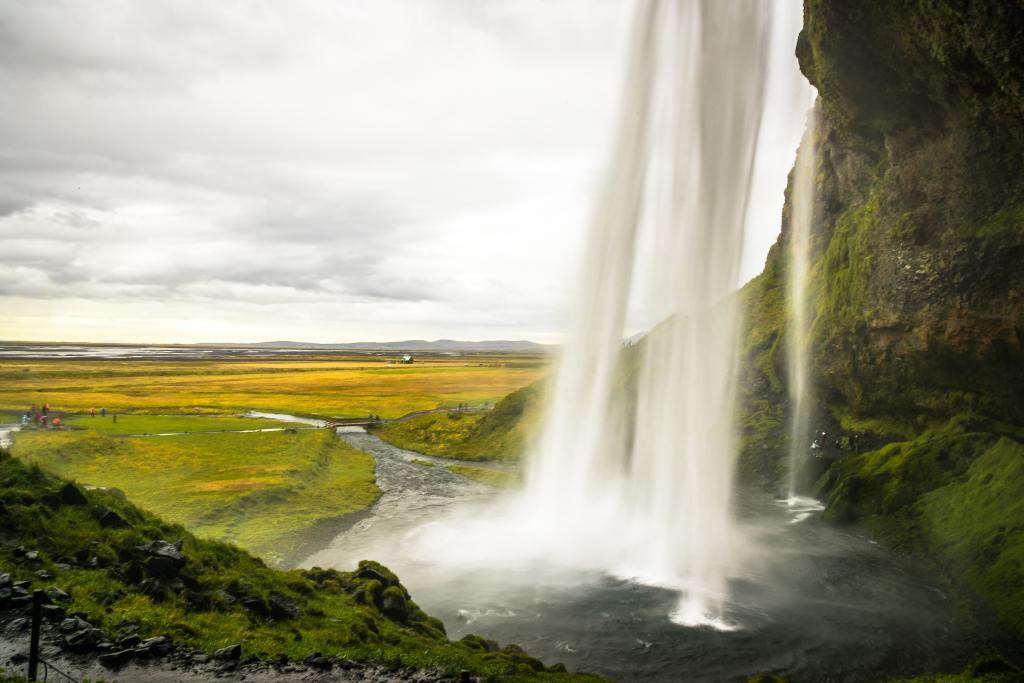
Scientifically, there are hypotheses that negative ions that are present in waterfalls increase serotonin levels, which ultimately enhances our mood. Wah! That’s great. And this geothermal water serves as a source too in the battle against water scarcity.
So, ready to stand together with the world to avoid the next world war?
LEED certification India is a hot topic these days. After engaging in different activities that harmed nature, its time we give our time to take care of mother earth from our busy schedule. Building certification is the testimony of that. LEED certification India is becoming essential for builders and developers aiming for green and sustainable buildings. Understanding the LEED India rating system helps projects meet environmental standards efficiently. This checklist offers a comprehensive guide. It walks you through the certification process in India step-by-step. This ensures you meet all the LEED certification requirements. This guide covers everything. It tells you the benefits of LEED certification and cost India.
Many projects aim for LEED Silver certification checklist standards to achieve recognized green building status. By following this guide, you can navigate the LEED certification process India smoothly and enjoy reduced costs, improved building performance, and positive environmental impact. Start your path to sustainable building success today with LEED certification India.
Okay, so what’s the big deal about LEED certification india? Is it different from other countries. For that let me quickly walk you through,
What’s leed certification india?
Leadership in Energy and Environmental design (LEED) is a building rating system established by US Green Building Council (USGBC) in 1998. The rating system awards points to a building in certain categories, with the leap towards eco- friendliness. V4.1, is the latest version of leed certification. It has universal standards, but some changes in countrywise. We are going to see how leed certification india works.
Now you know the leed cerfication India definition. Here’s the next question.
Is it worth being leed certified?
It will certainly take your building into the mountain of fame and the brand value skyrockets
It grows your business tremendously because customers will have a connect with you every time they approach your building for a service
It helps you to avoid the rat race with competitors, because you will have the unique advantage of the established benchmark of your responsibility to society.
The productivity of the employees or occupants will improve exponentially due to the features of the building.
The operation costs will downfall
After all, who doesn’t want to build a personal brand and be someone others want to replicate?
Now, I’m going to guide you through the simple steps to achieve this untold secrets of LEED.
Wait. Let me make the journey interesting for you. Imagine LEED as the favourite exam you have written in your life now.
Deal? Cool! Here we go.
How to get LEED certification India?
Outside the United States, many countries use the LEED certification India and local versions of LEED adapted by working with the U.S. Green Building Council (USGBC).
Countries like Brazil, China, Canada, India, the Philippines, and Spain have their own LEED India rating system adapted to local codes. Under this option, certification completes through the local system.
Alternatively, projects can pursue certification under the U.S. version of LEED, following U.S. codes and submitting documentation through the LEED online system.
To apply, begin by choosing the appropriate certification path—local adapted system or U.S. system—then submit project documentation through the LEED certification process India portal or the USGBC website, following the detailed LEED certification checklist relevant to your choice. This ensures compliance with either local or U.S. standards, unlocking the full benefits of LEED certification.
Now how do we apply for this?
LEED Certificaion India process comprises of 4 stages.
i. Register the building with the Green Building Certification Institute (GBCI). Although the U.S. Green Building Council develops and manages the LEED rating systems, the GBCI is responsible for all certification applications
ii. USGBC provides checklists for each rating system that cover the prerequisites and credits.
iii. USGBC’s LEED online system provides online templates that must be completed for each prerequisite and credit, and is used to upload supporting documentation.
iv. Submit the documents to the GBCI for review and certification
See, isn’t it easy to give it a shot?
We will look into the LEED certification india levels now.
leed Certified: 40 to 49 points
leed silver certification : 50 to 59 points
leed gold certification: 60 to 79 points
leed platinum certification: 80 + points
All good. You are one step away from being the owner or resident of the best of best buildings in the world. I will break out the whole pointing system and the step by step activities to achieve them henceforth.
There are different categories in the rating system with the type of the building such as new constructions, existing buildings, hospitals, schools etc. I will be explaining the rating system of an existing building which contains common fields among all the systems.
The table given below shows the leed certification checklist and requirements that determine the total scores.
Leed certification check list
At the end of every upcoming section, make a clear mental picture of how you would actually feel when you gain the points in real life. Trust me, that’s a very good feeling.
Location and transportation
LEED Certification – Transportation
According to the Study by world bank, transport currently accounts for a quarter of energy-related greenhouse gas emissions. Ouch! You and I must have put in a lot of effort to push transportation so hard that, it has reached at the coveted position (pun intended). Whatsoever, the latest version v4.1 of LEED rating system has placed transportation in the forefront to measure the eco friendliness of your building. The pointing structure is given below.
Transportation Performance Score
LEED Points
40 (Required)
6 (Required)
47
7
54
8
61
9
68
10
75
11
83
12
90
13
97
14
So how you can crack this?
Introduce telecommuting and compressed workweeks (Yes, what’s impossible with the technology you have.)
Commute in mass transit and make use of navel options such as rideshare.
Leverage human-powered conveyances, carpools, vanpools in the round trips.
Use low-emitting, fuel-efficient or alternative-fuel vehicles, walking or bicycling
Hey, we have confronted a major here. You have 14 points in handy now. Moving on,
2. Sustainable sites
We saw how to choose the most suitable site for your building in another blog on green building GREEN BUILDING: HOW TO MAKE A BUILDING GREEN AND BENEFITS OF A GREEN BUILDING. In this section, As the LEED full form says, they want you to be a leader and shower the wisdom of not disturbing nature. The section is subdivided into 6 categories.
i. Site management
You can grab the point by,
a. Monitor and eradicate invasive and exotic plant species from natural habitat areas.
b. Manage snow and ice in ways that limit degradation of water quality, surrounding plants and soil health from chemical deicer applications.
c. Prevent erosion by maintaining vegetative cover, and restore any eroded soils.
d. Reduce noise and air pollution resulting from gasoline powered equipment.
e. Divert from landfills 100% of plant material waste for composting reuse.
f. Reduce fertilizer use to only as needed for plant health applications based on soil testing. Eliminate preventive applications of herbicides, pesticides and fungicides applying only as needed for occurrences.
g. Prepare an Integrated Pest Management plan.
h. Add one or more inches of organic matter mulch, such as compost, to soil surfaces in planting areas annually.
i. Irrigate vegetation, other than planted containers, only with automatic controlled systems utilizing either rain shutoff, moisture sensing or weather based controls.
j. Monitor irrigation systems at least bi-weekly during the operating season and correct any leaks, breaks, inappropriate water usage, or incorrect timing.
k. Store materials and equipment to prevent air and site contamination
ii. Light pollution reduction
This is introduced to make sure that your building provides necessary features to improve the visibility of night sky.
To conquer this, you need to,
a. Shield all exterior fixtures such that the installed fixtures do not directly emit any light at a vertical angle more than 90 degrees from straight down
b. Measure the night illumination levels at regularly spaced points on the project boundary, taking the measurements with the building’s exterior and site lights both on and off.
iii. Heat island
Well, there are islands at different places around the globe. But the dangerous among them is the heat island, which is the increase in heat due to human (not humane) activities.
Not a good thing, right?
Hmm. How to score the point here?
For non-roofs,
Grow plants that provide shade over paving areas on the site
Vegetated planters.
Shade with structures covered by energy generation systems, such as solar thermal collectors, photovoltaics, and wind turbines.
Shade with architectural devices or structures Shade with vegetated structures.
Paving materials with a three-year aged solar reflectance (SR) value of at least 0.28.
Open-grid pavement system
If newly installed, plant material must be in place to provide full vegetative cover within 3-years.
Have in place a maintenance program that ensures all high-reflectance surfaces are cleaned at least annually to maintain good reflectance
iv. Rainwater management
If there is a lesson you were taught extensively from a very young age and still you have not embraced in your life, I bet that’s managing rain water. This is the wakeup call for you. Rise up and bring yourself to adopt those wonderful techniques. Make sure you do it right with the article RAINWATER HARVESTING; EVERYTHING YOU NEED TO KNOW
3. Water efficiency
LEED Certification – Water Efficiency
This section tests whether you adopt measures to reduce wastage of water and actually care for the universal liquid. The chart below shows the points for water performance score. If you adopt ways to conserve water, by presuming a life in every drop of water that gets wasted due to your water management practices, you can score full marks here.
The water performance score is calculated from the data shown by the energy meters in 12 months. Reboot yourself to get there.
Water Performance Score
LEED Points
40 (Required)
6 (Required)
44
7
50
8
57
9
64
10
70
11
77
12
84
13
90
14
97
15
4. Energy and atmosphere
Energy efficiency is a sister topic of every cost effective building. Well, buzz words are not always a good signage.
i. Energy efficiency best management practices
Take a tight grip on your energy management practices as follows.
a. Choose energy efficient appliances and electronics
b. Switch to energy efficient lighting sources
c. Reduce the energy consumption by sustainable construction practices
ii. Fundamental refrigerant management
This subsection takes into consideration the remedial measures to reduce ozone depletion. The best way is not use chlorofluorocarbon- based refrigerants in heating, ventilating, air-conditioning, and refrigeration. But if you have already had them, you really need to be cautious about this.
iii. Energy performance
In energy performance, the total score of 33 splitted as 16.5 leed points for green gas emissions and the remaining for source energy. Reduce the total building energy consumption arising from electricity, natural gas, chilled water, steam, fuel oil, etc.
iv. Enhanced refrigerant management
To gain the scores, do not use refrigerants, or use only refrigerants (naturally occurring or synthetic) that have an ozone depletion potential of zero and a lower global warming potential as I said before.
v. Grid harmonisation
Let’s go straight into how to manage this sticky spot.
a. Implement techniques to make energy generation and distribution systems more efficient, increase grid reliability, and reduce greenhouse gas emissions
b. Participate in demand response techniques that provide an opportunity for consumers to shift their electricity usage during peak periods in response to time-based rates or other forms of financial incentives.
c. Have infrastructure in place to take advantage of future demand response programs or dynamic, real-time pricing programs.
d. Develop a comprehensive plan for shedding at least 10% of the annual on-peak electricity demand.
You know, you have earned 63 scores so far. Good.
5. Materials and resources
LEED Certification – Materials and Resources
There are 4 subsections to this.
i. Purchasing policy
You need to initiate activities to reduce the environmental impacts of materials and products purchased during operations and maintenance of building. Have in place an environmentally preferable purchasing policy for materials and products purchased for the project during regular operations including ongoing consumables such as the five most purchased product categories based on total annual purchases, batteries, food and beverage and electronic equipment such as lamps, office equipment and appliances.
ii. Facility maintenance and renovations policy
Here, take action to reduce harming environment during purchase of items while renovating which can be,
a. Adopting a policy for waste management for safe storage, recycling and diversion of waste and also for furniture waste management during renovations.
b. Protecting stored on-site and installed absorptive materials from moisture damage.
c. Developing a plan to determine whether a flush-out or air quality testing is needed after construction ends and all interior finishes are installed but before occupancy.
iii. Waste performance
Track and reduce the waste generated aiding proper disposal or incineration.
iv. Purchasing
The points to keep in mind while purchasing products are,
a. Opt for recycled and reusable materials and products, those having extended use, bio- based products especially during construction and paper and wood products
b. Choose electronic components with energy star rating
c. Have locally sourced, promoting sustainable agriculture and organic food
d. And never mind about wine, beer, and liquor purchases in the point calculations.
6. Indoor environmental quality
LEED Certification – Environmental quality
The quality of air comes next.
i. Minimum indoor air quality
For spaces with mechanical exhaust, test and confirm proper operation of the exhaust systems
ii. Environmental tobacco smoke control
This can be tamed with the following considerations.
a. Prohibit smoking in the building.
b. Prohibit smoking outside the building except in designated smoking areas from all entries, Also prohibit smoking outside the property line in spaces used for business purposes.
c. Communicate the no-smoking policy to occupants of the building and have in place provisions for enforcement.
iii. Green cleaning policy
Yes, again another policy. You need to promote the following in the policy.
a. Standard operating procedures for effective cleaning of hard floors and carpets that will be consistently used, managed, and audited.
b. Provisions for addressing protection of building occupants during cleaning, including vulnerable populations.
c. Guidelines for selection and appropriate use of disinfectants and sanitizers.
d. Guidelines for safe handling and storage of cleaning chemicals used in the building, including a plan for managing hazardous spills and mishandling incidents.
e. Strategies for reducing the toxicity of the chemicals used for laundry, ware washing, and other cleaning activities.
f. Strategies for conserving energy, water, and chemicals during cleaning.
iv. Indoor environmental quality performance
Points for indoor environment quality are awarded based on the results from the CO2 and TVOC measurements. You have no worries here since you have prepared well for the test.
v. Green cleaning
USGBC wants to check your performance in cleaning the building through this step.
a. Perform routine inspection and monitoring of the facility’s green cleaning policy to verify that the specified strategies are being used and to identify areas in need of improvement.
b. Conduct an annual audit to evaluate yourself
c. Have in place permanent entryway systems in the primary direction of travel to capture dirt and particulates entering the building at regularly used exterior entrances.
vi. Integrated pest management
This is to minimize pest problems and exposure to pesticide. You can use integrated pest management services for the building and grounds within the project boundary that is certified and in good standing with GreenPro, EcoWise, GreenShield, or local equivalent.
6. Innovation
LEED Certification – Innovation
This is to encourage projects to achieve exceptional or innovative performance. To encourage integration of LEED expertise and collaboration toward project priorities.
So, have you decided to test the relationship between your bulding and nature through leed?
WHAT’S TRENDING
Welcomhotel Amritsar, the hospitality chain’s leisure upper-upscale property becomes Punjab’s first LEED platinum certified hotel
USGBC released Annual LEED-Certified Ranking list of buildings for 2019 and Colorado topped the list with 102 certified projects.
GBCI released the list of top 10 states for LEED (Leadership in Energy and Environmental Design) in India today and Maharashtra topped in the project with 307 projects as of December 2019.
Vincivil FAQ Corner
A. Lead certification course
These are courses done to become a green associate who can build up a career on consultancies exploiting the current green building principles and practices. There are plenty of courses out there like the online courses offered by Udemy.
B. Leed certification India
GBCI manages the certification process for all LEED rating systems in India, including the LEED India rating system.
Leed green association exam is the required exam. See the complete details in https://www.usgbc.org
Buildings with leed certification
There are a lot of leed certification buildings around the world and list grows at a good pace every year. Salt Lake City Library, Salt Lake City, Soldier Field in Chicago, One Bryant Park in New York City, Shanghai Tower in China are famous among them.
Credits: The technical specifications annotated in the blog post is taken from the website of USGBC (https://www.usgbc.org)
Disclaimer: The blog is intended to assist those who wish to get their building LEED Certified and the shared knowledge other than the technical specifications is strictly upon the knowledge of the author. We can’t take the responsibility of any sort of discrepancy pertaining to this in future.