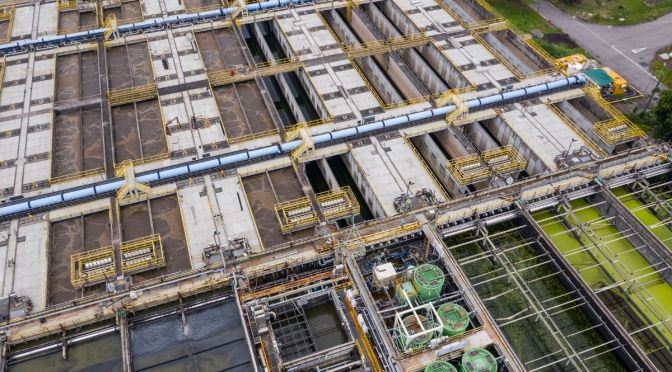
Activated Sludge Process – Stages and Process Control

The activated sludge process is a widely used and highly effective method in wastewater treatment, employing aerobic microorganisms to remove organic pollutants efficiently. This guide covers the activated sludge process definition, stages, and diagram, while explaining its role in secondary wastewater treatment for producing high-quality effluent. You will understand how aeration tanks, wastewater treatment microorganisms, mixed liquor suspended solids (MLSS), and return activated sludge (RAS) work together to maintain stable and efficient system performance. The activated sludge process in wastewater treatment relies on proper aeration, controlled sludge recycling, and effective process monitoring. Due to its reliability, adaptability, and high treatment efficiency, activated sludge wastewater treatment remains the preferred choice for many municipal and industrial wastewater treatment plants, ensuring consistent performance and environmental compliance.

Activated Sludge Process is a globally used wastewater treatment technique. In the previous blogs, I had shown you the various secondary wastewater treatment techniques. In this blog, we will dig deep into this widely used technique of activated sludge process, its configuration, process control and aeration methods.

Activated sludge Process – Definition

The activated sludge process is a type of wastewater treatment that uses aeration. It involves a biological floc made up of bacteria and protozoa to clean sewage or industrial waste waters. This process is biological and has various applications. It includes oxidising carbonaceous biological matter. Additionally, it deals with nitrogenous waste in the biological matter, mostly ammonium and nitrogen.

Before starting make sure that you take a quick glance through the blog, Wastewater Treatment- Stages and Process full details for better understanding
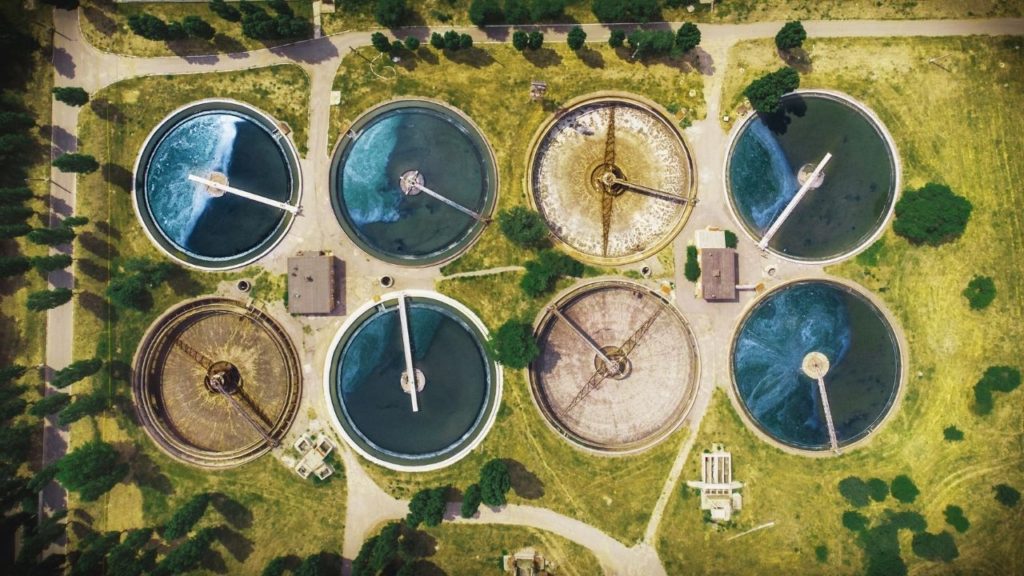
Aerial view of multiple circular wastewater treatment tanks with varying water clarity, surrounded by greenery.
Aerial view of multiple aeration tanks used in the activated sludge process for wastewater treatment.

The activated sludge process employs aerobic microorganisms that can digest organic substances in sewage. Also, they have the ability to cluster together via flocculation. The flocculated particles settle out as sludge. As a result, the liquid coming out is relatively free of suspended solids and organic matter.

Activated Sludge Process – Stages, Configuration, and Diagram

The activated sludge process is a widely used secondary wastewater treatment method. It removes carbonaceous organic pollution through aerobic biological activity. The configuration of an activated sludge wastewater treatment system consists of interconnected units that operate together to ensure efficient treatment.

Aeration Tank

The aeration tank is the heart of the activated sludge process in wastewater treatment. Primary treated sewage is mixed with microorganisms, forming mixed liquor suspended solids (MLSS). Air or oxygen is supplied using diffusers or mechanical aerators to support aerobic microbes. These microorganisms consume organic matter and convert it into stable end products.

Secondary Settling Tank (Secondary Clarifier)

The mixed liquor flows into the secondary settling tank, where biological flocs settle by gravity. Clarified effluent overflows for further treatment or discharge. Settled sludge collects at the bottom.

Sludge Recycling System

A portion of the settled sludge is returned as Return Activated Sludge (RAS) to maintain microbial concentration in the aeration tank. Excess sludge is removed as Waste Activated Sludge (WAS) to control sludge age and system stability.

Advanced control systems regulate aeration, sludge recycling, and flow rates, ensuring stable and efficient secondary wastewater treatment performance.

Now, how about looking deep into what happens inside an activated sludge process?

Diagram illustrating the activated sludge process, featuring an aeration tank, mixed liquor, secondary clarifier, return activated sludge (RAS), and waste activated sludge (WAS).
Diagram illustrating the activated sludge process, featuring the aeration tank, secondary clarifier, mixed liquor, return activated sludge (RAS), and waste activated sludge (WAS) pathways.

Activated Sludge Process Steps

The activated sludge process operates through a series of well-defined stages that enable effective secondary wastewater treatment. Each stage supports biological activity, sludge separation, and recycling to achieve high organic pollutant removal and regulatory compliance.

  • After primary treatment, wastewater enters into an aeration tank. A portion of sludge from the secondary settling tank also enters.
  • Organic matter comes into close contact with sludge from the secondary settling tank. Sludge is densely populated with microorganisms that are actively growing.
  • Diffusers or surface aerators inject air in the form of bubbles into the sewage-sludge mixture.
  • Microorganisms break down organic matter into stable chemicals like NO3, SO4, and CO2 while also producing new bacterial cells.
  • The effluent along with the actively growing microbial population passes to the secondary settling tank.
  • The secondary settling tank separates the aeration tank’s effluent, which contains flocculent microbial matter into supernatant and sludge. The treated supernatant undergoes further treatment before discharge.
  • This sludge from the settled waste returns to the aeration system’s inlet to re-seed the new wastewater reaching the tank. Return activated sludge (R.A.S.) is the fraction of the floc that returns to aeration tank.
  • The remaining sludge goes to sludge digesters for further treatment and safe disposal.

“Mixed liquor” refers to the combination of the liquid and microorganisms in the aeration tank. The suspended solids are called “Mixed Liquor Suspended Solids” (MLSS).

In the next section, we will find out the basic process control parameters in an activated sludge process.

Close-up of foam and sediment in a wastewater treatment process, illustrating the activated sludge process used for organic pollutant removal.
Foamy surface of wastewater during the activated sludge process, illustrating the aeration and microbial activity involved in organic matter treatment.

Process Control in Activated Sludge Process

The general process control method monitors the following variables:

  • Sludge Volume Index (SVI)
  • Mean Cell Residence Time (MCRT)
  • Food to Microorganism Ratio (F/M)
  • Dissolved oxygen (DO)
  • Biochemical oxygen demand (BOD)
  • Chemical oxygen demand (COD)

Let me explain these parameters in detail.

Sludge Volume Index

Sludge Volume Index measures the volume of settled sludge in milliliters. This volume is occupied by 1g of dry sludge solids after 30 minutes of settling in a 1000 milliliter graduated cylinder. It gives a measure of the settling ability of the sludge. SVI ranges from 40 to 100 for a good sludge which settles down easily. Bulking Sludge is a biomass consisting of filamentous organisms with very poor settling characteristics. For a bulking sludge, SVI value can exceed 200. Sufficient pH control, adequate aeration and addition of hydrogen peroxide to the aeration tank prevents bulking.

Mean Cell Residence Time

Mean Cell Residence Time is the ratio of total mass (lbs) of mixed liquor suspended solids in the aerator and clarifier to the mass flow rate (lbs/day) of mixed liquor suspended solids leaving as final effluent.

Food to Microorganism Ratio

The Food to Microorganism Ratio indicates how much organic matter is fed to the microorganisms each day. It is relative to the mass of microorganisms under aeration. In other words, it is the ratio of the amount of BOD fed to the aerator (lbs/day). It is compared with the amount (lbs) of Mixed Liquor Volatile Suspended Solids (MLVSS) under aeration. 

Main Control Parameters

The mean cell residence time and F/M Ratio are the main control parameters used industrially. Both are directly related to the effluent quality. However, it is tedious to control the plant on the basis of the F/M ratio since it necessitates a lot of laboratory work to find the BOD and MLSS in the system. Therefore, the mean cell residence time is the best choice for controlling an activated sludge system.

Now you got an idea about the entire process and its important parameters. Next, we move on to the various aeration methods.

Aeration Methods in Activated Sludge Process

The decomposition of organic waste requires a very high concentration of oxygen at the initial stages of contact between microorganisms and the organic matter. The conventional systems usually maintain a plug flow hydraulic regime and keeps aeration and a mixing at an uniform rate along the entire tank. As a result, the oxygen concentration drops rapidly in the inlet and this can harm the microbes.

At the outlet, there is a surplus of oxygen which is not necessary and leads to economical losses. In order to match the oxygen supply and demand along the entire journey of wastewater from inlet to outlet, the mode of aeration needs some modifications. Let’s have a look at the different aeration methods in an activated sludge process.

Diffused Aeration

Sewage liquor is pumped into large tanks with floor-mounted diffuser grid aeration devices. Passing air creates a curtain of bubbles that oxygenates the liquor while also mixing it. An air blower usually creates the air. Oxygen replaces air for unusually strong and difficult to treat sewage.
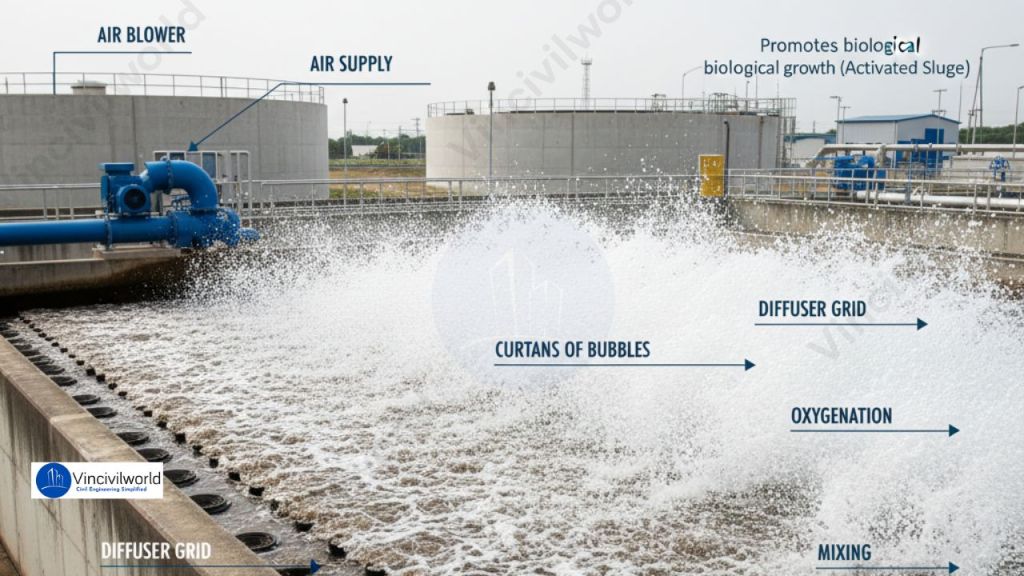
Aeration tank in activated sludge process featuring air supply and diffuser grid for oxygenation, promoting biological growth with visible bubbles.
Diffused aeration system in activated sludge process, promoting oxygenation and biological growth.

Tapered Aeration

The organic waste needs more oxygen at the inlet. As it degrades progressively its oxygen demand decreases. Tapered aeration works on this principle. Aeration is intense at the inlet and decreases progressively along the length of the aeration tank. As this method involves the more efficient use of air, it results in savings in the pumping costs too.

Step Aeration

This method aims to equalize the oxygen supply and its demand. It introduces fresh feed at several points in the aeration tank, while keeping the rate of oxygen supply constant. This ensures a more even oxygen distribution over the entire tank and throughout the aeration stage. Baffles divide the aeration tank into several channels with each channel representing one step of the process.

Complete Mix Activated Sludge Process

In complete mix process, the aeration tank receives a mixture of fresh feed and recycled sludge at several locations within the tank. This ensures a constant supply and demand of oxygen along the length of the tank.

Contact Stabilisation

The microbial mass comes in contact with wastewater for short durations of time, approximately 0.5 to 1 hour in the biosorption unit. An anaerobic digestion unit stabilizes the resulting sludge after a retention period of about 2-3 hours. In the digestion unit, microbes consume the organic wastes removed in the biosorption unit. Since we stabilize the return sludge with higher solid concentrations, this reduces the volume of the aeration tank.

Pure Oxygen Activated Sludge Process

This type of activated sludge process supplies pure oxygen instead of air. It recirculates this oxygen into well mixed and converted chambers. Conventional processes utilize only 5-10% of oxygen. In contrast, the pure oxygen activated sludge process ensures about 90% utilization of oxygen. Further, it results in higher bacterial activity, lower sludge volume and sludge with better settling characteristics.

That’s it about activated sludge process. Let us know in the comments if you wish to know more.

Key Takeaways

  • The activated sludge process effectively treats wastewater using aerobic microorganisms to remove organic pollutants.
  • Key stages include aeration tanks, secondary settling tanks, and sludge recycling to maintain treatment efficiency.
  • Proper aeration and control parameters like SVI and F/M Ratio are essential for optimal performance.
  • Various aeration methods, such as diffused and tapered aeration, improve oxygen supply and microbial activity.
  • This process provides a reliable solution for secondary wastewater treatment, ensuring cleaner effluent.

Conclusion

The activated sludge process is a proven method for secondary wastewater treatment. It is highly efficient and used worldwide. This process removes organic pollutants from sewage and industrial wastewater. This process promotes aerobic microbial activity in aeration tanks. It achieves effective BOD reduction, suspended solids removal, and stable effluent quality. Proper control of operational parameters, such as dissolved oxygen, MLSS, and sludge age, ensures consistent system performance. It also prevents common issues like sludge bulking. With multiple activated sludge process configurations and aeration methods, the system can adapt to varying wastewater loads and treatment requirements. Due to its flexibility, reliability, and high treatment efficiency, the activated sludge process remains a cornerstone of modern biological wastewater treatment systems and sustainable water management.
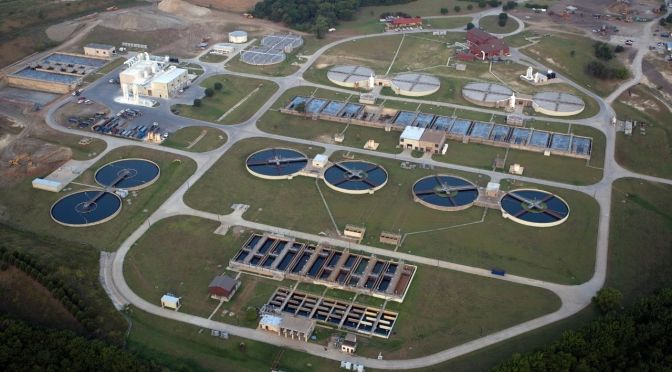
Secondary Treatment for Wastewater – Methods and Process

Secondary wastewater treatment uses biological processes to remove dissolved and suspended organic pollutants from sewage. It follows primary treatment and greatly lowers BOD levels. Microorganisms break down waste and improve water quality. This process creates cleaner effluent for discharge or reuse. Secondary treatment of sewage relies on activated sludge systems and trickling filters. These biological wastewater treatment methods work with constant aeration. The wastewater aeration process keeps microorganisms active and effective. Plants use aeration tanks and clarifiers for stable operation. Types of secondary wastewater treatment include activated sludge, oxidation ditches, SBR systems, and trickling filters. Each system supports reliable pollutant removal in municipal and industrial plants. Operators use the secondary treatment process in sewage treatment plants to reduce pathogens and organic matter. Advantages of secondary wastewater treatment include higher efficiency and better environmental protection. Secondary treatment vs tertiary treatment differs by the degree of purification offered.

n this blog, I will walk you through various biological methods used in the secondary treatment of wastewater. Before diving deep into the biological treatment processes, make sure you understand the entire wastewater treatment process. So please go through our blog,

 Wastewater Treatment- Stages and Process full details.

  1. What is Secondary or Biological treatment for wastewater?
    1. Anaerobic Wastewater Treatment
    2. Aerobic Wastewater Treatment
      1. Biochemical Oxygen Demand
  2. Types of Secondary or Biological wastewater Treatment Methods
    1. Trickling Filter in Secondary wastewater treatment
    2. Oxidation Ponds
    3. Oxidation Pond Configurations
      1. Anaerobic Pond
      2. Facultative Pond
      3. Maturation Ponds
    4. Activated Sludge wastewater treatment Process
    5. Anaerobic sludge blanket reactors
  3. Conclusion

What is Secondary or Biological treatment for wastewater?

Secondary or biological treatment for wastewater uses bacteria to remove dissolved and suspended organic pollutants. These microorganisms consume organic matter as food and convert it into carbon dioxide, water, and energy for growth. This process reduces BOD and improves water quality in the secondary treatment of sewage. It also protects the dissolved oxygen balance in rivers, lakes, and receiving streams. Biological wastewater treatment methods work in controlled environments inside treatment tanks. Operators maintain proper aeration, mixing, and retention time to keep microorganisms active. The wastewater aeration process plays a major role in activated sludge systems and other types of secondary wastewater treatment.

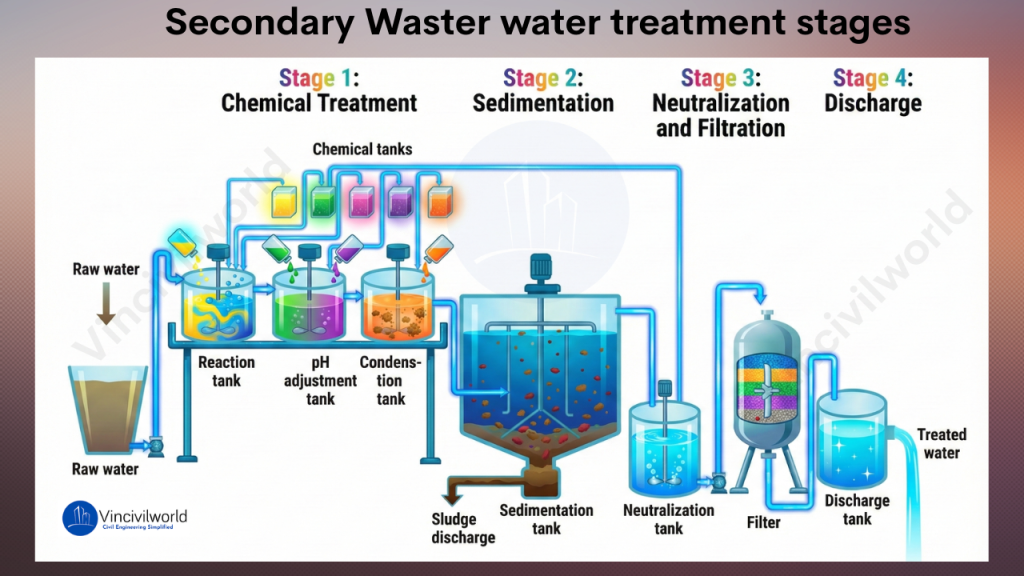
A diagram illustrating the stages of secondary wastewater treatment, including chemical treatment, sedimentation, neutralization and filtration, and discharge. It shows various tanks and processes involved in each stage.
Illustration of the secondary wastewater treatment stages, including chemical treatment, sedimentation, neutralization and filtration, and discharge of treated water.

The Biological treatment or decomposition of organic matter takes place in two ways as shown below:

  • Anaerobic Wastewater treatment
  • Aerobic Wastewater treatment

Anaerobic wastewater treatment works without oxygen and produces biogas. Aerobic wastewater treatment uses oxygen and supports faster decomposition. Both methods enhance the secondary treatment process in sewage treatment plants, and moreover, they ensure efficient pollutant removal.

Anaerobic Wastewater Treatment

Anaerobic wastewater treatment uses anaerobic microorganisms to break down and remove organic pollutants from wastewater. The anaerobic wastewater treatment process consists of two major stages:

  • Acidification
  • Methane generation
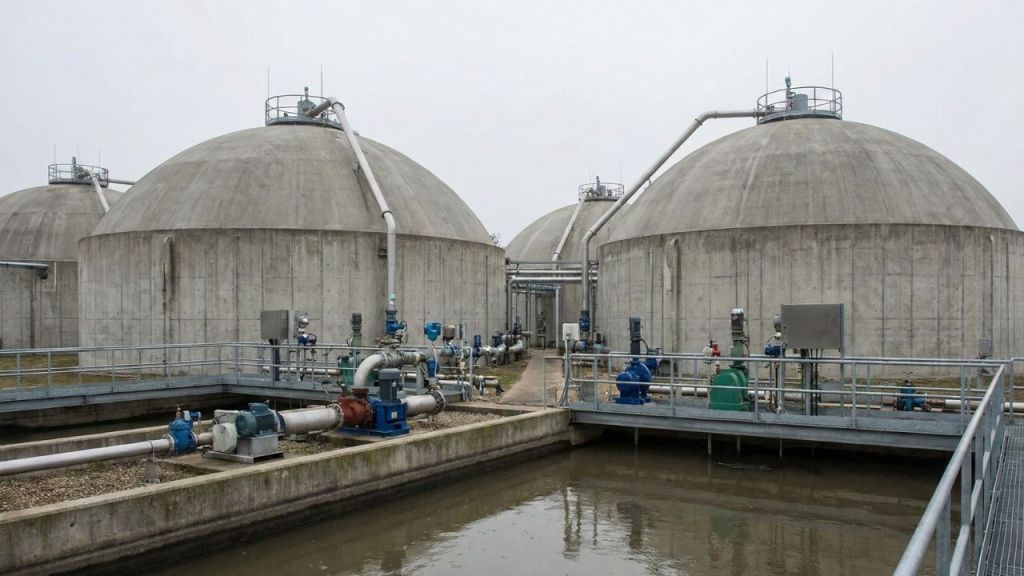
Concrete anaerobic digesters at a wastewater treatment facility, with pipes and pumps visible for managing sewage processing.
Anaerobic treatment tanks used in secondary wastewater treatment to break down organic matter.

In the initial acid-forming or acidification phase, anaerobes convert complex organic molecules into simpler, short-chain volatile organic acids. The second stage, known as the methane-production phase, includes two key steps:

  • Acetogenesis
  • Methanogenesis

During acetogenesis, anaerobes transform organic acids into acetate, hydrogen gas, and carbon dioxide. In the methanogenesis step, microbes react with these products to generate methane gas and carbon dioxide, completing the anaerobic treatment process.

Anaerobic systems are widely used for treating wastewater streams with high organic loads and warm temperatures. They offer several advantages over aerobic or biological wastewater treatment methods, including lower sludge production and the generation of valuable energy-rich by-products.

Aerobic Wastewater Treatment

Aerobic wastewater treatment uses oxygen-dependent microorganisms to break down organic pollutants efficiently. Furthermore, this biological treatment process involves aeration tanks where microbes oxidize waste, producing cleaner effluent. As a result, aerobic wastewater systems offer fast decomposition, stable operation, and high treatment efficiency, making them ideal for municipal and industrial aerobic wastewater treatment processes.

The aerobic wastewater treatment systems use oxygen-feeding microorganisms to clean water. These systems take advantage of the natural microbial decomposition process to break down industrial wastewater pollutants and remove them.

Biochemical Oxygen Demand (BOD) is directly related to aerobic wastewater treatment. It measures the amount of oxygen microorganisms need. This oxygen is necessary to break down organic pollutants.

Biochemical Oxygen Demand

The biochemical oxygen demand (BOD) provides a clear measure of the organic pollutants decomposed by bacteria during wastewater treatment. BOD refers to the amount of dissolved oxygen required by aerobic organisms to break down organic matter into smaller molecules. Additionally, high BOD values indicate a greater concentration of biodegradable material in the wastewater, signaling increased organic pollution levels.

Aerobic digestion is preferred for large quantities of dilute wastewater with BOD₅ < 500 mg/L. It is suitable for most aerobic wastewater treatment systems. For highly polluted wastewater streams with BOD₅ > 1000 mg/L, anaerobic digestion is recommended. It handles stronger organic loads more efficiently.

Types of Secondary or Biological wastewater Treatment Methods

The three most commonly used type of aerobic secondary wastewater treatment procedures for are listed below:

  • Trickling filter
  • Oxidation pond
  • Activated sludge wastewater treatment
  • Moving Bed Biofilm Reactor (MBBR)

Now, let’s dig deeper into their features and working. Off, we go.

Trickling Filter in Secondary wastewater treatment

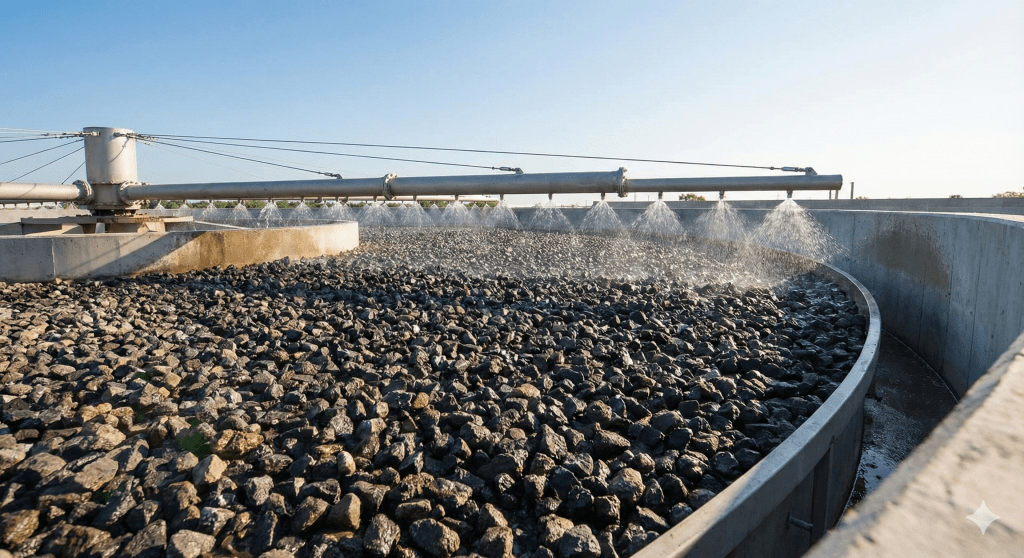
A trickling filter is an aerobic secondary wastewater treatment system. It uses a microbial biofilm attached to filter media to break down and remove organic pollutants. This biological wastewater treatment method is called an attached-growth process. In contrast, suspended-growth systems keep microorganisms mixed within the effluent. Trickling filters offer stable performance, effective BOD reduction, and low operational complexity, making them a reliable option in modern secondary wastewater treatment processes.

A trickling filter system for wastewater treatment showing a circular tank filled with rocks, with a spray mechanism distributing water over the surface.
A trickling filter system used in secondary wastewater treatment, showcasing a microbial biofilm attached to filter media for effective organic pollutant removal.
  • A trickling filter consists of a fixed bed of rocks, coke, gravel, slag, polyurethane foam, sphagnum peat moss, ceramic, or plastic media.
  • As wastewater trickles down, bacteria attach to the media and form a microbial slime layer (biofilm).
  • The continuous flow of sewage over the biofilm allows microbes to consume dissolved organic pollutants.
  • They release carbon dioxide, water, and other oxidised end products as wastewater passes over the media.
  • This process lowers the sewage’s biochemical oxygen demand (BOD).
  • Air moving upward through the media crevices supplies oxygen required for aerobic microbial activity.
  • The biofilm absorbs and adsorbs organic compounds and inorganic ions such as nitrite and nitrate.
  • The biofilm layer needs dissolved oxygen for effective biological oxidation.
  • As the biofilm thickens, available oxygen depletes before reaching the lower layers.
  • Anaerobic conditions develop at the base of the slime layer.
  • Microbes enter a decay stage and lose their ability to attach.
  • The biofilm detaches and becomes part of the secondary sludge, a process known as sloughing.
  • Trickling filters are widely used in milk processing, paper mills, and pharmaceutical wastewater treatment.

Ever heard of a pond which treats wastewater? Let’s look at what’s happening inside such oxidation ponds.

Oxidation Ponds

Oxidation ponds are artificial ponds that treat wastewater through the combined action of sunlight, microbes, and oxygen to reduce organic content and pathogens. Moreover, this waste stabilization pond uses microbes to stabilise residential, commercial, and industrial wastes. Typically, it appears as a shallow treatment pond with a water depth of 2–6 feet.

Industrial or domestic wastewater enters the oxidation pond through the inlet system. Bacteria then convert biodegradable organics into inorganic molecules through microbial interaction, producing carbon dioxide. Common bacteria in these stabilisation ponds include Achromobacter, Proteus, Alcaligenes, Pseudomonas, Thiospirillum, and Rhodothecae.

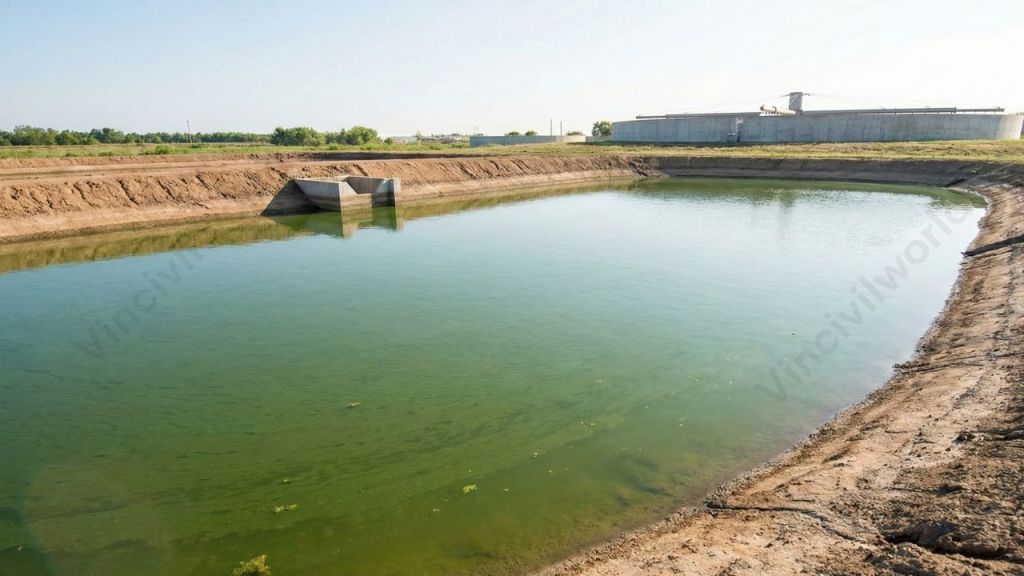
A shallow oxidation pond for wastewater treatment, showcasing water with visible aquatic vegetation and a concrete inlet structure, surrounded by earth banks.
An oxidation pond used for biological wastewater treatment, combining sunlight, microbes, and oxygen to reduce organic content and pathogens.

Anaerobic bacteria first convert insoluble organic waste into soluble organic acids such as ethanol without oxygen. These acids are further decomposed, releasing H₂S, NH₃, CH₄, CO₂, and other gases. Non-biodegradable solids settling at the bottom form sludge.

Most ponds require both bacteria and algae to maximise the breakdown of organic matter and remove contaminants. Algae produce oxygen during photosynthesis and leave an excess amount. Aerobic bacteria use this oxygen for respiration and oxidation of organic matter.

Treated water exits through the pond’s outlet system. Dredging removes accumulated sludge from the pond. Filtration or a combination of chemical treatment and settling removes algal and bacterial biomass.

Now, let’s move on to the various configurations of oxidation ponds.

Oxidation Pond Configurations

Waste stabilization ponds are artificial basins designed for biological wastewater treatment, consisting of single units or multiple series of anaerobic, facultative, or maturation ponds. Moreover, the main oxidation pond configurations used in wastewater treatment are:

  • A single facultative pond.
  • An anaerobic pond followed by a facultative pond.
  • A facultative pond followed by maturation ponds in series.
  • A series of maturation ponds preceded by an anaerobic pond and a facultative pond.

These configurations help optimise performance in waste stabilization pond systems.

Anaerobic Pond

Anaerobic ponds are deep ponds (usually 3.0 to 5.0 m) that receive raw wastewater. Most of the solid matter in the wastewater settle to the bottom as sludge. Due to the depth of the pond, oxygen can’t penetrate to the bottom of the pond. Thus the sludge digestion takes place under anaerobic conditions.

Facultative Pond

After coming out of an anaerobic pond, the remaining solid particles in the wastewater settles into a larger but shallow pond called a facultative pond. Air and sunlight kill the harmful germs in the wastewater and makes it less dangerous to the aquatic flora and fauna.

Maturation Ponds

Maturation ponds are two or three ponds in series wherein sunlight and oxygen destroy more harmful germs and make the liquid fit enough to be released for irrigation or into a river. Moreover, the higher the number of maturation ponds, the cleaner the effluent becomes.

Activated Sludge wastewater treatment Process

The Activated Sludge wastewater treatment method employs aerobic microorganisms that can digest organic substances in sewage. Also, they have the ability to cluster together via flocculation. The flocculated particles settle out as sludge. As a result, the liquid coming out is relatively free of suspended solids and organic matter.

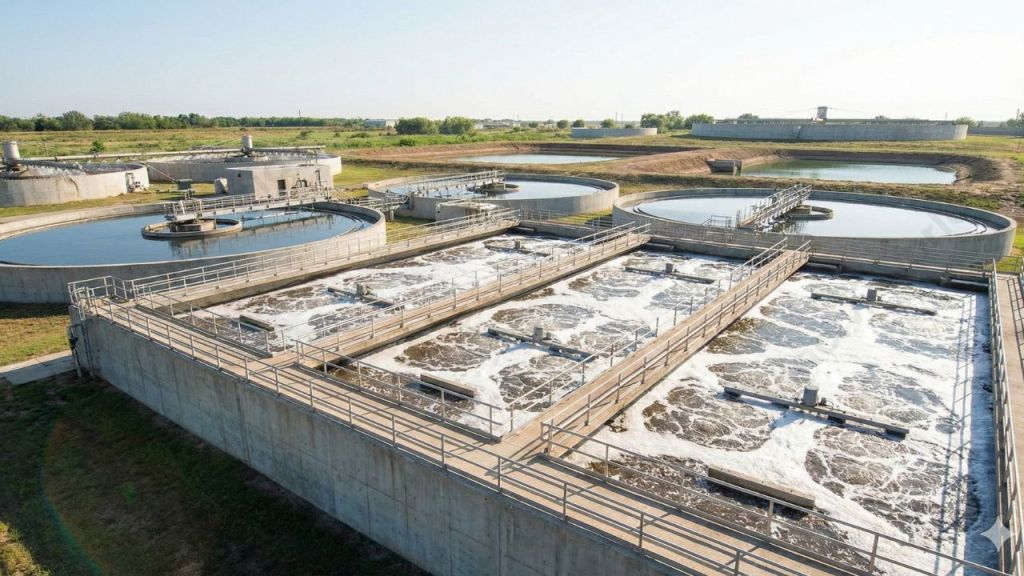
Aerial view of a wastewater treatment facility with several circular and rectangular tanks, featuring flowing water and foam, used for secondary treatment processes.
Overview of an activated sludge wastewater treatment plant, showcasing aeration tanks and clarifiers for effective pollutant removal.

The sludge blanket becomes Return Activated Sludge (RAS) once it has settled. Then, the RAS returns to the primary clarifying tanks, where the bacteria in it aid in the breakdown of organic waste in the entering sewage.

Anaerobic sludge blanket reactors

  • A popular method used in the anaerobic secondary treatment for water.
  • The wastewater is carried across a free-floating “blanket” of suspended sludge particles in sludge blanket reactors, which are a type of anaerobic treatment.
  • Anaerobes in the sludge multiply and accumulate into larger granules that settle to the bottom of the reactor tank and can be recycled for future cycles as they decompose the organic contents in the wastewater.
  • The treated effluent rises and exits the unit.
  • Throughout the treatment cycle, collection hoods collect biogases produced by the degradation process.

Shall we wrap up?

Key Takeaways

  • Secondary wastewater treatment uses biological processes to remove organic pollutants through methods like activated sludge and trickling filters.
  • Anaerobic and aerobic treatments both improve water quality, with anaerobic processes operating without oxygen and producing biogas.
  • Trickling filters employ a biofilm of microbes on media to reduce biochemical oxygen demand (BOD) and purify wastewater.
  • Oxidation ponds rely on sunlight, microbes, and oxygen to treat wastewater, showcasing various configurations for effectiveness.
  • Activated sludge processes involve aerobic microorganisms that cluster together, aiding in the removal of suspended solids and organic matter.

Conclusion

We explored the key secondary wastewater treatment methods, including the trickling filter system, oxidation pond process, activated sludge process, and anaerobic sludge blanket reactors. Each of these biological wastewater treatment methods plays a crucial role in reducing organic pollutants, lowering BOD levels, and improving overall effluent quality. The sludge produced from these secondary treatment units undergoes dewatering and digestion to reduce volume and enhance stability. Afterward, the dried sludge is commonly used in landfills or converted into nutrient-rich fertilizer, supporting sustainable wastewater treatment and reuse practices. Ultimately, these methods strengthen modern secondary wastewater treatment systems and ensure reliable environmental protection.

That’s it about secondary treatment methods for wastewater. Hope you found it informative.

Consistency test on cement – Significance and Procedure

The standard consistency test of cement is a crucial procedure for determining the precise quantity of water needed to create a workable paste, which is essential for subsequent laboratory tests. This test utilizes a Vicat apparatus to find the water content that allows the plunger to penetrate the paste to a specified depth, thus defining the normal consistency of cement. Establishing this value is a necessary step before conducting other important tests like setting time, soundness, and compressive strength, all of which rely on a correct water–cement ratio.

Understanding the significance of the consistency test helps one appreciate its influence on key concrete properties such as workability, strength development, and durability. By providing a clear explanation of the test’s procedure—from trial mixes to the final penetration reading—this article serves as a valuable guide for students, site engineers, and quality controllers. It aims to assist them in performing reliable laboratory work, ultimately ensuring high-quality cement performance in structures.

  1. Significance of cement tests
    1. Field tests of cement
    2. Laboratory tests
  2. Significance of Consistency test on Cement
  3. Relevant IS code for consistency test on cement
  4. Apparatus used for consistency test on cement
  5. Procedure of consistency test for cement (As per IS 4031 Part 4)
  6. Calculation
  7. Consistency of cement test procedure – Standards comparison
  8. Precaution
  9. Conclusion

Significance of cement tests

Cement is a key construction material used in buildings, bridges, and infrastructure. It forms concrete and mortar, and it directly influences the strength, durability, and performance of structures.

Cement is a key construction material, so its quality must be checked before use. Cement tests generally fall into two types: laboratory tests and field tests. Field tests are simple, quick checks that do not require special equipment or expertise. They help to judge whether cement can be accepted for work.

Field tests of cement

  • Checking manufacturing date
  • Visual lump check
  • Feel test (smoothness)
  • Heat test
  • Colour check
  • Water float test
  • Setting test

These tests provide approximate but useful quality indications.

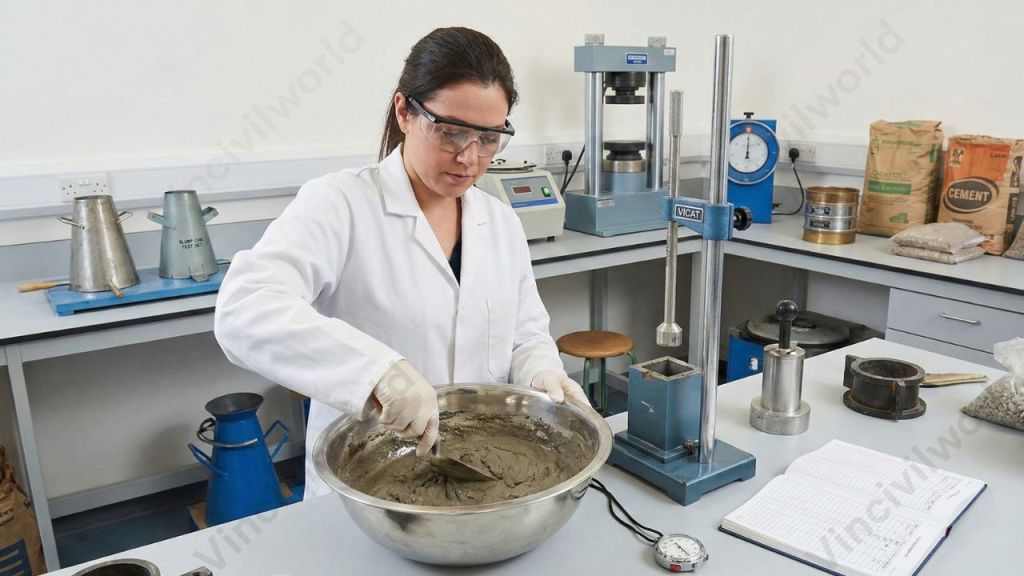
A laboratory technician wearing safety goggles and gloves mixes cement paste in a large bowl, with a Vicat apparatus and various testing equipment visible in the background.
A technician performing the standard consistency test of cement using a Vicat apparatus in a laboratory setting.

Laboratory tests

Laboratory tests provide detailed and accurate assessment of cement quality under controlled conditions , essential before use in structural works. Common lab tests for cement include:

  • Standard consistency test of cement
  • Initial and final setting time test
  • Soundness test (e.g., Le Chatelier method)
  • Fineness test (e.g., sieve or Blaine method)
  • Strength test (e.g., compressive strength of cement mortar)
  • Heat of hydration test (for some cements)
  • Chemical composition / chemical analysis

This article is about standard consistency test of cement.

Significance of Consistency test on Cement

The strength and durability of concrete depend greatly on the quality of cement and its correct water content. To achieve proper strength, the cement mortar must have standard consistency, which is determined in the consistency test of cement. In this test, standard consistency occurs when the Vicat plunger penetrates to a depth of 5–7 mm from the mould’s bottom. This penetration confirms the cement’s readiness. It is determined through trial and error to find the exact amount of water required to prepare a workable cement paste. Knowing the normal consistency of cement is crucial. It is needed before performing other laboratory tests, such as compressive strength, setting time, and soundness tests. Water directly influences hydration. Cement composition, fineness, and water–cement ratio affect consistency. Excess water weakens hardened cement, while too little water slows hydration and reduces strength. Therefore, determining consistency ensures reliable concrete performance and quality control.

Relevant IS code for consistency test on cement

  • IS 4031 (Part 4):1988 – Standard consistency test (India)
  • ASTM C187 – Amount of water required for normal consistency (USA)
  • BS EN 196-3:2016 – Standard consistence, setting times & soundness (UK/Europe)

Apparatus used for consistency test on cement

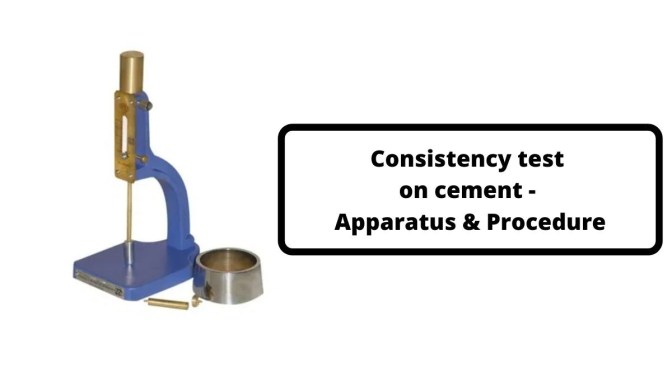
The Vicat apparatus is used to determine the consistency of cement. It consists of a plunger, a movable rod weighing 300 g, graduated scale, non-porous plate, split mould and Vicat mould. The diameter of the plunger is 10mm and the length is 50mm. The graduate scale measures the depth of penetration. The Vicat mould is a cone frustum with 80 mm diameter. The test should be conducted at a standard temperature of 27 C. The humidity should be 65%. A stop clock is used to measure the time from the addition of water to the drying of cement. As per IS code, the time of gauging is not less than 3 minutes, nor more than 5 min.

Procedure of consistency test for cement (As per IS 4031 Part 4)

Follow these steps when performing the consistency test under IS code:

  • Use a clean Vicat apparatus (as per specification) with 10 mm-diameter plunger and standard mould resting on a non-porous base plate.
  • Weigh a required quantity of cement and a proportionate amount of potable or distilled water.
  • Begin gauging (mixing): mix cement and water thoroughly, and complete gauging within 3 to 5 minutes from addition of water. Ensure gauging is completed before any sign of setting occurs.
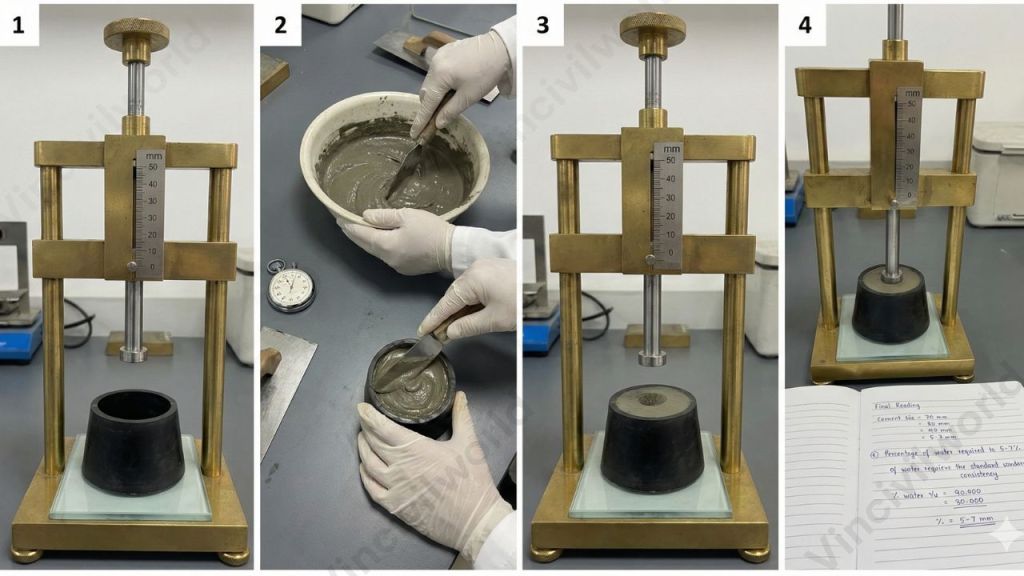
  • Fill the Vicat mould with the fresh cement paste, rest mould on non-porous plate. Level the surface — remove excess paste, smooth the top. A light shake may be used to expel air bubbles.
  • Lower the plunger gently so it just touches the paste surface, then release it to descent under its own weight (no external load).
  • Observe the depth of penetration on the graded scale. If plunger stops such that it’s 5–7 mm above the bottom of mould — that paste has “standard consistency.”
  • If the penetration depth is not within that range, discard paste; prepare a new paste with adjusted water content (increase or decrease water) and repeat until standard consistency is reached.
  • Document the percentage water (by weight of cement) that achieved standard consistency — this becomes the “water for normal consistency” or “standard consistency water proportion.”
Vicats apparatus setup for the standard consistency test of cement, showing the plunger mechanism.
Vicat apparatus used for measuring standard consistency of cement during laboratory testing.

Calculation

The standard consistency is expressed in terms of the percentage of the quantity of added water to the weight of cement. The consistency of cement ranges from 26% to 33%.

Standard consistency = ( Quantity of water added / Weight of cement) x 100

Consistency of cement test procedure – Standards comparison

StandardApparatus / PrincipleConsistency Criterion / Penetration DepthNotes / Use for Further Tests
IS 4031 (Part 4)Vicat apparatus (10 mm dia. plunger, standard mould)Plunger penetrates so that it stops 5–7 mm from the bottom of mould (i.e. ~33–35 mm from top) for standard / normal consistency (Basis for subsequent cement tests (setting time, soundness, strength) under Indian Code
ASTM C187Vicat-type penetration instrument / similar test method to determine water for “normal consistency” Penetration per ASTM calibration (aims to find water percent giving normal consistency) Used internationally / in labs following ASTM procedures; result used for further cement/concrete tests
BS EN 196‑3 (European / British standard)Vicat apparatus for consistency and setting-time / soundness tests Defines “standard consistence” via penetration depth per EN criteria; used before setting time & soundness tests Common in European labs; ensures standard baseline for cement tests under EN / BS norms

Precaution

We should take certain precautions before starting the test so that to obtain accurate results.

  • Clean the Vicat mould properly and grease the inside surface
  • Take immense care while attaching the plunger. Make sure it is vertical.
  • Place the apparatus on a levelled surface.
  • Maintain the standard temperature and humidity throughout the test.

Key Takeaways

  • The consistency test of cement measures the required water for a workable paste, using the Vicat apparatus.
  • This test is crucial for determining key properties like setting time, soundness, and compressive strength of cement.
  • Standard consistency is reached when the plunger penetrates 5–7 mm from the bottom of the mould, ensuring proper hydration.
  • Laboratory tests provide accurate assessments of cement quality, while field tests offer quick checks.
  • Precautions are vital for accurate test results, including cleaning the apparatus and maintaining proper temperature and humidity.

Conclusion

In conclusion, the consistency test of cement is essential for maintaining quality and performance in concrete works. By determining the standard consistency of cement, engineers identify the exact water needed to create a uniform and workable paste. This value is crucial for reliable results in other major laboratory tests such as compressive strength, setting time, and soundness. The significance of standard consistency test of cement lies in ensuring proper hydration, which directly influences the strength, durability, and service life of structures. Using the Vicat apparatus, the test provides accurate and repeatable outcomes for both laboratories and field quality control. When the water–cement ratio is correctly maintained, concrete becomes safer, stronger, and more durable, supporting high-standard construction practices.

Rebound hammer test on Concrete structures

ebound Hammer Test for Concrete is one of the most widely used non-destructive tests to evaluate in-place concrete strength. Also known as the Schmidt Hammer Test, it helps engineers quickly assess concrete surface hardness without damaging the structure. This test measures the rebound number when a spring-controlled hammer impacts the concrete surface, providing valuable insight into its compressive strength. The Rebound Hammer Test procedure is simple, fast, and highly suitable for quality control at construction sites. It is commonly used in buildings, bridges, and existing structures where core extraction is difficult or not recommended. Along with evaluating strength, the method helps identify weaker concrete zones and ensures uniformity. Due to its practical benefits, many professionals prefer this technique while comparing concrete hardness test methods. Understanding the advantages of Rebound Hammer Test ensures accurate decision-making in structural assessment and maintenance.

Rebound hammer test is one of the most popular and simple non-destructive concrete tests. The Non-destructive test is the process of detection of defects in concrete without its destruction. The determination of concrete quality is necessary for both fresh concrete and hardened concrete. The rebound hammer test is the common test for determining quality for existing structures.

  1. Rebound/Schmidt hammer test definition and significance
    1. Significance
    2. Relevant Codes 
  2. Objectives of Rebound hammer test
  3. Rebound hammer test procedure – Standard method
    1. Procedure – Step-by-Step
  4. Correlation between compressive strength of concrete and rebound index.
  5. Result Calculation of Rebound Hammer tests
  6. Concrete quality and rebound test values
  7. Advantages of rebound hammer test
  8. Conclusion

Rebound/Schmidt hammer test definition and significance

The Rebound Hammer Test for Concrete is a widely used non-destructive test for concrete strength. It evaluates surface hardness and provides an estimate of compressive strength. This is done without damaging the structure. In this Schmidt Hammer Test, a spring-controlled hammer impacts the concrete surface, and the rebound value indicates the concrete’s hardness. This concrete hardness test method is quick, simple, and ideal for assessing uniformity and quality in existing structures. The rebound hammer test procedure helps identify weak zones, monitor deterioration, and ensure proper maintenance. The advantages of rebound hammer test make it essential for preliminary and on-site concrete assessment.

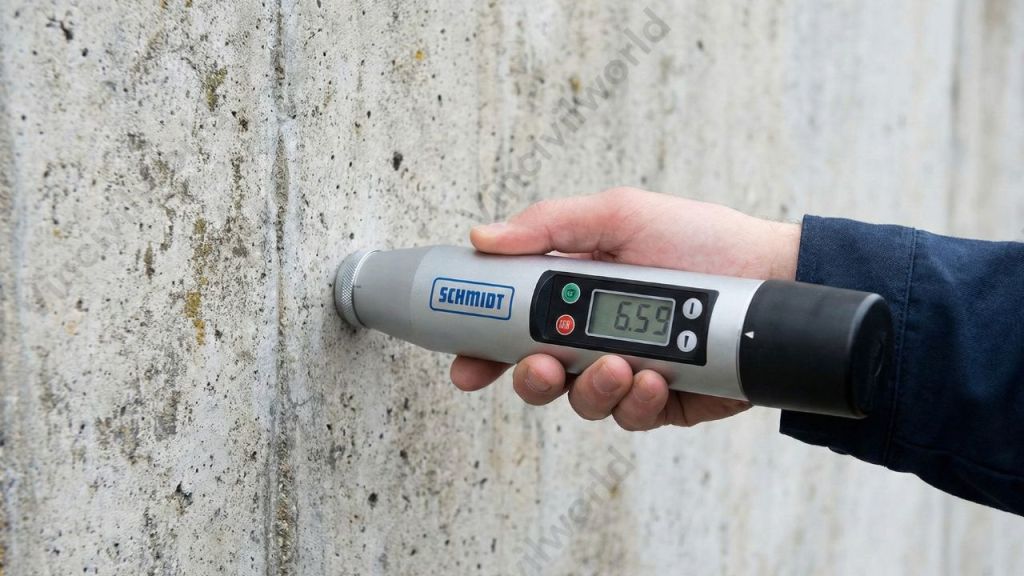
A person conducting a Schmidt Hammer Test on a concrete surface, showing the rebound measurement displayed on the device.
A Schmidt hammer being used to perform a Rebound Hammer Test on concrete, measuring surface hardness to estimate compressive strength.

Significance

  • Estimates in-place compressive strength of concrete
  • Checks surface hardness and material uniformity
  • Identifies weak zones or deteriorated areas
  • Helps compare different structural members
  • Quick, cost-effective, and non-destructive field evaluation

Relevant Codes 

Country / RegionStandard CodeTitle / Description
India 🇮🇳IS 13311 (Part 2): 1992Non-destructive testing of concrete – Rebound Hammer
USA 🇺🇸ASTM C805 / C805MStandard Test Method for Rebound Number of Hardened Concrete
Europe 🇪🇺EN 12504-2: 2021Testing concrete in structures – Part 2: Non-destructive testing – Rebound Hammer
International 🌍BS 1881: Part 202: 1986Testing Concrete – Recommendations for Rebound Hammer Test
International 🌍ACI 228.1RIn-place Methods to Estimate Concrete Strength (includes rebound hammer guidance)

Objectives of Rebound hammer test

The main objectives of the Rebound hammer test include

  • This determines the compressive strength of the concrete in terms of the rebound index.
  • Also finds the uniformity of concrete.
  • evaluates the concrete quality with standard requirements.

Rebound hammer test procedure – Standard method

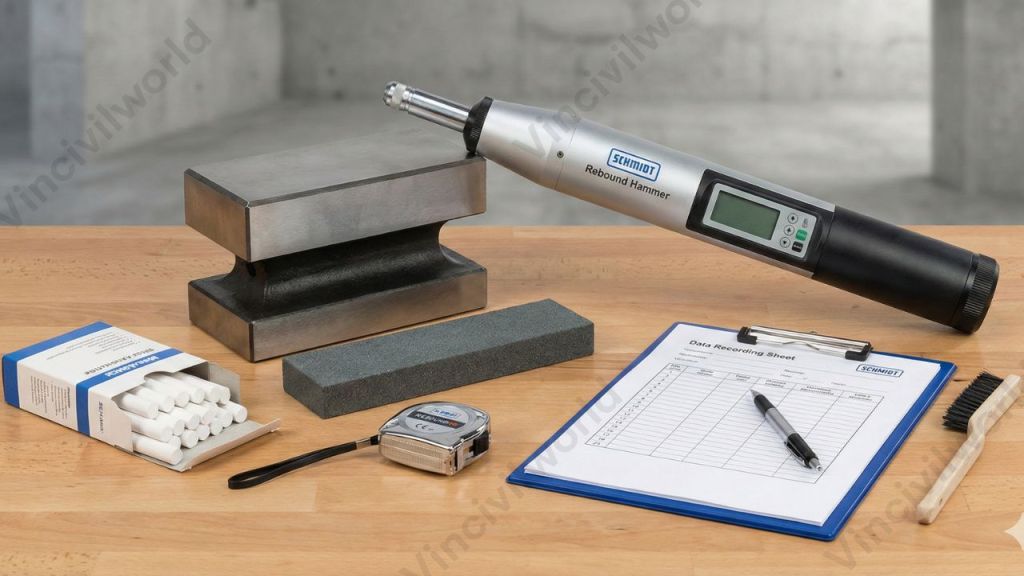
A Schmidt rebound hammer positioned near a concrete block, surrounded by a data recording sheet, measuring tape, and a set of reference materials for conducting the rebound hammer test for concrete strength.
The Schmidt Rebound Hammer, an essential tool for assessing concrete strength through non-destructive testing, displayed alongside testing materials.

The Rebound Hammer Test for Concrete is a widely used non-destructive test for concrete strength. It measures the surface hardness of hardened concrete to quickly estimate compressive strength using a Schmidt hammer. This test is simple, cost-effective, and provides immediate results on-site. It is an essential method in quality control to check concrete uniformity, detect weak zones, and evaluate structures without causing damage. While the rebound hammer test procedure ensures quick assessment, results must be correlated with laboratory-tested samples for accuracy.

Procedure – Step-by-Step

  • Select the test area – Smooth, clean, and free from loose particles or surface defects.
  • Hold the rebound hammer firmly and position it perpendicular to the test surface.
  • Press the plunger against the concrete until the hammer triggers a rebound.
  • Record the rebound number displayed on the scale.
  • Perform at least 10 readings on one point and discard abnormal outliers.
  • Take the average rebound number for that test location.
  • Apply correction factors (surface condition, carbonation, direction of testing).
  • Use a correlation chart to estimate compressive strength of concrete.

The correlation between the concrete strength and the rebound hammer shown in a graph is called the rebound hammer graph. 

According to IS 13311 (Part 2): 1992, the rebound hammer test requires specific calibration, correction factors, and surface conditions. These elements are necessary to ensure accurate results in Indian construction environments. IS also recommends correlating rebound numbers with compressive strength. The correlation should consider concrete grade, age, and surface hardness. This approach helps minimize interpretation errors.

Correlation between compressive strength of concrete and rebound index.

It is essential to calibrate the rebound hammer before testing. For this, we test a specimen of 150mm * 150mm * 150mm size using a compression testing machine (CTM). Fix the load rate at 7N/mm2, when the hammer result is 2.2 Nm. Test the vertical surface of the specimen using a rebound hammer. The results from the CMT and the rebound hammer should not have a major difference.

Result Calculation of Rebound Hammer tests

The Rebound Hammer Test for Concrete measures surface hardness and estimates compressive strength without damaging the structure. The rebound number directly reflects the elasticity of concrete—higher numbers indicate harder and stronger concrete. To calculate results accurately, we take several rebound readings on a smooth, clean surface, remove extreme values, and determine an average. This average rebound number is then compared with calibration charts. The charts are provided by the hammer manufacturer or relevant standards (IS 13311 Part 2:1992). This helps to determine the estimated compressive strength of concrete at the test location.

The rebound number assess the strength of the structure. As the rebound number increases, the strength also increases. This depends on the 

  • Cement type
  • Aggregate type
  • Surface condition
  • Age of concrete
  • Moisture content, etc.
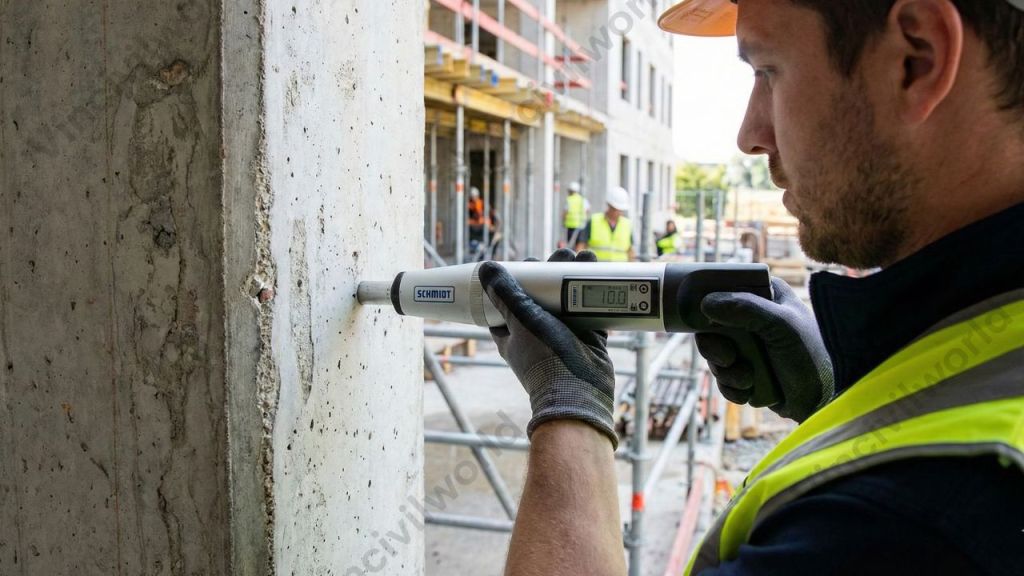
A construction worker using a Schmidt hammer to perform a rebound test on a concrete surface, displaying the rebound number on the device.
A construction professional using a Schmidt hammer to conduct a Rebound Hammer Test on concrete, assessing its surface hardness and strength.

The quality of concrete concerning the rebound concrete is as follows.

Concrete quality and rebound test values

Thus the rebound number predicts the quality of concrete. The rebound hammer apparatus is very easy to use. Also, it determines the uniformity of the concrete surface. Thus it can be used for the rehabilitation of old monuments. It produces a convenient indication of compressive strength

Rebound Number RangeEstimated Concrete QualityInterpretation Notes
≤ 20Poor / Very Weak ConcretePossible deterioration, low strength; further testing required
20 – 30Fair / Medium Quality ConcreteAcceptable for non-structural sections; verify structural safety using core tests
30 – 40Good Quality ConcreteSuitable for reinforced concrete structural elements
> 40Very Good / Hard ConcreteHigh strength concrete; ensure carbonation effects are considered

Advantages of rebound hammer test

The Rebound Hammer Test is one of the simplest and fastest non destructive tests for concrete strength. It allows engineers to quickly assess the surface hardness and uniformity of concrete without damaging the structure.

Key Advantages of Rebound/Schmidt Hammer Test

  • Quick and easy testing with instant results
  • Completely non-destructive, keeping the structure intact
  • Portable and ideal for on-site assessment
  • Helps identify weak or deteriorated concrete areas
  • Cost-effective compared to laboratory strength tests
  • Useful for quality control and comparative analysis
  • Can be used on both old and new concrete structures
  • Requires only a single operator and minimal training
  • Helps decide if further detailed testing (e.g., core cutting or UPV) is needed
  • Provides data for concrete hardness evaluation and uniformity checks

Key Takeaways

  • The Rebound hammer test for concrete is a widely used non-destructive method to assess concrete strength and surface hardness.
  • It involves a spring-controlled hammer that impacts the concrete, measuring the rebound number to estimate compressive strength.
  • This test is quick, cost-effective, and essential for quality control, helping identify weak zones and ensuring uniformity in structures.
  • Professionals appreciate the test for its practical advantages, including its portability and immediate results on-site.
  • Applicable codes include IS 13311 (Part 2) in India and ASTM C805 in the USA, ensuring standard practices across regions.

Conclusion

The Rebound Hammer Test for concrete is a widely used non destructive test for concrete strength. It helps engineers quickly check surface hardness and uniformity without damaging the structure. As one of the simplest concrete hardness test methods, it supports quality control. It is also used for preliminary assessment and condition monitoring of existing buildings. Rebound values alone do not determine exact compressive strength. They provide valuable onsite insights when combined with other techniques such as UPV or core strength tests. By following the correct rebound hammer test procedure and calibration guidelines, engineers can improve reliability and decision-making. The Schmidt Hammer Test offers a fast, economical, and practical way to evaluate concrete. It enhances durability, safety, and maintenance planning in modern construction projects.

Non Destructive test (NDT)- Hardened Concrete

Non destructive testing of hardened concrete plays a vital role in assessing the condition of concrete structures. It evaluates performance without causing damage. Engineers use non destructive test for concrete structures to evaluate strength, durability, and uniformity while the structure remains fully functional. These NDT methods for concrete evaluation help detect cracks, voids, honeycombs, and other hidden defects that may affect long-term performance. Professionals can estimate compressive strength by using advanced hardened concrete testing techniques. They can identify deterioration and also monitor the health of aging infrastructure. Modern tools like rebound hammer and ultrasonic pulse velocity make concrete strength testing faster. They support the process without causing damage and are more cost-efficient. The key advantages of NDT in concrete testing include safety, accuracy, rapid inspections, and extended service life of structures. Overall, NDT ensures reliable decision-making for repairs, rehabilitation, and quality control in construction.

Non-destructive test (NDT) and destructive tests (DT) are the the tests done one hardened concrete. Concrete is the oldest and most important construction material in the world. Testing of the concrete plays and important role to know about the strength, durability and condition of the structure. This article is about the types of Destructive and non destructive tests done on concrete.

  1. Types and significance of Concrete Tests
    1. Destructive Tests
    2. Non Destructive Tests (NDT)
  2. Non- Destructive testing techniques on hardened concrete
  3. Objectives/advantages of Non destructive testing (NDT)
  4. Classification of Non-Destructive test
    1. Penetration Resistance Test / Windsor Probe Test
    2. Rebound Hammer Test
    3. Ultrasonic Pulse Velocity Test
    4. Half-Cell Potential Test – Detecting Corrosion
    5. Covermeter / Rebar Locator Test – Locating Reinforcement Without Damage
    6. Impact Echo Test – Evaluating Internal Defects in Concrete
  5. Conclusion

Types and significance of Concrete Tests

Concrete testing plays a vital role in determining the strength, durability, and performance of concrete structures. Engineers conduct different tests to verify that the concrete mix meets design requirements and performs safely throughout its service life. These types of concrete tests help assess important properties such as workability, compressive strength, density, and internal defects. The tests are categorized into destructive tests and non destructive tests, depending on whether the specimen is damaged during inspection. Both testing methods are essential for ensuring quality control, structural integrity, and long-term durability of concrete in construction projects. By using the right concrete testing techniques, engineers can make reliable decisions in design, repair, and maintenance works.

Concrete tests are classified into two types

  • Destructive tests (DT)
  • Non – Destructive tests (NDT)

Destructive Tests

  • Compressive Strength Test
  • Flexural Strength Test
  • Split Tensile Strength Test
  • Pull-out Test
  • Core Cutting and Testing

Non Destructive Tests (NDT)

  • Impact Echo / Pulse Echo Test
  • Rebound Hammer Test
  • Ultrasonic Pulse Velocity (UPV) Test
  • Half-Cell Potential Method
  • Ground Penetrating Radar (GPR)
  • Cover Meter Survey
  • Schmidt Hammer Test

In this article we describes about the Non destructive testing techniques conducted on hardened concrete.

Non- Destructive testing techniques on hardened concrete

The standard method of non destructive testing of hardened concrete is carried out by testing concrete specimens. These specimens are cast simultaneously with structural concrete. These destructive tests on concrete can determine the compressive, flexural, and tensile strengths. The major disadvantage of these destructive concrete testing methods is the non availability of immediate results. Moreover, the properties of the concrete specimen differ from what it is in the actual structure. This difference is due to pouring conditions, curing factor, compaction and concrete density, etc. These tests come under the category of destructive tests (DT). Destructive testing of concrete destroys or changes the part. Even if it passes the test, the part is no longer fit for service.

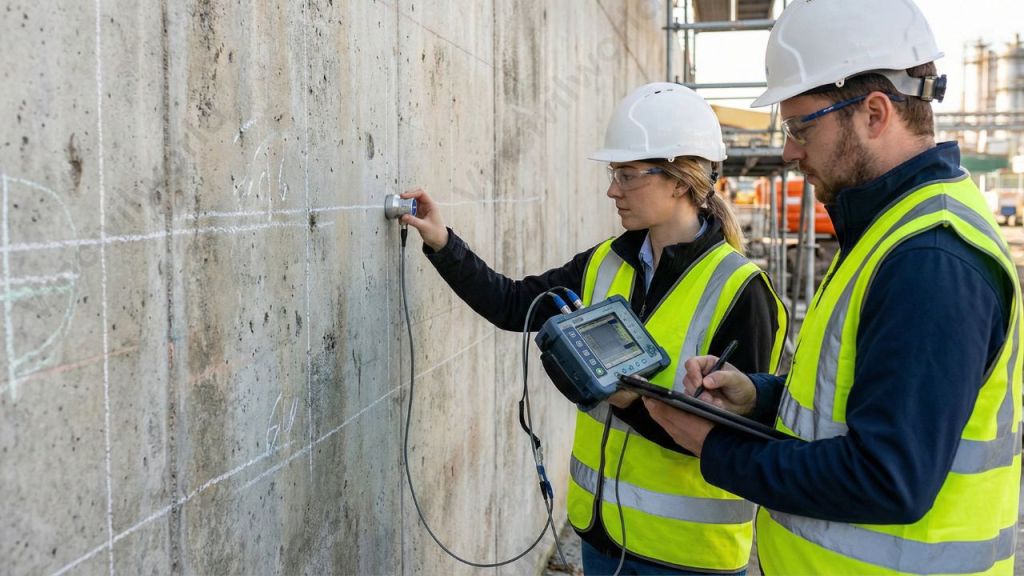
Two engineers conducting non-destructive testing on a concrete wall using specialized equipment.
Engineers conducting non-destructive testing on hardened concrete to assess its strength and durability.

Non Destructive Test (NDT) is for determining compressive strength and other properties of concrete from existing structures or buildings. NDT testing of concrete does not destroy the part. It does not change the part so that it is still fit for service if it passes the test. The non-destructive test determines the properties of concrete or structures without their destruction. Moreover, we can study its changes over time, The measurements are repeated many times and validate in detail, and gets immediate results. These NDT concrete testing methods help assess quality, strength, and durability in a quick and reliable way.

Objectives/advantages of Non destructive testing (NDT)

Non-destructive testing (NDT) helps evaluate hardened concrete structures without causing damage. It allows engineers to assess concrete strength and durability. They can also evaluate reinforcement condition, cracks, and internal defects. All of these are assessed while the structure remains fit for service. The advantages of NDT include quick results, safety, cost-effectiveness, and the ability to monitor structures throughout their life cycle. These advantages of NDT make it widely preferred for quality assurance and structural health monitoring.

  • Quality check of the existing structure.
  • For determining the homogeneity, internal and external characteristics of the concrete. 
  • To detect the cracks and voids of the concrete structures. 
  • Assess the quality of concrete with the standard requirement. 
  • To study the ageing of concrete. 
  • For finding the compressive strength of structures.
  • Evaluation of elastic modulus

Classification of Non-Destructive test

Hardened Concrete testing techniques/ Non Destructive testing are as follows

  • Windsor Probe Test
  • Rebound Hammer Test
  • Ultrasonic Pulse Velocity (UPV)
  • Half-Cell Potential Test
  • Covermeter / Rebar Locator Test
  • Impact Echo Test

Penetration Resistance Test / Windsor Probe Test

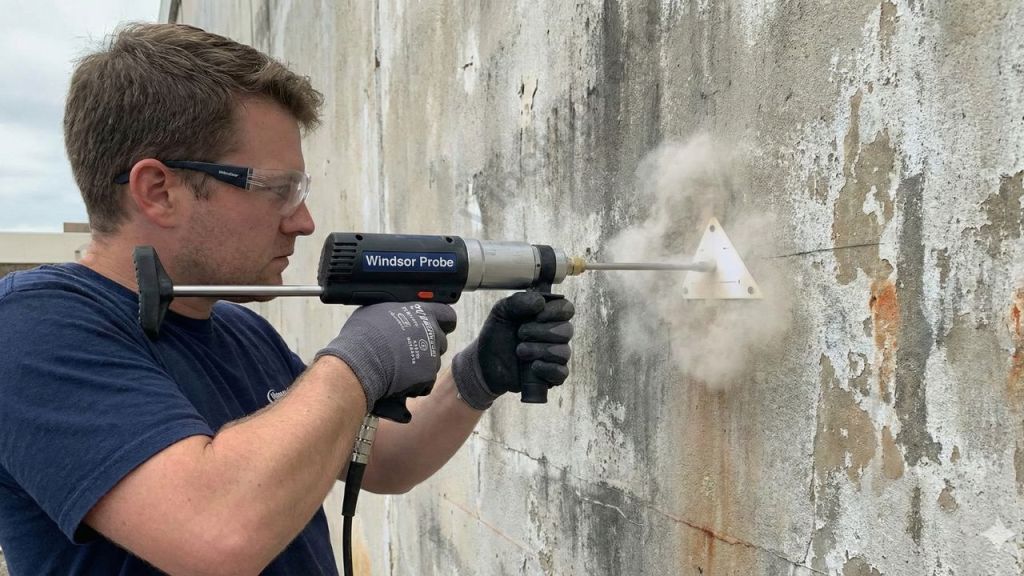
The penetration resistance test is an NDT that determines the relative strength of the concrete structures. The Windsor probe is the equipment for conducting this test. This equipment includes of powder-actuates driver or gun, probes, loaded cartridges and a gauge that measures the penetration.

The penetration depth indicates the compressive strength of the concrete. However, this depends on the aggregate type and size. This test evaluates the poor quality and deterioration of concrete

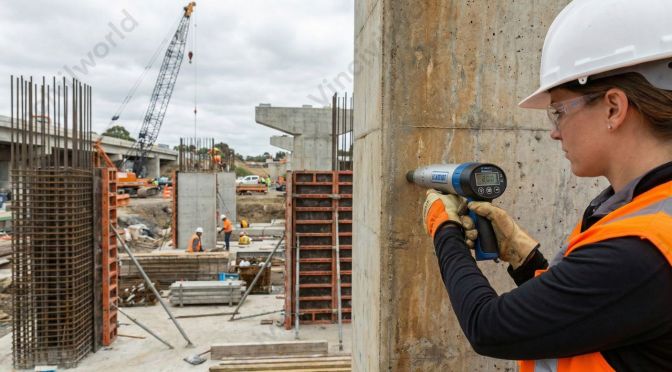
A professional using a Windsor Probe device to conduct non-destructive testing on a concrete wall, assessing its strength and quality without causing damage.
An engineer using a Windsor Probe for penetration resistance testing on hardened concrete.

The major disadvantage of this test is getting variable results. Several probes are often shot to achieve a solid average depth for arriving a final conclusion. So we cannot determine the exact strength. But it is a quick method to evaluate the quality and maturity of concrete. Care should be taken to calibrate the instrument before taking readings.

Rebound Hammer Test

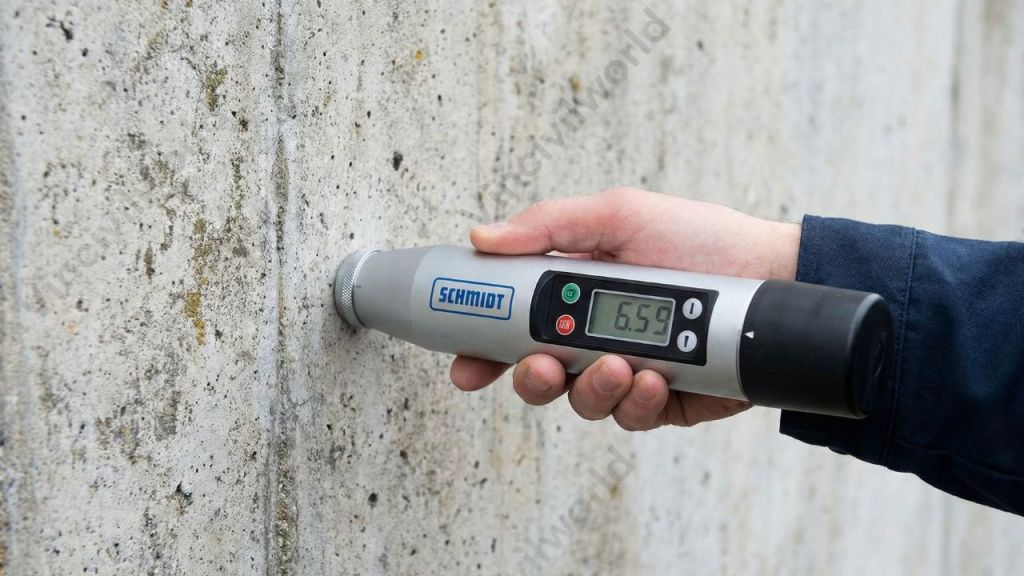
The rebound hammer is also known as Schmidt’s Hammer test. It determines the strength of concrete based on the hardness of the concrete surface. It is a surface hardness tester. The equipment consists of a spring-controlled plunger, a hammer that weighs 1.8 kg, and a graduated scale. By pressing the hammer on the concrete surface, the graduate scale measures the rebound number. A low rebound number means the concrete has low compressive strength and stiffness.

A person using a rebound hammer test device on a concrete wall to measure its surface hardness and estimate compressive strength.
A technician conducting the Rebound Hammer Test on concrete to assess compressive strength without causing damage.

An accuracy of 15 to 20% is possible through this test. It is a simple and quick method. Also, the result relies on the surface smoothness, water content, type and size of aggregate and carbonation of the surface.

Ultrasonic Pulse Velocity Test

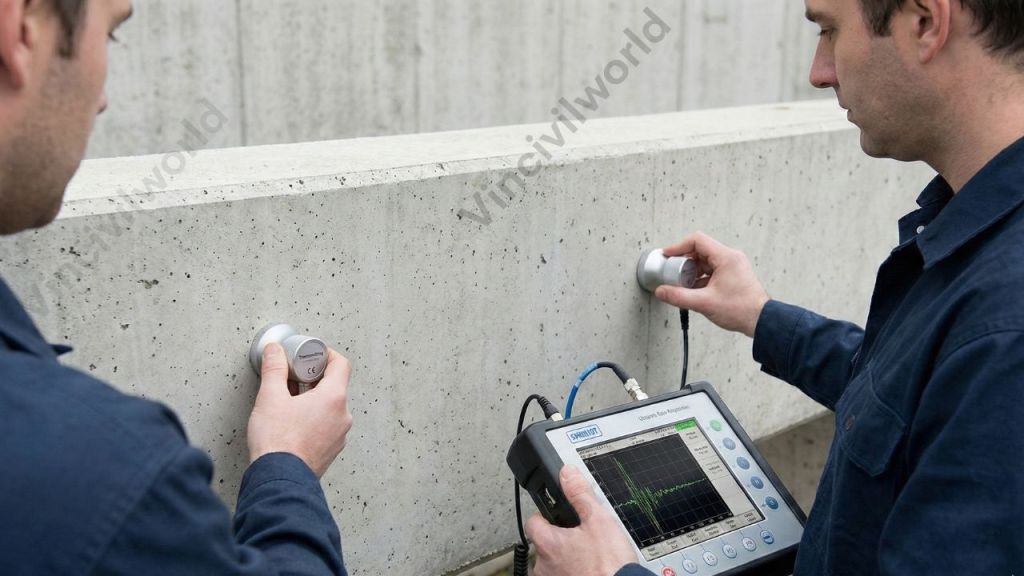
Ultrasonic pulse velocity test is another type of Non-destructive test. This test measures the time of travel of ultrasonic pulse waves for evaluating the concrete quality. The UPV test units consists of a pulse generator and pulse receiver. The frequency of the wave is 50-55 kHz. The pulse generator produces the pulses and is allowed to pass through the concrete. Then we calculate the velocity, by measuring the traversing distance and the time. Higher velocity means the concrete has a higher elastic modulus and density. It also determines the cracks and flaws in the structure. Large differences in pulse velocity values indicates a defective and deteriorated concrete.

Two engineers conducting non-destructive testing on a concrete structure using specialized equipment.
Engineers conducting an Ultrasonic Pulse Velocity test on concrete to assess its quality and detect any hidden defects.

For more details : Ultrasonic pulse velocity test || UPV Test – Methods and procedure

Half-Cell Potential Test – Detecting Corrosion

The Half-Cell Potential Test is a widely used non-destructive testing (NDT) method. It evaluates corrosion activity in steel reinforcement within hardened concrete. It measures the electrical potential difference between embedded rebars and a reference electrode. This reference electrode is typically a copper / copper sulfate (Cu/CuSO₄) cell. The test helps determine whether the reinforcement is actively corroding, passive, or at risk. An electrical connection directly connects to the rebar. Surface readings are recorded in a grid on moist concrete to ensure good conductivity. These readings are compared with standard probability charts provided in ASTM C876. The results allow engineers to locate corroded zones, plan preventive repairs, and avoid unnecessary concrete removal. Overall, it is a quick, reliable, and cost-effective tool for structural health assessment and durability maintenance of concrete structures.

A construction professional conducting non-destructive testing on a concrete structure using a measuring device, with a sponge for conductivity, to assess the integrity of the material.
An engineer conducting a non-destructive test on concrete using a specialized equipment to assess structural integrity.

Covermeter / Rebar Locator Test – Locating Reinforcement Without Damage

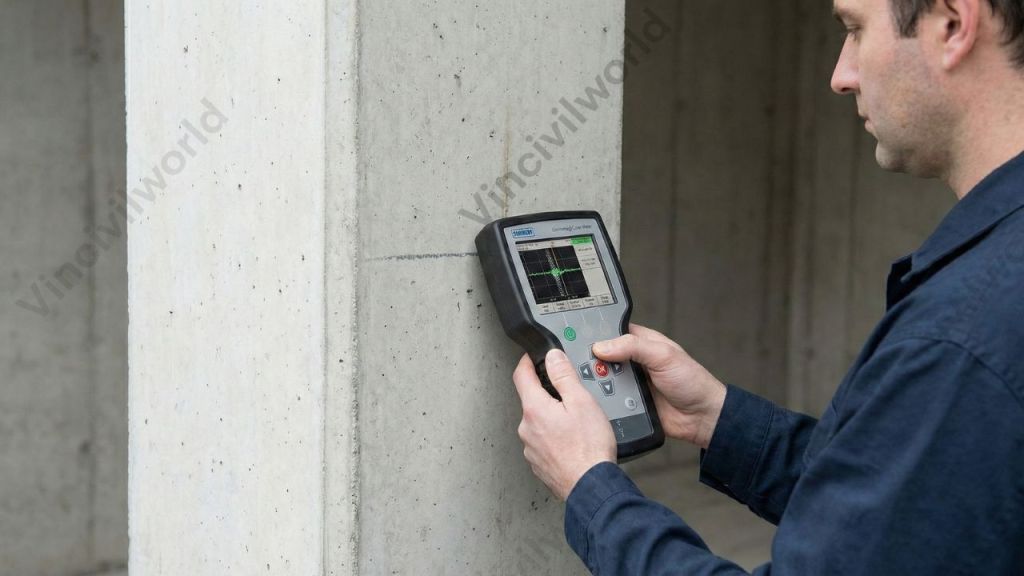
The Covermeter Test is also known as the Rebar Locator Test. It is a widely used non-destructive testing (NDT) method. This method is for detecting the position, depth, and spacing of steel reinforcement in hardened concrete. It works by measuring the magnetic field disturbance created by embedded steel when scanned with an electromagnetic probe. The test accurately determines the cover thickness. This is the distance from the concrete surface to the reinforcement. This measurement is critical for durability, fire safety, and code compliance. Modern Covermeter can also estimate bar diameter and identify congestion or missing rebars. This method adheres to standards such as BS 1881-204. It assists engineers in repair planning, drilling, and anchoring. It also helps in retrofitting without damaging the structure. Overall, the rebar locator test is fast, clean, and essential for structural assessment and quality control of reinforced concrete.

A technician using a handheld ultrasonic testing device on a concrete surface to assess the material's properties without causing damage.
A technician performing a non-destructive test on a concrete structure using specialized equipment to assess its condition.

Impact Echo Test – Evaluating Internal Defects in Concrete

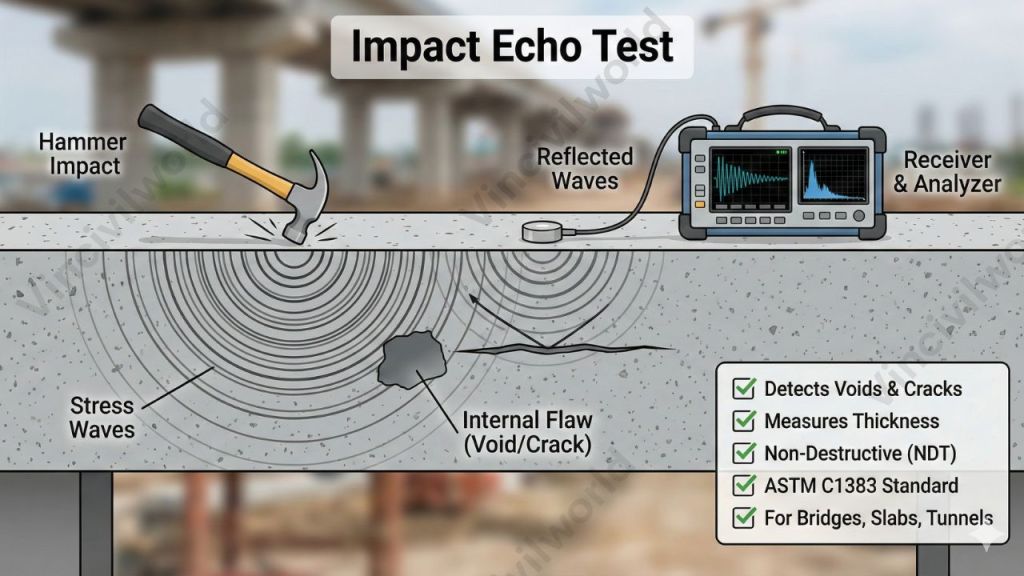
The Impact Echo Test is a reliable non-destructive testing (NDT) method. It is used to detect internal flaws such as voids, cracks, and delamination in hardened concrete. It also identifies thickness variations. It works by applying a short mechanical impact on the surface using a small hammer or impactor. This impact generates stress waves that travel through the concrete and reflect back from internal boundaries. A sensitive receiver records the returning signals and analyzes the wave frequencies to identify abnormalities. The method is guided by standards like ASTM C1383, making it suitable for bridges, slabs, tunnels, and precast elements. Engineers use this test to assess structural integrity, locate hidden defects, verify grouting, and ensure long-term durability—without drilling, cutting, or damaging the structure. Overall, the Impact Echo Test offers a fast and effective solution for concrete condition evaluation and maintenance planning.

Illustration of the Impact Echo Test showing a hammer impacting concrete, generating stress waves. The diagram includes labels for 'Hammer Impact', 'Stress Waves', and 'Internal Flaw (Void/Crack)', as well as a receiver/analyzer that detects reflected waves. The image highlights the test's ability to identify voids and cracks non-destructively, following ASTM C1383 standards.
Illustration of the Impact Echo Test used in non-destructive testing of concrete, showing hammer impact, stress waves, and internal flaw detection.

Key Takeaways

  • Non-destructive testing (NDT) evaluates hardened concrete’s strength and durability without causing damage, helping to detect hidden defects.
  • Engineers use both non-destructive and destructive tests to ensure quality control and structural integrity during concrete assessments.
  • Key advantages of NDT include quick results, safety, and cost-effectiveness, making it ideal for monitoring concrete structures over time.
  • Various NDT techniques include the Rebound Hammer Test, Ultrasonic Pulse Velocity Test, and Impact Echo Test.
  • These methods provide crucial insights into concrete quality, allowing for reliable repairs and maintenance planning.

Conclusion

Non Destructive testing of concrete plays a vital role in maintaining the long-term performance and safety of structures. NDT for hardened concrete enables engineers to assess strength, durability, reinforcement conditions, and internal defects without damaging the structure. With modern concrete NDT methods such as Rebound Hammer, Ultrasonic Pulse Velocity, and Covermeter testing, engineers receive quick data. Tests like Half-Cell Potential and Impact Echo provide reliable insights into structural integrity. One of the major advantages of NDT is the ability to monitor existing buildings. It helps identify deterioration early. Engineers can plan effective maintenance. By using advanced NDT techniques, the industry ensures cost efficiency, improved safety, and accurate decision-making throughout a structure’s life. Therefore, the advantages of NDT strongly support sustainable, safe, and high-quality construction management.

Concrete Pumps Types – Applications and advantages

Understanding the types of concrete pumps is essential for selecting the right equipment for modern construction. Each pump works differently and offers specific benefits depending on the site conditions and structural requirements. Engineers use concrete pump types in construction to increase productivity, reduce manual labor, and deliver concrete with accuracy. Truck-mounted concrete pumps handle large projects efficiently by pumping concrete over long distances and at greater heights using boom arms.

Meanwhile, stationary concrete pumps support continuous pumping operations in high-volume or high-rise structures. The advantages of concrete pumps include faster concrete placement, improved quality, and better safety for workers. By understanding various concrete pump applications, contractors can ensure the best performance when working on foundations, tunnels, bridges, and skyscrapers. This article explains all major concrete pump types and their impact on modern project success.

  1. Concrete pump types in construction
    1. Boom /Truck-mounted concrete pumps
      1. Features and Advantages
      2. Demerits / Limitations
    2. Line /Stationary concrete pump
      1. Features and Advantages
      2. Demerits / Limitations
    3. Trailer-Mounted Concrete Pump
    4. Specialized Concrete Pumps
  2. Concrete pump applications
  3. How to Choose a Concrete Pump ?
    1. Manufacturer of equipment
    2. Price and economic factors
    3. Selection Based on Work
  4. Concrete Pumps Advantages
  5. Disadvantages
  6. Conclusion

Concrete pump types in construction

Concrete pump types in construction help deliver concrete quickly and precisely to any required height or distance. These pumps improve productivity, safety, and quality on site while reducing manual labor. Engineers select the right pump depending on project scale, reinforcement congestion, accessibility, and structural height.

Types of Concrete Pumps

  • Truck-mounted concrete pump (Boom pump)
  • Stationary concrete pump (Line pump)
  • Trailer-mounted concrete pump
  • Specialized concrete pumps (Spider boom, Crawler pump, Underground pump)

Boom /Truck-mounted concrete pumps

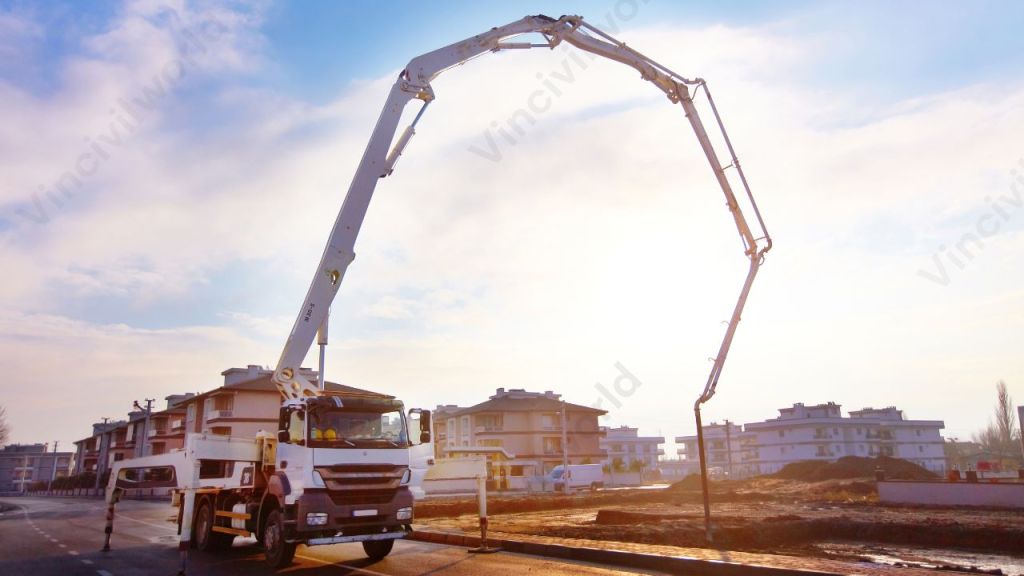
A truck-mounted concrete pump, commonly called a boom pump, delivers concrete quickly and accurately. It reaches over long distances or to high elevations. It boosts construction speed and reduces manual labor.

A truck-mounted concrete pump with a long boom is positioned on a construction site, delivering concrete from a mixer to the elevated framework of a building under construction, surrounded by workers and scaffolding.
A boom-mounted concrete pump efficiently delivering concrete at a construction site for a high-rise building.

Features and Advantages

  • Long hydraulic boom with multiple articulating sections — delivers concrete over tall buildings, deep foundation pits, or distant spots.
  • Mounted on a truck chassis — highly mobile and easy to reposition on site.
  • High pumping capacity — ideal for large-volume pours like high-rise, bridges, and large slabs.
  • Precise placement — reduces need for manual handling, improving safety and finish quality.
  • Saves time and labor — faster concrete pouring compared to manual or line-pump methods.

Demerits / Limitations

  • Requires good access and stable ground for truck setup — not ideal on narrow or unstable sites.
  • High rental or ownership cost and maintenance.
  • Boom reach limitations — very tall or complex geometry may need additional equipment or planning.
  • Setup and dismantling time — requires space and time to deploy the outriggers and boom.

Line /Stationary concrete pump

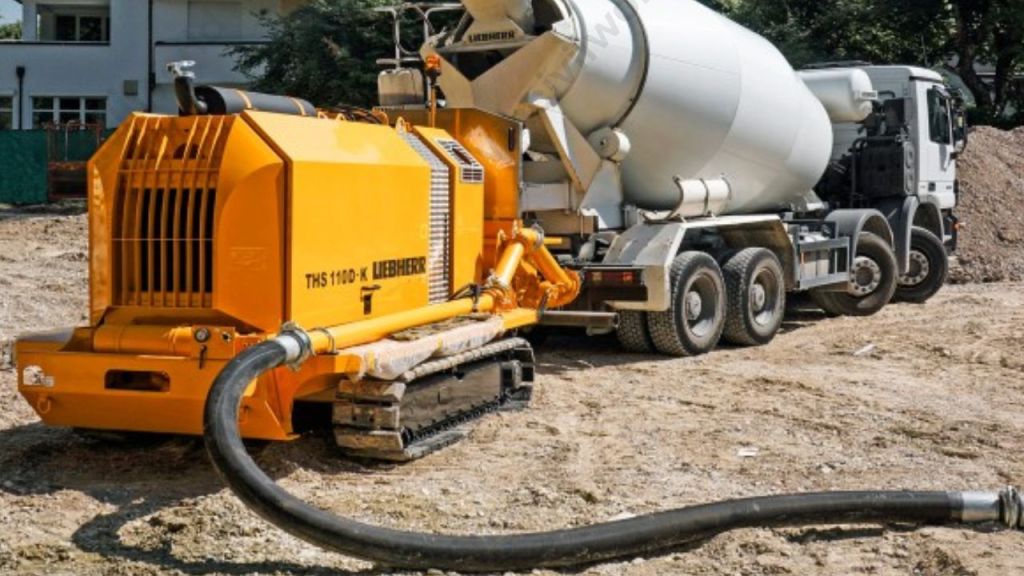
A stationary concrete pump is also called a line pump. It stays fixed on site. It delivers concrete through flexible hoses or pipelines. It suits small to mid-size pours and constrained work areas.

A stationary concrete pump connected to a cement mixer truck, with flexible hoses on the ground for concrete delivery at a construction site.
A stationary concrete pump efficiently delivering concrete via flexible hoses on a construction site, ideal for tight spaces.

Features and Advantages

  • Compact and easy to position — works well on tight or narrow sites where truck-mounted pumps can’t access.
  • Uses flexible hoses or pipelines — allows concrete placement in hard-to-reach corners, basements, or low-clearance zones.
  • Requires less setup space and simpler deployment — ideal for smaller pours or interior works.
  • Lower operational cost compared to large boom pumps — cost-effective for small slabs, staircases, or repair works.
  • Reduced noise and simpler handling — suitable for urban settings, residential sites, or renovation jobs.

Demerits / Limitations

  • Lower pumping capacity — not ideal for high-volume pours or high-rise projects.
  • Requires manual connection and repositioning of hoses for larger coverage — increases labor and time.
  • Less efficient over long distance or height — concrete flow may degrade if hoses are too long or steep.
  • Possible flow interruptions — need careful monitoring to avoid blockages or segregation.

Trailer-Mounted Concrete Pump

Trailer-mounted concrete pumps are compact units towed to the site and connected to pipelines or hoses for concrete delivery. They are ideal for small to medium-scale projects, interior works, and areas with limited access. These pumps offer flexibility, lower operating costs, and reliable performance for slabs, driveways, and repair works.

Specialized Concrete Pumps

Specialized concrete pumps like spider boom, crawler pump, and underground pump handle complex projects where standard pumps cannot operate. Spider booms fit inside tight spaces and deliver concrete overhead. Crawler pumps move on rough terrains, perfect for infrastructure projects. Underground pumps efficiently deliver concrete in tunnels, shafts, and mining projects.

Concrete pump applications

Concrete pumps improve placement speed and accuracy. This makes them ideal for projects requiring efficient delivery to high areas. They are also suited for distant or congested areas.

  • High-rise building construction
  • Bridge decks and flyovers
  • Foundations and retaining walls
  • Tunnels and underground structures
  • Residential slabs and floors
  • Large industrial projects
  • Dams and power plants
  • Pile foundations and diaphragm walls
  • Road pavements and airport runways
  • Precast concrete installations
  • Water tanks and reservoirs
  • Narrow or restricted access sites

How to Choose a Concrete Pump ?

The concrete pump is chosen based on the construction project’s specifications. The following criteria are used to determine a successful and appropriate concrete pump:

  • The Concrete Pump’s manufacturer
  • Concrete Pump’s Function
  • Construction Projects’ Schedule
  • Price and economic factors

Manufacturer of equipment

The following are important considerations to consider when choosing a successful concrete pump manufacturer:

  • Choose the best concrete pump manufacturer in the region. For this, consult local contractors and seek assistance from any recognised manufacturers.
  • A wide range of options are now available online. Check out the top-rated concrete pumps and the feedback they’ve received.
  • Under high pressure, the concrete pumping procedure is carried out. This long-term pressure must be able to withstand a strong concrete pump. 
  • If the concrete pump’s output is below average, building projects can break down and suffer losses.

Price and economic factors

The concrete pump chosen must be practical and work at the rate for which it was purchased. Avoid the risk of paying a high price for an underperforming concrete pump. Often choose a concrete pump based on its efficiency and cost. Compare the price and the results.

Selection Based on Work

When the concrete pump is chosen on the basis of work, two basic factors are considered:

  1. Volumetric Concrete Output
  2. The Pumping Pressure

The work determines the maximum volumetric concrete output required per hour for concrete construction. The pump’s pressure is specified based on this. This pressure is the criterion for choosing a concrete pump. 

The strength of the concrete pump’s driving unit is determined by the desired concrete output (Q) and the pumping pressure (P). Then the  hydraulic output (H) is given by:

H = Q x P 

The concrete pump described above can be chosen based on the various construction projects.

  • For the building of large road and highway projects, a boom or truck-mounted concrete pump is ideal.
  • A boom concrete pump is the best option for concrete pouring at various altitudes and where there is a small area for concrete pouring.
  • Boom concrete pumps can mount two or three robotic pump lines that function as a multi-purpose robotic arm, reducing the number of workers needed.
  • For the building of sidewalks or slabs, a line concrete pump or a stationary concrete pump is used. The stationary pump is used if only a small amount of concrete needs to be pumped.

Concrete Pumps Advantages

Concrete pumps improve productivity. They enhance safety and ensure high-quality placement. Pumps deliver concrete precisely where needed, even in difficult and congested construction areas. The advantages of concrete pumps are listed below.

  • Faster concrete placement
  • Reduced labor requirements
  • Precise and controlled pouring
  • Better quality and surface finish
  • Improved safety and reduced manual handling
  • Ability to reach high or distant locations
  • Efficient pumping in congested reinforcement zones
  • Less concrete wastage and cleanup
  • Continuous and consistent concrete flow
  • Works in areas inaccessible to trucks or cranes
A truck-mounted concrete pump with a long hydraulic boom extends over a construction site, demonstrating its use for delivering concrete to elevated areas.
A truck-mounted concrete pump in action, demonstrating its long hydraulic boom used for precise and efficient concrete placement at construction sites.

Disadvantages

The disadvantages of using concrete pumps in building projects are as follows:

  • The net cost would be higher.
  • Due to the huge initial cost, these pumps are not feasible for structures with minor concrete volume.

That’s it about concrete pumps. Let us know in comments if you found this insightful.

Key Takeaways

  • Concrete pumps convey concrete from a source to a casting location, using pistons to draw and discharge the material.
  • There are two main types of concrete pumps: Boom Concrete Pumps and Line Concrete Pumps, each with specific use cases.
  • Boom Concrete Pumps offer flexibility for high-rise construction, while Line Concrete Pumps are fixed and require more labour involvement.
  • Choosing the right concrete pump depends on factors like the project’s specifications, manufacturer, and economic considerations.
  • Concrete pumps provide advantages such as reduced labour reliance and adaptability, but they also come with higher initial costs.

Conclusion

Understanding the types of concrete pumps helps construction teams choose the most efficient equipment for each project. Different concrete pump types in construction provide unique advantages. Truck-mounted pumps and stationary pumps improve delivery based on height, distance, and site access. When used correctly, these pumps provide major advantages of concrete pumps, including faster placement, reduced labor, and better finishing quality. The right pump also ensures smooth and continuous flow. It works effectively through congested reinforcement during critical concrete pump applications. These include high-rise buildings, bridges, foundations, tunnels, and precast installation. By selecting the most suitable pump type, contractors can tailor their choices based on project requirements. This selection improves productivity. It enhances structural performance. Contractors achieve safe, reliable, and cost-effective results in modern construction.

Updates in civil engineering, architecture finishes, building construction, Environmental Engineering