What is a Retaining Wall? Everything You Need to Know

A retaining wall is a structure designed to hold or support soil behind it. These walls are commonly used in landscaping, construction, road development, and residential properties where uneven ground levels need additional support. A retaining wall helps reduce soil movement, erosion, and pressure caused by sloped terrain while also improving the usability of outdoor spaces.

Retaining walls can be built using materials such as concrete, stone, brick, timber, or reinforced blocks. The type of wall used often depends on soil conditions, drainage requirements, wall height, and the overall purpose of the project. In both residential and commercial construction, retaining walls play an important role in long-term ground stability and site management.

  1. Understanding Retaining Wall in Construction
  2. What Is The Purpose Of A Retaining Wall?
  3. Functions And Advantages
  4. Types Of Retaining Walls
  5. Size Of Retaining Wall
  6. Retaining Wall Installation Costs
    1. Factors That Affect Retaining Wall Cost
  7. Maintenance And Long-Term Durability
  8. Common Problems
  9. Finding Professionals For Retaining Wall Projects
  10. Wrapping Up

Understanding Retaining Wall in Construction

In construction, a retaining wall is designed to resist the lateral pressure created by soil, water, or sloped ground surfaces. These structures are commonly installed where natural slopes may create instability or where flat usable land is needed for building or landscaping purposes.

Retaining walls are often found near gardens, driveways, roads, basements, and hillside properties. In residential landscaping projects, they are also frequently combined with features such as patios, pathways, and outdoor fireplace areas to create more functional outdoor living spaces across various types of terrain.

What Is The Purpose Of A Retaining Wall?

The primary purpose of a retaining wall is to hold back soil and prevent erosion. Without proper support, sloped land can gradually shift over time, especially during periods of heavy rain or changing weather conditions.

Retaining walls also help improve land organization and outdoor functionality. Many residential properties use retaining walls to create level garden spaces, pathways, seating areas, or separated landscape sections across uneven terrain.

Functions And Advantages

Retaining walls provide both structural and visual benefits within construction projects. Structurally, they help stabilize slopes and reduce the risk of soil movement around buildings or outdoor spaces. This added support can help protect foundations, roads, and landscaping from erosion damage over time.

Beyond structural performance, retaining walls are also used to improve outdoor design layouts. Landscaped properties often combine retaining walls with patios, seating areas, or outdoor fireplace installations to create more functional outdoor living environments while managing elevation changes effectively.

Types Of Retaining Walls

Several types of retaining walls are used depending on the project size, soil conditions, and engineering requirements. Gravity retaining walls rely on their own weight to resist soil pressure, while reinforced retaining walls use steel reinforcement or concrete systems for additional strength.

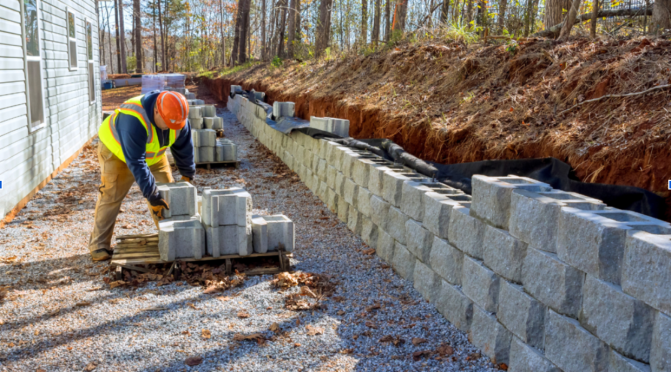
Cantilever retaining walls are commonly used in larger construction projects because they distribute pressure more efficiently. Segmental retaining walls, often built using interlocking blocks, are frequently used in residential landscaping because of their flexibility and simplified installation process.

Size Of Retaining Wall

The size and thickness of a retaining wall depend on factors such as wall height, soil type, drainage conditions, and the amount of pressure behind the structure. Smaller garden retaining walls may only require limited reinforcement, while taller walls often need engineering calculations and stronger foundation systems.

Local building regulations may also affect wall dimensions and permit requirements. In many areas, retaining walls above a certain height require professional design approval before construction begins.

Retaining Wall Installation Costs

The cost of building a retaining wall depends on factors such as wall height, materials, drainage systems, and site conditions. Because every project has different structural and landscaping requirements, retaining wall cost estimates can vary significantly between residential and commercial properties.

In the United States, an installation project commonly ranges between around $20 to $75 per square foot depending on the material and wall design. In Canada, pricing is often slightly higher because of labor costs and seasonal construction conditions, with many residential retaining wall projects averaging around CAD $25 to CAD $65 per square foot depending on complexity and materials used.

Factors That Affect Retaining Wall Cost

Retaining wall pricing can vary significantly between projects because costs usually depend on multiple site evaluations and planning considerations before construction begins.

  • Wall height and overall size
  • Type of material used
  • Soil conditions and drainage requirements
  • Excavation and foundation preparation
  • Accessibility of the construction site
  • Reinforcement or engineering requirements
  • Local labor and permit costs
  • Decorative finishes or landscaping integration

Maintenance And Long-Term Durability

Although retaining walls are built for long-term use, periodic maintenance remains important. Drainage outlets should remain clear, and visible cracks or movement should be inspected before structural issues become more serious.

Environmental exposure, soil pressure, and water buildup can gradually affect wall performance if maintenance is neglected. Proper installation combined with regular inspections generally improves the lifespan of retaining wall systems.

Common Problems

Several issues can affect retaining wall performance over time. Poor drainage is one of the most common causes of wall failure because trapped water increases pressure behind the structure.

Other problems may include weak foundations, insufficient reinforcement, soil erosion, or improper installation techniques. Identifying these issues early can help reduce repair costs and prevent larger structural damage later.

Finding Professionals For Retaining Wall Projects

Building a retaining wall often involves more than simply stacking materials together. Soil conditions, drainage systems, wall height, reinforcement, and local regulations can all influence the overall structural performance of the project. Because of this, many property owners choose to work with experienced contractors or landscape professionals when planning larger retaining wall installations.

Professional’s advice from these contractors can also help homeowners better understand a number of considerations before construction begins. Material selection, excavation requirements, drainage systems, and site accessibility are some of the factors that may affect the overall budget depending on the size and complexity of the project.

Wrapping Up

A retaining wall serves an important role in supporting soil, managing elevation changes, and improving outdoor functionality across residential and commercial properties. Different retaining wall systems are designed to handle varying structural conditions depending on wall height, soil pressure, and environmental exposure.

From erosion control to landscape organization, retaining walls provide both practical and visual benefits when installed correctly. Proper planning, drainage, reinforcement, and material selection all contribute to the long-term durability and effectiveness of retaining wall construction projects.


Shielding Your Sugar Land Home from Storms and Heat with Smart Roofing Choices

When it comes to protecting your property, investing in roofing in Sugar Land is essential. The local climate, known for intense heat, humidity, and seasonal storms, puts constant pressure on roofs. Over time, even small issues can escalate if ignored. That is why working with a skilled roofing contractor is crucial to ensure long-term durability and safety.

Texas continues to rank among the top states for weather-related property damage. According to the Insurance Information Institute, hailstorms alone cause billions in losses each year across the state. This makes regular maintenance and timely roof repair a necessity for homeowners and businesses alike.

  1. Emergency Roofing and Preventive Care
  2. Choosing Reliable Roofing Experts
  3. Sugar Land Living and Climate Impact

Emergency Roofing and Preventive Care

Severe weather can strike without warning, making emergency roofing support an important service. Strong winds and heavy rain often lead to leaks, damaged shingles, or weakened structures. Addressing these problems quickly helps prevent further complications.

A professional roofing company can assess the condition of your roof and recommend the right solution, whether it is a minor fix or a more extensive repair. The National Oceanic and Atmospheric Administration notes that Texas experiences hundreds of severe storm events annually.

This highlights the importance of having access to reliable roofing services when you need them most.

Routine inspections are equally important. They help identify hidden damage early and extend the overall lifespan of your roof while maintaining energy efficiency.

Choosing Reliable Roofing Experts

Finding the right professionals for roofing in Sugar Land can make a significant difference in the outcome of your project. For homeowners looking for dependable roofing in Sugar Land with fast response and expert workmanship, Madison Roofing stands out as trusted local roofing experts in Sugar Land providing solutions tailored to both residential and commercial needs. Their experienced team focuses on restoring safety, functionality, and long-term performance.

Working with experienced contractors ensures high-quality materials, proper installation, and clear communication throughout the process. This ultimately saves time, money, and stress.

Sugar Land Living and Climate Impact

Sugar Land is a vibrant city known for its family-friendly neighborhoods, growing economy, and attractions like Sugar Land Town Square and Cullinan Park. The area experiences long, hot summers and occasional severe storms, both of which can impact roofing systems. These environmental factors make durable and weather-resistant roofing a must for homeowners in the region.

Across Texas, more property owners are choosing energy-efficient roofing materials. Reflective roofing systems are becoming popular due to their ability to reduce heat absorption. According to the U.S. Department of Energy, these materials can lower roof temperatures by up to 50°F, helping reduce cooling costs.

A strong roof is one of the most important investments you can make for your property. From handling urgent issues to planning long-term care, working with experienced professionals ensures your home stays protected. With the right approach, roofing in Sugar Land can provide lasting value, safety, and peace of mind.

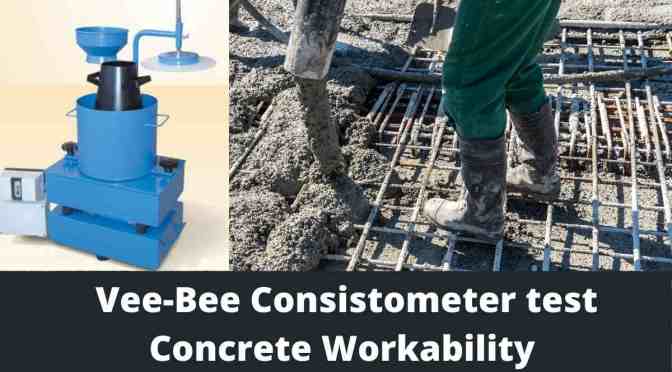
Vee Bee Consistometer test – Workability of concrete

Vee Bee Consistometer Test is a reliable laboratory method used to evaluate the workability of concrete, especially for stiff and low-workability mixes where slump test results are not accurate. The Vee Bee Consistometer test for workability of concrete measures the time required for concrete to remould under vibration, providing a clear indication of consistency. In the workability of concrete Vee Bee test, vibration energy replaces gravity-based flow, making it suitable for dry mixes. Understanding the Vee Bee test procedure helps engineers achieve consistent and repeatable results. The Vee Bee Consistency test of concrete is widely used in laboratories and quality control setups and is considered one of the most dependable tests for workability of concrete for controlled assessment of stiff concrete mixes.

This article explains the Vee Bee Consistometer test, its principle, procedure, applications, and importance in accurately assessing the workability of stiff concrete mixes.

Significance of Quality tests on concrete

Quality tests on concrete are essential for ensuring strength, durability, and performance in construction. These tests help engineers assess the workability of fresh concrete and the quality of hardened concrete. Common quality tests on concrete include checks during the production stage (on fresh concrete before placing), tests on hardened concrete specimens, and evaluations performed directly on finished structures. Including tests like the flow table test for concrete ensures reliable results and consistent quality throughout a project.

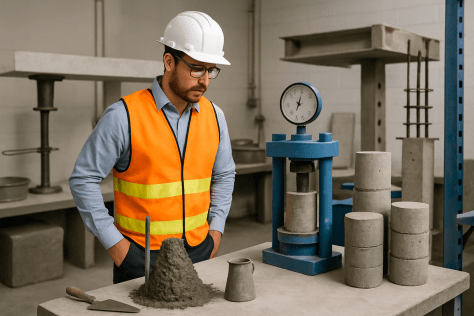
A construction worker in a safety vest and hard hat examines concrete samples next to a compression testing machine in a lab setting.
A civil engineer in a safety helmet and reflective vest analyzing concrete test specimens in a lab, showcasing the importance of quality control in concrete workability tests.

Quality tests performed on concrete are classified into

  • Production stage quality tests ( On fresh concrete before placing)
  • Hardened stage quality tests ( hardened concrete specimens)
  • Non Destructive tests On structures ( tests done on the structures )

Also read : Aggregate Crushing test – Strength of aggregate

Also read : 9 lab tests of Bitumen for flexible pavements

Production stage quality tests on fresh concrete

Production stage quality tests on fresh concrete are crucial for ensuring the right workability and consistency before placement. These tests help engineers select the best mix for construction and maintain quality control. Key tests include the slump test, compaction factor test, Vee-Bee test, Kelly ball test, and the flow table test for concrete.

This article focuses on the Vee Bee Consistometer test, explaining its procedure, importance, and how it compares with other workability tests like the slump test and compaction factor test.

Vee Bee Consistometer test for workability of concrete

The Vee Bee Consistometer Test is a laboratory test used to determine the workability of concrete, particularly stiff and low-workability mixes. It measures the time required for fresh concrete to remould from a conical shape into a cylindrical shape under controlled vibration. This time, known as the Vee Bee time, indicates concrete consistency. Unlike the slump test, the Vee Bee Consistometer test for workability of concrete is suitable for dry mixes that do not flow easily. Commonly used in quality control, this test helps engineers compare mix designs and ensure uniform concrete performance.

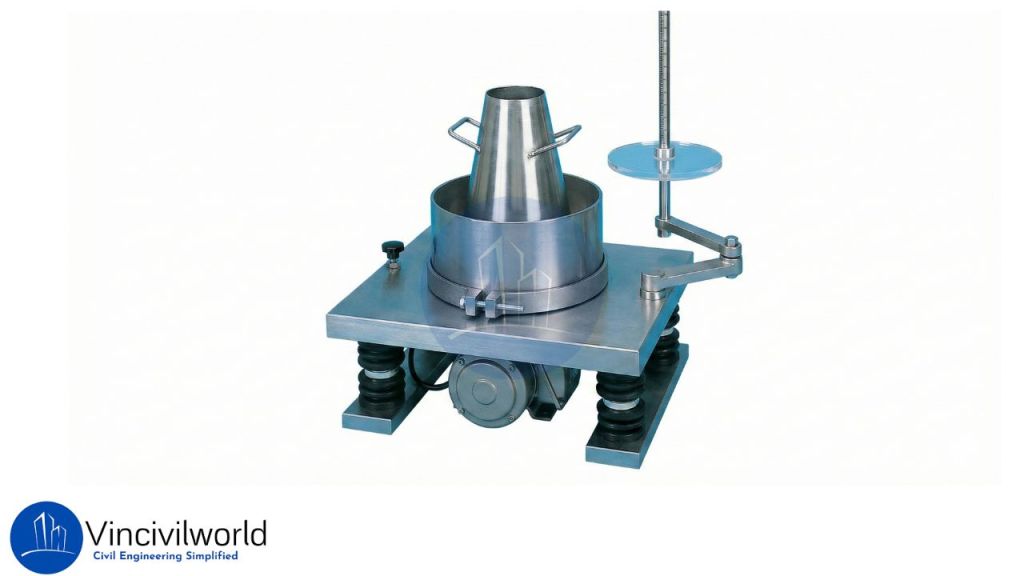
A steel laboratory apparatus used for material testing, featuring a cone-shaped container and a mechanical device for precise measurements.
Vee Bee Consistometer apparatus used for evaluating the workability of concrete in laboratory settings.

Relevant Codes and Standards for Vee Bee Consistometer Test

  • IS 1199 (Part 2): 2018 – Methods of Sampling and Analysis of Concrete – Workability
    Issued by Bureau of Indian Standards.
    This standard covers the Vee Bee Consistometer test, along with slump and compaction factor tests.
  • BS EN 12350-3 – Testing Fresh Concrete – Vebe Test
    Issued by British Standards Institution.
    Widely used in the UK and Europe for stiff concrete workability assessment.
  • DIN 1048 (Part 1) – Testing Concrete – Fresh Concrete Tests
    Issued by DIN.
    Includes the Vebe test for consistency measurement.

Note: These standards ensure uniform testing procedures, repeatable results, and reliable evaluation of low-workability concrete mixes.Relevant IS code

Apparatus used for Vee Bee Consistometer

A blue industrial machine with a funnel and a black container at the center, designed for processing materials.
Vee Bee Consistometer apparatus used to assess the workability of concrete.

The Vee – Bee Consistometer includes of 

  • A vibrator table resting upon elastic supports
  • A metal pot
  • A sheet metal cone, open at both ends
  • A standard iron rod

The dimension of the vibrating table is 380 mm in length, 260 mm in width and height of 305 mm. Also, supporting the table there is a rubber shock absorber. Under the table, there is a vibrator that vibrates electrically.  The dimension of the metal slump cone is 300mm height, 200 mm top diameter and 100 mm bottom diameter. 

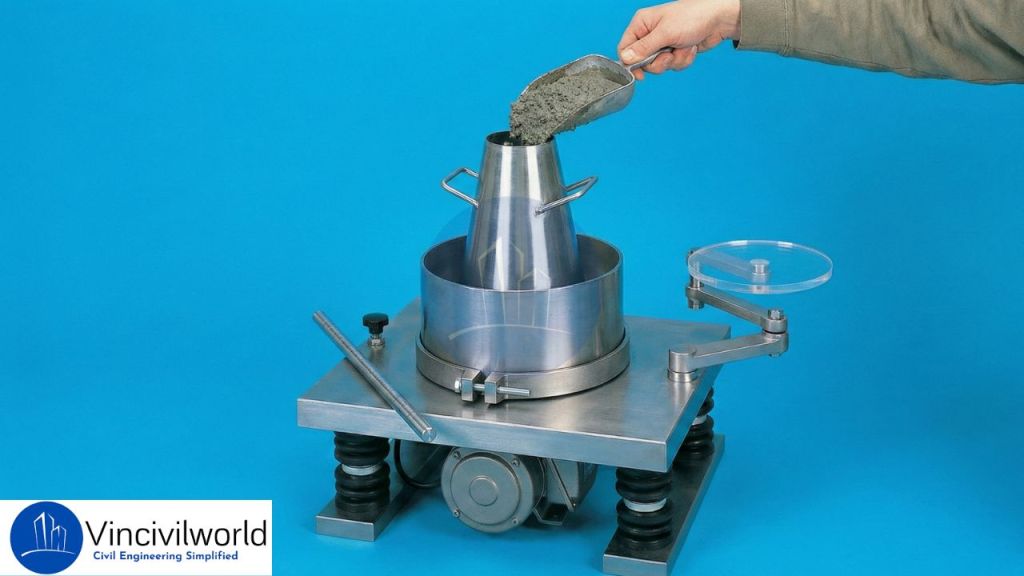
A person pouring a scoop of material into a metallic measuring cone on a balance scale, with a blue background.
The Vee Bee Consistometer, essential for evaluating the workability of concrete, particularly in stiff and low-workability mixes.

Test procedure

  • Initially fill the slump cone with four layers of concrete. Each layer should have a height of one – fourth of the cone. 
  • After that tamp each layer 25 times using a standard tamping rod and strike uniformly.
  • Then after placing the final layer, remove the excess concrete on the top of the concrete.
  • Move and place the swivel arm attached to the glass disc on the top of the cone.
  • Now remove the cylindrical cone gradually in the vertical direction and note down the slump.
  • Then switch on the electrical vibrator and allow the concrete to spread. 
  • The time taken by the concrete to spread uniformly is noted using the stop clock.
  • This time is expressed in vee bee seconds.

The time for the concrete to remould is the Vee-Bee seconds. The Vee Bee consistometer is an indirect measure of concrete workability. This method is suitable for concrete whose slump value cannot be determined. ie, for dry mixes. We can get direct result through this method.

Also Read : Soundness test on aggregate

Key Takeaways

  1. The Vee Bee Consistometer Test is designed to assess the workability of stiff concrete mixes.
  2. It measures the time required for concrete to remould under vibration.
  3. Longer Vee Bee time indicates lower workability of concrete.
  4. The test provides more reliable results than slump test for dry mixes.
  5. It is commonly used in laboratory-controlled environments.
  6. The method helps compare different concrete mix designs.
  7. Proper vibration is essential for accurate results.
  8. The test minimizes subjective judgment during workability assessment.
  9. It is standardized under Indian and international codes.
  10. The test is an important part of quality control procedures.
  11. It complements other tests for workability of concrete.
  12. It ensures consistency during concrete production.

Conclusion

The Vee Bee Consistometer Test plays a crucial role in evaluating the workability of concrete, especially for mixes with low water content. By measuring the remoulding time under vibration, the test provides a clear and quantitative indication of concrete consistency. Unlike the slump test, it performs well for stiff mixes where flow is minimal. When conducted according to standard procedures, the test helps engineers maintain uniformity in concrete production and placement. It also supports effective quality control by enabling comparison of different mix proportions. As one of the reliable laboratory-based tests for workability of concrete, the Vee Bee Consistometer Test remains essential for achieving durable and well-performing concrete structures.

Kelly Ball Test – Workability of Concrete

Kelly Ball Test is a simple and reliable method used to assess the workability of concrete directly at construction sites. Among the various tests for workability of concrete, this method stands out for its speed. It is also easy to execute on fresh concrete surfaces. The Kelly Ball Test concrete assessment works by measuring penetration depth. This makes it a practical Kelly Ball penetration test for large pours and ready-mix applications. To ensure accurate results, you must follow the standard Kelly Ball Test procedure. This procedure correlates penetration values with concrete consistency. The Kelly Ball Test is simple. It is also suitable for the field. Therefore, it continues to be an effective tool for monitoring concrete quality during placement.

  1. Significance of Quality tests on concrete
  2. Production stage quality tests on fresh concrete
  3. What is Kelly ball test ?
    1. Standard Guidelines
      1. Codes and Standards
    2. Kelly ball test Apparatus as per ASTM C360/C360 M 92
    3. Test Procedure
    4. Results
  4. Advantages – Kelly ball test
  5. Disadvantages of Kelly Ball Test
  6. Key Takeaways
  7. Conclusion

Significance of Quality tests on concrete

Quality tests on concrete are essential for ensuring strength, durability, and performance in construction. These tests help engineers assess the workability of fresh concrete and the quality of hardened concrete. Common quality tests on concrete include checks during the production stage (on fresh concrete before placing), tests on hardened concrete specimens, and evaluations performed directly on finished structures. Including tests like the flow table test for concrete ensures reliable results and consistent quality throughout a project.

Quality tests performed on concrete are classified into

Also read : Bitumen tests – 9 lab tests for bitumen

Production stage quality tests on fresh concrete

This article covers the kelly ball test ,apparatus details, procedure, merits and demerits etc.

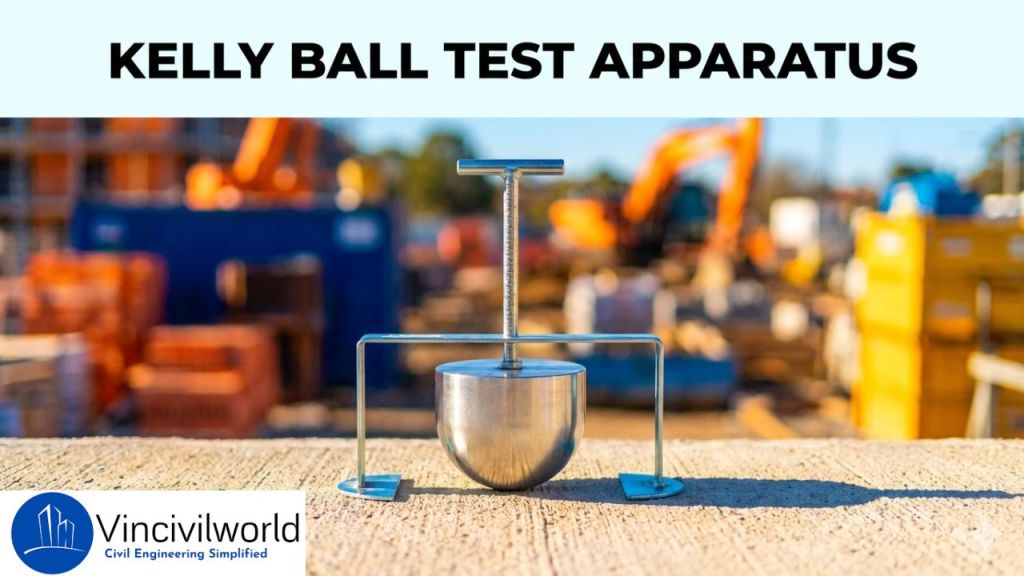
A Kelly ball test apparatus placed on a construction site, with blurred machinery and materials in the background.
The Kelly Ball Test apparatus used for assessing the workability of concrete at construction sites.

What is Kelly ball test ?

This simple field method assesses the workability of freshly mixed concrete. In the test, a standard steel ball penetrates the concrete under its own weight, and the penetration depth indicates concrete consistency. Engineers mainly use this test at construction sites to make quick decisions during concrete placement. The Kelly Ball Test helps verify whether the concrete is too stiff or too workable for proper compaction and finishing. Its significance lies in its speed, ease of use, and ability to provide a direct indication of concrete workability without complex equipment.

Standard Guidelines

Standard codes for the Kelly Ball penetration test provide guidance on equipment, testing procedure, and result interpretation. This ensures reliable assessment of concrete workability, especially during on-site quality control.

Codes and Standards

ASTM C360 / C360M 92– Standard Test Method for Ball Penetration in Freshly Mixed Concrete
Issued by ASTM International.
Note: This standard has been withdrawn but is still referenced in technical literature.

AASHTO T 183 – Ball Penetration Test
Issued by AASHTO.
Note: This standard is discontinued and mainly used for historical reference.

Indian Standards (IS Codes)
There is no specific IS code . Workability testing in India is generally covered under IS 1199, issued by Bureau of Indian Standards

Kelly ball test Apparatus as per ASTM C360/C360 M 92

The kelly ball apparatus for measuring the workability of concrete consist of..

  • Meta hemisphere (Ball)
  • Graduated scale
  • Frame
  • Handle

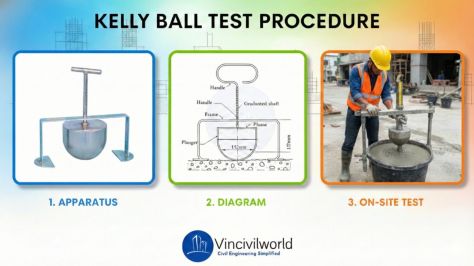
The workability of concrete is decided by the depth of the penetration of metal hemisphere (ball) which will descend under its own weight into the fresh concrete. The Metal hemisphere or ball has 152 mm diameter and 13.6 kg weight. J. W. Kelly (Professor, University of California) had devised the plan of the Kelly ball test afessor, University of California) had devised the plan of the Kelly ball test apparatus. Hence, later on it also came to be known as a ball penetration test. On the top of the apparatus, there is a handle. The graduated scale measures the penetration reading. 

A three-part image illustrating the Kelly Ball Test procedure. The left panel shows the apparatus used for the test, the middle panel features a diagram explaining the components, and the right panel displays a person conducting the on-site test with concrete.
Visual representation of the Kelly Ball Test procedure, showcasing the apparatus, diagram, and on-site testing process for assessing concrete workability.

Test Procedure

  • Place freshly mixed concrete on a level, rigid surface immediately after mixing.
  • Ensure the concrete surface is smooth and free from vibration.
  • Clean the Kelly ball and check that it moves freely along the guide rod.
  • Position the apparatus so the steel ball just touches the concrete surface.
  • Release the ball gently without applying any force.
  • Allow the ball to penetrate under its own weight.
  • Wait until the penetration stabilizes.
  • Read and record the depth of penetration from the graduated scale.
  • Repeat the test at different locations on the concrete surface.
  • Take the average penetration value as the final result.
  • Note: Greater penetration indicates higher workability, while lower penetration indicates stiffer concrete.

Results

The workability of the concrete is the average value of the readings from the penetration.

Advantages – Kelly ball test

Some advantages of this test are

  • Compared to other workability tests kelly ball test is very fast
  • Precise and Accurate results

Disadvantages of Kelly Ball Test

The disadvantages of this test include

  • This test requires a large amount of fresh concrete.
  • The result should not be precise if the size of the aggregate is large.
  • The concrete should be levelled before starting the test.

Key Takeaways

  • This is a simple field method for assessing fresh concrete consistency.
  • It directly measures penetration depth, reflecting the workability of concrete.
  • The test is faster and less operator-dependent than many laboratory methods.
  • Kelly Ball Test concrete assessment is suitable for large pours and flat surfaces.
  • The Kelly Ball penetration test works under the self-weight of the steel ball.
  • Proper surface preparation is essential for reliable results.
  • The procedure must be followed carefully to avoid errors.
  • It is mainly used as a supplementary field check.
  • Results help engineers make quick placement decisions.
  • It complements other tests for workability of concrete used in quality control.

Conclusion

The Kelly Ball Test remains a practical and efficient method for evaluating the workability of concrete under site conditions. By measuring penetration depth, the Kelly Ball penetration test provides a direct indication of concrete consistency during placement. Although not as widely standardized as slump testing, Kelly Ball Test concrete assessment is valuable for large slabs and mass concreting works. When carried out correctly using the recommended Kelly Ball Test procedure, it helps engineers maintain uniform quality and avoid placement issues. Among various tests for workability of concrete, the Kelly Ball Test stands out for its simplicity, speed, and field applicability. Used alongside standard methods, it supports better decision-making and effective on-site concrete quality control.

Types of interior paints – Distemper and Emulsion.

Types of interior paints play a major role in defining the look, durability, and comfort of indoor spaces. Choosing the right option becomes easier when you understand the interior paint types list and how each one performs. Homeowners often compare finishes, which makes knowing the best interior wall paint finishes essential for both aesthetics and maintenance. This guide clearly explains interior paint finishes explained in simple terms, helping you select the right sheen for every room. It also compares water based vs oil based interior paints, highlighting differences in drying time, durability, and ease of use. Since every space has unique needs, understanding interior paint types for different rooms helps achieve better results. With the right knowledge, you can select paints that look good, last longer, and enhance overall interior quality.

Interior paints, as the name suggests is the process of decorating the interior walls of a structure. While thinking of interior painting most people are more concerned about colours, shades, and textures. They never focus on the type of paint to be used for their interiors. The paint types to be used determine the durability, sheen and elegance, and life of the interiors and structures.

Deciding the right interior paint is the first and prime thing to do before going to shades and textures. Each paint type comes with its composition, properties, and functionalities.

This blog is about the types of interior paints that are used extensively in the painting of internal walls.

  1. Best Interior paints types list
  2. Interior paints Types– Distemper
    1. Dry Distemper
    2. Oil Bound Distemper (OBD)
  3. Distemper forms available in market
    1. Acrylic Distemper
    2. Synthetic Distemper
    3. UNO Acrylic Distemper
  4. Best interior wall paint finishes – Emulsion paints
  5. Types of Emulsion Interior Paints
  6. Water based vs oil based interior paints
  7. Advantages of Emulsions
  8. Key Takeaways
  9. Conclusion

Best Interior paints types list

A list of interior paint types helps you understand different paint options, finishes, and applications. This makes it easier to choose durable, stylish, and suitable paints for every room. Selecting the right paint type for interior surfaces is the first step before deciding on colours and textures. The following are the major interior paint types widely used today.

  • Emulsion paint
  • Enamel paint
  • Distemper paint
  • Texture paint
  • Metallic paint

First, we will examine the most commonly used interior paint types, namely distemper and plastic emulsion. Homeowners prefer these paints for interior walls. They apply easily. They remain affordable. They are available in multiple finishes and colours.

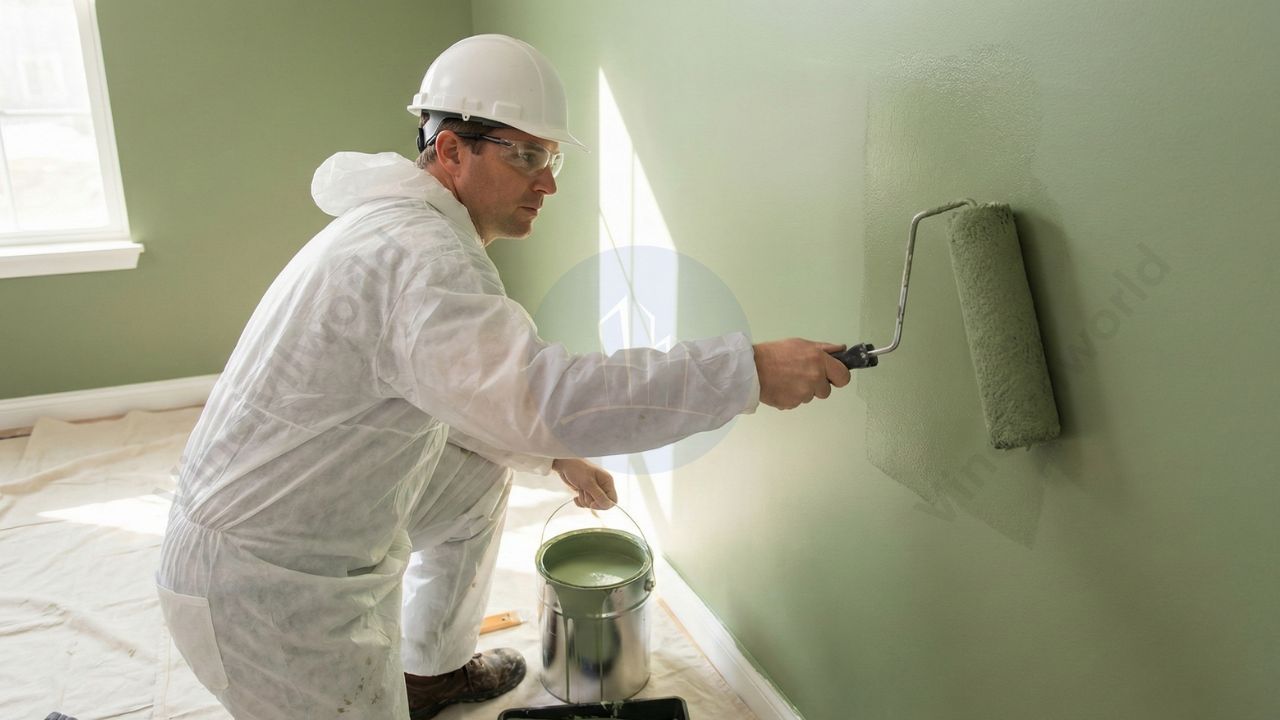
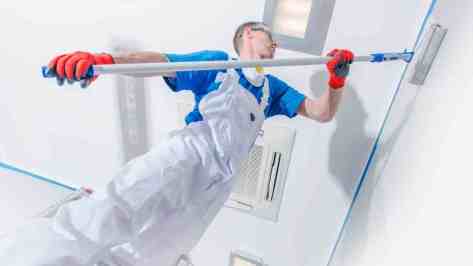
A man in protective clothing and a hard hat painting a green wall with a roller in a room.
A professional applies a fresh coat of green emulsion paint to an interior wall, demonstrating the essential role of interior paint types in home decoration.

Interior paints Types– Distemper

Distemper is the oldest type of interior paint. It was traditionally made by mixing water, chalk, and pigments with animal glue or resins as binders. Earlier, it was the most commonly used paint for interior walls, especially in the early 1980s. Over time, distemper has evolved and is now available in different types and improved grades to meet modern interior requirements. People often confuse distemper with whitewash, but distemper delivers far better finish, durability, and performance. Unlike whitewash, which uses a simple lime-based coating, distemper offers better coverage and a longer service life.

Workers apply distemper directly over plastered surfaces without using primer or putty. They must remove it before repainting with modern finishes. It does not serve as a suitable base coat for superior paints.

There are two types of Interior Distemper paints

  • Dry distemper ( water based paint)
  • Oil bound distemper (OBD)

Dry Distemper

Dry distemper is a water-based interior wall paint made from chalk, lime, glue, and water. Painters apply it using a brush, and it provides a better appearance than traditional whitewash. Manufacturers supply dry distemper in powder form, which users mix with water and glue before application. To achieve an even and smooth finish, painters apply a minimum of three coats. This type of distemper creates a rustic or earthy look, making it suitable for ceilings and low-traffic interior areas. However, dry distemper is non-washable and has limited durability. Due to its low cost and simple application, homeowners consider it the most economical interior paint for residential use.

Oil Bound Distemper (OBD)

Oil-bound distemper (OBD) is an improved form of distemper that contains drying oils or varnish, which provide better water resistance. It is available in ready-mix form and can be applied using a brush or roller. When applied in at least three coats, it delivers a smooth matte finish. One of the key advantages of oil-bound distemper is that it is washable, making it more suitable for interior walls. The presence of drying oils improves coverage area and allows the surface to dry within four hours. OBD is affordable, durable, and available in a wide range of colours. It is commonly used on plastered surfaces, brick walls, and ceilings in residential and industrial interiors. Compared to dry distemper, oil-bound distemper offers better durability and performance.

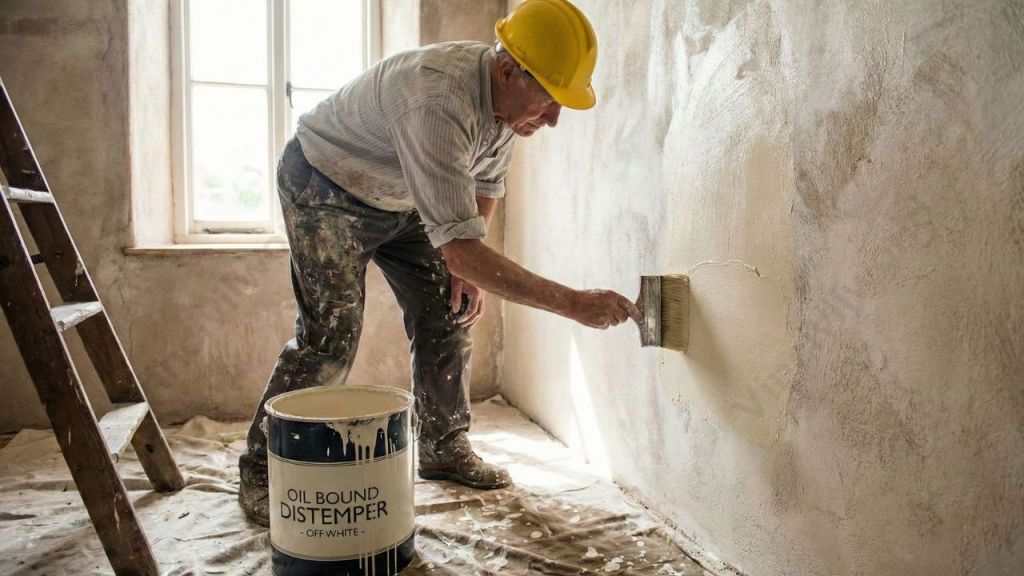
An elderly man in a yellow hard hat painting a wall with a brush while standing next to a can of oil-bound distemper. A wooden ladder is visible in the background.
A painter applying oil bound distemper on a wall, showcasing the practical application of interior painting techniques.

Also read : Marble flooring – Advantages and disadvantages – complete analysis

Also Read : Vitrified tiles vs ceramic tiles – which one do you choose

Also Read : Tiles and marbles – which is best

Distemper forms available in market

Distemper availability in the market includes several improved formulations designed for better performance and finish. Today, distemper paint is commonly available in the following three main forms:

  1. Acrylic distemper
  2. Synthetic distemper
  3. UNO acrylic distemper

Acrylic Distemper

Manufacturers formulate acrylic distemper as a water-based paint using acrylic copolymers, making it an eco-friendly choice for interior walls. It delivers a smooth matte finish and offers better durability than traditional distemper. Painters find it easy to apply, low in odour, and well suited for residential interiors that require affordability with improved performance.

Synthetic Distemper

Synthetic distemper is a water-based, oil-bound interior wall paint designed to offer improved strength and durability. Available in a wide range of ready-made shades, it delivers a consistent and attractive finish. Over time, the oil-bound film hardens, resulting in better washability and longer-lasting performance compared to conventional distemper paints.

UNO Acrylic Distemper

UNO Acrylic Distemper is a cost-effective, water-based acrylic distemper developed for interior wall applications. It offers good washability and durability while maintaining a smooth matte finish. Available in over 950 shades, it provides long-lasting color retention and is ideal for budget-friendly residential painting projects.

Best interior wall paint finishes – Emulsion paints

Emulsion paints use a water-based formulation, produce very low odour, and remain the most preferred choice for interior wall finishes.They provide a smooth appearance, excellent durability, and easy maintenance, making them suitable for residential and commercial interiors.

The main ingredients of emulsion paint include pigments, acrylic or vinyl resins, water as the solvent, and performance-enhancing additives. The acrylic resin is present in an emulsion form and acts as a binder, helping the paint adhere to the wall surface while holding all ingredients together after drying. Pigments provide colour, opacity, and protection against ultraviolet (UV) light.

Emulsion paints are quick-drying, washable, and long-lasting. Most stains can be cleaned using mild detergents without damaging the finish. They emit very low VOCs, making them eco-friendly and safe for indoor use. Unlike oil-based paints, emulsion paints produce minimal odour. For best results, primer and wall putty coats are required before applying the final emulsion paintwalls and minimises the odours which are a part of other oil-based paints. Emulsion paints requires a primer coat and putty coats before applying finish paint.

Plastic emulsion work

Types of Emulsion Interior Paints

Emulsion paints are commonly called plastic paints, plastic emulsions, or acrylic emulsions. Technically, all interior emulsion paints use a water-based formulation, while plastic emulsion represents a refined type with a higher acrylic binder content. Therefore, while all plastic emulsions are emulsion paints, not all emulsion paints qualify as plastic emulsions.

Plastic emulsion paint is a water-based acrylic wall paint that provides a smooth and uniform finish. Compared to ordinary emulsion paint, plastic emulsion offers better washability, higher durability, and improved stain resistance due to the presence of acrylic resins. These properties make plastic emulsions the most preferred choice for modern interior walls.

Types of Plastic paints are as follows

  • Matte finish plastic emulsion
  • Eggshell finish plastic emulsion
  • Satin finish plastic emulsion
  • Semi-gloss plastic emulsion
  • Gloss plastic emulsion

Matte finish plastic emulsion
Provides a smooth, non-reflective finish that hides surface imperfections well. Ideal for ceilings and low-traffic interior walls requiring a soft, elegant appearance.

Eggshell finish plastic emulsion
Offers a slight sheen with better washability than matte. It suits living rooms and bedrooms where designers need a balanced combination of visual appeal and durability.

Satin finish plastic emulsion
Delivers a silky, pearl-like sheen with good stain resistance. Commonly used in high-traffic areas like hallways for easy maintenance and enhanced durability.

Semi-gloss plastic emulsion
Has noticeable shine and excellent washability. Ideal for kitchens, bathrooms, and areas exposed to moisture or frequent cleaning.

Gloss plastic emulsion
Provides a highly reflective, shiny finish with maximum durability. Best for doors, trims, and feature walls where strong visual impact is desired.

Water based vs oil based interior paints

Choosing between water-based vs oil-based interior paints depends on durability, drying time, finish, and maintenance requirements. Understanding these differences helps in selecting the right paint for walls, woodwork, and frequently used interior surfaces.

Comparison Water based vs oil based interior paints

FeatureWater-Based Interior PaintsOil-Based Interior Paints
BaseWaterOil or solvent
Drying timeDries quicklySlow drying
OdourLow odourStrong odour
VOC levelLow VOC and eco-friendlyHigh VOC
WashabilityGoodExcellent
YellowingDoes not yellowYellows over time
MaintenanceEasyModerate
Typical useInterior walls and ceilingsDoors, trims, and woodwork

Advantages of Emulsions

Homeowners and professionals widely prefer emulsion paints for interior walls. They apply easily and dry quickly. These paints produce low odour. They offer good washability and resist humidity. Emulsion paints emit very low levels of volatile organic compounds (VOCs).

Comparison of Types of interior paints

FeatureEmulsion PaintDistemperEnamel Paint
BaseWater-basedWater-basedOil-based
Drying timeVery fastModerateSlow
OdourVery lowMildStrong
WashabilityExcellentPoorVery good
FinishSmooth and uniformChalkyHard and glossy
VOC emissionVery lowLowHigh
Humidity resistanceHighLowModerate
MaintenanceEasyDifficultModerate
SuitabilityWalls and ceilingsLow-traffic areasWood and metal

 Tiles and marbles – which is best

Key Takeaways

  • Emulsion paints are water-based interior paints that homeowners and professionals widely prefer for walls and ceilings.
  • Plastic emulsion paints contain acrylic binders that improve durability and washability.
  • Compared to distemper, emulsion paints provide a smoother finish and longer life.
  • Types of emulsion interior paints include matte, eggshell, satin, semi-gloss, and gloss finishes.
  • Matte finish emulsion paint hides surface imperfections effectively.
  • Satin and semi-gloss emulsions offer better stain resistance for high-traffic areas.
  • Water-based interior paints dry faster and emit very low VOCs.
  • Oil-based interior paints provide harder finishes but have strong odour and higher VOCs.
  • Emulsion paints require primer and putty for best performance.
  • Overall, acrylic emulsions are easy to maintain and eco-friendly.

Conclusion

Emulsion paints have become the most preferred choice for interior wall finishes. This is due to their performance, safety, and ease of maintenance. Unlike distemper and oil-based paints, water-based interior paints offer quick drying. They also have low odour and minimal VOC emissions. The availability of multiple types of emulsion interior paints, including matte, satin, and gloss finishes, allows flexibility for different rooms and usage conditions. Plastic emulsion paints provide superior washability and durability, making them ideal for modern residential and commercial interiors. When compared to oil-based interior paints, emulsions are more eco-friendly and user-friendly. With proper surface preparation using primer and putty, emulsion paints deliver long-lasting, aesthetically pleasing, and healthy interior environments.

What are E-wastes? | Classification and Recycling

E-waste management addresses the growing challenge of handling discarded electronic devices in a safe and sustainable manner. To understand this issue, it is important to know what is e-waste and how rapid technological advancement increases electronic waste generation. Identifying the types of e-waste helps in sorting and handling different electronic components effectively. Proper e-waste classification supports safe handling, treatment, and compliance with environmental regulations. An efficient e-waste recycling process ensures recovery of valuable materials while reducing environmental pollution. Moreover, electronic waste recycling plays a vital role in conserving natural resources and minimizing health risks. Effective e-waste management promotes environmental protection, resource efficiency, and sustainable development in modern societies.

India ranked third in the world in terms of E-waste production last year, behind China (10.1 million tonnes) and the United States (3.2 million tonnes) (6.9 million tonnes). Consumers waste 44 million tonnes of electronics per year, according to a 2019 United Nations study titled “A New Circular Vision for Electronics, Time for a Global Reboot,” and just 20% of that is recycled sustainably. According to the Global E-Waste Monitor 2020, customers discarded 53.6 million tonnes of electronics in 2019, an increase of 20% over the previous five years.

Shocking right? Can you imagine tonnes and tonnes of E-waste piling up? Think of the damage it would do to our mother nature. But what if I say there’s an alternative? Yes, you heard me right. I am talking about recycling or management of the Electronic-waste.

In this blog, I will walk you through Electronic-waste management , different types and its recycling process.

  1. What is e-waste ?
    1. Types or classifications of e-waste
  2. Significance Electronic waste management and recycling
  3. E-waste recycling process
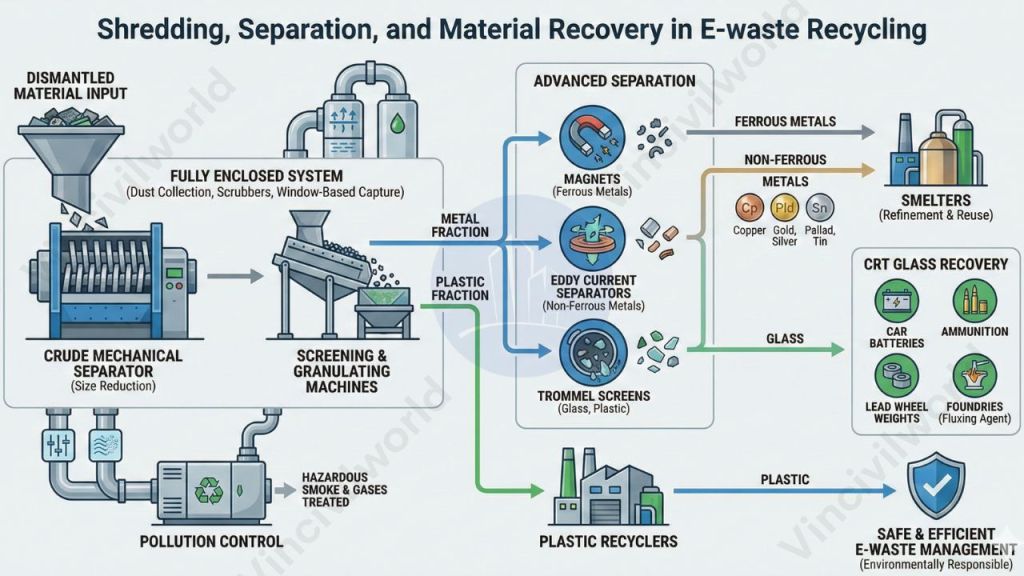
    1. Shredding, Separation, and Material Recovery in E-waste Recycling
  4. Benefits of Recycling
  5. Key Takeaways
  6. Conclusion

What is e-waste ?

E-waste, or electronic waste, refers to discarded electrical and electronic equipment that is no longer usable, repairable, or required. Common examples include computers, mobile phones, televisions, household appliances, and office electronics. As technology evolves rapidly, the generation of electronic-waste continues to increase worldwide. Improper disposal of e-waste can release harmful substances such as lead, mercury, and cadmium into the environment, posing serious risks to human health and ecosystems. Proper handling and recycling of e-waste allow the recovery of valuable materials like metals and plastics while reducing environmental pollution. Understanding what e-waste is helps promote responsible disposal practices and supports sustainable waste management solutions.

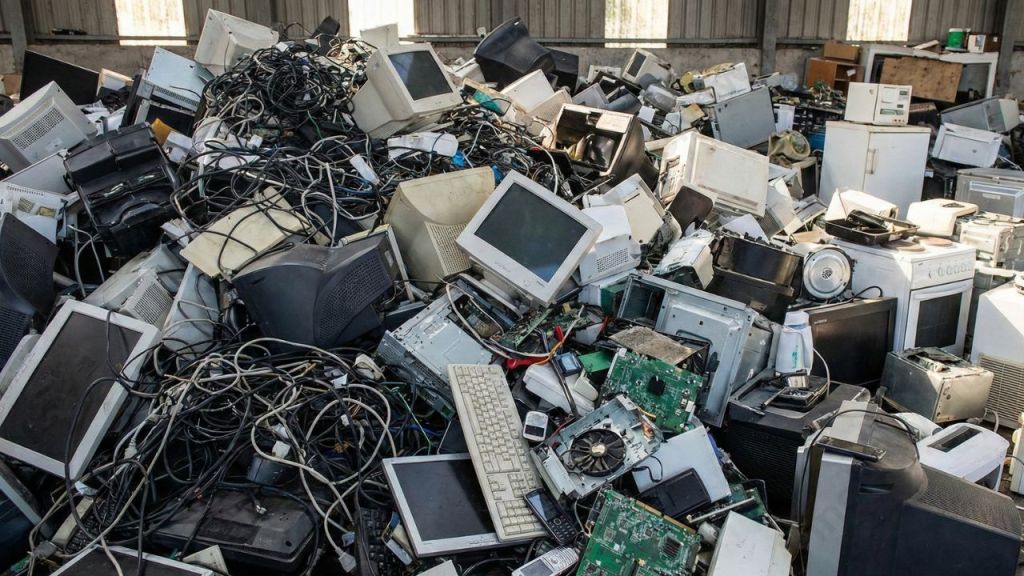
A large pile of discarded electronic devices, including old computers, monitors, keyboards, and tangled cables, in a warehouse setting.
A large pile of discarded electronic devices, highlighting the growing issue of e-waste.

Types or classifications of e-waste

Types of e-waste are classified based on the nature, size, and function of electronic equipment. Proper classification helps in safe handling, efficient recycling, and environmentally responsible e-waste management practices.

The European Directive on Waste Electrical and Electronic Equipment divides waste into ten categories: 

  1. Small household appliances
  2. IT equipment (including monitors)
  3. Consumer electronics (including TVs)
  4.  Lamps 
  5. Luminaires
  6. Toys
  7. Tools
  8. Medical devices
  9. Monitoring and Control Instruments,
  10. Automatic dispensers

Let me brief about the importance of recycling E-waste.

A cluttered pile of various electronic circuit boards and components scattered around, featuring an assortment of colors and types, with a keyboard and wires visible in the background.
A close-up view of various electronic waste components, illustrating the complexity and volume of e-waste generated in modern society.

Significance Electronic waste management and recycling

E-waste management is essential in addressing environmental challenges. It also helps with health challenges caused by the rapid growth of discarded electronic devices. Effective electronic waste recycling helps recover valuable materials, reduces pollution, and supports sustainable development by ensuring safe handling and proper disposal of electronic waste.

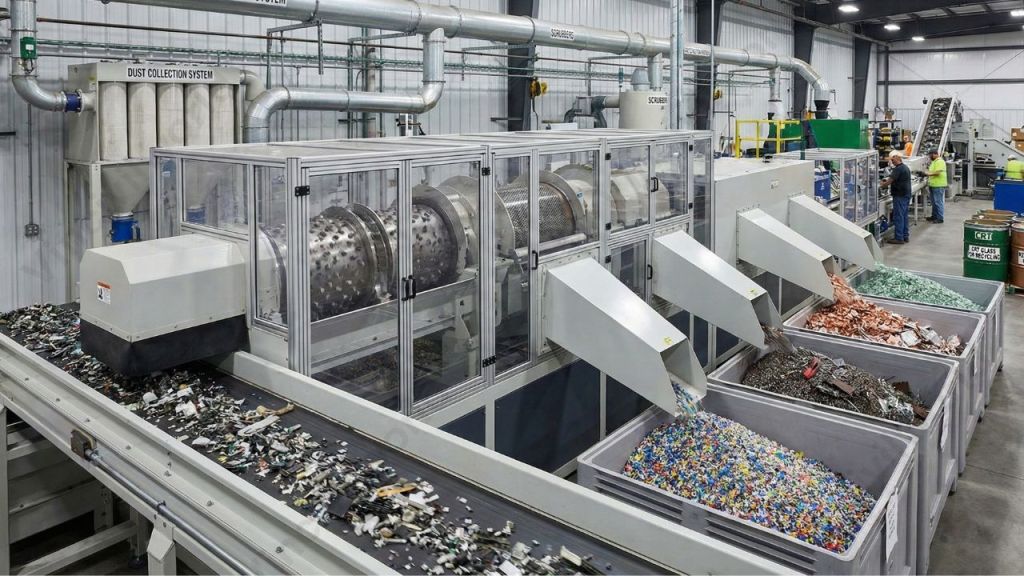
An industrial recycling facility featuring a conveyor belt with mixed waste, sorting machines, and bins for various types of recyclable materials.
An advanced e-waste recycling facility showcasing the shredding and separation process for efficient electronic waste management.

E-waste management is incomplete without recycling. Let’s see the reasons.

  • The aim of extracting metals and plastic from electronic waste is to use them in the manufacture of new electronics.
  •  Recycled metals are two to ten times more energy-efficient than metals smelted from raw ore.
  •  It’s used in tablets, smartphones, and electric car batteries.
  • According to the most recent estimates, the global value of e-waste is about $62.5 billion per year, which is more than the GDP of most countries.  It’s also worth three times what all of the world’s silver mines produce.
  • It can significantly minimise the release of radioactive materials into the atmosphere.
  • Helps to prevent the depletion of natural resources if properly implemented.
  • Reduces exposing workers to toxic and carcinogenic substances like mercury, lead, and cadmium.

E-waste recycling process

E-waste management depends on a well-structured recycling process that ensures safe handling, efficient material recovery, and environmentally responsible disposal of electronic waste. A step-by-step recycling approach reduces pollution, protects human health, and supports sustainable resource utilization.

Recycling printed circuit boards from electronic waste is one of the most difficult tasks. Gold, silver, platinum, and other precious metals, as well as base metals like copper, iron, and aluminium, are used on the circuit boards. 

Some of the ways of processing e-waste includes:

  • Melting circuit boards
  • burning cable sheathing to retrieve copper wire
  •  open-pit acid leaching 

Mechanical shredding and separation is the traditional process, but the recycling efficiency is poor. Cryogenic decomposition is an alternative method for recycling printed circuit board.

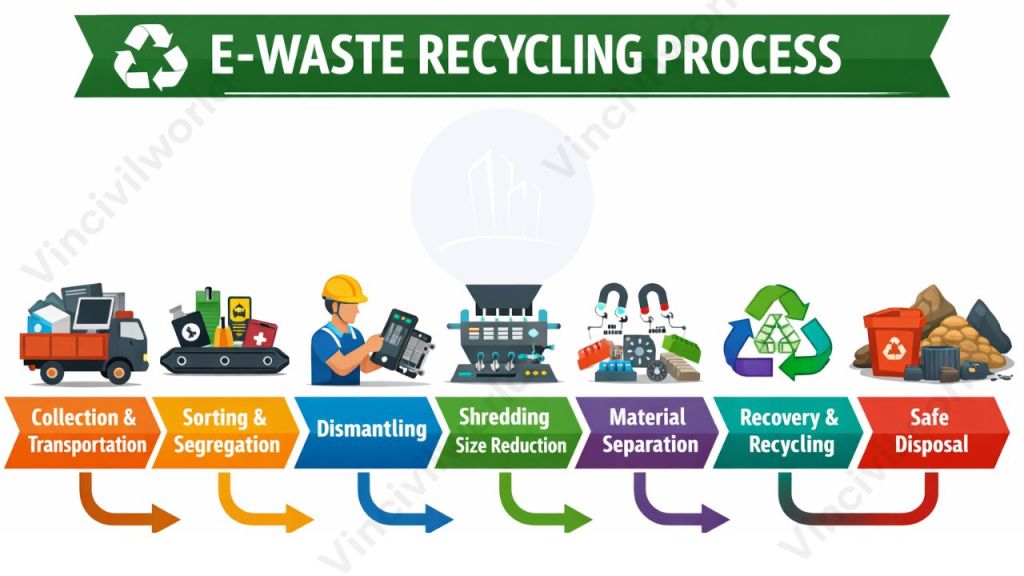
Infographic illustrating the e-waste recycling process, including steps such as collection, sorting, dismantling, shredding, material separation, recovery, recycling, and safe disposal.
Illustration of the E-waste recycling process, highlighting key steps like collection, sorting, dismantling, shredding, material separation, recovery, and safe disposal.

Shredding, Separation, and Material Recovery in E-waste Recycling

  • After dismantling, the material for shredding is conveyed into a crude mechanical separator, where size reduction begins. This stage plays a critical role in effective e-waste management by preparing materials for accurate separation.
  • The system uses screening and granulating machines to separate the constituent metal and plastic fractions. Once separated, these fractions are directed toward appropriate recovery streams and are sold to smelters or plastic recyclers for further processing.
  • This type of recycling equipment is fully enclosed and fitted with a dust collection system to prevent airborne contamination. Additionally, scrubbers and window-based capture systems collect a portion of the pollutants generated during shredding and granulation.
  • Following this, glass, plastic, and ferrous and non-ferrous metals are isolated using magnets, eddy current separators, and Trommel screens. These materials undergo further refinement at smelters.
  • CRT glass is recycled into products such as car batteries, ammunition, and lead wheel weights, or sold to foundries for use as a fluxing agent in raw lead ore production. Valuable metals including copper, gold, palladium, silver, and tin are recovered and sold to smelters for reuse.
  • To protect the atmosphere, hazardous smoke and gases are detected, contained, and treated. Through these techniques, all useful device construction materials are safely reclaimed, ensuring environmentally responsible and efficient e-waste management.
Infographic illustrating the process of shredding, separation, and material recovery in e-waste recycling, including stages like dismantled material input, crude mechanical separation, advanced separation for metals and plastics, and pollution control measures.
Diagram illustrating the shredding, separation, and material recovery processes in e-waste recycling.

Also read : Air pollution – effects and causes

Benefits of Recycling

  • The most successful solution to the growing e-waste issue is to recycle raw materials from end-of-life electronics. 
  • Recycling preserves our natural resources. 
  • Dismantling and reuse options prevent air and water contamination induced by hazardous disposal.
  • Furthermore, recycling decreases the amount of greenhouse gas emissions generated by new product production. 

Key Takeaways

  • E-waste management addresses the safe handling and disposal of discarded electronic devices.
  • Rapid technological advancement has significantly increased global electronic waste generation.
  • India ranks among the top e-waste–producing countries, highlighting the urgency of proper management.
  • Understanding what is e-waste helps promote responsible disposal and recycling practices.
  • Proper types and classification of e-waste support efficient collection and treatment.
  • Recycling enables recovery of valuable metals such as gold, copper, and silver.
  • Effective electronic waste recycling reduces environmental pollution and health risks.
  • Advanced recycling processes improve material recovery efficiency.
  • E-waste recycling conserves natural resources and saves energy.
  • Sustainable e-waste management supports environmental protection and circular economy goals.

Conclusion

E-waste management has become a critical environmental priority due to the rapid growth of discarded electronic devices worldwide. Understanding what e-waste is, along with its classification and recycling methods, helps address the environmental and health challenges associated with improper disposal. Efficient electronic waste recycling recovers valuable materials, reduces pollution, and minimizes the release of toxic substances into air, soil, and water. In countries like India, where e-waste generation is rising sharply, strong regulations and public awareness play a vital role in effective implementation. By adopting structured recycling processes and responsible consumption habits, societies can conserve resources, reduce energy use, and promote sustainable development.

Proper e-waste management is essential for protecting ecosystems and ensuring a cleaner, healthier future. Considering the huge volume of E-waste generated everyday recycling them is the need of the hour. India has formulated and notified its strategy to tackle e-waste through the e-waste (Management) Rules, 2016. Recycling reduces pollution, saves energy and conserves resources.

That’s it about E-waste. Hope you found it useful.

Updates in civil engineering, architecture finishes, building construction, Environmental Engineering