Ecological footprint- Methodology, Impact and Examples Complete Guide

The ecological footprint is gaining significance in the era of advancements. The unsustainable developments and rapid technological developments in the infrastructure says its high time we give significance to the concept.

In the blog, we will find out all the basic details about the EF. The methodology, applications and implementation examples are also included.

Let’s begin with the definition of ecological footprint (EF).

What’s an ecological footprint?

  • Ecological footprint is a metric to quantify human demand for natural resources.
  • Or, the amount of nature it takes to sustain people or an economy, promoted by the Global Footprint Network. It controls this demand through a method of ecological accounting.
  • The measure of land and water to produce goods and dispose of waste humans generate
  • The 3 types of lands are cropland, grazing land and fisheries.
  • Helps in managing assets wisely
  • Helps in taking necessary action
  • Unit of EF is gha

Also read: Cellular Light Weight Concrete: Manufacturing Process & Properties Full Details

The methodology of EF is given in the next section.

Methodology of ecological footprint

  • Tracks biologically productive area and water to meet demands
  • Demands: space for food growing, timber regeneration, fibre production, absorption of CO2 emission
  • consumption=Imports-exports from national production
  • Biocapacity-biologically productive are available to produce resources and absorb waste
  • Ecological reserve-footprint> biocapacity
  • Ecological deficit-footprint<biocapacity
  • 85% of population ecological deficit

The figure below shows the EF of production and ecological footprint of trade- the two factors that contributes to the ecological footprint of consumption.
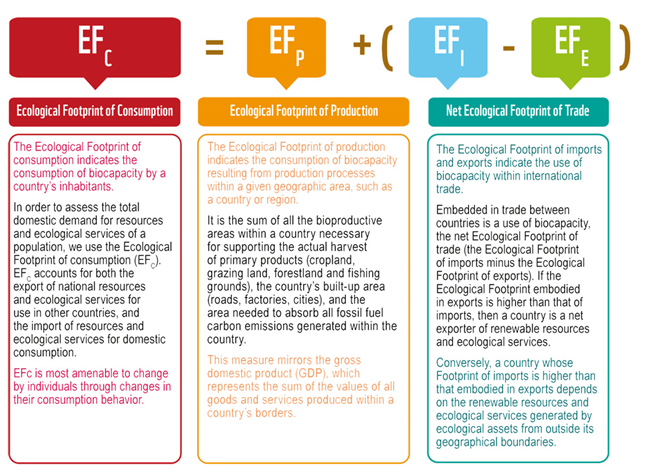
Ecological footprint of consumption
(SOURCE:GLOBAL FOOTPRINT NETWORK)

It’s time to have a look at the various factors that impact EF.

Impacts on EF

The section deals with the parameters that influence the ecological footprint.

A. Natural resources

  • Negative
  • Therefore excessive use controlled
  • Mining industry- advanced energy efficient technology
  • Reforestation,control fishing

B. Human capital

  • Negative
  • Locational advantage huge FDI
  • Education rate high hence human capital high
  • Tutorials ,public messages

C. Energy consumption and economic growth

  • Positively related
  • Stimulates use of fossil fuels
  • New technologies revolutionalize the energy sector to reduce emission
  • Govt should subsidize investments
  • Hydrogen fuel cell resolves storage issue
  • Policies-reforestation soil management, solar panels, organic farming

In the next section, we will find out the applications of ecological footprint.

Applications of ecological footprint

The main applications are as follows.

  • National review
  • Risk identification
  • Policy development
  • Footprint adoption
  • Monitoring
  • Communications

Also read: Types of Cracks in Building- 14 Causes& Prevention Full Details

Now that you know the basics of EF, let’s read through the implementation examples.

Examples of implementation

Places of less EF
Places having less EF

There are 4 implementation examples given below.

  1. United Arab Emirates
  • Largest per capita EF in 2006
  • Today exemplery model
  • Innovative awareness campaigns launched
  • Support from government
  • Energy efficient lighting regulation on oct 2013
  • Household sector main contributor(55%)

2. Philippines

  • Ecological deficit
  • Per capita biocapacity reduced 44%due to rapid population growth
  • In 2011 govt and global footprint network took an initiative to analyse country’s resources
  • Currently in the process of finalising national land use act –EF national indicator,protect area,careful use of resources

3. San Francisco

  • Overall EF 6% higher than avg Americans
  • Density and public transportation reduce EF
  • Increased consumption of city residents increase EF
  • Food and beverage consumption highest contributor

4. Calgary

  • The first city to develop EF reduction targets
  • If everyone same EF as Calgary resident,5 earths are required
  • Public rail transportation system powered 100% emission-free wind-generated energy
  • Greenhouse_gas emission 45% below 2005 levels
  • Already met 2020 reduction targets

Now, let’s wrap up.

Conclusions

  • Ecological footprint helps in measuring and assessing the impact of human activities.
  • Therefore take necessary actions which include rainwater harvesting, soil management practices, use of public transportation system, use of renewable resources, organic farming etc.
  • Strive towards a world where waste becomes energy, wastewater turned into bioplastics and heat and where electricity becomes green.

Also read: 3 d Printing buildings |Concrete Printing & Contour Crafting Methods Full Guide

So have you got all the important information regarding ecological footprint? Give a shoutout in the comments!

Happy learning

Reactive Powder Concrete- 6 Components and All Properties Explained

Reactive powder concrete is an ultra-high strength and highly ductile composite material with advanced mechanical properties, hence has high durability. In this blog, I will walk you through the components, properties, advantages and limitations of RPC.

Let’s start from the definition.

What is reactive powder concrete?

Reactive Powder Concrete (RPC) is a type of Ultra High Performance Concrete (UHPC). The main constituents are cement, sand, silica fume, steel fiber and quartz powder with minimal water to binder ratio, without coarse aggregate.

Next, let me show you the development of RPC that presents different steps of formation.

Development of RPC

In RPC, water- binder ratio is very low, CA is absent- reduce the heterogeneity of concrete mix and optimize microstructure. Precise gradation of particles yields compact, well-arranged and high strength hydrates of maximum density.

Development of RPC is based on the following principles.

  • Elimination of CA- Homogeneity enhanced
  • Utilization of pozzolanic properties of silica fume
  • Granular mixture optimization- to enhance the compacted density
  • Optimal usage of superplasticizer- improves workability, reduce w/c
  • Apply pressure (before and during setting)- improves compaction
  • Post set heat treatment- to enhance microstructure
  • Addition of small-sized steel fibres- improves ductility

Let’s move on to the components of reactive powder concrete now.

Components of RPC

  COMPONENT      SELECTION PARAMETER  FUNCTION  PARTICLE SIZE
SandGood hardness, readily available and low costGives strength150-600 µm
CementC3S: 60% C2S: 22% C3A: 3.8% C4AF: 7.4%Binding material for production of primary hydrates1-100 µm
Quartz powderFinenessMax reactivity during heat-treating5-25µm
Silica fumeVery less quantity of impuritiesFilling the voids,
enhance rheology,
production of secondary hydrates
0.1-1µm
Steel fibersGood aspect ratio, straight in shapeImprove ductilityLength 13-25 mm   Dia. 0.15-0.2 mm
Super plasticizerLess retarding characteristicsReduce w/cPoly acrylate based
Components of RPC

Here comes the properties of RPC in the next section.

Properties of RPC

  • RPC possess better strength (compressive and flexural) and lower permeability compared to HPC
  • Fracture toughness is higher for RPC- higher ductility
  • Ultra-dense microstructure- waterproofing and durability characteristics
  • Higher corrosion resistance- can be used in chemically aggressive environments
  • Workability of RPC mixtures (with and without fibres) measured by mortar flow table test- (120-140 mm)
  • Workability of HPC mixtures (with and without fibres) measured by slump test- (120-150 mm)
  • Density of fresh RPC and HPC mixtures- 2500-2650 kg/m3 
  • Compressive Strength of RPC and HPC- linked to durability, found that compressive strength of RPC is suitable for nuclear waste containment

How about the factors affecting the strength of RPC?

Also read: Self healing concrete|Bacterial concrete-Preparations& Advantages

Factors affecting strength of RPC

  1. Silica fume percentage- Compressive strength decreases as dosage increases, fluctuates in the range of 25-35% silica fume 

2. Quartz Powder- improves filler effect, 20% increase in compressive strength under accelerated curing condition

3. Curing Regime- compressive strength increased by 10% when subjected to hot water curing

4. Temperature- 

  • Compressive strength

– decreases at 100°C

– increases from temperatures 200-500°C 

– decreases at temperatures above 600°C

-increases as fibre content increases

-decreases as fibre content increases above 300°C

  • Tensile strength

– decreases below 200°C

 -increases from temperatures 200-300°C

 -decreases above 300°C

5. Pre-Setting pressure- Compressive strength of RPC increased by two times

Time to see the advantages of reactive powder concrete.

Advantages of reactive powder concrete

Reactive powder concrete
  • High ductility
  • Low porosity and permeability
  • Increased resistance to corrosion and chemical attack
  • Significant dead load reduction is possible
  • Eliminates the need for supplemental shear and auxiliary reinforcing steel
  • Improved seismic performance
  • Useful for containment of nuclear wastes- as there is minimum penetration of liquid/gas through RPC

We will find out the applications of reactive powder concrete now.

Also read: Reinforced cement concrete- Working stress and limit state method

Applications of RPC

  • Pre-stressed applications
  • Light weight structures- roof of stadiums, long span bridges, space structures, high pressure pipes, and blast resistance structures
  • Containment of nuclear wastes
  • Pre-cast structures 

Before we wrap up, let’s take a quick stroll through the limitations.

Limitations of reactive powder concrete

  • More expensive compared to conventional concrete
  • Technological and economical difficulties in applying pressure to mix and heat treatment in field
  • Since RPC technology is in its infancy, the long term are still not known
  • Fine sand becomes equivalent to CA of conventional concrete, hence acting as a weak link
  • Portland cement plays the role of fine aggregate and silica fume of the cement of conventional concrete

So, in nutshell,

Conclusions

  • RPC is a recent advancement in the field of construction
  • It has superior performance characteristics compared to HPC
  • Based on the principle of optimization of microstructure to produce hydrates of the highest strength and durability
  • Usage of superior materials has increased the cost of RPC considerably
  • Ambiguity in long term properties, technological difficulties
  • Intense research in this field guarantees that its limitations shall be resolved and it will be tapped to its full potential in the near future

That’s it about reactive powder concrete. Let me know your feedback on the article and any other topic suggestions in comments.

Happy learning!

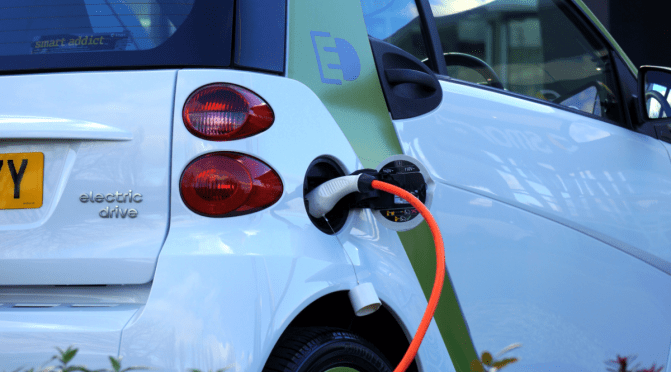
Electric Vehicles- 5 Types & Advantages Full Guide

The world is moving towards an increased share of renewable energy in order to reduce greenhouse gases. The transport sector is the main source of greenhouse_gas. Electric vehicles can be used as an alternative source. Because they cause zero emissions and is extremely eco-friendly. There have already been many reports that show the positive impact of EVs.

We will find out the basic details of EVs along with its challenges and solutions.

Let’s get into the first section that explains the working of electric vehicles.

Electric vehicles working

Electric vehicle technology is as follows.

  • EVs are defined as vehicles that use an electric motor for propulsion.
  • Although EVs offer several advantages and can be used in different application, there are several challenges in the popular use of them.
  • The electricity used to run the motor could come either through transmission wires.
  • This is the same case with electric locomotives, metro trains, and trams or through a single or a series of connected batteries.
  • And so is the case in electric bikes and electric cars, or it could be generated onboard using a fuel cell.
  • Powered through a collector system by electricity from off-vehicle sources, or maybe self-contained with a battery, solar panels or an electric generator to convert fuel to electricity.

I will walk you through the advantages of electric vehicles in this section.

Electric vehicles advantages

  • Electric vehicles cause zero emissions and therefore eco-friendly.
  • EVs are as green as the energy sources used to charge them
  • Do not have any tail-pipe or evaporative emissions.
  •  Not limited to, road and rail vehicles, surface and underwater vessels, electric aircraft and electric spacecraft.

Time to look at the different types of EVs.

Electric vehicles types

There are mainly 5 types of EVs.

1. Mild hybrid electric vehicles

  • Contains a small electric motor that enables a start-stop system, facilitates regenerative offers acceleration assistance.
  • Achieve small reductions in emissions, between 10% to 15%  at relatively high costs.
  • It is viewed as an intermediate system.

2. Fully hybrid

  • The larger motor and battery pack that provides the vehicle with electric launching, acceleration assistance and electric driving at low speeds.
  • Achieve a maximum of 25% to 30% in greenhouse gas emission contribution.
  • The cost of hybrid components is expected to fall by 5% per year.

3. Plugin hybrid electric vehicles

  • A larger battery that can be recharged by connecting a plug to an electric power source or grid.
  • The ability to connect to the grid gives the PHEV a range of 30 to 60 kilometres of all its electric driving.
  • The carbon reduction potential of a PHEV is between 30% to 40%.

4. Range extenders

  • A small ICE that is used to recharge the battery to extend the driving range.
  • Carbon reduction potential of between 60%- 80% depending on the electricity source used to charge the battery.

5. Fully electric

  • All the needed propulsion energy is stored in a large battery that can be recharged by connecting it to the electricity grid.
  • 2 to 3 times more efficient than conventional ICEs.
  • Only as clean as the source of electricity that is used to recharge the battery, and when charged using renewable sources.
  • Reduce emissions by up to 80 %- 100%.

I will show you the challenges of EVs in this section.

Challenges of electric vehicles

Tesla electric cars
Tesla electric cars

The major challenges has been categorized into the following types.

  1. Technical

Parameters which decide the designing and operation of EVs.

a) Light weight material

  • The main objective of EVs is to reduce the energy demand of the vehicle.
  • A large amount of the energy generated from the input will be utilized in driving the heavyweight of the vehicles.

b) Efficiencies of batteries

  • Battery system should be lightweight and its storage capacity should be more.
  • EV is based on increased battery capacity and efficiency.
  • Energy devices for EV system are Pb Acid,
  • Ni and Li-ion based batteries.

c) Driving range of EVs

  • Fully charged EVs are having approximate 5 times lesser driving range than that of a conventional diesel or petrol vehicles.

d) Charging Time

  • Older lead-acid batteries or valve-regulated lead-acid battery packs or the new Lithium-Ion packs will charge fully overnight.
  • Lead Acid batteries, 70% of the charging is done in the first 40% of charging time.
  • The rest is the “topping up” stage of the charging process.

e) Environmental Impacts

  • If electricity fed to EVs is generated by the fossil fuel the emission factor will be more
  • Disposal of the used battery
  • Pb can be very dangerous to dispose of it in open.

2. Infrastructure

a) Power infrastructure

  • Substantial increase in electricity production is required to offset the overloading of local transformer and grid.

b) Charging infrastructure

  • The requirement of sufficient charging stations
  • Also, fast charging devices should be used

c) Battery recycling

  • The disposal will cause environmental pollution
  • During designing a recycling process cost is the main factor.

3. Market

a) Vehicle servicing

  • Trained technicians are required for its servicing and maintenance
  • Costly compared to conventional vehicles
  • Due to less popularization of EV

b) High upfront cost

  • A high upfront cost of purchase along with battery replacement after a few years does seem like a heavy investment to an average Indian with decent income

c) Consumer perceptions

  • Change in consumer perception is required

d) Policy

  • Taxation of vehicles and components
  • Subsidies on fossil fuels
  • Electricity tariff policies

Also read: Road margins- 6 types of road margins in highway

We saw the challenges. Let’s solve them now.

Solutions to overcome the challenges

EV charging
EV charging
  1. Light weight materials such as glass, plastics, rubber, and special fibers are used in the production of a vehicle
  2. Aluminium and magnesium are used in the construction of body of vehicle to reduce the total weight.
  3. Natural fiber reinforced composites are also used in manufacturing
  4. Sodium ion, lithium sulphur batteries can be introduces for more capacity
  5. Super capacitors are also introduced which can be used to meet peak power demand condition and also for purpose of fast charging
  6. To reduce anxiety towards fuel
  7. Increase in charging stations
  8. Fast charging battery
  9. High density batteries etc.
  10. Solar power would provide cheap and reliable power system.
  11. Incentives will motivate the buyers to purchase EVs
  12. To make EVs affordable in India, domestic production of quality batteries has to be taken up.

Also read: Types of rails- 3 types full details with figures

Let’s wrap up.

Conclusions

  • The increase in the number of vehicles results in the increased emission of GHG.
  • Emission from the transportation sector is decreased: a great change in the carbon emission of our country.
  • EV – best alternative.
  • The complete economic comparison of fuels shows that electricity as a fuel is much cheaper than conventional vehicles

Are electric vehicles the future? Share your thoughts in the comments in the light of the article.

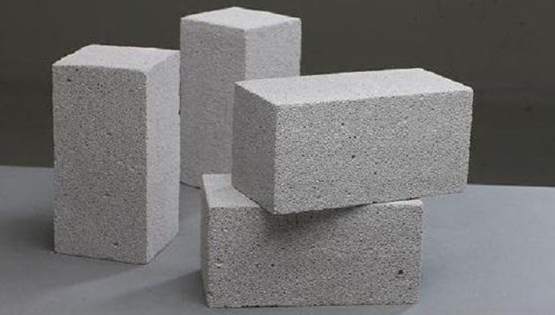
Cellular Light Weight Concrete: Manufacturing Process & Properties Full Details

Cellular Light Weight Concrete (CLC) is a lightweight concrete that is produced by mixing cement and fly ash slurry with pre-formed foam. CLC is also known by the names as foam concrete,  aircrete, foamcrete or reduced density concrete.

We will find out the main principles, constituent materials, manufacturing, properties, advantages and disadvantages of CLC in the blog.

Let’s start from the principles.

Cellular lightweight concrete technology

  • Cellular lightweight concrete is prepared by introducing air bubbles into the concrete using a foaming agent.
  • Amount of air-entrained determines the density of the material.
  • Use of coarse aggregates is eliminated in CLC.

We will see the constituent materials in the next sections.

Constituent materials

Cellular light weight concrete block
  1. Cement

Ordinary Portland Cement is used.

2. Water:

The water used in the manufacture of CLC Blocks is potable water.

3. Fly-Ash :

Class F Fly-ash conforming to IS 3812 (part-1) is used .

4. Sand :

Sand passing through 2.36 mm IS sieve is used.

5. Foaming Agent :

Hydrolyzed protein-based foaming agent or synthetic-based foaming agent is used. Protein-based foaming agents are prepared with raw material in presence of Ca(OH)2 and a small portion of NaHSO3.

Time to look into the classification of cellular light weight concrete.

Classification of cellular light weight concrete

The cellular light-weight concrete blocks confirms to the following grades :

  • Grade-A: These are used as load-bearing units and shall have a block density in the range of   1200 kg/m3 to 1800 kg/m3.
  • Grade-B: These are used as non-load bearing units and shall have a block density in the range of 800 kg/m3 to 1000 kg/m3.
  •  Grade-C: These are used for providing thermal insulation and shall have a block density in the range of 400 kg/m3 to 600 kg/m3.

How about the manufacturing process?

Cellular light weight concrete manufacturing process

CEMENT  (%)FLY ASH (%)SAND (%)
35650
35605
355510
355015
354520
354025
353530
Mix proportion of Cellular light weight concrete
  • Cement, sand and fly ash are dry mixed in proportion
  • The slurry is made by wet mixing with water.
  • Foaming agent about an amount of 1.5% of the total weight of cement, fly ash and sand is taken.
  • The foaming agent is diluted with water in the dilution ratio is 1:35.
  • The above solution is fed into the foam generator.
  • the foam is mixed thoroughly with the cement-based slurry.
  • After mixing is completed check that the wet density of the foamed concrete is close to what is required.
  • The slurry form of foamed cellular concrete is pumped into assembled moulds of blocks of dimensions 600mm x 250mm x 200mm.
  • The blocks are then cured and this curing is done by Water for 2 to 3 weeks.

We will find out the properties of fresh and hard cellular light weight concrete now.

Fresh CLC properties

  • Workability of foamed concrete is very high and have a slump value of 150mm to collapse
  • Reduces tendencies of segregation, bleeding and laitance
  • Reduced alkali-aggregate reaction
  • Freely flowing consistency and self-compacting property

Hardened cellular light weight concrete properties

  • Physical properties of the foam concrete are clearly related to the dry density (400 to 1400kg/m3)
  • Thermal conductivity of foam concrete ranges from 0.1W/m.K to 0.7 W/m.K
  • Better acoustical insulation
  • Good resistance against freezing and thawing
  • Reduced permeability

I will show you the comparison of various technical parameters of cellular light weight concrete in the next section.

Comparison of technical parameters of clc blocks and burnt clay bricks

1Dry Density (Kg/m3)  80090010001100
2Compressive Strength (N/mm2)  2.63.23.85.4
3Drying Shrinkage No Shrinkage    No Shrinkage    No Shrinkage     No Shrinkage  
4Thermal Conductivity (W/m.K)  0.320.340.360.37
5Water Absorption (%)  11.8711.5111.3710.96
Comparison of technical parameters of clc blocks and burnt clay bricks

Now comes the the mandatory section on advantages and disadvantages of cellular light weight concrete.

Advantages of CLC

  • reduces dead load of the building
  • easy to handle and hence reduce the cost of transportation
  • low thermal conductivity and good acoustical insulation
  • good resistance to freezing and thawing action
  • disposal of harmful industrial wastes like fly ash
  • better placeability
  • eco-friendly
  • lower water absorption
  • Fire resistant

Disadvantages of cellular lightweight concrete

  • Difficulty in finishing
  • Time of mixing longer
  • With the decrease in density, the compressive strength and flexural strength also decreases

Let’s wrap up with the conclusion.

Conclusions

  • 68% of our country’s electricity demand is fulfilled by coal-based thermal power plants and so the harmful fly ash produced can be used in CLC.
  • CLC blocks are environment friendly and thus we can reduce environmental pollution and global warming.
  • Technical properties of CLC are far more superior than conventional burnt clay bricks and so the use of burnt clay bricks can be replaced with CLC.

That’s it about cellular light weight concrete. Do you have any doubts? Did I miss out anything? Please help yourself to the comment box.

Happy learning!

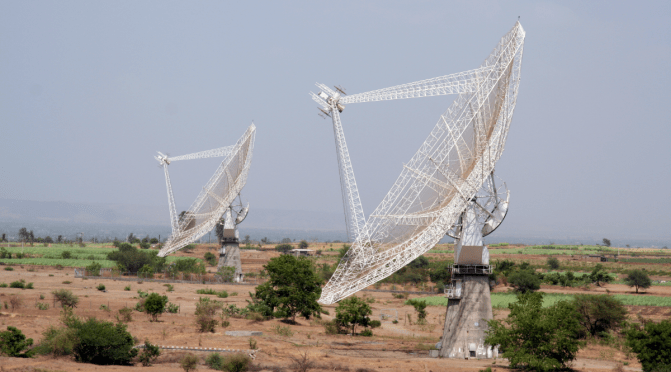
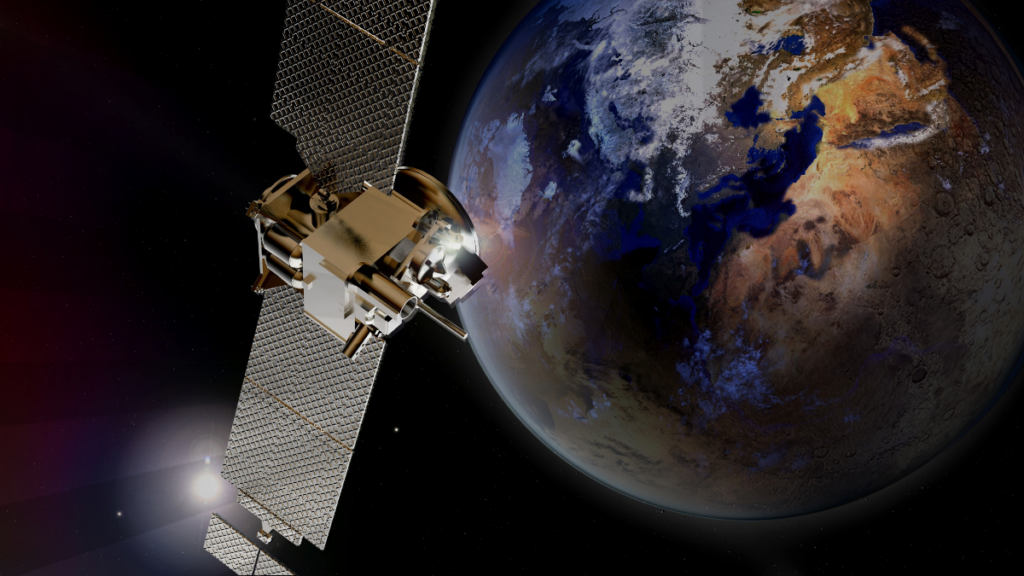
Remote Sensing- 4 Amazing Applications in civil engineering

Remote Sensing has been leveraged for various applications in various fields. We will see the definition, components & applications in civil engineering in this blog.

First let’s find out the definition of remote sensing.

What is remote sensing?

Remote sensing (RS) is the technology of acquiring information about the Earth’s surface without actually being in contact with it.

This is done by sensing and recording reflected or emitted energy and processing, analyzing, and applying that information.

I showed you the remote sensing definition.

We will find out the different components of RS now.

Remote sensing components

Components of remote sensing
Components of RS

7 components involved in RS are,

  • Energy Source or illumination
  •  Radiation and the atmosphere
  •  Interaction with the target
  •  Recording of energy by the sensor
  •  Transmission, reception and processing
  •  Interpretation and analysis
  •  Applications
  1. Energy Source or Illumination (A)– The first requirement for remote sensing is to have an energy source which illuminates or provides electromagnetic energy to the target of interest.

2. Radiation and the Atmosphere (B)– As the energy travels from its source to the target, it will come in contact with and interact with the atmosphere it passes through. This interaction may take place a second time as the energy travels from the target to the sensor.

4. Recording of Energy by the Sensor (C) – After the energy has been scattered by, or emitted from the target, we require a sensor (remote – not in contact with the target) to collect and record the electromagnetic radiation.

5. Transmission, Reception, and Processing (D)- The energy recorded by the sensor has to be transmitted, often in electronic form, to a receiving and processing station where the data are processed into an image (hardcopy and/or digital).

6. Interpretation and Analysis (E)- The processed image is interpreted, visually and/or digitally or electronically, to extract information about the target which was illuminated.

7. Application (F)- The final element of the remote sensing process is achieved when we apply the information we have been able to extract from the imagery about the target in order to better understand it, reveal some new information, or assist in solving a particular problem

We will move to the principles of remote sensing next.

Remote sensing principles

Symbolizing remote sensing working
Symbolizing RS working

Here we go with the principles.

  • Electromagnetic energy reaching the earth’s surface from the Sun is reflected, transmitted or absorbed.
  • Specific targets have an individual and characteristic manner of interacting with incident radiation that is described by the spectral response of that target.
  • Electromagnetic_radiation (EMR) like radio waves, infrared (heat) waves make characteristic patterns as they travel through space
  •  Soils of differed types water with varying degrees of impurities, or vegetation of various species

The next section deals with the different types of remote sensors.

RS sensors types

There are mainly 2 types of sensors used in RS.

  1. Passive sensors- Passive system record energy reflected or emitted by a target illuminated by the sun. e.g. normal photography, most optical satellite sensors

2. Active sensors- Active system illuminates the target with energy and measure reflection. e.g. Radar sensors, Laser altimeters RADAR(Radio Detection and Ranging), LIDAR(Light Detection and Ranging)

I will walk you through the platforms for remote sensing next.

Remote sensing platforms

Platforms of remote sensing

Platforms are used to house the sensors which obtain data for remote sensing purposes. 

The distance between the target being imaged and the platform plays a large role in determining the detail of information obtained and the total area imaged by the sensor.

Platforms are-

  • Ground-based
  • Airborne eg. Aircraft, Drone
  • Spaceborne eg. Satellite

Time to get into the last, but the most important section.

RS applications in civil engineering

  1. Site investigation
  • Site investigations in general require topographic and geologic considerations.
  • Remote sensing data permits such an assessment. In the case of dam site investigation, information on topography is essential.
  • Geological consideration involves the different soil and rock types and physical properties.
  • In selecting river-crossing sites for bridges and pipelines, an important consideration is the stability of slopes leading down to and up from the water crossing.
  • Such slopes include riverbanks, terrace faces and valley wall.
  • High spatial resolution satellite data can facilitate depth perception in the above-said investigations

2. Planning and design of highways

  • Highways are part of the infrastructure that makes up the spinal cord of modern society.
  • RS & GIS provides a valuable tool in the process of planning and design of highways.
  • To obtain an optimum highway route alignment which is economical, suitable and compatible with the environment, various types of data have to consider simultaneously.

3. Groundwater location

  • Knowledge of groundwater location is important for both water supply and pollution control analysis.
  • Remote sensing plays a vital role in delineating potential areas of groundwater occurrence for detailed exploration.
  • Thus, it reduces the cost and time involved in groundwater exploration. Potential groundwater areas cannot be seen as on satellite images directly

4. Landslide assessment

  • Landslide is the result of a wide variety of processes which include geological, geomorphological and meteorological factors.
  • The important terrain factors are lithology, structure, drainage, slope, land use, geomorphology and road network.
  • A complete landslide hazard assessment requires an analysis of all these factors leading to instability in the region.
  • The feature extraction of some of these factors can be done from the interpretation of RS using satellite images

That’s it about remote sensing. Let me your doubts in comments.

Happy learning!

Shotcrete – A total overview||Shotcrete vs Gunite

Shotcrete is a method of placing concrete where concrete/mortar is sprayed at high velocity to an overhead or vertical surface. Concrete is conventionally placed on the ground or to the formwork and compacted using appropriate vibration methods.

What is shotcrete? 

Shotcrete is a wet or dry mix of mortar/concrete sprayed to a vertical or overhead surface with high velocity. The mortar/concrete mix is conveyed through a hose and sprayed with a nozzle with high velocity. The force imparted by this application process consolidates the concrete/mortar resulting in an excellent bonding with almost all substrates. Shotcrete is also called sprayed concrete. The pressure will be maintained to around 20-30 N/cm2.

When mentioning about shotcrete another term which is commonly used is gunite or guniting.

Shotcrete process
Shotcrete process

What is gunite or guniting ?

Guniting and shotcrete are more or less the same. The difference between shotcrete and gunite is basically in the method of spraying and mixing ingredients.

Shotcrete spraying is accomplished through either of the following process.

a) Dry mix process

b) Wet mix process

The dry mix process is called gunite or guniting

In Gunite / dry mix process the dry materials are premixed and placed in a hopper. With the help of compressed air, the dry materials are driven to the nozzle. Water gets mixed with the ingredients from a separate source just before going out of the nozzle. The mixed material hit the surface to be applied at a super high velocity through the nozzle.

In the wet-mix process/Shotcrete, the ingredients are premixed with water like conventional concrete and placed in a hopper. Just like the dry-mix process, the wet-mix process uses compressed air to shoot the concrete through a hose. This is also called sprayed concrete were fully mixed concrete or mortar is sprayed through a nozzle.

Shotcrete of walls
Shotcrete of walls

Both these process are used depending on the area of application and site conditions.

Shotcrete vs Gunite – A comparison

Both of these methods have there pros and cons. The uses are distinguished depending on the area of application and nature of the job.

GUNITESHOTCRETE
In the gunite process, we can stop and start the job after some interval, and still, the material will stick on to the old surface due to the high velocity at which the material is applied.Shotcrete material is premixed and to be consumed within a specified time or else the material strength and qualities will be affected.
The applicators get much more work time since the cement mixing is done at the site. With gunite, you can stop and start the application without creating any cold joints. They got super high strength accompanied by low shrinkage.The joints formed in shotcrete due to any stoppage of work leads to a cold joint and the next layer applied after a certain period behaves as a different layer. A cold joint may develop and cracks may happen.
A super-skilled operator is required for gunite. The total quality, consistency, and strength of the gunite depend on the skill of the operator. And the ratio of water, cement sand mix. The nozzle operator controls the application, adjusting water levels as needed to get the right mix consistency.Highly skilled workers are not needed for a shotcrete application. The crew doesn’t have to be as skilled because the concrete comes already mixed and no need for any mixing or proportioning at the site. It’s easier to add specialised admixtures to the concrete
The high water content will ruin the mix and less water content will clog the hose and nozzle. Therefore care should be taken to maintain optimum water content.You don’t need to add water as it comes premixed with water. Sometimes water is added to improve the consistency of the mix in transit mixtures at site. This reduces the strength of the mix and cause shrinkage cracks.
Guniting gives a strong and uniform surfaceShotcrete gives a strong and consistent surface
Gunite produces a lot of oversprays called Rebound wastage. These rebound wastage are not to be reused and generate huge wastes. Disposing and housekeeping the area requires extra manpower.Wastage is less compared to Gunite in case of shotcrete.
Guniting is less expensive than shotcrete. Large-sized aggregates are not used in concrete, and mostly it will a cement-sand mix.Shot Crete is more expensive than gunite and uses aggregate up to 20 mm or as per design mix recommendations.
Completion time is slow compared to shotcreteThe shotcrete process is faster than gunite and got higher production rates.
Gunite is easier to clean up than shotcrete.
The hose is lighter and easier to use
Because you add water at the nozzle, the concrete is very fresh when you spray it.
If the hose gets clogged, it can be tough to clear which could be dangerous for the crew and property

The bottom line is that both gunite and shotcrete have their advantages and disadvantages. The truth is both will produce a high-quality, watertight, durable surface if you do the processes correctly. A super-skilled operator for doing the works improves the quality of the process.

Advantages of shotcrete

Shotcrete-sprayed concrete is increasingly becoming popular because of its extremely economical and flexible application process.

  • Shotcrete has got several advantages when compared to conventional concrete. For swimming pools, water retaining structures shotcrete is an ideal choice. They are easier to spray and admixtures can also be included to enhance mix qualities.
  • Shotcrete is durable and it imparts more strength to structures.
  • The process of application of shotcrete makes the concrete dense and less porous than conventional concrete.
  • They help in reducing shrinkage cracks, cold joints and produce an even, nonporous and durable concrete.
  • They help in reducing the construction time and reduce valuable time and money incurred as formwork costs and makes the work far more easier.
  • Shotcrete/gunite can save money in terms of shuttering, labour costs and can shorten the project delivery schedule.
  • Cold joints and areas where shuttering possibility is minimum can also be done using shotcrete methods.
  • It is possible to create any shape using shotcrete which is not possible using conventional concrete.
Gunite work
Gunite work

Application of Shotcrete/guniting

Shotcrete is extensively used in a wide range of applications due to there ease and flexibility in placing and capability of producing a dense and non porous concrete surface. They are used for..

  • Shotcrete is used for the construction of thin, lightly reinforced sections such as curtain walls.
  • Used for shell or folded plate roofs.
  • Used for underground structures and tunnels, lining works. For pre-stressed tanks, swimming pools, water retaining structures for treatment plants, etc.
  • Shotcrete/gunite is used for repairing deteriorated concrete and retrofitting works.
  • Used for structural steel encasing works.
  • Shotcrete is used for the formation of canal lining, reservoirs, and repairing of linings.
  • They are best suited for applications in underground structures, basement waterproofing works, water retaining structures, deep excavation slope protection, etc.

Disadvantages of Shotcrete/Gunite

  1. The success of shot crete depends on the skill of the operator.
  2. Shotcrete cost is higher than conventional concrete.
  3. Chances of concrete loosing its quality due to delay in spraying or pouring water to increase workability.
  4. Getting a perfect bond with some surfaces is very difficult.

Share this:

Updates in civil engineering, architecture finishes, building construction, Environmental Engineering