Road margins- 6 types of road margin in highway

Road margins is an inevitable topic everyone should know who are into transportation engineering. We will see the different types of road margins, the details about the right of way on road and the formation width of road as per irc in the blog. I will also walk you through shoulder of the road being an important road margin.

  1. What are road margins?
  2. Road margin types
    1. Shoulder of the road-important among road margins
      1. The main objectives of the shoulder of the road
    2. Parking lanes
    3. Bus bays
    4. Cycle track
    5. Footpath
    6. Guard rails
  3. Formation width of road as per irc
  4. Right of way on road
    1. Key Takeaways of Road Margins
  5. Conclusion

What are road margins?

The portion of the road beyond the carriageway and on the roadway can be generally called road margins. Different elements of road margins are shoulder, parking lanes, bus bays, cycle track, footpath and guard rails. Let’s get into each one of them and learn in detail.

Road margins are essential components of highway design, serving various functions to enhance safety and efficiency. They include areas adjacent to the roadway such as shoulders, sidewalks, footpaths, road verges, berms, and medians. These elements provide space for emergency stops, pedestrian pathways, drainage control, and separation of traffic lanes. Properly designed road margins contribute to the overall functionality and safety of highways, accommodating diverse users and environmental conditions.

Road margin types

Road margins are essential components of highway design, enhancing safety and functionality. Here are the main types:

  • Shoulder of the road
  • Parking lane
  • Bus bays
  • Cycle track
  • Footpath
  • Guardrails

We’ll cover each type one by one to provide a comprehensive understanding.

Shoulder of the road-important among road margins

A shoulder is an emergency stopping lane by the verge of a road or motorway, on the right side in countries which drive on the right, and on the left side in countries which drive on the left. Shoulder of the road is provided along the road edge.

The shoulder of the road is a crucial element among road margins, providing a safety buffer for vehicles to stop during emergencies. It offers additional space for cyclists and pedestrians, enhancing overall road safety. Shoulders also support the structural integrity of the pavement and facilitate drainage, preventing water accumulation on the roadway. Regular maintenance of shoulders ensures they remain effective, contributing to the smooth operation and longevity of the road infrastructure.

Also read: Bitumen for road- Grade and properties of bitumen

The main objectives of the shoulder of the road

The main objectives of shoulders are,

  • The accommodation of stopped vehicles
  • They serve as an emergency lane for vehicle
  • Shoulders of the road provide lateral support for base and surface courses

A shoulder of the road should be strong enough to bear the weight of fully loaded truck even wet conditions. The shoulder width should be adequate for giving working space around a stopped vehicle. It is desirable to have a width of 4.6m for the shoulders. Minimum width of 2.5m is recommended for 2 lanes rural highway in India.

That’s it about shoulder of the road. Next, let’s see about parking lanes.

Parking lanes

Parking lanes are designated areas adjacent to roadways where vehicles can be parked temporarily or for extended periods. Parking lanes are provided in urban lanes for side parking. Parallel parking is preferred because it is safe for side parking. Parking lanes should have minimum of 3m width in the case of parallel parking.

They help manage traffic flow by keeping parked cars off the main travel lanes, thus reducing congestion. Properly marked and managed parking lanes enhance road safety, improve access to businesses and residences, and provide organized parking solutions in urban areas.

Bus bays

A bus bay, otherwise called bus turnout, bus pullout, off-line bus stop is a designated spot on the side of a road where buses may pull out of the flow of traffic to pick up and drop off passengers. It is often indented into the sidewalk or other pedestrian area. They are provided so that they don’t obstruct the movement of vehicles in the carriageway. But at the cost of the time necessary to merge back into flowing traffic.

Bus bay - Component of Road Margins
Bus bays of road margins

Cycle track

A Cycle_track, otherwise called separated bike lane or protected bike lane is an exclusive bikeway that has elements of a separated path and on-road bike lane. They are provided in urban areas when the volume of cycle traffic is high. Minimum width of 2m is required.

Footpath

A footpath is a type of thoroughfare that is intended for use only by pedestrians and not other forms of traffic such as motorized vehicles, cycles, and horses. They can be found in a wide variety of places, from the center of cities, to farmland, to mountain ridges. Urban footpaths are usually paved, may have steps, and can be called alleys, lanes, steps, etc. Footpaths are for pedestrians, especially in urban areas. Minimum width should be 1.5m.

Footpath - Road Margin
Footpath – Road Margin

Also read: Applications of Intelligent transportation system- everything you want to know

Guard rails

They are provided at the shoulder of the road. Various designs of guard rails are there. Guard rails painted in alternate black and white are usually used. They also give better visibility of curves at night.

Guard rails are safety barriers installed along roadways to prevent vehicles from veering off the road or into hazardous areas. They absorb impact and redirect vehicles, reducing the risk of severe accidents and enhancing overall road safety.

So, we have seen the main road margins. Its time to look into some terms related to them.

Formation width of road as per irc

Formation width of road as per irc (The Indian Road Congress) or roadway width is the sum of width of pavement or carriageway including separators and shoulder of the road.

According to the Indian Road Congress (IRC) standards, the formation width of a road refers to the total width required to accommodate the roadway and its components. It includes the width of the pavement or carriageway, which is the portion of the road where vehicles travel, and the shoulders, which are adjacent strips of land providing safety and support.

Additionally, formation width encompasses separators or medians, which are central areas separating opposing traffic flows to prevent collisions and manage traffic effectively. This comprehensive width ensures that the road can safely handle the intended traffic volume and type, provides space for emergency stops, and supports drainage and other road infrastructure. The design of the formation width takes into account factors such as traffic volume, road classification, and safety considerations, ensuring that roads are both functional and safe for users. Width of formation for various class of roads (IRC) are:-

Formation width of roads

Right of way on road

Right of way on road otherwise called land width is the width of land acquired for the road, along its alignment. It should be adequate to accommodate all the cross-sectional elements and may reasonably provide for future development. To prevent ribbon development along the highways, control lines and building lines may be provided.

Also read: Intelligent transportation system: A comprehensive approach to its components

The figure below shows the right of way on road for different type of roads.

Right of way - Road Margin
Right of way

Got every detail about road margins and related terms? Let me know your doubts and feedbacks in the comments.

Key Takeaways of Road Margins

  • Road Margins: Essential components of highway design that enhance safety and functionality.
  • Shoulders: Provide emergency stopping space, structural support, and aid in drainage.
  • Parking Lanes: Manage traffic flow by keeping parked vehicles off main lanes, enhancing road safety.
  • Bus Bays: Allow buses to pick up and drop off passengers without obstructing traffic flow.
  • Cycle Tracks: Dedicated paths for cyclists, improving safety and accommodating high cycle traffic.
  • Footpaths: Designated pathways for pedestrians, ensuring safe movement in urban areas.
  • Guard Rails: Safety barriers that prevent vehicles from veering off the road and reduce the risk of severe accidents.
  • Formation Width: Total width of the road including pavement, shoulders, and separators, as per IRC standards.
  • Right of Way: Width of land acquired for the road, ensuring adequate space for road elements and future development.

Conclusion

In transportation engineering, road margins play a crucial role in enhancing road safety and functionality. They encompass shoulders, parking lanes, bus bays, cycle tracks, footpaths, and guard rails, each serving specific purposes. Shoulders are essential for emergency stops and structural support, while parking lanes and bus bays improve traffic flow and safety. Cycle tracks and footpaths ensure safe pathways for non-motorized users, and guard rails prevent vehicles from veering off the road. Properly designed road margins contribute significantly to the overall efficiency and safety of highways. A thorough understanding of these elements is essential for developing effective road infrastructure that meets diverse needs and environmental conditions.

MUST READ: Classification of roads-5 types of roads full details

Happy learning!

Water to cement ratio – An Important Strength Factor.

Water to cement ratio is the ratio between the weight of water to the cement weight used in a concrete design mix. The water to cement ratio can significantly impact the workability and strength of the concrete.

Water to cement ratio – Significance

Concrete is manufactured by mixing cement, aggregates, and water in designed proportions. The process of proportioning is done as a volumetric (nominal mix) or by weight (design mix). Cement is the main ingredient of the concrete and acts as a binding material. In combination with water, cement undergoes a chemical reaction leading to the formation of thick and sticky gels responsible for the adhesion between the ingredients. The chemical process is called the heat of hydration. Cement and water are the most important ingredients of concrete and their ratios have a huge impact on the quality and strength of concrete. So for a design mix of required strength, the ratio of water to cement has to be maintained in the right proportions.

workability
CONCRETE POURING

Water-cement ratio – Calculation

Cement requires 23% water for initiating the chemical reaction and another 15% for the formation of gel to fill the voids.38% percent by weight of water to cement ratio is essential for the complete hydration process.

Table 5 - IS 456
Table 5- IS 456

As per IS 10262, the water-cement ratio varies from 0.4 to 0.6 based on exposure conditions. For the calculation of water to cement ratio, we need the cement content of the design mix. The minimum cement content is to be confirmed from IS 10253 for different grades.

For Mix 1:2:4 Moderate exposure condition water requirement would be-

Plain concrete(moderate) Table 5 IS 10252

The Minimum cement content for M15=240 kg/ m3

and Min water cement ratio =water/cement =0.60

=water/240=0.60

Min water requirement for mix=240*.60=120 liters

For Design mix, the W/C Ratio will depend upon the workability, strength requirements.

Fig 1 - IS 10262
Fig 1 IS 10262

Water-cement ratio effect on the workability of concrete

The water cement ratio has a huge impact on the workability and strength of the concrete. The workability of concrete means the ability of concrete to perform a concreting process involving mixing, transporting, placing, compacting with ease, and without any segregation. In other words, the workability of concrete indicates the ability of concrete to work easily. W/C ratio is also an important consideration for the workability of concrete. A high w/c ratio leads to higher workability because inter particle lubrication is increased. Similarly, a lower w/c ratio leads to lower workability because there is a lack of inter particle lubrication. However the w/c ratio is not the only parameter that decides the strength of concrete. The strength of concrete depends on a lot of factors like aggregate quality, cement proportions, etc.

Also Read : QUALITY TESTS TO BE DONE ON CONCRETE- SLUMP TEST

Effect of high w/c ratio

A high w/c ratio leads to higher workability because inter particle lubrication is increased. However, the overall concrete strength is reduced with the increase in the w/c ratio. The addition of more water gives dilute paste that has more pores at the micro-level and segregation of concrete.

HOW TO FIND OUT WATER CEMENT RATIO FOR DESIGN MIX AND NOMINAL MIX

The aggregates and cement particles take the excess water that is present in concrete. This consumption is uncontrollable if a large excess of water is present in the concrete. Hence, separate water channels are created resulting in bleeding on the surface. This creates weak zones in concrete that are susceptible to cracking under service loads. Concrete with a higher w/c ratio is also more susceptible to cracking and shrinkage. Shrinkage leads to micro-cracks, which are zones of weakness.

Once the fresh concrete is placed, excess water is squeezed out of the paste. When there is a large excess of water, that water bleeds out onto the surface. The micro-channels and passages that were created inside the concrete to allow that water to flow become weak zones. These weak zones are responsible for shrinkage cracks and micro-cracks when applied with service loads.

Concrete placing
Concrete placing

Effect of low w/c ratio

Lower water to cement ratio can contribute to high strength and high-quality concrete. For higher-strength concrete, lower ratios are used, along with a plasticizer to increase flowability. But the w/c ratio alone cannot give good concrete. A good mix proportion and quality aggregates and binding materials contribute to a good mix design. A low w/c ratio is hence one of the factors influencing good mix design.

Using low w/c ratio is the usual way to achieve high strength and high-quality concrete, but it does not guarantee that the resulting concrete should possess sufficient strength. Unless the aggregate gradation and proportion are balanced with the correct amount of cement paste, excessive shrinkage, cracking and curling can result. Good concrete results from good mix design and low w/c ratio is just a part of a perfect design mix.

Classification of roads- 6 types of roads

Classification of roads or Types of road is an important topic in transportation engineering. It varies with different parameters. Let’s go through the important types of roads every civil engineer should know. We will see important details about cement concrete roads and types of road surface through the course of journey.

Road classification is fundamental for effective infrastructure planning and management. It involves the categorization of roads into specific categories of roads to ensure optimal functionality and connectivity. Understanding classified roads helps in addressing different transportation needs and designing suitable solutions. This blog will delve into road classification, exploring the various ways roads are categorized based on their use and characteristics. We will specifically highlight what are 6 types of roads, including National highways, Highways, District roads , village roads, each playing a crucial role in maintaining an efficient and well-organized transportation network.

Classification of roads or Road types

Road classification is essential for understanding the diverse categories of roads. There are six basic types of roads based on various factors, including surface type, location and function, number of lanes, weather conditions, pavement type, and traffic volume.

There are 6 basic types of roads depending on a mouthful of factors.

  • Types of roads based on type of road surface
  • Types of roads based on location and function
  • Types of roads based on number of lanes
  • Types of roads based on weather
  • Types of roads based on the type of road pavement  
  • Types of roads based on volume of traffic they handle  

We are going to sneak peep into types of roads in detail.

Classification based on type of road surface

This category in the types of roads is based on the type of road surface used in the construction. Classification based on type of road surface is a key aspect of road classification. This involves understanding classified roads by their construction materials and surface characteristics. By exploring these categories of roads, we can determine their durability, maintenance needs, and suitability for various conditions.

These can be divided into 7 types.

classification of roads

Now, let’s go deep into each of this.

Natural earth roads – Main road types

Classification of Roads : Natural Earth Roads

These are the cheapest type of road and is used at the places where traffic is rare. The type of road surface used in these roads is soil. The pavement structure is totally made up of soil available at site. The performance of these roads mainly depend upon the effective maintenance and proper drainage.

Gravel roads

These are intermediate between earthen and metalled roads. The carriage way of these roads is made by compacting a mixture of gravel and earth. These type of road surface usually consists of 26 percent sand, 13 percent clay and 61 percent gravel.

Kankar roads

The type of road surface used in this classification of roads is Kankar. Kankar is impure form of limestone. Hard variety of kankar may be as strong as stones, but soft variety may be very weak. The road having pavement layer of kankar are termed as kankar roads. Traffic capacity of this type of road depends on the type of kankar used.

Moorum roads

In this type of roads, Moorum is the material used for building the road. Moorum is obtained due to disintegration of igneous rocks by weathering agencies. In this road, the surfacing of the traffic way is constructed from Moorum. These type of roads are low and is equivalent to gravel and Kankar road in performance.

Water bound macadam roads (WBM roads)

The broken stones of base and surface course, if any are bound by the stone dust in presence of moisture is called WBM rods. Total thickness may vary from 7.5 to 30cm depending upon the traffic.

Bituminous roads

Most of the roads around the world are constructed by using bitumen. It is also called flexible pavement because it changes according to nature of loads and sub base. This is an important member in the types of roads in India. For the road construction, the major concerns, as with concrete, are cost and durability.

Applications of bituminous roads

Bituminous roads, a vital category of roads, are known for their durability and smooth surface. This classified road type is widely used due to its ability to withstand heavy traffic and diverse weather conditions. In road classification, bituminous roads are favored for highways, arterial roads, and urban streets, providing a comfortable and safe driving experience. They are also commonly used for airport runways and parking lots. When exploring what are 6 types of roads, bituminous roads stand out for their cost-effectiveness and ease of maintenance, making them a preferred choice in various transportation infrastructures. The application of bituminous road is mainly used in

  • Highways
  • Express ways
  • Runways

Now, let’s meet cement concrete roads.

Cement concrete roads types – Most durable classification of road

Cement concrete roads are the roads whose wearing surface is constructed with cement concrete. They are otherwise called concrete roads. They can be constructed either reinforced or plane type. Cement concrete roads are compatible to all weather conditions. It comes under rigid pavements. These are best suitable to roads having higher traffic.

Main applications of cement concrete roads
  • Parking aprons, taxiways and runway take off areas in airports
  • Parking grounds for vehicles of heavy weight
  • Heavy duty Industrial floors (vehicles on tracks and military tanks)
  • Floors for handling and storage of containers at ports
  • Industrial floors with high requirements in terms of flatness and durability to abrasion and surface exposure to aggressive attacks (use of toxic materials, welding etc)
  • Bridge decks
  • Road pavements in long tunnels for fire safety reasons, immediate reuse of the road following a fire and better energy consumption during service life (lower intensity lighting required)
  • Pavements at toll stations (resistance to braking and acceleration)

Now, let’s move on to the next classification of roads.

Related posts from vincivilworld

Classification of roads according to location and function

Classification of roads according to location and function is a key aspect of road classification, organizing roads into specific categories of roads. This classified road type includes national highways, highways, district roads, and village roads. National highways connect major cities and regions, while highways link significant urban and rural areas. District roads serve local connectivity, and village roads provide access to smaller communities.

Roads can be classified according to the location and function as follows.

Classification of Roads - High Altitude Roads
  • National highways
  • Highways
  • District roads
  • Village roads

Going deep to each of them,

National highways- top member in classification of roads according to location

Main highway runs through the length and breadth of the country. Roads connecting the neighbouring country. are also called national highways. Roads connecting the neighbouring countries are also called national highways. It should have high class surface finishing together with adequate structural strength.

Highways

These are the main roads within a state. These connect important towns and cities of the state. Highways should be two lane wide, but if it is one lane only, it must be provided with wide shoulder.

District roads

These roads should carry the traffic to the interior rural areas. These roads are considered as main branches from NH or SHs. District roads are of 2 types. Major district roads and other district roads.

Village roads

These roads are mainly meant for village roads use. These connect villages with each other and also with nearby towns. These roads can be stabilised each roads, but if metal surface is provided it can serve more useful purpose.

Moving on to the third classification…

Classification of roads based on number of lanes

You might have observed this type of classification while you travelled.
There are mainly 4 types as given below.

  • Single lane road- having only one lane for to and for mobility.
  • Double lane road- having two lanes for direction to opposite sides
  • Three lane road- having three lanes for movement in a road
  • Multi lane road- having more than three lanes for vehicle movement.

The decision on which of the above lanes is to be chosen is based on the traffic.

The next classification of roads is based on the geographic location of the roads.

Types of roads depending on weather

These are of 2 types.

  1. All weather roads- Roads which are compatible to all weather conditions. Types of roads in India should mostly belong to this type. Because the weather conditions are extreme.
Classification of roads based on weather

2. Fair weather roads- Roads which are not compatible to worse weather conditions.

Next is an interesting classification based on the geometry of roads.

Types of roads based on Road pavement type

  • Parallel roads- These are local roads running parallel to a higher-speed, limited-access road
  • Unparallel roads- These are local roads that don’t run parallel to a higher speed and limited access road. The village roads that connect small geographical places best fit for this classification other than other types of roads in India.

Cool. Let’s jump into the last classification of a road.

Types of roads according to the volume of traffic they handle

Roads can be classified depending on the traffic through it.

  • Light traffic road- Road carrying up to 400 veh/ day
  • Medium traffic road- 400- 1000 veh/day
  • Heavy traffic road- More than 1000 veh/day

That’s it. Any doubts or comments? Drop it in the comments. Let’s dwell on more.

MUST READ: Traffic signals in India- All types simplified

Key Takeaways – Road Classifications

  1. Surface Types: Roads are categorized by surface type, including natural earth, gravel, kankar, moorum, water-bound macadam (WBM), bituminous, and cement concrete roads.
  2. Location and Function: Roads are classified by their function, such as national highways, highways, district roads, and village roads, each serving specific connectivity needs.
  3. Lane Number: Classification includes single-lane, double-lane, three-lane, and multi-lane roads, based on traffic volume and requirements.
  4. Weather Compatibility: Roads are categorized into all-weather and fair-weather types, based on their ability to handle different weather conditions.
  5. Pavement Type: Roads are also classified by pavement type, including parallel and unparallel roads.
  6. Traffic Volume: Roads handle varying traffic volumes, categorized into light, medium, and heavy traffic roads.

Conclusion

Road classification is vital for infrastructure planning and management, addressing diverse transportation needs. Understanding road types based on surface materials, functional roles, lane numbers, weather conditions, pavement types, and traffic volumes ensures optimal road design and maintenance. By categorizing roads appropriately, civil engineers can enhance connectivity, safety, and efficiency in transportation networks, catering to both urban and rural needs. This structured approach aids in strategic development, maintenance, and resource allocation, ultimately supporting effective and sustainable transportation systems.

Applications of Intelligent transportation system- everything you want to know

We have seen the basic details about intelligent transportation system in the previous blog . If you haven’t gone through the blog, please go there and gather the knowledge before you begin here. I will take you for a trip starting from the major applications of intelligent transportation system, then to the disadvantages of intelligent transportation system. Later we will take a stroll through the intelligent transportation examples.

All set? Then let us start with why intelligent transportation system is a buzz word.

  1. Need for intelligent transportation systems
  2. Applications of intelligent transportation system
    1. 1.Electronic ticket machines
    2. 2. MCV
    3. 3. Autofare system- ancient among applications of intelligent transportation system
    4. 4. Radio system
    5. 5. Wayfarer ATM
    6. 6. Readers
    7. 7. Smartcards- one of the recent applications of intelligent transportation system
    8. 8. AVLC
    9. 8. Real time passenger information- One of the revolutionary applications of intelligent transportation system
    10. 9. CCTV
  3. Disadvantages of intelligent transportation system
  4. Intelligent transportation system examples

Need for intelligent transportation systems

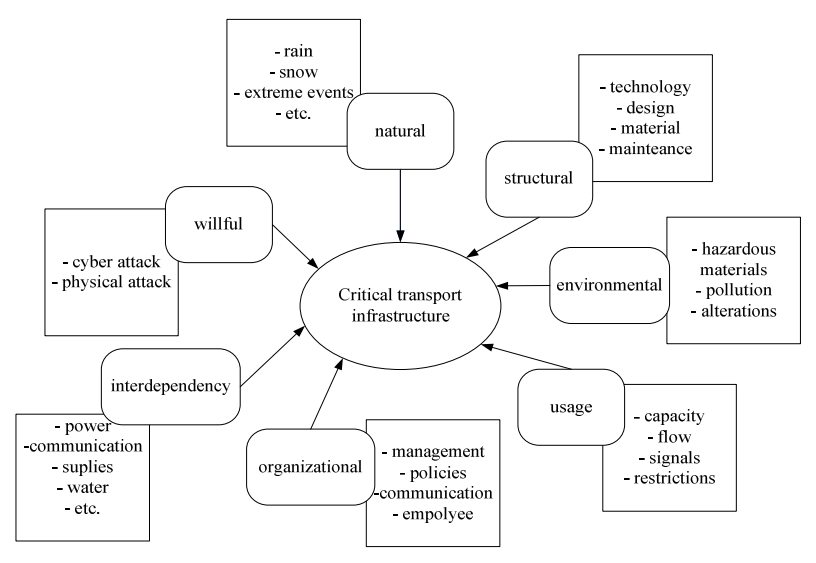
The picture talks faster than words, right? Look at the figure below which explains why ITS is an oxygen mask in the present traffic conditions.

need for ITS is shown
NEED FOR ITS

From the figure, we can reach at the following conclusions.

  • The transportation system framework is highly complex
  • It is composed of a wide range of infrastructures, such as terminal facilities, travel ways, transportation fleets, and information systems
  • Transport should be open and accessible, extensive and ubiquitous, effective and adaptable
  • Critical transportation infrastructure has great importance for the national economy, security and functioning of the state
  • It is essential for:
  1. national priority
  2. providing basic services
  3. their reliability and availability
  4. ensuring trade flows
  5. supports economic growth

Now, we are going to jump on to the interesting topic related to the intelligent transport system.

Applications of intelligent transportation system

A person in car using tracking feature in screen
Tracking feature in screen

The important applications of intelligent transportation system are broken down in this section. Starting from the familiar electronic ticket machines,

1.Electronic ticket machines

  • Replacement of conventional ticket sytem by electronic ticket machines.
  • ETM acts as the focal point for peripheral devices (e.g. card readers) with which it can communicate
  • The ETM has two distinct aspects, which provided the twin platforms of operational/data generating devices, and back-office/data analysis systems :
  1. Cash receipts and sales management
  2. Data generation, understanding of the business

2. MCV

These are one of the interesting applications of intelligent transportation system.

  • These MCVs were connected to the ETMs by the RS485 network
  • Received initiation and reference data from the ETMs
  • Passed their transaction data back to the ETMs for storage and subsequent transfer to the company’s data systems

3. Autofare system- ancient among applications of intelligent transportation system

  • The Autofare system was implemented in 1995
  • Drivers no longer handled any cash or gave change
  • Customers purchasing a ticket on board placed sufficient cash in the autofare device
  • The driver issued a ticket from the ETM for the requested fare
  • If the cash tendered exceeds the fare, a supplementary receipt is also printed from the ETM for the difference
  • When the tickets are issued, the cash drops into a safe beneath.
  • While the autofare achieved is the primary function, it had multiple issues:
  1. Very high back-office burden – removal of safes every day, handling the safes, transfer of safes and money, safe management and reconciliation
  2. Cash reconciliation and accountability, since multiple drivers may be assigned to a bus during the day, and hence associated with the takings in the individual safe
  3. Limited integration with the ETM

4. Radio system

  • Implemented a Trunked Radio System, broadly similar to mobile phone.
  • This gives call privacy, the dispatcher controls the radio exchanges, calls the drivers individually,
  • The drivers cannot directly initiate calls but must request to speak and await the dispatcher contacting them
  • Group calls can also be made
  • An emergency facility is available which overrides and allows the driver to communicate directly.

5. Wayfarer ATM

The main characteristics are:

  • It replicates the functions of the old ETM system, with which everyone was familiar
  • The entire fares and routes tables can be held by the ETMs, due to greater memory capacity
  • It supports the Integrated Ticketing System – i.e. the ticketing requirements of the scheme supported by the Department of Transport (this was obligatory on Dublin Bus)
  • Wireless communications are used for data downloads
  • this removes the previous requirement for portable data modules which each driver had to bring to the depot for download at the end of his/her shift
  • Wireless communication is also used for uploading information and data updates
  • Used for uploading software upgrades, removing the previous requirement to physically change the (E)EPROMs in each ETM every time software was amended

6. Readers

  • A reader in the cash office downloads the data when the safe is being emptied and the cash counted
  • It automatically knows which bus the safe has come from, and which drivers were associated with it for that day.
  • A permanent identified of the vehicle is embedded in the ETM tray (permanent fixture on the vehicle)
  • This is transferred to the ETM and from the ETM to any other device that needs it.
  • It means that whenever ETMs are switched they automatically pick up the vehicle number, and in turn are automatically assigned within the system.

7. Smartcards- one of the recent applications of intelligent transportation system

  • Smart Cards were implemented in 2008
  •  Smart Card readers are installed on the buses (one per bus) in parallel with the MCVs
  • The SCRs are another device on the ETM-hosted RS485 network.

8. AVLC

  • The AVLC was implemented from 2009
  • This involves real-time tracking of vehicles
  • Buses are polled on a 20 second cycle
  • The location data is based on GPS and Odometer
  • The Odometer provides the primary means of location, with the GPS supplementing it
  • Seems that they left the option open in the tender process, and this was what the market proposed

The AVLC has the following features:

  • Real-time tracking
  • More efficient route control regime
  • Facilitates a centralized control room
  • Generates comprehensive reports and statistics
  • Provides/supports RTPI
  • Support traffic signal priority

The AVLC kit consists of the following equipment: 

  • Bus radio
  • Driver’s console
  • GPS unit
  • On-board computer
  • Wireless LAN router
Figure shows AVL kit
AVL KIT

8. Real time passenger information- One of the revolutionary applications of intelligent transportation system

Real-time passenger information can process real-time information (forecast arrival times) about the travel information to the passengers.

9. CCTV

It has a network of 140 CCTVs providing excellent coverage of most of the key junctions and streets, and most potential disruptions points for the Dublin Bus network. It is very useful in difficult or disrupted circumstances. 

That was a hell lot of information, right? Relax now. We have reached at the shore of the wide of ITS. The main disadvantages of intelligent transportation system are as follows.

Disadvantages of intelligent transportation system

We have seen some impressive applications of ITS. But who is perfect? Let’s see the important disadvantages of intelligent transportation system below.

  • Difficult to use in mixed traffic
  • Preliminary difficulties in understanding
  • Equipments of ITS is costly
  • High maintenance cost
  • The control system software could be hacked by hackers
  • Can’t make quick response to emergency or congestion due to sudden accident
  • Not dedicated for traffic data collection

What do you think about the disadvantages of intelligent transportation system? Worth giving attention, right? Let’s wrap up with some intelligent transportation system examples to add cherry on the top of the ITS cake.

Intelligent transportation system examples

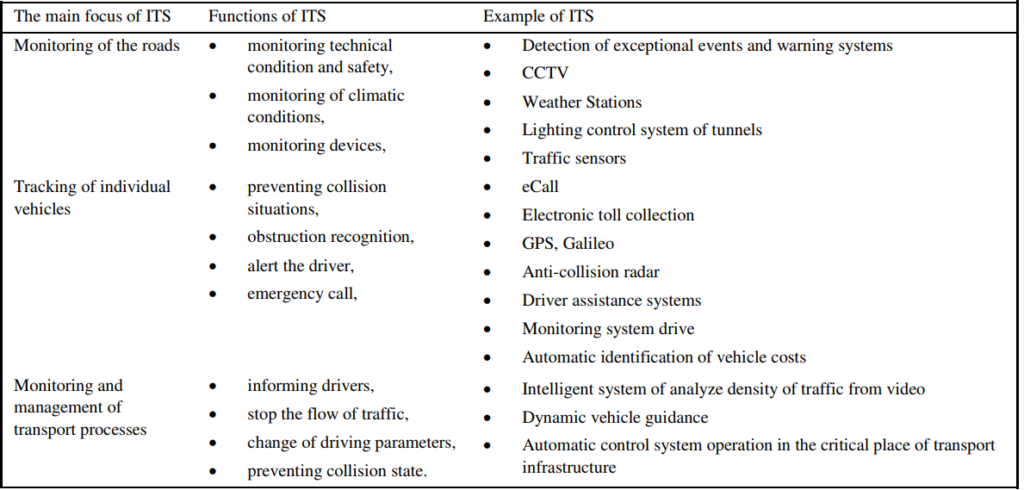
The figure shows the intelligent transportation system examples which comes under each category.

Figure shows ITS examples with categories

So, we are done. Now, Tech-savvy, tell me your feedbacks and doubts in the comments.

Enjoy reading!

MUST READ: Basic of civil engineering; Simple and in-depth guide

Types of shallow foundations – Advantages & Suitability

Types of shallow foundations – Foundations are broadly classified into shallow foundations and deep foundations. This article is a total overview of shallow foundations and the types of Shallow foundations.

What is a shallow foundation ?

Shallow foundations transfer the load laterally to the soil. It is also called stripped foundations. The depth of a shallow foundation is less than its width. Shallow foundations are adopted when the load acting on a structure is reasonable and has a competent soil layer capable of negotiating the loads available at a shallow depth or shorter depth.

A shallow foundation is placed on the surface of the ground. The depth of a shallow foundation can range anywhere between 1 meter to 3.5 meters and sometimes more. The width of the shallow foundation is greater than the depth.

  1. What is a shallow foundation ?
  2. Types of shallow foundations
    1. Shallow foundation – Spread footing or isolated footing
      1. Simple spread footing
      2. Sloped spread footing
      3. Stepped spread footing
    2. Types of shallow foundations- Strip footing
    3. Types of shallow foundations – Combined footing
    4. Strap footings
    5. Mat or Raft foundations
  3. Types of shallow foundations – Suitability

Types of shallow foundations

There are different types of shallow foundations adopted as per site conditions and design requirements.

Shallow foundation – Spread footing or isolated footing

The spread footing is one of the most commonly used types of shallow foundations. They are also called isolated footing or individual footings. Spread footings are further classified into simple spread footing, sloped spread footing, and stepped spread footing based on the shape of the footing.

  • Simple spread footing
  • Sloped spread footing
  • Stepped spread footing

Simple spread footing

This is a common type of spread footing. Simple spread footing consists of a base footing with a single column over it. This type of foundation is used for structures with reasonable loads and bearing capacities.

Types of Shallow Foundations-Simple Spread Footing
Types of shallow Foundations -Isolated or spread Footings.

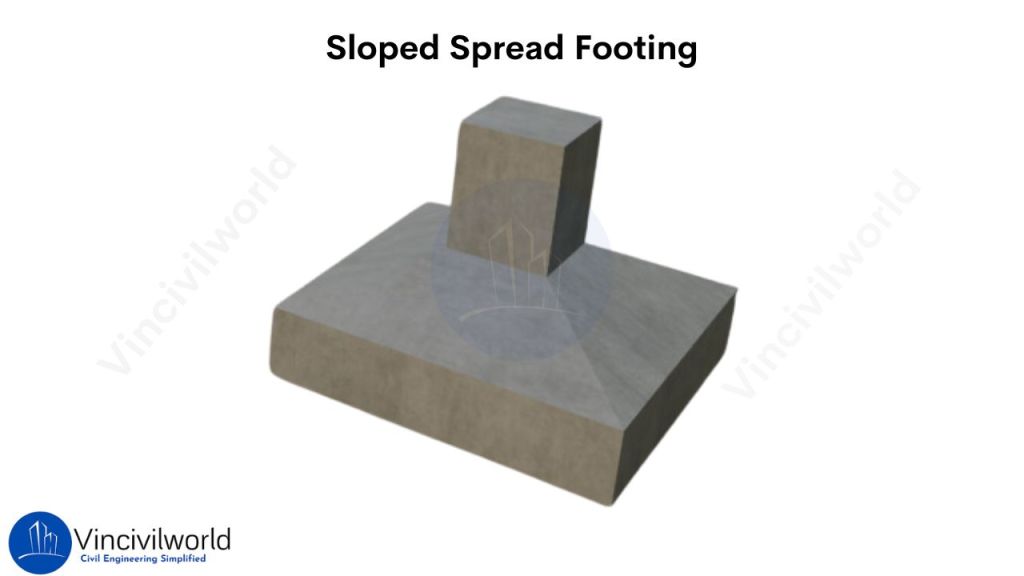
Sloped spread footing

In this type of foundation the footing is sloped as shown in the figure. The footing carries a single column. The cross section of these types of footings are trapezoidal.

Types of Shallow Foundations-Sloped Spread Footing
Sloped Spread Footing

Stepped spread footing

When the loads are high steps are provided in the footings as shown in the figure.

Types of Shallow Foundations-Stepped Spread Footing
Stepped Spread Footing

Types of shallow foundations- Strip footing

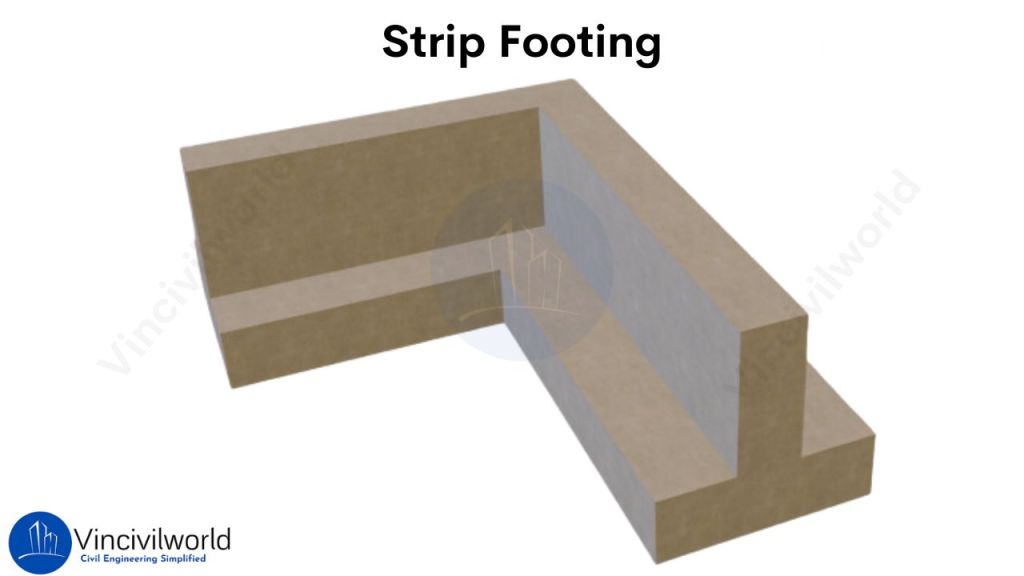
Strip footings are also called wall footings. They are used for providing load-bearing brick/stone/RCC walls over the footings. Strip footings run continuously throughout the wall area of a building. These types of footings are also used when the spacing between the columns is very less and the footings overlap each other.

Types of Shallow Foundations-Strip Footing
Strip Footing
Types of Shallow foundation : Strip Footing

Types of shallow foundations – Combined footing

Combined footing consists of two or more columns over a single footing. These types of footings are adopted when the distance between the two individual footings are very less and overlap each other. A combined footing is also provided in areas where further excavation is not possible due to any flushing with the boundary. A combined footing is classified as rectangular combined footings and trapezoidal combined footings.

Trapezoidal Combined Footing
Rectangular Combined Footing

Strap footings

Strap footings are also called cantilever footings consisting of two individual footings connected through a beam strap. The beam strap is designed as a rigid structure. These types of foundations are economical than combined footings.

Strap Footings
Strap Footings
Shallow foundation types : Strap Footing

Mat or Raft foundations

Raft foundation – One of the most commonly used types of foundation in construction is a continuous slab resting on the soil and covering the total area of the proposed structure. There are different types of raft foundations based on their applications. The selection of the type of raft foundation depends on a lot of factors like bearing capacity, loads, site conditions, etc.

Raft Foundation
Raft Foundation
Raft Foundation

Raft foundation/Mat foundation is a solid slab placed at a designed depth spreading over the entire area of the structure. Raft foundations consist of columns and shear walls for transferring loads coming on the structure to the ground. These types of foundations are mainly used when the bearing capacity of the soil is low and becomes difficult for individual footings to negotiate the loads. The raft foundation helps to transfer the entire load of the structure to a larger area.

Also read : RAFT FOUNDATION – TYPES & ADVANTAGES

Also read : PILE FOUNDATIONS – TYPES & ADVANTAGES

Types of shallow foundations – Suitability

Shallow foundations are very easy to construct and do not require highly skilled manpower and professional supervision. These foundations can even be done with the help of medium-skilled workers. A shallow foundation is very economical when compared with a deep foundation. Shallow foundations are end bearing type foundations that transfer loads to the end of the foundation.

Shallow foundations are considered as the most preferred option when the safe bearing capacity of the soil is reasonable and the structural loads are within the permissible limits.

VIDEO – SHALLOW FOUNDATIONS – DIFFERENT TYPES & ADVANTAGES

AAC blocks vs red bricks – An ultimate comparison.

AAC Blocks vs red bricks – AAC blocks are also known as Autoclaved Aerated Concrete Blocks. They are lightweight, load-bearing, durable, and economical. AAC blocks can be manufactured to meet any requirements. AAC blocks are considered a green option instead of red bricks. They have enormous potential in terms of insulation, fire resistance, and thermal resistance. AAC blocks are environmentally friendly. They are a superior material compared to concrete, wood, brick, and stone. They can enhance the construction speed, reduce the costs, and unwanted wastage at construction sites.

Autoclaved Aerated Concrete blocks are superior to conventional red clay bricks in a lot of factors. Considering the impact and necessity of these factors we can easily make a choice.

  1. AAC blocks vs red bricks
    1. Availability of sizes.
    2. AAC blocks vs red bricks- Technical properties
    3. AAC blocks vs red bricks – Construction speed
      1. Factors influencing construction speed
    4. Savings in labor
      1. Labour saving in mortar mixing
      2. Conveying and re-handling labour
    5. Material saving
      1. Saving in mortar
      2. Saving in plastering

AAC blocks vs red bricks

AAC blocks are superior to red bricks in a lot of factors relating to quality, speed, workability, cost, and wastage. There is much to discuss about the advantages of AAC blocks. They hold benefits over Red bricks, fly ash bricks, Cement Concrete hollow blocks, and CLC blocks.

AAC blocks are manufactured from materials like sand, fly ash, lime, and cement. They are lightweight, eco-friendly, and energy-efficient. Their efficiency is due to 80% voids and the use of industrial waste.

AAC blocks are superior to conventional bricks for several reasons. They are lightweight and have eco-friendly properties. These blocks offer better insulation and energy efficiency. They also utilize waste materials like fly ash.

Let us have a comparison between AAC blocks and red bricks in terms of following parameters.

  • Availability of sizes
  • Technical Properties
  • Construction speed
  • Savings in labour
  • Material Savings

Availability of sizes.

Customization in size is the most important aspect in deciding the choice of bricks/blocks for a particular structure.

AAC blocksConventional red bricks
AAC blocks are available in varied sizes are can be customised for special requirements.Mostly available in one or two standard sizes. No customisation is possible.

AAC blocks vs red bricks- Technical properties

AAC BLOCK DIMENSIONS
RED CLAY BRICK DIMENSIONS
AAC BlocksConventional Bricks
AAC blocks are available in 600 mm/625 mm (length) X 100–300 mm (height) X 230/240 mm (width).Bricks are available in 225 mm (length) X 115 mm (width) X 75/70 mm (height).
The dimension tolerance of the AAC block is +/- 5 mm.The dimension tolerance of brick is +/- 5 mm to +/- 15 mm or more.
Density ranges between 500-650 kg/cm³.Density ranges between 1400-1900 kg/cm³.
The drying shrinkage of AAC blocks is 0.4%, which is very low compared to conventional bricks.The drying shrinkage of bricks is 0.8%, which is comparatively high compared to AAC blocks.

AAC blocks vs red bricks – Construction speed

AAC blocks are considered cost-effective and economical in comparison with conventional bricks. The cost-effectiveness of AAC blocks is mostly related to the construction speed.
AAC blocks can enhance construction speed when compared to conventional bricks. This improvement is due to some unique characteristics detailed out in the following table.

AAC blocks vs red bricks

Let us take a wall of 3mtr x 3 mtr size and 4 inch thickness

AAC BlocksConventional Bricks
Area of BlockArea of Brick
Area of block = 24 inch x 9 inch (600 mm x 230 mm) = 0.138 sqmArea of brick = 9 inch x 3 inch (230 mm x 70 mm) = 0.0161 sqm
Wall area = 3m x 3m = 9 sqmWall area = 9 sqm
No. of blocks = 9 sqm / 0.138 sqm = 65 blocks (600 mm x 230 mm x 100 mm)No. of bricks = 9 sqm / 0.0162 sqm = 555 bricks (230 x 110 x 70 mm)
Total Mortar JointsTotal Mortar Joints
85 rmt (approx)170 rmt for 4-inch wall & 240-250 rmt for 9-inch wall
WeightWeight
Weight of an AAC block (9 inch) = 16-17 kgWeight of brick = 3-3.5 kg (approx)
1 no. 9 inch block = 14-15 bricksBricks are heavy

From the above comparisons, it is clear that the AAC blocks are lightweight and covers more area than bricks. Brick masonry got 3-4 times higher mortar joints and around 14-15 bricks constitute an AAC block. That is why Brick masonry is very slow.
AAC blocks are big, got fewer joints, and can be completed very fast.

Factors influencing construction speed

Factors Influencing Construction SpeedAAC BlocksBricks
Dimensional AccuracyAAC blocks are factory-made and possess dimensional accuracy, making them easy to place and plumb.Red bricks are locally made, irregular, and less dimensionally accurate, making them difficult to place, level, and plumb.
Number of JointsAAC blocks have fewer joints, increasing construction speed.Red bricks have 4 times more joints than AAC blocks, significantly reducing construction speed.
Coverage AreaAAC blocks cover a larger area.Bricks cover a smaller area.
Skill RequirementAAC blocks can be placed by semi-skilled workers due to their dimensional accuracy and shape.Brickwork requires skilled masons because of inaccuracies and shape issues.
Mortar JointsAAC blocks use ready-mix block adhesive with a joint thickness of 3-5 mm.Brickwork uses site-mixed mortar with a minimum joint thickness of 10 mm.

Savings in labor

Savings in LaborAAC BlocksBricks
Pre-curing and post-curing laborAAC blocks do not require any pre-curing. AAC block masonry joints are air-cured and do not require any curing. Infrastructure and labor involved in the curing process can be eliminated.Bricks must be soaked in water before use. Additionally, 7-day curing is required for brickwork, which demands curing infrastructure and labour involvement.

Labour saving in mortar mixing

Labour Saving in Mortar MixingAAC BlocksBricks
Mixing ProcessAAC blocks use ready-mix bonding adhesive as jointing material, available in 25-30 kg packs and mixed with water before use.Brickwork uses site-mixed mortar that involves handling, mixing, and conveying of raw materials and mortar.
Labour CostThis can save substantial labour costs incurred for mortar mixing and conveying.Extra labour costs involved for mortar mixing and conveying.
Mortar mixing
AAC BLOCKS VS RED BRICKS – MORTAR MIXING

Conveying and re-handling labour

Conveying and Re-handling LabourAAC BlocksBricks
Supply and ConveyingAAC blocks are supplied in pallets. They can be easily lifted and conveyed to work spots using cranes and tower cranes directly from the trucks.Bricks are supplied loose and unloaded manually. They need to be filled in buckets for lifting to heights, requiring more labour.
Labour and WastageSaves labour in unloading, conveying, and lifting. Less handling generates zero wastage.Brick shifting and conveying involve heavy labour and generate a large amount of wastage.

AAC block work rates are comparably less than brickwork due to the saving involved in the labour part. The rate per cum of AAC blocks will be around INR – 650/- to -750 /- per cum whereas brickwork is around INR 1400-1500/- per cum.

Material saving

Saving in mortar

AAC blocks got fewer mortar joints of 3-5 mm thickness whereas brick masonry generates 3-4 times higher number of joints of 12 mm thickness. This can save substantially in terms of jointing material.

Analysis of Mortar for Brickwork

DescriptionQuantityxRate (INR)=Cost (INR)
1 CUM Brickwork = 0.35 to 0.4 CUM mortar
Sand cost (Rs. 2500/- per CUM)0.35x2500=875
Cement1.3x300=390
Total cost per CUM of brickworkINR1265/-

Analysis of Block Adhesive

DescriptionDetails
1 CUM block work30 kg of block adhesive
Rate per kgRs. 12-15 per kg
Cost for 30 kgAround INR 400/- per CUM

Conclusion:
Block adhesive costs approximately INR 400/- per CUM, whereas mortar costs around INR 1250/- per CUM.

Saving in plastering

AAC blocks are dimensionally accurate and both faces of the block-work look even without any undulations. The undulations can be levelled by providing a minimum plastering thickness of 10 mm inside and 12-15 mm outside. AAC blocks can even be painted by directly applying putty/Gypsum plaster over it.

Brickwork has a fair face and unfair face. To cover up undulations, a 12 mm plastering thickness is required for the fair face. A minimum of 18 mm thickness is needed for an unfair face.

AAC blocks offer other value-added benefits. They are superior in fire resistance, termite resistance, and thermal resistance. Additionally, they serve as a green building material. Please read ADVANTAGES OF AAC BLOCKS.

Also read : MANUFACTURING PROCESS OF AAC BLOCKS

Updates in civil engineering, architecture finishes, building construction, Environmental Engineering