Materials for False ceiling – Top 7 False ceiling materials

Selecting the materials for the false ceiling is one of the tricky tasks everyone should be facing while thinking of a new construction or renovating an old one. The materials for false ceilings should be durable and be in line with the requirements of application areas.

An artificial ceiling below the main roof of a room or a building is known as a false ceiling. False ceilings are second layer roofs, hanging from the main roof on suspended hanger supports. False ceilings provide an attractive and aesthetically pleasing look on the roofs. This article is about the top 7 trending materials for false ceilings.

  1. Benefits of False Ceiling
  2. Materials for False ceiling
  3. POP of Plaster of Paris False ceiling
  4. Gypsum board false ceiling
  5. Metal False ceiling (Tile and plant type)
  6. Wooden Ceiling
  7. PVC False Ceiling
  8. Mineral Fibre Board
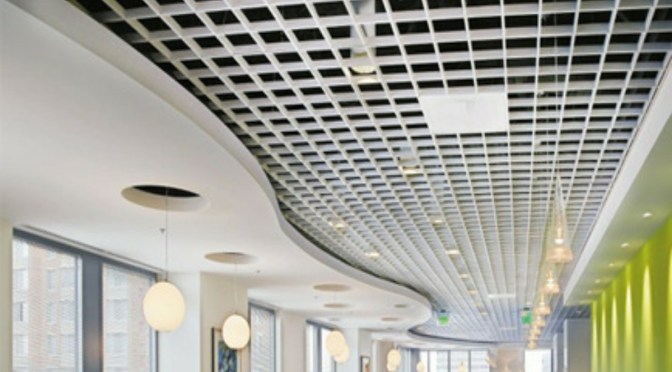
    1. Open Grid False ceilings
  9. Disadvantages of false ceiling
  10. Installation method of all false ceilings
    1. Checks for brickwork
    2. Plastering and painting
    3. Check for concealed systems
    4. Fixing of False ceiling
    5. Cut outs for fixtures
  11. Precautions For False ceiling works

Benefits of False Ceiling

The main benefits of false ceilings are…

  • Improves the aesthetic appearance of the interiors.
  • Reduces room height proportionally and makes space feel more compact and pleasant.
  • Acts as heat insulators and thereby reduces air conditioning load. The air gap between the ceiling and roof behaves like a nonconducting medium and minimises the heat and cold transmission. This reduces the air conditioning loads and energy bills.
  • A false ceiling hides the air condition ducts, fire sprinkler lines, and wiring for concealed light systems. It also conceals other security systems. This setup gives an excellent look to the ceilings.
  • Helps accommodating additional ceiling lights. Ceiling lights in the right places enhance ambient lighting inside the room considerably.
  • Acts as an acoustic insulator and a noise reduction medium (mainly uses in auditoriums and movie halls).
  • False ceiling materials are mostly fire-rated and provide fire protection.

Materials for False ceiling

  • POP or Plaster of Paris false ceiling
  • Gypsum False ceiling
  • Metal False ceiling
  • Wooden False ceiling
  • Mineral fibre board false ceiling
  • PVC false ceiling
  • Open grid False ceiling

POP of Plaster of Paris False ceiling

Plaster of Paris (POP) is the most popular and economical choice of material for false ceiling works. It is preferred in residential, commercial, and industrial sectors. Plaster of Paris is a white powder obtained by calcinating gypsum. ie. heating at a high temperature to remove the water content.

Steel grids are suspended from the roof and is covered with chicken wire mesh. POP is mixed with water to form a paste. The POP paste is applied over the chicken mesh in layers, leveled, and finished.

POP or Plaster of Paris False ceiling

POP is a very flexible, durable, and readily available material for false ceilings. It is moulded to any shape, design, and pattern. POP false ceilings are very cheap, elegant, and maintenance-free when compared to other false ceiling materials.

The main disadvantage with POP is the time taken to finish the work. It also creates an enormous amount of wastage. Housekeeping expenses will be high. Plaster of Paris could not match the factory-made superfine surface of gypsum boards. POP is vulnerable to water and moisture and should be avoided for areas prone to water and moisture.

Gypsum board false ceiling

Gypsum board is a premier and widely used surface layer material for interior works. It includes wall, ceiling, and partition systems in residential, institutional, and commercial buildings.
The gypsum panel has a non-combustible gypsum core. It is covered by a firmly bonded specialised paper on the surface and long edges. These panels are fixed on steel frames hanging from the ceiling.
The joints between Gypsum boards are sealed with tapes, thereby giving a seamless and elegant look to the ceiling. Apart from providing a very elegant look, they offer fire resistance and sound control. They are economical, versatile, durable, and very easy to install.

Gypsum board false ceiling

Metal False ceiling (Tile and plant type)

A false ceiling that uses metals either in the form of GALVANISED IRON, STEEL OR ALUMINIUM is called a metal false ceiling. Metal false ceilings are hard, durable and very easy to install. The ceilings are plank type (linear pattern) or grid type. Metal false ceiling tiles are easy to remove and refix after maintenance. They are economical, Maintenance-free and got high self-life when compared to other false ceiling materials.

Metal false ceilings tiles use suspended systems capable of fixing panel and grid tiles.

For more details about the Metal false ceiling please check our earlier article “ Metal false ceiling types – Clip in and Lay in tile.”

Tile type metal false ceiling
Plank type metal false ceiling

Wooden Ceiling

Wooden false ceilings are versatile, classic materials having a variety of natural patterns and textures. They are easy to work with and is installed using screws. Block boards with veneer surfacing are used for wooden false ceiling panels.
Wooden false ceiling is expensive because of its high material cost and higher maintenance cost. They are used in full areas or used as a highlighter. A wooden false ceiling is durable but is vulnerable to termite attacks and moisture.

Wooden False ceiling

PVC False Ceiling

PVC or Polyvinyl chloride ceiling is a popular and easy false ceiling option available for residential and commercial areas. PVC false ceiling consists of strong, lightweight, factory-manufactured panels with a hollow core and shiny surface. Polyvinyl chloride false ceilings are strong, seamless finish and come with various designs, colours, sizes and lengths. They are very effective in resisting moisture and water. They are used for bathrooms, balconies, and other areas prone to moisture.

PVC false ceilings are reusable and durable materials that do not require any painting or polishing. They are available in pre-laminated shades and do not split, crack, wrap or rot.

Mineral Fibre Board

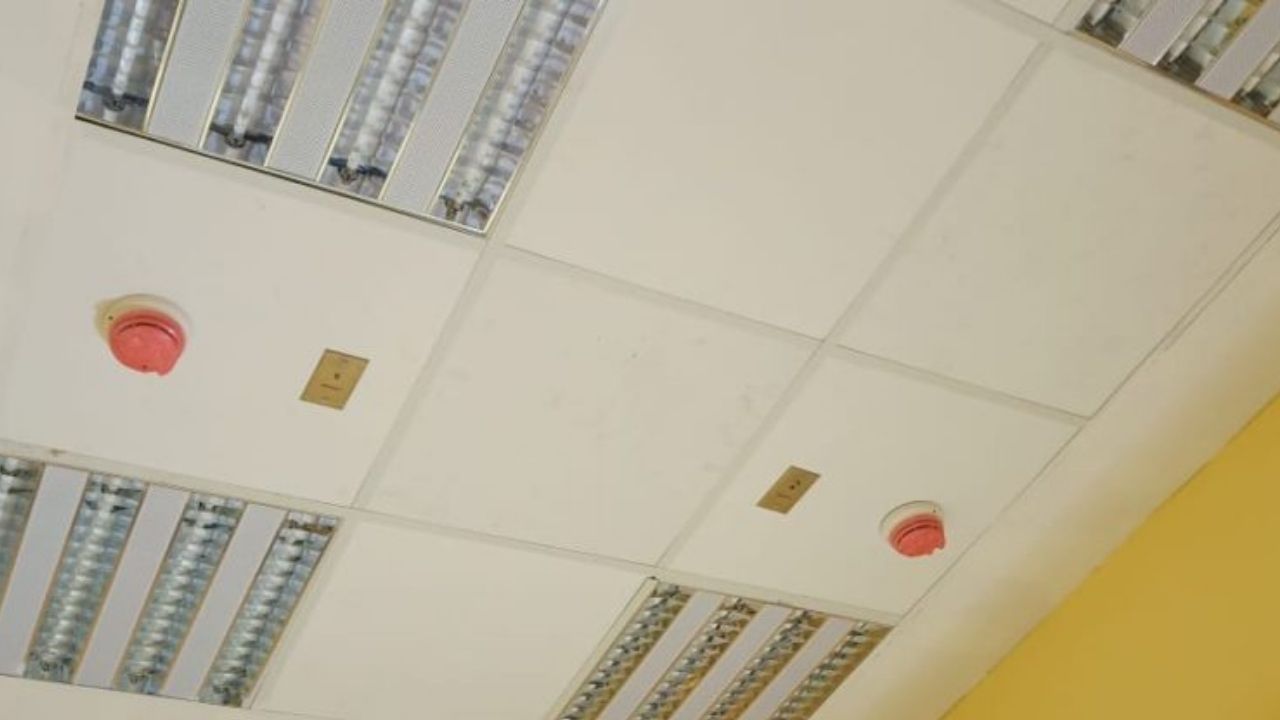
Mineral fibre board panels are manufactured using naturally occurring resources to recycled and processed materials. Mineral fibreboard possess excellent acoustic performance and fire resistance properties.
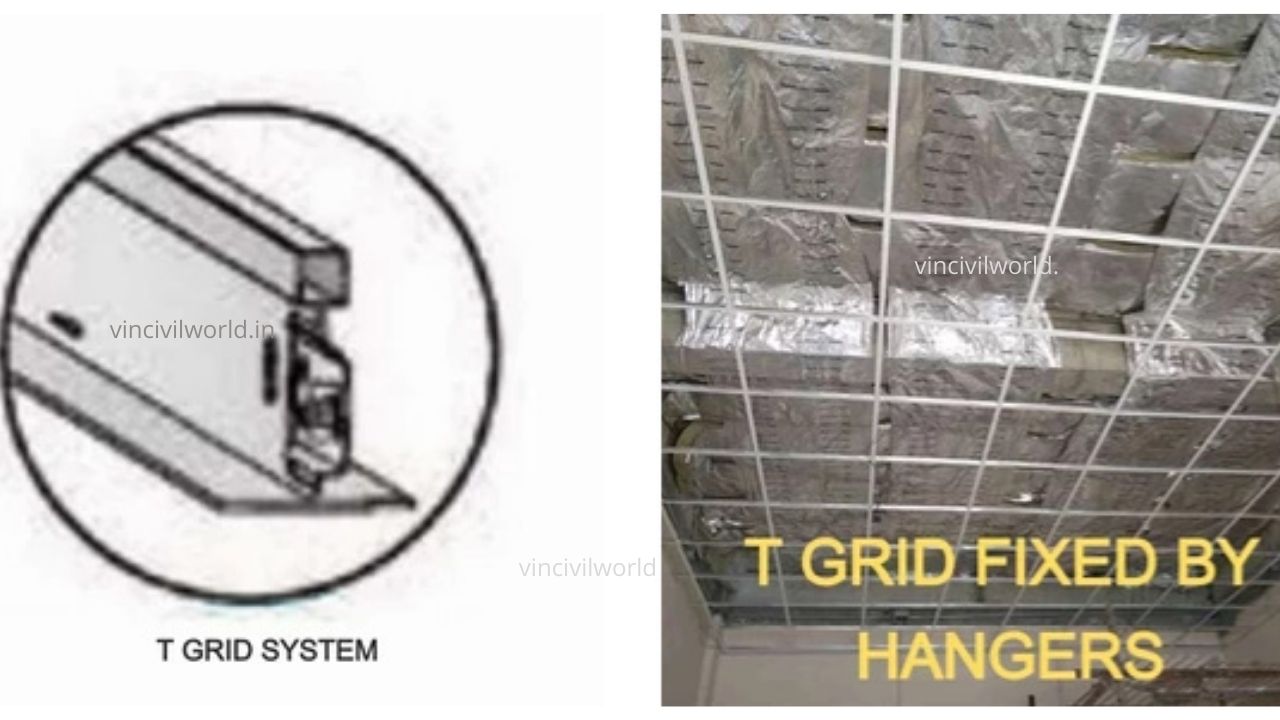
Mineral fibre board false ceiling got a suspended T- Grid Support system like metal false ceilings. They are lightweight and easy to install the environmentally friendly product. The main disadvantage with mineral fibre is that they are brittle and breaks frequently. Mineral fibre boards are vulnerable to water and moisture and painting is not possible over the surface.
Mineral Fibre Board False ceiling

Open Grid False ceilings

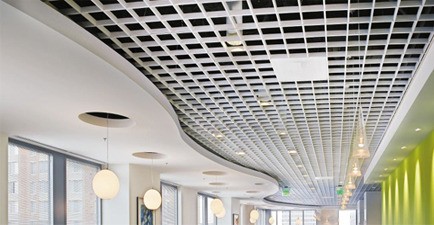
Open Cell Ceiling systems comprise a series of open-cell modules designed to lay onto a suspension grid. Open cell ceilings are especially useful for buildings areas lower ceilings without actually changing the roof height.
The tiles are integrated with metal ceiling support systems and plasterboard ceilings. Open cell ceilings are pleasant and can create a visually pleasing look to the room.
Open grid metal ceilings are suitable for the leisure industry, schools, offices, and corporate buildings as well as public spaces.
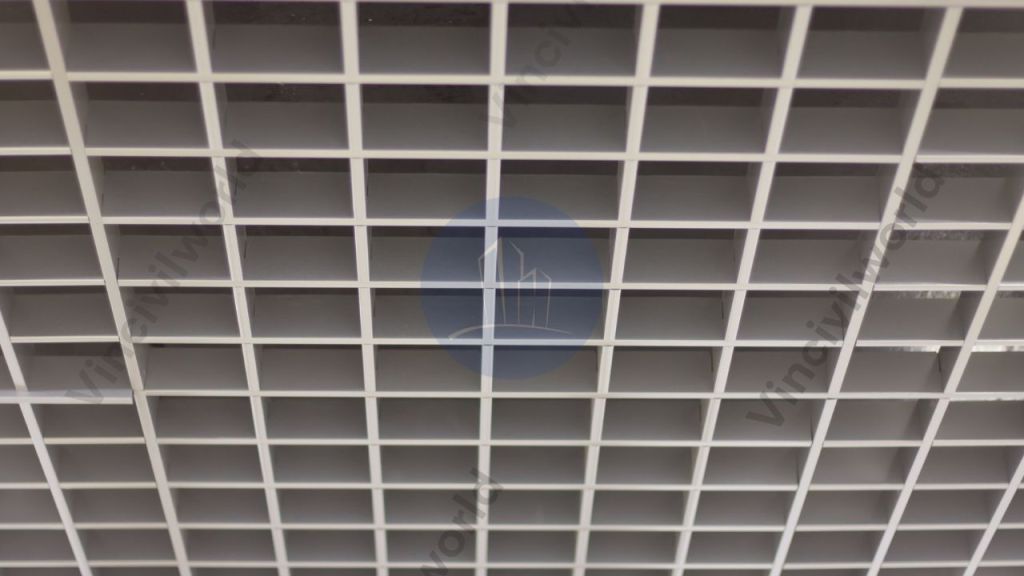
Open Grid Type False ceiling
Open grid False ceiling

Disadvantages of false ceiling

  • False ceiling reduces the height of the rooms. Hence installation of fans may not be possible.
  • Chances of fittings falling from the ceiling.
  • Ceilings may sag and de- colourise in course of time and to be replaced.
  • Rodents and pests can easily enter the ceiling.
  • False ceiling system may fall due to weak supports.

Installation method of all false ceilings

Checks for brickwork

The room’s walls should be perpendicular to each other. Diagonals to be checked to ensure 90 degrees of the walls.

Plastering and painting

  • Plastering to be done for a height of 150 mm above the false ceiling.
  • The main ceiling and area above the false ceiling are to be rendered.
  • A basic coat of primer to be applied before starting ceiling works.
  • Final painting to be done after work completion.

Check for concealed systems

  • Cabling /wiring relating to all concealed systems like Ceiling lights, Air condition system, Fire alarm and sprinklers, security cameras has to be completed.
  • Under deck insulation, if any to be done before doing the ceiling.
  • The ducts for supply and return air for the air condition system are to be completed and insulated before starting ceiling works.

Fixing of False ceiling

The ceiling level has to be marked all around the room using marking fluids Edge angle / Wall angle shall be fixed in line with the marking .

Appropriate hangers (steel wires/steel angles ) in line with the ceiling system shall be fixed to the ceiling using anchor fasteners, likewise the hangers may be used as per the ceiling type and manufacturer. Main grids shall be hanged from the hangers and end of the main grids however should rest on the wall angle. Intermediate tees/ sections are fixed on the main grid for facilitating ceiling boards or tiles fixing.

Cut outs for fixtures

Cut outs required for fixtures shall be done on the board as per drawings, however provision of additional members around the openings to ensure the hold of ceiling fittings.

Precautions For False ceiling works

  • Check with the services drawings to ensure completion of concealed wiring works before starting ceiling works.
  • Provide strong hangers well enough to handle the false ceiling load.
  • The centre portion of the ceiling should be kept little bit higher than the external portion to counter the sagging.
  • Light layouts and marking for cut outs should be marked and checked before cutting
  • Extra members if required shall be provided in case of cutting of any member coming in line with the fixtures.
  • All openings made for cable entry and ducting have to be properly sealed before doing ceiling to restrict pests and rodents from entering the area.

FUSION BONDED EPOXY COATING-TOTAL OVER VIEW

Fusion bonded epoxy coating is also known as F B E coating and F B E powder coating. F B E coating is a thermosetting polymer powder coating used for protecting reinforcement steel used for concrete works in coastal areas. F B E coating acting as a barrier in preventing oxygen, chlorides, and other corrosion elements from reaching the surface of steel thereby prevents corrosion. The composition is based on a specially selected range of Epoxy resins and hardeners.

The effectiveness of a corrosion control coating mainly depends on the ability to perform long term and essential that it should stay bonded to the substrate during the entire life span of the structure.

ADVANTAGES OF FUSION BONDED EPOXY SYSTEM

The coating poses a strong adhesion to the coated surface.
The coating has tremendous chemical and mechanical resistance in all climatic conditions and poses high mechanical impact strength.

PERFORMANCE PROPERTIES OF FUSION BONDED EPOXY

a) F B E poses low permeability to water vapour and gas pressure.

b) F B E is abrasion-resistant and can be handled and conveyed without damage.

c) F B E protected steel poses strong resistance to corrosive soil, saltwater, microorganisms, etc

d) Have an ageing resistance against heat and have very good dielectric properties.

Advertisements

The application process of Fusion bonded Epoxy is different from the conventional method of epoxy applications.

APPLICATION PROCESS OF FUSION BONDED EPOXY ON REBAR

Resin and hardener in powder form are applied over the steel and heated to a particular temperature. A thin continuous film is formed fusing the powder and this process is FUSION BONDING.

This process is not irreversible. Once the process is complete it cannot be returned to its original form anymore.

There are four application methods used for fusion-bonded coatings. They are fluidized bed process, electrostatic bed process, electrostatic spray process, and plasma spray process. The electrostatic spray process is the most commonly used process of applying powders.

ELECTROSTATIC SPRAY PROCESS- METHODOLOGY OF APPLICATION

a) SURFACE PREPARATION

Surface preparation is the most important activity which is required to bond a coating to the rebar surface. Shot blast cleaning is the best & effective method that can remove mill contaminants, mill scale, rust, etc, and make the surface rough. Shot blast cleaning provides an anchor of 40 -100 milli micron depth on the steel surface and increases the effective surface area of steel. The rebar are blast cleaned to a near white metal finish as per Swedish standards.
In the blast cleaning process, a blast wheel uses a centrifugal to propel the abrasive (grits used for blasting) in a controlled direction speed and quantity. Normally two blast wheels are provided at the top and 2 at the bottom of the cabinet over the top and bottom of the rebar pass line. The location of the blast wheel shall be in an angle where the total area of steel shall be covered.

b) PRE -HEATING

Heating can be done in various methods, but induction heating is the commonly used method for preheating. Induction heating is the process of heating metal by electromagnetic induction and developing eddy currents. Eddy currents generated within the metal and resistance induces Joule heating of the metal. For preheating using induction heating, the steel is passed through a high-frequency AC magnetic field which heats steels to the temperature required for the Fusion Bonded Epoxy application. The typical application temperature ranges between 225 degrees to 250 degrees.

c) FUSION BONDED EPOXY COATING

The heated rebar is passed through a powder spray booth where the dry epoxy powder is sprayed through several spray nozzles. Immediately when powder leaves the spray gun, an electrical charge is imparted to the particles. These electrically charged particles are attracted to the grounded steel surface providing even coating coverage. When the dry powder hits the hot steel, it melts and flows into the anchor profile (i. e., the microscopic peaks and the valleys on the surface) and covers the ribs and deformations of the rebar making good bondage with steel.

The heat also initiates a chemical reaction that causes the powder molecules to form complex cross-linked polymers that give the material its beneficial properties. Coating thickness in the range of 50 to 150 micrometers is usually obtained, even though lower or higher thickness ranges might be specified, depending on service conditions.

The molten powder is converted to a solid coating, once the ‘gel time’ is over, which occurs within a few seconds after the coating application. The resin part of the coating when subjected to heat undergoes a process known as cross-linking. This process is known as ‘curing’ in hot conditions. Complete curing is achieved either by the residual heat on the steel or by the help of additional heating sources. Full curing can be achieved in a minute or two depending upon the coating system used.

d) WATER QUENCHING

The coated steel after hot curing is passed through a water tunnel and subjected to water spray for cooling the bars.

e) INSPECTION AND TESTING

FBE coated reinforcement bars are tested as per the relevant standard (IS 13620 – 1993). Checks for thickness are also carried out. All batches are laboratory tested for chemical resistance, short spray, resistance in continuous boiling water, abrasion resistance and impact resistance, etc. Any weak patches observed shall be marked and touched up before loading in a rack area. They are bundled in the rack area for transporting to destinations.

DISADVANTAGES OF FUSION BONDED EPOXY.

Fusion bonded epoxy coatings can affect the bond strength between coated rebars and concrete. Apart from that, the coating process is factory based and the rebar has to be handled and transported to the destinations. These double handlings may damage the coatings. So handling of bars has to be done with utmost care to minimize damage to the coatings.
The performance of the FBE coated rebars is dependent on the coating quality. Patching the defective areas may not be as effective as factory coating and this may act as a corrosion initiator in the later stage because due to the lack of cathodic protection systems.

Corrosion cells accumulate in the damaged area of the reinforcement bars leads to the delamination of the epoxy coating followed by rusting.

FBE coated reinforcement bars undergo degradation on long term exposure to sunlight. FBE coated reinforcement bars shows generally poor alkali resistance.

Epoxy for floor | Epoxy flooring Types | Best flooring option

Epoxy is a system based on a combination of RESINS & HARDENERS. On mixing ,the resins and hardeners chemically react to form a homogeneous rigid plastic material. The final product has good adhesive properties to bond well irrespective of the surface where it is applied. Epoxy floors are very strong , abrasion resistant and inert and can resist heavy traffic . The reason for this, is that epoxy flooring proves to last many years, and offers a durable, smooth, easy to clean, water impermeable and high-performance floor surface that is able to resist heavy loads.That is why epoxy floor is used in industrial facilities , sports complex, hospitals ,commercial areas etc.

THE TYPES OF EPOXY FLOORING

A ) SELF LEVELLING EPOXY

SELF LEVELLING EPOXY

Self-levelling epoxy is applied over new, old, cracked, or damaged concrete floors to create a smooth, durable, and a levelled texture on the surface of the floor. Self-levelling epoxy floors comes with different colours and it can be used in commercial, industrial, and residential spaces. Upon application the epoxy resin coating forms a smooth and level texture on the surface of the floor .The resin has a tendency to “self-level” unlike applying the coating with a roller. The self levelling epoxy shall be used as flooring and floor coatings.

EPOXY MORTAR FLOORS

This flooring option is the most stringent epoxy floor system available for use. This epoxy floor is made up of 100% solid epoxies and graded or quartz sand. Mortar systems are ideal for floors that has to be highly chemically-resistant and has to negotiate a great deal of impact. This epoxy mortar can also be used to repair cracks and level a pitted floor prior to the application of self levelling epoxy floorings.

QUARTZ FILLED EPOXY FLOORS

Quartz epoxy flooring is a combination of a high-performance epoxy polymer resin and stained quartz grains. Normally 150 micron to 2 mm quartz sand is used in this type of flooring. This epoxy is used for decorative spaces that require sanitary and slip-resistant properties.

ANTISTATIC EPOXY FLOORS (ESD FLOORS)

ANTI STATIC EPOXY FLOOR

This is also called ESD floorings (Electro static Dissipate). For taking care of static hazards anti-static epoxy floors are applied.This epoxy floor typically holds a conductive compound that accumulates static electricity that dissipates any potential discharge. An anti-static solution is a highly recommended epoxy floor for spaces that contain flammable materials. This type of flooring is commonly used in electronic, chemical, or pharmaceutical manufacturing facilities, healthcare facilities, or any spaces that use flammable gases or liquids that bring a risk of combustible dust buildup.

EPOXY FLAKE FLOORS

EPOXY FLAKE FLOORS
EPOXY FLAKE FLOORS

This type of epoxy floor contains colored flake materials that are inserted in the epoxy to create a vibrant, multi-hued look. The flakes not only offer a seamless look but also provides each surface with subtle grooves to reduce any slips and falls. Epoxy flake floors come in an infinite variety of sizes, colors, styles, and textures that is customizable for any space. and used in sports venues , showrooms etc.

VIDEO ON EPOXY FLOORING


Metal False ceiling Types -Clip in and Lay in Tile

WHAT IS A METAL FALSE CEILING?

A false ceiling that uses metals either in the form GALVANISED IRON, STEEL OR ALUMINIUM is called metal false ceiling. Metal false ceilings are hard and durable and very easy to install. The ceilings are plank type (linear pattern) or grid type. These ceiling tiles can be removed and refixed easily after maintenance .These ceilings are economical and maintenance is very low.The self life of the metal ceilings are high compared with other false ceilings. For more details about false ceiling material types, refer our earlier article ” Materials for false ceiling – Top 7 false ceiling materials.

WHAT ARE THE DIFFERENT TYPE OF METAL FALSE CEILINGS?

a) Metal ceiling lay in type

b) Metal ceiling clip in type

c) Metal ceiling plank type

d) Open cell type

c) linear pattern C shape, U shape, R shape panels, 150 F panels

 d) customise ceiling panels.

e) plain & perforated patterns

The thickness of a metal false ceiling mostly ranges from 0.4 mm to 1 mm. Thickness more than 1 mm is also available . The metal false ceiling is available in GALVANISED IRON , ALUMINIUM & STEEL types and the surface coating shall powder coated type which is used in aluminium and coil coated type used in steel false ceilings. The tiles used for metal false ceiling shall be square type or plank type or perforated type.

Following are the commonly used types of metal false ceiling.

METAL CEILING WITH LAY IN TILE

Lay in type Metal false ceiling

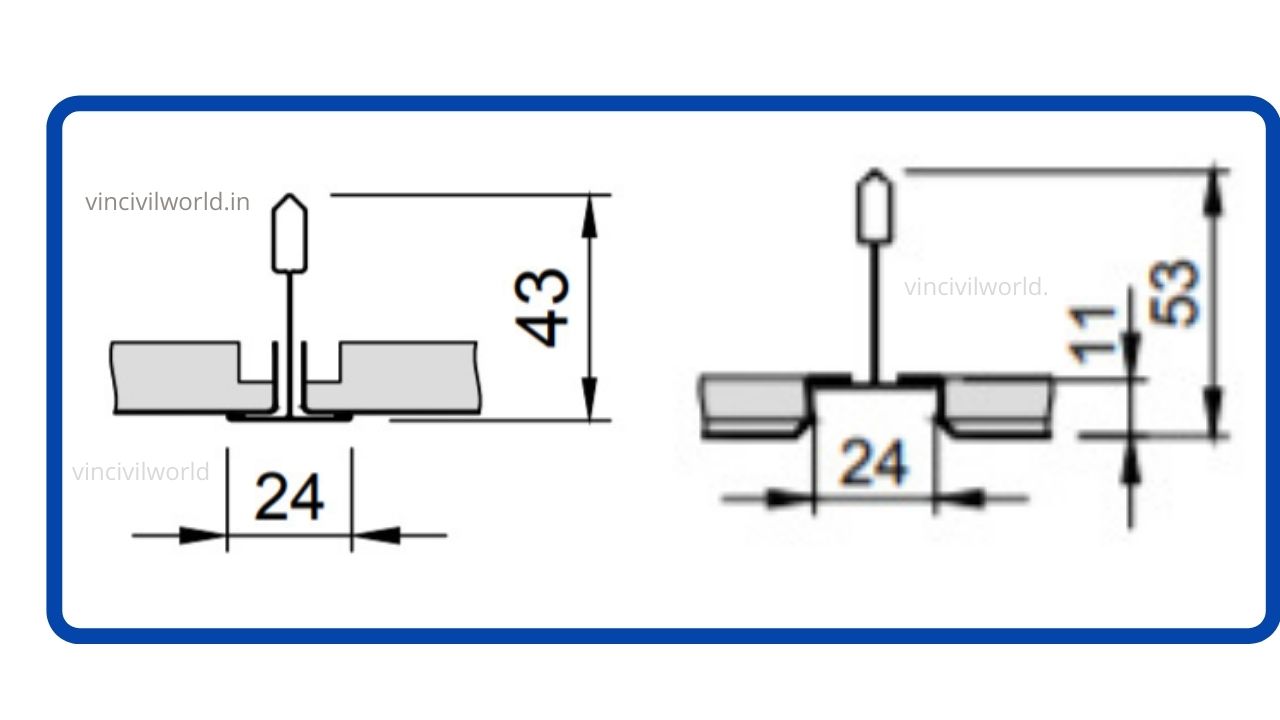
In these type of ceilings the tiles are laid over a T grid (as shown in fig) which is hanged to the ceiling using hangers/ wires 3 to 4 mm thick. The tiles used can either be plain type or perforated type. The size of grids normally used shall be 600×600 mm. In this type of false ceiling the grids are exposed and can be seen from outside. Tiles are simply placed on a T-shaped runner (ref fig), generally between 10 and 25mm, and can be easily installed and can be demounted as individual tiles during maintenance of services like AC, fire fighting,electrical etc.

T grids for Tile Laying


This ceiling system comprises of Galvanized steel /Aluminium lay in tiles ( 600 mm x 600 mm) are manufactured out of 0.50-1 mm thick polyester coil coated steel 120 gsm zinc coating or powder coated with 50 microns polyester paint. Aluminium tiles are manufactured out of 0.70mm – 1 mm thick aluminium sheets and are powder coated using polyester paint 50 micron thick. The lay in tiles used can be plain tiles or perforated tiles. The perforations depend on the client requirement and manufacturer specifications.

Grid system for lay in tiles

Advantages of lay in tile
Lay-in tiles are easy to remove and flexible for services related to electrical, fire ,plumbing and air conditioning facilities concealed in the false ceiling etc. They are also the easiest to move around when renovating and shifting office spaces.Installation and maintenance is very easy.The tile can be removed and remounted without any skilled assistance.The material is very durable and moisture and fire resistant.

METAL CEILING WITH CLIP IN TILES

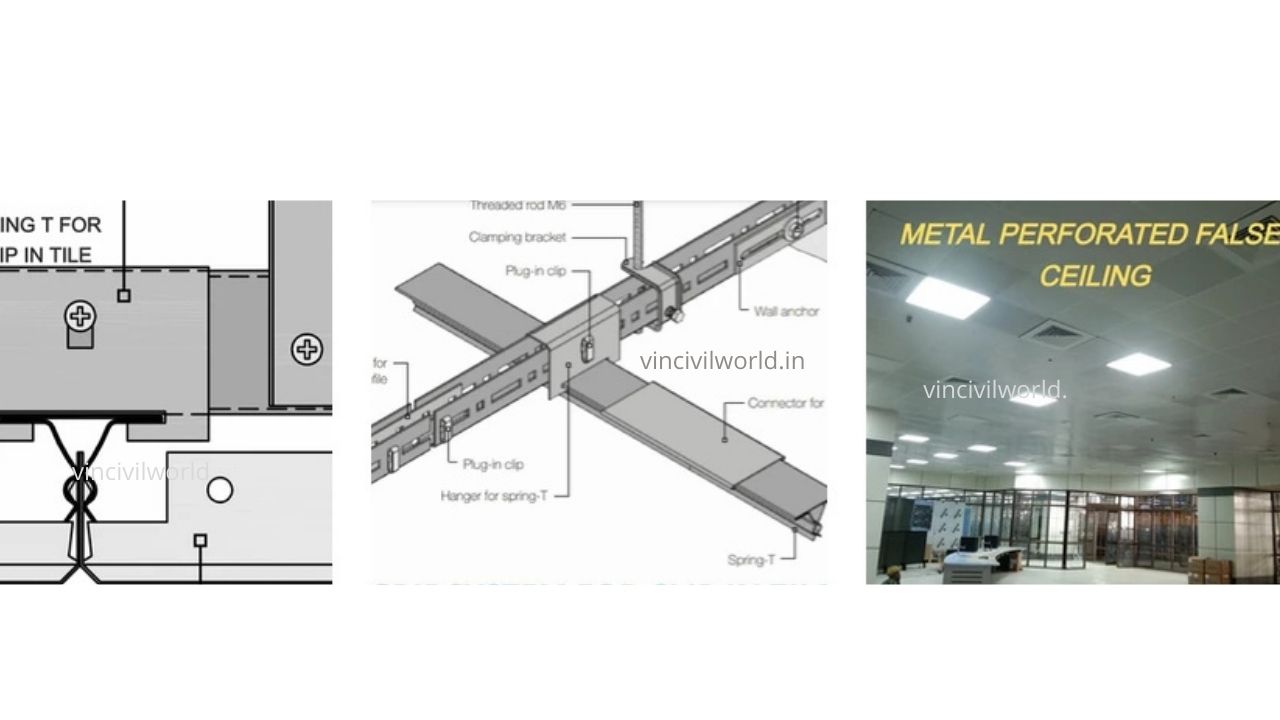
In the clip-in system, ceiling tiles clip into the suspended runner. Due to their washability clip-in tiles see consistent use in industrial and commercial uses. Ceiling tiles clip on to the suspended grid and therefore conceal the grid from view. Manufacturers have their own unique clip-in systems that match their boards but generally they all consist of a spring tee runner from which boards clip on to.

Clip in tile grid system

This ceiling system comprises of Galvanized steel /Aluminium lay in tiles ( 600 mm x 600 mm) are manufactured out of 0.50/1mm mm thick polyester coil coated steel 120 gsm zinc coating or powder coated with 50 microns polyester paint. Aluminium tiles are manufactured out of 0.70mm-1 mm thick aluminium sheets with powder coated 50 microns polyester paint. The CLIP IN TILES used can be plain tiles or perforated tiles. The perforations depend on the client requirement and manufacturer specifications.

Conclusion

Metal false ceiling systems are durable and long lasting when compared with any other ceiling. They are easy to install and maintain and a very preferred choice for industrial, commercial and residential areas.

Quality Tests on Concrete-Slump test

<p value="<amp-fit-text layout="fixed-height" min-font-size="6" max-font-size="72" height="80"><strong><span class="has-inline-color has-vivid-red-color">WHAT DO YOU MEAN BY CONCRETE?</span></strong>WHAT DO YOU MEAN BY CONCRETE?

<p class="has-text-align-justify" style="font-size:17px" value="<amp-fit-text layout="fixed-height" min-font-size="6" max-font-size="72" height="80"><strong>Concrete </strong>is a composite material, which is produced from a mixture of cement, aggregates (coarse & fine), water and sometimes admixtures in required proportions. These mixture consolidates in course of time to form a dense mass called concrete.Concrete is a composite material, which is produced from a mixture of cement, aggregates (coarse & fine), water and sometimes admixtures in required proportions. These mixture consolidates in course of time to form a dense mass called concrete.

INGREDIENTS OF CONCRETE

a) CEMENT

b) COARSE AGGREGATE

c) FINE AGGREGATE

d) WATER

e) ADMIXTURE

f ) AIR

WHY QUALITY CONTROL OF CONCRETE IS IMPORTANT ?

<p class="has-text-align-justify" style="font-size:17px" value="<amp-fit-text layout="fixed-height" min-font-size="6" max-font-size="72" height="80">Concrete is designed for a particular strength and the total structural stability is dependent on a good quality concrete. and that is why quality control is one of the most important aspects taken into account during the production of concrete . A little variation in water to cement ratio, ingredient proportioning, increase in slump etc will have a major impact on the desired strength of the structure which in turn affects the structural stability.Concrete is designed for a particular strength and the total structural stability is dependent on a good quality concrete. and that is why quality control is one of the most important aspects taken into account during the production of concrete . A little variation in water to cement ratio, ingredient proportioning, increase in slump etc will have a major impact on the desired strength of the structure which in turn affects the structural stability.

The quality control of concrete is done in three stages

a) Production stage ( On fresh concrete before placing)

b) Hardened stage ( hardened concrete specimens)

c) On structures ( tests done on the structures )

TESTS TO BE DONE ON FRESH CONCRETE

a) SLUMP TEST

b) Compaction Factor test

c) Vee- Bee Test

d) k slump test

e) Kelly ball test

f ) Flow table test

TESTS TO BE DONE ON HARDENED CONCRETE

a) COMPRESSIVE STRENGTH TEST (CUBE TEST)

b) WATER PERMEABILITY TEST

c) WATER ABSORPTION TEST

NON DESTRUCTIVE TESTS ON STRUCTURES

a) REBOUND HAMMER

b) UPV TEST

CONCRETE CORE TEST

SLUMP TEST

WHAT IS A SLUMP TEST?

Slump cone test is to determine the workability or consistency of a concrete mix prepared at the laboratory . Slump test shall be done on fresh concrete immediately after production at the batching plant to ensure the workability is in line with the design mix requirements and also at the pour point immediately after releasing from the transit mixture.

HOW DO YOU DO A SLUMP TEST (AS PER IS 1199:1959 REAFFIRMED 2013)

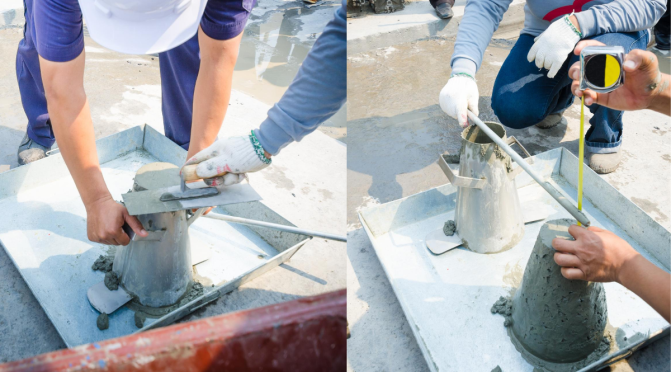
The nominal size of the aggregate shall be less than 38 mm . The cone has 20cm bottom diameter and 10 cm top diameter. The height of the cone is 30 mm. It consists of a 16 mm tamping rod having a length of 600 mm

The mould shall be filled in four layers, each approximately one-quarter of the height of the mould. Each layer shall be tamped with twenty-five strokes of the rounded end of the tamping rod. The cone is removed gently and the decrease in the height of concrete is the slump of concrete.

The slump tolerance shall be +/- 25 mm . If a design mix recommends a slump of 100 mm it cant go beyond 125 mm and go below 75 mm.

Also read

COMPACTION FACTOR TEST

<p value="<amp-fit-text layout="fixed-height" min-font-size="6" max-font-size="16" height="80"><amp-fit-text layout="fixed-height" min-font-size="6" max-font-size="16" height="80">

READY MIX CONCRETE-OVERVIEW

READY MIX CONCRETE (RMC)

PLACING OF READY MIX CONCRETE

Concrete is the most widely used building material in the world. Concrete is perfectly inert, and has exceptional durability without the need for special maintenance.Concrete is basically a mixture of Portland Cement, water and aggregates comprising sand and gravel or crushed stone. In traditional construction sites, each of these materials is procured separately and mixed in specified proportions at site to make concrete.
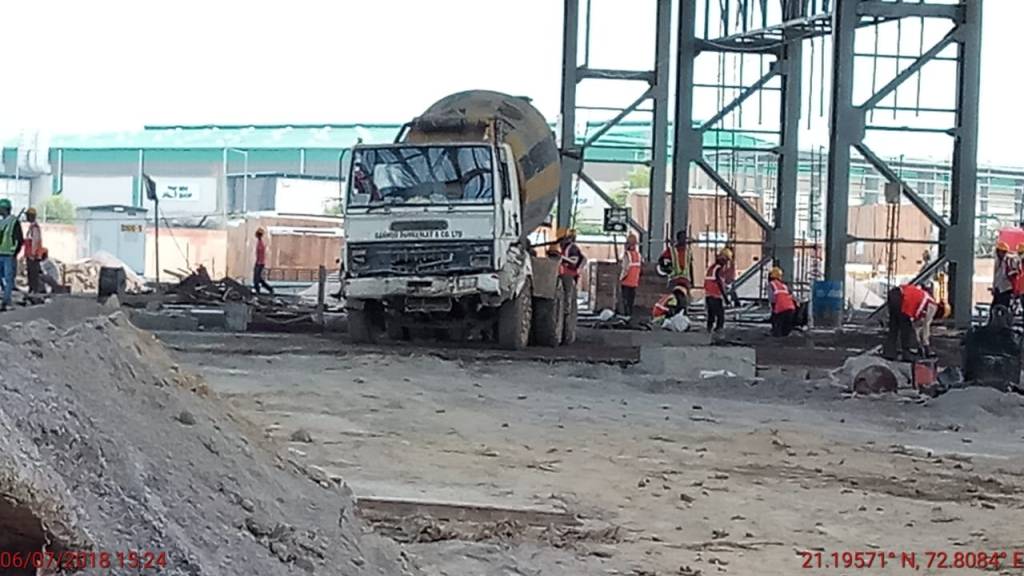
Ready mix concrete refers to a concrete manufactured from a batching plant according to customer/clients requirements & approved Design Mix and conveyed to the site in a ready to use condition. The concrete is conveyed through transit mixers of capacity ranging from 3 cum to 10 cum and more. 6 cum trucks are most commonly used. Batching plants are available in a wide range of capacities and types. ranging from 10 cum per hour to 125 cum/hr and some manufactures have much higher capacity plants.Most commonly used capacities are 30 cum, and 60 cum.

MAJOR CONSUMERS OF READY MIX CONCRETE

a) BIG CONSTRUCTION COMPANIES

They have there own batching plant set up along with expertise for installation, operation and maintaining it. These are used for there own use in construction sites depending on the feasibility in terms of space,quantity and economy.These plants are site specific and no commercial selling may not be permitted.

b) COMMERCIAL RMC SUPPLIERS

They setup there own plant in a specified location with all arrangements for stocking raw materials and commercially manufacture the materials as per customer/ client requirements.

COMMON METHODS USED FOR CONVEYING RMC

a) Transit mixed or truck mixed concrete

b) Shrink mixed concrete

c) Central mixed concrete.

a) Transit mixed concrete

The materials are batched at a central plant and are thoroughly mixed in the truck in transition. Transit-mixing separate water from the cement and aggregates and allows the concrete to be mixed instantly before using at the job site, Frequently partial mixing happens in transit and remaining mixing shall be done at site just before casting. This avoids slump loss, segregation, premature hardening, delays due to traffic jams, pouring delays due to equipment failure etc. The main disadvantage is the truck capacity is less compared to the one carrying fully mixed RMC.

b) Shrink mixed concrete

In shrink-mixed concrete, concrete is partially mixed at the plant to reduce or shrink the volume of the mixture and mixing is completed in transit or at the jobsite. The disadvantage is that concrete that has been remixed tends to set more rapidly than concrete mixed only once.

c) Central mixed concrete

The concrete is batched and completely mixed in a stationary mixer at the plant site before discharging it into the truck mixers. This can enhance the quality of concrete and cater higher production requirements.

HOW RMC IS MANUFACTURED

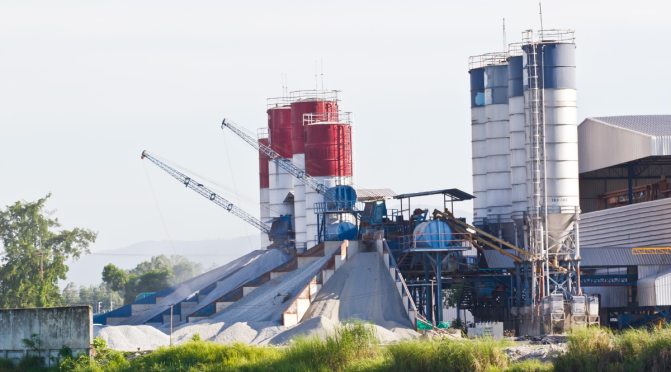
Ready mix concrete is manufactured from a centralised plant having facilities for storage of raw materials, Lab for inspection of raw material quality and concrete quality, having a series of batching plant/plants of different capacities etc.

RMC PLANT
RMC PLANT

The raw materials are checked to ensure compliance with relevant Indian standards so that there shall no be any quality issues to the end product. The raw materials are stored in separate areas on a firm ground. The RMC plant uses there In house design mixes most to the time. Customisation can also be done with the help of quality engineers. The design mixes are done in a way to give maximum quality with economy.

RAW MATERIAL BIN OF RMC PLANT

The running time, distance covered, initial settling time, slump etc are controlled using addition of special admixtures(mineral and chemical) etc without hampering the concrete strength. RMC is a totally controlled concrete having high work efficiency.

The raw materials stored shall be conveyed to the mixing drum using conveyor belts or bucket elevator. Cement is stored in silos also are conveyed using screw conveyors attached to the batching plants.

VIDEO SHOWING THE MIXING METHOD OF RMC

Once  the weight of all material types meets the needs of specific amounts,  the door of the weighing hopper is opened automatically. The materials  will then be mixed by a concrete mixer. Once the setting time is over,  the loading door of the concrete mixer opens and the concrete flows into  a transit mixer.

WHAT ARE THE ADVANTAGES OF READ MIX CONCRETE

a) Uses the updated technology in proportioning, mixing and conveying and hence RMC plants can maintain excellent quality.

b) Transportation and placing is very easy. Once the concrete transit mixers reaches site concrete placing can commence immediately through concrete pumps, concrete buckets or boom placers.

c) As the concrete production and mixing is done in another place the site will be free form noise and dust pollution and free from raw material and cement trucks.

d) By using RMC the construction speed can be enhanced and schedule delays can be avoided upto an extent.

c) The concrete produced from RMC plants can be customised as per the client/ customer requirements.

d) RMC plants are a great relief when the site do not have sufficient spaces for stocking of raw materials and locating a batching plant with its raw material bins. RMC plants can cater any quantity of concrete starting from small residences to big construction sites.

e) Onsite wastage of raw materials and concrete can be eliminated by using Ready mix concrete.

d) Labour required for production of concrete and manpower for operation and running of batching plant & its associated machinery can be eliminated .

WHAT ARE THE DISADVANTAGES OF RMC

a) Requires huge investment to set an RMC plant.

b) Labour force shall be ready to place the concrete as and when it comes

c) Unforeseen delays and traffic jam leads to concrete rejection.

d) A very efficient and effective transporting system has to be maintained.

e) Quality has to be checked at site as per is standards on fresh concrete and also on hardened specimen.

f) Very effective quality system to be maintained for adjusting the setting time and slump according to the time of transit.

g) For residential construction the customer may not get a better idea of the quality of concrete due to lack of site testing facilities.

h) There are problems due to discrepancies in quantities which cant be convinced properly to the RMC vendors.

Updates in civil engineering, architecture finishes, building construction, Environmental Engineering