Non destructive testing of hardened concrete plays a vital role in assessing the condition of concrete structures. It evaluates performance without causing damage. Engineers use non destructive test for concrete structures to evaluate strength, durability, and uniformity while the structure remains fully functional. These NDT methods for concrete evaluation help detect cracks, voids, honeycombs, and other hidden defects that may affect long-term performance. Professionals can estimate compressive strength by using advanced hardened concrete testing techniques. They can identify deterioration and also monitor the health of aging infrastructure. Modern tools like rebound hammer and ultrasonic pulse velocity make concrete strength testing faster. They support the process without causing damage and are more cost-efficient. The key advantages of NDT in concrete testing include safety, accuracy, rapid inspections, and extended service life of structures. Overall, NDT ensures reliable decision-making for repairs, rehabilitation, and quality control in construction.
Non-destructive test (NDT) and destructive tests (DT) are the the tests done one hardened concrete. Concrete is the oldest and most important construction material in the world. Testing of the concrete plays and important role to know about the strength, durability and condition of the structure. This article is about the types of Destructive and non destructive tests done on concrete.
Concrete testing plays a vital role in determining the strength, durability, and performance of concrete structures. Engineers conduct different tests to verify that the concrete mix meets design requirements and performs safely throughout its service life. These types of concrete tests help assess important properties such as workability, compressive strength, density, and internal defects. The tests are categorized into destructive tests and non destructive tests, depending on whether the specimen is damaged during inspection. Both testing methods are essential for ensuring quality control, structural integrity, and long-term durability of concrete in construction projects. By using the right concrete testing techniques, engineers can make reliable decisions in design, repair, and maintenance works.
Concrete tests are classified into two types
Destructive tests (DT)
Non – Destructive tests (NDT)
Destructive Tests
Compressive Strength Test
Flexural Strength Test
Split Tensile Strength Test
Pull-out Test
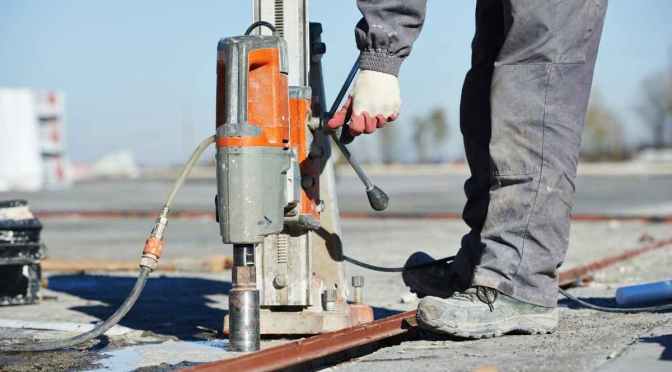
Core Cutting and Testing
Non Destructive Tests (NDT)
Impact Echo / Pulse Echo Test
Rebound Hammer Test
Ultrasonic Pulse Velocity (UPV) Test
Half-Cell Potential Method
Ground Penetrating Radar (GPR)
Cover Meter Survey
Schmidt Hammer Test
In this article we describes about the Non destructive testing techniques conducted on hardened concrete.
Non- Destructive testing techniques on hardened concrete
The standard method of non destructive testing of hardened concrete is carried out by testing concrete specimens. These specimens are cast simultaneously with structural concrete. These destructive tests on concrete can determine the compressive, flexural, and tensile strengths. The major disadvantage of these destructive concrete testing methods is the non availability of immediate results. Moreover, the properties of the concrete specimen differ from what it is in the actual structure. This difference is due to pouring conditions, curing factor, compaction and concrete density, etc. These tests come under the category of destructive tests (DT). Destructive testing of concrete destroys or changes the part. Even if it passes the test, the part is no longer fit for service.
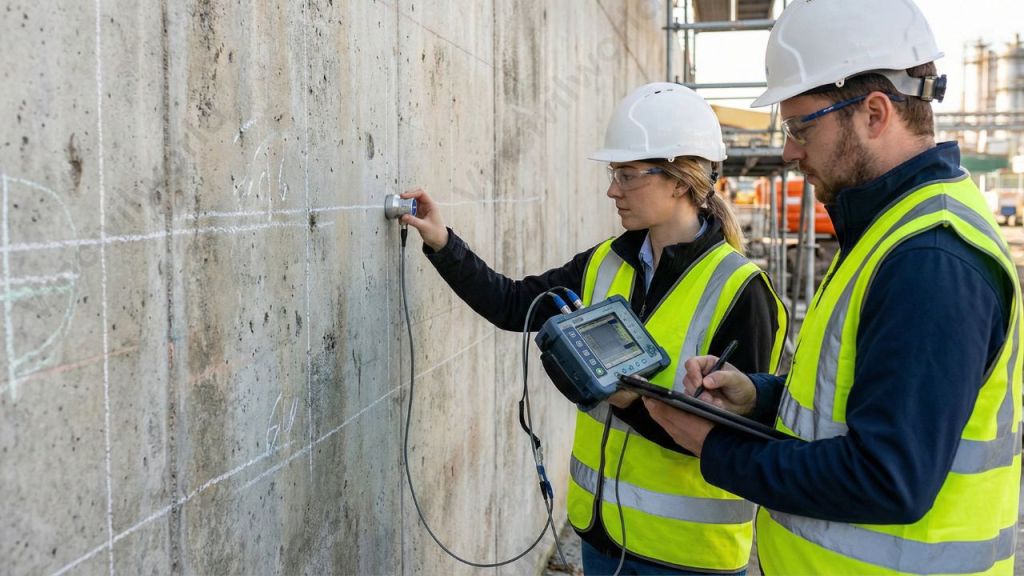
Engineers conducting non-destructive testing on hardened concrete to assess its strength and durability.
Non Destructive Test (NDT) is for determining compressive strength and other properties of concrete from existing structures or buildings. NDT testing of concrete does not destroy the part. It does not change the part so that it is still fit for service if it passes the test. The non-destructive test determines the properties of concrete or structures without their destruction. Moreover, we can study its changes over time, The measurements are repeated many times and validate in detail, and gets immediate results. These NDT concrete testing methods help assess quality, strength, and durability in a quick and reliable way.
Objectives/advantages of Non destructive testing (NDT)
Non-destructive testing (NDT) helps evaluate hardened concrete structures without causing damage. It allows engineers to assess concrete strength and durability. They can also evaluate reinforcement condition, cracks, and internal defects. All of these are assessed while the structure remains fit for service. The advantages of NDT include quick results, safety, cost-effectiveness, and the ability to monitor structures throughout their life cycle. These advantages of NDT make it widely preferred for quality assurance and structural health monitoring.
Quality check of the existing structure.
For determining the homogeneity, internal and external characteristics of the concrete.
To detect the cracks and voids of the concrete structures.
Assess the quality of concrete with the standard requirement.
To study the ageing of concrete.
For finding the compressive strength of structures.
Evaluation of elastic modulus
Classification of Non-Destructive test
Hardened Concrete testing techniques/ Non Destructive testing are as follows
Windsor Probe Test
Rebound Hammer Test
Ultrasonic Pulse Velocity (UPV)
Half-Cell Potential Test
Covermeter / Rebar Locator Test
Impact Echo Test
Penetration Resistance Test / Windsor Probe Test
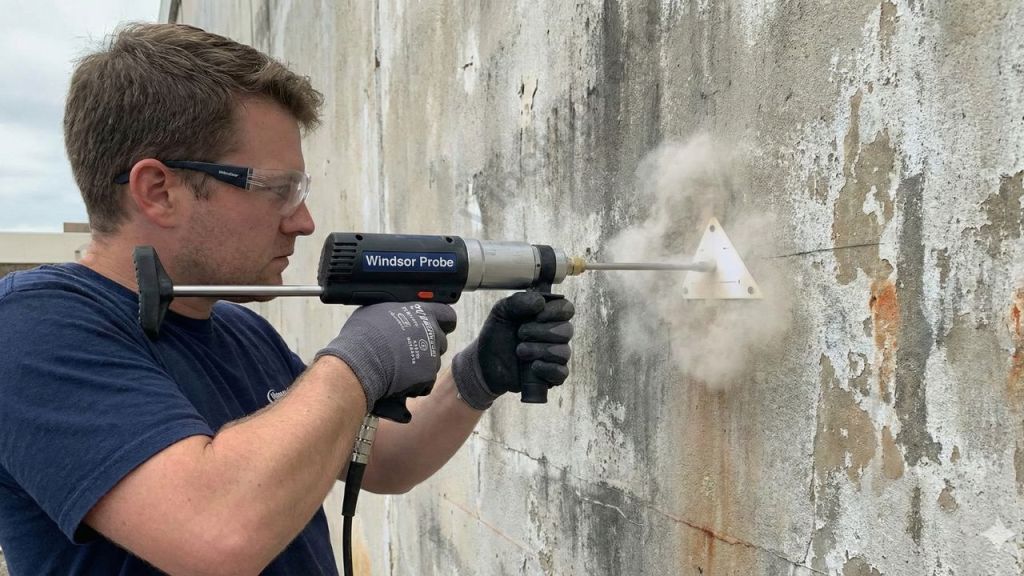
The penetration resistance test is an NDT that determines the relative strength of the concrete structures. The Windsor probe is the equipment for conducting this test. This equipment includes of powder-actuates driver or gun, probes, loaded cartridges and a gauge that measures the penetration.
The penetration depth indicates the compressive strength of the concrete. However, this depends on the aggregate type and size. This test evaluates the poor quality and deterioration of concrete
An engineer using a Windsor Probe for penetration resistance testing on hardened concrete.
The major disadvantage of this test is getting variable results. Several probes are often shot to achieve a solid average depth for arriving a final conclusion. So we cannot determine the exact strength. But it is a quick method to evaluate the quality and maturity of concrete. Care should be taken to calibrate the instrument before taking readings.
Rebound Hammer Test
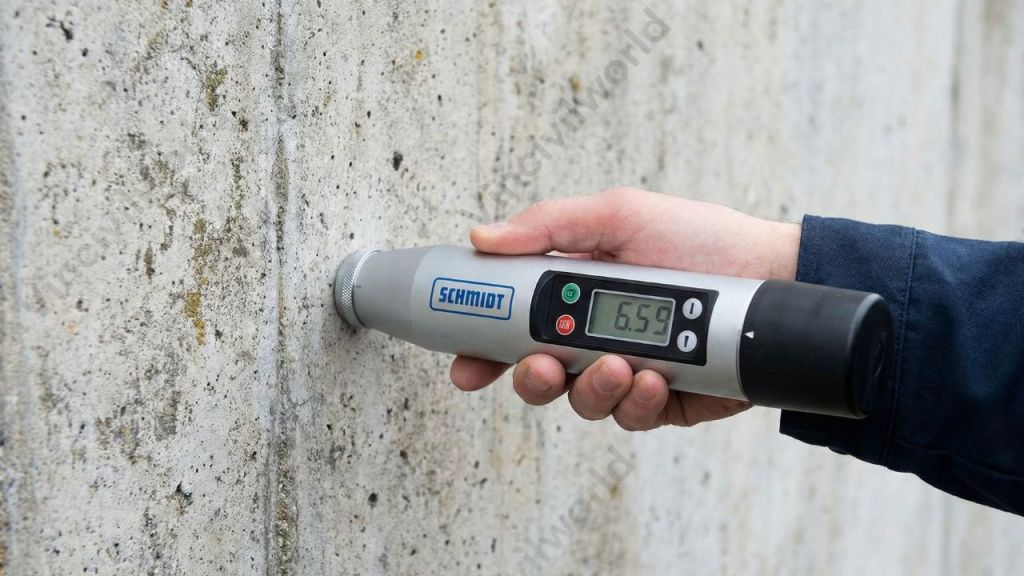
The rebound hammer is also known as Schmidt’s Hammer test. It determines the strength of concrete based on the hardness of the concrete surface. It is a surface hardness tester. The equipment consists of a spring-controlled plunger, a hammer that weighs 1.8 kg, and a graduated scale. By pressing the hammer on the concrete surface, the graduate scale measures the rebound number. A low rebound number means the concrete has low compressive strength and stiffness.
A technician conducting the Rebound Hammer Test on concrete to assess compressive strength without causing damage.
An accuracy of 15 to 20% is possible through this test. It is a simple and quick method. Also, the result relies on the surface smoothness, water content, type and size of aggregate and carbonation of the surface.
Ultrasonic Pulse Velocity Test
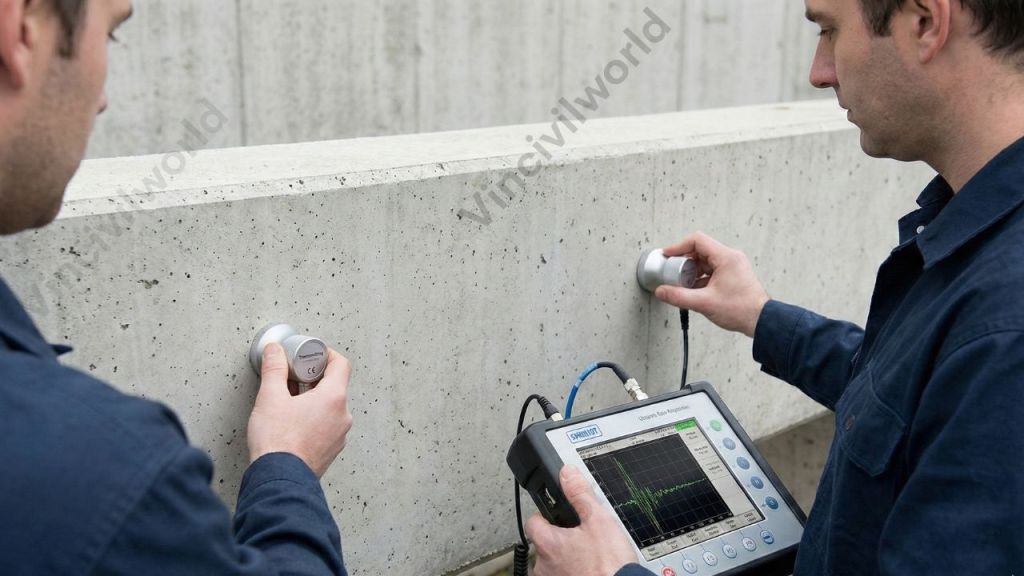
Ultrasonic pulse velocity test is another type of Non-destructive test. This test measures the time of travel of ultrasonic pulse waves for evaluating the concrete quality. The UPV test units consists of a pulse generator and pulse receiver. The frequency of the wave is 50-55 kHz. The pulse generator produces the pulses and is allowed to pass through the concrete. Then we calculate the velocity, by measuring the traversing distance and the time. Higher velocity means the concrete has a higher elastic modulus and density. It also determines the cracks and flaws in the structure. Large differences in pulse velocity values indicates a defective and deteriorated concrete.
Engineers conducting an Ultrasonic Pulse Velocity test on concrete to assess its quality and detect any hidden defects.
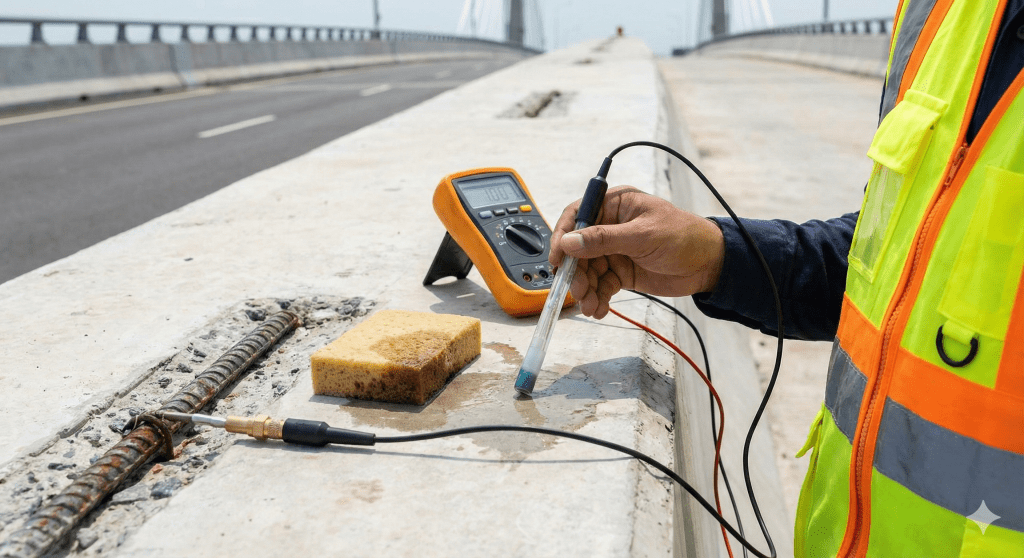
The Half-Cell Potential Test is a widely used non-destructive testing (NDT) method. It evaluates corrosion activity in steel reinforcement within hardened concrete. It measures the electrical potential difference between embedded rebars and a reference electrode. This reference electrode is typically a copper / copper sulfate (Cu/CuSO₄) cell. The test helps determine whether the reinforcement is actively corroding, passive, or at risk. An electrical connection directly connects to the rebar. Surface readings are recorded in a grid on moist concrete to ensure good conductivity. These readings are compared with standard probability charts provided in ASTM C876. The results allow engineers to locate corroded zones, plan preventive repairs, and avoid unnecessary concrete removal. Overall, it is a quick, reliable, and cost-effective tool for structural health assessment and durability maintenance of concrete structures.
An engineer conducting a non-destructive test on concrete using a specialized equipment to assess structural integrity.
Covermeter / Rebar Locator Test – Locating Reinforcement Without Damage
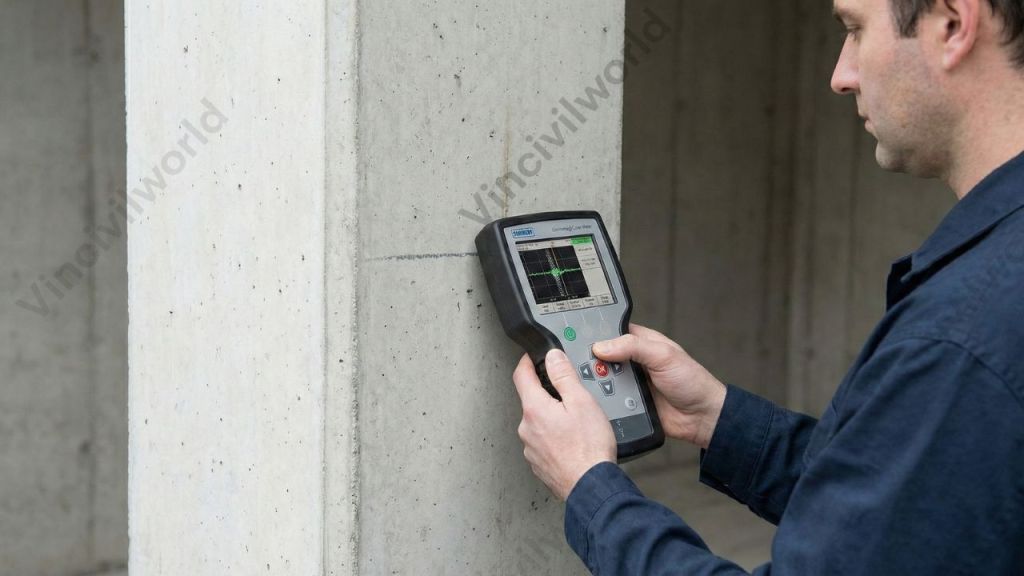
The Covermeter Test is also known as the Rebar Locator Test. It is a widely used non-destructive testing (NDT) method. This method is for detecting the position, depth, and spacing of steel reinforcement in hardened concrete. It works by measuring the magnetic field disturbance created by embedded steel when scanned with an electromagnetic probe. The test accurately determines the cover thickness. This is the distance from the concrete surface to the reinforcement. This measurement is critical for durability, fire safety, and code compliance. Modern Covermeter can also estimate bar diameter and identify congestion or missing rebars. This method adheres to standards such as BS 1881-204. It assists engineers in repair planning, drilling, and anchoring. It also helps in retrofitting without damaging the structure. Overall, the rebar locator test is fast, clean, and essential for structural assessment and quality control of reinforced concrete.
A technician performing a non-destructive test on a concrete structure using specialized equipment to assess its condition.
Impact Echo Test – Evaluating Internal Defects in Concrete
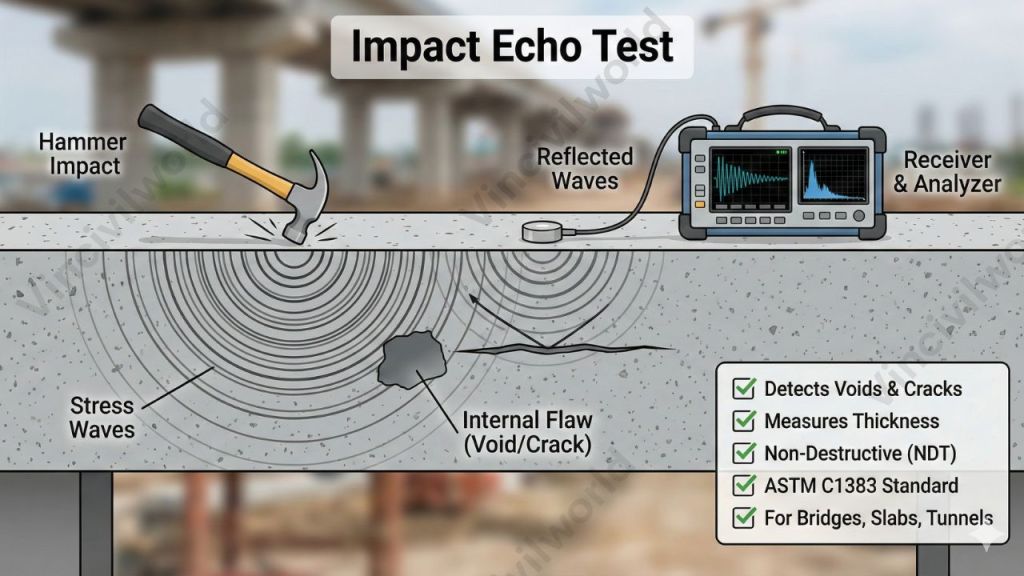
The Impact Echo Test is a reliable non-destructive testing (NDT) method. It is used to detect internal flaws such as voids, cracks, and delamination in hardened concrete. It also identifies thickness variations. It works by applying a short mechanical impact on the surface using a small hammer or impactor. This impact generates stress waves that travel through the concrete and reflect back from internal boundaries. A sensitive receiver records the returning signals and analyzes the wave frequencies to identify abnormalities. The method is guided by standards like ASTM C1383, making it suitable for bridges, slabs, tunnels, and precast elements. Engineers use this test to assess structural integrity, locate hidden defects, verify grouting, and ensure long-term durability—without drilling, cutting, or damaging the structure. Overall, the Impact Echo Test offers a fast and effective solution for concrete condition evaluation and maintenance planning.
Illustration of the Impact Echo Test used in non-destructive testing of concrete, showing hammer impact, stress waves, and internal flaw detection.
Key Takeaways
Non-destructive testing (NDT) evaluates hardened concrete’s strength and durability without causing damage, helping to detect hidden defects.
Engineers use both non-destructive and destructive tests to ensure quality control and structural integrity during concrete assessments.
Key advantages of NDT include quick results, safety, and cost-effectiveness, making it ideal for monitoring concrete structures over time.
Various NDT techniques include the Rebound Hammer Test, Ultrasonic Pulse Velocity Test, and Impact Echo Test.
These methods provide crucial insights into concrete quality, allowing for reliable repairs and maintenance planning.
Conclusion
Non Destructive testing of concrete plays a vital role in maintaining the long-term performance and safety of structures. NDT for hardened concrete enables engineers to assess strength, durability, reinforcement conditions, and internal defects without damaging the structure. With modern concrete NDT methods such as Rebound Hammer, Ultrasonic Pulse Velocity, and Covermeter testing, engineers receive quick data. Tests like Half-Cell Potential and Impact Echo provide reliable insights into structural integrity. One of the major advantages of NDT is the ability to monitor existing buildings. It helps identify deterioration early. Engineers can plan effective maintenance. By using advanced NDT techniques, the industry ensures cost efficiency, improved safety, and accurate decision-making throughout a structure’s life. Therefore, the advantages of NDT strongly support sustainable, safe, and high-quality construction management.
Magnetic Particle Test (MPT) is a widely used non-destructive testing (NDT) method. It detects surface and near-surface discontinuities in ferromagnetic materials, such as iron, nickel, cobalt, and their alloys. This technique is renowned for its speed, cost-effectiveness, and relative ease of application, making it a preferred choice across various industries, including aerospace, automotive, marine, power generation, and oil and gas sectors
Magnetic Particle Testing (MPT) operates by magnetizing the component under inspection. If defects are present, they disrupt the magnetic field, causing leakage fields. When fine ferromagnetic particles are applied to the surface, these particles cluster at the leakage sites. This clustering forms visible indications of discontinuities. This method enables quick and reliable detection of flaws that compromise the integrity of critical components.
This article explores the history of Magnetic Particle Testing (MPT), covering its magnetization methods, principles, and equipment. It explains the procedure, detectable discontinuities, advantages, and applications. Additionally, it highlights safety measures and recent advancements. It emphasizes MPT’s role as a reliable non-destructive testing technique for ensuring material integrity.
Historical Background of Magnetic Particle Test (MPT)
Magnetic Particle Testing (MPT) has played a crucial role in non-destructive testing (NDT) for over a century. It all began in 1868. Inspectors magnetized cannon barrels and used a magnetic compass. They detected defects by watching needle deviations. As technology advanced, MPT techniques improved significantly.
By the early 1900s, industries started refining the process. By the 1930s, railroads widely adopted MPT. They used it to inspect metal components and enhance safety. Over the years, there have been further advancements in magnetization techniques. Fluorescent magnetic particles and portable equipment have increased the accuracy and convenience of the technique. Today, MPT continues to be an essential tool across various industries, ensuring the reliability and safety of critical components.
Magnetic Particle Test (MPT)
Magnetic Particle Testing Principle
Ferromagnetic materials, such as iron, nickel, and cobalt, strongly attract magnetic fields. Their unique atomic structure allows groups of atoms to align in the same direction, forming magnetic domains. In an unmagnetized state, these domains are randomly arranged, resulting in no net magnetization. However, when exposed to an external magnetic field, the domains shift and align with the field. This alignment creates a strong overall magnetic effect, making ferromagnetic materials highly responsive to magnetization.
Magnetic Particle Testing (MPT)
Magnetic Particle Testing (MPT) detects surface and near-surface flaws in ferromagnetic materials. The process starts by magnetizing the part, either locally or entirely. If a flaw like a crack is present, it distorts the magnetic field, creating flux leakage. Fine ferromagnetic particles are applied to the surface. These particles gather at the leakage points, forming visible indications. This buildup reveals the flaw’s location, size, and shape. MPT is a reliable method for identifying defects in critical components.
The effectiveness of MPT depends on factors such as the type of current used for magnetization. Alternating current (AC) is typically used for detecting surface flaws. Direct current (DC) is more effective for subsurface flaw detection.
Types of Magnetization Methods in Magnetic Particle Testing
Magnetic Particle Testing (MPT) employs two primary magnetization techniques: direct and indirect magnetization.
Direct Magnetization
In direct magnetization, an electric current flows through the test object, generating a magnetic field within the material. This method is highly effective for finding out surface and near-surface flaws. Inspectors typically use two common approaches: clamping the component between contact heads or applying current through prods. As the current passes through, it creates a circular magnetic field around its path. If a defect exists, it disrupts the magnetic flux, causing magnetic particles to gather and reveal the flaw. To ensure accuracy, proper contact is essential. This prevents arcing. Additionally, current levels must be carefully controlled to avoid overheating or damage. Due to its simplicity and reliability, direct magnetization remains widely used in industrial applications for flaw detection.
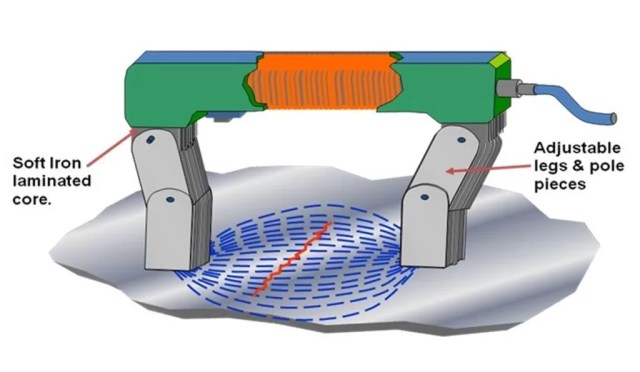
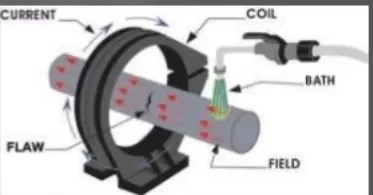
Indirect magnetization, also known as magnetization by induction, creates a magnetic field in the test object without direct electrical contact. This method involves placing the component inside a current-carrying coil or using a yoke to generate an external magnetic field. As a result, the material becomes magnetized, allowing defects to be detected. This technique is useful because it does not require direct current application. It is especially beneficial for inspecting components where direct magnetization is impractical. Additionally, it ensures even magnetization across complex shapes, improving the accuracy and efficiency of Magnetic Particle Testing (MPT).It is ideal for components with complex shapes or when testing specific areas. However, the field’s strength and orientation must be carefully controlled to ensure accurate and sensitive flaw detection.
Magnetic Particle Testing (MPT) – In direct Magnetization
Comparison of Magnetization Techniques
Factor
Direct Magnetization
Indirect Magnetization
Magnetization Method
Electric current passes directly through the test object.
External magnetic field induces magnetization.
Field Strength
Produces a strong magnetic field.
May generate a weaker magnetic field.
Suitability
Best for simple-shaped components.
Ideal for complex-shaped components.
Electrical Contact
Requires direct contact, which may not be feasible for all parts.
No direct electrical contact, reducing arcing risk.
Application
Effective for detecting surface and near-surface flaws.
Suitable for localized inspections and components sensitive to direct currents.
Limitations
Risk of overheating and arcing if not properly controlled.
Field strength and orientation must be carefully managed for accuracy.
Equipment and Materials Used in Magnetic Particle Test
Magnetic Particle Testing (MPT) uses different tools and materials to find surface and near-surface flaws in ferromagnetic materials. It requires magnetizing equipment, magnetic particles, and suspension mediums for accurate defect detection.
Magnetizing Equipment
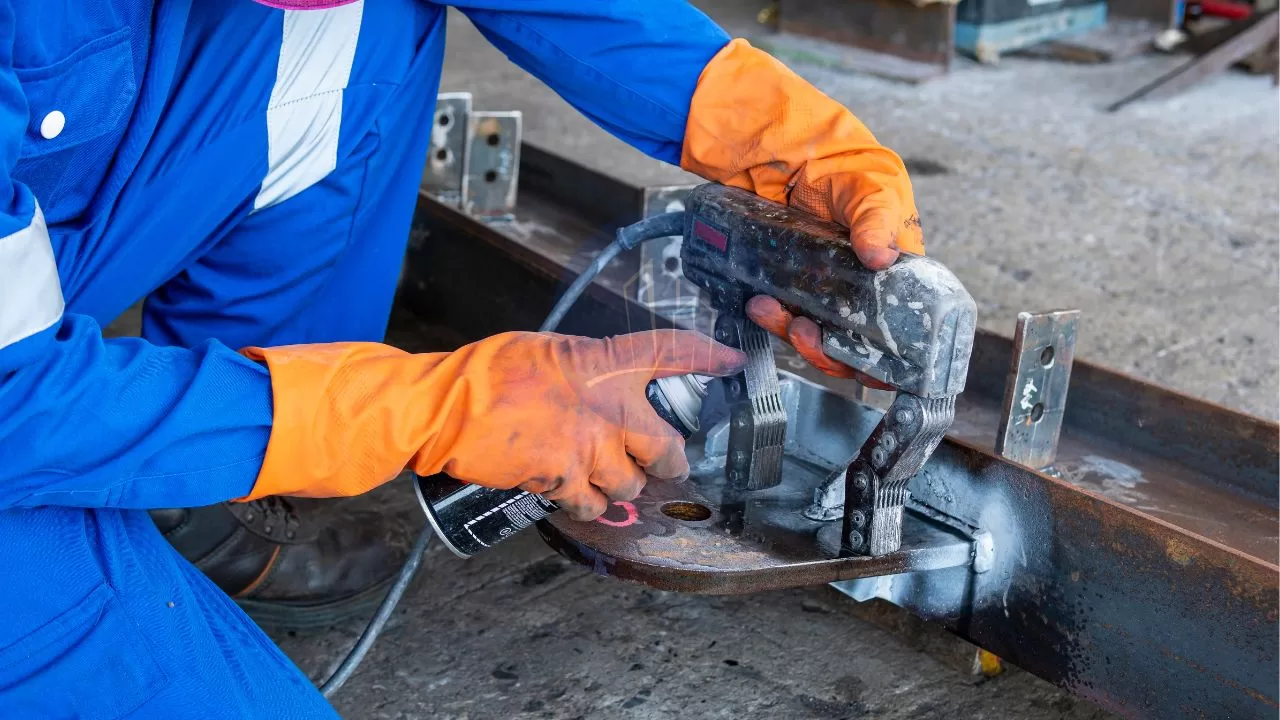
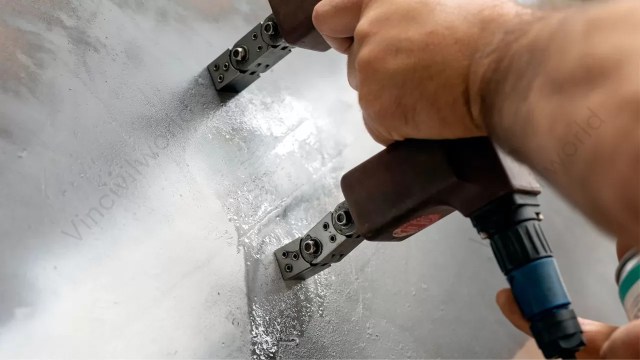
Yokes are Portable devices that create a magnetic field between two poles. They help inspect specific areas and are popular for their flexibility and ease of use.
Electromagnetic coils generate a longitudinal magnetic field when current flows through them. Placing a test object inside the coil induces magnetization, making it ideal for simple-shaped components.
Prods are Handheld electrodes send current directly into the test object, forming a localized magnetic field. They work well for inspecting welds and targeted areas but need careful handling to prevent surface damage.
Types of Magnetic Particles
Dry Particles are Finely milled ferromagnetic powders applied directly to the test surface. They are ideal for detecting discontinuities on rough or uneven surfaces and in high-temperature environments.
Wet Particles are Magnetic particles suspended in a liquid carrier, such as water or oil. This method enhances particle mobility, increasing sensitivity to fine defects. Wet suspensions are particularly useful for smooth surfaces and can be applied using spray systems.
MPT – Dry particle and Wet Particle
Suspension Mediums and Their Applications
Water-Based Suspensions utilize water as the carrier fluid, often with added wetting agents to improve particle dispersion and surface coverage. They are environmentally friendly and suitable for a wide range of applications.
Oil-Based Suspensions employ light petroleum distillates as carriers, offering superior corrosion protection and suitability for components prone to rust. They are preferred in situations where water adversely affect the test material.
Selecting the appropriate combination of equipment and materials is crucial for effective Magnetic Particle Testing, ensuring accurate detection of flaws and maintaining the integrity of the components under inspection
Step-by-Step Magnetic Particle Testing Procedure
Magnetic Particle Testing (MPT) is a non-destructive method that finds surface and near-surface flaws in ferromagnetic materials. The process follows key steps to ensure accurate and reliable results.
Surface Preparation
Thoroughly clean the test surface to remove contaminants such as oil, grease, dirt, and rust, which could interfere with the inspection process. Generally, a clean surface ensures proper particle adherence and accurate defect detection.
Application of Magnetic Field
Apply a magnetic field to the component using yokes, coils, or prods. The method depends on the part’s shape and inspection needs. Yokes create a field between two poles for localized testing. Coils generate a longitudinal field for cylindrical or simple-shaped parts. Prods introduce current directly, producing a strong, localized field. When magnetized, any flaw in the material distorts the field, causing flux leakage. This leakage attracts magnetic particles, making defects visible. Proper magnetization is crucial for accurate results. Inspectors must choose the right technique to ensure full coverage and reliable detection of surface and near-surface discontinuities.
Application of Magnetic Particles
Apply magnetic particles to the magnetized surface using dry powder or a liquid suspension. These particles spread across the surface and gather where magnetic flux leaks due to flaws like cracks. Dry particles work well for field inspections, while wet suspensions offer better sensitivity for fine defects. The inspector ensures even coverage to detect all possible flaws. Under proper lighting or UV light for fluorescent particles, defect indications become visible. This step is crucial for identifying the exact location and size of discontinuities. Correct application improves detection accuracy and ensures reliable inspection results in Magnetic Particle Testing (MPT).
Inspection Under Appropriate Lighting Conditions
Carefully inspect the surface for particle build-up, as this often indicates defects. To enhance visibility, use proper lighting techniques. For non-fluorescent particles, rely on bright white light, ensuring even illumination. For fluorescent particles, use ultraviolet (UV-A) light. Do this in a dark environment to make defects stand out more clearly. Additionally, adjust the light source as needed to achieve full coverage and eliminate any shadows. Proper lighting plays a crucial role in accurate detection. Following these steps ensures reliable Magnetic Particle Testing (MPT) results. This ultimately improves safety and quality in inspections.
Demagnetization Process
After inspection, demagnetize the component to eliminate any residual magnetism, which could affect its performance or interfere with future inspections. This step is crucial for maintaining the material’s integrity.
Post-Inspection Cleaning
Clean the component to remove any remaining magnetic particles and inspection residues. This ensures the part is free from contaminants and ready for service or further processing.
Adhering to these steps in the MPT process ensures the accurate detection of defects. This contributes to the safety and reliability of critical components.
Types of Discontinuities Detected by MPT
Magnetic Particle Testing (MPT) is a non-destructive testing method used to identify surface and near-surface discontinuities in ferromagnetic materials. It is particularly effective in finding out various types of flaws that can compromise the integrity of components.
Surface Cracks
Surface cracks on the material’s exterior is due to fatigue, stress, or mechanical damage. In Magnetic Particle Testing (MPT), these cracks disrupt the magnetic field, causing flux leakage. Consequently, magnetic particles gather at these leakage points, making the cracks clearly visible. This method effectively detects cracks early, thereby preventing potential failures. Moreover, regular inspection enhances safety and extends the durability of critical components across various industries. As a result, industries can minimize risks, reduce maintenance costs, and ensure reliable operations.
Subsurface Flaws
Subsurface flaws, like voids or inclusions, lie just beneath the surface and are not visible. In Magnetic Particle Testing (MPT), these flaws disrupt the magnetic field if they are close enough. This disruption creates flux leakage, which in turn attracts magnetic particles to the flaw’s location. As a result, the gathered particles form visible patterns, making it easier for inspectors to detect hidden defects. By identifying these flaws early, industries can prevent costly failures and enhance material reliability. Moreover, regular inspections improve overall safety and extend the lifespan of critical components, ensuring smooth and efficient operations.
Inclusions and Seams
Inclusions are non-metallic materials trapped in metal during manufacturing. Seams are long, narrow defects caused by structural imperfections. Both disrupt the magnetic field in MPT, creating flux leakage. Magnetic particles gather at these spots, making the flaws visible.
Detecting these defects helps prevent failures and ensures the reliability of ferromagnetic components. MPT is essential for maintaining safety and quality in industries like aerospace, automotive, and construction.
Advantages of Magnetic Particle Testing
Magnetic Particle Testing (MPT) is a non-destructive testing method used to detect surface and near-surface flaws in ferromagnetic materials. It is widely utilized across various industries due to its effectiveness and efficiency.
Magnetic Particle Test
High Sensitivity – MPT effectively detects surface and near-surface defects, including cracks, seams, and laps.
Quick and Efficient – The testing process is fast, providing immediate results for quick decision-making.
Cost-Effective – MPT is an economical method compared to other NDT techniques, requiring minimal equipment.
Portable Equipment – Handheld yokes and compact units allow inspections in various locations, including field applications.
Works on Coated Surfaces – MPT can be performed on thinly coated surfaces, reducing the need for surface preparation.
Minimal Training Required – Operators can learn MPT quickly compared to more complex NDT methods.
Versatile Application – Used in automotive, aerospace, railways, and manufacturing industries for safety and quality assurance.
Reliable Results – Consistently identifies defects that could lead to material failure.
Limitations of Magnetic Particle Test
Magnetic Particle Testing (MPT) is a widely used non-destructive testing method, but it has several limitations:
Material Restriction: MPT is limited to ferromagnetic materials. This includes materials such as iron and steel. It cannot be used on non-ferromagnetic materials like austenitic stainless steel.
Surface Condition: The accuracy of MPT can be affected by surface conditions. Rough or dirty surfaces hinder defect detection. Proper cleaning is necessary before inspection.
Depth Limitation: MPT is effective for detecting surface and near-surface defects but may not identify deeper flaws within the material.
Demagnetization Requirement: After testing, components may retain residual magnetism, requiring demagnetization to prevent interference with their intended function.
Coating Thickness: Thick paint or coatings can impede the detection of defects. MPT is less effective on heavily coated surfaces.
Orientation Sensitivity: Defects not aligned perpendicularly to the magnetic field may go undetected. Inspections from multiple directions are necessary to ensure comprehensive evaluation.
Electrical Power Dependence: Most MPT methods require a consistent electricity supply, limiting their applicability in remote or power-scarce environments.
Interpretation Challenges: Non-relevant indications can occur. This makes the interpretation of results challenging. Skilled personnel are required to distinguish between true defects and false indications.
Understanding these limitations is crucial for selecting the appropriate non-destructive testing method for specific applications.
Comparison with Other NDT Methods
MPT is quicker and more affordable than UT but only works on ferromagnetic materials and detects surface or near-surface flaws. UT can find internal defects in various materials, including non-ferromagnetic ones. However, it needs advanced equipment and skilled operators.
MPT is cleaner and gives instant results without waiting for development. However, LPT works on non-ferromagnetic materials and can detect finer surface defects across more materials.
The selection of an appropriate NDT method depends on several factors. These include material type, defect nature, inspection environment, and required sensitivity.
Here’s a comparison of Magnetic Particle Testing (MPT) with other common Non-Destructive Testing (NDT) methods
Aspect
Magnetic Particle Testing (MPT)
Ultrasonic Testing (UT)
Liquid Penetrant Testing (LPT)
Material Suitability
Effective only on ferromagnetic materials (e.g., iron, nickel, cobalt, and their alloys).
Applicable to a wide range of materials, including metals, plastics, and composites.
Suitable for non-porous materials, both ferrous and non-ferrous.
Defect Detection
Detects surface and near-surface discontinuities.
Capable of identifying internal and surface defects.
Primarily identifies surface-breaking defects.
Portability
Equipment is generally portable, allowing for on-site inspections.
Equipment can be portable but often requires coupling medium and skilled operators.
Highly portable with minimal equipment needed.
Cost
Relatively low-cost method.
Typically more expensive due to advanced equipment requirements.
Generally cost-effective with low equipment costs.
Surface Preparation
Requires clean surfaces; contaminants can hinder accuracy.
Surface condition can affect accuracy; requires good contact.
Requires thorough cleaning to remove contaminants before application.
Not suitable for non-ferromagnetic materials; depth of detection is limited.
Requires skilled operators; surface roughness and geometry can affect results.
Only detects surface defects; not suitable for porous materials.
Applications of Magnetic Particle Testing
Magnetic Particle Testing (MPT) is a non-destructive testing method widely used to detect surface and near-surface discontinuities in ferromagnetic materials. Moreover, its versatility makes it invaluable across various industries, ensuring the integrity and safety of critical components. By identifying defects early, MPT helps prevent failures, reduce maintenance costs, and enhance overall reliability. As a result, industries like aerospace, automotive, and construction rely on MPT to keep high safety and quality standards.
Magnetic Particle Test
Industries Utilizing MPT
Construction: MPT assesses the structural integrity of buildings, bridges, and infrastructure by detecting surface and near-surface flaws in steel structures.
Specific Use Cases and Examples of Magnetic Particle Test
Railway Industry: Regular MPT of rails and wheels detects fatigue cracks, preventing derailments and ensuring safe train operations.
Role of Magnetic Particle Testing in Quality Assurance and Inspection Works
Magnetic Particle Testing (MPT) is a vital non-destructive testing method widely used in quality assurance and inspection. Not only does it detect surface and near-surface defects in ferromagnetic materials, but it also ensures safety, reliability, and compliance across various industries. Furthermore, by identifying flaws early, MPT helps prevent failures, reduces maintenance costs, and enhances overall operational efficiency. Consequently, industries rely on this method to uphold high standards and improve equipment performance.
Detecting Hidden Defects
Magnetic Particle Testing (MPT) helps identify surface and near-surface defects such as cracks, seams, and inclusions in ferromagnetic materials. These flaws are not be visible to the naked eye but can compromise structural integrity. The magnetic field highlights defect areas, allowing particles to accumulate and make them visible. This technique ensures that critical flaws are detected early, preventing unexpected failures in industrial components.
Ensuring Safety in Critical Components
Safety is a major concern in industries such as aerospace, automotive, and construction. MPT helps inspect critical components like welds, castings, and machined parts, ensuring they meet quality standards. Faulty components can cause severe accidents, but regular MPT inspections help maintain operational safety. By detecting defects early, MPT prevents equipment malfunctions, reducing risks to workers and the environment.
Fast and Efficient Testing
One of the key advantages of MPT is its speed and efficiency. Unlike other non-destructive testing (NDT) methods, MPT provides immediate results. Inspectors can analyze defects in real-time without needing extensive post-processing. This makes it ideal for high-volume inspections, such as during routine maintenance or production line checks. Its ability to deliver quick results helps industries minimize downtime and maintain productivity.
Compliance with Industry Standards
Many industries follow strict quality control and safety regulations. MPT ensures that components meet required industry standards before they are used. Organizations such as ASME and ASTM set guidelines for proper inspection techniques. Regular MPT inspections help companies comply with these standards, preventing legal and operational issues. Adhering to quality assurance protocols also enhances a company’s reputation for reliability.
Preventing Costly Failures
Undetected defects can result in costly repairs, operational delays, or even catastrophic failures. However, MPT helps detect issues early, significantly reducing maintenance costs and extending the lifespan of critical components. Moreover, by investing in regular inspections, companies can prevent expensive replacements and improve equipment performance. Ultimately, prevention through MPT ensures safer, more reliable, and cost-effective operations, allowing industries to maintain efficiency while minimizing risks.
Magnetic Particle Testing plays a crucial role in inspection work. It ensures safety, reliability, and compliance while providing fast and accurate defect detection. Regular inspections help industries prevent failures, reduce costs, and maintain high-quality standards.
Recent Advances and Future Trends in Magnetic Particle Testing
Magnetic Particle Testing (MPT) has seen significant advancements, enhancing its efficiency and accuracy.
Technological Innovations
Recent developments in MPT include the adoption of automated systems and robotics, which minimize human error and provide consistent results. High-resolution sensors and energy-efficient electromagnets have improved defect detection capabilities, allowing for the identification of smaller imperfections even under challenging conditions. Additionally, innovations in fluorescent magnetic particles have increased the visibility of defects, facilitating more precise inspections.
The integration of digital technologies into MPT has revolutionized data analysis and record-keeping. Advanced automation and augmented reality (AR) tools enhance defect visualization, enabling inspectors to assess flaws more effectively. Real-time data analysis systems provide immediate feedback, streamlining the inspection process and improving decision-making. These digital enhancements contribute to more reliable and efficient testing procedures.
Future Prospects and Research Directions
The future of MPT will bring exciting innovations, focusing on AI and machine learning to predict defects and optimize inspection settings. Researchers are also developing eco-friendly testing materials to reduce environmental impact. As industries focus on safety and quality, MPT will continue evolving with advanced technology. It will adopt sustainable practices. This will guarantee more efficient and reliable inspections.
Key takeaways from Magnetic Particle Testing (MPT):
Non-Destructive Testing Method: MPT detects surface and near-surface defects in ferromagnetic materials without causing damage.
Material Suitability: Effective only on ferromagnetic materials like iron, nickel, cobalt, and their alloys.
Advantages: Simple, fast, and cost-effective method for detecting surface and slightly subsurface discontinuities.
Limitations: Not suitable for non-ferromagnetic materials; may not detect very fine or deeply embedded defects.
Recent Advancements: Incorporation of automation, high-resolution sensors, and digital technologies has enhanced accuracy and efficiency.
Safety and Compliance: Proper handling, health precautions, and adherence to regulatory standards are essential for effective and safe MPT operations.
Conclusion
NDT Magnetic Particle Testing (MPT) is a vital non-destructive testing method for identifying surface and near-surface defects in ferromagnetic materials. Its cost-effectiveness and efficiency make it indispensable across industries such as aerospace, automotive, and construction, ensuring the safety and reliability of critical components. Recent technological advancements, including automation and digital integration, have enhanced MPT’s accuracy and applicability. Adherence to proper handling procedures, health precautions, and regulatory standards is essential for effective and safe MPT operations. As industries continue to prioritize quality assurance, MPT’s role remains crucial in maintaining structural integrity and preventing failures. Ongoing research and technological integration promise to further advance MPT’s capabilities, solidifying its importance in modern industry.
Non-destructive testing (NDT) has long been a cornerstone in ensuring the integrity and safety of structures, components, and materials across various industries. As technology advances, the integration of nanotechnology into NDT has opened up new frontiers, offering unprecedented levels of precision, sensitivity, and efficiency. This article provides an overview of the convergence of non-destructive testing and nanotechnology, exploring the innovative techniques, applications, and potential impact on diverse sectors.
Non-destructive Testing (NDT)
Non-destructive testing encompasses a range of techniques designed to evaluate the properties of materials without causing damage. These methods are crucial for identifying defects, assessing structural integrity, and ensuring the reliability of critical components. Traditional NDT methods include ultrasonic testing, radiography, magnetic particle testing, and eddy current testing. While these methods have proven effective, the marriage of NDT and nanotechnology is poised to revolutionize the field.
Nanotechnology in NDT
Nanotechnology involves manipulating materials at the nanoscale, typically at dimensions of less than 100 nanometers. When applied to NDT, nanotechnology brings a wealth of advantages, including enhanced sensitivity, improved resolution, and the ability to detect defects at a microscopic level. Here are key ways in which nanotechnology is making an impact in non-destructive testing.
Enhanced Imaging Resolution
Nanomaterials, such as nanoparticles and nanocomposites, enable the development of advanced imaging agents. These agents, when incorporated into NDT methods like radiography or magnetic resonance imaging, enhance resolution and provide detailed insights into the internal structure of materials.
Sensitivity Improvement
Nanoscale sensors and probes enhance the sensitivity of NDT techniques. For instance, nano sensors can be employed in ultrasonic testing to detect minute defects or irregularities that may go unnoticed with conventional sensors. This heightened sensitivity contributes to early defect detection and prevention.
Functional Nanomaterials
Functional nanomaterials, like carbon nanotubes or quantum dots, are employed to tailor specific properties for NDT applications. Carbon nanotubes, for example, can be used in sensors to improve conductivity and responsiveness, making them valuable for detecting flaws in materials.
Smart Coatings
Nanotechnology enables the development of smart coatings that respond to external stimuli, such as changes in temperature or stress. These coatings, when applied to surfaces, can reveal hidden defects or structural changes, providing real-time data during operation without disrupting the material’s integrity.
Applications of Nanotechnology in NDT
The incorporation of nanotechnology into non-destructive testing has resulted in a myriad of applications across diverse industries. Some notable areas where this synergy is making a significant impact include:
Aerospace Industry
In the aerospace sector, where the demand for lightweight yet robust materials is critical, nanotechnology aids in identifying defects at the nanoscale. This ensures the integrity of components like aircraft wings and fuselage, contributing to overall safety and efficiency.
Medical Imaging
In the field of medical imaging, the use of nanomaterials enhances the resolution of diagnostic tools. Nanoparticles can be employed as contrast agents in techniques like magnetic resonance imaging (MRI) or ultrasound, allowing for more accurate and detailed medical assessments.
Materials Science and Manufacturing
Nanotechnology plays a pivotal role in materials science and manufacturing, where the detection of microscopic defects is crucial. Whether assessing welds in construction materials or inspecting microelectronics in manufacturing processes, nanotechnology-driven NDT ensures the quality and reliability of products.
Oil and Gas Industry
In the oil and gas sector, nanotechnology aids in the inspection of pipelines and critical infrastructure. Nano sensors can detect corrosion or structural weaknesses in real-time, preventing potential disasters and optimizing maintenance schedules.
Challenges and Future Directions
While the integration of nanotechnology into NDT holds immense promise, there are challenges that researchers and industries must address. Ensuring the scalability and cost-effectiveness of nanotechnology-driven NDT methods, as well as addressing potential environmental and health concerns related to nanomaterials, are crucial aspects.
The future of NDT with nanotechnology is likely to witness further innovations, including the development of autonomous nanorobots for in-situ inspections and the application of artificial intelligence to analyze complex nanoscale data. As research progresses, the synergy between non-destructive testing and nanotechnology will continue to redefine the boundaries of material inspection and quality assurance.
Conclusion
The convergence of non-destructive testing and nanotechnology represents a paradigm shift in how we assess the integrity of materials and structures. Nanotechnology’s ability to operate at the molecular and atomic levels brings unprecedented precision and sensitivity to NDT methods, ensuring early defect detection and contributing to enhanced safety across industries. As research and development in this field advance, the innovative applications of nanotechnology in NDT are poised to reshape industry standards, making material inspection more reliable, efficient, and technologically sophisticated.






 vin civilworld