Soundness test on Aggregate | Sample selection and procedure


Soundness test of aggregates is a crucial evaluation that determines an aggregate’s ability to withstand weathering effects. These weathering effects include wetting, drying, freezing, and thawing. This test is vital in assessing the durability and longevity of aggregates used in construction. Soundness test determines the disintegration of aggregates due to weathering. This includes freezing, thawing, marine condition etc. Yet, the weak and porous aggregate shows a change in weight during this soundness test.

Understanding the soundness of aggregate test is essential for ensuring the performance and reliability of materials in various infrastructure projects.Aggregates are the significant factor that contributes adequate strength to concrete. Hence, it is important to obtain the right quality aggregate for construction. This article examines both IS 2386 Part 5 and ASTM methods. It aims to highlight why maintaining aggregate quality is important in construction applications.

We will explore the soundness test on aggregate in this article. We will focus on the methodologies outlined in IS 2386 Part 5 and American Society for Testing and Materials (ASTM) standards.

  1. Tests on Aggregate
  2. Purpose of soundness test for aggregate
    1. Durability Assessment
    2. Expansion and Contraction
    3. Preventing Structure Failure
    4. Construction Material Selection
  3. Soundness test for aggregates (IS-2386-PART-5)- Testing method
  4. Relevant IS code
  5. Sample selection for fine and coarse aggregates
  6. Apparatus for Soundness test
  7. Reagents used
  8. Test procedure of soundness test
  9. Soundness test on Aggregate as per ASTM C88
    1. Key Takeaways
    2. Conclusion

Tests on Aggregate

For ensuring the quality of aggregates the following tests are conducted.

This article is about the soundness test on aggregate. We will focus on the methodologies in IS 2386 Part 5. We will also follow relevant American Society for Testing and Materials (ASTM) standards.

Purpose of soundness test for aggregate

This section explores the importance of the soundness test on aggregate.

A hand holding several pieces of aggregate, showing different shapes and sizes, against a background of loose aggregates.
A hand holding various aggregates used for soundness testing in construction.

Durability Assessment

The soundness test on aggregate evaluates its resistance to deterioration due to freezing and thawing cycles. It also assesses its resistance to repeated wetting and drying. This test ensures the aggregate’s longevity in construction applications.

Expansion and Contraction

Moisture absorption and freezing lead to expansion and contraction of aggregates. This can weaken structures, emphasizing the need for the aggregate soundness test to identify potential vulnerabilities.

Preventing Structure Failure

The soundness of aggregate test is essential for confirming that aggregates can withstand environmental stresses. This capability prevents structural failure. It ensures long-term stability and durability in construction projects.

Construction Material Selection

Results from the IS 2386 Part 5 soundness test guide engineers and contractors. They help in choosing appropriate aggregates for specific construction applications. This promotes effective material selection and enhances overall project quality.

Soundness test for aggregates (IS-2386-PART-5)- Testing method

In the soundness test on aggregate, samples are immersed in sodium sulfate or magnesium sulfate solutions multiple times. Salt deposits form within the aggregate’s pores due to this repetitive process. These deposits cause internal pressure that can weaken and break the aggregates. After a specified number of cycles of dipping and drying, workers sieve the aggregates. This process assesses the percentage of material loss. This procedure, outlined in IS 2386 Part 5, is crucial for conducting a successful aggregate soundness test. It ensures the durability and longevity of aggregates in construction applications.

Soundness test of aggregate
A laboratory setting where a person in a lab coat and blue gloves is conducting a soundness test on aggregates, using measuring equipment and samples.
A laboratory technician preparing samples for the soundness test of aggregates, ensuring quality control in construction materials.

Relevant IS code

  • IS: 2386 Part V
  • ASTM C88

Sample selection for fine and coarse aggregates

  • The fine aggregate passing through the 10 mm IS sieve should be held as a sample for this test.
  • Then sieve the sample again through 10mm, 4.75 mm, 2.36 mm, 1.18 mm, 600 microns, 300 microns.
  • However, the sample should be decided in such a way that, it will not yield below 100g of given sizes. 
  • For coarse aggregate, sample remove aggregates finer than 4.75 mm. 
  • Then dry the sample and again sieve through 80mm, 63mm, 40mm, 20mm, 10mm IS sieves.
  • Choose the sample in such a way that, it will not yield below the given amount for the given sizes.
  • Weigh the samples separately and store them in different containers.

Apparatus for Soundness test

  • IS Sieves (80 mm, 63 mm, 40 mm, 31.5 mm, 25 mm, 20 mm, 16 mm, 12.5 mm, 10 mm, 8.0 mm, 4.75 mm, 4.0 mm, 2.36 mm, 1.18 mm, 600 micron, 300 micron, 150 micron)
  • Container
  • Weighing machine
  • Drying oven (105 to 110 degree)
Laboratory setup with metal sieves arranged on a table, showcasing equipment used for the soundness test of aggregates.
Apparatus used for conducting the soundness test on aggregates, crucial for assessing their durability in construction.

Reagents used

  • Sodium sulphate solution
  • Magnesium sulphate solution

Test procedure of soundness test

  • After the selection of aggregate samples, wash them thoroughly on a 300 micron IS sieve.
  • Then dry them at 105 to 110-degree celsius in drying oven.
  • After that immerse the sample in a solution of sodium sulphate or magnesium sulphate for 16 to 18 hours. 
  • Cover the container for reducing evaporation and accidental addition of extraneous substances. 
  • The temperature of the solution should be 27 degree Celsius. 
  • After 18 hours, take out the sample and dry them at 105 to 110-degree celsius. 
  • Allow them to cool to room temperature and repeat this process.
  • After the final cycle, wash the sample and dry them again at 105 to 100-degree celsius.
  • Weigh them and sieve them through the same sieve we used before the test.
  • The percentage of finer sieve after the test and before the test is determined.
  • The percentage loss of weight indicates the soundness of aggregate.

Soundness test on Aggregate as per ASTM C88

The soundness test on aggregate using ASTM C88 assesses how well aggregates resist weathering. It subjects them to alternate cycles of immersion in a sulfate solution and drying. This test simulates natural conditions where aggregates are exposed to wetting, drying, freezing, and thawing, helping determine their durability. The procedure involves immersing aggregate samples in either sodium sulfate or magnesium sulfate solutions for 16 to 18 hours. After soaking, the aggregates are dried at 105°C to 110°C, then cooled to room temperature. This cycle is repeated a set number of times, typically five, to simulate environmental conditions.

A person pouring aggregate material into a sieve for testing, illustrating the soundness test process for assessing the quality of aggregates used in construction.
Sifting aggregate samples during the soundness test, a crucial step for assessing durability and resistance to weathering effects.

After the cycles, the samples are sieved, and the percentage loss in mass is calculated to assess the aggregate’s soundness. The higher the loss in mass, the less durable the aggregate. The aggregate soundness test per ASTM C88 helps engineers select durable aggregates. These aggregates are reliable for use in construction projects under harsh environmental conditions.

Key Takeaways

  1. Soundness test on aggregate evaluates the durability of aggregates. It assesses their resistance to weathering effects like wetting, drying, freezing, and thawing.
  2. IS 2386 Part 5 outlines the standard procedure for performing this test, ensuring accuracy and consistency.
  3. Aggregate soundness test involves repeated cycles of soaking in sodium or magnesium sulfate solutions. These cycles assess the percentage of material loss.
  4. Fine and coarse aggregate samples are sieved, immersed, and dried under controlled conditions. These steps help determine the soundness of aggregate test results.
  5. The test ensures proper material selection, preventing structural failure due to environmental stress.

Conclusion

The soundness test on aggregate is essential. It evaluates an aggregate’s ability to withstand weathering effects. This test also helps maintain an aggregate’s structural integrity. This test is defined in IS 2386 Part 5 and ASTM C88 standards. It involves submerging aggregate samples in sodium sulfate or magnesium sulfate solutions. These solutions simulate real-world conditions such as freezing, thawing, and drying. The test identifies aggregates that may deteriorate by measuring the percentage loss of material. This is done after a specified number of cycles. Soundness testing is vital. It ensures only durable aggregates are used in construction projects. This enhances the longevity and reliability of infrastructure.

Soundness test on Cement – Procedure and Calculation

The soundness of the cement is the ability to resist volume changes after hardening. The soundness test on cement is significant because,using unsound cement leads to cracks and hamper the structural quality. A sound cement is one of the key materials used in construction. Therefore it is essential to determine its quality before using it in construction. 

Ensuring the quality of cement is essential for the strength and durability of construction projects. The soundness test of cement checks if the cement will maintain its volume after setting, preventing it from expanding and cracking. This test finds any excess lime or magnesia that could cause issues.

In this blog, we will dive deep into the soundness test of cement, covering its procedure, calculation, and importance in making sure construction materials are reliable. You will learn all about the Soundness Test for Cement and why it’s essential for ensuring cement quality. We’ll cover the cement soundness test ways, the step-by-step procedure, and how to interpret the results. By understanding the soundness of cement test, you’ll gain insights into how it impacts construction durability. Whether you’re a professional or a learner, this guide will simplify the soundness test of cement for you.

  1. Types of Tests on Cement
  2. Field tests on Cement
  3. Laboratory tests for Cement
  4. What is Soundness test of cement ?
  5. Why is the Soundness of Cement Test Necessary?
  6. Relevant IS code for soundness test of cement
  7. Standard Methods for Soundness Test for cement
  8. Procedure for Soundness Test of Cement
    1. Apparatus required for Le chatelier’s Method
    2. Procedure for soundness test on Cement
    3. Calculation
  9. Interpreting the Results of the Soundness Test for Cement
    1. What Do the Results of the Soundness of Cement Test Indicate
    2. Acceptable Limits and Standards for Cement Soundness
  10. Importance of Soundness Test in Quality Control
  11. Key Takeaways
  12. Conclusion

Types of Tests on Cement

Cement is one of the oldest and most used binding materials and an integral ingredient used in the construction sector. The quality, serviceability, and stability of a structure are directly related to the quality of cement used in it. Hence it is necessary to analyse the quality of cement before using it for works. The tests for determining cement quality are split into two major categories.

Field tests on Cement

The quality of cement is determined using some simple field tests. These tests do not require any sophisticated types of equipment and professional skills and get the results very quickly. By conducting these simple tests and analyzing the results we will get an idea about the cement quality and can at once decide on accepting or rejecting it.

Following are the common field tests conducted to ensure the quality of cement

These are first look tests and the quality of cement is ensured by its smoothness to touch, the colour of cement, etc.

  • Checking manufacturing date
  • Visual checking of lumps
  • Feel test
  • Heat of cement
  • colour
  • Water float test
  • Setting test

These basic tests give an approximate characteristic of cement. These are easy and quick but not accurate, however help in concluding the acceptance of cement for works.

Laboratory tests for Cement

The laboratory tests defines the physical and chemical properties of cement. It is not possible to check all the cement properties at the site. The main laboratory tests conducted on cement is as follows.

Infographic illustrating various laboratory tests for cement, including Fineness Test, Compressive Strength Test, Consistency Test, Setting Mold, Vicat Test, Soundness Test, and Tensile Strength Test, with labeled apparatus and descriptions.
Illustration of laboratory tests for cement, highlighting key methods such as soundness, compressive strength, and consistency tests essential for ensuring cement quality.

Lab tests require time. But it provides accurate results. In this article, we are going to describe the Soundness test on cement.

What is Soundness test of cement ?

The soundness of the cement is the ability to resist volume changes after hardening. The Soundness Test for Cement evaluates how well cement maintains its volume over time, ensuring it does not expand or shrink excessively after setting. The cement soundness test is significant because usage of unsound cement leads to cracks and hamper the structural quality.

The chemical composition of cement consists of lime. About 60 to 70% of cement is lime. The main function of lime is to help cement in the setting process. A good quality cement do not change its volume after hardening.

Following are the reasons for the unsoundness of cement.

  • If the cement has an excess amount of lime, expansion or contraction in volume occurs after setting.
  • Another reason for unsoundness is the inadequate burning of cement. This leads to cracks, disintegration and a decrease in durability.
  • Improper grinding and mixing of raw materials during the manufacturing process of cement.
  • Due to the high proportion of magnesium content or sulphate content.

Therefore Soundness test is performed to determine whether the cement shows volume changes or not.

Why is the Soundness of Cement Test Necessary?

The Soundness Test for Cement evaluates how well cement maintains its volume over time, ensuring it does not expand or shrink excessively after setting. By performing the soundness of cement test, we can identify any potential issues that might lead to deformation or cracking. The soundness test of cement helps prevent problems in the final structure, ensuring long-term quality and performance. Conducting this test allows engineers to ensure that the cement used meets the necessary standards and maintains its integrity throughout its service life, contributing to overall construction reliability.

A laboratory technician conducts a soundness test on cement using the Le Chatelier apparatus, with a focus on measuring expansion. In the background, a bag labeled 'LE CHATELIER SOUNDNESS TEST' and various lab equipment are visible.
Conducting the Soundness Test for Cement using the Le Chatelier method to evaluate cement’s stability and volume consistency.

Relevant IS code for soundness test of cement

  • IS 4031 (Part 3)-1988
  • ASTM C 151-09
  • BS EN 196-3: 2005

Standard Methods for Soundness Test for cement

Standard methods for the Soundness Test for Cement include the Le Chatelier Method and the Autoclave Test. The Le Chatelier Method measures expansion using a special apparatus with a cement sample and a reference gauge. The Autoclave Test involves curing the cement in a high-pressure steam environment to evaluate its expansion. Both methods help determine if the cement meets required standards for stability and durability. In this article we will emphasis on Le Chatelier Method for Soundness test for cement

Procedure for Soundness Test of Cement

To perform the Soundness Test of Cement, mix cement with water to create a paste and mold it into a specific shape. Using the Le Chatelier Method, measure the expansion of the molded sample with the Le Chatelier apparatus. This method evaluates the cement’s stability by checking for excessive expansion. Accurate measurement ensures that the cement maintains its integrity and does not cause structural issues.

Apparatus required for Le chatelier’s Method

Soundness of cement is calculated by using Le-chatelier’s apparatus.

  • Le-Chatelier mould
  • Balance
  • Water bath
  • Vernier Calliper
  • Pan and trowel

Le-chatelier mould is made using brass. It consists of a spring-tensioned split cylinder and an indicating long arm in its either side. The internal diameter and height of the cylinder are 30mm and 30mm. The size of glass plates is 50mm x 50 mm. For each test, we need three such moulds. The test should be performed at a temperature of 27 ± 2°C and relative humidity of 50 to 80 per cent as per IS code.

Diagram illustrating the Le Chatelier apparatus used for soundness testing of cement, showing dimensions and components such as split cylinder and glass plates.
Diagram illustrating the Le Chatelier apparatus used for the soundness test of cement.

Procedure for soundness test on Cement

Before Performing the test, calculate the standard consistency of cement to find out the water required to obtain the normal consistency(P).

  • Take about 100 gm of cement and add 0.78-times the water needed to make cement paste with normal consistency.
  • Then grease the glass plate and the Le-chatelier mould to avoid the sticking of cement on its surface.
  •  Fill the cement paste and strike out the excess cement using a trowel.
  • Cover the mould with another glass plate and place a weight above the glass plate.
  • Then immerse the whole assembly inside the water bath for 24 hours. 
  • After 24 hours, take out the mould from water and measure the distance between the indicators.
  • Note this measurement as L1. After that place, the assembly in the water bath 
  • Boil the water for 25 to 30 minutes and leave them for 3 hours.
  • After that, allow them to cool till it reaches the room temperature.
  • Now take out the assembly and measure the distance between the indicators and mark them as L2. 

Calculation

Volume expansion of cement = L1 – L2

L1 is the distance between the indicators after immersing in water for 24 hours

L2 is the distance between the indicators after immersing in water at boiling temperature for 3 hours

This value differs for different types of cement. The expansion of volume for Ordinary portland cement, portland pozzolanic cement, low heat cement and rapid hardening cement should not exceed 10mm. For high alumina cement, super sulphate cement, the volume expansion should not exceed 5mm. Because it contains excess lime or magnesium which is not suitable for construction.

Interpreting the Results of the Soundness Test for Cement

Interpreting results from the Soundness Test for Cement involves assessing whether the cement maintains its volume. The test results indicate if the cement will remain stable and avoid excessive expansion.

What Do the Results of the Soundness of Cement Test Indicate

The results of the soundness of cement test show whether the cement expands or contracts after setting. If expansion is within acceptable limits, the cement will remain stable and prevent structural issues.

Acceptable Limits and Standards for Cement Soundness

Cement soundness test results must meet specific standards, such as those outlined in ASTM C150. Typically, acceptable limits are defined to ensure that expansion remains minimal, ensuring cement’s long-term stability and performance.

Importance of Soundness Test in Quality Control

The Soundness Test for Cement is crucial in the cement industry for maintaining quality control. It ensures that cement will not expand excessively after setting, preventing structural issues such as cracks. By assessing the soundness of cement, manufacturers can guarantee that their products meet industry standards and provide long-lasting stability. This test directly affects construction quality, as stable cement ensures reliable and durable structures.

Key Takeaways

  • The Soundness Test for Cement evaluates the cement’s ability to maintain volume post-hardening.
  • Le Chatelier Method is a common method used for this test, assessing expansion.
  • Unsound cement can lead to structural issues such as cracks.
  • The test helps identify excess lime, magnesia, or improper manufacturing that may cause expansion.
  • ASTM C150 and IS 4031 set standards for acceptable limits in cement soundness.
  • Accurate results are crucial for ensuring cement’s stability and long-term durability in construction.

Conclusion

The Soundness Test for Cement is vital for ensuring the quality and reliability of cement used in construction. By measuring the cement’s ability to resist volume changes, this test helps prevent potential issues like cracks and structural failure. The Le Chatelier Method provides a reliable way to evaluate cement stability, ensuring that it meets industry standards. Conducting this test is essential for achieving durable and high-quality construction, making it a key part of quality control in the cement industry.

Penetration Resistance Test – Significance and Procedure

enetration Resistance Test is an important method used to assess in-situ concrete strength without causing damage, making it a key part of modern evaluation practices. When engineers ask ,What is Penetration Resistance Test. They refer to a non-destructive technique. This method measures surface hardness by driving a probe into concrete. It correlates penetration depth with strength. This approach fits within Non-destructive test penetration resistance concrete applications, especially where core extraction is impractical.

In today’s construction environment, accuracy and structural reliability are essential. The significance of the Penetration Resistance Test in concrete continues to increase. Engineers often use it alongside the Windsor Probe Test concrete strength assessment system, which provides standardized and repeatable results. As part of evolving field assessments, the method aids in faster decision-making. It complements laboratory testing. The method remains practical, economical, and relevant in modern engineering practice.

This blog covers what the Penetration Resistance Test is, its significance, procedure, equipment, influencing factors, advantages, limitations, and practical applications for assessing concrete strength on site.

  1. What is Penetration Resistance Test?
  2. Significance of Penetration Resistance Test
    1. Destructive testing vs Non destructive testing
    2. Why Penetration test is Considered NDT ?
  3. Types of Non Destructive tests
  4. Penetration Resistance Test Procedure
    1. Relevant Codes
  5. Windsor Probe Penetration Resistance Test
  6. Apparatus – Windsor Probe Penetration resistance test
    1. Equipment List
  7. Test Procedure for Penetration Resistance Test
    1. Factors Affecting Penetration Resistance Test Results
    2. Advantages and Limitations of Penetration Resistance Test
    3. Applications of Penetration Resistance Test in Concrete Structures
  8. Conclusion

What is Penetration Resistance Test?

Engineers use the Penetration Resistance Test as a non-destructive method to estimate in-place compressive strength by measuring the penetration depth of a driven probe. The working concept is simple, the harder and stronger the concrete, the lower the penetration depth. A specially designed driver propels a hardened probe into the concrete surface. The depth of penetration is then measured. This reading is compared with calibrated charts. The comparison gives the estimated concrete strength. The test reacts directly to how resistant the surface is to penetration. This means it has a clear link to concrete surface hardness.

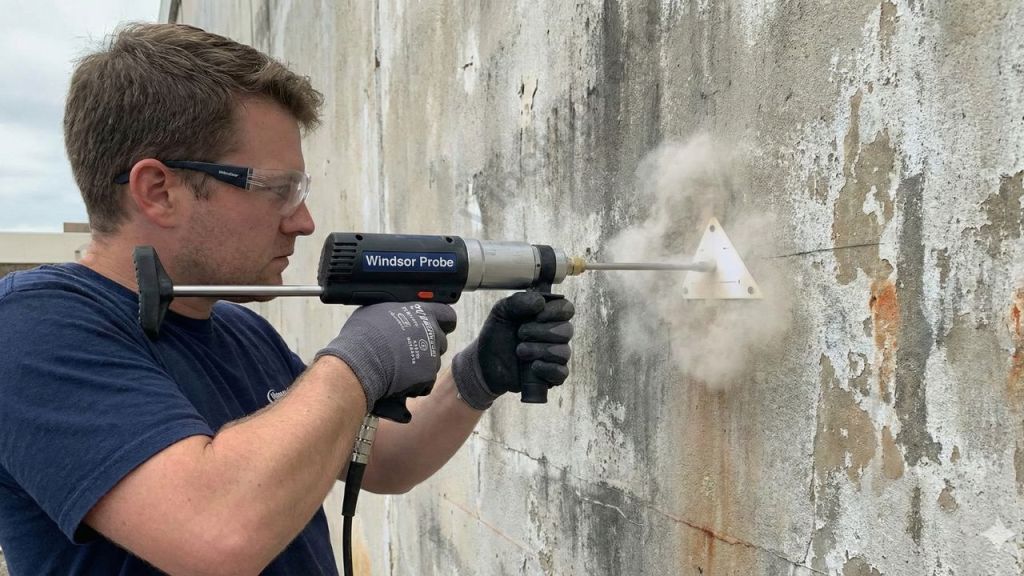
An engineer conducting a Penetration Resistance Test on a concrete wall using a gunpowder-actuated driver and probe.
An engineer conducting the Penetration Resistance Test on a concrete surface using a Windsor Probe to measure in-situ concrete strength.

The method is useful for testing concrete already in a structure. It works well on slabs, pavements, overlays, bridges, and repair areas and does not require removing samples. This method does not cause structural damage. It allows strength assessment safely and quickly on site.

Significance of Penetration Resistance Test

Engineers evaluate concrete strength using two main categories of tests:

  • Destructive Testing (DT)
  • Non-Destructive Testing (NDT).

Understanding the difference aids us in comprehending the widespread use of the Penetration Resistance Test. This test is commonly employed in modern concrete evaluation and field testing.

Destructive testing vs Non destructive testing

Destructive Testing involves casting concrete specimens at the same time as the structural concrete. Later, these specimens are tested for compressive, tensile, or flexural strength. These tests take time, and the results are not immediate. Also, the concrete specimen may not represent the real concrete in the structure because pouring conditions, curing method, compaction, and density can vary. DT also damages or destroys the sample, so it cannot be reused and does not allow repeated testing.
Non-Destructive Testing, however, measures concrete strength directly from existing structures without causing damage. NDT keeps the structure in service, allows results to be obtained immediately, and makes it possible to check strength development and deterioration over time. This makes NDT useful for bridges, slabs, pavements, repairs, and old structures.

Why Penetration test is Considered NDT ?

The Penetration Resistance Test qualifies as a non-destructive testing method. It measures surface hardness and in-situ strength. It does this by checking probe penetration depth without reducing the structural capacity. Engineers often use it with the Windsor Probe system. They rely on it to perform safe, simple, and reliable concrete assessment on site.

Types of Non Destructive tests

Penetration resistance test is a concrete non-destructive test. Nowadays Non-destructive test is conducted to determine the relative strength of the concrete. The non-destructive test is the method of evaluating the strength and durability of concrete without loading the specimen.

The main Non Destructive test are

  • Penetration Resistance Test
  • Rebound Hammer Test
  • Ultrasonic Pulse Velocity Test
  • Pullout Test and Pull-off Test
  • Concrete Core Testing or Compressive strength test

Penetration Resistance Test Procedure

The Penetration Resistance Test Procedure outlines how to assess in-situ concrete strength using a driven probe. It follows standard codes and defines equipment requirements. It provides systematic steps for accurate surface hardness evaluation.

Relevant Codes

  • ASTM C803 / C803M – Standard Test Method for Penetration Resistance of Hardened Concrete
  • ACI 228.1R – In-Place Methods to Estimate Concrete Strength
  • BS 1881 – Methods of Testing Concrete (NDT Guidance Reference)

Windsor Probe Penetration Resistance Test

The Windsor probe test is used to determine the following

  • To determine the concrete strength.
  • For evaluating the uniformity of concrete.
  • To identify deterioration in concrete. 
  • To evaluate the in-place strength.
  • For investigating the presence of cracks and flaws.

Apparatus – Windsor Probe Penetration resistance test

The equipment used for this test is called the Windsor Probe System. To begin with, it is designed to estimate in-situ concrete strength. In this method, it works by measuring the penetration depth of a hardened probe. Furthermore, the setup includes a gunpowder-actuated driver. This driver then propels the probe into the concrete surface with controlled energy.

The probe is a hardened alloy rod with a blunt conical nose. Different probes are chosen based on aggregate hardness. This ensures accurate readings and prevents corrosion. A depth gauge is used to measure the penetration length. The reading is then converted into estimated compressive strength using calibration charts.

Spacing rules must be followed during testing. There should be at least 100 mm between probes. The test point must also be 200 mm away from edges. These requirements prevent interference and ensure reliable results.

Equipment List

A collection of Penetration Resistance Test equipment, including a gunpowder-actuated driver, depth gauge, calibration chart, and various probes, arranged on a blue background.
A comprehensive equipment set for the Penetration Resistance Test, essential for assessing in-situ concrete strength.
  • Calibration chart
  • Gunpowder-actuated driver
  • Loaded cartridge
  • Hardened alloy probe
  • Depth gauge
  • Alignment and positioning guide
Penetration-resistance-test

Test Procedure for Penetration Resistance Test

  • Select the Test Area – Choose a clean, smooth concrete surface free from cracks, honeycombing, coatings, or loose material.
  • Check Edge Distance – Ensure the test point is at least 200 mm away from edges and corners to avoid weakened zones.
  • Confirm Probe Spacing – Maintain a minimum spacing of 100 mm and a maximum of 175 mm between test points to prevent overlapping influence.
  • Position the Guide Device – Place the alignment guide firmly against the surface to ensure the probe is driven perpendicular for accurate penetration.
  • Load the Cartridge – Insert the correct cartridge into the gunpowder-actuated driver according to manufacturer specifications and safety guidelines.
  • Insert the Probe – Place the hardened alloy probe into the driver barrel, ensuring proper seating.
  • Discharge the Driver – Trigger the device to drive the probe into the concrete with controlled force.
  • Measure Penetration Depth – Use the depth gauge to record penetration length precisely.
  • Repeat Readings – Take at least three penetrations in the same area and average the results.
  • Interpret Results – Compare the averaged penetration depth with the calibration chart to estimate in-situ concrete strength.

Correlate the depth of penetration with the compressive strength. If the depth of penetration is low, then the strength of concrete is high and vice versa. 

Factors Affecting Penetration Resistance Test Results

The Penetration Resistance Test results can vary due to several factors. Concrete hardness, moisture, and carbonation effects can all play a role. Incorrect probe angle or positioning also influences penetration depth and strength interpretation.

  • Material hardness
  • Moisture and carbonation
  • Test angle and positioning

Advantages and Limitations of Penetration Resistance Test

The Penetration Resistance Test offers advantages over the rebound hammer and UPV. It provides a more direct indication of concrete strength. This is related to surface hardness and penetration depth. It delivers quick on-site results and is useful for comparative evaluation. Engineers avoid using the test on weak or highly porous concrete. They also refrain from using it on lightweight or freshly cast concrete. Surfaces where aggregate hardness, carbonation, or nearby reinforcement can distort readings and reduce accuracy are also avoided.

Applications of Penetration Resistance Test in Concrete Structures

The Penetration Resistance Test is widely used for assessing concrete strength in bridges, pavements, slabs, and structural repair zones where sampling is difficult. It supports quality control checks, renovation planning, surface wear evaluation, and strength verification in existing structures. The test helps engineers identify weak spots, confirm uniformity, and monitor ageing concrete without damaging the member, making it practical for field investigation and ongoing structural performance assessment test has some limitations, this method is apt for the on-site estimation of concrete strength

Key Takeaways

  • The Penetration Resistance Test is a non-destructive method that evaluates in-situ concrete strength by measuring probe penetration depth.
  • This test is crucial in modern construction, as it provides immediate results without damaging structures, unlike destructive testing.
  • Engineers can use the Penetration Resistance Test alongside methods like the Windsor Probe Test to determine concrete strength accurately.
  • Factors such as material hardness and moisture can affect the test results, emphasising the need for careful procedure adherence.
  • Overall, the Penetration Resistance Test is practical for assessing concrete in various structures like bridges and slabs without extraction.

Conclusion

The Penetration Resistance Test is a valuable concrete strength test. It helps engineers assess in-situ strength without damaging structures. This makes it an essential part of non-destructive testing practices. Understanding what the Penetration Resistance Test is and how it relates to concrete surface hardness enables more accurate evaluation. This method is better compared to traditional destructive testing. Destructive testing requires specimens and delays results.

The Significance of Penetration Resistance Test in concrete is evident in bridges, pavements, and slabs. It is also crucial for overlays and repair assessment. Quick decisions are necessary in these areas. When performed according to the Penetration Resistance Test Procedure, the method supports reliability. It ensures quality control and aids in condition monitoring using the Windsor Probe. Despite influences like moisture, carbonation, and positioning, it remains a practical tool for field evaluation, structural performance checks, and long-term concrete assessment.

What is Tertiary Wastewater Treatment? – Top Physicochemical Methods Explained

Tertiary wastewater treatment, also known as advanced wastewater treatment, is the third step of wastewater treatment. After secondary treatment, tertiary treatment of effluent entails several extra procedures to minimise organics, turbidity, nitrogen, phosphorus, metals, and pathogens.

Tertiary Wastewater Treatment plays a crucial role in producing high-quality effluent that meets strict environmental standards. Before exploring the top physicochemical treatment methods like reverse osmosis and Electrodialysis, it is important to understand what is tertiary wastewater treatment and why it is essential.

This advanced stage goes beyond primary and secondary processes, removing fine suspended solids, nutrients, pathogens, and dissolved contaminants that conventional systems cannot eliminate. As part of modern tertiary treatment in wastewater, industries and municipalities use filtration, chemical dosing, disinfection, and membrane systems to achieve superior purity.

These processes fall under advanced wastewater treatment processes, designed to protect ecosystems and support water reuse. By learning the types of tertiary wastewater treatment, readers gain a complete picture of how physicochemical techniques ensure cleaner and safer water for diverse applications.

  1. What is Tertiary Wastewater Treatment
  2. Tertiary Waste Water Treatment Methods
  3. Common Tertiary Wastewater Treatment Methods
  4. Reverse Osmosis -Tertiary Wastewater Treatment
  5. Electrodialysis – Tertiary Wastewater Treatment
  6. Filtration
    1. Diatomaceous Earth Filtration
    2. Sand Filtration
    3. Ultrafiltration
  7. Conclusion

What is Tertiary Wastewater Treatment

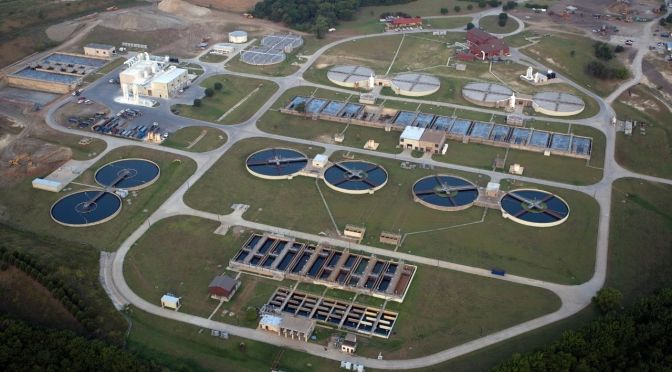
Tertiary wastewater treatment is the final and most advanced stage of the purification process. It is designed to remove contaminants that primary and secondary treatment cannot eliminate. It focuses on polishing the effluent by targeting fine suspended solids, nutrients like nitrogen and phosphorus, dissolved pollutants, and harmful microorganisms. By using filtration, chemical dosing, membrane processes, and disinfection, tertiary systems ensure the water meets strict environmental and reuse standards. Understanding what is tertiary wastewater treatment is essential because it plays a key role in protecting ecosystems, supporting industrial reuse, and ensuring a safer, cleaner water supply for communities.

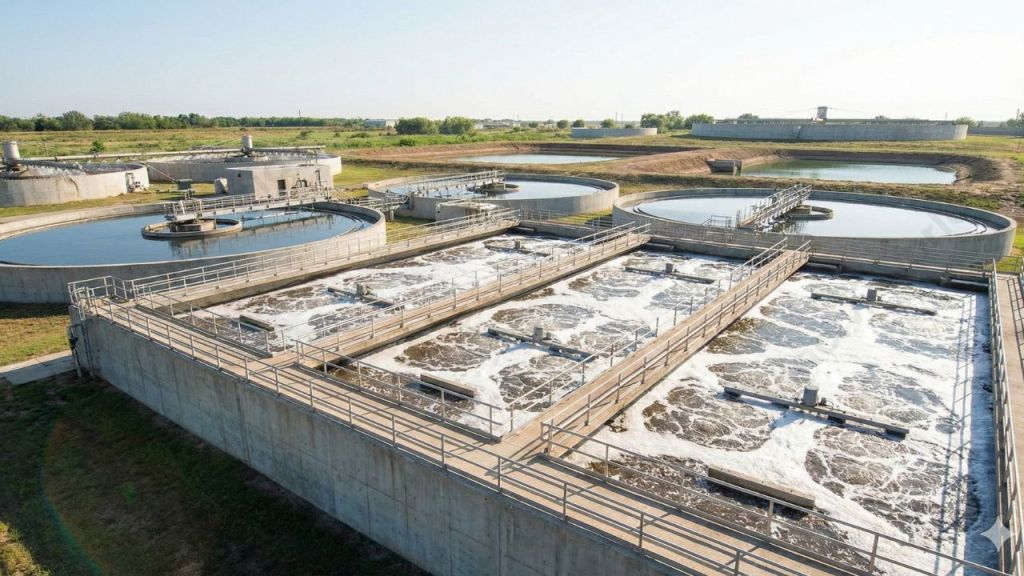
Aerial view of a large wastewater treatment facility featuring multiple circular and rectangular treatment tanks, surrounded by green fields and buildings.
Aerial view of a modern wastewater treatment facility, showcasing various stages of tertiary treatment processes.

Tertiary treatment of wastewater makes it ready for reuse. Some examples of reuse include:

  • Reclaimed water finds use in cooling systems, boiler feed, process water, and other industrial applications.
  • Reuse in agriculture, horticulture, lawn watering, golf courses, and other applications
  • Finds use in groundwater recharge to supplement groundwater resources for downstream consumers or to keep saline water out of coastal areas.

Tertiary Waste Water Treatment Methods

Tertiary wastewater treatment methods provide advanced purification beyond primary and secondary stages, ensuring high-quality effluent suitable for discharge or reuse. These methods remove fine solids, nutrients, pathogens, and dissolved contaminants using specialized physical, chemical, and membrane-based processes designed for maximum water clarity and safety.

Physicochemical methods use physical actions and chemical reactions to remove pollutants that biological treatment cannot fully eliminate, making them advanced wastewater treatment processes. These methods target fine suspended particles, dissolved solids, nutrients, heavy metals, and microorganisms by enhancing separation, adsorption, or chemical transformation. Physicochemical methods deliver precise and highly effective purification in tertiary wastewater treatment, producing high-quality effluent suitable for discharge or reuse.

Common Tertiary Wastewater Treatment Methods

Here are the common physicochemical methods used in tertiary wastewater treatment:

  • Filtration (Sand, Dual-Media, Multimedia)
  • Membrane Filtration (UF, NF, RO)
  • Activated Carbon Adsorption
  • Ion Exchange
  • Chemical Coagulation and Flocculation
  • Disinfection (Chlorination, UV, Ozone)
  • Nutrient Removal (Phosphorus & Nitrogen Removal)
  • Advanced Oxidation Processes (AOPs)
  • Constructed Wetlands
  • Electrodialysis

Reverse Osmosis -Tertiary Wastewater Treatment

Reverse Osmosis produces demineralized water by forcing water through semipermeable membranes at high pressure. We apply a pressure greater than the osmotic pressure across a membrane that separates a concentrated solution and a dilute phase.

A close-up view of a reverse osmosis system used in tertiary wastewater treatment, featuring multiple membrane modules arranged in rows on a blue support structure, alongside various connecting pipes.
Reverse Osmosis unit for advanced wastewater treatment, showcasing a structured layout of membrane modules designed for efficient purification.

This drives the solvent or water toward the dilute phase, making solute or impurity concentration rise on one side while pure water moves through the membrane. In Tertiary Wastewater Treatment, this method is widely used because it ensures high-quality purification. The Reverse Osmosis process requires pressures of about 4000 to 7000 kN/m² to achieve sufficient solvent flux.

The most crucial element is the permeable membrane, typically made from cellulose acetate, formamide, and magnesium perchlorate. These membranes need large surface areas for effective treatment. To optimize space, membrane modules are preferred over single sheets. This is especially true in advanced systems used for Tertiary Wastewater Treatment.

Reverse osmosis finds applications in the following:

  • Separation of toxic ions from plating wastes.
  • Desalting seawater to produce drinking water.
  • Concentration of radioactive wastes.
  • Removal of organics from vegetable and animal wastes.
How Reverse Osmosis in Tertiary Wastewater Treatment Works? Credits ESP Water Products
How Reverse Osmosis Works? Credits ESP Water Products

Electrodialysis – Tertiary Wastewater Treatment

Electrodialysis is another popular tertiary wastewater treatment method that employs the removal of the solute from the solution instead of removing the solvent. This process uses selectively permeable membranes and an electric potential difference to separate ions from a solution. The electric power required depends on the number of ions removed from the water.

An electrodialysis cell contains anionic and cationic membranes arranged alternately, creating multiple compartments between electrodes placed at each end. When an electric voltage is applied, anions migrate toward the positive electrode and cations move toward the negative electrode. As a result, solutions in alternating compartments become dilute while others become more concentrated. Once the process reaches the desired degree of separation, the system removes the solutions. This selective ion removal makes electrodialysis an effective option in tertiary wastewater treatment, especially when precise control over dissolved salts is needed.

Filtration

Tertiary treatment removes total suspended solids (TSS). It eliminates the fine particles left after the secondary clarifying process. Proper pretreatment is essential before filtration. The concentration of suspended particles in the influent must be below 100 mg/l. This ensures efficient filtration.

Three professionals inspecting a reverse osmosis system in a wastewater treatment facility.
Industry professionals assessing a reverse osmosis system used in tertiary wastewater treatment.

The most common filtration methods include diatomaceous earth filtration and pressure filtration. Sand filtration is used with standard and multimedia units. Ultrafiltration and the moving-bed filter are also common. All these systems work by physically straining finely separated particles. Filtration is a key step in tertiary wastewater treatment.

Diatomaceous Earth Filtration

Diatomaceous Earth

Diatomaceous earth filtration is a type of mechanical separation that involves filtering wastewater with diatomaceous earth, a powdered filter aid, on a supporting media. As the filtration progresses, the solid material that will not pass through the diatomaceous earth accumulates on the filter. Eventually, this builds up pressure that prevents filtration. After that, we backwash the filter and remove the accumulated material to prepare it for the next round of filtration.

Sand Filtration

The standard method of filtration uses sandbeds with graded sand. The sand is placed on a supporting medium. An underdrain collects the filtered effluent. Solids will build up and eventually block the holes as wastewater containing solids passes through this type of filter. This results in excessive head loss and/or poor effluent quality. As a result, sand filtration demands some provisions for the removal of the accumulated material. Backwashing the sand, or reversing the flow with air scour, helps to keep the sand in suspension while washing away the lighter material.

Ultrafiltration

Ultrafiltration (UF) is a widely used tertiary wastewater treatment method that purifies water by forcing it through a semipermeable membrane. In this process, water and low-molecular-weight solutes pass to the permeate side, while suspended particles and larger solutes stay on the retentate side. As one of the most reliable physicochemical treatment methods, UF removes most organic compounds, viruses, and many dissolved salts. People highly prefer it because it delivers consistent water quality regardless of the source, occupies minimal space, and eliminates 90–100% of pathogens. Moreover, ultrafiltration supports advanced purification without chemicals, except during membrane cleaning. Compared to other types of tertiary wastewater treatment, UF operates at much lower pressures—around 50 psi—while reverse osmosis often requires pressures above 500 psi, making UF energy-efficient and cost-effective.

A close-up view of advanced wastewater treatment equipment featuring pipes and membranes, essential for processes like reverse osmosis and ultrafiltration.
Advanced membrane filtration systems used in tertiary wastewater treatment for enhanced purification.

Shall we wrap up?

Key Takeaways

  • Tertiary Wastewater Treatment is the final stage of purification, targeting contaminants that earlier processes cannot remove.
  • It uses methods like filtration, chemical dosing, disinfection, and membrane processes to ensure high-quality effluent.
  • Common techniques include sand filtration, reverse osmosis, and ultrafiltration, which enhance water treatment efficacy.
  • This stage supports water reuse in agriculture, industry, and groundwater recharge, protecting ecosystems and public health.
  • Understanding Tertiary Wastewater Treatment is crucial for achieving environmental compliance and safe water supplies.

Conclusion

Tertiary wastewater treatment plays a crucial role in producing high-quality effluent suitable for discharge or reuse. In this blog, we briefly explored advanced methods such as reverse osmosis, electrodialysis, ultrafiltration, and other physicochemical techniques that provide superior purification compared to primary and secondary stages. Each method has its own advantages, and depending on the final application—whether irrigation, industrial reuse, or safe release into natural water bodies—engineers may choose a single technique or a combination of multiple processes. These tertiary wastewater treatment methods help remove fine solids, nutrients, pathogens, and dissolved contaminants, ensuring strict environmental standards are met. Ultimately, tertiary treatment strengthens water sustainability by delivering cleaner, safer, and more reliable treated water for diverse needs.

Tunnel Engineering- Definition,Study Modules Guide

Tunnel Engineering plays a vital role in modern infrastructure by enabling safe and efficient passage through mountains, urban areas, and underwater regions. This field focuses on planning, designing, and constructing tunnels using advanced methods and technologies. A clear Tunnel Engineering Definition helps students and professionals understand its scope. Structured Tunnel Engineering Study Modules guide learners through essential topics like geology, excavation methods, support systems, and safety practices. Understanding the Basics of Tunnel Engineering is essential. It helps build a strong foundation for exploring innovative Tunnel Construction Techniques used in today’s complex projects. This article serves as an Introduction to Tunnel Engineering. It offers an easy-to-follow study path. This is for anyone interested in mastering this specialized branch of civil engineering.

There is much more to know about the amazing sector. Needless to say, no tiny virus can be a reason to prevent us from transporting for essential purposes. Therefore, the career opportunities are always out there for you.

In this blog, I will walk you through the basics of tunnel engineering. I will explain the works done by a tunnel engineer. I will also cover fundamental details about tunnels. And finally the advantages and disadvantages of tunnels. 

Let’s jump into it right away!

  1. What are tunnels in tunnel engineering? 
  2. Tunnel engineering basics and Definition
    1. Definition/Introduction of Tunnel Engineering
    2. Basics of Tunnel Engineering
    3. Modules
  3. What does a Tunnelling Engineer do?
  4. Tunnel Construction Techniques
  5. Advantages of Tunneling
  6. Tunneling Disadvantages
  7. Conclusion

What are tunnels in tunnel engineering? 

  • A tunnel is an underground corridor built through the surrounding soil/earth/rock and completely enclosed except for the entrance and exit points, which are usually at each end. 
  • Some contemporary tunnels have used immersed tube construction techniques. These techniques differ from classic tunnel boring methods. However, a pipeline is not a tunnel.
  • A tunnel can be used for pedestrian or vehicular traffic, rail traffic, or a canal.
  • The tunnel is usually where the key parts of a rapid transit network are located. 
  • Some tunnels are aqueducts that transport water for human consumption or hydroelectric power plants, while others are sewers. 
  • Utility tunnels are used to transport steam, chilled water, electrical power, and communications cables. They also connect buildings to allow people and equipment to move about more easily. 
  • Military tunnels are constructed to smuggle weapons, contraband, and people. In contrast, civilian tunnels are built for the same purpose, smuggling weapons, contraband, and people. 
  • Wildlife crossing tunnels, for example, are created to assist wildlife to safely cross human-made barriers.
Interior view of a modern tunnel featuring curved walls, bright lighting, and a smooth asphalt road surface.
Interior view of a modern tunnel showcasing advanced design and lighting features.

Cool. Time to know about the basics of tunnel engineering.

Tunnel engineering basics and Definition

Tunnel Engineering involves the planning, design, and construction of underground passages. This section introduces its definition and covers the fundamental basics that shape safe and efficient tunnel development.

A dark tunnel leading to a bright exit with stairs at the end, illuminated by lights along the walls.
A dimly lit underground tunnel leading to bright stairs, exemplifying essential elements of tunnel engineering.

Definition/Introduction of Tunnel Engineering

Tunnel engineering is a truly interdisciplinary field. It requires knowledge and abilities from civil, geological, and mining engineering. It also involves mechanical and electrical engineering, geophysics, geology, and other disciplines. Tunnel Engineering is a specialized branch of civil engineering. It focuses on designing and planning underground passages. It also involves constructing these passages for transportation, utilities, and water conveyance. It involves understanding geology, selecting excavation methods, ensuring structural stability, and applying safety measures. The goal of tunnel engineering is to create durable, efficient, and safe tunnels that meet functional demands while minimizing environmental and construction risks.

Basics of Tunnel Engineering

Basics of Tunnel Engineering cover the fundamental principles needed to design and build safe underground structures. These basics include understanding geology, selecting suitable excavation methods, choosing support systems, and applying modern Tunnel Construction Techniques. Together with a clear Tunnel Engineering Definition, learners can follow structured Tunnel Engineering Study Modules to build strong technical knowledge. These essentials form the core of any Introduction to Tunnel Engineering, ensuring reliable and efficient tunnel development.

Modules

The main modules involved in the course are,

  • General Tunneling Aspects
  • Engineering Geology (stresses, strains, and anisotropy)
  • Engineering Rock Mechanics
  • Soil Mechanics & Geotechnical Engineering, Investigations
  • Using Rock and Soil Mechanics
  • Analytical and Numerical Methods for Diagnosis Phase; Therapy Phase for Preliminary Confinement
  • Type A tunnels: Analytical
  • Methods of Analysis and Design
  • Type A Tunnels: Excavation in Rock
  • Therapy Phase and Construction Phase for Preconfinement (Type B & C Tunnels) and Final Lining
  • Mechanized Tunneling with Face Control for Type B and C Tunnels
  • Monitoring and Surveying
  • Risk Assessment & Management

Now you might be thinking about what exactly you will be doing after being an engineer. Here we go.

What does a Tunnelling Engineer do?

Tunnel engineers are highly qualified civil engineers who are in charge of designing and managing tunnelling projects. From the original design stages through the day the first automobile or train travels through, they are involved in every step of the tunnel construction process. 

Aerial view of a tunnel construction site, showing excavation work and heavy machinery around a partially completed tunnel entrance.
An aerial view of a tunnel construction site, showcasing heavy machinery and excavated earth, illustrating the complexities of tunnel engineering.

Tunnel building can be done in a variety of ways, each needing specialised expertise and equipment. Bored tunnels with Tunnel Boring Machines (TBMs), sprayed concrete lined tunnels, tunnels built with explosives, and tunnels built by pipejacking, piperamming, or thrustboring are examples of these procedures.

Tunnel Construction Techniques

Tunnel Construction Techniques involve methods used to excavate and support tunnels safely and efficiently. These techniques are selected based on geology, tunnel size, and project requirements. They ensure stability, speed, and cost-effectiveness during construction while minimizing risks. Cut and Cover Method

  • Drill and Blast Method
  • Cut and Cover Method
  • Bored Tunnelling (TBM Method)
  • New Austrian Tunneling Method (NATM)
  • Immersed Tube Method
  • Sequential Excavation Method (SEM)
A tunnel boring machine operating in a large underground tunnel, with engineers overseeing the process from various platforms.
A tunnel boring machine (TBM) in action, showcasing advanced technology used in tunnel construction.

Advantages of Tunneling

When compared to other approaches, the tunnelling method has a few advantages, which are listed below: 

  • When the depth exceeds a certain limit, the tunnelling approach is more cost effective than the open cut trench method. 
  • When tunnelling takes place, there is no disruption to surface life or ground activities such as transportation. 
  • The approach provides high-speed building while consuming minimal power. 
  • Noise Pollution is Reduced 
  • In high-altitude settings, these approaches are devoid of snow and iceberg risks. 
  • Tunnels are subject to restrictions on surface and air interference. 
  • The provision of tunnels with gentle gradients aids in the reduction of hauling costs.
  • When it comes to public utility transit, tunnelling offers a significant advantage over bridges. 
  • When a dangerous open cut to a nearby structure is required, the tunnelling approach is used to solve the problem. 
  • In aerial warfare and bombing situations, the tunnelling provides more protection.
A perspective view of a long, dark tunnel with a bright light at the end, illustrating the concept of tunnel engineering.
A dimly lit tunnel leading towards a bright exit, symbolizing the journey through tunnel engineering from darkness to clarity.

How about the disadvantages? It’s waiting for you in the next section.

Tunneling Disadvantages

Because of its complexity and difficulty, the tunnelling approach has some drawbacks. Here are a few examples: 

  • When compared to the open cut method, the initial investment cost for starting the tunnel is significant. 
  • Only a team of highly competent and experienced designers and engineers will be able to complete this procedure. 
  • You need to maintain higher and continuous supervision from the beginning to the finish of the tunnelling project, with no compromises. 
  • Tunneling activities necessitate the use of very sophisticated and specialised equipment.

That’s it about tunnel engineering and the basics of tunneling. Do you have any more doubts regarding the topic? Let us know in the comments. 

Key Takeaways

  • Tunnel engineering is crucial for modern infrastructure, facilitating safe passage through various terrains.
  • The field combines aspects of civil, geological, and mining engineering and includes study modules on geology, excavation, and safety practices.
  • Tunnel engineers oversee the design and construction process, utilising various methods such as TBMs and explosives.
  • While tunneling is cost-effective for deep projects and reduces disruption, it also requires high initial investment and skilled supervision.
  • Understanding both the advantages and disadvantages of tunneling helps in making informed engineering decisions in tunnel engineering.

Conclusion

Tunnel Engineering plays a crucial role in shaping modern transportation and utility networks by enabling construction beneath mountains, cities, and waterways. Understanding the Tunnel Engineering Definition helps readers appreciate how this field blends geology, structural design, and safety planning. The Basics of Tunnel Engineering further highlight the importance of ground behavior, support systems, and proper excavation choices. Through well-organized Tunnel Engineering Study Modules, learners can explore each concept step by step and build strong technical competence. Additionally, familiarizing themselves with various Tunnel Construction Techniques allows engineers to select the most suitable method for each project. This Introduction to Tunnel Engineering concludes by emphasizing that mastering these core principles ensures the creation of durable, economical, and safe tunnels for future infrastructure needs.

Land Pollution Effects – Top 7 Effects Explained

Land pollution causes and effects are becoming a major global concern as they directly influence ecosystems, human health, and natural resources. The impacts of land pollution can be seen in declining soil fertility, loss of biodiversity, and contamination of water sources. Moreover, the soil contamination consequences of land pollution extend to food insecurity, habitat destruction, and long-term environmental instability. These effects of soil pollution are worsened by rapid industrialization, urban waste generation, and unsustainable land-use practices. As a result, the outcomes of land contamination now threaten the survival of humans and animals alike, disrupting ecological balance and reducing land productivity. The results of land degradation also lead to toxic exposure, reduced agricultural output, and weakened ecosystem resilience. Understanding these environmental effects of land pollution is essential for adopting better waste management, pollution control, and conservation measures to protect our land for future generations.

n the previous blog, we had seen an overview of the effects and causes of land pollution. In this blog, I will show you the effects of land pollution in detail and how it drastically affects the entire ecosystem and threatens the survival of our planet.

  1. Causes and effects of land pollution
    1. Soil contamination consequence
    2. Poisoning of groundwater
    3. Drinking-Water shortage
    4. Land pollution and human health
    5. Habitat Loss
    6. Air Pollution
    7. Negative Impact on Tourism Industry
  2. Conclusion

Causes and effects of land pollution

Land pollution is the degradation of the Earth’s land surface due to the accumulation of toxic substances harmful to both man and the ecosystem. The effects of land pollution don’t limit to soil pollution but have serious biological, ergonomic and economic consequences. Let’s have a look at the disastrous effects of land pollution.

A desolate landscape showing barren ground with cracked earth and dead trees, shrouded in a misty atmosphere, indicating severe environmental degradation.
A barren landscape affected by land pollution, showcasing cracked earth and dead vegetation, emphasizing the severe consequences of soil degradation.

Soil contamination consequence

Soil contamination consequence is a major environmental concern that affects the health and productivity of land. It occurs when harmful chemicals or pollutants alter the natural nutrient balance of topsoil. The soil contamination consequence becomes severe when excessive chemical fertilisers, uncontrolled soil erosion, and aggressive pest control methods degrade soil quality. Over time, the soil contamination consequence leads to reduced agricultural productivity, loss of forest cover, and declining pasturelands. This degradation ultimately threatens food security, biodiversity, and long-term land sustainability.

According to the World Wildlife Fund, half of the world’s topsoil has been destroyed in the previous 150 years. For 2.5 millimetres of topsoil, the regeneration process takes at least 500 years. Now you can imagine the magnitude of the crisis that we are undergoing.

Desolate landscape showing dead trees and barren soil under a cloudy sky, illustrating the severe impacts of land pollution.
Devastated landscape illustrating the severe consequences of land pollution, highlighting barren soil and dead vegetation.

According to the United Nations’ Food and Agriculture Organization (FAO), excessive use of chemical fertilisers and pesticides destroys essential soil microbes. Destruction of these microbes results in diminishing biodiversity and has disastrous repercussions for soil health. Microorganisms are required for several processes that contribute to soil fertility, including:

  • Nutrient cycling, through which microbes convert nutrients into forms that crops can utilise.
  • Microorganisms degrade hazardous substances that are by-products of agrochemicals, thereby reducing soil contamination. If there aren’t any microbes in the soil, it can drastically reduce its fertility.

Also read: What are Water Pollutants? – Definition, Sources and Types

Poisoning of groundwater

When we inappropriately dispose of hazardous chemicals and other wastes on land or in illegal landfills, the chemicals may eventually seep into the groundwater system. This procedure is known as leaching. It can occur on farms, industrial sites, and landfills, posing a health risk to animals, plants, and humans.

A close-up view of a crack in the ground, through which bright blue liquid is visible, contrasting against the dark soil.
A close-up of polluted land showing toxic runoff seeping into the soil, highlighting the effects of land pollution.

Nutrient pollution, which arises due to farm runoff of chemical fertilisers is a subset of land pollution. The resulting nutrient enrichment of water bodies leads to eutrophication. When humans consume this contaminated water it leads to a variety of health issues. Even in little amounts, increased nitrate levels in water from fertiliser residues can be detrimental to newborns causing Blue Baby Syndrome.

The poisoning of groundwater which is a major source of drinking water for humans creates the worst consequence of land pollution, that is drinking water shortage. Let’s move on to it.

Drinking-Water shortage

Land pollution has the potential to spread in all directions, causing harm to the surrounding ecosystem. It can contaminate water and drastically impair its quality. Surface rainwater runoff carries chemicals and other harmful substances from landfills and solid wastes into rivers and makes the water unfit for human consumption.

Simultaneously, leaching occurs, allowing harmful metals and compounds to penetrate aquifers and water tables. Furthermore, contaminated water evaporates and condenses as precipitation along with the contaminants, perpetuating the pollution and aggravating the drinking water shortage.

Also read: Water Pollution – Effects and Causes

Land pollution and human health

Land pollution and human health are closely connected, as contaminated soil and waste exposure can lead to serious illnesses and long-term health risks. The effects of land pollution and human health include respiratory issues, skin diseases, neurological problems, and increased vulnerability to toxic chemicals in our environment.

Many parts of the world, particularly developing countries and slum areas, have massive amounts of rubbish piled up in the streets. This increases the contact of garbage with humans and the food we consume. These wastes contain hazardous chemicals, insecticides, and metals all of which are harmful to humans.

A large pile of compressed plastic waste and discarded materials in an industrial area, with buildings and greenery in the background.
Piles of plastic waste in a landfill, highlighting the serious issue of land pollution and its impact on the environment.

Plastic garbage contains chemicals like acrylic, polyvinyl chloride, polycarbonate, and phthalates. They have the potential to cause cancer, skin ailments, respiratory problems, and birth defects in pregnant people. Upon burning plastics in landfills, these chemicals escape into the air and pollute the air. In some other cases, they seep into water bodies. Ultimately, they reach the human body and damage the internal organs.

Chemical components contained in pharmaceuticals, pesticides and fertilisers, industrial wastes, such as cadmium, asbestos, mercury, cyanide, arsenic, and chromium, have severe impacts on human health. They are carcinogenic and can also cause lung, kidney, and liver damage.

According to a 2015 scientific study, “cancer villages” in China are connected to locations where farming takes place on land poisoned by the overuse of chemical pesticides and other heavy metals. Arsenic, asbestos, and dioxins are the main cause of cancer in Europe. Poisoning by lead and arsenic induce neurological damage and lower the IQ.

Habitat Loss

Wildlife creatures have suffered greatly in recent decades as a result of the continuous threats to their natural habitat and surroundings. Human commercial activities on land have gradually damaged and ruined the environment, forcing wildlife to migrate further away and adapt to new environments. As a result, some species have died while attempting to adapt, some have become extinct. And, others are on the verge of becoming extinct.

A deer stands on a grassy area with its back to the camera, while a littered landscape filled with plastic waste is visible in the background, highlighting the impact of land pollution on wildlife.
A deer stands amidst a backdrop of land pollution, highlighting the impact of habitat loss and environmental degradation on wildlife.

Air Pollution

Landfills and dump sites emit foul odours and stenches in the locations where they are located. Residents in cities and towns near large dump sites and landfill areas have reported excessive levels of a noxious odour. Aside from the unpleasant odour, landfills are constantly burning, contributing to air pollution.

Negative Impact on Tourism Industry

Landfills and abandoned waste disposal within cities generally create a negative picture of the population and the city’s governance. Landfills and garbage sites also degrade air quality and may pose a health risk to humans. As a result, it causes a city to lose its tourist appeal. This results in a loss of tourism revenue for the government.

Aerial view of a devastated urban area with piles of debris and damaged buildings, surrounded by greenery and high-rise structures in the background.
Aerial view of a devastated urban area, highlighting the impact of land pollution and industrial waste accumulation.

Shall we wrap up?

Key Takeaways

  • Land pollution has severe effects on ecosystems, animal, and human health due to toxic substances and industrial activities.
  • Soil pollution reduces fertility and biodiversity, risking food production and disrupting essential microbial processes.
  • Contaminated groundwater poses health risks, particularly through leaching of hazardous chemicals and agricultural runoff.
  • Land pollution leads to water shortages, as harmful substances impair drinking water quality and availability.
  • Ultimately, land pollution harms tourism and habitats, damaging local economies and threatening wildlife survival.

Conclusion

Land pollution effects create long-term damage that is often irreversible, especially when chemical residues cause soil contamination consequences that spread through land degradation from pollution. Once hazardous compounds enter the ground, the effects of land pollution on soil and groundwater intensify, posing serious land pollution and human health risks. Because the causes and effects of land pollution are interconnected, prevention remains the most effective solution. Increasing recycling, reducing misuse of land, and improving waste handling can limit further soil contamination consequences. Community cleanups and environmentally responsible practices also help control land degradation from pollution. By acting early and consistently, we can reduce the effects of land pollution on soil and protect both ecosystems and human health.

Updates in civil engineering, architecture finishes, building construction, Environmental Engineering