Category Archives: civil engineering

Types of Levelling in Surveying – Uses and advantages

Types of levelling in surveying include direct levelling, trigonometric levelling, barometric levelling, and stadia levelling. Direct levelling is the most commonly used method. It involves using a level and staff to determine height differences between points. Trigonometric levelling uses angles and distances measured with a theodolite. Barometric levelling relies on atmospheric pressure readings, while stadia levelling involves using a telescopic instrument to measure distance. Each method serves different applications based on the project requirements. Levelling surveying ensures accurate elevation data for construction, roadworks, and drainage systems. The advantages of levelling include precise ground profiling, improved accuracy in projects, and efficient data collection. Define levelling as a key technique for enhancing surveying reliability.

Types of levelling – Leveling is a branch of surveying that deals with computing and determining the relative heights between different points with respect to the datum. The purpose of leveling is for determining the elevation of a point and establishing the same at a given elevation. Moreover leveling deals with the computation of measurements in the vertical plane. There are different types of leveling in Surveying. In this article, we will discuss the purpose advantage and types of leveling.

  1. Purpose of levelling in Surveying
  2. Types of levelling
    1. Barometric levelling – Types of levelling
    2. Trigonometric levelling – Types of levelling
    3. Stadia levelling – Types of levelling
    4. Direct levelling
      1. Simple levelling
      2. Differential levelling
      3. Profile levelling
      4. Reciprocal levelling
      5. Precise levelling
  3. Key Takeaways: Types of Levelling in Surveying
  4. Conclusion

Purpose of levelling in Surveying

The purpose of levelling in surveying is to determine the relative height of different points on the earth’s surface. Levelling ensures accurate measurements of elevations, helping in the design and construction of roads, buildings, and drainage systems.

  • Mapping and contouring : Preparation of accurate map layouts with elevation details.
  • Establishing Elevations : To decide the elevation of points by establishing the height differences between points.
  • To prepare contour maps.
  • Earth work : Determination of depth of cutting and filling in earthworks.
  • To make the cross-section of canals, roads, etc.
  • For establishing control points.
  • Water Flow control : Ensures proper Drainage and irrigation
  • Building Layout – Facilitates precise alignment for construction.

By understanding the types of levelling in surveying, professionals achieve greater accuracy in infrastructure projects. This enhances the advantages of levelling techniques.

Types of levelling

Types of Levelling in Surveying are crucial for determining accurate elevation differences. Different methods cater to varying project needs, enhancing the advantages of levelling.Each method has distinct advantages, making levelling surveying versatile in engineering and construction projects.

There are mainly four types of levelling in surveying. 

  • Barometric levelling
  • Trigonometric levelling
  • Stadia levelling
  • Spirit levelling or Direct levelling

Each method has distinct advantages, making levelling surveying versatile in engineering and construction projects.

Barometric levelling – Types of levelling

Barometric leveling is a type of leveling. The measurement of elevation is based on atmospheric pressure by using a barometer. Therefore, we use a barometer. The main principle of Barometric leveling is the difference between the elevation of two points. This difference is proportional to the difference between the atmospheric pressure of the points. Since it is inaccurate, this method of leveling is rarely used. Because leveling takes time and the atmospheric pressure does not remain constant throughout the day. Therefore they give only a rough estimation.

Though not as precise as other types of levelling like differential levelling, it is useful for rough elevation measurements. This method is effective over large distances where accuracy is not critical.

The advantages of levelling using the barometric method include its simplicity and cost-effectiveness for non-critical tasks. It complements various methods of levelling in broad-scale levelling surveying projects.

Trigonometric levelling – Types of levelling

Trigonometric levelling is a method used in levelling in surveying to calculate the elevation. In this method, the difference in elevation is calculated using the observed vertical angle. The calculation also involves the known horizontal distance. The height difference is then calculated using trigonometric formulas. Another name of trigonometric levelling is Indirect levelling. For vertical angles, generally, we use theodolite. For horizontal distance, if the distance between the points is less, we measure using plane surveying. If the distance between the points is greater, we use geodetic observation. 

Among the various types of levelling in surveying, trigonometric levelling is particularly useful for long-distance or high-elevation measurements. The advantages of levelling with this method include its ability to handle rough terrain and large-scale surveys. It complements other methods of levelling for projects where precision is critical.

trigonometric levelling

Stadia levelling – Types of levelling

Stadia levelling is similar to trigonometric levelling. To determine the elevation of points, we use a tacheometer. Hence, It is an optical distance measurement method. This type of levelling is suitable in hilly regions. Stadia levelling is an accurate method of levelling. Another name of stadia levelling is Tachometric levelling. It is efficient for surveying in areas where direct measurement is difficult. The advantages of levelling with stadia include its simplicity and speed. It’s often used in combination with other methods of levelling for topographic mapping and large area surveys.

Direct levelling

Direct levelling is also known as spirit levelling. It is the most precise and commonly used levelling method. In this method, the vertical distance is taken with respect to the horizontal line. This determines the relative position between the points. The instruments which are used in Direct levelling are level and a levelling staff. The level consists of a telescope, level tube, levelling head and a tripod.

It is the most accurate among the types of levelling in surveying. It is commonly used in construction and land surveys.

The advantages of levelling using the direct method include high accuracy and simplicity in application. It’s widely used for detailed work. It also serves as a basis for more complex methods of levelling like trigonometric or barometric levelling.

Direct levelling is further divided into …

  • Simple levelling
  • Differential levelling
  • Profile levelling
  • Reciprocal levelling
  • Precise levelling

Simple levelling

It is the simplest method of levelling. In this method, we place the levelling instrument between the points for determining elevation. This type of levelling is suitable if the distance between the points is less. 

simple levelling
simple levelling

Differential levelling

Differential levelling is suitable in places where the distance between the points are great. This type of levelling is also known as fly levelling. In differential levelling, the levelling station is shifted various times. 

Differential levelling

Profile levelling

Another name of profile levelling is longitudinal levelling or sectioning. In this type of levelling, the points are far apart at known distances. So levelling is done at intervals along the given line. It is suitable for roads, canals, sewer lines, railways, etc. 

profile levelling
profile levelling

Reciprocal levelling

This type of levelling is done, when it is not possible to set up the level between two points. It is the accurate method of levelling. It is suitable in the place where ponds, rivers are seen. 

reciprocal levelling

Precise levelling

This types of levelling have high precision. It is similar to differential levelling. In precise surveying, special equipment and special precaution are taken to eliminate errors. 

Key Takeaways: Types of Levelling in Surveying

Understanding the types of levelling in surveying is essential for accurate elevation measurements in various engineering and construction projects. The main methods include direct levelling, trigonometric levelling, barometric levelling, and stadia levelling.

  1. Direct Levelling (or spirit levelling) is the most precise method, utilizing a level and staff to determine height differences.
  2. Trigonometric Levelling calculates elevation based on angles and distances, making it suitable for long distances and rough terrain.
  3. Barometric Levelling measures elevation through atmospheric pressure differences, though it is less accurate and primarily used for rough estimates.
  4. Stadia Levelling employs a tacheometer for distance measurement, excelling in hilly regions where direct measurement is challenging.

Each type offers distinct advantages, ensuring accurate mapping, earthwork planning, and construction alignment. By selecting the appropriate method, surveyors enhance project reliability and efficiency.

Conclusion

In conclusion, understanding the various types of levelling in surveying is crucial for achieving precision in elevation measurements. These measurements are fundamental to successful engineering and construction projects. Each method—direct levelling, trigonometric levelling, barometric levelling, and stadia levelling—serves specific applications and offers unique advantages. Direct levelling stands out for its accuracy, making it ideal for detailed work. Trigonometric and stadia levelling are invaluable for long distances and challenging terrains. Barometric levelling, although less precise, provides a quick solution for rough estimations over large areas. By employing the right levelling technique, surveyors can enhance the quality and reliability of their data. This leads to improved decision-making in design and construction processes. As infrastructure demands grow, we must leverage the strengths of each levelling type. This will be essential for optimizing project outcomes. It will also ensure that construction aligns with planned specifications and environmental considerations.


Types of beams – Top beam types explained

Types of beams popularly used In construction and engineering are classified based on their shape, the way they are supported, their structural behaviour etc. The beam is a horizontal or sloping structural member that supports a load and resists bending.In construction, beams are essential components that support loads and provide structural stability. This article explores the types of beams used in various applications, focusing on types of beam in building construction.We’ll cover what are the 4 types of beams, which are widely used in both residential and commercial projects. Additionally, we’ll discuss types of beams and support systems to understand how these beams interact with other structural elements. We’ll also examine different types of beams and their specific characteristics, along with popular beam types in modern construction. By the end, you’ll have a clear understanding of various type beams and their practical uses.

Beams are typically made from materials such as wood, steel, or concrete. They support floors, roofs, and walls. They also bridge gaps between supports. The type of beam used depends on factors such as the load to be supported, the span length, and the structural design of the building or structure. Beams can come in a variety of shapes, including rectangular, square, circular, and I-shaped. Proper selection and installation of beams are critical for ensuring the stability, safety, and durability of a structure.

This article is about the different types of beams popularly used in civil engineering and construction.

  1. Classification of beam types
    1. Types of beams based on the shape
      1. Rectangular beam
      2. Square beam
      3. Circular beam
      4. I-shaped (H-beam)
      5. T-shaped beam
      6. L-shaped beam
  2. Types of beams based on support conditions
    1. Simply supported beams
    2. Fixed beams
    3. Cantilever beams
    4. Continuous beams
    5. Overhanging beam
  3. Types of beams based on structural behaviour
  4. Types of beams based on materials used
    1. Timber beam
    2. Steel beam
    3. Concrete beam
    4. Composite beam
  5. Key Takeaways
  6. Conclusion

Classification of beam types

Types of Beams can be classified based on several factors, including their shape, the way they are supported, and their structural behaviour. Here are some common classifications of beams.

Beams are vital components in construction, and understanding the different types of beams is essential for choosing the right structure. So, what are the 4 types of beams? Beams can be categorized in various ways. Beam types based on shape include rectangular, I-beams, and T-beams. Type beams are also defined by their support conditions, such as simply supported and cantilever beams. What are the 4 types of beams based on structural behavior? These include flexural, axial, shear, and torsional beams. Additionally, the types of beams in building construction are often selected by material, including concrete, steel, and wood beams. Understanding the types of beams and support ensures optimal performance in construction.

Related posts from vincivilworld

  • Types of beams Based on the shape

Beams can be classified as rectangular, square, circular, I-shaped (also known as H-beam), T-shaped, and L-shaped.

  • Types of beams Based on support conditions

Beams can be classified as simply supported, fixed, cantilever, continuous, and overhanging.

  • Types of beams Based on structural behaviour

Beams can be classified as determinate or indeterminate. Determinate beams have a fixed number of supports and can be analysed using statics. Indeterminate beams have more supports than are needed for stability and require more advanced analysis techniques to determine their behaviour.

  • Types of beams Based on the material

Beams can also be classified based on the material used, such as wood, steel, or concrete.

The choice of beam type depends on the load to be supported, the span length, and the structural design of the building or structure.

Types of beams based on the shape

Beams can be classified based on their shape, which refers to the cross-sectional profile of the beam. The shape of the beam affects its structural properties, such as its strength, stiffness, and weight. Here are some common shapes of beams.

Rectangular beam

A rectangular beam is a type of beam that has a rectangular cross-section. It is a simple and commonly used beam in construction due to its ease of fabrication and ability to support both bending and compression loads. Rectangular beams are typically made from materials such as wood, steel, or concrete.

Square beam

A square beam is a type of beam that has a square cross-section. It is commonly used in applications where a symmetric load is expected, and it provides uniform support in all directions. Square beams are typically made from materials such as wood, steel, or aluminium and are used in construction, manufacturing, and other engineering applications.

Circular beam

A circular beam is a type of beam that has a circular cross-section. It is commonly used in applications where torsion is a concern, such as in helicopter blades and wind turbines. Circular beams provide strength and stability in all directions and are typically made from materials such as steel, aluminium, or composite materials.

I-shaped (H-beam)

An I-shaped beam, also known as an H-beam, is a type of beam that has an I-shaped cross-section. It is commonly used in construction because of its high strength-to-weight ratio and ability to support large loads. I-shaped beams are typically made from steel. They are used in a variety of applications, such as bridges, buildings, and other infrastructure.

T-shaped beam

A T-shaped beam is a type of beam that has a T-shaped cross-section. It is commonly used as a lintel or in other load-bearing applications where a shallow beam is needed. T-shaped beams provide structural support in one direction. They are typically made from materials such as steel, wood, or reinforced concrete.

L-shaped beam

An L-shaped beam is a type of beam that has an L-shaped cross-section. It is commonly used as a bracket or in other applications where load-bearing support is needed. L-shaped beams provide structural support in two directions and are typically made from materials such as steel, wood, or reinforced concrete.

The choice of beam shape depends on the load to be supported, the span length, and the structural design of the building or structure.

Types of beams based on support conditions

Beams can also be classified based on their support conditions, which refers to how the beam is held in place. Here are some common support conditions for beams:

Simply supported beams

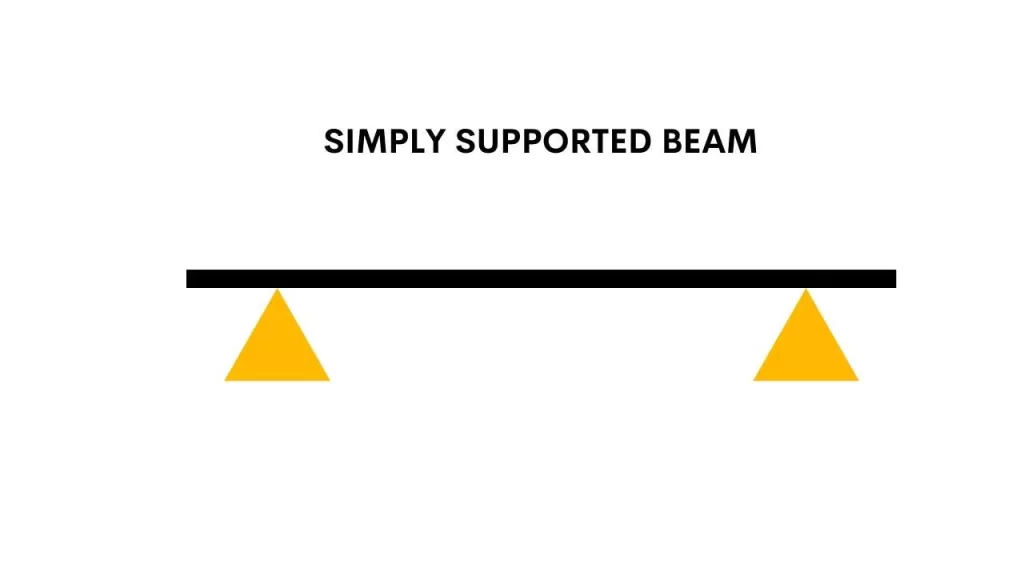
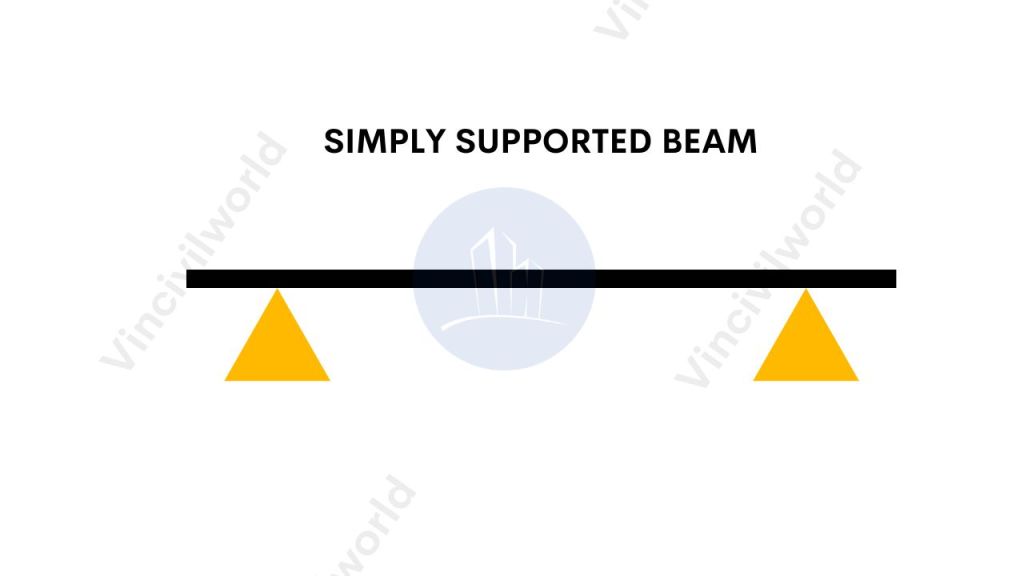
A simply supported beam is a type of beam that is supported at both ends and is free to rotate. It is one of the most common support conditions for beams and is used in a wide range of applications, such as bridges, buildings, and other infrastructure. Simply supported beams are typically used to support lighter loads and have a simple design.

Simply supported beam types
Simply supported Beam
Simply Supported beam

Fixed beams

A fixed beam is a type of beam that is rigidly fixed at both ends and cannot rotate. This support condition results in a beam that is capable of supporting heavier loads than a simply supported beam. Fixed beams are commonly used in construction. This includes the construction of tall buildings or other structures that require a high level of load-bearing capacity. However, the design of fixed beams is more complex than simply supported beams. This complexity arises due to the structural constraints imposed by the fixed supports.

Types of beams - Fixed beams
Types of beams – Fixed beams

Cantilever beams

A cantilever beam is a type of beam that is supported at one end and is free to rotate at the other end. It is commonly used in applications where an overhanging structure is required, such as in balconies or bridges. Cantilever beams are capable of supporting relatively heavy loads. They have a unique design that requires careful consideration of the forces acting on the beam.

Beams types - Cantilever beam
Beams types – Cantilever beam

Continuous beams

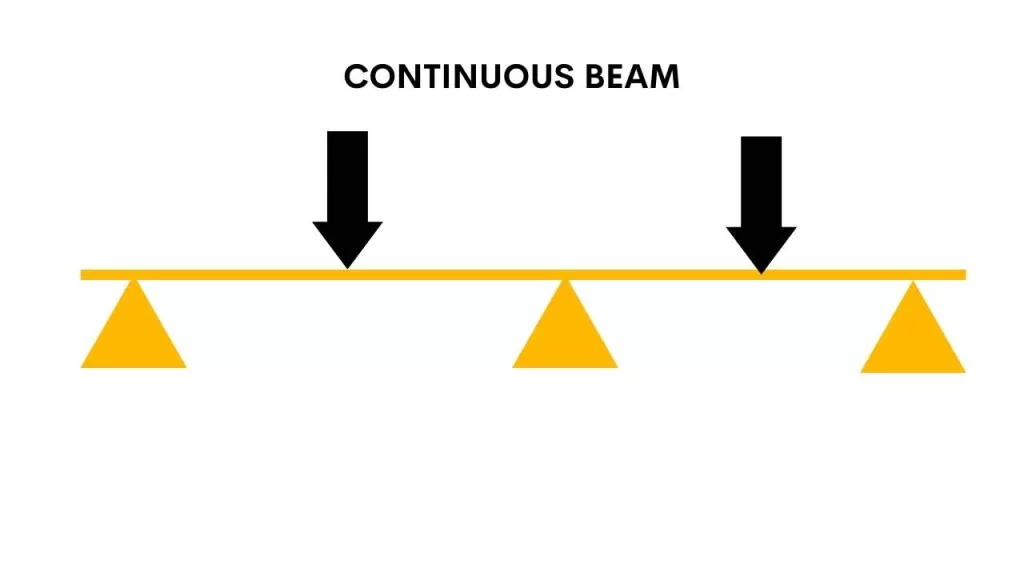
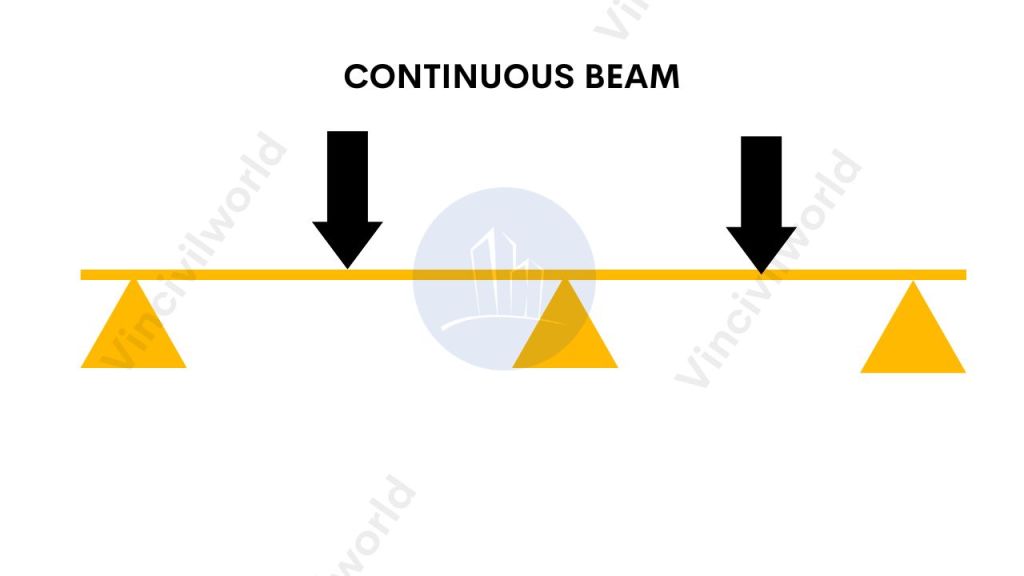
A continuous beam is a type of beam supported by more than two supports. It has one or more internal supports. This support condition results in a beam that is capable of supporting heavier loads. It can support more than a simply supported beam or cantilever beam. Continuous beams are commonly used in construction. They are used in the construction of bridges or multi-story buildings. Careful consideration of the distribution of loads and internal support points is required.

Types of beams - Continuous beam
Beam types - Continuous beams
Beam types : Continuous Beams

Overhanging beam

An overhanging beam is a type of beam that extends beyond its supports and has one or more overhanging sections. This support condition results in a beam that is capable of supporting loads that are not symmetrical or evenly distributed. Overhanging beams are commonly used in construction. They are often used in the construction of balconies or awnings. These beams require careful consideration of the distribution of loads. This includes the structural design of the overhanging section.

The choice of support condition depends on the load to be supported, the span length, and the structural design of the building or structure. Different support conditions result in different load-bearing capabilities and structural behaviour for the beam, which must be taken into account during the design process.

Types of beams based on structural behaviour

Beams can be classified as determinate or indeterminate. Determinate beams have a fixed number of supports and can be analyzed using statics. Indeterminate beams have more supports than are needed for stability and require more advanced analysis techniques to determine their behaviour.

Types of beams based on materials used

Beams can also be classified based on the materials used in their construction. Here are some common classifications based on materials:

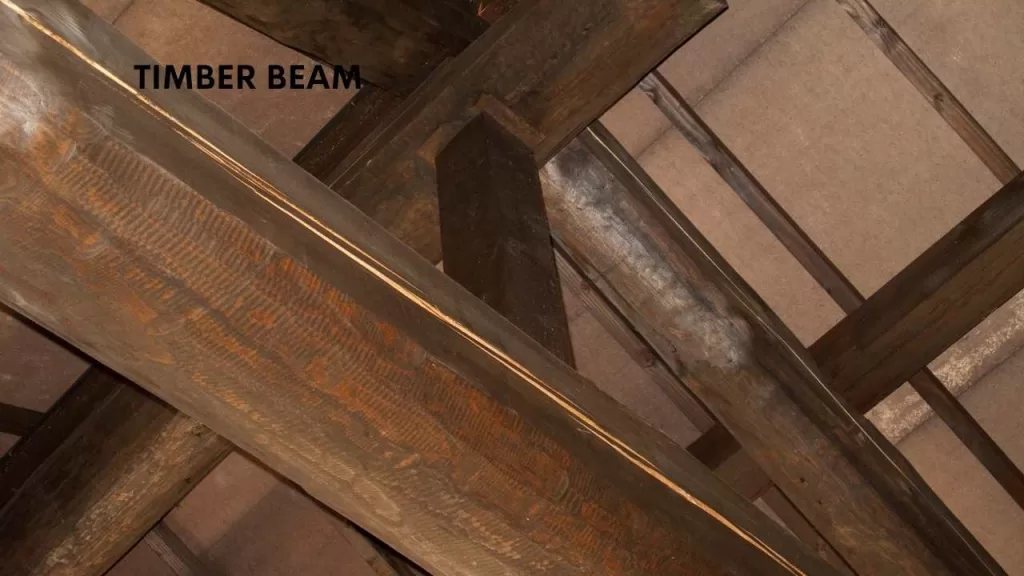
Timber beam

A timber beam is a type of beam that is made from wood. Timber beams are commonly used in residential and light commercial construction due to their relatively low cost, ease of construction, and natural aesthetic appeal. However, their strength and durability can be limited compared to other materials, which must be taken into account during design.

Timber beam
Timber Beam
Timber beams

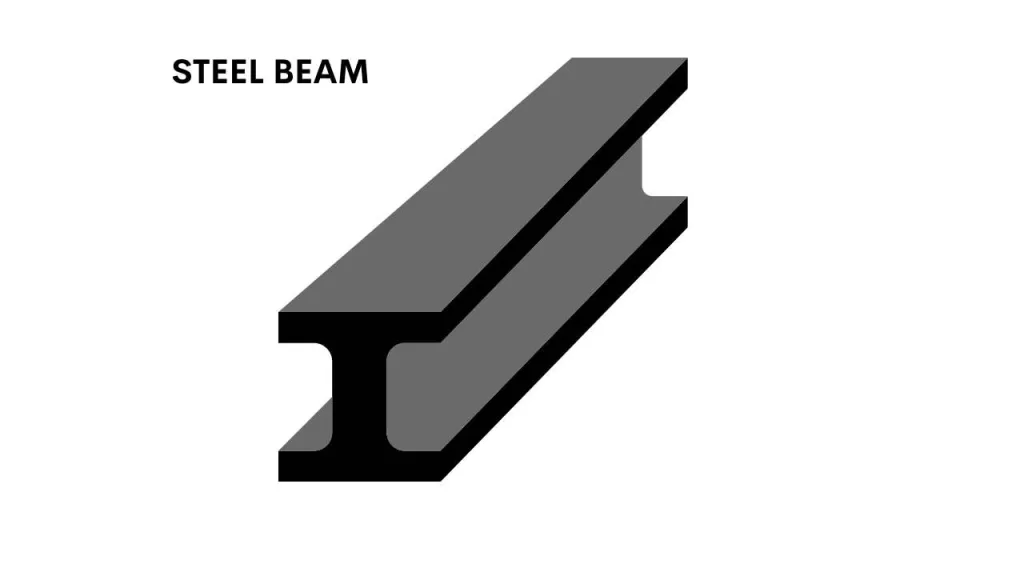
Steel beam

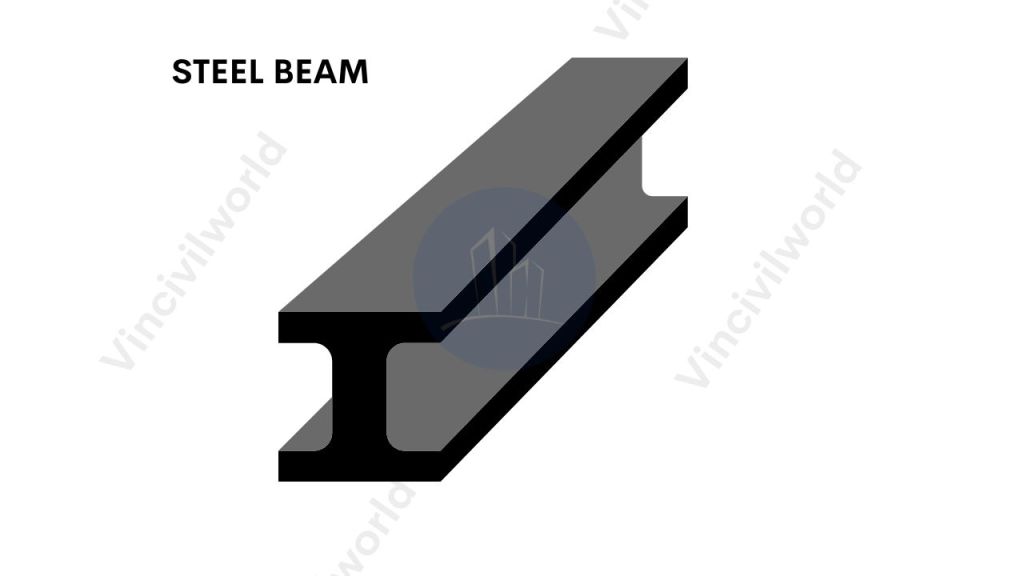
A steel beam is a structural element made of steel that is used to support loads over a span. It is typically I-shaped or H-shaped and comes in various sizes and lengths. Steel beams are commonly used in construction projects such as bridges, buildings, and infrastructure due to their strength and durability.

steel beams
Steel beams
Steel beam

Concrete beam

A concrete beam is a structural element made of reinforced concrete that is used to support loads over a span. It is typically rectangular or T-shaped and comes in various sizes and lengths. Concrete beams are commonly used in construction projects such as buildings, bridges, and infrastructure due to their strength and durability.

Concrete beam
Concrete Beam
Concrete beam

Composite beam

A composite beam is a structural element made of a combination of different materials, typically steel and concrete, that work together to support loads over a span. The steel and concrete are bonded together to create a strong, durable beam that can be used in construction projects such as buildings, bridges, and infrastructure.

The choice of material depends on the load to be supported, span length, and other design requirements. Each type of beam has unique structural properties that must be taken into account during the design process to ensure that the beam can support the intended loads.

Key Takeaways

  • Beam Types in Construction: Beams are classified based on their shape, support conditions, structural behavior, and material.
  • Shape-Based Beam Types: Rectangular, square, circular, I-shaped, T-shaped, and L-shaped beams are used depending on load requirements and structural design.
  • Support Conditions: Beams can be simply supported, fixed, cantilever, continuous, or overhanging, each offering different load-bearing capabilities.
  • Structural Behavior: Beams are categorized as determinate or indeterminate, influencing how they are analyzed in design.
  • Material-Based Beam Types: Common materials include timber, steel, concrete, and composite materials, each with unique properties for different applications.
  • Beam Selection: Factors like load, span length, and structural stability influence the choice of beam types in building construction.

Conclusion

Beams are fundamental components in construction, supporting loads and providing structural stability. They can be categorized based on shape, support conditions, material, and behavior. Each type is designed to meet specific structural demands. Rectangular and I-shaped beams are commonly used in buildings and bridges. Cantilever beams are perfect for overhanging structures. The correct selection of beam types is essential to ensure safety, durability, and performance in any construction project. Understanding the various beam types helps in designing more efficient and stable structures.

GATE Exam 2024 CE | Date, Application Process, online coaching

The Graduate Aptitude Test in Engineering (GATE) is one of the most prestigious national-level entrance exams in India. Each year, the Indian Institute of Science (IISc) and seven Indian Institutes of Technology (IITs) take turns conducting the exam. The GATE exam tests the aptitude of engineering and science graduates aspiring for higher education and jobs in the field of engineering, technology, and research. In this article, we will discuss the GATE CE Exam Notification 2024, including the exam date, application process, syllabus, eligibility criteria, gate exam score and result.

  1. Introduction to GATE exam.
  2. GATE CE Exam Notification 2024
  3. Eligibility Criteria
  4. Exam Date and Schedule
  5. Application Process
  6. Exam Pattern and Syllabus
  7. Admit Card and Exam Centers
  8. Result and Scorecard
  9. Cut-Off Marks and Qualifying Criteria
  10. Counselling and Admission Process
  11. GATE CE Exam Online Coaching
  12. Conclusion

Introduction to GATE exam.

The GATE exam administers 27 computer-based tests, including one for Civil Engineering (CE). The GATE CE exam tests candidates’ understanding of civil engineering topics. It includes Structural Engineering, Geotechnical Engineering, and Water Resources Engineering. The exam also covers Environmental Engineering, Transportation Engineering, and Construction Management.

GATE EXAM 2024

GATE CE Exam Notification 2024

The Indian Institute of Science (IISc) released the GATE CE Exam Notification 2024 on August 10, 2023. For further details, visit the official website for GATE 2024 at gate.iisc.ac.in. The notification includes all essential information about the exam. Specifically, it covers the exam date, schedule, eligibility criteria, syllabus, application process, exam pattern, admit card, exam centers, result, scorecard, and cut-off. Additionally, the notification provides guidance on how to navigate each aspect of the exam, ensuring that candidates are well-prepared and informed.

Eligibility Criteria

The eligibility criteria for the GATE CE exam are as follows:

  • The candidate must have a Bachelor’s degree in Engineering/Technology/Architecture or Master’s degree in any relevant Science subject.
  • The candidates appearing in the final year of their qualifying exam are also eligible to apply.
  • There is no age limit to appear for the GATE exam.
GATE EXAM -2024

Exam Date and Schedule

The GATE CE exam is scheduled to be held on February 3, 4, 10, and 11, 2024. The exam will be conducted in two sessions, i.e. The forenoon session from 9:00 am to 12:00 pm and the afternoon session from 2:00 pm to 5:00 pm.

Application Process

The application process for the GATE CE exam is entirely online. Candidates can apply for the exam by visiting the official website at gate.iisc.ac.in. Furthermore, the application fee is Rs. 1500 for General and OBC candidates, whereas it is Rs. 750 for SC, ST, and PwD candidates. Therefore, candidates should ensure they meet the eligibility requirements and submit their applications before the deadline to avoid any inconvenience. The last date to apply for the exam is September 15, 2023.

Exam Pattern and Syllabus

The GATE CE exam consists of 65 questions for a total of 100 marks. The exam is divided into two sections, i.e., General Aptitude (15 marks) and Technical (85 marks). The Technical section consists of two types of questions, i.e., Multiple Choice Questions (MCQs) and Numerical Answer Type (NAT) questions.

The syllabus is divided into seven broad sections.

  • Engineering Mathematics
  • Structural Engineering
  • Geotechnical Engineering
  • Water Resources Engineering
  • Environmental Engineering
  • Transportation Engineering
  • Construction Management.

Each section has several topics, and the detailed syllabus is available on the official website.

Admit Card and Exam Centers

The GATE CE exam admit card will be available for download on the official website. Candidates should download and print the admit card and bring it to the examination center. Additionally, they must carry a valid photo ID as proof of identity.

The exam centers for the GATE CE exam will be spread across multiple cities in India and a few international cities. Candidates can choose up to three exam centers in order of preference during the application process. The exam conducting authority will allocate the exam center based on availability and feasibility.

Result and Scorecard

The official website declared the result of the GATE CE exam 2024 on March 30, 2024. Candidates can download their scorecards from April 1, 2024, onwards. The scorecard will include the candidate’s name, registration number, marks obtained, and the All India Rank (AIR). Additionally, the GATE score is valid for three years from the result declaration date.

Cut-Off Marks and Qualifying Criteria

The GATE CE exam cut-off marks are the minimum marks that candidates need to obtain in order to qualify for the exam. The cut-off marks vary every year based on factors such as the difficulty level of the exam and the number of candidates appearing for the exam. The qualifying criteria for the GATE CE exam is that the candidate should obtain a minimum of 25 marks out of 100.

Counselling and Admission Process

The GATE CE exam score is accepted by several institutes and universities in India for admission to postgraduate courses in Civil Engineering and related fields. Additionally, the counseling and admission processes vary among different institutes and universities. Consequently, candidates need to apply separately to the institutions of their choice. Furthermore, they must navigate each institution’s specific counseling and admission procedures. Thus, it is essential for candidates to stay informed about the requirements of each institute or university to ensure a smooth admission process.

GATE CE Exam Online Coaching

If you’re aspiring to crack the GATE CE exam, then opting for GATE CE online coaching can be a game-changer for you. With the convenience of learning from anywhere and anytime, online coaching offers a plethora of benefits to students. Not only do you get access to expert faculty members, but also high-quality study material and mock tests that are crucial for exam preparation. Additionally, online coaching also saves you the time and effort of commuting to a physical classroom, allowing you to utilize that time for self-study and revision. So, enrol in a reliable GATE CE exam online coaching program today, and give yourself the best chance of acing the exam.

Conclusion

The GATE CE exam is an important examination for aspiring Civil Engineers. It provides a platform for candidates to showcase their knowledge and skills in the field of Civil Engineering and helps them to get admission to some of the most reputed institutes and universities in India. Candidates should prepare well for the exam by following the exam pattern and syllabus, practising the previous year’s question papers, and taking mock tests. They should also keep themselves updated with the latest exam notifications and announcements.ouncements.

Understanding the Importance of Quality Welding Equipment

Welding is a critical process in various industries, including construction, manufacturing, automotive, and aerospace. The integrity of welded structures directly impacts the safety, durability, and performance of the final products. Therefore, selecting high-quality welding equipment is essential for achieving reliable and precise welds. To get the best results, it’s crucial to rely on reputable suppliers like The Edge WA, which provides a wide range of premium welding tools and accessories.

Ensuring Safety and Reliability

Quality welding equipment significantly enhances safety in the workplace. Welding involves high temperatures, electrical currents, and potentially hazardous fumes, making it a dangerous task if not handled properly. High-quality equipment is designed with advanced safety features such as automatic shut-off mechanisms, stable power sources, and efficient ventilation systems. These features minimize the risk of accidents and injuries, ensuring that welders can work with confidence and focus on the task at hand.

Image credit

Moreover, reliable welding equipment reduces the likelihood of equipment failure during critical operations. Inferior tools are prone to breakdowns, which can cause delays, increase costs, and compromise the quality of the welds. Investing in top-tier welding machines and accessories means fewer interruptions and more consistent results, contributing to the overall efficiency and productivity of the project.

Achieving Precision and Quality

The precision of the welding process is paramount, especially in industries where structural integrity is non-negotiable. High-quality welding equipment ensures accurate control over the welding parameters, such as voltage, current, and speed. This precise control is vital for producing strong, defect-free welds that meet industry standards and specifications.

For instance, advanced welding machines come with features like pulse welding, which allows for better control over the heat input, reducing the risk of distortion and improving the appearance of the weld. These machines also often include programmable settings that enable welders to save and recall specific configurations for repetitive tasks, ensuring uniformity and precision across multiple welds.

Enhancing Efficiency and Productivity

Using superior welding equipment can significantly boost efficiency and productivity. High-quality machines are typically more powerful and faster, enabling welders to complete tasks more quickly without sacrificing quality. This increased speed translates to higher output and shorter project timelines, which is particularly beneficial in high-demand industries like automotive manufacturing and construction.

Additionally, premium welding equipment often requires less maintenance and has a longer lifespan compared to cheaper alternatives. This durability means less downtime for repairs and replacements, allowing welders to maintain a steady workflow. Over time, the initial investment in quality equipment pays off through reduced maintenance costs and increased operational efficiency.

Adapting to Technological Advances

The welding industry is continuously evolving, with new technologies and techniques emerging to improve the welding process. Quality welding equipment is designed to adapt to these advancements, offering compatibility with the latest tools and technologies. For example, modern welding machines are often equipped with digital interfaces that provide real-time feedback and diagnostics, helping welders monitor their performance and make necessary adjustments on the fly.

Furthermore, many high-end welding machines are now compatible with automation systems, such as robotic welders. These systems can perform repetitive welding tasks with high precision and speed, further enhancing productivity and consistency. Investing in cutting-edge welding equipment ensures that businesses stay competitive and are able to leverage the latest technological developments in the industry.

Reducing Costs in the Long Run

Image credit

While the initial cost of high-quality welding equipment may be higher, it often leads to significant cost savings in the long run. Reliable equipment reduces the risk of errors and rework, which can be costly in terms of materials, labor, and time. Additionally, the durability and longevity of premium welding tools mean fewer replacements and lower maintenance expenses over time.

For instance, a top-quality welding machine that operates efficiently and consistently will use less energy, contributing to lower operational costs. Energy efficiency is an important consideration in industries with high power consumption, as it directly impacts the overall profitability of the business. By choosing quality equipment, companies can achieve better financial outcomes through improved efficiency and reduced wastage.

Meeting Industry Standards and Compliance

Adhering to industry standards and regulations is crucial for any business involved in welding. Quality welding equipment is designed to meet or exceed these standards, ensuring that the welds produced are safe, reliable, and compliant with industry requirements. This compliance is particularly important in sectors such as aerospace, automotive, and construction, where the consequences of substandard welds can be severe.

Using certified equipment from reputable suppliers like The Edge WA helps businesses avoid potential legal and financial repercussions associated with non-compliance. It also builds trust with clients and stakeholders, demonstrating a commitment to quality and safety.

Supporting Skilled Workforce Development

The availability of high-quality welding equipment is also vital for the development of a skilled workforce. Modern welding machines often come with advanced features and capabilities that require proper training and expertise to operate effectively. By providing access to top-tier equipment, businesses can attract and retain skilled welders who are proficient in using the latest technologies.

Additionally, investing in quality tools supports ongoing training and professional development programs. Welders can refine their skills and stay updated with industry advancements, leading to continuous improvement in the quality of work. This focus on skill development not only enhances individual performance but also contributes to the overall reputation and success of the business.

Ensuring Customer Satisfaction

Ultimately, the use of quality welding equipment directly impacts customer satisfaction. High-quality welds that meet or exceed expectations build trust and loyalty among clients. Whether it’s a robust structure in a construction project or a precisely manufactured automotive part, the quality of the welds plays a crucial role in the performance and durability of the final product.

Satisfied customers are more likely to return for future projects and recommend the business to others, leading to increased opportunities and growth. Investing in premium welding equipment is, therefore, an investment in the future success of the business.

Non-destructive Testing Meets Nanotechnology: Exploring Innovations and Applications

Introduction

Non-destructive testing (NDT) has long been a cornerstone in ensuring the integrity and safety of structures, components, and materials across various industries. As technology advances, the integration of nanotechnology into NDT has opened up new frontiers, offering unprecedented levels of precision, sensitivity, and efficiency. This article provides an overview of the convergence of non-destructive testing and nanotechnology, exploring the innovative techniques, applications, and potential impact on diverse sectors.

Non-destructive Testing (NDT)

Non-destructive testing encompasses a range of techniques designed to evaluate the properties of materials without causing damage. These methods are crucial for identifying defects, assessing structural integrity, and ensuring the reliability of critical components. Traditional NDT methods include ultrasonic testing, radiography, magnetic particle testing, and eddy current testing. While these methods have proven effective, the marriage of NDT and nanotechnology is poised to revolutionize the field.

Non Destructive Testing

Nanotechnology in NDT

Nanotechnology involves manipulating materials at the nanoscale, typically at dimensions of less than 100 nanometers. When applied to NDT, nanotechnology brings a wealth of advantages, including enhanced sensitivity, improved resolution, and the ability to detect defects at a microscopic level. Here are key ways in which nanotechnology is making an impact in non-destructive testing.

Enhanced Imaging Resolution

Nanomaterials, such as nanoparticles and nanocomposites, enable the development of advanced imaging agents. These agents, when incorporated into NDT methods like radiography or magnetic resonance imaging, enhance resolution and provide detailed insights into the internal structure of materials.

Sensitivity Improvement

Nanoscale sensors and probes enhance the sensitivity of NDT techniques. For instance, nano sensors can be employed in ultrasonic testing to detect minute defects or irregularities that may go unnoticed with conventional sensors. This heightened sensitivity contributes to early defect detection and prevention.

Functional Nanomaterials

Functional nanomaterials, like carbon nanotubes or quantum dots, are employed to tailor specific properties for NDT applications. Carbon nanotubes, for example, can be used in sensors to improve conductivity and responsiveness, making them valuable for detecting flaws in materials.

Smart Coatings

Nanotechnology enables the development of smart coatings that respond to external stimuli, such as changes in temperature or stress. These coatings, when applied to surfaces, can reveal hidden defects or structural changes, providing real-time data during operation without disrupting the material’s integrity.

Smart coating - Nano Technology

    Applications of Nanotechnology in NDT

    The incorporation of nanotechnology into non-destructive testing has resulted in a myriad of applications across diverse industries. Some notable areas where this synergy is making a significant impact include:

    Aerospace Industry

    In the aerospace sector, where the demand for lightweight yet robust materials is critical, nanotechnology aids in identifying defects at the nanoscale. This ensures the integrity of components like aircraft wings and fuselage, contributing to overall safety and efficiency.

    Medical Imaging

    In the field of medical imaging, the use of nanomaterials enhances the resolution of diagnostic tools. Nanoparticles can be employed as contrast agents in techniques like magnetic resonance imaging (MRI) or ultrasound, allowing for more accurate and detailed medical assessments.

    Materials Science and Manufacturing

    Nanotechnology plays a pivotal role in materials science and manufacturing, where the detection of microscopic defects is crucial. Whether assessing welds in construction materials or inspecting microelectronics in manufacturing processes, nanotechnology-driven NDT ensures the quality and reliability of products.

    Oil and Gas Industry

    In the oil and gas sector, nanotechnology aids in the inspection of pipelines and critical infrastructure. Nano sensors can detect corrosion or structural weaknesses in real-time, preventing potential disasters and optimizing maintenance schedules.

      Challenges and Future Directions

      While the integration of nanotechnology into NDT holds immense promise, there are challenges that researchers and industries must address. Ensuring the scalability and cost-effectiveness of nanotechnology-driven NDT methods, as well as addressing potential environmental and health concerns related to nanomaterials, are crucial aspects.

      The future of NDT with nanotechnology is likely to witness further innovations, including the development of autonomous nanorobots for in-situ inspections and the application of artificial intelligence to analyze complex nanoscale data. As research progresses, the synergy between non-destructive testing and nanotechnology will continue to redefine the boundaries of material inspection and quality assurance.

      Conclusion

      The convergence of non-destructive testing and nanotechnology represents a paradigm shift in how we assess the integrity of materials and structures. Nanotechnology’s ability to operate at the molecular and atomic levels brings unprecedented precision and sensitivity to NDT methods, ensuring early defect detection and contributing to enhanced safety across industries. As research and development in this field advance, the innovative applications of nanotechnology in NDT are poised to reshape industry standards, making material inspection more reliable, efficient, and technologically sophisticated.

      Understanding the Uses and Benefits of Heavy Duty Steel Trestles

      Finding the right solution for your heavy-duty load-bearing tasks can sometimes feel like a daunting mission. Yet, help is at hand with the effective and comprehensive option of heavy-duty steel trestles. This article aims to serve as an informative guide to understanding heavy duty trestles, their uses, and benefits.

      heavy duty steel trestle

      Image credit

      In the wider sphere of construction, a trestle is referred to as the framework consisting of a horizontal beam supported by two pairs of sloping legs. Steel trestles specifically possess commendable robustness and resilience, which makes them ideal for intensive industrial applications. When we delve into the realm of heavy-duty steel trestles, we are introduced to remarkable strength and a higher load-bearing capacity. 

      A heavy-duty steel trestle not just stands as a symbol of strength and durability but also promotes high functionality in various applications. They can support substantial weight, thereby acting as a perfect solution for various tasks that require load-bearing.

      Uses of Heavy-Duty Steel Trestles

      1. Versatile Utility Across Industries

      Image credit

      Heavy-duty steel trestles serve as indispensable tools in various industries, demonstrating their adaptability in fields ranging from construction and mining to automotive and heavy industries. Their primary function is to provide robust support for a multitude of applications, including scaffolds, formwork structures, pipes, containers, machinery, and even bridges. This versatility allows them to cater to diverse needs beyond mere structural support, making them valuable assets in the industrial landscape.

      2. Assisting Assembly and Disassembly

      These steel trestles go beyond static support roles by actively participating in the assembly and disassembly processes within manufacturing units. They facilitate tasks such as equipment setup, component assembly, and maintenance activities. Additionally, their utility extends to tasks like painting structures, where they provide temporary support to workers, ensuring safe and accessible work surfaces for painting and coating applications.

      3. Customization for Specific Requirements

      One of the standout features of heavy-duty steel trestles is their customizability. They can be adjusted and tailored to meet specific project requirements, which enhances their adaptability and broadens their scope of applications. This customization capability ensures that they can effectively support a wide range of industrial and construction-related tasks, making them a versatile solution.

      4. Temporary Work Platforms at Construction Sites

      Construction sites often employ heavy-duty steel trestles to create temporary elevated work platforms. These platforms offer elevated workspaces for construction workers while allowing unobstructed movement beneath them. By providing such elevated spaces, steel trestles promote a more efficient workflow at construction sites, improving accessibility and contributing to streamlined construction procedures.

      5. Promoting Safety and Efficiency

      The use of heavy-duty steel trestles at construction sites enhances both safety and efficiency. They offer a secure and stable work environment for tasks conducted at heights, reducing the risk of accidents. Simultaneously, the ability to create temporary work platforms ensures that workers can efficiently access elevated areas, boosting overall productivity and expediting construction processes. Their adaptability, durability, and role in enhancing workplace safety make them a valuable asset in a wide range of industrial and construction scenarios.

      Benefits of Heavy-Duty Steel Trestles

      1. Exceptional Load-Bearing Capacity

      Heavy-duty steel trestles have many benefits in addition to their excellent load-bearing capacity. They can withstand even the most demanding working conditions thanks to their inherent strength and tough structure, which makes them incredibly resistant to wear and tear. Their longevity is increased by their durability, which also guarantees that they can constantly satisfy the requirements of heavy-duty applications.

      2. Unrivaled Corrosion Resistance

      Heavy-duty steel trestles exhibit remarkable resistance to corrosion and rust, making them impervious to the detrimental effects of weather elements. This unique attribute positions them as the go-to choice for tasks in all weather conditions and outdoor projects. Moreover, their non-corrosive nature significantly reduces maintenance costs and effort, providing a cost-effective and hassle-free solution.

      3. Safety and Dependability

      From a safety perspective, heavy-duty steel trestles are invaluable assets. Their unwavering stability and unwavering rigidity make them reliable tools for a wide range of critical applications. These trestles are engineered to ensure the safety of workers and to provide a secure platform for various tasks, instilling confidence in their performance and safeguarding workers in demanding environments.

      4. Versatile and Essential

      Heavy-duty steel trestles emerge as essential and versatile tools across diverse industries. They are designed to endure the rigors of heavy-duty applications while consistently delivering commendable performance. Their relatively long lifespan, coupled with their inherent ruggedness and safety features, renders them a highly worthwhile investment for any project or industry, guaranteeing durability and reliability for the long haul.

      Final Thoughts

      Heavy-duty steel trestles are an all-in-one solution for all your heavy-duty load-bearing tasks. They amalgamate strength, durability and functionality, solidifying their status as invaluable assets in the realm of industrial and construction operations. Whether you run a construction, mining, or manufacturing business, understanding the benefits and uses of these trestles can contribute to streamlining your operations and reducing overhead costs. The adaptability and versatility they offer makes them worth considering for your business.