AAC Blocks vs red bricks – AAC blocks are also known as Autoclaved Aerated Concrete Blocks. They are lightweight, load-bearing, durable, and economical. AAC blocks can be manufactured to meet any requirements. AAC blocks are considered a green option instead of red bricks. They have enormous potential in terms of insulation, fire resistance, and thermal resistance. AAC blocks are environmentally friendly. They are a superior material compared to concrete, wood, brick, and stone. They can enhance the construction speed, reduce the costs, and unwanted wastage at construction sites.
Autoclaved Aerated Concrete blocks are superior to conventional red clay bricks in a lot of factors. Considering the impact and necessity of these factors we can easily make a choice.
AAC blocks are superior to red bricks in a lot of factors relating to quality, speed, workability, cost, and wastage. There is much to discuss about the advantages of AAC blocks. They hold benefits over Red bricks, fly ash bricks, Cement Concrete hollow blocks, and CLC blocks.
AAC blocks are manufactured from materials like sand, fly ash, lime, and cement. They are lightweight, eco-friendly, and energy-efficient. Their efficiency is due to 80% voids and the use of industrial waste.
AAC blocks are superior to conventional bricks for several reasons. They are lightweight and have eco-friendly properties. These blocks offer better insulation and energy efficiency. They also utilize waste materials like fly ash.
Let us have a comparison between AAC blocks and red bricks in terms of following parameters.
Availability of sizes
Technical Properties
Construction speed
Savings in labour
Material Savings
Availability of sizes.
Customization in size is the most important aspect in deciding the choice of bricks/blocks for a particular structure.
AAC blocks
Conventional red bricks
AAC blocks are available in varied sizes are can be customised for special requirements.
Mostly available in one or two standard sizes. No customisation is possible.
AAC blocks vs red bricks- Technical properties
AAC BLOCK DIMENSIONS
RED CLAY BRICK DIMENSIONS
AAC Blocks
Conventional Bricks
AAC blocks are available in 600 mm/625 mm (length) X 100–300 mm (height) X 230/240 mm (width).
Bricks are available in 225 mm (length) X 115 mm (width) X 75/70 mm (height).
The dimension tolerance of the AAC block is +/- 5 mm.
The dimension tolerance of brick is +/- 5 mm to +/- 15 mm or more.
Density ranges between 500-650 kg/cm³.
Density ranges between 1400-1900 kg/cm³.
The drying shrinkage of AAC blocks is 0.4%, which is very low compared to conventional bricks.
The drying shrinkage of bricks is 0.8%, which is comparatively high compared to AAC blocks.
AAC blocks vs red bricks – Construction speed
AAC blocks are considered cost-effective and economical in comparison with conventional bricks. The cost-effectiveness of AAC blocks is mostly related to the construction speed. AAC blocks can enhance construction speed when compared to conventional bricks. This improvement is due to some unique characteristics detailed out in the following table.
AAC blocks vs red bricks
Let us take a wall of 3mtr x 3 mtr size and 4 inch thickness
AAC Blocks
Conventional Bricks
Area of Block
Area of Brick
Area of block = 24 inch x 9 inch (600 mm x 230 mm) = 0.138 sqm
Area of brick = 9 inch x 3 inch (230 mm x 70 mm) = 0.0161 sqm
Wall area = 3m x 3m = 9 sqm
Wall area = 9 sqm
No. of blocks = 9 sqm / 0.138 sqm = 65 blocks (600 mm x 230 mm x 100 mm)
No. of bricks = 9 sqm / 0.0162 sqm = 555 bricks (230 x 110 x 70 mm)
Total Mortar Joints
Total Mortar Joints
85 rmt (approx)
170 rmt for 4-inch wall & 240-250 rmt for 9-inch wall
Weight
Weight
Weight of an AAC block (9 inch) = 16-17 kg
Weight of brick = 3-3.5 kg (approx)
1 no. 9 inch block = 14-15 bricks
Bricks are heavy
From the above comparisons, it is clear that the AAC blocks are lightweight and covers more area than bricks. Brick masonry got 3-4 times higher mortar joints and around 14-15 bricks constitute an AAC block. That is why Brick masonry is very slow. AAC blocks are big, got fewer joints, and can be completed very fast.
Factors influencing construction speed
Factors Influencing Construction Speed
AAC Blocks
Bricks
Dimensional Accuracy
AAC blocks are factory-made and possess dimensional accuracy, making them easy to place and plumb.
Red bricks are locally made, irregular, and less dimensionally accurate, making them difficult to place, level, and plumb.
Number of Joints
AAC blocks have fewer joints, increasing construction speed.
Red bricks have 4 times more joints than AAC blocks, significantly reducing construction speed.
Coverage Area
AAC blocks cover a larger area.
Bricks cover a smaller area.
Skill Requirement
AAC blocks can be placed by semi-skilled workers due to their dimensional accuracy and shape.
Brickwork requires skilled masons because of inaccuracies and shape issues.
Mortar Joints
AAC blocks use ready-mix block adhesive with a joint thickness of 3-5 mm.
Brickwork uses site-mixed mortar with a minimum joint thickness of 10 mm.
Savings in labor
Savings in Labor
AAC Blocks
Bricks
Pre-curing and post-curing labor
AAC blocks do not require any pre-curing. AAC block masonry joints are air-cured and do not require any curing. Infrastructure and labor involved in the curing process can be eliminated.
Bricks must be soaked in water before use. Additionally, 7-day curing is required for brickwork, which demands curing infrastructure and labour involvement.
Labour saving in mortar mixing
Labour Saving in Mortar Mixing
AAC Blocks
Bricks
Mixing Process
AAC blocks use ready-mix bonding adhesive as jointing material, available in 25-30 kg packs and mixed with water before use.
Brickwork uses site-mixed mortar that involves handling, mixing, and conveying of raw materials and mortar.
Labour Cost
This can save substantial labour costs incurred for mortar mixing and conveying.
Extra labour costs involved for mortar mixing and conveying.
AAC BLOCKS VS RED BRICKS – MORTAR MIXING
Conveying and re-handling labour
Conveying and Re-handling Labour
AAC Blocks
Bricks
Supply and Conveying
AAC blocks are supplied in pallets. They can be easily lifted and conveyed to work spots using cranes and tower cranes directly from the trucks.
Bricks are supplied loose and unloaded manually. They need to be filled in buckets for lifting to heights, requiring more labour.
Labour and Wastage
Saves labour in unloading, conveying, and lifting. Less handling generates zero wastage.
Brick shifting and conveying involve heavy labour and generate a large amount of wastage.
AAC block work rates are comparably less than brickwork due to the saving involved in the labour part. The rate per cum of AAC blocks will be around INR – 650/- to -750 /- per cum whereas brickwork is around INR 1400-1500/- per cum.
Material saving
Saving in mortar
AAC blocks got fewer mortar joints of 3-5 mm thickness whereas brick masonry generates 3-4 times higher number of joints of 12 mm thickness. This can save substantially in terms of jointing material.
Analysis of Mortar for Brickwork
Description
Quantity
x
Rate (INR)
=
Cost (INR)
1 CUM Brickwork = 0.35 to 0.4 CUM mortar
Sand cost (Rs. 2500/- per CUM)
0.35
x
2500
=
875
Cement
1.3
x
300
=
390
Total cost per CUM of brickwork
INR
1265/-
Analysis of Block Adhesive
Description
Details
1 CUM block work
30 kg of block adhesive
Rate per kg
Rs. 12-15 per kg
Cost for 30 kg
Around INR 400/- per CUM
Conclusion: Block adhesive costs approximately INR 400/- per CUM, whereas mortar costs around INR 1250/- per CUM.
Saving in plastering
AAC blocks are dimensionally accurate and both faces of the block-work look even without any undulations. The undulations can be levelled by providing a minimum plastering thickness of 10 mm inside and 12-15 mm outside. AAC blocks can even be painted by directly applying putty/Gypsum plaster over it.
Brickwork has a fair face and unfair face. To cover up undulations, a 12 mm plastering thickness is required for the fair face. A minimum of 18 mm thickness is needed for an unfair face.
AAC blocks offer other value-added benefits. They are superior in fire resistance, termite resistance, and thermal resistance. Additionally, they serve as a green building material. Please read ADVANTAGES OF AAC BLOCKS.
Final year Civil engineering project are the tipping point of your college activities. While you prepare yourself to bid goodbye to your college, this is like a nagging friend. Well, not really. It is the last chance to exercise your skills in civil engineering and practice what you learnt in the textbooks. You will come across all the details on final-year civil engineering projects as well as final-year civil engineering project topics in the blog.
b) Picking the right team for project topics for Civil engineering project
You should be keen while choosing your teammates. First of all, they should have similar interests as you and should be able to fill in the gaps where you are weak.
c) Approaching a guide for the project
The guide for your final year civil engineering projects should be able to provide you with the required guidance for completing the project. And supportive too (why allow backstabbing?). You may ask the guide’s previous team about their experience with them.
So, the first baby milestone is taken care of. Now, let me introduce the major topics for the final year project in civil engineering.
100 Civil engineering project topics for you
Final year civil engineering projects
I have categorized the civil engineering project topics based on the branch of civil engineering to which they belong. For any details regarding the listed topics for Civil engineering project please mail me
I’m pretty sure that you will have a lot more doubts regarding your final year civil engineering projects that hover around your brain. Also, when you want more details on any of the above-mentioned civil engineering project topics, drop them in the comments!
The advantages of AAC blocks over other alternatives stamps it as a perfect and superior building material in comparison with conventional bricks. Advantages of AAC blocks and their properties are listed out in detail.
Advantages of AAC blocks
AAC Blocks or Autoclaved Aerated Concrete Blocks are lightweight, load-bearing, durable, and economical walling material. They are eco-sensitive and green option to bricks, due to its enormous potentials in terms of insulation, fire-resistant, acoustic, and thermal resistant properties. AAC Blocks are superior material when compared with concrete, wood, brick, and stone. They can enhance the construction speed, reduce the costs, and minimise wastage at construction sites.
The unique qualities of AAC blocks are mainly due to its properties. AAC blocks are something more than a brick alternative. AAC block posses a lot of qualities that make them stand out from other alternatives. The advantages in terms of technical properties are listed below.
AAC blocks sizes are customised and manufactured in various sizes. The most common dimensions available in the market is : 600/625 mm (length) x 230/240 mm(height) x 100 mm-300 mm (thick)
TECHNICAL ADVANTAGES OF AAC BLOCKS
Dimension and appearance
The biggest advantages of AAC blocks are its Dimension and appearance.
AAC Blocks are factory manufactured and hence got a perfect size and finish with a dimension tolerance of +/- 5mm. They have sharp edges and corners, uniform colour, and pleasing appearance.
AAC block density is around (550-650)kg/cm3 which can be customised as per requirement.
AAC blocks pose a drying shrinkage of around 0.4 % which is considered very less when compared to conventional bricks.
Dimension optimisation is the main feature of AAC blocks. They can be customised to cater to any dimension requirements. AAC blocks are available in thickness ranging from 100 mm to 300 mm with a standard length of 600 mm/625 mm. The dimensions of AAC blocks also differ with the manufacturer.
Fire resistant advantages of AAC blocks
AAC blocks are non-combustible and got excellent fire-resistant properties. The melting point of the AAC blocks is around 1600 degrees Celsius which is much higher than the temperature of building fires, where it is around 500 degrees Celsius. AAC block can withstand fire up to 4-6 hours depending on the block thickness.
ADVANTAGES OF AAC BLOCKS DURING FIRE
Acoustic/Sound proof qualities
AAC Blocks possess low density and high porosity due to the presence of billions of voids. The voids make up 80% of the total volume. The AAC block got high sound absorption properties when compared with any other building materials like concrete and brick due to its high porosity.
The high acoustic properties make AAC blocks a preferred choice for cinema halls and auditoriums walls.
Insect and termite resistant
AAC Block uses inorganic materials like fly ash, cement, gypsum, etc as ingredients in its manufacturing process. AAC block possesses good insect and termite resistant qualities due to the presence of these inorganic materials.
Advantage of AAC blocks – Thermal insulation and energy savings
Fly ash is the main ingredient and constitutes more than 70% weight of AAC blocks ingredients. The micro pores constitutes around 80% of AAC blocks accounts for its excellent thermal insulation properties. The thermal insulation qualities help in maintaining inner temperature cool in summers and warm in winters. More cooler interior means less AC load which in turn can reduce energy consumption by 20% and can eliminate costly thermal insulation.
Advantage of AAC block-Impact of earthquake
AAC blocks are lightweight and reduces dead load/ mass on the structure. The impact of earthquake is directly proportional to the weight of structure. Because of its light weight properties, AAC blocks can reduce the impact of earthquake to an extend and hence preferred for earthquake zones.
Water and Moisture Resistant
AAC blocks constitutes millions of micro pores which prevent capillary transport of water and moisture over a long distance. The walls can resist moisture even with a lesser thickness compared to bricks. The water and moisture resistant qualities enable to use a less thick block as partitions.
Advantage of AAC block in terms of strength
AAC blocks are highly superior in terms of the strength. Higher level of strength of these blocks gives higher stability to the structure of the building.
Economical compared to any other alternative
AAC blocks are economical and stands out as the preferred option due to a lot of factors. This is the main advantage of AAC block over conventional red bricks.
CUTTING OF AAC BLOCK
Ease of cutting and chasing
Using recommended tools we can easily cut,drill and chase AAC blocks . The blocks will not break,crack or de-bond from its position while doing so.
Ensure fast construction
AAC blocks are lightweight, easy to fix and have a very accurate dimensional tolerance +/-5 mm and can be fixed, jointed and plumbed easily.
A single block of any thickness have an area of 24 inches x 8 inches
For completing a wall of 10 ft x 10ft
Surface area of block = 24 inch x 8 inch = 0.6 m x 0.2m = 0.12 sqm per block
Area of wall : 10 ft x 10 ft = 100 sq ft = 9.29 sqm
Quantity of block for an area of 9.29 sqm
9.29 sqm/0.12 sqm = 77.41 blocks for 100 sqft
Ordinary brick area is 9 inch x 3 inch = 0.23 m x .075 = .01725 sqm
Area of wall = 9.29 sqm area = 9.29/.1725 =
538 bricks (for 4 inch thick wall) and 1080 bricks for a 9 inch wall)
Higher the number of bricks greater the number of mortar joints.
AAC blocks are big in size and it can cover 13-14 bricks with a block. This can speed up the construction.
Advantage of AAC block in terms of Labour cost
PLACING OF AAC BLOCK
AAC blocks are very fast and easy to place due to the less number of joints when compared with bricks.
AAC blocks doesn’t require any soaking before placing for masonry and no curing is required after carrying out the works. The block adhesive used is air cured . This can reduce substantial labour and infrastructure costs involved in curing and soaking of blocks.
AAC block uses ready mix block adhesive in place of mortar for bonding the blocks, wherein mortar making requires handling of aggregates, mixing and conveying to the location for use. The labour involved in this lengthy process can be saved in the case of AAC blocks. More over the area looks neat and clean as site mixed mortars tends to generate a lot of waste.
Bricks got 4 times more mortar joints than AAC blocks. The dimensional tolerance of bricks are very high around +/- 5 mm to 15 mm and more. It is difficult to plumb and place in position.
AAC block work can even be done with a semiskilled labour with a little bit of training mostly due to their dimensional accuracy.
AAC blocks are available in pallets and can be conveyed and lifted to any location with the help of cranes and tower cranes. This can save labour involvement in carrying of blocks.
Because of these factors the labour charges for placing AAC blocks are almost 50% less when compared with conventional bricks/ or any other walling material.
Advantages of AAC block – Savings in material cost
Saving in jointing mortar
The block adhesive joint thickness is around 3-4 mm and it is much cheaper than mortar which includes cement and sand and its mixing.
Saving in plastering material
There is a huge amount of savings in terms of plastering. AAC blockwork presents a fair face on both sides of wall whereas brick work generates a fair face and unfair face on the walls. For covering the unfair face of brickwork the thickness of mortar should be adjusted to a minimum of 18 mm or more. In case of AAC blocks due to its dimensional accuracy they can be covered even with 10 mm thick mortar on inside faces and 12 mm thick mortar for outside faces. AAC blocks comes in perfect shapes and can even be painted directly after applying POP or gypsum plaster in very thin coats.
PLASTERING OF AAC BLOCKS
Wastages
AAC block wastage is around 2% whereas brick wastage is around 10% to 15% which is relatively very high. This can generates substantial saving in terms of wastage and removal of debris.
Design optimisation
AAC blocks are light weight with very less density of around 600 kg/cm3. Structural designers can optimise their designs due to less dead loads similarly optimised design consume less steel and concrete.
AAC is 100% Green building material & is a walling material of a choice in LEED certified buildings. AAC is most energy & resource efficient in the sense that it uses least amount of energy in manufacturing and material per cum of product. Brick manufacturing process uses fertile topsoil wherein AAC uses Fly-ash (65% of its weight) which is an industrial waste harming the environments.
AAC Blocks is a unique and excellent building material due to its superior heat, fire and sound resistance qualities. AAC blocks are lightweight and offers ultimate workability, flexibility and durability.
Ways to conserve water is a quite relevant topic in the digital era. World population is exploding and the need for water is skyrocketing. It is even said that the next world war will be for water. In the crunchy situation, you don’t need me to tell you why it’s relevant to save water. Out of the existing methods, some are very sophisticated while some needs improvisations. Through the post, we are going to explore existing techniques to conserve water by digging deep.
How many times did you have goosebumps looking at nature?
True. Be smart like nature. Soil and water conservation methods include planting deeper rooting crops, such as grasses or cereals that will leverage soil water reserves more effectively than shallower rooting crops such as vegetable crops and therefore can be grown in drier period.
Take measures to avoid run off
An important part of different ways to conserve water is avoiding spilling out. When it comes to water, the part played is runoff. This is equally important as the ways to conserve water resources. The various types of run-off management are those increase water intake and storage and so reduce runoff, control water movement over the soil surface, dispose safely of the excess rainfall as runoff or concentrate inadequate rainfall runoff. Remedial measures such as incorporating plantings especially in areas where runoff collects protecting trees that help absorb and filter runoff, choosing permeable materials for pathways etc. can potentially contribute to reducing runoff.
Cheap Ways to Conserve Water- Use Rainwater Effectively
We should always bear in mind that groundwater is a candy that should not be consumed uncontrollably. Because it takes time to recharge it back to its initial level. Only by conscientious exploitation of groundwater can it be proportionately conserved. For this to happen, ways to conserve water from ground water conservation methods such as crops requiring less water given priority over crops requiring more water need to be considered. Less water should be used by industries. The necessary drainage area should also be made available for recharging ground water.
Redistribution of Water– must use ways to conserve water
Sharing is a great habit that benefits all who are involved in it. Whether it’s knowledge, love, physical goods, anything, right? That’s exactly what it takes to turn the cries of people around the world for water into a smile of gratification. Extensive re-wiring of the supply of water in water conservation system from areas with lower demand to areas with higher demand is needed.
How do you do that?
This can be accomplished through the development of water reservoirs and a network of canals. Excess rainwater that flows away from rivers without being used can be stored by the construction of water reservoirs from which it can be supplied for agriculture, industry, urban areas, etc. These reservoirs are also designed to protect against flooding and, apart from flood protection, they can also be used for a variety of purposes. Water distribution is also possible through the canal system. The canal system transfers water from excess rainwater to scarce rainwater areas and conserves water for various purposes.
Now we have seen 5 ways to conserve water. But we are yet to hit some more wonderful ways to save on water. Moving on…
Protection of Water from Pollution
Pollution is a taboo that has disturbed our ears since the day we can remember. Activities such as disposing of different wastes without treatment in rivers, pollution caused by tourism on lakes and sea coasts, bathing and other similar activities in the vicinity of drinking water sources and Weeds produced in water are the main causes of water pollution.
So how to reduce water pollution?
There is a need for a cooperative policy at international level for conservation of water bodies by regulating oil and nuclear waste in the oceans. Water should become reusable after physical, chemical, mechanical and organic processing processes, and lakes should not be used as outlets for the transport of products.
Traditional ways to conserve water
TRADITIONAL WATER CONSERVATION METHOD
One of the fascinating practices in every culture is that they have developed innovative techniques for all necessary human needs. Water conservation is no exception to this. If so, then can you think about how would it be in India, the land of diversities.
Traditional ways to conserve water in India are,
Bamboo Drip Irrigation System
Bamboo is too expensive to use for a low cost building but is a boon for people of Meghalaya. Because, they have been leveraging it for ways to conserve water in India. This system of water conservation is a brilliant drip irrigation system. It uses bamboo of various sizes and reduces the output to 20-80 drops per minute, which is excellent for betel leaf and black pepper crops.
Johads
Johad is a crescent shaped small check dam built from earth and rock to intercept and conserve rainwater in Rajasthan. This helps to improve percolation and increases groundwater recharge.
Kul
Kuls are diversion channels that carry water from a glacier to village. Often spanning long distances, with some over 10 km long, kuls have been around for centuries. They are the lifeline of people of Spiti valley of Himachal Pradesh and in Jammu too.
Eri
One of the oldest water conservation systems in India of Tamil Nadu is still widely used around the State. With over a third of irrigation in the State being made possible due to Eri, the traditional water harvesting system plays an important part in the agriculture. They also have other advantages such as prevention of soil erosion, recharge of groundwater, and flood control.
Zabo
This method of conservation of water in India is a unique combination with animal care, forests and agriculture. Mostly practised in Nagaland, Zabo is used to deal with a lack of drinking water supply. During monsoon, rainwater that falls on the hilltops is collected into the pond like structures that are carved out on the hillsides. The water is then passed onto cattle yards below from where the water enters the paddy fields rich in manure.
See, such still in use water conservation model that tells the beautiful story of water use and conservation doesn’t have copyright and patent problems. It’s open to the whole world. So why can’t we be inspired by them and use suitable conservation method of water in our own lives?
Use of Modern ways to conserve water
On average, 80 percent of the fresh water withdrawn from rivers and groundwater is used to produce food and other agricultural products. Therefore, we need to pay attention to improved ways of irrigation such as sprinkler and drip irrigation that save 50 per cent water.
In the drip irrigation method, the hole pipes are spread over the surface of the soil so that the crop receives water directly. There is no loss due to evaporation and approximately 95% water is used. This process therefore uses maximum water.
Increasing Forest Cover
According to recent reports, forests cover 31 percent of the world’s land surface, just over 4 billion hectares which is down from the pre-industrial area of 5.9 billion hectare. This needs to be addressed since trees bear drought conditions for a long duration as compared to crops and they are helpful in reducing the demand for water along with recharging water sources.
Flood Management
FLOOD MANAGEMENT
Floods carry with it harmful contaminants such as soil, animal waste, salt, pesticides, and oil which can potentially impact drinking water wells and water quality. By construction of embankments and canals, a large part of the land can be conserved besides minimizing flood losses. Intensive afforestation can also provide security from floods which will be helpful in the absorption of water in the soil.
After such disasters, construction of green building aided byeco friendly materials are preferred. Because they are built with all necessary measures for water conservation.
Conserving Water in Industries
Water has to be re-used after processing. Recycling of water should be developed because normally industrial units dispose off water on the ground surface after using it only once. Because of not re-using it after processing, it also pollutes other water sources. Water demand can also be reduced by recycling used water in industries.
Reuse of Urban Waste
Demand for water has increased in cities due to increasing urbanization. There is no provision for waste water treatment in many cities of various countries of the world. After use of water in urban areas, disposed waste water can be treated and conserved for use in agriculture in the peripheral areas of cities. Such policies should be incorporated while planning urban development.
Population Control
The world’s population is growing by approximately 80 million people every year. Changes in lifestyles and eating habits in recent years require more per- capita water consumption. Biofuel production has also increased sharply in recent years, with a significant impact on the demand for water. It’s obvious that a controlled population can avoid a tug of war for water by reducing the demand as well as the qualitative deterioration of water.
Water conservation by Municipal bodies
According to the World Economic Forum’s 2015 Global Risk report, around one third of the global population is currently water stressed, with about one billion people not getting safe drinking water. the water crisis is perceived as a top-order threat. In this nerve wracking situation, a governing body is indeed and they should exhort awareness on how to conserve water and capacity building among people.
Use of water from hot waterfalls
WATER FALL CAN BE USED AS A SOURCE
Scientifically, there are hypotheses that negative ions that are present in waterfalls increase serotonin levels, which ultimately enhances our mood. Wah! That’s great. And this geothermal water serves as a source too in the battle against water scarcity.
So, ready to stand together with the world to avoid the next world war?
Reinforced cement concrete is a topic you will need to familiarise at some point, if you are into civil engineering field, agree? Well, if you were surfing on the internet for some fresh knowledge and stumbled on to here, then also welcome! Let’s learn.
What is reinforced cement concrete?
Reinforced cement concrete (RCC), a composite material has been accepted worldwide as a construction material, bridges, retaining walls, docks and harbour, airfield pavements, flyovers,multi-storey building,complexes and simple houses etc.,
Okay. now what is the importance of RCC?
Concrete is good in resisting compression but is very weak in resisting tension. Hence reinforcement is provided in the concrete wherever tensile stress is expected. The best reinforcement is steel since the tensile strength of steel is quite high and the bond between steel and concrete is good. As the elastic modulus of steel is high, for the same extension the force resisted by steel is high compared to concrete.
However in tensile zone, hair cracks in concrete are unavoidable. Reinforcements are usually in the form of mild steel or ribbed steel bars of 6 mm to 32 mm diameter. A cage of reinforcements is prepared as per the design requirements, kept in a formwork and then green concrete is poured. After the concrete hardens, the formwork is removed. The composite material of steel and concrete now called R.C.C. acts as a structural member and can resist tensile as well as compressive stresses very well.
Moving onto more technicalities, let’s sneak into the properties of RCC.
Properties of reinforced cement concrete
The properties of a good RCC are,
It should be capable of resisting expected tensile, compressive, bending and shear forces.
It should not show excessive deflection and spoil serviceability requirement.
There should be proper cover to the reinforcement, so that the corrossion is prevented.
The hair cracks developed should be within the permissible limit.
It is a good fire resistant material.
When it is fresh, it can be moulded to any desired shape and size.
Durability is very good.
R.C.C. structure can be designed to take any load.
Ingredients of RCC
1. Cement
We have seen all the details of cement in previous blogs.
These are the inert or chemically inactive materials which form the bulk of cement concrete. These aggregates are bound together by means of cement.
They can be classified into two. The selection of aggregate is based on the purpose and its maximum size.
a) Fine aggregates
The material which is passed through BIS test sieve no. 480 is called a fine aggregate. River sand is an example.
b) Course aggregates
The material which is retained on BIS test sieve no. 480 is termed as a coarse aggregate. Broken stone is and example.
3. Steel
Steel is used for reinforcement in the form of round bars of mild steel. Diameter of the steel bars used is between 6 mm to 40 mm.
4. Water
Nobody wants a description of what water is, right? Instead, let’s talk about why its significant. Water is an important ingredient because its amount determines the mixing of other ingredients in concrete.
5. Admixtures
Admixtures are ingredients other than above that are added in concrete to give it certain improved qualities or for changing different physical properties in its fresh and hardened stages. The addition of an admixture may improve the concrete with respect to its strength, hardness, workability, water-resisting power, etc.
Uses of reinforced cement concrete
It is a widely used building material. Some of its important uses are,
R.C.C. is used as a structural element, the common structural elements in a building where R.C.C. is used are
(a) footings (b) columns
(c) beams and lintels (d) chajjas, roofs, slabs and
(e)stairs
2. R.C.C. is used for the construction of storage structures like
(a) Water tanks (b) Dams
(c) Bins (d) Silos and bunkers.
3. It is used for the construction of big structures like
(a) Bridges (b) Retaining walls
(c) Docks and harbours (d) Under water structures.
4. It is used for precasting
(a) Railway sleepers (b) Electric poles
5. R.C.C. is used for constructing tall structures like,
(a) Multistorey buildings (b) Chimneys
(c) Towers
6. It is used for paving,
(a) Roads (b) Airports
7. R.C.C. is used in building atomic plants to prevent danger of radiation. For this purpose R.C.C. walls built are 1.5 m to 2.0 m thick.
Cool. You have known enough to design RCC. Whom are we waiting for?
Design of reinforced cement concrete
Design of reinforced cement concrete
A structural member made by two or more different components constructing together is called as composite structure. A reinforced concrete structure belongs to this category.
Methods 1- Working stress method
In this method, behavior of the structure is assumed to act as linearly elastic body under the action of service loads.
Assumptions of working Stress Method
1. At any cross section,plane sections before bending remains plane after bending.
2. All tensile stresses are taken up by reinforcement and none by concrete,except otherwise specially permitted.
3. stress-strain relationship of steel and concrete under working load is a straight line.
4. The modular ratio m has the value 280/3 stress (cbc) is permissible compressive stress due to bending in concrete
Keeping the assumptions in mind, let me break down the procedure of working stress method below.
Steps of working stress method
a) The stresses in an element is obtained from the working loads and compared with permissible stresses.
b) The method follows linear stress-strain behaviour of both the materials.
c) Modular ratio can be used to determine allowable stresses,
d) Ultimate load carrying capacity cannot be predicted accurately.
e) The main drawback of this method is uneconomical.
The figure shows the grade of concrete and proportions of ingredients proposed by working stress method
Grade of concrete and proportions
Advantages of working stress method
Its a simple method
The design results give a large section. Therefore, deflection and cracking is less.
The structure designed using the method gives larger serviceability
Disadvantages of working stress method
This method doesn’t show the real strength of structue. And doesn’t give real factor of safety under failure of structure.
Because of creep, the stress- strain relationship of concrete doesn’t have definite modulous of elasticity
Method- 2 Limit state method
It is the method of designing structures based on statistical concept of safety and the associated statistical probability of failure.
The structures designed should satisfy the dual criteria which are safety and serviceability.
a). Safety
It can be defined as an acceptable degree of security against complete collapse. Or, the failure the concrete structure can occur by various modes such as compression, tension, flexure, torsion, shear.
b). Serviceability
The intended structure shouldn’t deteriorate to such an extend that if fails to fullfils the function for which its built. In concrete structure, the state can be reached due to excessive deflection, cracking, vibration, corrosion of reinforcement etc.
The steps in limit state of design
a) The stresses are obtained from design loads and compared with design strength.
b) In this method,it follows linear strain relationship but not linear stress relationship.
c) The ultimate stresses of materials itself are used as allowable stresses.
d) It shall also statisfy the serviceability requirements,such as limitations on deflection and cracking
Reinforced cement concrete books
The important books for clearing all your doubts regarding RCC are,
B.C. Punmia, Limit state design of reinforced concrete, 2007
S.S. Bhavikatti, Advance R.C.C. design, 2006
Murari Lal Gambhir, Design of reinforced concrete structures, 2008
You may note that other important authors are Unnikrishnan Pillai & Devdas Menon, V.L.Shah & S.R.Karve ( Local publication in Pune), P. Dayaratnam, R.Ramamutham and N. Krishnaraju.
Also you can refer NPTEL lectures and notes which are available in internet.
AAC Blocks or Autoclaved Aerated Concrete Blocks are a lightweight, load-bearing, a durable, eco-sensitive, and economical alternative for conventional bricks. AAC Blocks can be customised to satisfy dimensional requirements. When compared to concrete,wood ,brick and stone AAC block possess excellent insulation, fire-resistant, and thermal resistant properties. AAC block can enhance construction speed and reduce costs.
AAC BLOCKS LAYING
AAC Blocks Manufacturing
AAC block constitute 80% voids and hence it is lightweight and easy to handle. They are manufactured using easily available materials. The ingredients include sand, fly ash, lime, cement, gypsum, and aluminum powder. The manufacturing process is clean and does not emit any hazardous chemicals. Major raw materials used for AAC block manufacturing are industrial wastes like fly ash and gypsum. The manufacturing process is energy efficient eco-friendly certified green building materials.
Ingredients of AAC blocks
The main ingredients of AAC blocks are Fly ash, Sand, Cement, Lime, Gypsum, water, and aluminum powder. Aluminum powder is used as a foaming agent.
Cement used for AAC block manufacturing is OPC 43 or OPC 53 grade cement and is used as a binding material.
Fly ash is an industrial waste from power plants. The density ranges from 600kg/cm3 to 1400kg/cm3. The presence of fly ash is responsible for imparting insulation and fire-resistant properties of AAC blocks.
The lime is obtained by grinding limestone in the block manufacturing factory or outsourcing as lime powder.
Aluminum is used as a foaming agent and is responsible for the development of voids inside the blocks.
Gypsum is an industrial waste generated from fertiliser plants and is abundantly available.
AAC Blocks manufacturing process
The manufacturing process of AAC blocks is associated with a series of operations starting from, feeding of ingredients to the stacking of blocks. Every stage is associated with strict manufacturing quality guidelines for ensuring requisite strength and density. AAC block manufacturing processes are broadly classified as follows.
Raw material preparation
Dosing & mixing
Moulding, rising and pre-curing
De-moulding and Wire cutting
Autoclaving
Raw material Preparation
The basic ingredients required for AAC block manufacturing are fly ash or sand. Fly ash is abundantly available as industrial waste from power plants. Hence fly ash is used for manufacturing AAC blocks. It is mixed with water to form fly ash slurry which is stored in containers for the next stage of operation.
Dosing and mixing
The fly ash slurry is stored in a container which is connected to a mixing drum. All other ingredients like lime powder, gypsum, and cement are stored in different storage containers and are fed into the mixing drum using screw conveyors. Automatic feeding systems are attached to each storage container to ensure correct ingredient proportions. The proportioned ingredients are simultaneously fed to a mixing drum where it is mixed thoroughly. Aluminum dosing is done through a feeding attachment and is controlled according to the requirement. The ingredients are thoroughly mixed and ready to be poured into the moulds.
MIXING DRUM
Moulding, rising and Pre-curing
The casting of AAC blocks is done in moulds. The moulds are cleaned and coated with oil to avoid any sticking of the ingredients on the surfaces of the mould which in turn can hamper the surface finish of blocks. Already mixed slurry is poured into the oiled moulds. Inside the moulds, the aluminum reacts with calcium hydroxide (lime) and water and produces a lot of unconnected hydrogen bubbles and expands the slurry. The expansion is almost twice that of the original volume. This process is called rising. These hydrogen bubble spaces are responsible for the lightweight characteristics of AAC blocks. The process of rising is followed by de-moulding and cutting the blocks. The cutting of the blocks into the required sizes requires some strength for the cube. For that, the mould is allowed to settle and cure for a while just enough for the wire cutting process. The pre-curing time can be anywhere between 1-3 hours or more depending on weather conditions. This can be done by indirect heating also. After the pre-curing process, the green cake is strong enough for a wire cut.
De-moulding and Wire cutting
The pre-cured moulds are carried to the cutting area. The moulds are removed and the green cake is wire cut as per the required sizes. The wire cutting process is done in two stages. The first stage is a vertical cut and the second stage is a horizontal cut. De-moulding and cutting give the dimensional perfection and finish of the AAC blocks. This process has to be done with utmost care or else rejection may happen.
WIRE CUTTING OF AAC BLOCKS
Autoclaving of AAC blocks
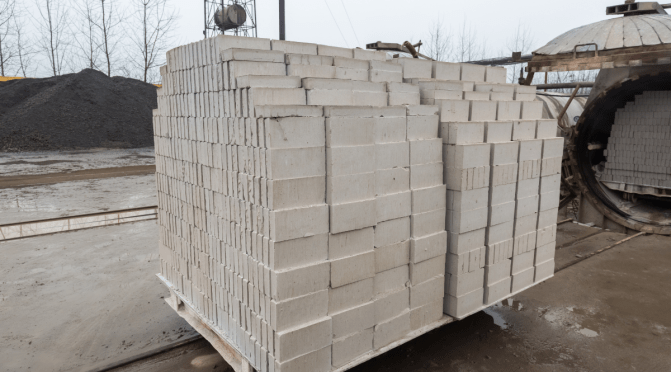
The final process of manufacturing is autoclaving. The wire cut blocks are transported to an autoclaved chamber where is heated to the required temperature. This process gives the desired durability and structural stability to AAC blocks. The baking is done for about 8-12 hours at a temperature of around 180 degrees. The temperature and period of heating determine the grade of the materials. Curing in an autoclave reduces drying shrinkage.The autoclave curing process requires more energy and a more expensive kiln, but it can produce blocks in less time.
The blocks are stacked on pellets on completion of autoclaving process for transporting to the required destinations. All quality tests are conducted in the factory itself.













 vin civilworld